A Daily History of Holes, Dots, Lines, Science, History, Math, Physics, Art, the Unintentional Absurd, Architecture, Maps, Data Visualization, Blank and Missing Things, and so on. |1.6 million words, 7500 images, 4.9 million hits| Press & appearances in The Times, Le Figaro, Mensa, The Economist, The Guardian, Discovery News, Slate, Le Monde, Sci American Blogs, Le Pont, and many other places… 5000+ total posts since 2008.

Category: Blank and Empty Things; A History of

  • History of Blank, Missing and Empty Things, Part 66: The Response to Hope

    JF Ptak Science Books  Post 2045  Part of the series, a History of Blank, Empty and Missing Things

     
    Follow Me on Pinterest

    Outsider Hauck DETAIL

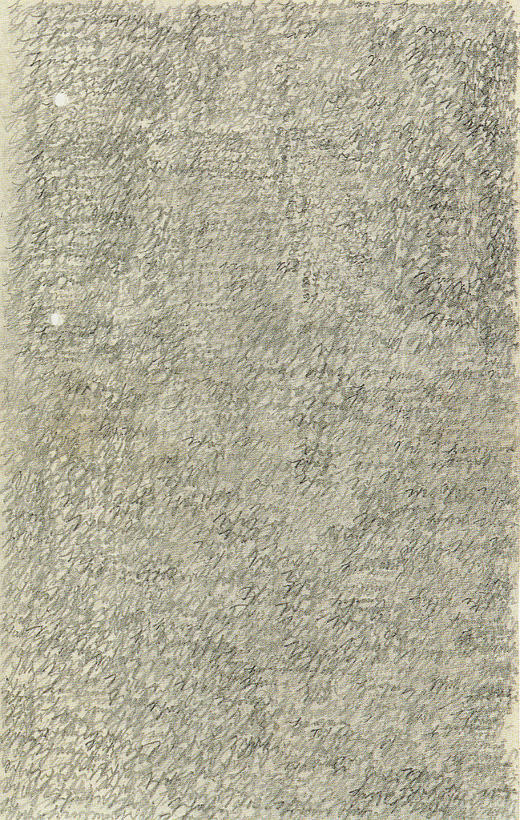
    This is a detail from an image of great hope lost.  Here’s the full picture, one of many, one of hundreds similar to it:

    Outsider HauckThis
    is a letter from a woman named Emma Hauck (1878-1920), a “pateint”, a committed
    person, in an asylum for the “fatally” insane; a schizophrenic, an
    incurable who simply wanted to go home. She was not insane enough to not 
    know where she was, not insane enough to not want to get out, not insane
    enough to know that she was in desperate straights, not insane enough
    to try to get some help.  Emma Hauck wrote letters to her husband,
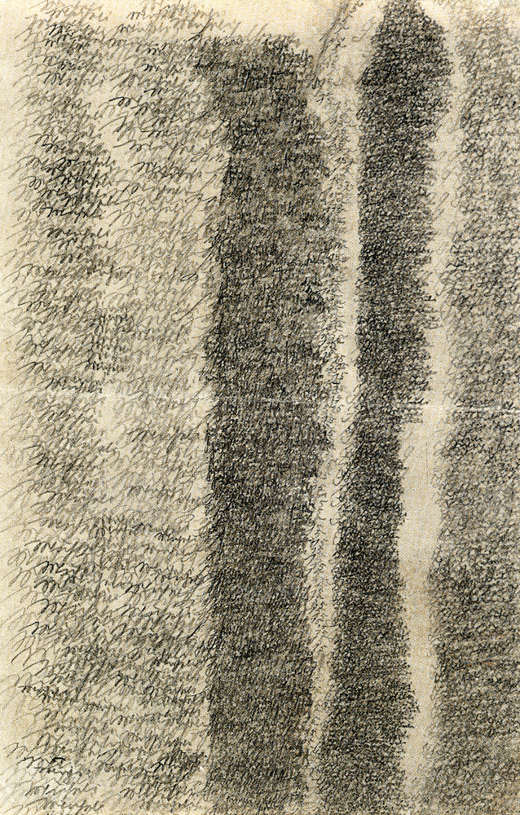
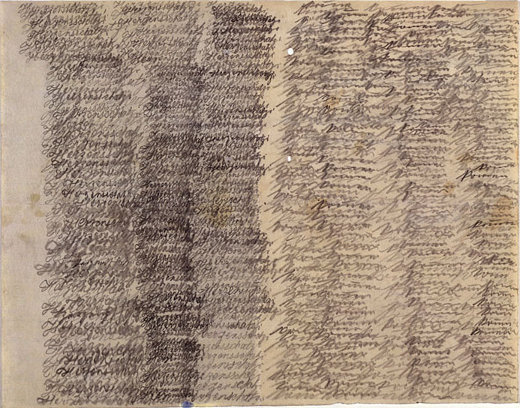
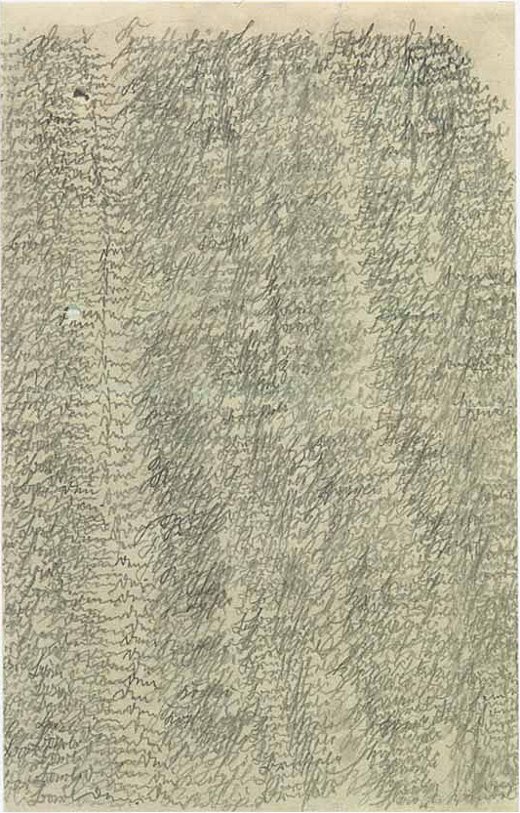
    Michael (father of her two children) after her second and last commitment, beginning in 1909.  Mostly the letters were composed of single words (like “kommen,
    kommen”, “come/come”) or simple phrases (“Herzensschatzi komm” or “sweetheart/come”)
    written concisely and tightly, over and over again, layers of
    kommen/kommen, so many that there is a geology of letters, though there
    is no geologist.

    Outsider hauck 2
    The images appear in the book and collection of psychiatrist and art historian Hans Prinzhorn (1886-1933), in his Bildnerei der Geisteskranken: ein Beitrag zur Psychologie und Psychopathologie der Gestaltung1,
    which was published in Berlin in 1922.  Prinzhorn was among the first
    in his profession to study the art of the insane, and to use it in
    diagnosis.  In the meantime, over dozens of years, he accummulated a
    collection of thousands of works of art (many coming when he was an
    assistant to Karl Wilmanns at the psychiatric hospital of the University of Heidelberg), most of which are housed today in the Sammlung Prnzhorn (UniversitätsKlinikum Heidelberg, here).

    Emma Hauck’s letters were never sent. I think it is unclear whether they were not sent because the institution in which she was confined did not mail them, or if she simply did not actually try to send them.

    A very distrubing short experimental film was made by the Brothers Quay in the U.K. featuring Hauk’s letters (complicated and viscerakized by a very grating Stockhausen soundtrack), which is located here.

    Notes:

    1.  The English translation of this work:  Hans Prinzhorn, Artistry of the mentally ill: a contribution to the psychology and psychopathology of configuration,
    translated by Eric von Brockdorff from the second German edition, with
    an introduction by James L. Foy, (Wien, New York: Springer-Verlag),
    1995. 

    Outsider hauck 3

    Outsider hauck 4


  • Eugenics, War, and Stupid Stuff

    JF Ptak Science Books  Quick Post

    This paper, “The Eugenic and Social Influence of the War” by Prof. J.A. Lindsay, published in The Eugenics Review in October 1918, ends with the words that I will begin this post with:

    “There is some soul of goodness in things evil,

    Would men observingly distil it out”

    It is a paper that seems a logical extension of something from somewhere, and some of the points are common sensical–but the it is published in this eugenics thing, which pretty much dooms it to eugenics and itself. The qualities of some of his opinions are sometimes of lofty incredulity:

    “The loss of life in war is  a question not only of quantity, but of quality.”

    “War, for obvious reasons, tends to depress the birth rate.”

    “A remarkable and unexpected result of the war has been a decided decline in the rate of suicide.”

    “A very unexpected feature of war-time has been the decline of insanity.”

    “Perhaps the most fundamental gain from the war will be interest in education, and the larger measure of attention devoted to it.”

    Somehow here at the end of a war in which since 100 million people were killed or wounded Prof Lindsay seems to have written a piece on that great conflict without being somewhat cognizant of the human value of such loss.

    And that, as they say, is that.

    Full text is located here, at the U.S. National Library of Medicine.

    G.K. Chesterton,. Eugenics and Other Evils, here.


  • Negative Space Images: the Dark Imaging of an Absent Halo?

    JF Ptak Science Books   Post 2033  

    Follow Me on Pinterest


    Part of a series on the History of Blank, Empty and Missing Things
    Negative space di Credi[Image source: Metropolitan Museum of Art.]

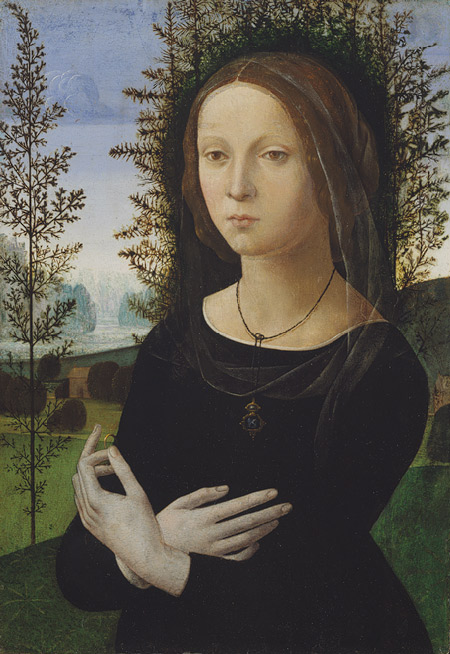
    The idea of negative imaging–of forming an image “backwards”, or by using a surrounding space to define the image’s properties–came into play for me while looking at this beautiful portrait in the collection of the Metropolitan Museum of Art in NYC.  Lorenzo di Credi (Florentine, ca. 1456-1536) painted Portrait of a Woman (an oil on panel) in the last decade of the 15th century, a beautiful work presenting the portrait of a woman who was possibly in mourning, modestly dressed in very dark clothing and holding a ring.  What strikes me is the “dark halo” around her head, a black space outlining her head and neck and shoulders, giving all of those features a further powerful light by the very wide border between them and the juniper in the background.  I imagine that this technique was used to establish a deep luminosity, but for me it also creates the presence of a halo by painting its absence–this is admittedly tenuous, but that is the way it seems, to me. 

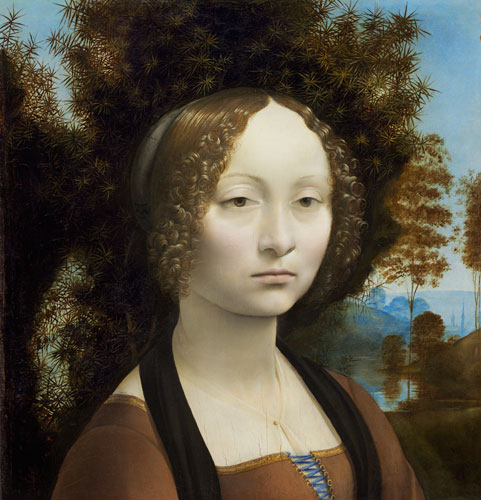
    It also reminds me in a way of Leonardo da Vinci’s  Ginevra de’ Benci, (c. 1474/1478, oil on panel), though there is much more detail in Leonardo’s non-halo. 


    Negative leonardo

    [Image source: National Gallery of Art, Washington D.C.]

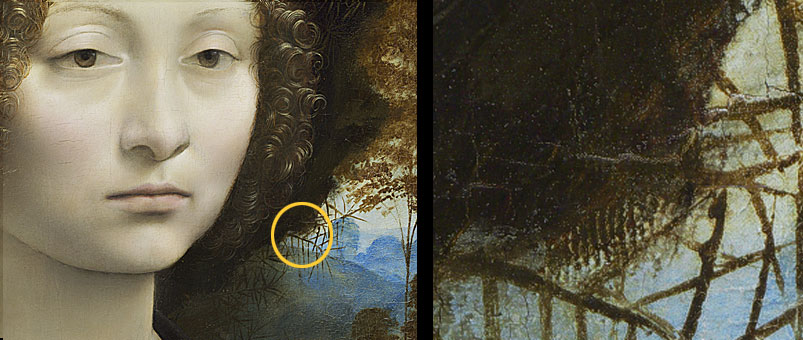
    Even
    though there does not seem to be a “halo” in the Leonardo, there does
    seem to be a fingerprint where the non-halo isn’t–evidently Leonardo
    did not limit himself to just the brush in his painting technique, but
    used his fingers as well.

    Negative space leonardo fingerprint


  • Helping Hitler, 1938

    JF Ptak Science Books  Post 2024

    There are many unhappy episodes during WWII of small groups from the Allied countries which gave comfort and solace and economic and physical support to the Nazis.  The economic aspect gets very complex and pretty deep here in the U.S., with major companies lending assistance even in violation of the Trading with the Enemies Act into 1943, and of course there was the German-American Bund which was relatively full-throated until America got into the war on 8 December 1941, and so on.  There were also occupation Nazi-fueled governments like Vichy, but what I’m interested in for this post are the volunteers who materially contributed to the Nazi war effort, with time, and effort and fighting in uniform. The hard figures for the volunteers and conscripts who fought wth the Waffen-SS during the war totaled some 350,000 men1.–and considering what was happening to the German army post-Barbarossa, that was not an insignificant figure.

     
    British Legion283

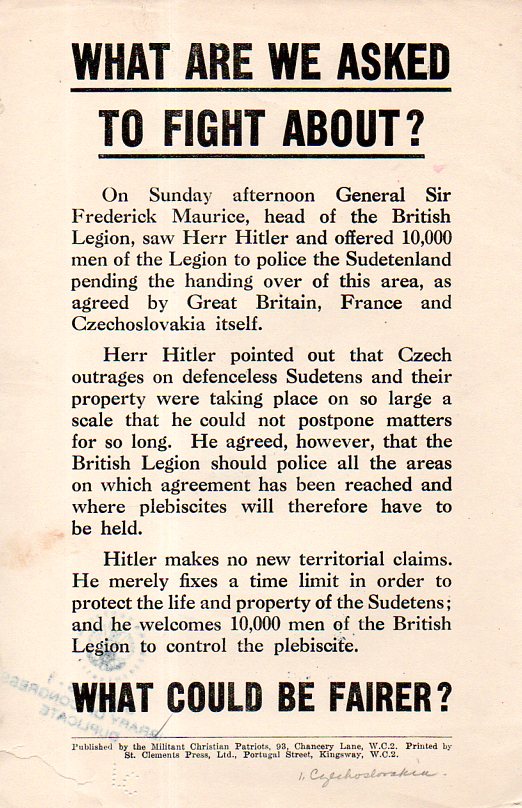
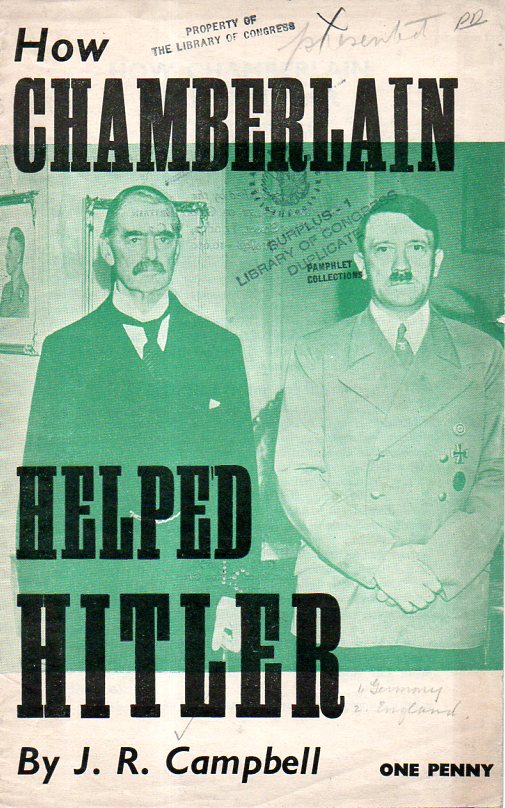
     General Sir Frederick Maurice (1871-1951) , one of the subjects of the leaflet,  had a very long and sine-curve military career, and was an academic of some achievement–he was also along in there was head and founder of the British Legion.  And it was in this capacity and under his auspices that the British Legion offered 10,000 men to help Adolf Hitler and secure a modest success in the transition of control of that country.

    What an enormously disappointing handbill this was to read, coming from the press of a militant right-wing and racist organization in support of Hitler and the Nazis in their swallowing-alive of a living Czechoslovakia. The Militant Christian Patriots2 were the publishers of this handbill–this was a group were formed as part of an earlier organization called The Britons (founded in 1919), both of which were viciously anti-Semitic and severely racist, and were on board with most of the programs of the NSDAP.  (The publishing arm of the Britons, the Britons Publishing Company, for example published 85 editions of the vicious and ridiculous Protocols of the Elders of Zion.) They supported Neville Chamberlain and were happy to keep the U.K. out of any confrontation with Germany.   As we see in this handout, they were eager and able to support Hitler’s invasion and destruction of Czechoslovakia by providing a British volunteer force of more than 1,000 to aid in the Nazi take-over by policing the supposedly audacious and Seudeten-German pillaging Czechs. 

    The story of the Nazis in Czechoslovakia is a complex story, riddled with nothing by treachery-lust on the part of the Nazis, and of course ending very badly for the Czechs, the Germans living out a series of aspects of the Big Lie until it was all over.  The British Legion chose to believe what they needed to believe in order to sustain their own nationalist beliefs. 

    There were many who found Chamberlain simply wrong in his negotiation with Hitler and where he was guiding the country, not the least of whom was the Communist Party via J.R. Campbell, who expressed a general outrage in this pamphlet (published October 10, 1938), the cover telling the story: 

    Chamberlain284

    Notes:

    1. These included volunteers and conscripts from Albania, 9000; Armenia, 2000; Belgium, 27,000; British Commonwealth,  never more than 100 in the British Free Corps; Bulgaria, 700;  Croatia, 20,000; Denmark: 8,000; Finland, 1,500; France, 9,000; Georgia, 2,000 to 3,000; Hungary: 40,000; India, 3,500; Italy, 15,000; Latvia: 60,000; Netherlands: 25,000; North Caucasus, 1,000 to 2,000; Norway, 6,000; Russian (& Belarusian): 15,000, Russian (Cossack) 20,000, Russian (Turcic),10,000; Romania, 6,000; Serbia, 8,000; Spain: 3,000 in Spanische-Freiwilligen-Kompanie der SS 101 and SS 102; Sweden, 300-500; Switzerland, 800; Ukraine: 20,000.

    2. There’s another example of this publisher described in this blog, here:   https://historyofideasblog.com/thesciencebookstore/2011/01/blank-empty-things-series-the-militant-christian-patriots-hitler-and-saving-britain-from-itself-1938.html


  • TV’s Quest for Illuminated Poetry and a Dirac Non-Equation, 1946

    JF Ptak Science Books    Post 2024

    ‘I don’t see how you can work on physics and write poetry at the same time. In science, you want to say something nobody knew before, in words everyone can understand. In poetry, you are bound to say something that everybody knows already, in words that nobody can understand.’–Paul Dirac (1902-1984, Nobel Prize in Physics for 1933 with Erwin Schrödinger, “for the discovery of new productive forms of atomic theory”), quoted in The Book of Universes by John Barrow.

    Television abomb278

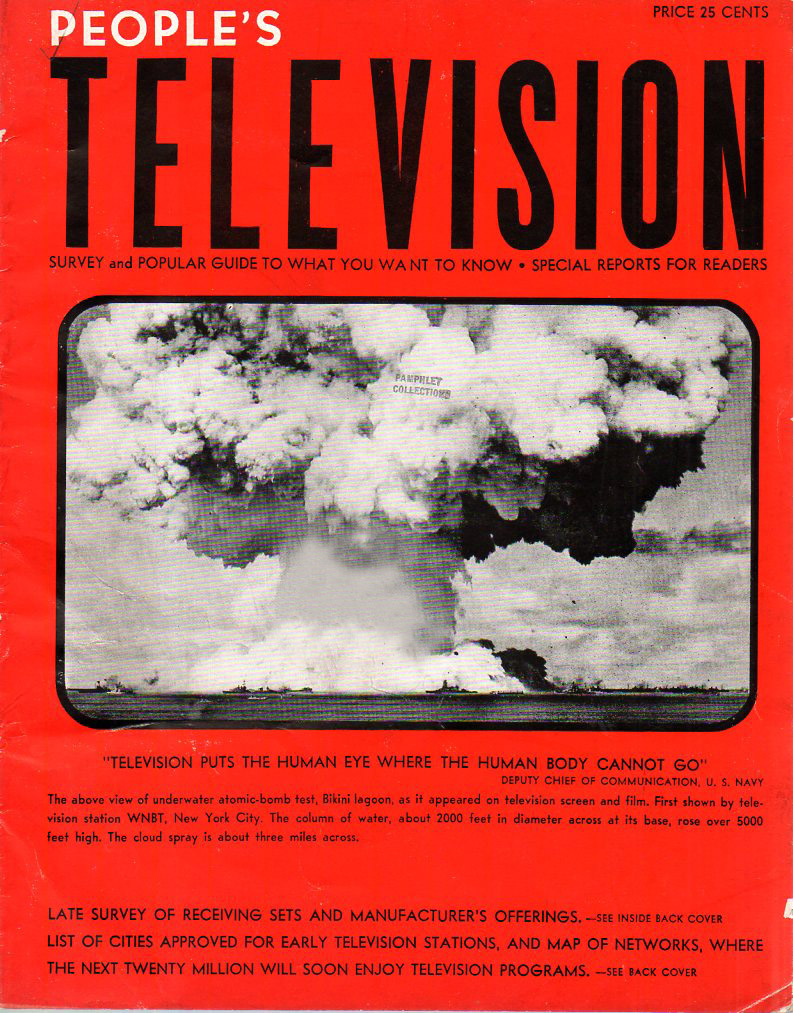
    The opening sentence of this pamphlet breathes a lead: “The story of Television, as well as the smashing of the atom, must be explained in a non-technical manner, now that World War II has ended, so that the public may know the facts…”

    I think that I would have preferred this quote to end a little sooner than it does–that way it might have been a little more poetical, a little on the absurd side:

    the story of Television as well

    asd smashing the atom

    must be explained

    in a non-technical manner,

    now that World War II has ended.

    This short pamphlet was produced in 1946, and at the time it was still possible to believe in the great possible poetry that the new medium could produce.  And it certainly did produce something, even in these early days, though I do not think it was poetry.  It did deliver some measure of truth and accountability, though.  It is difficult to imagine seeing the image of one of the earliest post-war atomic tests delivered to the DuMont Teleset in your living room.  I imagine that the societal reaction to seeing these events broadcast may have been like when photography was brought to bear in the news reporting business.  Harper’s Weekly started to run woodcuts of Civil War battles with the imprimatur “from a photograph” rather than something like “drawn at the scene by our correspondent”, readers were immeasurably more responsive to the drawing after a photography because of the undeniable archivitization that goes on when a photograph is made, as the memory of a photograph is for the most part unimpeachable.  This delivered an instantaneous increase in the belief in the reporting.

    It seems as though seeing events such as an atomic explosion from a cozy home encapsulation may have had the same effect. It was a democratization of truth in a way (the title being People’s Television) similar to that which you could experience seeing newsreels in the movie houses–there, everyone paid the same fee, sat where they wanted (for white people, anyway), and were exposed to the same images at the same time. 

    Its character leaned and leaped further away from reality and truth with each passing moment, finally reaching a point in the early part of national broadcasting where reality and entertainment and commercials all blended into one socio-molding opinion-grinding unit.

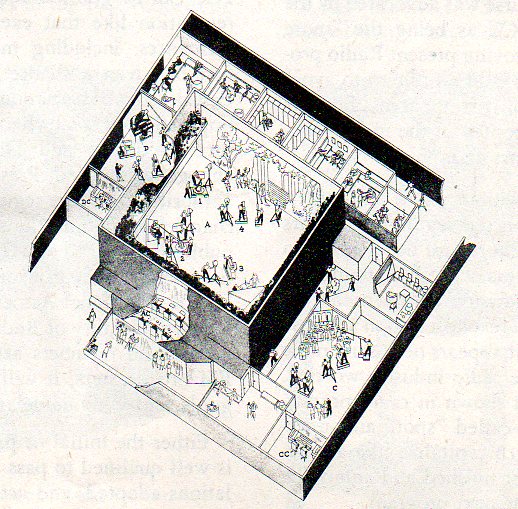
    The dreammaking units responsible for creating the bigness of artificial life were quite modest in 1946, as we can see in the pamphlet’s  wonderful plan of a television studio:


    Television abomb279

    With the description:

    Television abomb280

    The next seven years would toss this pamphlet into the Obsoleteinator; 13 years more would make it seem as though this pamphlet never needed to exist.  The poetry part certainly seems to have disappeared somewhere in these years–not completely and entirely to make poetry in television extinct, but certainly enough to make it an endangered sub-species. 

    ‘Imaginary universes are so much more beautiful than the stupidly constructed ‘real’ one’–G.H. Hardy


  • Visionary Map: the Earth Without Water, 1694

    JF Ptak Science Books   Post 2020  Follow Me on Pinterest

    Part of the series on the History of Blank, Empty and Missing Things

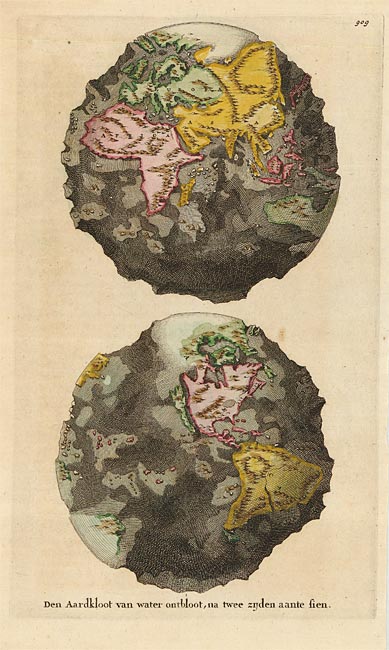
    I stumbled upon this fantastic leap into science affliction, an attempt to display the absolutely enormous idea of draining the Earth of all water revealing its ultimately rocky structure.  And this in the relatively young modern cartographic days of 1694. 

    Map world without water
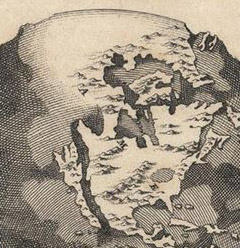
    This map (“Den Aardkloot van water ontbloot, na twee zijden aante sien”, published in Amsterdam in 1694 by Wilhelm and Jan Goeree in a Dutch edition of the expansive and imaginatively suggestive cosmo-theo-geographical work, Telluris Thoeoria Sacra) reveals the half-believed idea of California being an island was we can clearly see the enormous canyon separating it from the North American mainland. On the other hand, the “opposite” (in a way) belief takes place in the north, showing a large and towering land mass at the North Pole.

    Map world no water detail N Amer_edited-1

    All-in-all, given the state of geographical knowledge for the unseen stuff of the Earth, this was an excellent attempt to reveal the structure of the globe.  Sure, the depths of the oceans are a little off, the idea and the attempt to depict it was an extraordinarily interesting display for the time, especially with limited hard data.  This is even a more-remarkable series of observations considering the theoretical framework in which all of this was taking place. 

    Burnet (1635-1715) poured out his pounding heart into the pages of his sacred history, teaching people about the structure and history of the  Earth with generally little or unsuccessful regard to science–but no matter.  (Burnet did try to figure out where all of the water came for the flood, which is  a great question.  It is impossible for it to come from a natural rain of any sort, and Burnet probably came to the conclusion this the answer for the flood couldn’t come from the surface of the Earth.  So to keep things in compliance with his faith, Burnet established that the water necessary for the flood came not from the surface of the sphere, but below it, in the hollow Earth which was actually filled with water.) This was a work of structured faith and a belief  system, and wasn’t seen as much more than that except to the initiated. But a resulting map of the structure of a waterless Earth seems to me a more powerful piece of imaging than an Earth simply covered by water. 

    [Black and white image source  Barry Lawrence Ruderman Rare Maps, here.; color version from Oldmaps.com, here]


  • Ice Hooves and Blank People, 1555

    JF Ptak Science Books  Quick Post   Blank, Empty and Missing Things series

    Follow Me on Pinterest


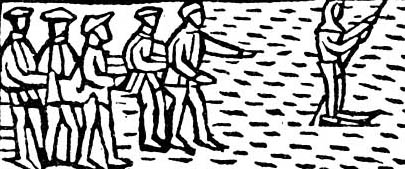
    Magnus--ice hooves and blank peopledetail blank
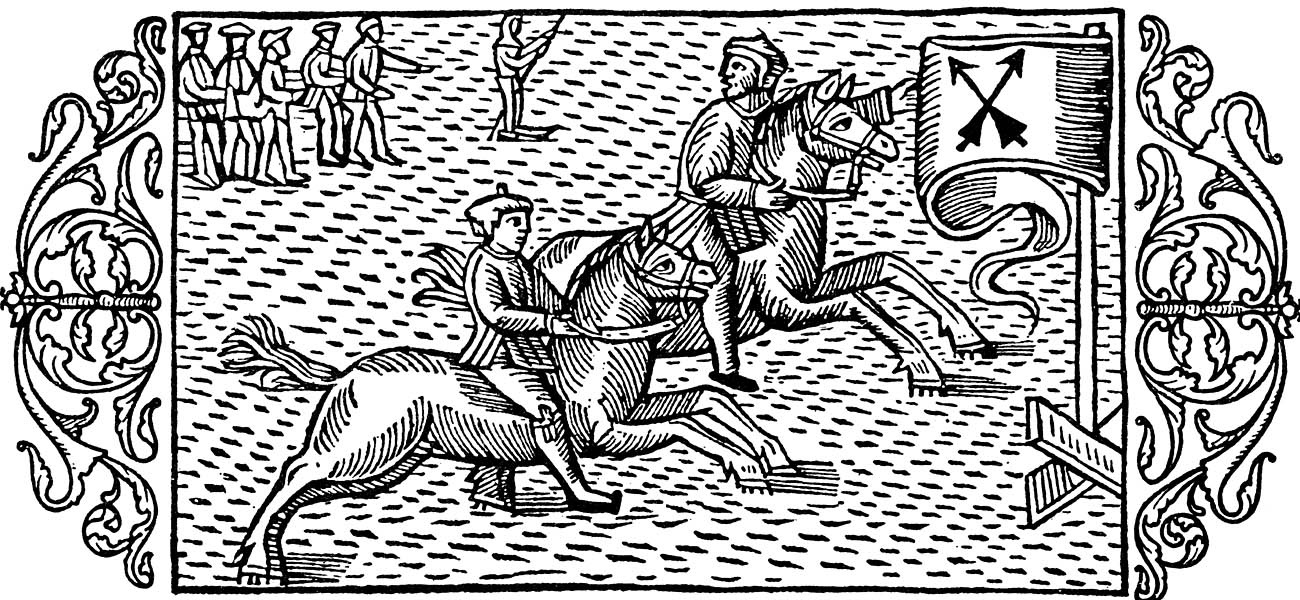
    This image may be unusual to the modern eye but not so for Nordic vision in the mid-16th century.  The appeal comes in the detail, which at least in a crafty title description seems a little odd, even though I have no doubt that it was all very sensible to the people of the time.

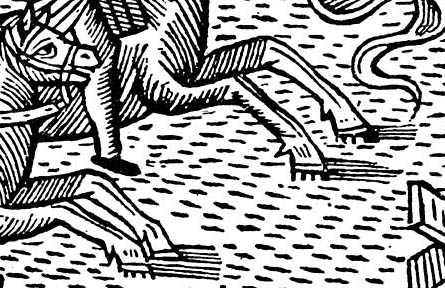
    The scene is from Olaus Magnus (Swedish historian and geographer, born. at Skeninge, Sweden, 1490; and died at Rome, 1558) who wrote the legendary and Renaissance-high-point Historia delle genti et della natura delle cose setentrionale1… in 1555.   Among many dozens of generally fabulous images we find this horse race on ice–naturally, in order for this to happen, the horses need to be specially outfitted with crampons, which is a good thing to do if you absolutely have to take your horse out on an iced-over river.  Still, it just seems entirely anithetical to riding a horse.

    Magnus--ice hooves and blank people detail hooves

    Magnus--ice hooves and blank people
    The first image is one in a developing series on this blog concentrating on blank and empty things–in this case, the detail of faces in the small crowd in the background is the issue.  It is interesting to note that the group holds on to one another to form a line for stability while moving across the ice without any special footgear–the leader however is more prepared, and pushes along the ice with a staff while wearing bone skates. 

    Notes

    1.  The full and rather lengthy title of Historia de gentibus septentrionalibus… is translated as  “Olaus Magnus Gothus’, the Upsala Archbishops’, history of the nordic people’s different manners and camps, also about the wonderful differences in customs, holy practices, superstitions, bodily exercises, government and food keeping; further on war, buildings and wonderful aids; further on metals and different kinds of animals, that live in these neighbourhoods “.


  • Breaking Bad in Half: a Book to Exhaust and Maim the Reader

    JF Ptak Science Books

    “Sometimes a book is just entirely bad, and sometimes it is entirely nothing. It is impossible for a book to be both very bad and very nothing. Impossible.  Except for this book, whose badness is exceeded only by its nothingness, and vice versa“. –Oscar Wilde

    And so into this black hole of imaged Wildeian description we go, into a very real-ish book.

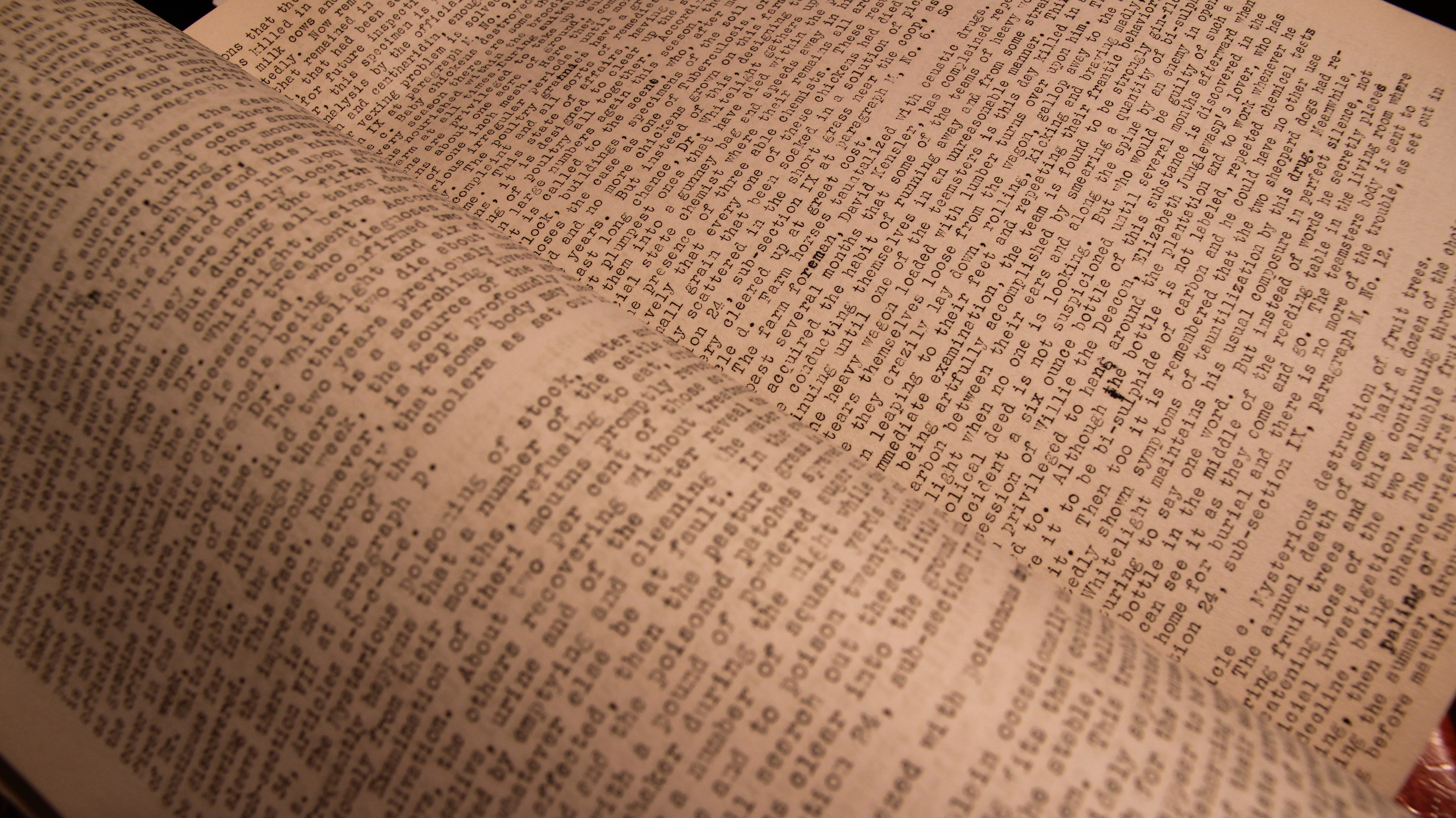
    I found a novel tonight, bought long ago and long ago mostly lost.  It was written by a doctor who worked in the District Hospital in Lima, Ohio, and written in 1934.  The Lima Hospital was the largest poured concrete structure in the world when it was built in 1915, and stayed so until the Pentagon was completed.  The hospital was established for the criminally insane, had 14″-thick walls, and reinforced steel bars laid into the walls that went “right down to bedrock”. 

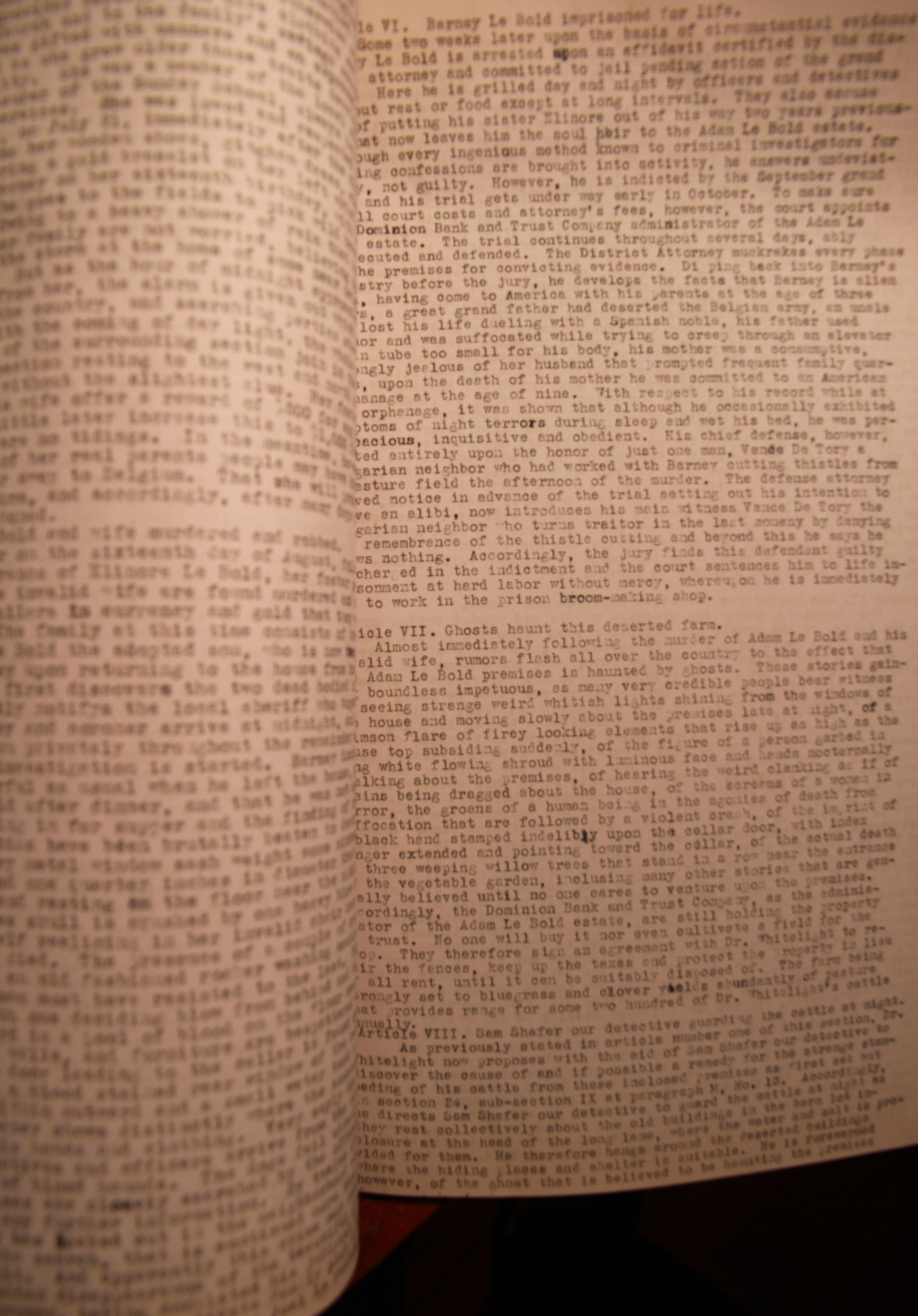
    It was somewhere in there that this doctor wrote something that was really so toweringly bad that it escapes comprehension. I own the carbon copy of the unpublished work, which is typed on 14×8.5″ sheets of paper, front and back, running 94 pages. It is a very crowded affair, with 90 lines of single-space typed lines, making the work about 115,000 words long. 

    There wasn’t enough space evidently for paragraphs, which gives the work a kind of insistent, casket-cramped cruelty.  To read it takes your breath away for its dullness–the book moves so weirdly and at the same time so very slowly that it doesn’t move at all even while moving.

    Manuscript insane one

    A few months ago I found the seven-foot-long scroll of the book’s plan–a work of crowded magnificence of nothing and confusion, being very orderly at the same time.  It went to a friend of mine who created artwork around it, and as it happens made a very noticeable appearance in a very significant yearly show in NYC last week. I was stunned to find that there was actually a text to go with the scroll-outline–it emerged from the warehouse this week, so perhaps this too will find a very celebrated life as art as well. Certainly the book would go nowhere on its own as a book, though it stood a chance at surviving on the grounds of its considerble design weirdness, which is of a complexified beauty.

    Manuscript insane two

    In the meantime, before all of the letters slide themselves off the page from sheer boredom and before the thing is resurrected as a magnificent artistic effort, I’ll share some ianges of the extra-ordinary book of reversed brilliant badness. I’ve also culled a few imaginary descriptions of the book from writers known and not:

    Potboiler scribbler:

    “He couldn’t speak.  He could barely see. Blinded by the flames ignited inside his eyeballs from the novel in his lap.  The words were like molten lead, sucked off the page by his eyes, forming a vacuum in his brain.  It was a bad book”.

    The first-time published novelist’s approach:

    “He couldn’t speak the words of the thoughts in his head, because they and all of his breath were stolen by the magic of the complete badness of the book in his lap”.

    Gertrude Stein:

    “The book was bad and bad, and bad was the book. Even the badness of the bad was bad, a whole new insight into being bad. It was the bad book by which bad books are called bad”.

    Ernset Hemingway:

    “He didn’t read the book so much as he looked through it.  It was easy–there was nothing there. As bad as it was, it could get no worse. So he shot it, and poured a drink”.

     You might wonder what this book is about.  Me too.


  • Pale Horse and the Lake of Fire: a Map of End Times

    JF Ptak Science Books

    Blog--jun 13 end of the world


    There are, in my experience, very few antiquarian images
    depicting the end of the world in which we see the entire globe exploding or in
    pieces or in flames. This sort of image gets more play in the 20th
    century, especially after 8 August 1945, but prior to that it is really very
    scarce.  I own a few images that appear
    in the 17th and 19th centuries, and another from 1929 (Das Weltbild which show a “giant ice
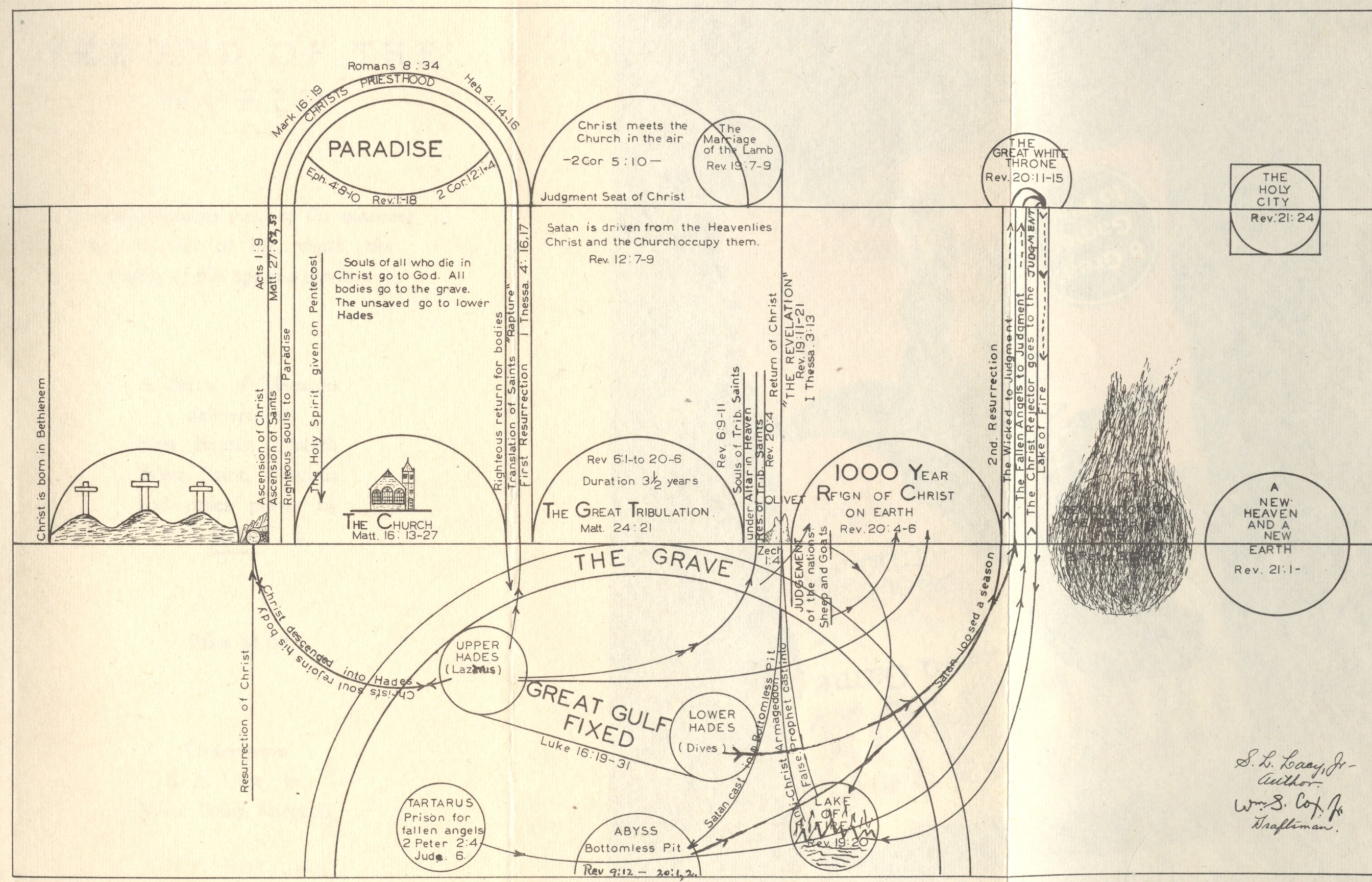
    ball” colliding into and completely destroying the earth). .  Then there is this new find, S.L. Lacy’s The End of the World, (necessarily) self-published
    in West Point, Virginia, in 1941.  It is a short and stocky, and bound in orange
    wrappers—its spine title (The End of the
    World
    ) begs the casual reader to pull it from the shelf. It’s a simple
    book—studying the Bible prophecies and revelations on the end of all things—and
    it annoys and is insulting but doesn’t disappoint.

     I started to breeze through the book (back-to-front as always) and opened the
    book to Chapter XIII, finding this delicious chapter heading:  “The Chronological Order of Final Things”,
    this being a full page pre-PowerPoint summation of the time-shrinking fireball
    that is rolling inexorably towards us all. 
    To say that one is able to put a period at the end of the world’s flow
    of time, that someone is able to identify the point in the future where the
    future is no more, is “presumptive”–this in the most understated
    fashion as to offend even the highest of high-Victorians’ sense of restrained
    propriety.  Wrapped in a comfortable
    Christian chrysalis of pre- and post-apocalyptic religious certitude, Mr. Lacy
    delivers his interpretation of biblical prophecy for the coming of the end,
    hustling it to the front of the religious line of things to come.

    It seems that in 1941 the end was beginning, and Lacy saw
    all of the images implied by prophecy that were necessary to announce the
    glorious final days of broad retribution. This includes the list if the ten
    things indicating “the sign of The Times”, one of which (Number 5)
    was “The Automobile” and another (Number 7) was “Increased
    Knowledge and Travel” (announced by Nathum 2: 3,4 and old dependable
    Daniel. 12:4, respectively.  There’s
    nothing that doesn’t fit into Daniel’s visions or revelations, though Mr. Cash
    has certainly made a lovely song of them.) 
    When everything fits perfectly into a predictive model with no possibility
    of falsification (or of proof or disproof), then the model has no validity
    outside of a belief system in itself. Very tidy.

    Blog--jun 13 end of the world det

    It is an annoying, cloying minor treatise, promising little
    more than The Lake of Fire awaiting almost all of us, even the sleeping dead,
    who would be scraped from their graves to be spit into this burning
    tragedy. 

    Lacy does a lot of inspired interpretation and
    philosophizing, much of which he doesn’t seem to bother separating from
    biblical quotations—I don’t think it is intentional, just bad writing.  A random
    find in Lacy’s thinking dislodges the following  nugget:

    “Satan is in the atmosphere above the earth, with access to
    heaven and earth with a circumscribed power over the atmospheric elements and
    the earth including the inhabitants”. 

     Oh dear.

    But enough of this nonsense. What brought me to this work is
    the folding schematic map at the front of the book.  It is a slightly complex jumble of
    semi-circles and circular reasoning, and I have no interest in straightening
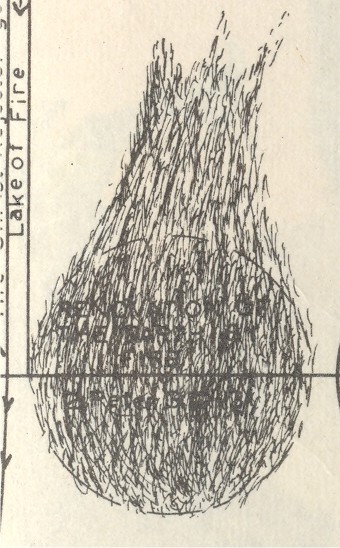
    out this jumbled linguine. What has my interest is the dissolving Earth part of
    the diagram, a part of the dead earth that comes between Calvary 
    and Heaven-on-Earth.  What makes this
    image different from the others though is that the Earth reappears—different from
    its former self having been vanquished and cleansed by all consuming fire, but
    the Earth nevertheless.  Or something
    like it.  Or nothing like it. 


  • Labor, Monotony and Obedience: the Prison Tread Wheel, 1824

    JF Ptak Science Books   Post 1961  

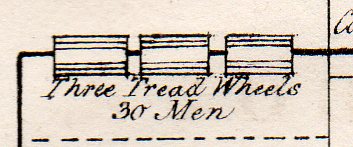
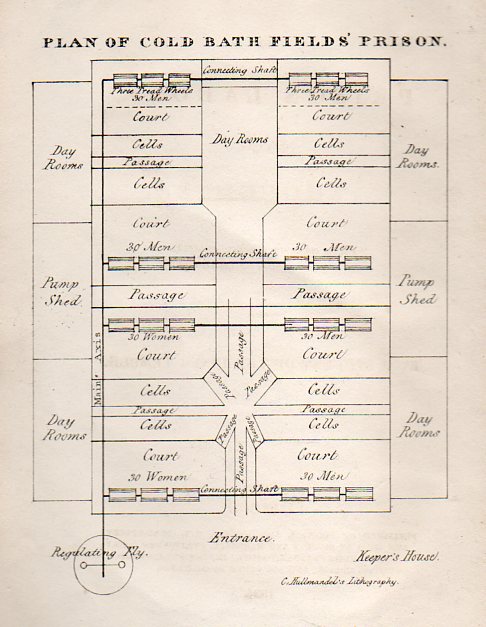
    Looking through some of the books here at home today I found Thoughts on Prison Labor, etc etc…by a Student of the Inner Temple1, a book on prison and punishment, published anonymously in London in 1824. What struck me right away was the plan of the Cold Bath Fields Prison, and the unusual dark line that ran along the left side of the image, connecting a “regulating fly” to this:

    Treadwheel999

    “tread wheels” are just what they sound like.  They were  used as a means of punishment and control, keeping the prison population busy and occupied.  In general, the tread wheel was used in many prisons, and even though there were hundreds of people working on them int he course of a day employing thousands and thousands of steps to move the giant wheels, the large devices were connected to nothing. I guess they could have been connected to a grinder or something that would transmit the generated power into some purpose, but–at least in this case–the only thing the wheel was connected to was a fly wheel, which I assume helped govern the amount of force necessary to produce motion in the tread wheel. 

    Cold Field Baths was a prison of long standing and had been functioning for about 200 years at the time of publication of the book. For the most part the prison held low-level criminals, mostly with sentences of two years and under.  People–men, women and children–served time there for vagrancy, some felonies, misdemeanors and unresolved debt (which is where most of the children come into the picture, as the debtor often found himself imprisoned with his family). 

    Each of the ganged three wheels would accommodate 30 people. There were six units of three tread wheels at work, meaning that there could be 360 people working the wheels at any given time.  That’s a lot of energy produced in the pursuit of obedience.  And punishment.

    This is the detail from the frontispiece map, in full below:

    Treadwheel998

    • (There were additions to the prison performed in 1850, which greatly expanded the place.  The original prison though is still visible in the plans. See Note 2.) 

    Here’s a view of what those treadmills looked like, giving a prisoners’-eye view of the proceedings, this coming from 1864:

    File:Coldbath-fields-treadmill-mayhew-p306.jpgEvidently people would work on the tread wheel for periods of 10-15 minutes, which would explain the lines of men walking to their turns, above.  Standing and slow walking was the cool-down exercise.