A Daily History of Holes, Dots, Lines, Science, History, Math, Physics, Art, the Unintentional Absurd, Architecture, Maps, Data Visualization, Blank and Missing Things, and so on. |1.6 million words, 7500 images, 4.9 million hits| Press & appearances in The Times, Le Figaro, Mensa, The Economist, The Guardian, Discovery News, Slate, Le Monde, Sci American Blogs, Le Pont, and many other places… 5000+ total posts since 2008.

Category: Blank and Empty Things; A History of

  • The 15 Billion Year Old Monkey and “Gasoline Alley”

    JF Ptak Science Books  Post 2118   Part of the series A History of Blank, Empty and Missing Things  Follow Me on Pinterest

    Concevons qu’on ait dressé un million
    de singes à frapper au hasard sur les touches d’une machine à écrire …
    [translation: Let us imagine a million monkeys typing haphazardly on
    typewriters …”
    1


    Gasoline alley723[
    Gasoline Alley, 1931]

    There are some ideas that leave me with a powerful sense of nothing.

    To me, “nothing” can be very important–especially in writing and speaking and action, doing or saying nothing has been the important and the correct thing to do.  “Nothing” isn’t necessarily an ending, and, just a period or a coma, can just be a placeholder for something that is developing.  There can be long nothings and short one, forever- and micro-nothings, and nothing that is nothing for almost nothing.  Nothing can be implied, insinuated, broadcast and defined, though self-defined extended nothingnesses (like John Cage’s 4’33”) is a tricky thing to make happen with success. 

    The ideas that leave me with a sense of nothing are interesting things.  And there are a lot of them. When I can remember them they are in my nothing file, waiting for nothing–or something–to happen.

    This is the sense I had when I was trying to explain randomness to my 10-year-old daughter and her 11-year-old cousin, sitting out in a park, looking at stuff.  Somehow I reached into the past and pulled up the infinite monkey theorem, and tried to make that interesting, but just couldn’t do it. Maybe it was the difficulty of super-large numbers, or the fascinating but incomprehensible thought-threats of Borges and his infinite library, but I was left with nothing.

    It is Borges who writes a lovely piece on the history of producing everything from nothing, appearing in his “The Total Library” in 1939 (and then again in “The Library of Babel” in 19412), reviewing machines and such of spectacular randomization that could produce the whole of what we recognize as what we know. 

    Emile Borel wrote on it in 1913, finding the possibility of one million monkeys pounding away at one million typewriters.  In his wonderful work, The Math Book3, Cliff Pickover looks at 250 big ideas in the history of mathematics and gives each of them one page only for presentation and explanation.  He approaches the infinite monkey theorem by looking at one monkey wailing away at one typewriter, striking the keys, and analyzing how long it might take for the one monkey to produce one line from one book.  The line is “In the beginning…” at the beginning of one great nothingness, from the Old Testament, a 56-object sentence (including punctuation and spaces) and, Pickover reasons, that if there is a 93-character keyboard,then this monkey will have a 1/9356 possibility times 10100 of getting it right, and that if it worked for 24 hours a day striking one key every second then it will have used all of the time in the present universe–the Big Bang Monkey.

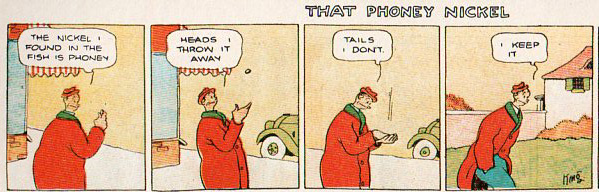
    All I got back were big stares, and a big sense of nothing in my gut.  It reminded me of the cartoon featured above, a toss-off sub-cartoon in a panel of the Gasoline Alley series.  Did he actually look at the coin?  Did he just decide to keep it?  And why keep a phoney nickel? And who counterfeits nickels, even during the Depression?  What is the outcome of the panels–just some guy walking down the street with a nickel in his pocket.  Something may have happened, but it was a lot of nothing. 

    I know that I should have a bigger sense of what Felix Edouard Justin Emile Borel and Jorge Francisco Isidoro Luis Borges were writing about and in many ways I do, but in the end I know that I am left with nothing.  But I have it in my pocket.  

    Notes

    1. Émile Borel (1913). “Mécanique Statistique et Irréversibilité”. Statistical mechanics and irreversibility) J. Phys. 5e série 3: 189–196.

    2.  Jorge Borges,  “La biblioteca total” (The Total Library), Sur No. 59, August 1939. Translated by Eliot Weinberger, in Selected Non-Fictions (Penguin: 1999)

    3.  Clifford Pickover, The Math Book, (2009), Sterling, page 328.
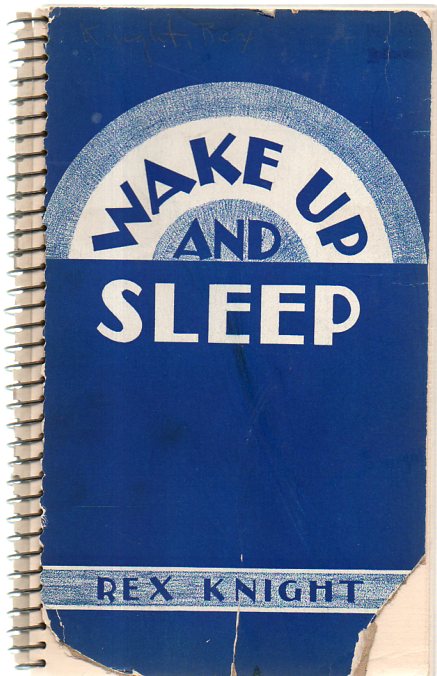

  • Wake Up and Sleep! Riding Ether Waves to Bigger Brains, 1938

    JF Ptak Science Books   Daily Dose from Dr. Odd

    Wake up and sleep679

    Q: What is the one sure thing that is very impressive about this publication by Mr. Rex Knight?

    A:  The 35-ring wire binding on a six-inch tall publication. There’s not much to recommend itself to recommendation and memory. 

    Wake up and sleep681
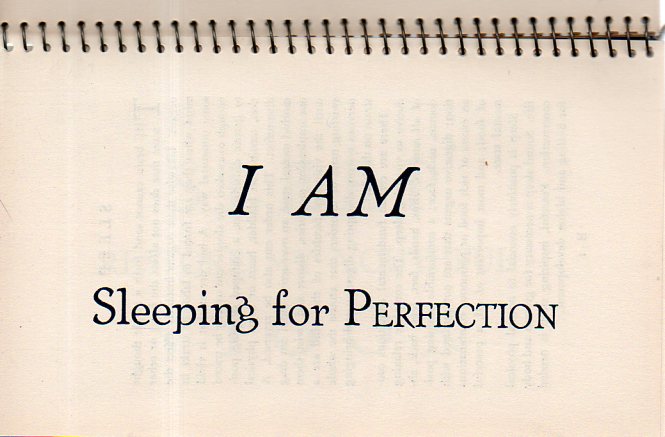
    [Perfection had better hurry up and get here given my own fast-short-sleep habits]

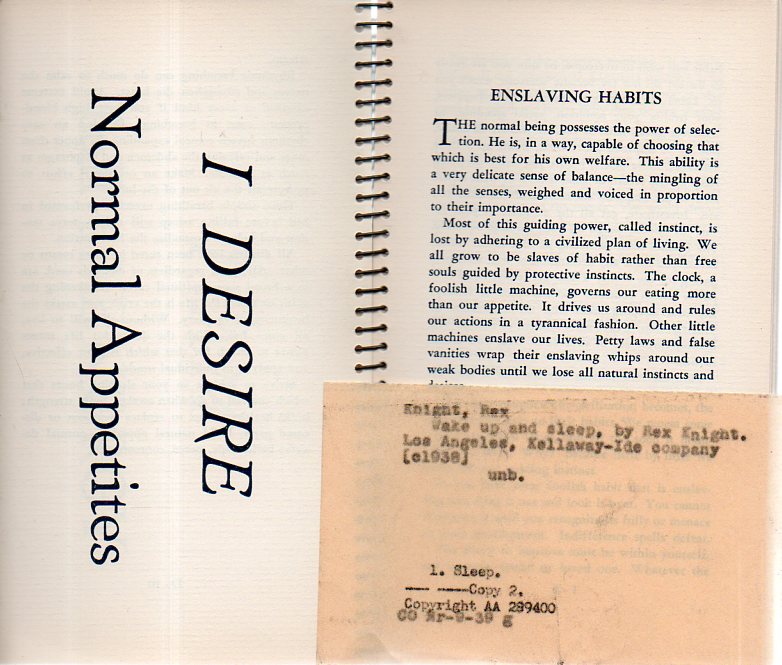
    Mr. Knight had some ideas about sleep and well-being and achieving various states of normalcy and perfection, most of which had to do with waking up during hte night and staring at one of the many full-page neuro-demands which evidently were in direct confrontation with whatever it was in your head that was keeping you from success and strength and wealth and inspiration and self, combating “enslaving habits” and “lesser habits” by telling the brain what to do with the mind.  Or something along those lines.

    Wake up and sleep680
    In any event, Mr. Knight tried something out and used a lot of wire to bind the really rather nice paper his effort was printed on, so Wake Up and Sleep had at least that going for it.  Aside from that, his suggestions seem more disruptive and potentially rheumy-eyed more than anything else, waking you through the night to hand deliver messages to your sleeping and semi-enslaved brain to find its own appropriate “wave” to enrich your life.  “The prize idea that you seek is in the air all around you”, he writes.  “Ether waves, mental waves, cosmic or whatever you choose to call them, are everywhere.  All you are trying to do is to get tuned in on the right wave”. 

    “Expect more and more of sleep” says Mr. Knight–at least that is one remedy that would sound good to almost everyone. 

    It is interesting to note that “Rex Knight” is very close to being “Rx Night”.  And “King of the Night”.

    Lastly, according to WorldCat, there is only one copy located in libraries worldwide–that at NYPL.  My copy was from the copyright office/collection at the Library of Congress when it came to me in a Very Large Grouping (called with little imagination “The Pamphlet Collection”) many years ago.  It never was a hit for the libraries.


  • Finding Normal, USA

    JF Ptak Science Books   Post 2101

    Normal
    As a part of my semi-developing History of Normalcy, I decided to see if I could find a place in this country that was “normal”–and indeed, I found one.  Several–quite a few, actually, Normal and Normals and Normalcies, enough for everyone.

    Here’s one–Normal, Illinois.  (Population, 40,000, 1990), in Normal Township.  There’s also Normal Township, in North Dakota. And one in Alabama.

    And the town of Normal (Kentucky) and Normal (Tennessee), Normal Hill and Normal Landing (Louisiana), Normal Park (Nebraska), Normal Square (Pennsylvania), and Normalville (Pennsylvania).

    Normal may or may not be a desirable thing; if it was a model thing, there is also a place called Model (in Colorado). On the other hand although there are a number of “normals”, there are no places called Average, or Mean, or Natural, or Regular, or Typcial. 

    Outside of the normals, perhaps on the more combative end of normal, there are places identified called Troublesome (Colorado), Truthville (New York, Washington County), and Halfway (Georgia, Lumpkin County); there is no place called hell, though there is a Heaven(er) (Kansas). 

    Oh–and there is a Standard City, Illinois.


  • The Closeness of Mining–Above-Ground

    JF Ptak Science Books   Post 2100

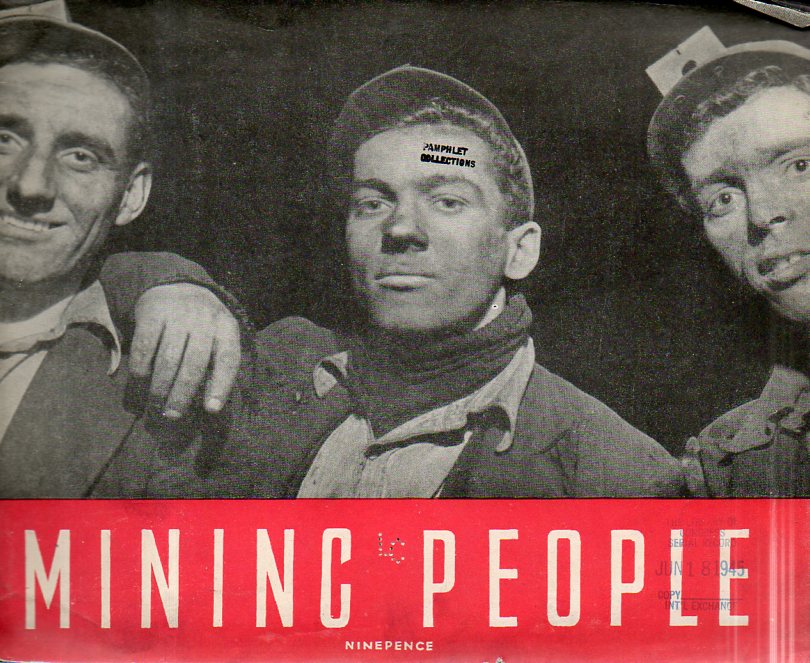
    There is no doubt that Mining672the working life of the miner was and is a very dangerous, incredibly demanding job.  Written descriptions and engraved and photographed and film images all will very quickly and profoundly depict the very demanding physical, psychological and medical demands that are made on the miner.  (Perhaps one of the most demanding accounts of the life of the miner is told by George Orwell in his The Road to Wigan Pier, which I quote from in an earlier post to this blog, here; see also an associated post on Welsh mining boys, also drawing on Mr. Orwell, here.)

    Even in a sympathetic publication like Mining People–published by the Miners’ Welfare Commission in 1945–the idea of crushing proximity and indomitable closeness is present in almost every image, including those that have nothing to do with actually being underground.

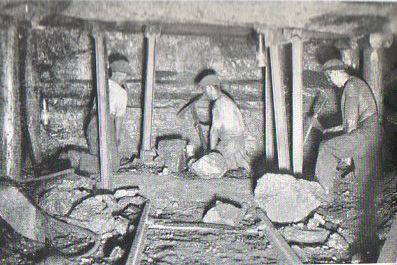
    There are a few images of miners at work, like so:

    Mining673
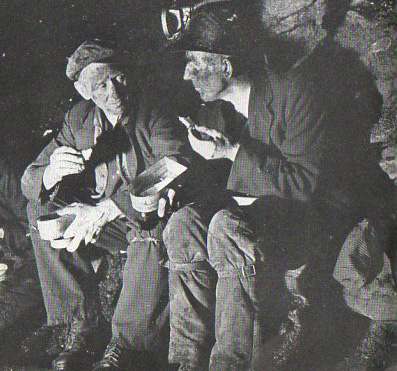
    And so:

    Mining674

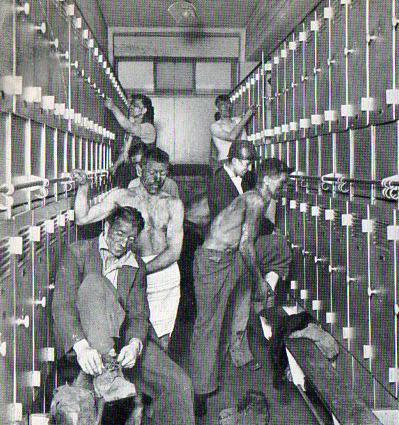
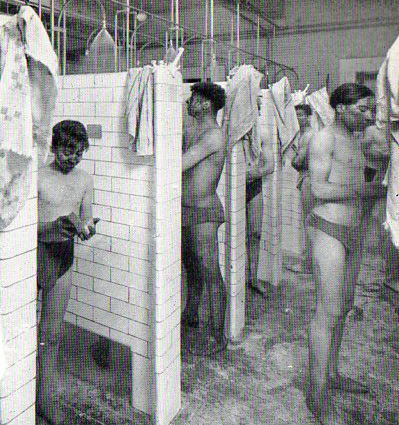
    These would hardly have been investigative-style photos as the pamphlet was trying to sell certain ideas of the mining union for self-care and preservation, so I am guessing that the photos would be no more than “average”.  The odd bits come from the photos of miners out-of-the-mines, because there is no mistaking the extreme closeness of these men to one another in places where that didn’t necessarily have to be the case.  The locker room, for example, looks compact and tight, and unnecessarily so–I mean, why have men be compressed together in a changing room after having just spent 10 hours underground in tight and bunched quarters? 

    Mining676Since this was basically a trade publication extolling good works with union dues money, perhaps this locker room is an improvement–still, there are two sets of lockers that are about five feet apart, with two benches that seem to be no more than six inches wide.

    After sending men down into the mines to work all day it seems that the least that could be done would be to allow a wide enough space to allow for people to sit moderately comfortably.  The six-inch bench really bothers me.

    Mining677
    Perhaps these showers were luxurious by those provided by other mines–perhaps other mines didn’t even have showers for the miners.  But again it seems to me another very cramped scene (and this one with the lead figure being a young boy).

    AS I said, perhaps these after-work images were scene of comparative luxury.  The degrees of cramped closeness though are inescapable. 


  • Empire of Earth

    JF Ptak Science Books  Post 2099  
    Follow Me on Pinterest

    Part of the series on the History of Blank, Empty and Missing Things.

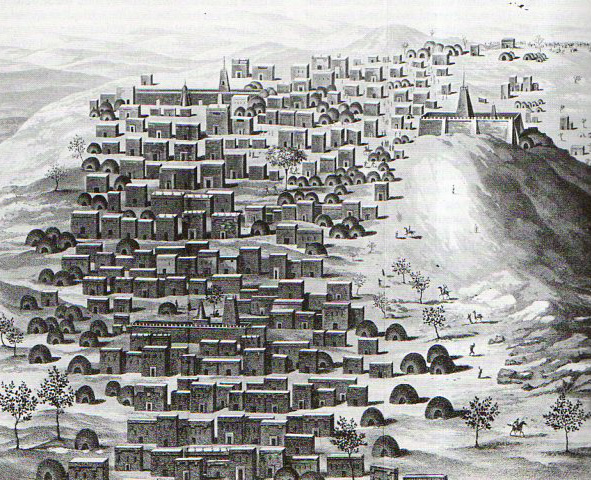
    Timbuktu, “a mass of ill-looking houses built of earth”–Caillie, 1830, volume 2, page 45

    Architecture indigernous669
    Of the many legends of the hypnotizing idea of the city of Timbuktu none illuminated the place as a city of earthen structures.  It was long a center of trade, located on the outskirts of the Sahara and just north of the Niger, with settlement in modern times reaching back to the 12th century, though there were settlements pre-dating this period by centuries. In any event, it was an unreachable place for the Western mind even though in Africa it was a hub of activity for trade in salt, gold, ivory, and slaves–and scholarship.  There’s a reason for people nowadays referring to distant/far-removed/inaccessible places as “Timbuktu”–and that’s because before the 19th century, it really was vastly inaccessible. And so the rumors of vast wealth and mystery wove their way into whatever little fabric of truth existed for the place. 

    Europeans were enormously desirous of real information about Timbuktu–the French government offered 10,000 francs to the first explorer to see the place, and live.  That person turned out ot be Rene Caillie, an exploring son of a baker, who made his way there after much adventure in 1828, and published his saga two years later.1 His report was not one of the expected golden mystery, but of a long-established town of antiquity and earthen hurts. 

    The image above comes from his 1830 work, and is remarkable–it is beautiful, and evidently accurate, if not very dramatic or fulfilling of floating expectations. It was truthful.  And unexpected. 

    • Caillié, René (1830), Travels through Central Africa to Timbuctoo; and across the Great Desert, to Morocco, performed in the years 1824-1828 (2 Vols), London: Colburn & Bentley. Google books: Volume 1, Volume 2.
    • Caillié, René (1830), Journal d’un voyage à
      Temboctou et à Jenné, dans l’Afrique centrale … pendant les années
      1824, 1825, 1826, 1827, 1828 … Avec une carte itinéraire, et des
      remarques géographiques, par M. Jomard. (3 Vols)
      , Paris: Imprimerie Royale. Gallica: Volume 1, Volume 2, Volume 3. Google books: Volume 1, Volume 2, Volume 3.

  • Underwhelming the Overwhelming: Nuclear Holocaust and Dental Care, 1956

    JF Ptak Science Books   Post 2093 
    Follow Me on Pinterest

    “What is the appropriate behavior for a man or a woman
    in the midst of this world, where each person is clinging to his piece
    of debris? What’s the proper salutation between people as they pass each
    other in this flood?” Siddhartha Guatama Buddha (thanks to Patti Digh for the quote).

    Mass casualty561

    See also the related post, “Ueber-spectacular Understatement“.

    In a world where mass extinction of human beings by nuclear weapons was hypothesized, theorized, and nearly implemented, there was certainly a lot of room for discussion about what would come after the Big Event.  Great and massive and insignificant and small were all on the board for conversation and study; in a new world of hyper-change, anything and everything could be an issue–well, everything and nothing, nothing and everything, because in an exchange of a million megaton, everything starts to look like nothing.  But be that as it may, planners needed to plan for eventual changes in what we humans would call “daily life”. Sometimes that everything was big, sometimes not, and sometimes the big stuff just looked little.

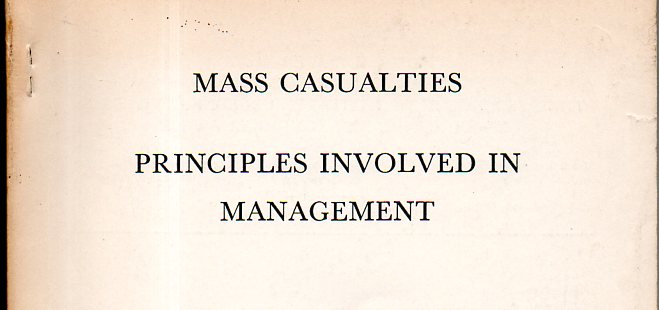
    For example, the pamphlet Mass Casualties, Principles Involved in Management, published as an offprint from the journal Military Medicine (April, 1956), is filled with numbing categories of thought, and doubly-numbing sub-categories, all of which needed a thinking-out, because when you have to make plans for the destruction of all things, there must be some sort of planning for what happens when the fires go out.

    There were the cautious introductory overviews, chapters on casualty estimates, initial aid and rescue, effects of fallout, emergency medical care, and the like. The work starts to get a little less oblique when the chapters become  a little more detailed, like that one devoted to “Mass Thermal Burns”. But what happens in these more-detailed headings is that the treatment of its subject gets less-detailed.  (“…the thousandfold increase in power and relative increase in radiant energy considerably enhance the burn hazard with the fusion bomb”  “…although the ideal treatment must be somewhat compromised in handling massive numbers of burn patients…” (page 319)).

    Ditto the chapter for “Management of Mass Psychiatric Casualties”. And “Public Health and Sanitation Problems of Nuclear Warfare”. These topics sound a little not-quite-right, and almost like a bad joke, but they are deadly serious. 

    “Organization for the Sorting of Casualties” is another.  Now even in this pamphlet the authors/editors were talking about massive exchange, which means that the “sorting” process would be involving tens of millions of people.  And who knows who would be the sorting stuff in such a situation, or if there would be a sorting place or doctors, or hospitals.  Nevertheless, this chapter underwhelms the overwhelming, which is a common occurrence in works like this. 

    • “A wide disparity will in all probability exist between  the patient and the medical resource”.
    • “All available medical forces will be used to the maximum for the care of the wounded”. 

    And so on. 

    It wasn’t just the care of human survivors that came under auspices of this work–there was also the matter of the social structure, which is what happens in “Welfare Problems in Nuclear Warfare”. In four short pages the chapter addresses the need to deal with the care of the survivability of the social network. And money.

    • “Ordinary jobs as people knew them would be nonexistent. Income from private investments, private insurance, social insurance, public assistance, government employment or any other source will be disrupted.  A whole income maintenance system will need to be developed and be ready so that income will either be in cash or in kind and be available when it is needed.” (Page 389)
    • “Any attack will bring in its wake a multitude of personal rehabilitation problems”.

    The author does get to the crux of the biscuit, finally, saying that after everything was said and done, that “much either medical or social care would have to be self-care in so far as humanly possible…” (Page 388).

    So what can one say to as a drowning person to another drowning person in a flood?  Best to look for higher ground?  There’s really not much that can be said, and I am sure that at the end of the day that these well-meaning contributors knew that there would not be much working following the nuclear dumpster fire–but I guess you have to plan for it anyway, just in case. 


  • Napkins of the Apocalypse

    JF Ptak Science Books  Post   Post 2084    History of Holes series  
    Follow Me on Pinterest


    …and don’t forget the DDT.

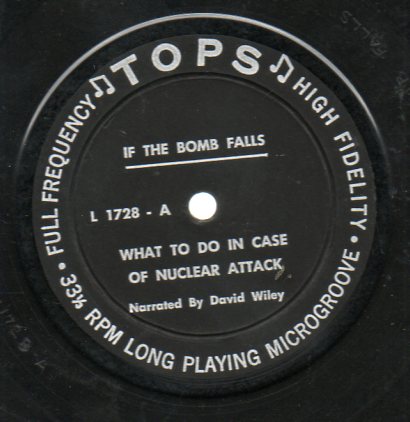
    Nothing quite sells like the smell of fear–or the sound of it.  In 1961, about the scariest sound was the air raid siren, which is what opens this record album, If the Bomb Falls.  At what was probably the highest height of the Cold War, with schoolchildren taught to “duck and cover” under their wooden school desks to protect themselves from a massive nuclear fireball, and in which thousands of families constructed their own fallout shelters, the Tops record company decided to fan the flames of public fear by producing a this-is-what-it-takes to survive effort.

    Bomb falls488
    For the most part, Tops was a low rent label, producing stuff that sounded like (‘sound alikes”) a current hit, and by indulging in ‘exotic” music like its Voodoo hit.  If the Bomb Falls answered its own fear-stoked questions with not-very-good responses.  That’s where the napkins come in–among other things, the album suggests that you keep a two-week supply of napins on hand, in addition to general-purpose paper towels and the like.  Also:  batteries, just in case the power goes out, and DDT, which went unexplained. And: be aware that in the fallout shelter there will be a period of unusual closeness at hand, testing your privacy.

    There is of course a lot of pertinent information survival information on the record, though it comes with very padded edges, and with very little flavor for what radiation is all about, and what it will do.  Plus all of that wicked winged death stuff that was waiting for you outside the bunker. 

    But this is what was done, at the time, to prevent general panic in the though of nuclear attack–stuff like this offered their own bits of religiosity, with the promise of possible islands of heaven here and there, heavens buried in your backyard or scooped out the side of your basement.  Like any belief system, it was based in, well belief–and belief doesn’t take that much firming-up once somebody believes in it.  Things will work out if you believe they will; science and logic take the background in cases of a staggering hope of survival based upon belief (and instructions from micrgoove vinyl). 

    In the end, what you are left with in the event of nuclear holocaust is what is in the middle of this record:

    Bomb falls490

    Other Tops producers included these lovelies (source of which is here):


  • Henry James’ Beautiful Nothingness on Charles Dickens, 1865

    JF Ptak Science Books   Post 2081

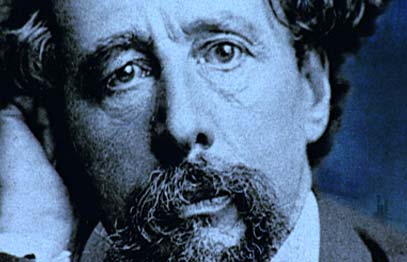
    Dickens[Picture source: PBS.org.]

    At the tender age of 21 Henry James was deeply in love with words.  Sometimes he may have been in love with them for the sake of their sound and placement rather than their meaning, at least so when he was a young man…as he grew older, James became one of those few people who never wrote a bad sentence (according to Mr. McMurtry).  However, in 1865, he wrote some lovely-sounding sentences that were mechanically semi-pure if not accurate in what they were saying, but certainly sounded pretty in their pettiness.

    It was in The Nation on 21 December 1865 that James wrote what is a very good example of this beautiful nothingness when he brought out his pen and stabbed Charles Dickens in the heart.

    He was reviewing Our Mutual Friend, but he managed at the very beginning to say that it was not simply that this novel was not good, but that everything Dickens had written in the previous ten years–back to when James was 11–was “poor with the poverty not of momentary embarrassment, but of permanent exhaustion”.  It is true that Dickens at this point was slowing down a bit–at least compared to himself, as he had previously written twenty novels in 18 years–and he had only another five years to live, but the novels of exhaustion of those ten years that James was referring to included  Little Dorrit,  A Tale of Two Cities,  Great Expectations, and Our Mutual Friend.  Four novels, ten years, three great classics. 

    James writes that “…the word humanity strikes us as strangely discordant in the midst of these pages, for, let us boldly declare it, there is no humanity here…”  This is a very strange thing to say, given that Dickens semi-discovered a majority of London life that really never quite made it into public display in newspapers and novels except for their crimes, giving a face of grace and courage to the poor and middle classes.  And for all of that, Henry James tells us that Dickens may be a great humorist, but “he is nothing of a philosopher”. 

    Then there are these two low sentences:  “But when he
    introduces men and women whose interest is preconceived to lie not in
    the poverty, the weakness, the drollery of their natures, but in their
    complete and unconscious subjection to ordinary and healthy human
    emotions, all his humor, all his fancy, will avail him nothing, if, out
    of the fulness of his sympathy, he is unable to prosecute those
    generalizations in which alone consists the real greatness of a work of
    art. This may sound like very subtle talk about a very simple matter;
    it is rather very simple talk about a very subtle matter.” 

    James continues, as he begins to wind up is review, with some very sniffy and long-nosed observations (bolding mine):

    “Such scenes as this are useful in fixing the limits of Mr Dickens’s
    insight. Insight is, perhaps, too strong a word; for we are convinced
    that it is one of the chief conditions of his genius not to see beneath
    the surface of things. If we might hazard a definition of his literary
    character, we should, accordingly, call him the greatest of superficial
    novelists
    . We are aware that this definition confines him to an inferior
    rank in the department of letters which he adorns; but we accept this
    consequence of our proposition. It were, in our opinion, an offence
    against humanity to place Mr Dickens among the greatest novelists
    . For,
    to repeat what we have already intimated, he has created nothing but
    figure. He has added nothing to our understanding of human character. He
    is master of but two alternatives: he reconciles us to what is
    commonplace, and he reconciles us to what is odd.”

    I really am not sure what was driving Mr. James to the place he drove for, but it certainly seems very weird to me–perhaps he needed to sharpen his young quill on the bones of a popular and legendary older writer. In any event, James seemed to be trying to rush a certain patina of aged reasonableness here, and all he managed was to shine an ugly brass.

    The full review, here.

    And just for the record, here’s a list of Dickens’ books, all written somehow by one man:


  • The Endless Immensity and Finite View of the Infinite of Thomas Wright, 1754

    JF Ptak Science Books   Post 2064
    Follow Me on Pinterest

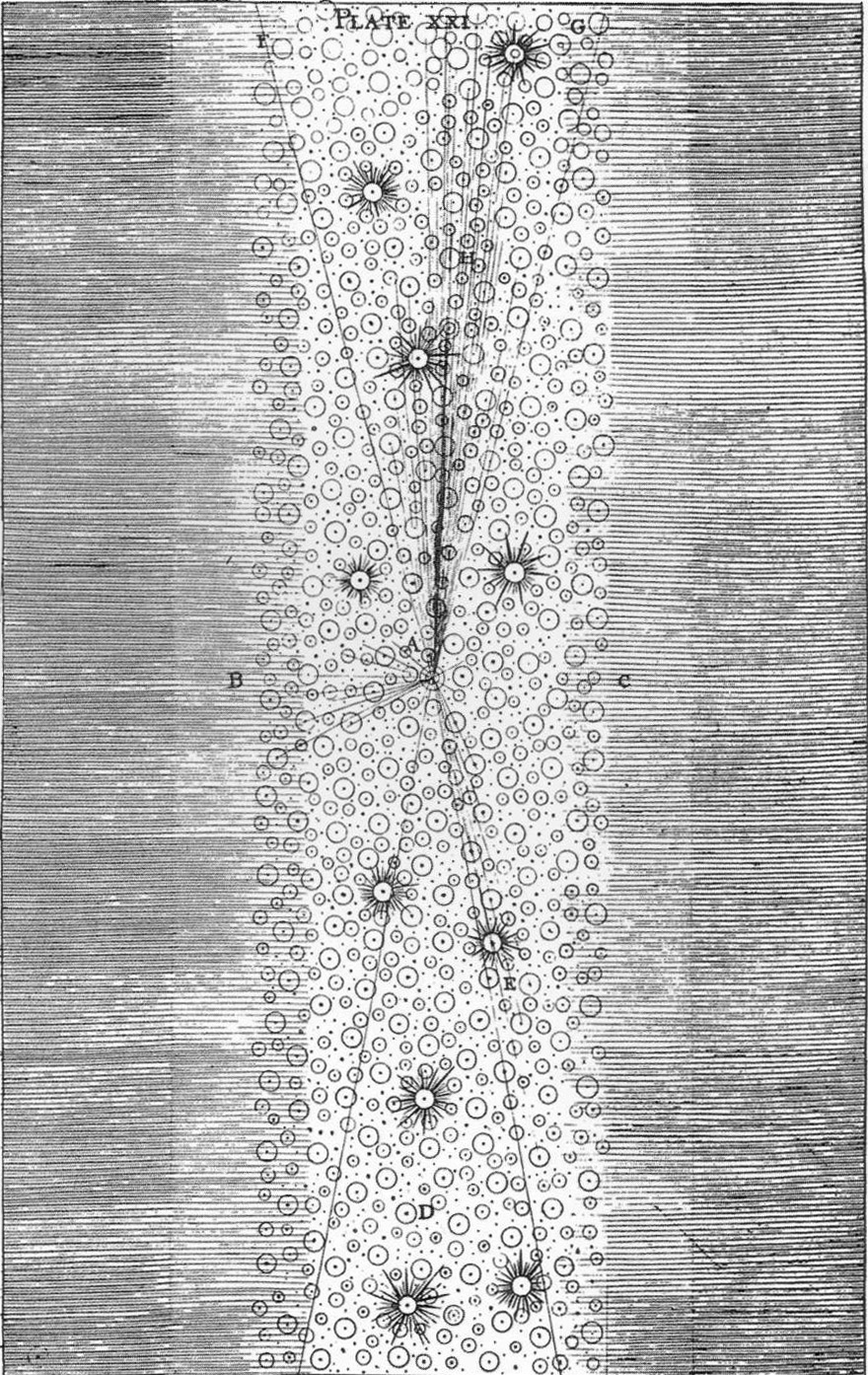
    Thomas Wright (1711-1786) saw about as deeply into the deep as just about anyone else–he looked into the night sky and pretty much saw all of it. In his book, An Original Theory or New Hypothesis of the Universe, Founded upon the Laws of Nature1, he described a version of the universe that was influential in the thinking of Kant and Herschel, finding a rectangular/squashed “finite infinity” of stars, “a vast infinite Gulph, or
    Medium, every Way extended like a Plane,
    and inclosed between two Surfaces”.

     
    Wright thomas [plate 23

    Our Milky Way, which at the time was thought to be the entire universe rather than a galaxy as it was later discovered to be–one galaxy in a seemingly endless sea of galaxies–was presciently seen by Wilkins as being but one assembly of stars in an “endless immensity” of stars:

    “And farther since without any impiety; since
    as the creation is, so is the Creator also magni-
    fied, we may conclude in consequence of an in-
    finity, and an infinite all-active power; that is
    the visible creation is supposed to be full of si-
    derial systems and planetay worlds, so on, in
    like similar manner, the endless immensity is an
    unlimited plenum of creations not unlike the
    known Universe.”–page 143. (Again, the “Universe” eferred to here is the Milky Way galaxy.)

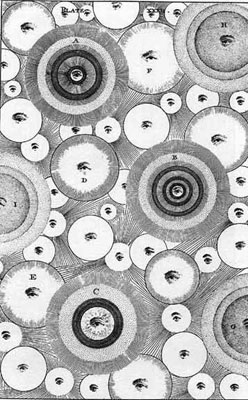
    Wright’s vision of this plethora of Universes, in which each creation is one like the Milky Way–a radical thought in 1750:


    Wright 32

    [Part of me wants to include the first Wright engraving in this blog’s series on the History of Lines, seeing as how they represent the great Something that seem to be infinitely binding the infinity of universes…]

    Wright also writes on the minuteness of the human condition, of the perfect sense of nothingness that is the Earth in a sea of infinite possibilities of other earths and earthy creations, which was definitely an outpost of thinking in 1750:

    “In this great celestial creation, the catastro-
    phe of a world, such as ours, or even the to-
    tal dissolution of a system of Worlds, may pos-
    sibly be no more to the great author of nature,
    than the most common accident in life with us,
    and in all probability such final and general
    doom-days may be as frequent there, as even
    birth-days, or mortality with us upon the Earth.
    This idea has something so cheerful in it, that
    I own I can never look upon the Stars without
    wondering why the whole world does not be-
    come Astronomers; and that men endowed with
    sense and reason, should neglect a science they
    are naturally so much interested in, and so ca-
    pable of enlarging the understanding, as next to
    a demonstration, must convince them of their
    immortality, and reconcile them to all those lit-
    tle difficulties incident to human nature, with-
    out the least anxiety.”–page 132


    Notes

    1.  The full title:  An Original Theory or New Hypothesis of the Universe, Founded upon the Laws of Nature, and solving by Mathematical Principles the General Phenomena of the Visible Creation ; and particularly the Via Lactea. Comprised in Nine Familiar Letters from the Author to his Friend. And illustrated with upwards of thirty graven and mezzo-tinted Plates by the best Masters. London, MDCCL.” Full test, here.

     2. An odd note about Thomas Wright’s personal history, from Science, 1902: “A word, in passing, about Wright. Like many another, so unfortunate as to live ere the
    times were ripe, he has been consigned to unmerited oblivion. Even the writer of the entry upon him in the ‘ Dictionary of National Biography ‘—a work so uniformly accurate — is unaware of the sources from which information could have been obtained, and so has nothing to tell, — does not even know the dates of his birth and death, or why he was called ‘of Durham.”–[Science, N. S. Vol. XIII. No. 321. 2-22-1902

    An interesting poem by Rafinesque to start of his edition of Wilkins:

    “Where ends the range and limits have been set
    To mortal eyes, there mental sight begins
    To fathom space, and worlds invisible
    Surveys, admires
    The mind must feel that space can have no bound*,
    Whatever number be of things or thoughts
    Others may be beyond—and thus behind
    The Nebulas and Belts, our Galaxies
    Of stormy clouds and oceans
    There stands the central land and throne
    Of our wide Universe, the home of Angels,
    The seat of Love Divine”
    Rafinesque, Poem on Instability, found at the beginning of Rafinesque’s 1837 American edition of Wright’s 1750 work. 


  • Electro-Punk Memory, 1929

    JF Ptak Science Books   Quick Post  

     
    Follow Me on Pinterest 

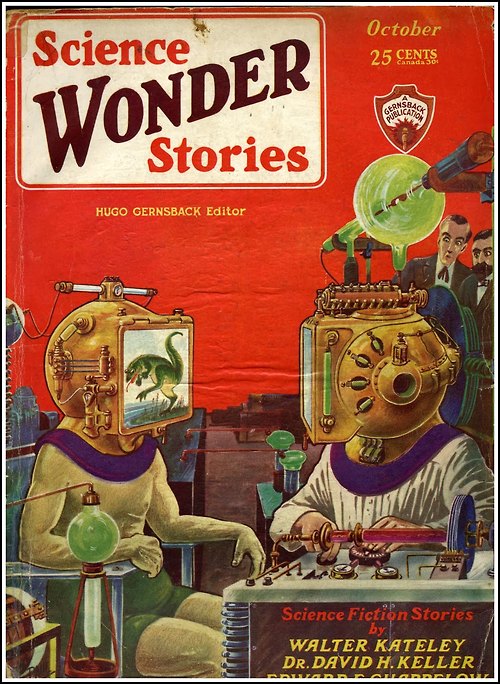
    Gernsback memory machine
    [Image source: the wonderful Frank Wu (sci-fi fanasy artist) website, here.]

    This is the delightful and reaching cover art by the great Frank R. Paul for the October 1929 Science Wonder Stories, illustrating “Into the Subconscious” by Ray Avery Myers, a story of a physician/shrinkologist/physicist who concocts a way of reading into the memories of his subjects–long, deep, ancestral memories. The doc (Macey) is seated at right on the cover, somehow retrieving images from the patient–an idea that has had long legs, and seen famously in the end-all road movies,  Wim Wender’s 1991 PunkNoir film, Until the End of the World. Or perhaps its  more future-driven than that, where each viewer is viewing the other’s memories or dreams or visions, rather than their own, the images flickering to life onto the monitors, initiated by the simple proximity of another person…all memories available, nothing secret.

    At least in the Wenders portrayal of the dream-end of this idea, there was precious little time for anything but dreams.