A Daily History of Holes, Dots, Lines, Science, History, Math, Physics, Art, the Unintentional Absurd, Architecture, Maps, Data Visualization, Blank and Missing Things, and so on. |1.6 million words, 7500 images, 4.9 million hits| Press & appearances in The Times, Le Figaro, Mensa, The Economist, The Guardian, Discovery News, Slate, Le Monde, Sci American Blogs, Le Pont, and many other places… 5000+ total posts since 2008.

Category: Blank and Empty Things; A History of

  • Questions Answered with Guts, Wax, Bumps and Glory: Fortune Telling Patent Devices

    JF Ptak Science Books   Post 1956
    Follow Me on Pinterest


    [All images via the lovely and easy to maneuver Google Patents here]

    Fortune telling and divination is mostly the subject of the pretty patents (below), a quick penny-ante for the fulfillment of the instant treatment of possibility. reckoning via mechanical means,easing folks out of the necessity to think about What May Come, and also, possibly, relieving some of them of the possibilities of worry should the fortunes agree with their hopes.  And desires. Opposite, for the opposite. 

    This thinking goes back a long way into dark and dusty time, though it becomes interesting (to me, anyway) when it gets wrapped up in Renaissance magic and science. 

    I’m not sure what it reveals except for what people might have wanted to believe in during different periods of time.

    Anyway, the patent drawings are pretty.

    The ways of telling fortunes are broad and numerous and may have been dictated by the stuff that was readily available at hand; a veritable alphabet can be quickly summoned to deal with the most common of the sort:

    Alectromancy (telling the future by relatively brainless modern dinosaur roosters pecking at the ground for stuff);

    Astrology
    (thinking that the motions of stars that are light years away from the
    observer in a vast sea of space and their annotation on an
    infinitesimally small speck of universe dust called “Earth” can somehow
    interact with living organisms that are 1030000 the amount of space that can be affected by the light from the stars that are 1/1,000,000,000 of the age of those stars);


  • Blank & Empty Things Series: Self-Referencing Languages and Babel

    JF Ptak Science Books      Part of the History of Blank, Empty and Missing Things.

    Follow Me on Pinterest


    Blog--14 nov--fantastic arch


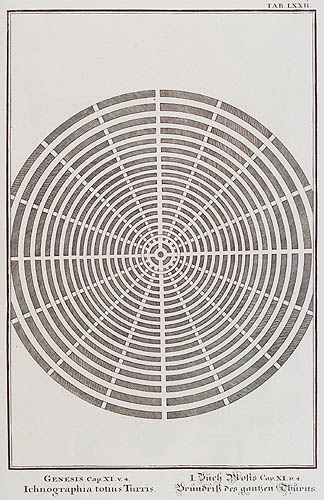
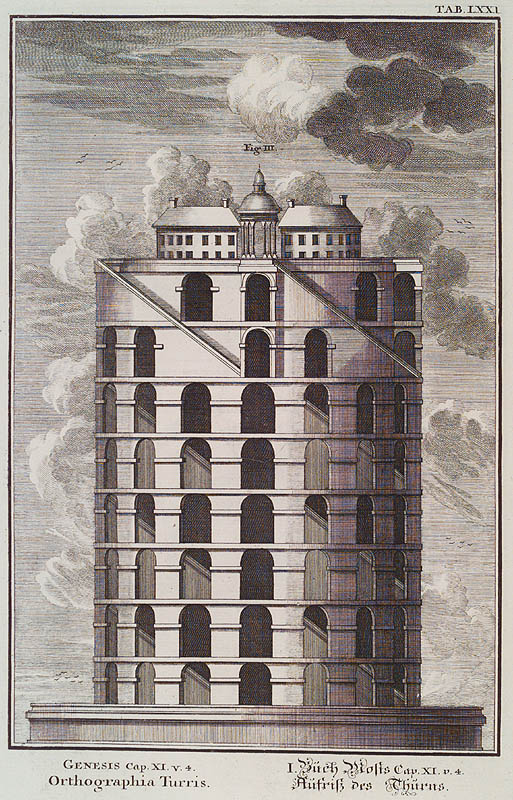
    Returning to Jean-Jacques Scheuchzer’s1 magical, inventive, fact-bending naive-surreal work on universal history based on the Old Testament, I’ve found these two glorious and odd images of the Tower of Babel.  The first (“Genesis Cap.XI.v.4. Orthographia Turris.Mediummetalis”) is terrific, shocking even in its abrupt construction and flat-out stumpiness, because it is one of a very small minority that shows the structure to be canonical, with a little church at top. The enormous stairway is just completely out of proportion to the purpose of the structure, the effort falling into some sort of odd advanced-child category.

    If Italo Calvin’s “Invisible Cities” or (better yet) Jorge Borges’ “The Circular Ruins” were to be illustrated, this image would fit right in.

    The other very unusual bit here, is that Scheuchzer also provides a plan for the city that was to be built around the tower–I’m pretty sure that I haven’t seen references to this before, and the Biblical references to it are no help whatsoever in determining its physical aspects.

    There are probably very few things that could be as blank or as empty as combative, competing, nonsensical and completely self-referential language or communication.  Well, except for Scheuchzer’s very empty town plan locating the tower in an urban setting–a listless place of surrounded circles of nothingness for a place in which everything is said and nothing is understood.  Ground Zero for blank Blog--nov 14--planlanguage.


    Notes:

    Two interesting books that I should mention that address the ideas
    of fantastic/imaginary architecture and decay are C. W. Thomsen, Visionary
    Architecture: From
    Babylon to Virtual Reality,   (Prestel, 1994) ; and  Paul Zucker, Fascination of Decay (Gregg  Press, 1968).

    1.  Kupfer-Bibel, in welcher die Physica sacra, oder geheiligte
    Natur-Wissenschafft derer in heil. Schrifft vorkommenden naturlichen
    sachen, deutlich erklart und bewahrt,
    printed in Augsburg and  Ulm
    by  C.U. Wagner, 1731-1735. Offered in four volumes, illustrated with
    758 plates, it is a magnificent work, if not altogether correct, or
    even near- correct, with an enormously confused pedigree, implying the
    wisdom and text of the Bible (and the old Testament at that) as the
    background for a physical history of the world.


  • Sending Antique Letters to Santa

    JF Ptak Science Books   Post 1949
    Follow Me on Pinterest

    In my adventures in collecting antique art made by children, antique children making antique art, I found the following three letters. I’m hoping that by posting these lost letters to Santa that the dreams and sentiments they contain will somehow be at least read by Santa, and then perhaps even addressed in some way to another girl or boy, even if the requests come 120 years after they were made.

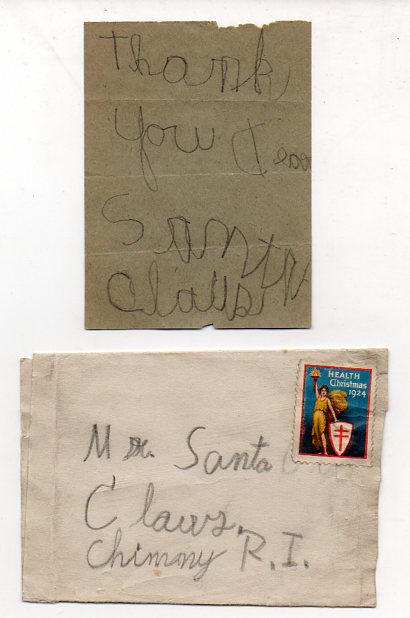
    The first and perhaps most important of these letters is a beautiful little note, by a very young hand, written in 1924.  It reads, simply: 

    “Thank you dear/ Santa Claus”

    and addressed to “Mr. Santa Claws” at Chimny, R.I.”.  It may be that the child sent the letter to his own chimney for Santa to pick up on Christmas Eve. 

    Santa letter948
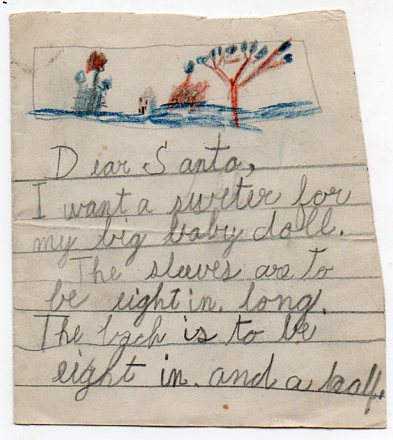
    Next, this illustrated letter, which was  being  around 1890/1900

    “Dear Santa,

    I want a sweter for my big baby doll. 

    The sleeves are to be eight in. long. The back is to be 8 in, and a half.

    My Mother wants a table crumber. A silver crumber. I want a nurses dress and a cap. Dear Santa. I have out grown my golashers that is a nother thing I would I would like. 

    Good bye

    From Martha.”

    Santa letter946


  • The Solids in Bellini (?) Is the Blankness a Heritage of Uccello or Bartleby?

    JF Ptak Science Books   Post 1943 (Part of the series on the History of Blank, Empty and Missing Things.)
    Follow Me on Pinterest 

    “Where is abstract without solids, I ask you?” — William Gaddis, on the solids in Uccello, The Recognitions, 1955

    Actually, I think that there’s plenty of abstract without solids, so long as you’ve seen solids before.

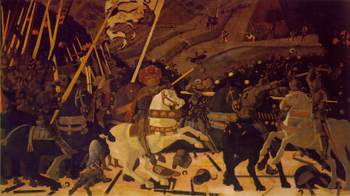
    I’ve returned to a slightly recurrent theme in this blog dealing with the great Paolo Uccello (1397-1475) and his study of perspective–but most directly as he was observed by William Gaddis in his Great American Novel The Recognitions.  (I am forever grateful to my brilliant Patti Digh for really hooking me into Gaddis so many years ago–Patti was long intrigued by Gaddis and wrote her UVa master dissertation on his Big Book. Gaddis’ book can be found here.) Among other things Uccello is recognized as being one of the greatest and among the earliest artist to re-discover the science of perspective, and was throughout his life a passionate student and practioner. 
    Blogsan_romano[Much of Uccello’s work can be found at Paolo Uccello Complete Works website, here.]

    “Painting is exquisite as the punishment for the thinker.”–William Gaddis, The Recognitions

     The “solids’ recognized by Gaddis (and not really
    discussed, and mentioned only twice in the book I believe) are incredible to me.  Looking at his painting Battle of San Romano 
    (1457) we see Perspective in her place; but when we look at, say, the rumps
    of the horses, we see almost no detail, just a mass of color, a solid,
    with spectacular plainness. What in the world was he thinking?  He could
    certainly have painted the horse and the other solids with texture and
    detail, but he didn’t, and to me it seems antithetical to the painting. 
    What in the name of all motherly things was he thinking?  And who else
    on earth was using such huge amounts of plain solids in their
    paintings?  I’m not aware that anyone else was, and I am relatively
    clueless as to why he did it, abandoning detail in order to raise awareness of the surrounding parts of the painting, or perhaps heightening  a sense of the not-yet-existent abstract, or drawing attention to the perspectival aspect of the work?
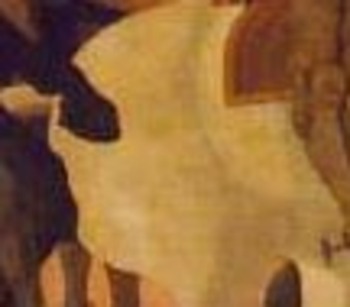
     

    Blogsan_romano_rump[A detail of the missing detail, above.]

    But the solids are not just limited to Uccello, though they may have appeared there first, especially as the “exhibited” variety of this thinking. Jacopo Bellini (ca. 1400-ca. 1470) was a contemporary, living pretty much during the same period of time as Uccello, and who was responsible as much as anyone else for introducing oils in painting and establishing the Venetian style.  He was a brilliant artist, the teacher of Mantegna, ran a fabulous studio, and was the father of two great artists. (One son, Giovanni, was a highly regarded artist who was also the teacher of Girgione and Titian.) 

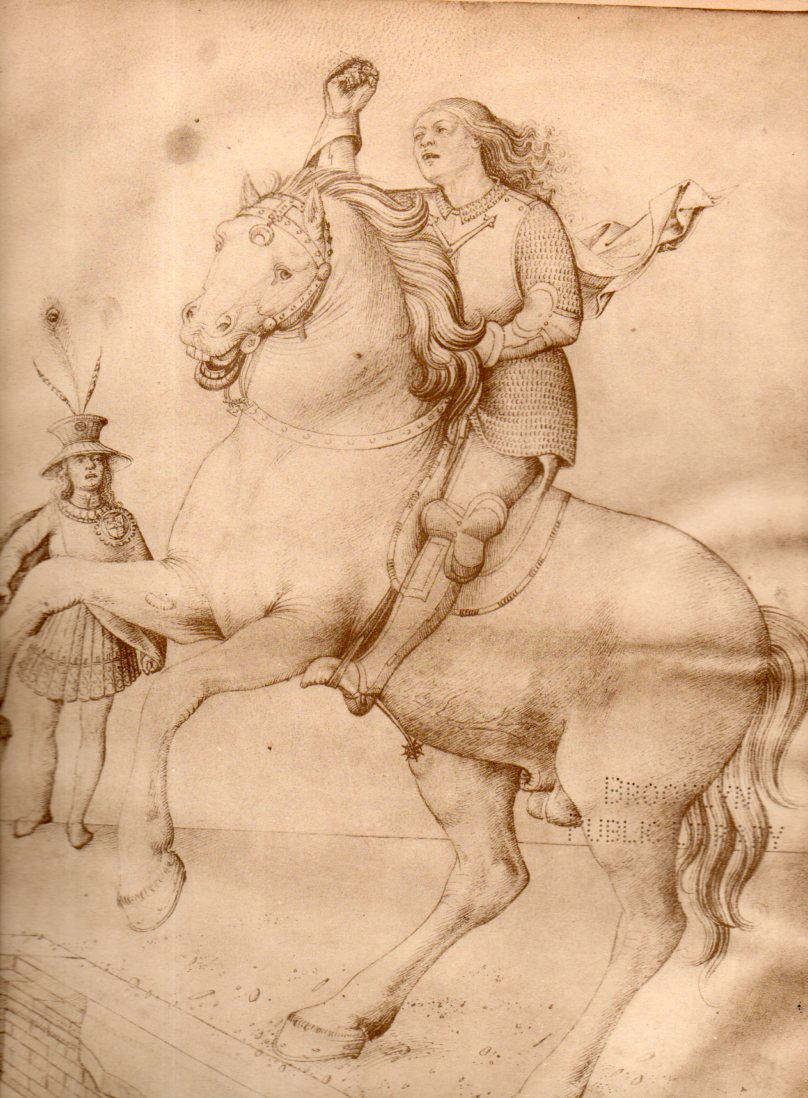
    In looking through two volumes of Jacopo’s drawings, I was struck by the number of times that horses and other objects appeared without detail, as solid solids, or mostly solid, quite outside the way in which these things were painted in the 15th century. Pacing though the books flipping through the open pages is like looking at a pop-up book in reverse–each set of pages opened are like looking into, looking through, the book, into space.  They are collections of perspective. And they are populated by those other solids, which was surprising.

    His horses appear very much like those in Uccello–except of course that these images were personal, workbooks for the artist, idea-machines and memory devices.  There was plenty of detail in other aspects of these drawings, but the lack of the detail int he Uccellian manner really struck me.

    Christiane L. Joost-Gaugier’s “Jacopo Bellini’s Interest in Perspective and its Iconographical Significance” found in  Zeitschrift fuer Kunstgeschichte  (1975)
    makes a very learned and eloquent case for the overwhelming interest
    that Belinni had in the study of perspective–not to the exclusion of
    all other things, because there were still patrons to be satisfied and
    religious and triumphal scenes that needed to be  painted–and
    concentrated on that interpretation focusing on Bellini’s stylebooks. 
    (Most of Bellini’s output has been lost, but there are two volumes of
    manuscript studies that have survived.)

    “Though
    many of Jacopo Bellini’s drawings are reminiscent of model-book notions
    in that they illustrate a variety of suggestions for the representation
    of traditional themes – for example Flagellations, Adorations, Davids,
    and animals -they are, taken as a whole, entirely different from model
    book drawings. Jacopo rarely concentrated on a subject for the sake of
    its thematic content. Almost never does a bald statement of fact appear
    to describe, for example, a biblical event. Rather than focusing on the
    event itself, Jacopo’s compositions characteristically are concerned
    with other things. In the vast majority of cases the subject is set
    within the context of a variety of architectural motifs or in that of an
    extensive naturalistic world. It would appear that for Jacopo Bellini
    biblical subject matter was a justification for his participation in a
    variety of other new interests. Primary among these was the special
    attention given to perspective…”
    No mention of course of the Uccello horses.  And perhaps they’re really not there there, but it certainly looks like they are, at least to me.  They might not have been there for Gaddis, either, as Bellini doesn’t show up in the book, Gaddis thinking more about Uccello, and then even more so of Hieronymous Bosch, Hugo van der Goes, and Hans Memling.

    And here it is, Bellini’s solids, an example:
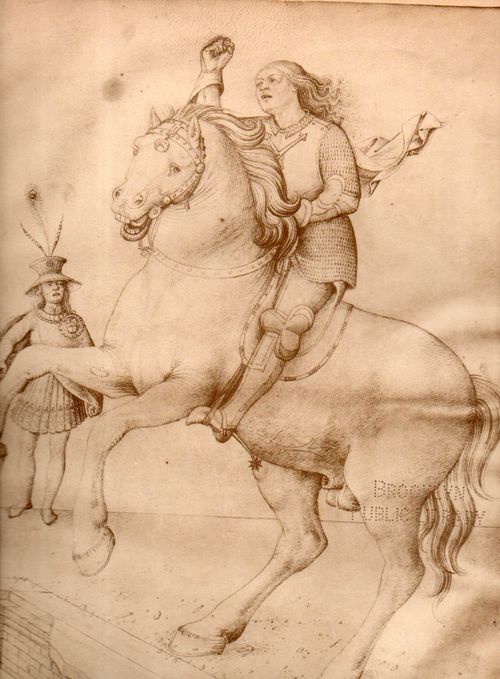
    Solids bellini913
    There are others as well, examples of what, I am not sure–fantastic visions into blankness and into the future of what painting would become 450 years hence.

    Perhaps they were just place-keepers, to be filled-in as neededm just a shrt-hand expression of a horse rather than a transcendental imperative.  After all, Bellini knew horse muscles, and decided in his workbooks that he just didn’t need to draw them, or that in the sense of Bartleby the scrivener that he’d prefer not to. 

    Notes:

  • Blank, Empty & Missing Things Series: Sound and Silence

    JF Ptak Science Books    Post 1918   Part of a long series, Blank, Empty & Missing Things

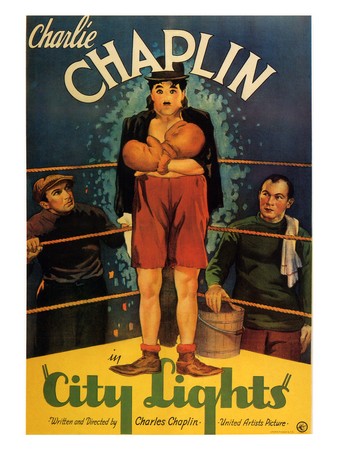
    Chaplan city lights
    In the American motion picture industry, the sound technician position did not exist in 1927; in about 1000 days it would be almost as important as the director.  1927 marked the first year of the synchronous, simultaneous sound-on-film motion picture, with the first commercial production appearing in 1929. (The history of motion pictures with sound is pretty complex for the 1920’s; suffice to say that there were different attempts on synching separately filmed and audio recordings which was a difficult beast to master, and virtually no one did; the winning attempt at introducing sound into the movies had to be sound-on-film so that there would be simultaneous play of sound/film.) Prior to this, all dialog, all sound effects, were confined to the mind of the viewer, though there was sometimes live musical accompaniment.  Two years later, sound was in, and silence (as an absolute given) was out. 

    The impact of sound had an overwhelming effect on the medium—not only because the actors could speak, but because they could also act within the subtleties of now being heard.  Whereas just the other day actors had to pantomime hearing different sorts of sound, or act in such a way that the audience knew that they were weeping—much had to be visually over-acted to support the lack of actually being able to hear things.  Once sound was incorporated, the dramatic range of actors advanced exponentially.  Of course there was also everything else outside of voice that could be incorporated by the director:  ticking clocks, advancing footsteps, thunder,  sirens, heartbeat, a soft wail, a chortle, an echo.  And silence could now be used to its true effect, its importance rediscovered.

    The last, true silent film came in 1931, with Charlie Chaplin’s City Lights.  Chaplin acted/directed/produced the film, which, interestingly, was not really, altogether, absolutely, a “silent” film.  The movie—which directors Stanley Kubrick and Andrei Tartofsky both selected as their fifth film in their top-ten all-time movie lists—actually used idiosyncratic and unintelligible sounds as speech in a spectacular salute to non-speech speech.  Chaplin was one smart man.
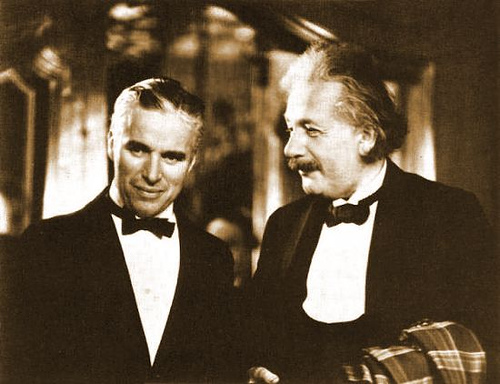
    Chaplin einstein

    The advent of sound curiously silenced the careers of some of the great silent-era actors whose voices were really just beyond reach and the range of the enjoyable.  Clara Bow bowed out as a result of her deep Brooklyn accent, as did John Gilbert for his very high-pitched voice, and many others.  Such are the few ironies that came along with this rich technical advancement, small price to pay for a piece of the future.

    (Chaplin and Einstein at the premier of City Lights.)


  • A History of Blank, Empty and Missing Things: Mona Lisa’s Jewelry

    JF Ptak Science Books  Post 1939    Part of the series on the History of Blank, Empty and Missing Things.

    Follow Me on Pinterest

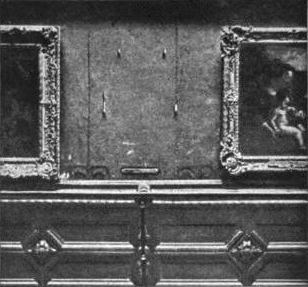
    Mona_lisa_stolen-1911

    [A photo of the place on the wall in the Louvre where the Mona Lisa lived until stolen in 1911.]

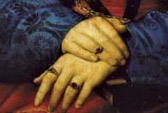
    I bumped into a Google search page that was filled with entries for designers and jewelers with business names invoking the Mona Lisa–Mona Lisa Jewelry and so on.  This coupling could well be found in the crushed metaphor jar in the back of the refrigerator.  One thing is for certain: no doubt the real Mona Lisa had plenty of money (probably the wife of a successful merchant named Francesco de Giocondo) and privilege to afford jewelry, but in the Leonardo’s painting she is pictured quite plainly, wearing none. Her hair is also very simply portrayed. This was a rare thing to do in portrait–as a real people who portraits were being made usually wore as much jewelry as they could or in some sensical variation of that. The hair too was a big deal–all you have to do is take a quick survey of hairstyles of Renaissance women in paintings and it will become instantly clear hairstyles were complex and involved. Mona Lisa’s dress, too, is very simple–plain even–and in understated, muted color. 

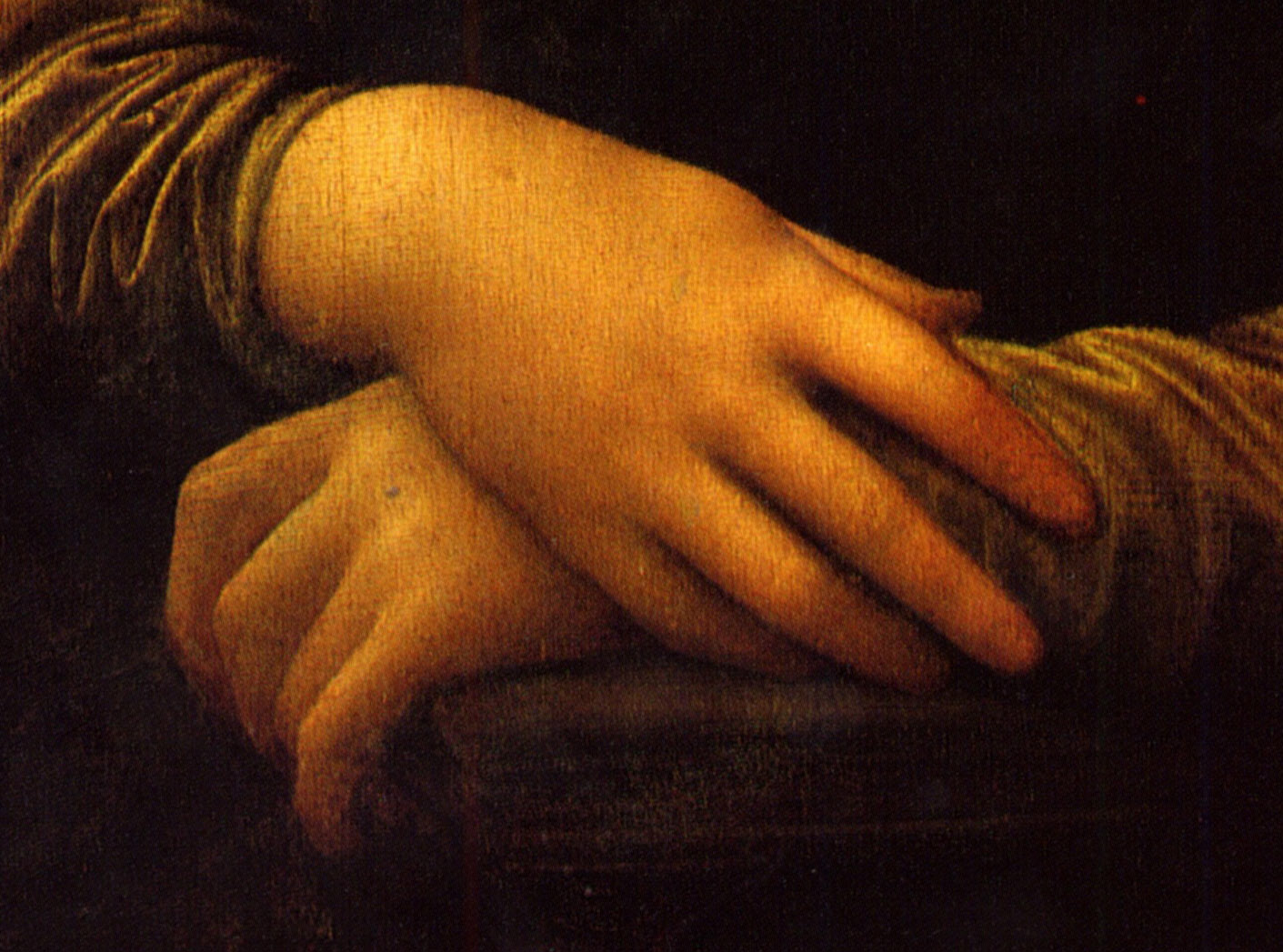
    Mona_Lisa yhands
    All of this was exceptionally unusual for the time.

    There’s not a speck of jewelry on the Mona Lisa, and her hair is simply parted, falling to her shoulders.  Maybe Leonardo didn’t want anything in the painting to fix it at any specific point in time, as the whole entity seems to be in a state of suspended completion, or complete but not quite there, still becoming something.  Perhaps highly defined hair and jewelry on her fingers would have been unacceptable anchors, giving places for the eyes to land and move away from the lush layers of light and tone that give the painting some of its enormous “motion”. 

    It is hard to imagine the hands of Mona Lisa like those seen in the portrait by Raphael of  Maddalena Strozzi Doni. Painted at about the same time as the Mona Lisa, the 22-year-old master Raphael achieved a great image of course, but one very much in opposition to Leonardo’s. (The next year Raphael would paint St. Catherine, who would have no jewelry and simple hair, but of course she was also a saint–but he did give her some pretty fancy and involved clothing, in spite of the wheel she was leaning against. Depictions of saints and religious icons are different from secular portraits–but even here it is difficult to break away from imaging luxurious cloth and clothing.)

    Raphael msddalena hands[The hands of Raphael’s  Maddalena Strozzi Doni, 1506.]

    So in the history of missing things, or of missing jewelry and finery, the Mona Lisa must rank pretty high. It was just unusual to think of a business name invoking the antithesis of what the business is about. 

    The Mona Lisa of course became one of the most famous missing things in the history of missing things when she was stolen by the not-very-bright Vincenzo Peruggia in 1911, but that’s another story (and one which I talk a little about in the post The Most Famous Missing Doorknob in the History of Art).


  • Extending Manhattan: Filling in the East River & Part of NYC Harbor

    JF Ptak Science Books   Extending Post 1470 
    Follow Me on Pinterest 

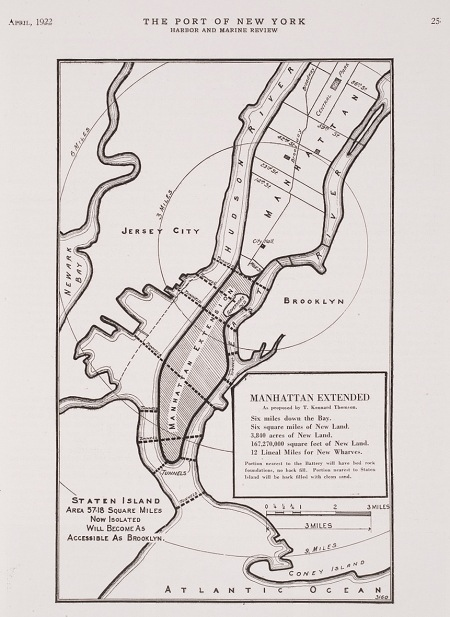
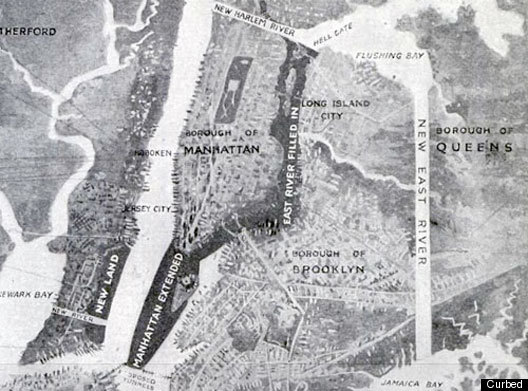
    A while ago I wrote a post on  Herman Soergel’s  plan for extending the landmass of the countries around the Mediterranean Sea by damming the straits of Gibraltar, lowering the sea and irrigating the Sahara–an original, interesting but not very good idea, filled with briney cultivation and racial politics. In the past on this blog I’ve written about other city plans–and in particular, for New York City–that have involved floating Manhattan into the harbor, or filling up large chunks of the Narrows, or floating the city on an enormous anti-gravity platform, and so on. Some of those plans were real, some science fiction, and some were plainly beyond both.  The plan presented above is another monster, but at least this one could work, if not for the doing of it, and the expense. And the will.

    NYC Really Big
    But the bottom line, according to the engineer doing the thinking on this project, Kennard Thomson, would supposedly net the city a cool billion dollars after everything was said and done, and that would be 1916 dollars–that was equal to about 5% of the American GDP (!) in 1916, which would be about $400 billion in terms of 2010 GDP.  I’m not sure how Thomson came up with this very big/very round number, though it must have been done for effect–I can just imagine him standing before a smokey room filled with civil engineers talking about his massive plan for enlarging NYC and throwing out the billion-dollar figure, watching the cigars glow red in exhaled disbelief.

    NYC really big
    [Source: Popular Science, 1916.]

    Thomson did know what he was talking about–he was a busy (and “leading” according to the NYT) Manhattan civil engineer of stature, working on the Canal Barge and being the principal engineer for the Municipal and Singer buildings, for example–and his project seems to be well within the scope of possibility.  Their sensical aspects however are, well, questionable. 

    Here’s the story–around 1911, while examining proposals to repair and extend New York’s wharves, Thomson came upon the idea–a magnificent, fabulous idea–of adding new wharves by adding new lands to the city.  In short, the overall plan was to fill in the East River (!!) and reclaim the new land for city living,  dam Hell Gate,  construct a New East River (from Flushing to Jamaica Bay),  extend the tip of Manhattan Island from the Battery to within a quarter-mile of Staten Island (!), create a new 40-square-mile island between Sandy Hook and Staten Island, extend the Jersey shoreline, add two new Manhattan-sized appendages to the east shore of Staten Island, and more.  All of this would be connected by various new bridges and roads and tunnels, as well as a 6-track elevated railway that would circumnavigate the city.  The purpose of all of this would be to add 100 miles of new docks, an enormous amount (“50 square miles of reclaimed land”) of new land and the capacity for NYC to house 20+ million people, all of which would be worth a billion dollars. 

    Thomson really meant “really” in the title for the proposal. There have been reclamation projects undertaken in New York Bay since then of course, and I think that virtually all of what Thomson talked about could be done.  I think it would be a very interesting project for a class of some sort to undertake an estimation of what such a thing would cost today (and I would guess to duplicate the idea in real terms now would take up a sizable chunk of the GDP).  Maybe all of this will make sense at some more future point. 

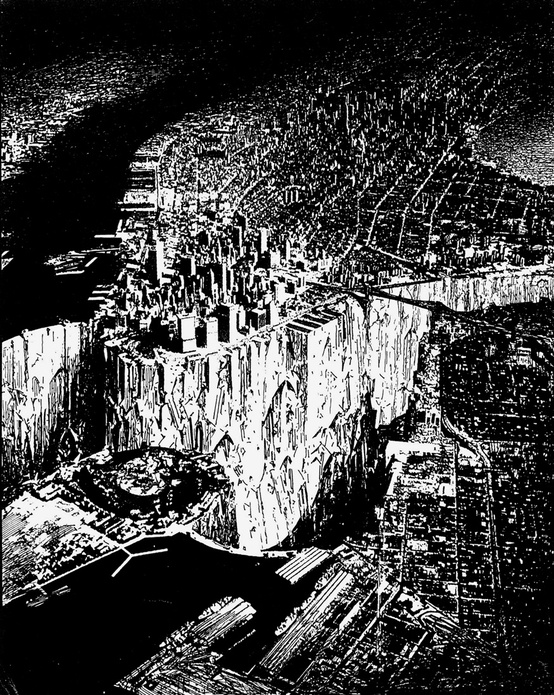
    And along this line of thinking I include a very interesting drawing made by architect Lebbeus Woods, showing the bedrock part of Manhattan. He empties the East River and damns (?) the Hudson, and also builds some new port extending from Staten Island or out from Jersey…but the effect of the dry river bed between Manhattan and Brooklyn.  Andthen some–he empties the river, and then deepens/excavates, heightening the depths (?!) of Manhattan Canyon. The depth of the river where we can see it in the drawing is maybe 100 feet, and certainly (judging the depth against the heights of the structures in the lower island) the canyon is deeper than that–maybe an order of magnitude deeper.

    NYC woods
    [Source: Lebbeus Woods, here.]

    Notes:

    –A good read on Thomson and Woods can be found here, at Telemachus Untitled. 

    –A contemporary NY Times article on the Plan can be seen here and another (with illustrations) from 1913 here (“Plan to Fill in East River to Solve Port Problems”).

    –Another treatment of the whole idea can be seen at Frank Jacob’s great Strange Maps blog, here.


  • Requiem for a Hankie–Golden Directory of Missing Apparel Manufacturers, NYC, 1939

    JF Ptak Science Books   Post 1937 (Part of the series on the History of Blank, Empty and Missing Things)

    Follow Me on Pinterest

    Apparel905
    Tony Soprano may have been a murdering and lecherous crook, but the man was always on hand with a handkerchief if a sobbing woman needed one.  They were washed and ironed and folded by the wife he would cheat on, and he’d dab his brow from murderous sweat with it, but, well, he had one when it was needed.  Few people carry one around, nowadays, and very few people manufacture them, at least here in the U.S., let alone in NYC, the place opposite Tony’s Exit 13.

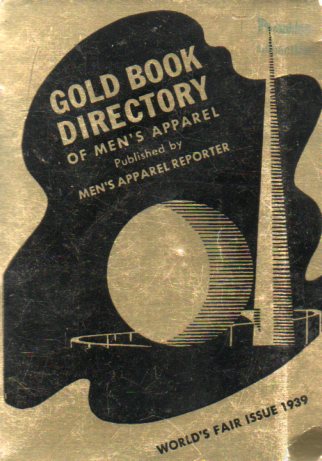
    Apparel904The Gold Book Directory of Men’s Apparel (“published by Men’s Apparel reporter”) was issued for the World’s Fair in 1939–it is a stubby, 320-page, 5-inch-tall and designed booklet, and it is pretty much a mausoleum-y reminder of what once was.  New York had been a center of clothing manufacturing for  a long time, and this pamphlet reminds us of that–and I’m not getting too rosey and sentimental about a tough trade that had its share of abuse of the unprotected,   as there were generations of immigrants who passed through those sweat-box meat grinders choking out pants and shirts for the lower- and middle-class while making pennies-per-piece. The shirt-pocket-sized golden book does remind us of industry that once was, and now moved overseas to perhaps even more vast abusing sweatboxes to produce cheap goods at clothing prices lower than they were (CPI-adjusted) in 1939. 

    It is striking to see the tabbed division headings:  “New York Hat and Cap Manufacturers” (listing 100+ businesses), “New York Handkerchief Makers”(60+!), robes (60), shirts (300), underwear (250), robes (90), evening dress (100), waistcoat (50), cumberbunds (24), label makers (woven (!)75), and of course New York Pajama Manufacturers, weighing in (with a line of pj’s called “Mr. Stubb” for “the short man”) with more than 120 manufacturers.  It is really enough to make the modern reader misty for lost  times.  Now, these categories were not mutually exclusive, and the Zenith Underwear Company could also produce handkerchiefs, but there is ample evidence here of vastly lost and different times–not only in the loss of domestic manufacturing, but also in the disappearance of the need for evening dresses, cumberbunds, waistcoats and (almost-but-not-quite) handkerchiefs. 

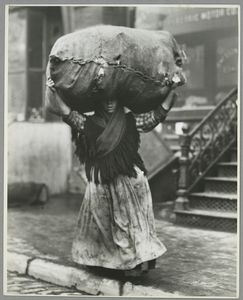
    Here’s a bit that appeared on this blog a little while ago on the grim part of the garment manufacturing industry in NYC (called Ancient Myths Modern: the Other Statue of Liberty, 1911, here):

    A tenement gleaner, New York C... Digital ID: 416509. New York Public Library


  • Blank and Missing Things: Life. An Example in the Discovery of the Obvious

    JF Ptak Science Books    Post 1934

    An entry in the series on the History of Blank, Empty and Missing Things.

    Anatomy--before and after
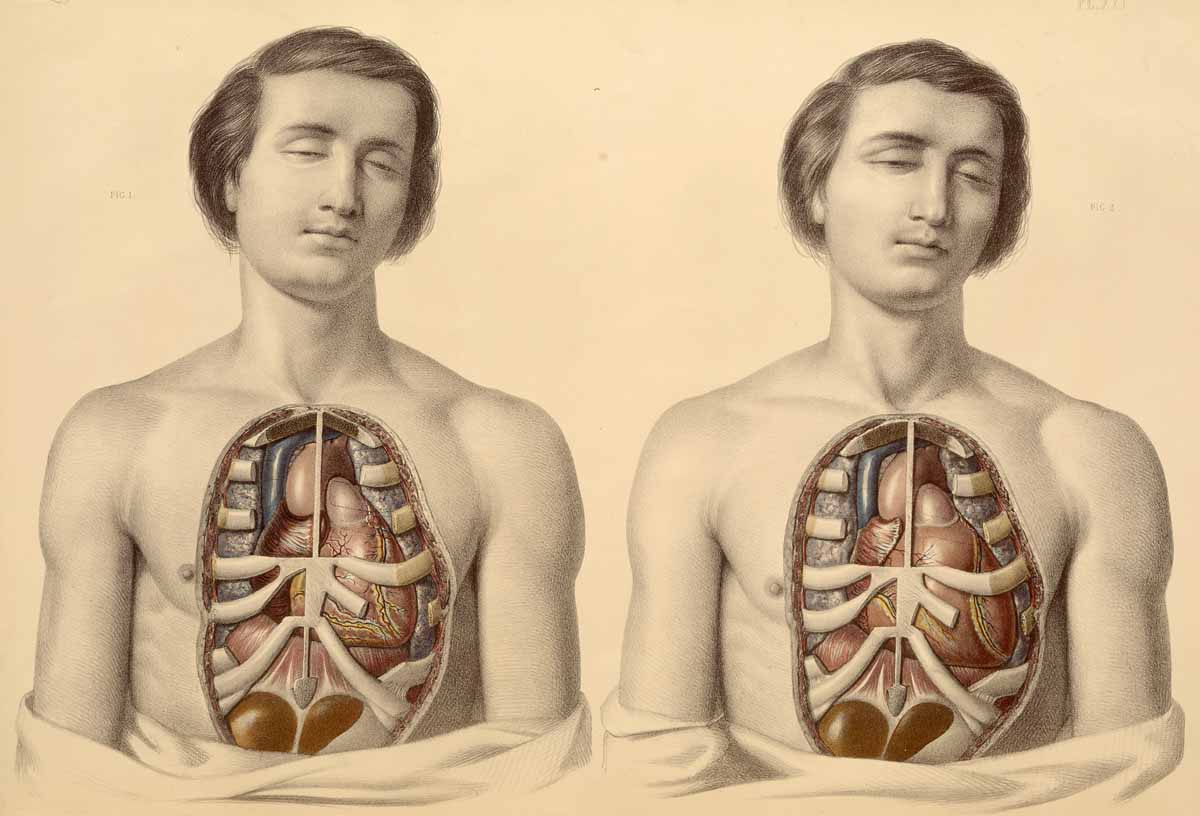
    This is fascinating–the anatomist Francis Sibson (1814-1876) in his Medical Anatomy  (London, 1869) provided descriptive/illustrative examples of what the body’s internal organs look like in cadavers and in living patients.  Offhand I am not aware of such a comparison being done before this date, and as he clearly demonstrates (and which you can see more clearly by expanding the above example) there is of course a huge difference in the anatomy of the living and the deceased. 

    This is an enormous observation that seems as though it should have been made earlier, but perhaps it wasn’t–though it must be admitted that “the obvious” isn’t until it is.  For example, Etienne Durand was the first architect to include examples of plans of different buildings on the same scale side-by-side, and that wasn’t until the mid-19th century–clearly this would be pro forma for just about describing two elements of anything, but it just simply wasn’t done until 160 years ago or so.  This also applies in a way (though there are more complexities involved as to why this is different) to the antisepsis practices of Joseph Lister who in simply washing surgical tools between use on different patients (and hand-washing and the use of surgical masks and so on) increased the chances of surviving surgery by at least 50% (though I think that number is much bigger than that), and these practices weren’t begun until the mid-19th century. 

    So the business of identifying “the obvious” is very tricky, because, well, something isn’t obvious if it hasn’t been done/seen before.  Or, if it has been seen, it hasn’t been seen seen.  As in clouds–as present as they have been for the whole of human history they basically escaped classification by the great human natural history classifiers until the very early 19th century. 

    And when I looked at the history of the word “obvious” it seems to have made its first appearance in print in 1603, so I went naturally to William Shakespeare for a quote using the new word.  Evidently, the great wordweaver never used “obvious”. (See here for an index of all the words of Shakespeare.)

    [Image printed by chromolithography after the artwork of William Fairland, 1869. Source: the National Library of Medicine.]


  • Blank and Missing Things: Land (California as an Island)

    JF Ptak Sciene Books    Part of the series on The History of Blank, Empty and Missing Things.

    The influence of economic strategy seems to be the Old Red Sandstone of the geology of life on this planet, and sometimes it reaches right into cartography, expressing itself in unusual ways.  Such may be the case with the creation of the idea of California beign an island.

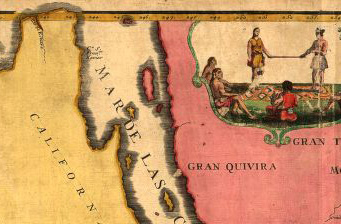
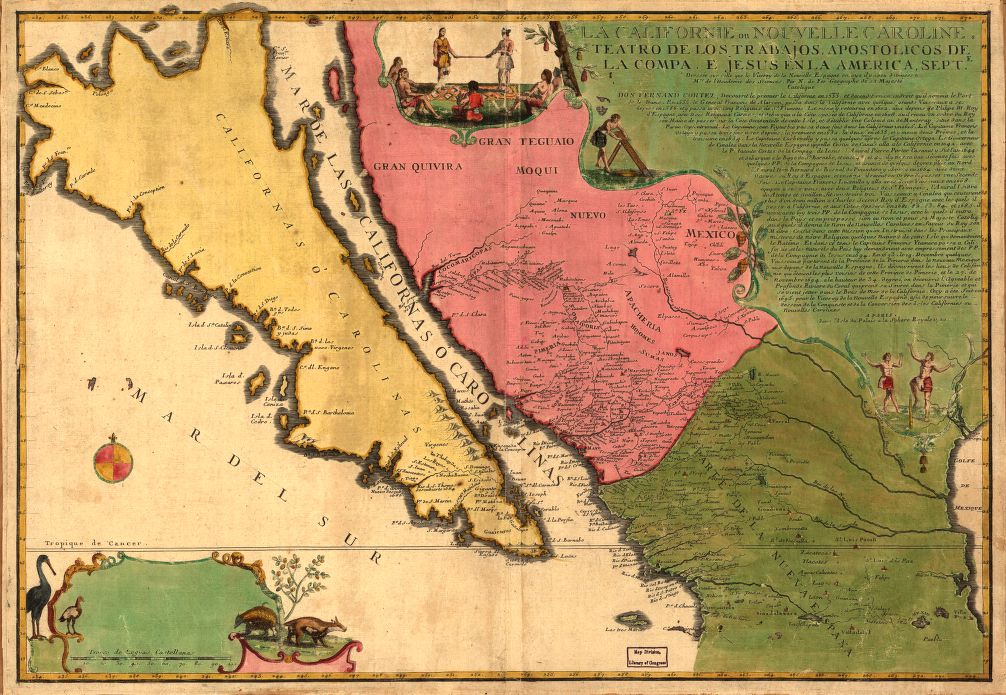
    California as an island det[A detail of a sample map showing California as an island, by Nicolas de Fer, 1720, and depicting the famous missing land at the north end of the Gulf of California.]

    In general, much of the vast expanse of blankness of the continent in the 16th and 17th century was hidden under ornate Baroque cartouches and their encumbrances, which was a tried-and-true method of taking up space on  a map where you didn’t (a) really know what was their and (b) didn’t want to make stuff up to fill in the white space. By necessity most of North America was unknown to cartographers at this time because, well, there was no reliable information to work with.  The far reaches of the middle North American western coastline enjoyed a history of
    connectivity with the large land mass that exists east of the Gulf of
    California, the region known today as “california” being connected to the rest of the continent from the early 16th century.

    About 116 years later, though, cartographic thinking on part of the coast changed.  Antonio de la Ascensíon is credited with first giving flight to the idea that the California Peninsula was in fact an island–and so, beginning in 1620, California would frequently make guest appearances on maps as an island. (Fray Antonio was born in Salamanca in 1573/4 and studied there and at the College of Pilots in Seville; he was ordained in the Order of Discalced Carmelites, and sent off to Mexico. As a cosmographer he accompanied Sebastian Vizcaino (1548-1624) on his expedition to California to find a good port for Spanish galleons coming from Manila, which is when Antonio produced his diaries with the famous island maps1.)  This map was created during a period where there was heavy competition for trade routes and geographical knowledge was actual currency, so there was some amount of cartographic information that was proprietary. When the abbot’s map was lost to/and recovered by the Dutch, the changes that were made to California were codified and published–the Spanish thought it not necessary to correct the misinformation. Perhaps.  In any event, it seems plausible that the Spanish crown had no interest in involving itself with what may or may not have been the loss of proprietary information, and so let the island business slide.  Until1751, when the King of Spain issued a proclamation saying that California was indeed not an island.

    This practice continued to about 1747, when there was more than ample evidence to suggest that the island status of California was erroneous–still, it took several decades for the last of the island-maps to make its appearance. 

     
    California as an island