A Daily History of Holes, Dots, Lines, Science, History, Math, Physics, Art, the Unintentional Absurd, Architecture, Maps, Data Visualization, Blank and Missing Things, and so on. |1.6 million words, 7500 images, 4.9 million hits| Press & appearances in The Times, Le Figaro, Mensa, The Economist, The Guardian, Discovery News, Slate, Le Monde, Sci American Blogs, Le Pont, and many other places… 5000+ total posts since 2008.

Category: Blank and Empty Things; A History of

  • History of Boredom: “Nothing” in the Window

    JF Ptak
    Science Books  Post 802 (from 2009, revised and expanded)
    + window statrers

    Looking at little things has its rewards, though what rewards those are may be a little oblique.  Today’s post is relegated to looking at the sidewalk on a stroll rather than the surroundings, and the sidewalk view is more like Baudelaire’s sidewalk botanist than Proust’s golden Parisian sidewalks. So it goes.
    + window statrersdet

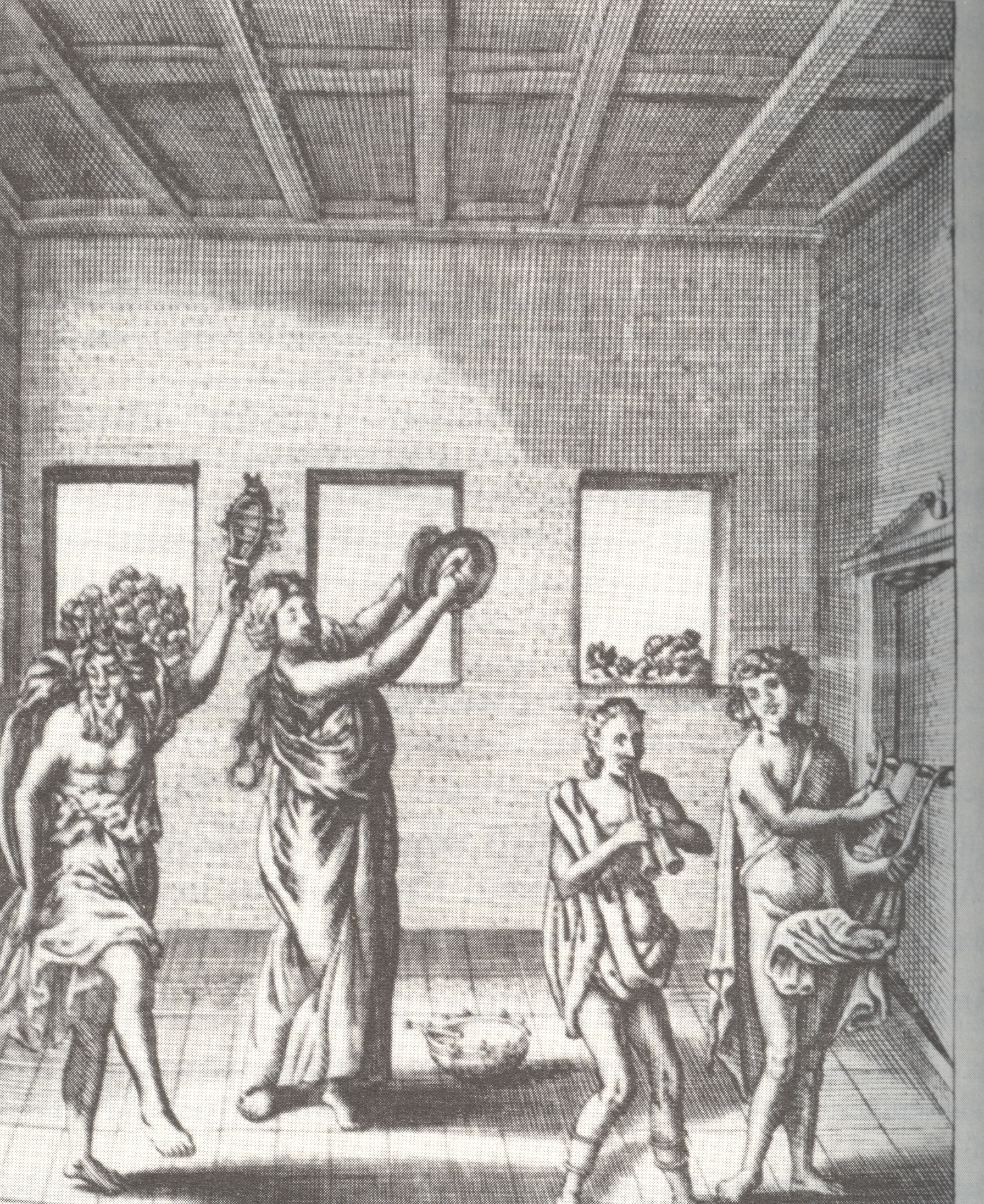
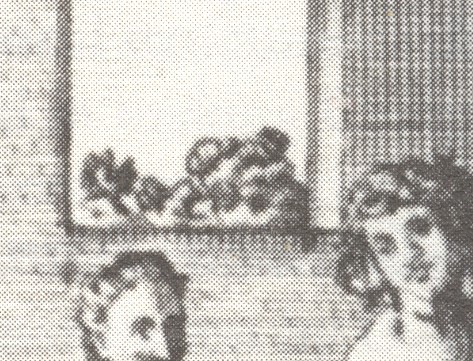
    Petrus Ciacconius Toledanus (Pedro Chacon,1525-1581) was a scholar who wrote on many things; this book, De Triclinio sive De modo co
    nvivandiapud priscos Romanos…(printed in 1664, 63 years after the author’s death) , takes a wide and classically scholarly look at bathing practices…and that includes bathing in water or in wine, and bathing once or six times a day, with dinner in the water or not, what to wear bathside, and all sorts of other bathing entertainments and necessaries.
    Arnolfini

    But that’s not why I’m making this short stop here—it’s the odd bit in this illustration that has my attention.  I’m also not sure about the activity in the print—I’m fixed on the little bit of shrubbery that we can see in the background windows.  Having looked at thousands and thousands of images like this, I must say that seeing natural nothingness like this outside a window is very unusual.  In the unknown, unused and non-existent
    art appreciation genre of “Boring Things Seen Through Windows”, this print would be standard fare.

    But the real issue here for me is that the window is just a window in this print.  It doesn’t have any of the heavy significance associated with windows-in-art of the past, the window dripping with symbolic/spiritual significance (illumination, enlightenment, vision, godhead, divinity).  The window as a simple source of light or vehicle to relieve crowded interiors seems to be
    VanEyck_TheArnolfiniMarriage,detail

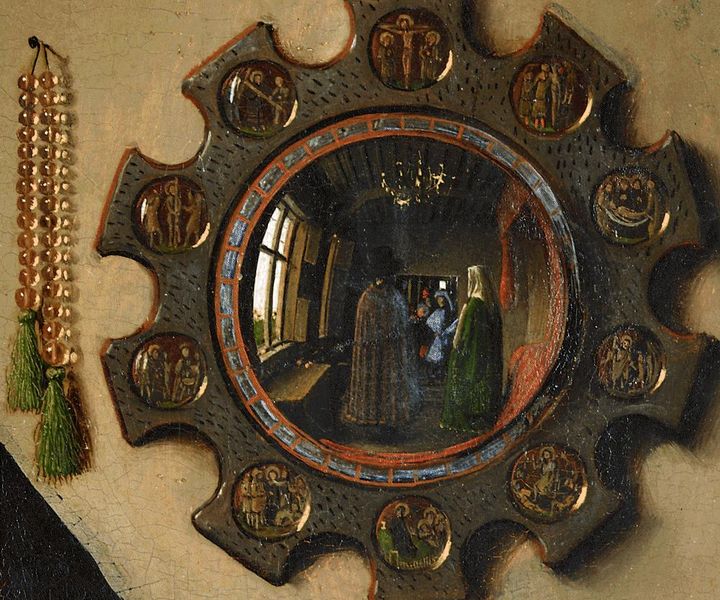
    overwhelmed by the religious/needy windows at least t
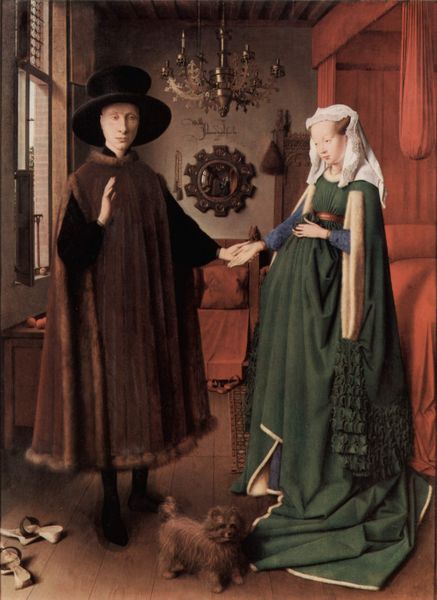
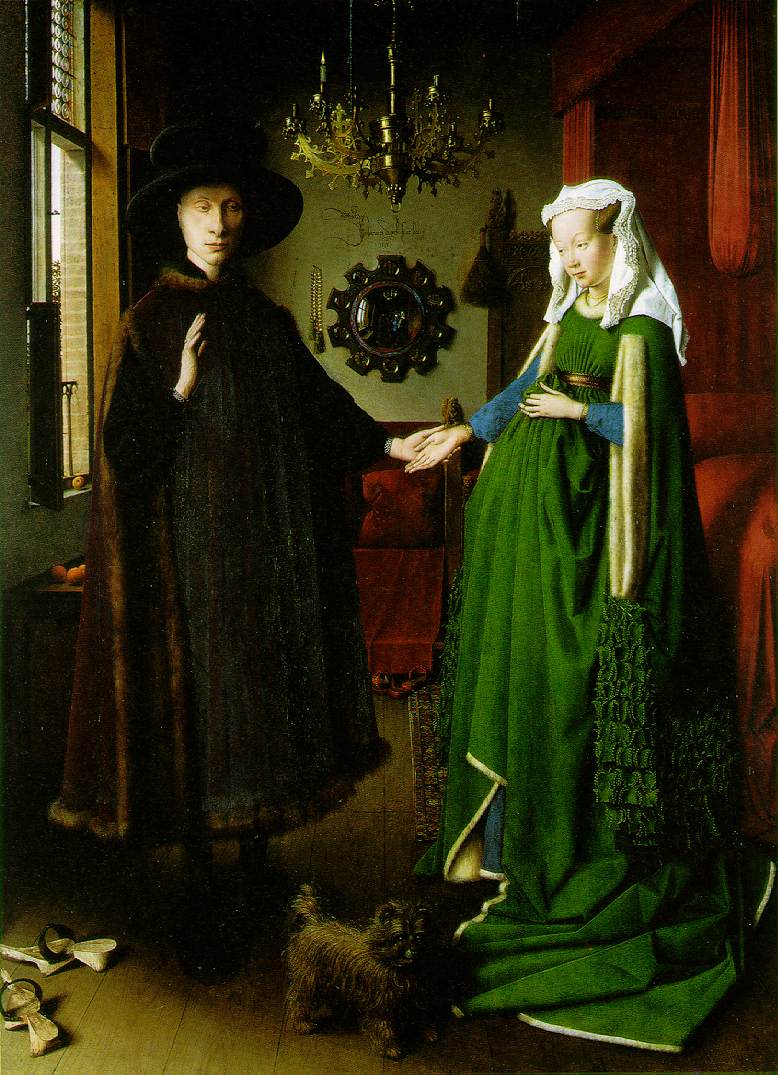
    hrough the first half of the 17th century.  (At least that’s my sense of it—I haven’t a single figure to back anything up.) The little windows that creep into the work of Van Eyck–especially in the famous “The Marriage of Giovanni Arnolfini and Giovanna  Cenami” of 1434—are interesting examples of the window as a simple source of light. (In the “Marriage” painting the window is much more visible in the iconic reverse double-painting seen in the mirror on the wall in the background.)
    St. Jerome

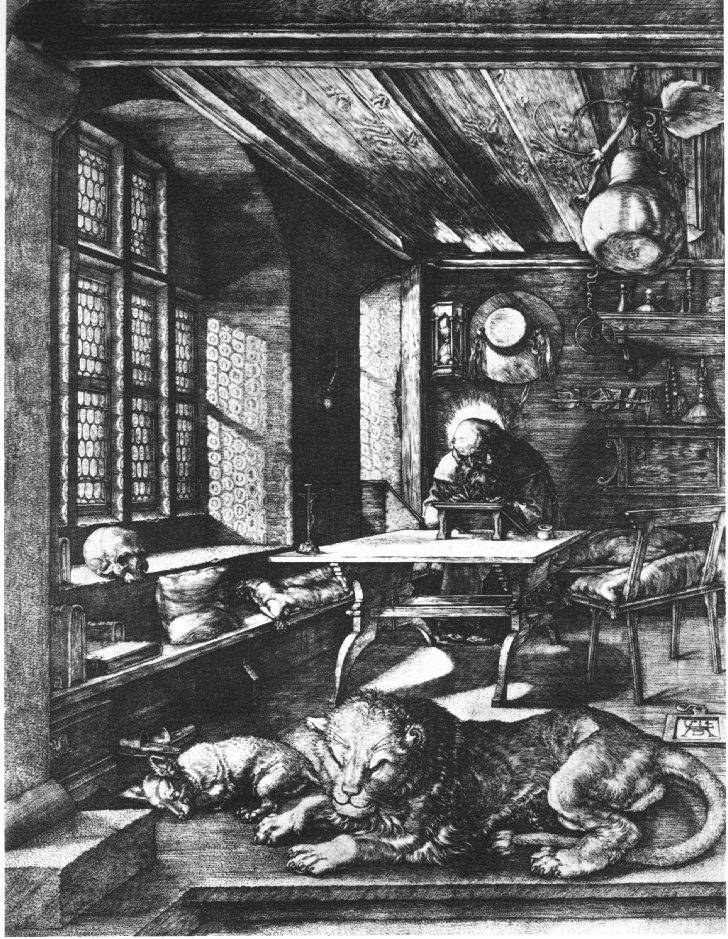
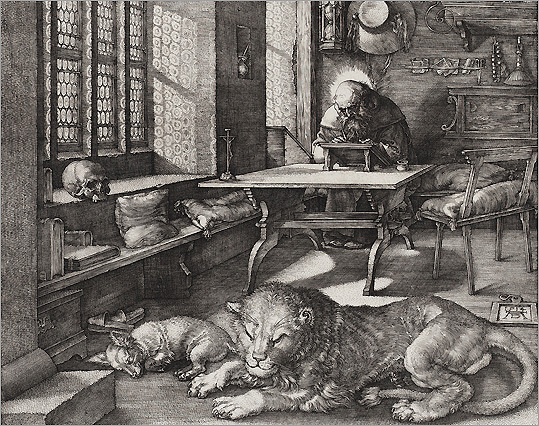
    Same too for the windows in some Vermeers, where you can virtually feel the breeze coming through them and into the  occasionally stuffy rooms.  And also for Durer:  while his great study of St. Jerome has a presiding possibility of Pure Holy Light coming into his room, it might also just be sunlight; on the other hand there is little doubt that the windows in his famous depi
    ction of an artist working a perspective study of a model through a dividing screen have nothing to do with the spiritual, and are just simple mundane windows.
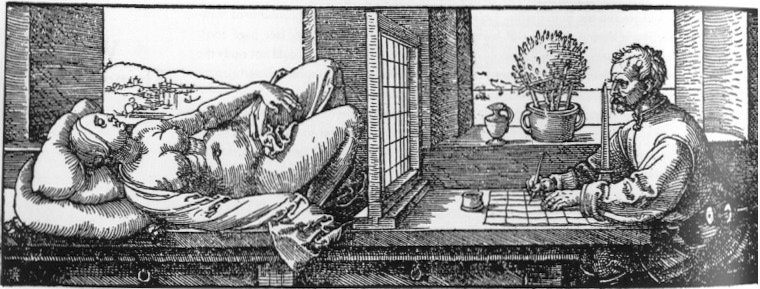
    Durer


    By the 17th century there is a new genre of paintings having people looking out of windows (as with the case of Gerrit Dou, where we observe what seems like every one of his subjects looking out through a window),
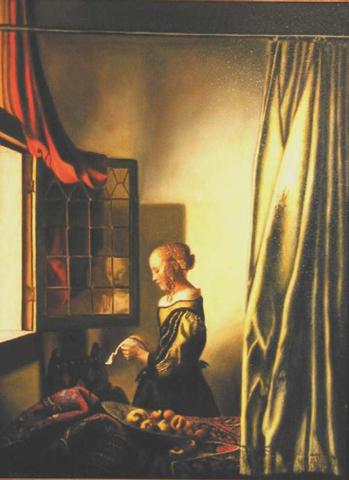
    VermeerGirlAtOpenWindowLetter

    which means I guess that the observer is the one who might shine in.  Enter the 20th century and the window takes on new meanings, as in bent/draped windows in Dali, or floating windows looking into the lonely world of Magritte, or the solitary nothing-but-a-window sculpture of Duchamp. 
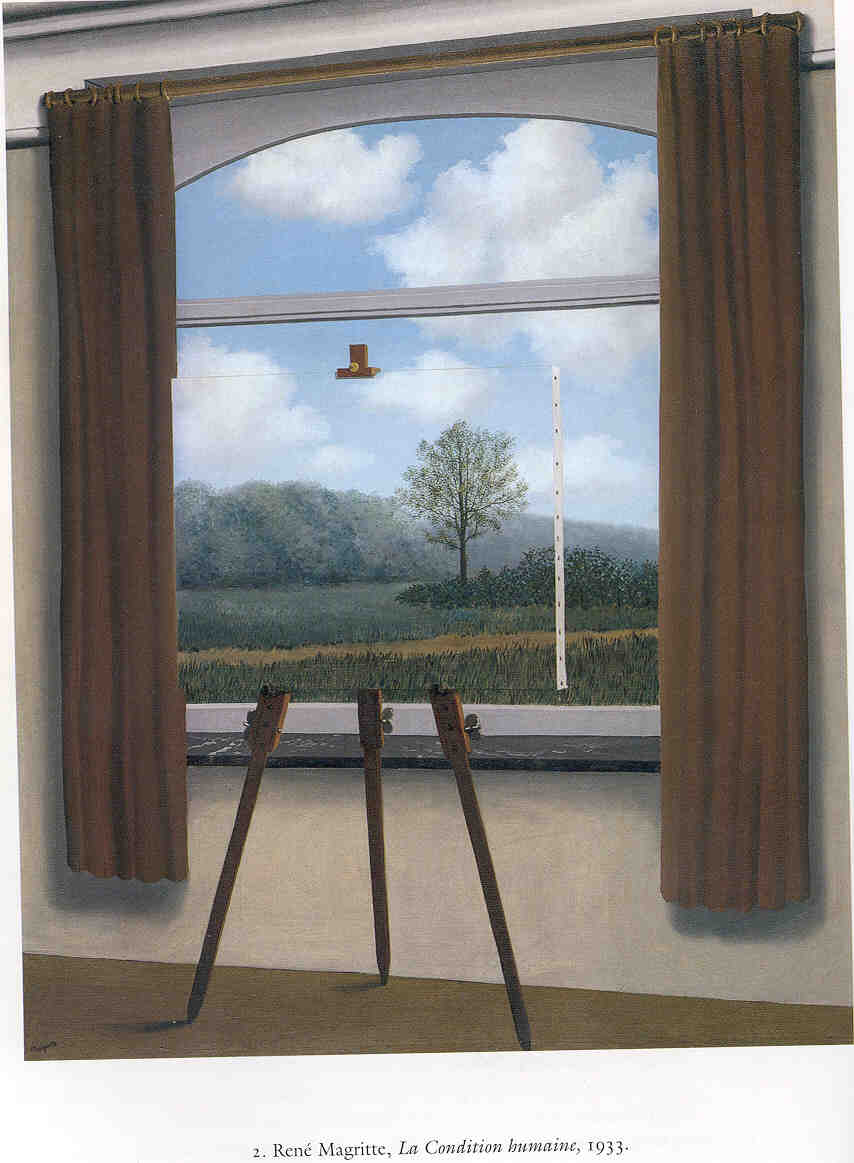
    Magritte

    The unintended nothingness of the 16th century is what I think I like the best.

    Notes:

    For some pretty interesting books written on the window in art, see: Carlo Gottlieg, The Window in Art (University of Michigan, 1981, and which is a nice chronological treatment of the window, plus some psychological stuff) and Suzanne Delehenty, The Window in Twentieth-Century Art (1986), among others.  These will point the way.


  • The Floating Eden of Allendale, South Carolina

    JF Ptak Science Books  Post 2247

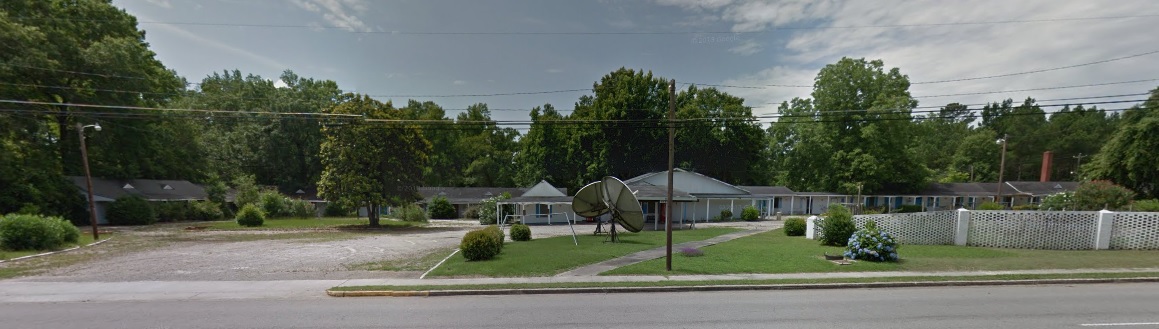
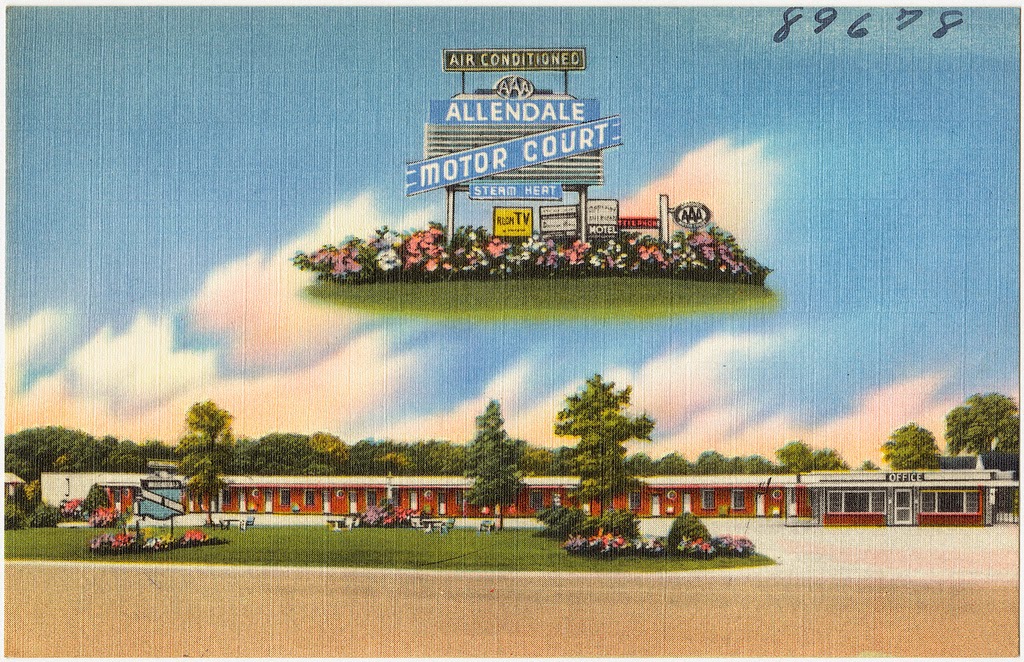
    Allendale motor court

    (From the Passion of Former Days site–with many more Very Highly Colorful examples of motel advertising postcard art, here.)

    Slate Vault‘s Rebecca Onion shared a great post from the Passion of Former Days site, a feature of colors-not-found-in-nature color postcards from the 1950’s or so.  They are all striking, and striking in one form or another above being simply striking, but the most striking for me was the Allendale Motor Court’s floating Allendale Eden.  It is, in its thrift-store-velvet way, a sublime image, a late Renaissance woodblock image depicting normality and piety and an expression of what could come for the obedient and penitent, the promise of the rewarded afterlife (as seen in so many images published in the first 50 years after Gutenberg), lifted from that dusty sleep and re-imagined on this linen-backed postcard promising a happy sleep removed from a dirt road in deep South Carolina. 

    Above all else, whatever it is in this floating paradise, it is all air conditioned. And heated with steam. And with a telephone.  And a “Room TV” (thanks to Linda Anderson for that clarification!)

    And today:

    Allendale motor court today

    The town has seen better days. It is a small place–3 square miles–and has a population of 3,800, down from 4,000 a decade ago.  The tough part is that the median income in Allendale is $16,000, and the per capita is just $10,000, making for a very hard go.  About 60% of the town’s under-18 population lives under the poverty line, as does 41% of the population in general. This makes it a poor city in a poor county of a poor state–S.C. ranks 48th in per capita income in the country ($34,000 against a national average of $42,000).[Source] Another site listing S.C. counties and places shows Allendale at 348th in 368 listed areas in the state, with Allendale county coming in at 43rd out of 46 counties for per capita income.  

    Nearly a third of the town is single-mother households.  That is a hard life.  I don’t know what the percentage of children in town that figure represents–that is, how many of all of the town’s children are being raised in single-parent households…but the number seems big.  Bigger than the big number that is the national average, where something approaching 30% of all American children are being raised by single parents.  

    Somehow this is so even though the University of South Carolina Salkehatchie campus is located there–a public school with an enrollment of 1100 and an academic staff of 57.  Evidently it does not draw much income for the town. 

    Part of this problem surely are the sky-high unemployment figures for the town, which topped out at 22% in the years following the 2008 Disaster.  Today unemployment stands at about 10%, far above the national avergae of 6.6 (whatever)%  There is no telling what these Allendale numbers mean, not knowing how many people simply fell out of the queue for work.  The numbers sound mean and nasty.  

    The floating Eden I think has not been seen in Allendale for quite some time–or at least since Route 95 skirted the town and made one of the major north-south arteries–Route 301–a thing of the past. Or passed.  301 goes through Allendale and in pre-95 times there was quite a tourist trade.  I called the newly-expanded library in Allendale and the librarian I spoke with confirmed this. She did tell me though that for as small a place as Allendale is that they get 150-200 patrons a day, which is about 5% of the town’s population, which is pretty high traffic, per capita.  She was very enthusiastic about her town, and I commmend her for it. “We’re expecting great things to happen in Allendale” she said. And I wish every good thing for her.  


  • Stalin’s Repugnant Haiku: Poetry Using Stalin’s Borrowed Library Book Titles (1926)

    JF Ptak Science Books    Post 2216  History of Blank, Empty, and Missing Things series

    I don’t mean this post to be snarky or irreverent, really, because we’re dealing with one of the most fantastically murderous people in the history of humans.  Since the seven book titles that I have been able to find so far are so, well, unusual, that pulling the individual words out and alphabetizing them might prove to be an insight into the mind of grown-up Soso, Joseph Stalin.  I found the titles while researching Stalin’s report card from when he was a child, and found “Stalin’s Library Card”, by David Wojahn, a poem in seven parts that treats each of the books borrowed by Stalin in 1926, when he was 47 years old. 

    Stalin in 1926 had been General Secretary of the CPSU for two years, in spite of several years of bickering and argument with the stroke-ridden Lenin, who for some years before his death (in 1924) grew more stratigraphically dissatisfied with Stalin and warned the resat of the leadership against him.  After maneuvering against Zinoview, and Kaneneov, and Trotsky, and Bukharin and all of the people below them, Stalin was by this time solidifying his power.  Purges, manufactured famines, internal deportations of millions, executions, imprisonment, and stupid decisions at the beginning of the German invasion of the USSR in WWII, Stalin had his had in causing the death of many millions of people.  

    What did he have in mind in 1926 with these books1? Well, I think we know. There are 36 words used in the titles, including six repetetives, leaving 30 unique words.  There’s certainly enough for haiku if you wanted the taint, and a poem like that could be one that would be difficult to unremember, not (in spirit but of course not in equivalence) unlike the unremembered masses who were forced into “non-personhood” by Stalin, who when he finally died was left out of the very next printing of the Great Soviet Encyclopedia as the Vast Un-nameable. 

    I’m cataloging this entry in the History of Blank, Empty, and Missing Things series because Stalin caused so muuch of that to happen to so many people, to nearly an entire country.  And then he became missing, himself.  


  • Rising to a Higher State of Misery: Books Read by Frankenstein’s “Monster”

    JF Ptak Science Books   Post 2169

    Did I request thee, Maker, from my clay
    To mould Me man? Did I solicit thee
    From darkness to promote me? John Milton, Paradise Lost (X.743–5)

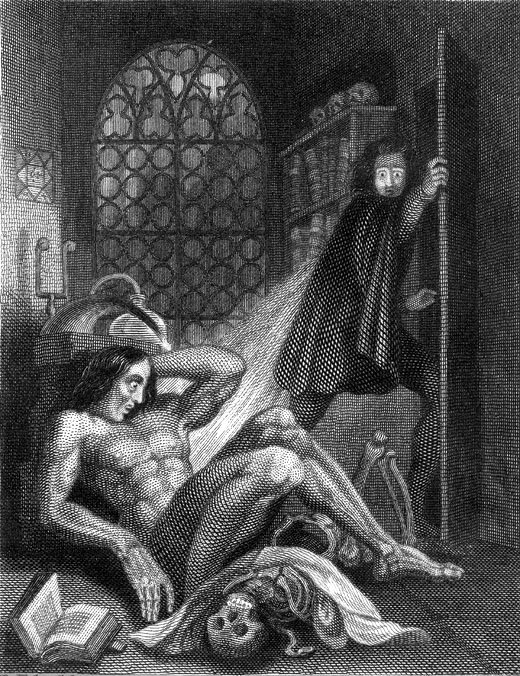
    The animated human created by Victor Frankenstein in 20-year-old Mary Shelley’s anonymously published Frankenstein, or the Modern Prometheus was a far more intelligent being than was ever portrayed in the many movies that made the novel famous in the 20th century. “Frankenstein” refers to Dr. Victor, not the creation, who refers to himself as the Adam of his maker’s labors (and then later as Victor’s Fallen Angel), while elsewhere in the book he is called “it”, as well as “being”, “creature”, “daemon”, “Fiend, “monster”, “vile insect” and “wretch”,  among other adjectival variants. 

    Frankenstein2[Illustration by Theodor von Holst for the 1831 edition of Shelley’s book.]

    “Remember that I am thy creature; I ought to be thy Adam, but I am rather the fallen angel, whom thou drivest from joy for no misdeed. Everywhere I see bliss, from which I alone am irrevocably excluded. I was benevolent and good; misery made me a fiend. Make me happy, and I shall again be virtuous.”

    Mostly the creation is referred to as a “monster”–the word being used 35 times, mostly in reference to Victor’s animated man.

    It is difficult to refer to the creation as a “monster” once you get to know him a little—he is exceptionally smart, teaching himself to read, and then reading difficult and complex works with deep understanding, which is hardly something that is expected from what Boris Karloff gave to us.


  • A Map of Nobody Marching Through the Southern Mountains, 1865

    JF Ptak Science Books   Post 2137  One of a series of posts on the History of Blank, Empty,and Missing Things 
    Follow Me on Pinterest


    Civil war--mil map sherman asheville188

    In the history of blank, empty, and missing things in maps there can be maps with large expanses of nothingness (as in the case seen here with the Bellman’s map from Lewis Carroll’s The Hunting of the Snark, an Agony in Eight Fits), maps with mostly everything that was to be expected to be expected but intentionally wrong (as with these propaganda maps of the Polish and Czech “threats” to Germany), maps with large expanses of nothing because there was simply so data to be displayed, and so on.  And then there are the cases of perfectly good maps that are accurate and secure, but do not display what was thought to be there on the map but wasn’t because it really wasn’t there. 

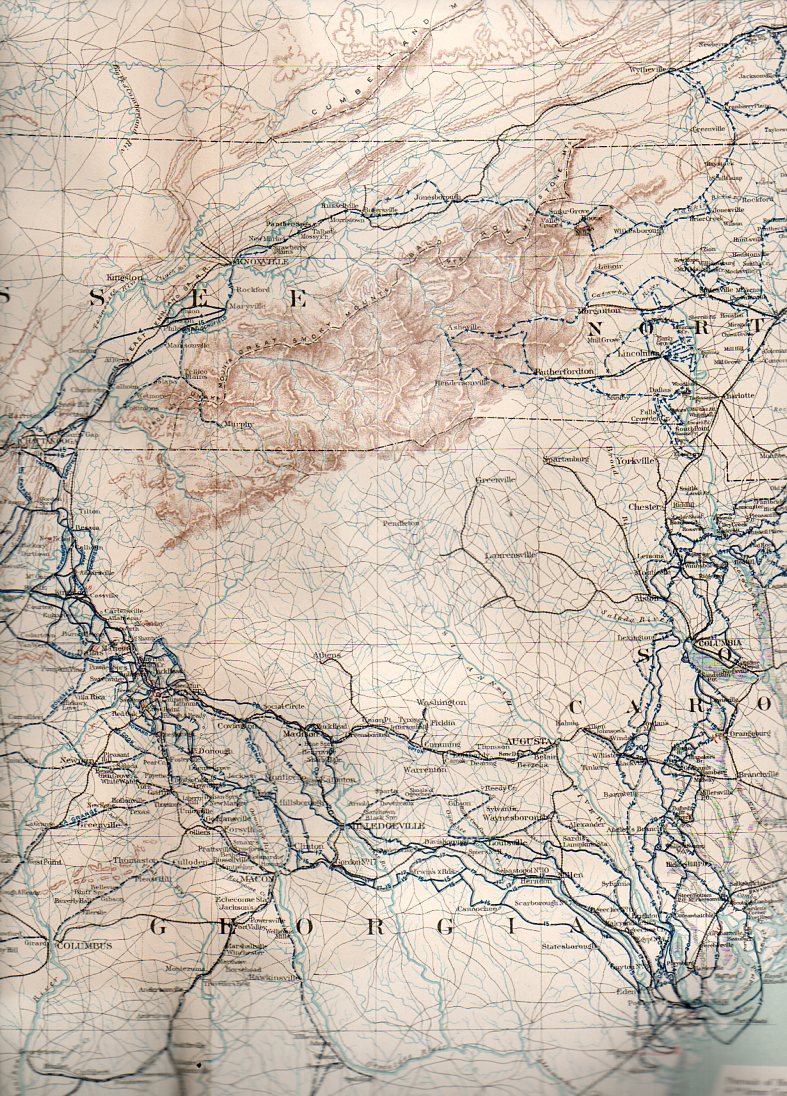
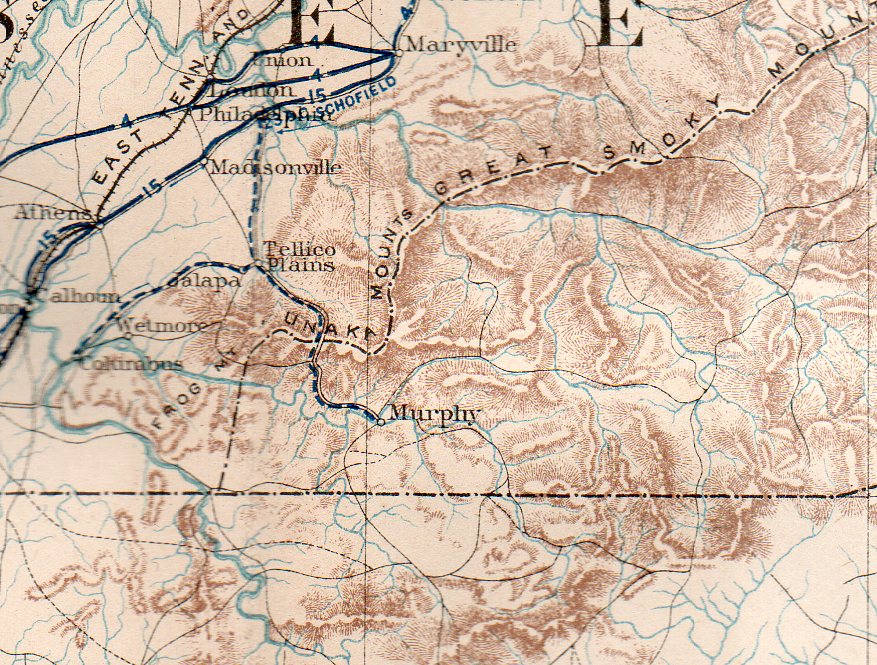
    In the store that I maintained in downtown Asheville, North Carolina, I was often asked about what sort of Civil War action occurred around those parts.  It is the sort of question that jumps out from maps showing troop movements during the war that you see on maps–maps without contour lines, or anything else that might show elevation. The answer to that question about Civil War battles here in the southern reaches of the Appalachians is that there was very little official action–and for the most part the reason for that is because there are in fact the Southern Highlands, and in the mid-19th century this very large region was just too bloody difficult to fight in or fight for. 

    This all becomes cartographically apparent when you look at the region with maps that give you an idea of the terrain. 

    There is an amazing map that shows you the extent to which this land was inhospitable for combat. The Military map of the marches of the United States forces under command of Maj. Gen. W.T. Sherman, U.S.A. during the years 1863, 1864, 18651…., which was originally published in 1865 but more widely known for its inclusion in the Atlas to Accompany the Official Records of the Union and Confederate Armies2 (full text here) in 1895.  As the map graphically shows, there are plenty of blu and gray lines depicting troop movements of the armies, though nearly all swarm around our mountainous region.

    http://farm6.static.flickr.com/5247/5281408282_bdec02e5a4.jpg

    Apart from the difficult terrain, the mountains, and general inaccessibilty, there wasn’t all that much to fight for up here–and so, aside from some regional skirmishes and a lot of political and social conflict, they didn’t.

    Civil war--mil map sherman asheville188

    At least not until the very end of the war, in the Battle of Asheville, April 6, 1865, where about 1500 soldiers met each other about 750 feet away from where we used to live, three days before Appomattox. The action there was indecisive, though Asheville was not taken by Union forces.

    And the detail:

    Civil war--mil map sherman asheville189

    Notes


  • Ungod, Ungodded, and Ungodding

    JF Ptak Science Books   Quick Post

    Follow Me on Pinterest

    Earlier this month I wrote two posts on the un-prefix in words occurring in Joyce’s Ulysses and in Webster’s 1828 dictionary–there were many surprises, including an entire category of new words outside their original intentions. One example that came up today, flushed out while reading in a very erudite but long-nosed and very sniffily dismissive work by F.W. Bussell (Religious Thought and Heresy in the Middle Ages, published in 1918).  The author was a man of very deep and long learning who wrote a bit, thick-as-a-brick-or-two book of high physical appeal. It seemed to me though that his understanding of some “foreign” religions did not broaden his own appreciation of difference in cultures, as some of the heretical belief systems included Buddhism and Hinduism. 

    As much as Bussell seems to put god into various religious equations, he more than occasionally proves judgmental in taking god out of others. Here’s a sampel from Mr. Bussell:

    BussellIt’s a difficult go. 

    And rightly or wrongly it brought up ungod/ungodded/ungoding, the words I bumped into in Webster’s, and so their appearance in the OED:

    UNGOD. To deprive of the qualities or position of deity; to undeify. (Common c1640–1740.)
     

  • When You Leave out the Detail, Where Does it Go?

    JF Ptak Science Books   Post 2140   Part of the series on the History of Blank, Empty, and Missing Things.


    Follow Me on Pinterest

    When modern art was becoming modern, and artists were reveiling more of nature and life by using less of its components and using more of suggestion and motion and color–leaving out the “detail”–where indeed did that detail, well, go?

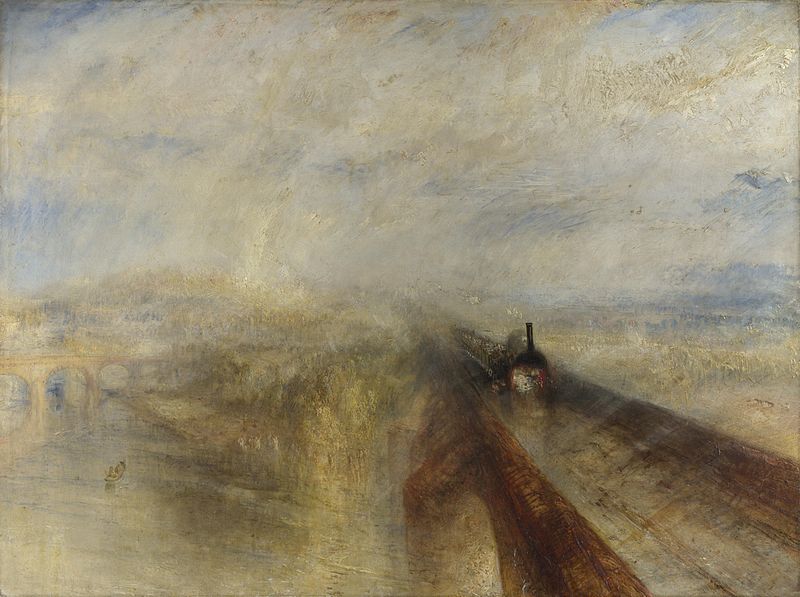
    Detail turnerIt is interesting to imagine a composite world to our’s, a place where that missing and removed detail goes.  For example, when JMW Turner painted a train passing over a river on a bridge, he was more suggestive of the scene than he was in reality-based descriptors.  [Rain, Steam and Speed – The Great Western Railway, 1844.]  The intricacies of realism and reproductional relativity is not there, the action and train and river implied, artistic impressions and whatever else was in the artist’s toolbox or mind’s eye. 

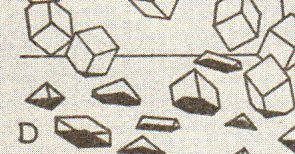
    Perhaps the seeping detail from one world to the next is more like the sphere entering the two-dimensional world of Flatland, or better yet the reverse of Charles Bragdon’s 1drawings of the footprints of 3-D objects passing through a 2-D plane…the detail of the Turner seeping through the canvas and into the opposing DetailWorld, falling like rain. Maybe it is a world of non-representational images and impressions awaiting the attention and arrival of detail to give it all a solid, easily distinguishable representation of the imagined world around the easel in that Other Place.

    Detail bragdon

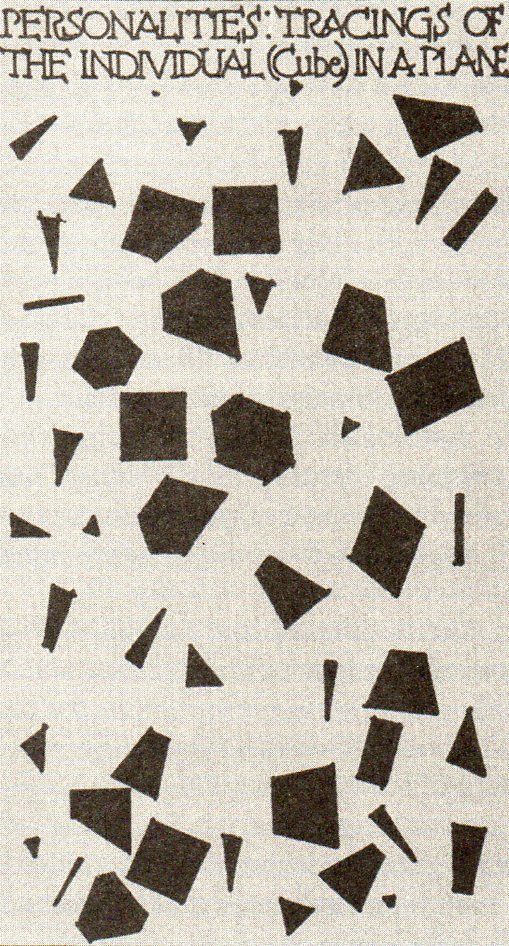
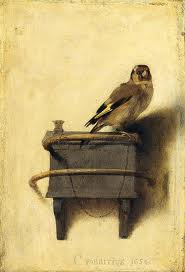
    Another beautiful image by Bragdon is from “Personalities: Tracings of the Individual (Cube) in a Plane” from  Man, the Square2 shows the “shadows” of the three-dimensional figures as they lived in their two-dimensional world.  It comes close to the impact of the cubes above, but really only depicts what two-dimensional creatures would see of the three-dimensional beings inhabiting their Bragdonesque world.  Blog--blagden 1 det349 All of this was put into my mind by seeing this image (The Goldfinch, 16540  by Carel Fabricius.  Clearly we can see a bird on a perch, chained to the upper rung, with another rung below, but as much as we can see  the detail  we don’t.  So much of this image is suggested and implied, hundreds of yers before Impressionism:  the face of the bird is barely there, the second rung dissolves into the wall, the shadows are muted and half-existent, and so on.  The details of the painting are as much missing as they are there.

    Detail fabricius

     And of course the world of detail would disappear more and more, until by 1911, it existed hardly at all, the representational world drifting off the canvas completely, for those who wanted that to be the case. 

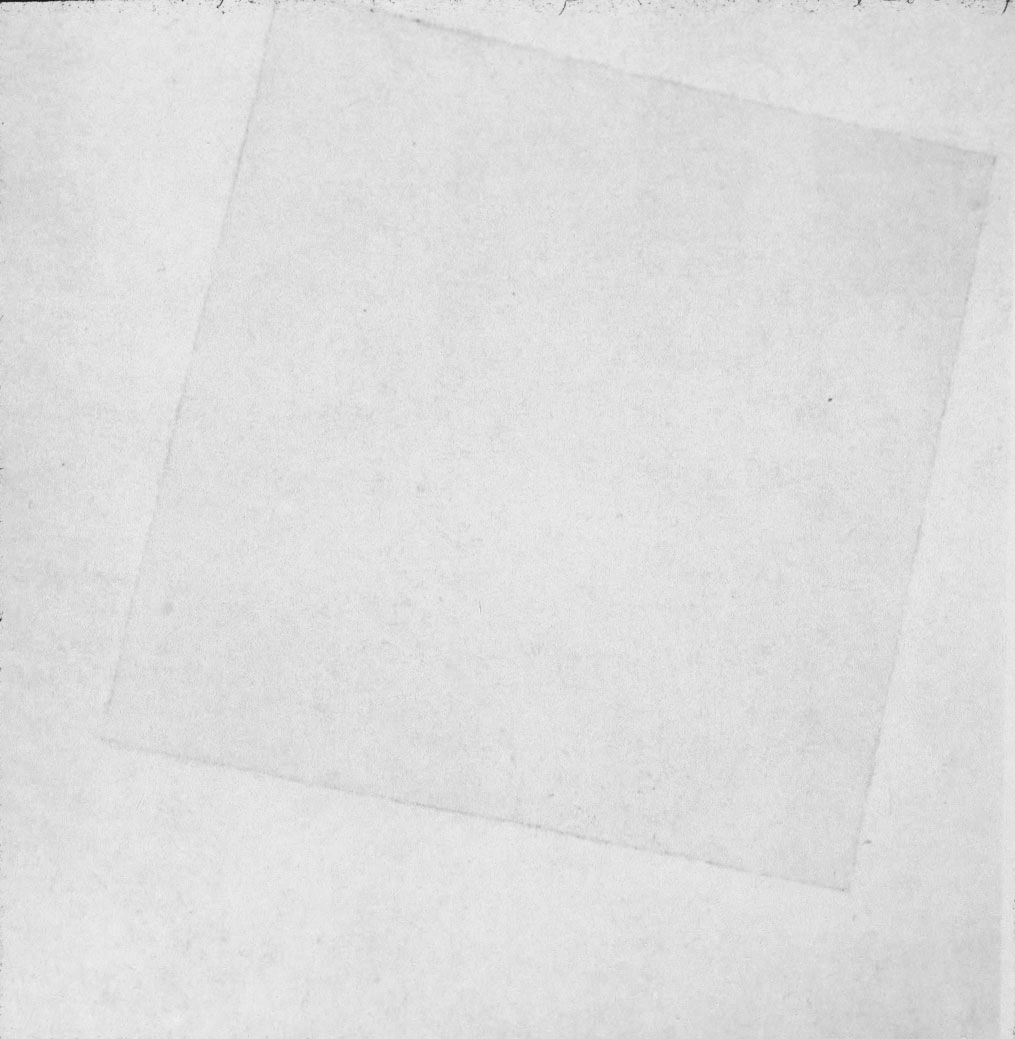
    Again, as much as say Kasimir Malevich made all of the detail go away in his Suprematist paintings like a white square on a white square (White on White, 1917/18, which I can say is not served well at all with images online or in books, as the artwork is really pretty textured and detailed),

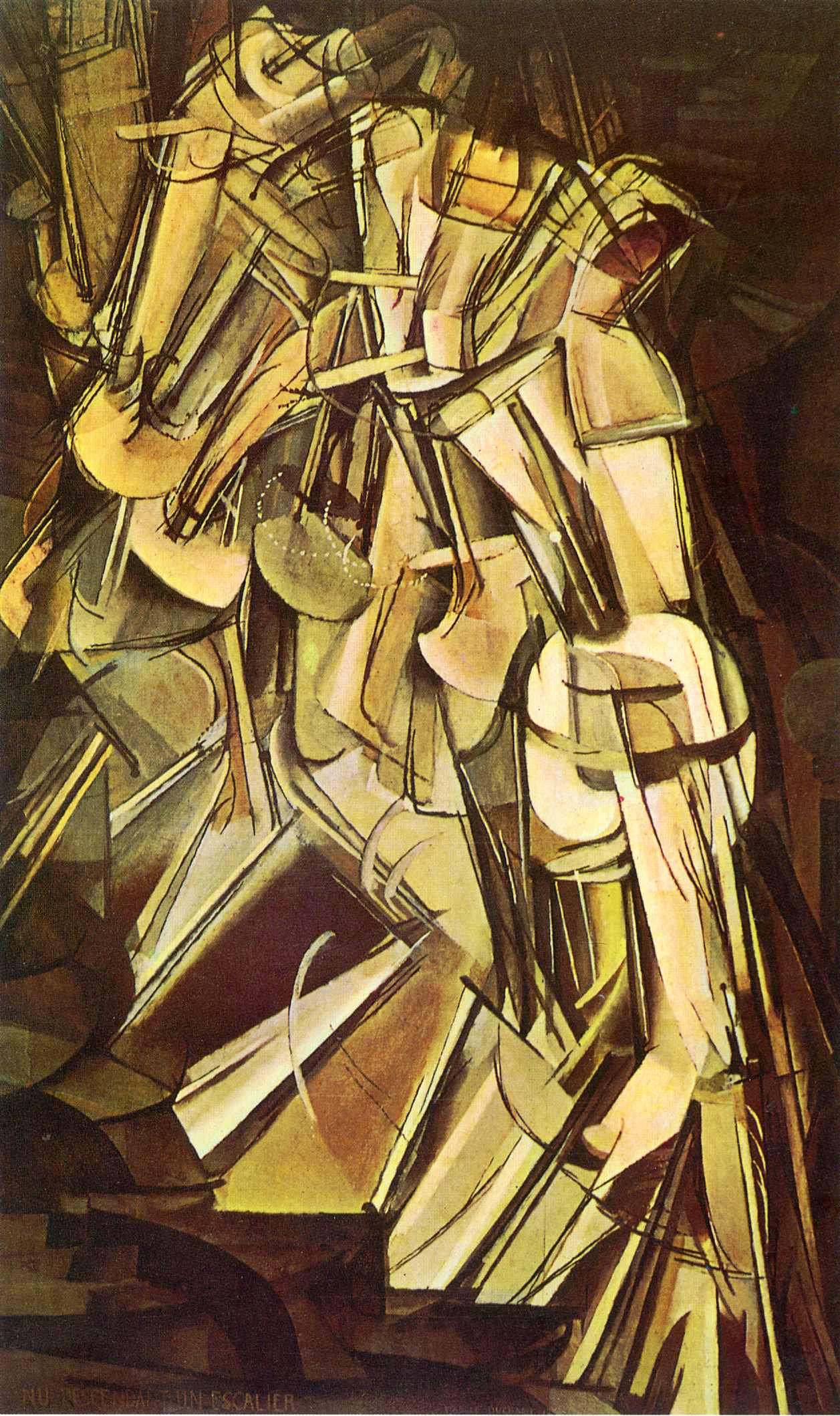
    Detail  white squareat about the same time ither artists like Marcel Duchamp were both taking away details of one sort while adding new details of another never-yet-done sort, as in his Nude Descending (1912), where we begin to see the representation of the fourth dimension in art:

    Detail duchamp

    Perhaps the rain of details into DetailWorld work in reverse for the unexpected details of stuff we can’t see in our world? 

    Well. We know that there is no DetailWorld, but I think it is certainly interesting enough to think of these revolutionary changes in art and trying to imagine the enormous amount of painterly stuff that the innovations/discoveries replaced, if they were to all go to one place.  In a way it is analogous to the changes in the mountain that I can see now from my living room window–mostly it is invisible when the patch of woods between our house and the mountain is all leafed out (seeing the forest for the trees), but with autumn and winter here at about the same time, it is easier to appreciate both the trees that I can see when I can’t, and the mountain that I can’t see sometimes when I can. 

    Notes:

    1.(Bragdon) A PRIMER OF HIGHER SPACE. (The Fourth Dimension). Rochester: Manas Press, 1913. 8vo, (12), 79pp, including 30 plates. 

    2. (Bragdon) MAN THE SQUARE. A Higher Space Parable. Rochester: Manas Press, 1912. 12mo, 34pp, 9 illustrations.  


  • The Zero in Politics

    JF Ptak Science Books   Quick Post  A History of Blank, Empty and Missing Things 

    Follow Me on Pinterest
     

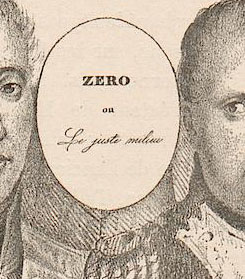
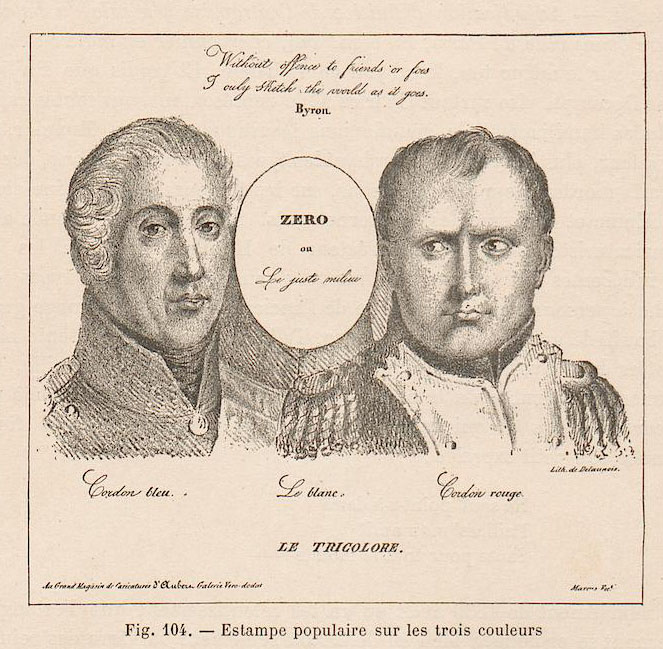
    In this blog’s series on the History of Blank, Empty, and Missing Things there have been I think no contributions to nothingness in the political sphere–which is odd, given how much of the time politics is about just that, staffed by people of that same quality.  The experience of seeing nothing portrayed in a political caricature as seen below was such that it struck me how little I have seen any images quite like it.  The “zero” appears in J. Grand-Carteret’s Les Moeurs et la Caricature en France, a thick book published in 1888 detailing the history of caricature and satiric expression in France.  The image appears in chapter eight, on the political situation in France between 1816 and 1848 (Louis XVIII, Charles X, and Louis-Philippe). (Two years after abdication of Napoleon and right up to the revolutions of 1848.  I wonder what it was like for Napoleon’s mother, outliving her son by 15 years?)

    Blank Napolean_edited-1And the full image:

    Blank NapoleanIt is a overt play on the missing color of the tricolor–the flag and the colors of the flag that came into existence in France beginning with the revolution of 1789, and became the flag of the new republic.  The color of course are red, white and blue (liberty, equality, and fraternity, or perhaps the colors of Paris (red and blue) and the white of the House of Bourbon, or something else.  In any event, the “white” as the artist/commentator saw it, the leader filling that space, was not yet present. 

    The entire book is located at the University of Heidelberg site, here. The book is very highly illustrated, and it also has an appendix with a very useful list of caricature journals (pp 554-620) and biographies of artists (pp 620-675). 


  • History of Blank, Missing and Empty Things, Part 66: Hope

    JF Ptak Science Books  Post 2121  Part of the series, a History of Blank, Empty and Missing Things

     
    Follow Me on Pinterest

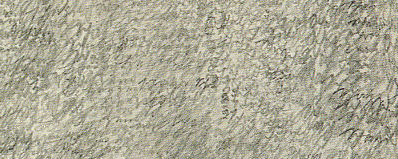
    Outsider Hauck DETAILThis is a detail from an image of great hope lost.  Here’s the full picture, one of many, of hundreds like it:

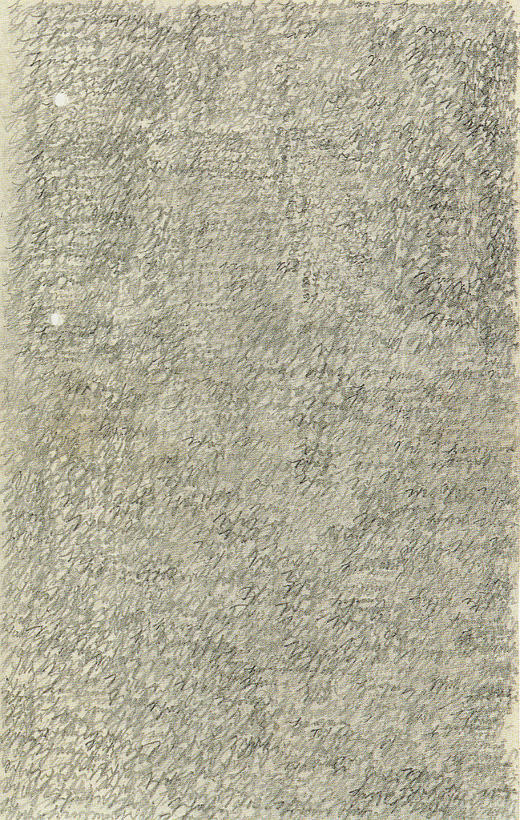
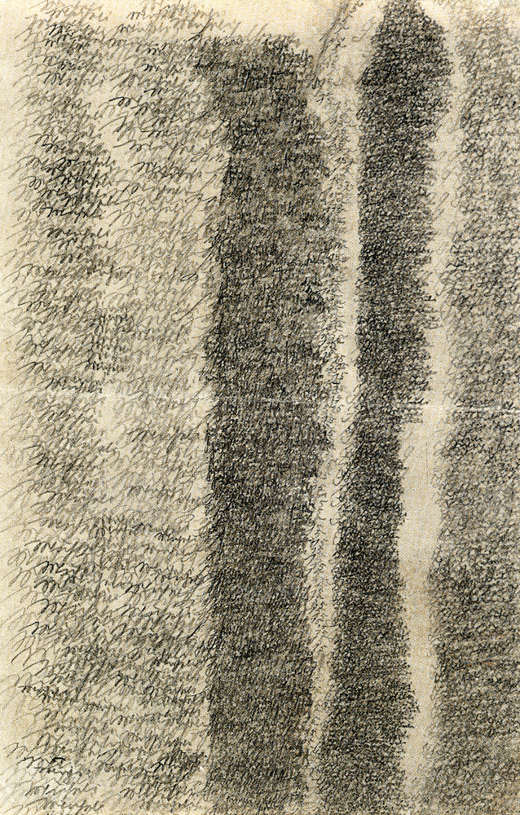
    Outsider HauckThis is a letter from a woman named Emma Hauck, a “pateint”, a committed person, in an asylum for the “fatally” insane, a schizophrenic, an incurable who simply wanted to go home. She was not insane enough to know where she was, not insane enough to not want to get out, not insane enough to know that she was in desperate straights, not insane enough to try to get some help.  Emma Hauck wrote letters to her husband, Mark.  Mostly, the letters were composed of single words (like “kommen, kommen”, “come/come” and “Herzensschatzi komm” or “sweetheart/come”) written concisely and tightly, over and over again, layers of kommen/kommen, so many that there is a geology of letters, though there is no geologist.

    Outsider hauck 2
    The images appear in the book and collection of psychiatrist and art historian Hans Prinzhorn (1886-1933), in his Bildnerei der Geisteskranken: ein Beitrag zur Psychologie und Psychopathologie der Gestaltung1, which was published in Berlin in 1922.  Prinzhorn was among the first in his profession to study the art of the insane, and to use it in diagnosis.  In the meantime, over dozens of years, he accummulated a collection of thousands of works of art (many coming when he was an assistant to Karl Wilmanns at the psychiatric hospital of the University of Heidelberg), most of which are housed today in the Sammlung Prnzhorn (UniversitätsKlinikum Heidelberg, here).

    The Emma Hauck images are astounding, and deeply private, communicating hope and despair in an illegible performance.  Letters sent in hope to her husband to come and save her; letters which were never sent. 


  • The 15 Billion Year Old Monkey and “Gasoline Alley”

    JF Ptak Science Books  Post 2118   Part of the series A History of Blank, Empty and Missing Things  Follow Me on Pinterest

    Concevons qu’on ait dressé un million
    de singes à frapper au hasard sur les touches d’une machine à écrire …
    [translation: Let us imagine a million monkeys typing haphazardly on
    typewriters …”
    1


    Gasoline alley723[
    Gasoline Alley, 1931]

    There are some ideas that leave me with a powerful sense of nothing.

    To me, “nothing” can be very important–especially in writing and speaking and action, doing or saying nothing has been the important and the correct thing to do.  “Nothing” isn’t necessarily an ending, and, just a period or a coma, can just be a placeholder for something that is developing.  There can be long nothings and short one, forever- and micro-nothings, and nothing that is nothing for almost nothing.  Nothing can be implied, insinuated, broadcast and defined, though self-defined extended nothingnesses (like John Cage’s 4’33”) is a tricky thing to make happen with success. 

    The ideas that leave me with a sense of nothing are interesting things.  And there are a lot of them. When I can remember them they are in my nothing file, waiting for nothing–or something–to happen.

    This is the sense I had when I was trying to explain randomness to my 10-year-old daughter and her 11-year-old cousin, sitting out in a park, looking at stuff.  Somehow I reached into the past and pulled up the infinite monkey theorem, and tried to make that interesting, but just couldn’t do it. Maybe it was the difficulty of super-large numbers, or the fascinating but incomprehensible thought-threats of Borges and his infinite library, but I was left with nothing.

    It is Borges who writes a lovely piece on the history of producing everything from nothing, appearing in his “The Total Library” in 1939 (and then again in “The Library of Babel” in 19412), reviewing machines and such of spectacular randomization that could produce the whole of what we recognize as what we know. 

    Emile Borel wrote on it in 1913, finding the possibility of one million monkeys pounding away at one million typewriters.  In his wonderful work, The Math Book3, Cliff Pickover looks at 250 big ideas in the history of mathematics and gives each of them one page only for presentation and explanation.  He approaches the infinite monkey theorem by looking at one monkey wailing away at one typewriter, striking the keys, and analyzing how long it might take for the one monkey to produce one line from one book.  The line is “In the beginning…” at the beginning of one great nothingness, from the Old Testament, a 56-object sentence (including punctuation and spaces) and, Pickover reasons, that if there is a 93-character keyboard,then this monkey will have a 1/9356 possibility times 10100 of getting it right, and that if it worked for 24 hours a day striking one key every second then it will have used all of the time in the present universe–the Big Bang Monkey.

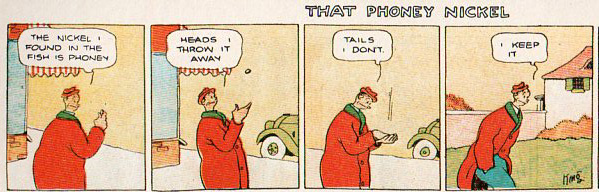
    All I got back were big stares, and a big sense of nothing in my gut.  It reminded me of the cartoon featured above, a toss-off sub-cartoon in a panel of the Gasoline Alley series.  Did he actually look at the coin?  Did he just decide to keep it?  And why keep a phoney nickel? And who counterfeits nickels, even during the Depression?  What is the outcome of the panels–just some guy walking down the street with a nickel in his pocket.  Something may have happened, but it was a lot of nothing. 

    I know that I should have a bigger sense of what Felix Edouard Justin Emile Borel and Jorge Francisco Isidoro Luis Borges were writing about and in many ways I do, but in the end I know that I am left with nothing.  But I have it in my pocket.  

    Notes

    1. Émile Borel (1913). “Mécanique Statistique et Irréversibilité”. Statistical mechanics and irreversibility) J. Phys. 5e série 3: 189–196.

    2.  Jorge Borges,  “La biblioteca total” (The Total Library), Sur No. 59, August 1939. Translated by Eliot Weinberger, in Selected Non-Fictions (Penguin: 1999)

    3.  Clifford Pickover, The Math Book, (2009), Sterling, page 328.