A Daily History of Holes, Dots, Lines, Science, History, Math, Physics, Art, the Unintentional Absurd, Architecture, Maps, Data Visualization, Blank and Missing Things, and so on. |1.6 million words, 7500 images, 4.9 million hits| Press & appearances in The Times, Le Figaro, Mensa, The Economist, The Guardian, Discovery News, Slate, Le Monde, Sci American Blogs, Le Pont, and many other places… 5000+ total posts since 2008.

Category: Bad Ideas

  • An Enormously Modest Proposal–Toilet Paper as a Social Medium, 1932

    JF Ptak Science Books LLC  Post 998

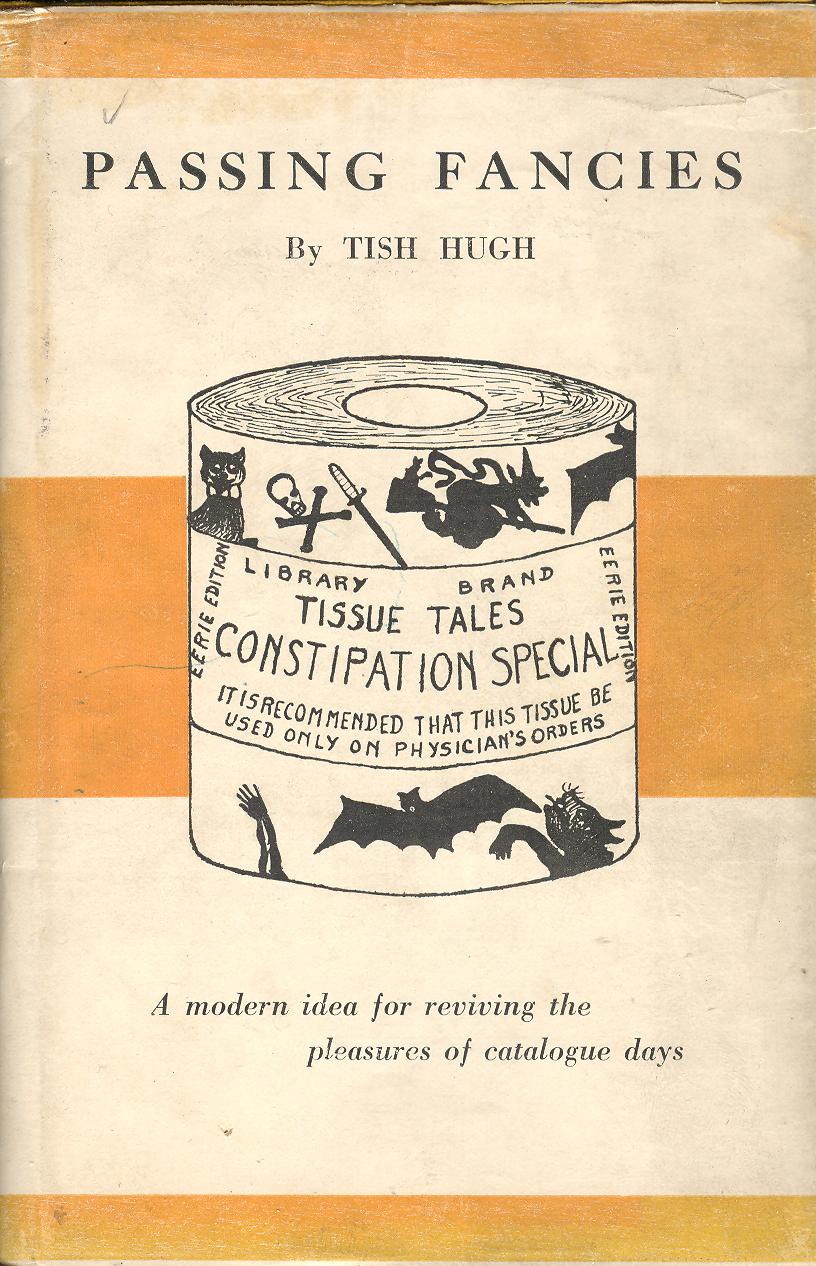
    In the days before the well-rubbed catch-phrase “social media” was thunk, and in the days long passed the era of twice-daily postal delivery and four daily editions of newspapers, a man named Henry M. Robinson–writing as “Tish Hugh”– wrote a small book proposing toilet paper publishing/social interface.
    Blog--april 4 toilet paper tp

    Passing Fancies, published in 1932, extols the virtues of spending “alone time” with a passive interactive medium.  He rues the days that mail order catalogues were replaced by toilet tissue as a medium of cleanliness conveyance, saying something to the effect that a great deal was lost replacing the pages of goods-for-sale with plain whitish tissues.

    And so to the rescue of the lonesome and bored goes Mr. Robinson, who suggests that toilet tissue be sold imprinted with newspapers, novels, biographies, historical fiction, and so on.  They would be vertical issues of your favorite reading material, including magazines, everything included–except food advertisements.  Mr. Robinson notes that olfactory memories of reading food advertisements while “actively engaged” could lead to “disastrous”  associations with the advertised product.  

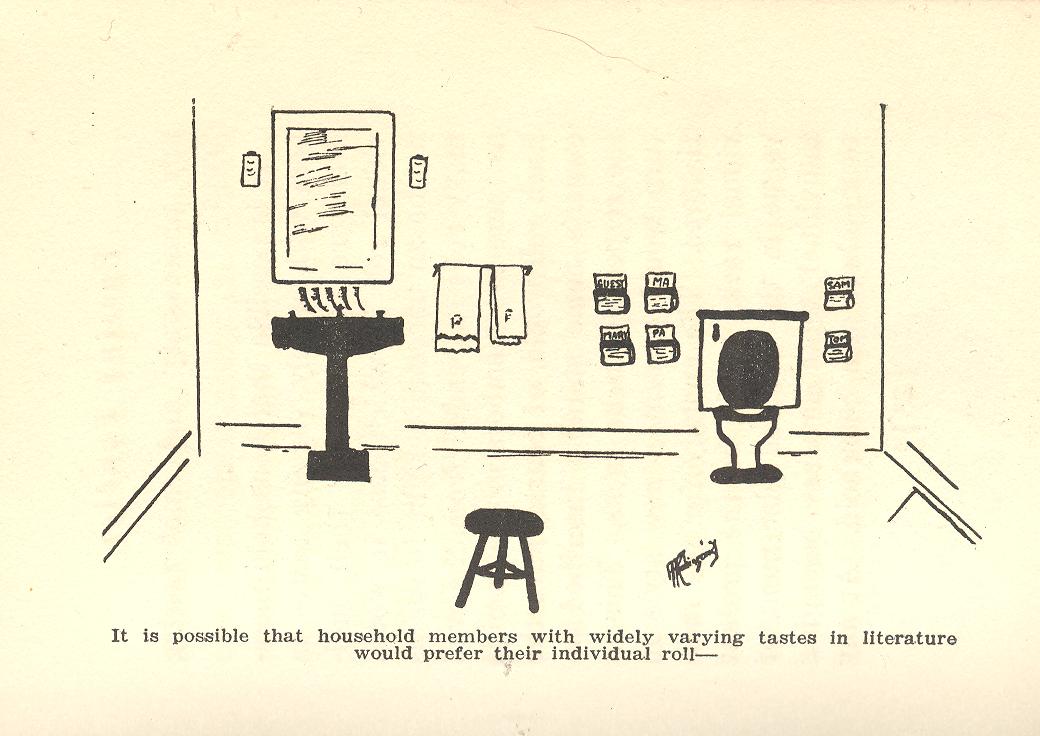
    Also suggested in the slim and stubby book’s 32 pages:  multiple-rolled bathrooms, with tissue rolls for individual family members according to their interests.  

    It is a somewhat interesting proposal, and evidently may very well be among the earliest to suggest a deeper commodification of toilet paper as a delivery system for the written word.  The aspect for earlyness for this idea seems a little shaky, as toilet paper as a mass-produced (and available) item was already at least fifty years old by 1934, but sometimes it takes a long time for something that looks obvious to take effect.  Perhaps it took so long in this case because it wasn’t a particularly good idea.

    I am positive that Mr. Robinson paid no attention to the critics or reviewers of his work. If so he could always have paraphrased the stout assessment and response made by the musician Max Reger to one of his (harsher) critics: ‘I am sitting in the smallest room in my house,” he wrote, .
    ”I have your review in front of me. Soon it will be behind me.”

    (Earlier in this blog I wrote a post on the most important innovation in the history of the prolongation of human life–the flush toilet.)
    Blog--april 4 toilet paper multi

    ·Posted by :

    ·in:

    —

  • America Co-opts Canadian Flying Saucer Program, 1954.

    JF Ptak Science Books LLC  Post 997 

    Blog--april 1--saucer pilot
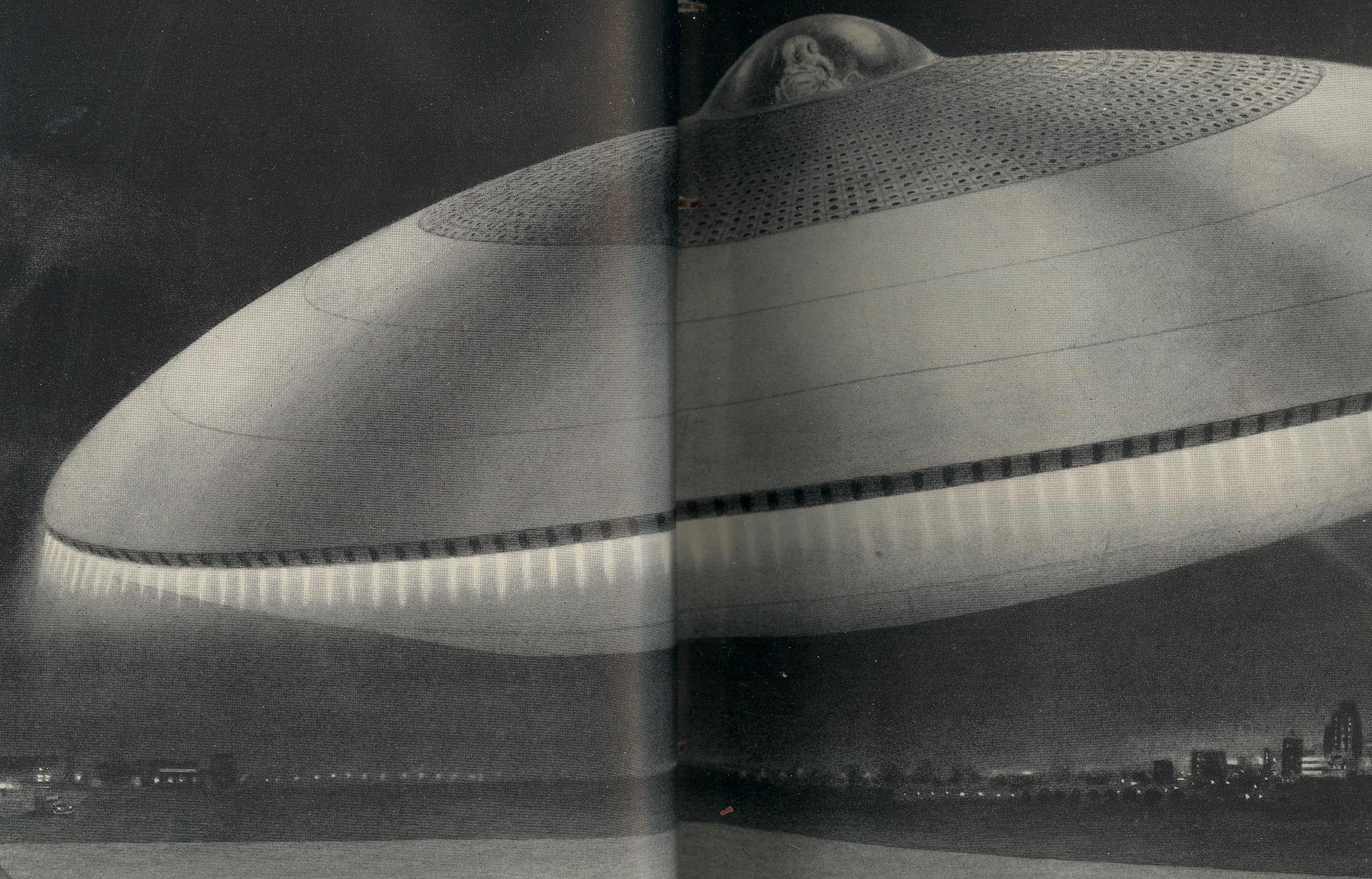
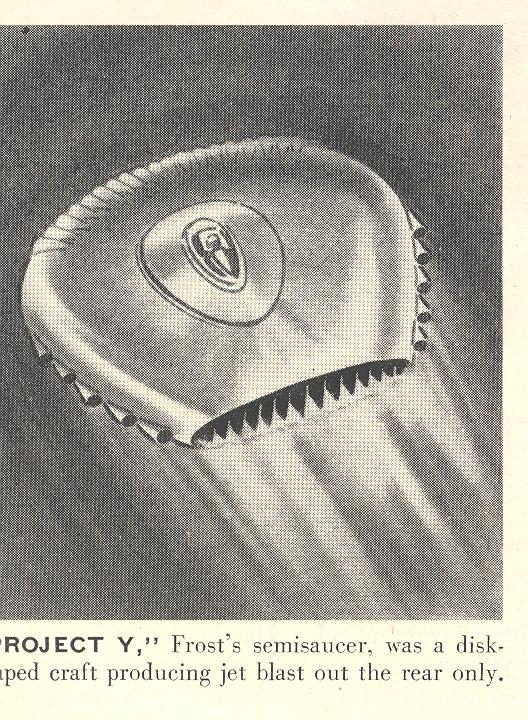
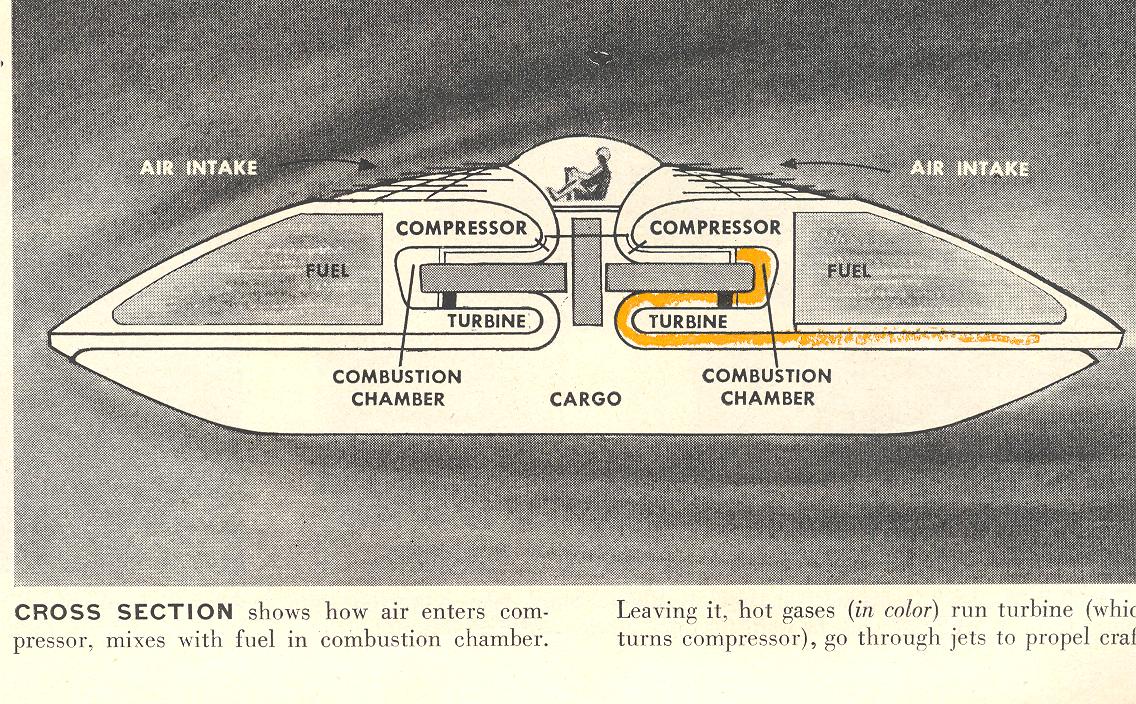
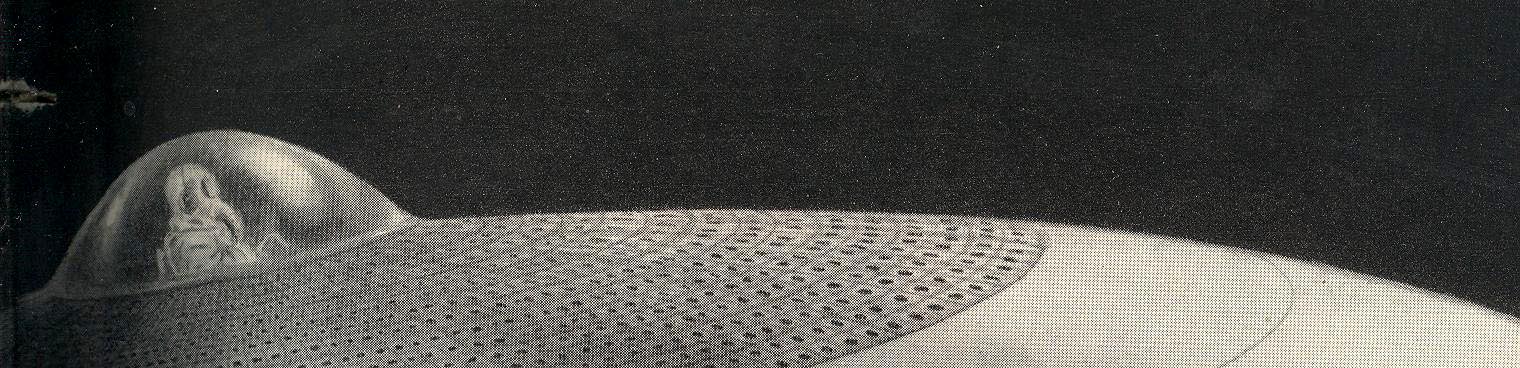
    “Fling Saucers” weren’t ten years old by the time that John C.M. Frost–an engineer from De Haviland–came up with the idea of re-fitting his swooping-shovel shaped idea for a rocket plane with a saucer-shaped one.  He worked hard on his idea, spending some $400,000 on the project–Canadian.  Frost was in Ontario and working for the government before the government stopped working for him, abandoning the undertaking (called “Project Y”) just as the United States became interested in it.  

    Blog--april 1--saucer

    There are numerous reports around the web on this aircraft, so I’ll just provide a couple of starter links here and little commentary.  What I was most intrigued by in this whole affair of producing a 2,500 mph hovercraft was that instead of having a U.S. Air Force star somewhere on the aircraft the thing could’ve been running around with a red Maple Leaf.  

    Blog--april 1--saucer semi

    Don’t get me wrong, I love Canada–went to school there, I did–but the idea of a combat-ready flying saucer with the maple leaf on it is just completely, well, wrong. 

    Blog--april 1--saucer det


  • Outsider Logic Department: the Fabulous Curative Necessity of Fatty Meats

    JF Ptak Science Books LLC    Post 989

    [see also my related posts on Women Meat Pioneers and of course Meat String and Curled Hair]

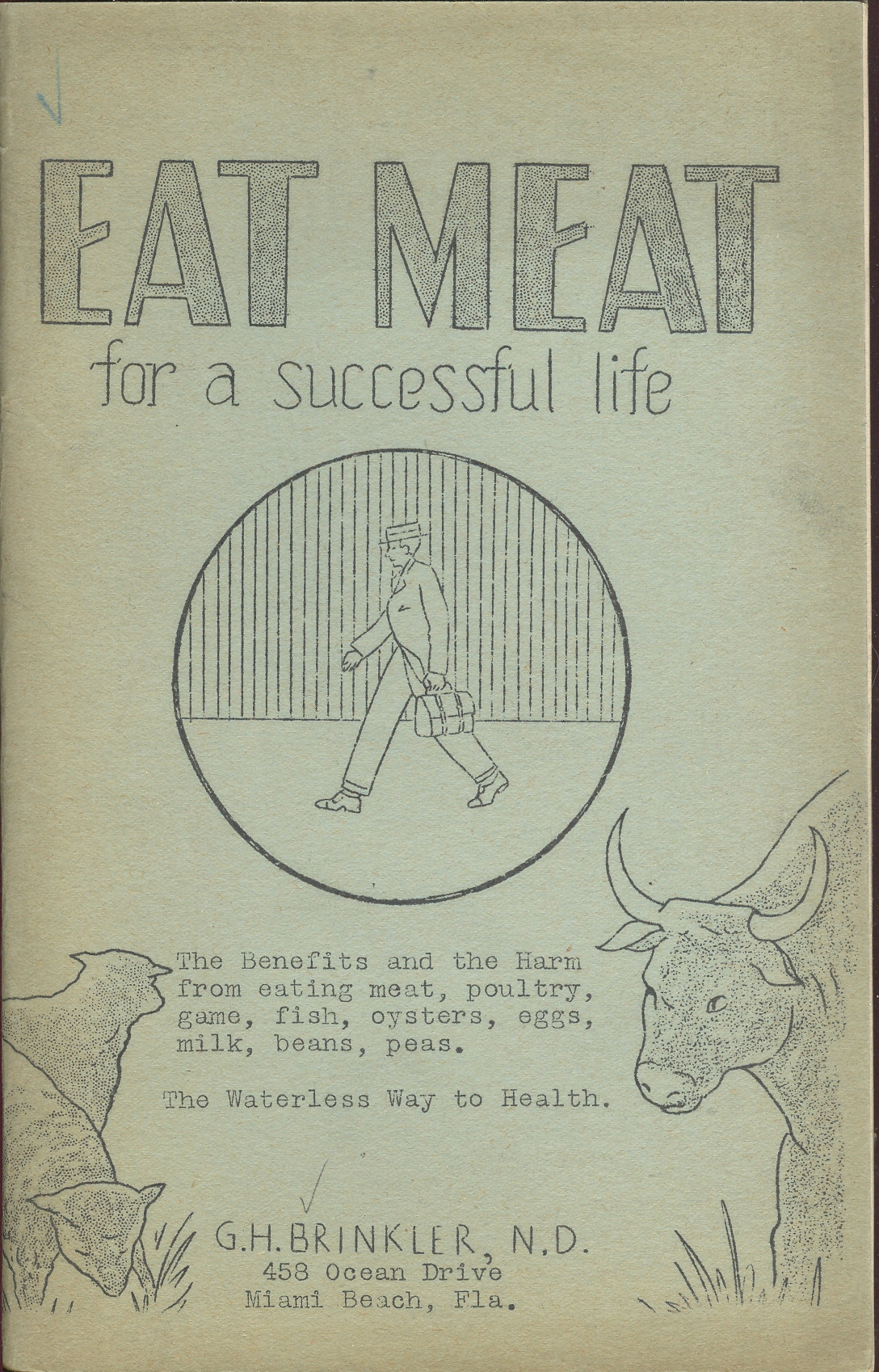
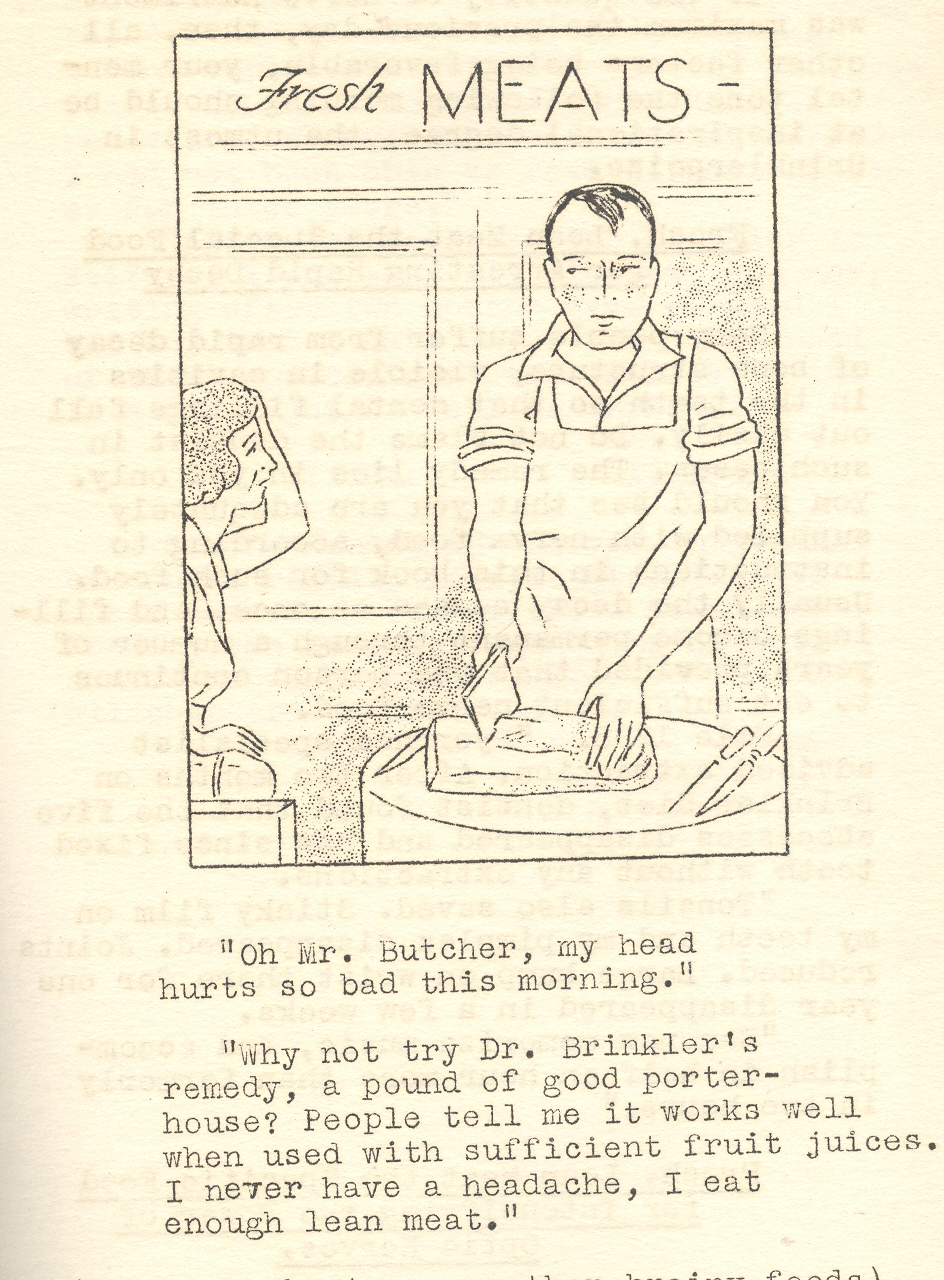
    I have a suspicion that the author of Eat
    Meat for a Successful Life
    , G.H. Brinkler 
    (a “N.D.”, doctor of nauturopathy,  from the American School
    of Naturopathy and the tautologically-surprising “founder” of the “Brinkler
    Club”) had a compromised and possibly antagonistic personal history with
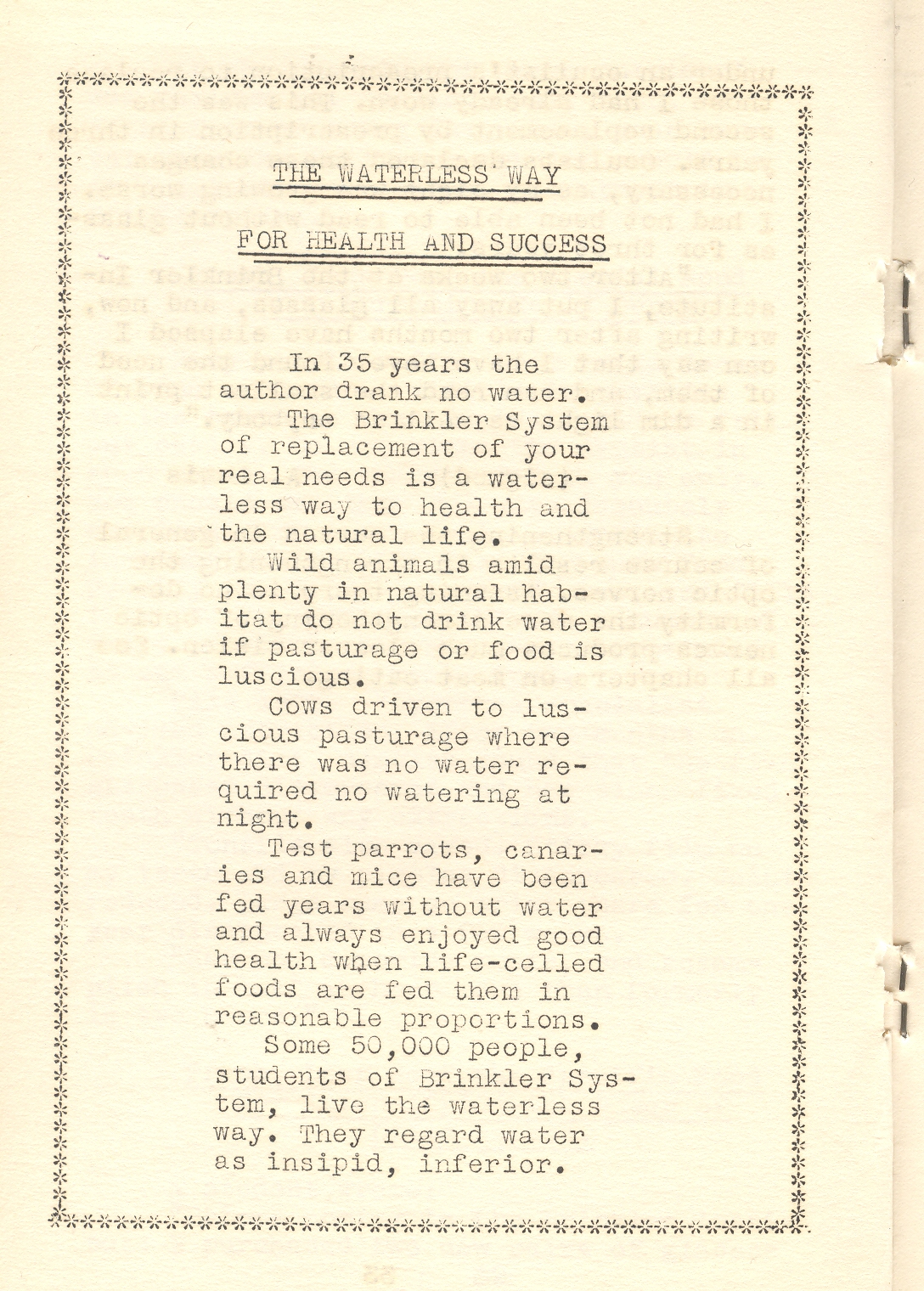
    vegetables.  And water, as Mr. Brinkler
    is also the originator of the “Brinkler
    Waterless Way
    to Health”, and a man who claims not
    to have drunk any water in 35 years. 

    Mar 26 eat meat

    Most humans don’t do so well without water after a few days, though there
    are extreme cases where people have survived for several weeks without water.
    To have survived 1,820 weeks seems pretty much to be well on its way to being a
    vastly under-appreciated record of human endurance.

    Mar 26 eat meat water 001

    But the main story here of course is the meat, with the waterless bit woven
    through it like heart-ending marbling in a butt chop.  Meat, as we are told by Mr. Brinkler, is
    pretty much a “natural fixer” for just about anything.  Lazy in the morning?  A pound of pork on the broiler will cure
    that.  Sexual inadequacy?  Solved with meat (ingestion).  Poor memory?–the answer:  meat, and lots of it. And not only just meat;
    it definitely needs to be not lean. Big fatty meats are the greatest source of the
    desired “muscle food”; lean meats, unfortunately, are only “nerve foods”. Somehow
    the meat mixed with the waterless way induces the “nerve-ends” into a “more
    natural” and strengthened existence.

    Mar 26 eat meat water

    The Brinkler follower should also chew their meat less.  “The masticating fad might result in tiring
    the jaws and gross undernourishment”.

    I could go on and pull further quotes out of context from this piece, but
    that would be mean. The pamphlet (1934) I have is the U.S. Copyright Deposit copy, and I suspect that there may not have been many copies other than mine. I think that all the
    man was trying to do was sell broilers. 


  • “Women are Human, too”: Human Resource Workbook for Females, 1943

    JF Ptak Science Books LLC  Post 988

    In the history of archaic thought it doesn’t take very much at all to reach
    the uncomfortable bits in the sulfurously tangled history of the subjugation
    of women. But it is most interesting when you find the points at which the “backward-looking”
    archaic parts are actually somewhat forward-looking for their time.

    Mar 25 women equals but

    Mar 25 women are humans cvr

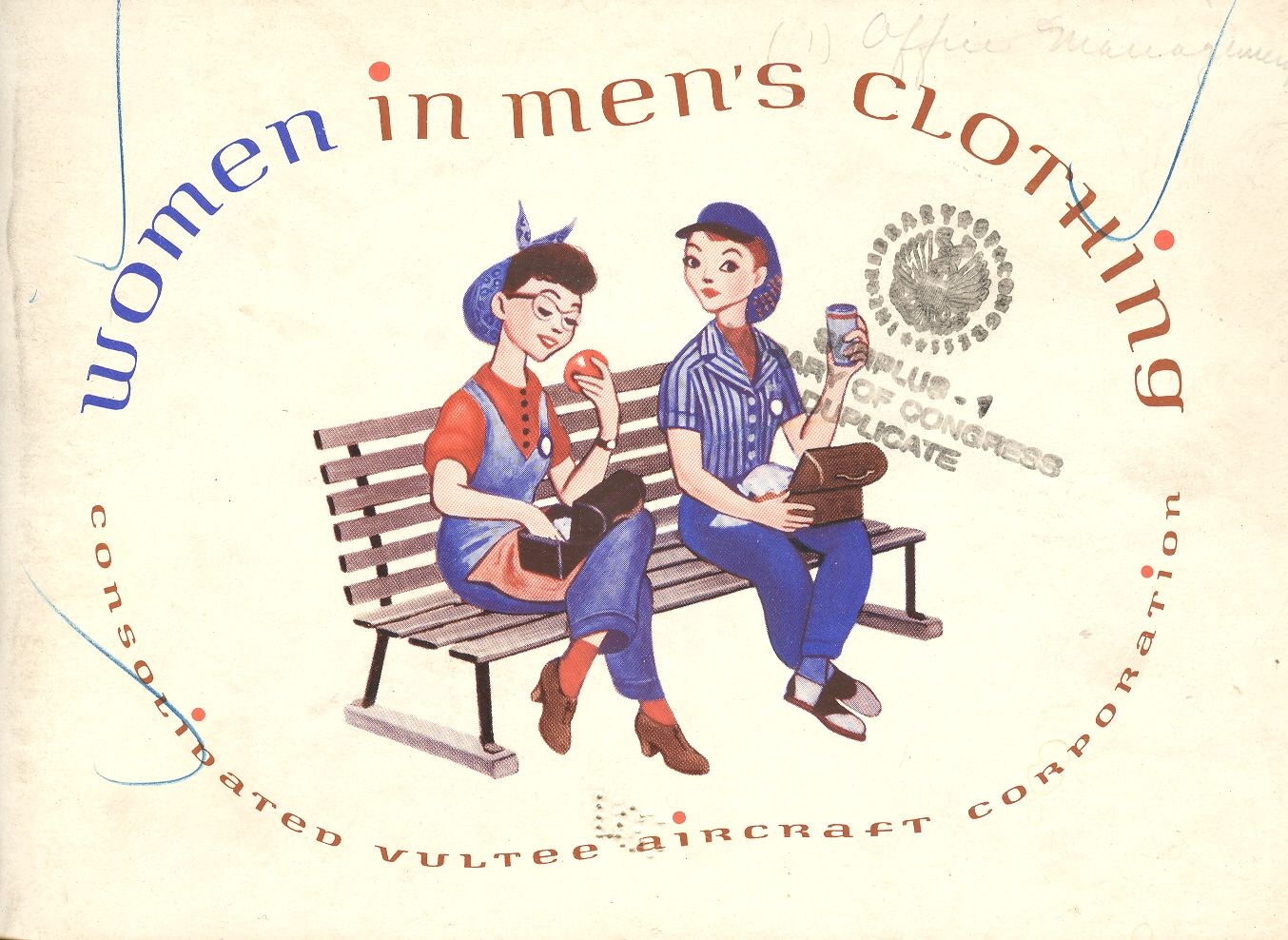
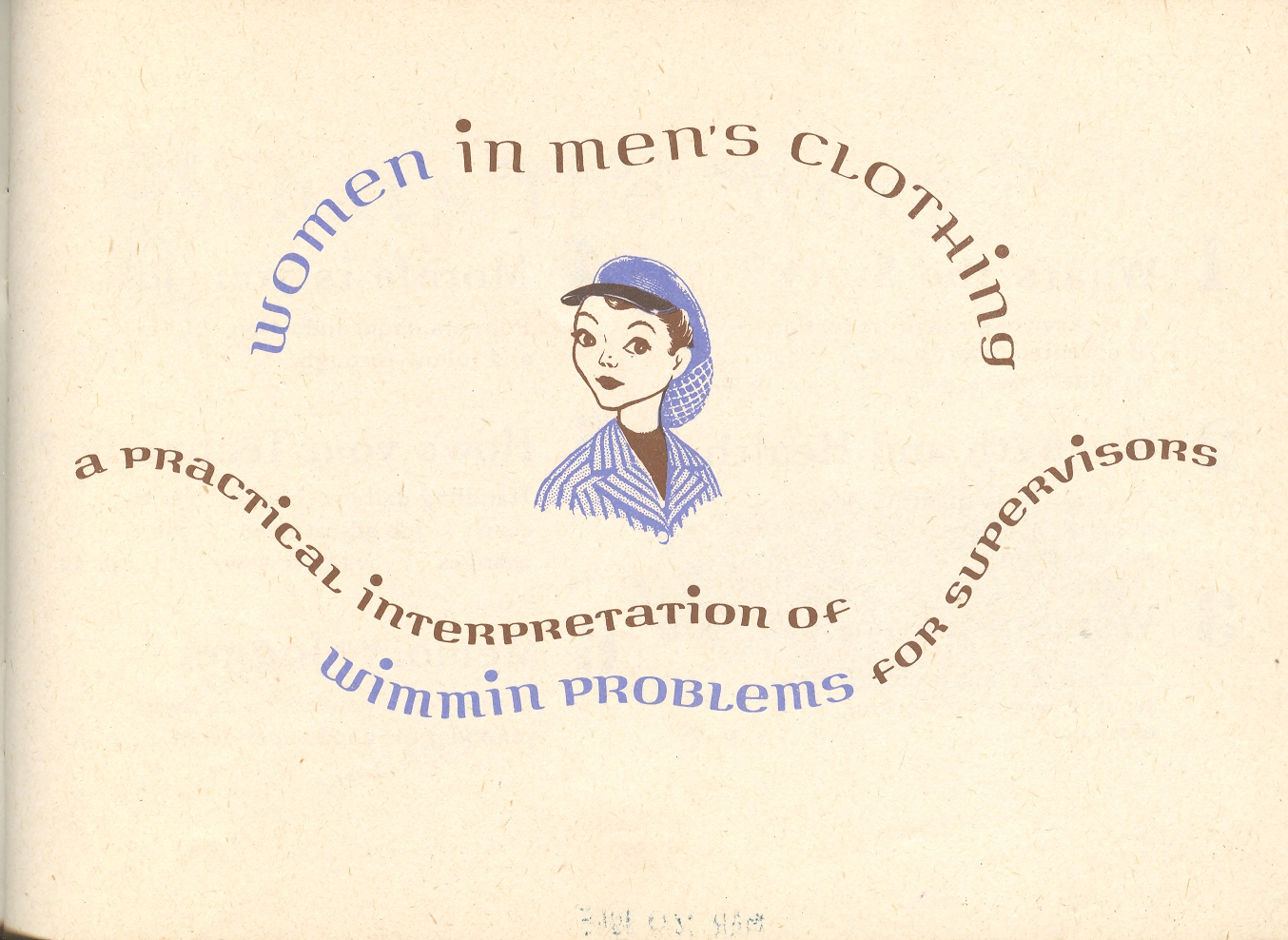
    Such is the case with this odd and interesting little pamphlet, Women in Men’s Clothing, published by
    the Vultee Aircraft Corporation, and published in 1943—it can be simultaneously
    awkward as a broken product of its time and oddly, slightly, futuristic (with a grudging and clawing recognition of women as possible equals as members of the work force).  Overall the publication looks pretty painful from today’s perch, but when you look a little past the winces you can see a little bit of recognition for women in general; at least this is far forward from anything that might’ve been published slightly before the war. 

    Mar 25 women are humans cvr title

    The pamphlet was intended as a human resources tool for managers and
    supervisors in an aircraft production facility where women had been sought and
    recruited to fill the very many vacancies brought on by the war.  (Millions of women entered the workforce for the
    first time between 1942-1945; millions of them exited too once the servicemen
    returned from active duty to reclaim their jobs.)  For most industrial supervisors, the prospect
    of women in the workforce was not a welcomed one, and many had never before needed to think of such a diversified workplace. This slight publication translated the idea of “women/”wimmin” for these
    men. 

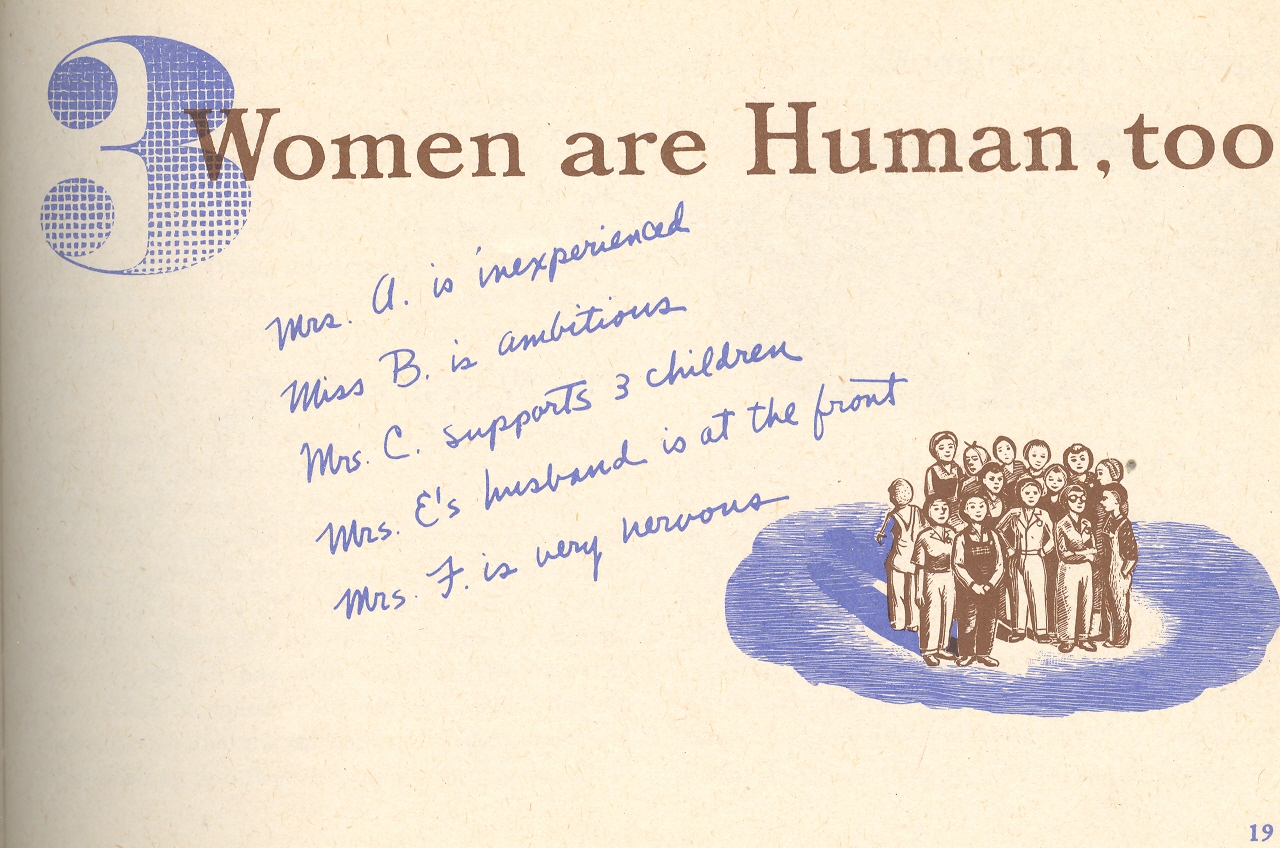
    Mar 25 women human too

    The “translation” of the understanding of women from home to the workforce doesn’t go very far to advancing the understanding of women at work–they’re pretty much the same (dogmatic, condescending, sexist, domineering).

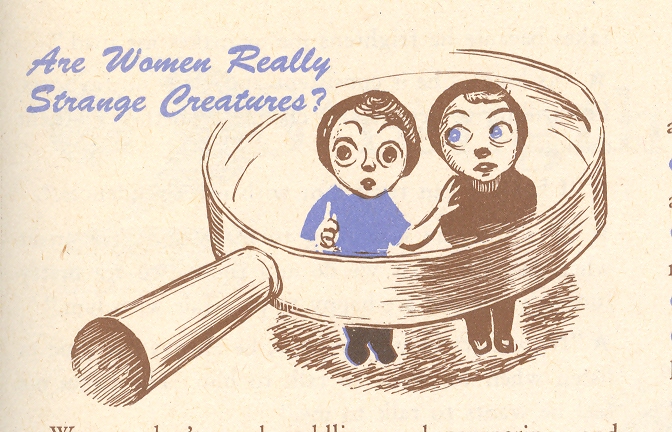
    Mar 25 women strange creatures

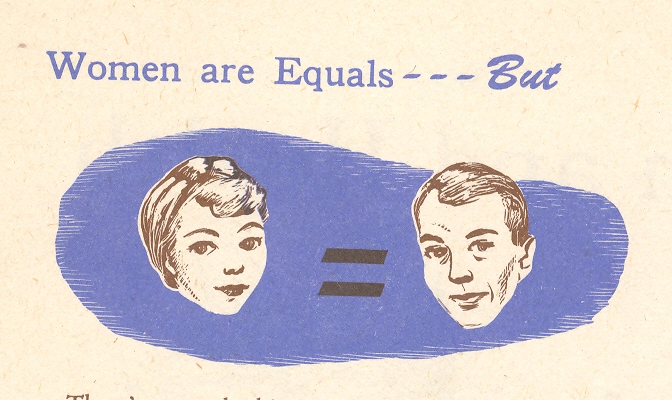
    All of that is pretty well summed up by the first picture in this series–the asterisked “equality” between men and women.  I must admit that I don’t think I’ve ever seen this “equals, but” label before, or at least so deep into the century. 

    Mar 25 women older girls

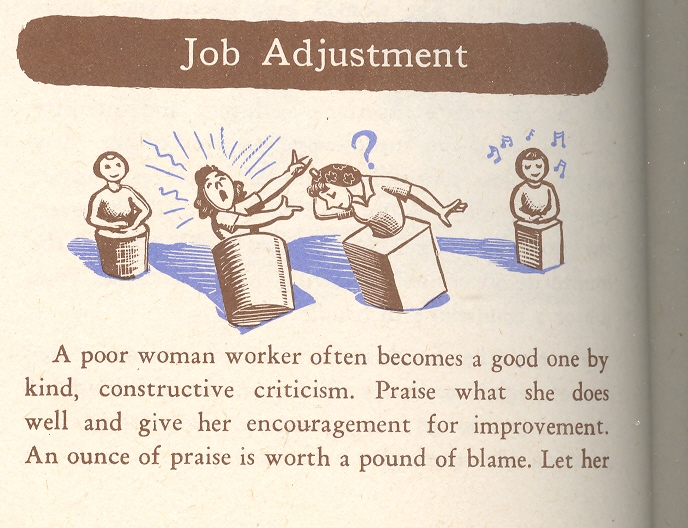
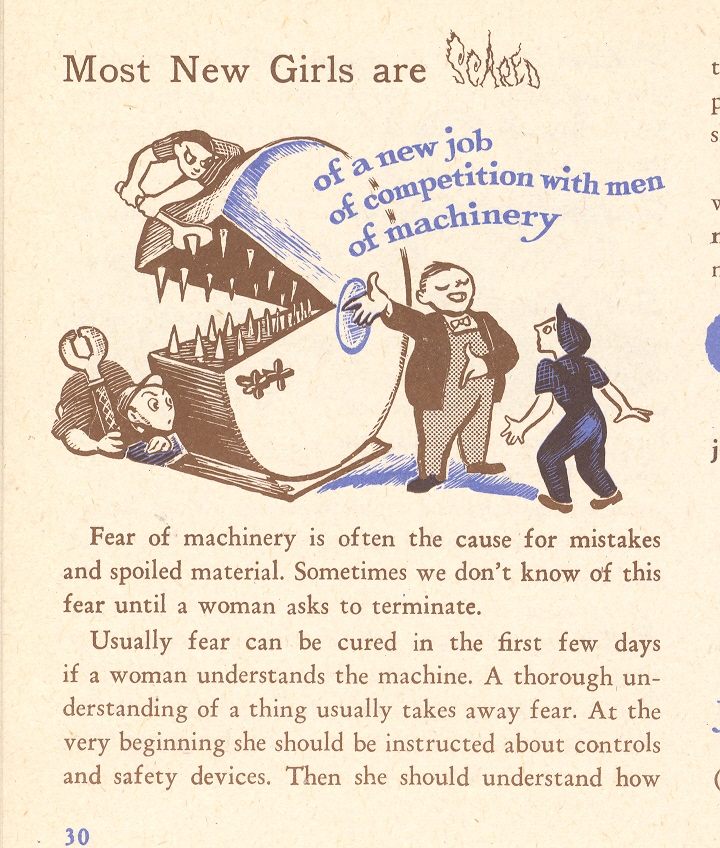
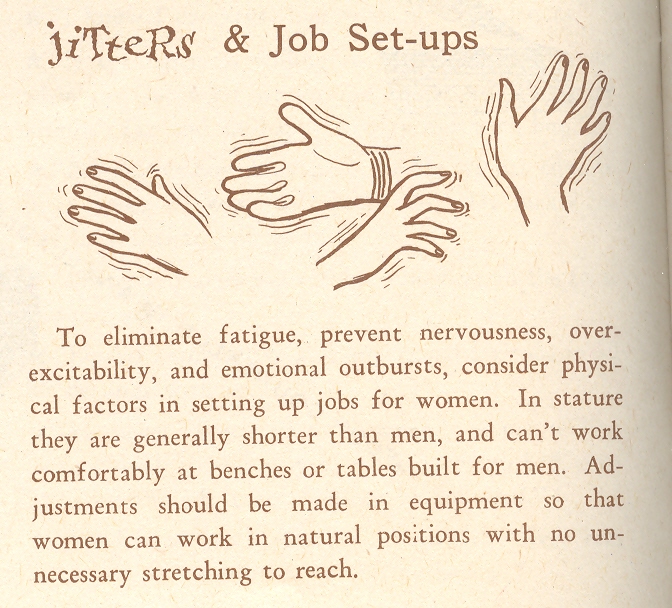
    And of course “women are Human, too” needs very little comment…as is the case for most of the images in the pamphlet.  

    Mar 25 women job adjust

    Mar 25 women chompers 

    Mar 25 women hands


  • Propaganda and the Dinner Table: Strike-Breaking and Graphical Display of Data, 1911

    JF Ptak Science Books LLC  Post 987

    Mar 25 dinner plate det

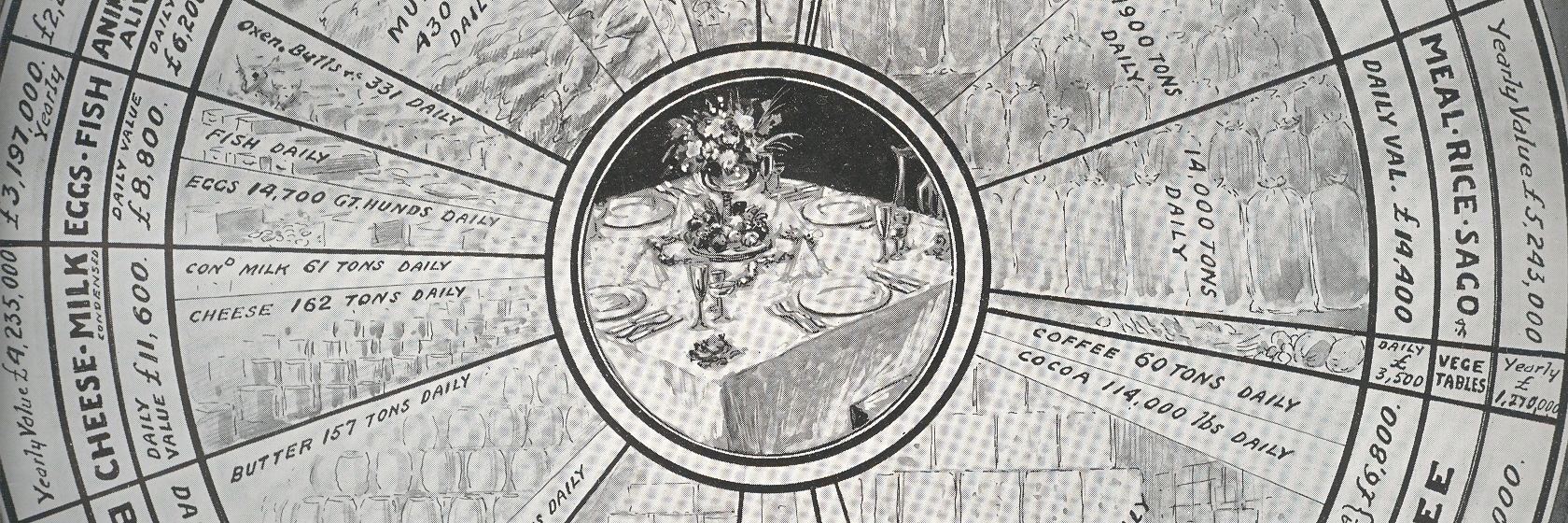
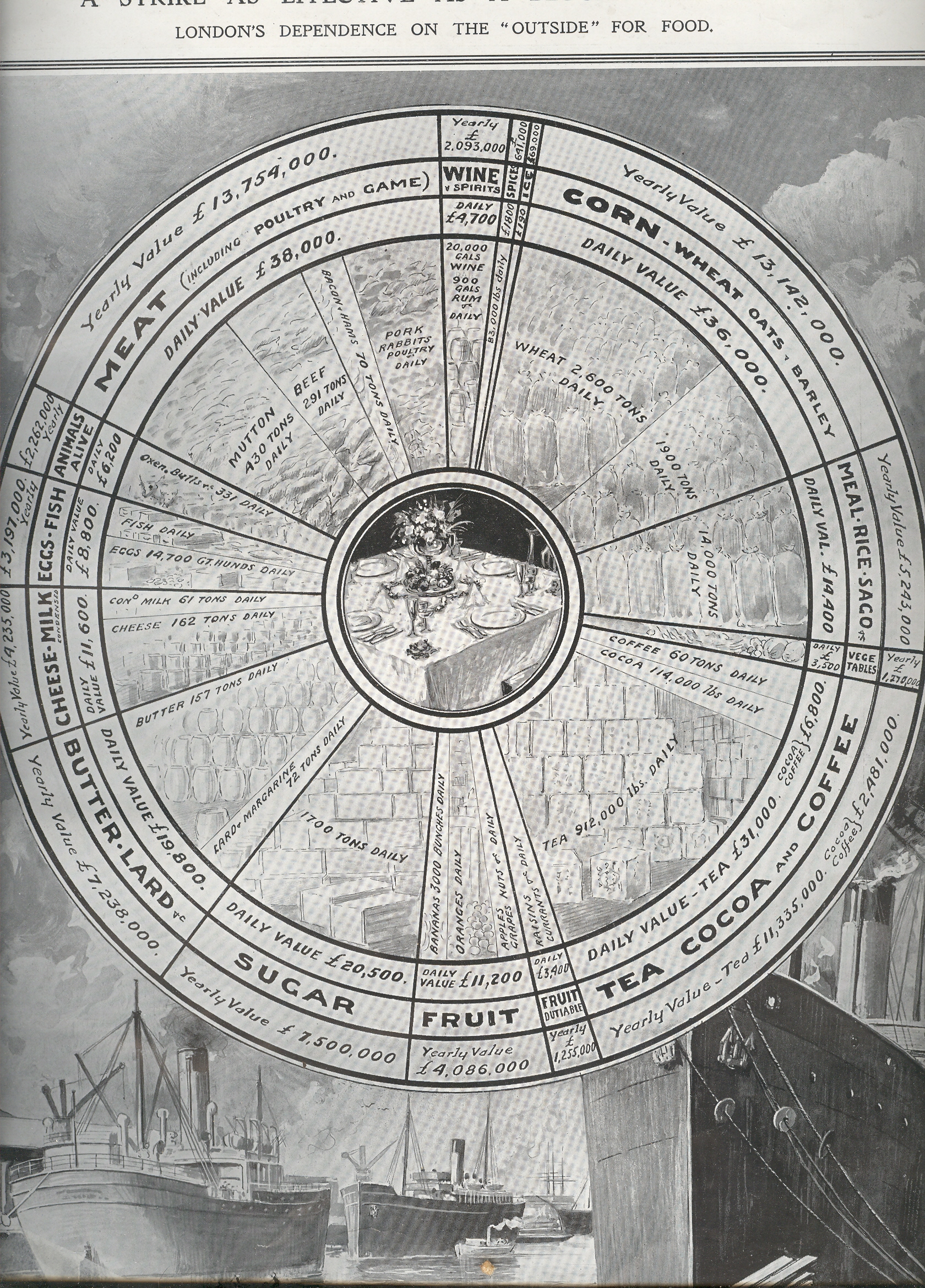
    This graphic display of the effects of a  transport workers’ strike is a pretty,
    well-designed piece of propaganda designed to draw in the general, middle-class
    (such as it was) and working population into league against the strikers.  At least that’s what it looks like to me: the
    strangulating effects of food not coming into the port of Liverpool
    and its attack on the family dining table. Literally, and figuratively: a
    table, by the way, that appears at the direct center of attention, the bull’s-eye
    of what is a target, made to look like the transport workers were taking direct
    aim at the symbol of the family. 

    All of what was going on of course was that some hard working people were
    trying to get a little more money to put food on their own  tables—the facilitators of food distribution
    for the nation’s people wanting nothing more than a little more food for
    themselves and their families.  And these
    were the people, by the way, who did not set a five-utensil place settings with
    linen table covers and a large fresh bouquet as is oddly the case in the illustration.

    By the time this illustration appeared in the Illustrated London News in August 1911 the movement had already
    been active for a year—there had also been a call to action the month before
    involving over 100,000 workers.  The National
    Sailors and Firemen’s Union, and the National Union of Ships’ Stewards, Cooks,
    Butchers and Bakers, dockhands, lorry rivers,  general laborers, and on and on, were involved
    in the strike, which was a bitter and confrontational battle between them,
    scabs, police, the army, and of course the owners of the means of production
    and shipping means.

    Mar 25 dinner plate


    After the battle of greed and need, need won.


  • Human Experimentation on Children in an Orphanage: the Borden Company, 1924

    JF Ptak Science Books LLC     Post 980

    Nothing
    quite makes a profound statement like simplicity—the same sentiment applies
    to   the incredible, or impossible, or
    inconceivable statement as well.  For
    example, Gertrude Gates Mudge’s “An Interesting Experiment with Malnourished
    Children” (The Nation’s Health, August 15, 1922) seems quite an
    exclamation without an ounce of emphasis in sight, a vast oversight of decency
    compounded in its inelegant simplicity. Evidently acceptable (at some level) in
    its own time, the announcement today seems criminal. 

    Mar 19 human exp det
    The
    world is full of such pronouncements—perhaps they’re the very bones on which we
    all walk.  I was drawn to this subject
    this morning, finding a bit of undoubtedly long-lost historical reporting on
    medical experimentation which (in its second paragraph) makes the following
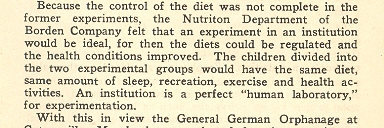
    overwhelming understatement: “an institution is a perfect ‘human laboratory’
    for experimentation”.  It comes from a
    small pamphlet published in 1924 by the Borden Company called The Catonsville Experiment   It seems that Borden (a famous and large
    dairy company) was trying to experiment with children to determine the
    effectiveness of their new sweetened condensed milk over “regular” milk.  They attempted experimentation in public
    schools, but could only statistically control for milk intake at the school
    itself, finding it  “impossible to have
    complete control over the rest of the childrens (sic) diets”.  In the free school situation the Borden
    company could also not control for exercise, sleep and “health concerns”.

    Mar 19 human exp school records

    That
    is when the idea struck the Borden Nutrition Department to conduct their study
    in an orphanage. Borden’s aim was to test the healthy effectiveness of their sweetened
    condensed milk, and to also show that “no abnormalities in physical growth,
    bone development, blood count, and kidney function would result from such an
    experiment”.  What this means is that
    there events were a possibility, but it was worth it to Borden to test their
    hypothesis out on actual human children. 

    There
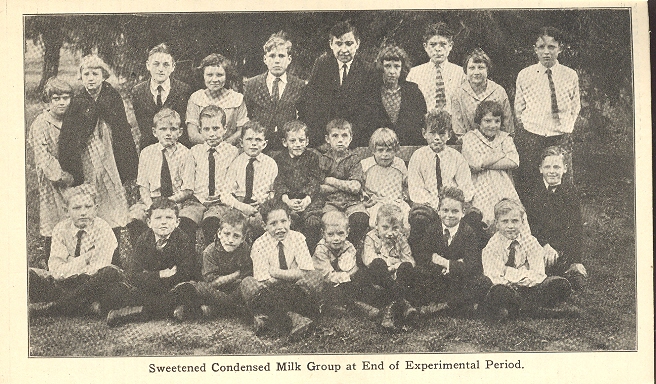
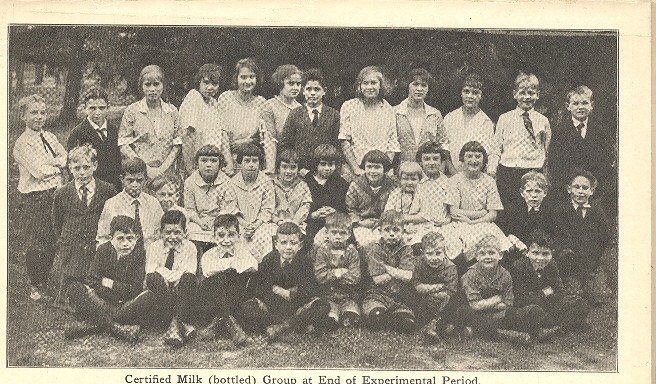
    were 60 children in the “experiment”, divided into two groups, one of which was
    the control.  All facts of the lives of
    the children were controlled from March 15, 1924 though November 30, 1924—play,
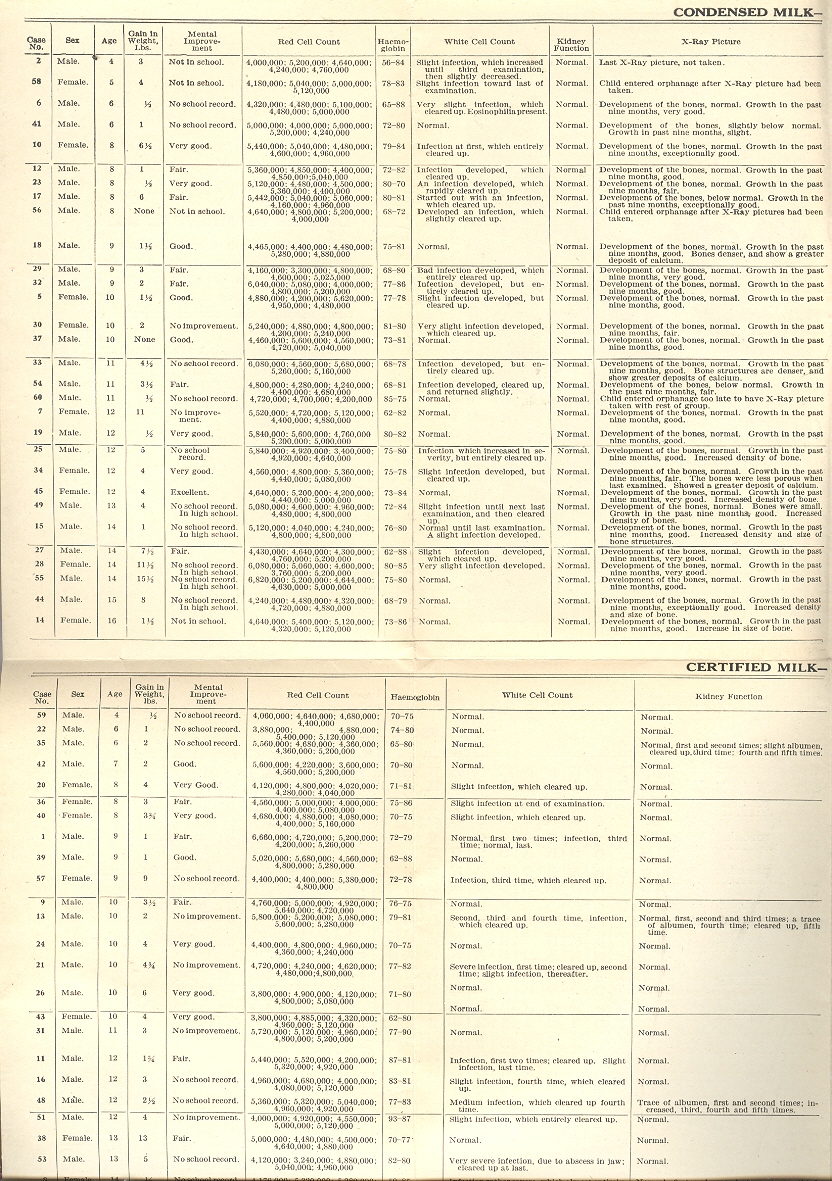
    regulated sunshine, sleep, schooling, rest, and of course food intake.   Medical tests were conducted (frequencies not
    specified), including general overall medical evaluations as well as blood and
    urine tests—there were (at least) 18 sets of x-rays over 270 days.
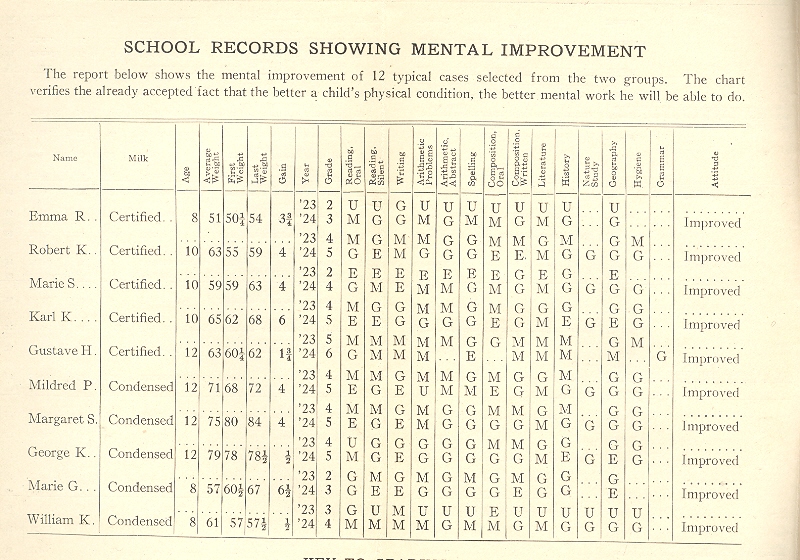
    Psychological and intellectual tests were also conducted, with the children
    measured over dozens of different categories, including 14 classroom
    activities.

    The
    Borden Company published the results of all of these experiments in this small
    pamphlet, with one large (and impressive) folding diagram outlining some of the
    medical results (shown below). 

    Mar 19 human exp big chart

    There
    were also two photographs of the test subjects. 
    Undoubtedly they were not intended to look as though they were trophies,
    but that is the general feeling I get when looking at the photographs.

    The
    bottom line was that Borden found their own product to be safe, and to not cause
    kidney, liver or bone damage.  Which was
    good news to the children who were their test subjects.

    Remarkably
    Borden published these results two months after the test ended, evidently
    without any assumption whatsoever that if there were to be negative effects
    that they would occur immediately, and that a longitudinal study was wholly
    unnecessary. Once the experiment ended, so too did the nee for testing their
    short-term hypothesis of damage to the children.

    Mar 19 human exp pic

    I
    wonder about what the effects of the 18 rounds of x-rays in 270 days  were on these children, over time.

    Mar 19 human exp pic control 

    No doubt that in the dark history of human experimentation the Borden exploit would find itself in somewhat mild company–this of course hardly relieves them of their gross injustice of subjecting children to this sort of control and possible danger just so that the company could sell a milk product. It is an action that makes me think more of Lizzie (“I gave my mother forty whacks…”) when I think of Borden than Elsie the Cow. After a long run of financial successes, including being one of the leading dairy companies in America (and the owner/producer of Elmer’s and Krazy Glue, among many other diversified things), the Borden Company was completely and totally divested in 2005.

    Logo_borden


  • Popular Culture Imagery–16th Century Street People (Fools, Musicians and Pregnant Women and more)

    JF Ptak Science Books LLC Post 970

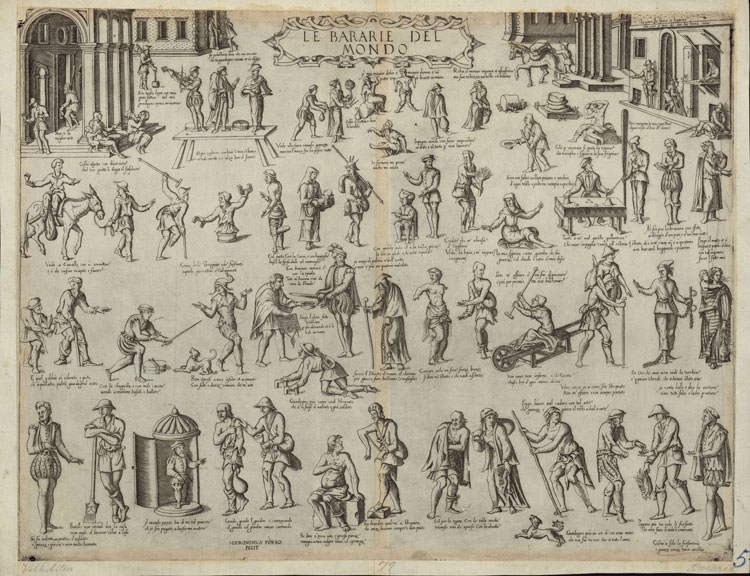
    Le
    barbarie del
    mondo,
    by Hieronymous Porro (fl
    1574-1604), depicts Italian street
    people collected under the unkind general heading of  “barbarism of the world”. I misread the description of the actions of the people in the print
    (found at the University
    of Texas
    website below) as “Making
    a living doing unnecessary tasks of nothing”—a harsh appraisal of the efforts
    of people who have nothing trying to make a little bit of change for bread, though it does describe the general sentiment of the print, wrong or not. Though the
    written descriptions are slightly kinder than this, the depictions of the social
    unfortunates was certainly not. 

    Mar 10 porro

    The people described in this image–the collection of unfortunates,a veritable museum of social “outcasts”–include fools, street laborers, merchants, the disabled, prostitutes, destitute women (with children), musicians, street performers, flagellants, religious zealots, and general beggars, not to mention what must’ve been alley dwellers, street-sleepers and the homeless.

    Not too much different from today. What makes this image remarkable to me is that it makes these generally invisible people visible, gathered together in one image.  Generally these people would be used occasionally as found objects, tertiary depictions in larger, grander artworks showing grand structures or town views, the people used to show scale, and the artist taking some small liberty by employing street people as the scale units rather than landed strollers. (See here for an example.) Holbein, de Hooghe, Bruegel–masters of the large gathering and crowds, did not attempt a solitary image to the underclasses’ underclass.

    [Source:  Harry Ransom Humanities Research Center, University of Texas, Austin.]


  • A History of Blank, Missing & Empty Things: #75, Monks

    JF Ptak Science Books  LLC  Post 963

    [A History of Blank, Missing & Empty Things, installment #75]

    Many
    are the things that are “missing” (or blank or empty), but seldom are they
    depicted in antiquarian prints, which is why I report them every time that I
    found them. Today’s installment:  missing
    monks. 

    March 5 missing


    This
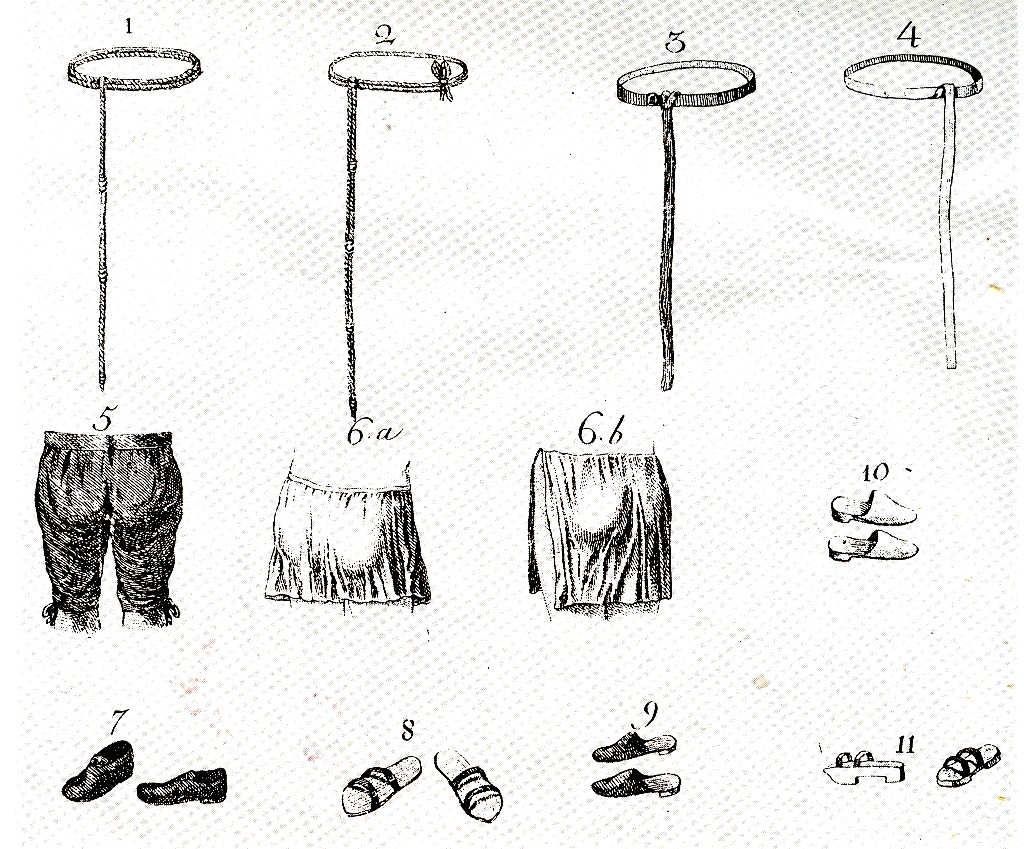
    image comes to us from the anti-cleric Ignaz Edler* von Born’s (1752-1791)
    viciously satiristic Specimen
    Monachologiae Methodo Linnaeanna
    …., which was published in Vienna in 1783. (Mozart
    was there, in Vienna,
    a year married and finishing his first violin quartet.  He was also evidently tutored in Masonic ways
    by Born , who had introduced the young man into the Benevolence lodge.) The
    pamphlet was a scathing rant against monkish religicisim (?!), taking off on
    Born’s mineralogist background and classifying the orders according to a
    diverted Linnean system.  This image—for all
    the world displaying four “missing” monks—catalogs their sashes, shoes and (of
    course buttock-filled) underwear according to Born’s choppy and determined mal-intent.  Born had evidently seen enough of religion to
    make fun of it, what with his Jesuit-educated background followed by extensive
    studying and a professional career in the physical sciences. 

    *Born
    was born to the nobility, as the “edler” denotes.

    ·Posted by :

    ·in:

    —

  • Mobile Maginot: Movable Land and Floating Forts, 1940

    JF Ptak Science Books  Post 959

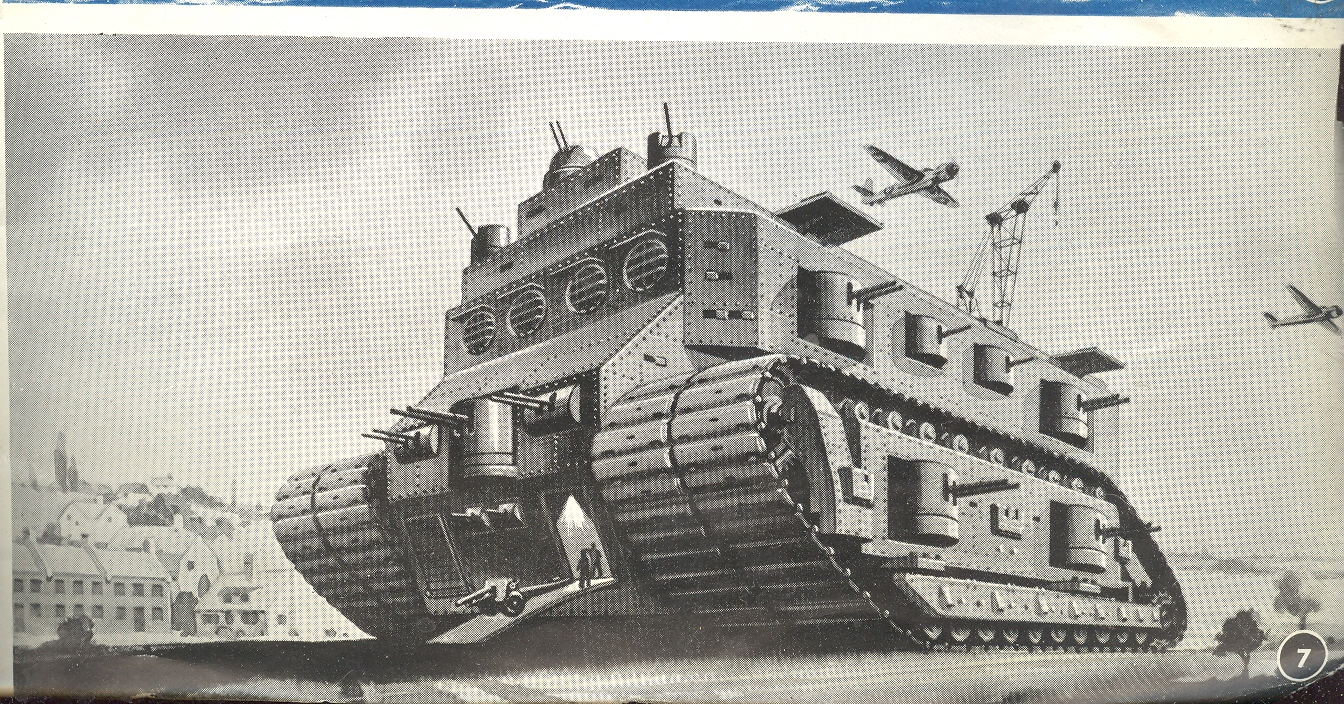
    Nothing quite exceeds like excess said Mr. Wilde (and others) , and he/they could be no more correct when looking at this picture of a Movable Maginot Line—it is a mobile fort, complete with plane launching capacity, two dozen long canons, a crane, and a host of other stuff.  

    000--win--land tank

    It looks as though it has ample room for all sorts of materiel though leaving little room for, perhaps, an engine.  I just can’t see where it might be…perhaps it is near the not-room-enough-for-it-either ammunition compartment.  Maybe they were in a smaller armed cart being pulled by the mothership?  I reckon that this beast was 66 feet high, 100 feet long and 60 feet wide, which is a very big, heavy near-cube. Good luck with driving the thing in anything that was less than perfect conditions.  A big profile like this, filled with guns and canons or not, also makes for a big target profile—a tall, broad target with flat/non-inclined sides. ( I should also point out that there are two 10’ loudspeakers mounted on the front of the fort to instill fear in the people that the thing was approaching with loud noise.  The author points out that the Nazis used noise against the French with their “screaming dive bombers”, and so the fort would use the same tactics against the Nazis in the movable fort—not that the sound of the engines and the attendant noise wouldn’t’ve been enough of a fear factor in themselves…)

    000--win--tubular ship

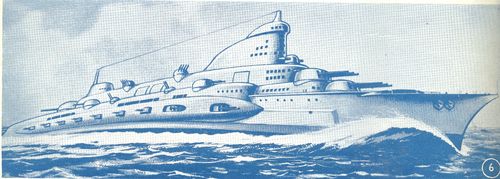
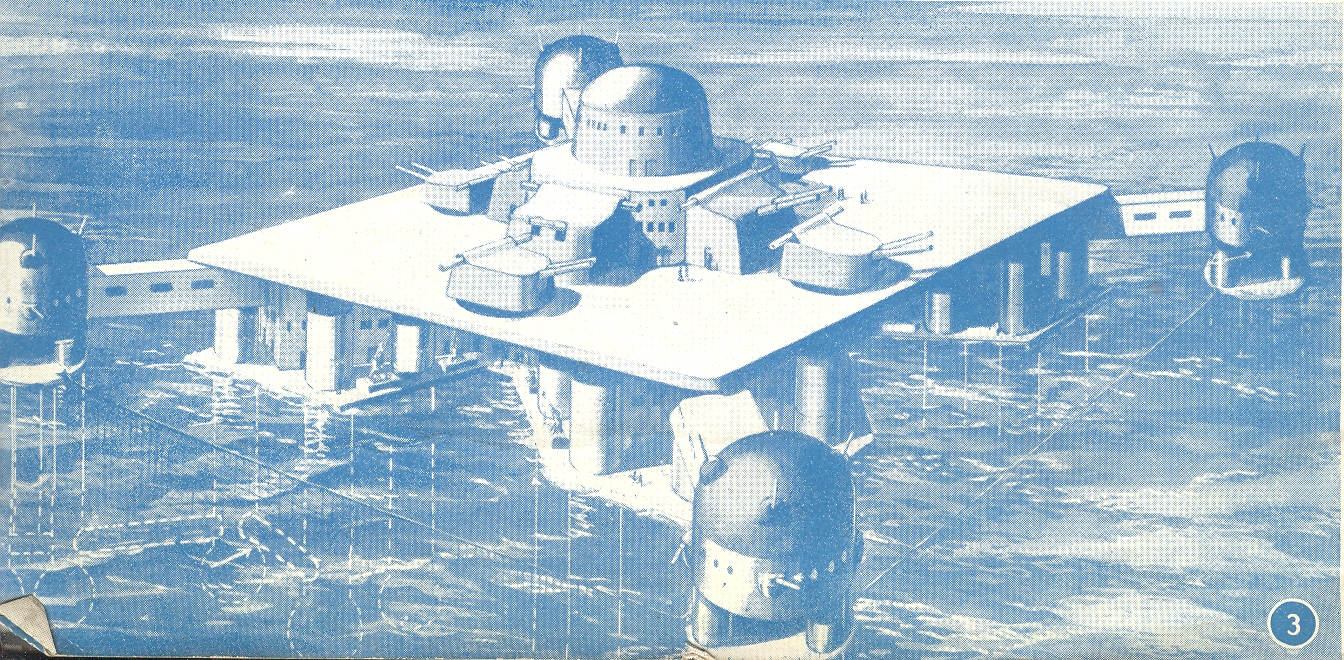
    But the image of such a monster, sensical or not, was enough for the purposes of the pamphlet in which it appeared.  The Brains to Win was a piece of British spirit/hope propaganda issued at about the time of the Battle of Britain in 1940, and it listed the sorts of technological breakthroughs that were going to push the nation over the top to victory.  Some of the stuff was real, some not—like the moving fort/Howl’s Castle above, and the floating fort, below.

    000--win--floating airport

    I’m not sure where a floating fort would make sense, especially one of that size. (Iterating the figures on deck into distance, it looks as though the deck on the floating platform was 150 or 200’ square.  It would’ve looked like a big target from above.) Given the time and expense and material  needed for such a thing, it seems that it would’ve been cheaper to make a moveable fortress not quite so big, with less of a profile, and more mobile—I think that this was called a “destroyer” or “battleship”.  

    But no matter, I’m just poking fun at some of the future vision that became archaic the moment it was drawn, punk retro-future.  All the pamphlet was trying to point out in its 32 pages was that overall the Brits were smarter than the Germans and that would be the balance for victory in the war.  “Hitler will get some very unpleasant surprises before this is over” the author very politely pointed out, no doubt with one eyebrow raised.  The scientists agreed.

    And they were right, which is all that matters.


  • Defining “Ugly” in Architecture: Rooftop Airport, NYC, 1946

    JF Ptak Science Books LLC Post 942   Bad Ideas Department

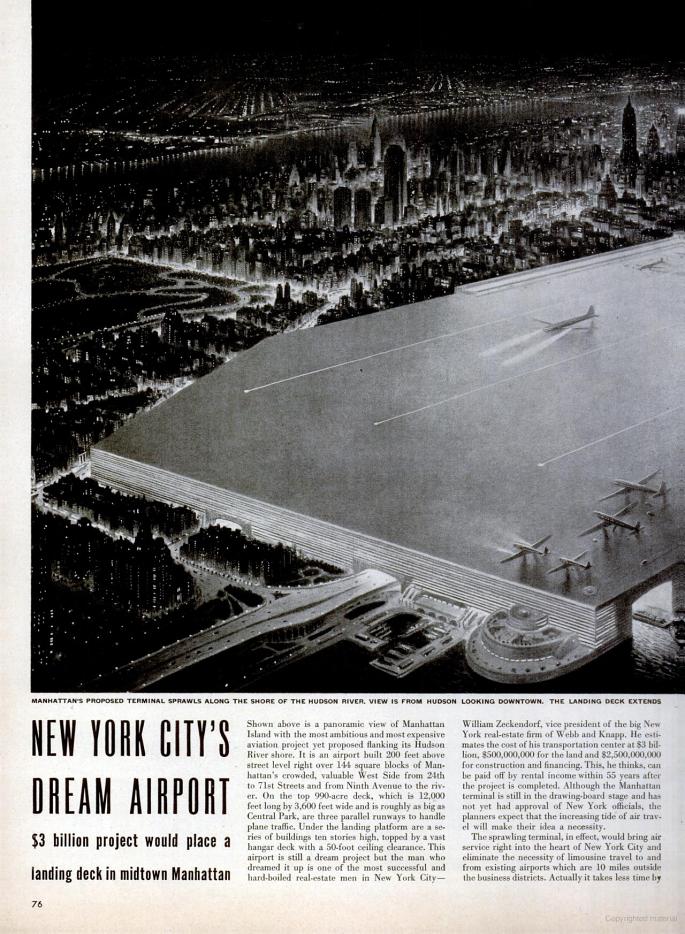
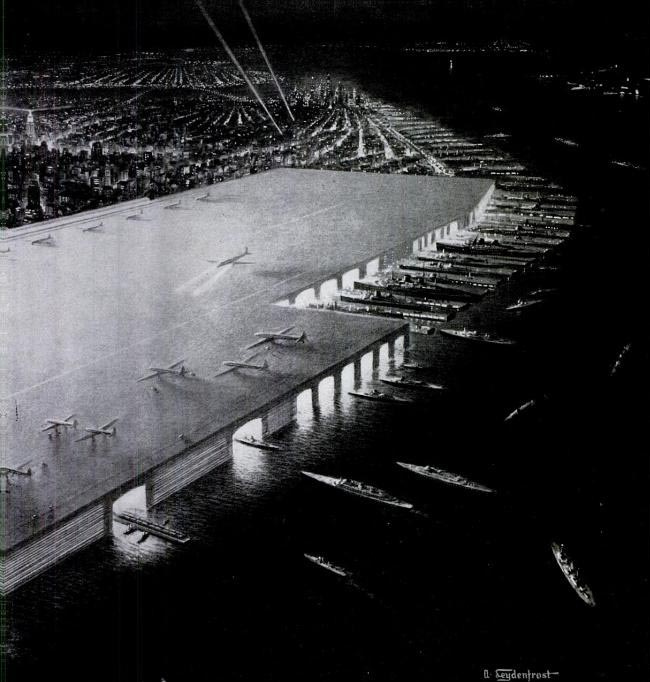
    I think that I’d like to introduce a subset in my Bad Ideas category:  Bad Flat Ideas.  To start it off, I found this very lovely example in LIFE magazine for 18 March 1946, the brainchild of generally-appropriate real estate mogul William Zeckendorf: a spectacularly bad idea of installing a rooftop airport along  a very long swath of property along the West Side. 

    Books 

    It seems as though the airport would extend from the bottom third of Central Park south to, well, I really can’t tell, perhaps lower midtown? Honestly, it doesn’t matter.  For all of its size it actually isn’t quite big enough, looking like there’s maybe 10 or 20 plane lengths margin-of-error at the end of the runway.  Plus there’s the *no* margin of error bit for the edges of the airport, which assumes that no plane will ever topple over the table top. Plus a host of other pertinent stuff.

    The penultimate line:  it is also incredibly ugly, a definition of architectural ugliness that few projects could match. 

    Books_003 det 

    The bottom line though to this project was the bottom line:  in the end, the Manhattan Airport would save about 15 minutes travel time to Philly over Laguardia. 

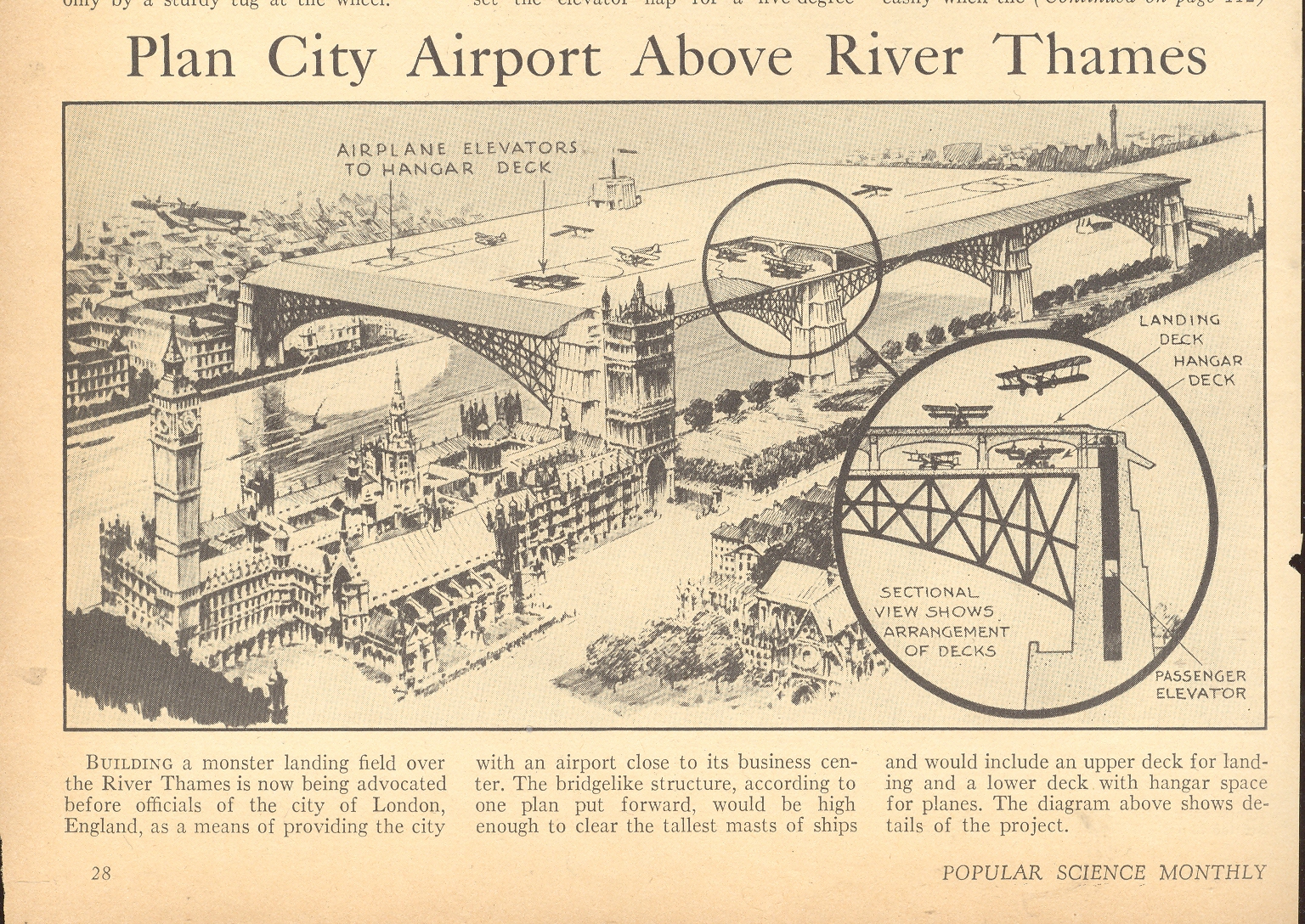
    I should not leave unmentioned the unmentionable project proposed for poor London (which I wrote about late last year here):

    Blog Dec 17 thames airport