A Daily History of Holes, Dots, Lines, Science, History, Math, Physics, Art, the Unintentional Absurd, Architecture, Maps, Data Visualization, Blank and Missing Things, and so on. |1.6 million words, 7500 images, 4.9 million hits| Press & appearances in The Times, Le Figaro, Mensa, The Economist, The Guardian, Discovery News, Slate, Le Monde, Sci American Blogs, Le Pont, and many other places… 5000+ total posts since 2008.

Category: Bad Ideas

  • Selling the Memory of Missing Things: Camel Cigarettes, 1947

    JF Ptak Science Books  Post 1041

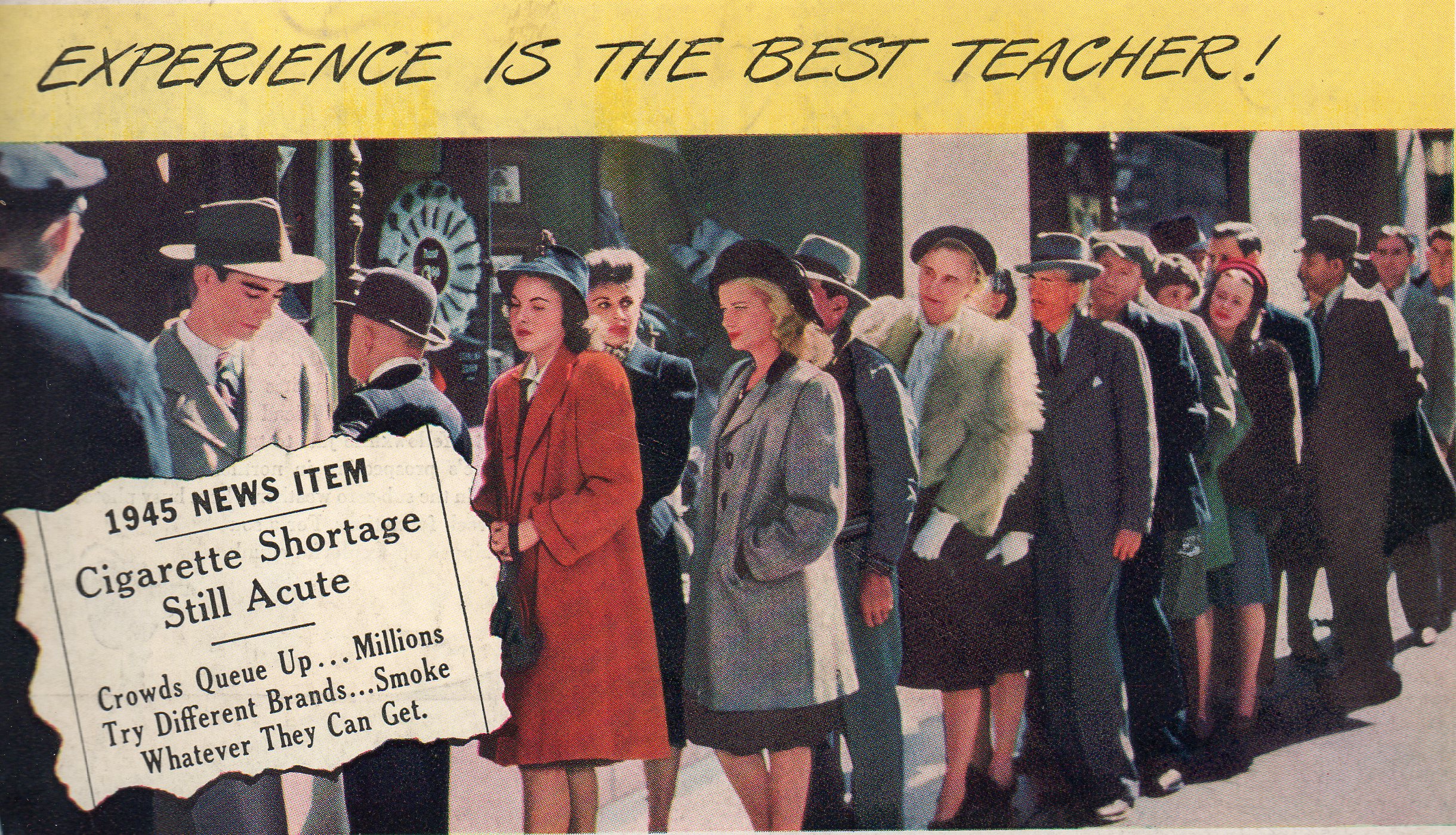
    Here I think is another instance (following yesterday’s post on “The Ineffable Religiosity of American Meat Memory”) of tweeking the American consuming memory, an advertisement bringing out the recollection of past shortages to make the present consumer want the now-abundant item even more.  In this case that item is the cigarette–Camel cigarettes to be specific.  The ad correctly refers to the two-year-old memory of cig

    000 cigarettes013

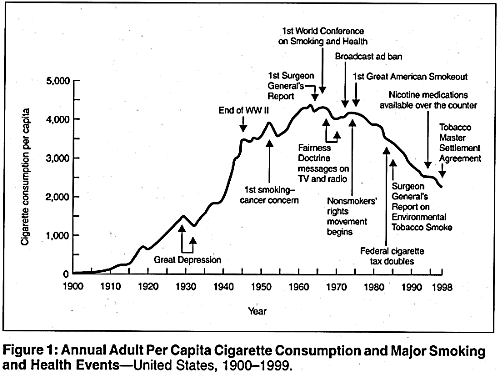
    shortage in the U.S.  Cigarettes became increasingly scarce during the war–soldiers were given smokes with their C-rations, exports increased, and so did general consumption.  At the beginning of 1940, 181 billion cigarettes were made in the U.S., with a per capita intake of 2,558 cigs a year; 1945 saw production spike to nearly double. By 1950, the production hit 370 billion, with the per capita use at 3,522 cigarettes a year, about a half-pack for everyone in the country.  In fact nearly half of the adult population smoked in 1950, making for more than a pack-a-day habit.  And it was Camels who lead the smokey way, comprising nearly 28% of all cigarette sales in the country (followed by Lucky Strikes and Chesterfields, their combined totals making another 42% of the market share).  In short, there were three giants who ruled the industry, and that for decades.  And before 1950, only 2% of all of those cigarettes had filters, so all of the harmful stuff got to the lungs cleanly.

    Back to the ad–I’m sure that these hatted folks weren’t smoking “whatever” they could get, especially with the cop standing at the front of the queue.  But in 1947 (the year this ad appeared in LIFE magazine advertising Camel cigarettes) the ciggie shortage experienced at the end of WWII was long dead and gone.  Camel just wanted to remind people of the craving for their missing cigarettes, especially the ones they enjoyed, and of course especially Camels.  The ad brought up the memory of smoking the off brands like Ramses and Pacayunes and how they tasted, and how “good” Camels were in comparison–and now one could buy Camels with reckless abandon, the freedom to consumer right to the edge of the grave. 

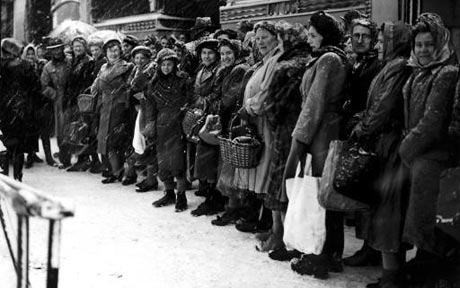
    The advertising message pricked the American memory of shortage; the U.K. on the other hand was experiencing the real thing, with massive amounts of shortages of nearly everything (from petrol to medicine to white linen), and queues and ration books were supplied to deal with the real problem.

    A “real” line in London, 1947, for food::

    000 winter-1948_798431c

    0000 cig consumption


  • The Ineffable Religiosity of American Meat Memory: PREM, 1947

    JF Ptak Science Books   Post 1040                                                 


    The category of the specialty meat, the meat that both is and isn’t meat, is one that holds a particularly high place in the religico-belief system of consumption in America—and particularly so in the historical American meat memory.  For it is here, in this very purply ad in LIFE magazine in July 1947 that we find a reminder for a meat product being sold as such, printed with the statement that the meat is being sold with meat in it, which is odd because it suggests the rejoinder that the opposite is true, too.

    000 meat prem014

    The ad is magnificent in its own special way, falling just short of  reading “Prem Meat: Now with MEAT!”.

    The adipose-y Prem meat-like clone sprung from the mind of Elmer Gantry-looking Joe Hormel,  who I wrote about earlier in this blog under the title “Spam, Smeat, Spic, Prem, Mor & Arf: Food by Any Other Name”.   Prem was a Spam-like product, a waste-meat issue of food that was packaged as a molded solution for the lower-middle-class American family.  The belief in Prem and such things as meatfood must’ve been strong; I doubt that anyone who had the remotest imagination would have thought of it as an adhered-jell byproduct which nearly ended its life on the slaughterhouse floor waste grate before it was thought of as something that could be scrubbed off the metal grid, loaded with other extreme leftovers, loved up with coloring, solidifiers, sugars, preservatives and flavorings and then sold as an ingestable commodity.  The romance of Prem is lost if you drain it of its belief system and expose it as the salvaged refuse bin
    material that it was. 

    000 meat red010

    As a 20-year vegetarian I’m strangely attracted to these ads, just as I would be any other piece of quackery from the sciences or medicine. These odd meat things were fortified with splashy store displays and crisp metal packaging.  It certainly looked okay in the pictures; could digestive goodness be far behind?

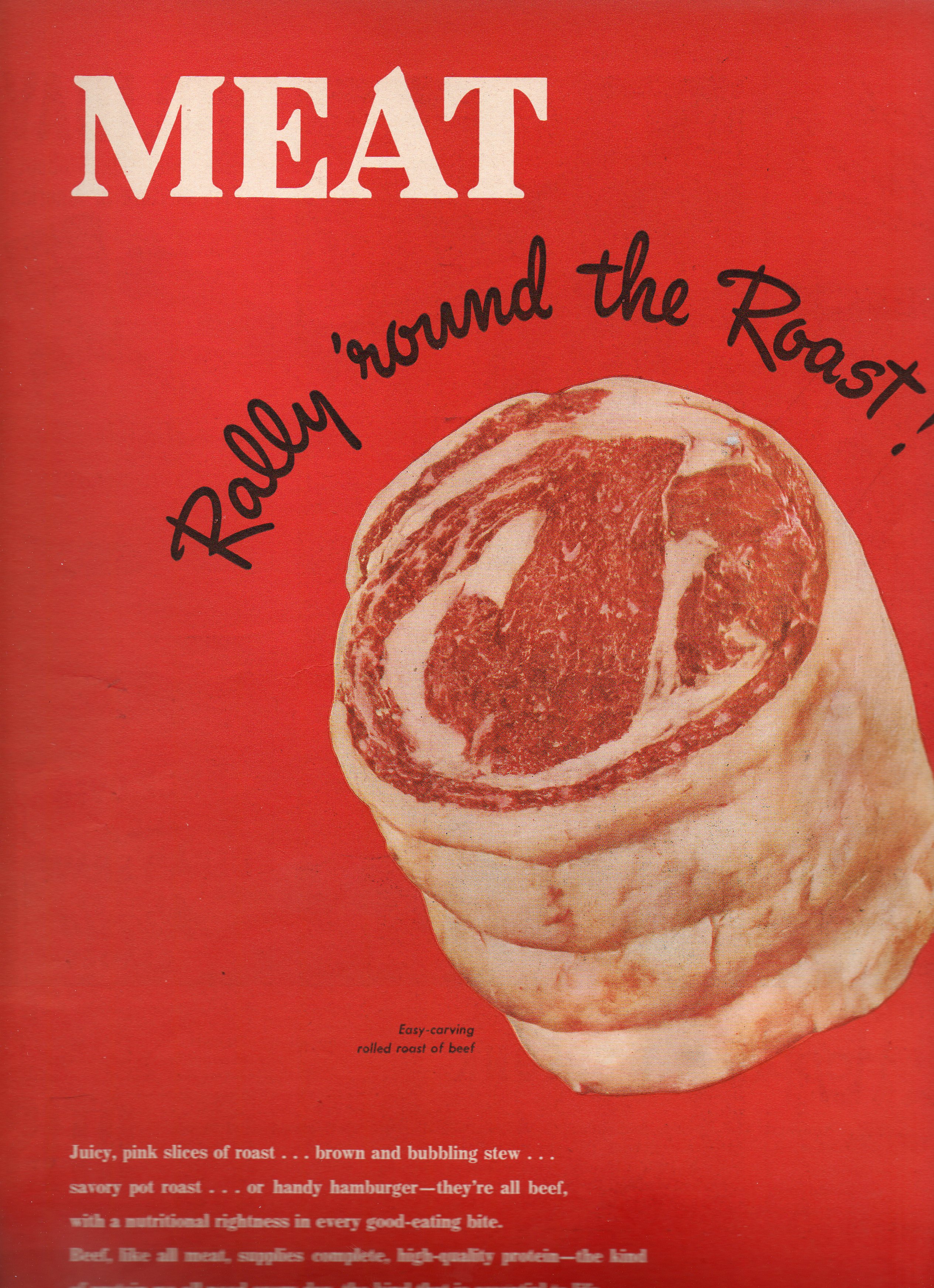
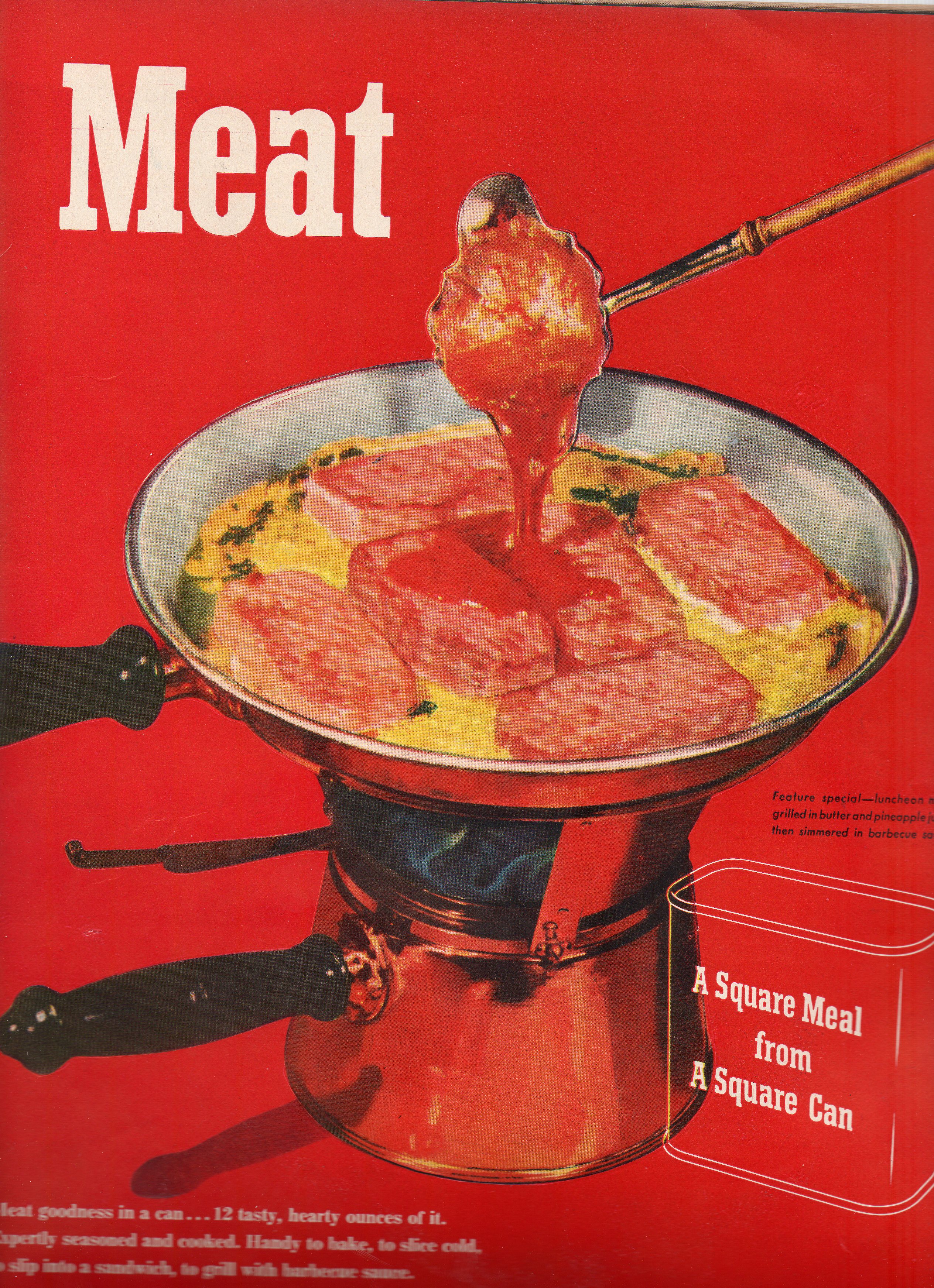
    The other bit that runs far and wide through LIFE that reminds Americans that the meat that they are eating is meat  , red meat, and the RED MEAT ads–these things are incredibly red, and big, and make quite the bloody splash considering that the ads were about 14 inches tall. 

    Anyway, reminding someone that they were eating more of their memory than the actual thing itself seems as though it would’ve opened more dangerous doors to unsavory discussions rather than closed them–but close them they did, as the new-old memories posted by these ads seem to have worked their sensate magics.


    000 meat red 2011


  • Dis-inventing the Left-Hand Turn–City Planning with Le Corbusier

    JF Ptak Science Books  Post 1038

    Somebody must’ve invented the automotive right-hand turn, and someone too must’ve come up with the idea of dis-inventing the left-hand turn–for the sake of this post and brevity that person might as well have been Le

    Right hand turn 2006

    Corbusier.  I know that city planners and traffic engineer types must’ve been working on the idea of how to push new traffic through old city streets, and the notion of making traffic not cross against itself must’ve come fairly early on, but I just offhand don’t know when.  It makes sense to me to not have cars make left-hand turns against oncoming traffic–it adds immeasurably (?) to the gas guzzling stop-and-go adventures in driving, the chain reaction of so many cars stopping and piling up behind one solitary driver waiting to make a left-hand turn against a stream of oncoming cars is just enormous.  Restricting the left-hand-turn to three right turns would slash the waiting/idling business and allow traffic to proceed quicker. (In a similar line of thinking my friend Richard Rudman from New Zealand points out that studies prove that restricting highway lane changes also makes enormous sense as well–it gets people to were they’re going quicker and with greater fuel economy if the flow isn’t interrupted by constant starts and fits of changing lanes.)            

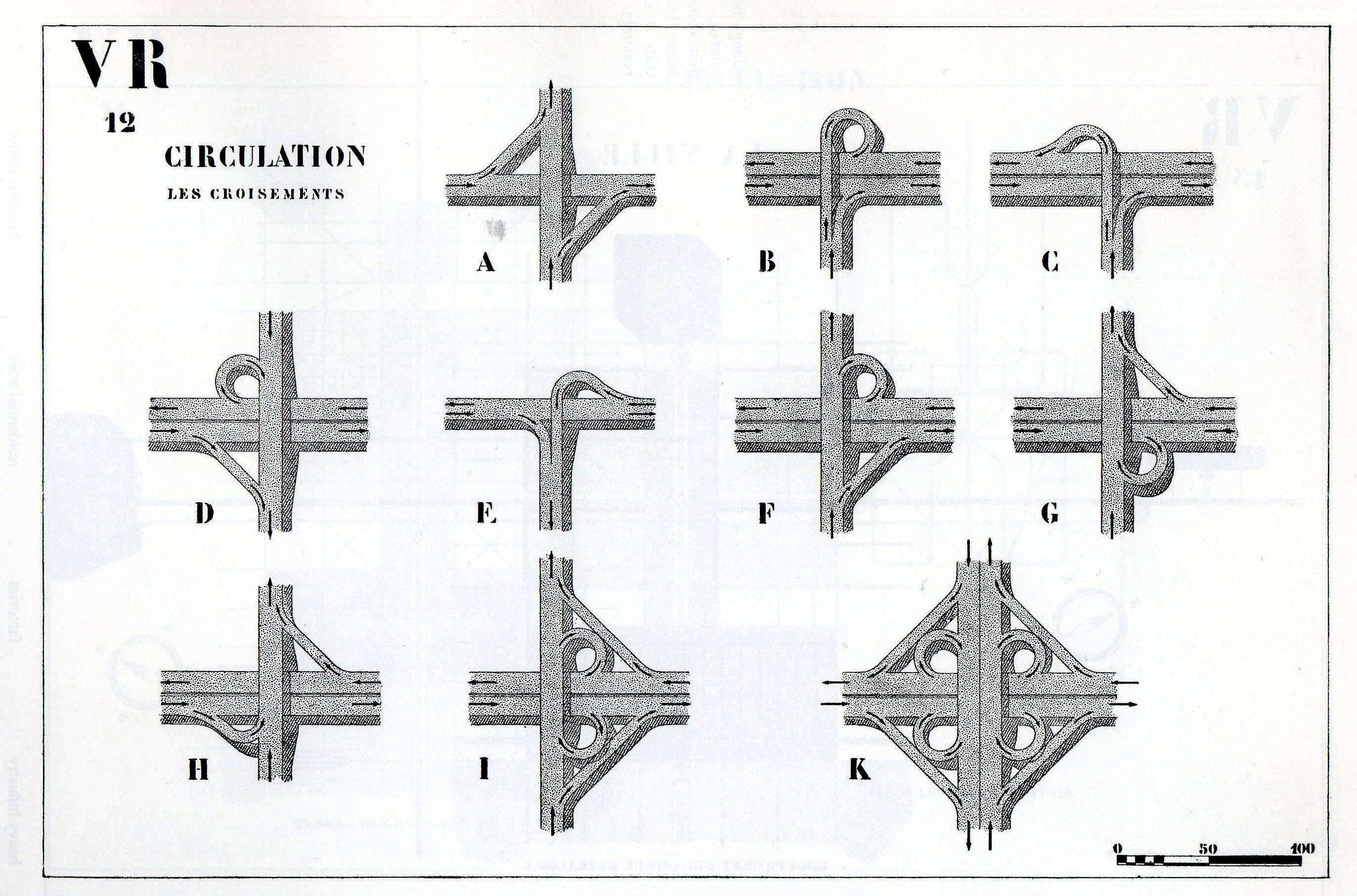
    Further on in The Radiant City we find this visual encyclopedia of right-handed turns:

    Right hand turn 10

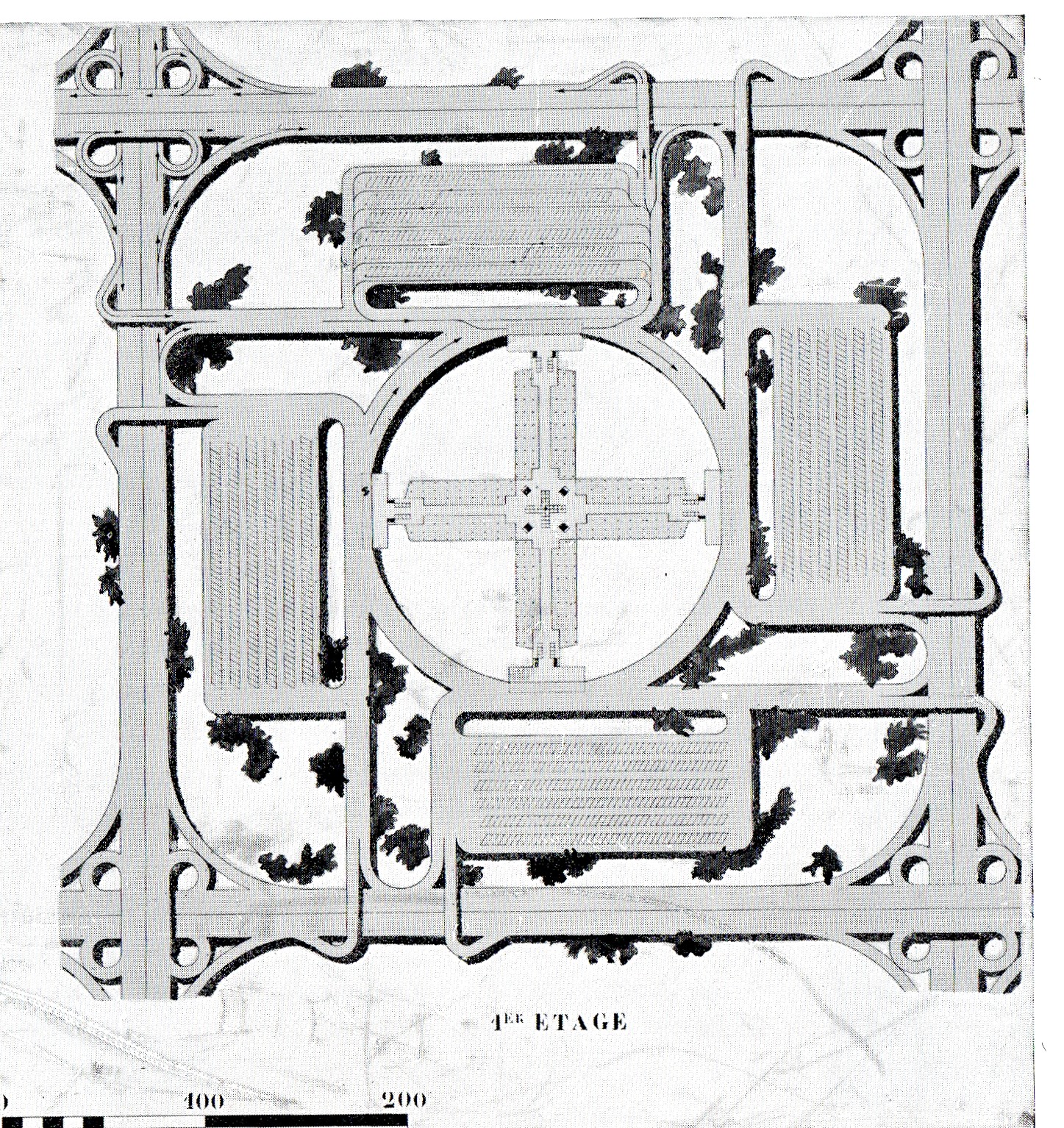
    And so we come to this plan, a part of the 1930’s Radiant City of Le Corbusier.  It is a section of a series of “horizontal skyscrapers”, “Cartesian (works) in steel and glass”, 220 meters tall buildings set in 400 meter square sections.  All of the architecture aside, the street plan is what interests me–all of the traffic here in this section of the Radiant City is in one direction along streets that are largely lacking right angles.  Elsewhere in the book Le Corbu presents his ideas for intersections for large cities–all of the designs remove the cross-traffic turn, keeping traffic flowing without those series of infinite stops.

    I’ve not been a very big fan of this man, but this is the stuff that seems to make sense to me. 

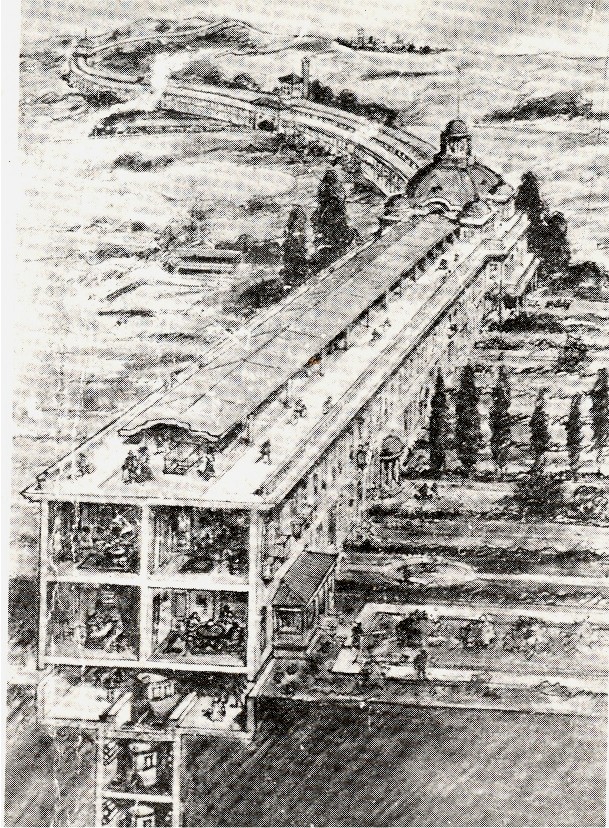
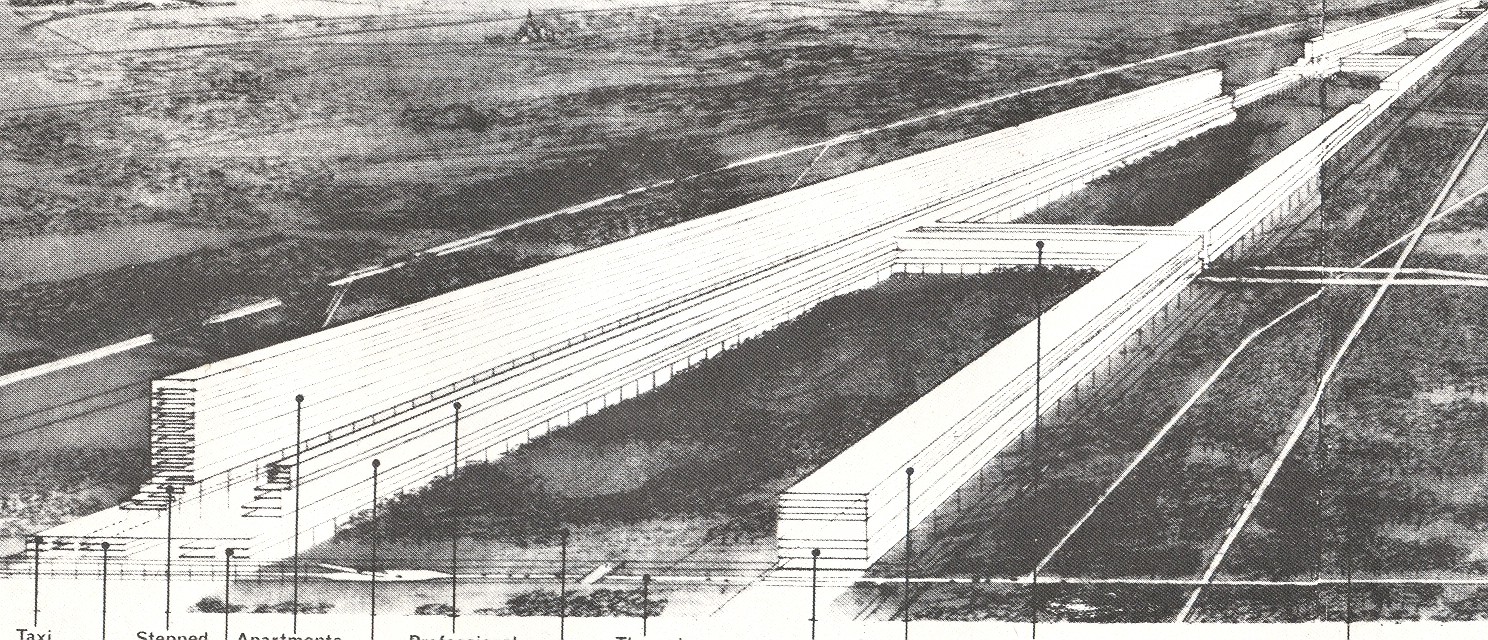
    These ideas are also in vast contrast to the city plans of linear cities (which I wrote about earlier here), seen in the 1910 Chambless image (below) and the 1932 Popular Science city (below that).

    Linear cities 2

    Linear cities

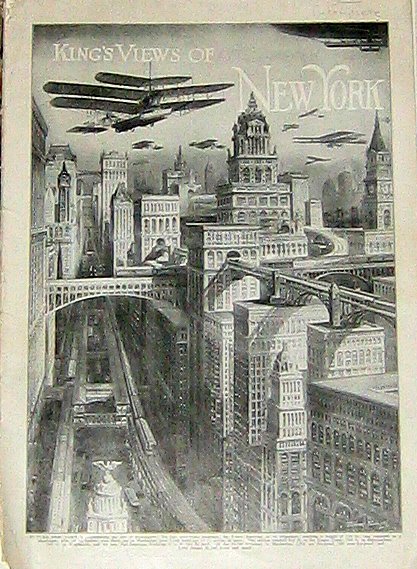
    It is also entirely different from the methods of dealing with traffic that were seemingly very popular in the early/first-third part of the century–massive 12-lane roadways, suspended garganutan affairs with traffic turning everywhere, some of which took place high in the air and in the interiors of massive skyscrapers. (Some of which I wrote about here.)

    Kings new york


  • Imprisoned and Force-Fed Suffragists, 1910

    JF Ptak Science Books   Post 1037 

    {This is part of our History of Women series)

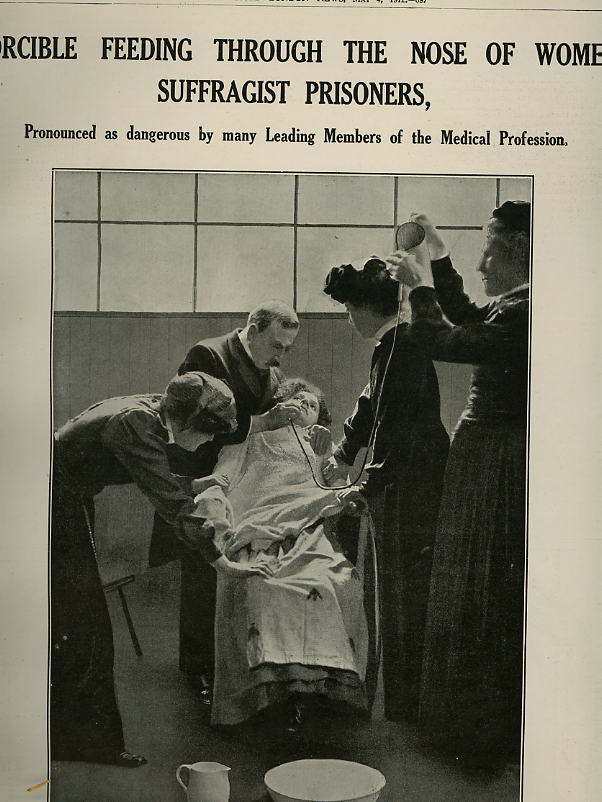
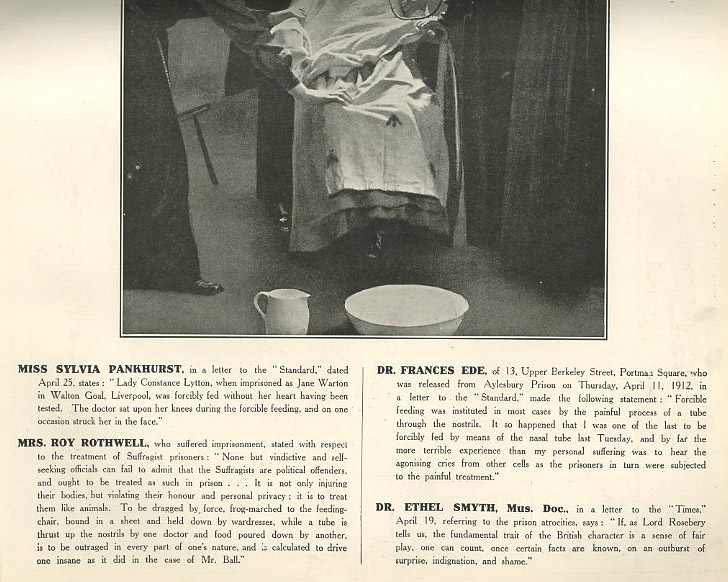
    In January 1910 the Illustrated London News (perhaps sympathetically) reviewed the case of the forced feeding of a leading female suffragist–very forced, very forcible, feeding-tube-up-the-nose-and-into-the-stomachDetail face forcible, the work of a grappling prison doctor and assistants.  The full-page illustration was entitled:

    “Forcible Feeding Through the
    Nose of Women Suffragist Prisoners”

    and then pointing out:

     “Pronounced as dangerous by many
    Leading Members of the Medical Profession…”

    It is the story of medical indulgence and state insistence of not recognizing any displays of independence while imprisoned–feeding a woman against her will, a 
    woman prisoner at the hands of what sounds to be cruel warders and an insistent doctor. The woman in question was Lady Contance Lytton (b. 1869, imprisoned in disguise as “Jane Warton”) in Walton Goal, 


    File0505

      
    File0507

    Liverpool. She was arrested and placed there for minor offenses to the civil code while protesting for the rights of women to vote in England. She carried her struggle further in jail, doing about the only thing she had left to do while she was put away–make herself into a political statement by refusing to eat or ingest  liquids.  Walton Goal would have none of it, and resisting the entreaties of professionals, decided to feed the woman themselves at whatever cost.  The doctor who administered the fluid
    evidently sat on her knees and slapped her until the Lytton’s resistance
    failed. My guess is that the white cloth covering her in the photo is not for drips and drops, but was used to cover restraints–I hardly think that the two female attendants would’ve been able to hold down Lady Lytton’s arms by themselves, especially in that posed posture. There are three other accounts of women being bound, restrained,
    held by wardresses, and in general being badly treated.  (There is a
    continuation of the story of Lytton, below.)

    The vote did not come until 1918 with the Representation of the People Act, which in June 1917 passed the House of Commons and which went through the House of Lords in February of the next year, granting full enfranchisement to all women (over the age of thirty. This is about two years before American women were given the right to vote–on August 26, 1920–and 25  years after women won the vote in New Zealand, which again was first on the scene like it has been so many times). Lady Lytton would do badly in prison after this, suffering a heart attack and then a stoke by 1911, and never really recovered–she was half-paralyzed , was hardly robust, and wound up in her grave in 1923, aged 54.

    The Story of Lady Constance Lytton:

    “I was visited by the Senior Medical
    Officer, who asked me how long I had been without food.  I said I had
    eaten a buttered scone and a banana on Friday about
    midnight.  He said, “Oh, then,
    this is the fourth day; that is too long, I must feed you at once.”

    “He urged me
    to take food voluntarily.  I told him that was absolutely out of the
    question, that when our legislators ceased to resist letting women vote then I
    should cease to resist taking food in prison.

    “Two of the
    guards took hold of my arms, one held my head and one my feet.  The doctor
    leaned on my knees as he stooped over my chest to get at my mouth.   I
    shut my mouth and clenched my teeth.  He seemed annoyed at my resistance
    and he broke into a temper as he plied my teeth with the steel implement. 
    He dug his instrument down and it pressed fearfully on the gums.  The pain
    of it was intense and at last I must have given way for he got the gag between
    my teeth, when he proceeded to turn it much more than necessary until my jaws
    were fastened wide apart, far more than they would go naturally.

    “Then he put
    down my throat a tube which seemed to me much too wide and was something like
    four feet in length.  The irritation of the tube was excessive.  I
    choked the moment it touched my throat until it had got down.   Then the
    food was poured in quickly; it made me vomit a few seconds after it was down
    and the action of my sickness made my body and legs double up, but the guards
    instantly pressed back my head and the doctor leaned on my knees.  The
    horror of it was more than I can describe.  I was sick over the doctor and
    the guards …

    “When the
    doctor had gone out of the cell, I lay quite helpless.   The guards were
    kind and knelt round to comfort me, but there was nothing to be done.  I
    had been sick over my hair, all over the wall near my bed, and my clothes
    seemed saturated with it, but the guards told me they could not give me a change
    that night as the office was shut.

    “Before long
    I heard the sounds of the forced feeding in the next cell to mine.  It was
    almost more than I could bear, it was Elsie Howey.  When the ghastly
    process was over and all quiet, I tapped on the wall and called out at the top
    of my voice, which wasn’t much just then, “No surrender,” and
    there came her reply, “No surrender.”

    — above taken from “Eyewitness to History” by
    John Carey, 1987,
    Avon Books,
    page 423


    ·Posted by :

    ·in:

    —

  • Fat as (1) Medicine or (2) Jump Rope? [Adventures in Fat Series #4]

    JF Ptak Science Books

    {See also the post Art Made of Fat]

    Well, given the choice of having to use fat, or rather rendered fat–suet–as either (1) a medicine or (2) solidified enough to use as a jump rope, I think I’d have to select option #2.  At least I wouldn’t have to eat it. 

    But the fact of the matter is that in “real life”, in the history of human life and the care of humans, suet was in fact used as an invigorating energy producer to be added to the daily diet.  Or was it by the spoonful?  I’m not sure, though I do see that it was available “Shredded” or as a “block”.

    I do admit to adding the jump rope text to this 1920 ad–but the rest of it is real. 

    1--may 11 suet copy

    ·Posted by :

    ·in:

    —

  • The Call for the Elimination and Destruction of the Beggar and Tramp Classes, 1926

    JF Ptak Science Books LLC  Post 1022

    The once-esteemed journal, The Eugenics Review (1909-1968, published in London by Macmillan & Co., with  Darwin’s son Leonard as it president and guided by a very well placed “consultative council”) is an issue-to-issue marvel of dead and repugnant ideas.  It seems more now an encyclopedia of The Great Ill Wind than anything else, and this of course ironically in spite of its own sterling pedigree.1


    Eugenics10b
    I occasionally pick up an issue an graze, and usually something strikes the sensibilities immediately.  Today it was the issue for April 1926, and the article “The Merxplas Beggar Colony”.  I had never heard of a “beggar colony” before this, today, and was surprised to learn that there were six of them in Belgium , one of which was Merx plas, with many of them established beginning in the 18th century.  Merx plas was a physical entity, a containment camp (or perhaps better a “concentration camp?”) where tramps/beggars/the habitually unemployed/thieves/pimps were sentenced to between two and seven years’ stay.  People went in, and they could not come out–so although not a prison, it seems more a communistic prison setting with an post-dated exit sign.

    The Eugenics Review took a quick view (in this four page article) of places like Merx plas Belgium) as social engineering tools, with heavy medical/biological/pathological metaphors.  The author, J.G. Pringle, quotes a “M. Le Jeune” who found the sound idea in his statement: “this (habitually unemployed) class could be eliminated by a process of segregation” leaving the real unemployed a chance to find work once removed from this “contagion”. Mr. Pringle agrees: “While segregated they would not reproduce either their species, their diseases, or their vices”.  

    Indeed.  Merx plas was also opened not only for these above-mentioned people, but was expanded to include “convicted epileptics, tuberculous persons and mentally deficient persons”.  He continues: “it would appear that this further classification of inmates will make possible the selection of individuals for whom any liberation whatsoever could be shown to be inadvisable”. 

    There were generally about 5,000 people at Merx plas–a quick look at  the stats reveals that at any given time 75% of the population had made at least one previous tour there; 25% had been there at least three times. I’m not so sure what that means in terms of anything save that the state prevented these guys from reproducing.

    In general Mr. Pringle likes what he sees and wants the communal work farms to be instituted in Great Britain.  He closes:  “The measure of success achieved at Merx plas in dealing with a type of parasite which is also a source of social contamination would form a happy precedent for a similar experiment in this country”.

    Such imaging of a class of people in terms of disease, contagion, social contamination and the “correcting” of their behavior in terms of “segregation”, virtual sterilization and “elimination” takes me immediately to the question:  what’s left?  Once they began to creep in TB persons and the “feeble-minded” and not let them out, how else best to deal with beggars and tramsp who continue to abuse the system, especially once you’ve already introduced the idea of these folks being disease/contagion and that their incarceration is a form of segregation and elimination?  I guess they could talk about not letting anyone out again, but, well, it sounds like Merx plas was already an economic drain and stain; how much could it support?  The math starts to look big and bad and bloody at this point. 

    In general though the road to a conclusion to these unhappy thoughts was sterilization (which I wrote about a little here and elsewhere on this blog)–but this is a story for another day.

    Notes

    1.  The eugenics people identified their intellectual foundations in the work of master multi-tasker and genius Sir Francis Galton, and had much help along the way with the likes of the superior R.A. Fisher, Charles Davenport, Henry F. Osborn, Bernhard Mallet, R.W. MacBride, Julian Huxley, W.P. Pycraft, Francis and Leonard Darwin, and many others.


  • Atomurbia: Responding to Atomic Threat by Moving Everyone Everywhere. 1946

    JF Ptak Science Books LLC  Post 1018

    “It is probably not worth putting (all) railways under ground.”  Ed Teller, 1947

    [See also our 50+-part Atomic & Nuclear Bomb series here]

    There is a universe of alternate universes constructed of nothing but the dim bits of bad thinking that is the very DNA of the history of bad ideas.  In those realms there are bad ideas that are bad, bad ideas that are toweringly bad, and bad ideas that are so bad that they’re not even bad as they transcend communication capacities of badness.  The idea I’m writing about today lives at that unspeakably-bad level.

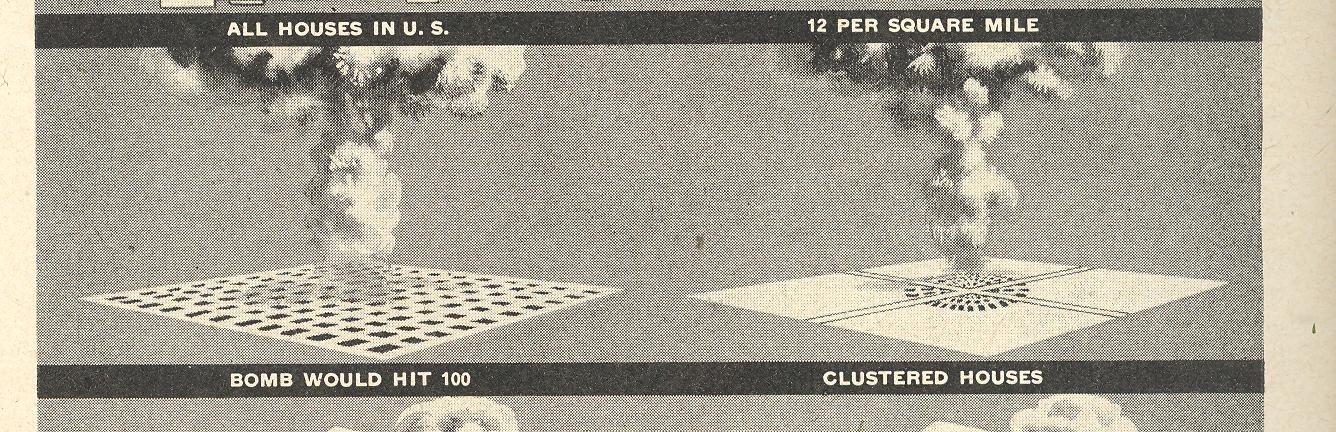
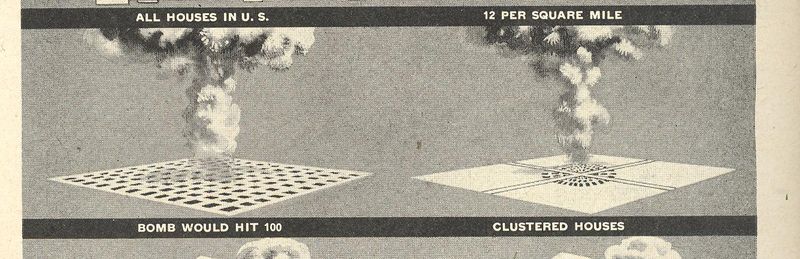
    And that bad idea is this: relocating and dispersing the entire population of the United States into a geometric grid-work covering all parts of the country, emptying all American cities into a vast nothingness of exurban Atomburbs. 
    1-may 3-atomic 2

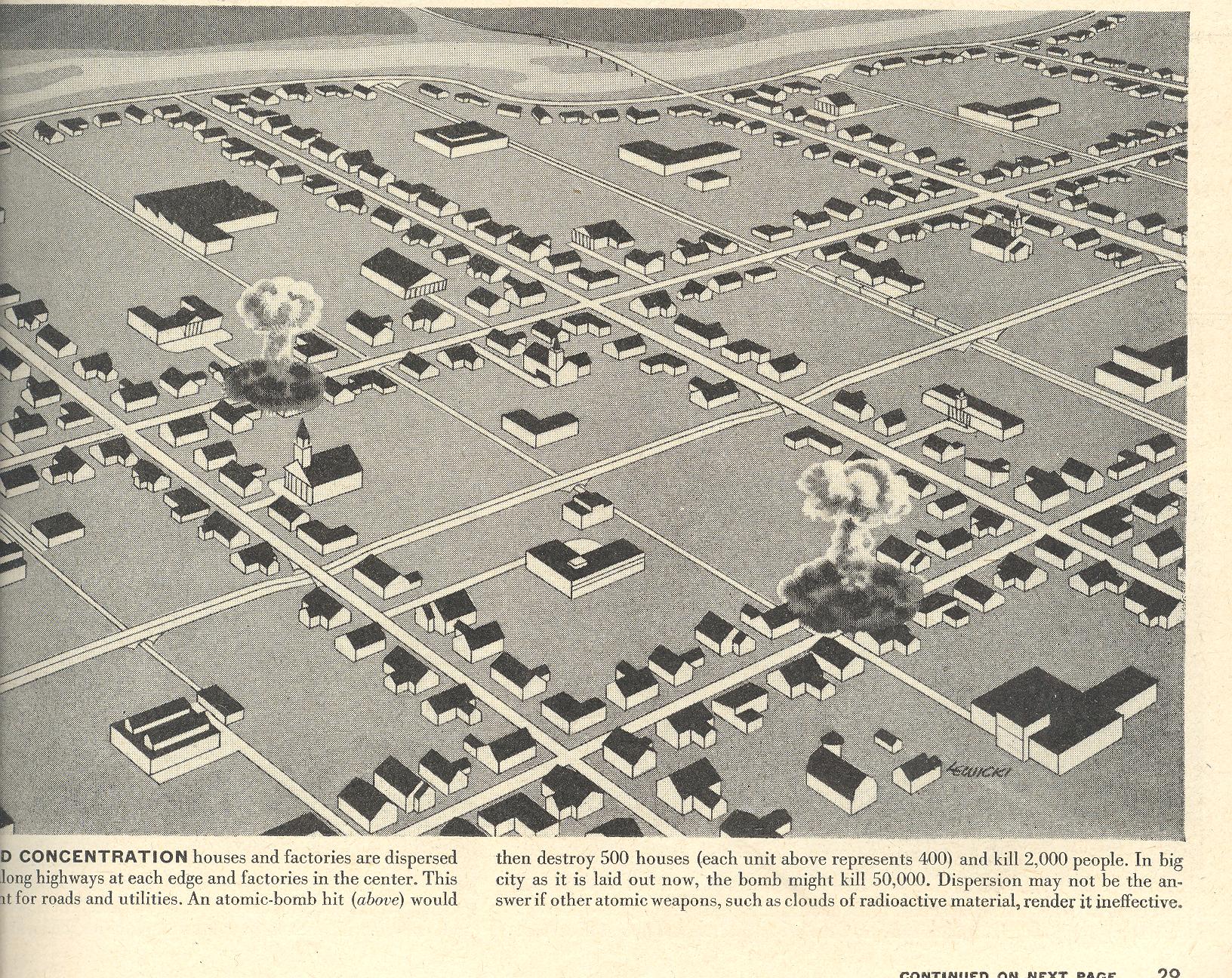
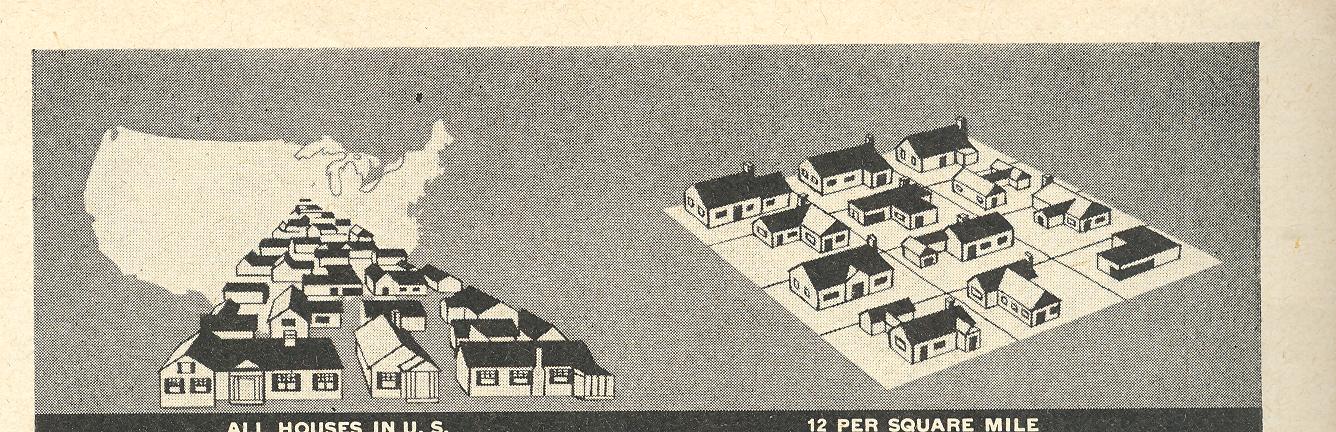
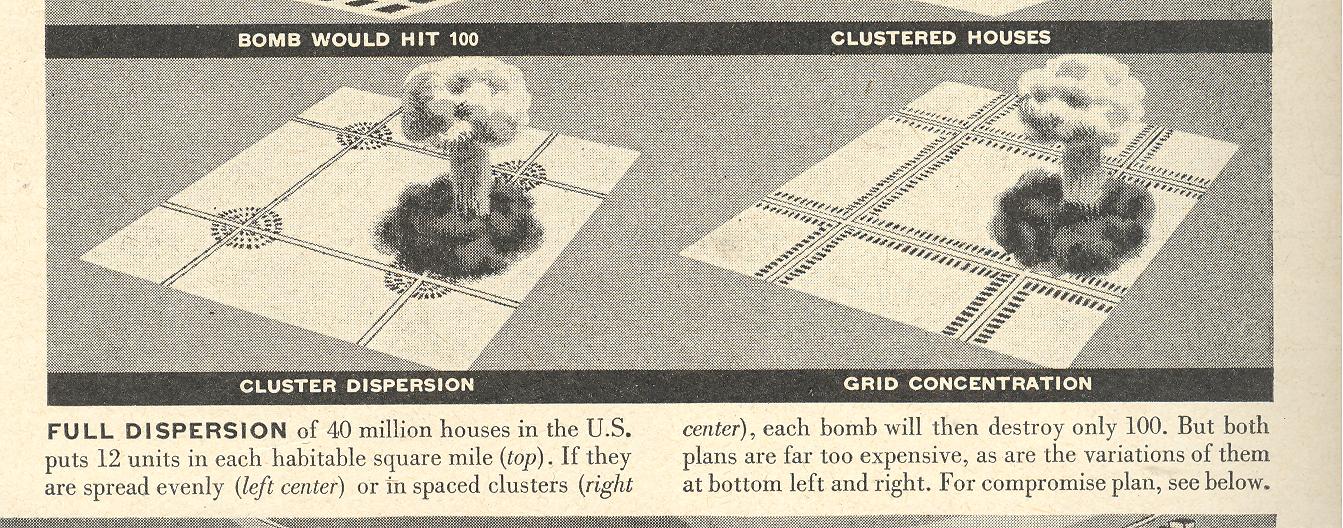
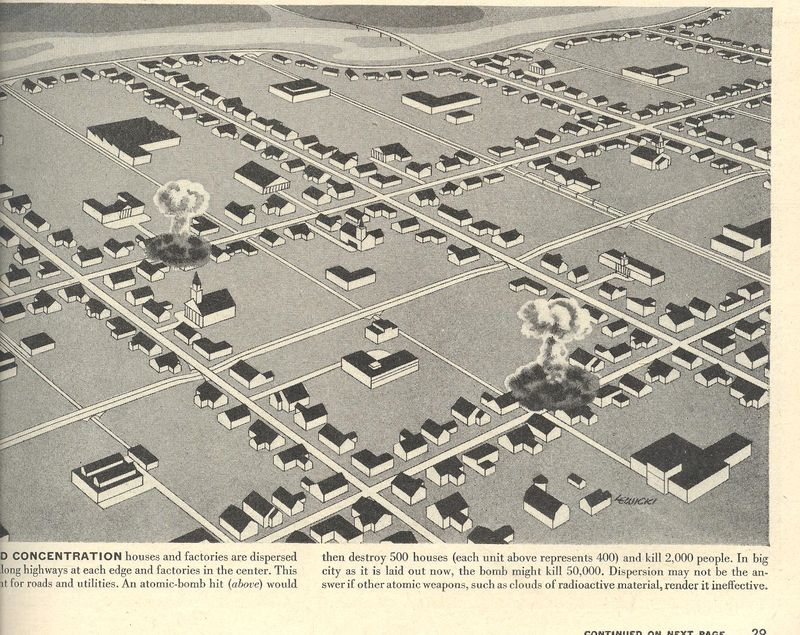
    There.  I said it.  Unfortunately, the thoughtfully blank idea was “real” and  was worked out by three smart guys, the result published in the Bulletin of Atomic Scientists in 19461.  The kernel of the proposition was republished for the masses in LIFE magazine in (15 June) 1947, complete with maps which stand on their own as being spectacular and peculiar examples of visual propaganda.         

    Listen: the crux of the issue was to remove everyone from any American city with a population greater than 50,000 people and place them in newly-built communities set out across the country’s landscape (mostly) like a chess board, the towns existing on all of the connecting lines. [As weird as this sounds, the great Norbert Wiener came up with a similarly astounding, untouchable idea using circles.]. The authors proposed to build 20,000,000 new homes, relocate industry (preferably underground), reallocate and redistribute energy supplies and natural resources, and recreate the very fabric of social and economic life in America.  
    1-may 3-atomic 4
    The governor of this thinking was the coming arms race and the American susceptibility to clouds laced with Soviet atomic weapons–and worse.[The calculations for destruction being used here were for the Hiroshima atomic bomb; in 1952 the U.S. would detonate the first hydrogen bomb, followed by the Soviets the next year.  These bombs would be measuring explosive force in terms of hundreds of thousands–and then dozens of millions–of pounds of explosives.]  How does this idea get thunk in a group and not abandoned?  And then how does it manage to be published by a a reputable organization?  These are smart men, these authors, and I just cannot think of how they could’ve come to these conclusions–though Teller, who was part of the genius flotilla of superb and essential Hungarian scientists, was undoubtedly mentally affected by his supernova hawkishness. I didn’t know this about Marshak, and I really am not very familiar with Klein.  They were all University of Chicago, and the Bulletin was originally published as the Bulletin of the Atomic Scientists of Chicago. 

    There are deeper, more disturbingly anti-spectacular ideas laced through the short article, some of which are so soaringly and diligently insane that it is difficult to address them.  For example, the authors suggest that the “ribbon cities” wouldn’t necessarily have to be “laid out in exactly straight lines” and that the lines could be adapted to the terrain.
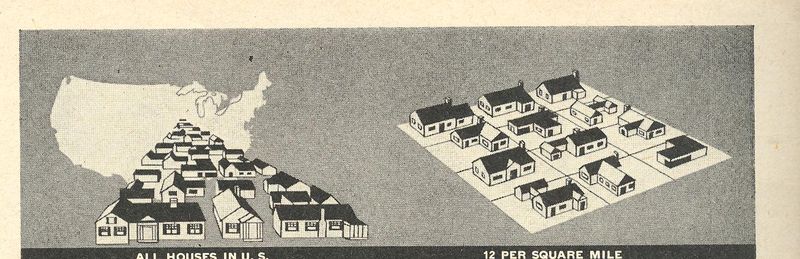
    1-may 3-atomic 1

    Even though the authors propose moving and rehousing 20 million people (and so on), this was not what they really wanted to do.

    They wanted to put everything in lines and underground. 

    “We shall have to forgo elaborate schemes of underground cities” because of expense, they write.  And what of the cost, as long as we’re at it?  Somehow a figure of 200 billion is floated around–200b in 1947 dollars, which is 5 trillion in 2010 dollars (or so), which really doesn’t seem to be a figure that is in any way near to what an undertaking of this magnitude would cost.  (The odd thing about this figure is that $200 billion is about the same percentage for a single year of 1950 GDP as the $5 trillion is of the 2010 GDP.) [It seems unfair to take things out of context like this, but, well, it isn’t–the entire article is filled with almost nothing but these statements.  In a way I’m doing the authors a service by taking things out of context so that the entirety of their madness isn’t revealed as the ugly road-kill thinking it is.]

    Of course, g_d knows where all of this building material was going to come from.  Or the people who would actually do the work.  Were there 3 million construction/building folks in the 1950 census?  I don’t think so.

    And so in spite of the overwhelmingly underestimated cost, and the rerouting of the infrastructure of the entire country, and moving everyone in the country, and building 20 million houses, and finding the material to do so, and finding the workers to build them all and reconstruct all of the infrastructure and build all industry underground and have the tools to do it all with, the authors felt as though the whole thing could be pulled off in 10 years.

    Someone, somewhere, was certainly going to be working late.
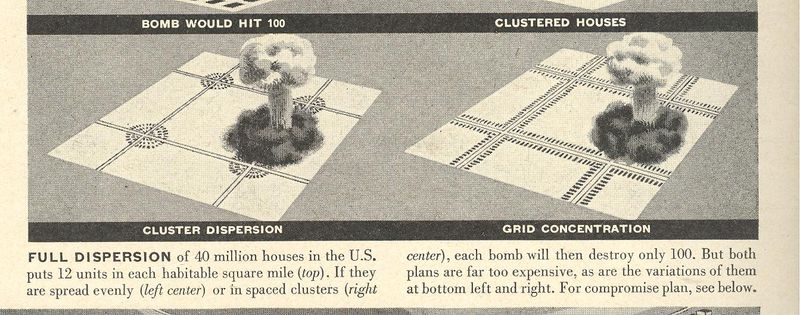
    1-may 3-atomic 3

    And so the interesting part of this thought-tragedy for me is–what is the equivalent idea of this going on right now?  I know there is one, and there will be a new one tomorrow. 

    Notes
    1.. Jacob Marshak, Edward Teller, and Lawrence R. Klein. “Dispersal of Cities and Industries.” Bulletin of the Atomic Scientists 1, April 15, 1946, 13.

    See also:
    “Naked City.” Time. Nov. 28, 1949, 66. Also at.  Also see .The City Under the Bomb.. Time, Oct. 12, 1950

    Charles Grutzner. “City folks‘ fear of bombs aids boom in rural realty.. “ New York Times. August 27, 1950, 1.

    Michael Ray Fitzgerald.  Sitcoms and Suburbia. The Role of Network Television in the Deurbanization of the U.S., 1949-1991.
                   
    Molella, Arthur P. “The City as Communications Net: Norbert Wiener, the Atomic Bomb, and Urban Dispersal” Technology and Culture – Volume 45, Number 4, October 2004, pp. 764-777


  • 1947 Atomic-Powered Farm Industry and the 1945 Internet–Interesting Future Visions Fueled by Booze

    JF Ptak Science Books LLC  Post 1017

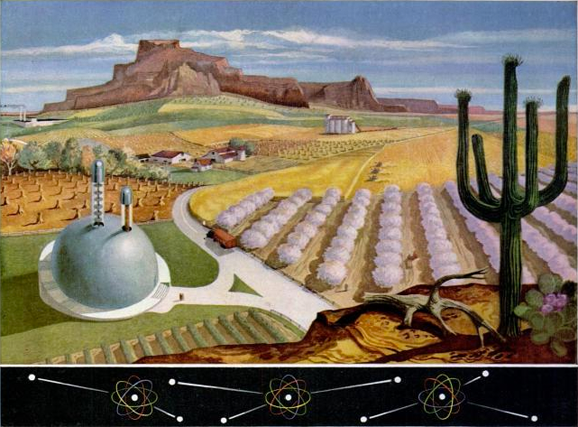
    Seagrams V.O. Canadian Whiskey powered the future through a series of a dozen or so ads for itself in the 1945-1947 period, taking a usually-strangled though occasionally interesting peep into what the future might bring.  (And of course the future is brought by men who drink Seagrams.)  In this ad, appearing in the 12 May 1947 issue of LIFE Magazine, we are told “deserts will bloom through atomic power”–how this might happen is left to the imagination. Also left to fantasy is what exactly is being farmed there in front of the incongruous “atomic energy plant”. Plastic smoke?  Taking a fractured approach to the possibilities one might say that atomic bomb mushroom clouds are being grown from seedlings here from the ground up, nurtured until the day they too will be as big as the blasts of August 1945.

    Atomic garden

    Oddly enough, the illustrator–who after all was just trying to sell alcohol–came pretty close to the truth, except that they got the power source wrong.  Rather than nuclear energy, it would be petrochemical industries that would lie there at the heart of America’s farm production (via seeds and fertilizers and so on)–I’m sure that it would’ve made more sense in a weak way back there in 1947 to believe the atomic story rather than thepossibility that it would be petroleum that would drive the entire production of food forward.  

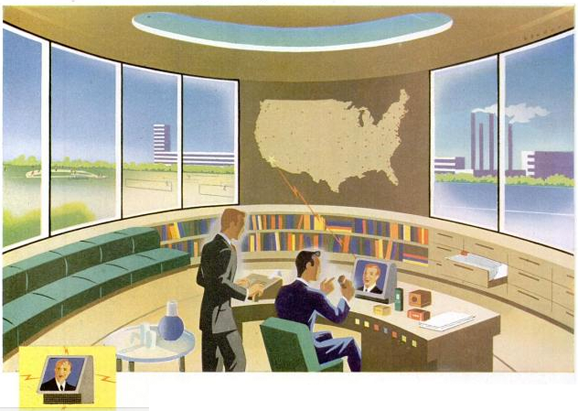
    In another weirdly prescient image–“weird” anyway for a quick effort made by an artist trying to sell drunk juice–is this proto-internet office view, made in May 1945. There’s lots of passive solar going on here(though not really very effective when you consider the other ways of directing and filtering exterior light inside) in the office of tomorrow, but more important is the desk and the file cabinets.  The seated man is talking to someone across the country  via phone/wireless, with data en masse at his fingertips, a “computer” (in the old sense of the word, that being a person–and usually a women–given the charge of adding long columns of number or whatever and then doing the arithmetic, like a comptometer) working some sort of calculating interest on the largish calculating instrument. In general we see a decision-maker awash in responsibility connecting all of the parts of his world: a primitive, secular, analog internet.  And this too just at about the same time that Vannevar Bush introduced his own vision of the informational future with his superb Memex (which I wrote about earlier on this blog here.)

    Internet 1945


  • A History of Blank & Empty Things #70: Thought and Fox-Tossing

    JF Ptak Science Books LLC  Post 1015

    1 april 27 fox tossing

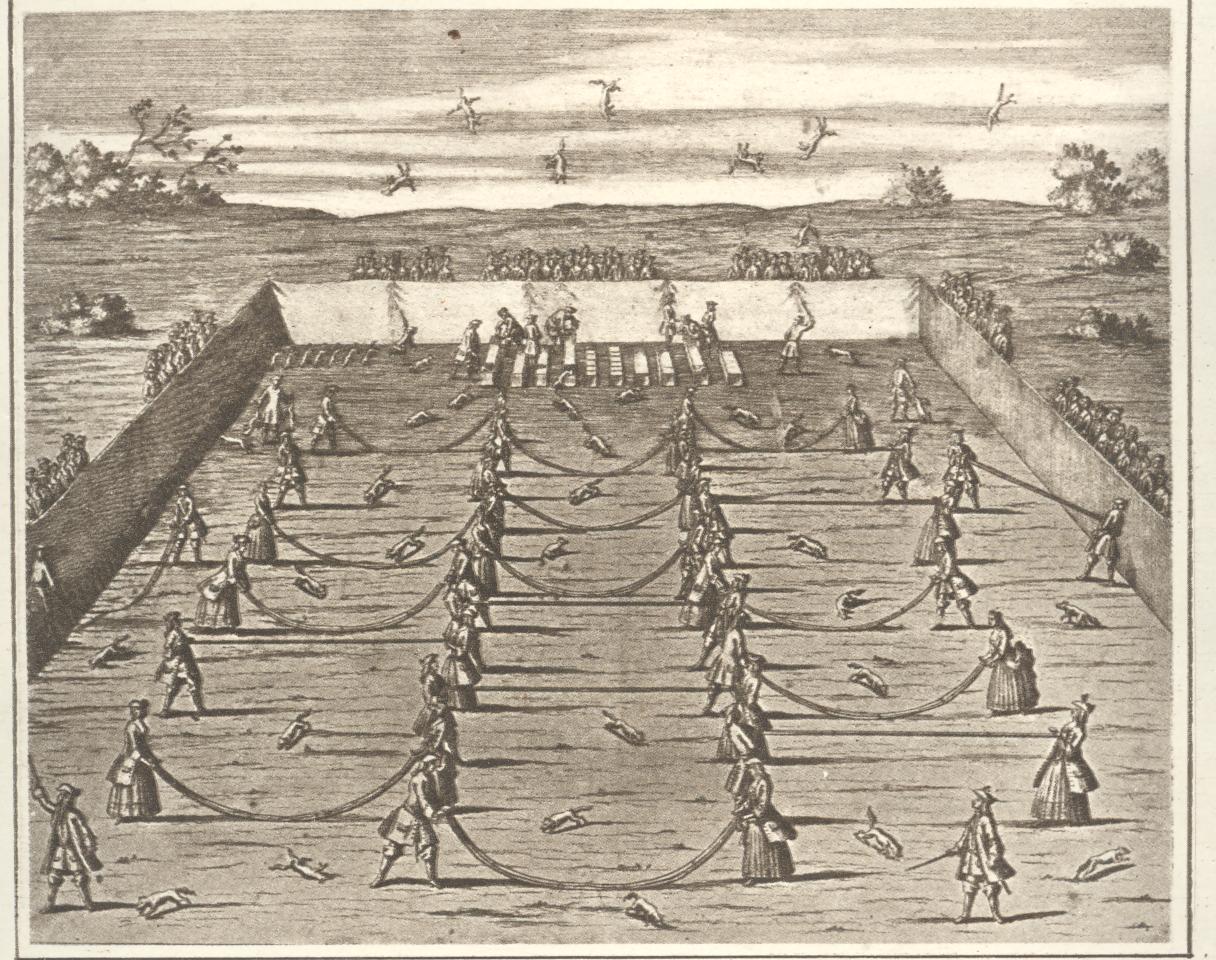
    In the ten-level history of blank thought none are more cardinally ninth-level than the abuse of animals–except of course the abuse of animals for sport. (As unspeakable as this is there is always another level of the truly unspeakable.)  In the early 17th century, at about the same time that the two Electors of Saxony were legendarily and grossly dispatching animals of all shapes and sizes (including 110,530 deer, 54,200 wild boar, 6,607 wolves, 477 bears and all manner of small “prey”) there existed a German Court sport of fox-tossing.

    What would happen is this: a coral would be made of cloth screens; court favorites would entire the enclosures with ropes while disabled foxes were also introduced; the people would pair up with a long rope between them, held slack t the ground; the animals would run in an enforced terror around and through the pairs and over the slack ropes; when the fox tried to run over the rope, the pair would yank the rope taught, launching the fox into the air.  And so on until everything was up in the air or dead.  And that’s it. 

    Fleming’s  Deutsche Jaeger  (published in 1719) produced this (above) image, and commented on it: “Skilled male tossers could toss a fox 24 ft. high…At a famous fox-tossing in Dresden there were tossed some 687 foxes, 533 hares, 34 badgers, 21 wild cats, and at the end 34 young wild boar and 3 wolves….”

    Oscar Wilde famously skewered fox hunting, which pales in comparison to this thing; I find it difficult to imagine what he might have said about fox tossing. 


  • Monetizing Madness

    JF Ptak Science Books LLC  Post 1004

    Hail, horrors! hail
    Infernal world! and thou profoundest hell,
    Receive thy new possessor, one who brings
    A mind not to be chang’d by place or tie.–Milton

    I wonder when it was that people began to institutionally
    capitalize the monetary value of madness? 
    People of course have been “mad” for as long as there have been people;
    but the issue of centralizing them, of locating people with mental disorders,
    or collecting folks who displayed far-ranging attributes of the norm, I think
    is relatively recent.  Certainly it is a
    more modern invention of capitalizing on madness, as “hospitals for the insane”,
    “institutions for the feeble-minded”, “lunatic asylums” and so on are mostly an
    invention of the 17th century. 

    In many instances these institutions were for-profit
    ventures, and most of these were run for the benefit of making money more
    helping the people who would be confined there. 
    It was certainly not pretty.

    The conditions for being sent to one of these places varied
    from country to country, region to region, judge to judge.  Insanity was not a necessary condition,
    either—many wives who stood in the way of mistresses wound up conveniently
    out0of-the-way in mental institutions; it was also a way to gain control of a
    relative’s estate.

    The later may be true in the very celebrated case of William
    Belcher, who spent seventeen years in a private asylum (from 1778 to 1795).  Belcher wrote (as “a victim of the trade of
    lunacy”) about his experience with vindictiveness and vitriol in his Address to Humanity: Containing a Letter to
    Dr. Thomas Monro, a Receipt to Make a Lunatic and Seize his Estate, and a
    Sketch of a True Smiling Hyena
    (1796, which can be seen in full here).

    Another famous case was that of John Perceval, who recounted
    his story in his 1838 book, A narrative of the treatment experienced by a
    Gentleman during a state of mental derangement designed to explain the causes
    and nature of insanity, and to expose the injudicious conduct pursued towards
    many unfortunate sufferers under that calamity.
     Perceval did actually have some
    sort of something going on, a suspension of his normal facilities, as he says
    in the first lines of his book: “
    “In the year 1830, I was
    unfortunately deprived of the use of my reason. This calamity befel me about
    Christmas. I was then in Dublin.
    The Almighty allowed my mind to become a ruin under sickness – delusions of a
    religious nature and treatment contrary to nature. My soul survived that ruin.”  But the base of it all was  the seizure of his considerable property,
    against which he could barely fight. 
    Perceval continued his fight against the lunacy trade for the rest of
    his life (he died in 1876). As a matter of fact Perceval was one of the founders
    of one of the first patients’-advocacy groups, the very bouncily-named Alleged Lunatics’ Friend Society. 

    Evidently the was a
    certain porosness to the definitions of “normalcy” and “lunacy”, the
    distinctions between the two sometimes settled for a cool lump payment.