A Daily History of Holes, Dots, Lines, Science, History, Math, Physics, Art, the Unintentional Absurd, Architecture, Maps, Data Visualization, Blank and Missing Things, and so on. |1.6 million words, 7500 images, 4.9 million hits| Press & appearances in The Times, Le Figaro, Mensa, The Economist, The Guardian, Discovery News, Slate, Le Monde, Sci American Blogs, Le Pont, and many other places… 5000+ total posts since 2008.

Category: Bad Ideas

  • The Gift that Keeps on Giving: Radium, in Powder or Suppository

    JF Ptak Science Books  Quick Post

    Radium.  It was for some short period of time a magnificent and harmless thing, soemthing with a life of its own, sort of, in the way that people used to think of electricity. 

    Adium299

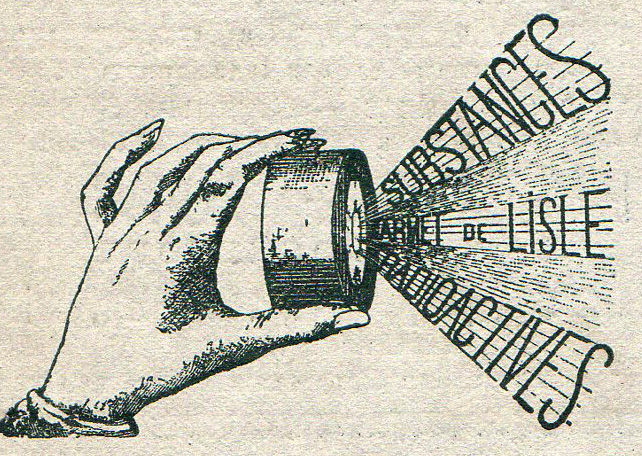
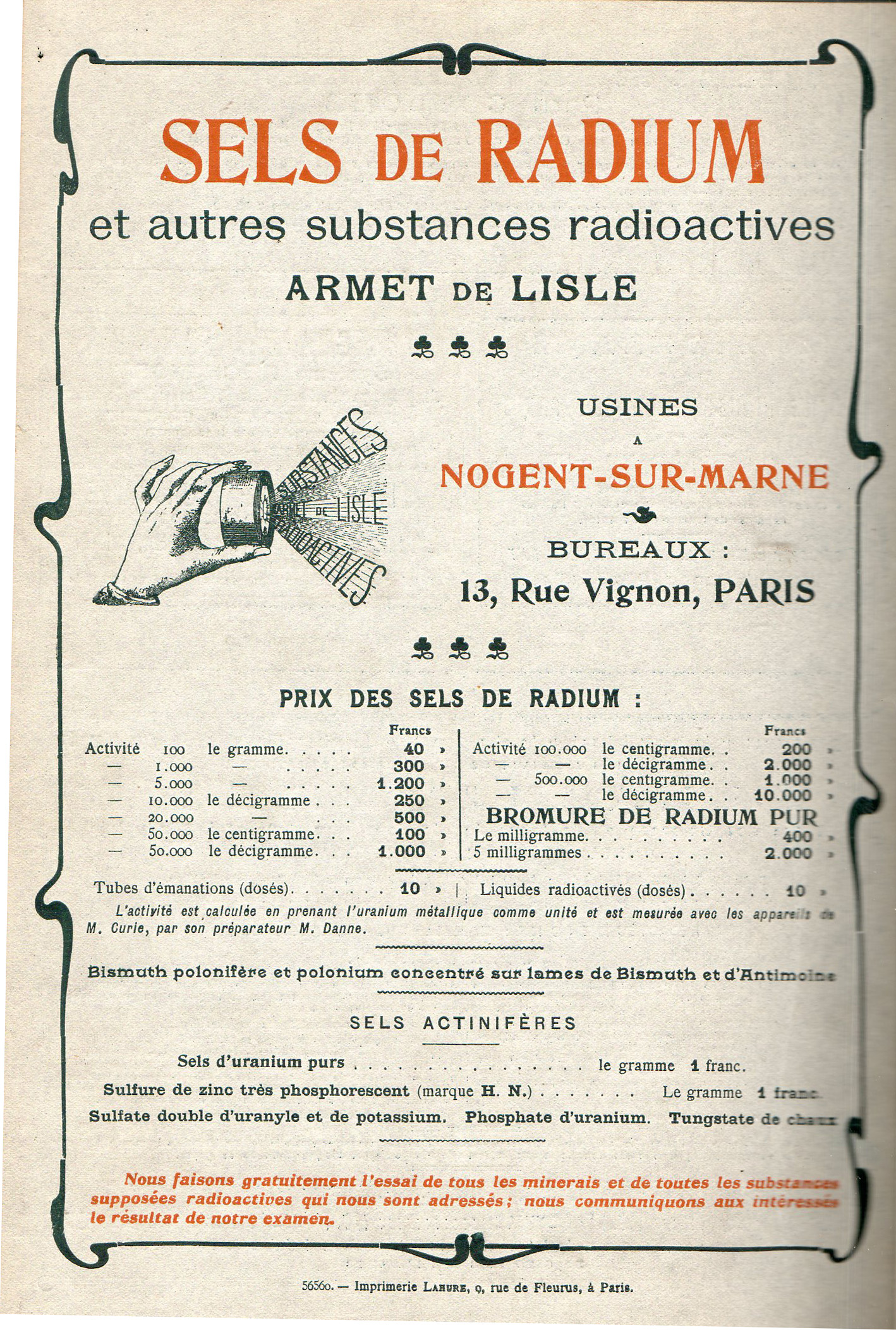
    This is a detail for an advertisement for radium salts, found in the December, 1903 issue of Le Radium.  At this point, just five years after the Curies discovered it and quick-published (in five days) their results in the Comptes Rendus…, the massive biochemical effects of human/radium interaction was not understood. And so the ads for firms like Armet de Lisle, which  was loudly selling Sels de Radium (and other radioactive substances like uranium salt  and uranium phosphate) without any real knowledge of the adverse health effects of its products.  (The Curies and Becquerel had noticed ulcertating reactions to their skin when it was left in contact to radium, and “radium dementia” had been reported beginning about 1900, but it would take quite some time for this radioactive material to be understood as lethal products.)

    Adium298Radium was used (in very small dosages) for the illuminating of instrument panels and dials (in, say, aircraft) and wrist watch faces into the 1960, though the major health factors ground themselves out in the worker who would come into contact with the radium itself. 

    Of course there were other uses for radium as a cure-all, which would have been a completely different story:

    In the early 1900s, real men used radium suppositories

    [which I wrote about here in “Radium Dance”]


  • The Polish Threat to Germany as Seen by the Nazis, 1939

     JF Ptak Science Book–expansion of Post 230 (September 2008)

    This is one of those times when a pamphlet has posed an idea that had never before occurred to me. This anonymous work produced by the German propaganda machine in May 1939  asserts that Poland did indeed have plans to continue to break the back of Germany over the never-to-be-forgotten and at this point hardly-observed Treaty of Versailles, and to also physically attack south-eastern Germany some time in 1940.

    Blogsept_1_poland476

    Again, the idea that Germany was defending itself against an imminent attack by Poland was completely novel to me.  There’s always a reason for these sorts of beginnings of wars, but this one really is exceptionally removed.  Poland had just decided to defend its borders against the Germans following their conquest of Czechoslovakia the previous year–until then the Polish military’s biggest threat was the Soviet Union.  The German attack, the blitzkrieg (Fall Weiss) which would begin on 1 September 1939 involved 1.5 million German soldiers attacking two principal points in Poland. It was ostensibly launched in response to a supposed Polish attack on the German border town of Gliwce–an attack orchestrated and simulated by Germany.  In the attack, the Germans unleashed 11 tank divisions versus Poland’s 1; sent in 1250 bombers and fighters to Poland’s (mainly obsolete) 360; rolled 4 motorized divisions against Poland’s, um, that’s right, they didn’t have any.  And of course the Germans had a modern and vastly superior navy, compared with Poland’s 4 destroyers, five subs, and assorted smaller numbers of smaller and less-significant vessels. 

    The British and the French issued an ultimatum to Germany to cease and desist; Hitler had no intentions in stopping, throwing the five armies of von Rundstedt and von Block deeper into the country in a fast and (according to many German generals) breakneck manner.  The British and French declared war on the 3rd, by which time the war in eastern Poland was already almost over.  The Germans did respond to the ultimatum (see this in continued reading, below) in which it outlines some of their needs and Polish-inspired dears. 

    By 24 September the Germans had reached the formerly important geographic boundary of the Vistula and swarmed past.  Warsaw was bombed by some 1150 aircraft, and by the 27th, the fighting was almost entirely over. (Some divisions held out to 6 October, the invasion completed in 36 days). 


    It is sometimes forgotten in the quickness of this defeat that Poland inflicted some heavy losses on the German military machine:  8000 soldiers killed with 27,000 wounded and 5,000 MIA; 217 tanks were destroyed.  The Luftwaffe lost over 500 planes, either entirely destroyed or damaged to the point of uselessness.  Polish losses were far greater.

    It was at this time that the first of my grandmother’s brothers, Raymond Dymek of Pittsfield, Massachusetts, would cross the border into Canada and volunteer, becoming a pilot in the Royal Canadian Air Force.  He would fly against the Nazis with the CRAF, then joined the RAF, until finally, when the U.S. joined the  European war 27 months later, would fly for the U.S. Army Air Force.  He had a very long career and made it through.  His five brothers would also enlist in the U.S. armed forces; all six brothers would return home. Fatherland and all that.   I know the vocabuarly for their response to the idea that Germany was responding to a Polish threat of invasion didn’t exist to them–it barely does for me.


  • On the Invasion of America (Part II)

    JF Ptak Science Books    Post 1686  Works in the Reverse Esteem of the Gettsburg Address

    “The cheek of every American tingle with shame as he reads the silly, flat, dishwatery utterances of the man who has been pointed out to intelligent foreigners as the President of the United States”–The Chicago Times, on the Gettysburg Address, 1863.   

    We all know today what to expect when we hear something referenced as a Gettysburg Address–and we certainly know what something might be if it was referenced as not-the-Gettysburg-Address. The address as it was when Lincoln gave it didn’t even have a title, named as it was post  facto by the newspapers and periodicals covering the event (on the spot or remotely).  The speech is considered as being among the greatest ever given by an American, though at the time it its reception was very mixed—in many cases it was seen as a failure and even as an embarrassment to the solemnity of the moment and place. There were many newspapers which panned the speech (as in the case above with the Chicago Times, which at the time was considered more of a Democrat paper than anything else), while others (like the New York Times gave the speech a warm reception.   The speech’s presence in national memory was crafted over time (not unlike Mr. Leonardo), its perception formed into the polished gem that it is seen as being today. 

    ==Blog July 15==bsttle for amer

    The possibility of the implied actions of the titles of the pamphlet below were somewhat similar, though in reverse.  I’m not saying that some of them were always seen as quacky and the works of demented seers; their titles and possible content, though, were not seen as dismissible, and their concerns were real and a possibility. The concerns over “invasion” today depend on what invasion means.  I don’t imagine that people are seriously considering the possibility of a land or air force attacking this country, though other sorts of invasions (biological, chemical, cyber, etc.) are a possibility. 

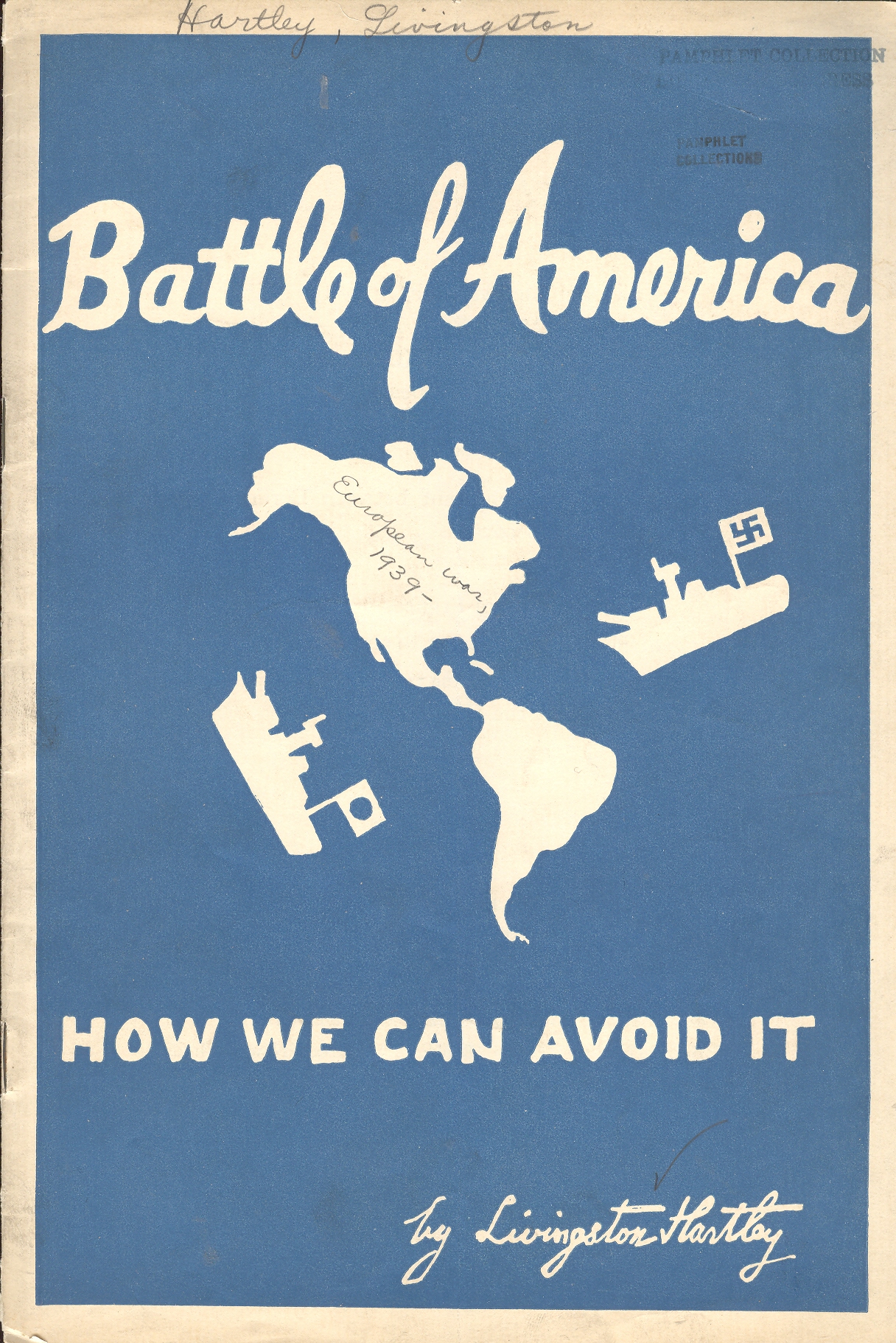
    The Battle for America/How We Can Avoid It (1939) was published by the Committee to Defend America by Aiding the Allies (and headed by William Allen White, iconic middle America newspaper editor and editorialist) which attacked isolationism and advocated strong support of the European effort.  The thinking here was that if America didn’t become involved now it would so later, with battle lines of a Nazi-illuminated truce drawn close to American borders.  So it was a pay-now-or-pay-more-later position from a man who supported the New Deal but whop didn’t support FDR.  ==Blog July 15==battle detail

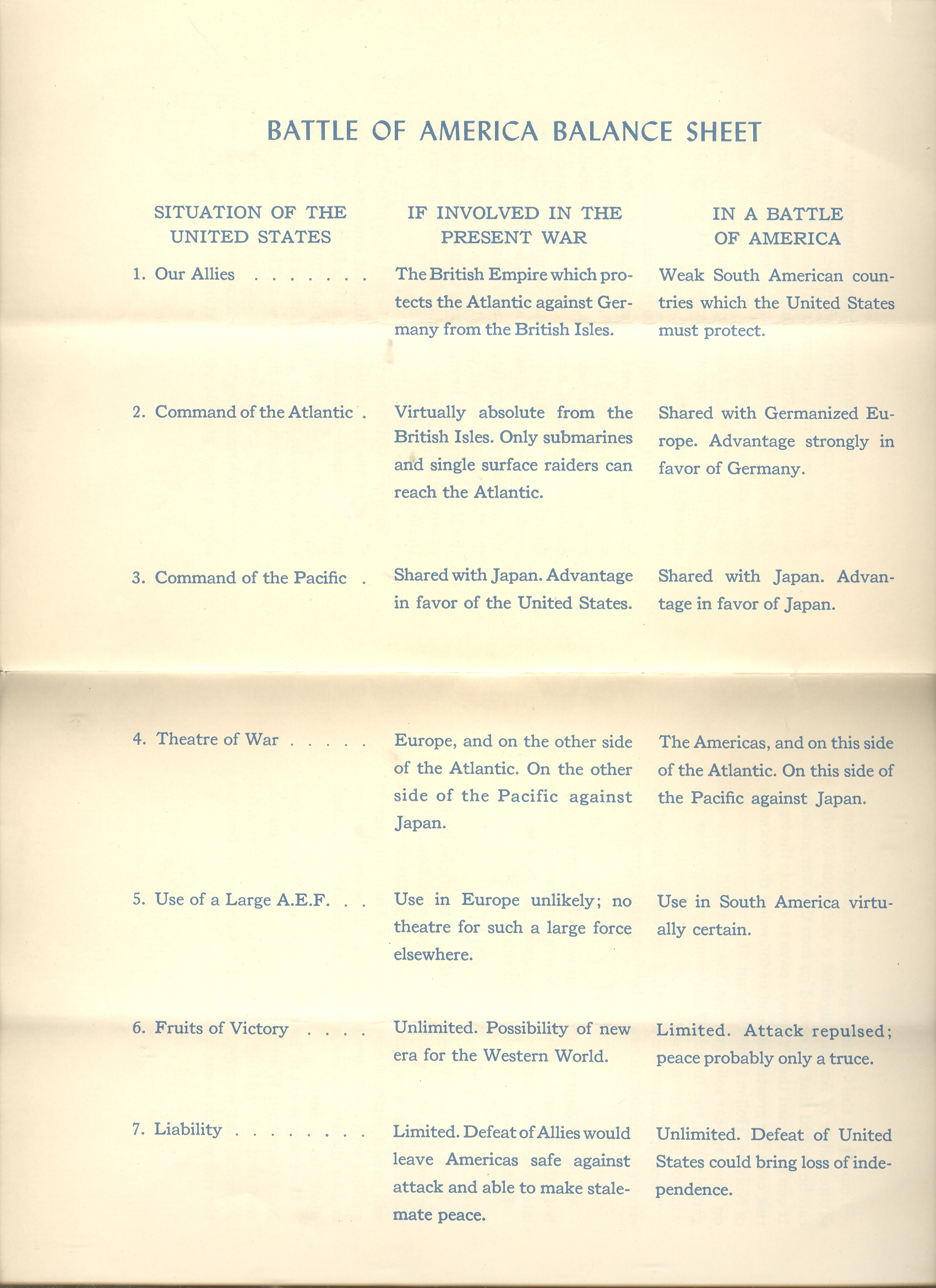
    Much of this thinking looks a bit tenuous to me.  For example the position excluded the use of an American expeditionary force in Europe (“for theatre for such a large force elsewhere”), though if nothing at all were done there would be a “certain” use of the AEF in South America combating Nazism.  Also, if the U.S. backed the Allies with supplies and war materiel the “liability” to the US in the consequence of European defeat “would leave America’s fate against attack and able to make stalemate peace”.  So at the very least, doing a little bit of something would d at least allow us to make a truce with the German/Japanese alliance.   Doing nothing at all in this area would infer “unlimited” liability, and “defeat of the United States could bring loss of independence”. (“Could”?)

    The way aid ourselves in this war “(was) to aid  Britain to hold out to defeat Nazi Germany….the chance for Britain to hold out and win is a good risk for America”.

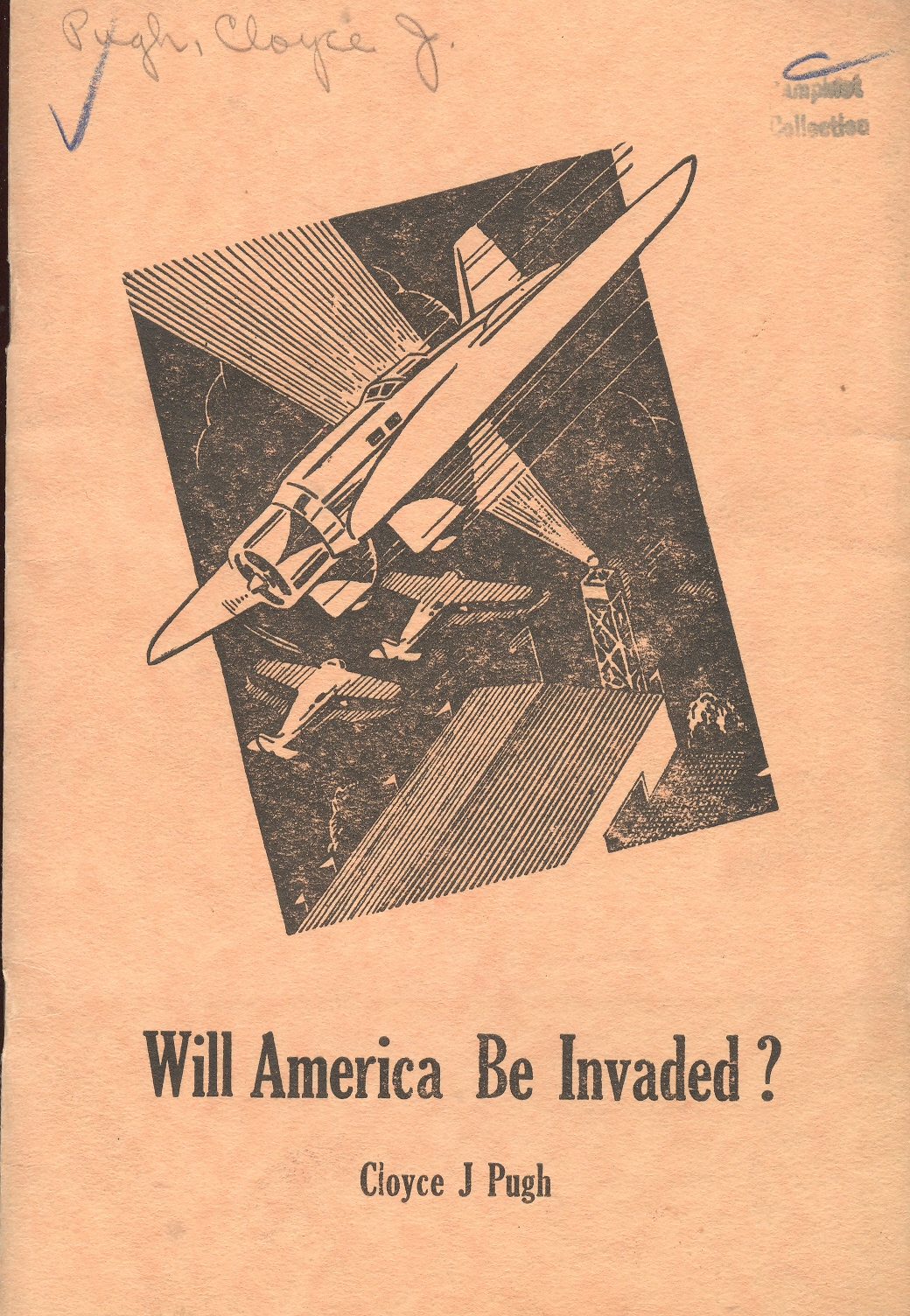
    The second pamphlet, Will America Be Invaded, was published by the Christian Fellowship Press in Akron, Ohio, in 1941, and leans mightily upon scripture to state assumptions about the coming menace to America being presaged in the Bible.  That invasion also seems to be allowed by God (according to prophesies and such) in pursuit of murky results.  The conditions which will prevail “when God permits invasion” (according to this person’s reading of the bible)) include the formation of monopolies, extensive wine and music, “unbelief in God’s judgments”, conceit, “wine and bribes in high places”, and “perverted moral stanfa5rds.  All of this—it is claimed—can be remedied through one medium:  prayer; and prayer through only one mediator, Jesus Christ, who would then take the communications to god’s ear.  

    ==Blog July 15==will america be

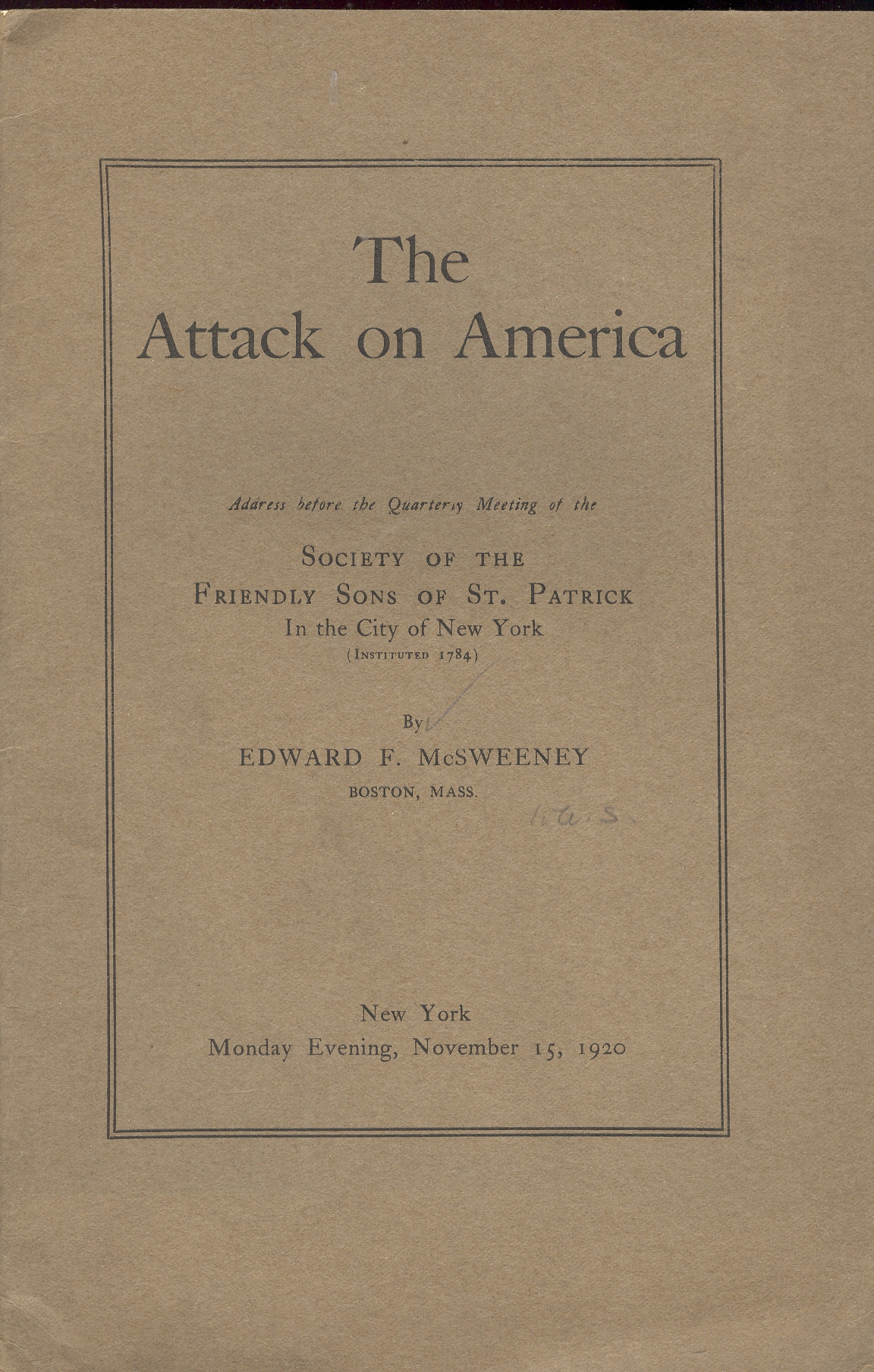
    The Attack on America, published by the Friendly Sons of St Patrick (of NYC), was a cautionary pamphlet published in 1920 warning against certain dispassionate evils of British propaganda in the United States.  Freedom or Enslavement for United States of America (sic), published in 1939 for the Mothers of United States of America (sic) advocated a freedom policy that prohibited conscription in foreign wars and would present a state of permanent neutrality. It also made some pretty vicious anti-Roosevelt attacks, finding him the Socialist root of the coming empire of American evils with a wildly power-mad and legislative-grabbing presidency.

     ==Blog July 15==attack omn amer

    Quite a grouping of pamphleteers concerned with the potential overthrow of the United States, each seeing the unfortunate possibility of national death via divergent and disparate means:  the fall of the country due to not being part of the Allies during the war and also for being in it; biblical ordination of invasion that is only combatable through prayer; British and European propaganda control of the national welfare; and of course the diabolical Socialist menace of Franklin Roosevelt and the imperial presidency as the ruination of the nation’s future.  All of this gently hidden by disturbing titles which really dont give you a hint about what wildly unexpected ways the end was approaching.  And whatever they were, they were definitely not high-order thinking.


  • On the Cost-Effectiveness of Killing: Poison Gas (1921) and Atomic Bombs (1945)

    JF Ptak Science Books   Post 1678
    Chemical warfare

    Atomic bomb eco detil

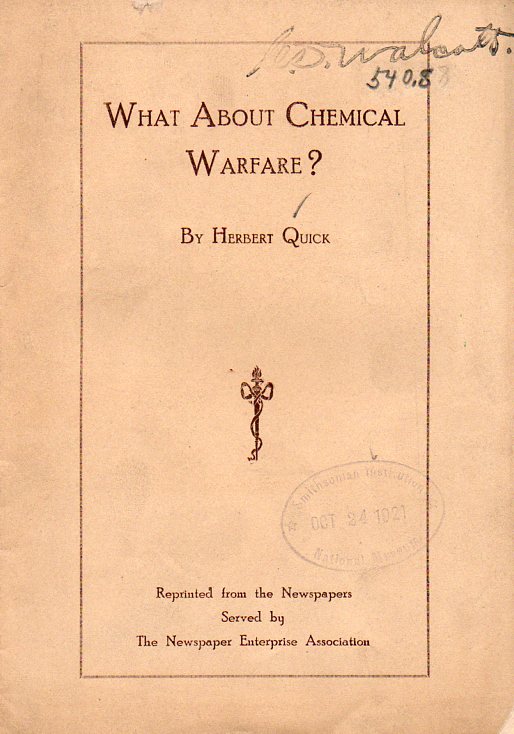
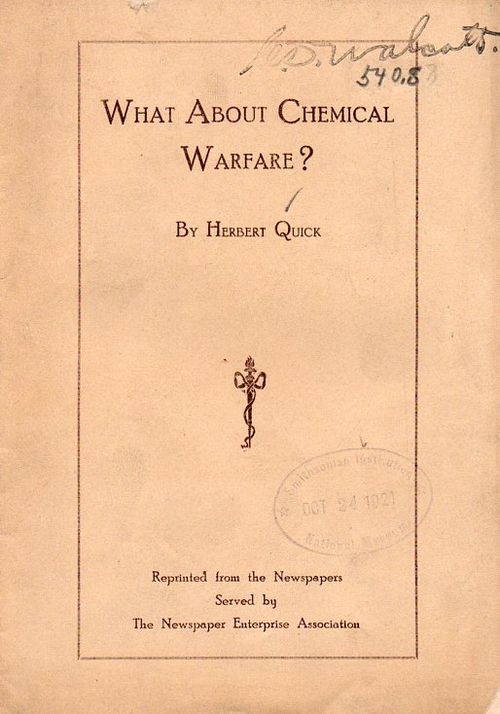
    Herbert Quick did a fair amount of thinking about the military use of poison gas, and it winds up, in the final analysis, thinking that it was tolerable.  What About Chemical Warfare? (published by the Newspaper Enterprises Association in 1921) is certainly a possible title for a Duck-and-Cover A-Bomb or You and Your Hormones kind-of-film–it has that certain stripe to it, bearing the certainty of wrongness that becomes more visible with each passing month.  (The pamphlet is available for purchase from our blog bookstore, here.)  But Mr. Quick took the slow boat around his issue, thinking about it a little long and out loud, before coming to his final conclusion in the chapter titled “Gas Warfare Cheapest and Most Effective Arm of Defense”.

    {See here for my post on Willis R. Whitney’s letter/proposal for establishing the American chemical warfare capacity, 1917.]

    He points out the enormous impact in the war effort that relatively small chemical corps played in WWI–something on the order of hundreths of one percent of all serving soldiers were employed in the combined chemical corps, saying “how small a body to produce such great results!” Which is true, assuming that by “great” he meant ‘widespread’, though it is unclear exactly what he was talking about.

    Mr. Quick (born in the first year of the American Civil War and dead four years after the publication of this pamphlet, writing evidently from the cushion of old age) does make a case for poison gas being not so inhuman as presented by most civilized people, pointing out both its high quick-death rate and survivability/recovery rates, which seems to be giving/taking at the same time. No matter:  “But woe to the army or nation that does not keep up with the times.  The Angel of Death will breathe in their faces” he writes. 

    The author alsoAir raid885 warns that though Germany was “stripped” of her war-making capacities, he thought it was not so of the industries necessary to produce poison gas. He points out that Germany can produce these munitions in secret, and that if any “militaristic nation conquers the world in the future”, it will be through the use of the poison gas it developed in secret. 
    Defense was also important:  “in the absence of efficient defense worked out beforehand, our great cities might be wiped out with gas bombs dropped from aircraft”.  Mr. Quick believes that protecting cities is possible, writing simply “preparation will prevent such a crisis”.  Indeed.  Unfortunately no ideas about this defensive posture were forthcoming, though he did bring himself around to writing about gas as a defensive tool.  Against looters. And rioters. And snipers.  “Gas puts the sniper in the power of his enemy” Quick writes, using the Marine action in Vera Cruz, Mexico, as a good example of where gas (“gas grenades”) would have come in handy.

    The bottom line is of course the bottom line, practically stating that poison gas as a weapon was indisputably more cost-conscious than anything else, by far, each dollar spent on chemical warfare being worth “from three to five hundred for the army”.  Poison gas services Quick says should be pursued, because “gas warfare cannot be stopped until all war is stopped”.

    Gas warfare “gives the educated, intelligent nations the advantages over the people of lower civilizations”.

    “When both sides are prepared it is much less inhumane than war with bullets and high explosives; but it means horrible annihilation to the army which is unprepared.”

    It is an interesting exercise to replace “poison gas” with other types of weapons, just to see how it reads.

    Mr. Quick was up and down in his treatment of poison gas and war, though almost entirely down.  One thing he didn’t see, that no one saw, really, was the use of a particular gas that was used to destroy millions of people, and which was developed quite in the open in Germany for many years, used for killing rats.  The Nazis simply used it instead on people.  No one saw Zyklon-B coming, and no one could have, even when they did.

    See also my post here on Hermann Goering and Zyklon-B.

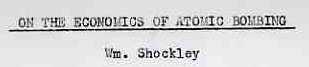
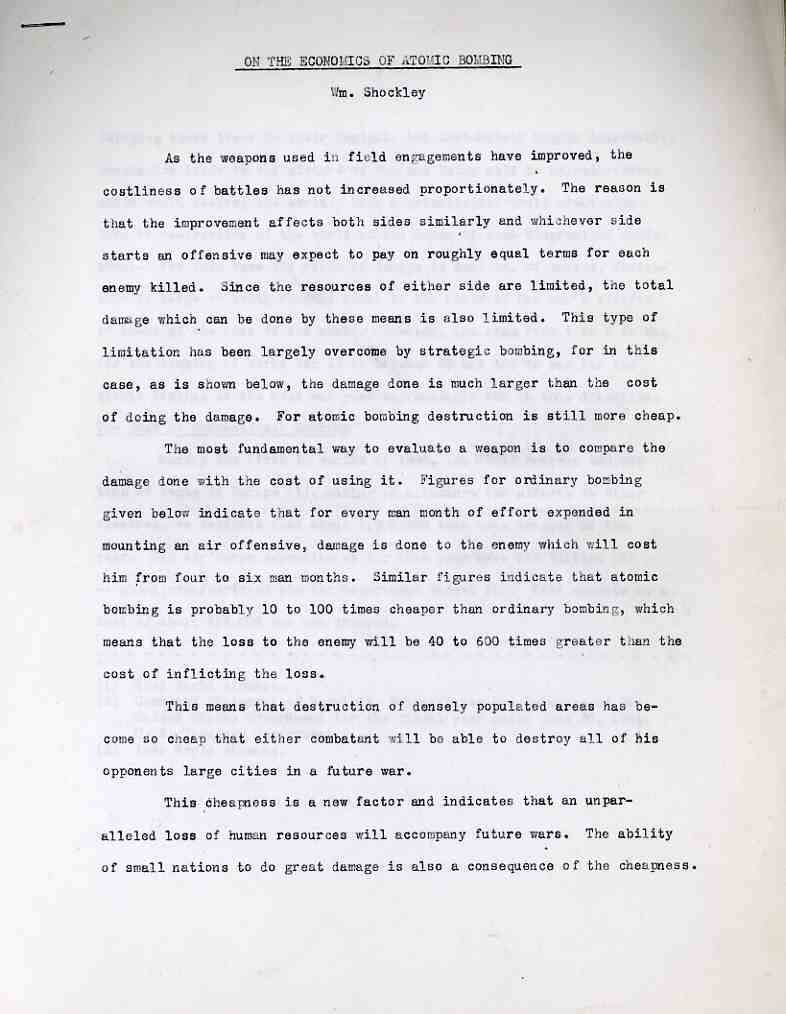
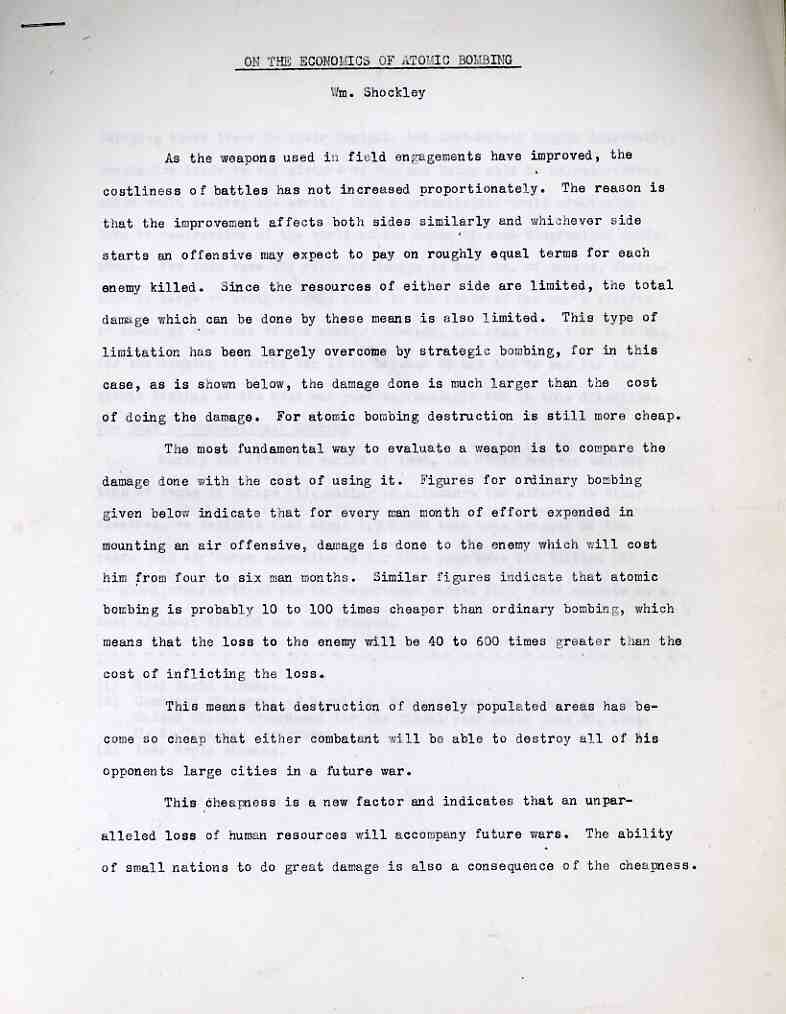
    William Shockley–a future Nobelist and probable weak member of a Nobel-team that invented the transistor and which included John Bardeen and Walter Brattain, or I should say rather a team of Walter Brattain and John Bardeen including William Shockley–sent forth a memo on the mathematics of destruction and the use of the atomic bomb.  He was part of a largish team working on what to do with the new technology once the bomb had been used and the war won.  (I’ve written more on this paper here.)
    Shockley atomic


    This paper was written towards the end of 1945 and is on five pages and runs about 1500 words, and is an extension of work he had already been doing for Henry Stimson with Quincy Wright on evaluating the combinations of casualties that would lead the Japanese to surrender.  He begins this paper with a logical statement of the issue of the economics of conventional and atomic bombing, ending with the sentence “For atomic bombing destruction is still more cheap”.  What Shockley is getting to is the overall cost of the amount of destruction caused per square mile, and the conclusion that he draws over these five pages is the destruction caused by the atomic bomb is 1/100th the cost of conventional bombing per square mile destroyed (“atomic bombing is probably 10 to 100 times cheaper than ordinary bombing”).

    Shockley also recognizes that the problem in the near future will be the increasing cheapness of producing atomic (and greater) weapons, and their developing accessibility to small nations.  “This cheapness is a new factor and indicates that an unparalleled loss of human resources will accompany future wars.  The ability of small nations to do great damage is also a consequence of the cheapness.”  He writes further that taking this thinking to its “logical conclusion”, that at some point in the future a single individual will be able to use this new technology to destroy the world.  The main point though that he was making in this line of thinking was the dispersion and proliferation of the new technology–that an arms race would occur, and that it would be dangerous, and that it could be very very bad.  Shockley has of course nothing to say about any of that or the implications of his finds as that was not his charge. 

    After figuring that the cost of destruction by the atomic bomb was about $600,000 per square mile (compared to $6,500,000 per square mile for conventional bombing), Shockley concludes that “since the atomic bomb art is in its infancy, we may well expect future economies of a factor of 10 in cost per square mile destroyed…”
  • Episodes in the History of Dropping Things–Baby Bombs, Bomb Babies and Dropping Women on Manhattan

    JF Ptak Science Books   Post 1670

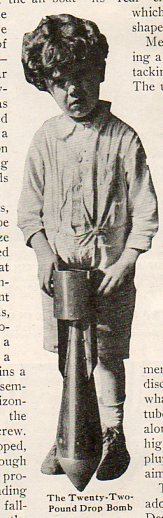
    Dropping things036In the history of dropping things–as distinguished from simple falling things–it must be said I think that this is the easiest of all human activities ever invented, and people have been trying to improve on this creation ever since.  After all, almost anyone can do it and–if you include pushing things over a ledge so that they might fall–most complex life forms can do it, too. 

    Of course there have been intellectual and technological adaptations, particularly when you include throwing and shooting things so that the objects have been charged with a “created height” so that they will be dropped in the designated location.  Cannons have been particular benefit to this aspect of advanced dropping.  And then of course there are the “Galileos” of dropping–like Galileo–and Jonas Moore and David Letterman and of course Seinfeld’s Kramer, and to a lesser extent there’s also every other person from the Boston area who represent hundreds of millions of people who drop a letter from somewhere in their spoken vocabulary.  There are people who drop their accents altogether, and of course politicians who drop the truth, and the tantilizers who drop suggestions, and paid-for pharmaceutical consultants who drop the untoward test results and their accountants who drop a zero when necessary.

    [Image source:  June, 1936, Popular Mechanics.]

    People drop options, they drop in and out and off, pennies and dimes, lawsuits and dumplings, coverage and names and the f-bomb.  They also drop dead and bombs, the last two being closely related, though more people “drop dead” when bombed because they are killed. 

    Bombs seem to be the biggest of all dropped things, especially bombs dropped by airplanes, and especially those bombs dropped on collections of people, which are called cities.

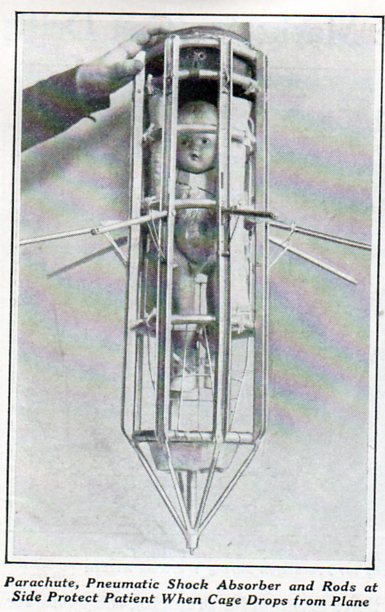
    Perhaps one of the strangest things to be dropped, though, is the following, found in  the September 1935 issue of Popular Mechanics

    Dropping things 2038This was a model of sorts for a critical-care-parachute-gurneystretcher, or something, for when a crew member of a U.S. Army Air Force aircraft was injured and needed care, though the article doesn’t specify where the person would be dropped. Overall it seems not the height of workable ideas, and suffered no doubt from its model using a baby doll, which just looks altogether wrong. 

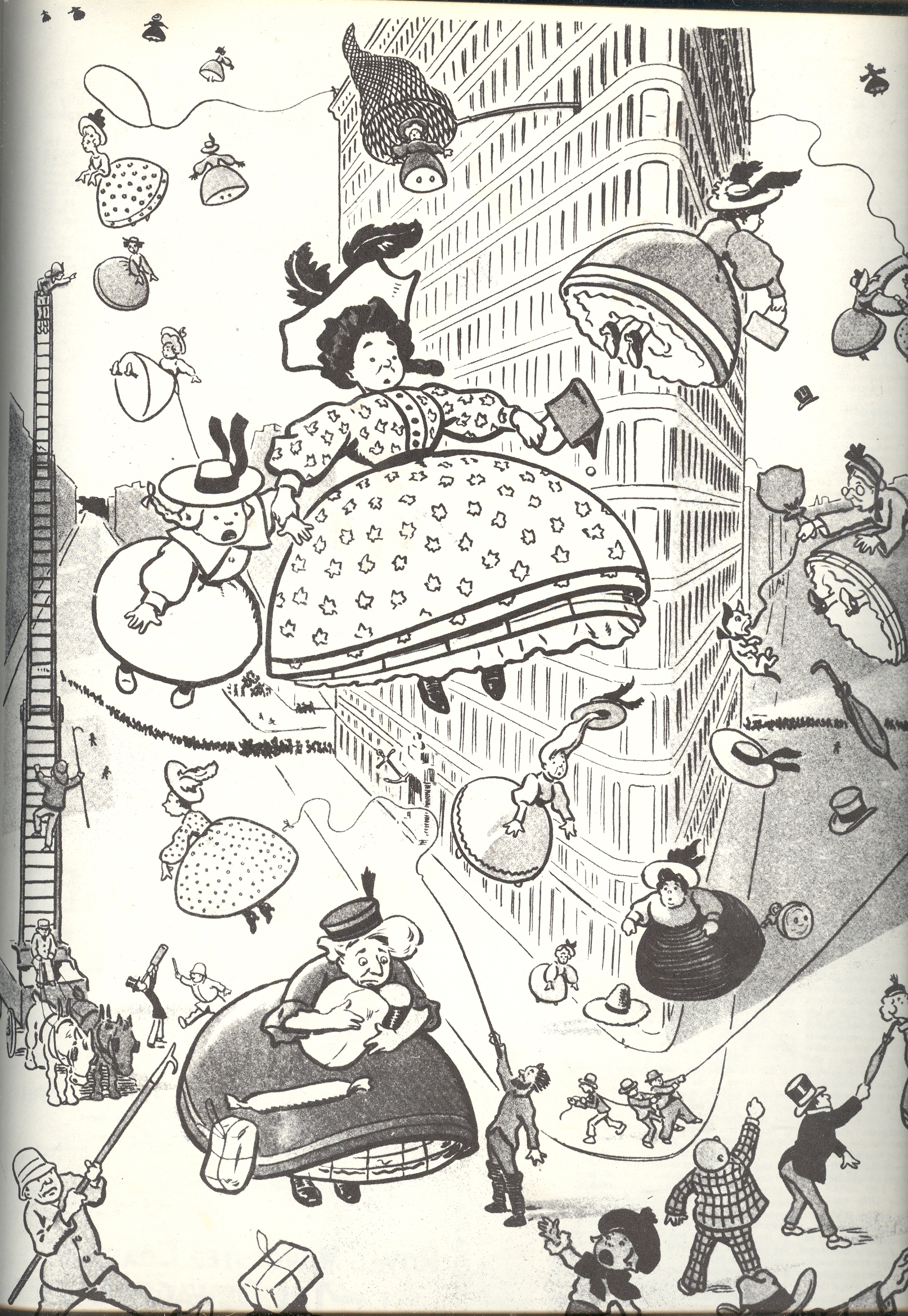
    And the last part of this episode is another strange bit:  dropping women on Manhattan. The  image comes from 1904 and–when taken out of context–it seems as though Manhattan is in for the worst of it, with a view in front of the Flat Iron Building of an aerial bombardment of women.  This is probably one of the few bad things that weren’t done with/at women, and would actually significantly predate the first use of explosives being dropped from aircraft.  Unfortunately the original, intended image was a poke at  crinoline  and featured women being blown up into the air rather than the other way around, though I like my interpretation better.

    5-women


  • Electro-Punk Heavy Metal Birthing Machine–a Fantastically Bad Idea

    JF Ptak Science Books   Re-posting entry #1500

    I found this by accident, and needed to share it immediately, because in the splendid and chilly vastness of the infinite Encyclopedia of Bad Ideas, this entry would seem quite the poster child for such a stupendous effort–the mud to which all dust aspires. 

    The centrifugal machine for human birth…its hard to even finish that sentence, let alone finish it without wincing.

    I think what we have here is the Vitruvian Woman of Bad Ideas relating to human birth, the patent described more fully in this great piece by Marc Abrahams (of the Annals of Improbable Research) in The Guardian, 2006):


    Read the rest of this post here.


  • Sterilizing the Insane, Epileptics, Prostitutes, and More–U.S.A. 1929

    JF Ptak Science Books    Post 1335     On “the Privilege of Sterilization”

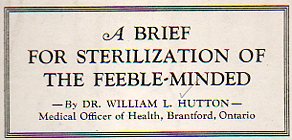
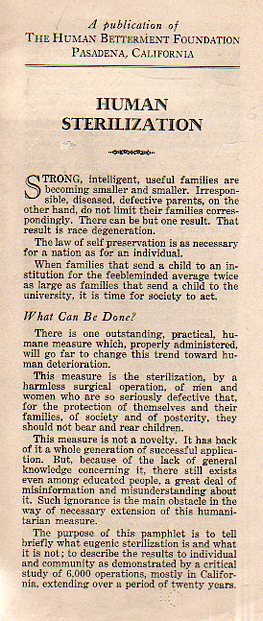
    Sterilization--feeble minded388 There are so many ways of spelling “n-a-z–i” without using a “z”.  Or the “n”.  The vowels come in handy, though.  The Human Betterment Foundation of Pasadena, California did just that, as did the Association of Ontario Mayors, the Eugenic Society, and many other correct-thinking associations and societies.  What these people had in mind was the raising of the genetic good through the malleable confusion of human rights issues resulting in the forced
    “asexualization” of the lesser elements of society–forced sterilization of inmates in state-run mental and correctional institutions, (I’ve written about sterilization and eugenics earlier on this blog, here, though the pamphlets I’m writing about today are different.Today’s pamphlets are available for purchase at our blog bookstore.)

    Sterilization--human steril389 To paraphrase the good doctor Hunter Thompson, (“when the going gets tough the weird turn pro”), the Nazis did that, becoming complete beasts, horrors even to their own horror, almost unimaginably so. (As a matter of fact, they were so bad that a certain percentage of the population believes that the Holocaust and the Nazi experimentation didn’t happen because, among other, race-hating reasons, the crimes were just too enormous to be true.)  But before eugenics studies were molded into what the Nazis needed they provided ample justification to other groups. before the Nazis were elected to power in 1933.  These American groups weren’t nearly on the same level as the Nazis, but they did create their own levels of hell, just not as deep and as profoundly grotesque as the Nazi-version.  But it was something very deeply disturbing.

    The Human Betterment Society put the issue quite simply in their slim little pamphlet, Human Sterilization–to save ourselves from “race degeneration”  society had to act and restrict ‘defective” men and women from bearing and rearing children.   There aren’t that many pages in this publication but they each present some astounding assertions, perhaps the most shocking of which is that this society had its eyes on a larger prize–the country was burdened by as many as 18 Million people with mental disease, who “put a charge and a tax on the population” and who would “cost a billion dollars a year” to take care of.  The Human Betterment people do not say outright that 18 million people should be sterilized, but the statements come in the middle of a pamphlet making the case for sterilization, so we are left with the determinant that riding this people from the gene pool would be a desirable outcome. 

    Dr. William Hutton makes the case for the humanitarian treatment of the treatment espoused in the title of his A Brief for the Sterilization of the Feeble-Minded (1936). “It would be unjust and anti-social to withhold the privilege of sterilization from the victims of mental disorders (the insanities)…”(emphasis mine). He dives into the deep-end of the sterilization issue, making the cse for dealing with the “blind, deaf-mutes, haemophilicacs and brachydactyly (deformed fingers)” in the same manner.

    Of course the Nazis performed all manner of sterilizations before 1939 and before they started to simply exterminate entire populations of who they considered to be human beings unworthy of life. The eugenics people didn’t want to kill people–they just wanted to take away all of their reproductive rights, forever.

    As it turns out, the list of the types of people who were subject to enforced, state-organized sterilization got a little shadow-y around the edges, enough so that prisoners or mental patients accused of “moral terpitude” could include, say, poor women forced into prostitution. The lateral motion of these sorts of issue were decided by different state agencies–in New Jersey for example it was the Board of Examiners of the Feeble-Minded; in Indiana, it was a board of “eugenics experts” (who were to be paid no more than $3 per case).

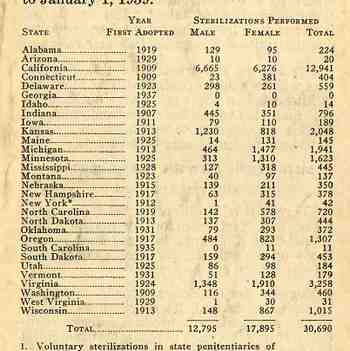
    The reach of sterilizations varied by state–some states did not have any laws regarding enforced sterilizations, though most did–the reach of the practice varied from state to state as well, some (like New York) reaching beyond the state penal institutions, mental hospitals and “homes for the feeble-minded”, and then right down into reform schools for boys and girls (with Michigan looking into industrial schools as well).   Some states–like Kansas–reached across these lines into the lives of epileptics; Michigan did not hunt for epileptics but did so for “imbeciles”. Oregon seemed to cast the widest net, including the “feeble-minded, insane, epiletpic, habitual criminals, moral degenerates, and sexual perverts” found in any institution maintained at the public’s expense who condition was found to be “inadvisable for procreation”.  Maine on the other hand simply included “other forms of mental disease”.

    By 1933 state-sponsored sterilizations of these classes of people reached the following totals:

    Blog1sept_10_sterilization539And so it almost ends, the story of sterilization growing weak and stale by World War II, exhausted and failing under its own exhaustion and failure.  The sterilization of sterilization really begins with the Supreme Court Decision of 1942, the Court finding unanimously that (in Skinner v Oklahoma) that Mr. Skinner’s–a chicken thief–right were being violated when faced with castration.  Justice William O. Douglas wrote:  “[S]trict scrutiny of the classification which a State makes in a sterilization law is essential, lest unwittingly, or otherwise, invidious discriminations are made against groups or types of individuals in violation of the constitutional guaranty of just and equal laws.”The practice continued with less abandon and more restrictive uses into the Nixon administration, which even as late as 1970 increased Medicaid funding for sterilizations, a weirdly appropriated funding that seemed to dramatically increase the sterilization of poor blacks.  Forced sterilization breathed its last in Oregon in 1981.  


  • Kolberg and Sachsenhausen, 1945–Visions of Fantasy and Reality

    JF Ptak Science Books Post 1661

    At the end of WWII there was a tale of two battles, both by the name of Kolberg.  One was a propaganda tool filmed in Agfacolor at the request of Josef Goebbels, a movie begun in 1944 about the mythically-endowed victory of Germany over Napoleon at Kolberg.  It was an epic, costly movie made at a time when the 180,000 “extras” composed of Wehrmacht troops could not be spared, but it was seen by Hitler and whoever was around to agree with him that a movie selling selflessness and sacrifice (blood sacrifice) was more valuable than a military victory1. When it was finally put to bed, the movie “opened” virtually nowhere in Berlin in January 1945, as  the city was becoming a bombed-away shambles–much more so in the next three month.  The visions of resistance-to-the-last-breath played in few places outside of Hitler’s bunker, where the dictator professed the qualities of sacrifice and the fight-to-the-death messages in the movie, though not applying those necessaries to himself.  

    The other Kolberg battle was the Battle of Kolberg (a Baltic seaport city in Pomeria located about halfway between Berlin and Koenigsberg), which took place in real life from 4-18 March 1945.  It was a fight between the Germans and combined forces of the Soviet and Polish armies–it ended in Polish hands on the 18th following the retreat of the Germans and he destruction of most of the city.

    It is ironic that the defeat of the Nazi forces in the real city of Kolberg occurred at nearly the same time as the wasteful film of the 1807 battle extolling the virtues of heroism and sacrifice was released.

    It is interesting too that the  actor depicting the leading German hero in the movie Kolberg (directed Veit Harlan and Wolfgang Liebeneiner)  Heinrich George–who acted in a number of Nazi propaganda films after finding ways to get back into favor following his pre-Nazi pro-Communist politics—found himself arrested and imprisoned in Sachsenhausen concentration camp, where he died of “complications” in 1946.

    Sachsenhausen was one of the longest-lived concentration camps, being in operation from 1936 to 1950.  From its beginning to May 1945 it was of course a Nazi concentration camp (Konzentrationslager Sachsenhausen), where from 1943 until the fall of Nazi Germany it was also an extermination camp.  As many as 200,000 people were seized and sent through Sachsenhausen and its satellite/tributary camps. From the end of 1945 to 1950 it was operated by the Soviet Union, where another 15,000-30,000 people were imprisoned, Heinrich George being one of them. 

    In addition to the many horrors of Sachsenhausen, there was also this–it was the center of a plot to destroy the British economy with the production and distribution of a hundred million pounds worth of counterfeit British currency.  The lead counterfeiter at Sachsenhausen, Salomon Smolianoff (a gifted artist who once said “why make art when you can make money?”) was an inmate with exceptional skills and who basically headed the team of workers responsible for this effort,  For good work in his part of pulling down the economy of Great Britain, Smolianoff was rewarded with an occasional go at a ping pong table, as well as less-rancid pieces of meat. 

    File:Forgednote.jpg[One of the forged Sachsenhausen notes.]

    This was operation Bernhard, named for its director, SS Major Bernhard Kruger (the leader of the VI F 4a Unit in the Reichssicherheitshauptamt (Reich Main Security Office) or RSHA), who was responsible for the operation from 1942, and which eventually extended from Sachsenhausen to other camps, most notably a major operation at Auschwitz.  More than 134,000,000 pounds of what the Brits considered to be the most perfect counterfeits ever were produced, but for various reasons–not the least of which was sabotage instigated by extraordinarily brave concentration camp internees–the vast part of the plan was never implemented. 

    As it turns out, Smolianoff survived Sachsenhausen, survived the war, and then became a puff of smoke. He was a wanted-but-not-found fugitive, and spent his last days in Brazil, painting.  And creating toys.  He died in 1976.

    Bernhard Kruger (born in 1904), also survived the war.  When the pound-forging plan was scuttled in 1944, he moved the idea over to American currency, which he worked on until the end of the wat.  Although he was kept by the British for two years, and then by teh French for one year, he was eventually released, and faced no charges until a Denazification court ordered him to trial, where he was somehow acquitted.  He died an old man, aged 85, in 1989, in his bed. 

    Notes:

    1.  At least this is so as reported by Sir Ian Kershaw in his biography, Hitler, 1936-1945.


  • A Curious Episode in the History of Sitting–Speed Chairs & Trainless Trains

    JF Ptak Science Books    Quick Post

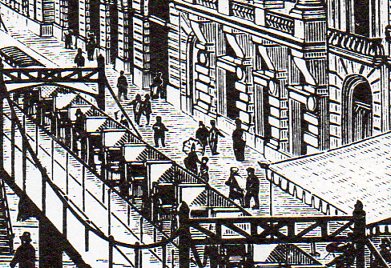
    Sidewalk 997
    It may be that the history of human locomotion is the story of fast sitting.  Except for some of the earliest incarnations of powered movement, it seems one of the most significant engineering aspects moving a person forward is how that person should be carried in the vehicle.  And, well, it seems that in the vast majority of cases, the person is sitting. (There are of course exceptions, notably in say the standing of the engineer in the Tom Thumb when that locomotive set the land speed record;or the Wright Brothers’ powered aircraft, where the pilot was laying down; or say in a chariot powered by a team of horses. Even in some of the earliest versions of steam-powered tractors, the mammoths were steered by a standing operator. It seems though that in very quick order the operator in most of these vehicles find themselves in a seated position.)

    Sidewalk 998

    A very curious application of moving seated humans is seen in this woodcut of a chaired walkway–for all intents and purposes, the pedestrians looking to use the moving sidewalk would have been offered a chair instead.  It seems as though as its base that this was a very simple form of an elevated subway or trolley, though without the train. 

    The moving seated sidewalk was the dreamchild of Alfred Speer (1823-1910), of Passaic, New Jersey, and it seems as though it might have been the first form of mass rapid transit in the city for which it was intended, which was NYC.  It stood fairly high in the opinions of some prominent New Yorkers (like Horace Greeley and Peter Cooper) when it was presented in the early 1870’s, and even passed the New York State Legislature in an act authorizing funding for the program in 1873 and 1874–but it was each time vetoed by Governor John Dix, and the people-moving dream ended there, right before the Centennial.  (See here for the New York Times obituary for Speer., and see All Ways NY blog for a longer look at Speer’s moving sidewalk, here.)

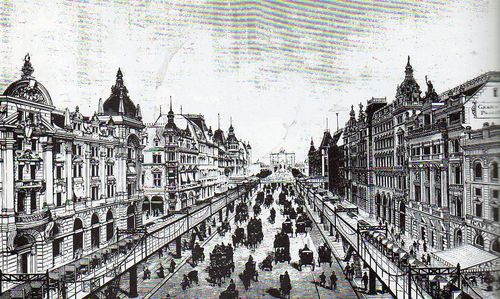
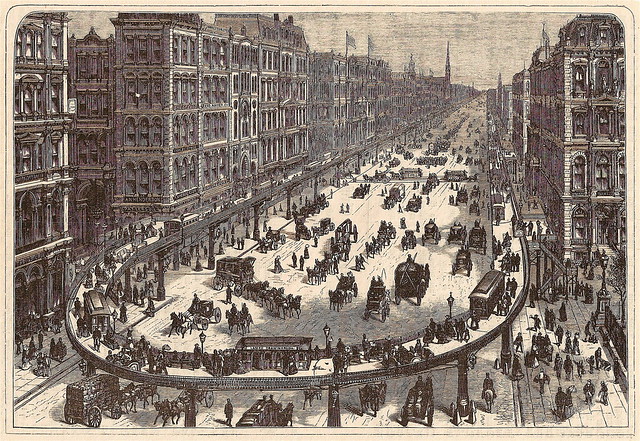
    Here’s another version of Speer’s idea, though this look more like a moving sidewalk, complete with trolley cars, all of which were stationary objects located on the moving walkway.  The idea of course was to free up the chaos and gridlock of the very busy areas of Broadway by placing a large chunk of the confusion on a moving second floor.  It seems as though it might have been a good half-year idea or so, and the $3.7 million dollar price tag might’ve been a hefty one if you calculated the cost per minute of relieved traffic. 

    photo

    [Picture source:  All Ways NY.]

    Mr. Speer seems to have let his vision go and settled down to a life of wine making.


  • Dreaming of the 10-Ton Eiffel Tower Luxury Bullet–addendum

    JF Ptak Science Books  Post 736–addendum

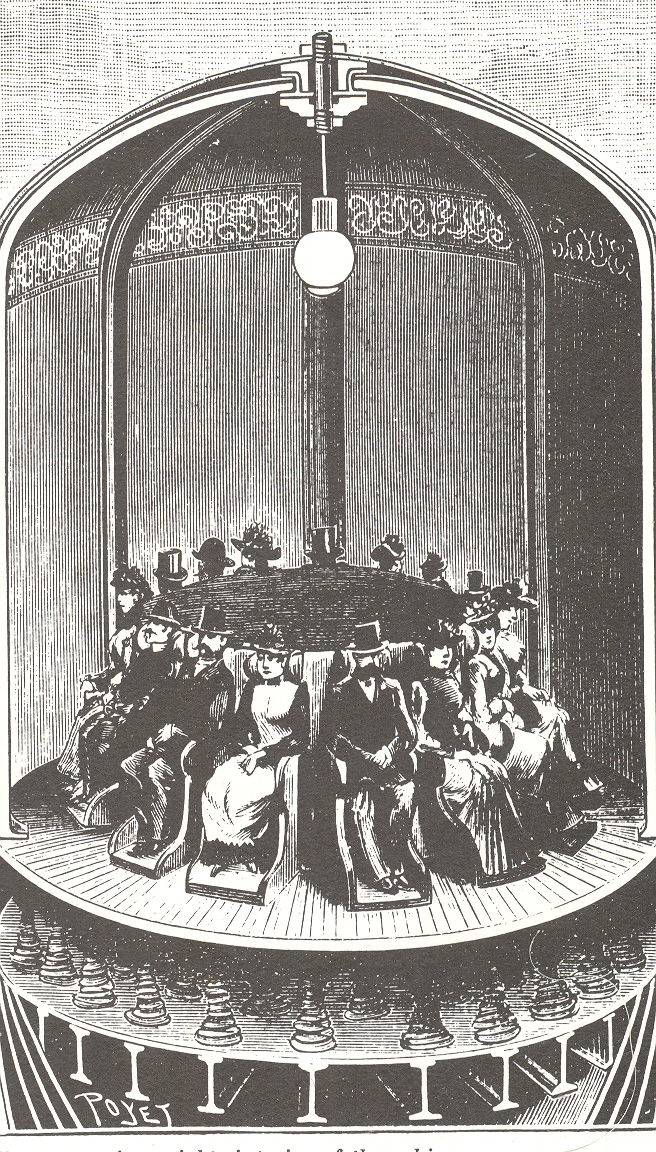
     People find inspiration everywhere, insight to creativity in the obvious and not so.  Great statues have been envisioned in the depths of slabs of marble, solutions to mathematical problems in the step of a bus, the beginning of a new physics in the rolling ball in a wagon.  Its an old and very worn cliché, but the world can be seen in a grain of sand if you could just pieces together the bits of glass:  just as pointillism was seen in the not-simple intercession of two colors and cinematography in the latent image and the structure of the universe in a patch of dancing dust.

    ===blog==aug 30--eiffel

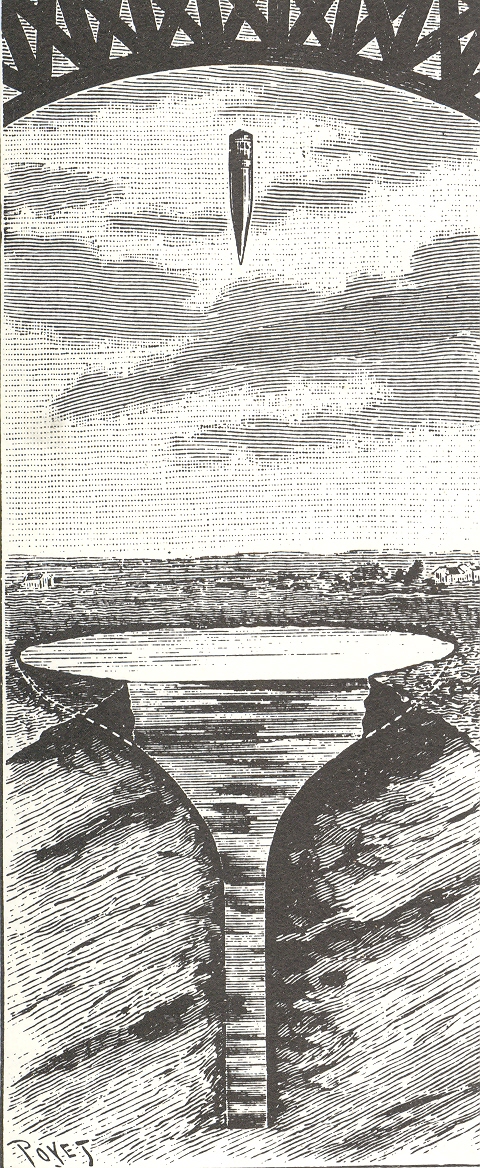
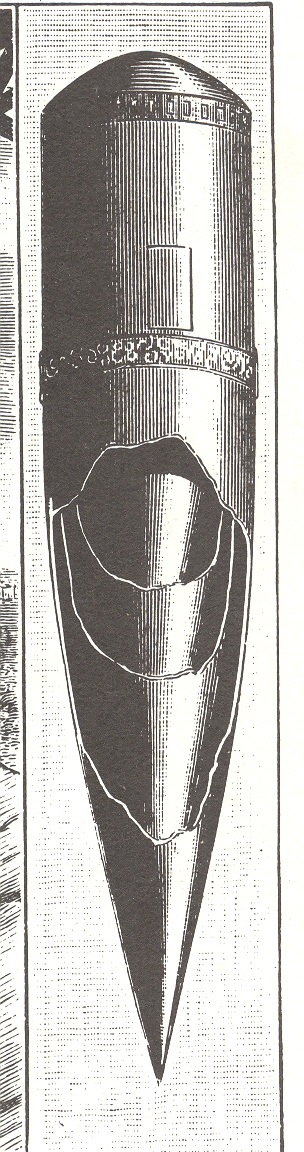
    The Eiffel Tower has had its own way with the visions of people, from it representing the birth of The Modern, to an icon of passion, to architecture and engineering innovation, and to general  adventure and the call of possibility.  It has moved other people to think “special” thoughts:  like, for example, what a lovely canvas it would be to place a 700’-tall electrified sign.  And to M. Carron of Grenoble, who may have the most unusual inspirations from M. Eiffel, the tower was the perfect place to drop a 40-foot tall, 20,000-pound bullet filled with 20 people in leather armchairs into a 200-foot deep champagne-glass pool.

    ===blog==aug 30--eiffelbullet

    This is certainly a singular insight.  But in 1891 it represented something a little more than just giving people a thrill ride.  Physics of impact aside for the moment, M.Carron’s bullet capsule would be released from the top of the interior of the Tower, about 900 feet above the ground, and released to fall into an excavated pool 150’ across and 200’ deep.  The idea was that in addition to the springs inside the capsule, the water would act as a “shock absorber”, and so “the shock felt by the occupants on landing will be in no way unpleasant”.  

    [Okay, so the thing would hit at 138mph or so, and, assuming that the whole thing wasn’t compromised on impact, I’m not so sure that 200’ of depth is very much wiggle room for the thing to come to a halt (if it didn’t deform).   Also it would have to not have any wind deflection so as to not veer off its perfect entry into the water.  And so on.]

    ===blog==aug 30--eiffelinside

    The thing is, though, the thing that made this so appealing, is that for the 20-francs that get a person a seat in the bullet, that they would each get to go twice as fast as any human had ever traveled before in a conveyance ( 65 miles per hour was about the speed of the fastest train constructed).  So it was an extraordinary claim, an done that doesn’t get made all that often in the history of locomotion.

    And so this wasn’t a practicable or workable idea; but, well, so what?  It was an unusual idea, inspired by some sort of different thinking, which are both good places to be in according to the Gazetteer & Atlas of Ideas.  Sometimes thinking like this is just prelude to something else, thought avenues that had to be explored before the real thinking could get done, introducing you to a new geography of thought.  That’s what M. Carron had going for him; the newness of his thinking was much more important than the wrongness of it.

    *This story comes at the end of a post called Bad Ideas Department:  the First Image of a Hypnotized Chicken, so in spite of the title you’ll wind up in Paris.

    ·Posted by :

    ·in:

    —