A Daily History of Holes, Dots, Lines, Science, History, Math, Physics, Art, the Unintentional Absurd, Architecture, Maps, Data Visualization, Blank and Missing Things, and so on. |1.6 million words, 7500 images, 4.9 million hits| Press & appearances in The Times, Le Figaro, Mensa, The Economist, The Guardian, Discovery News, Slate, Le Monde, Sci American Blogs, Le Pont, and many other places… 5000+ total posts since 2008.

Category: Bad Ideas

  • Writers with Guns

    JF Ptak Science Books   Quick Post

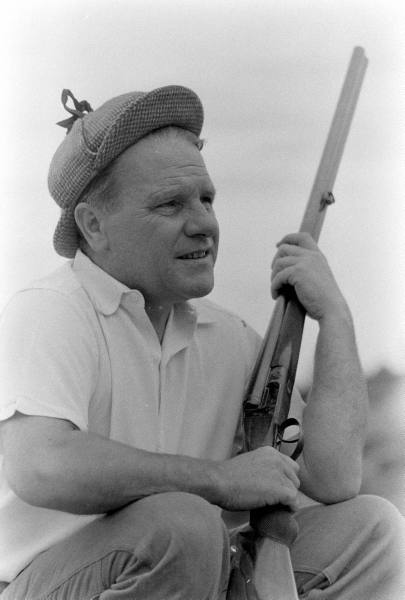
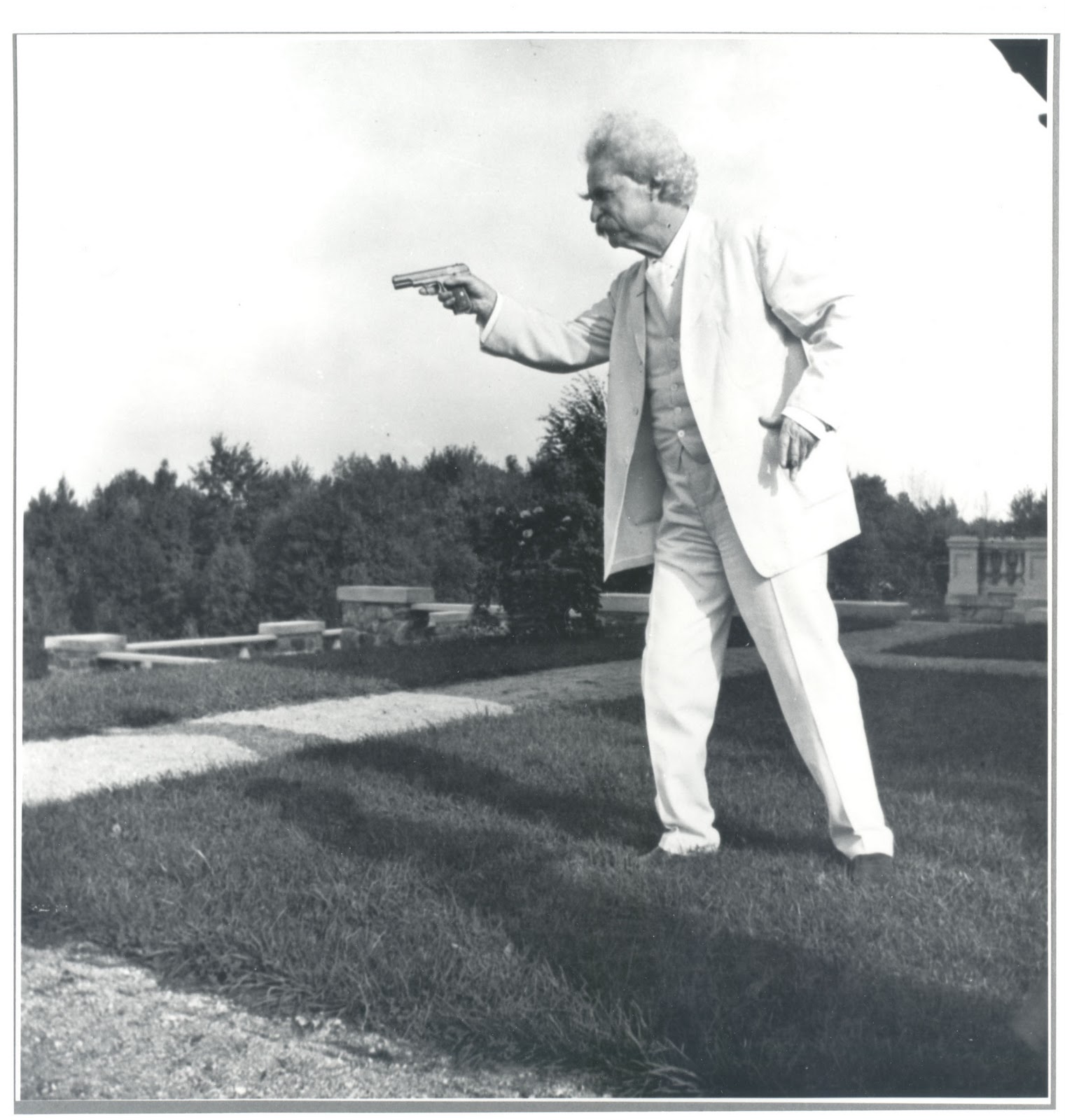
    Well, just a very quick post here for some found images of our leading lit figures posing with guns.  Real guns.  The Samuel Clemens image looks photoshopped to me but so far as I can tell it is real–its a long shadow produced by a rising/setting sun, the other shadow belonging to someone just out of the picture. I like his safe handling of the weapon. 

    http://4.bp.blogspot.com/_wmn8WjrdQfM/TOPSMEhhIzI/AAAAAAAAGVw/ZFcQ_C3-KG8/s1600/Twain+2.jpg

    Ernest Hemingway,  ca. 1905, with air rifle–evidently his connection with guns went way back, but so did it too for just about every other American boy. 

    http://4.bp.blogspot.com/_wmn8WjrdQfM/TOPSiD4kJqI/AAAAAAAAGV0/oa4HFWtYPLs/s1600/Hemingway.jpg

     [Source: Philosophisches & Literarisches Sehloft blog.]

    And of course there’s Mr. Burroughs.  He didn’t meet his end with a gun but he was on the oppsoite end of one that ended his wife’s life back in the old, dim days.  Now, Dr. Benway is dead with the rest of them, but his gun lives on. Ah Pook is here.

    burroughs

     Hunter S. Thompson.  He and Burroughs shared a middle initial and a taste for some wild things, as well as a very good sense of very dark humor.  Thompson was funny and a great political pundit ’till about, oh, perhaps 1974.  Maybe 1976.  But that’s about it–until then, he could call the state primaries like no one else and evidently made a fair amount of money doing it.  He respected Nixon’s ability to see into the future of primaries, even though he saw that man as a pig on fire. 

    huntersthompson1

    Burroughs and Thompson courtesy of ABove the Aether

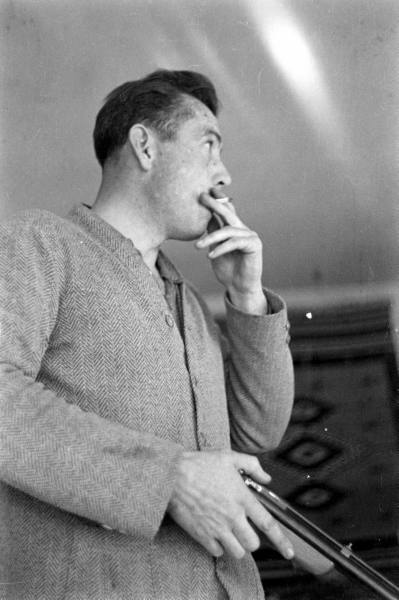
    Lawrence Durrell, author of the Alexandria Quartet–I’m not sure about his gun connection, though we had to read his quartet in high school.  

    WRITERS WITH GUNS! Lawrence Durrell, Indian-born, Colonial - or rather Cosmopolitan, writer: Feb. 27, 1912 - 1990. Famous for The Alexandria Quartet from the late 50s - good friend of Henry Miller… Photo by Loomis Dean, 1960, probably at Durrell’s Cyprus residence…

    John Steinbeck, 1937.  I just like him. 

    WRITERS WITH GUNS! John Steinbeck (Feb. 27, 1902 - 1968), the American author who many say did not deserve getting the Nobel Prize in 1962 (when he was clearly way past his prime). Steinbeck himself stated bluntly that he did not deserve it. I think he deserved getting the Award, for a number of reasons: The Grapes of Wrath, Of Mice and Men, East of Eden… Photo of Steinbeck, 1937 in Pacific Grove near Monterey - by Peter Stackpole, LIFE

    ·Posted by :

    ·in:

    —

  • Disinventing Left, Part II–Eliminating Left Pages

    JF Ptak Science Books   Post 1572

    If (and only if, (iff)) eliminating left turns in auto traffic is a good idea, perhaps getting rid of the left-sided newspaper page is a good idea, too.  (?)

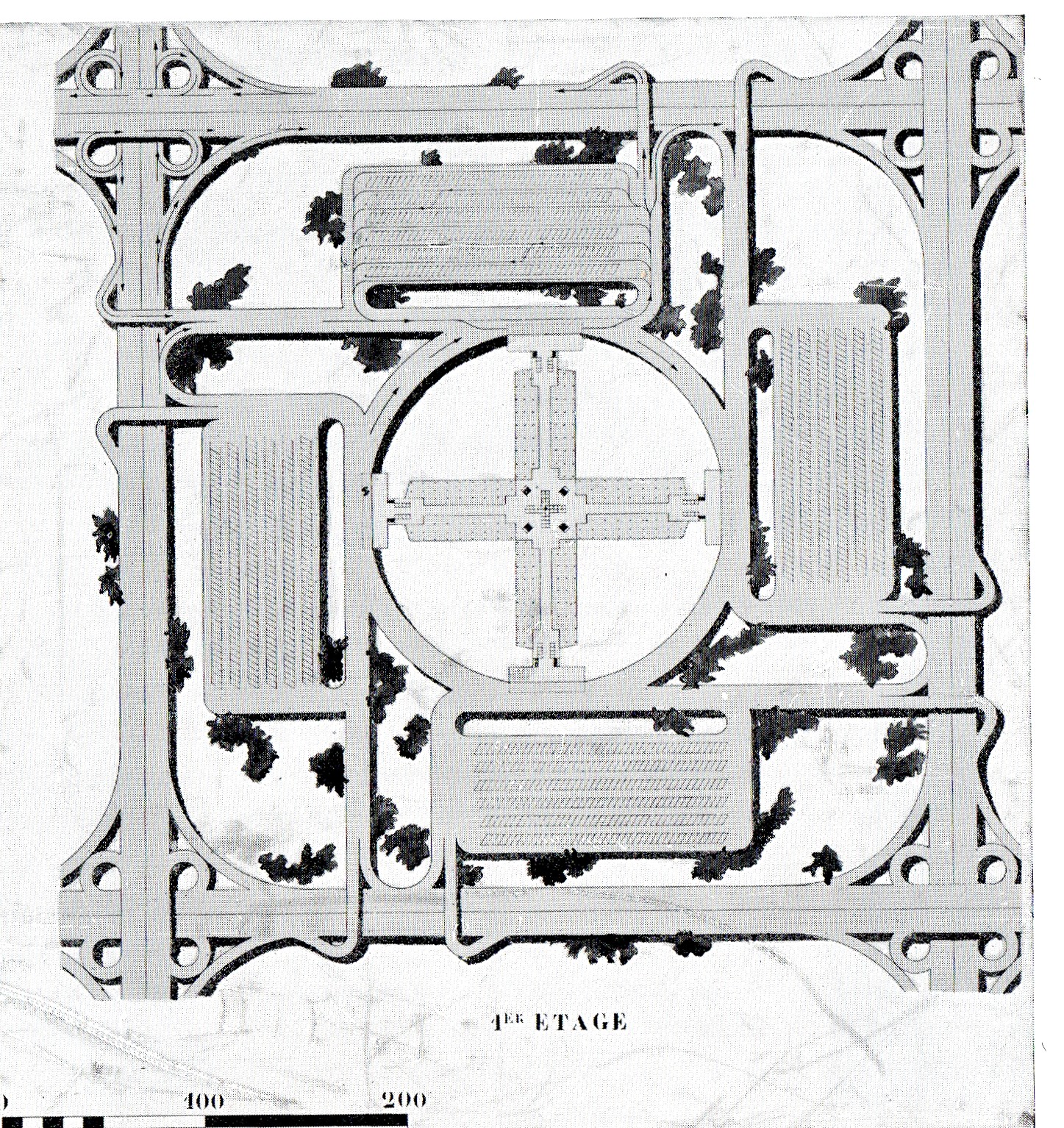
    A post appeared earlier in this blog on dis-inventing the left-hand traffic turn, which for better or for worse was laid at the feet of Le Corbusier, who imagined a new network of inner-city traffic turns as follows:

    Right hand turn 2006

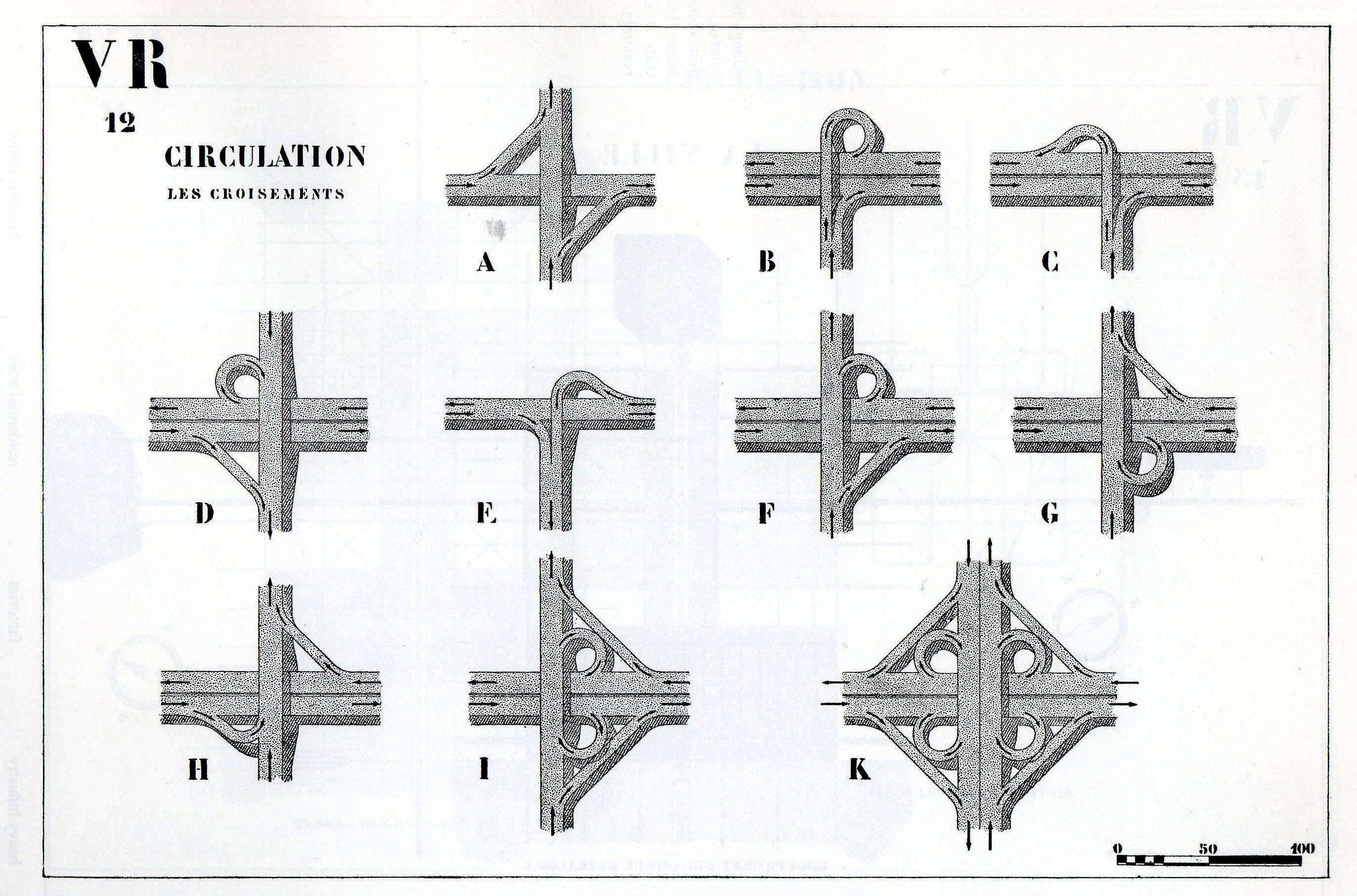
     which appeared in his Radiant City (edition of 1930).   He beautifully includes the following crib sheet for the incremental development of right-turns-only in cities, which I think can stand on its own as the template for x-number of short stories:

    Right hand turn 10

    This is nestled into one of many plans, though Le Corbu’s recipe for mega-sameness seems desperate to me–this one called for a massive complex of 220-meter-tall structures nested in 400-meter squares, going on and on. 

    But I think at its base that eliminating left hand turns for cars in cities seems like a good idea–making the left turn a series of three rights seems at it base to make traffic flow smoother, and since enormous amounts of time and energy and  everything else comes as a result of volatility in traffic flow, and since a lot of that volatility comes as a result of the formation of lines behind cars that are crossing traffic for a turn, then getting rid of the cause of volatility seems the logical response.  Unless of course it causes volatility elsewhere.

    In 1905–one of the greatest years for ideas in the history of ideas, ever, though the following is not one of them–George Ebenezer Morrison proposed to eliminate a source of unease and volatility in publishing advertising revenue by destroying the idea of the left-hand page of text.  He made the case that the value of advertising space on the left-hand side of newspapers and magazines and such was far less than the ads that appeared on the right-side pages–this because, he said, people tend to hold what they are reading with the right-side centered in front of them, leaving the poor left-side abandoned on, well, on the left.  So, with attention centered on the right, ad space was at a premium. 

    Mr. Morrison’s solution–his idea, for which he was granted a patent in the U.K. 1905/105291–was to print the left-hand pages upside down, so that once the right-side was read, the reader would turn the newspaper etc. upside down to read the second half, and thus the left-side page would be entirely eliminated. So, all things being equal, everything would now be right-sided.

    I am not sure if–like finding new traffic problems in multiple right-hand turns–eliminating the left page doesn’t create the same issue with the left side of the all-right-hand page reading material.

    I am sure that Facebook and Kindle and etc.–having already gotten rid of the pages in toto–are now at work in eliminating the left side of our monitors. 

    And whatever it is going on right now, the same thing seems to be going on, it politics. 

    Notes:

    1.  I’d share the patent image, but it is just a rectangle divided into eighths.


  • Note on the Visual Semantics of Ideas: John WIlkins, Jorge Luis Borges, Oliver Byrne

    JF Ptak Science Books   Post 1568

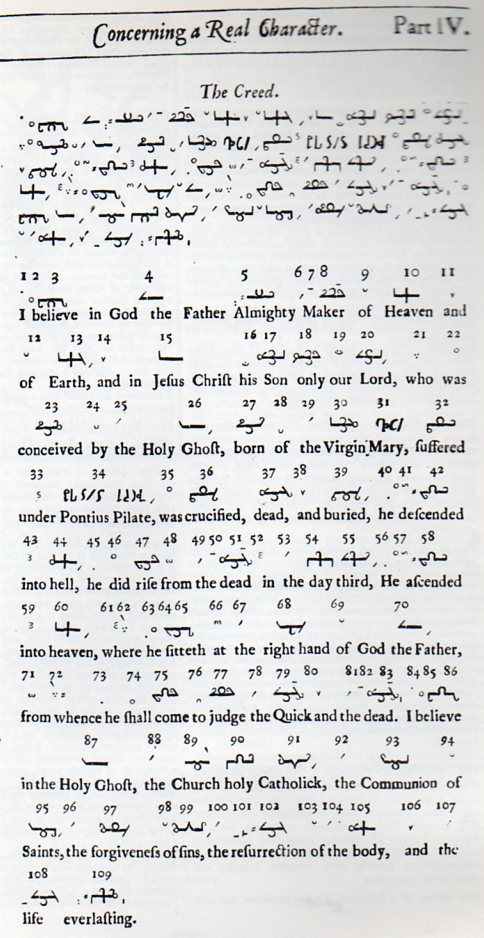
    John Wilkins’ construction of a new, theoretical language, a visual semantics of idea that was to be read and not spoken, a new international language to communicate thought, seems straight from the heart of the great Jorge Luis Borges.  And in fact, Wilkins does come from Borges, in a way–as part of a story Borges wrote in 1942, a fantastical semi-non-fictional account of Wilkins’ fabulous effort1.

    Wilkins was a 17th century figure with a sort-of 20th century idea, but even advanced to this point in time, and with actual mathematical and linguistic tools at his disposal, his work is still better as a sci-fi movie backdrop than anything else–not that there’s anything wrong with that.  The book of his in question, An Essay towards a Real Character, and a Philosophical Language, was published in London in 1668, and was an very interesting, Aristotelian non-standard approach to construct a universally understood language composed of characters which were in a way axiomatic of a developing system of genera, a taxonomy of ideas, that were somehow, fantastically, capable of expressing the foundations and flights of human thinking. 

    Borges’ presented Wilkins in a very Borgesian way in his  “The Analytical Language of John Wilkins“, mixing fact with creative fancy, exhibiting Real Character as though it was being re-discovered and studied by living academics. 
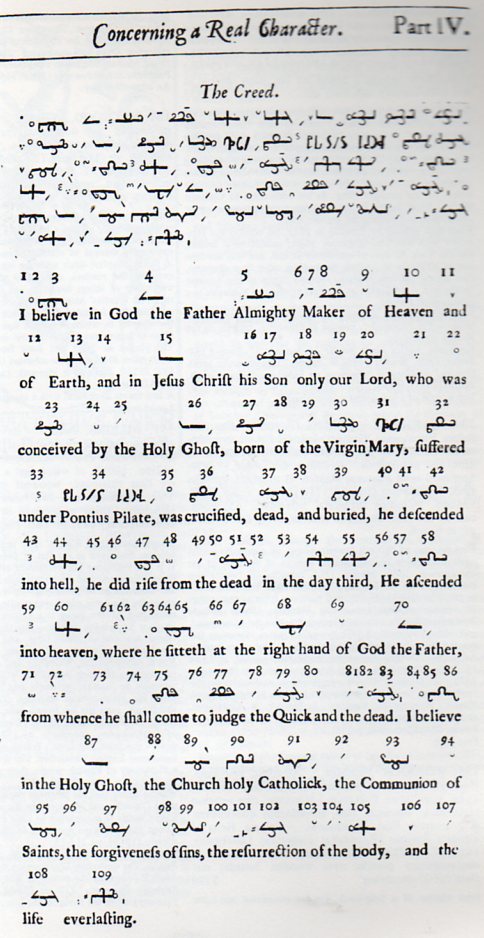
    Wilkins631

    It reminds me somewhat of other massive buit not-quite-nowhere-near-there efforts by people like Oliver Byrne and his color-coded approach to Euclid (1847), J.H. Woodger with his Axomatic Methods in Biology (1937), and Clark Hull’s Principles of Behavior (1944). Fascinating ideas, constructed with big brains, but which ultimately produce a product which more deeply confuses and obscures the subject matter it set out to explain–and which don’t really work, anyway.  But they are beautiful things int heir own right–Byrne’s work in particular also happened to be one of the most beautiful books produced in the 19th century–assemblies of bits and pieces that are occasionally magnificent but whose final destination was of course The Twilight Zone.

    They were in some way a Search for a Perfect Language (as in the work by Umberto Eco); they sought to step deeply outside themselves in an effort to grasp a higher knowledge, perhaps not much too unlike Isaac Newton and his  deep experimentation in alchemy, looking for the massive truths that were handed down to the few selected ancient ones.  They are beautiful things with a lot of very good thinking–they just weren’t right. 

    Notes:

    1.  “The Analytical Language of John Wilkins“, 1942, in which Borges presents an imaginary intellectual archaeologist assessing the work, comparing it in particular to the imaginary encyclopedia Celestial Emporium of Benevolent Knowledge.

    “He divided the universe into forty categories or genera, these being further subdivided into differences, which were subdivided into species. He assigned to each genus a monosyllable of two letters; to each difference, a consonant; to each species, a vowel. For example: de, which means an element; deb, the first of the elements, fire; deba, a part of the element fire, a flame. In a similar language invented by Letellier (1850) a means animal; ab, mammal; abo, carnivore; aboj, feline; aboje, cat; abi, herbivore; abiv, horse; etc. In the language of Bonifacio Sotos Ochando (1845) imaba means building; imaca, harem; imafe, hospital; imafo, pesthouse; imari, house; imaru, country house; imedo, post; imede, pillar; imego, floor; imela, ceiling; imogo, window; bire, bookbinder; birer, bookbinding. (This last list belongs to a book printed in Buenos Aires in 1886, the Curso de Lengua Universal, by Dr. Pedro Mata.)”–Jorge Luis Borges

    Borges described Wilkins’ taxonomy as follows, dividing it into 14 categories (compared to the original Wilkins list of 40):

    Those that belong to the emperor; Embalmed ones; Those that are trained; Suckling pigs; Mermaids; Fabulous ones; Stray dogs; Those that are included in this classification; Those that tremble as if they were mad; Innumerable ones; Those drawn with a very fine camel hair brush; Et cetera; Those that have just broken the flower vase; Those that, at a distance, resemble flies.

  • The Statue of Liberty as a Billboard, 1888

    JF Ptak Science Books   Post 1567

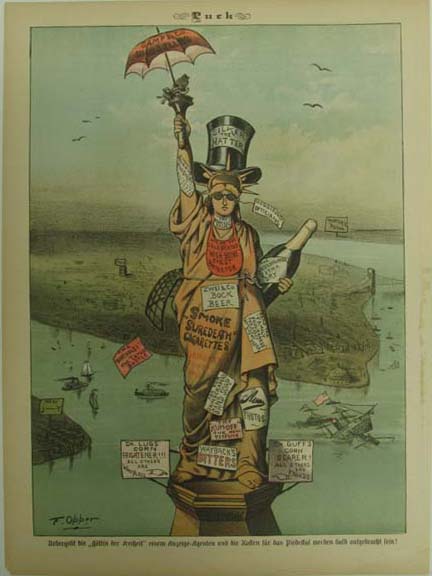
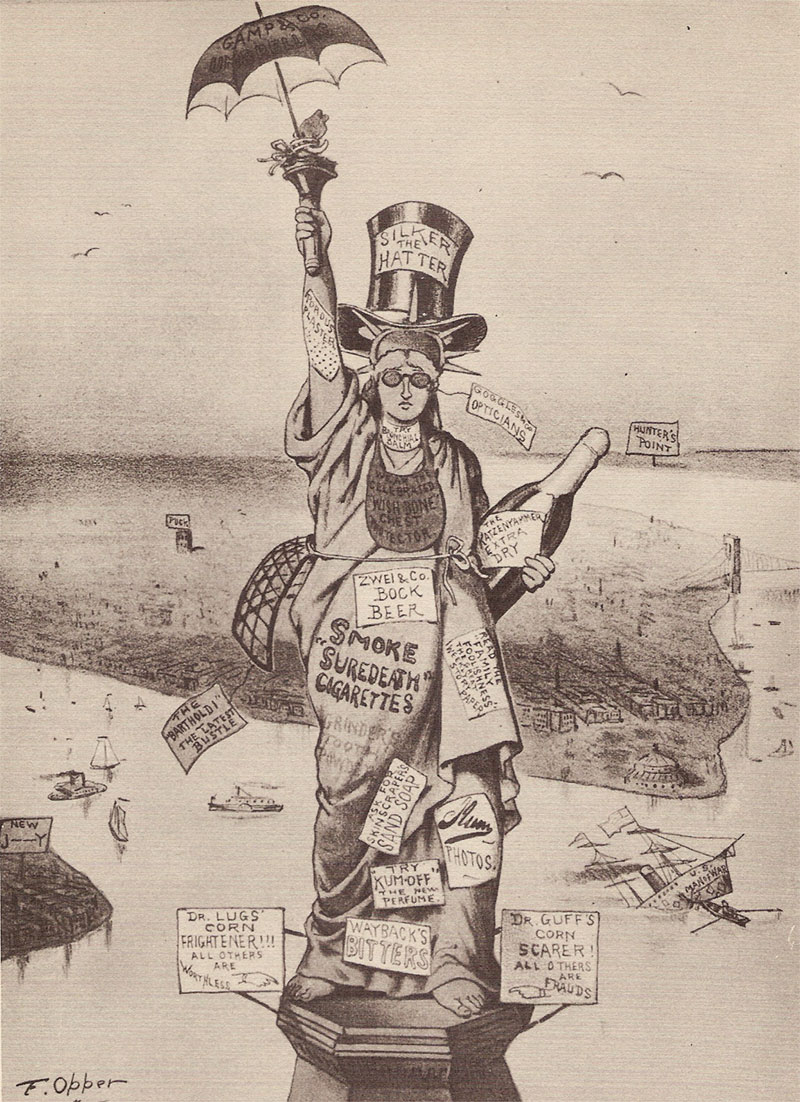
    This image of the near-future Statue of Liberty (“Liberty Enlightening the World”) appeared in the German version of Puck magazine in 1888–since the statue was officially dedicated on 28 October 1886 it didn’t take the cartoonists and social satirists very long at all to get around to using Lady Liberty/Libertas as a backdrop for their message.   And the message here was the creeping advertising age, which was just the shroud of an advancing consumerist society, because there wouldn’t be that many ads if there wasn’t so much material fighting for so many consumers. Advertising was beginning to creeping in everywhere–and here the cartoonist foresaw a near-future in which the Statue of Liberty was a pure advertising vehicle, and as it turns out, most of the stuff advertised there was junk. 

    http://www.printsoldandrare.com/wallstreet/1156ws.jpg

    Here’s another version in glorious black and white

    http://2.bp.blogspot.com/_sGYULzoQCgA/R1DsrSOectI/AAAAAAAABNA/-jpU7nyymuA/s1600-R/1885-puck-magazine-Predicti.jpg

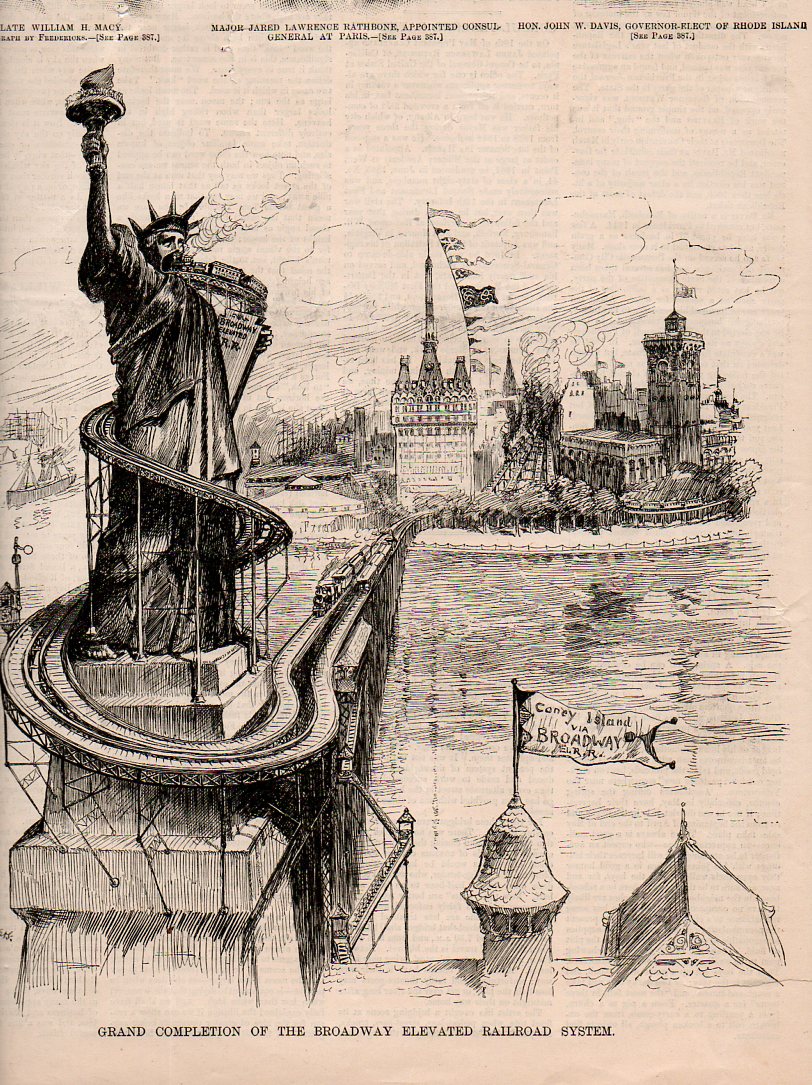
    Another intriguing image of the Statue of Liberty of the future appears below, and described in an earlier post on this blog, here.  Although not being used for advertising, she has become just another part of the landscape, swallowed up by the advancing transportation age. 

    Statue liberty407

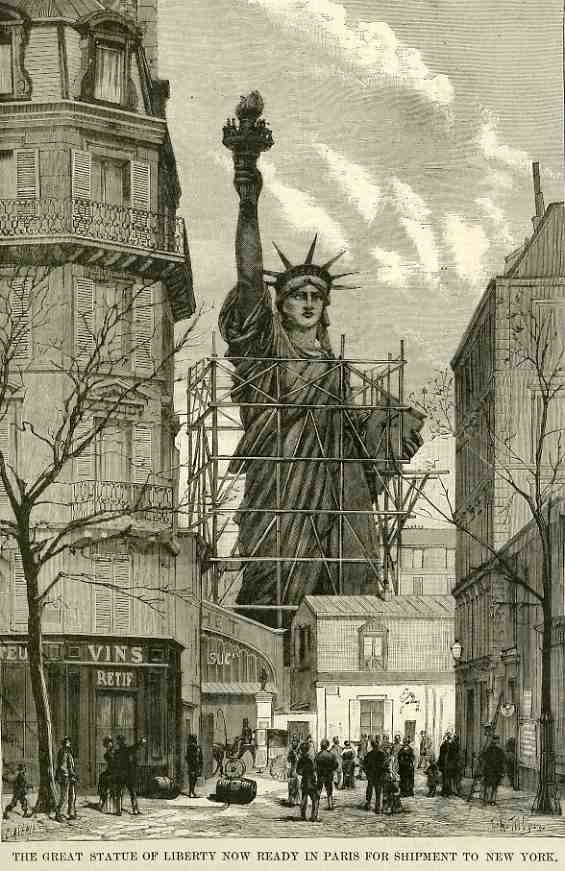
    And although it looks as though Lady Liberty is being packed away as part of a mothball fleet of iconic Americana, this image shows her in France, being constructed (for deconstruction), in 1884. 

    0 blog jan 22 statue409


  • Mitigating and Matriculating Apocalyptic Nuclear Exchanges, 1959

    JF Ptak Science Books  Post 1559

    [This is part of a series of posts on planning for the post-apocalyptic nuclear war world.  Others include Virtuosic Apocalypticism:  Maps anbd Charts of Nuclear Exchange, 1964,  Taxes Trump Death in the Post-Nuclear-Attack World, 1964, and others which are linked to those two posts.]

    There is nothing quite like reading turgid handbooks filled with impossible hope for recovery from un-recoverable situations.  Of course, there are few situations that might actually occur in which recovery (to anything like the “life” that existed before the event) would be impossible:  enormous meteorites making impact with the Earth would certainly be one, and there is little else besides this, really, outside of an enormous nuclear war.  And it is exactly this, this second scenario, that the U.S. Government planned for to great lengths for decades on end–it was expected to be investigated, of course, because there was little else that could be done short of doing away with nuclear weapons, which was/is an action that would not be a serious consideration. 

    Planning for post-Armageddon was a solid, white-collar job that kept thousands of people employed for 30+ years.  The idea behind the smiling mask was simple–that in an “exchange” (an uncommonly milky euphemism for launching nuclear weapons between enemies) there would be winners and losers, and in spite of tens of thousands of megatons of nuclear weapons being detonated, there would be enough infrastructure that would survive to be able to declare one of the smoke-filled-holes a winner in the conflict. 

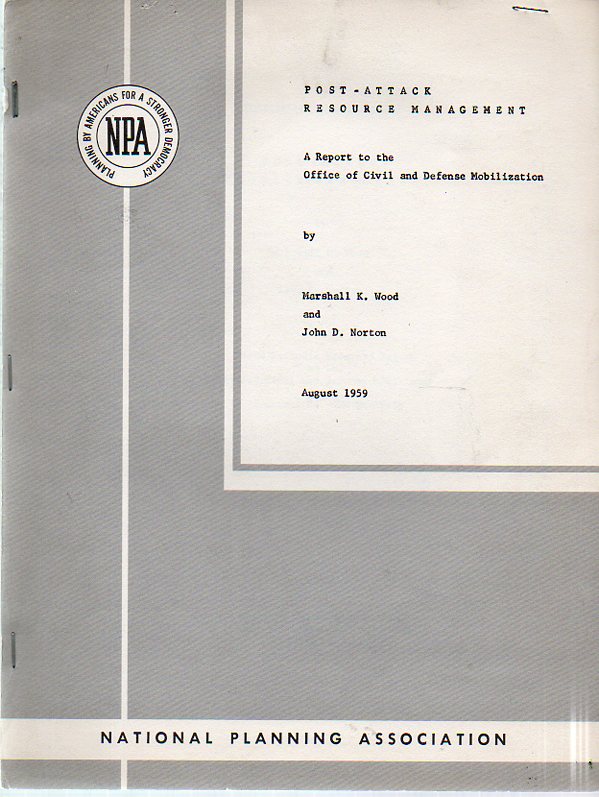
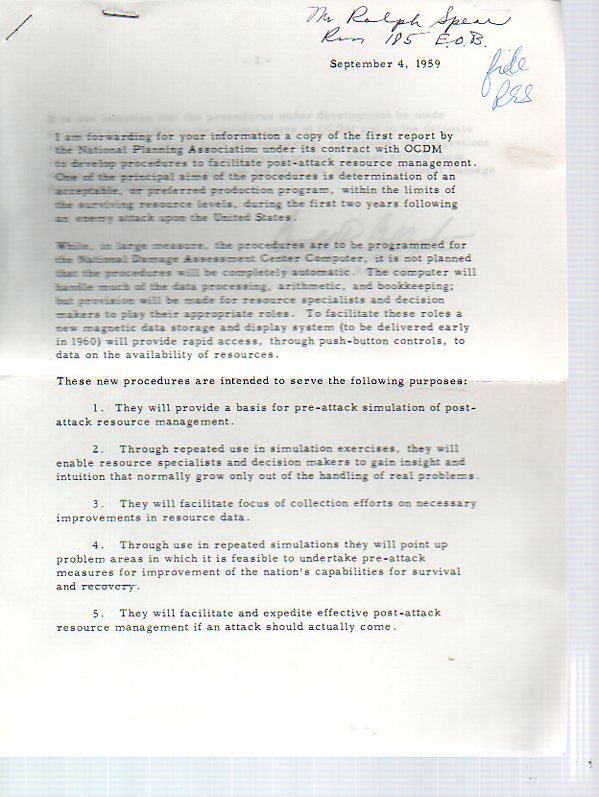
    ATOMIC BOMB POST-ATTOMIC PLANNING613 That is certainly the optimistic outlook of a preliminary report issued by Marshall K. Wood and John D. Martin, who issued this working paper on the state of a computer program that was being constructed to assist post-attack planners in re-establishing the broken remains of the country.  Post-Attack Resource Management (PARM) was being compiled for the National Damage Assessment Center, under the National Planning Association, under the Office of Emergency Planning, in the Executive Office of the President,  to be run on the UNIVAC Scientific and the Sperry Rand ERA 1103A computers, and made to assess national economic and military recovery of the U.S. post-nuke-war.  This of course is a gargantuan, staggering task, given the number of changing variables, but someone had to give it a try.

    Just collecting the existing data on x-number of ATOMIC BOMB POST-ATTOMIC PLANNING614 eco-industrial-military-medical-human variables that make to country run is a daunting thing; try to imagine that as you added the Factors of Change in a nuclear war, trying to determine how thousands of explosions over the breadth of the country would affect the national infrastructure if these thousands of bombs were exploded in place A1-A1xN over periods of time T1-TX.  It would be a phenomenal task to try and determine what results there would be on the country following thousands of different attack models.  And then, after everything was said and done, there just wouldn’t be very much left. 

    Maybe the thing worked.  Maybe by planning for a survivable outcome to an unsurvivable situation enticed the actors to wait and prepare their weaponry to such a point where they would be the one certain to survive a nuclear war.  In this way the build-up would continue forever, as no one party could achieve any sort of dominance in a first strike capacity to be able to wipe out their adversary’s war-making capability before they had a chance to employ it.  Perhaps in some weird, sick way this sort of planning for post-war activity kept the war from ever occurring by virtue of no one actor being able to achieve a superiority.  Or perhaps not. 


  • Baby Marriage, Nicot-ine and the Production of Death, 1869-1880

    JF Ptak Science Books   Post 1557

    “The use of tobacco is growing greatly and conquers men with a certain secret pleasure, so that those who have once become accustomed thereto can later hardy be restrained therefrom.”–Sir Francis Bacon (1561-1626)

    In a way the abuse and use of tobacco and the deaths of, what–a billion?–people from diseases caused by it is partially due to the forced/.arranged marriage of two babies. It was Jean Nicot de Villemain who introduced tobacco to France  and thus to most of Europe when he arranged for the plant to be sent home from Brazil tn 1560  while serving as the French ambassador to Portugal.  He was there to negotiate this baby marriage–between six-year-old Princess Marguerite de Valois to five-year-old King Sebastian of Portugal, and so while there took advantage of his new experience with the plant, one variety of which was named after him, and for which the alkaloid (nicotine) is named.  The job of introducing the ethnogen to the rest of the world would fall to someone, and in this case that someone was Nicot, baby-marry-er:  of course this was a royal job and the marriage assured bloodlines more than any sort of lust, a creation of dynasty and ensuring treaties and power consolidation, but it did expose Nicot to the plant in Portugal, and the rest is a nasty history.

    The addictive qualities of tobacco has been recognized for as long as people have been writing about it, going back hundreds of years, deep into the 16th century, almost from the same time of its introduction into England and Europe. 

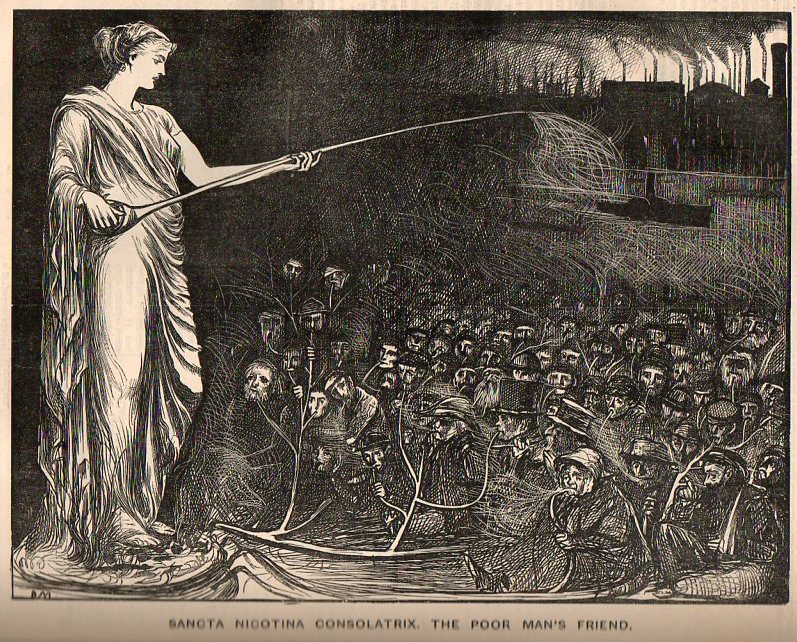
    These images of the horrific nature of the addiction to tobacco appeared in the January1869 issue of the London Punch magazine and are particularly biting–there are few images like them in those years for this journal, so far as my experience can relate. 

    This one is labeled “Old Nick-Otin, stealing “away their brains”

    And this, appearing in next week’s issue: 

    Nicotine598

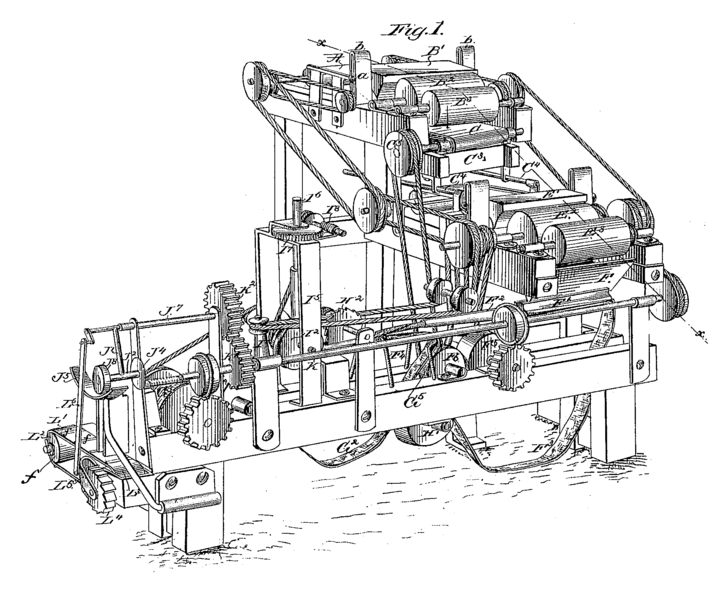
    So the editors of Punch decided to send a strong and distasteful message to their readers on the dangers of tobacco to the high class and the low.  But this was still in the day that tobacco was a luxury to the working classes and the poor, before the introduction of the mass-produced cigarette.  Real death and destruction took place after the ingenious invention of James Albert Bonsack (born just months after this issue of Punch), who patented an automatic cigarette-rolling-making machine from his home in Roanoke in 1880.  What the machine did was this:  it increased the output of the hand-rolled cig from four cigarettes an hour to about 200 a minute.  Getting rid of the human element in cigarette production was a crucial fix in the history of advancing death, and allowed for inexpensive distribution of the lethal addictive habit across all sections of society.    As with Nicot, someone would have developed this machine, and in this case it was Bonsack, who collected a $75,000 prize fr being the first to automate this process for high-speed production.  It was a remarkable machine, really–unfortunately for all the only thing that it did was make cigarettes.

      Cigarette machine

    The Bonsack invention and its progeny sanitized and economized  cigarette production to the point where–in relatively short order–the cigarette was available to anyone, and in the coming decades became a simple part of the landscape, blending into the human environment.

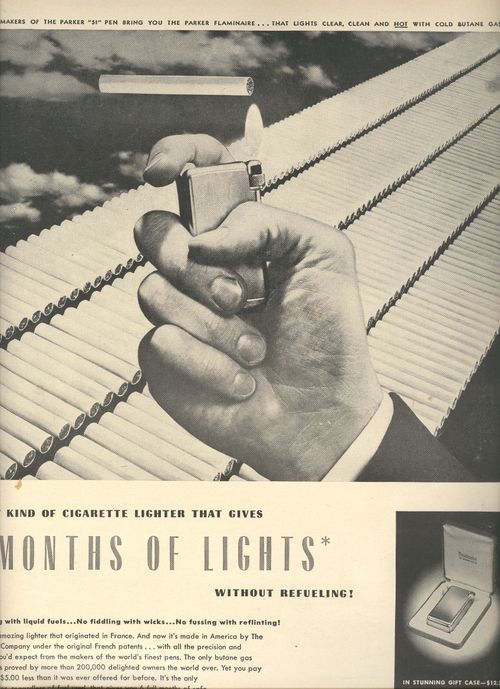
    This is a simple ad for a butane-based lighter (appearing in LIFE magazine for 18 December 1950), lighting the way down Cigarette Road of the Bonsack/Nicot/etc. future.  Actually, it was more a highway than a road, and a superhighway at that. There were few rules on that road to perdition, and government-sponsored warnings about tobacco health issues was still more than a decade away. 

    Cigarettes

    It seems to me that there are about 300 cigarettes in this ad, and that looks like a lot—point of fact though is that in 1950, the average American (of 18+ years) smoked about 3,522 cigarettes a year, which means about 10 cigarettes a day for everyone in the country.  Not 10 per smoker; 10 for everyone in the entire country, smoker or not, who was over 18 years of age.

    The average smoker in 1950 smoked about 2.5 packs a day, or 50 cigarettes or so—that’s equal to this line of cigarettes being smoked every six days. 

    There were few rules on the Cigarette Highway–and, basically, no brakes.


  • Virtuosic Apocalypticism: Maps and Charts of Nuclear Exchange, 1964

    JF Ptak Science Books LLC  Post 1555  {Part of a long series on atomic and nuclear weapons].

    Today is the 66th anniversary of the first detonation of an atomic weapon at Alamogordo, New Mexico, July 16, 1945.

    March 3--cvr

    “…our choice of path may be delayed too long… “  Dante, Divine Comedy, Inferno, Canto XII, line XIII, 2nd level of Hell (envy).

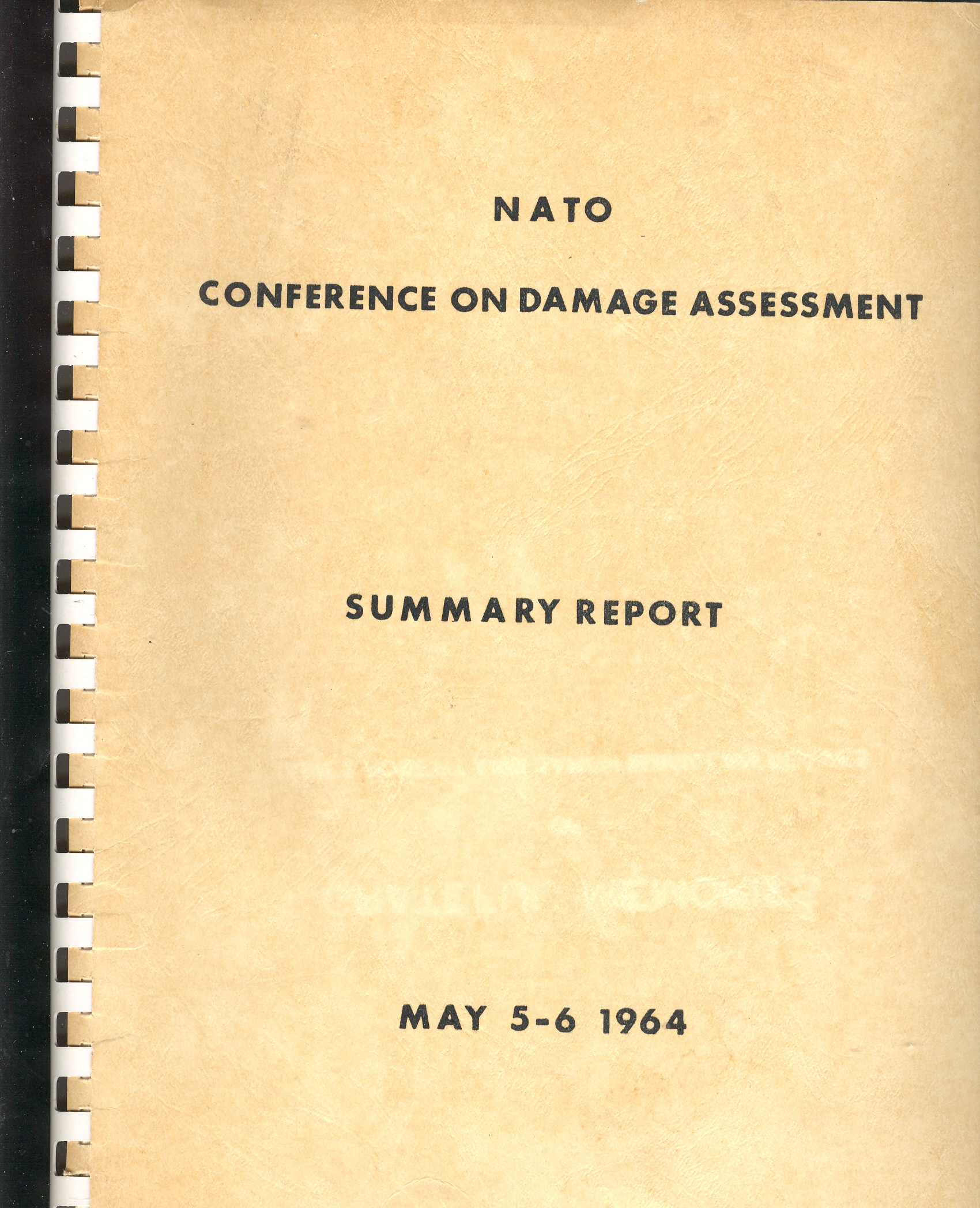
    The NATO Conference on Damage Assessment Summary Report (May 5-6, 1964) was not one written for its outcome, necessarily, but the means of getting there. The outcomes were highly differentiated levels of sameness, a strategic tour of Dante’s creation cataloging the layers of deep destruction like those of his funneling pit. [This book is available through our blog bookstore, here.]

    Professionally  the paper dealt with several different ways of computing nuclear exchange scenarios (given names of understated inelegance like Jumbo, Brisk, Frisky, Dart and Dusk) with lots of smokily mirrored hocus pocus, the necessary ingredient of the philosophical technology of Mutually Assured Destruction. MAD.  Somehow it all worked out without any exchange ever happening. (The principal contributor here was James Coker, chief of the National resource Evaluation Center, Office of Emergency Planning, Executive off of the President.)

    March 3--20 mt blast “Which utterly with sadness had confused me,  New torments I behold, and new tormented Around me, whichsoever way I move,  And whichsoever way I turn, and gaze.”  Dante, Divine Comedy, Inferno, Canto VI, third circle, gluttony.


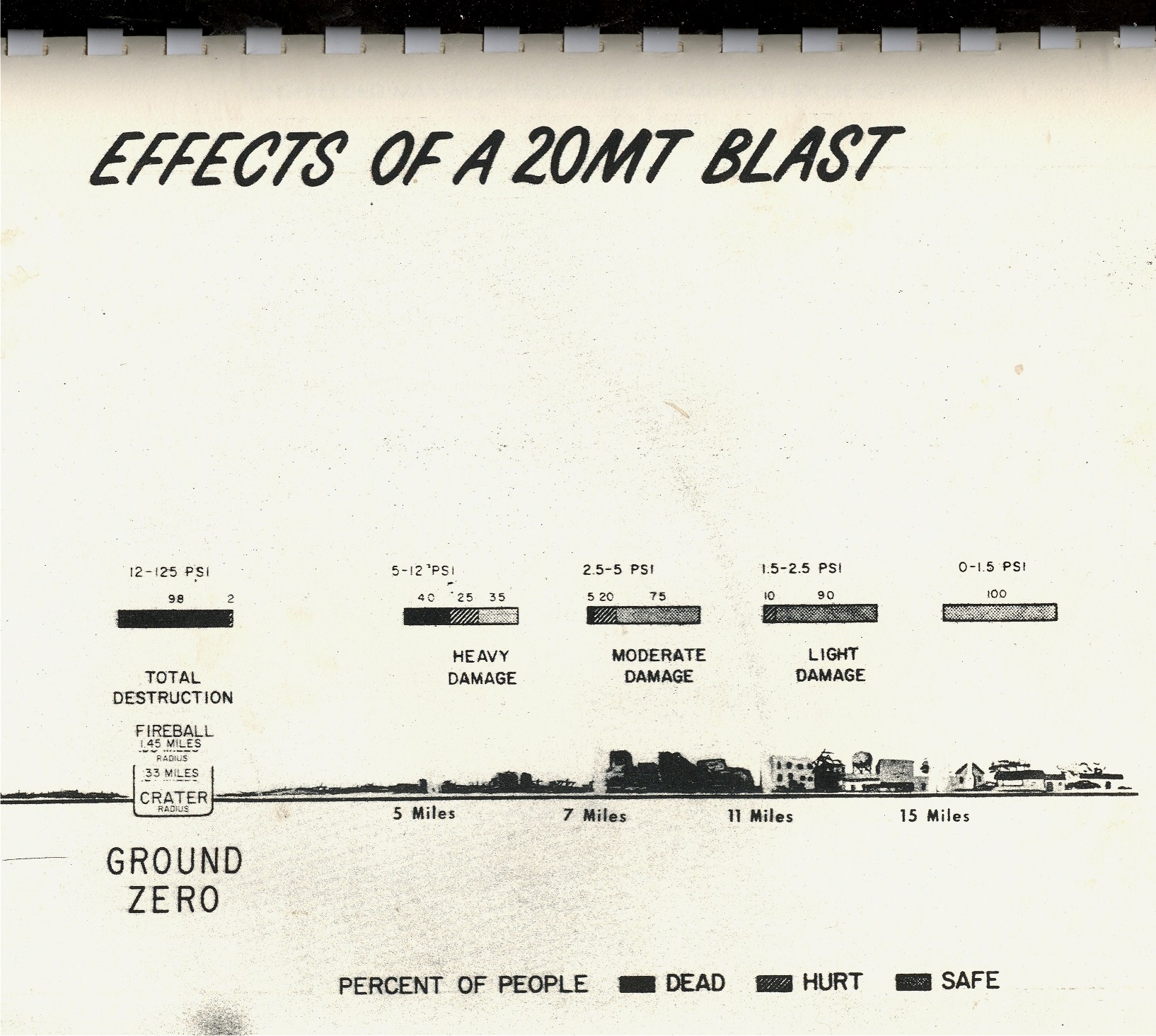
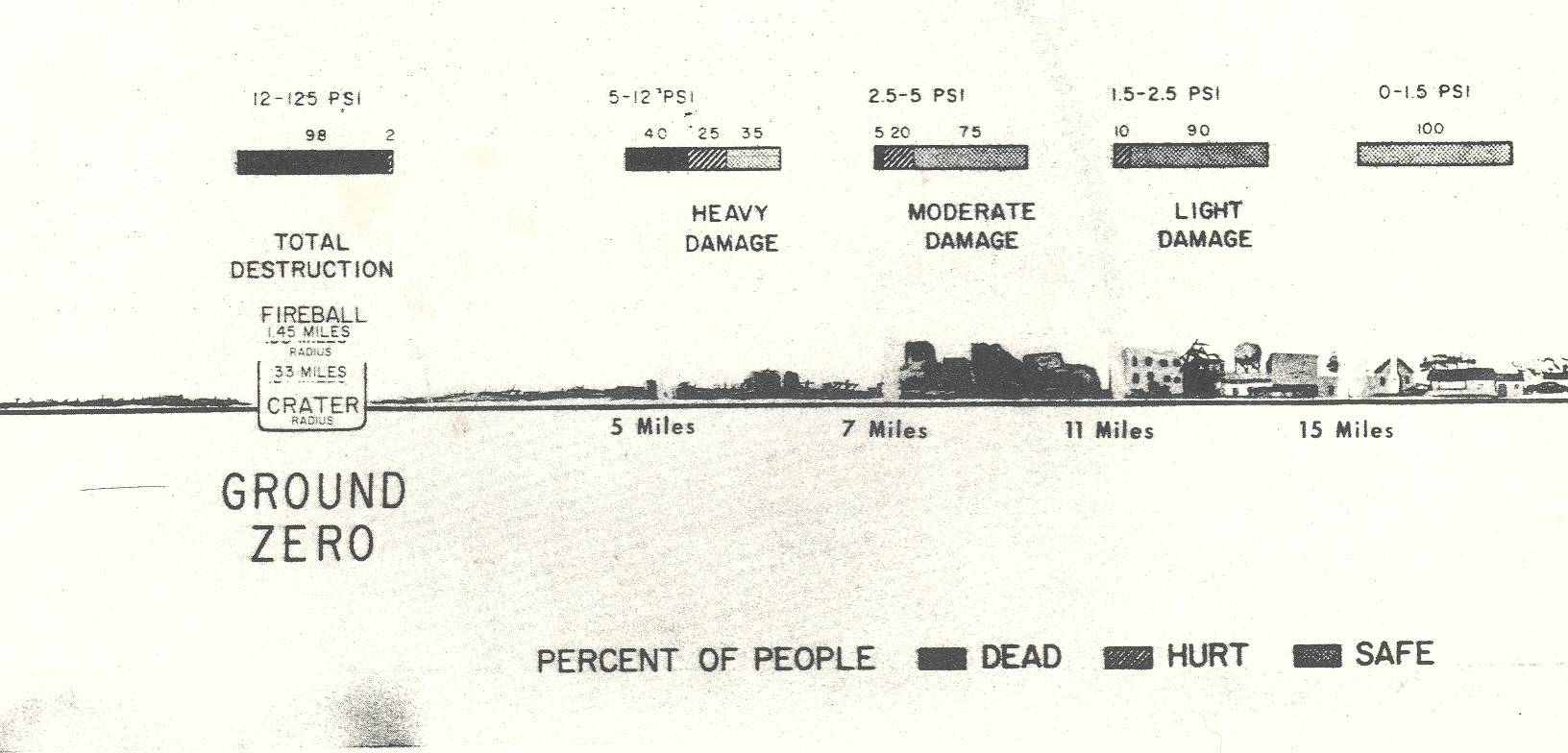
    The first image shows the effects of a 20 megaton nuclear blast detonated in in a city, presenting an incredible picture of absolute destruction, reaching out from ground zero for more than 11 miles.    


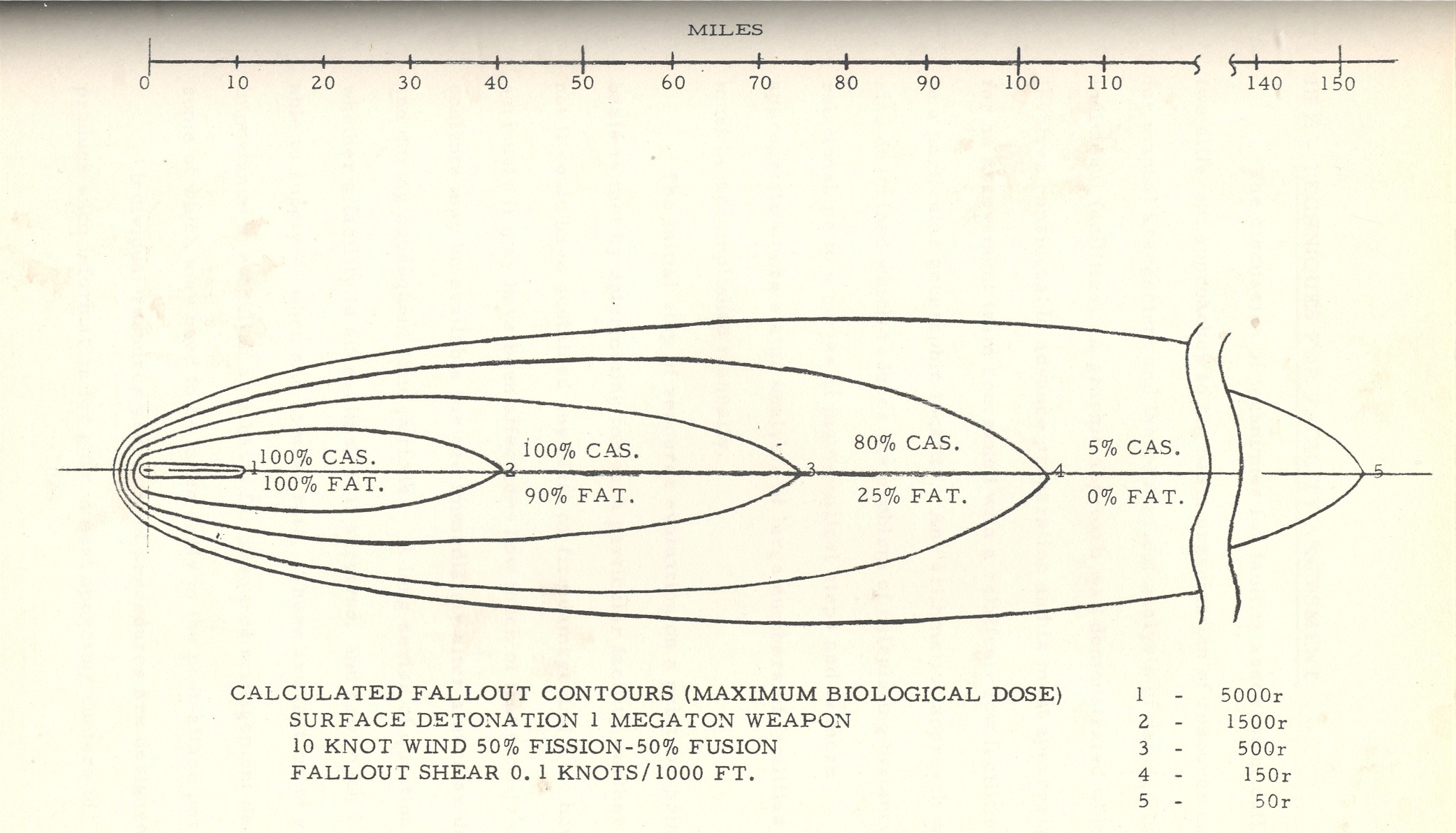
    This doesn’t begin to measure the overall damage inflicted by radiation, which is deeply, extraordinarily, severe.  This again is the effect of one weapon, the 100%  fatality rate eventually reaching out 12 miles; 90% reaching over 40 miles.  General casualties extend to 80% up to 70 miles from ground zero. 

    March 3--20 mt det blast
    March 3--spear

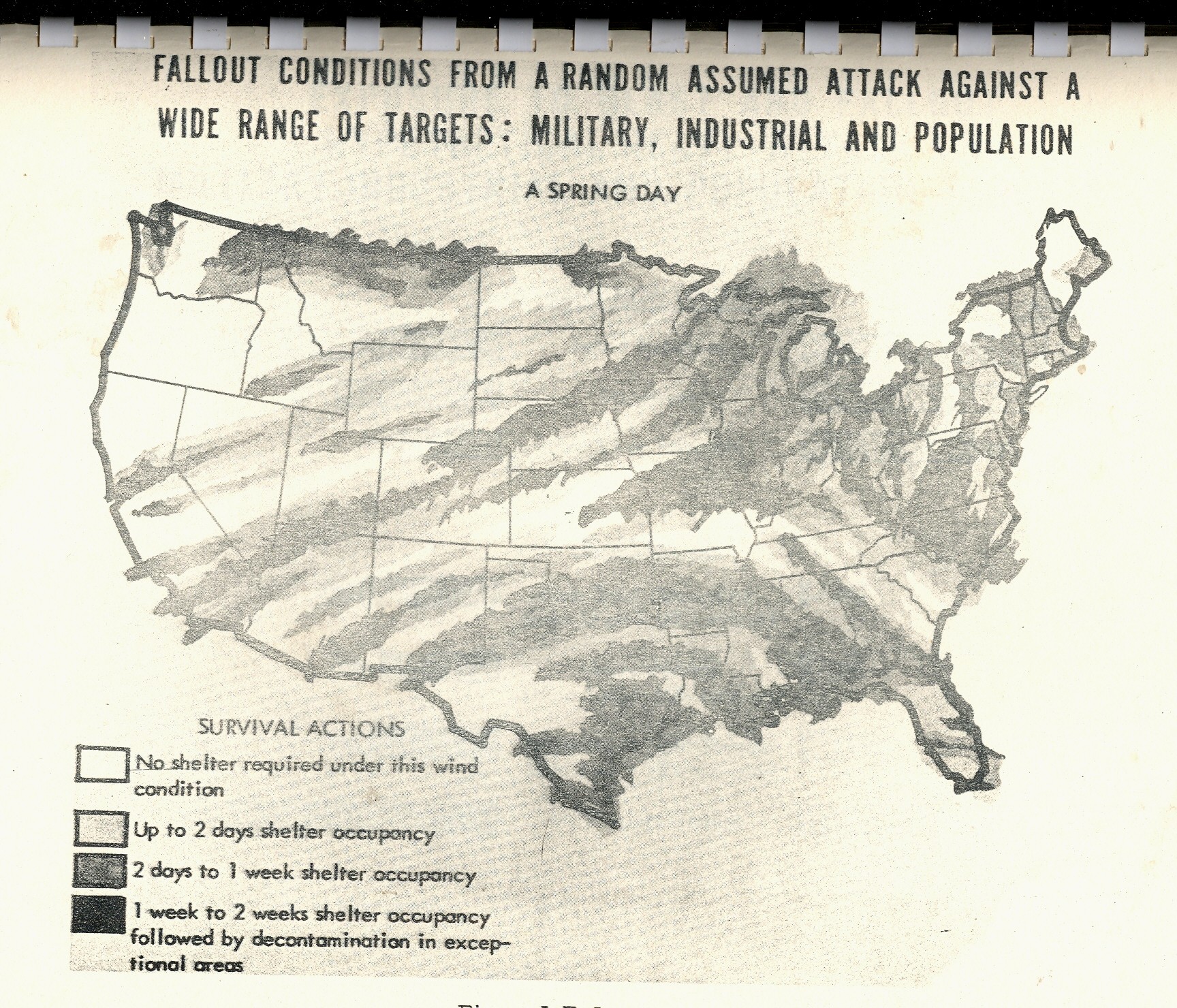
    The emergency planning end of the paper comes in at about this point.The fallout map of the U.S. shows a possible situation of an unspecified (though wide-ranging) attack (on a “spring day”) and its effects on the population as it is housed in various shelters and bunkers, suggesting the amount of time needed to “survive” the attack by staying inside the fail safe habitation.

    March 3--spring day

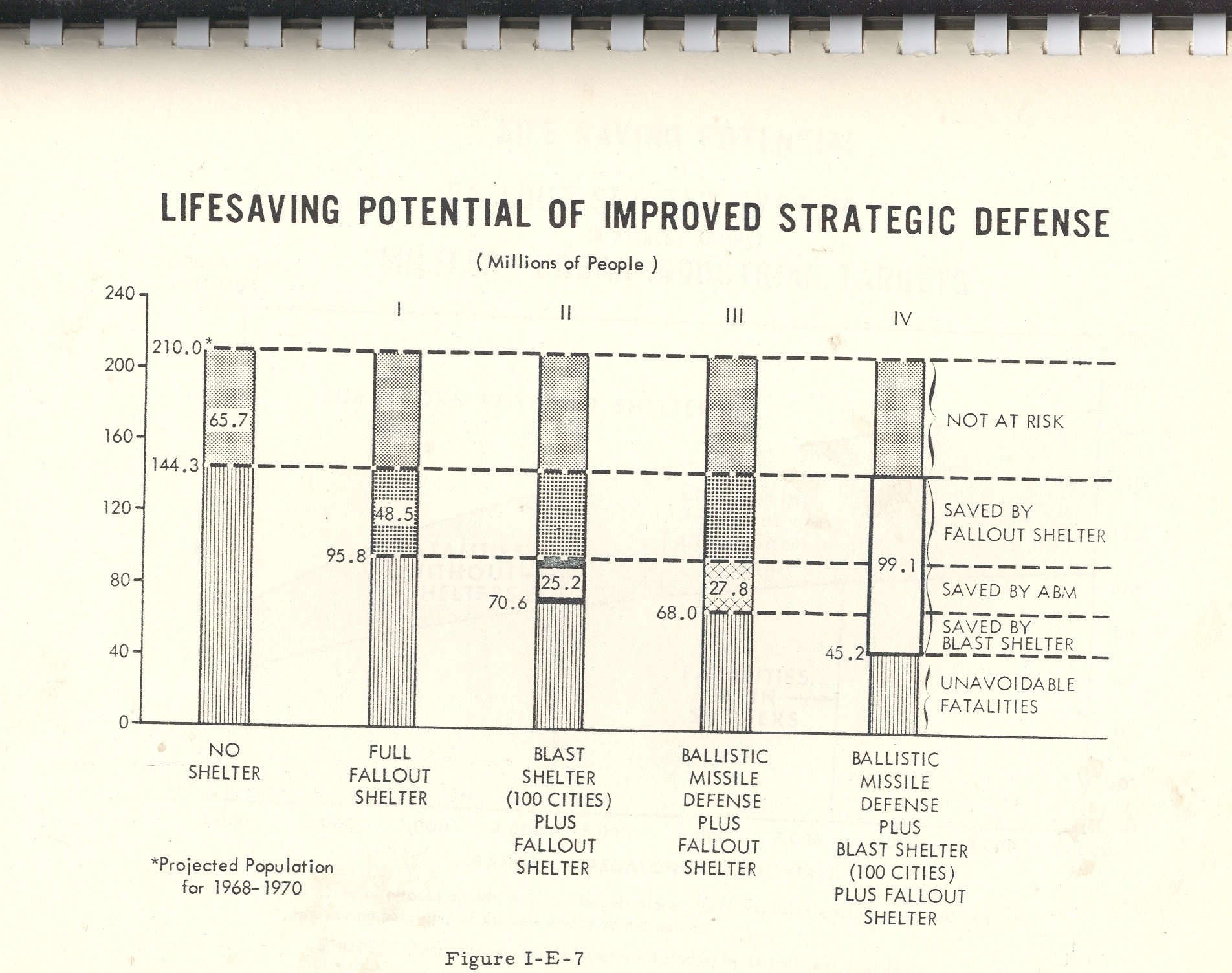
    The following chart, “Lifesaving Potential of Improved Strategic Defense” (in millions of people) shows the effect of the installation of the shelters and bunkers.  In this scenario, in  a massive strike, the fatality rate in the U.S. of an unprotected population was 65%, or 144 million.  On the other end of the extreme was “ballistic missile defense plus blast shelters plus fallout shelters”, or a massively- protected population of fictional expanse shows that in spite of all precautions 45.2 million people would die (as “unavoidable fatalities”). 

    March 3--life saving potential

    “These have no longer any hope of death;  And this blind life of theirs is so debased,    They envious are of every other fate.” Canto III, Vestibule of Hell, the Opportunists.
    This document is nothing if not a death sentence had the massive strike ever been launched.  In the dozens of such reports that I’ve seen, there hasn’t been one with the Really Big One with thousands of euphemistically-named “exchanges”, which I assume would make all  of these others pale by comparison.


  • Child Straigtener & Other Edwardian Cyborg Bits: Patent Reports

    JF Ptak Science Books   Post 1549

    (The following images are taken from the U.K. Intellectual Property Office Espacenet patent search page, here. The quotations following the illustrations for the patents are from that page.)

    Close Straightening Encounters for Children of the Reading Kind

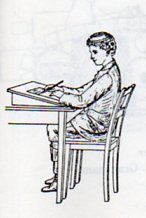
    Here’s an interesting implement that no doubt brought secondary thoughts about reading to any child made to wear this thing–the unhappy child is at left, and the skull-cap, at right.

     
    Yborg578

    First page clipping of GB 190421618 (A)

    Abstract of  GB 190421618  (A)

    “Lorenz, H.. For indicating when wearer deviates from an upright position; caps.-A cap I is made in the form of an inverted bottomless saucer with holes 3 in the side for lightness and ventilation. It is intended to be worn by school children to prevent stooping, inasmuch as it only remains on the head so long as the wearer remains in an erect posture…”


    Hand Guard for Cutting Things


    First page clipping of GB 190402703 (A)

    Francis John Crell: GB190402703 (a) “A Hand Guard for use in Cutting Bread and for Other Like Purposes”.  I’m not sure how this works as a glove-protective unit  given the spaces in-between the springy fingers–mostly it seemed to increase the cutter’s grip rather than protect them for accidental cutting.


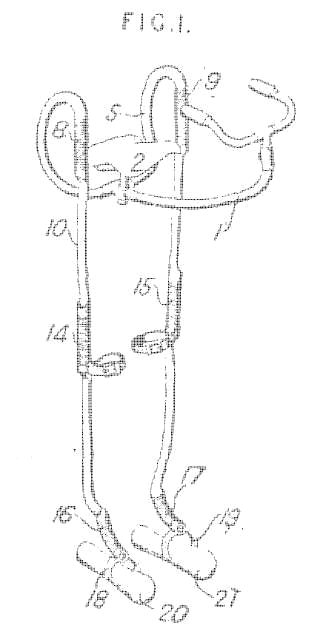
     Walking and Running Anti-Deformation Appliance

    Patent Brit walking running machine

    Abstract of  GB 190414477  (A)

    “Skorzewski, Comte V. Walking and running, appliances for aiding.-A n appliance for aiding walking and running is adapted to store up, and to give up at the required moment, the energy resulting from the alteration in height of the centre of gravity of the body. The user sits on a saddle 2 adjustably attached to a tube 1 provided with handle – bars. The tube 1 branches into two tubes 5, which are connected by joints 8, 9, 14, 15, 16, 17 to other tubes of narrower crosssection, conforming in shape to the legs of the wearer, who is strapped to the appliance. The joints 16, 17 are connected by means of stirrups 18, 19 to soles 20, 21, or to straps by means of which soles may be attached to the appliance. The tubes are filled with compressed air through a suitable cock or valve. The joints are preferably formed of armoured rubber tubes, coated or not with para rubber.”


  • Women with Guns–a “First” in Women/Pistols/Advertising?

    JF Ptak Science Books   Post 1548  [Abdullah Cigarettes Revisited]

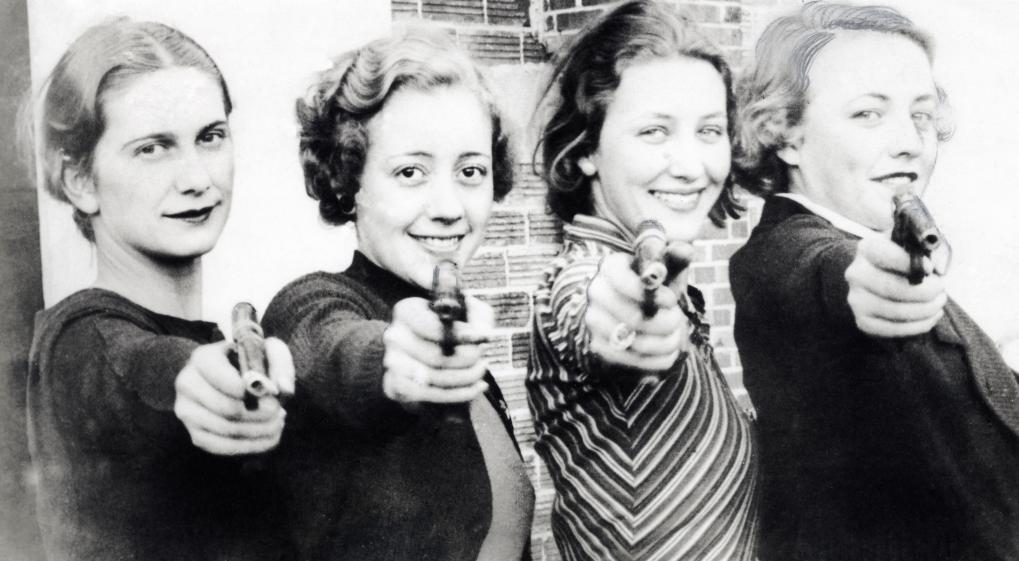
      Women with pistols

     
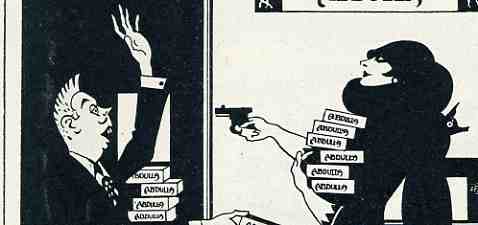
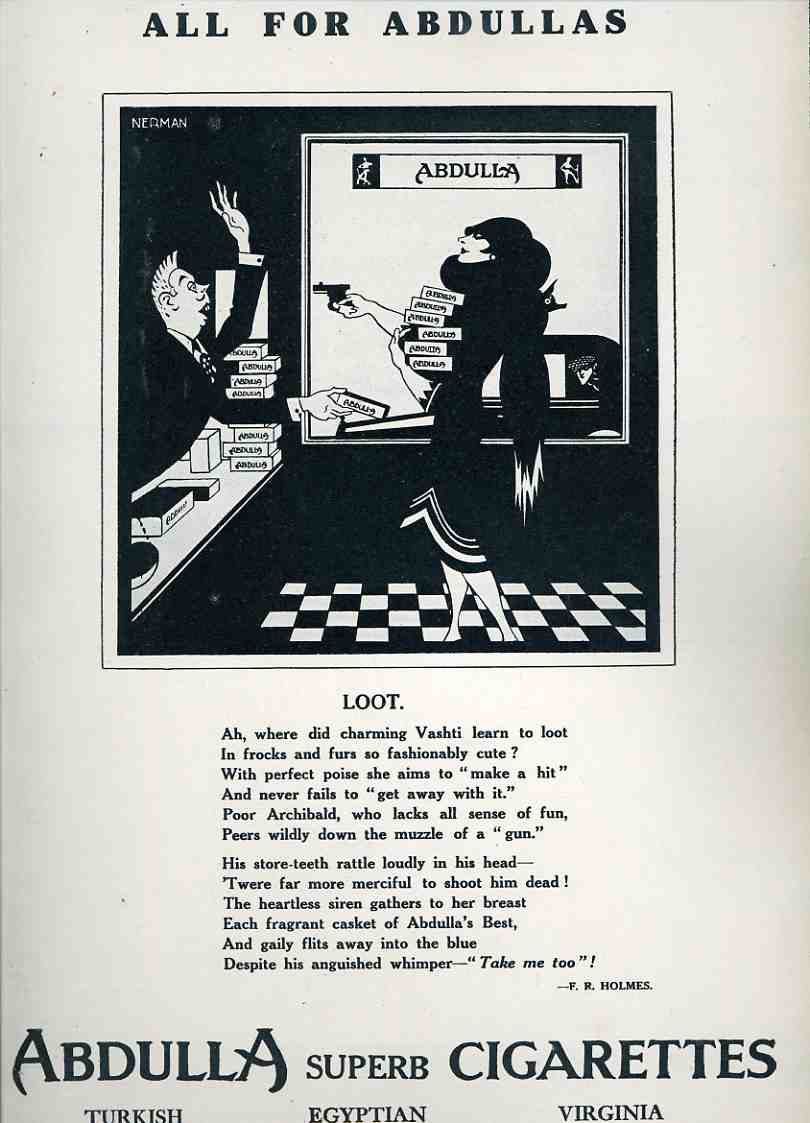
    Here’s a not-usual question:  when was the first image printed of a woman pointing a gun in the commission of a felony who was NOT an American Western leather-slapping, bronc-ridin’, Buffalo gal?  I have a funny feeling that it wasn’t until relatively recently, 20th century, or thereabouts.  I thought about this when I saw this ad in the Illustrated London News for 21 August 1926, calling for women to rush out and buy the ciggy that was worth stealing–Abdulla (“Superb”) cigarettes.

    0 blog feb 26630


    The doggerel of the poet-izer F.R. Holmes that decorates this page (and who recognizes that the clerk named Archibald who was handing over the cigarettes was chattering through “store-teeth”, which is kind of nice) did absently grind out a factual bit when he referred to the packaging of the Abdulla cigarettes as “Caskets”. Of course he had something else in mind in line with his time, but he did mistakenly have a peep into the future when he labeled the box of coffin0 blog feb 26629 nails so, though not so “fragrant” as he was thinking.  (I also like the masked male accomplice peeping into the scene from the safety of the getaway car.)

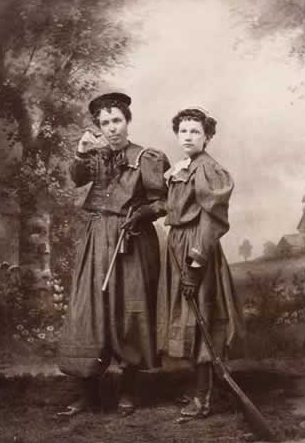
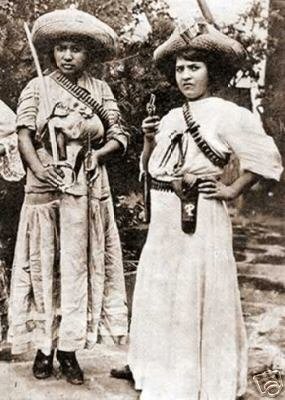
    Offhand, though, I cannot bring up an earlier image of a non-cowgirl-performing woman pointing a gun at someone to achieve a criminal end–especially not in an advertisement. 

    It is interesting considering this ad as a statement of sorts of women in the marketplace purchasing stuff that had previously been considered male terrain.  Woman had been he target of cigarette manufacturers in some small ways in the late 1880’s and early 1890’s, but it seems not until after the War and then after the Vote was there a full-on effort to sort women into some consuming fields that they had been excluded from previously.  Unfortunately, in this case, the advertisers recognized that they were missing perhaps half of their possible market, and that new market was pursued and resulted in tens of millions of cancer-related deaths. 

    Well!  Now that I’ve finished this short post, it just came to mind that a good alternative and much earlier source might be images of she-pirates, though it might still be a stretch to find one of those women with their sword at someone’s neck…

    Women and guns

    ·Posted by :

    ·in:

    — —

  • The History of Aerial Bombing, Advertising and Laxatives

    JF Ptak Science Books  Post 1534

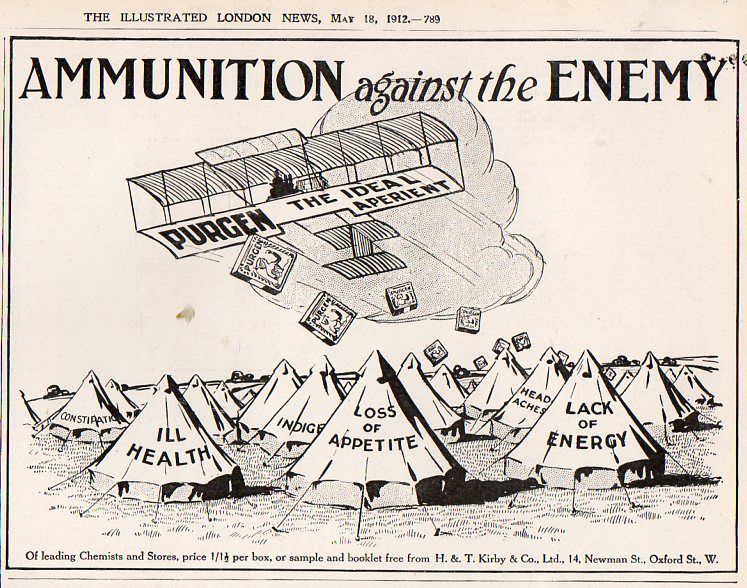
    The business of bombing people and places from airplanes/aeroplanes was fresh in the history of invention when this advertisement appeared in The Illustrated London News on 18 May 1912. 

    Bomb554
    Superweapons have been used against cities for quite some time in the new world of speculative fiction, and there had been real-life aerial bombings from hot-air balloons, but the first time that a bomb was dropped from a heavier-than-air airplane on anything happened just months earlier, on 1 November 1911, when Lt. Giulio Cavotti dropped a hand grenade from his Etrich Taube on the oasis of Tagiura, in North Africa during the Italo-Turkish War.  He dropped four parcels of hand grenades on the not-necessarily-military population at the oasis, injuring no one.  The attack was one of attempted vengeance, a payback by the Italians against the Arabs of Tripoli, in general, for having joined forces with the Turks to fight against them. 

    This air attack was fresh on the heels of a devastating slaughter of the Arabs at Tripoli on 25 October 1911–the Tripoli War would not come to an end until October of 1912. A complaint was lodged that the Italians had broken international law, as bombing from balloons had been outlawed by the Hague Conference of 1899–but the Italians argued that the spirit of the agreement did not apply to bombing from airplanes because airplanes were not balloons. The issue of the legitimacy of bombing from airplanes and then for bombing civilian populations would be a debated issue if not recognized as a restricted practice for decades to come.  As the cogs and wheels of the international court ground out its miniscule progress, people got blown up.  The people-blown-up part trumped international law almost every time. 

    In the meantime came this image of an airplane dropping boxes of Purgen, “the Ideal Aperient” on military-style tents  of “Ill Health”, “Loss of Appetite”, Lack of Energy”, and so on, all within the possibility of cure by this Purgen product.

    So, among the very first advertisements using the idea of aerial bombing as its own delivery system, was this one for Purgen.  A laxative.