JF Ptak Science Books Post 1512
Part of this blog’s series on Blank, Empty and Missing Things. (My thanks to Blanche McCallister for setting me on this path this morning.)
“A disgrace to the American people in general, and of the government in particular.” “The men who killed bison for their tongues and who shot them from railroad trains were murderers.”–William T. Hornaday, on the extermination of the American bison, particularly in the 1870’s.
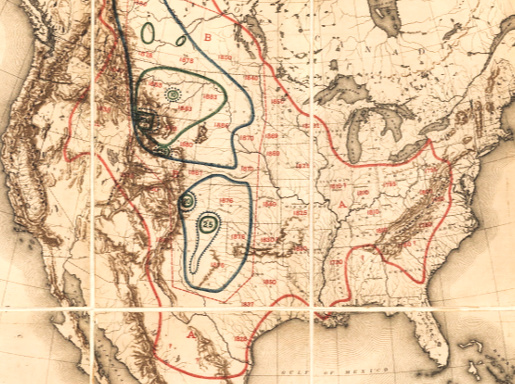
William Temple Hornaday was an early–and probably a founding–member of the American conservation movement, and was also director of the National Zoological Park. He wrote a tremendously bitter and accurate report for the U.S. National Museum in 1894 on the extermination of the American bison, an absolute head-shaker, detailing the history of the bison in North America and its destruction at the hands of sportsmen, hunters, mindless dolts and many others who massacred tens of millions of the animal (“murdered” is the word Hornaday uses constantly). To put the whole issue in perspective, Hornaday issued a famous map showing the shrinkage of the North American bison herd, setting out the enormity of the issue instantly on one piece of paper, a summary of hundreds of pages of bad stories and big numbers.
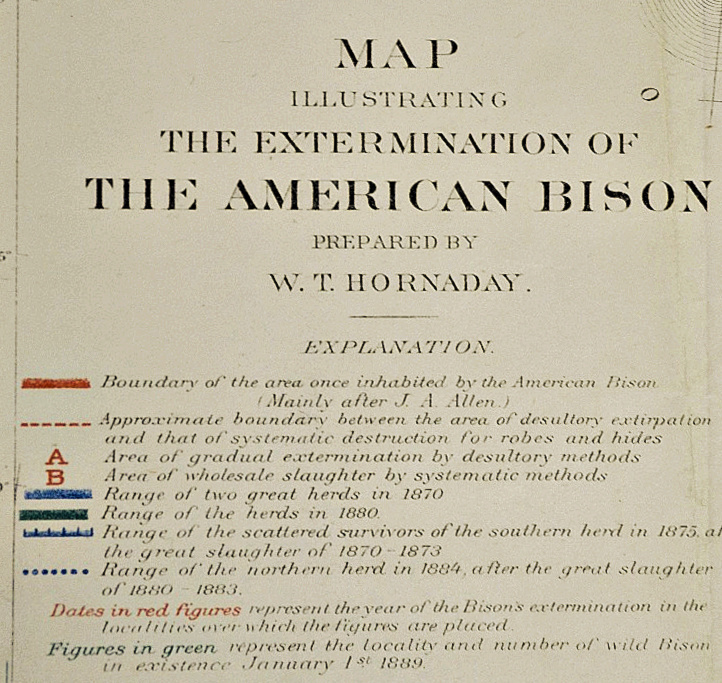
And the legend
[William T.Hornaday, “Map Illustrating the Extermination of the American Bison”. published in the 1886-1887 Report of the National Museum, Washington, D.C. entitled The Extermination of the American Bison, and printed by the ubiquitous Government Printing Office in 1894. This full text version comes from the Library of Congress site.]
The map certainly provides a real context to the numbers collected by Hornaday–numbers so big that it is hard to put them in any perspective. For example, for the year 1873, the Atchison, Topeka and Santa Fe Railroad carried out 250,000 bison robes, 2.7 million pounds of bones and 1.6 million pounds of meat. Generally the robe count was estimated at being about 1/6 of all the bison killed, so of the 1.2 million of taking this train ride in this one year (of aggravated annihilation) there was 1.6 million pounds of meat. Now the refrigerated car was available at this time, so it was possible for meat to be transported to market, like 100 million pounds worth, but that was not of interest to anyone. Not really. Except of course for the bison tongue, which was sometimes the only thing removed froma slaughter of thousands. The tongue was a delicacy, and sold for 50 cents. Just for the record, bison calf skins were sold for 50 cents, as well; adults were $1.25. (Fifty cents in 1873 would be what the lowest-paid cowboy would be paid per day, half a dollar to the guy at the tail end of the cattle herd, the dust-eater.) Over a three year period for the same railroad, 1872-4, there were 450,000 robes shipped, plus 2.2 million pounds of meat, and 16 million pounds of bones. Again, this is about a pound-per-bison of meat, not even the weight of a tongue.
Hornaday records the murder and murderers, repulsed at his findings–his revulsion comes through, as does the overwhelming lesson of carelessness and stupidity in dealing with the American landscape, and the creatures that lived on it.
The iconic photographs of bison skulls awaiting shipment are incredible, but I think it is the Hornaday map that gives the entire issue an overall correspondence to the magnitude of the destruction.


And here’s a map of one of the last bison hunting expeditions, this undertaken for specimens for the National Museum, showing the enormous, continent-covering herds reduced now to individual dots on a large landscape.
 |
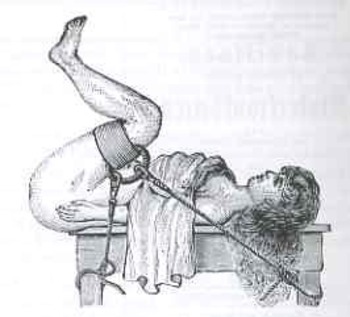 This leads to another uncomfortable image. At first glance I thought it was part of a delivery procedure, but it turns out that this was the rigging for a woman undergoing a gynecological examination. The woodcut appears in the first volume of Sammelband von 7 Kleinschriften zu gynakologischen Spezialthemen, 1858-1901, and more exactly in the contribution by Ludwig Neugebauer on an examination with a “speculum bivale l’ecarteur vaginal a trios branches…” published in 1884. I know that the prissy prejudices brought about with the coming of Queen Victoria in 1837 still had another 17 years to go at this point, which could explain why, perhaps, a doctor would want an aid in helping a woman maintain an examination position without him having to touch his patient, but, well, just look at the massiveness of the restraints! Also, the woman’s arms are *inside* the ropes—not down, not holding the ropes, but inside the binding, restrained. Either way, it isn’t good, treating the woman—in either case of pregnancy or obstetric examination—as the inferior vessel.
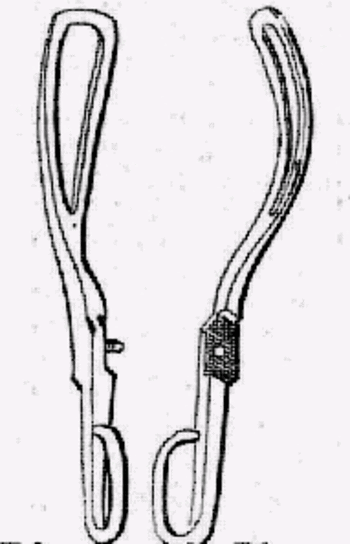 though everyone today knows what these things are, the Chamberlens kept them a secret from the inquisitive medical world for more than a century. Their instrument was shrouded—literally!—in secret(s), used under cover, with ceremony, conveyed to the delivery area in a box and brought out with no witnesses. The Chamberlens felt their invention to be their own, for their own particular use and monetary gain, and the rest of the world be damned, and at least three generations (grandfather, father, son) kept the family secret. If their family could not be in charge of such a delivery then there would be no use of their extraordinary invention. This of course would save their income from being chipped away by other physicians or midwives or whatever competent person could be found to utilize the forceps—their economic gain coming at the cost of (savable but imperiled) pregnant women who would either pay the Chamberlens for aid in their breeched births or, well, probably die. To what degree this revolting behavior damaged other people can not be calculated. I’m not even sure about how to translate this into something more recognizable—would it be like Robert Koch keeping his isolation of Bacillus anthracis (1877), or tuberculosis bacillus (1882) a secret? Or Wilhelm Roentgen shrouding his discovery in secrecy somehow? (I know, I know, this is impossible.) Or isolating a secret, proprietary cure for cancer?