A Daily History of Holes, Dots, Lines, Science, History, Math, Physics, Art, the Unintentional Absurd, Architecture, Maps, Data Visualization, Blank and Missing Things, and so on. |1.6 million words, 7500 images, 4.9 million hits| Press & appearances in The Times, Le Figaro, Mensa, The Economist, The Guardian, Discovery News, Slate, Le Monde, Sci American Blogs, Le Pont, and many other places… 5000+ total posts since 2008.

Category: Bad Ideas

  • Mysteries of the Smoke Signals–Weird Secondary Enticements in Cigarette Ads

    JF Ptak Science Books    Post 1640

    [Continuing the post The History of Cigarette Eyes and part of the series on Blank, Empty and Missing Things.]

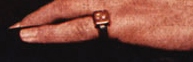
    Mysteries of smoke harrison det

    What is it about the pinky ring that makes you want to smoke?  And makes you want to smoke the cigarette in the pinky-hand’s counterpart?

    The psychology of advertising in cigarette ads in the 1940’s or thereabouts is a strange thing to me.  The secondary items in the ads–the stuff there besides the cigarette–are sometimes baffling and occasionally troubling,  disquieting, unusual things sent to capture the attention once the cigarette has been removed from the field of attention.  I’m pretty sure why those things are there–because of their suggestive natures and their attempt to relate directly with cigarette smoking–but I’m not aure how that connection between the object and the suggestion (of power, or control, or social beauty, or sex and so on) takes place.  The meaning and connection can be forced out with a little muscle, but that wasn’t supposed to be so hard for the viewing public back there eight decades ago.  The social contrivance of the connection seems to have slipped over time into a smoky nothingness, and I think that it would be interesting to try and restore it, if only for the sake of understanding that lost part of advertising’s quadratic equation.

    And so on to a few examples from the advertising world, all of the images coming from the great cigarette advertising archive at Stanford University (here).  Removing the cigarettes as a main focus of attention  in the following ads leaves us with pinky rings, puffy man-ladies, cigarette holders, close touching, electronics, stub-handed stubby cigarettes, wedding rings and suggestive “product  placement”. 

    The vast smokey elegances of pinky ring (from above):

    http://elane.stanford.edu/images/exhibits/tobacco/luckystrike/scientifictestsproverexharrisonL.jpg


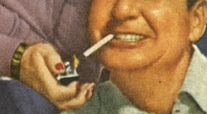
    The smokey, puffy man-lady (“so round, so firm, so fully packed”):

    Mysteries of smoke phil harris det

    Phil Harris just looks entirely and completely out of place, and not comfortable, though perhaps he just wanted to “feel pretty” getting a light from man-handed Alice Fayew?

    http://elane.stanford.edu/images/exhibits/tobacco/luckystrike/philharrisL.jpg


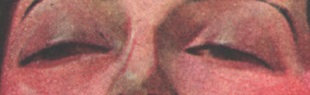
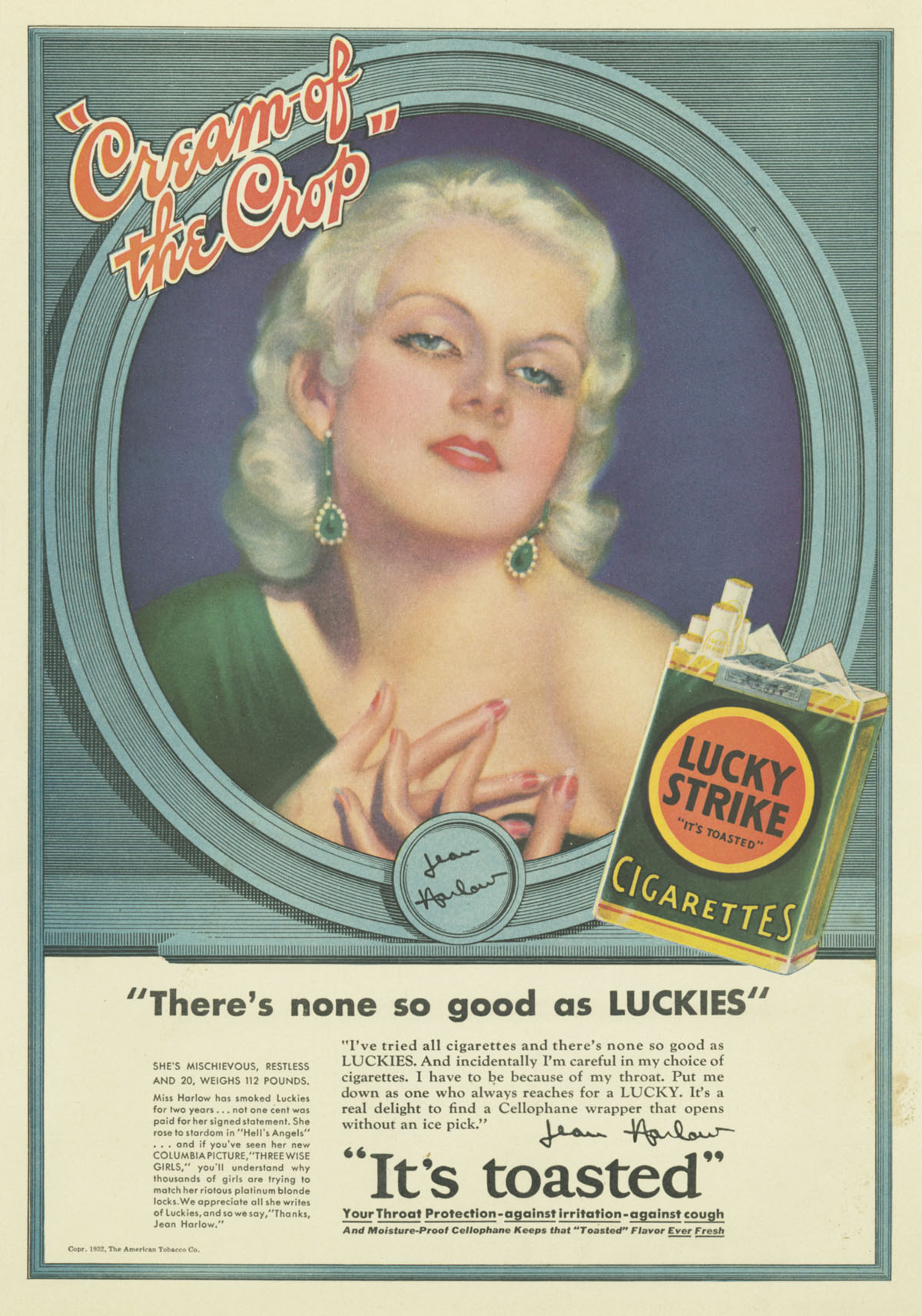
  • The History of Cigarette Eyes

    JF Ptak Science Books  Expansion and Correction(s) of  Post 1638 (Thanks to Orion Pozo at NCSU for starting this off by outing the Marlboro baby.) Part of the series on the History of Blank, Missing and Empty Things, Part 77:  Promises.

    “The world is my dream.”– Sir Karl Popper

    In the History of Empty Promises advertisements for fulfilling experiences with safe/pleasant/not-addictive/sweet-smelling tobacco cigarettes would find a key position, if for no other very large reason than having killed so many millions of people.  Many of the lies told to the consuming public on the efficacy of cigarettes have come through billions of dollars worth of print advertisement, many of which featured the earnest eyes of someone famous (Babe Ruth, Lou Gehrig, the Duchess of Windsor), or authoritative (football referees, doctors, lawyers, airline pilots), or trustworthy (Santa, the family dog), or even innocent (teenagers and of course babies).  I’ve collected a few examples that I find particularly arresting–there are hundreds or thousands more to choose from.

    • Note–all images are drawn from the great resource at Stanford University on cigarette advertising, here.

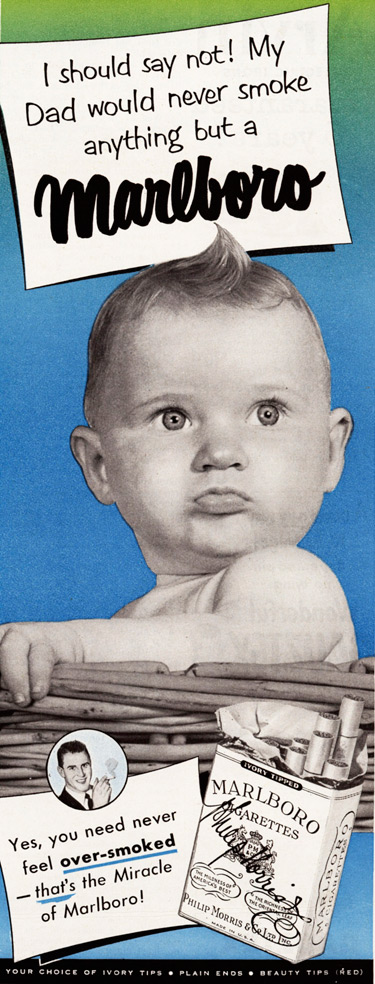
    Cigarette Eyes of Babies (for Mommy–for Daddy, see below):

    Ciggie eyes baby
    In one of the high twisted occurrences in the history of Buying Things, Marlboro cigarettes started its life out as a smoke for women, a mild, feminine object for ladies.  And as we can see here an early appeal to the possible consumer came through the eyes of an infant.  The product didn’t sell well, and was repackaged for men, the baby eyes eventually being replaced by the iconic cowboy. This is one of the few times that an a consumer object that began its career as a sales vehicle for women crossed the gender barrier. 

    Ciggies--baby

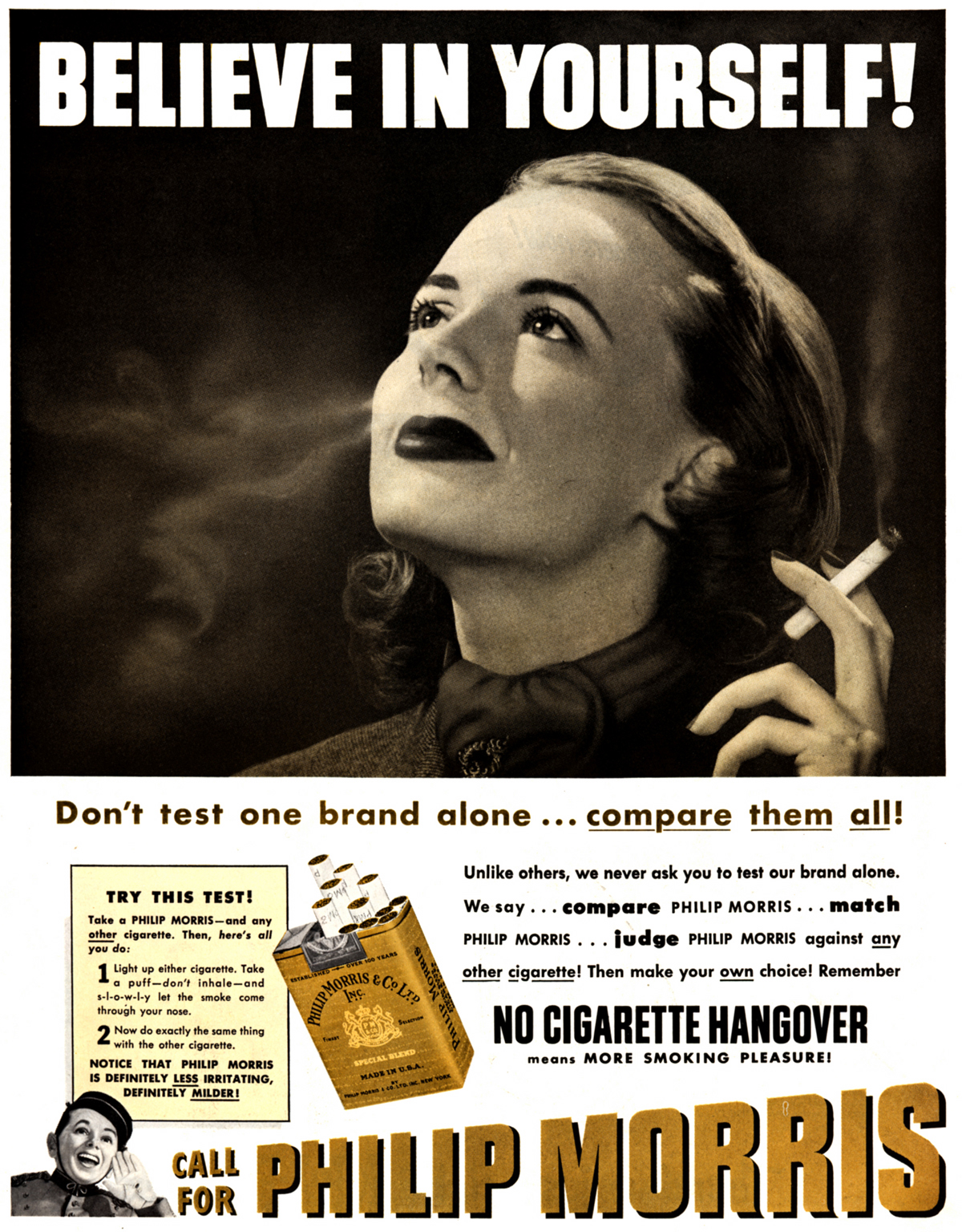
    Cigarette Eyes (and Nostrils) of self-knowledge and belief (because nothing quite spells out personal knowledge than blowing hot smoke through your nose holes):

    Ciggie belief detail

    Ciggie belief

    Cigarette Eyes of the edification of pure scientific support for the glory of smoking:

    Ciggies--eyes w microscope det
    Chesterfield not only conquered the alphabet for cigarettes, but “science” as well.  Here we see Big Science affirming the ABC claim that there is no “aftertaste” in their cigarette.  (The ‘scope has no identifiers, probably taken away in the darkroom, but it looks like it might be a Spencer to me.  Maybe B&L.)

    Ciggies eyes of science

    Cigarette Eyes of Babies (for Daddy):

    Ciggie smokes daddy det

      Ciggies baby daddy


    Ciggie Slim-Lust Eyes:

    Ciggie slim detail
     

    Ciggie slim

    Cigarette Nurse Eyes of Trust and Responsiveness:

    Ciggie nurse detail

    Ciggie nurse


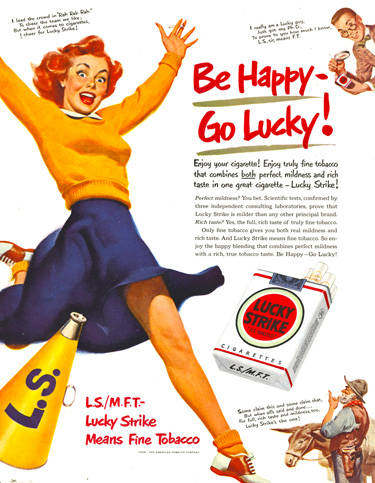
    Cigarette Teenager Eyes:

    Ciggie teens eye det


    Ciggie cheerleader

    Nothing quite spells out h-e-l-l (even to non-believers) than those things that are dangerous and targeted at children.  This add provides even a little more than that–the  leaping teenager does have a cigarette in her left hand  (if you look closely you’ll see it)  an is revealing quite a lot of herself in flight…even the angle of descent is suggestive.  At first glance I thought this was a cheerleader to be exposing so much, but, no–she’s just a teenager who is smoking and leaping.  


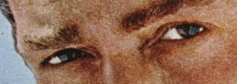
    Cigarette Teacher Eyes:

    Ciggie educators det
    Ciggie teacher

    Well, I guess that these weren’t necessarily teacher/scientist eyes, but the man in the suit was supposed to convey that.  He was after all smoking a smart cigarette, with a filter–something relatively new in the mid-1960’s when Lorilard Company pushed their Micronite filter.  It was supposed to filter out the bad stuff from cigarette smoke, and did so by employing crocidolite asbestos as part of the filtering agent–this is a form of asbestos that is the most dangerous of the amphibole asbestos family.  Evidently something like 18% of the miners who mined this sort of asbestos (also known as “blue asbestos” have died of mesothelioma–not contracted the disease, but died of it.  And here it was, being inhaled with cigarette smoke.)


    Ciggie Eyes of Sex:

    Ciggie sex detail

    This was far from being the first round of advertisements using sex as a possibility achieved via the purchase of a commodity. It was also not the oddest promise for weight loss from an unsuspecting product–cocaine was sold for this purpose as well in the early part of the century.  Heroin too.  I can guarantee that if you these this often enough it will loosen your grip on food, almost to the point of exclusion; and then, like magic, food gone, you will lose weight.  Cigarettes offered themselves as a substitute for candy–for women–and in this way became an inglorious end to what still seem the impossible dream of maintaining an always-improbable desired figure. 

    Ciggie sex


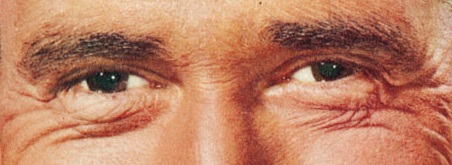
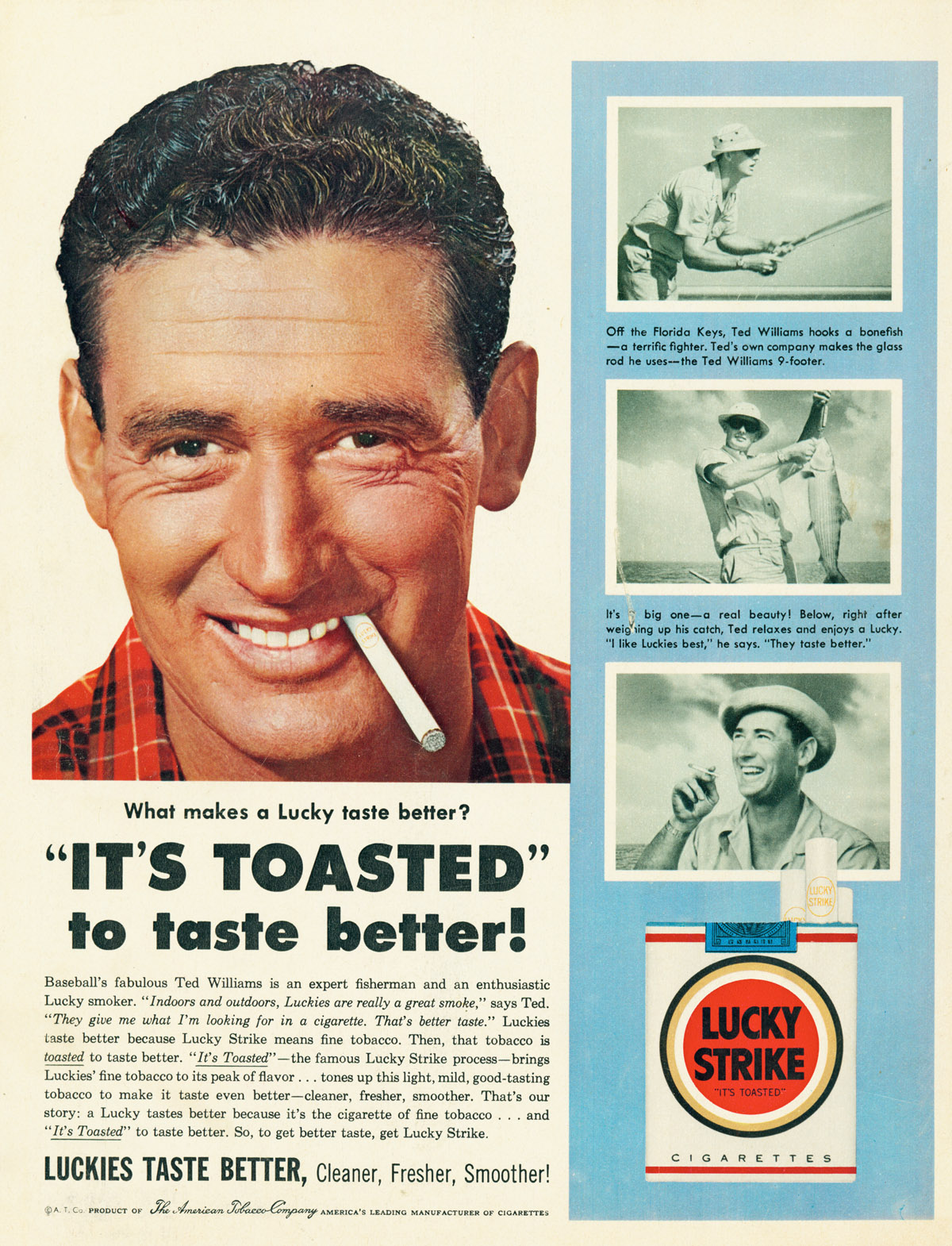
    Ciggie eyes of Teddy Ballgame:

    Ciggiee baseball detail

    Ciggiee baseball

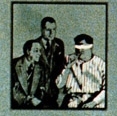
    And from the other end of the field, a little inset picture of Babe Ruth, who evidently could tell his ciggies apart, blindfolded, and in uniform.  It is a creepy and surreal image:

    Ciggie athlete  ruth det last
    He didn’t have the best relationship with his wives, and had some other social factors weighing in against him, but the man was famously kind and generous with children, which gets him a “pass” in my book.  He died of cancer in 1948, aged 53. (His last public address was eloquent and heartfelt, a truly wonderful short speech.)

    Cigarette Eyes of Santa:

    Ciggie santa detail

    In a world of things in which everything was wrong, this was among the “wrongest”, so wrong it isn’t even wrong. There are many ads featuring Santa, some of which show him decorating a Christmas tree with boxes of cigs, others showing him with his sack full of yet more cigarette cartons.  Even in an Encyclopedia of Bad Taste, this would be a key entry.

    Ciggie santa


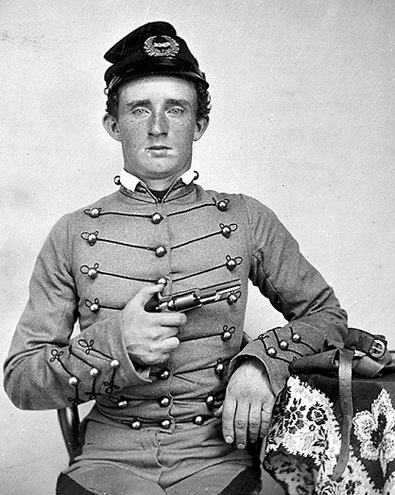
  • Custer–the Limited Man of No Limits–and Exterminating Southerners

    JF Ptak Science Books  Post 1630

    “…I would offer no compromise except that which is offered at the point of a bayonet. I…favor a war of extermination. I would hang every human being who had a drop of rebel blood in their veins whether they be men, women or children…”–G.A. Custer in Richard Slotkin Fatal Environment…, Harper, 1985, pg. 384.

    Here’s a bit of Custer legend that is true and seldom heard—if left to his own devices in a Custer-filled world,  the general would have “exterminated” everyone in the South, every one (“men, women or children”) , “with an ounce of rebel blood” flowing in their veins, hanged dead.  At that point the South would be free, and would be repopulated with the “loyal and patriotic” people,l presumably from either up north or Southerners loyal to the Union.a

    Custer This was part of  a long letter (transcript below) to U.S. Senator Jacob Howard, written on 19th January 1864, in the field.  Custer was feeling on the ropes at the time, needing to defend his loyalty to Lincoln and his policies, and needing to distance himself from Lincoln’s election contender and inferior general, George McClellan. (Richard Slotkin, in his fabulous The Fatal Environment, the Myth of the Frontier in the Age of Industrialization, 1800-1890 notes that Custer needed “to justify himself…(and) disabled his previous affiliations and the nature of his relationship with McClellan…’)

    Custer’s relationship–real and imagined–with McClellan was putting him in a stench void, creating the possibility of distance between himself and the powers that be–particularly with Senators like Howard and Zachariah Chandler, “who controlled army promotions” (Slotkin, page 384), which meant distancing himself from the higher rank he thought he was destined for. Custer had been on McClellan’s staff, and had aligned himself with his war policies, though not necessarily so his presidential ambitions.  Howard, a Republican from Michigan and member of the Military Affairs Committee, believed that Custer was a “McClellan Man” and set against Lincoln, and for that was set to block his promotion to brigadier general.  Custer’s  salvaging letter1 to Howard left no doubt about his supposed non-political feelings and where he stood on Lincoln, the Emancipation, and the treatment of the Confederates:


    ·Posted by :

    ·in:

    —

  • A Comet of Vertical Falseness (?)–an Episode in the History of Unusual Ideas

    JF Ptak Science Books    Quick Post

    Blogjuly_22asteroid358 

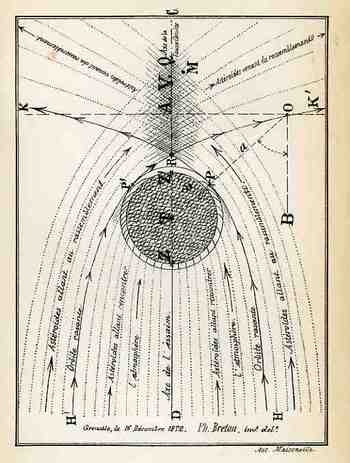
    the title of this interesting, odd beauty is “Formation d’une Fausse Comete Verticale”, and it looks as though it was published in the 1872 or so, and engraved in Grenoble by Ph. Breton (for “aut” or the author of the paper, Maisonville (?)).     The nature of this illustration has flipped around quite a bit—the initial translation of the title sends it to the heights of uncompromising weirdness, “On the Formation of a False Vertical Comet”, except that the “false comet” part was really, I think, referring to an asteroid more so than, well, I don’t know.  (This “I don’t know” part can get very weird, as we’ll see below.)   So the title kind of gets back into line with the world of the possible (except for the “vertical” part); but from my reading, the content of the illustrations takes it back out, again.  The round object in the middle is the earth; and the curved parabolics leading towards it, and inside it (deep inside it), leaves me only with wonder, and without explanation.  It is entirely possible that I’m just not up to the task of interpreting this image, but the inner-earth cross-hatchwork of asteroids leaves me baffled, as does the “axe de l’essaim” (“stacked axis??), and the trailing atmosphere, and so on.  I really can’t find any key to this image. 

    Getting back to the unforeseeable weirdness that “explain things”, I found the following statement from a website explaining the “true” nature of the Shoemaker-Levy comet—the writer claims that it wasn’t a comet, not a comet at all, but rather a false comet (“une fausse comete” redux), and actually a series of “bombs” built by the U.S. Army and delivered to the surface of Jupiter by NASA disguised “as cometary collisions”.  (“En 1997 parait sur le forum fr.sci.astronomie un étrange document anonyme. Ce texte soutient que l’étrange série d’objets appelé “Comète Schoemaker-Lévy 9” ou SL9, qui a frappé la planète Jupiter en juillet 1994 en provoquant des explosions colossales était en fait une expérimentation de bombes d’antimatières misent au point par l’armée américaine, lancées par les navettes spatiales de la NASA et déguisées en collisions cométaires.”)  I must say that this explanation stumped me—sounds like a long, long way to go over a long period of for an experiment to blow up gas on Jupiter, if you ask me…

    ·Posted by :

    ·in:

    —

  • Things Not Built: Liberty Landing and Closing NYC Harbor, 1935

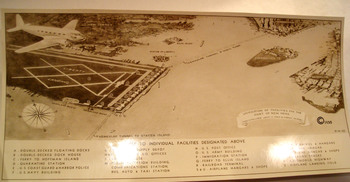
    Dsc04768 I recently uncovered an interesting, unpublished and probably not-acceptable engineering report to extend the ports capacity in the Hudson River at New York City–the ports of the  area being famously over-busy for a long period of time, especially right before World War II.  Charles Palliser and Frederick W. Capon presented a proposal in 1935 for a unification of the port and airport facilities to take care of the overcrowding and overworked problem.

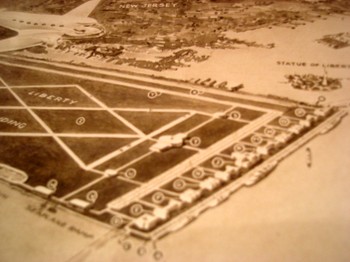
    What they came up with was Liberty Landing, a mile-long and half-mile-wide facility that nearly bumped into theDsc04769 Statue of Liberty (and hence its name).  The plan called for backfilling the “flats” that were just south of Jersey City, as “the natural formation of these were very favorable”, which meant that the airport-port combo would extend all the way into the harbor to the edge of the channel, which would put it further out than the Statue of Liberty, which would also be just hundreds of feet away from the end of the north runway.

    Also attached to the backfill and new land would be a one-mile-long floating dock.  Oh my!

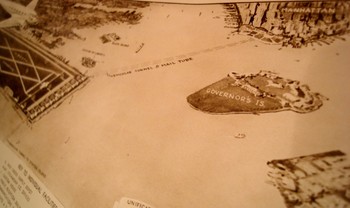
    The floating island would also have vehicular tunnels that connected it to Staten Island and the Battery.  There were facilities for seaplanes, airplanes, railroads, dirrigbles, and trucks, plus a military installation, a custom’s house and the US Mail Service, so that all commerce would converge at this one point, which sounds interesting (for about 20 seconds). 

    Dsc04773
    This is a good candidate for the “Better Left Undone” award for 1935.

    As I look at the photograph of the aerial view of the plan it strikes me that if the designers increased the surface area by only 125% or so they could’ve connected the new facility with Governor’s Island AND Brooklyn, building a land bridge from Jersey City to Coney Island—a superbly bad idea to cap an already strongly bad idea. 

    The report is called, simply, Liberty Landing, and published by the architect in Jackson Heights, NYC, 16 Septmeber 1935.  This is also the U.S. Copyright Deposit copy (accepted 10 October 1935), which is where the history of this project ends.


  • America Attacked, 1937–and the Bizarre Architectural Response to Poison Gas and the Homeless Unemployed.

    JF Ptak Science Books   Post 1648

    [An earlier post on this blog, Mapping the Invasion of America, 1942, addressed another vision of the invasion of the United  States–it is also the Most Viewed post that I’ve written, having been read more than 400,000 times.  Try out this bit on the Invasion of America (naval, at Pearl) in 1932;  see also Part II of this post, here; and consider a  related post on the Nazi sub-orbital Amerika Bomber]

    America attacked poison962
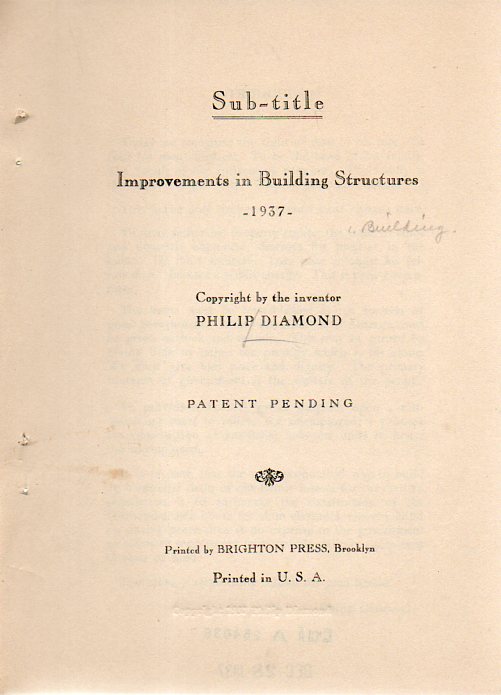
    Philip Diamond discovered an interesting concept in “blurryness” in the pursuit of building with a purpose.  In his pamphlet Should it Happen Here, self-published (and printed by the Brighton Press of Brooklyn, U.S.A.) in 1937, Diamond established a need for creating (1) inexpensive housing for the unemployed and (2) poison-gas-proof housing for Americans in general, and came up with (1.5) inexpensive poison-gas-proof housing.  In blurring the lines between the two needs I’m not sure that he satisfied anyone’s needs, spreading his engineering/architectural gifts jut a little (or a lot) of bit too thin.

    One thing Diamond was sure of was that the next war would be governed by “one man flying in an aircraft and releasing vapors of poisonous gas for destruction” and assured his readers that in this new war “there would be no front lines”.  “The future war will not be carried to the front line; it will be carried to the front door.”  That of course was true for hundreds of millions of people in Europe and the Soviet Union and South Asia, but not so in the same sense for anyone in America–unless those Americans happened to live on a remote chain of Alaskan islands.  Diamond was sure that war was coming directly to the U.S., and although he doesn’t name the country/countries that would be responsible for attacking America with poison gas, he did name one of the aircraft that would come here to do that–the HE112. (The HE 112 was a prototype fighter aircraft that wasn’t adopted, with fewer than 100 produced. How this would get across Europe and then across the Atlantic and then across the U.S. I’m not sure.)

    America attacked poison963
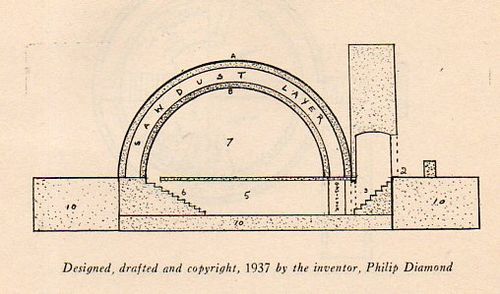
    Once Diamond gets to the design of his house things get a little fuzzy–and heavy./  Very heavy.  HE proposed a domed structure with a foot-thick “exterior roof” and a foot-thick “interior roof” of concrete, between which would be sandwiched three feet of sawdust.  The sawdust was supposed to act as both a filter to noise and soot and dust from the outside world, as well as a filter for poisonous gases. 

    The 5-foot thick structure would be embedded on a 10-foot thick concrete bed (for earthquake protection) and surrounded on its sides by another 10-foot concrete structure of something that I can’t figure out.  Not surprisingly, the author announced with a section headings that there would be “No WIndows”.  There would be a double entry equipped with an “air condition” that would wash folks entering the house and decontaminate the gases that might’ve impregnated their clothing or bodies (though Diamond says nothing about outerwear). 

    America attacked poison964
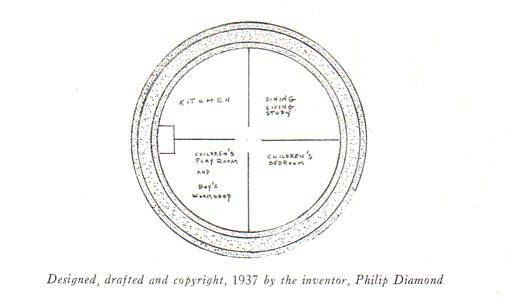
    Once inside (charmingly referred to as “the vault”) the occupants would find two bedrooms, a kitchen/dining room, and two lavatories (one “miniature” for the children, not so much for “hygiene”, but to “protect the delicate moal grace amongst the children”. That was the best line in the pamphlet, and about the only thing that really made any sense.)

    6 million of these houses could be constructed for the unemployed, costing $3,000/each, meaning that this part of the project could be funded with 18 billion dollars.  This was at a time when the New Deal was having a heart attack, unemployment was spiking again, and the entire GDP of the U.S. was $91 billion, which means that Mr. Diamond was seeking a 20% cut of the GDP pie.  In current terms, that 20% would mean $3 trillion. 

    So far as I can determine Mr. Diamond’s plan was not taken seriously. 

    Also, this I think is my only encounter with  a title pages that starts out with the words “Sub-title”.

    America attacked poison965


  • A History of Changing Sides, Part 1: a Half-Fascinating, Wholly-Horrible Biography of a Forgotten Man

    JF Ptak Science Books  Post 1642

    This is the first post in a new series on this blog on “changing sides”–that is, having a new allegiance, Adopting/acting on an something completely out of the mainstream of the personal experience, believing in the opposite of an established belief; to leave something, falling away or rejecting one thing for its opposite or something different, done with integrity or with the abandonment of honesty. 

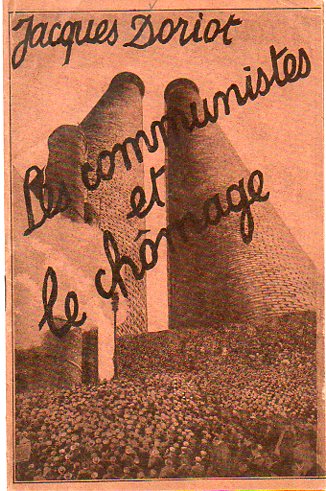
    Doriot953Jacques Doriot.That was the name on the pamphlet that I pulled out of a stack of pamphlets segregated for their cover art.  Les Communistes et le chomage was written by Doriot in the year after he became mayor of St. Denis, an ancient commune just north of Paris, in 1932.  That was years, of course, after Doriot returned home from being a POW of the Germans in WWI and found himself joining the French Communist Party (PCF), a group in which he rapidly succeeded.  HE went to jail for the violent protest of teh French occupation of the Ruhr, emerging into the political arena as mayor of St. Denis.

    At one point he was taken by the Communists, but a bitter debate erupted after which he was expelled from the Party (in 1934).  He abandoned thoughts of the communists and established a new ultra-nationalist Parti Populaire Français (PPF) in 1936.  From there things went downhill, but not yet downhill and on fire. 

    File:Bundesarchiv Bild 101I-141-1258-15, Russland-Mitte, Soldaten der französischen Legion, Fahne.jpg

    Doriot supported the idea of France becoming more like its Facsist neighbors Germany and Italy, and when the war rolled into existence in 1939, Doriot jumped on the foreign Fascist bandwagon.  In France.  He supported the occupation of the Nazi’s French occupation of the north, but when that proved to not be fascist enough for him, he toddled off to Paris where he found a better reception for his pro-Nazi sentiments among the Nazis themselves, what with the Vichy government providing too-soft a version of governance.  His transformation was in full blossom by that time, when in 1941–after having an Ezra Pound-like experience in espousing pro-Nazi beliefs on Radio Paris–he and Marcel Deat went almost all the way into the heart of the Fuhrer, creating the Legion des Volontaires Francais (LVF), which was a French force organized to fight with the Wehrmacht. (The French were hardly alone in this, with something like 350,000 soldiers in the Wehrmacht coming from places outside of Germany.  See the note below for troop strength numbers. 1 )

    Doriot954
    Not surprisngly the LVF was thrown into the Barbarossa meatgrinder, and was decimated, along with millions of German soldiers as well as more millions of Russian citizens and soldiers. (According to a wiki page, the LVF started out at regiment strength of about 2,400 when they went into battle in October 1941; by the spring of 1942, there were only two batallions left, comprising about 600-800 soldiers in total.2.) Doriot survived, and in what must have been the high point of his life, was awarded the Iron Cross in 1943. In coming back west he pursued other pro-Nazi activities, including what looks the support of German agents inside liberated France in 1944, which I think would leave an ordinary person completely vacant and a deranged one full of pride and fortitude.

    Somehow he made it almost to the end of the war, though had he survived it I am sure that he would have been visited with vengeance and retribution.  (It seems that most of the officers were tried and executed while the soldiers were either sent to jail or offered to work off their debt to the nation via service in the Foreign Legion.) Doriot was killed when the car he was driving in was strafed by a fighter plane on Washington’s birthday, 1945. 

    It is quite a remarkable, and horrible, little life that Doriot led, a life that actually has me feeling a little hollow as I write about it–very off-putting and upsetting in a dark, struggling way. 

    ·Posted by :

    ·in:

    — — —

  • On Being Not Even Wrong–What is the Word for a Wrongness that Transcends “Wrong”?

    JF Ptak Science Books  Quick Post

    This is just a very quick post making use of the excellent cigarette advertisement resource at Stanford University (all images used below are found in their archive, here).  This is the third installment on this blog on cigarette advertisements that are as wrong as wrong can be, so wrong–as I’ve said in earlier posts–that they aren’t even wrong, that they are on-beyond wrong in that classification that defines terminal wrongness. 

    http://elane.stanford.edu/images/exhibits/tobacco/embassy/inhaleheartcontent1L.jpg


    This stuff is worse than wrong–it is substantially a wrongness where the word “wrong” is too weak and impotent to describe a particular wrongness, much like the very-overused and not-replaced “spill” could be used to describe what happened in the Gulf Coast.  There is no one word in English I think that described that occurrence, just as there really isn’t one suitable word to describe this behavior of the tobacco industry.  The wrong that isn’t even wrong isn’t that it is nothing, but that the wrongness of the thing is too weakly described by the word. 

    Rudolf Peierls (a phsyicist of very high order and co-author of the Frisch-Peierls memorandum of 1940 that theorized a workable weapon fahioned of U-235) described the original use of the “not even wrong” phrase, attributing it to the great Wolfgang Pauli (Nobel physics 1945), who when shown a paper by a young physicist commented sadly that it wasn’t right, and it even wasn’t even wrong.  It was nothing. (It is interesting to note that if you took two of the things that these physicists were known for and placed them out of context in a literary/philosophical arena, they kinda work to describe Pauli’s wrongness principle:  that would be the Peirels Instability and the Pauli Exclusion principle.)

    These ads weren’t nothing.  And the odd thing is that they exist in their contemporary flavors today, efforts that will be seen in our short future as being as impossible as these antique ads seem to us today.  More’s the pity when we know almost all of the story. 


    And this one is just “__________”:

    http://elane.stanford.edu/images/exhibits/tobacco/luckystrike/certainlyL.jpg

    http://elane.stanford.edu/images/exhibits/tobacco/cigars_pipes/ronaldreganL.jpg


  • Signs of Discrimination: Photographs from the Library of Congress FSA Collections

    JF Ptak Science Books  Quick Post

    Negro drinking at "Colored" water cooler in streetcar terminal, Oklahoma City, Oklahoma

    All of the photographic material below comes from the U.S. Library of Congress website for its prints and photographs division, and is a very small sample of what is offered from its online holdings of Farm Security Administration/Office of War Information (FSA and OWI) photographs. It is not ancient history–most of the images are 75 years old or so, a part of our near-past which still shadows our near-future.

    “Photographers working for the Farm Security Administration Historical Section (later transferred to the Office of War Information) were encouraged to document continuity and change in many aspects of life in America during the years the unit was in operation. They were particularly encouraged to photograph billboards and signs as one indicator of such developments. Although no documentation has been found to indicate that photographers were explicitly encouraged to photograph racial discrimination signs, the collection includes a significant number of this type of image, which is rarely found in other Prints and Photographs Division collections.”

    Beale Street, Memphis, Tennessee

    On of the great innovations in a sea of great things accomplished during the Franklin Roosevelt administrations was the formation of the FSA, a division of the government established to help farmers through the devastating Dust Bowl and Great Depression.  A subset of the FSA was a photographic unit which was set up to document the progress made by the FSA (and provide, I am sure, for some much-needed good news, a hearts-and-minds campaign).  This division was headed by Roy Emerson Stryker, who wound up hiring a collection of dream-team photographers unlike any ever assembled for a single purpose.  Esther Bubley, Marjory Collins, Mary Post Wolcott, Arthur Rothstein, Walker Evans, Russell Lee, Jack Delano, Gordon Parks, Charlotte Brooks, John Vachon, Carl Mydans, Dorothea Lange and Ben Shahn were sent out all across the country and wound up with the greatest and most beautiful photographic history ever assembled.  There were about 77,000 images made, and I recall reading (somewhere) that the total budget for the Stryker group for the years 1936-19421 was about $100,000, meaning that each completed image cost just over a dollar apiece.

    Rex Theatre for colored people. Leland, Mississippi Delta

    1) Bethlehem-Fairield shipyards, Baltimore, Maryland.
    May 1943.
    Arthur Siegel, photographer.
    “A drinking fountain.” [Sign: “White.”]
    Location: D-90666
    Reproduction Number: LC-USW3-26442-E
    [view catalog record]


    A drinking fountain labeled with a sign 'White.'
    1
    2) Memphis, Tennessee. October 1939.
    Marion Post Wolcott, photographer.
    “Secondhand clothing stores and pawn shop on Beale Street.”
    [Sign: “Hotel Clark, The Best Service for Colored Only.”]
    Location: E-2185
    Reproduction Number: LC-USF33-30637-M3
    [view catalog record]
    Secondhand clothing stores and pawn shop on Beale Street labeled with a sign: 'Hotel Clark, The Best Service for Colored Only.'
    2

    3) Durham, North Carolina. May 1940.
    Jack Delano, photographer.
    “A street scene near the bus station.”
    Location: E-255
    Reproduction Number: LC-USF33-20522-M5
    [view catalog record]

    A street scene near the bus station.
    3
    4) Durham, North Carolina. May 1940.
    Jack Delano, photographer.
    “At the bus station.”
    Location: E-5153
    Reproduction Number: LC-USF33-20522-M2
    [view catalog record]


    At the bus station.
    4


    ·Posted by :

    ·in:

    — — —

  • The Holocaust-Denying Discoverer of the Atomic Bomb in the Bible (1945)

    JF Ptak Science Books  Post 1597 [Part of the Atomic and Nuclear Weapons series]

    Atomic bomb god723
    It is astonishing sometimes to think of all of the subterranean atom-bomb-applicable cultural subcultures that quickly/instantly popped into existence following the use of the weapon on 6 August 1945.  The United States, for one, became an atom-crazed country, from atomic laundry flakes to milkshakes to hotels to condoms. This exuberant atommannia knew no bounds, and leechingly found its way into religious messages.  One thing that the atom bomb seemed to be that few people anticipated was its popular impact on the general population, as well as its extraordinarily broad base of applications. 

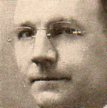
    Atomic bomb god724 The man trying to look into your soul from around the edges of his glasses, the man looking annoyed and reproachful and judgmental with his thin-lipped contempt, is W(illiam D(ewey) Herrstrom, the author of The Atomic Bomb and the End of the World, written in 1945, and published by Bible News Flashes of Minneapolis, Minnesota1. This is an unhappy little pamphlet filled with massive fear and innuendo, and calls for its readers to address that fear and all uncertainty by embracing Jesus Christ.  After all, it is not the Atomic Bomb that we need to worry about, says the author: it is our salvation and the potential wrath of the creator for all sinners.  Herrstrom shouts out that the atomic bomb will not end the world or set it on fire–that job is left for god, so we need to address god before we do so the bomb.  He writes:

    “The scientists who say that the heavens could be ignited by man to bring about the end of the world may be right.  But there is at least one good reason why this will never happen.  That reason is clearly stated in II Peter 3:7.  God has “RESERVED” this for his own time.”

    Mr. Herrstrom’s–who may have believed too much in the transliteration of his name from the German, which would be “Mr. Power”– message was one of fear and perdition, of the End Times coming true, of prophesies found in the Bible that were being unearthed right there in 1945–luckily, Mr. Herrstrom was ready to supply all of the necessary information about dealing with such stuff in his Bible News Flashes magazine, every month, which was somehow available for the subscription of 25 cents per year.  He had earlier addressed these issues in his Judgment Day for Everybody (improbably in its second edition) and The Revived Roman Empire, both of which were skinny, and both published in 1939–not that he was taking advantage of any situation in particular to press forward his bitter and hard nail visions of the future of our souls and the coming death of a sinful world. 

    “The Bible is history pre-written and God’s book is scientifically correct…and is ahead of the human race…”

    And as proof of these revelations the author offers bits like the following, in this case, a Bible quotation as proof of foretelling the invention of the jet plane:  “Like…chariots on the tops of the mountains they shall leap” (Joel 2:5).  And this for the atom bomb:  “And men were scorched with great heat, and blasphemed the name of God” (Rev 16: 18-20) and seven more pages of other large-print proof2.

    Herrstrom advertisers himself–on the title page, and in his interior full-page portrait–as a “World Traveler, Prophetic Analyst” and editor of Bible News Flashes, the Illustrated Prophetic Monthly Magazine, which is advertised on the back cover of the pamphlet, and where Herrstrom adds “News photographer” to his credits.

    One thing he doesn’t credit himself with and for which he should receive major recognition is for being one of America’s earliest and ugliest Holocaust deniers. The fantastic all-things-atomic  Conelrad blog, which has written another story on Herrstrom and his work, finds Herrstrom in Deborah Lipstadt’s book3,4:

    “In 1952 W. D. Herrstrom, an American antisemite, declared in Bible News Flashes that there were five million illegal aliens in the United States, most of whom were Jews. These were the Jews who were supposed to have died in the Holocaust. “No use looking in Shickelgruber’s [Hitler’s] ovens for them. Walk down the streets of any American city. There they are.” pp 66-67

    Well, as confessions of a hating faith-based ignorance, one could scarcely find better examples than these. 

    Notes:

    1. (Unfortunately, the only address given on the pamphlet is for a PO Box for Lake St. Station. Herrstrom’s other pamphlets include:  Mussolini & Facism, 1937, Wichita Falls, Kansas, Defender Publishers (?!), 49pp;  Will This War End Armageddon, 1941, 47pp; Golden Key to Bible Interpretation, 48pp, 3rd revised edition (again, ?!), 1940; Is God  a Jew, 1943, 24pp; Judgment Day, 1943, 64pp; Revival of the Roman Empire, 1939, 48pp.  Herrstrom had a few years where he was on fire,m from 1937-1945, during which most of this stuff was written.  It is noteworthy that hewrote books that were mainly 24 or 48 pages long.  His Bible News Flash appeared from 1943-1949, and is located in six libraries in the U.S., which makes it on the rare side.  Somehow, The Atomic Bomb and the End of the World is not located in the massive database for worldwide library holdings. 

    2. Herrstrom was hardy alone in laying claim to the ecumenicism of the atomic bomb.  There was also, for example the following:

    Mel Morris  published God’s Atomic Bomb  in 1945, which means he must’ve worked a little feverishly to pump up his bible prophesy and history to include the new atomic weapon to replace whatever else he had been using as a prophecy for end of times.  (As it turns out, “God’s Atomic Bomb” was more tempest and disaster in the bible, and not (whew!) the bomb itself.  Though as we’ve learned from scientologists and the sort-of creative mind of Ron Hubbard, a civilization came to the earth thousands of years ago and pummeled it with “atomic bombs” and other nastiness, polluting humans for milennia to come.  But that’s another story–suffice to say that Morris found many dozens of examples of “God’s Atomic Bomb” being used in the deep biblical past, and that the use of the real atomic bomb in 1945 was pre-ordained, and not without its figurative historical counterparts.  I’m not sure why any of this was necessary outside of proving to some small minority that these preachers could at least be contemporary and topical. 
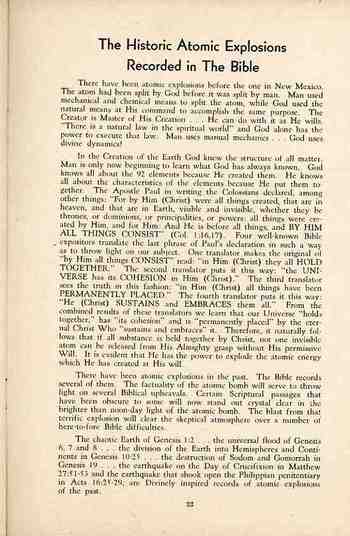
    Blogsept_2_atomic_bomb_god_2txt483

    3 Deborah E. Lipstadt, Denying the Holocaust, the Growing Assault on Truth and Memory, 1993.

    4.  Conelrad also found Herrstrom’s longest book,  Seventy Five Reasons Why Community Water Supplies Should Not be Fluoridated.  Good work, Conelrad!

    5. Bibliographic note–I’ve seen this cover now in three different colors (red, blue, green) and I believe now that it wasn’t so much a factor of a number of different printings being done of the work over time, but rather of using whatever cover stock in whatever color happened to be on hand for the first printing. 

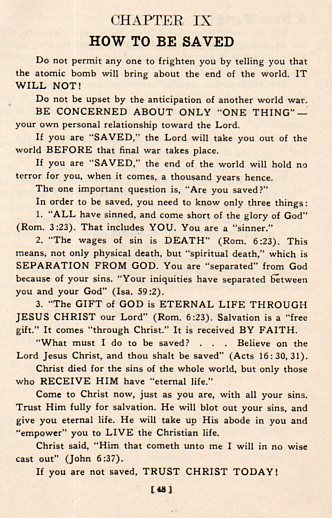
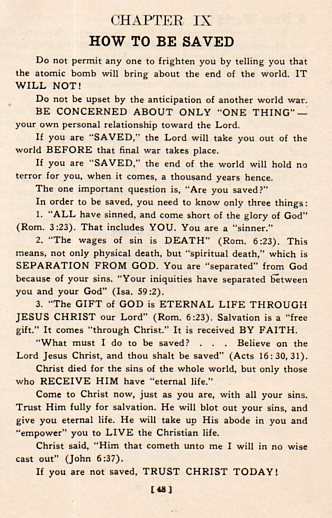
    Here’s a note from Herrstrom on how to get into Heaven:
      Atomic bomb god722