A Daily History of Holes, Dots, Lines, Science, History, Math, Physics, Art, the Unintentional Absurd, Architecture, Maps, Data Visualization, Blank and Missing Things, and so on. |1.6 million words, 7500 images, 4.9 million hits| Press & appearances in The Times, Le Figaro, Mensa, The Economist, The Guardian, Discovery News, Slate, Le Monde, Sci American Blogs, Le Pont, and many other places… 5000+ total posts since 2008.

Category: Bad Ideas

  • The Intestinal String Polisher in the Curled Hair Dept.–Armour Meats, 1917

    JF Ptak Science Books   Post 1826

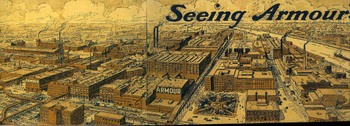
    The following impressions are a result of reading the Armour & Company’s hard-sell-we’re-really-really-clean promotional pamphlet, Seeing Armour’s. (I’m not sure why there is a plural possessive in the title, which is lopped off in the photo below–the pamphlet is actually splayed out here, opened from the 4×7.5 oblong to show both sides of the cover, revealing both halves of  the vastness of the company’s campus).
    Blogsept3_armour488


    Knowing full well The Jungle* story and the insufferable conditions in the livestock killing and processing industry, what really stopped me was this short note on one of the many elements of the company:
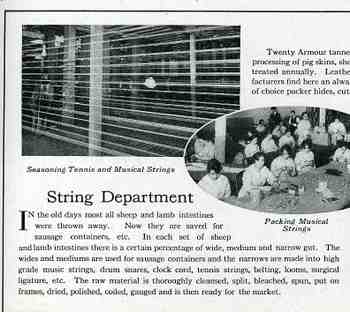
    Blogsept3_string484 the String Department.  (?)  How deflating it is to start thinking about this concept.   Yes, of course, of course there is a string department at the Amour Meat Packing Company, though they’re not making the stuff from field-grown fibers.  This string is just gut, but useful gut:  “In the old days most all sheep and lamb intestines were thrown away.  Now they are saved for sausage containers, etc.”  Et cetera?  I’m not sure if the “etc.” part is more baffling than the originality of the opening sentence (and a sentence which is probably never-before encountered).   There’s wide, medium and narrow gut, as it turns out, and it was cleansed, split, bleached, spun, put on frames, dried, polished, coiled and gauged.  (Now that’s a job title:  intestinal string polisher).

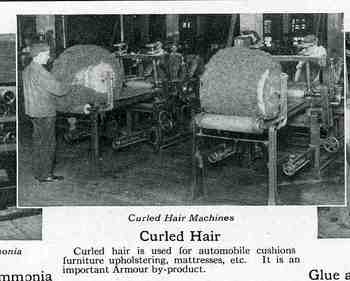
    There were a number of other expected/unexpected surprises.  The Curled Hair room was a surprise. I was expecting the soap room but didn’t expect the huge interior that it filled, with hundreds (?) of young women (all dressed in white) seated at long wide tables with mountains of soap, doing god knows what.  Oleomargarine, bullion, extract of beef, sausage, leaf lard and bacon were expected; the eggs, butter, cheese, grape juice, peanut butter, salmon and fruit syrups departments weren’t.  Armour seems to have been waging a veritable food war, with a little bit of beef/pork/sheep going into a little bit of everything. 
    Blogsept3_hair485

    Finally, having had just about enough of Mr. Armour, I stumbled into the stuff on the killing rooms.  Even though the description is cleaned up i the pamphlet, it still is not pretty, and sharing the photographs is just not necessary.

    20 years a vegetarian, here. 

    *Note:

    The Jungle was written by Upton Sinclair (often referred to as a “socialist” which he definitely, positively, was) in 1906.  It was basically an expose on the living and working conditions of the lower working classes, and is best remembered for bringing to vast public knowledge the grotesque conditions of the meat packing industry.  It is not possible, really, to overstate its importance, which is credited with leading to Meat Inspection Act and the Pure Food and Drug Act of 1906, which established the Food and Drug Administration.


  • Drugs Looking for a Need: Heroin, Thorazine and Etc., in Old and New History

    JF Ptak Science Books    Post 1825  

     Follow Me on Pinterest

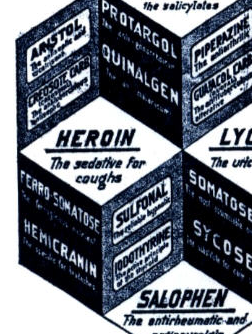
    Ads--heroinLooking at old advertisements for the application of new/improved pharmaceuticals can be an experience in search of an explanation. Certainly we recognize the impact of these drugs today for what they really are, the business-end of their basis unmasked.  But at the time–well, at the time, before revelation, there was hope in the use of them. 

    Opium of course has been used for centuries, but it was synthesized first in 1874 by the English chemist C.R. Alder Wright, though that first application went basically nowhere.  The big push came when it was independently re-synthesized and re-discovered by Fleix Hoffmann who was working at the time for the Aktiengesellschaft Farbenfabriken of Elberfeld, Germany, which is todyay known as Bayer, and which was re-named and marketed under the name, “heroin”. 


    Ads--heroin bayer
    Heroin was sold for nearly two decades as a cough suppressant, a safe replacement for morphine, and also non-addictive.

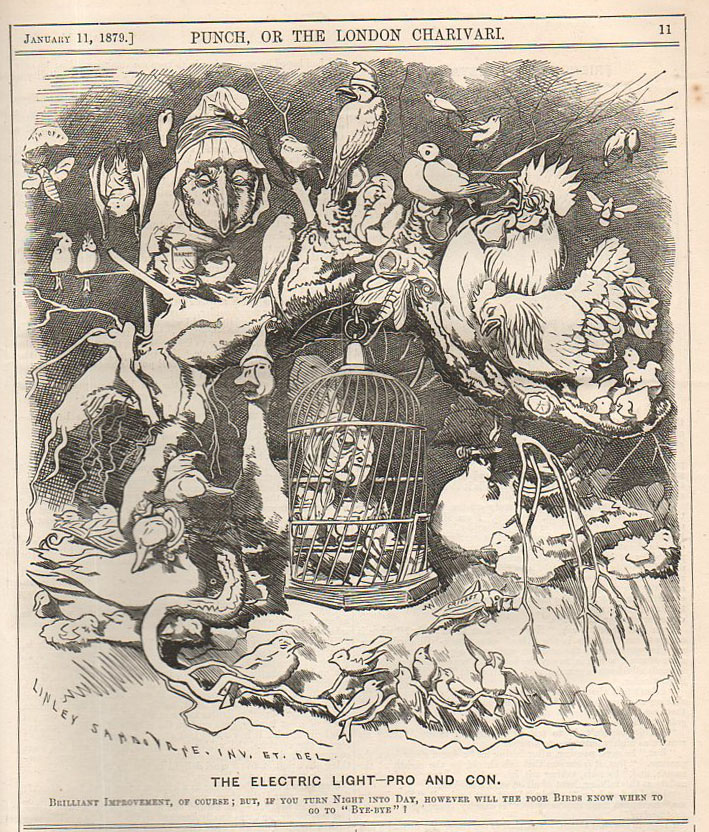
    Narcotics in general however were applied somewhat liberally for complaints of all manner–narcotics not being controlled until 1925, banned by the Single Convention on Narcotics Drugs and the League of Nations (for its signatories, at least).   AS we can see int he detail of this Punch cartoon of 1879, the problems to be brought on by the new applications of electricity (still quite young in its modernistic sense at this time) could be sleeplessness for birds, as the outdoor lights might keep them awake.

    Electricity575

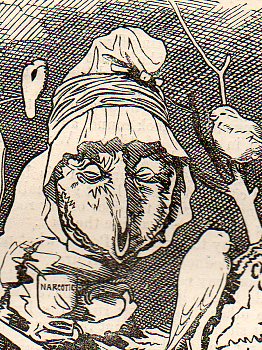
    But in detail, the sleepy old owl might have been dipping a little heavy into one of those bottles with bumps on its sides, its bottle of “narcotics” to help in tracking down sleep:

    Electricity576


  • Get Off the Earth: an Example of Institutionalized Discrimination from 1896 and What it Means Today

    JF Ptak Science Books   Post 1824

    Racism and discrimination are never so more obvious I think than when it is present in everyday bit and pieces of our lives, as gratuitous indulgences, unnecessary except to disparage its target–it is at these times that you can see how deeply something is ingrained in the culture of a place. 

    And an excellent example of this is the transforming/movable puzzle created by the master puzzleteer, Sam Loyd.  He patented the idea of mechanism of the thing in 1896 and published it in the same year, selling millions of varieties of the thing. One of the most successful of the puzzles using the design was called, with a fantastically indelicate title, Get Off the Earth. 

    Working version from the  murderousmaths.co.uk website, here.

    The title would mean less had not the most popular version of the game featured Chinese men who were getting off the Earth, and this of course at a time of indoctrinated, inculcated, adjudicated and legislated, legalized segregation and discrimination.  It was a time of very high Sinophobia, with all manner of advancements against people of Chinese descent:  the Anti-Coolie Laws of 1862, the Pigtail Ordinances (of California) of 1873, the Chinese Exclusion Act of 1882 (renewed in 1892 and 1902), and so on, displayed America’s unease and at times hatred of the Chinese people.  Loyd referred to the men as “warriors”, which I think disingenuous, as the characters hardly have a warrior-like quality to them–they are simply racist.  And they were being made to disappear from the Earth, something many people in this country wanted to happen. 

    According to several web sources, the puzzle was actually used by the William McKinley campaign of 1896 in an effort to out anti-Chinese his opponents2.

    What these objects do for us today is help us think about what “get off the Earth” objects we have in 2012, and how awful they’ll look in the decades to come. The fabric of society has not crumbled under the weight of allowing non-land-holders to vote, or to allow women more equal rights or the right to vote; abandoning slavery did not crush the country, nor did Brown v. Board of Ed, nor did the abandonment of the miscegenation laws.  I can hardly believe that an issue such as Gay marriage will be the great under of the Republic as it has been present in legislation and state constitutional amendments; it will look as bad in a few decades from now as does the Get off the Earth puzzle looks now, or the idea of slavery, or the idea of voting privileges only for the privileged male, or maintaining Jim Crow laws, and so on, on a nd on into the misty night of bad ideas and societal discrimination.

    Notes:

    1.  Nice stories on Sam Loyd and deep on puzzles in general, here.  Sam Loyd’s book of 5,000 puzzles.

    2.  A summary of the McKinley presidential campaign making use of the puzzle to help raise itself in the eyes of the anti-Chinese voters, see here.

    The odd thing is that current sites have referred to the men surrounding the globe (below) as “Chinamen”, or still use the Loyd reference to “Chinese warriors”, and many still hold to the indulgences that this is a simple puzzle and nothing else.  It is hardly that simple.


  • Appeasement, Hitler’s Promise, and Peace in our Time, 1938.

    JF Ptak Science Books    Post 1802

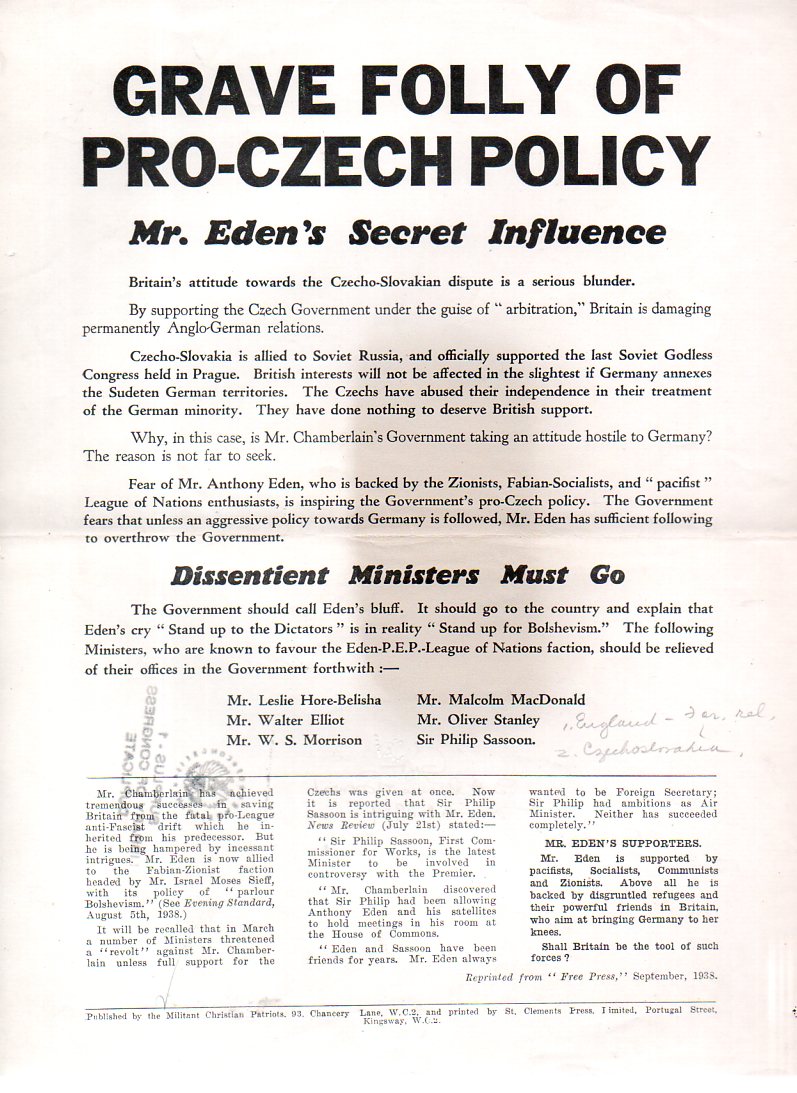
    Here’s a slathering piece of propaganda published by the Militant Christian Patriots (of London) on how the British government was dealing with the Nazi/Seudeten problem in September 1938.  In their gunsights was Anthony Eden, who was seen by this group as a Bolshevist supporter, and who as the Foreign Minister of the United Kingdom under Prime Minister Neville Chamberlain was against the appeasement policy of the government towards Nazi territorial acquisitions, particularly in this case with Czechoslovakia.  Eden. identified here as “backed by the Zionists, Fabian_Scoailists and “pacifist” League of Nations enthusiasts” was a multiple threat, and seen to be capable of directing national policy towards a confrontation with Germany over the looming Czech problem.
    Propaganda anti-czech491[The original is available from our blog bookstore.]
    On the other hand, Neville Chamberlain, who was the Prime Minister of the United Kingdom at this time (and from May 1938-May 1940), was seen as a better ideological fit with his issues and policies of appeasement of the German nationalist needs and territorial rape. Chamberlain certainly gave what Christian Militants wanted–a free hand to Hitler in Czechoslovakia (and more), and perhaps an acknowledgement of defeat to the Nazi nation.  Winston Churchill certainly thought so:

    “We have suffered a total and unmitigated defeat… you will find that in a period of time which may be measured by years, but may be measured by months, Czechoslovakia will be engulfed in the Nazi régime. We are in the presence of a disaster of the first magnitude…we have sustained a defeat without a war, the consequences of which will travel far with us along our road…we have passed an awful milestone in our history, when the whole equilibrium of Europe has been deranged…”  Winston Churchill, MP, 1938

    The Christian Militants saw it all differently, tending to agree with Hitler on the Czech matter, and seeking to keep the U.K. out of confrontation and thus away from war by giving Hitler (and then Mussolini) what they demanded to satisfy their growing national needs. 

    “I am asking neither that Germany be allowed to oppress three and a half million Frenchmen, nor am I asking that three and a half million Englishmen be placed at our mercy. Rather I am simply demanding that the oppression of three and a half million Germans in Czechoslovakia cease and that the inalienable right to self-determination take its place.” -Adolf Hitler’s speech at the NSDAP Congress 1938

    Eden resigned his position earlier in the year, in March 1938, but stayed in the fray.  As everyone knows things went badly at the end of the month of September, 1938, with Chamberlain letting everything go and appeasing Hitler in the Munich Conference (known to the Czechs as the “Munich Dictates” and worse) in which bits of Czechoslovakia were given to Germany in a series of meetings in which that country was not invited.

    A large crowd on an airfield; British Prime Minister Neville Chamberlain presents an assurance from German Chancellor Adolf Hitler.

    And so the P.M. returned to the home country having done nothing in Germany but give away a part of someone else’s country, all in a feeble attempt at maintaining peace for Europe’s key players.  He landed at Heston Aerodrome and held a piece of flimsy paper in his hand, which was battered by a tiny wind, and declared that there would be “peace in our time” because Hitler’s signature said it would be so, all of which was a “prelude to peace” in Europe as a whole:

    “My good friends, this is the second time there has come back from Germany to Downing Street peace with honour. I believe it is peace for our time. We thank you from the bottom of our hearts. Now I recommend you go home, and sleep quietly in your beds.”

    Less than a year later it would all come crashing down, the appeasement policy (such as it was) a shambles, and the world plunged into war.  Chamberlain would last as P.M. for a little longer, until May 1940, when he was at last replaced–by Winston Churchill. 

    ·Posted by :

    ·in:

    — — —

  • Addition to Inner City Rooftop Airport Design: Big, Bad, & Ugly; London, 1931

    JF Ptak Science Books    Post 1799

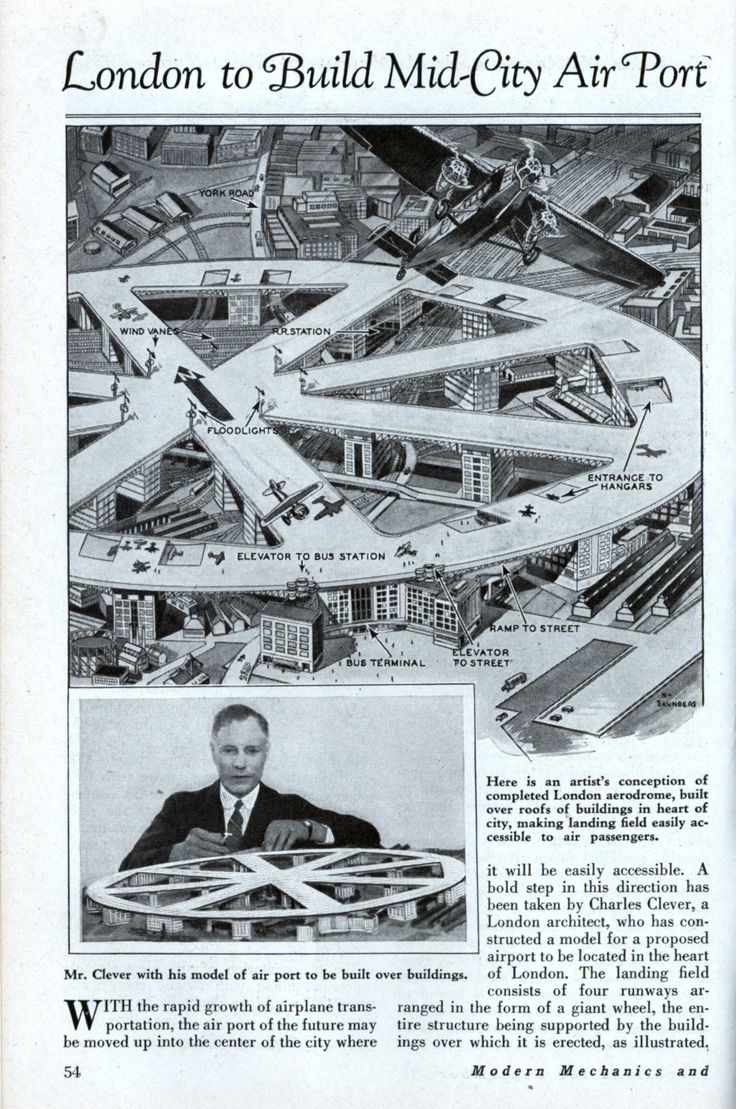
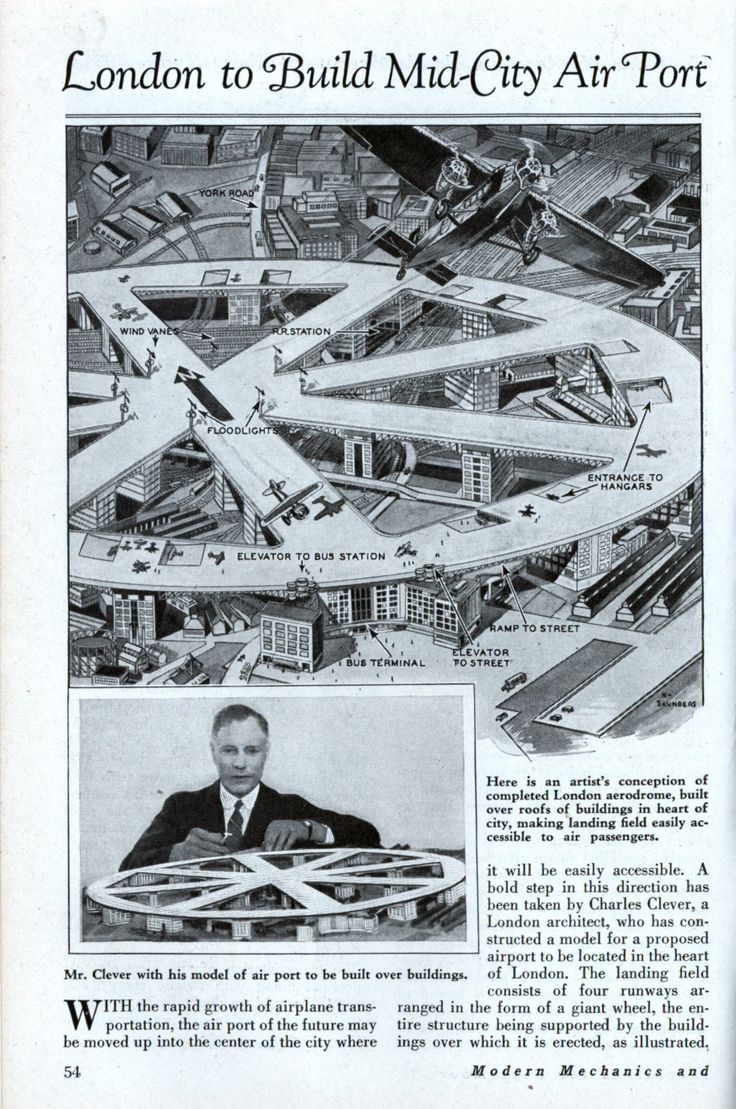
    London airport

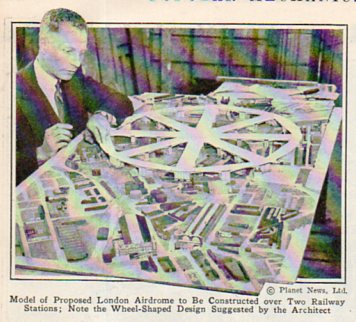
    Airportldn rooftop472[Source: Popular Mechanics, September, 1931.]

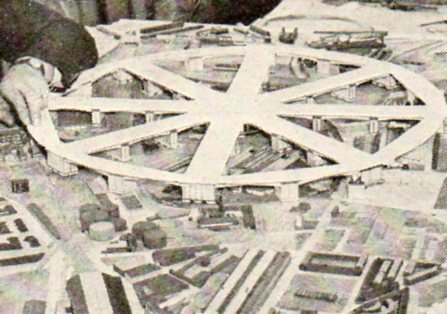
    I am not an architectural historian nor a historian of aviation, but I have looked at a lot of images relating to these fields over the past 30+ years, and so when I find something unusual it makes me pause.  One developing category in this area are rooftop/elevated inner city/downtown airports (I’ve done two earlier posts about this sort of design, including airports designed to be constructed over the Thames and Central Park NYC in Rooftop & Floating Airports -and- Rooftop Airports in a Levitating NYC, 1929  and Elevated, Rooftop Inner City Circular Airports.   I’m not at all certain about what these planners (above) were thinking except that the locations of the airports were central and would save on driving town from the hinterlands to central city–and the “central city” here was London, with the “aerodrome” hosted above King’s Cross and St. Pancras station, and might even have reached Regent’s Park, though I’m not sure.   Evidently there wasn’t much of a concern of the planes missing their runways, or coming in too low, or too fast, or just having an accident–any one of which would wind up in the lap of a busy city rather than in a field somewhere or on a large piece of ground devoid of buildings and a population (where airports are normally situated.  True, there are many airports in this country that are located in urban and suburban sprawls–there was calculated room for error and they were not located right on top of error-proof zones in the middle of a vastly populated areas. So, in the “what were they thinking” department, I clearly do not understand what they were thinking. 

    In addition to being a not-very-good-idea, it was also unwholesomely unpretty. And big.

    Airportldn rooftop473


  • From our Jell-O Department: The Staggering Un-Beauty of Gelatin

    JF Ptak Science Books  Post 1777  [Part of the Bad Ideas series.]

    Jello440“Gelatin is a protein substance derived from collagen, a natural protein present in the tendons, ligaments, and tissues of mammals. It is produced by boiling the connective tissues, bones and skins of animals, usually cows and pigs.”

    Gelatin of course is still around, present in all sorts of things, the Old School equivalent of the coming New School use of cellulose filler in everything–except of course that cellulose isn’t the leftover stuff on the slaughterhouse floor.  Lots of kid foods are made with it–gummy bears are just about all gelatin, all the time, with the exception of the shelf-life lengtheners and coloring.

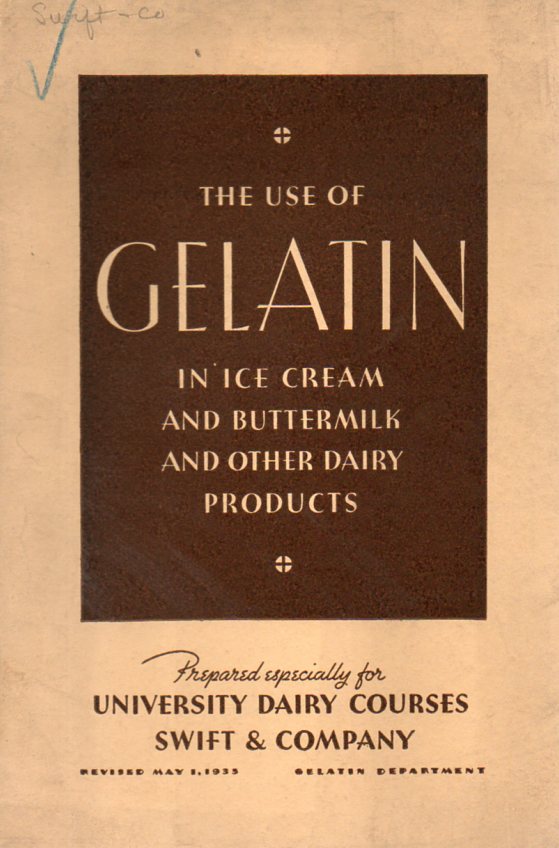
    Jello439The first lively hard-sell pamphlet, The Use of Gelatin in Ice Cream, and Buttermilk and other Dairy Products (1935) was assembled by the “Gelatin Department” of Swift & Company.  Swift (purchased in 2008 by JBS S.A.) used to be the world’s largest processor of cows and pigs and other things with eyeballs and veins and brains, making them into food for human beings.  The company (started in 1855) expanded into other things in the mid-19th century, getting into the insurance and petroleum fields.  It used to own Peter Pan peanut butter, too.  And Playtex, makers of bras and etc.

    I have to give Swift credit though for stating exactly what gelatin is, right there on the first page, in  no-nonsense language. The short (12-page) pamphlet is then given over to a quick sales talk on the uses of gelatin–in chocolate milk, sour cream, cottage cheese, ice cream, sorbet and buttermilk–and how to prepare it.  At first a reader might think that the use of gelatin in the pre-WWII days was not so widespread, until they remembered that this pamphlet was directed at just dairy products.  There was a whole other world of gelatin use besides this one.

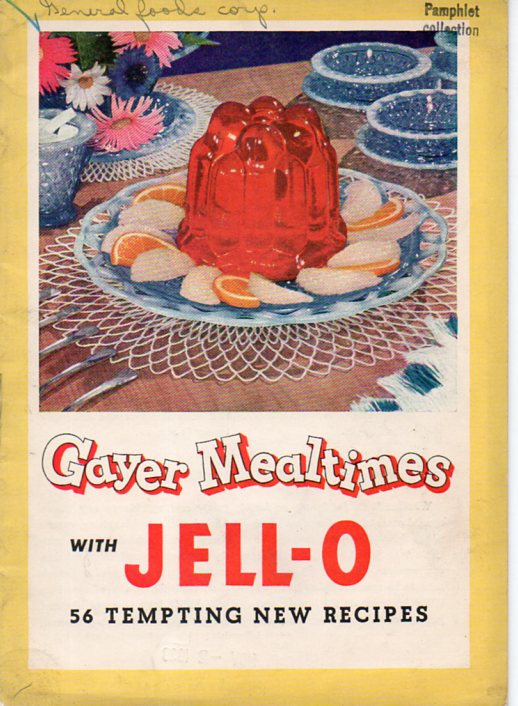
    And that’s been the story of Jell-O, a product of extraordinarily modest and not-pretty means, morphing itself and Jello434the Postum Company over a relatively short period of time (from 1895 to 1925) into the megamonolth:  the General Foods Corporation.  “America’s Most Famous Dessert” got its third (or better) start on life in Le Roy, New York, under the creative hands of Mr. & Mrs. Pearle B. & May Wait (true!), who took sugar, powdered gelatin and artificial fruit flavors to make a concoction May called “Jell-O”.  But her reach was none-too-grand compared to that of Frank Woodward, who bought the company from her and created the demand for this ‘food” and who ultimately created General Foods with it.  (Its an old story:  consumable and saleable product with no consumers:  Marlboro cigarettes started out as a specialized cig for “ladies” and failed; the same cigarette was then re-marketed as a testosterone-laden product and then succeeded beyond all wild expectation, killing millions of its consumers in the process.)  In any event Ms. Wait trumped another New York state resident, Charles Knox,  in the race to develop a pretty and tasty  granulated/[powdered gelatin desert mix.  “Knox’s Gelatine”, originally made with calves’-foot jelly, was a little earlier to the table than Mrs. Wait, but failed to properly develop his product. It also suffered its own “purity” by not having any sugar in it.  

    Jello438
    Plus, there’s the entire aspect of colors-not-normally-found-in-nature inherent in the spectacular nature of gelatin:


  • Bad Ideas of Great Timelessness: Basball Bat, 1890

    JF Ptak Sciene Books   Quick Post

    Some ideas are bad enough to stay that way, possibly forever. Impervious to the future, nothing anywhere ever catches up to them to make them unbad.  The design for this baseball bat fits snuggily into that category. Not only is this a bad idea, it is an ugly one, too.  I have to say that there is an intrinsic beauty to a baseball bat–its angularity, its diameter-to-length ratio, its color (for the most part), its patina, and even the applied non-Brettian pine tar–that just should not be trampled. (I’m sorry, but baseball bats really need to be the original color of the ash wood–not brown, or black.  I’m of course not talking about metal bats which are also in and of themselves a bad idea, “wrong”, somewhat like monster golf drivers,  not to mention that they can be made in a variety of colors, which simply deepens their wrongness.)

    Caveat–none of what I’ve just said applies if any of these bats are being used by children. Any kid with any bat at any time is perfectly fine.  And natural.) 

    I’m happy that no one felt any particular need to need Mr. Kinst’s (patented) bat.

    A nice history of bats can be found here.

    Mr. Kinst as he appeared in 1924.  The image is found in the American Memory Project of the Library of Congress, and the caption to the photo is as follws: “SUMMARY: Head and shoulders portrait of Emile Kinst, inventor of a baseball bat, looking toward the camera, sitting in front of a light-colored backdrop in a room in Chicago, Illinois.”

    ·Posted by :

    ·in:

    —

  • Cigarettes as Toy Soldiers: Playing with Tobacco, 1939

    JF Ptak Science Books   Quick Post

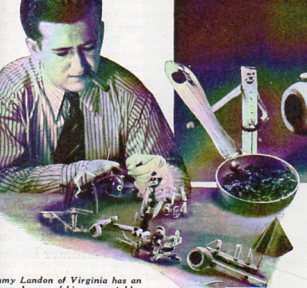
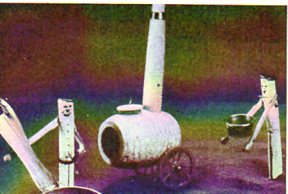
    Sometimes a bit that I post in this blog’s Unintentional Absurdist category need nothing more than an elementary introduction, their images usually being enough of a story–more of a story–than could be told of them.  This current installation, “Pipes and Cigarettes Form a Tabletop Army”, from Popular Mechanics for December, 1939, is a good example of this.

    The story is simple:  for some reason, Mr. Jeff London (of Virginia) and his son Tommy built soldiers and sailors and horses and guns and mess wagons and so on from pipes and cigarettes and matches. They called it “Fags Army”.  I’m not sure what compels this sort of expedition into creativity, but, well, here it is:


    Ciggie soldiers402

    Ciggie soldiers403

    ·Posted by :

    ·in:

    —

  • Disinventing Human Flight–Hiram Maxim’s Steampunk Mistake

    JF Ptak Science Books   Post 1751

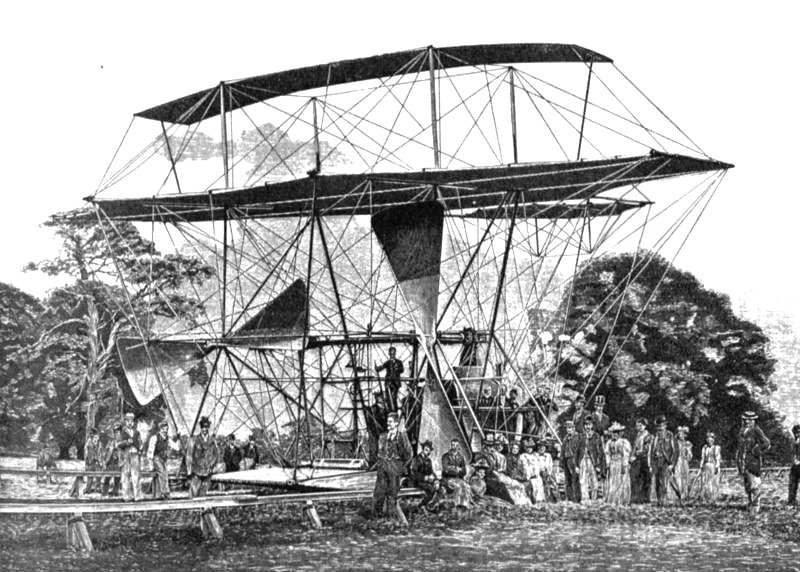
    Hiram Maxim, Sir Hiram Maxim, an ex-pat Yank and a great inventor of things other  than aircraft, certainly did not do his best on his early flying machine.  He built an enormous monument to Steampunk Aerostation, and in that 8,000 pounds of steel wheels and smoke, he completely lost the idea of making a flying machine, concentrating solely on the idea of thrust and lift, consoling himself with the notion of raising a brick from the ground.

    Hiram Maxim sitting with dignatories on support rail by his crashed aircraft, Baldwyns Park, 1894

     I’m not sure that you can disinvent many physical things, although I know that there have been many attempts to do just that , though usually in the fields of human beings doing horrible things to other human beings.  The Soviets I know disinvented untold numbers of people in the plague years of the human stain, Joseph Stalin; so to with Adolf Hitler, who tried to disinvent the Jewish people and the Soviet Union. 

    Hiram Maxim (1840-1916) tried to build a monster that would leave the ground but not actually fly, and he basically did just that, very briefly with very heavy/crashy results. His flying machine was over 100′ wide, had two 17.5′ propellers, room of multiple crew members, weighed four tons, and traveled along guiding railroad tracks on steel wheels. In 1897 it powered  down 1800′ of track before accidently breaking free of its moorings and  rizing briefly above them for a distance of about 100′, which at 40mph would’ve been about 2 seconds of  foot-tall “flight”, causing the crew to shut the engines down and causing the whole thing to crash  And that was that, the end of Maxim’s adventure. It was remembered by him in strange and wonderfully terrible ways in his memoirs, where he claimed that his truly dreadful ideas were those that were used and copied by the pioneers who followed him and who actually created successful flying machines.  That he could remember things in their imagined states with such hopeful clarity is to think of him as providing precisely the wrong blueprints at the right time. 

    http://www.wright-brothers.org/History_Wing/History_of_the_Airplane/Who_Was_First/Who_Was_First_Intro/Who_Was_First_Intro_images/1893_Maxim_Test_Rig.jpg

    In his book, Aviation, an Historical Survey from its Origins to the End of World War II (Science Museum, London, 1970), the insightful, opinionated and occasionally acerbic Charles H. Gibbs-Smith remarked on Maxim’s outlandish maxims on his enormous failure, quoting him so:

    “…the fact that practically no essential departure has been made from my original lines, indicates to my mind that I had reasoned out the best type of a machine even before I commenced a stroke of the work”  (Maxim, Natural and Artificial Flight, 1908)

    Gibbs-Smith writes: “it is hard to imagine anyone uttering more egregious nonsense”, and when you look at the Maxim machine and see its specs and the nil-time spent on what to do with the thing if it ever actually lifted off the ground, you’d be hard-pressed not to agree.  Had people followed his lead, Maxim would have been able to disinvent human flight.  There, I said it.  There’s wrong, and then there’s wrong–and then there is this.


  • Questionable Quidity: on Rowing Flying Boats, 1889

    JF Ptak Science Books  Quick Post

      This remarkable flying machine was patented by N.H. Borgfeldt (of Brooklyn, NYC) on 1 October 1889.  It really seems to be not that much more than the rowing-section part of a Roman galleon, except that it is in the air;  there are five “rowers” int his aircraft, plus someone to operate the rudder. And a flag.

    This certainly is not the most effective way of using human muscle, even in an odd application like this one: