A Daily History of Holes, Dots, Lines, Science, History, Math, Physics, Art, the Unintentional Absurd, Architecture, Maps, Data Visualization, Blank and Missing Things, and so on. |1.6 million words, 7500 images, 4.9 million hits| Press & appearances in The Times, Le Figaro, Mensa, The Economist, The Guardian, Discovery News, Slate, Le Monde, Sci American Blogs, Le Pont, and many other places… 5000+ total posts since 2008.

Category: Bad Ideas

  • Making Human Junk from Children, 1914

    JF Ptak Science Books  Quick Post
    “There is work that profits children, and there is work that brings
    profit only to employers. The object of employing children is not to
    train them, but to get high profits from their work.”
    –Lewis Hine, 1908

    These broadsides are tough going. They are the work of advocates and reformers who sought to give children an even chance at growing up as children, rather than joining the hundreds of thousands of 6-12 year olds already in the workforce in America in the first decade or two of the 20th century. They were a simple and very powerful appeal to business-owners and parents to resist the temptation of child exploitation–none though so far as I can tell directly addressed the children.  See my other posts on this topics here:

    [Source for the following images at Inquiry Unlimited, follow the link for other examples. ]

    Child work making_human_junk

    ·Posted by :

    ·in:

    — —

  • Electricity as an Added Lethal Measure to Barbed Wire: World War I

    JF Ptak Science Books  Quick Post

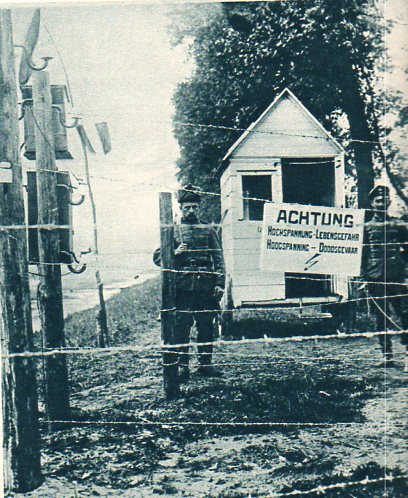
    Barbed wire was one of the most successful and horrifying defensive weapons of World War I.  In 1915 it was made more effective yet by adding high-voltage electricity to the emplacements.  In general the electrical barbed wire fence was employed as only a tiny fraction of all wire fences during the war–as the non-electrified fence was already extremely effective, very cheap to produce and very easily installed–but the possibility of finding an electrified wire somewhere along the lengthy rat’s nests of miles and miles of this thing must’ve had some sort of very major weight in most soldiers’ minds. 

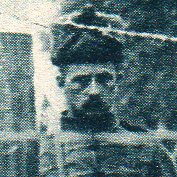
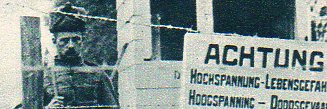
    The following image (and details) from The Illustrated London News for 9 October 1915:

    WWI--e---electric fenc dete extra647

    WWI--e---electric fenc dete646

    WWI--e---electric fence645

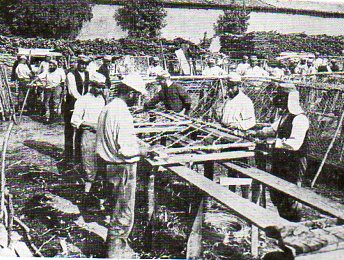
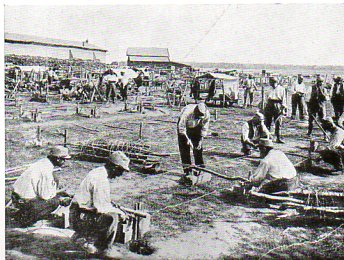
    And the places where the barbed wire was made and packaged, again from The Illustrated London News for 16 October 1915.

    WWI--e--barbed wire making648

    It looks as though the wire was stretched across 3.5 foot poles, with the barbed wire added diagonally, and then rolled up in long sections for easy transport and deployment.

    WWI--e--barbed wire making649


  • Institutionalized Nonthinking: the “Negro Pencil” of 1938

    JF Ptak Science Books   Quick Post

    • See also The Long Fight for the Capitalization of the “n” in “Negro” here  

    “I believe that eight million Americans are entitled to a capital letter.” W.E.B. BuBois
    1002021653
    I was walking home the other day, taking a short cut through the Chamber of Commerce (of Asheville) and stopped to read an historical marker placed in parking lot for a Civil War prison and hospital.  Sprinkled throughout the two hundred word synopsis were varied parenthetic ( ) corrections of the quoted text. But not when it came to the quoted line using the small-n “negro”, there was no parenthetic correction to (N)egro.  No sic. Nothing.

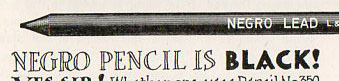
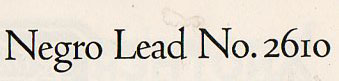
    The “Negro Pencil” was found in the corporate pamphlet, The Pencil, published by the American arm of the Czech company Koh-I-Noor Pencil Company.  It was a lovely thing, really, a lusty bit for the pencil fancier.  And then I came to this.

    Negro pencil811

    The “Negro” Pencil is not a matter of non-translation into “hard black” or whatever–there are no other instances of the transliteration not taking place.  “Negro Pencil” is a product of its time. 

    Negro pencil812

    The history of the power of words is long and complex, and for the most
    part is on one side or the other of the political and social mirror, at
    least in the United States. Controlling the meaning of a word or phrase
    controls the idea which alters the way people approach it, defining the
    very heart of what may control the impulse for war or peace, which
    means that people may die as much for words as they will for ideas.

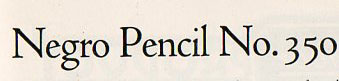
    “Negro” may be capitalized here, but perhaps it is because it started a sentence.

    It may have been capitalized, but using the name of a race to sell the color of a pencil might as well have taken the capitalization away, demeaning a race to sell a pencil, all without a second thought.  It was a product of the time that such a discrimination could be so engrained as to not even think that the use of the word was demeaning. 

    Washington Redskins.

    Negro pencil813


    ·Posted by :

    ·in:

    —

  • Trademarks, Memory, Nazis, and Death Camps

    JF Ptak  Science Books  Post 1891

    In the world of identifying symbols–which I’ve been writing about a little over the past few days, but mainly on Renaissance and Baroque and Mannerist iconography–few are as distinctive and recognizable as modern trademarks.  There’s a lot of high-voltage connecting wires between modern advertising and memory devices and Renaissance emblemata, and as I was sorting out some of the nice compatables I was stopped in my tracks by one of the modern images, mainly because I had a recollection for an older and unmentioned iteration of the symbol.

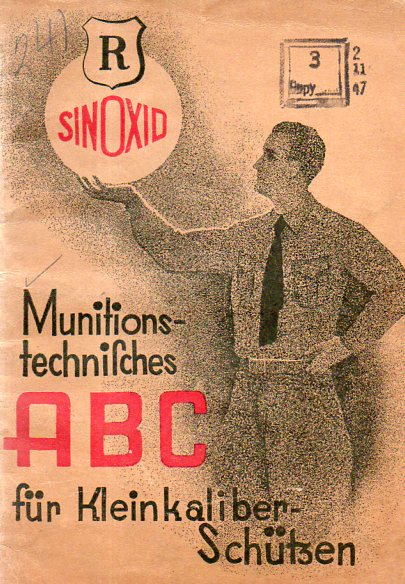
    Sinoxid.  It was recorded in the registry of German trademarks for 16 November 1968 as being owned by Dynamit Nobel AG. 

    This is what the trademark looked like in 1968:

    http://img03.mar.cx/_images/CA317024

    The same trademark, a little earlier in its career, as it was being admired by a Nazi Brown Shirt S.A. member in 1933:

    Trademark758Dynamit Nobel A.G. is an old company. It is the German arm of the Swedish Nobel munitions firm (begun in 1864) by Emil and much-more famous (and longer-lived) brother Alfred.The German company was established in 1865 in Toursiburg so that the dangerous products produced by the firm wouldn’t have to travel as many miles if it was produced closer to the consumer.  The Nobel firm manufactured munitions–famously so with a nitrogylcerin compound known as “blasting oil” that was notoriously unstable, and which in a fit of instability  actually killed Alfred’s brother Emil in 1864. It also blew up parts of the German factory (on two occasions before 1870).  The stuff was beyond lethal.  But it didn’t stop Nobel from shipping their explosive goods worldwide in unmarked crates so as to not attract attention to a dangerous product. Three such cases were once sent to the Union Pacific company in San Francisco in 1866–two became unstable and blew up in the company’s headquarters, killing dozens. But no one was scared beforehand.

    Alfred Nobel left no heirs and so donated some percentage of his firm’s monies to the foundation we know today by his name. The company grew into the largest munitions producer in Europe. Beginning in the mid-1920’s it began a relationship of fusions and mergers and so on with the giant cartel I.G. Farben, among many others.

    I.G. Faben company produced Zyklon B. It operated its business with slave labor in concnetration camps. It sent tens of tens of thousands to their deaths working on Farben products. Zyklon B itself killed millions of human beings.
    This is what used canisters of Zklon B looked like after they had been used to murder Jews and other prisoners in the death camps:


    They have a design much like the tossed-away bodies of their victims.

    ·Posted by :

    ·in:

    —

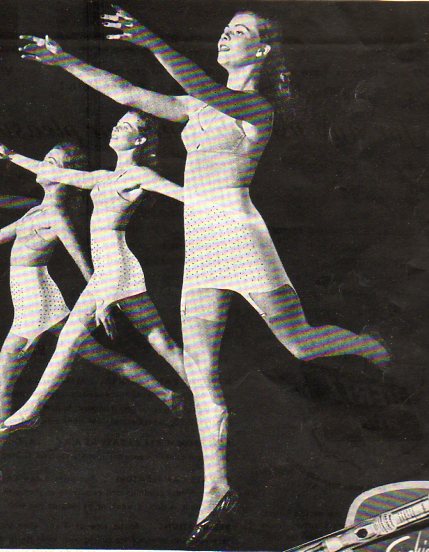
  • Girdle vs. Goedel: the Pink Ice Girdle Ballet of 1951 vs. Logic. Part I of the History of Holding Things In

    JF Ptak Science Books  

    Girdle--a det428[My thanks to Patti Digh for providing the idea for the Goedel part of this adventure into Playtex and Logic–she did so because (a) they fit together and (b) girdle/Goedel sounded almost identical to a woman who once lived in Munich!]   

    In the long history of Holding Things In, perhaps the newest of its
    members was upon us only recently. In the long, deep past we have held
    our breath, hidden our anger, stowed our emotions, and so on, but it was
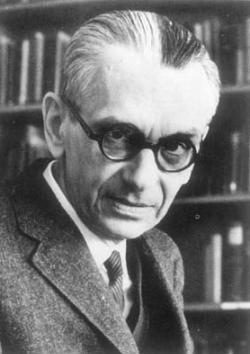
    only recently that we began to hold our bellies in.  One of the masters of Holding Things In for this period turns out to be the sublime logician and re-inventor of modern mathematics (by putting one piece of the great Hilbert to sleep), Kurt Goedel, who towards the mistakenly-self-engineered end of his life, Goedelheld on to everything, virtually–he organized and filed almost very piece of paper that he came into contact with at any level, became ever more reclusive, and at the end (due to his theories of people/institutions wanting to kill him) refused food and, of all things, water.  Surrounded by the smartest people on the planet (including his friends Einstein and von Neumann) up there at the Institute for Advanced Study at Princeton, Goedel withered away until he had almost no shadow. It is a bad irony that he could be so inconceivably unmovable and restrained while at the same time, and in the same life, offered such incredible newness to the maths–both ends of the mountain at the same time.
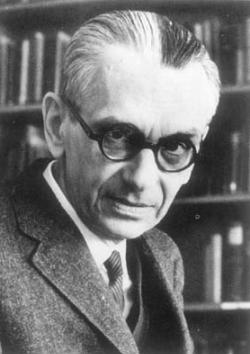
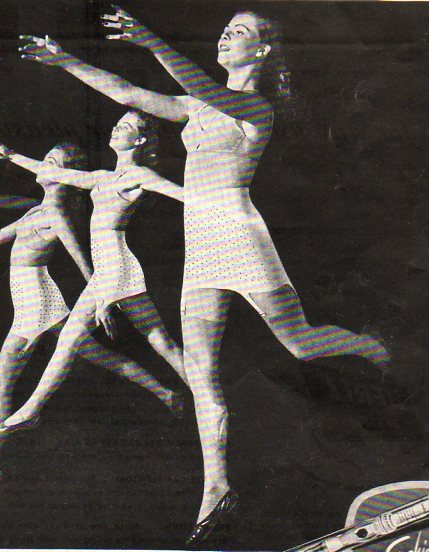
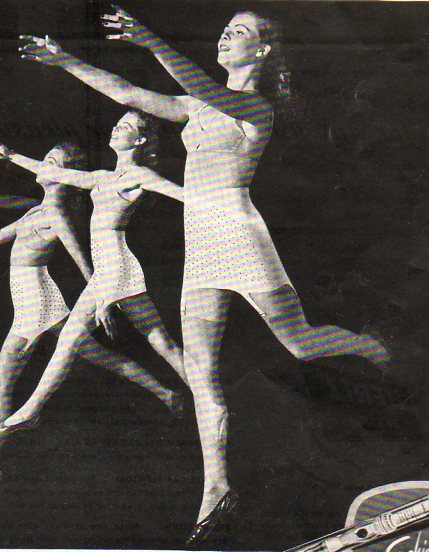
    1951, the year in which these girdle advertisements appeared in Life magazine, was also the year that Goedel present us with the Goedel  metric, and also in which he received (with Julian Schwinger) the first Albert Einstein award (and of course delivered his famous Gibbs lecture  “Some basic theorems on the foundations of mathematics and their implications”).

    The popular introduction of the girdle I think that
    this happened at about the same time for the sexes, only these
    conveniences were much more often advertised for women than they were
    for men.  Slender and non-existent waistlines for women were more of a cultural identifier
    than a slim-hipped man, and the ads for his cheaters appeared far less
    frequently than those for women.

    The first widespread appearance of the girdle for the sake of vanity must have occurred during the 19th century, or perhaps a little later is my best guess–but the first time the device began to appear for the common woman must’ve come around the time when there was time for leisure, or shopping, or of being seen in public in short intervals.  And that I believe is a Victorian-age invention.

    But the binder doesn’t come into fabulous presence until the distribution of mass population illustrated magazines, or I should say the advertisements that made these magazines possible:  production like LIFE (from which these 1951 images come) reached far more women than the popular older periodicals like Harper’s Weekly or other polite mid-19th century journals for women.  The advertisements were certainly more enticing, the possibilities more rewarding, and the girdle comfort levels far higher than their predecessors, and the availability of disposable income for women far greater–and so incidentals like the girdle became more greatly commodified, and moved into the “essentials” category. 

    The idea of these ads seem horribly revolutionary: on the one hand, the badly-named and hyphenated  Playtex product “Pink-Ice” squeezed women into new tight but  malleable molds, while at the same time promised some sort of ballet-like freedom because of it. Like the creeping (“two steps forward and one step back”) communism of the time, Playtex promised the possibilities of enhanced freedom through restrictive clothing (in a “peace through strength” vision).  In any event, and in spite all of what I just wrote, the pictures are kind of amazing.  

    [I’m well aware that this may be one of the worst things ever written about Kurt Goedel–the Renault Dauphine of Goedeliana.  But it doesn’t matter, because in all of his powers, Goedel could absolutely prove that g_d existed, and that  I don’t.]

  • Thomas Jefferson’s Arithmetic of Black People, 1783

    JF Ptak Science Books   Post 1869

    I was picking my way through Mr. Jefferson’s Notes on the State of Virginia (written in 1783/4), and dipped into Query 14, “Laws”.  Six pages in came the Great Man’s thoughts on being white and being black. He really didn’t have much hope for the black person in the new United States, and in an odd way, I think, did a sort of arithmetic calibration on the black race, giving a few points here and there “for”, and piling up the count “against”, making an overall large negative number for the possibility of the black and white races living together.  [The full text of the work us available, here.]

    In very many cases in his later writing Jefferson re-evaluates this thinking, as seen in this example, writing to Benjamin Banneker in 1791 (‘”No body wishes more than I do to see such proofs as you exhibit, that nature has given to our black brethren, talents equal to those of the other colors of men, and that the appearance of a want of them is owing merely to the degraded condition of their existence”), and in many others (as in the very full example1 of this 1809  letter to Henri Gregoire, shown below).

    Jefferson had already written somewhat earlier in the book about blacks on page 197, where he discusses albinism in black people as part of a natural history chapter dealing with animals:

    To this catalogue of our indigenous animals, I will add a short account of an anomaly of nature, taking place sometimes in the race of negroes brought from Africa, who, though black themselves, have in rare instances, white children, called Albinos…

    This is not promising. This is also the first appearance in the book of the word “negro”. [I wrote a short bit on the history of the fight for the capitalization of the letter “N” in “Negro” here; this was a fight that dragged itself into the first third of the 20th century.]

    I am no Jefferson scholar, not by any means.  Only familiar with the “basics” of Jefferson, and his design and architecture and technical aspects, and somewhat familiar with his writing on the basic morality of slave-holding, I was surprised to find what he had written about constitution of black people here in the Notes. 

    Perhaps I shouldn’t’ve been so, but I was.  Perhaps I wasn’t as familiar with Jefferson during the time of the Revolution as I thought, seeing him as not only a man who changed the product of his time but who was also a product of them, writing in his present on the state of blacks in America that seems to have been seen as a great error in the mind of the Thomas Jefferson who would read these thoughts in the future, and refute (and perhaps repudiate) them.


  • Bad Idea Department: F Lloyd Wright and the Goodness of the Bombing of Britain

    JF Ptak Science Books  Post 1866  

    [I’ve written earlier on a related and very bad idea, Atomurbia, for atom-bomb-proofing American cities, here.]

    Reading Nicholson Baker’s Human Smoke I found a set of very unflattering and semi-unbelievable quotes from the unpretty Frank Lloyd Wright.  Present at a MoMA exhibition he was sharing with D.W. Griffith (detailed in the publication Two Great Americans published by the museum in 1940), Wright chose the background of the Battle of Britain, in which German bombs were falling on English cities killing thousands, to promote his city design idea of Broadacre (among other things).

    In development since 1932 (appearing in his book The Disappearing City) and kept on until his death in 1959, Wright’s idea for city /suburban development spread a “city” ti its limits, nearly stripping it of its citiness and expanding it towards the horizon in a wide and low wave of a complete suburbia.  With this, Wright must have reasoned, Broadacre City must have seemed “bomb-proof” compared to the normal concept of the city, and decided to make the best of a horrible situation to promote his idea.

    And with this, he was quoted in November 1940 in the New York Times, saying:

    “I would not say that the bombing of Europe is not a blessing, because at least it will give the architects there a chance to start all over again”

    To say that this was an idea best left to the imagination rather than in the pages of the Paper of Record goes without saying.

    And what of the architects whose buildings were lost during the Blitz?  Say, like Christopher Wren?

    “I don’t think that anyone will miss Wren’s work very much” (This, and the quote above, found in Baker, page 248.)

    I’ve had a problem with Wright for a long time, but had never bumped into this part of his thinking before.

    [Wright’s wrongs on the Bombing of Britain are also recorded in Peter Shedd Reed (ed), The Show to End All Shows: Frank Lloyd Wright and The Museum of Modern Art, 1940 (MoMA 2004, here), and here, in the Milwaukee Journal for 22 June 1941, and also in the News Chronicle of London in”How I would Rebuild London”]


  • Booze-Vision Atomic Farming and Other Nuclear Dreams

    JF Ptak Science Books  (Expanding an Earlier Post)

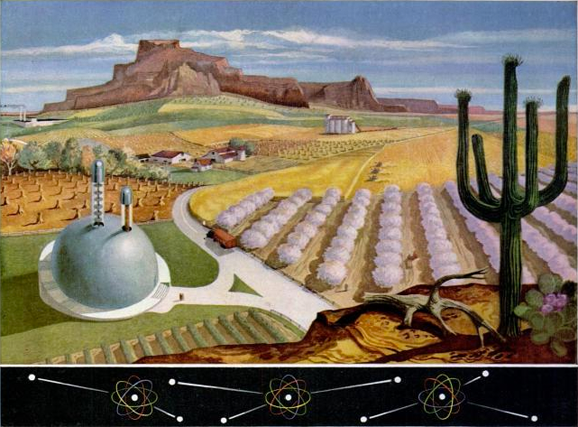
    Seagrams V.O. Canadian Whiskey powered the future through a series of a dozen or so ads for itself in the 1945-1947 period, taking a usually-strangled though occasionally interesting peep into what the future might bring.  (And of course the future is brought by men who drink Seagrams.)  In this ad, appearing in the 12 May 1947 issue of LIFE Magazine, we are told “deserts will bloom through atomic power”–how this might happen is left to the imagination. Also left to fantasy is what exactly is being farmed there in front of the incongruous “atomic energy plant”. Plastic smoke?  Taking a fractured approach to the possibilities one might say that atomic bomb mushroom clouds are being grown from seedlings here from the ground up, nurtured until the day they too will be as big as the blasts of August 1945.

    Atomic garden

    Oddly enough, the illustrator–who after all was just trying to sell alcohol–came pretty close to the truth, except that they got the power source wrong.  Rather than nuclear energy, it would be petrochemical industries that would lie there at the heart of America’s farm production (via seeds and fertilizers and so on)–I’m sure that it would’ve made more sense in a weak way back there in 1947 to believe the atomic story rather than the possibility that it would be petroleum that would drive the entire production of food forward. 

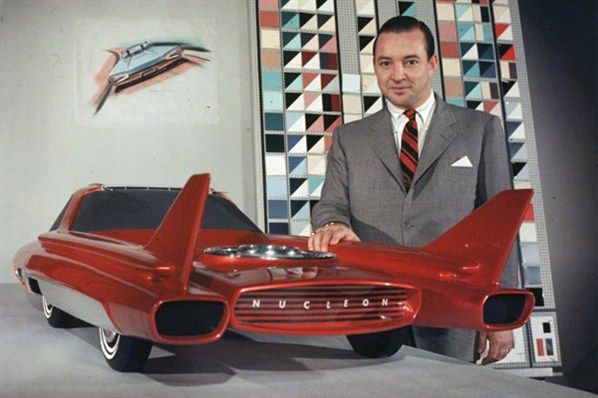
    There were many proposed uses for atomic energy over the next few decades, most not very good–the Ford Nucleon, a screamer with a 5,000-mile cruising range powered by a steam engine driven by a small uranium fission muscle box in the car’s rear, was one of those ideas.  The nuclear-powered submarine, which sounded like the Nucleon in 1946, was a solid workable idea, a science fiction come true in 1954 with the launch of the USS Nautilus (SSN-571).

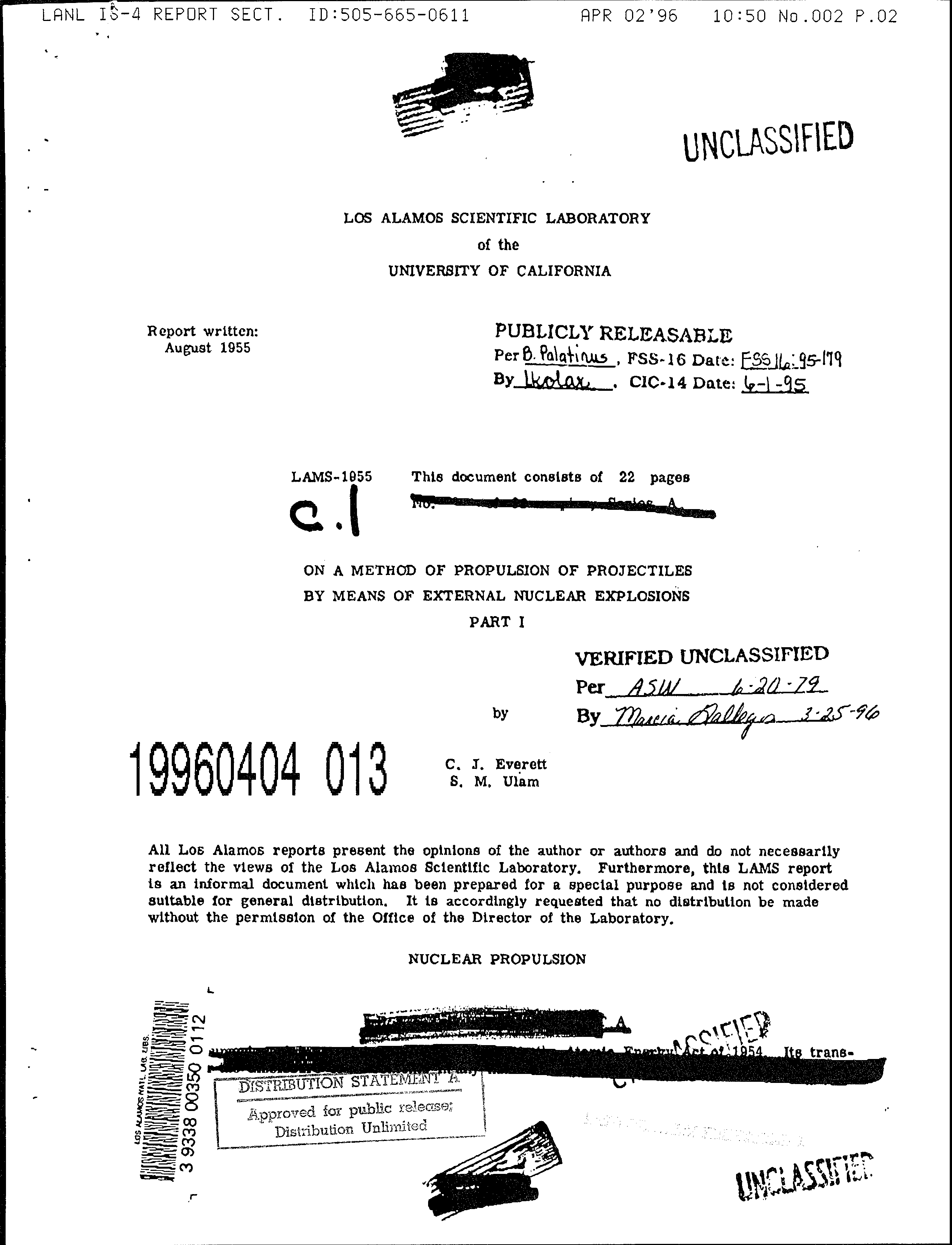
    Ford nucleonNuclear medicine–although not powering an atomic heart–was a very important development that seemed not conceivable in the decade preceding its development.  Atomic-powered helicopters, trains and planes are other examples of the not-good-idea variety.  The nuclear powered space vehicle, which was first proposed in 1946 by Stan Ulam (and then in a report written by him and C.J. Everet  On a Method of Propulsion of Projectiles by Means of External Nuclear Explosions. Part I. University of California, Los Alamos Scientific Laboratory, August 1955, pictured and linked below), has morphed into something monumental in Project Orion, and to me sounds like a fabulous idea:

    [Source here.]

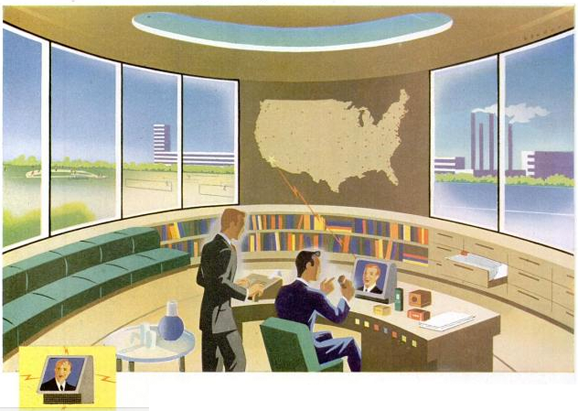
    IBut getting back to the liquor ads, here’s an weirdly prescien and naive image–“weird” anyway for a quick effort made by an artist trying to sell drunk juice–is this proto-internet office view, made in May 1945. There’s lots of passive solar going on here(though not really very effective when you consider the other ways of directing and filtering exterior light inside) in the office of tomorrow, but more important is the desk and the file cabinets.  The seated man is talking to someone across the country  via phone/wireless, with data en masse at his fingertips, a “computer” (in the old sense of the word, that being a person–and usually a women–given the charge of adding long columns of number or whatever and then doing the arithmetic, like a comptometer) working some sort of calculating interest on the largish calculating instrument. In general we see a decision-maker awash in responsibility connecting all of the parts of his world: a primitive, secular, analog internet.  And this too just at about the same time that Vannevar Bush introduced his own vision of the informational future with his superb Memex (which I wrote about earlier on this blog here.)

    Internet 1945


  • Frederick Soddy’s Economics and the Protocols of the Elders of Zion (1939)

    JF Ptak Science Books       Quick Post on Anti-Semitism & Propaganda

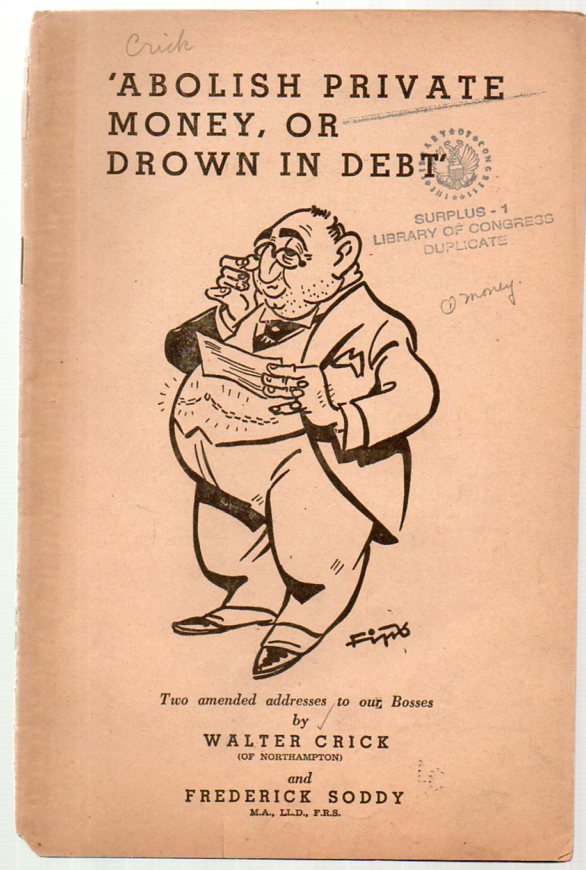
    Soddy700Frederick Soddy, Nobel Prize in chemistry (1921) and one of the fathers of nuclear fission, was also an economist.  Well, an anti-economist of high order, an anti-economist preaching anti-economics on the order of the altruistic anti-economy, ideal anti-economist, material- and Left- and Nationalist-economics, and so on.  He is the author, along with Walter Crick (who happens to be the uncle of Francis Crick of DNA fame), of a clumsily-titled pamplet-y takeoff of his major works on anti-economics, Abolish Private Money, or Drown in Debt (1939)  It was published by the Nationalist Press Association (147 E 116th Street, NYC), an arm of the American Nationalist Party, and which also published such works as Are all Jews Liars? (1940), The Jew and Peril and the Catholic Church (1936, also published by the American White Guard), Why are Jews Persecuted for their Religion (1940), and other titles.

    Soddy also quotes from The Protocols of the Elders of Zion, and did so five years after The Times ran a blistering and complete denunciation of the rabid anti-Semitic creation that seems resistant to contradictory evidence to its belief. And still he seems to have kept his belief in the document, like any other object demanding of belief and not-critical thinking, kept it alive like millions of others. 

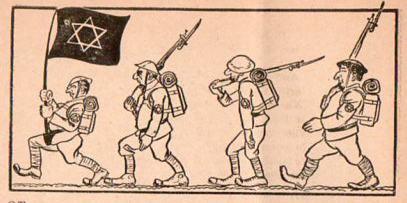
    I did not know this about Soddy, and I am sorry for it.  The cover illustration is disgraceful, though there is no place in the text that I have seen that is actually and outwardly anti-Semitic. The illustrations, however, are.

    Soddy701I really have no idea about what Soddy is talking about in his “scientific” and anti-economic theory that money and banks are the ruin of the way a country (and the world) conducts business.  Its structure brings immediately to mind–probably wrongly–the brilliant/odd/goofy contribution of T.E. Lawrence to the Encyclopedia Britannica on guerrilla warfare and his attempt to make a “science” of it.  But the overall flavor of the Soddy/Crick thing is not very good (and that leaving out the anti-Semitic part, which is something else, entirely)>.

    ·Posted by :

    ·in:

    —

  • Cliff’s Notes for Nazi School, 1937

    JF Ptak Science Books    Post 1849

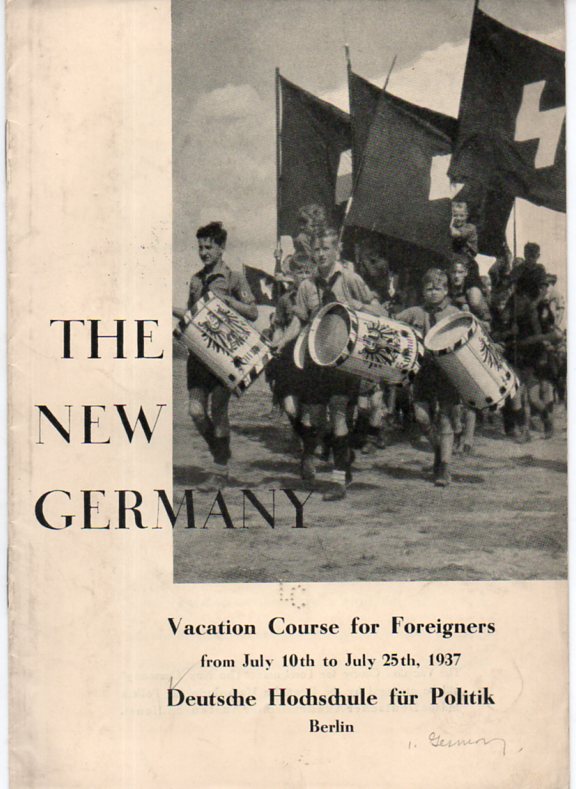
    Oh happy day for this handy Cliff’s Notes pamphlet for the visiting visitor, for the foreign foreign, to the “new” Germany of 1937.  It is difficult to imagine but not horribly so the subtitle here, “Vacation Course for Foreigners”–it was, after all, so far as the rest of Europe and England and the rest of the world was concerned, still only a conceit that the Germans were harboring for themselves, the sabre-rattling Lebenstraum was still in the theoretical stage, though the loathing and discrimination of the Jews and other sorts of humans was not. 

    Nazi school621

    The pamphlet promises to “give our foreign guests an opportunity o f seeing young National-Socialist Germany as it really is” and to “show them that the German people do not want anything but to attend to their work in discipline and peace”. Which was not the case.

    I was interested to see the “programme” of instruction, and to check out the near-futures of the people who were the lecturers for each section.  Before I began, I wondered how much their fates would be changed eight years hence and if they would resemble the fates of other high ranking Nazis. (I looked at the lives of Nazi medical personnel and experimenters in an earlier post here called  “Kristallnacht: The Long post-WWII Lives and Forgotten Pasts of Criminal Nazis: Doctors”, here.)

    Mostly, they went on to live long lives.

    In the program, Dr. Reinhard Hoehn delivered a talk on “National-Socialist Law”. Hoehn was a Nazi academic lawyer with a criminally morose view of jurisprudence; he went rather high-ranking and was successful in laying the “legal” groundwork for Nazi ambitions, including being a representative at the Wannsee Conference.  Born in 1904, Hoehn went on to live until 2000.