A Daily History of Holes, Dots, Lines, Science, History, Math, Physics, Art, the Unintentional Absurd, Architecture, Maps, Data Visualization, Blank and Missing Things, and so on. |1.6 million words, 7500 images, 4.9 million hits| Press & appearances in The Times, Le Figaro, Mensa, The Economist, The Guardian, Discovery News, Slate, Le Monde, Sci American Blogs, Le Pont, and many other places… 5000+ total posts since 2008.

Category: Bad Ideas

  • Note on an Illustrated Gazetteer of Nuclear Mega-Death

    JF Ptak Science Books   Post 2073   Series on Atomic and Nuclear Weapons
    Follow Me on Pinterest

    [Thanks to Eric Edelman of Retrocollage who put me on the trail of a bomb shelter for 5 million Manhattanites in the Kenneth D. Rose book, One Nation Underground, (NYU Press, 2001)  in which the following thread was found. Incidentally, here’s the RAND report on the Manhattan mega-shelter, to have been located 800′ in bedrock–to date the deepest part of the NYC subway system is 191 St station, at 180’…]

    I think that there may be some room to put together a gazetteer of depictions of American cities in imaginary destruction and nuclear desolation–as seen in newspapers.  And perhaps just the front pages of newspapers.  There is a lot of material for this in general, though the restriction of front page coverage might be a little difficult–if the imagery was left open to views of decimated cities that appeared in large circulation newspapers and magazines, there might be enough stuff for a gazetteer and alphabet. 

    Part of the great source for these images is FearSell, which seems to have been made into a $100 billion advertising industry, plus the stuff that it advertises. No longer is it just a “weather report” on the television, it is “Storm Center 4 with Super Doppler”; streaming radio isn’t just for listening to local reports from different cities but a way to ‘protect your family” int he event that the radio station you listen to is destroyed somehow.  Fear as a packaging implement has worked its way into nearly everything, though I must say that I haven’t seen any anti-fear protein FDR supplements for food enhancement (though there are plenty of ads for ‘victory seeds” and pre-packaged long-term bomb shelter food and so on). Yet.
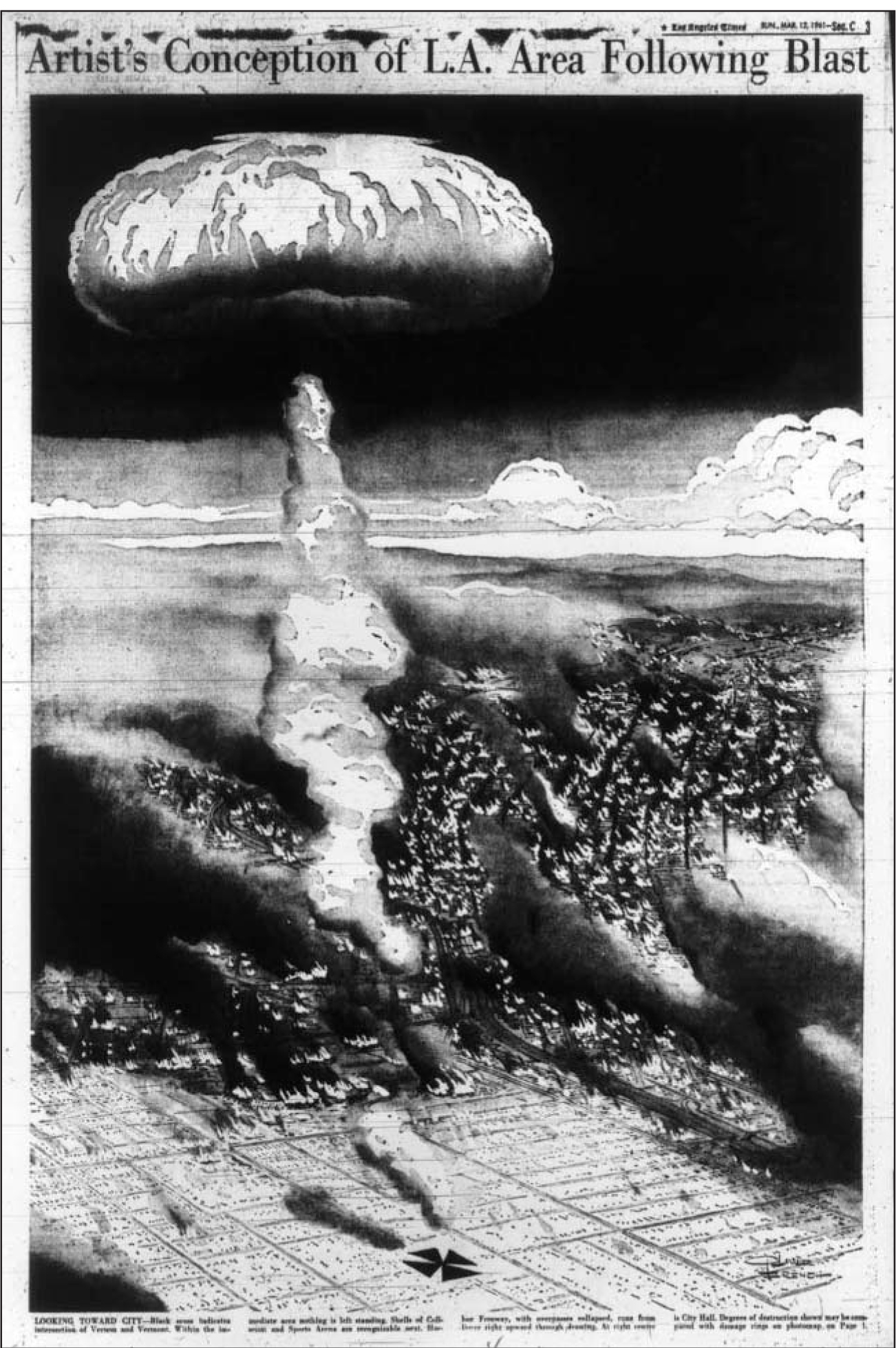
    LA Bomb 1-71[Source:  Rose, One Nation Underground]

    This was of course the time of the Great Fear, of nuclear Armageddon, of  “going toe-to-toe with the Russkies” (General Buck Turgidson), the highest height of the Cold War, when personal underground bomb sheCDlters (or at least plans for them) were becoming common and the escalation towards at least an accidental foul-up that could end the world was becoming a more distinct possibility.  Duck-and-cover exercises in school on a weekly basis were weird and scary, especially the part where your wooden desk was going to save you from the eye-of-god fireball that was going to envelope your city.  Those odd and rusting signs that have been scraped from buildings now for a few decades in the 1950’s and 1960’s were daily fear reminders of the threat from above. 

    There were also the not-subtle fear/training campaigns of the federal government, such as with Operation Alert, which “simulated attacks on major cities in the U.S. to see how city defenses and people might react to actually having to do something in the face of a nuclear exchange. The exercises were mostly futile and even obsolete, but they did manage to create a huge amount of fear. (Robert Moses, the great NYC-planner, noted that if even one subway car was derailed or had a problem that there would be massive consequences and failure, and that plans to evacuate any large city–even if there was a place to evacuate people to–was “like so much moonshine”.  (See the Rose book, page 27.) )

    And the threat came to everyone–not just military targets:
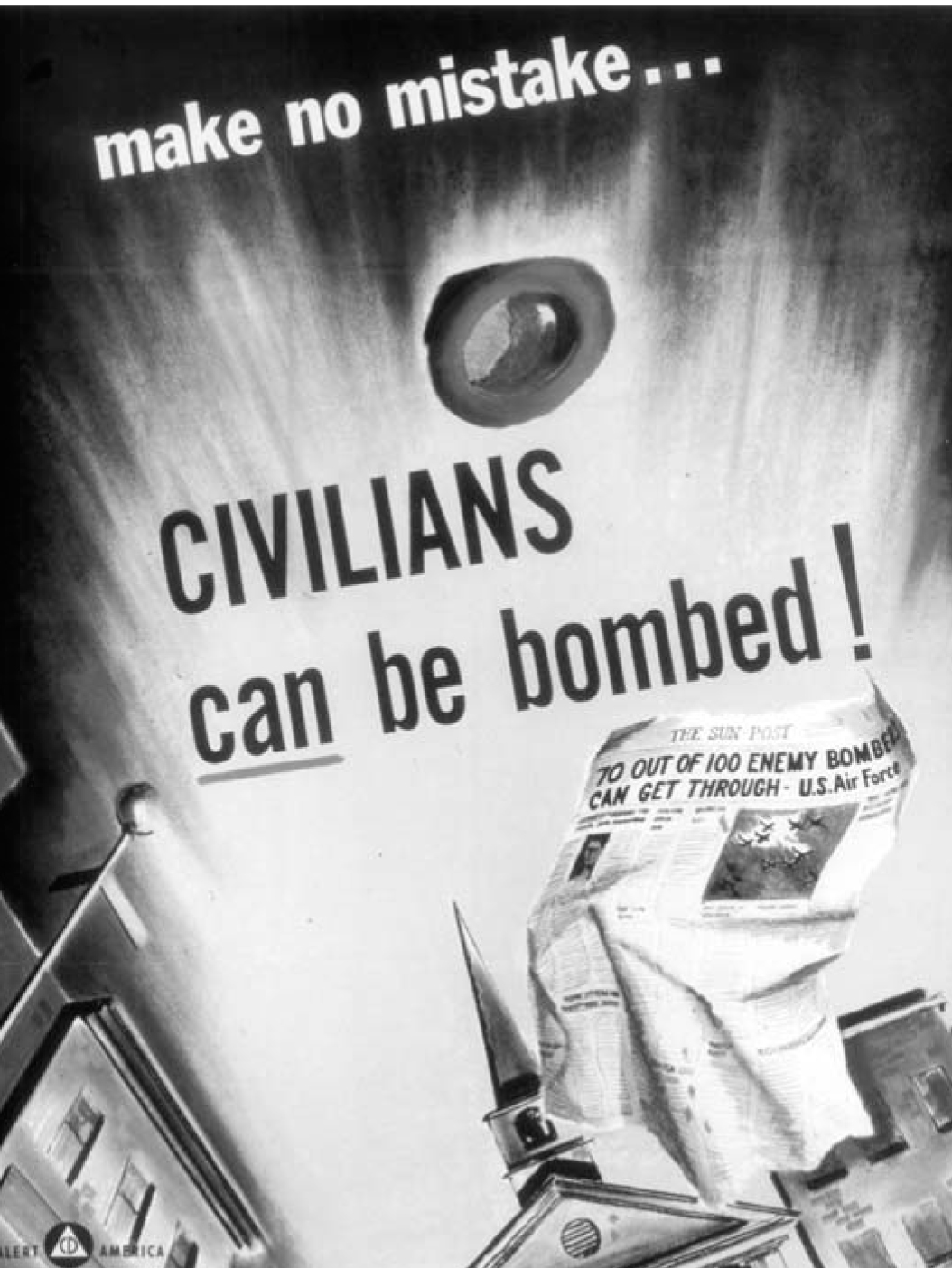
    LA Bomb 1-18But this practice of bombing populations-in-general was basically in place–at least from the air–almost since the beginning of modern flight, from about 1911 or so.  There were plenty of conferences and protocols restricting the use of bombs dropped from planes on civilians, but then there was the debate about what was it exactly that defined the “civilian” population, and the arguments peeled themselves away in the face of common practice.  Anyway, during the Cold War the bombs were so very gigantic that there was little home of rescuing the idea of what a “civilian population” meant, especially in the face of perhaps destroying most of the planet. 

    This first story (“Red Alert. What if an H-Bomb Hit L.A?”) appeared in the Los Angeles Times 12 March 1961, and made no doubt for some very sobering contemporary wake-up-and-die reading.  If you were living anywhere in the country at the time and had never seen a representation of your city in ruins, and you encountered such a story and images before coffee, you might remember that missing cup for the rest of your life.  The dramatization and mapping was done by Harlan Kilby, and it portrayed the destruction of the city and millions of people in the event of detonation of a 10 megaton nuclear weapon–it gave the reader a vague notion of what city-eating looked like, the bomb ‘flattening” everything in a 3-mile radius of its central zone and killing everything in 28 square miles. (A little earlier, in 1960, there appeared a work by Harrison Brown and James Real called Community of Fear, which was a sci-fi kill-’em-up that used a kill zone with a 25-mile radius.)
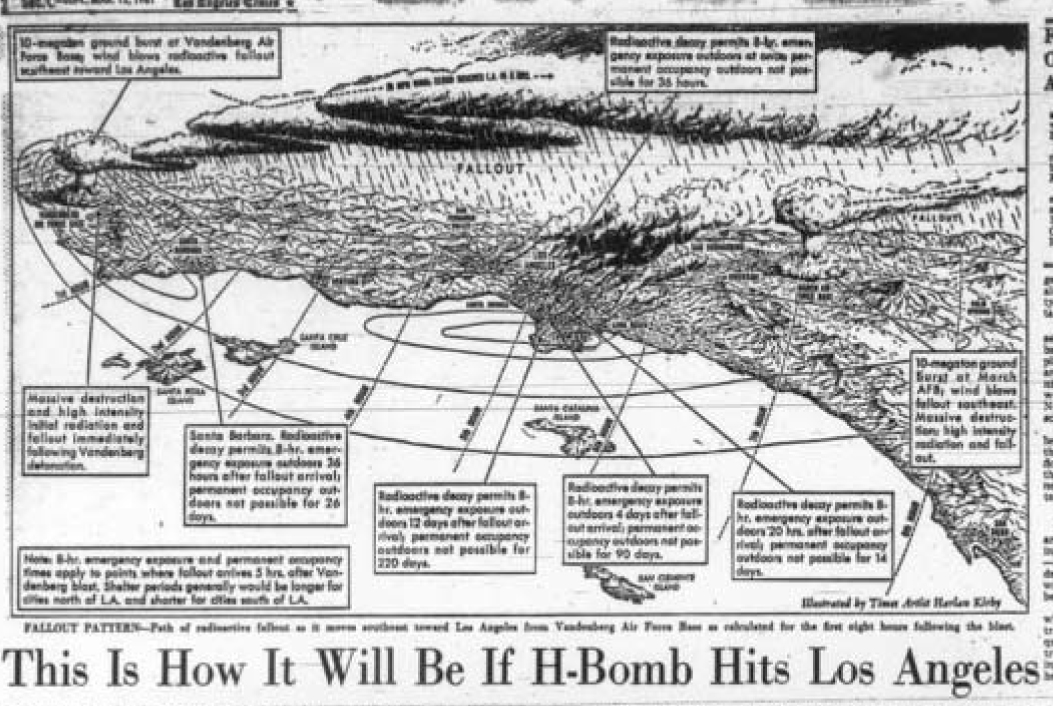
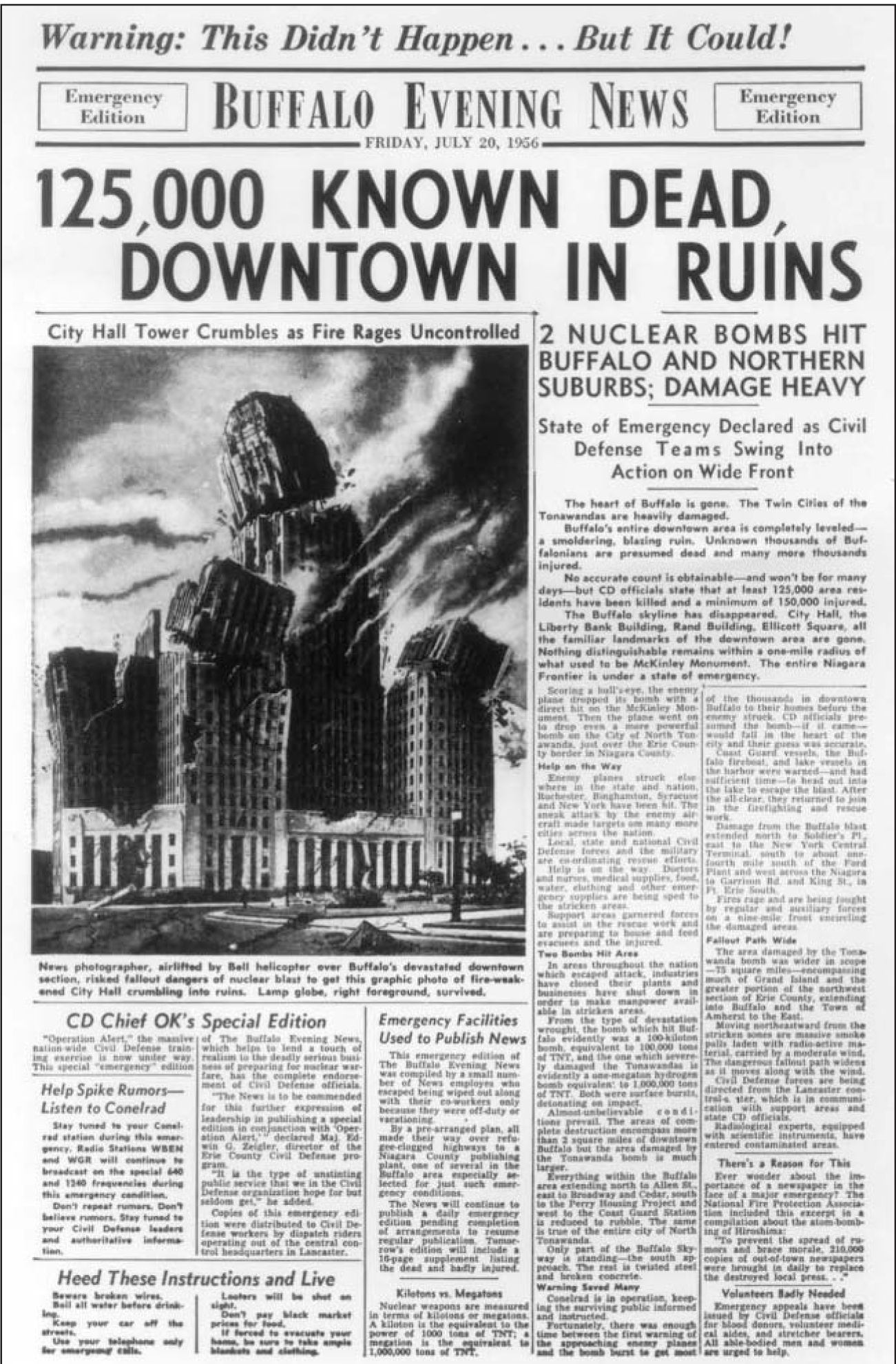
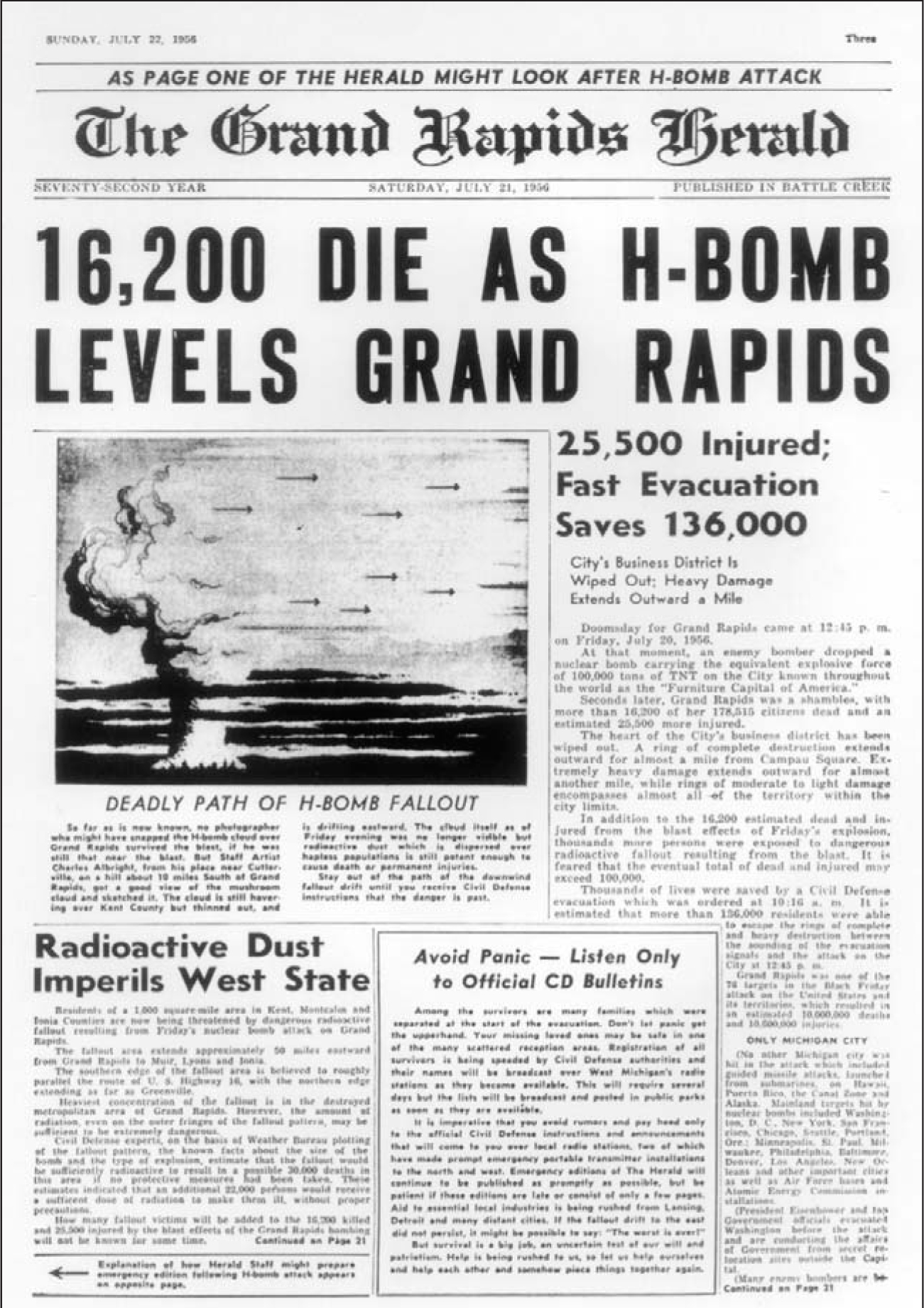
    LA Bomb bird's-eye copySince this appeared in a newspaper story–and a long story at that–it gave the exercise a real sense of urgency, to say nothing of the amount of fear that it generated.  At least it didn’t appear as the front page, as was the case with some other end-time scenarios, like these newspapers for Brooklyn and Buffalo and Grand Rapids (below).
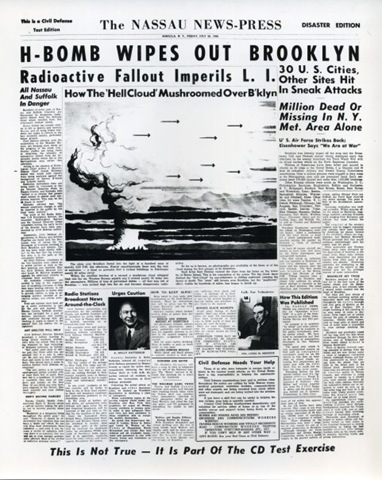
    Wipe out Brooklyn[Source:  Conelrad blog and also at the website]
    LA Bomb 1-74_edited-1
    [Source:  Rose, One Nation Underground.]
    LA Bomb 1-75_edited-1
    [Source:  Rose, One Nation Underground]

    Seems today like it might be a stretch for Grand Rapids and Buffalo to be bombed into oblivion by our arch-Cold Warriors, but there were more than enough delivery capabilities to make these cities into targets, so the  possibility was definitely real. 

    This next  graphic shows the difference in destructive capacity of an atomic bomb (small circle beneath an air-burst detonation) and a hydrogen bomb (the large circle showing area of total destruction, which in this case would be about 50 square miles) on the city of Chicago. this one did not appear ont he front page of a newspaper, but did appear in a sort-of “America’s Magazine”, though not on the cover.  There are many other examples of this sort of imagery–perhaps I’ll put together a gazetteer of mega-doom with images for them…
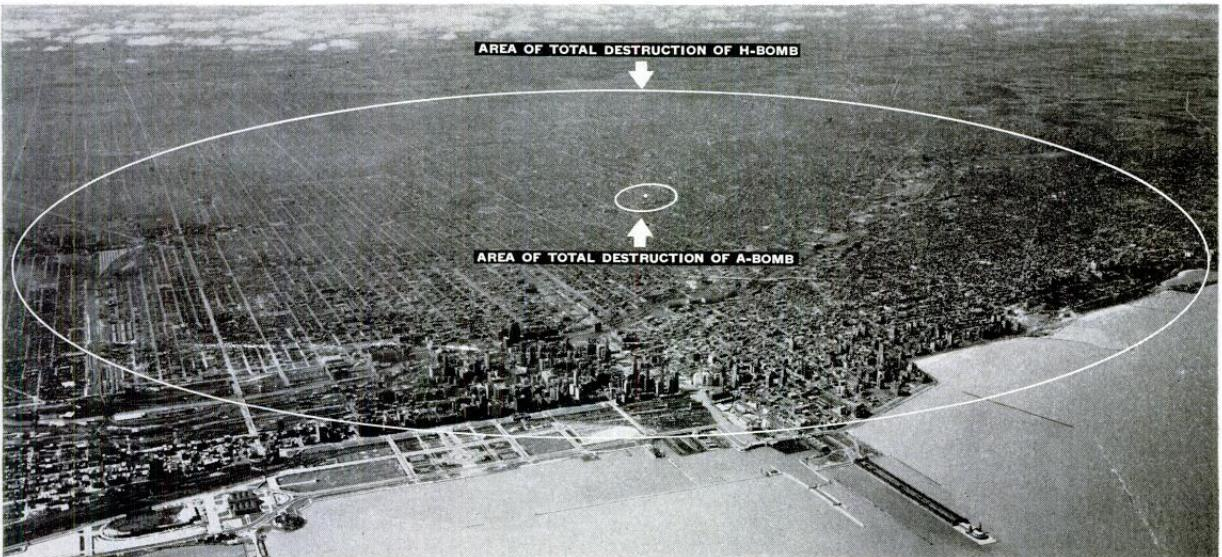
    Wipe out chicago
    [Source:  LIFE Magazine, 30 Jine, 1950]


    But don’t worry, even if the Chicago and Brooklyn and New York and so on were destroyed, the U.S. Navy would survive, which would  be either great or horrible if you were a sailor:]

      H-Bomb  WIpe out NAvy

    In any event, this is a small start to the Nuclear Doomsday Gazetteer–enough of this for this morning. 

  • Children in Insane Asylums, 1854-1900

    JF Ptak Science Books   Post 2071

    I came upon this remarkable article, written by Kate Gingell, on the reason for admitting children to insane asylums between in the middle/late 19th century. The article, “The forgotten children: children admitted to a county asylum between 1854 and 1900”, appeared in The Psychiastrist1 in 2001, and stipulates the causes for admittance, as well as the causes for the mental disorder2.  It is all quite upsetting, in a quiet and determined way, even when presented in tables–even without Gingell’s commentary and conclusions. It is really the stuff of nightmares3.

    A total of 195 case notes were identified from a total of 6573 admissions to the Powick Asylum in the years 1854-1900. (Powick, Worcestershire, was founded in 1847 as the Worcester County Pauper and Lunatic Asylum, and had a long life, closing only in 1989.)

    “During the 19th century the attention paid to the mental health of children was influenced by the physical health of the population, the cultural climate of the day and beliefs about children and child rearing. The fact that children were admitted to an asylum for years and frequently died there without apparent contact with their family must be set in the context of a high infant mortality (156 per 1000 live births in 1897) and difficulties in travel and communication among pauper families…”

    Explanation given for the cause of some admissions  (Table 2)

      n

    Mania

    63
    Sunstroke 1
    Measles 1
    By being thrown from a trap 1
    Fright and uterine derangement 1
    Loss of employment 1
    Abdominal tumour 1
    Fright by a dog 1
    Over study 1
    Non-appearance of menses 1
    Uterine functional derangement 1
    Frightened by a cow 1
    Epilepsy 86
    By being put inside a recently killed pig 1
    Scarlet fever 1
    Worms 1
    Fright of mother during pregnancy 2
    Tossed by a cow 1
    Imbecility 21
    Cutting teeth 1
    Fright at being almost drowned 1
    Idiocy 54
    Enlarged thyroid gland

    1


    Diagnostic categories used on admission notes (from Table #1)

    Diagnosis Age 4-10 (n=34)* Age 11-16 (n=161)*
    *70 children were given more than one diagnosis.
    Epilepsy 22 64
    Idiocy 20 34
    Mania 3 60
    Dementia 6 28
    Delusions — 4
    Moral imbecility 1 1
    Melancholia 1 —
    Imbecility 3 18

    “It is highly unlikely that asylums provided a sympathetic environment for children. Children were treated in exactly the same way as adults, with the difference that boys were kept on the female wards until they were about 7 or 8 years old. Admission procedures were identical for adults and children. The method of assessment of dangerousness is not detailed, but children as young as 4 were identified as dangerous and this is recorded in the same way as for adults.”

    Notes

    1.  The Psychiatrist (2001) 25: 432-434 doi: 10.1192/pb.25.11.432, and located here.

    2.  See also the lists of patients and their aliments and the causes of same in the New Orelans Public History website, 1882-1908.   See also: http://nutrias.org/inv/cityinsaneasylum1_50.htm 

    And also, the long and reworked list of the Trans-Allegheny Insane Asylum, located here.

    3. “It is not possible to equate the diagnoses of the day with recognisable contemporary diagnoses. The very high prevalence of epilepsy (Table 1) may be a real finding, indicating the high level of organic disease causing behavioural problems, or may be a misdiagnosis. Idiocy was found to be a common diagnosis for those under the age of 10, but does not necessarily indicate cognitive deficits. Idiocy was a term given to less dangerous inmates, whose cost on the public purse was less because they could contribute to the functioning of the hospital by doing jobs such as gardening or working on the farm. Some of the children diagnosed as idiots could read and write, and were thus discharged cured. The general view was that idiocy was an example of reversion to a lower type in the evolutionary scale. Another reason for diagnosing most children as idiots was the prevailing belief that insanity only occurred in those who could lose their reason. Children were considered to be born without reason, which gradually grew in them as they developed to adulthood. They could not then, by definition, be insane.”

    ·Posted by :

    ·in:


  • The Written Test of the Dead and the Bump Map of Crime

    JF Ptak Science Books   Post 2062 
    Follow Me on Pinterest

    Thanks to the always-fascinating book by Jan Bondeson, Buried Alive, the Terrifying History of our Most Primal Fear (W.W. Norton, 2001), which excited this interest in Dr. Severin Icard. 

    The determination of the occurrence of death was a major medical feature of the 19th century, the French in particular waging a fight for how this to be so.  Briefly
    put, for centuries even before Pliny death was described as the absence
    of an audible heart—the crux of the sentence being the word “audible”,
    so that the end of life was dependent upon being a physician’s/person’s
    capacity to hear the heart beating.  This might be very
    problematic if the person listening for that heartbeat had faulty
    hearing from defect or age, as the listener would place his/her ear on
    the chest of the patient to determine if the heart was functioning or
    not.  The stethoscope wasn’t invented until 1816 by Rene
    Laennec–who produced a monaural device much like a primitive hearing
    horn made of solid wood—which was a vast improvement over no stethoscope
    at all, by again was very crude compared to early 20th century devices.  It
    was much more preferred by most doctors (though there were contingents
    who distrusted the instrument and wouldn’t use it and still others who
    thought it an insult to their person insinuating defective hearing
    capacity) compared to the ancient hairy-ear-on-chest method.  It was also, in a small way, a kind of auditory x-ray.

    There were other ways to make the sometimes very difficult determination of actual death.  Some methods seem extreme, and a little barbaric, and at the very least, “odd”, but they were also effective to some degree.  For example, Leon Collongues believed that he could hear the capillary functions of a possibly-dead person’s fingers if placed in his ear; Jules Antoine Josat
    invented a nipple-pincher (“pince-mamelon”) life-rejuvenation device,
    operating on the assumption that a deeply sedated person could not
    resist a strong pinch of the nipple and would have to wake up if alive; the tongue-pulling idea of Dr. J.-V. Laborde; Christian August Struwe’s electrical device that delivered a dual shock to the eye
    and lip that was supposed to result in a twitch in the supposed-departed’s eye or lip; the tobacco enema of Antoine Louis; Barnett’s scalding death cure, which recommended burning the skin of the
    arm to see if it blistered (no blister/no life); and so on, deep into the fearsome, troubled and death-filled night.

    There was one death test, though, that went beyond the others, if only because it employed a “written test”.  This was the invention of Dr. Severin Icard, who devised a putrefaction test where the words “I am really dead” on a piece of paper written in acetate of lead would be placed under the note of the “deceased” where the words would appear if they came into contact with putrefaction gas dioxide of sulphur.  So, the “breath” of the dead would force the letters to announce their death.  Unfortunately the test was not fool-proof and the not-dead could sometimes produce dead results, which would be highly unfortunate in the premature burial kind of way…which is somewhat ironic, because that is how many of these dead tests came into being. 

    I should point out that Icard had another outre idea for the physical determination and identification of criminals.  He proposed that a substance be injected into an unidentified part of a felon to identify the person as a criminal.  the injection would produce a visible bump or lump on the person, somewhere; multiples were also possible, as were the locations of the bumps, so that a trained eye could determine the crimes committed by the Bump Map of Crime on the victim. 


    [Source: Journal of the American Medical Association, volume LVII, July-December 1911.]


  • Pabst Malt Extract as a Cure for Typhoid Fever, 1895

    JF Ptak Science Books 

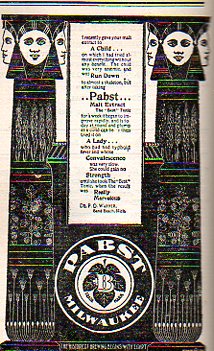
    Pabst Brewing Company, makers of Pabst Blue Ribbon Beer (evidently named for the Blue Ribbon that they did not receive in the 1893 Columbian Exposition) marketed one of their malt extracts as a curative, a palliative of some sort.  In this ad–rendered in a sort of Egyptian motif, because as we see in the legend at the bottom of the image in a barely-visible type, “the history of brewing begins in Egypt”–the malt extract is useful for a very wide variety of aliments. 

    Pabst372
    The two testimonies quoted in the ad come from a Dr. P.O. Warner, of Sand Beach, Michigan.  The first example is for the use of the Pabst product for an “anemic…run down to almost a skeleton” child–after a week of use of the malt extract, the child was again “plump”.  Unfortunately, the use of malt extract is generally used to treat constipation, and irritable bowel syndrome, and as a stool softener–something to help folks go to the bathroom….in the case of a weakened child, this seems to have been exactly the opposite thing to prescribe. 

    The second case is even more reaching:  “really marvelous” results in using Pabst malt extract to help a woman with/getting over (?) typhoid fever.  I’m not sure how this would have come into play, or if  the simple consumption of a Pabst beer would have been a less-harmful remedy. 

    The elegant ad appears in a beautifully printed nickel Little Magazine called The Chap Book, printed by the estimable Stone & Kimble of Boston. 

    ·Posted by :

    ·in:

    —

  • Cigarette Bombs as Munitions of Peace, 1916

    JF Ptak Science Books  Post 2078  

     
    Follow Me on Pinterest


    2013-07-24 10.00.29
    Superweapons have been used against cities for quite some time in the
    new world of speculative fiction, and there had been real-life aerial
    bombings from hot-air balloons, but the first time that a bomb was
    dropped from a heavier-than-air airplane on anything happened just
    months earlier, on 1 November 1911, when Lt. Giulio Cavotti dropped a
    hand grenade from his Etrich Taube
    on the oasis of Tagiura, in North Africa during the Italo-Turkish War. 
    He dropped four parcels of hand grenades on the
    not-necessarily-military population at the oasis, injuring no one.  The
    attack was one of attempted vengeance, a payback by the Italians against
    the Arabs of Tripoli, in general, for having joined forces with the
    Turks to fight against them.

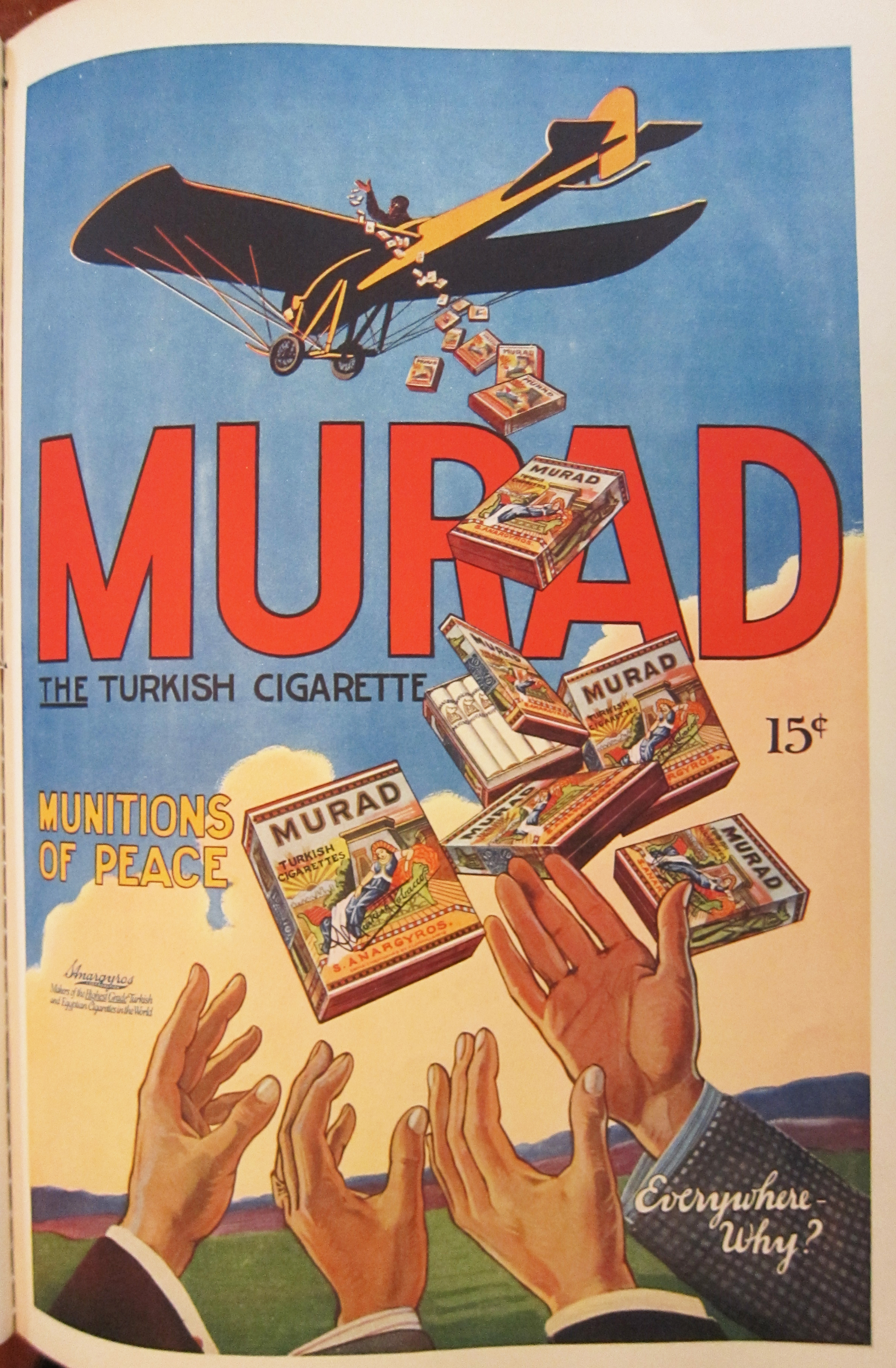
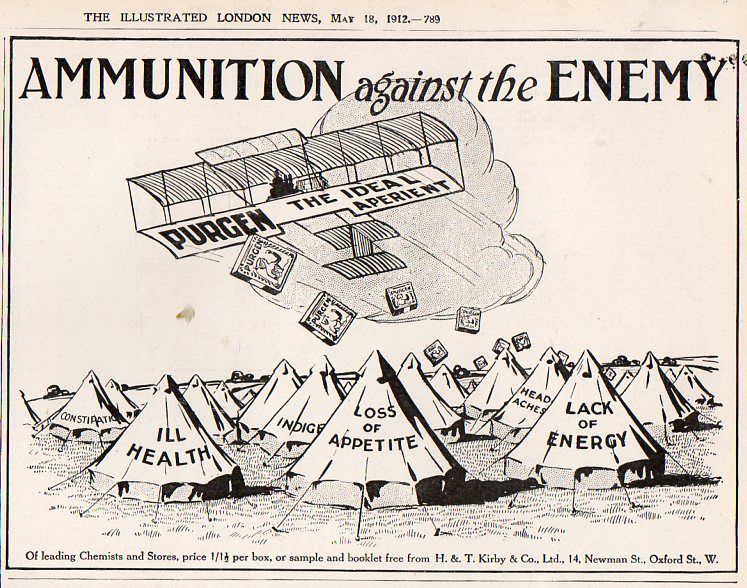
    Five years later (including two years of World War) advertisers were feeling quite enough at home with the idea of aerial bombing to use it on a growing basis to sell stuff to people.  The idea of bombing people with cigarettes–“munitions of peace”–was another in a developing series of dropping-what-you-want-to-sell-to-people-from-aeroplanes.  Murad is striking, but it is far from the first ad to employ airplane bombing–a good candidate for that occured four years earlier and only a year after the practice of dropping real bombs from planes was established. That would be in this 12 May 1912 ad for Purgen,
    “the Ideal Aperient” dropped on military-style tents  of “Ill Health”, “Loss of
    Appetite”, Lack of Energy”, and so on, all within the possibility of
    cure by this Purgen product. 

    Purgen was a laxative; Murad was cigarette bombs. 

    Bomb554

    ·Posted by :

    ·in:

    —

  • The Bomb God, 1946

    JF Ptak Science Books   Quick Post

    This wonderful, semi-impossible sulphur-laden pamphlet emerged from the bottom of one of the “Naive Surreal” boxes today in the warehouse:

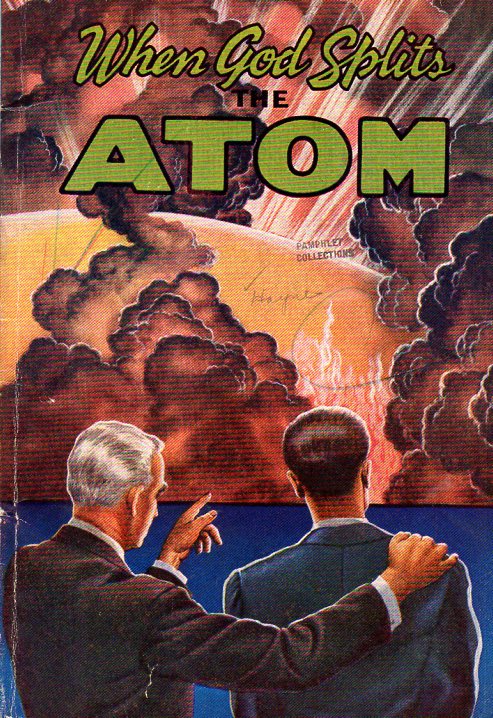
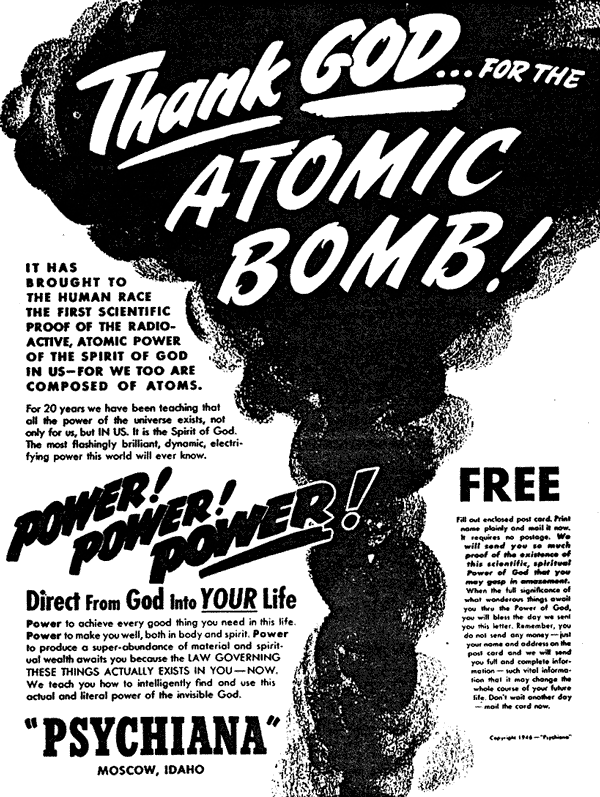
      God Atom287When God Splits the Atom (1956) offers a not-so-friendly piece of advice:  “its later than you think”.  We are told that God delivered the atom and the atomic bomb and the end of the war and the beginning of the United Nations.  None of that will save us from the burning ring of fire, and the U.N. will fail, and so on, down to the firey pit if there is no repentence and acceptance of the higher power.  The cover pretty much tells the entire story. 

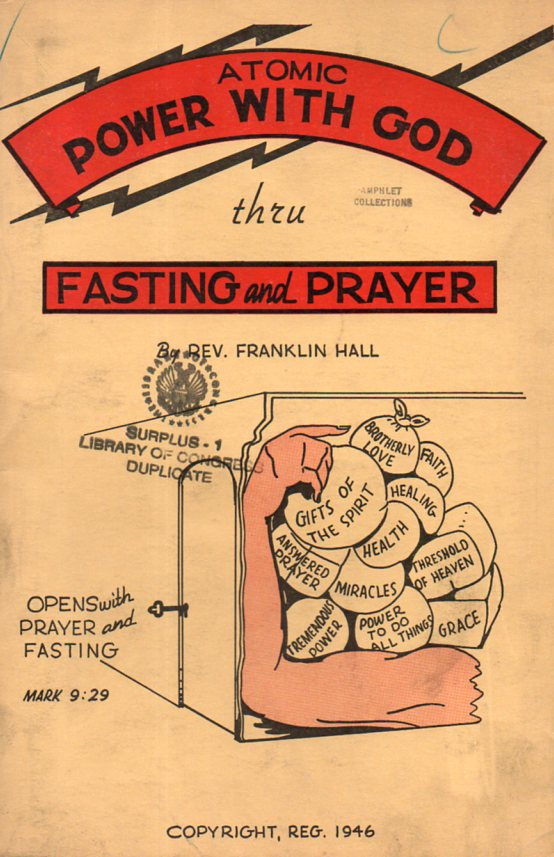
     There are a few other God-and-athe-atomic-bomb posts on this blog, like, well, this one:

    Atomic power with god628(Found here.)

    And this one (from Miss Atomic Bomb: the A-Bomb in Popular Culture–Comics, Cakes and the Will of God):

    Atomic bomb thankgod

    And of course on the other end of this:

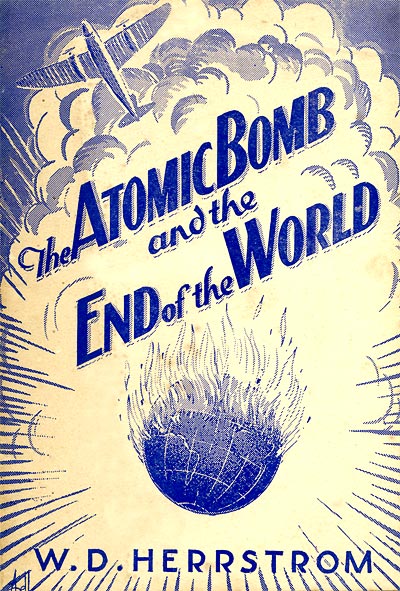
    Atomic_bomb_end_of_world

    And that’s pretty much that.

    The idea and imagery of the atomic bomb was instantly re-purposed and used to identify and sell food and comfort, and was employed for hotel names, cakes, dart games, watches, restaurants, patience games, and so on–God was just one of a series in a long line of a-bomb apps.


  • Daily Dose from Dr. Odd: Let Your Man fill Your Eyes With Smoke

    JF Ptak Science Books  Quick PostDaily Dose from Dr. Odd series

    Follow Me on Pinterest


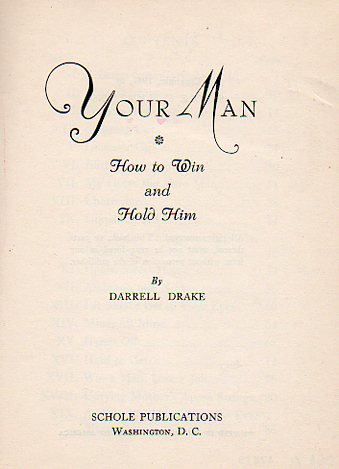
    Man Keep225Darrell Drake was full of advice, not much of which seems to have weathered the wearying bits of time very well.  Most of what he has to offer has to do with being coy, reserved, and retiring, and so much so to the point of being insipid acquiescing in the superior qualities of the man, forever in the back seat, quiet and demure, patient and understanding and making the back-step always the job of the woman. Not much of a surprise.  But what was very unexpected was the chapter called “Let Smoke Get in Your Eyes”, a four-page baiting in which he warns women against the antagonism of correcting the manners and behavior of the man, so much so that she should be well willing to have  smoke blown into her eyes rather than suggest that the smoker not do so–you don’t see that every day. 


  • Anti-Gravity & Anti-Aging Centrifuges, 1932

    JF Ptak Science Books  Quick Post

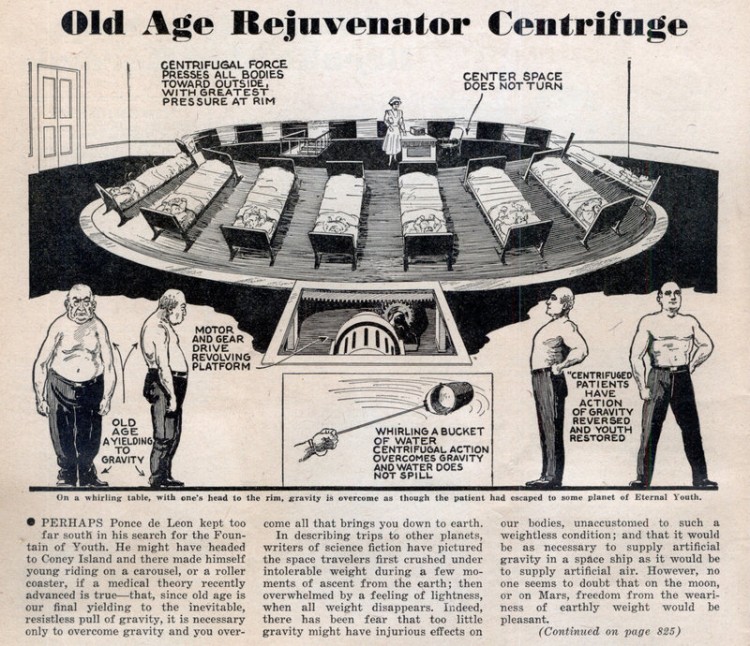
    Old-Age-Rejuvenator-Centrifuge-750x646

    [Source:  the great Modern Mechanix blog, here.]

    Q:  What could possibly go wrong with the idea of settling out mostly-imaginary biological issues than spinning? 

    A:  Well, its not so much as getting something wrong than it is getting nothing right.

    Such is the case with the spinning hyper-centrifugal anti-aging machine, found at the Modern Mechanix site.  Among bad ideas it isn’t so much “bad” as it is “hyper-bad”, though it is not quite so hyper-bad when compared to the mega-hyper-bad-so-bad-it-isn’t-even-bad-but-worse idea for the centrifugal birthing patent that appeared in this blog earlier (here, in the Electro-IronPunk Centrifugal Birth Machine post). 

     The centrifuge had been around for a long time prior to its estrangement and corruption in the anti-aging scheme. James Watt created one (in 1786) as a regulator in his fabulous 1781 parallelogram steering of his double-acting steam engine, and Oliver Evans employed one in his Philadelphia-based mill at about the same time. (Robert Hooke in 1674 had proposed a universal system of cosmic glue using a balanced approach between centrigical force and gravitation as the stuff that held the universe together, only to be bitterly disappointed by the publication of Newton’s Principia nine years later.) Like other bold and advanced ideas corrupted to popular Atomic-Motel misuse, the centrifuge was no exception.

    ·Posted by :

    ·in:


  • NarcoPunk: Using Narcotics for Sleep & Enema Treatment of the Insane, 1845

    JF Ptak Science Books   Post 2009

    Follow Me on Pinterest


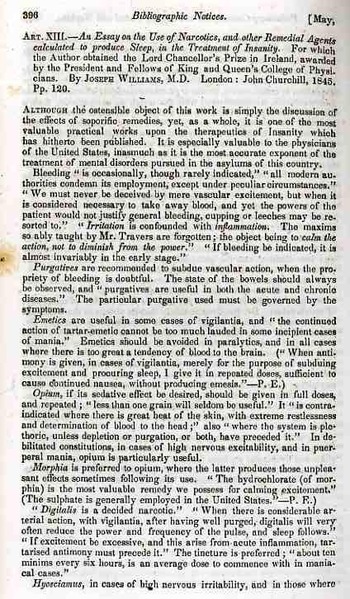
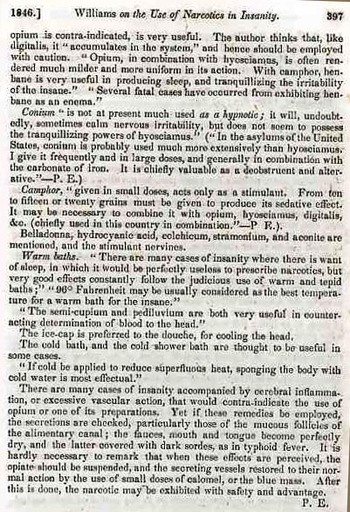
    This book review on the use of narcotics in treating the insane appeared in the New York Journal of Medicine for 1846.  The book, An Essay on the Use of Narcotics, and other remedial Agents calculated to produce Sleep in the Treatment of Insanity…., was by Joseph Williams, M.D., and was published in London in 1845.  The theory behind the sleep treatment was that the basic mechanism of insanity was “cerebral inflammation” or “excessive vascular action” in the brain—inducing deep sleep, evidently, was a good way to combat the over-active/inflammed/blooded-up brain.
    Blogdrugs_crazy254

    The article itself comes at an odd time in the history of the treatment of the insane.  It came almost 40 years after the establishment of  McLean Hospital (first known as the “Asylum for the Insane,” a division of the Massachusetts General Hospital), which opened on Oct. 1, 1818, and was the first hospital dedicated to the treatment of the insane in the U.S.  It came 70 years after the great advances of Benjamin Rush, who elevated the “Mental Patient” from chains on the floor to the status of medical or nervous illness or disease.  The use of narcotics over this period seems to have surged and waned.  In 1879, in an article in the New York Times, the reputation of the Asylum for the Insane on Ward’s Island in NYC was considered—and one of the high points was that it had (largely) discontinued the use of narcotics in treating the patients their. (There were still problems, of course, what with the asylum being overcrowded, housing 1100 in an institution meant to house 700, and where the chores and even nursing positions were staffed by the inmates, who were feed on 32 cents a day.)  As late as 1921, though, Jacob Alter Goldberg notes in his Social Aspects of the Treatment of the Insane, that there was a new, sharp increase in “toxic narcotic” treatments of the insane.  Of course, I guess one could replace “narcotic” with some sort of other misplaced treatment, like shock therapy, or Freudian mélanges, or something.  Each age must necessarily have their entry in the encyclopedia of embarrassments
    Blogdrugs_crazy255 . 

    In this article we find sleep assaulted by the use of the following:  purgatives (“to subdue vascular action when the propriety of bleeding is doubtful’), emetics, opium (to be used “in cases of high nervous excitability and in puerperal mania”), morphia (“the most valuable remedy for calming excitement”), hyosciamus (“to produce sleep, tranquilizing the irritability of the insane”).  It is weird to see that the last sentence in the description of hyosciamus reads “some fatal cases have occurred from exhibiting henbane as an enema”.  Henbane has been in use since ancient times, and is largely understood to be a dangerous/poisonous drug–to administer the thing as an enema leaves little doubt that it would kill people. 

    Still to come in the review is conium (“I have used it frequently and in large doses…it is chiefly valuable as a deobstruent and alternative”, followed by camphor, Belladonna, hydrocyanic acid, colchirum, stramonium aconite, and others.  “Warm baths’ makes an appearance (“90 degrees may be considered to be the best temperature for a warm bath for the insane”), as do cold baths, and the applications of ice caps. 

    I’m not so sure about what to make of it all, the sleep treatment of insanity I mean—after all, Joseph Lister only makes his epochal pronouncements on cleanliness in the operating theatre 15 or so years after this paper, which seems today to be the most rudimentary thing that one could do in treatment in the surgical room, so treating extra blood in the brain through drug-induced sleep doesn’t seem all that far away from the realm of possibility back there in early Victorian England.

    I don’t think I’ll forget the toxic narcotic enema any time soon, though.  Or the word “deobstruent”. 

    ·Posted by :

    ·in:

    —

  • On Tanning Names on Newborn Babies (1930)

    JF Ptak Science Books  Quick Post  Daily Dose from Dr. Odd

    Baby tan181[Source: Popular Mechanics, October, 1930]

    I’m looking for post #2000–this isn’t it.  It is however Quick Post #450 or so, which means that we’re closing in on 2,500 overall posts in this blog since 2008.  But there should be something with a little more flavor than baby tanning for #2000. 

    This is a good/appropriate installment for the Daily Dose from Doctor Odd series.  As ideas go, it is not a very good one–but it is not among the Dantean 9th-level-worst.  If we classify bad ideas on a six-point Major-Minor scale, from MajorMajor to Major to MinorMajor and then to MajorMinor and then Minor and finally MinorMinor, this one would probably rank at the MinorMajor level. Or maybe even a full Major.  It is a bad idea.  (An example, by the way, of a full MajorMajor bad idea would be the electropunk centrifugal birthing patent machine, described earlier on this blog, here. Okay, here’s another:  on draining the Mediterranean Sea, here.)

    There are less invasive ways of ensuring that the correct baby is delivered to the correct parent(s) than tanning the baby’s name onto their body–which doesn’t of course take into account the instances where the baby’s skin is too dark or whatever to be tanned.  But the idea of subject a brand-new baby to a tanning lamp as  its welcome to the world seems a bit–what?–horrible. Exposure to ultraviolet rays that will cause a six-month brand sounds like it might stir up the melanosome pot to cause damage to organs other than the skin, that it could have been a real assault on the DNA.  Also, that metal object on the table looks a lot like a clamp–I hope it wasn’t.