A Daily History of Holes, Dots, Lines, Science, History, Math, Physics, Art, the Unintentional Absurd, Architecture, Maps, Data Visualization, Blank and Missing Things, and so on. |1.6 million words, 7500 images, 4.9 million hits| Press & appearances in The Times, Le Figaro, Mensa, The Economist, The Guardian, Discovery News, Slate, Le Monde, Sci American Blogs, Le Pont, and many other places… 5000+ total posts since 2008.

Category: Bad Ideas

  • A Really Big Idea: the 5,000 Ton Tank (1916)

    JF Ptak Science Books   Post 2389

    These spectacular images of monumental monumentality appeared in the December 1916 issue of Popular Science Monthly.  The author Frank Shuman (1862-1918) had some major inventing chops, not the least of which was some very forward-thinking work (in theory and practice) on solar power (one of which was a solar powered steam engine and another a liquid O2 propulsion system for submarines), so these suggestions for gigantic land battleships came with a fair amount of gravitas. This is some grand thinking, and as Shuman tells us, the beast below would weigh about 5,000 tons (the weight of several hundred Sherman tanks1) and would roll along on 200′ diameter wheels.  Unfortunately, outside of  seeing some sort of (steam) power plant, there is no mention of how those wheels would be turned–I’d’ve liked to read about that.  There is a mention of shock absorbers, but only so, jsut a bare hint.  

    [Image source is Google Books–I have this volume in a 40 year run of this periodical down in the warehouse, but the book was really too thick to lay flat ont he scanner, and so the Google Books scan was used..]

     And for whatever reason there is no heavy artillery on this thing. The damage to the enemy would be done via the three wheels, and also by the enormous chains that hang from the front of the enormity, like a flailing slow-moving monster from a 1950’s B-movie. 

    My guess is that this wouldn’t do so well in the rain.  


  • Massiveopolis: Filling in the North Sea (1930)

    JF Ptak Science Books   Post 2378

    This is part of a series of Mega-Massive Invisible Engineering, the Filling-it-In Section. Other examples from this series not necessarily filling-stuff-up include:

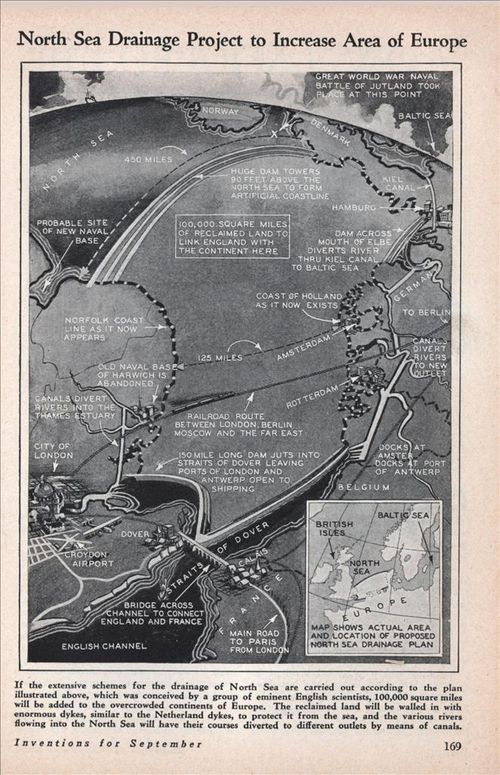
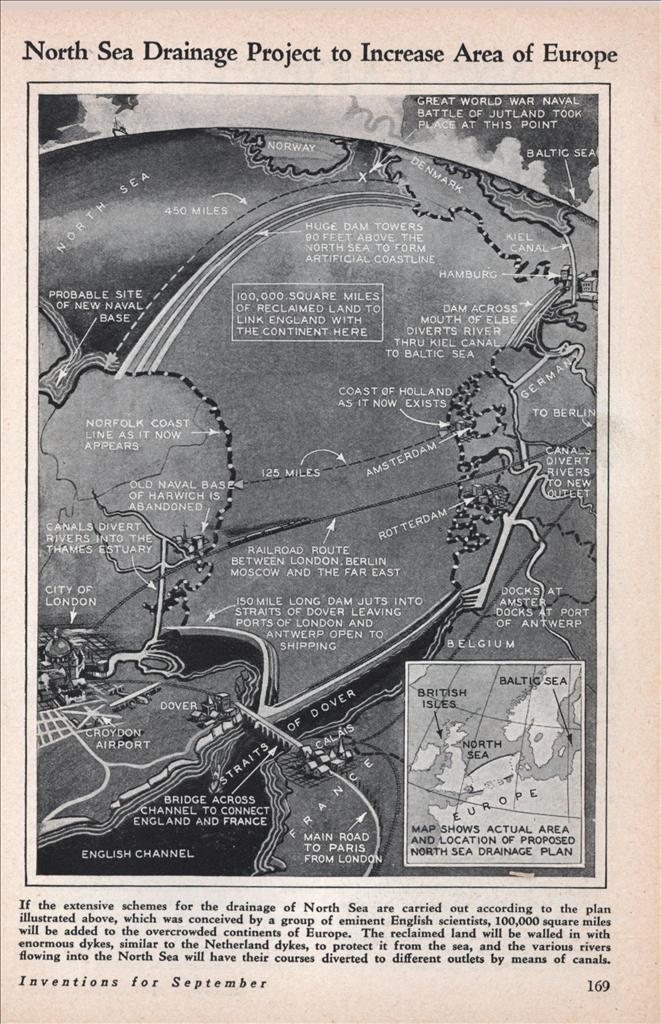
    The title of this post is a bit of a tweeker–the project is not to fill in the entire the North Sea, just the southern North Sea.  This actually makes a pretty big difference bathymetrically, because the sea floor gets mighty deep up along the coast of Norway. Still, though, as impossibly ambitious projects go, this is still a massively unstable consideration, the entire North Sea or not.  
    North sea[I owe the fun I had thinking about this project to two great sites: Modern Mechanix and Imaginary Cities–Modern Mechanix for posting it to begin with and Imaginary Cities for tweeting it.  These are two great sites well worth subscribing to.]

    A sort-of Atlantis was drowned some 8500 years ago, a large piece of land that connected what is today Great Britain and Europe. Rising water did away with this territory leaving behind the great island nation and much else. The plan referred to above in the title is the extraordinary thinking for “raising” that lost Atlantis-esque land, and was floated in the September 1930 of Modern Mechanics. 

    The author maintains some sort of possibility for recovering some 100,000 square miles of submerged land that would connect south-eastern England with France, Belgium, the Netherlands, and Denmark. It would be accomplished by erecting some 700+ miles of dykes and dams and then, somehow, emptying all of that surrounded and captured water into the sea that it once belonged to.  

    100,000 square surface miles is an area twice the size of England, three times the size of Lake Superior, nearly the size of the Caspian, and equal to the size of Colorado. 

    The English Channel and the straits of Dover would become a divided thoroughfare; the Thames would be part of a canal system that would extend along the old Norfolk coast to The Wash; a bay from the Straits would extend inland to Belgium, where it would be met by a canal system that would extend to the Baltic.  All of this would be held in place by a 150-mile long dam of unusual  shape. And just for good measure, bisecting these two would be a monster bridge from Dover to Calais. 

    This is of course extraordinary, but when we look north we see a breathtaking proposal for a  450-mile long, 90′-high dyke extending from the English coast to Denmark. The artwork claims that this is 90′ above the water for the rest of the North Sea, which means that the structure would have to be at least 110′-150′ high, plus the foundation. Luckily for the designer the southern North Sea is a relatively shallow water sea, 20-40′ deep, though there is a stretch of 100′ miles where the depth is considerably deeper.  I haven’t considered yet how wide this dyke would be, except that it would be, well, big.

    There is also a drawing for a London-Berlin and points east train. The  Elbe is dammed, and it looks as though the Netherlands is no longer the Lowlands, everything there being “filled in”, with the sea being moved some 200 miles to the west. 

    This is just a short spec piece that appeared in a popular science magazine 84 years ago, but there is no mention of what these changes might mean to the currents of the south North Sea, or Jutland coastal waters, or the Continental Coastal waters; or the changes it might dictate to salinity, or nutrients to the rest of the North Sea, to say nothing of the sea floor inhabitants and fish, and so on.  There would no doubt be some natural consequences to this (literal!) undertaking.  

    I suppose someone at some point would have to think about how all that new land would be divided, but I guess that would all take care of itself.  

    • Another related article from Modern Mechanix posting a Modern Mechanics May 1931 addresses the issue of water removal albeit at as much lesser scale, here.
  • A Little Version of the Big Giant Head

    JF Ptak Science Books  Quick Post

    Crandal dream504

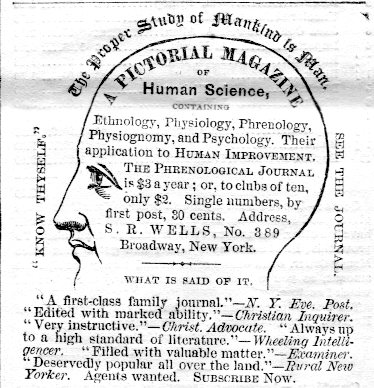
    I haven’t read anything in the Phrenological Journal before seeing this in American Agriculturalist for 1869, but the small (two inches tall) ad made an impression, what with the big head filled with text concerning all of these questionable sub-medical practices.  It seems that the head in the image is big and very smooth and very unphrenologicalistic about it. 

    ·Posted by :

    ·in:


  • Captives of Capitalism–the Red Streak in the Sky that Isn’t Santa

    JF Ptak Science Books  Post 2370

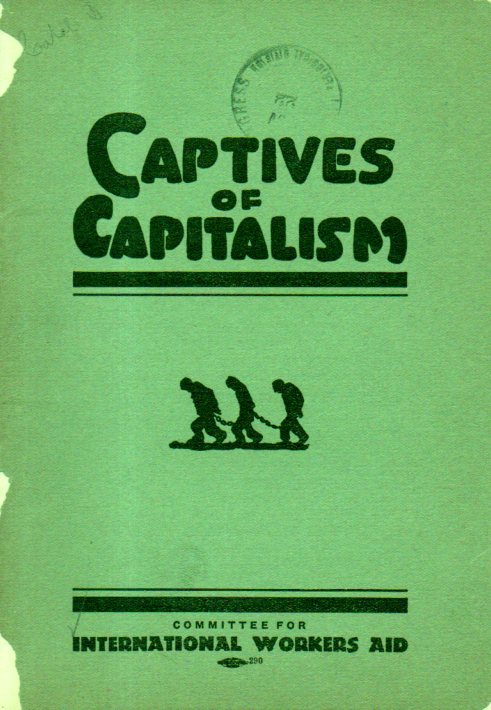
    Captives of Capitalism (printed ca. 1925) is a small pamphlet with a big reach. It was published by the Committee for International Workers Aid, a Communist organization created in Berlin in 1921 (as the International Arbeiter-Hilfe) to help raise money for famine and drought victims in Russia. It was evidently expanded to include collecting money to help victims and prisoner of Fascism, which seems to be the major target in this pamphlet. 

    Captives of Capitalism508


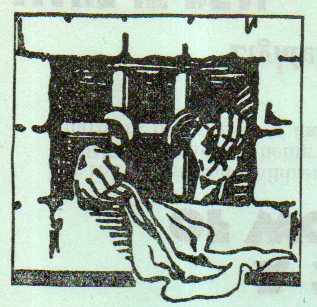
    Although pretty slight the pamphlet looses no time in getting to the heart of the matter, detailing atrocities and unjust imprisonments by fascists and capitalists in Germany, Roumania, Bulgaria, Hungary, Lithuania, Finland, Lithuania, and Italy.  Although not mentioning the United States the “Call to Action” states that “Democracy is on the rampage, with proletarians as its victims” with calls for unity of workers and donations to the International Workers Aid as well as to Red Aid–money to help “lighten the burden of the imprisoned” and to “support starving families”.  


    Captives of Capitalism513

    Inside of my copy of the pamphlet was a small handout, a long sheet folded into quarters with the working “title” of “Drop by Drop the Bucket Will Fill”, and on opening the sheet the entire reverse is a form to fill in with the names of donors and amounts of the “drops” they send into the bucket.  This request series in particular was aimed at “Xmas Relief”

    Captives of Capitalism507

    The “Call to Action” ends very strongly: “A united front of the workers of the world so that

    Every humiliation

    Every persecution

    Every Eexecution

    Every murder

    of a proletarian fighter against capitalism creates a millionfold echo from the workers of the world.”

    Captives of Capitalism509


    Unfortunately the Soviet Union would become its own home-made disaster following the turmoil and famine(s) of the early ‘twenties.  Lenin’s death in 1924 led to Stalin, and Stalin went down a terrifically bad path, beginning his Five Year Plans in 1928 which would displace 25 million families to create the collective farm state; smashmouth industrialization lead to great gloom and the development of Stalin’s cult-of-state created the Great Famine in ’32-’33 and the rest of the hideousness that would cover the Soviet Union through the rest of Stalin’s existence. 

    Captives of Capitalism510


    Captives of Capitalism511

    Captives of Capitalism512


  • Photographic Composite of Criminality (1883)

    JF Ptak Science Books  Quick Post

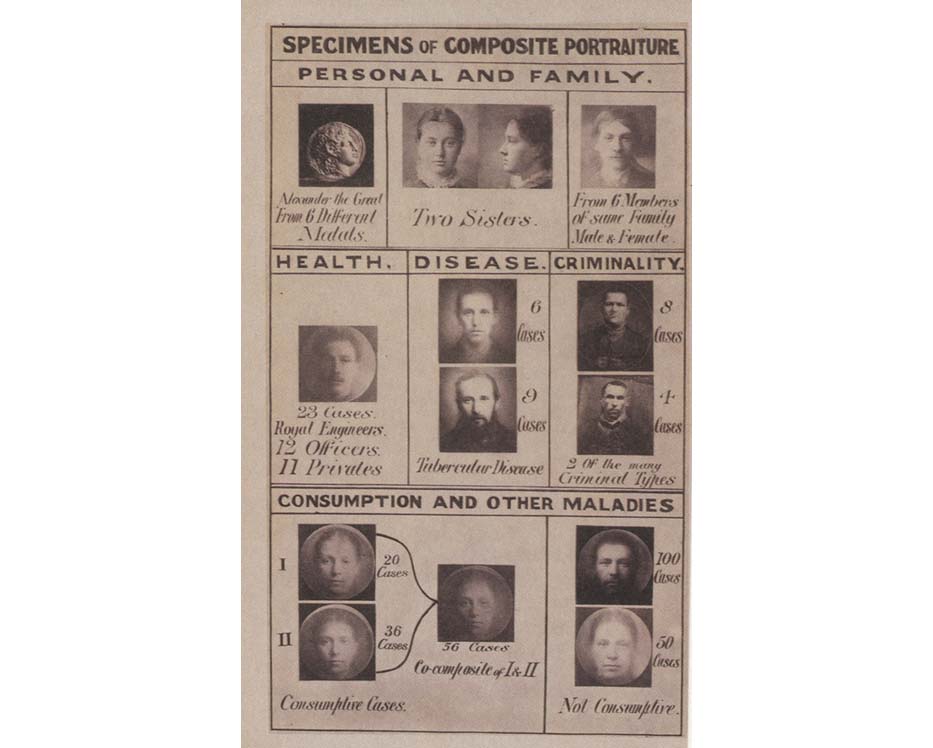
    This is a comparison between two different types of photographic vision–one on seeing instantaneous and direct responses, a photograph recording a true and unguarded reaction; the other, though it was the achieving the same but used a series of photographs laid one on top of the other for a complex amalgam.  Charles Darwin used the first, particularly in the Expression of Emotions, and Francis Galton the second, in his Inquiries into the Human Faculty (1883). This is Galton’s version, the famous frontispiece to his 1883 work:

    Galton faculty

    Living within a self-defined truth function, and its own language, setting its own parameters, finding what it wanted to find. Galton’s work is more like ambient music with a touch of Steve Reich, multiple layers of the same piece of music textured at intervals one piece on top of the other, seeing what came out the other end.  Darwin’s approach was a simple score.  


    ·Posted by :

    ·in:


  • Very Deep Racism–on the Vocabularies of “children, negroes [sic], parrots and schizophrenics” (1942)

    JF Ptak Science Books   Post 2361

    I am constantly surprised-and-then-unsurprised, having the “surprise” part ripped away like a bandage to leave a vacuum of missing surprise, when I bump into deep, inherent, part-of-the-language and part-of-the-social-landscape racism.  I’ve mentioned before in this blog that some years ago I bought a very large collection of pamphlets from the Library of Congress–it was a collection in name only (even though almost every item was stamped “the Pamphlet Collection”) though their storage and relationship was basically unassociated and uncategorized even though they were supposed to be so, housed in 3,000 document boxes that supposedly put everything into order, though the classifications were extremely loose and could refer to author/title/subject/publisher and so indexed almost nothing. The great majority of the time The Finding of Things was almost random, and there was really no telling what might slip out of each box.  

    Racist found455I looked at quite a few of these documents, and one thing that I found over and over, in varied subject areas and content, in obvious and odd places, was periodic deep-seated racist remarks. The vast majority was directed at African Americans, though there has been a showing for the Japanese and Chinese, as well as Mexicans, and Eastern Europeans, and of course Jews. The surprising thing to me has been how this racism emerges from the pamphlets–usually it seems so, well, “out of context”, even if you were racist, the way that suddenly something bizarre and racist would appear, as though dropping unexpectedly from the sky.  For example, in the middle of an introduction to carnival barking, the caller was supposed to occasionally “slap his hands like a n-word” when accepting money. I mean, right there in the middle of a nothing sentence, this awful stuff would just appear.  After many exposures to this I took it to represent very deeply rooted systemic racism, where light banter and semi-meaningless explanations would be peppered seemingly from nowhere with racist statements.  I remember feeling so outraged opening a pamphlet on Purina sheep feed and catching a phrase where the farmer is supposed to feel some part of a sheep’s wool and that it should feel something like “n-word hair but softer”.  It is an incredible disgrace to read it in 2014 and to think that in 1940 (when the Purina sales catalog was written) that it would be so much part of the verbal landscape that it would seem like nothing at all.

    And this happened many times, and all by chance, a weird turgidity of racist serendipity.

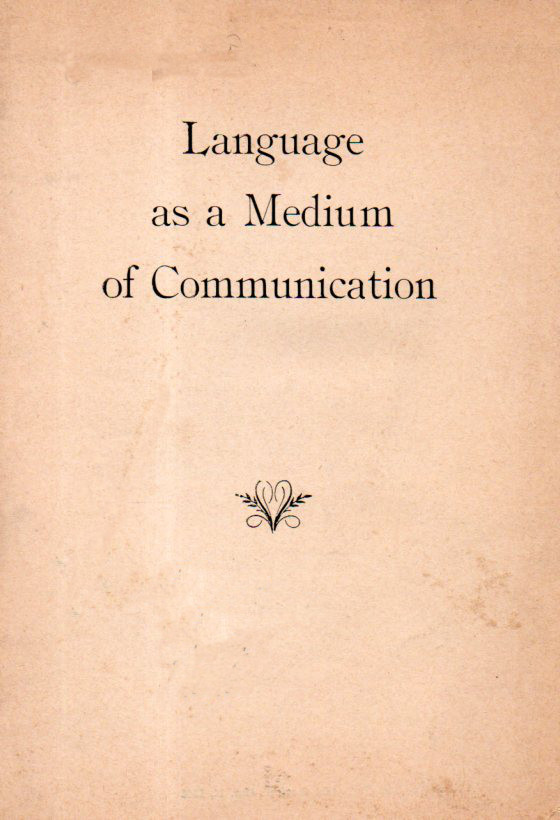
    Which brings me to tonight.  I selected the pamphlet (above) called Language as a Medium of Communication to be part of my book cover Found-Surreal collection–I mean, what else is language for, and what would Wittgenstein say in his quietest moments about this? I opened the pamphlet, and there it was, the found-offending bit, on page 9.

    The question the author asked in text was “Does the increase in vocabulary facilitate ease in thought?” Which is kind of an interesting question if it wasn’t so filled with the demand for explanation and definition.

    The rejoinder was this:

    “Do remarkable vocabularies of many hotel porters, couriers, precocious children, negroes, parrots, and schizophrenics “facilitate” their “ease in thought”?

    Now, the irony here of course is that this problematic and overwritten pamphlet was on language and communication, and what happens here is that (a) the author does not capitalize “Negro” even though it had been a long-fought battle that was basically decided in favor of the capital “N” a few decades earlier, which communicates something in a corruption of language, and (b) that the inclusion of “Negro” speech alongside that of parrots, children, and schizophrenics communicates a racist view of African American speech. None of this makes a dent in the consciousness of the author because these completely unexpected racist bombs that seem so incredibly pernicious and disgusting to us now were really evidently nothing when this pamphlet was written in 1942. That they appear without any real call for them is a damnable thing, that the racist aspect was so deep that one could include a racist reference even in an innocuous statement–that made bitter and repugnant with the expression of stupidity, fear, and loathsomeness. And this is only 72 years ago. 

    ·Posted by :

    ·in:


  • On Building a Vertical City in the Grand Canyon and Covering It Up

    JF Ptak Science Books   Expanding an earlier post from 2009…


    Blog Dec 17 underground city

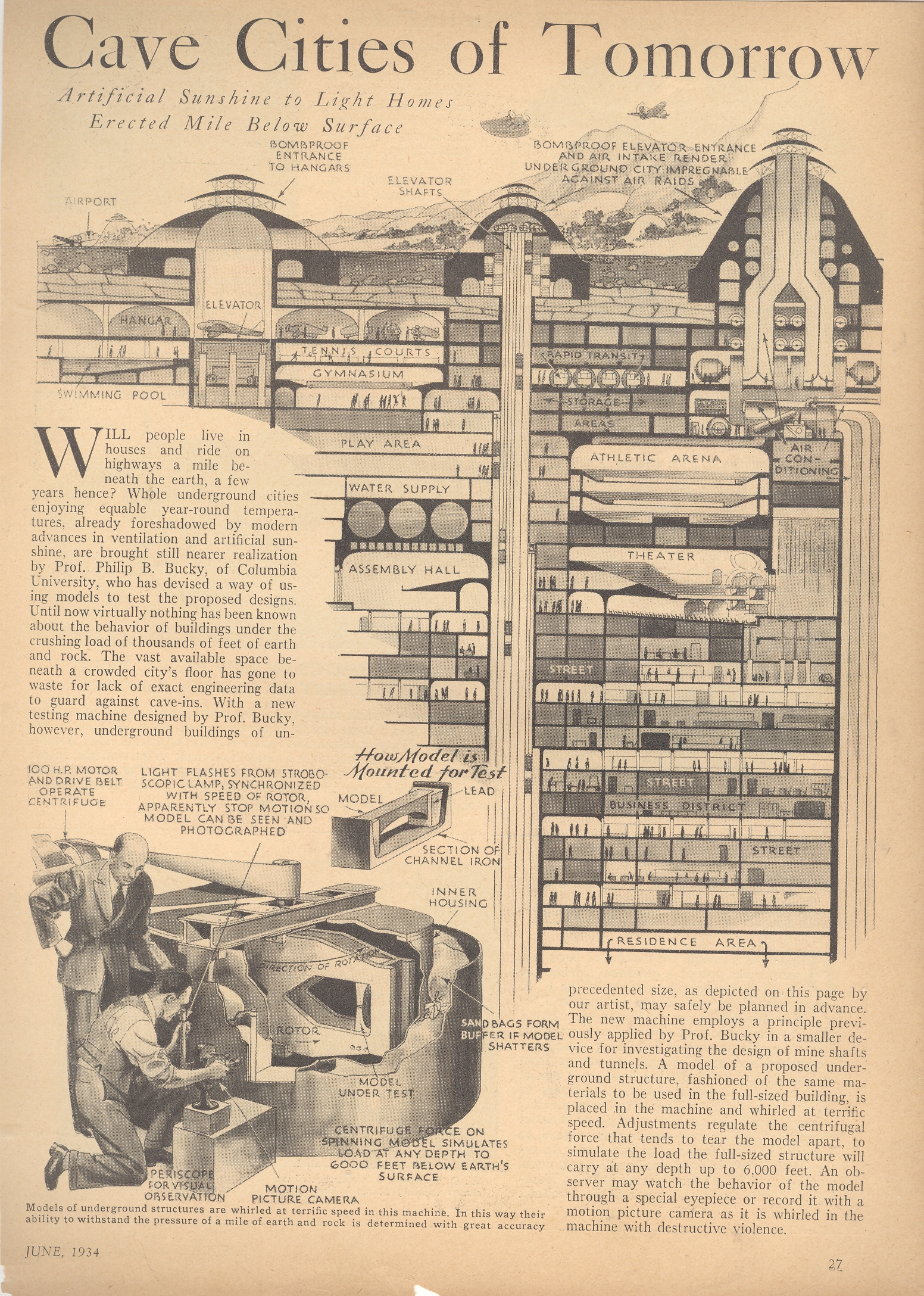
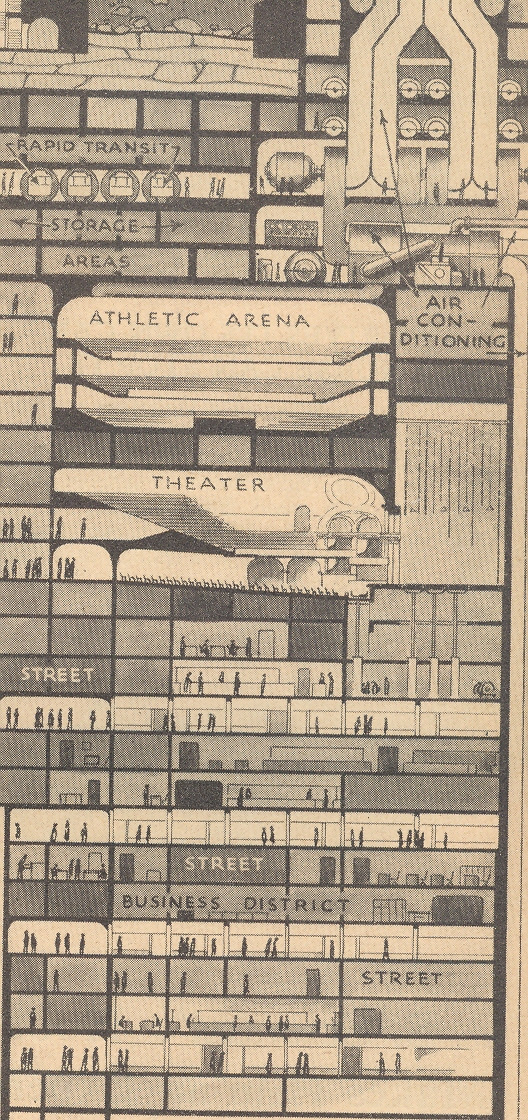
    I’m a sucker for cross sections, and this one has it all—nicely drawn, a glimpse into the possibilities of the future, and technoid removed from the realm of possibility.  This article appears in Popular Science Monthly for June, 1934, and presents the possibility of extending downward into the earth for future city development. (as a matter of fact, the fabulous  Modern Mechanix site has a similar story on display, asking the question “Are Skyscrapers Doomed?” for the same year, with the same engineers.) Well. It seems as though in this cross section that residences for people begin below the thirtieth floor, making living quarters starting at about 350’ down.  The story goes that it would be possible to dig these cities up to about 6,000 feet into the earth, which of course is a long way down.  Its difficult enough to drill an oil well hole to this depth; its difficult to imagine digging/outfitting/removing the earth from something—I’m not even sure what to call it—that was, potentially, thousands of feet deep and miles wide and long.   That’s playing with figures hundreds of billions of cubic feet. Of construction. Underground.  Well, I guess it wouldn’t be necessarily underground–it could be an excavated hole that is a mile or two wide and across and down, which would make the hole itself several times larger than the largest whole ever dug by humans, which is the Bingham Canyon Mine, a pit slope mine that is about .5miles x 2.5 miles. And then construction would begin after which the remaineder would be covered by earth.  

    Anyway, it is a big hole and a lot of construction, the volume of it at the beginner phases of say a cubic mile would be equal to the volume of 25,000 Great Pyramids or 5,400 Empire State Buildings.  It would be easier probably to build a vertical city in part of the Grand Canyon (or of course a “more modest canyon” and then cover it up–that’s an idea you won’t see in print too often. (I should poitn out that I’ve bumped into canyon-filling ideas every now eand then, one of my favorite truly-floated ideas being the one that would fill up Washington D.C.’s Rock Creek Park, which snakes its way north-south in the central part of the city.  Around 1890 the Federal government was trying to figure out how to best multi-task the area for parkland and roadway.  One incredible plan called for the creek, which in many places is bounded by some pretty steep embankments (25-75 feet or so) and extends about 8 miles north of downtown, to be filled in, leveled off, and paved over.  Now that  would’ve been a lot of dirt.  The final plan was perfectly fine and had a series of small roads snaking their way through the park, making it one of the nicest rides (Central Park-like) of any major metropolitan cities in North America.)

    Blog Dec 17 underground city det


  • Bombs of Fuel Delivery–the Future of War, 1974 (1958)

    JF Ptak Science Books  Quick Post

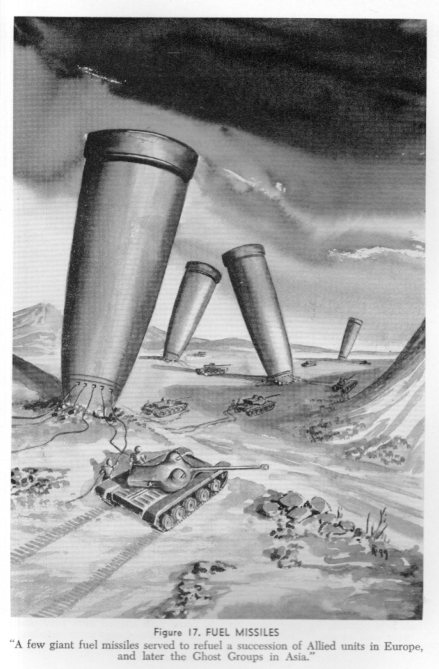
    This is one of hose books that I couldn’t possibly spend any time with, save for skimming the illustrations looking for something unusual. Generally popular books published by Certain Publishing Houses on the future of warfare tend to read like bad sci fi–having not read this one I can’t address that here, though this pic found at the end of the book may offer a little insight to the rest of the book’s content.  The author was a tank commander of high distinction, which might explain at least his hopes for the technological breakthrough of delivering fuel to motorized units in the front line–via “giant fuel missiles”. Evidently these enormous missiles (the width of a tank) and filled with fuel is somehow launched and the projectiles fall gently enough to stand precariously on their own with the top 5% of the length buried a slight bit but somehow enough to support the weight of the missile and the contents.  Remarkable.

    War 1974384

    ·Posted by :

    ·in:

    —

  • The Plane-Train and the Elimination of Curves, 1894

    JF Ptak Science Books   Quick Post

    Plane-train376

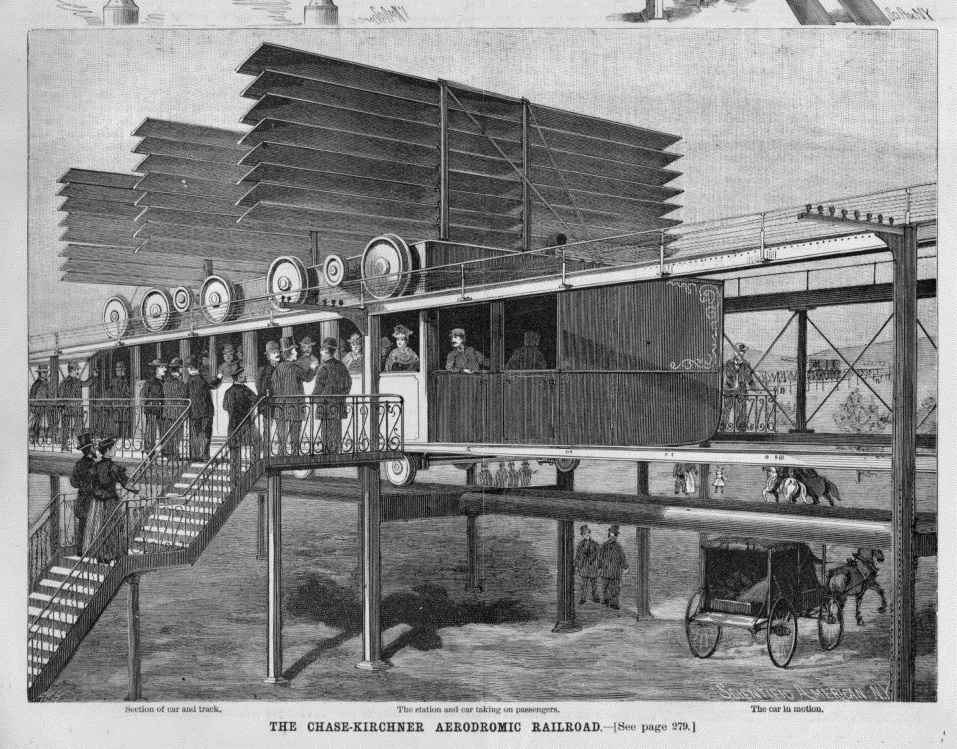
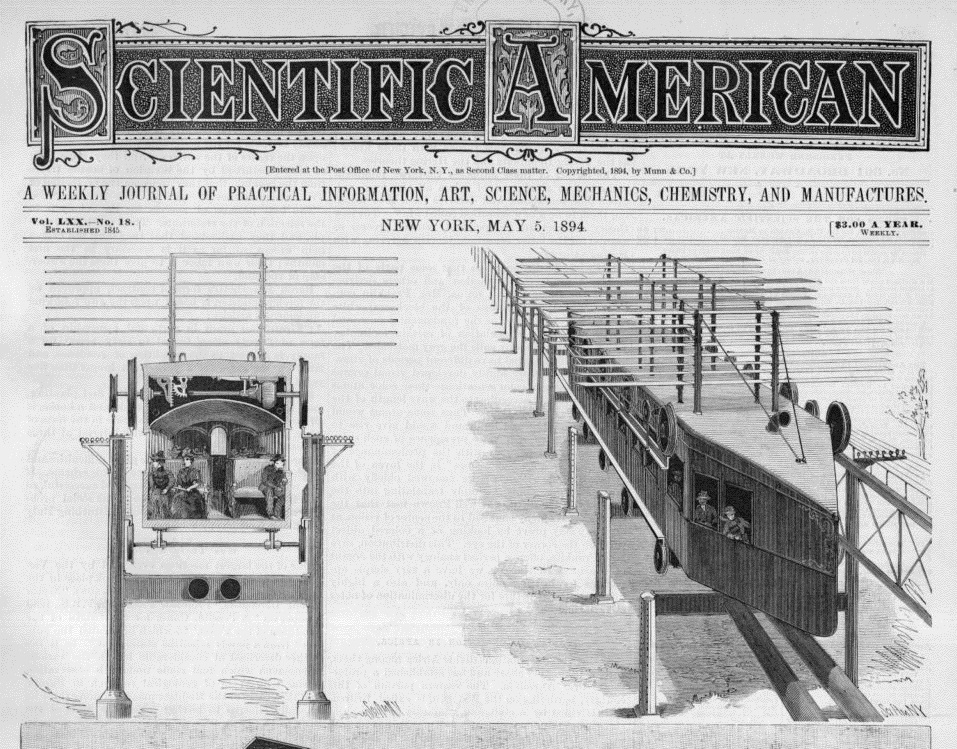
    In the history of transportation there haven’t been many marriages between trains and planes.  There have been proposals for Trains-Boats as we’ve seen in proposals for transporting ocean-going ships on a ganged series of railway cars and pulled  x-number of locomotives across the isthmus of Tehauntapec. I also recall a Balloon-Tramway-Train where hot air balloons were guided along a particular harnessed route 50 feet above the ground for miles and miles.  But the plane-train not found on the covers of Popular Mechanics in the 1930’s and 1940’s is a rare sight. I did spot a fantastic example of one though on the front page of the Scientific American for May 5, 1894. 

    Plane-train377

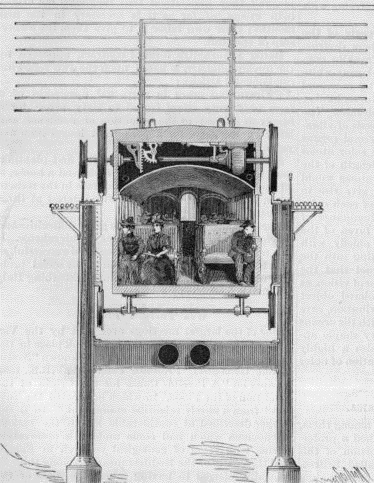
    It is a splendid beast–electric, under-powered, very heavy, and full of friction.  Somehow the engineers envisioned the train reaching speeds of over 130 mph, and with speeds this great it was essential that all curves be removed from the coast-to-coast rail line, making this a straight shot from coast-to-coast, literally.  (This would have just about doubled the land-speed record for sustained travel by rail, by steam.  I’m not sure what the record was for electric trains, though I’m pretty sure it is safe to assume it wasn’t close to the steam record.)

    The part about removing curves was mentioned twice in the article, so it was definitely not a typo.  The adjustable wings (here called “aeroplanes” which was the beginning of the terms that we now use to describe the whole aircraft) were added because it was felt that they would provide (some sort of) lift to the train. At the very least it was an interesting idea for 1894, and the wings would certainly have served a function of slowing the train down if they didn’t get ripped apart in the process.  

    Plane-train378


  • Blood Poison and its Non-Existent Mystery Cure, 1903

    JF Ptak Science Books   Quick Post

    See also the related post from 2012 “A Bloated Alphabet of Fat Cures: Strychnine Pills, Vibrators and Hope”, here.

    Blood poison352

    Pushing its way past other adds in the back of the May 1903 issue of The Confederate Veteran is this contagiously interesting advertisement for a very loud quack cure for “blood poisoning”.  It was manufactured by the Cook Remedy Company of Chicago, Illinois, and offered their cure (“unknown to the profession”) to sufferers of “the Bad Disease”, which they say can affect anyone, not just confined to “dens of vice or the lower classes”.  “Our magic cure” they say, can help all sufferers, curing “quickly and permanently”–otherwise the bad stuff happens, not the least of which was bringing “disease to you and disgrace upon your children”, which is tough hardball stuff, especially coming from con-artist quick-thieves who would say anything and offer any hope to desperate people for a buck, trading on frailty, ill-health, and fear.  

    By Cook Remedy was identified as a quack organization by the federal government, having a not-so-pretty appearance in the 1912 Hearings on the Pure Food and Drug Act.  

    I suppose that the cross in “Blood Poison” was designed to resemble a cemetery/graveyard marker…

    ·Posted by :

    ·in:

    —