A Daily History of Holes, Dots, Lines, Science, History, Math, Physics, Art, the Unintentional Absurd, Architecture, Maps, Data Visualization, Blank and Missing Things, and so on. |1.6 million words, 7500 images, 4.9 million hits| Press & appearances in The Times, Le Figaro, Mensa, The Economist, The Guardian, Discovery News, Slate, Le Monde, Sci American Blogs, Le Pont, and many other places… 5000+ total posts since 2008.

Category: Bad Ideas

  • Every U.S. Doctor Questioned About (Their) Cigarette Habits, 1946 (?)

    JF Ptak Science Books   Quick Post

    Seriously now–“every”?

    Every Doctor076Every doctor in private practice, unquestioned about their smoking habits, and happily the ones that answered positively selected Camel Cigs are their cig of choice. 

    Every Doctor075

     This ad comes from my own run of LIFE magazine and dates from January 7, 1946. It was a a massive campaign, begun at least by 1946 and establishing the tag about “More Doctors smoke Camels than any other cigarette!”, and is widely viewed as one of the most successful campaigns of any cigarette ever undertaken, which means it probably killed more people than did any other advertising campaign. This means too that more doctors were dying of smoking-related cancers, too, than by any other cigarette brand. 

    Plus, all that unfiltered tarry smoke makes the doctor a delight to smell, as well, especially if they were smoking through coffee grinds, in spite of that white rounds coat.  

    See the fine Stanford Collection of ciggie ads, here. 

    ·Posted by :

    ·in:

    —

  • Bombing Subs with Exploding Birds, 1918

    JF Ptak Science Books    Quick Post

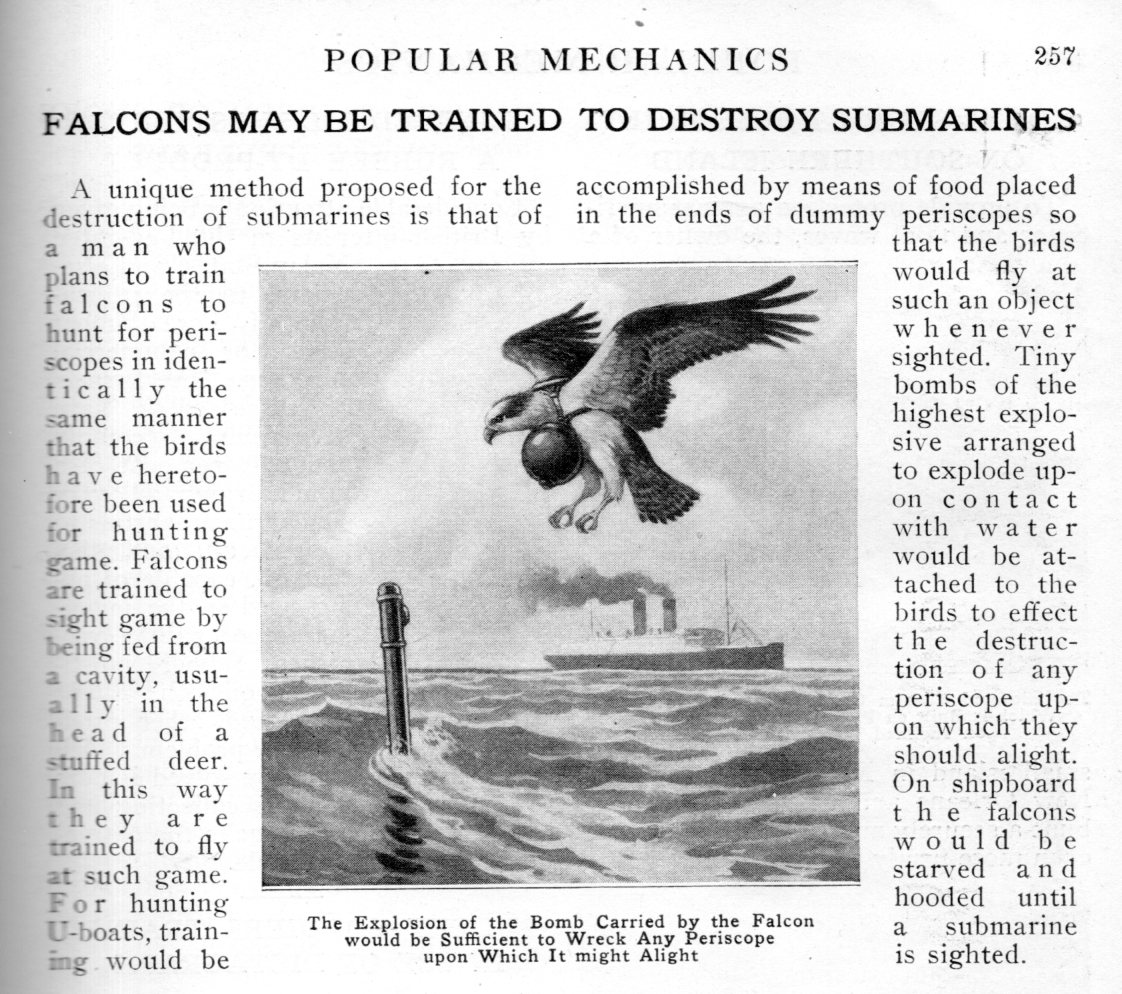
    This title sounds a little stretched and disingenuous, but it is not, not really–there was a plan to destroy periscopes of subs, rendering them ineffectual while submerged, and it did involved exploding birds, so the title to this quick post is largely true.

    The article/note explaining it all appeared in the February 1918 issue of Popular Mechanics, which is reproduced here in full. It is brief and to the point: a falcon would be trained to hunt a metal tube protruding from water, which is would attack while carrying a pouch of high explosives around its neck that would detonate when it came into contact with water.  No more periscope, no more sub, no more falcon.

    Exploding falcons956

    It does seem to be a wooden-cog reaction to a metal gear problem…and very off-putting.  

    I haven’t seen very many bits on using animals as actual weapons of mass destruction, though the ones I recall catapulted diseased animals over and into enemy lines, and a few other truly bad things not worth repeating. But I must say that I found this approach to warfare particularly repugnant, even for warfare of desperation.  

    ·Posted by :

    ·in:

    —

  • Electroshock Therapy for Melancholy in the 40+ Age Group

    JF Ptak Science Books   Quick Post

    Follow Me on Pinterest

    This advertisement for a remarkable new and ‘painless” therapy for involutionary melancholia looks to me strained and strangely Ken Keasyian, John-Forbes-Nashian. The disease–not actually recognized as such by the DSM-5–was said to be lessened by “electro-tonic therapy”, which looks to me to be electroconvulsive therapy, or ECT.  Evidently before treatment for illness like involutionary melancholia were available via antidepressants the ECT worked in some number of cases.  Still to me this looks like all kinds of bad.  

    ECT therapy

    ·Posted by :

    ·in:

    —

  • The Drunken Sale of a Sober Wife, with Pig Jobbers and a Bloody Battle

    JF Ptak Science Books    Quick Post

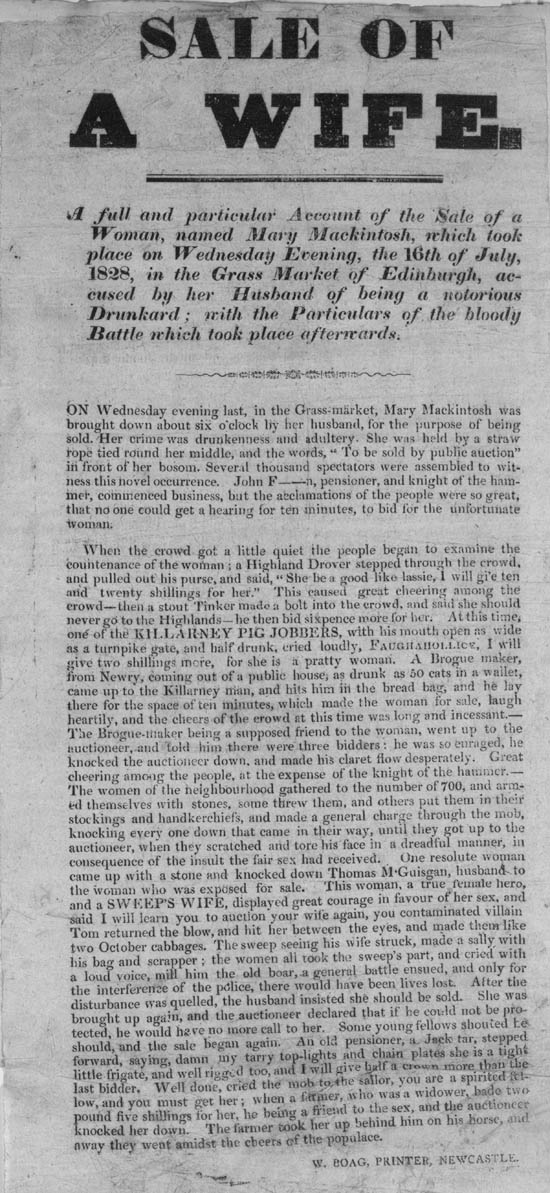
    The title of the broadside is constrained though it does give a little bit of a pull and hint about the juicy tenders to follow, all brought to you from the National Library of Scotland:

    ‘A full and particular Account of the Sale of a Woman, named Mary Mackintosh, which took place on Wednesday Evening, the 16th of July, 1828, in the Grass Market of Edinburgh, accused by her Husband of being a notorious Drunkard; with the Particulars of the bloody Battle which took place afterwards.’

    Unfortunately it was legal to sell your possessions and your wife, though it seems as though this was an activity of the “lower classes” and a much frowned-upon activity by most.  

    And here are one set of the details that you could purchase for a penny, with much colorful language and alliteration to come:

    “When, the crowd got a little quiet the people began to examine the
    countenance of the woman ; a Highland Drover stepped through the crowd,
    and pulled out his purse, and Said, ” She be a good like lassie,’l will gi’e ten
    and twenty shillings for her.” This caused great cheering among the
    crowd?then a stout Tinker made a bolt into the crowd, and said she should
    never go to the Highlands?he then bid sixpence more for her. At this time,
    one of the KlLLARNEY PIG JOBBERS, with his mouth open as wide
    as a turnpike gate, and half drunk, eried loudly, FAUGHAHOLLICE , I will
    give two shillings more, for she is a pratty woman. A Brogue maker,
    from Newry, coining out of a public house; as drunk as 5O cats in a wallet,
    came up to the Killarney man, and hits him in the bread bag,”

    Broadside wife seller

    Full transcription http://digital.nls.uk/broadsides/broadside.cfm/id/15971/transcript/1

    Source:  National Library of Scotland  http://deriv.nls.uk/dcn3/7441/74414096.3.jpg


  • Cigarette Women of the Second Dimension, 1940

    JF Ptak Science Books   Quick Post

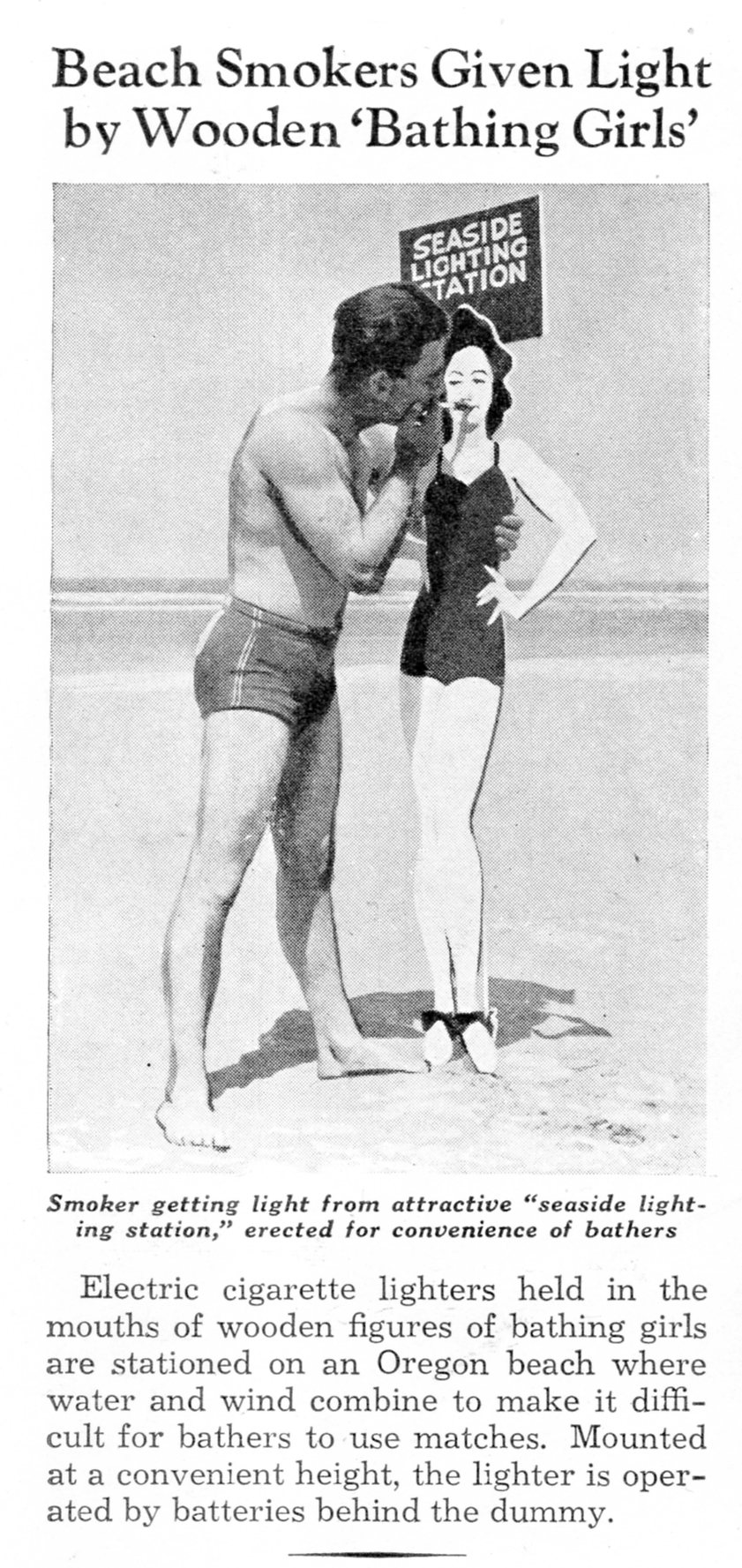
    Nothing quite spells out the duties of subjugation as being a one-dimensional-purposed two-dimensional object.  And in the world of these things few seem to come as close to becoming-a-real-girl in the Pinocchioiana sense than this item.


    Woman ciggie lighter corrected875

    It is a cigarette-lighting girl for beachgoers, found sleeping lightly on page 556 of the October 1940 issue of Popular Mechanics.  It seems that it is an issue for people being able to light their cigarettes on the beach, so cigarette manufacturers or their agents or agents of agents manufactured this device to make sure that no ill wind would come between the cigarette consumer and the uninterrupted consumption of cigarettes.  And so this device was created–the lightless ciggie smoker would come up to the cut-out and place their cigarette tip into the recesses of the lighting element in the cutout’s mouth.

    Weird, filled with dread, and true.  

    ·Posted by :

    ·in:

    —

  • Multiple-Maginot and the “Floating Wall of Fire” (Romania, 1940)

    JF Ptak Science Books    Post 2430

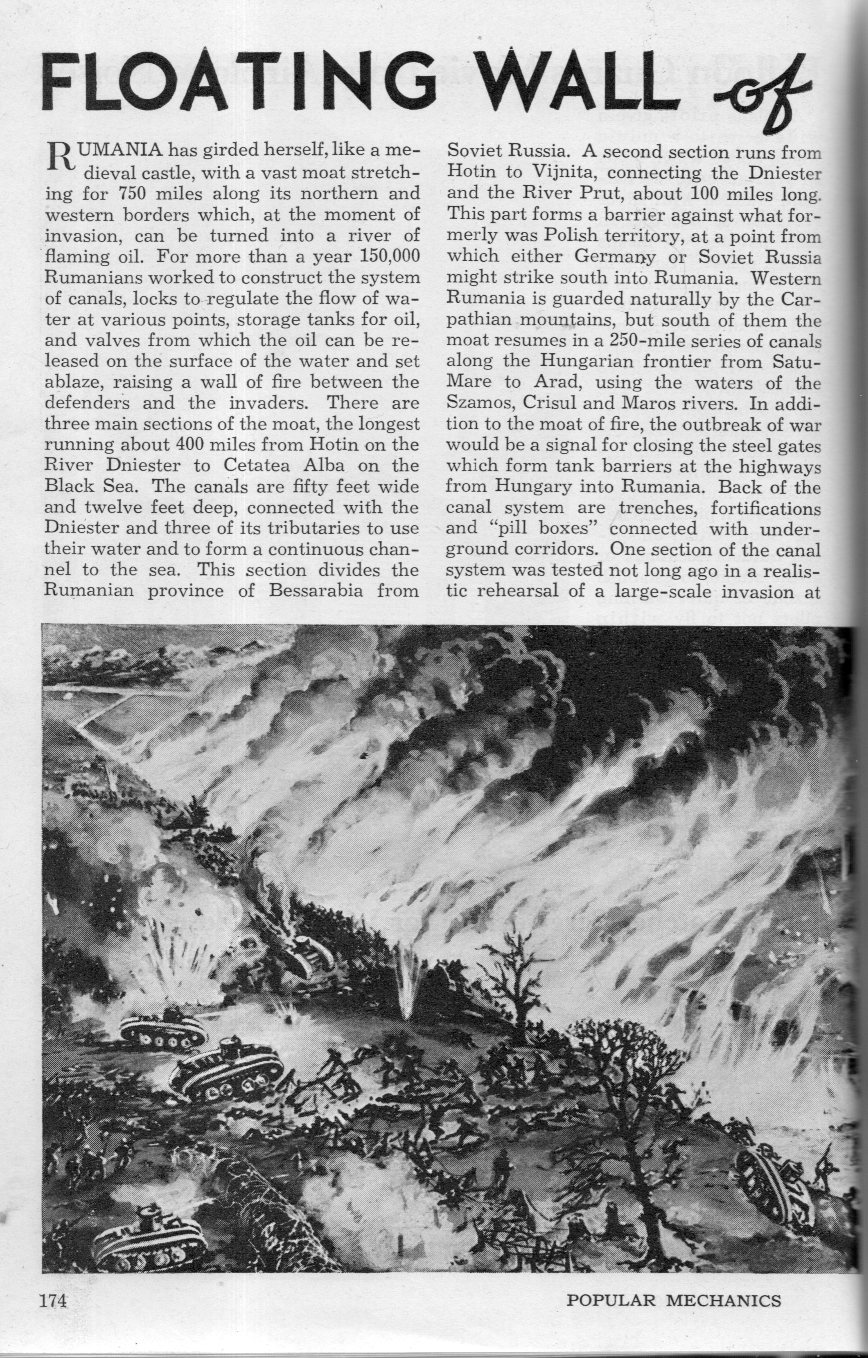
      Fire wall872Fire wall871

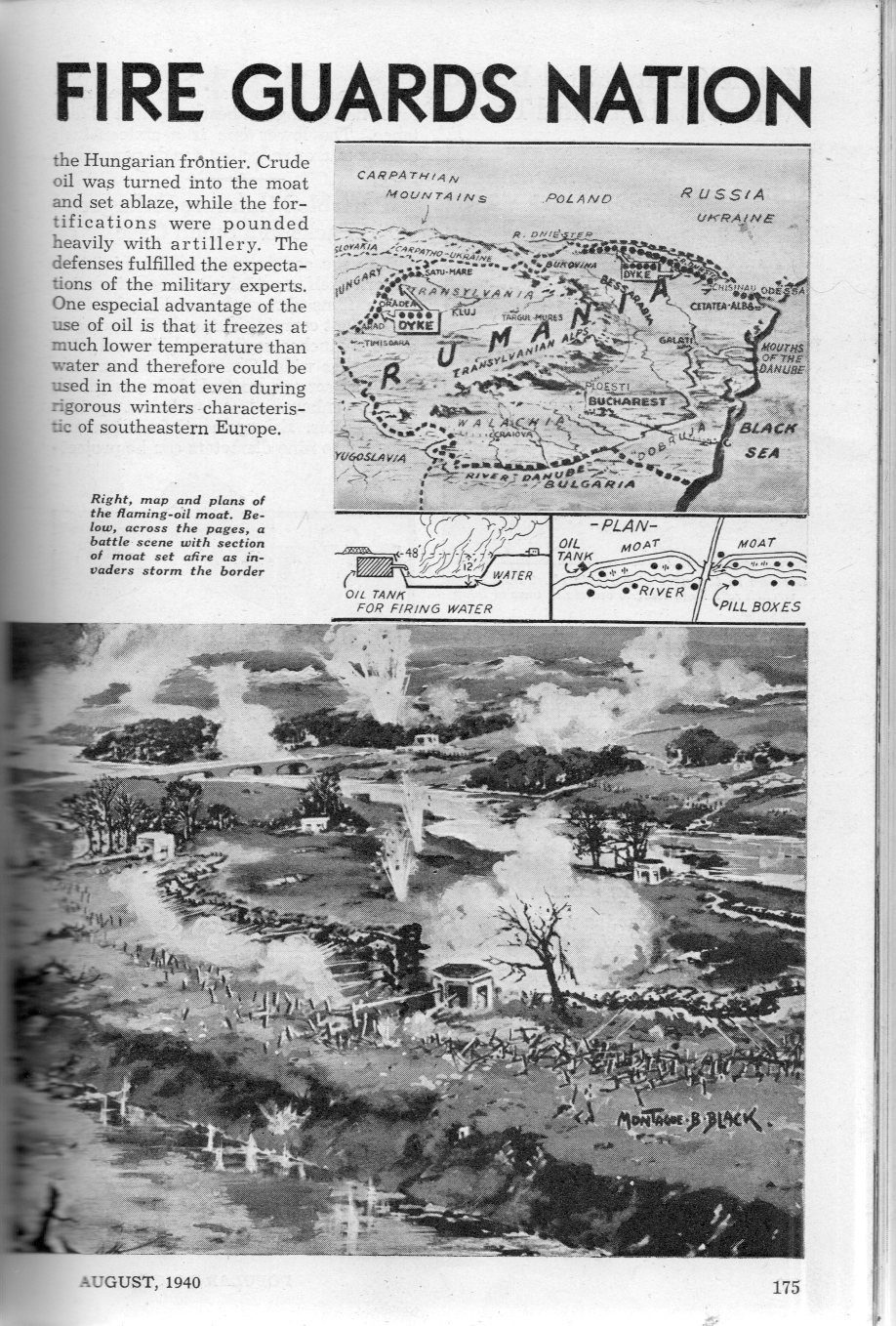
    In August 1940 Popular Mechanics reported on another example of cloudy thinking on the coming world of warfare–the “Floating Wall of Fire” of Romanian defensive consideration.  The article tells the story of how Romania “girdled itself, like a medieval castle, with avast moat stretching for 750 miles….which, at the moment of invasion, can be turned into a river of flaming oil”.  The canals which make up this open-pit Maginot line were 50′ wide and 12′ deep, the longest of them running some 400 miles, the combined efforts of the big dig meant top protect the country from invasion from Hungary, Poland, the Soviet Union, Yuoslavia, and Bulgaria–and of course from Germany which at the time could advance from a number of different positions.  There were also hundreds of gun emplacements facing the pit, I guess to fire on whomever if they decided to try and break through/over the moat, which would have been flooded with crude oil and set ablaze when invasion occurred.

    The problem of course was that even a year after the Blitzkrieg in Poland with the combined assault by land/air forces the lesson had not been learned here–unless of course the flames were 20,000′ high.  And obviously the river of fire would last only so long–depending on available amounts of crude oil I wonder how long they determined the wall of fire could be maintained?  A day?  A week?  (I know that from controlled burns of oil spills that in one case some 16,000 barrels of floating oil was burned off in a controlled burn in about four hours–it seems to me that if there was an invasion front that was miles wide and striking at numerous point along a 100-mile front that…well, the problems are obvious.)

    Could anyone have expected an invasion force to arrive and then once confronted by a burning moat turn back and retreat?  

    In spite of fulfilling expectations during a “rehearsal of a large-scale invasion”, it seems very highly dubious that anyone could really have been comfortable with the first line of national defense being fire in a long hole.  

    [It should be mentioned that after the once-neutral-ish Romania settled into its relationship with the Axis that the worst single-mission air losses for the U.S. Army Air Force occurred in the bombing of petroleum facilities in the area of Ploiesti, Romania, on 1 August 1943. In an unsuccessful attempt to damage the flow of petroleum to Axis forces, Operation Tidal Wave targeted this location but with devastatingly bad consequences, with 53 aircraft and 660 servicemen lost in the action.]  


  • Nazis in the Soup; Found-Swastikas, 1935

    JF Ptak Science Books  Quick Post

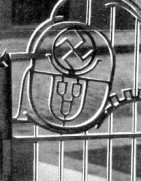
    I know this shouldn’t be so semi-surprising and yet so not-unexpected, but it is–finding NSDAP/Nazi symbolism in Germany in the ’30’s embedded in and “edifying” common items and ordinary locations.  The thing would just appear, like a little stamp of approval, in advertisements for toothpaste, cars, pins, engines, oil–multiple alphabets of everyday bits made to associate with NSDAP emblems.  In this instance the found-swastika  caught my eye in a design detail for a gate. The company, Remanit (in Krefeld, northwest of Dusseldorf), specialized in indoor and outdoor stainless steel fixtures–handrails, lighting elements, doors, gates, so on. The gate in the ad–appearing in an oversized magazine on art and taste, Die Kunst, Monatschefte fuer Freie und Angewandte Kunst, volume 74, 1934/5—contained a decoration of a family crest-like design, incorporating a cross; on the other gate, another crest, and almost lost in the shadow was a large swastika.  Party members and sympathizers and other passives used the symbol (in its many iterations) quite a bit,adorning their possessions and products with it– and evidently also in one’s stainless steel impervious-to-rusting-but-not bombing gate crest, a stamp of approval for the eclipse of a culture and nearly unprecedented destruction. 

    Nazi soup851

    And the detail:

    Nazi soup852

    ·Posted by :

    ·in:


  • And in the Middle of Nothing: Racial Purity Bubbles (1937)

    JF Ptak Science Books    Quick Post

    Piedmont purity681 detail

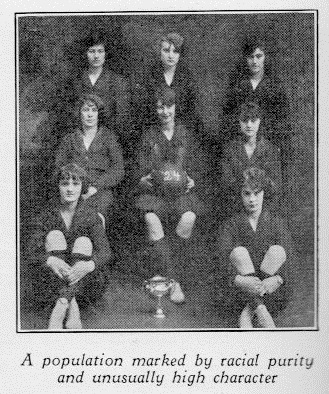
    I was having  a breezy little time looking through Piedmont Carolinas, Where Wealth Awaits You, published by Duke Power in 1937 and extolling the many virtues of living in the section of North Carolina between the western mountains and the western edge of the lowlands–this is not far from where I’m sitting right now, in the Southern Highlands, 50 miles west. I was enjoying reading about the beautiful roads, and the fine country (where farmers outnumbered industrial workers three to one).  

    But then the romance stopped, bumping into this:

    Piedmont purity681

    The pamphlet was pleasant and standard-enough discussing manufactures,industrial markets, industries, farms, opportunities, and so on, and then along comes this bit, folded into the teased normalcies. 

    ·Posted by :

    ·in:


  • Children and Labor, 1937

    JF Ptak Science Books     Quick Post   

    • (There are several posts on this blog relating to child labor–a simple search in the Google box will bring up a few.)

    What a dirty little pamphlet this is–at least that’s the way it feels in my hands.  The author, Sara Birchall, takes to task the results of a survey that finds 10,000 child toilers” in New York (in 1937). The push behind the survey was for the passage of a constitutional amendment banning all child labor. Birchall makes the case that the “quaint statistics” are incorrect, and that state in themselves have taken great leaps to end the child labor menace, and therefore the need for a federal involvement (“boondoggle”) was happily unnecessary.

    Child labor680

    I don’t know what the National Child Labor Committee (founded 1904) had to say about this in particular. They were certainly active in the push for a constitutional amendment, though that effort would be pretty much d.o.a. in the mid 1930’s.  Ironically just  a year after this missive was written came the Fair Labor Standards Act, which very heavily favored child labor laws pushed by the NCLC.  In the weight and gravitas of the issue, Birchall’s effort left a mean, red-knuckled impression on me, saying the federal initiative wasn’t worth the effort and that the whole deal could be handled at the state level.  That was sort of true, though my guess is that things might have happened quick for a couple of generations of child laborers had there been a cohesive national plan. 

    ·Posted by :

    ·in:


  • Massiveopolis: Filling in the North Sea (1930)

    JF Ptak Science Books   Post 2378

    This is part of a series of Mega-Massive Invisible Engineering, the Filling-it-In Section. Other examples from this series not necessarily filling-stuff-up include:

    The title of this post is a bit of a tweeker–the project is not to fill in the entire the North Sea, just the southern North Sea.  This actually makes a pretty big difference bathymetrically, because the sea floor gets mighty deep up along the coast of Norway. Still, though, as impossibly ambitious projects go, this is still a massively unstable consideration, the entire North Sea or not.  
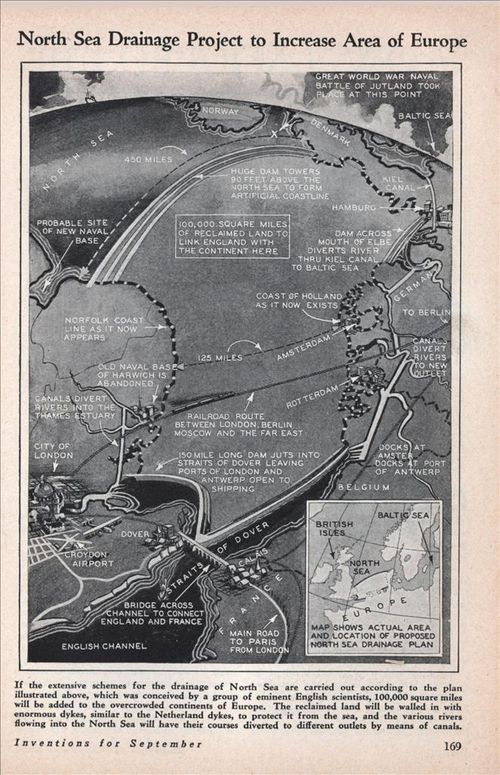
    North sea[I owe the fun I had thinking about this project to two great sites: Modern Mechanix and Imaginary Cities–Modern Mechanix for posting it to begin with and Imaginary Cities for tweeting it.  These are two great sites well worth subscribing to.]

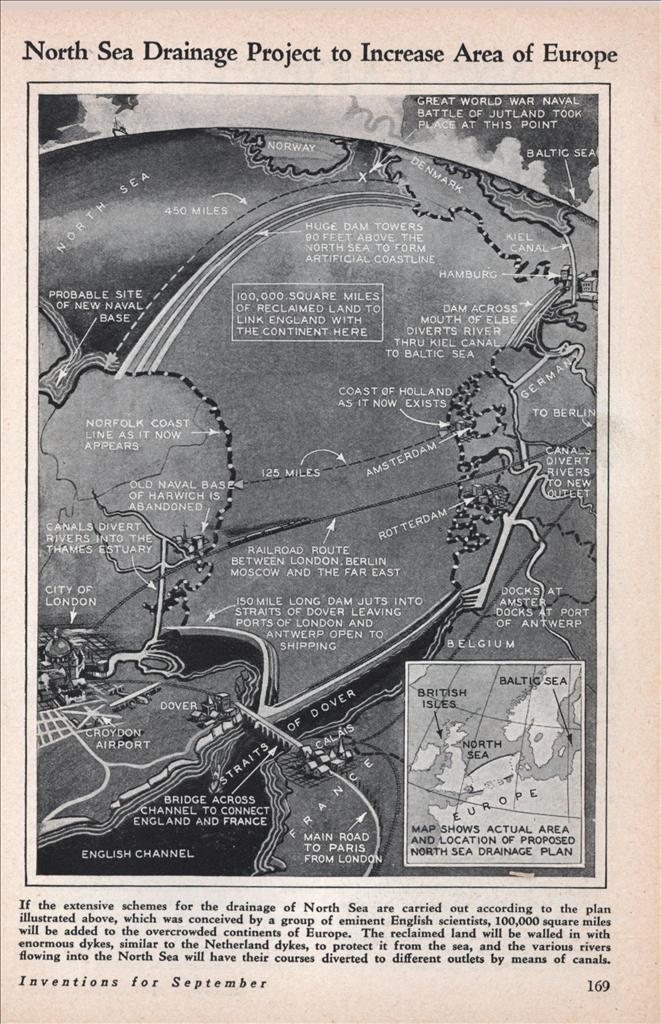
    A sort-of Atlantis was drowned some 8500 years ago, a large piece of land that connected what is today Great Britain and Europe. Rising water did away with this territory leaving behind the great island nation and much else. The plan referred to above in the title is the extraordinary thinking for “raising” that lost Atlantis-esque land, and was floated in the September 1930 of Modern Mechanics. 

    The author maintains some sort of possibility for recovering some 100,000 square miles of submerged land that would connect south-eastern England with France, Belgium, the Netherlands, and Denmark. It would be accomplished by erecting some 700+ miles of dykes and dams and then, somehow, emptying all of that surrounded and captured water into the sea that it once belonged to.  

    100,000 square surface miles is an area twice the size of England, three times the size of Lake Superior, nearly the size of the Caspian, and equal to the size of Colorado. 

    The English Channel and the straits of Dover would become a divided thoroughfare; the Thames would be part of a canal system that would extend along the old Norfolk coast to The Wash; a bay from the Straits would extend inland to Belgium, where it would be met by a canal system that would extend to the Baltic.  All of this would be held in place by a 150-mile long dam of unusual  shape. And just for good measure, bisecting these two would be a monster bridge from Dover to Calais. 

    This is of course extraordinary, but when we look north we see a breathtaking proposal for a  450-mile long, 90′-high dyke extending from the English coast to Denmark. The artwork claims that this is 90′ above the water for the rest of the North Sea, which means that the structure would have to be at least 110′-150′ high, plus the foundation. Luckily for the designer the southern North Sea is a relatively shallow water sea, 20-40′ deep, though there is a stretch of 100′ miles where the depth is considerably deeper.  I haven’t considered yet how wide this dyke would be, except that it would be, well, big.

    There is also a drawing for a London-Berlin and points east train. The  Elbe is dammed, and it looks as though the Netherlands is no longer the Lowlands, everything there being “filled in”, with the sea being moved some 200 miles to the west. 

    This is just a short spec piece that appeared in a popular science magazine 84 years ago, but there is no mention of what these changes might mean to the currents of the south North Sea, or Jutland coastal waters, or the Continental Coastal waters; or the changes it might dictate to salinity, or nutrients to the rest of the North Sea, to say nothing of the sea floor inhabitants and fish, and so on.  There would no doubt be some natural consequences to this (literal!) undertaking.  

    I suppose someone at some point would have to think about how all that new land would be divided, but I guess that would all take care of itself.  

    • Another related article from Modern Mechanix posting a Modern Mechanics May 1931 addresses the issue of water removal albeit at as much lesser scale, here.