A Daily History of Holes, Dots, Lines, Science, History, Math, Physics, Art, the Unintentional Absurd, Architecture, Maps, Data Visualization, Blank and Missing Things, and so on. |1.6 million words, 7500 images, 4.9 million hits| Press & appearances in The Times, Le Figaro, Mensa, The Economist, The Guardian, Discovery News, Slate, Le Monde, Sci American Blogs, Le Pont, and many other places… 5000+ total posts since 2008.

Category: Bad Ideas

  • Abbreviating Auschwitz: the Construction Contract for the Building of Auschwitz III

    JF Ptak Science Books 

                        1blogsept_23_astro_det641_2

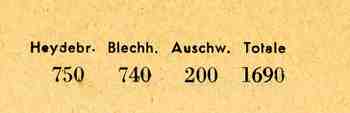
    This document of death, this pamphlet is the Auschwitz III Construction Contract between IG Farben and the Confederazione Fascista degli Industriali for Construction of the Buna Works at Auschwitz III, as well as construction at Heydebrek and Blechhammer, and was printed in 1942.  I’ve only been able to scan five pages as the document is fairly weak and I have a flat bed scanner–I just don’t think it would take much more abuse without falling out of its binding.  But I have scanned some of it, notably the participatory Italian companies and some of the allocation of workers to the different concentration camps.
    1blogsept_23_astro_cvr_detail643

     
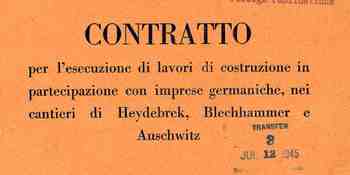
    The full title reads of the work reads:

    Contratto per l’escusione di lavori di construzione in partecipazione con imprese germaniche, nei cantieri di Heydebrek, Blechhammer e Auscwitz. It was printed by Tipografia del Gianicolo, in Rome, 1942, by the Confederzione Fascista degli Industriali, Federazione Nazionale Fascista Raggruppamento Germania.  The document measures a fragile 30.5 x 21 cm,  and is 29 pages long.  Like dozens of thousands of other things here at the store, this was formerly in the “Pamphlet Collection” of  the Library of Congress (which received the publication 12 July 1945) until we purchased the collection at the end of 1999.   
    Auschwitz_12map

    This is also probably the most awful thing I own.  Its like looking at those blueprints for the crematoria and the barracks–so precise, swimming in their blue pool, these concise, sure, white lines; designs for one of the worst things built in the 20th century–just drawings, lines on a long sheet of paper, for building something.  Completely removed from the breathing world, just cold logical constructions for someone else’s end.  That’s the feeling I get from handling this thing–the Italians and Germans figuring out where to put the thousands of workers, making sure that they get paid, providing for some sort of maintenance for the workers’ health, salaries, benefits, work schedules, breaks, vacations, incentives, mailing and the post, and so on.  All of the bits of the most mundane things that go into a large construction projects, like building a highrise, or a tunnel, or a highway, or a bridge to hell.  This contract could’ve been for just about anything at all.  But it isn’t.  Its for building a part of Auschwitz when anyone with any sense whatsoever knew what was already going on there.

    Of the many terible things in this document I was really bothered to see Heydebrek, Blechhammer and Auschwitz abbreviated at the top of some of these pages.    This is just so wrong. Wrong on every level, being an attribute of the nothingness, of the emptiness, of this document. 

    It is a simple, basic document on one of the least simple and basic things of the 20th century.  The contract detailed labor expectations, needs and regulations from both the German and laboring Italian sides for the construction of these three concentration and slave labor camps in 1942.   Subjects of interest in this document include salaries, housing, vacations, health care and insurance, as well as the application of German laws to the workers, qualifications, and classification of occupations.

    Perhaps the part of most interest is the short list—reprinted below—on pages 3 & 4 of the firms and engineers taking part in this agreement..

    ***

    The names that are attached to this document and signing off on the contract of this agreement (of 2 March 1942  which provided 8,636 Italian laborers for this construction) include:

    1)    for IG Farbenindustrie AG, Heydebreck, Heydebreck OS
    Adolf Mueller and (Hans) Deichmann

    Hans Deichmann served as (senior) legal representative for IG Farbenindustrie in Rome and Milan from 1942 to 1945 and in 1942 was responsible for recruiting Italian workers for construction in the above-named concentration camps.

    2)    for Oberschleische Hydrierwerke AG, Blechhammer, Kreis-Consei       
    Schlick

    3)    for IG Farbenindustrie AG Auschwitz, Auschwitz OS
    Adolf Mueller and (Hans) Deichmann

    The signatures representing Italian interests include:
    Aurelio Aureli
    Giacomo Milella

    Notes:
    –Blechhammer was a satellite camp of Auschwitz III (Monowitz)
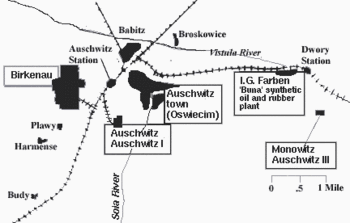
    –Auschwitz III, also called Buna or Monowitz, was established in nearby Monowice to provide forced laborers for the Buna synthetic rubber works. The German conglomerate I.G. Farben established a factory in order to take advantage of cheap concentration camp labor and the nearby Silesian coalfields. It invested more than 700 million Reichsmarks (about 1.4 million U.S. dollars in 1942 terms) in Auschwitz III.

    On Italian labor being used at Nazi Concentration camps, as found in Vol  VIII, pg 749, 
    Nuremberg War Crime Tribunals:

    Q. Did you go to ter Meer* to get Italian workers — I am thinking of a prosecution exhibit, the one which was shown to ter Meer on cross examination.

    A. I was told at the time by an official source that Italian industry, after the collapse, would no longer produce because there was no coal, no current, or something. I was also told that since the Italian State obtained goods from Germany — buna, for example — the Italian State would be willing to enter into an agreement with Germany to make labor available, as was always the case from Italy. I said to him: “In case that is so” — neither ter Meer nor I knew whether that really would be the case — I said, “help the people at Auschwitz; help them to get workers if now” — I believe this was in 1944 — “the plants gradually go into operation.” For in these plants we wanted to have skilled workers — as I said yesterday, it is very important whether or not the man in charge has knowledge of the work he is doing.   –Vol  VIII, pg 749,  Nuremberg War Crime Tribunals. 

    *”Fritz ter Meer served on the IG Farben [Farben was Hitler and Hitler was Farben. (Senator Homer T. Bone to Senate Committee on Military Affairs, June 4, 1943.] board of directors from 1926 to 1945 and was the head officer directing the operations of the IG Farben factory at Auschwitz. The Nuremberg War Crimes Tribunal sentenced him to seven years in prison. He was released after serving only four years. Not long after, in 1956, Ter Meer was elevated to the chairman of the supervisory board at BAYER, a position he held for seven years. His grave in Krefeld has a meter-high wreath on it – donated by BAYER in recognition of his services.”
    ·Posted by :

    ·in:


  • Stalin’s Repugnant Haiku: Poetry Using Stalin’s Borrowed Library Book Titles (1926)

    JF Ptak Science Books    Post 2216  History of Blank, Empty, and Missing Things series

    I don’t mean this post to be snarky or irreverent, really, because we’re dealing with one of the most fantastically murderous people in the history of humans.  Since the seven book titles that I have been able to find so far are so, well, unusual, that pulling the individual words out and alphabetizing them might prove to be an insight into the mind of grown-up Soso, Joseph Stalin.  I found the titles while researching Stalin’s report card from when he was a child, and found “Stalin’s Library Card”, by David Wojahn, a poem in seven parts that treats each of the books borrowed by Stalin in 1926, when he was 47 years old. 

    Stalin in 1926 had been General Secretary of the CPSU for two years, in spite of several years of bickering and argument with the stroke-ridden Lenin, who for some years before his death (in 1924) grew more stratigraphically dissatisfied with Stalin and warned the resat of the leadership against him.  After maneuvering against Zinoview, and Kaneneov, and Trotsky, and Bukharin and all of the people below them, Stalin was by this time solidifying his power.  Purges, manufactured famines, internal deportations of millions, executions, imprisonment, and stupid decisions at the beginning of the German invasion of the USSR in WWII, Stalin had his had in causing the death of many millions of people.  

    What did he have in mind in 1926 with these books1? Well, I think we know. There are 36 words used in the titles, including six repetetives, leaving 30 unique words.  There’s certainly enough for haiku if you wanted the taint, and a poem like that could be one that would be difficult to unremember, not (in spirit but of course not in equivalence) unlike the unremembered masses who were forced into “non-personhood” by Stalin, who when he finally died was left out of the very next printing of the Great Soviet Encyclopedia as the Vast Un-nameable. 

    I’m cataloging this entry in the History of Blank, Empty, and Missing Things series because Stalin caused so muuch of that to happen to so many people, to nearly an entire country.  And then he became missing, himself.  


  • Lowering the Mediterranean, 1930 (!)

    JF Ptak Science Books (continuing an earlier post) 

    A Monumental and Potentially Fantastically Bad Idea: Draining the Mediterranean

      Soergel403 [Image source: private collection.]

    “Simply the thing I am shall make me live.”–from Jorge Luis Borges, “Shakespeare’s Memory”

       
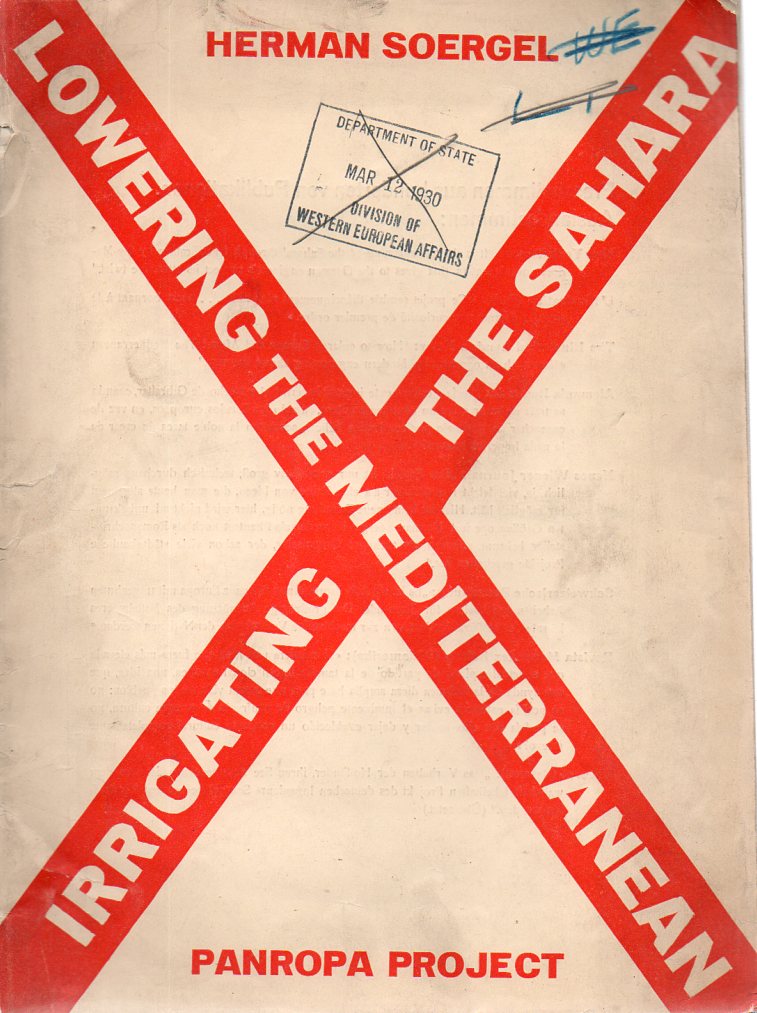
    It would be a Purgatory, or worse, to suddenly wake up one morning with another person’s memory–worse yet than to have wished it, only to find that you didn’t want it at all.  This evidently works out with memories high and low, though it is tempting to want to wish to see what the inspiration looked like for one idea located in a particular memory.  Or maybe not.  But I am curious about when and here the author of the pamphlet above got his idea, and what it looked like to him–did he hear or see or smell something that prompted the inspiration for this reverse-monumental jolt?

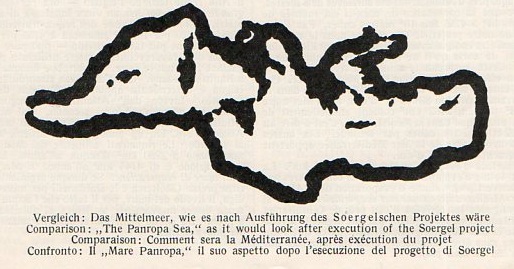
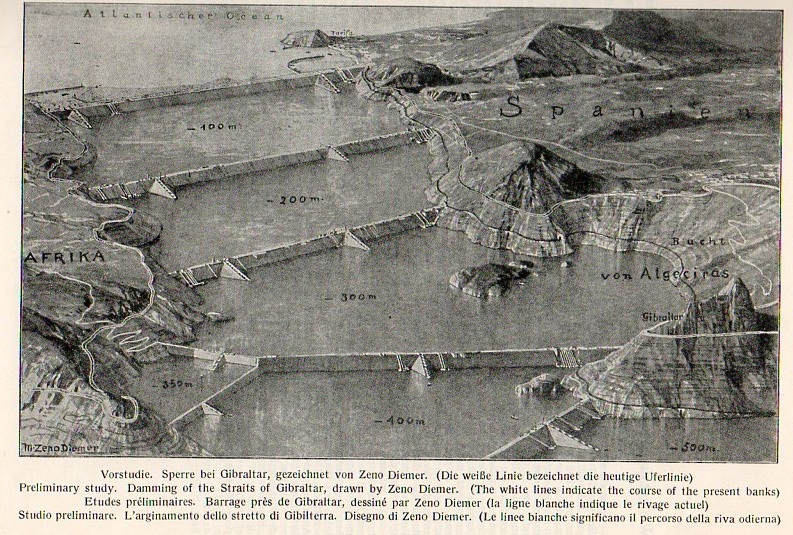
     It is interesting to pursue a loose thought like this to its not-necessarily logical end.  Such is the case with the self-styled Paneuropic ideas of Hermann Soergel (1885-1952), the author of the above. Soergel was a Bauhaus architect and author of a number of works on design and far more ethereal, floating-castle ideas. His most spectacular contribution—incubated in the mid-1920’s and still clinging by its fingertips as an idea among some current thinkers—was to put a dam across the straights of Gibraltar.  The dam would generate electricity of course, but most importantly to Soergel, it would also empty an enormous amount of water from the Mediterranean leaving vast new expanses of land to be developed and colonized over generations into the future.  The water of course would have to go somewhere, and that somewhere was the Sahara Desert, somehow in its wake creating farmable and productive lands. Soergel was creating a certain, very wide, fantastical future of uncertain monumental prospects.

    Soergel405
    A “brief outline” of the idea was published in this four-language pamphlet, Lowering the Mediterranean Irrigating the Sahara (Panropa Project), which was published by J.M. Gebhardt in Leipzig in the very bumpy year of 1929. (The Weimar years in Germany were already into deep bumpiness; the rest of the world would follow suit in October of that year.)  To be fair, Soergel didn’t plan on emptying the entire Mediterranean, just a bunch of it–at least enough to be able to rename it.

    [Here’s a map of the new Mediterranean, or the Mediterranean that would be made to go away.  As you can see at this point Sicily and Italy become enormous, and the Greek Islands are combined to form one large land mass–this last bit alone is enough to form total and complete reisstance to this idea. Also at this stage perhaps 150 or so miles of new lands have been reclaimed from the sea all along its former borders–more so in Turkey.  There is no mention as yet of any new islands that are formed in the sea water’s wake.]

    Soergel404

    The master plan at work was that the world would be divided into three economic spheres in the future, all beginning with the letter “A”:  American, Asia, and the new land to be created by Soergel, “Atlantropa”, which was the former Europe expanded into the new dry beds of the Mediterranean and North Africa.  And also of course Egypt, which would be covered with “thousands” of canals and become semi-submerged by the new borders of the meandering sea.  This would be the way for Europa to compete with the rest of the world in the future. 

    [I should point out that the image above comes from the Illustrierte Zeitung (Leipzig) for August 1931, and is a drawing by an artist named “AS. Christ” depicting a cross section of one of the bridge/dams of Soergel’s Panropa’s ideas.]

    Perhaps it is actually three steps to get from the idea of damming up the straits of Gibraltar to the osmosis of Shakespeare’s memories into someone else’s brain—a squinting acquiescence of the middle touch being the brilliant Jorge Luis Borges.  You see it was in the Argentine master’s last published story, “Shakespeare’s Memory”, that we meet Herr Soergel (as Hermann Sorgel) again.  But so far as I can remember Soergel exists only as a fictional character, with no reference to his real-life self.  In this wonderful story, Soergel inherits the memories of William Shakespeare—these bits come to him slowly but surely, until they start to conflict with his own memory, and things get difficult.  The man with Shakespeare’s memories winds up phoning strangers on the telephone, giving them away at random, until Soergel is left with his own mind again.  Superior as Bill’s memories were, they still weren’t Hermann’s, who wanted his own life back in the end. 

    And so from the titanic, pan-europic technodream of Bauhausian Hermann Soergel to the dead brains and living memories of William Shakespeare, all through the fingers of the beautiful Jorge Luis Borges.  

    ==Blog July 21==shakespeares memorie

    I’m sorry to report that at the end of it all, near the end of the pamphlet, Soergel releases his opinion on the political importance of his project.  And yes, his aim was to form an alliance between the new PanAmerica (of the “three Americas” with the new Pan-European African Union to thwart “the yellow peril” which “arises from the racial antipathy of India, China and Japan.  Soergel writes that “the fate of occidental civilization…will be settled on the Mediterranean”.  

    After it is all said and done, perhaps the best reiew of the work by Soergel is provided by the graphic designer who put the Big Red X on the cover of his work.  It fits. 

    Some of the works by Soergel include the following:

       Atlantropa. Fretz & Wasmuth, Zurich / Piloty & Löhle, Munich 1932

    Vorwort zu: Wayne W. Parrish : Technokratie – die neue Heilslehre , Piper, München 1933

    Die drei großen A, Amerika, Atlantropa, Asien , 1938. The three large A, , Atlantropa, Asia, 1938

    Atlantropa-ABC. Atlantropa ABC. Kraft, Raum, Brot. Kraft, Raum, Brot. Erläuterungen zum Atlantropa-Projekt , Arnd,Leipzig 1942 

    Some works about  Soergel: 

    Alexander Gall: The Atlantropa project. Die Geschichte einer gescheiterten Vision. The story of a failed vision. Herman Sörgel und die Absenkung des Mittelmeers .

    Herman Sörgel and the lowering of the MEditerranean . Campus, Frankfurt am Main 1998. 

    Wolfgang Voigt: Atlantropa. Wolfgang Voigt: Atlantropa. Weltbauen am Mittelmeer. Building the Mediterranean world.Ein Architektentraum der Moderne . An architects dream of modernity. Dölling und Galitz. Hamburg  1998.


  • Dangerous & Impossible Books: Writing that Hurts When Read

    JF Ptak Science Books  Post 2203 (an earlier post continued and expanded)

    “Sometimes a book is just entirely bad, and sometimes it is entirely nothing. It is impossible for a book to be both very bad and very nothing. Impossible.  Except for this book, whose badness is exceeded only by its nothingness, and vice versa“.  (probably not) Oscar Wilde

    And so into this black hole of imaged Wildeian description we go, into a very real-ish book.

    I found a novel tonight, bought long ago and long ago mostly lost.  It was written by a doctor who worked in the District Hospital in Lima, Ohio, and written in 1934.  The Lima Hospital was the largest poured concrete structure in the world when it was built in 1915, and stayed so until the Pentagon was completed.  The hospital was established for the criminally insane, had 14″-thick walls, and reinforced steel bars laid into the walls that went “right down to bedrock”. 

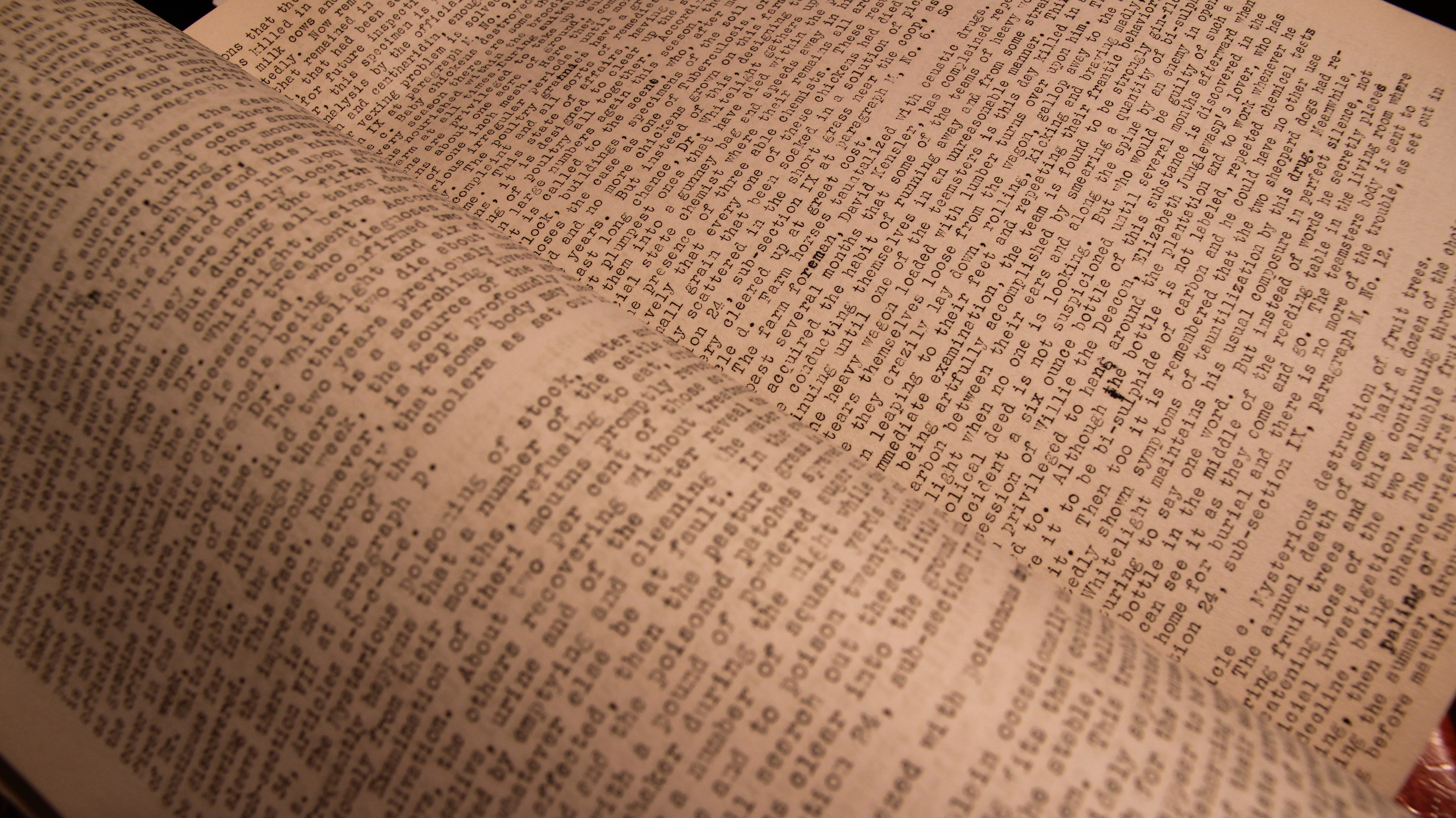
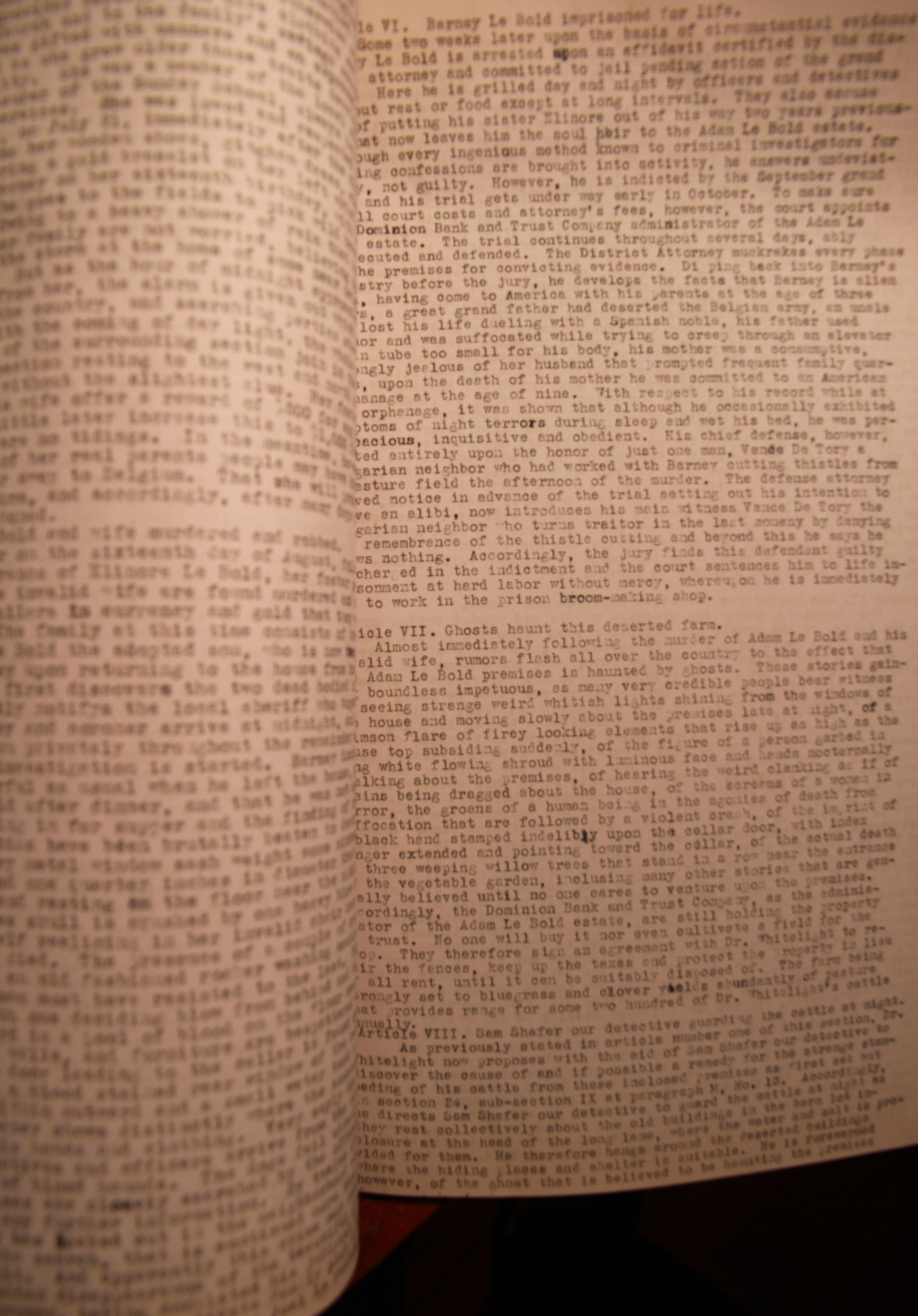
    It was somewhere in there that this doctor wrote something that was really so toweringly bad that it escapes comprehension. I own the carbon copy of the unpublished work, which is typed on 14×8.5″ sheets of paper, front and back, running 94 pages. It is a very crowded affair, with 90 lines of single-space typed lines, making the work about 115,000 words long. 

    There wasn’t enough space evidently for paragraphs, which gives the work a kind of insistent, casket-cramped cruelty.  To read it takes your breath away for its dullness–the book moves so weirdly and at the same time so very slowly that it doesn’t move at all even while moving.

    Manuscript insane one

    A few months ago I found the seven-foot-long scroll of the book’s plan–a work of crowded magnificence of nothing and confusion, being very orderly at the same time.  It went to a friend of mine who created artwork around it, and as it happens made a very noticeable appearance in a very significant yearly show in NYC last week. I was stunned to find that there was actually a text to go with the scroll-outline–it emerged from the warehouse this week, so perhaps this too will find a very celebrated life as art as well. Certainly the book would go nowhere on its own as a book, though it stood a chance at surviving on the grounds of its considerble design weirdness, which is of a complexified beauty.

    Manuscript insane two

    In the meantime, before all of the letters slide themselves off the page from sheer boredom and before the thing is resurrected as a magnificent artistic effort, I’ll share some ianges of the extra-ordinary book of reversed brilliant badness. I’ve also culled a few imaginary descriptions of the book from writers known and not:

    Potboiler scribbler:

    “He couldn’t speak.  He could barely see. Blinded by the flames ignited inside his eyeballs from the novel in his lap.  The words were like molten lead, sucked off the page by his eyes, forming a vacuum in his brain.  It was a bad book”.

    The first-time published novelist’s approach:

    “He couldn’t speak the words of the thoughts in his head, because they and all of his breath were stolen by the magic of the complete badness of the book in his lap”.

    Gertrude Stein:

    “The book was bad and bad, and bad was the book. Even the badness of the bad was bad, a whole new insight into being bad. It was the bad book by which bad books are called bad”.

    Ernset Hemingway:

    “He didn’t read the book so much as he looked through it.  It was easy–there was nothing there. As bad as it was, it could get no worse. So he shot it, and poured a drink”.

     You might wonder what this book is about.  Me too.

    ·Posted by :

    ·in:

    —

  • The Department of Irony: the Unselfish Society

    JF Ptak Science Books  Quick Post

    1502   tr. Ordynarye of Crysten Men (de Worde) iv. xxii. sig. ff.iii,   Suche synne is named yronie, not that the whiche is of grammare, by the whiche a man sayth one and gyueth to vnderstonde the contrary.  —  Oxford English Dictionary, in an example of the earliest usage of “irony” in English.

    I wonder if there are such things as “small” and “big” ironies?  Perhaps it is more a question of small and big wonders. 

    Eugenics198

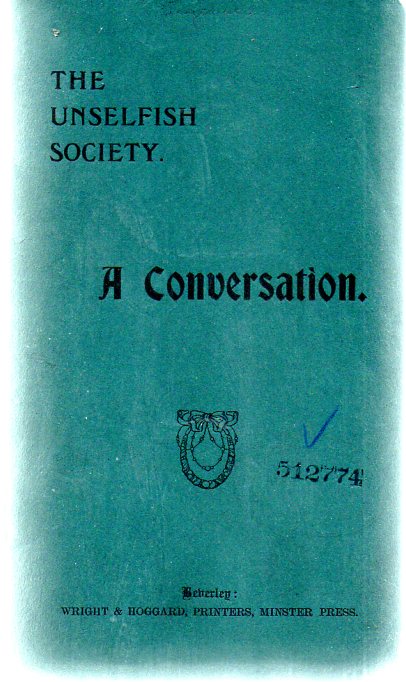
    In any event, the Unselfish Society of this pamphlet refers to a eugenics Society, or eugenics in general, and was part of a Socratic dialog in the pamphlet concerning eugenic principles and education.  It feels more like backlash of theatrical Shavian wit, what with the eugenics folks being about as far removed from principles of un-selfishness as possible.  Or perhaps they are interested in “unselfishness” as a principle expressed by others in order to better the genetic and societal lot of the more-privileged people.  But the expectation of unselfishness in others is not being unselfish in yourself, unless you’re Ayn Rand.  And in this instance we’re talking about the so-called “positive” eugenics, and not the “negative” one, where there is an enforced elimination of what is deemed (by them) to be society’s “weak links”.  “Unselfishness” is not a currency expected (and sometimes extracted) from others and used for yourself.  

    Eugenics1971883   F. Galton Inquiries into Human Faculty page 44.   “The investigation of human eugenics, that is, of the conditions under which men of a high type are produced.”

    Full text here

    ·Posted by :

    ·in:

    —

  • Big Science 1886–Moving Big Stuff

    JF Ptak Science Books   Revisiting/expanding an earlier post from 2009

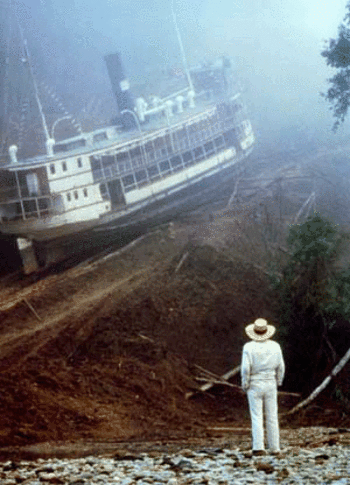
    Blogbig_sciencefitz In 1982 Werner Herzog, in what may have been a weirdly fashioned and irresistible death-wish effort, released a very difficult film that he wrote and directed:  Fitzcarraldo.  It is a spill-over-big, magnificent film about a would-be ice-making rubber baron bringing an opera house into the trans-Andes, trying to make his way into the dense forest in a huge rear-paddle steamboat on the Amazon to stake a claim in exploiting leased lands filled with rubber trees  The problem faced by Fitzcarraldo (played by the probably-insane Klaus Kinski–just see Herzog’s 1972 Agiurre, Wrath of God and you’ll know what I mean) is that his path is blocked by unnavigable rapids–he can however reach his destination by hauling his very large ship up and over a mountain to get to a more pliant river and then to his goal.  Herzog actually does this for the film–no digital anything here–in what is one of the most glorious things I’ve even seen in the movies.  He really does have native people clear a path up and over a mountain, and they DO haul this ship up and over.  It really, truly, is magnificent. 

    The story is partially based upon the adventure of Carlos Fermín Fitzcarrald, who in 1890 attempted a similar feat, though with a much smaller vessel, and who also dismantled the craft (?!) to haul it overland.

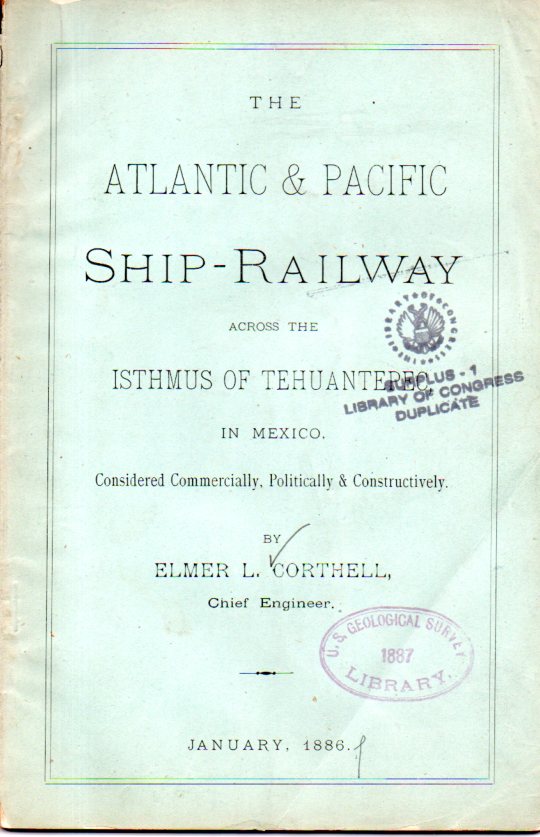
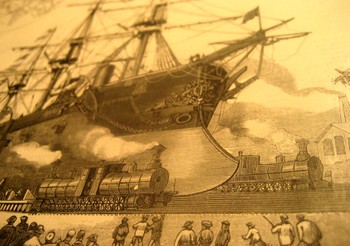
    Blogbig_sciencefitzcarraldo    The bigger and deeper back-story though is the effort–mainly by Elmer Cotherell and James Eads–to build a combination railroad ship canal across the Tehuantepec isthmus in Nicaragua.  The idea of moving across central America rather than taking the enormously long route around the tip of South America and up again is hundreds of years old.  The Cotherell/Eads plan, begun in 1870’s and alive in the early ’80’s, was really the first feasible (and workable) initiative.
    Blog_big_large_ship
    It would have been a gigantic undertaking, and even though it was much longer (130 miles or so)  than the more-favored Panama location for the canal, it seemed more workable as there would be less digging and no need for a lock/canal system as required at Panama. The plan was outlined in the pamphlet below, and printed in 1886.  (This pamphlet is available for purchase at our blog bookstore.)

    Corthell161

    The French began a doomed attempt at conquering Panama shortly before this.  Ferdinand de Lesseps tried to build a canal in 1880, but the organization and general construction plan was truly inferior; also, the sanitary and medical conditions were irreproachable, with the French losing perhaps 22 thousand men in the failed process to disease (mainly malaria).  (The United States would lose 5,609 workers while building the Panama canal, on land granted as a payback for “helping” Panama release themselves from Columbia.)

    Blog_big_closeup
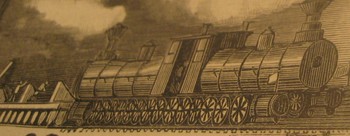
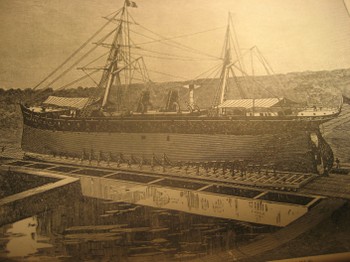
    The Cotherell/Eads (who by the way was a master builder perhaps best known for his inspired masterpiece of a bridge at St. Louis) plan called for hauling the ships up and out of the water in a short canal and placing them on an enormous floating roundabout; the roundabout would then be raised, and the ship place on huge cradles borne upon vastly augmented railway lines.  Once on the cradle, the ship would be pulled and pushed by a team of four large locomotive teams which were in turn composed of two large engines.  Happily aboard, the ship would then be taken on the extended, expanded wide and augmented rail 130 miles overland and dumped into the Pacific.

    It was evidently not a workable deal all the way around, though, as the U.S. decided on the new Panama to works its engineering miracle

    Blog_big_big_closeup .There is something pleasing though about the Ship Railway, though, something that appeals to the little bit of Mr. Herzog in me.  Perhaps it was the appraisal of the very stiff-lipped Sir Edward Reed–who was the former master engineer for the British navy and consultant to Eads—that makes it all so irresistible.  “It would be best to avoid a very high rate of speed” when hauling the massive ocean-going and heavily laden cargo ships.  Indeed.

  • The Non-Talking Talkie–Soundless Talking Pictures (1917) and the Beauty of Timelessly Bad Ideas

    JF Ptak Science Books   Post 2162

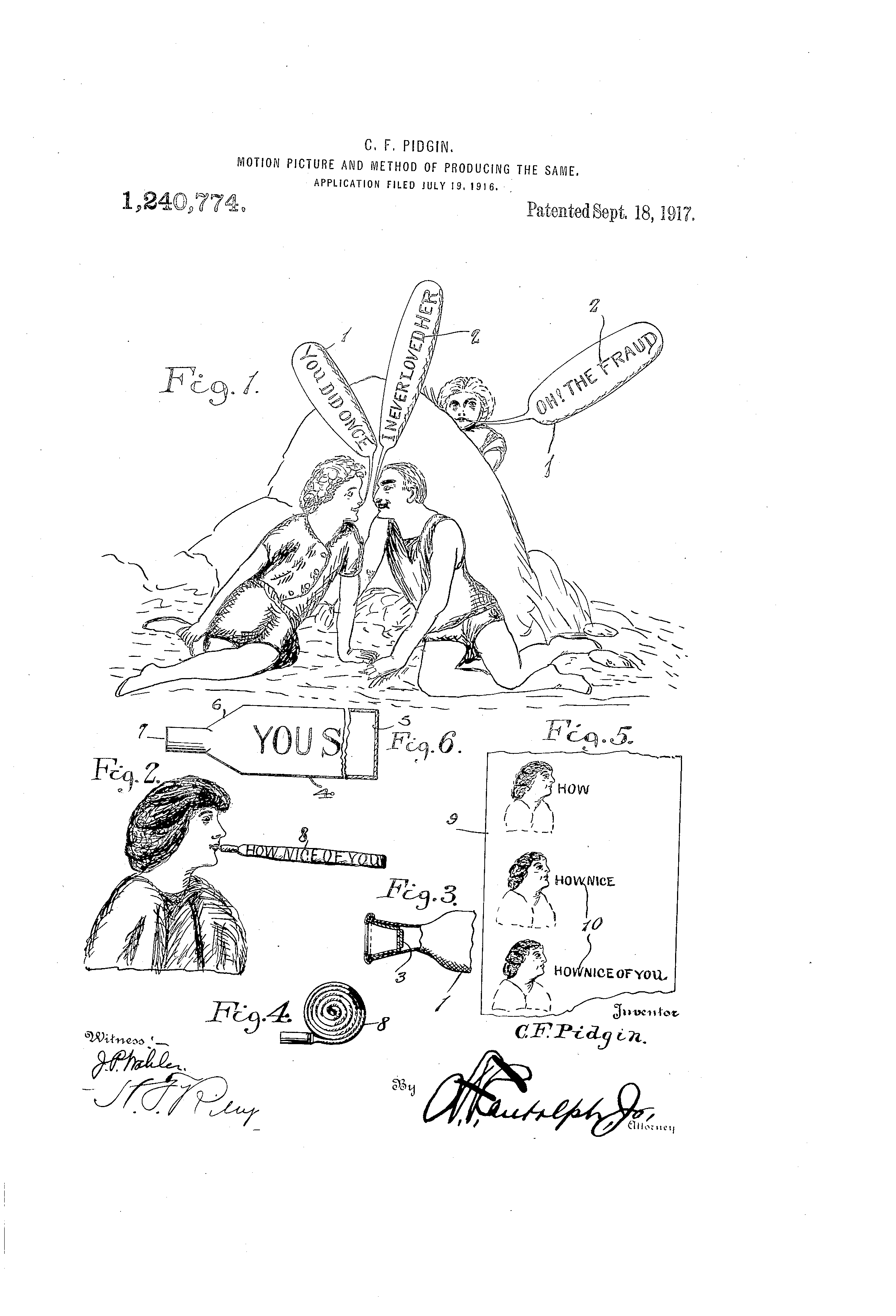
    “Motion-picture and method of producing the same.”


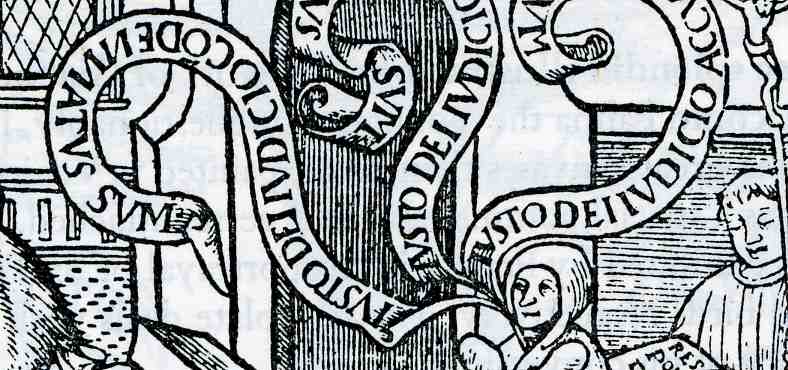
    I’ve written a note earlier on this blog about the history of word balloons–it is the stuff that we think of today as the little clouds filled with words over the heads of comic book characters and such, but which had a long history stretching back at least to the Renaissance when speech was illustrated in a similar way, but with lovely scrolls instead of blank clouds (as we see above).

            See for example:

    The following illustrations though come at a great expense to the imagination, and were a weak but fully patented  attempt to replace spoken-word captions in the pre-audio motion picture–that is silent films before the Talkies.  In general I guess the complaint with illustrating speech during a photoplay was that the text card was a breakaway from the moving-picture part of the experience, necessitating a clean break from action so that the audience could read about what was being pantomimed.

    Folks were well underway in processes to produce sound motion pictures, though up to this point–1917–the systems were separate recordings of sound and speech which would be played in conjunction/synchronously though not necessarily at exactly the right moments with the motion picture. Edison was hot on this trail but with blemished trials, combining his kinetoscope and phonograph in very early and novel attempts at producing a sound motion picture in the first decade or so in the development of moving pictures. The next 20 years in this development are fairly complex, but the matter is fairly well solved by at least three different technologies by 1923 with the production of successful continuous sound-on-film motion pictures, and then most famously and successfully debuting with The Jazz Singer in 1927.  

    And then there is this colossal bit of overdeveloped-underdeveloped thinking that would link the seamless word of not needing text card interruptions with non-spoken speech–and coming just this shy of not meaning anything at all. The work is that of Charles F(elton) Pidgin (1844-1923) who was a very successful author of genre/historical romance books (though he did have an interesting-sounding title in The Letter H, a Novel). He was also an engineer of some sort with some advanced patents in calculating machines and devices, which is the way I came to his name (via a letter I have written to him by the director of the U.S. Census rejecting his tabulating apparatus because it basically produced too much info for too much money, but that’s another story). 

    Pigdin’s idea–in short–was to have an inflating paper text bubble issue from the mouth of the actor during a scene–in that way the view could see what the other actors on the screen were “hearing”. 

    Pigdin motion picture

    [Source:  the lovely Google Patents, here.]

    I know this might sound as though I’m judging a technological effort from the vantage point of the idea’s deep future, but I believe that this idea was a truly bad one right from the moment of conception, a two-beer idea that should’ve stayed in the bar, no matter if it was 1917 or 1967 or 2017.  Sometimes bad ideas are just bad ideas, top to bottom–and some of them are timesless, like this one.  

    NOTES:

    And from Pidgin’s patent, explaining it all: 

    ·Posted by :

    ·in:

    —

  • A Catechism of Communism for Catholic Schools (1937)

    JF Ptak Science Books   Quick Post

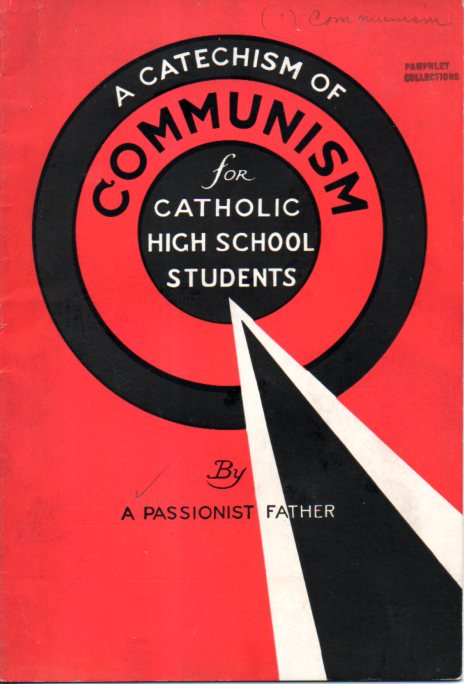
    This is a beautifully design object, and for a moment I thought that this might actually be a sympathetic-Communist pamphlet–something from the Paulist Press, for a Catholic high school system, and from 1936 when there were still plenty of Reds running around the U.S.–so I needed to look around the booklet a little bit. 

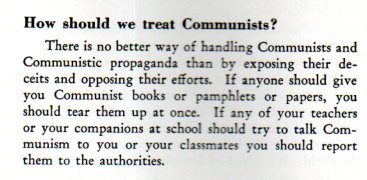
    Communism in catholic school009And of course I found out what it was really about just about instantly, and so there was no mistake about what the Passionate Father was really passionate about:

    Communism in catholic school text010

    This is pretty strong stuff considering that Communists weren’t terribly uncommon in the U.S. half-way through the Depression, though that can be mostly due to the absence of the real story about what was going on in the Soviet Union under mega-murderer Joseph Stalin.  But really it is more the Socialists who were more popular in the off-party politics in America in the mid-’30’s.  In any event the author hit the Communists pretty hard based on their anti-god and anti-Catholic positions, so, naturally, there was very room left at the table of philosophy for the Communists. 

    ·Posted by :

    ·in:


  • The Slavery-is-not-a-Sin, Anti-Catholic Diatribist, Samuel Morse

    JF Ptak Science Books   Post 2136 
    Follow Me on Pinterest

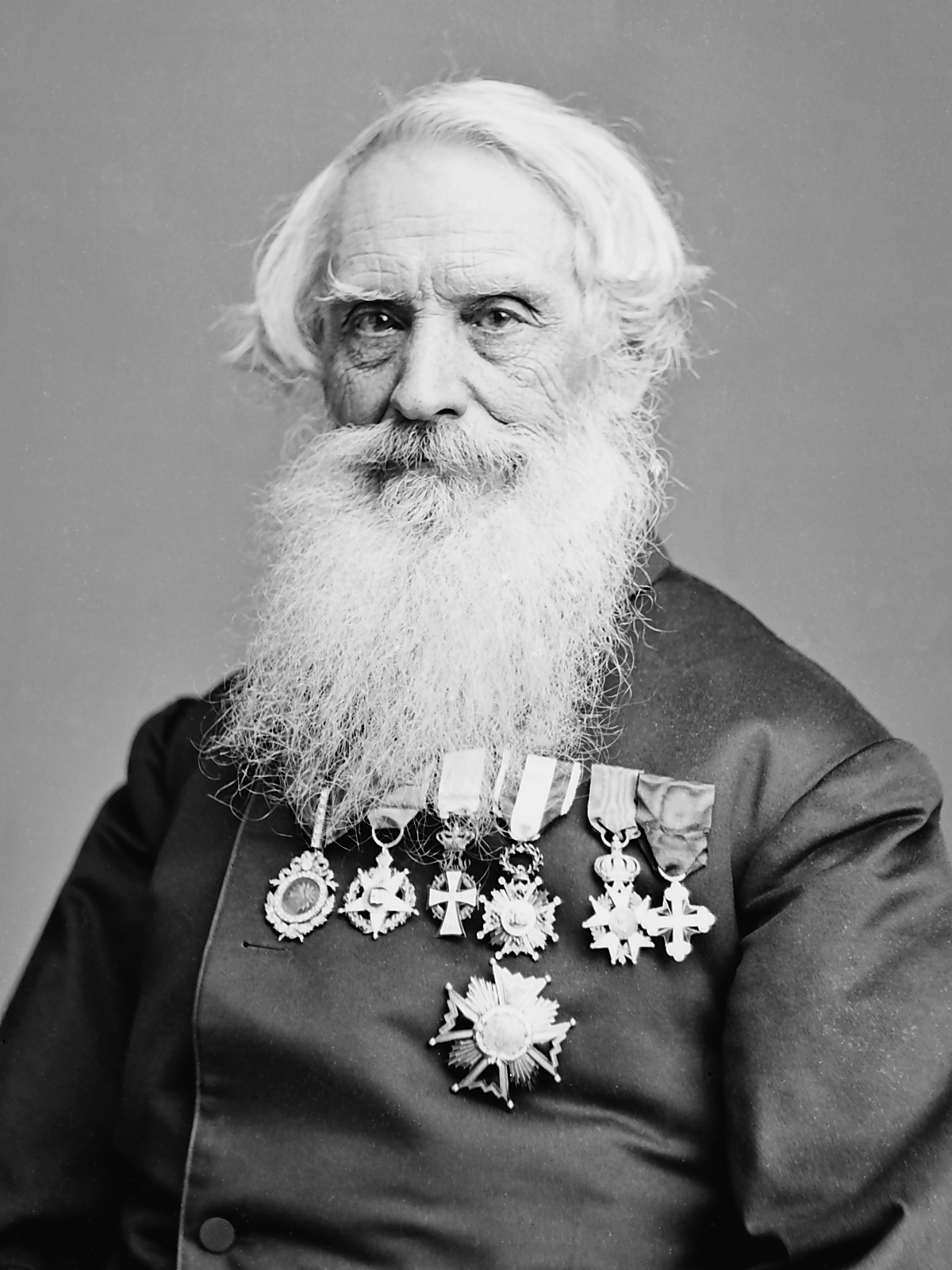
    In what could be a very long thread, this installment in the Just Because You’re Smart Doesn’t Make You Smart series takes place on the ethically/morally suspect creator of the single-wire electrical telegraph, Samuel F.B. Morse. 

    Samuel_Morse det

    Some of this could have been learned at a young age via his “militant” Congregationalist minister father, who created “a household temper…of the deepest animosity against other faiths”1.  And then again, perhaps not–but even weighing the spirit of the times in which he lived (1791-1872), Morse had a particularly long-lived, deep, and very public hatred of the Catholic Church and “Popery”, finding it a creeping abomination that was setting out to destroy the United States via the churches propagandist agents in the Jesuits and through mass immigration.

    Morse’s book on this subject, Foreign Conspiracy Against the Liberties of the United States (1835), became a much-reprinted guidebook for Catholic-haters and immigration conspiracy types, curling itself around the impending priest-ridden despotism of the Vatican and (whatever was left of) the Holy Alliance.

    “Surely American Protestants, freemen, have discernment enough to discover beneath them the cloven foot of this subtle foreign heresy. They will see that Popery is now, what it has ever been, a system of the darkest political intrigue and despotism, cloaking itself to avoid attack under the sacred name of religion. They will be deeply impressed with the truth, that Popery is a political as well as a religious system; that in this respect it differs totally from all other sects, from all other forms of religion in the country.”2

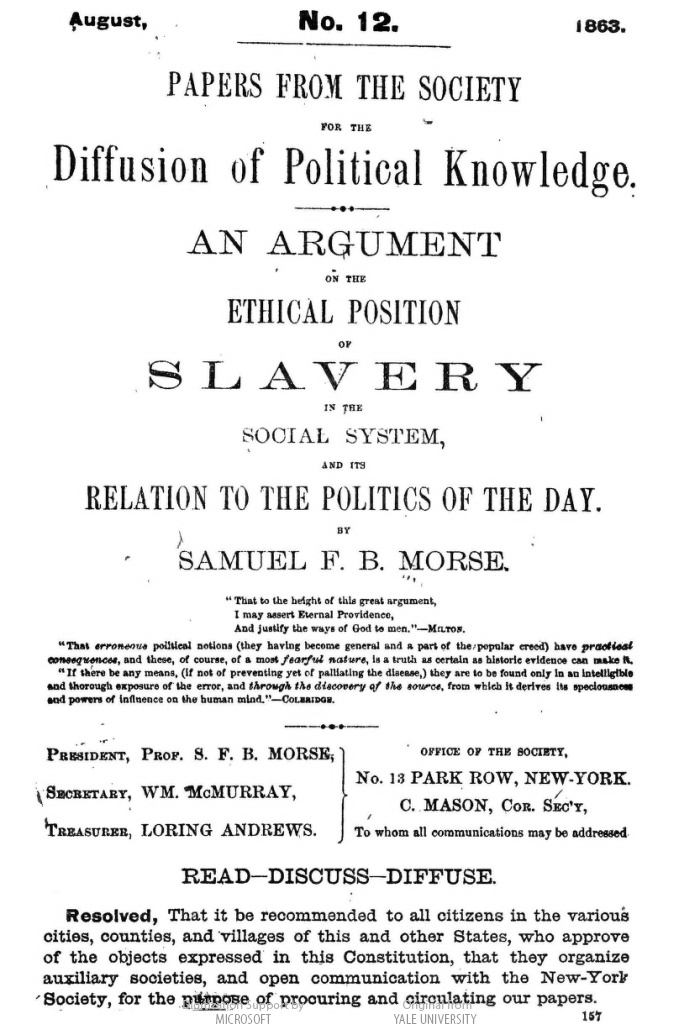
    Morse also found slavery to be an ordained right and a creation of God for right, wise, benevolent and disciplinary purposes,3  writing about it publicly in his pamphlet An Argument on the Ethical Position of Slavery in the Social System, and its relation to the Politics of the Day4 in the middle of the Civil War, 1863.

    “Slavery or the servile relation is proved to be one of the indispensable regulators of the social system, divinely ordained for the discipline of the human race in this world, and that it is in perfect harmony … with the great declared object of the Savior’s mission to earth.” (Morse, Ethical Position of Slavery, 1863, page 10.)

    “My creed on the subject of slavery is short. Slavery per se is not sin. It is a social condition ordained from the beginning of the world for the wisest purposes, benevolent and disciplinary, by Divine Wisdom. The mere holding of slaves, therefore, is a condition having per se nothing of moral character in it, any more than the being a parent, or employer, or ruler.” (Morse, Ethical…, page 13.)

    Morse slavery(Via Yale University Library; also the Yale Slavery treatment of Morse, here.)

    The Yale website also goes on to point out that Morse thought it sacrilegious to oppose slavery and support Abolition (citing Samuel F.B. Morse, Letters and Journals, ed. E. L. Morse, Boston: Houghton Mifflin Company, 1914, 2:416):

    “Conscience in this matter has moved some Christians quite as strongly to view Abolitionism as a sin of the deepest dye, as it has other Christian minds to view Slavery as a sin . . . Who is to decide in a conflict of consciences? If the Bible is to be the umpire, as I hold it to be, then it is the Abolitionist that is denounced as worthy of excommunication; it is the Abolitionist from whom we are commanded to withdraw ourselves, while not a syllable of reproof do I find in the sacred volume administered to those who maintain, in the spirit of the gospel, the relation of Masters and Slaves”

     This goes on and on, a distribe with Scriptural and distanced-moral support, on into a cold dark night of extraordinary egotism and ethical despotism.  And it is a fine example of people with some great abilities and high intelligence could be correct in some things and wrong in so many others. 

    Notes:

    1.Gustavus Myers, A History of Bigotry in the United States, Random House, 1943, p. 160.

    2. Wikipedia article on SFB Morse.

    3.. Edward Lind Morse, editor, Samuel Finley Breese Morse, His Letters and Journals, vol 2, pp 19, 46-8, 531.

    4. An Argument on the Ethical Position of Slavery in the Social System, and its relation to the Politics of the Day (New York, Papers from the Society for the Diffusion of Political Knowledge, no. 12, 1863)

    Samuel_Morse

    ·Posted by :

    ·in:

    —

  • Engineering with the A-Bomb, “To Conquer Forever the Dust Bogey”, 1945

    JF Ptak Science Books   Post 2104

    Atomic resevoir708
    1945, Autumn:  the question is, now that “we” have the atomic bomb, what can be done with it?

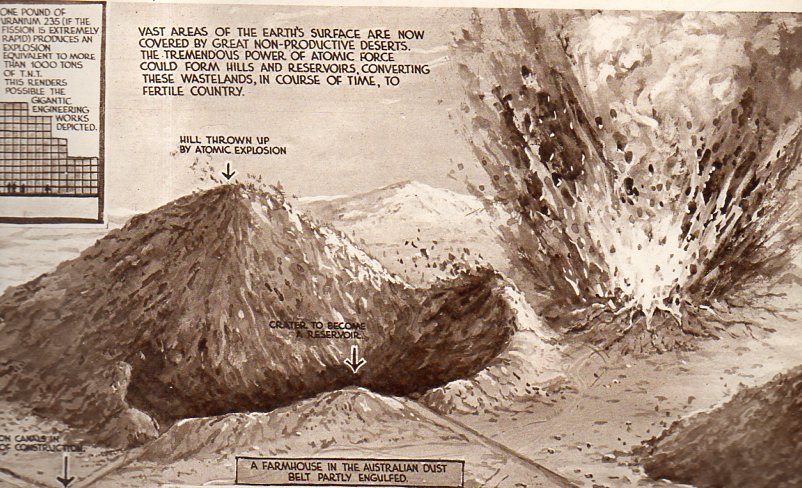
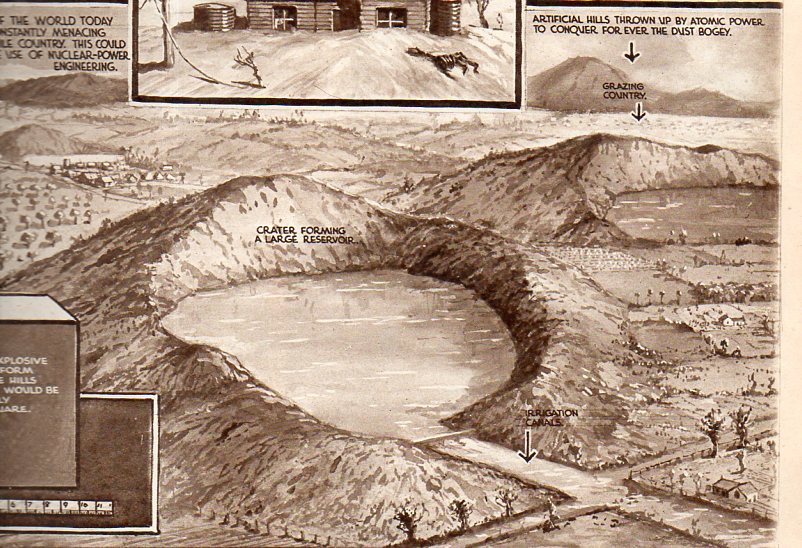
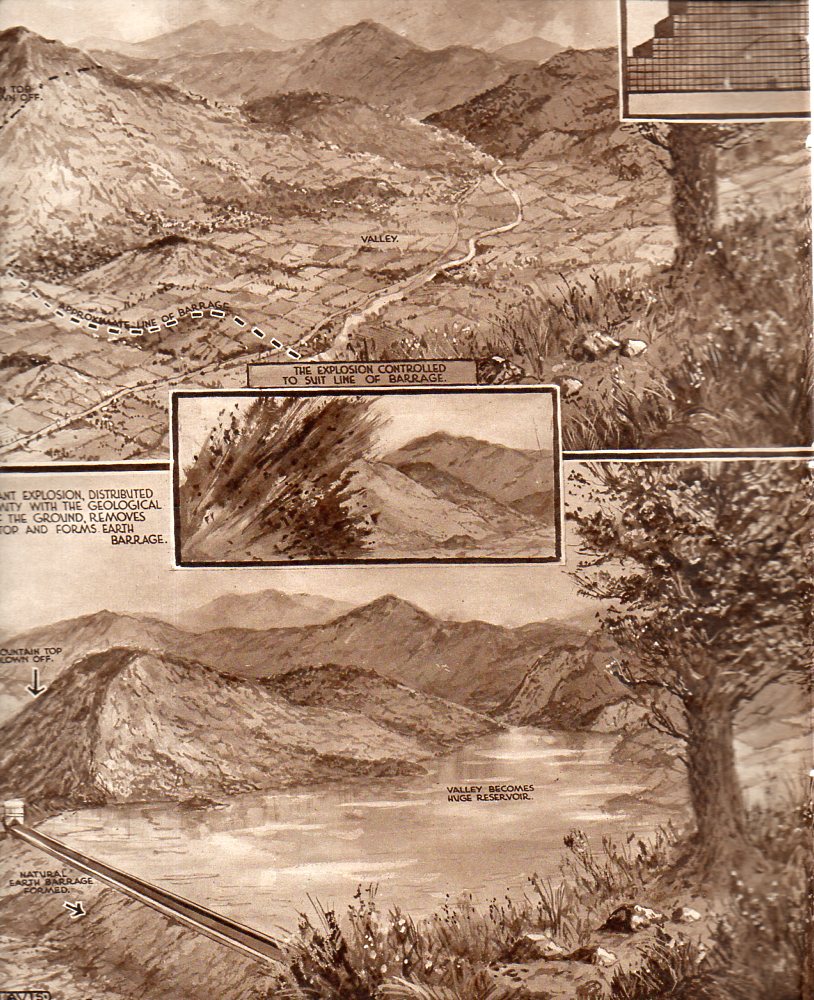
    One thing is for certain–it could be used not only to make big holes out of little ones, but also make big mounds of dirt where there were none. This stands to reason, of course, because if you are producing massive holes in the Earth then the dirt and other hole-filling stuff must go somewhere (as Beakman says in his often-repeated admonition and perhaps the most important thing that is said on this kid-based science show, “everything goes somewhere”). Unfortunately the mountain of hole-dirt doesn’t get made quite like the way it was envisioned in this article in the Illustrated London News for 17 November 1945, but they were trying, and it was still a very young and tender period in the history of public discussion on the atomic bomb/bombing. 

    Atomic resevoir709
    Still, “The Force Which Can Move Mountains:  Harnessing the Atom to Vast Projects for the Benefit of Mankind” imagined an atomic-bomb-fueled set of public works projects that were of Pyramidally-historic proportions, and was among the first fissionally-inspired public portrayals of the peaceful uses of atomic bombs. (The “Peaceful Uses of Atomic Energy” UN-based conferences and etc. would come later.)  Engineering with atomic bombs does have some considerable issues, like radioactivity, but some of those issues were worked out somewhat–but that came later on. 

    Atomic resevoir711
    Back in 1945 the bomb was being discussed as a hole-maker for reservoirs and for making mountains in the deserts of the world to cut down on the sandstorms and related problems (the “dust bogey” from the fantastic quote in the heading of this post).  More thought would be given to this issue on the peaceful applications of nuclear weapons in such platforms as Operation Plowshare1, an American undertaking begun in 1961, which entertained half-fantastical thoughts of widening the Panama Canal and creating–through a series of five hydrogen bomb detonations–a new harbor at Cape Thompson, Alaska.  Some of the dirtiest of all nuclear detonations were associated with Plowshare–like the Sedan shot of 1962 which displaced 12 million tons of dirt and made a really big hole but which also contributed something on the order of 7% of all fallout contamination of the total
    amount of radiation which fell on the U.S. population during all of the
    nuclear tests at Nuclear Test Site.  It is still the largest man-made hole in the U.S. and for what it is worth it is listed on the National Register of Historic Places.  Over the years such testing for Plowshare (alone) cost the U.S. about 700 million dollars, which seems like a wildly undervalued estimate of costs.

    In any event, I liked this story form the ILN and for the hope that it represented, coming at the earliest public history of the use of atomic weapons. 

    Atomic resevoir710

    Notes.

    1.  Perhaps people felt a little kinder towards monster ideas like this if the name of the proceedings found its origins in the Old Testament, like this one: Isaiah 2:3–5, “And he shall judge among the nations, and shall rebuke many people: and they shall beat their swords into plowshares, and their spears into pruning hooks: nation shall not lift up sword against nation, neither shall they learn war any more”.