A Daily History of Holes, Dots, Lines, Science, History, Math, Physics, Art, the Unintentional Absurd, Architecture, Maps, Data Visualization, Blank and Missing Things, and so on. |1.6 million words, 7500 images, 4.9 million hits| Press & appearances in The Times, Le Figaro, Mensa, The Economist, The Guardian, Discovery News, Slate, Le Monde, Sci American Blogs, Le Pont, and many other places… 5000+ total posts since 2008.

Category: Art History

  • Empty, Blank and Disappeared Things 6: Skin and Sand

    JF Ptak Science Books  LLC Post 196
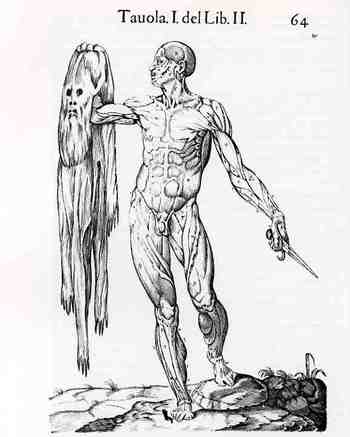
    Blogaugust_8_empyty_skin379 Continuing a thread of interesting and  odd observations of things that are empty, absent and disappeared are the following two images.  The first is from Valverde’s Historia de la compiscicion del cuerpo humano (Anatomia del corpo humano in Latrin), published in 1560,  by the artist Gaspar Becerra, who was a student of Girogo Vasari (another “V”) and thus, by extension, a grand-student of Vasari’s teacher, Michelangelo.  Valverde’s work was one of the most popular anatomical texts printed in the 16th century–second only perhaps to the great work by Vesalius (a third “V”, which is a little unusual)–though it may be an ironic understatement, as Valverde  “heavily borrowed” from his master teacher, with some of the illustrations being virtually identical.   One illustration that he definitely did not borrow from Vesari though (according to Samuel Edgerton in his masterful Pictures and Punishment, Art and Criminal Prosecution during the Florentine Rensaissance, Cornell, 1985) is this esorche figure showing the sample (a human male) standing and displaying his muscular system, holding his flayed skin in his hand. (“Esorche”  is a relatively new term for an older idea, meaning “flayed” and in the artistic sense meaning the drawing of creatures with their skin removed, was brought into use in French art circles in the mid-19th century, though Leon Battista Alberti (February 14, 1404 – April 25, 1472, a polymathic humanist renaissance man of the renaissance) at least recommended that artists draw a figure muscles outward, applying skin later.)   For our purposes the Becerra image is like very few others, so far as I can determine, with the flayed man holding his own skin, the cleaving knife in hand–the skin empty, wanting its form. 

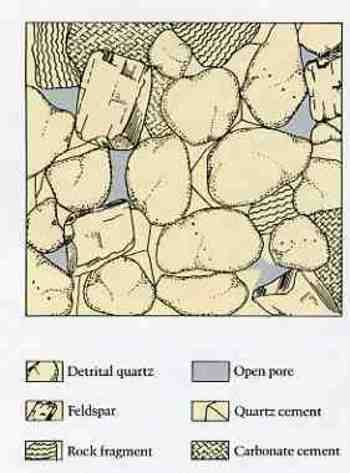
    Coming tonight directly from the beaches of the Georgia coast brings to mind a second, less “demanding”, image of emptiness.  Sitting here in a developing pile of sand which seems to come of course from everywhere and nowhere, I’m reminded of the formation of sandstone, or I guess the deformation of sandstone. What I’m thinking about are the empty bits in sandstone, illustrated below (from Sevier’s deceptively fabulous book, Sand, showing “open pores”, the unfilled blank spaces in sandstone.  I know there’s no real connection between these two (except that I do have a massive sunburn caught on the Tybee Island sands) but I just couldn’t not list them together. 
    Blogaugust_8_empyty_sand380


  • The Tree of Life and Coal’s Phylogeny–a decent Diagram but a Bad Idea

    JF Ptak Science Books LLC  Post 165
    Blogcoal_tree318

    Even though this is a simple classification scheme, and a
    very-well designed graphic at that, the use of the tree describing the genealogy
    of coal by-products just seems, well, wrong. The use of the tree in defining a visual phylogenic interrelatedness of
    living things appears pretty much for the first time in the first edition of the
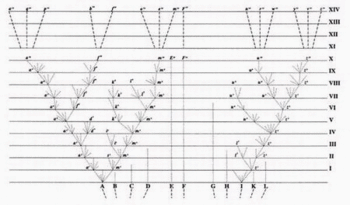
    Origin of Species in 1859, and it is the only diagram that appears in the
    book. (And by this I mean the use of the tree-scheme for scientific purposes:  the tree of life of course has been used for many, many centuries, the philosophical design woven into the fabrics and incised into the stone of many cultures.  It sort of appears in print in classification usage at least by the wily and polymathic Athansius Kircher, who used it to display the elements in a Kabbalistic Tree of Life some 350 years ago.)
    The Verkaufsvereinigung fuer
    Teererzeugnisse (of Essen) used this idea in
    1922, publishing the ad for their company in the Illusrtriete Zeitung (Leipzig). The great tree spring from a bed of coal (“kohle”)
    exhibiting the “stammbaum der nebenerzeugnisse” (roughly the “pedigree of our
    product”), with the trunk being gas, branching out into tar, coke and cyan and
    so on.  Even though it’s the lifeblood of
    the continuing industrial revolution, and even though we’re hundreds of years into
    a deep need with the products, the use of the tree just seems antithetical to it
    all on all levels of recognition, especially now. 

    (The Darwin tree of life is below.)Darwintreeoflife


  • Blank and Disappeared People Follow-Up: a Sin-Laden Manikin, 1871

    JF Ptak Science Books LLC   Post 162 and a quarter
    Blank315

    My old friend Jeffrey Donlan, who  is in charge of what must be a top 1% highest-elevation library in the U.S. (at 7000+ feet) in Salida, Colorado, sent me a playful pinch, asking about what ever happened to the History of Blank People (which I posted about a few months ago)

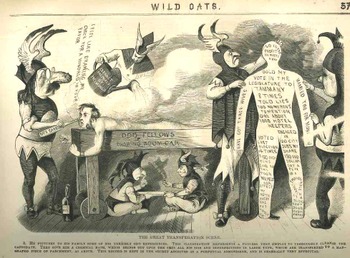
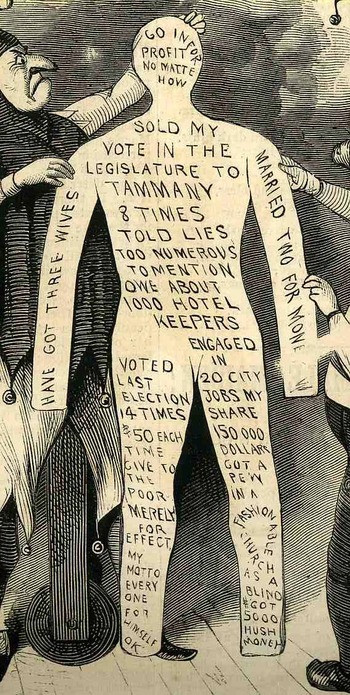
    Well, it isn’t easy coming upon these images of people being made to disappear and/or people being “filled up” (you’d better see the post), but within a day after his contact and within a day of Jeff’s visit, I stumbled upon one (looking of course for an image of matchmakers, as in Lucifer Sticks).  It spilled out of the pages of Harpers Weekly for 1871, and was part of a caricature of the selection process for folks becoming a member of the The Independent Order of Odd Fellows. The work is a strong attack upon the fellowship, with this section showing a possible member being stripped of all his sins and foulnesses and various other transgressions, all of which are taken from his body and applied to a blank manikin. 
    Blank_det316

    Instead of burning the sin-laden manikin, though, the unnamed caricaturist contends that the society of Odd Fellows keeps the maikin, as it might come in handy for them later.  In any event, it is a rare occurrence of finding a Blank Person, weirder still that it was found after someone actually/kinda/sorta/not really asked for it. 


  • Dada and Modernism for Children? 1905-1932

    JF Ptak Science Books LLC Post 161
    Blogdadanemo
    In a sub-sub-sub category of the sub-category of “Books that I Want to See” comes Dada-ist books for children, and less loosely, modernist books for kids.  Or students.  I’m not sure how close I can define this field because, well, I know basically nothing about it, but I am interested in how long it took for the bits of
    created modernism (1895-1915 or so) to reach the level of publications intended for children.  And by Modernism I’m talking about the epochal changes in nearly all disciplines brought about by people like Einstein, Ibsen, Klee, Kandinsky, Braque, Stravinsky, Woolf, and so on. (Nearly all disciplines, that is, except for politics—and then I guess too that if you included the concentration camp then it would join the modernist ranks, too.)

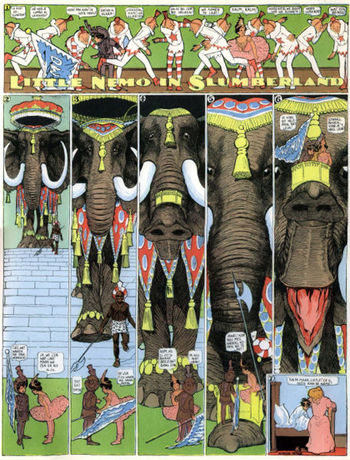
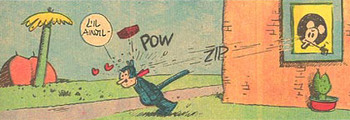
    I’ve started thinking about this in Europe but the first thing that comes to my mind is Little Nemo (and Dreams of the Rarebit Fiend too, while we’re at it), the fantastic creation of Michigan-born (Ypsilanty-schooled) Windsor McKay (1867-1934), which I think is definitely modern but not at all related to Dada, and which came to life in the miracle year of 1905.   McKay just happened to be years above and away from whatever his contemporaries were doing.  No one came close to McKay, in my opinion, until Ignatz picked up his first brick, and George Herriman drew Krazy Kat for the first time in 1913.  Blogdada_herriman

    Still skirting the Dada part, I’d love to see Konvolut von 14 russischen Kinderbuchern der Jahre 1930-32, a spectacular constructivist work aimed at children and from what I can see is a treasure trove of  Malevichian insight. 
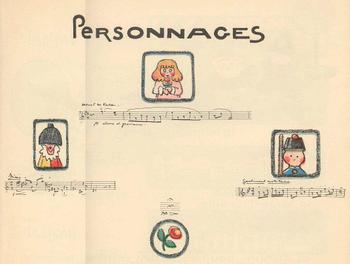
    Andrew. Helle’s La Boite a Jouhoux, (“The Box of Toys”) Ballet pour enfants (Paris, 1913), is a beautiful composition, a modernist construction, using the idea and artwork of illustrator Helle and the music of Claude Debussy.  The score is witty and has a very light touch, Debussy pleasingly borrowing from himself and his
    Blogbooks_wantdebussy

    friends in a work partly inspired in a Milneian way by 7-year-old Chouchou Debussy (and her toys and dolls).  It’s a beautiful work that I’d love to have in my hands.
    Blogbdad_kid_debussy294

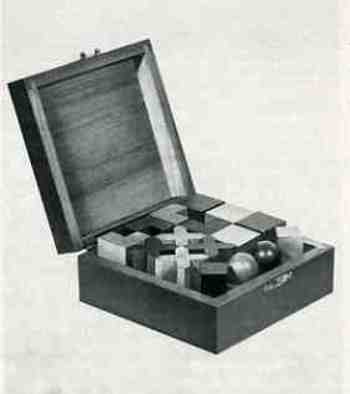
    Another magnificent-looking object that I’d like to see is the box wooden Bauhaus-inspired shapes, pictured in Junge Menschen kommt ans Bauhaus//Werbeprospekt, published in Dessau in 1929 and featuring work by Klee, Kandinsky, Albers, Ridel and Meyer.  The box of shapes is to die for, and it seems as though it offered new geometrical toys/tools  for the inquiring mind in the last year of the ‘twenties.
    Blogbooks_wanted_kids291
     

    But I’m no closer to Dada for kids than at the beginning of this post, hoping as I was that something might shake loose if I thought about it some.  Its an interesting question to me, and I’d really like to return to it when I actually know something. 

    ·Posted by :

    ·in:

    —

  • The Marcel Duchamp of 18th Century France: Visionary Architect Jean-Jacques Lequeu

    JF Ptak Science Books LLC  Post 160
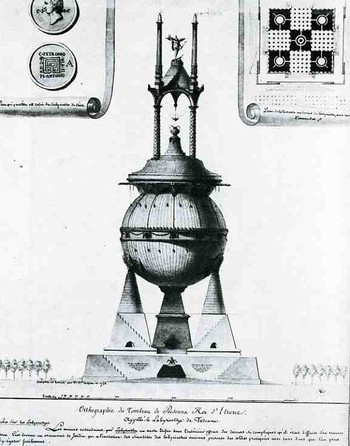
    Bloglequewu289 Jean-Jacques Lequeu (1757-1825), a French architect of fabulously distanced sight, produced this breathtaking image in 1792.  The Tomb of Lars Porsena, King of Etruria (the great Etruscan king, d. ca. 500 BCE ), is just one of hundreds of works by Lequeu, a re-discovered architectural genius who worked during the same era as other visionary architects such as Etienne Boullee (1728-1799), Claude-Nicolas Ledoux (1736-1806), Louis-Jean Desprez (1743-1803), Francois Barbier (1768-1826), Charles Bernard (1765-1818), Francois-Joseph Belanger (1747-1818), and others, though these guys are the most famous.  As a matter of fact, I think, almost all of these architects were re-discovered—Boullee, perhaps the most famous of the lot, was found again not in his buildings but in his visionary drawings that he deposited with the National Library.  But Lequeu—found again in the same way–it seems had to be rescued from an even greater obscurity than the others.  He tried to expose a unity that he saw in the world, some secret sort of unity, that he saw all around him, and which was unseen by everyone else in creation—at least until the 20th century.
    Lequeu started out in a staid and brilliant way, a successful architect in his own right, and student of Scoufflot, designing ancient-inspiration buildings for the super rich.  But along came the Revolution and away went his career—he wound up a surveyor and a cartographer until his retirement in 1815, after which he enters social and historical oblivion, until he finally dies in total obscurity ten years later (or so, the date is unclear).  His post-revolutionary vision was as phenomenal as his success in selling his ideas were dismal.  Well, this is really a cheap shot—his imagination was shockingly large, enormous, his designs fantastic and beautiful, and completely unexpected, and they seemed to grow larger/loftier and more interesting as time wore away at him.

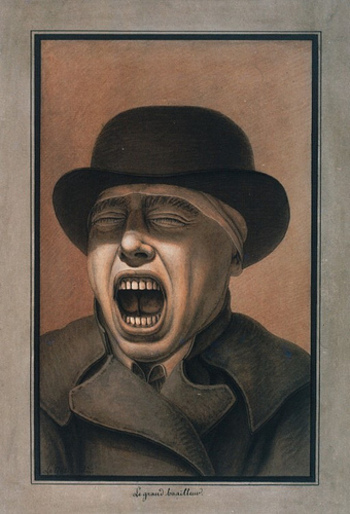
    I think that as Lequeu was cleaved away, cell by cell falling through the floorboards of his single rented room, he reached further into time and deeper into space than almost any architect of that hundred-year period.   I also think that he was very well aware of his genius being seen as pure eccentricity—his dozen or so self portraits are among the most bizarre that I’ve ever seen (before 1900). Lequeu_portrait

    The odd thing in all of this is that in this brilliance there is still a reluctance to leave the Baroque, and this at a time when just about everyone else—beginning around 1750—was abandoning it.  So much of the work of the other visionaries mentioned earlier freed themselves of the Baroque—not entirely true, not true at all, for the unique creations of Lequeu, who (as in the Tomb of Lars Porsena) included more than a few bits of the practice even in his most incredible works. 

    Somehow Lequeu saw the Lars Porsena tomb as a 650-foot tall (!!) structure, with impossible insight and filigree.  Extraordinary. (In the upper corners of the drawing of the tomb Lequeu included a design for a coin and also the plan of the structure.  The original tomb of Lars Porsena, according to Pliny the elder in his Natural History, XXXVI, 19, 91ff, was a 15 meter high rectangular base with 90 meter sides–completely destroyed in the wars in the first century. 
    Bloglequewu288_2

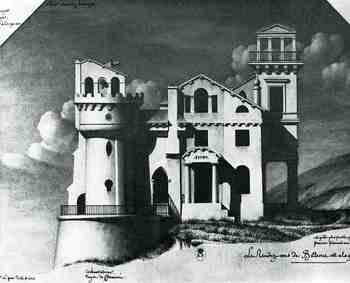
    Perhaps his most sensational creation (and one which was devoid of all Baroque influence, as it turns out) was his Meeting Place at Bellevue.  It is almost impossible to believe that it is am 18th century creation—it is as harmonious (armonia) as it is asymmetrical.  It looks deeply 20th century, and looked as far into the future as it was deeply unknown.


  • Alphabetical Renaissance Bestiary: Edward Topsell’s “Four Footed Beasts”, 1607


    JF Ptak Science Books LLC  Post #130

    Alphabet 1:  An Alphabetical Renaissance Bestiary

    Edward Topsell (c. 1572 –1625),  English cleric (C of E) and antiquarian who played at being a naturalist was creator, writer and semi-inventor of the History of Four-footed Beasts (1607).  Actually, Topsell wasn’t a naturalist at all, not whatsoever, but did cobble together bunches of facts, true and otherwise, to assemble this fantiScience work from 401 years ago.  He relied mainly on much earlier writers like Albertus and Gesner (Historia Animalium) and transcribed their findings whole cloth, for good or for ill.  He made no pretensions about being a scholar in this area (though he did probably take his M.A. from Christ College, so he was a scholar, but of other things), and wrote his caveat: “I would not have the Reader… imagine I have … related all that is ever said of these Beasts, but only [what] is said by many”.

    I’m really just interested in the images right now and not with the entire aspect of Renaissance zoology (even though Topsell occurs in the early 17th c I think his manner still classifies him with the rest of the Renaissance). In the hulking bulk of his considerable effort Topsell tries to convey three essential aspects of animals to the readers of his work, what he calls his three holy uses: sacrifice, visions, and reproof and instruction.  In his descriptions Topsell tries to remind the reader of the uses of the animal described in sacrifice, and how to interpret the animal when seen in a vision or dream.  Pretty standard I think, even viewing Topsell outside the offices of “historian”.  The interesting bit though is from the third part–reproof and instruction–where he attempts to have the reader regard the animal for the insight and education it could provide for the human viewer.  That’s the part that strikes me as “modern”, or at least thoughtful, especially when considering the fantastic and terrific descriptions that are woven through his questionable tapestry like wide threads of glittering gold. Some of these nuggets include the statements that weasels give birth through their ears, and lemmings graze in the clouds, and elephants worship the sun and the moon and become pregnant by chewing on mandrake; those, and many others, not the least of which include further factual descriptions of Gorgon, the Sphinx, the Manticore, the Lamia, the Winged Dragon and the Unicorn.

    The real treasure here is the illustration–right or wrong or both, they are gorgeous, powerful, and sumptuous. 

    We present here an Alphabetical Bestiary Based upon Topsell’s The History of Four-footed Beasts and Serpents, 1607.

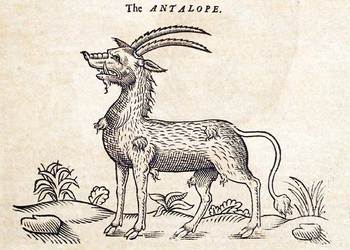
    Antelope
    Topsellanatalope


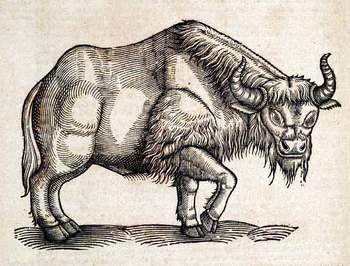
    Bison

    Topedllbison


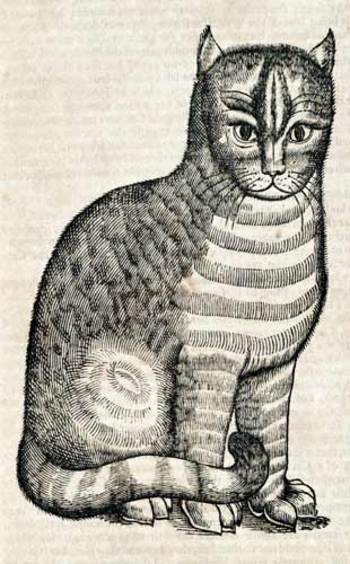
    Cat
       Topsellcat_2


  • Head Replacement ca. 1700–the Baker of Eeklo

    JF Ptak Science Books LLC    Post #111
    Blogbaker_eeklo144

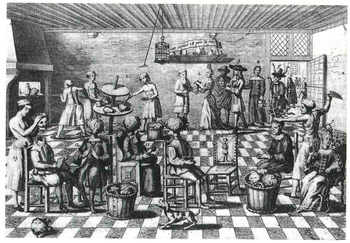
    Here’s a very curious engraving, a little on the light-noirish side, by the Dutch Philibert Bouttats de Jongere (1656-1728).  The copperplate is made from a painting called De Bakker von Eeklo (The Baker of Eeklo) which hangs in the Muiderslot castle in the town of Muiden, near Amsterdam—I found the reproduction in a very charming book by Midas Dekkers called The Way of All Flesh, a Romance of Ruins (2000).  Dekkers thinks about reflects (and I use this word in the clinical, autopsy-room way) on the way of all fleshly ruination—what happens to cause it, what the mechanisms of deformation are, and the effects of time on us all.  He comes to this engraving in a chapter of fighting the effects of the physical and biological mechanics of skin and plastic surgery.  It is a marvelous image—people coming to the bakers for a rejuvenation and reformation of their entire head.  How it seems to happen is this:  people arrive from far and wide and have their heads removed by a baker’s assistant (as at left), where a group of bakers work their wonders (with paints and other stuff) on a revolving table, when the head is sent to what looks like a bread oven for a firing and cooking.  In the meantime the cabbages that are kept in baskets an laying about on the floor are actually put to use—they are placed in the bottom/wound of the removed heads and also serve as replacement headholders until the baked heads are ready. (Cabbage head?)  For some reason all of the bakers are without shirts; it is after all a bakery and it probably is hot, but everyone else is dressed pretty heavily, and looking pretty calm, so maybe there’s something more to the shirtless bit than just heat.  And speaking of calm, most of the head-rejuvinatees are sitting very patiently, with their hands together, or fingertips touching, in classic aspects of ease, and I’m not sure about that, either. 

    But is that really the story here?  The odd part of this odd allegory is that the people in the upper right, entering the bakery, are already carrying heads.  It makes sense in an artful way to have a cabbage replace your own cooking head, but if you were coming to the baker with head-in-hand and set to go, then you wouldn’t need a cabbage head for your own decapitated noggin because, well, they’d lop of your own head and replace it with the new one right away; no cabbages necessary.  So perhaps there are two different things going on here:  one where you get your own head re-worked, and a second where you bring in a head to have put on your own body.

    The big question in the room then is where did these other heads come from? 


  • Ships in Siege: Rhodes 4th Century BCE and Porphyrius 4th Century ACE

    JF Ptak Science Books LLC    Post 135
    Blogrhodes197
     

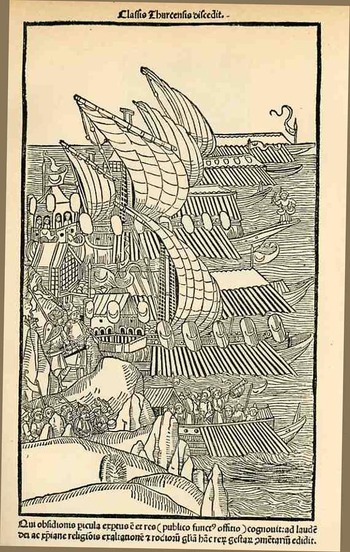
    We find this splendid woodcut in the book by Guilelmus Caorsin, Obsidionis
    Rhodiae urbis descriptio
    , printed in Ulm by Johann Reger in 1496—it is anonymous, identified only
    as by the Maitre de Caorsin. It depicts the
    siege of Rhodes (from 305 to 304 BCE), one of the best known and most famous
    sieges of antiquity, and the handiwork of Demetrius Poliocretes, when he tried
    to break the back and will of the city of Rhodes (which was a great mercantile
    center) in its alliance with Ptolemaic Egypt. It is a strong, simple scene, showing the ships of Demetrrus trying to
    lay siege to the harbor, all under full sail, the their rowers at ready (under
    protective canopies); the water of the harbor is symbolic and beautiful, and
    all of the action takes place under an absolutely neutral non-sky.

    Another entirely different sort of ship is found in the next
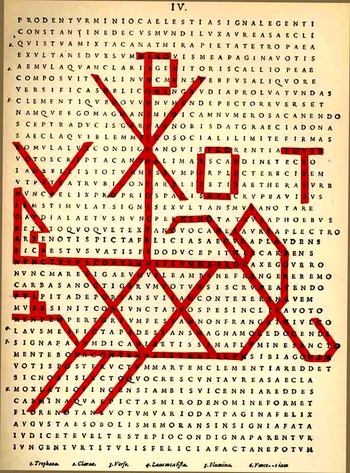
    image, its outline revealing the message in a faux-cryptographic siege. It is from a curious piece of complicated
    obsfucation by Porphyrius, and is entitled  Publillii Optatiani Porphorii panegyricus
    dictus Constantino Augusto, printed 99 years after the book above (1595, in Augsburg). It is a curious thing, being mainly a series
    of complex acrostics which, when pieced together or parsed out, revealed some
    very flattering pieces of poetry to Constnatine.

    In the Chronicles of Hieronymous we find the following
    observation on this effort: It is a most
    extraordinary aggregation of acrostics, pattern poems, and every possible
    device of useless, mechanical variety of form, of little value, excepting as a
    sort of dime-museum exhibition of patience and ingenuity…” Be that as it may, the found artforms in the
    acrostics and other bits is really quite arresting, and remind me more of twentieth century artwork than 4th century BCE  poetry.  Blogrhodes_2198


  • The American Log Cabin–a Tiny Masterpiece of Antique Children’s Art

    JF Ptak Science Books  Post #127

    Bloglog_cabin_primitive188

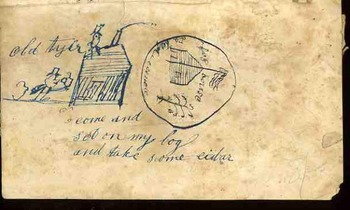
    Here is an example of a beautiful, achingly simple, drawing of two log cabins by a child, and done around 1830.  I absolutely adore antiquarian manuscript artwork of children.  The observations are pure and simple, and reminds me of what my children draw, except of course for the subject matter.  The work of children from 125 years or more ago is really quite difficult to find:  the writing and practice material of choice was in general absolutely ephemeral, taking place on a chalk board to save on paper and writing implements, as paper was far more expensive pre-1850 than it is today.  To further complicate things a family would have to actually save the art for four generations so that one could find it today, which is asking a lot from your family.  Most of the time the surviving artwork comes in two ways:  in the form of a notebook, which has survived through the years intact; and as incidental artwork jotted down on the free end papers in textbooks.  In any event, the art is hard to find. 

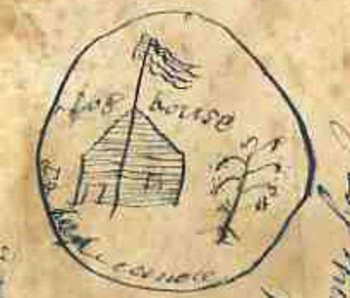
    The drawing has two elements:  the first shows a man approaching a house, an dis titled “Old Tyler”; to its right and on it side is the glorious image, “Log House”, complete with a flag on a flagpole and a little aphorism:
    “Come and
    Set on my log
    And take some cider”.

    Bloglog_cabin_primitive_det

    This is just simple a super bit of naïve childhood Americana.

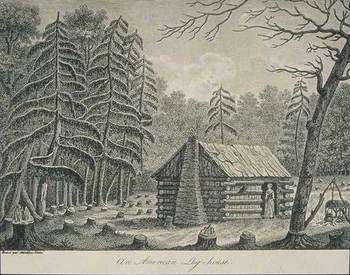
    Here is another image of frontier life in the US int he early 19th century, though this one, from George Collot’s Voyage dans l’Amerique Septentrionale, published in 1826, around the time, I reckon, that the child (above) was making this drawing, but is of course iconic and was distributed, unlike our young artist, whose drawing living only on for him and whoever the child might have shared it with.   I believe that the Collot image of the famous American log house is one of the earliest ever published. It is a gorgeous image and speaks to the spirit and humble pride of the folks who lived there.

    Collot log house


  • The Best Images of Horses, Ever: Hans Beham and Perspective, 1528

    JF Ptak Science Books LLC Post #105
    Blogmodel_bookhorses129

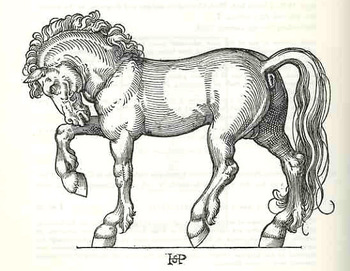
    Hans Sebald Beham wrote—produced, rather, the text and illustrated—Dises buchlein zeyget an und lernet ein mass oder proporcion der Ross, nutzlich iungen gesellen, Malern und goltschmiden, a tremendous, inspired model book for artists and observers, back there in 1528.  Amidst the heavy, blocky Gothic type of the book lie a series of just beautiful, proportional studies of horses.  It is probably the single greatest illustrated work on horses done in the history of printing to this time; and it has stood the test of time as a work of art, rather well.

    It is also, evidently, the work of an anti-Lutherian and certified “godless” painter, expelled by the city of Nurnberg (along with his brother and as it turns out the subject of yesterday’s Saturn post, George Pencz).  He, and his brother Barthel, and Pencz—with whom he shares birth and death dates of 1500 to 1550—were shaken by the city half way through his life in 1525 for having bad thoughts about religion and the proper way of not avoiding it. The decision by the city didn’t affect his art, as we can well see
    Blogmodel_bookhorses2130

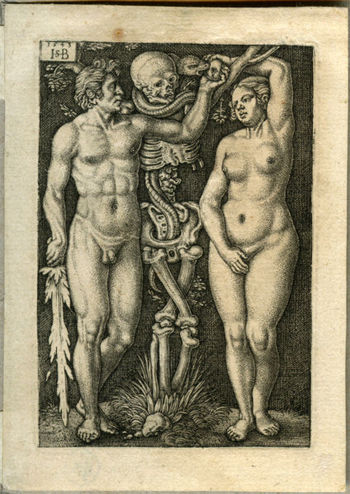
    Beham’s model book on the horse was followed by one on the human figure.  He was an extraordinary talent whose fine, deft touch can be recognized across the room, miniature or not.

    Behamadam_and_eve
     

    ·Posted by :

    ·in:

    —