A Daily History of Holes, Dots, Lines, Science, History, Math, Physics, Art, the Unintentional Absurd, Architecture, Maps, Data Visualization, Blank and Missing Things, and so on. |1.6 million words, 7500 images, 4.9 million hits| Press & appearances in The Times, Le Figaro, Mensa, The Economist, The Guardian, Discovery News, Slate, Le Monde, Sci American Blogs, Le Pont, and many other places… 5000+ total posts since 2008.

Category: Absurdist, Unintentional

  • “The First Thing is to Find Some Men” How to Get a Boy-Date, 1941

    JF Ptak Science Books LLC  Post 914

    [Continuing the posts “What Makes Human Robot Girls, 1941” and The Missing Pieces of Women, Pope Joan and the Proper Girl]

    Do Boys Like You? is
    the name-of-the-game for girls, evidently (“set out to make yourself worthy of a boy’s
    affection.  Just one boy—any boy…”),
    brought to you as a part of a long, continuing series by Elizabeth Woodward in
    the Ladies’ Home Journal in the early
    1940’s. Blog jan 20 boys like you
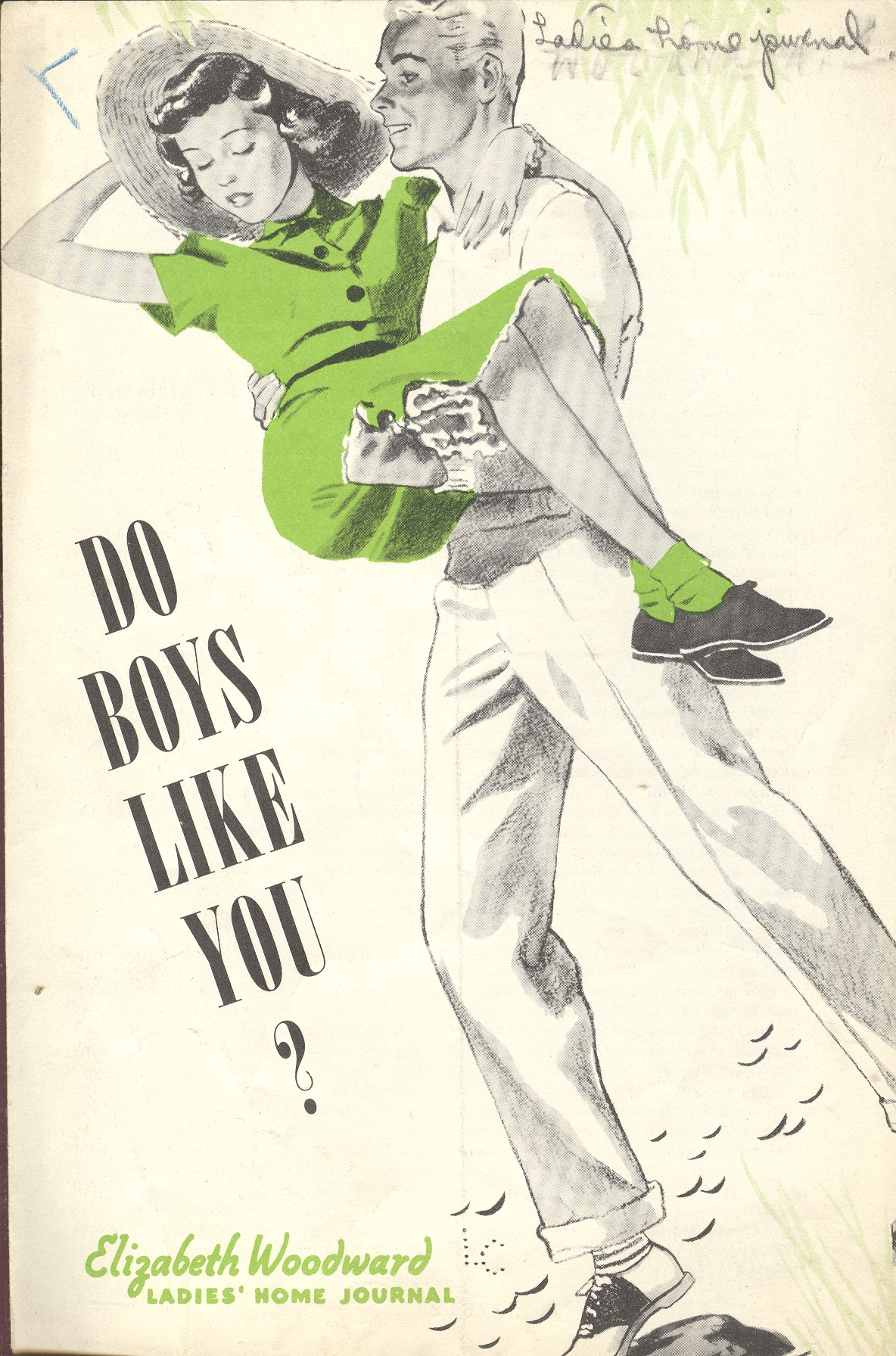
    This installment is about getting a boy for a date, and how to make
    oneself getable and datable and boy-friendly, all while maintaining the
    thinnest veneer of self-acknowledgment (“be adaptable as a chameleon”) as possible while staying true to “yourself”.  It is a cocktail of overall old-lady sense
    and deep ruffled bows writ by the hand of gender entrapment and not-so-subtle
    subjugation. Let’s get to it with some of the more archaeologically-interesting
    statements of this social-norms-establishing pamphlet:

    Paragraph: (Intro):

    “Do boys like you, or don’t they? Its as easy as that!  Either you have dates and go places with lots
    of boys, or they don’t pay any attention to you at all.”

    Paragraph: “A Female World”

    “…the first thing is to find some men.” (Which is odd
    because “men” is used only one other time beyond this reference—its all boys
    and nothing but boys.)

    “Short of throwing yourself on their (boys’) mercy, see if
    you can’t wrangle an introduction out of the girls who do know boys…”

    “Your parents could invite their friends over for dinner and
    ask them to bring along their son. And you do a good job on him!” (I’m not sure
    what that “job” is.)

    “They (boys) can’t find you if you’re packed away in a mob
    of females.”

    Paragraph: “A Rank Outsider” (on being the new girl in a
    community):

    “The girls have things under control and they don’t want any
    interference from you.”

    “You might know more than they do, and you just might talk
    down your pug nose at them.”

    “…you’d better get accustomed to traveling alone…”

    “Give them every chance to find out that you aren’t high
    hat, that you like the same things they do, that you aren’t out to sniggle
    their men away…”

    “When they (the girls) accept you, the boys will too…”

    Paragraph: “an Old Story”

    “(Boys) are so used to looking at you that they think of you
    as furniture.You’ve got to be new!”

    “If you’re fat and pudgy, make yourself lean, sleek and
    smart.”

    Paragraph “Take it Easy”

    “…its going to take practice to make boys like you. Take it
    easy. Set out to make yourself worthy of a boy’s affection.  Just one boy—any boy…”

    Paragraph “A Few Gentle Hints” (Seems that we’ve gone way beyond this by now.)

    “Don’t run around with girls who are dud.”

    “Don’t go in pairs with a girl who is overwhelmingly popular…Better
    pick a girl who will give you an even break.”

    “Don’t languish for some local ‘hero’ who is sought after by
    all the girls in town.  He may be
    good-but he’s far out of reach…”

    “Don’t pick on a lad who has never had a date with a girl.”

    “Don’t be careless or sloppy when you’re talking with boys…”

    “Don’t expect (or even hope) that every boy you meet will
    ask you for a date.”

    And (not quite) lastly, but should’ve been:

    “Don’t go around thinking about boys constantly.”

    But lastly thus:

    “Act as though you are having fun. Be alive, gay and enthusiastic. Be interested in what’s going on. Be sweet, tactful, and adaptable as a chameleon. Have definite likes and dislikes, but don’t be so rigid
    that you are stubborn, opinionated and difficult to get long with. Be carefree,
    casual, easy, willing to play and fun to play with. And don’t be shy about
    liking the boys.

    THEN THE BOYS WILL LIKE YOU! [Emphasis in the original.]

    My poor mother would’ve been reading this…

    (Thanks to Jeff Donlan for pointing out that the chap on the
    cover carrying the girl away has joined the fabric of her skirt to (1)  hold
    onto and steady her and (2) make sure her skirt doesn’t fly up and out and is not actually touching her thigh…)


  • Missing Pieces of Women: Pope Joan & the Proper Popular Girl of “The Ladies’ Home Journal”

    JF Ptak Science Books LLC  Post 910Pope joan weltknronik

    Listening
    to these dreadful stories this morning on NPR about the Vatican’s relations
    with the Roman Jewish community and the abortive WWII papacy of Pope Pius XII—the
    papacy of blank and missing compassion—I thought about the missing Papacy of
    Pope Joan.  Whether or not she existed is
    a question of debate; whether she was a pope or not is perhaps even less
    debatable.  What seems not impossible
    though is the ability of a large institution like the Catholic Church to make
    the entire issue of unwanted history or legacy to go away. 

    The
    historicity of this papacy is long and shows the murkiness of the earliest
    writers on Joan. She was supposed to have served as pope between Leo IV and
    Benedict III around the year 850.  The
    fuller versions of her history turn up in the 14th century, although
    the earliest mentions of a female bishop of Rome go back to the 9th
    century—Joan remains unnamed though until the 13th century when
    Martin of Opava’s Chronicon Pontificum et Imperatorum1(referring to
    Joan as “John Anglicus” or “John of Mainz”) does so for the first time.
    Joan apocJoan
    escapes the Middle Ages with a little flair, but doesn’t do so well in the
    Renaissance.  As a Missing Piece in the
    history of the Papacy she turns up not-so-well represented:  for example, she is seen here looking good
    but turning up bad overall as the Whore of Babylon2.  She was treated as a disgrace, and impostor,
    someone who demeaned the Catholic institution by her sex and deception, though
    god knows that the history of the papacy is filled with horror stories3 that
    far exceed the reach of mere deception.

    So
    I was thinking about the piecing-together of the Pope Joan jigsaw and
    remembered an actual “womanly” jigsaw that could actually be pieced
    together.  This bit came together as a
    result of a post I did here just two days ago (What Goes Into Making Human Robot Girls, 1941), and was one of a series of
    intolerably heavy eight-page pamphlets cementing the structure of female social
    intercourse at the hands of the magazine The
    Ladies’ Home Journal
    . 

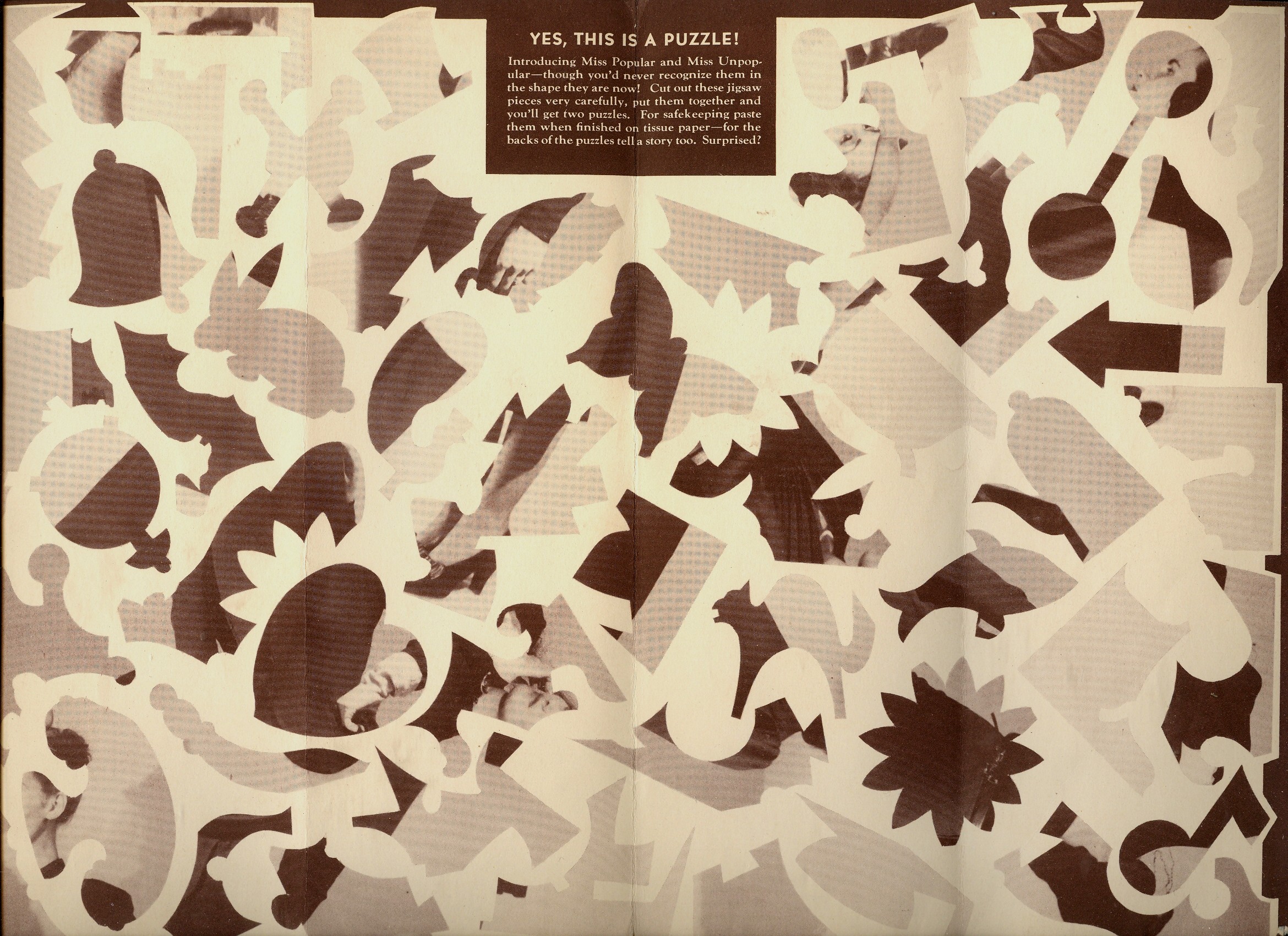
    Blog jan 13 Puzzle cvr

    One of these
    publications—hardly a pamphlet per se, just a folded 11×8 inch sheet of heavy
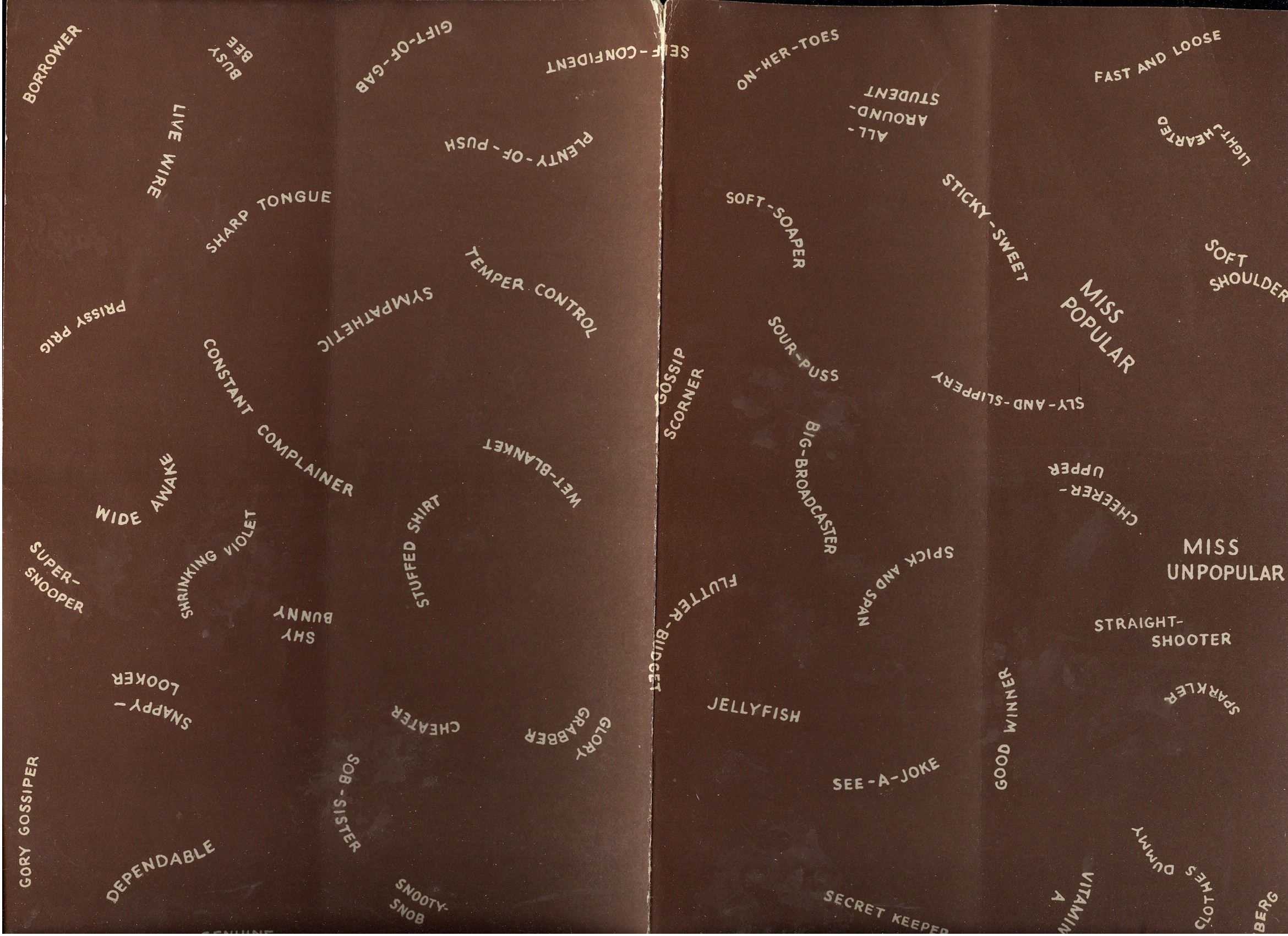
    stock—came without a title, presenting itself as a puzzle. The puzzle pieces
    are parts of two women, “Miss Popular” and “Miss Unpopular”: the reader was to
    take the publication, cut out the pieces, and reassemble them into hidden role
    models, with phrases describing each on the back of each puzzle piece, all done
    without the slightest possible understanding of metaphor or irony.

    Miss
    Popular phrases/descriptors
    : live wire, plenty of push, wide awake, snappy
    looker, dependable, genuine, secret keeper, on-her-toes, spick and span, light
    hearted, all-around-student, straight-shooter, gossip scorner, sympathetic,
    cheerer-upper, sparkler.

    Blog jan 13 Puzzle pzl

    Miss
    Unpopular’s phrases/descriptors
    : glory grabber, sour puss, cheater, sob-sister,
    snooty-snob, wet-blanket, borrower, prissy prig, sharp tongue, gory gossiper,
    clothes dummy, iceberg, sly and slippery, jellyfish, sticky-sweet, soft soaper
    (?) and of course fast and loose.

    And
    so girls—or young women—picking up this publication in 1941 were expected to
    cut this thing up and piece together the proper (paper) role model using the
    reinforcing traits of meager acceptance printed on the back of the puzzle
    piece. And poor Pope Joan, whether she was real or not, whether she was
    imagined or sunk purposefully away into the Pandora’s sisters’ boxes of forced
    forgetfulness—it really doesn’t matter—is just another woman or part of woman’s
    puzzle whose blank or missing piece has been extruded, forced into a form more
    friendly to a world less friendly to women. 

    Notes

    1.According
    to the Chronicon:  “John Anglicus,
    born at Mainz,
    was Pope for two years, seven months and four days, and died in Rome, after which there
    was a vacancy in
    the Papacy
    of one month…” [See continued reading section below for more]

    2.
    Babylon was the
    representation of the seat of evil on the Earth.  From the “Book of Revelation” (17:3–4):
    “And I saw a woman sitting on a scarlet beast, full of names of blasphemy
    with seven heads and ten horns. The woman was garbed in purple and scarlet, and
    gilded with gold, gems, and pearls, and bearing a golden goblet in her hand
    full of abominations and filthiness of her fornication.”

    3.
    Borgia and the Medicis not being the least of the story: see E.R. Chamberlin’s The Bad Popes, (1969)


  • Mapping the Invasion of America, 1942

    JF Ptak Science Books LLC  Post 873           Blog Bookstore

    [See also Part II of this post, here; and consider a  related post on the Nazi sub-orbital Amerika Bomber]


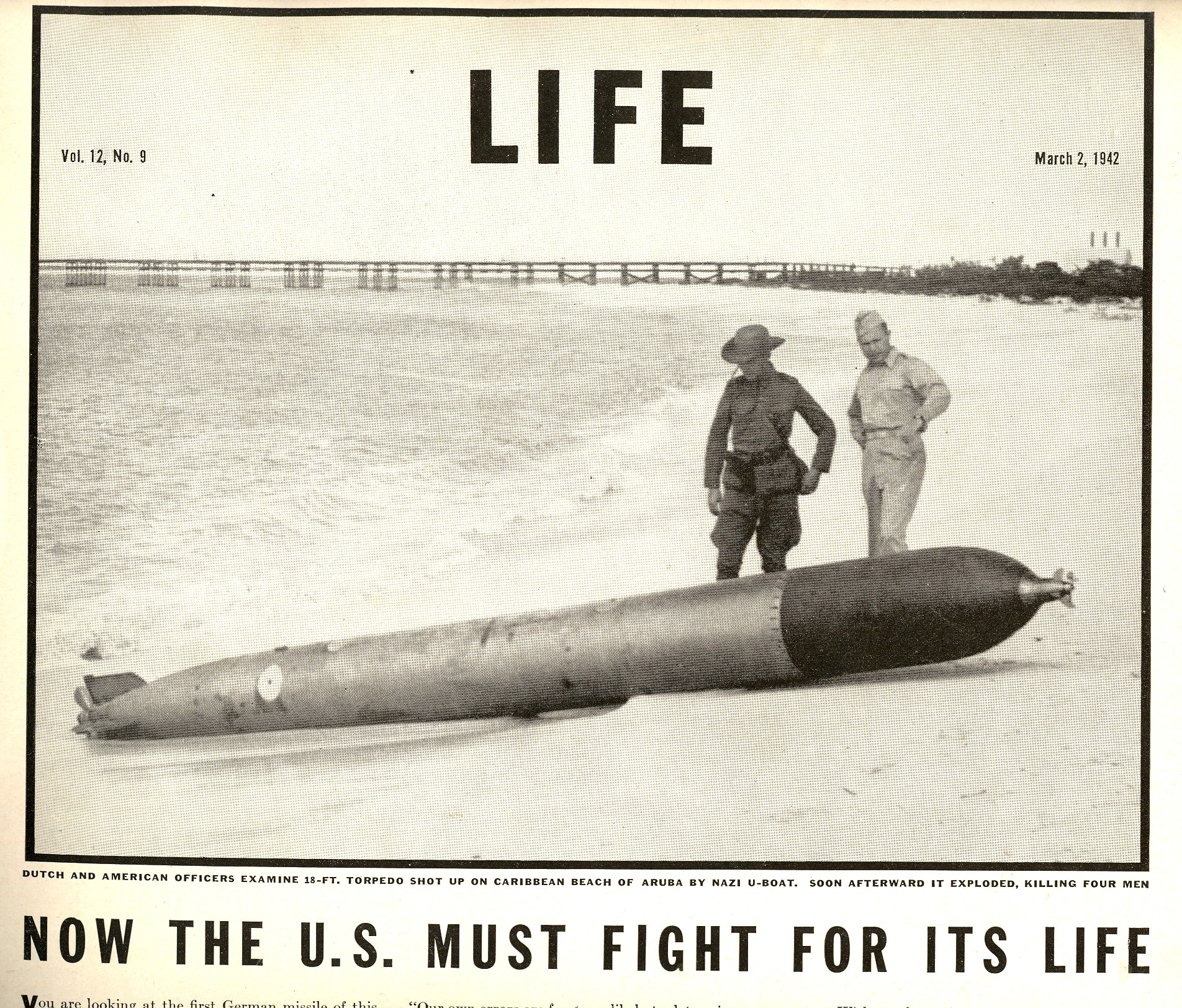
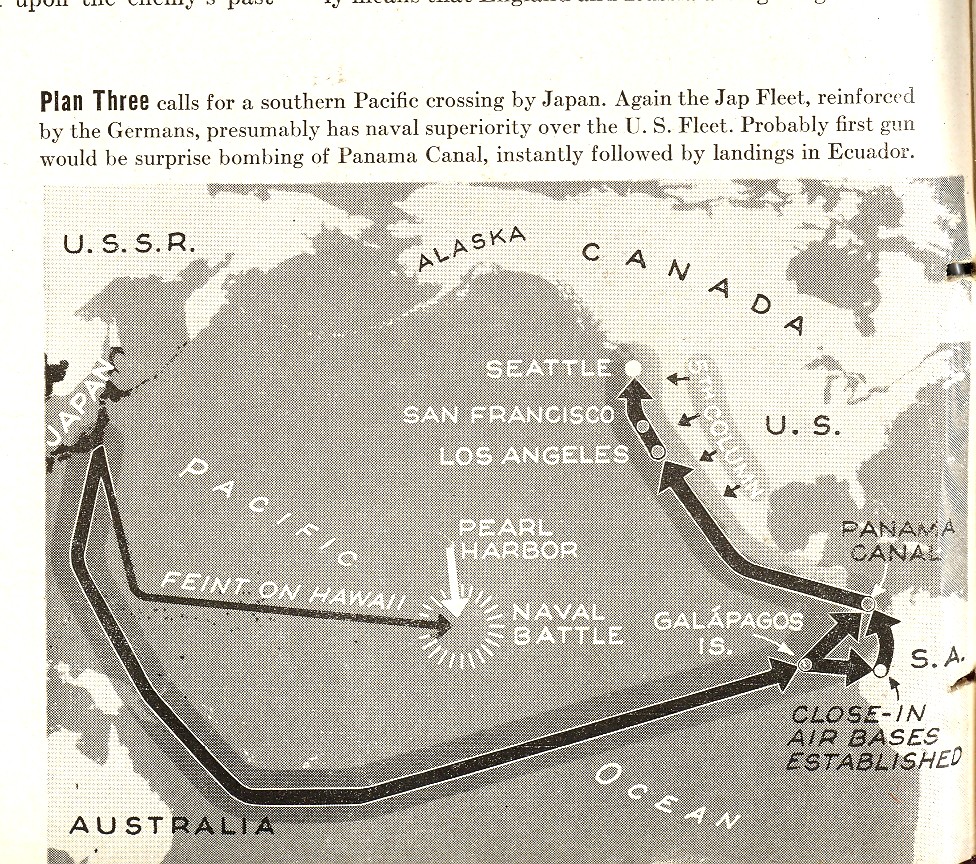
    Blog Dec 12 USA attacked map overview LIFE Magazine issued a wake-up call of sorts to its readership in their 2 March 1942 issue.  I say “of sorts” because even though this hard article (entitled “Now the U.S. Must Fight for Its Life”) must have sorely sobered some of its readers, it started on page 15, following big ads for Listerine, Matrix (women’s shoes, Bell Telephone, Modess, Clapp’s Baby Food, Dot Snap Fasteners, Goodrich Tires, White Horse Scotch, Pompeian Massage  (for shaving), Jack Benny/Carole Lombard’s “To Be or Not To Be”, Colgate, Yardley powder and  Mimeograph, and a few interspersed puff pieces—and a Ginger Rogers cover photo.  But once LIFE paid its bills1, the article got right to business, responding to a February article by sci-fi/novelist Philip Wylie2 on the possibilities of the U.S. losing the war.    

     Blog 12 10 USA map attack 1

    Losing looked like something that could actually happen in pre- war-ready America3.  The war in Europe had been on in earnest since the very end of 1939 (since 1933 in Asia), and the Axis had reached just about the fullest extent of their victories (though there would be more gains in the Pacific to come).  By March of ‘42, we had Bataan, MacArthur leaving the Philippines and the fall of rape of Manila, the siege of Leningrad, Corregidor, Java Sea, the Brits leaving Singapore, Malaya, and so much more.  The Axis powers in Europe were now in control of Austria, Czechoslovakia. Poland, Denmark, Belgium, the Netherlands, Luxembourg, France, Norway, Yugoslavia, Finland, Greece, Lithuania, Latvia, Estonia, and parts of the Soviet Union (Ukraine, Bylorussia, Crimea), and parts of North Africa;  plus the allies of Hungary, Romania, Bulgaria, and Slovakia. There was also Italy, of course, controlling Sicily, Ethiopia and Libya., and of course the Japanese controlled large swaths of China, South East Asia, Indonesia and points in-between.  The overall situation did not look very good. 

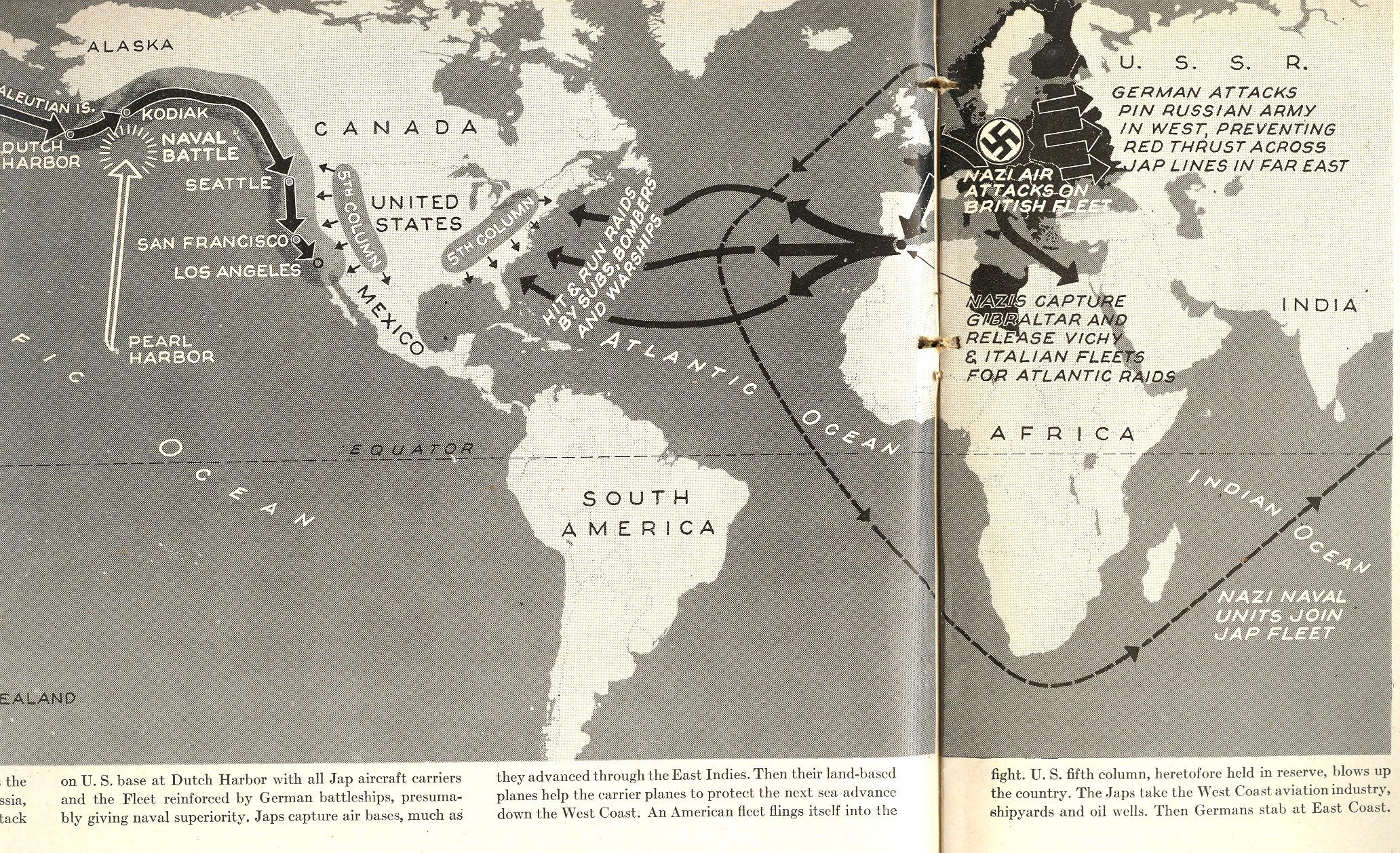
    Blog Dec 12 USA attacked map 2
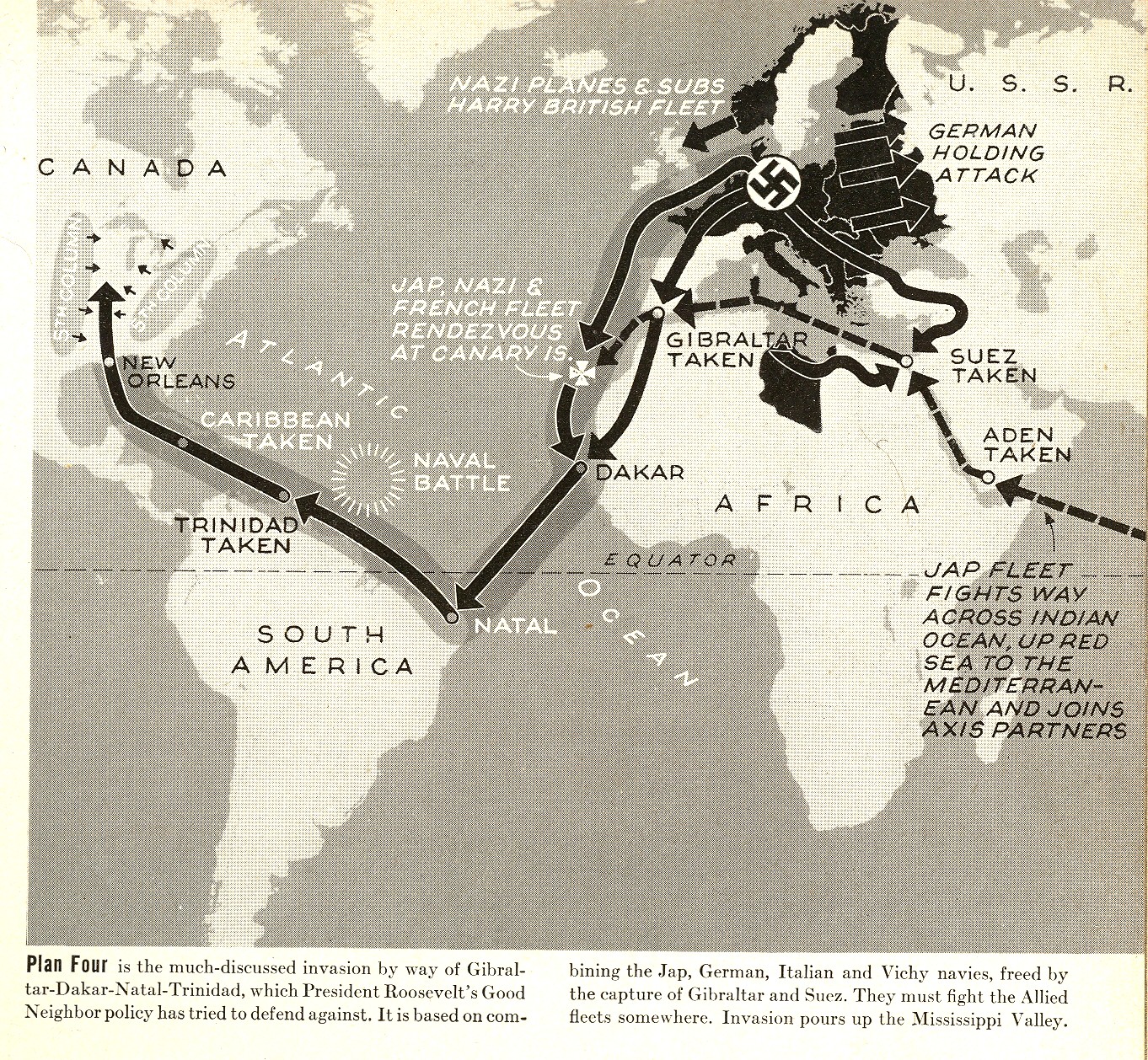
     The following maps appeared in a two-page spread, detailing ways in which the Axis powers could combine their efforts, focus on America, and take over the country.  Maps such as these with arrows being drawn towards America were absolutely uncommon during this time. 

    Blog Dec 12 USA attacked map 3 001

    Notes

    1.This is almost universal SOP for war reporting for almost all media, and which continues today.  The Illustrated London News delivered reports of success and disaster sandwiched between ads for socks and trifles, as did the Illustriete Zeitung (Leipzig and Berlin), the New York Times, and so on.  I remember very clearly as a kid hearing the reading of the daily list of American soldiers killed in Vietnam  on one of the Big-Three networks, somber and intoned, followed instantly by a ad for Coke or Mister Kleen. 

    2 Wylie (1902-1971) was an interesting guy with a wide reach.  In addition to Hollywood-feeding work, interesting fiction, insightful scifi and social commentary, Wylie also provided the inspiration for the creation of Superman (“The Gladiator”, 1930) and Flash Gordon (When Worlds Collide, 1933).

    3.  Once the war machine in the U.S. got into hyper drive I think that it was impossible for this country to be defeated given its population, workforce, industrial capacity, raw materials, and of course scientific superstrucutre.  Also there was also no other country in the world with the necessary (and enormous) components needed to construct an atomic bomb.  This is a simplified statement that seems pretty homespuna dn jingoistic, but the fact of the matter is that the U.S. was the seat of overwhelming  possibilities and capacities. And yes the Nazis had been slowed down mightily with the expense of dozens of millions of Russian lives and the entire British war machine and on and on—I’m just saying that in the end, the U.S. could not have been beaten.  

    MORE maps in the extended section, below:


  • The Odd Department: Cartoons & Tongue-Stuffed Calve’s Brains

    JF Ptak Science Books   Post 807  Blog Bookstore

    + blog 10.26 multiple


    In the excitable, pulsing pile that is my collection of Naively Bizarre Literature–some 5,000 items now pushing themselves around like a 750-pound bad idea–comes this lovely, “what the  ____!?” title:  Let’s Serve Something New. 53 Selected Recipes for the use of Liver, Heart, Kidney, Sweetbreads, Tongue and other Meat Specialties.

    + blog 10.26 liver cvr

    Now, once I got the tongue part out of my 18-year-long vegetarian brain, I wondered about what on earth the other part of the ripping title and what “specialties” there might be.

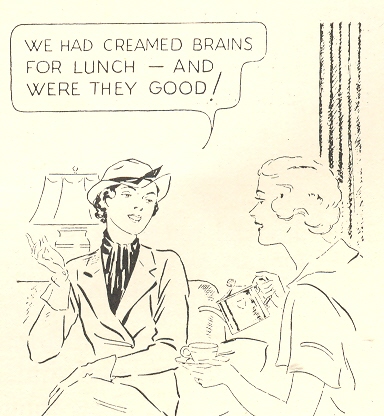
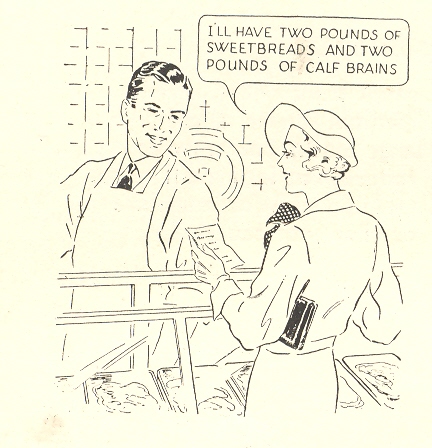
    But before I could get there I was stopped by these unique cartoon illustrations romping their way through the text with spectacular word balloons   There are SO many more words that could be injected into these balloons than the ones that were used, and so much more expected. But the zombie texts was inserted by the publisher, which was the American Institute of Meat Packers, whop no doubt were trying to force every last penny of profit out of whatever was left in the sluice sieves of the chopping room floor. 

    + blog 10.26 liver brains

    If these cartoons were extracted from this source, and their balloons left blank, and if people were asked to supply new text, the original words would be the very last in a very long list of possible fillers.  


    Removed from context, the illustrations are unexpected and hysterical; placed back into context, and well, they are a little wince-y. 

    + blog 10.26 i'll have calf brains

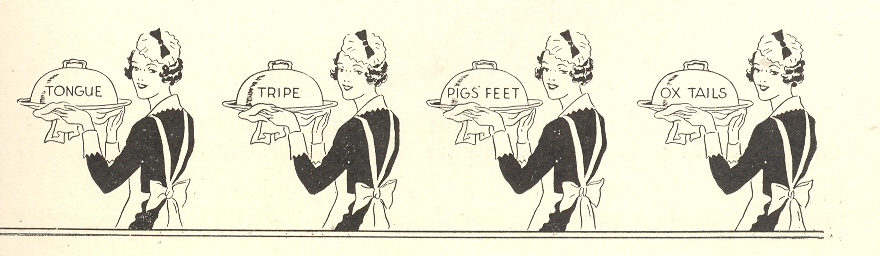
    The recipes that decorate this pamphlet are no less unbelievable, at least from where I’m sitting, and I’m sitting hard:  stuffed baked liver with vegetables in liver dressing, pork liver fermiere, liver with brown liver gravy, liver Pasadena (liver and butter and broiled bacon swimming in bacon fat), liver dumplings stuffed with liver, creamed sweetbreads, kidney omlettes, baked stuffed heart with rice border, heart chop suey, scrambled brains, sauteed brains, creamed calves brains, cold jellied tongue, tongue omlette, tripe roll, baked pig’s feet, and, not last, Tripe a la Mussolini (which is 1.5 pounds ogf tripe, bread crumbs, and tomato sauce).  (Spam stuffed with spam and spam jelly, braised in a light spam sauce, and covered in crackled spam.)

    + blog 10.26 gee mom


    After everything was said and done, the other surprise meats didn’t seem so surprising anymore, what with running up on the heals of delicacies like stuffed tongue and parboiled sumpin’s: tails, feet and oysters (a la Waldorf) seemed as harmless as a Sunday Slider. 

    Spam.


  • Selling to “Simple” Women, 1939: “She’s Not Interested in Bloody Meat”

    Post 882 (revised; part of the History of Women Series; also see Women Meat Pioneers.)

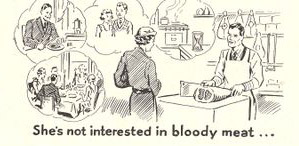
    Women--bloody meat
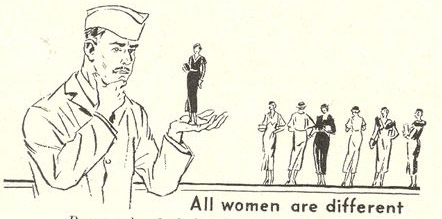
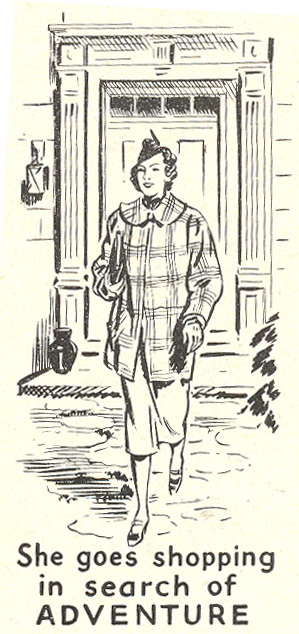
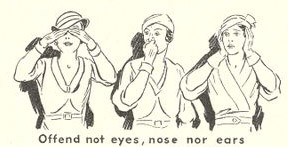
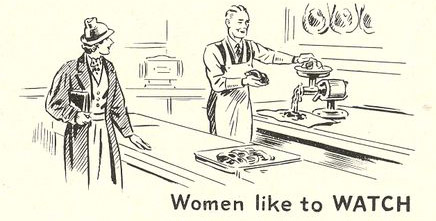
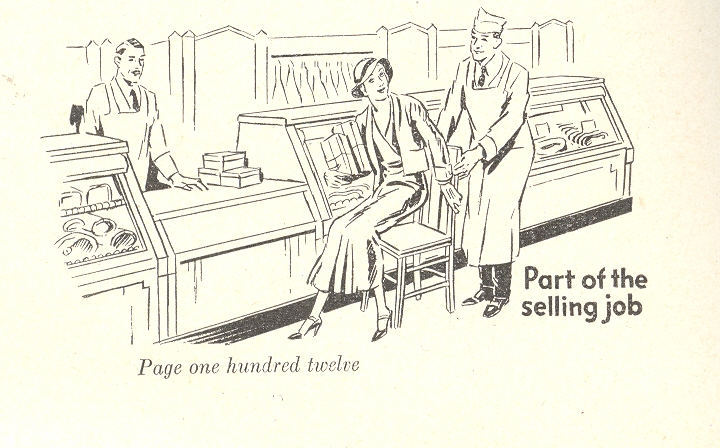
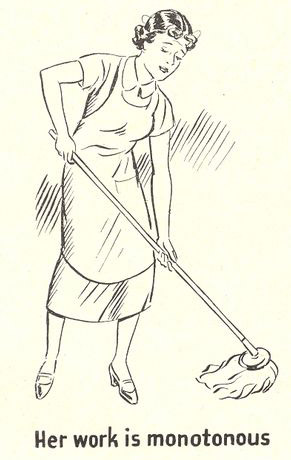
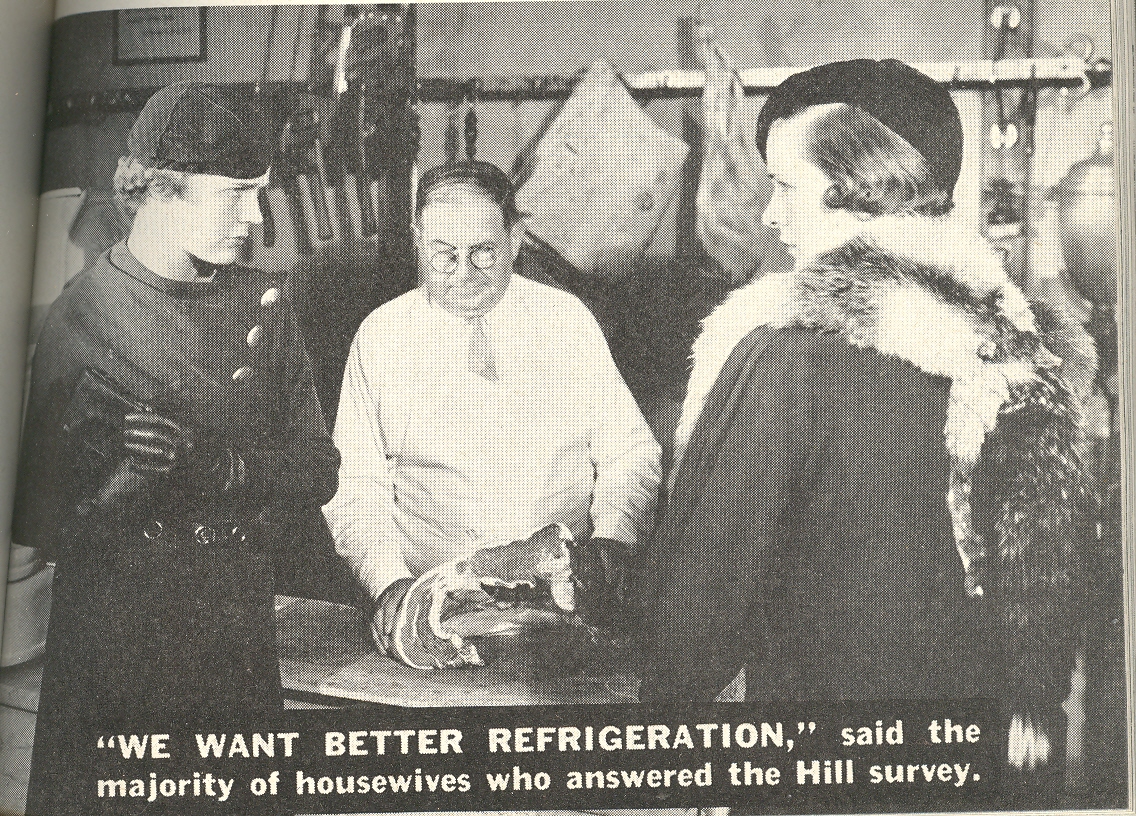
    These sales-happy customer relations images from a  modern food merchandising catalog (Modern Merchandising, 1939) come at an interesting time in the history of eating—or lesser yet, the history of buying food.   The pamphlet addresses the growing idea of the super market, a notion still new in the minds of consumers —it seemed as large to the consumer familiar with the 1920’s concept of a market as it seems tiny to the megamarket people of the present.The illustrations–all quite small, margin-inhabiting affairs, space killers, no bigger than 1×2 inches–are there to help the grocer deal with women customers and better understand “them”. 


    Women--all different 

    Women--shopping


    I’ll address the interesting merchandising changes here in another post—right now I’d like to focus on the marginal drawings in the bottom corners of the text.  They may be small and offhanded–generally they are less than two square inches–but the messages they delivered, marginalia or not, were very strong.  Over and over again these bits demand the sub-class of women, emphasizing their trivial, ephemeral interests—bits of Nothing reinforcing large bits of Something.  

    Women--offend not eyes

    The messages beneath the images, collectively: “women judge meat by appearance:; “there a little bit of the monkey in all of us…we like to see and handle”; “offend not eyes , nose nor ears”; “part of the selling job”; “women like to WATCH”; “her work is monotonous”; “she goes shopping in search of adventure”; “she’s not interested in bloody meat”. They present cascading reactions: they’re somewhat funny to my eyes, and then uncomfortable, and outrageous, and then simply sad that their solemn pronouncements on the status of women would be so acceptable, their as-yet unidentified sexism and bitter “racism”a non-sequitur.

    Women--like to watch
    .

    + women monkey 


    + women sitting down 


    Women--her work


    + women want more refrig


  • The Indredible and Useless Dog Engines of 1895 and 1939

    JF Ptak Science Books   Post 797 (Sept 2009) Extended. 


    ++00++ 9.22 dog det


    In 1702, at the beginnings of the Industrial Revolution, Thomas Savery (c.1650 – 1715) began the idea of calculating the work done by steam engines over that done by horses, writing in his book, The Miner’s Friend:

    “So that an engine which will raise as much water as two horses, working together at one time in such a work, can do, and for which there must be constantly kept ten or twelve horses for doing the same. Then I say, such an engine may be made large enough to do the work required in employing eight, ten, fifteen, or twenty horses to be constantly maintained and kept for doing such a work…”   But it was James Watt who first introduced the term ”horsepower” while trying to advertise and place forever the idea of his steam engine over than of the earlier Newcombe engine and, of course, horses.”

    ++00++ 9.22 dog


    James Watt (1736-1819), Scottish inventor and “re-inventor” of the steam engine, the man who put the ‘power” into “horsepower”, determined that a horse could turn a mill wheel (of a 12-foot radius) about 144 times in an hour (about 2 ½ times a minute), traveling 2.5x2pix12 per minute.  It has been shown though that on average a horse will work at about 1.5 horsepower like this for an hour on and off; and less than 1 horse in other times; a man could work at 1.5-2.5 horsepower for a short time, but generally would pull about a tenth of that for an extended time.


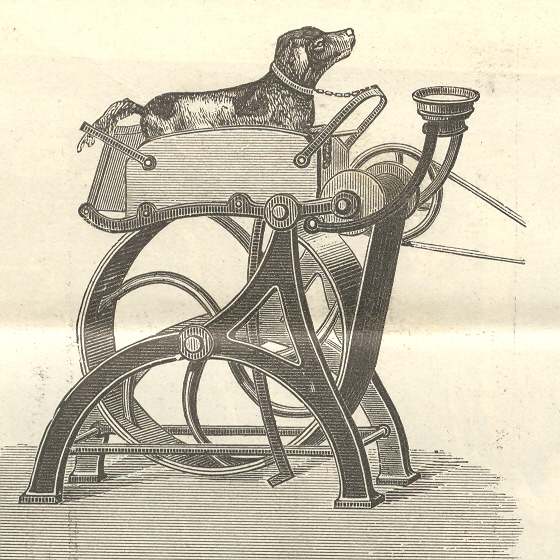
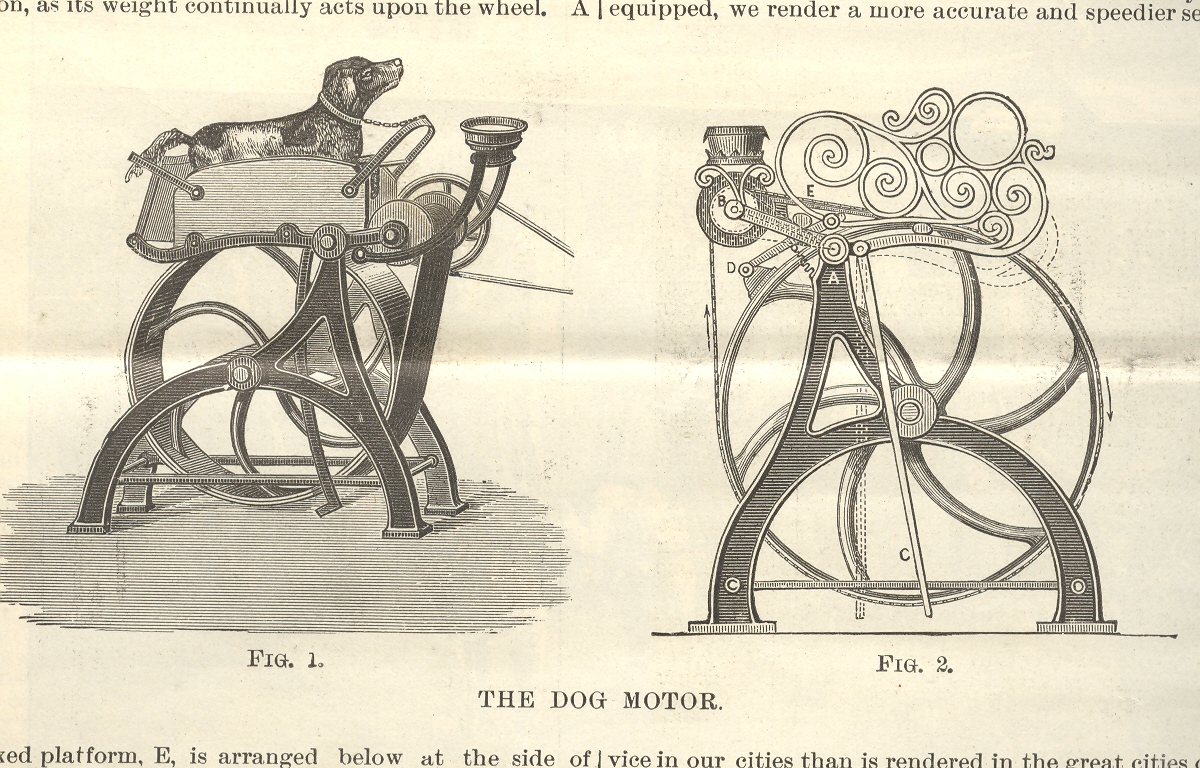
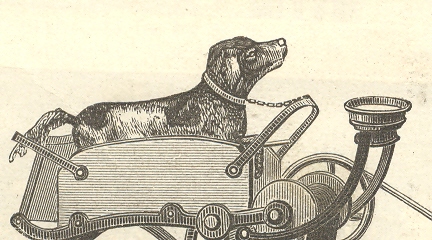
    And so we come to the crux of the biscuit of this post:  a dog motor.  This entirely, utterly, unconvincing and thoroughly bad idea was fully fleshed out by a M. Richard (naturally of Paris) for the Agricultural Exhibition and re-published from La Nature in the Scientific American Supplement  on 10 August 1895.  It is slightly lovely in its high Victorian way, or at least so until you consider that an animal goes in side the thing, working its way along an infinite belt, a cup of water just within reach.  The dog would power the large wheel, which would turn a smaller wheel and belt, which in turn would be connected to smaller, and so on, until it reached whatever it was it was powering, which is left entirely to our imagination.  Even when I squeeze my eyes in a telescoping effort, I cannot see what it is that this poor doggie might power.  Given the descending orders of radii of the wheelworks, perhaps the tenth-horsepower dog engine ran a fan, or something, something remarkably insignificant.  It does tell us something about over-design, like buying a ten dollar bill with a twenty. 


    ++00++ 9.22 dog det 2


    Another, more recent but less serious attempt at utilizing canine power was found in Popular Science for 1939:


    The thing that really bothers me is that both of these really bad ideas occurred in years where there were fantastic ideas in the history of physics–1895 being the home to the discovery of the atomic world in the work of Wilhelm Roentgen, and 1939, well, more of the same plus making the atomic world go “boom”.

    In this same vein, and keeping with the highlight-year-for-physics theme, is this thing, created in the 1880’s but published in Popular Science in 1933:

    With the help of Laura Massey (Bookn3rd !), from the wonderful bookseller blog, The Cataloguer’s Desk at the great Peter Harrington Rare Book Shop (London), I’m including an 18th century version of sweating dogpower called the Turnspit:

    File:Turnspit Dog Working.jpg

    I’m not sure what it is that would keep the dog running after it realized in the first half-minute that it will never be able to retrieve that hanging thing set out in front of him/her–maybe things got poke-y. 


  • Outsider Logic Department: Earth Clocks, Ocean Spigots, and Mystery Exhausts

    JF Ptak Science Books LLC  Post 597

    Several years ago I purchased a very large collection of pamphlets of the Library of Congress.  It was all housed in 2400 blue document boxes, all the document boxes were labeled and neatly ordered.  The problem was that the classification scheme really didn’t relate to one thing in particular, and the judgment which set one pamphlet in a box wasn’t the same through and through—the alphabetization could have related to author or title or region or keyword or publisher.  In short, each box was an adventure—and a lovely, bizarre one at that.

    Blog--april 27-bizarre earth clock

    It may be a unique one, too.  The one thing that really did hold this thing together as a collection was that the vast majority of the pamphlets were not located in any other libraries in any part of the world.  Now for many of them it was probably okay for the work to slip into a bliblio-singularity, but for thousands and thousands of others, it was a good save.

    And here’s the larger rub:  as I classified and segregated the pamphlets into the “normal” areas of interest, I also started a pile of good-god-what-is-it pamphlets. The GGWII material was extraordinary—some had fantastic covers (and which many times was the most interesting thing about the publication), some had extreme titles, some had ludicrous subject matter, and some were just, well, bizarre.  As the GGWII pile grew into the low thousands, I started to box them for a rainy day project, because I frankly didn’t want to deal with them.  Some of the pamphlets’ covers/subject/title were rather mundane, pedestrian things when they were originally published; however, the high-winded sands of time ripped the flesh from this commonness, making them somewhat unapproachable, unknowable, and incredible–this group was called The Naïve Surreal .   A subset of this group are works that were not approachable and enveloped by their own unique needs from the day they were born; pamphlets made of the stuff of incomplete dreams and adventurous vocabulary—the Outsider Logic group. 

    The Naïve Surreal has all manner of representatives:  pamphlets with just question marks or exclamation points as the title, or histories of unknown things, or beginning with “The Story of ______ “ [mud/zippers/a stone/a bubble/etc].  You get the picture.  The Outsider Logic pamphlets are really very difficult to categorize—perhaps that is their unintended  job.

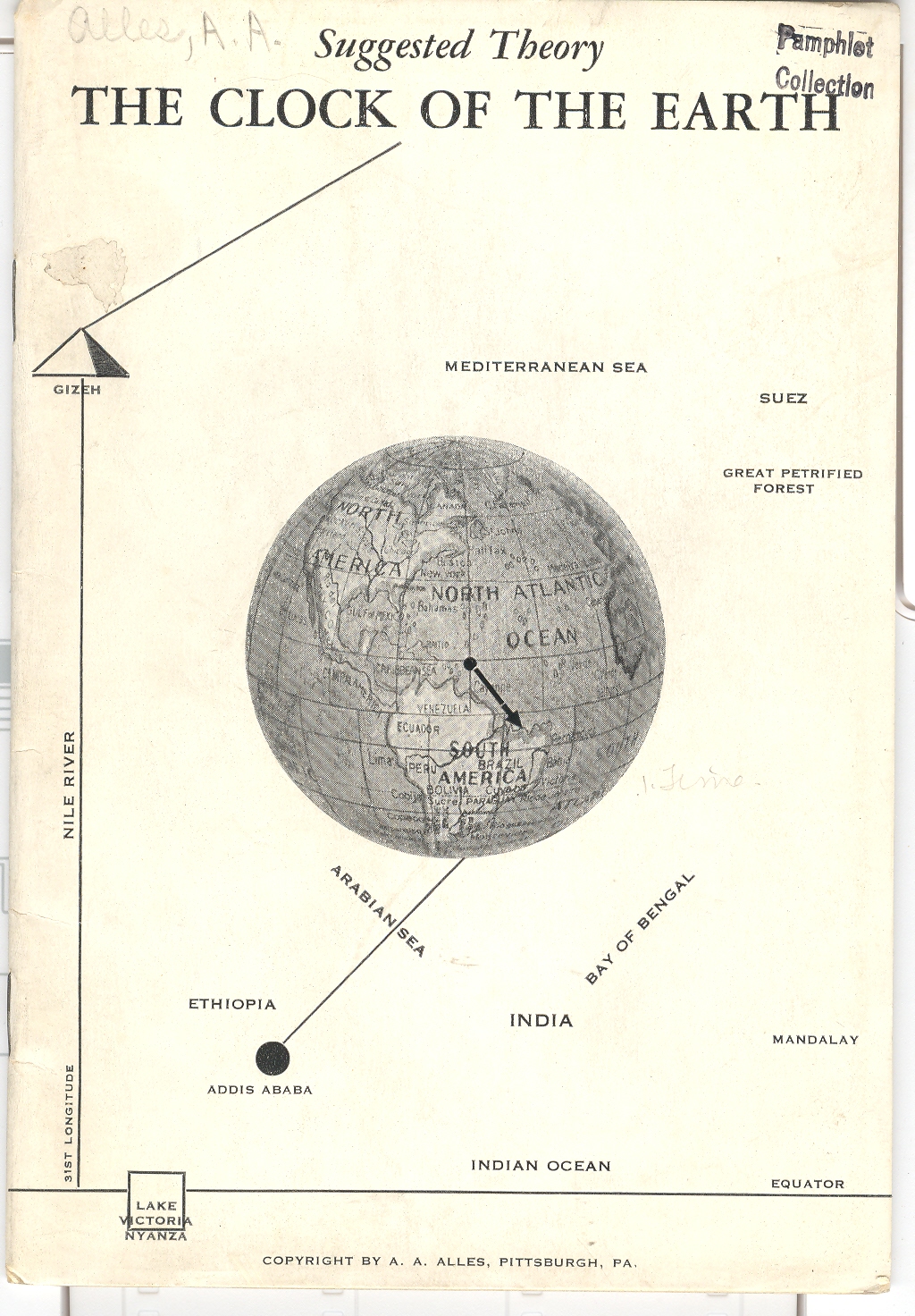
    Today’s emergent beauty from the Outsider Logic collection is .A. Alles Suggest theory The Clock of the Earth, printed in Pug, Pa., in 1935.  This pamphlet is only 18 pages long but I just couldn’t read it.

    Here’s why:  the first sentence reads:

    “The Clock of the Earth represents strange matter from inner-stellar space collected and compounded at the equator which accurately controls the revolutions of the seasons…”

    It goes on but I just can’t type it out.  Sometimes there is a benefit to reading the Outsider Logic pamphlets, and sometimes the benefit is knowing the cover.

    Mr. Alles’ cover is striking and deeply inscrutable, as you can see.  Somehow there is a system for the hour hand there at the equator, but it is mainly a secret, even though it is explained.  Why the geographic locations are printed in the white space surrounding the earth and connected to Addis Ababa, the Nile, Gizeh and the Great Petrified Forest and placed the way they are and connected to the equator clock will have to stand as art rather than explanation.

    Most of the time superior, deeply-removed art like this cover is disappointed by the textual counterpart.  Mr. Alles may not disappoint with his writing, though.  He ends the book beginning the last paragraph with this:

    “Four thousand years ago the open spigot on the equator at longitude thirty-one degrees east of Greenwich , flowing directly to the pyramids in Gizeh…. “ Then there’s something about “exhaust flow”.  Again, as I said, I just can’t penetrate this work.  I’m happy enough with the art, forever open to interpretation.


  • Material Things Out-of-Context: the Statue of Liberty in Paris, 1884

    JF Ptak Science Books LLC  Post 482

    0 blog jan 22 statue409


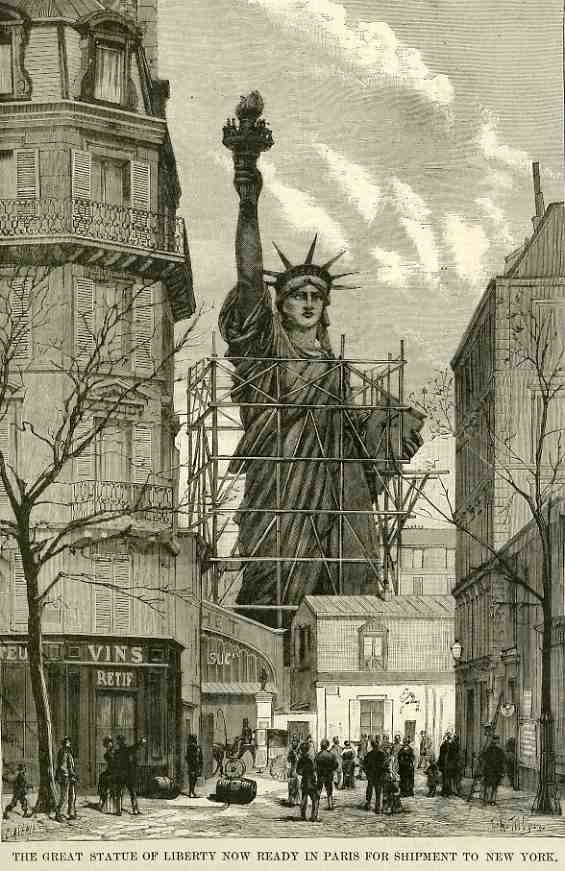
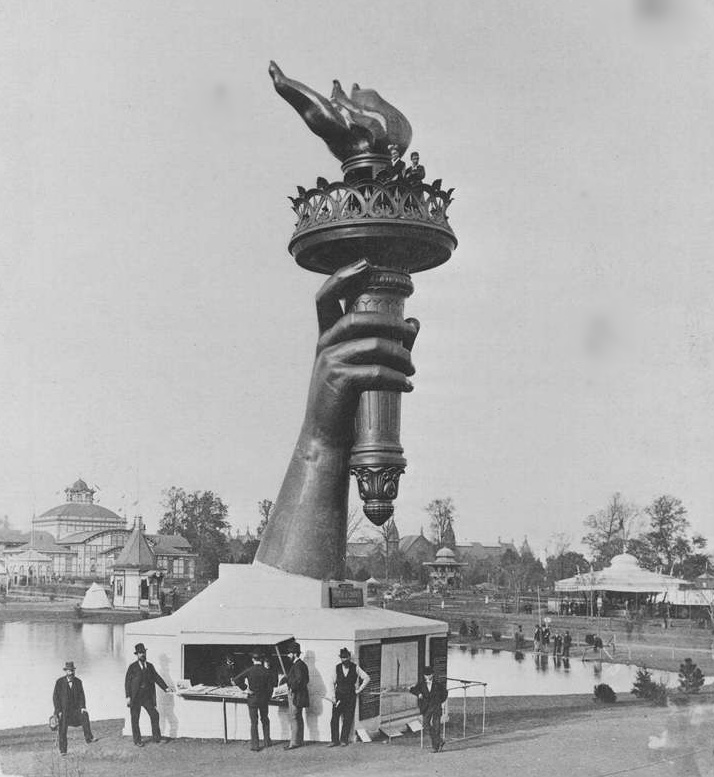
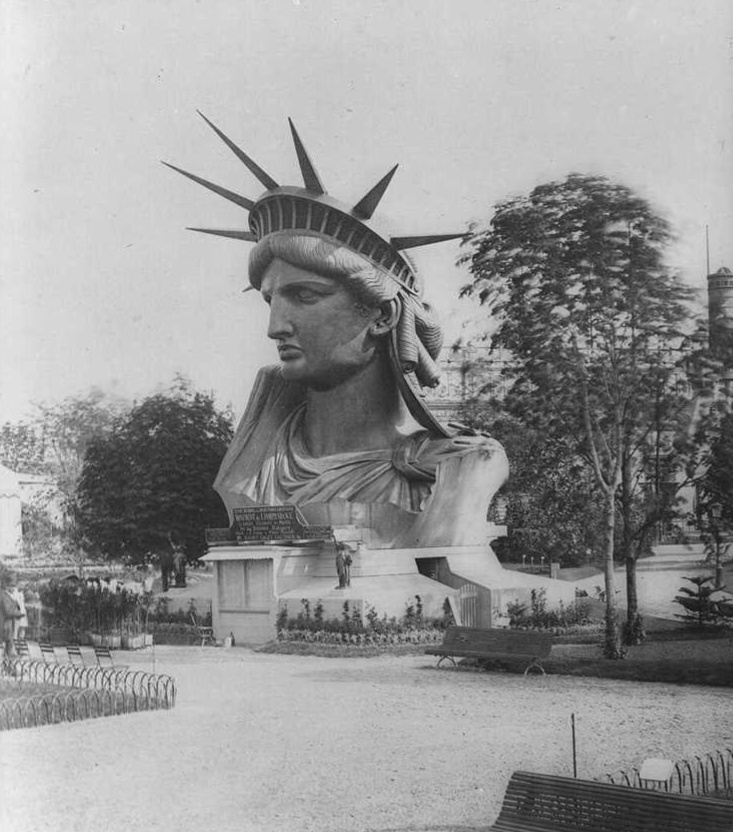
    “The colossal statue of Liberty, which is to be placed as a pharos in New York Bay, is at last finished.” So leads this front-page story of the Scientific American for May 10, 1884 (published in its Supplement section #413).  The image reminds me of many that I have seen over the years of familiar objects being found in unfamiliar places.  In this case, the statue loomed over the warehouses as it was assembled in the courtyard of Gaget et Gauthier, rue de Chazelles, Paris, prior to its shipment to the United States. (It was shipped in 350 pieces and packed away in 315 crates, bouncing its way to America in the French frigate Isere.)  The arm of  the statue made an appearance all on its own at the Centennial Exhibition in Philadelphia in 1876, and then rested at Madison Square in NYC until joined by the rest of the body in 1886.  The head of the statue was also separately exhibited in Paris until 1885.


    Liberty arm

    Out-of-context is interesting and dissonant and anything but normal; and anything-but-“normal” is good, seconding the claim of Mme. Curie that “dissymmetry causes phenomena”, which means that something happens that is not part of the ordinary, and that in turn means that something new can be discovered. 

    Liberty head


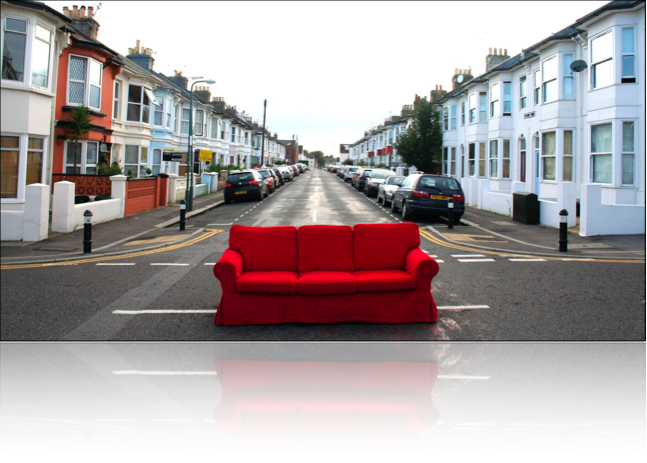
    There are some interesting and purposeful collections of instituted disturbances like this: for example, there’s the red Couch Project, a continuation of a photographic odyssey of a large red couch that has been moved many thousands of miles across the world, finding itself in situations entirely unexpected of a piece of furniture. Then too there is Philippe Halsman’s The Jump Book (1959), in which he simply asked (famous) people to “jump”. Red couch

    He semi-seriously (probably not seriously at all)  interpreted their efforts, fitting their jumps into what he saw as his subject’s personality.  Peter Ustinov (shown here) tries hard to look as though he is not jumping, while Richard Nixon jumps a very careful, self-conscious  and studious jump.  

    Jump


    In any event, in spite of liking thee last two works immensely, I prefer the unintentional out-of-context molestation of required memory.  (Though anything else that can get me to the not-normal stage of being is welcome.)


  • A Sea of Hats: 1915

    JF Ptak Science Books LLC  Post 364

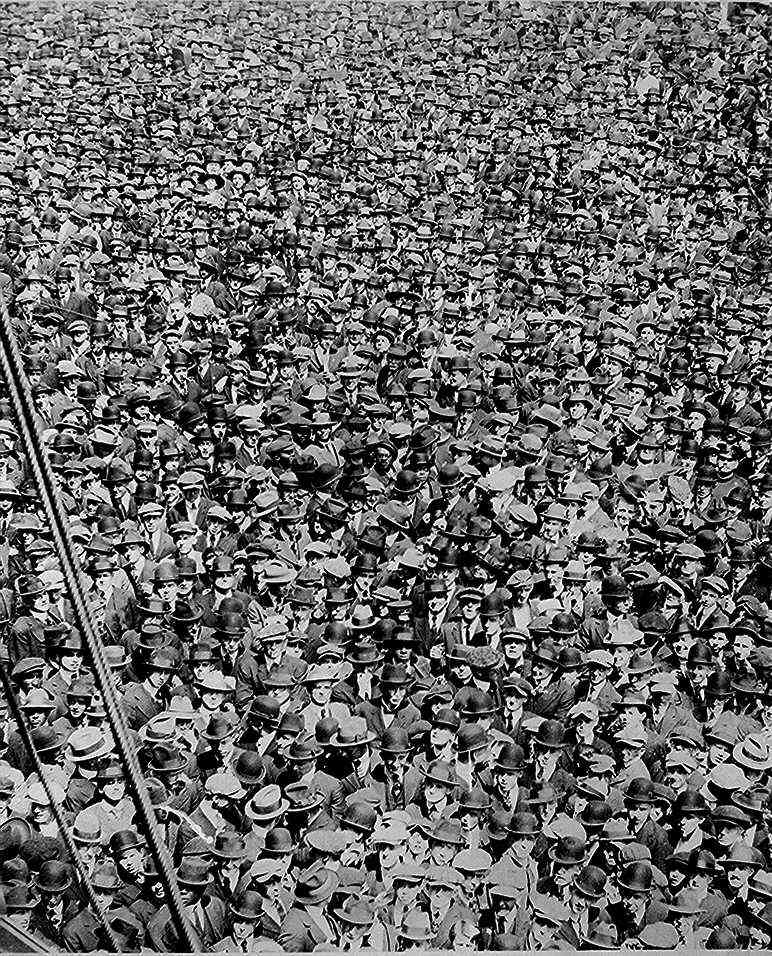
    Hatsdetail Another extraordinary image of pressed-together humans, of a human sea, a carpet of hatted men.  And believe me, every person in this image of (I’d say) approximately 5000 men has got a hat on.  There are hundreds of folks in the photo who re aware of the photographer and who are looking right at the camera, but there is only *one* person who is lifting his hat to the photographer. 

    I don’t have much to say, and I have nothing to connect the photo to (know); I just wanted to surface it before I lost it again….

    Hats


  • What Things Are Not Department: Life, Cityscapes, and the Virgin Mary in Stone.

    JF Ptak Science Books   Post 305

     1blog_oc_t_9_not_here791

    Stone has preserved the evidences of much of the life on Earth—in the fossil record (which happens to stretch some number of years back before 4004 BCE contrary to what one of the vice presidential candidate believes), or an arrested day in Pompeii; indeed the entire landscape shows the way life looked by filling in the negative of what you see today., a negative landscape in a way of what has come before. The City of Rocks, New   Mexico, for example, out there near  Silver City, is a wonderful example of trying to employ your imagination to render in your mind the massive volcano that once stood there, the “City” being the last remnant of its existence. Better yet is the great Ship Rock (hello Officer Jim Chee!), a massive 1,800 foot tall fractured volcanic breccia spire in Navajo Land (Tsé Bit’a’í, in Navaho, “rock with wings”), the internal remnant of yet another massive volcano, though in this case the enormous radiating dykes (igneous rock called “minette“.) exploding away from its base gives you a better idea of the footprint of the missing mountain. You can see this magnificent mountain from a great distance, and it is only when you start to get closer and drive through one of the dikes (that has been separated for the road) that is 20’ tall and still a long way from the base of the mountain that you get a =good appreciation of just how massive it all is. 1blog_oc_t_9_not_here792


    I cannot imagine the gargantuan profundity felt by the person who first realized that the Grand Canyon was formed by erosive forces over previously unimaginable long periods of time, its awesome and enormous silence a negative punctuation to the enormity of the idea.

    Prior to the major discoveries in geology in the 19th century, say from the mid-18th century and earlier, there were many “discoveries” of life in stone—they weren’t very useful and most often were very misleading, but they were, in two words, pretty and unusual.

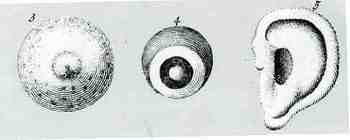
    The people who made and recorded these discoveries were often more circumspect about what they were finding than their readers; sometimes not. Jean-Baptise Robinet (1735–1820) was a French naturalist, Jesuit-philosopher and encyclopediaist (best  known for his five-volume work De la nature (1761-8)) who found all manner of interesting and scientifically-divergent items in stone—eyes, ears, skulls and occasionally an entire body. Antoine J.D. d’Argenville at about the same time in the 1750’s also uncovered silhouettes of dressed human,  birds, cityscapes, trees and the like in stones, which seeped its recordings of the animate into receptive fantasies.

    1blog_oc_t_9_not_here_kircher_793
    But these durable micro- explorations in agate go back thousands of years, expounded by Pliny and some of the other ancients, who followed the origins of humanity back into the rocks. This was a popular idea for the origin of animate beings, propounding itself for centuries, even winding up in the bony lap of Leibniz of all people, who wrote that “men derive from animals, animals from plants, plants from fossils, which in turn derive from bodies that the senses and imagination represent to us as being totally dead and formless”. Stoners therefore held the seeds of the formation of the world; all things living, breathing, and not.

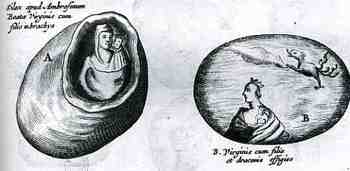
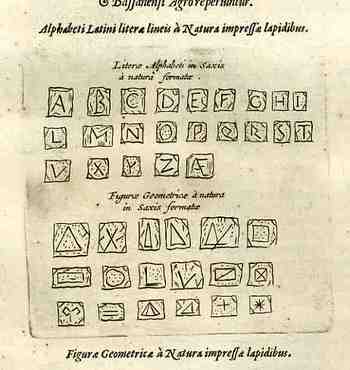
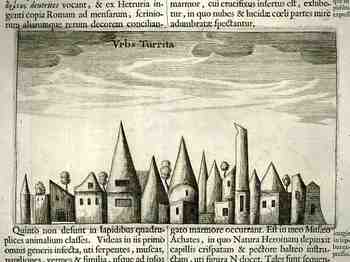
    Our own Athanasius Kircher, the definition of Polymathic ability and superior imagination was responsible for many such observations and discoveries. It seems to me that as much as Kircher gave, he took away, keeping ahead of his critics and the rest of the scientific community with tremendous output…people I think just couldn’t keep up with him. He found all sorts of things in stone: as early as 1619  he exhibited an image of   St. Jerome (in no less a place than the cave of the Nativity in Bethlehem!) that he found in agate. His Munduis Subterraneus (1661) is ahome to a wide range of these objects: quadrupeds of all shapes and descriptions, human full-length portraits, hands with jewels, and even the Virgin Mary and child. AS spectacular as these are there is always more: the magnificent cityscape (reproduced here) and the sublime discoveries of a full set of the alphabet and a series of 15 geometrical drawings, all naturally impressed in stone.

    1blog_oc_t_9_not_here_kircher_alpha

    Perhaps these men gave little more regard to the details in this stone than was necessitated by accepted theory; perhaps they added details to suit their observational needs, as they images were, after all, drawings of the susceptible and the fantastic, and were not photographs. Recording their record was as much open to interpretation as were the theories. I have no doubt that if you look hard enough at things you will at some point find what you are seeking. Only here it is by chance that these figures appeared, and not by the will of a divine creator placing a seed of potential in the stone.

    My five-year-old daughter, Tessie, asked me just the other day about where numbers and letters “came from”. She wanted to know “why are they here?”, which is a fabulous question with a long difficult answer. I do know though that they didn’t come to us from agate.