A Daily History of Holes, Dots, Lines, Science, History, Math, Physics, Art, the Unintentional Absurd, Architecture, Maps, Data Visualization, Blank and Missing Things, and so on. |1.6 million words, 7500 images, 4.9 million hits| Press & appearances in The Times, Le Figaro, Mensa, The Economist, The Guardian, Discovery News, Slate, Le Monde, Sci American Blogs, Le Pont, and many other places… 5000+ total posts since 2008.

Category: Absurdist, Unintentional

  • Drugs Looking for a Need: Heroin, Thorazine and Etc., in Old and New History

    JF Ptak Science Books    Post 1825  

     Follow Me on Pinterest

    Ads--heroinLooking at old advertisements for the application of new/improved pharmaceuticals can be an experience in search of an explanation. Certainly we recognize the impact of these drugs today for what they really are, the business-end of their basis unmasked.  But at the time–well, at the time, before revelation, there was hope in the use of them. 

    Opium of course has been used for centuries, but it was synthesized first in 1874 by the English chemist C.R. Alder Wright, though that first application went basically nowhere.  The big push came when it was independently re-synthesized and re-discovered by Fleix Hoffmann who was working at the time for the Aktiengesellschaft Farbenfabriken of Elberfeld, Germany, which is todyay known as Bayer, and which was re-named and marketed under the name, “heroin”. 
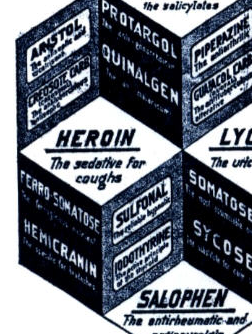
     

    Ads--heroin bayer
    Heroin was sold for nearly two decades as a cough suppressant, a safe replacement for morphine, and also non-addictive.

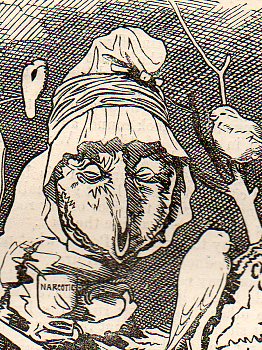
    Narcotics in general however were applied somewhat liberally for complaints of all manner–narcotics not being controlled until 1925, banned by the Single Convention on Narcotics Drugs and the League of Nations (for its signatories, at least).   AS we can see int he detail of this Punch cartoon of 1879, the problems to be brought on by the new applications of electricity (still quite young in its modernistic sense at this time) could be sleeplessness for birds, as the outdoor lights might keep them awake.
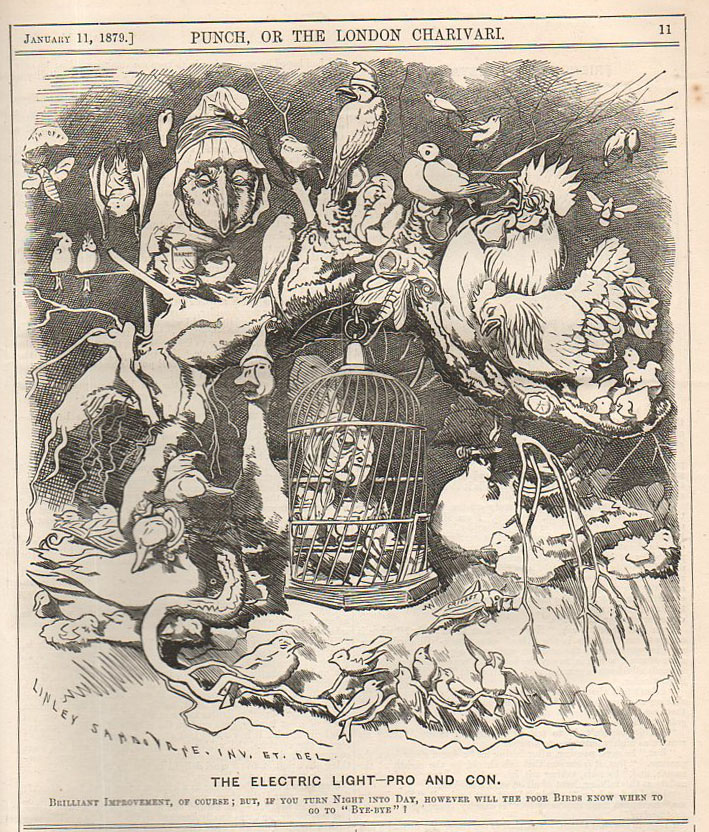
    Electricity575

    But in detail, the sleepy old owl might have been dipping a little heavy into one of those bottles with bumps on its sides, its bottle of “narcotics” to help in tracking down sleep:
    Electricity576


  • Fitzcarraldo Deux: on France’s Monumental Overland Ship Railway, at the Break of Doom

    JF Ptak Science Books    Post 1808 

    Ship overland537
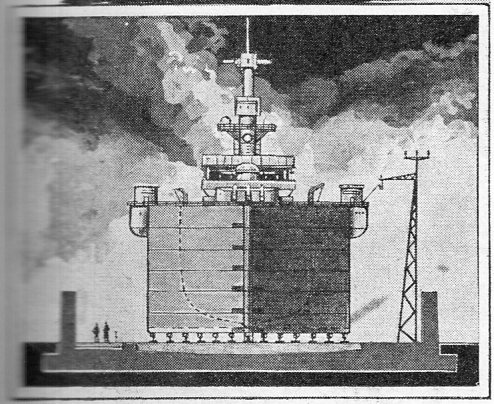
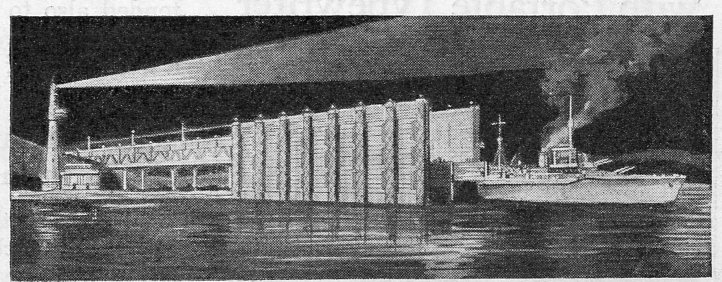
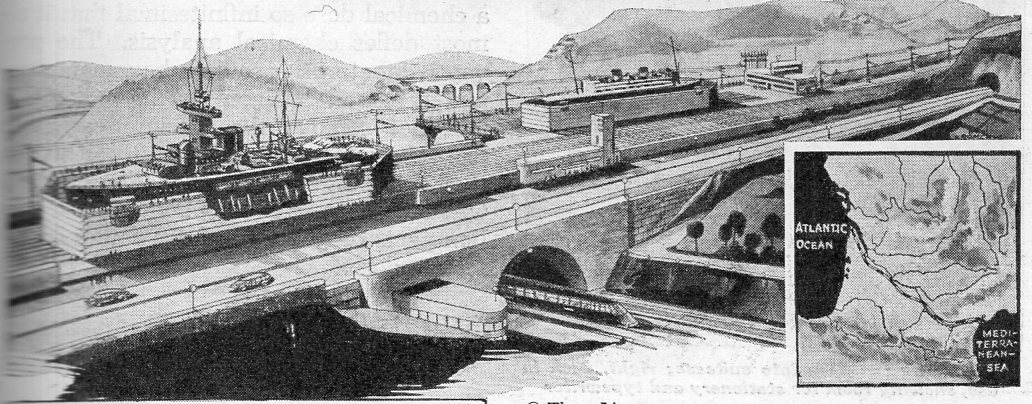
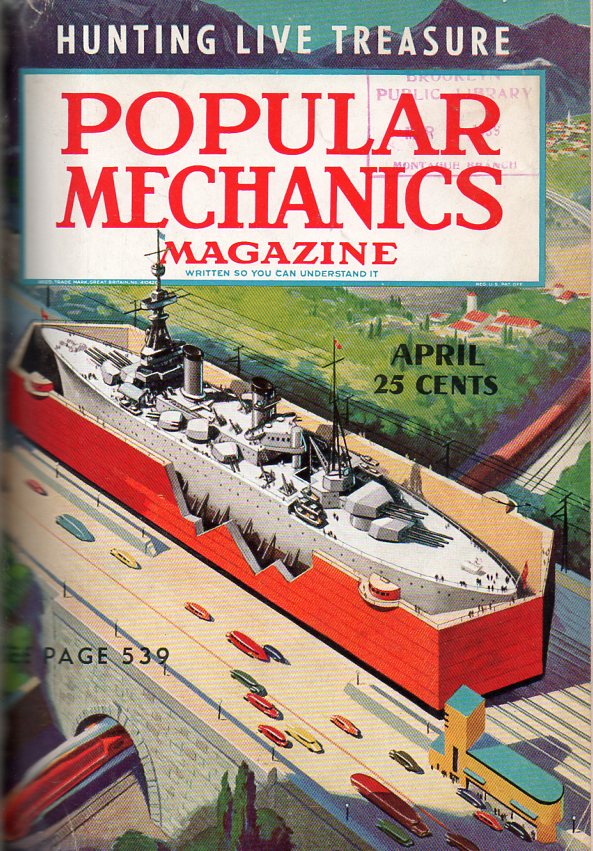
    This fantastic cover appeared in Popular Mechanics, volume 71, and showed a devotion to a monumental idea of dragging enormous ships by rail from the Atlantic Ocean to the Mediterranean Sea.  It was to be 300 miles long, and what looks like 125′ wide, connecting Port le Verdon and Beziers, putting down the 1,200-mile Bay of Biscaye/Gibraltar/Mediterranean route.

    It puts me in the mind of ponderable (and not impossible) colossi, some of which I wrote about in a short post on Werner Herzog’s film Fitzcarraldo. (It is a spill-over big, magnificent film about a would-be ice-making rubber baron bringing an opera house into the trans-Andes, trying to make his way into the dense forest in a huge rear-paddle steamboat on the Amazon to stake a claim in exploiting leased lands filled with rubber trees. See here.)

    The spirit of peace was nearly gone in Europe at this time, and the railroad line was to be guarded at 1000′-foot or so intervals by balloons which would suspend a steel net, protecting it from aerial attack.

    Ship overland540

    In one year’s time this would all be shrinkingly academic, a microbe in the plans for a greater France.  This issue was printed in June, 1939, three months away from the official start of the Second World War.  France would be attacked by Germany on 10 May, 1940, and an armistice would be signed with the aggressor five weeks later. 

    Ship overland538
    It is a little painful to look at the color image from the cover, with an enormous battleship hosted within a turreted mobile structure perhaps 100′ wide, lumbering along on eight sets of railroad lines.  Not only that, but this absolutely enormous mobile situation was crossing over another railroad, atop a very, very substantial stone bridge. 

    Ship overland539

    And as I said, a year later, France was conquered, and another Maginot Line was never built.


  • Daily Dose from Dr. Odd: Superbly Unusual and Beautiful Baseball Portraits

    JF Ptak Science Books   Post 1831

    (Please also see this blog’s post on Women in Sports, from about the same era, here as well as here)

    Strolling through the New York Public Library Digital Collection (here), I came across many hundreds of images of baseball players.  What struck me with some of them were their stubborn, unabashed pride, images made of the ballplayers standing squarely in front of the camera, mostly looking directly into the lens, shoulders set squarely under that, a straight, dead-on shot.  Its not just in cartoons where the full frontal is rare–my experience shows it to be uncommon almost across the board. 

    [Unidentified baseball player in pitching form.]

  • What a Biologically-Downloaded Intelligencer Virus Might Look Like in 2112.

    JF Ptak Science Books   Quick Books

    Somehow, in some way that is difficult for us to imagine in 2012, these ads were attractive enough in the mid-last-century.  Of course we have our own examples of this behavior, only more-so, I expect, given the vast multiples of advertising we undertake today.  Somehow it feels as though there just isn’t enough space in our own year for the sheer weight and smell of ads, and that some of them must be occupying and stealing oxygen from our time in the future.  Then again, in the future maybe we will all be paying for quiet in our brains so as to not be subjected to nothing but constant streams of commercialism, perhaps inherent in our neurons, ads becoming a part of the very part of the thought process, commercials interrupting our creative process, and popping up at appropriate times in the process of recollection. (Happy thought, that). 

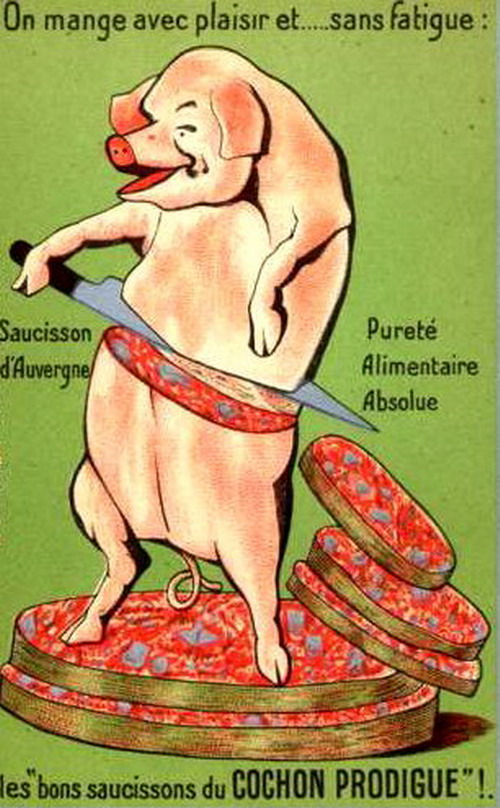
    And so this might look to be an unbelievable, incoherent way of attracting someone to eat pork bellies and eyelids–but at least it appeared in a print ad in 1948 (or whatever), and that was the end of it.  In the future if this was seen once it might be possible for the thing to be incorporated in a memory process that had anything to do with the letters “p” “o” “r” “k” when put together in a row, frontwards or backwards. That’ll be when we have to pay for our memories to be cleaned of commercial sponsors.  

    I can see a short story developing from this, of a person in the year 2112 (on 11 November) having a problem with the artificial memory intelligencer–the things that would make us “smart” in the future–where the biologically-downloaded data contained a virus (literal or figurative) that caused the man to think about this image every time a thought was thunk.  And there was nothing that could be done for him, short of him raising twice the labor exchange units that he had access to in order for this image to be expunged.  No ransom payment meant seeing this pig a thousand times a day.  And so a new crime is born. 


  • The Archaeology and Secret Evolution of Meat–a Collection of Posts

    JF Ptak Science Books    Quick Post

    I’ve collected some of the unusual posts that I’ve done on this blog regarding the hard tendencies and shallow measures of meat. 

    The Ineffable Religiosity of American Meat Memory, here.

    000 meat red 2011


    Women Meat Pioneers of 1943, here.

    4-1 prop meat

     Anatomy of Womanly Desire–Aprons, Plastics and Meat, here.

    Women--growing Kelvinator453

     “The String Department” and “Curled Hair Machines” at the Meat Plant  (here)

    Blogsept3_hair485

    Spam, Smeat, Spic, Prem, Mor & Arf: Food by Any Other Name  (here)

    +++spam ad

    States of Perfection: the Refrigerated Archaeology of Meat, here.

    March 6 refer meat det

    Food, Food Packaging and Creating Desire: the du Pont Company, WWII. (here)

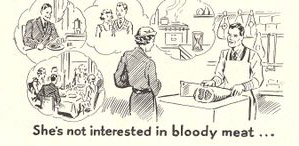
    Selling to Simple Women, 1939:  “She’s Not Interested in Bloody Meat”, here.

    Women--bloody meat

    The Importance of Bridges in the Invisible Evolution of Meat, here.

    + The Kodacolor Bridge of Evolving Meat


  • The Intestinal String Polisher in the Curled Hair Dept.–Armour Meats, 1917

    JF Ptak Science Books   Post 1826

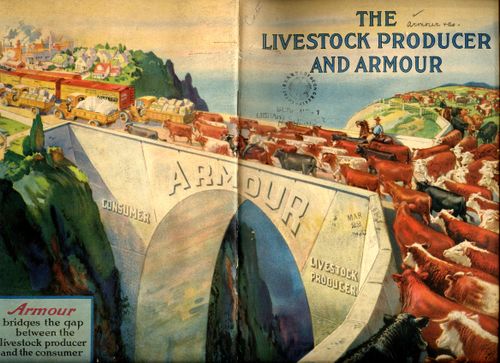
    The following impressions are a result of reading the Armour & Company’s hard-sell-we’re-really-really-clean promotional pamphlet, Seeing Armour’s. (I’m not sure why there is a plural possessive in the title, which is lopped off in the photo below–the pamphlet is actually splayed out here, opened from the 4×7.5 oblong to show both sides of the cover, revealing both halves of  the vastness of the company’s campus).
    Blogsept3_armour488


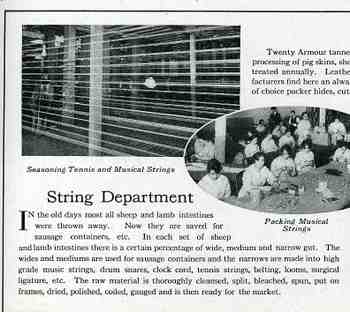
    Knowing full well The Jungle* story and the insufferable conditions in the livestock killing and processing industry, what really stopped me was this short note on one of the many elements of the company:

    Blogsept3_string484 the String Department.  (?)  How deflating it is to start thinking about this concept.   Yes, of course, of course there is a string department at the Amour Meat Packing Company, though they’re not making the stuff from field-grown fibers.  This string is just gut, but useful gut:  “In the old days most all sheep and lamb intestines were thrown away.  Now they are saved for sausage containers, etc.”  Et cetera?  I’m not sure if the “etc.” part is more baffling than the originality of the opening sentence (and a sentence which is probably never-before encountered).   There’s wide, medium and narrow gut, as it turns out, and it was cleansed, split, bleached, spun, put on frames, dried, polished, coiled and gauged.  (Now that’s a job title:  intestinal string polisher).
    There were a number of other expected/unexpected surprises.  The Curled Hair room was a surprise. I was expecting the soap room but didn’t expect the huge interior that it filled, with hundreds (?) of young women (all dressed in white) seated at long wide tables with mountains of soap, doing god knows what.  Oleomargarine, bullion, extract of beef, sausage, leaf lard and bacon were expected; the eggs, butter, cheese, grape juice, peanut butter, salmon and fruit syrups departments weren’t.  Armour seems to have been waging a veritable food war, with a little bit of beef/pork/sheep going into a little bit of everything. 

    Blogsept3_hair485

    Finally, having had just about enough of Mr. Armour, I stumbled into the stuff on the killing rooms.  Even though the description is cleaned up i the pamphlet, it still is not pretty, and sharing the photographs is just not necessary.

    20 years a vegetarian, here. 

    *Note:

    The Jungle was written by Upton Sinclair (often referred to as a “socialist” which he definitely, positively, was) in 1906.  It was basically an expose on the living and working conditions of the lower working classes, and is best remembered for bringing to vast public knowledge the grotesque conditions of the meat packing industry.  It is not possible, really, to overstate its importance, which is credited with leading to Meat Inspection Act and the Pure Food and Drug Act of 1906, which established the Food and Drug Administration.


  • The NCC-1701, 1930: the pre-Starship Enterprise

    JF Ptak Science Books   Quick Post

    Uture plane519

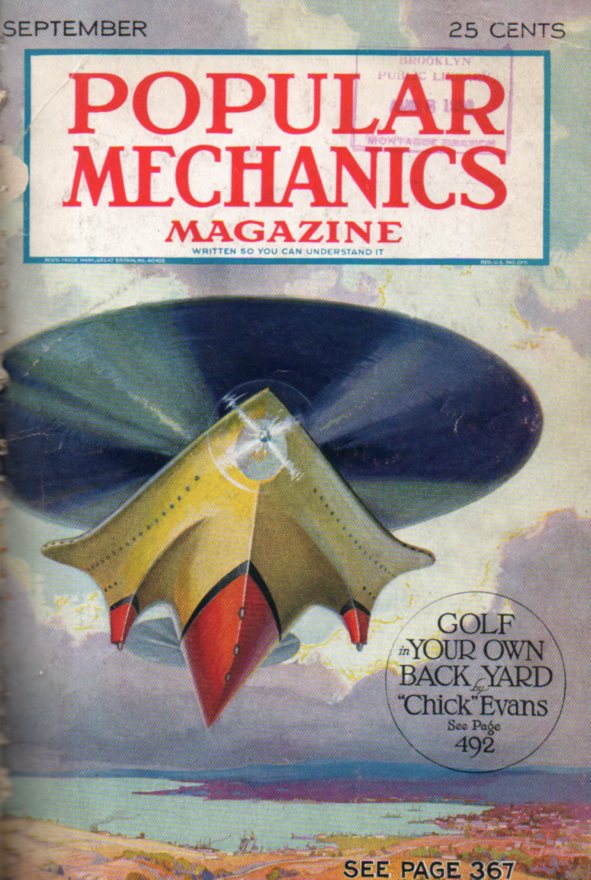
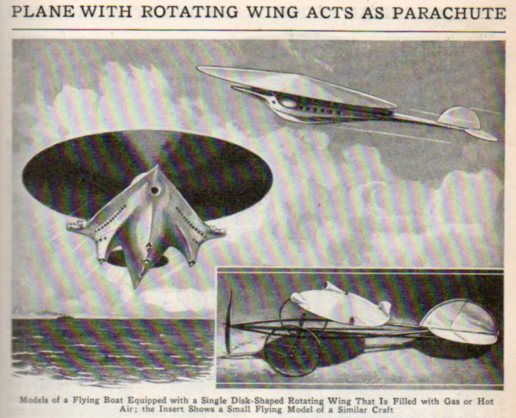
    Well, what is really was, or what this was intended to be in this memory of a possible aviation future–or naval future, as this airship was really a flying boat, an “amphibian, a dirigible, a gyrocopter ….an airplane”.   A ship, really, trying to judge the size of the thing by the position of the portholes/windows–the thing was big, and the “single wing, rotating disk-shaped affair filled with gas or hot air” was even bigger.   We read here that the disk was “turned by a gasoline engine” which was located in the center of the ship, leaving still plenty of room for “quarters” for the crew and passengers, making for what the inventor thought was an easy ascent and then, using the lifting device as a parachute, and then having a parachute-y descent, soft and simple.

    Its hard to judge the size of the machine, but it looks like there are 40-50 portholes or windows running the length of the ship, and so I’d guess that the fuselage of the craft was 150 feet long, which was about half of its overall length, making it about 300 feet overall.  The disk then could be 150-200 feet in diameter, giving it an area of close to one acre.  Big. 

    And so:

    Uture plane520


  • The Liar in Political Winsprumerfall–a Short Episode in Blank, Empty & Missing Things

    JF Ptak Science Books     Post  1805  [Part of the History of Blank, Empty and Missing Things series.]

    Pencz, Georg: Der Verleumder
    [Source:  Zeno.org.]
    As we approach the new political season (where it is always all fours seasons,
    simultaneously, and known as “Winsprumerfall”) and where everything is good and
    bad, and decent and not, and moral and wanting, and right and wrong so far as the “wrongness” falls upon your opponent, and cloudy and clear, and all at the same time as always, everything all at once, it might serve us well to have an image of Georg Pencz’s
    (who I wrote about earlier today, here) Verleumder in mind. 
    And as we can see and guess, the wood engraving depicts the lying liar, the defamer influencing a value judgment, the slanderer of a fact known to be true and uttered false, a libeler.  A cheat of the fact.  In times like these, it is always good to listen closely and follow the logic, and then the money.  And then fact-check.

  • Dr. Strangelove as Dr. Merkwürdigliebe, 1930

    JF Ptak Science Books   Quick Post

    Strangelove517

    Well, maybe not,but there aren’t too many candidates that pop out of magazines all by themselves and get anywhere near approaching the original.

    http://www.portlandmercury.com/binary/80b9/mwbw-drstrangelove.jpg

    This fellow, the first one, illustrated a not-described revolutionary device that somehow and magically prevent auto theft, and appeared in Popular Mechanics in September 1930:

    Strangelove516

    We read what it is not (no electric shock or flamethrower device, hello Johannesburg), but you wouldn’t find out what it was until you sent in your name to apply to sell the thing, which I bet was a key.  They generated lists then too to sell other stuff, just like today.

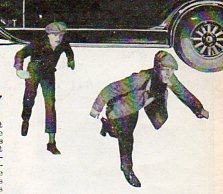
    And then there are these two guys, who I guess are badly dressed car thieves who are scrambling away as best as their replacement stick legs could carry them–stick stump legs with silk stockings, they seem to be running very carefully, as though on iced eggs or something:

    Strangelove518


    ·Posted by :

    ·in:


  • An Accumulation of Fantastic Opposites: J.J. Grandville, 1844

    JF Ptak Science Books   Post 1804

    I’ve remarked on this blog several times on the work of the fabulist proto-surrealist (etc.) J.J. Grandville (for example, here), and today I’d like to return again to his soaring Un Autre Monde (published in 1844) for the work he did in satirizing conventions by reversing their orders, presenting common entities in their “opposite”position. (Perhaps “opposite” is a too far reaching word, perhaps “contrary” is more appropriate in these cases–for now, either will do.)  And so:

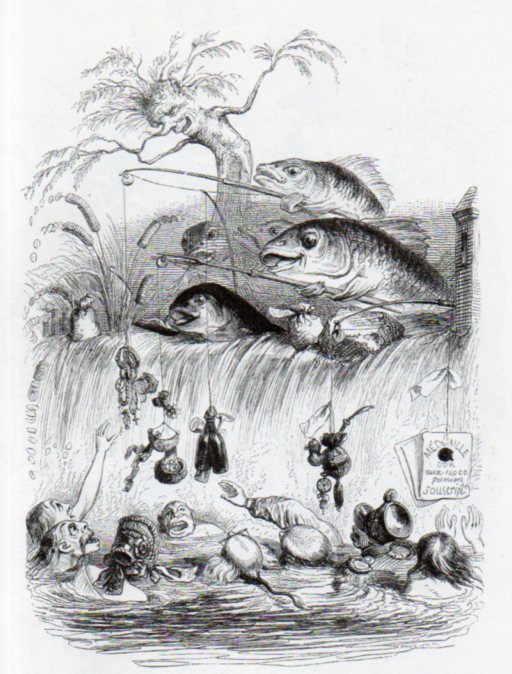
    Fish are goaded (by what I thought was supposed to be a thistle) in their hunting pursuit, which was formerly known as “fishing” but in this case could be know as “humaning”.


    Opposite501

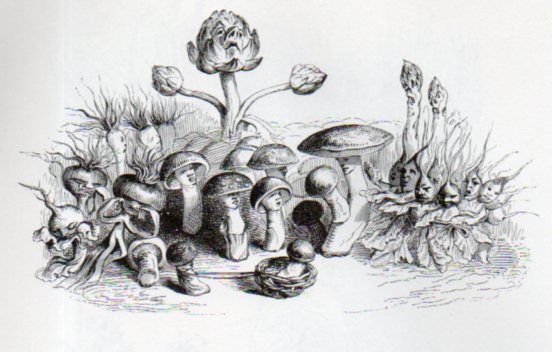
    To be eaten no more forever.  A revolt of edible plants takes place in Un Autre Monde, determined to rise and overcome their lethal oppressors, determined not to be killed and eaten as food again.  If there was a credible great creator of all things, it would seem that the most effective replacement system for expended energy would be something like photosynthesis and not the killing of other living things to sustain other forms of life. But so it goes here on Earth, with half of the biota eating the other half, with half of the being-eaten half being eaten alive. It just doesn’t seem to be a wise way to conduct the business of existence.

    Opposite502