A Daily History of Holes, Dots, Lines, Science, History, Math, Physics, Art, the Unintentional Absurd, Architecture, Maps, Data Visualization, Blank and Missing Things, and so on. |1.6 million words, 7500 images, 4.9 million hits| Press & appearances in The Times, Le Figaro, Mensa, The Economist, The Guardian, Discovery News, Slate, Le Monde, Sci American Blogs, Le Pont, and many other places… 5000+ total posts since 2008.

Category: Absurdist, Unintentional

  • A Black-on-Black Detail in a Sea of Hats Panorama, 1912

    JF Ptak Science Books   Quick Post

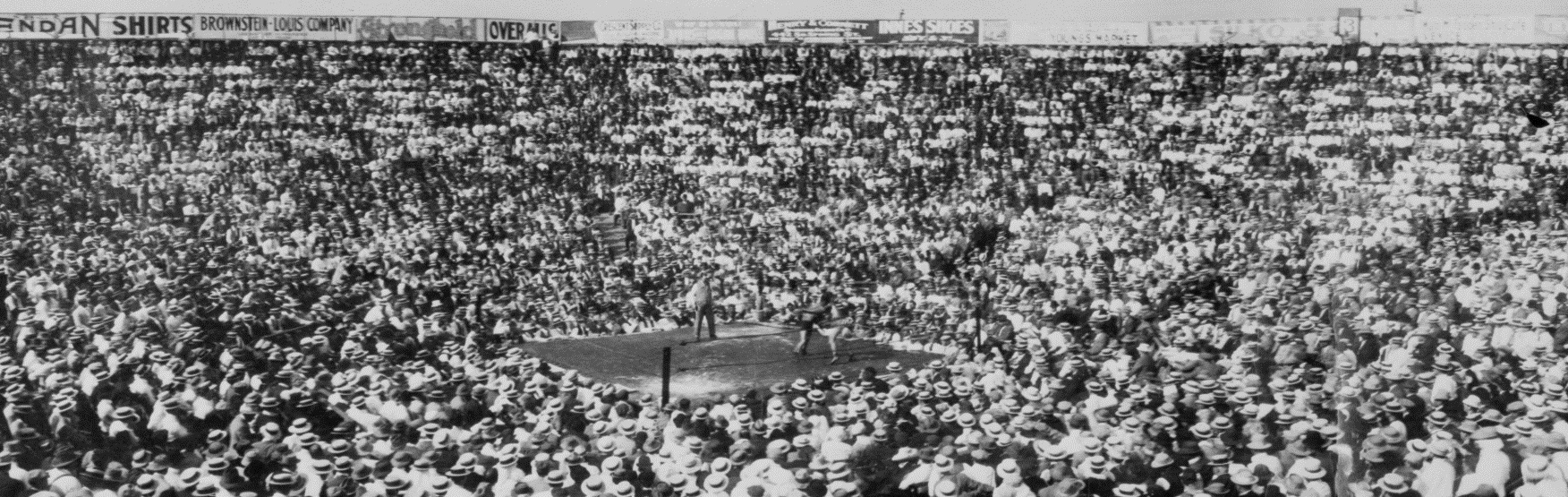
    In my long exposure to antiquarian prints I’ve long paid attention to images with a lot of black in the engraving or etching or woodcut–nighttime, caves, underwater, windlowless low-light interiors, and so on.  It is a definite challenge to accomplish these images, as well as a high use of ink–in any event, my eye is set for black details in black images in black prints. And so it came to be that I noticed this very small detail in the backdrop for the photo-copying of this fine panorama below, found at the Prints and Photographs Division of the Library of Congress (here). 

    Black on black of Boxing Day

    It is basically invisible to inspection in the version of the full print, below, but in the 80 mb examples it pops right out. (It certainly occupies less than 1% of the image space, but up-close it takes on a bit of its own life and legacy.) 

    The full photograph (45″ long)  shows a boxing match between Wolgast and Rivers at the Vernon Arena in 1912:

    Boxing sea of hats

    I was originally attracted to the photo by the hats, but the black blotch on black won out.  

    Panorama boxing vernon arena detail A

    For a wonderful essay on Black on Black art, see Public Domain review, here.  

    • Title: Vernon Arena, Wolgast – Rivers boxing match
    • Related Names: 
         Prince, Geo. (George), 1848- , copyright claimant
    • Date Created/Published: c1912.
    • Medium: 1 photographic print : gelatin silver ; 8 x 45.5 in.

  • Multiple-Maginot and the “Floating Wall of Fire” (Romania, 1940)

    JF Ptak Science Books    Post 2430

      Fire wall872Fire wall871

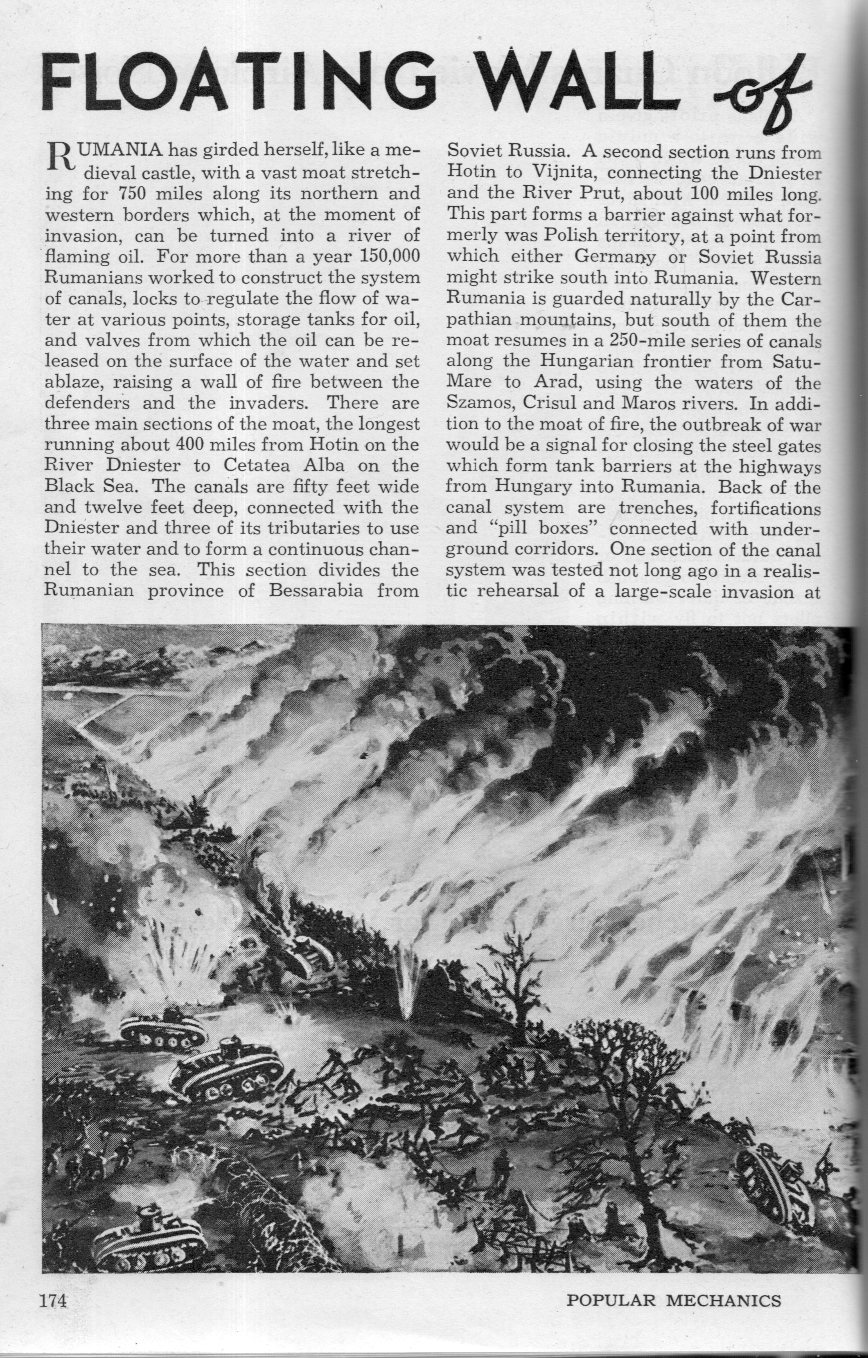
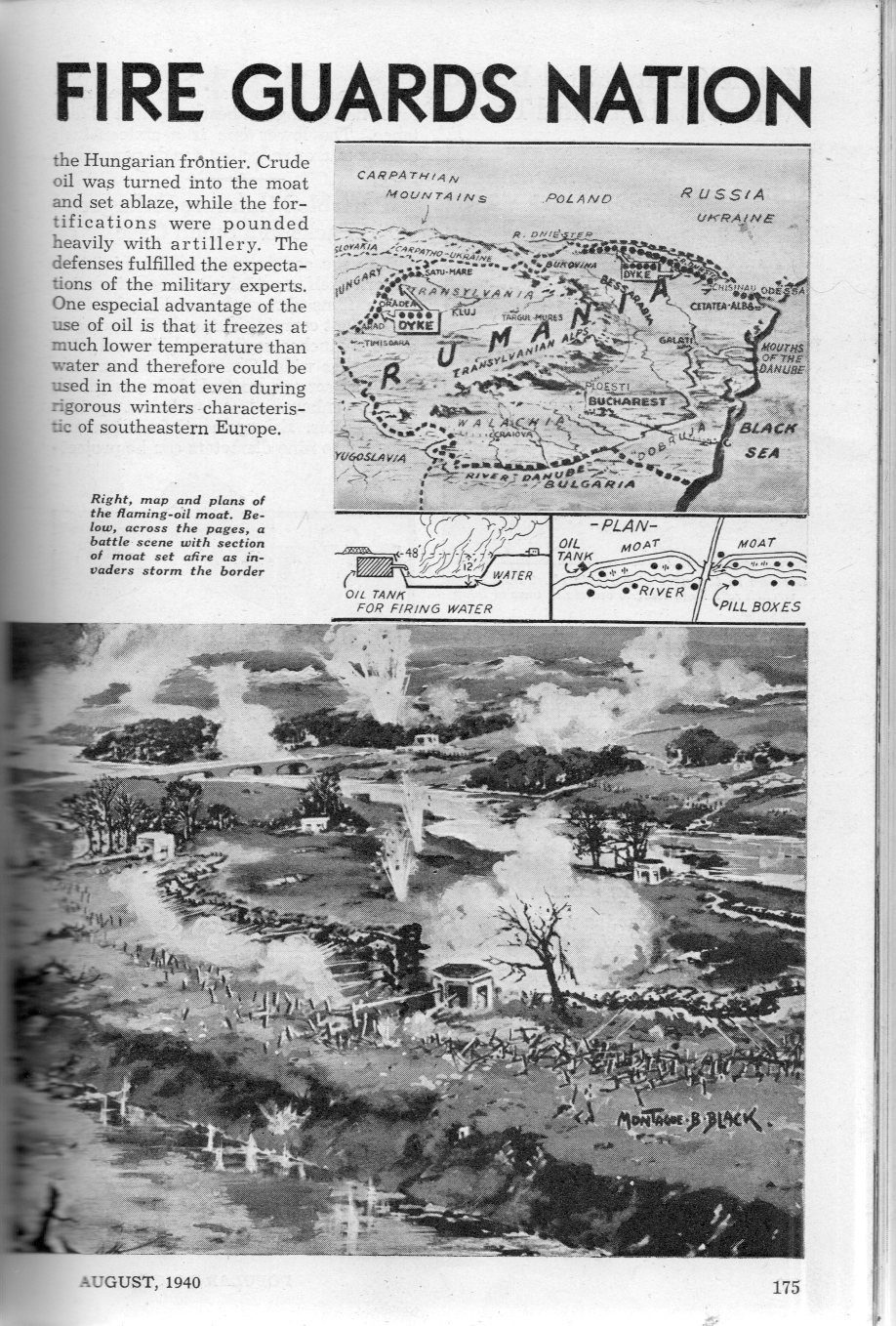
    In August 1940 Popular Mechanics reported on another example of cloudy thinking on the coming world of warfare–the “Floating Wall of Fire” of Romanian defensive consideration.  The article tells the story of how Romania “girdled itself, like a medieval castle, with avast moat stretching for 750 miles….which, at the moment of invasion, can be turned into a river of flaming oil”.  The canals which make up this open-pit Maginot line were 50′ wide and 12′ deep, the longest of them running some 400 miles, the combined efforts of the big dig meant top protect the country from invasion from Hungary, Poland, the Soviet Union, Yuoslavia, and Bulgaria–and of course from Germany which at the time could advance from a number of different positions.  There were also hundreds of gun emplacements facing the pit, I guess to fire on whomever if they decided to try and break through/over the moat, which would have been flooded with crude oil and set ablaze when invasion occurred.

    The problem of course was that even a year after the Blitzkrieg in Poland with the combined assault by land/air forces the lesson had not been learned here–unless of course the flames were 20,000′ high.  And obviously the river of fire would last only so long–depending on available amounts of crude oil I wonder how long they determined the wall of fire could be maintained?  A day?  A week?  (I know that from controlled burns of oil spills that in one case some 16,000 barrels of floating oil was burned off in a controlled burn in about four hours–it seems to me that if there was an invasion front that was miles wide and striking at numerous point along a 100-mile front that…well, the problems are obvious.)

    Could anyone have expected an invasion force to arrive and then once confronted by a burning moat turn back and retreat?  

    In spite of fulfilling expectations during a “rehearsal of a large-scale invasion”, it seems very highly dubious that anyone could really have been comfortable with the first line of national defense being fire in a long hole.  

    [It should be mentioned that after the once-neutral-ish Romania settled into its relationship with the Axis that the worst single-mission air losses for the U.S. Army Air Force occurred in the bombing of petroleum facilities in the area of Ploiesti, Romania, on 1 August 1943. In an unsuccessful attempt to damage the flow of petroleum to Axis forces, Operation Tidal Wave targeted this location but with devastatingly bad consequences, with 53 aircraft and 660 servicemen lost in the action.]  


  • The Outsider’s Outsider PoliSci Insider (1910)

    JF Ptak Science Books   Post 2429     Outsider Logic series

    Outsider  classic drama859 detail

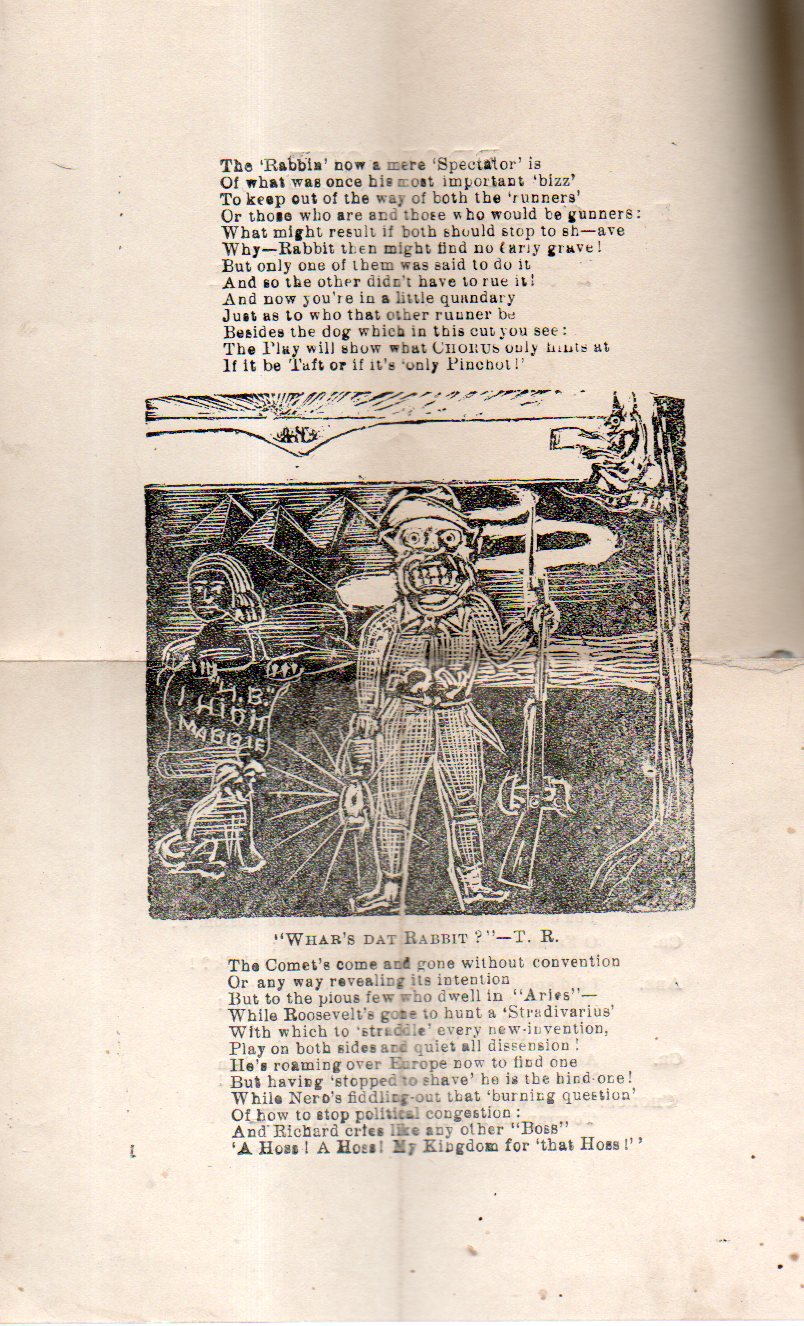
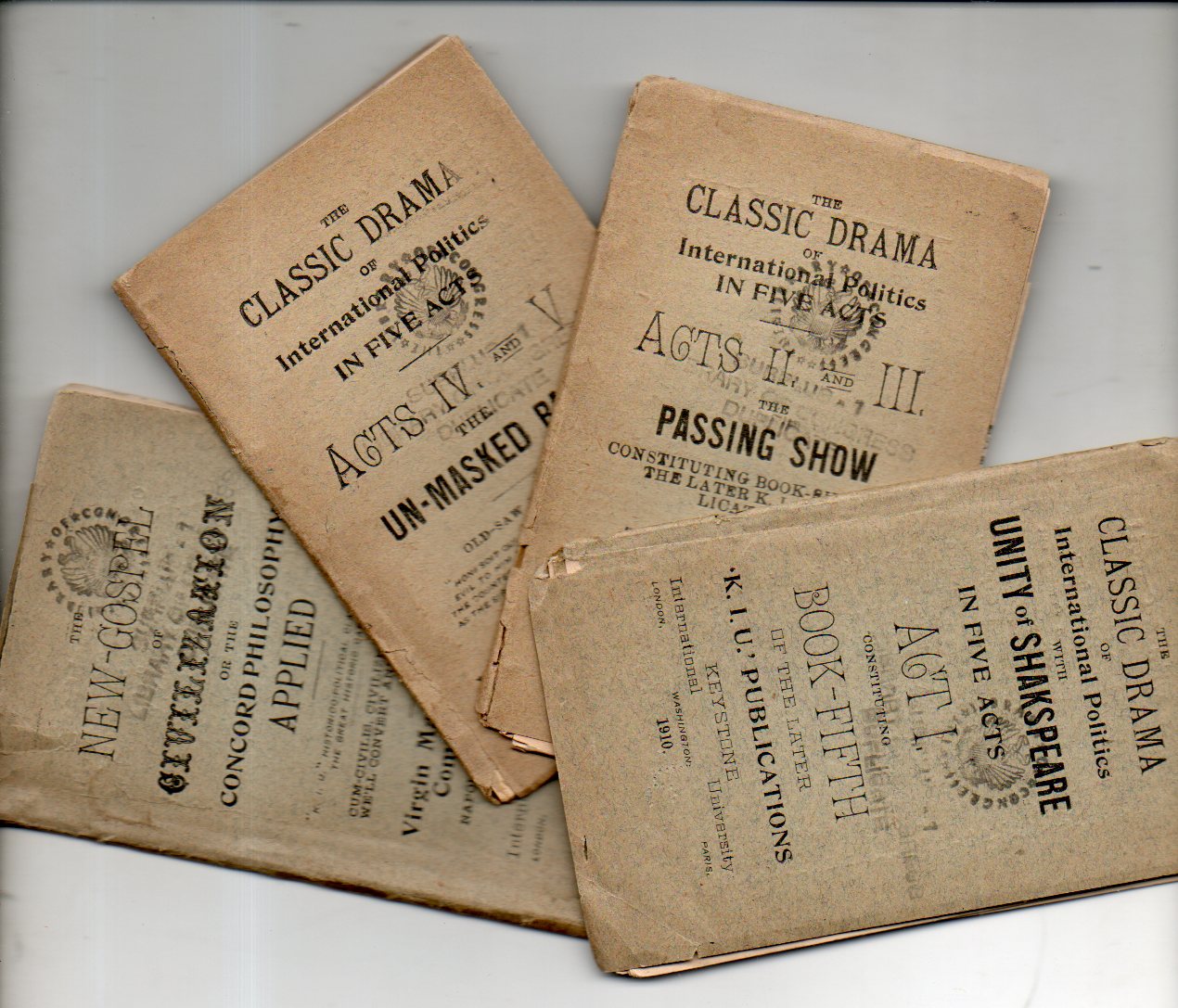
    There is a new find in my collection of Outsider Texts: The Classic Drama of International Studies with Unity of Shakespeare in Five Acts, written anonymously by the Keystone International University in 1910.  

    It is impenetrable. Well, it is impenetrable as a whole going from page to page, and maybe from sentence to sentence, but within sentences is where there is some sense and the series’ most penetrable aspects; but at the end of a “chapter” somehow the words you’ve read have all gone away into some brittle aphasic two-dimensional soup.

    The work is complete in three pamphlets covering five parts which constitute two parts (but not three) of the fifth and sixth book “of the later K.I.U. Publications”, all of this happens before we open the covers of these little five-inch-tall publications–they are packed and are already confusing, and it only gets more so from there.  Every chance interaction with the text is baffling, though it does seem to be about the Teddy Roosevelt administration/Babylon, I think, a satirical Old Testament-laden prophetic-something–in rhyme.  

    My guess is that the anonymous author of this three-part series (paginated from page 122-192) may have been the university itself (?) in spite of the proclamation of it being in London, Washington, and Paris. I can find in a not-deep investigation no evidence of the university, nor can I find any copies of these pamphlets on the web, nor is there any trace of them whatsoever in WorldCat. 

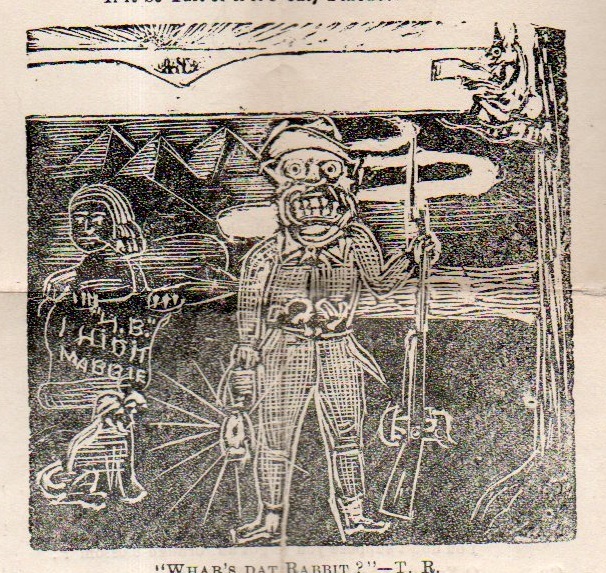
    I just like these personal logical systems–or at least I like the idea of them, even though many are just impossible to read.  There is a surprise, though, in one:  a political “cartoon” of suits, a very odd representation of Theodore Roosevelt and I-don’t-know-what-else.  

    Outsider  classic drama859

    The illustration makes everything worthwhile…or maybe it doesn’t. There is a high creep factor to it, though it was carefully prepared as a woodblock or cut of some sort.  

    I wasn’t going to spend this much time on this adventure in words and just publish the artwork, but I got sucked in a little to see if there was anything there, but the entrance is also the exit, and as soon as you’re in you’re out.  As my brother-in-law would say: “It is what it is” though maybe it wasn’t what it was.

    Outsider  classic drama861


  • Found Art Inside Nuclear Fission (1939)–Albert Ein(stein)?

    JF Ptak Science Books   Post 2415
    Naturwissenshaften

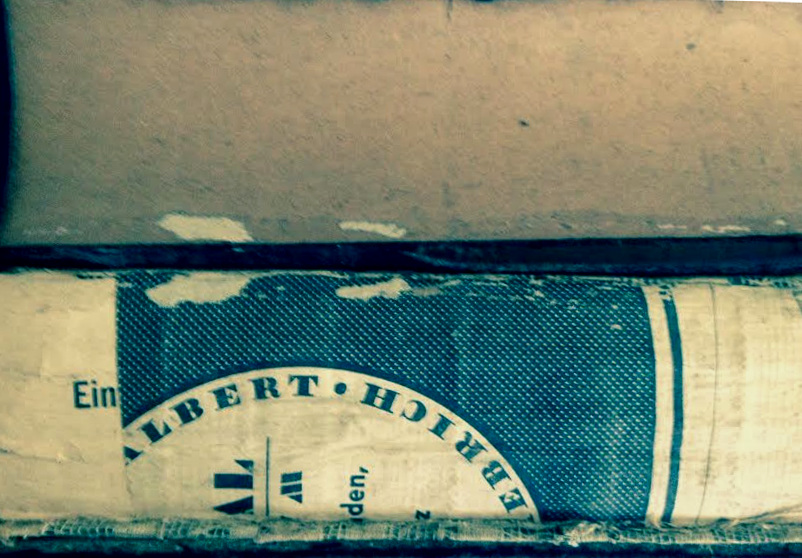
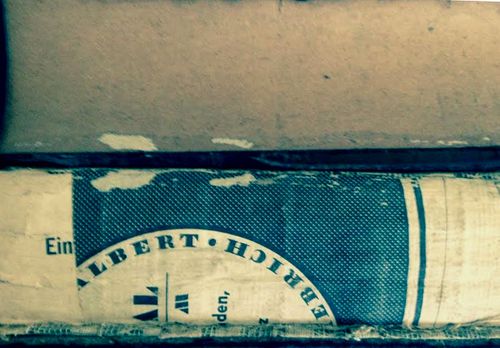
    Well: this is “inside” the book in which nuclear fission is announced–the backstrip/spine was pulled away on one edge from my um “lovely” copy of Naturwissenschaften, volume 27, 1939, to reveal the chocolatey-nugget equivalent of the guts of a book.  This is the famous volume which contains (at least) six seminal contributions in the history of nuclear physics including the big one by Otto Hahn and Fritz Strassman (on January 6)  in which they announce the discovery of uranium fission1.  The spine cover is still hinged on one side, making it a convenient flap to see the covering for the glue etc. holding the sewn signatures and the spine together. 

    The anatomy of the book reveals a  pretty and interesting art-ish composition, with a surprise: there are major elements of Albert Ein(stein’s) name display, clear as an azure sky of deepest summer (a line by Peter O’Toole from The Ruling Class).  

    This is highly appropriate. Einstein naturally knew of all o these developments and felt deeply threatened by them because of the next step, which would be atomic-bomb-building. So on August 2, 1939, he and Leo Szilard wrote a letter to Franklin Roosevelt urging American development towards this end, because surely the Germans would be up to it as well.  Although written in August the letter (the first of three) would not be delivered by Szilard to the President until October.  I think that it can be safely said that this meeting was the first step in the development of the Manhattan Project.  Roosevelt’s immediate reaction in this meeting was to insist that the U.S. do The Mega Big Something to ensure that “the Nazis don’t blow us up”.

    In any event, I found it at first artistic and then weirdly interesting that Einstein’s name almost appears in the hidden part of this important volume.  


    Notes

    1.  This would be cleared up further as nuclear fission by Lise Meitner in the February 11 1939 issue of the journal Nature.  

    The papers contained in this volume of Naturwissenschaften:

    HAHN, Otto and Fritz Strassmann.  Six papers announcing the discovery of nuclear fission, including:

    “Über den Nachweis und das Verhalten der bei der Bestrahlung des Urans mittels Neutronen entstehenden Erdalkalimetalle” (On the detection and characteristics of the alkaline earth metals formed by irradiation of uranium with neutrons)

    ____.  Nachweis der Enstehung aktiver Bariumisotope aus Uran und Thorium durch Neutronenbestrahlung’ Nachweis weiterer aktiver Bruchstucke bei der Uranspaltung. 

    ____. Uebervdie Bruchstucke beim Zerplatzen des Urans 

    ____. Zur frage nach dervEzistenz der “Trans-Urane”.

    ____. Weite Spaltproduckte aus der Bestrahlung des Urans mit Nuetronen.

    ____. F. Strassmann und S. Fluegge. ueber einige Bruchstuckebeim Zerplatzendes Thoriums. 

    All in Die Naturwissenschaften volume 27.  The volume of 862pp. 



  • Albert Einstein: Part Time Civil Servant.

    JF Ptak Science Books   Quick Post   The History of Blank and Empty Things series

    Archives--Einstein payroll detail

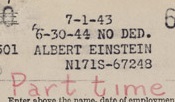
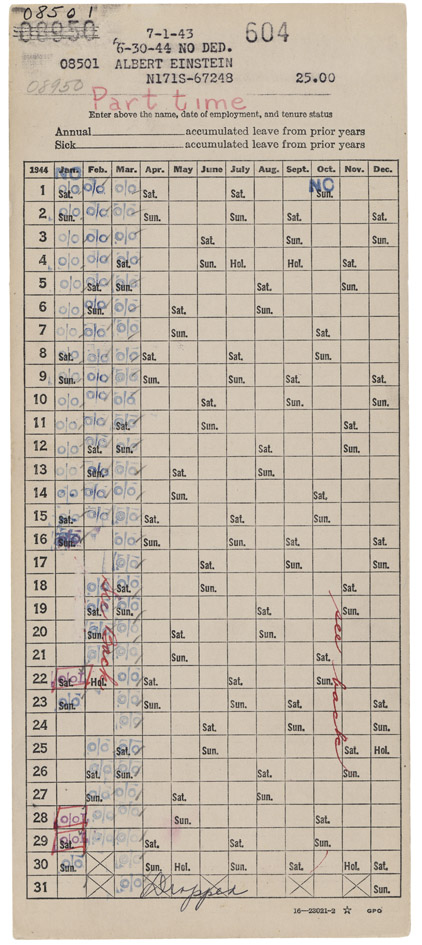
    “Albert Einstein, Part Time Civil Servant.”

    I can almost see this title as a eggshell-white comic strip in a Sunday Featureette with everything else in color– it just sounds so, well, wrong, and colorless.  Fact is though that at this time Einstein was working on weapons projects for the U.S. Navy, and evidently he needed to account for his work time just like everyone else.  

    The “part time” was what interested in this. What was he doing not being part time? 

    It was actually a little more than that, the “part time” part.  Because until he was hired by the Navy on 2 May 1943, Einstein worked “no time” on the war effort.  Not full time, not part time: no time.  The FBI thought him not trustworthy, and he was rejected by Army G2 in July 1940 as not clearable..  Einstein was out–in spite of the fact that he wanted desperately to work on something to help defeat the Nazis, and he would have made a pretty good go-to guy.  In May ’43 though he was cleared by the Office of Naval Intelligence and he went to work–at $25/day– on sub warfare and HE projects, much to his high happiness.

    Einstein did so without the Navy haircut, as he liked to tell.

    I have this post in my Blank, Empty and Missing Things series for the missing/absence/emptiness of trust and judgment extended to Einstein in wartime.  

    Archives--Einstein payroll

    In addition to this there are three other images, all hiosted  by the U.S. National Archives, here: http://research.archives.gov/description/597840


  • The Incidental Absurdity of Near-Nothingness

    JF Ptak Science Books  Quick Post     Part of the Unintentional/Incidental Absurdist series

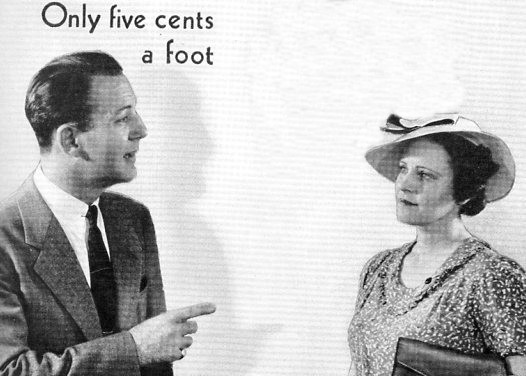
    Sometimes there’s nothing better in finding the absurdity in quiet mundane than actually finding it, rather than creating it. This is the case with the following images, all of which have a certain flat, blatant, absurd quality to them–for their conversation (or lack of it), poses, stares, direction of vision, and so on.  All of them come from “Maintaining Good Relationships” a chapter in the provocatively-named Tested Selling Methods (1939).  None of the following conversations say very much, and on the face of them (presented without their captions) most are about nothing, or seem to be.  

    Women of course are approached differently from the men, almost like children, though mostly salesmen were warned to place women in the position of making decisions for the household.

    Seems like good postcard material to me.  

    Sales822


  • Report on Post-ICBM Weaponry: the “Non-Violent” War, 1957

    JF Ptak Science Books  


    The RAND Corporation (Research And Development) is a think tank originally formed in 1946 by the US Army Air Force as part of a contract to the Douglas Aircraft Company.  After 1948 RAND Corp was funded by a number of different sources, private and governmental, and left the sphere of being a direct arm of the
     U.S. military. (Maybe.)  It still did enormous amounts of work on behalf of the military, and seems to have been their chief  theoreticians during this period.  It was also the time that the policy of Mutually Assured Destruction (MAD) was formulated at , partially under the direction of we’ll-see-him-again-down-the-road Robert McNamara.  And of course much else. 

    +()+ebay icbm

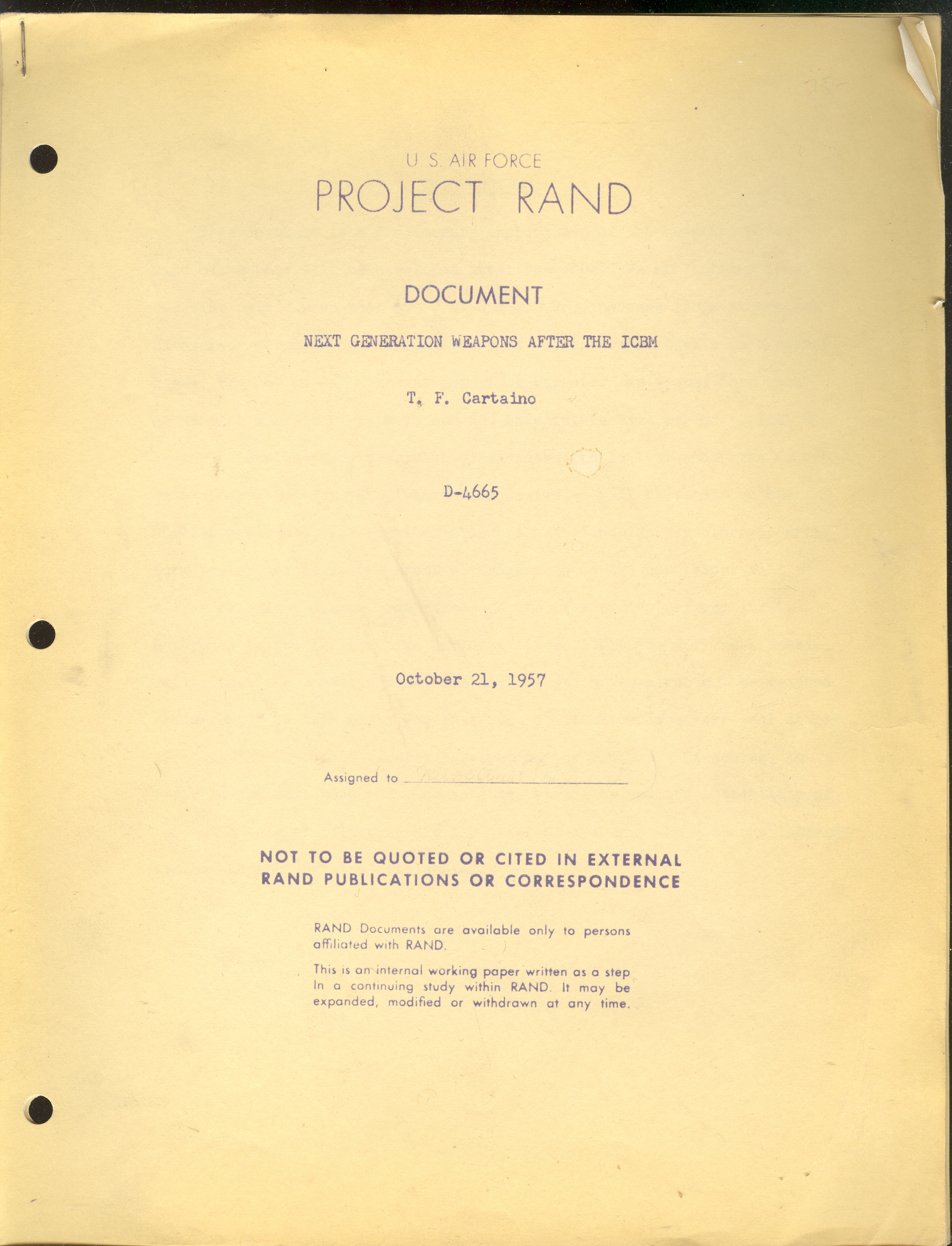
    This publication (Project Rand, Next Generation Weapon After the IBM.  RAND Corp., 1957). was an internal RAND document, not yet meant for the eyes of the outside world, at least in 1957.  I own a number of these reports, and I must say that this one is odd—it seems quick and flippant, sometimes oddly and darkly unintentionally funny.  It is also short (four pages) and gets to the very meaty part of the issue immediately.  The author(s) assume that the US and the USSR will have achieved a point of stasis such that it would make absolutely no sense for either actor to actually employ their arsenal (and excluding “the possibility of the button pusher ‘flipping his lid’ “.  The paper attempts then (“let’s jump right in and assume we find ourselves in this stalemated period”) to envision the next kind of war in which the ICBM would not be an active factor. “We therefore postulate here that the kind of war we will be engaged in…in the period of nuclear stalemate of the non-violent war, the opening phase of which has been called the cold war.”


  • Candy & Cellophane & duPont=Food! For Profit! (1939)

    JF Ptak Science Books  Quick Post

    Candy & WOnder Woman

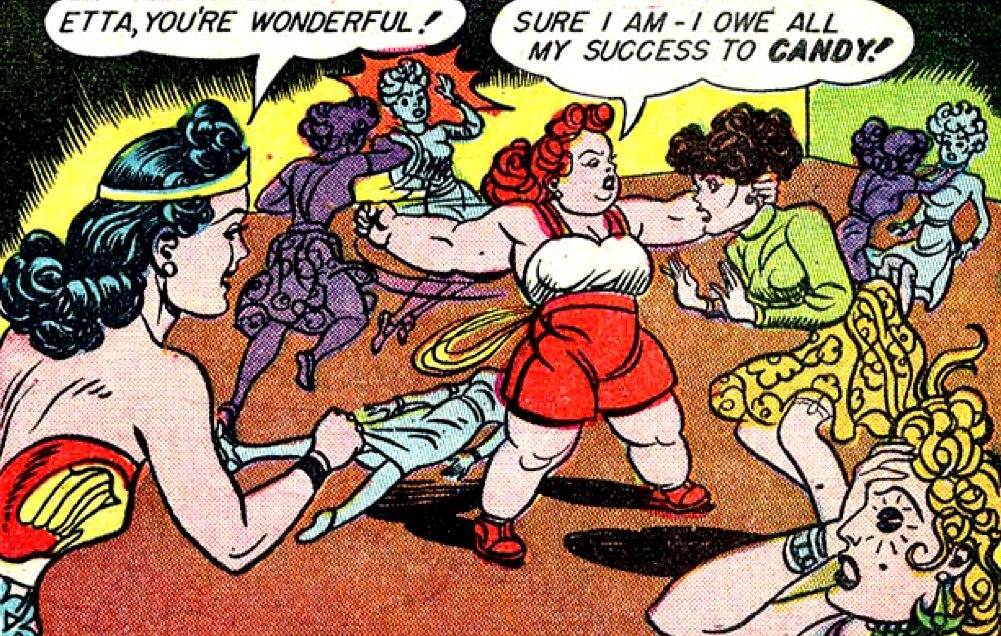
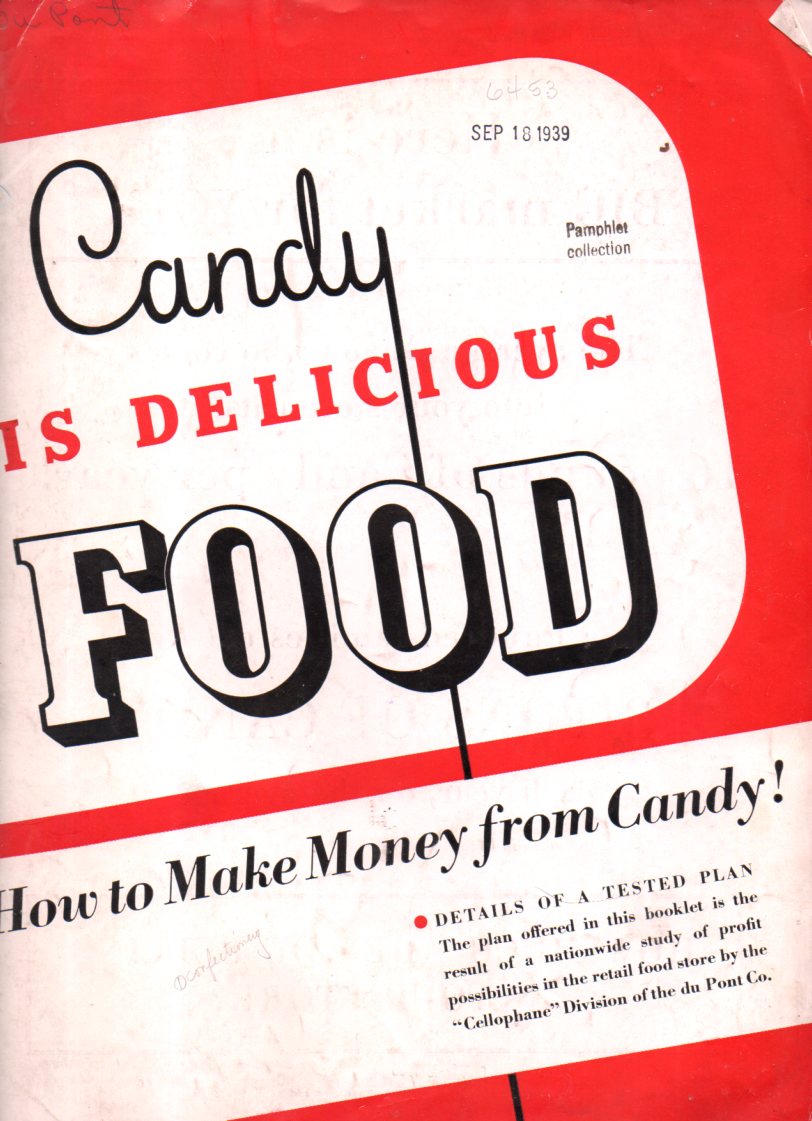
    This hand-out pamphlet seems to be a case where the sale of an edible product is made for the sale of its packaging.

    Candy is food609

    The pamphlet shouts that CANDY IS DELICIOUS FOOD, which is certainly a correct statement if food=digestible.  It tells/sells the story of candy as a profit-maker to the grocery seller, saying that “32% average gross profit on home consumption units“, those delicious-sounding unit-things being the candy.

    There are bits and pieces about candy display and placement, all on the advice of the maker of the stuff that in which the candy was wrapped–cellophane. The publisher and distributor of the pamphlet, the “Cellophane” Division of the E.I. du Pont de Nemours & Co. Inc., had a huge vested interest in candy sales: candy was mostly wrapped in Cellophane (starting with Whitman in 1912) and by the time du Pont achieved its water- and moisture-proof Cellophane in Delaware the product accounted (in 1938) for 25% of the company’s profits.  That’s pretty big, and so candy as a major muncher of Cellophane would be promoted by du Pont as pretty big, too. And as food, for added Bigness.  

    Candy is food610


  • A Really Big Idea: the 5,000 Ton Tank (1916)

    JF Ptak Science Books   Post 2389

    These spectacular images of monumental monumentality appeared in the December 1916 issue of Popular Science Monthly.  The author Frank Shuman (1862-1918) had some major inventing chops, not the least of which was some very forward-thinking work (in theory and practice) on solar power (one of which was a solar powered steam engine and another a liquid O2 propulsion system for submarines), so these suggestions for gigantic land battleships came with a fair amount of gravitas. This is some grand thinking, and as Shuman tells us, the beast below would weigh about 5,000 tons (the weight of several hundred Sherman tanks1) and would roll along on 200′ diameter wheels.  Unfortunately, outside of  seeing some sort of (steam) power plant, there is no mention of how those wheels would be turned–I’d’ve liked to read about that.  There is a mention of shock absorbers, but only so, jsut a bare hint.  

    [Image source is Google Books–I have this volume in a 40 year run of this periodical down in the warehouse, but the book was really too thick to lay flat ont he scanner, and so the Google Books scan was used..]

     And for whatever reason there is no heavy artillery on this thing. The damage to the enemy would be done via the three wheels, and also by the enormous chains that hang from the front of the enormity, like a flailing slow-moving monster from a 1950’s B-movie. 

    My guess is that this wouldn’t do so well in the rain.  


  • Bicycle Story Without Words, 1869

    JF Ptak Science Books   Quick Post

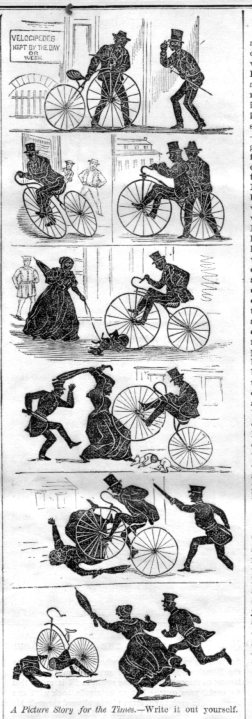
    I found this interesting story-without-words in a column in American Agriculturalist, April, 1869.    The velocipdes were fairly big, and fairly new-ish to be peddle-powered at the front wheel, and apparently not so welcome on urban streets.  (Within fifteen years the bike would take on a decidedly very modern look, easily recognizable as being a close family member to that Schwinn cruiser you owned in 1982.) I don’t have any insight about the editorial content of the segment…  

    Bicycle598