A Daily History of Holes, Dots, Lines, Science, History, Math, Physics, Art, the Unintentional Absurd, Architecture, Maps, Data Visualization, Blank and Missing Things, and so on. |1.6 million words, 7500 images, 4.9 million hits| Press & appearances in The Times, Le Figaro, Mensa, The Economist, The Guardian, Discovery News, Slate, Le Monde, Sci American Blogs, Le Pont, and many other places… 5000+ total posts since 2008.

Category: Absurdist, Unintentional

  • Judging Two Books by their Ten-Cent Covers

    JF Ptak Science Books   Quick Post

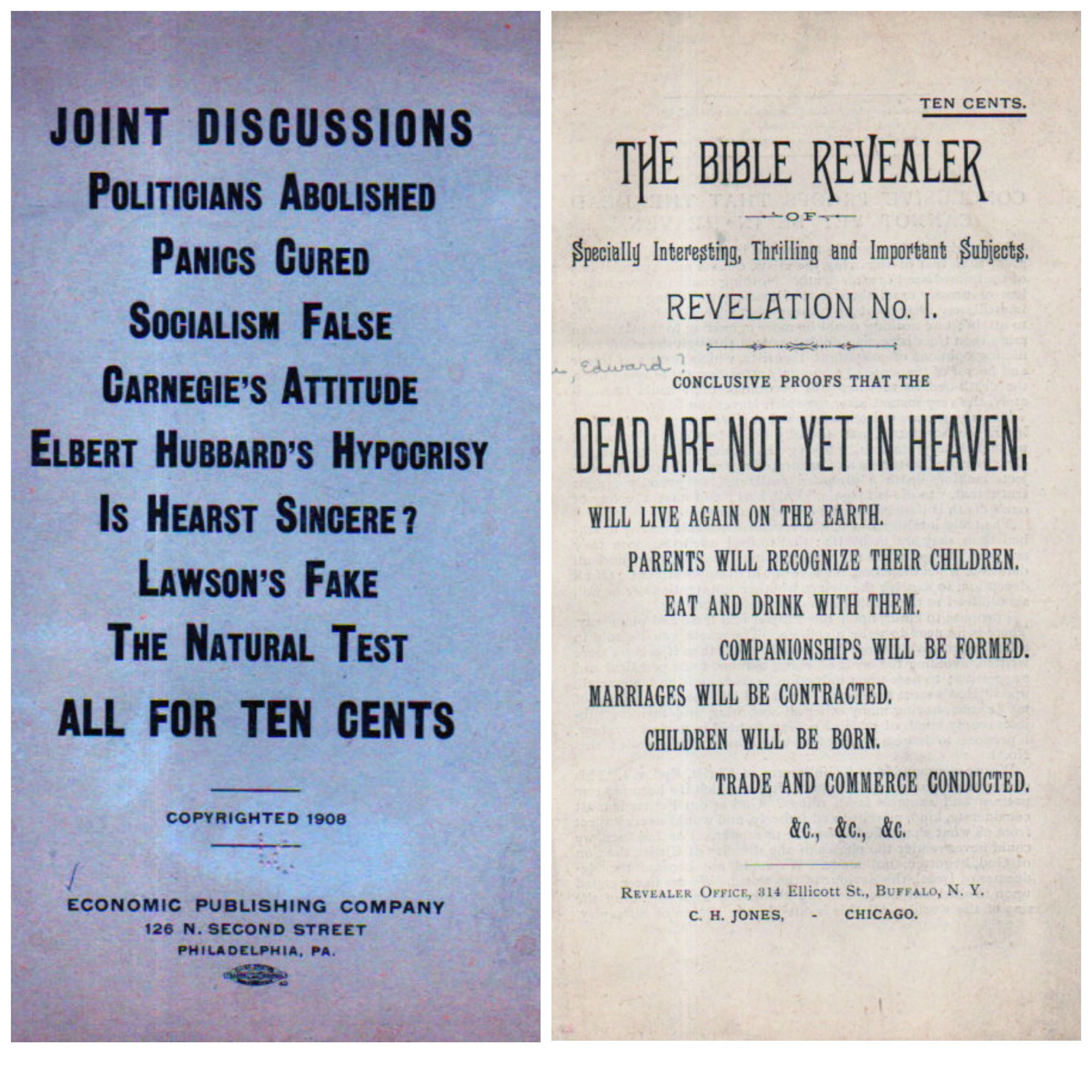
    These are two full-cover pamphlets that promise a compelling amount for the ten-cent admission fee.  The first is newer, published for ten cents in 1932; the second was printed in 1908, and for the same amount (and worth about 14 cents in 1908 monies, according to the Bureau of Labor Statistics inflation calculator).  They are each Outsidery-flavored efforts in their fields, so far as I can tell–they are also not quite interesting enough to spend any time with outside of remarking on their remark-able covers, which is sometimes that is all you need.  (The second pamphlet is actually by a very well known and influential theological person, Edward Hine, who may have achieved his greatest fame I try to establish that England is Israel, among other things, and developed a considerable following.)

    Ten Cent CollageI have other remarkable books with title similar to these in length, and composition–I’ll need to pull them all together, someday. I think that the most glorious days of enormous titles are hundreds of years in the past, and mostly 17th century from my perspective; these more-modern examples are not only long, but they are challenging and promising, all at the same time. 


  • Should There be a Post about Question Marks?

    JF Ptak Science Books  Post 2506

    • “You talkin’ to me?”–Travis Bickle
    • “Is it safe?” — Christian Szell
    • “Who’s on first?”–Bud Abbott & Lou Costello

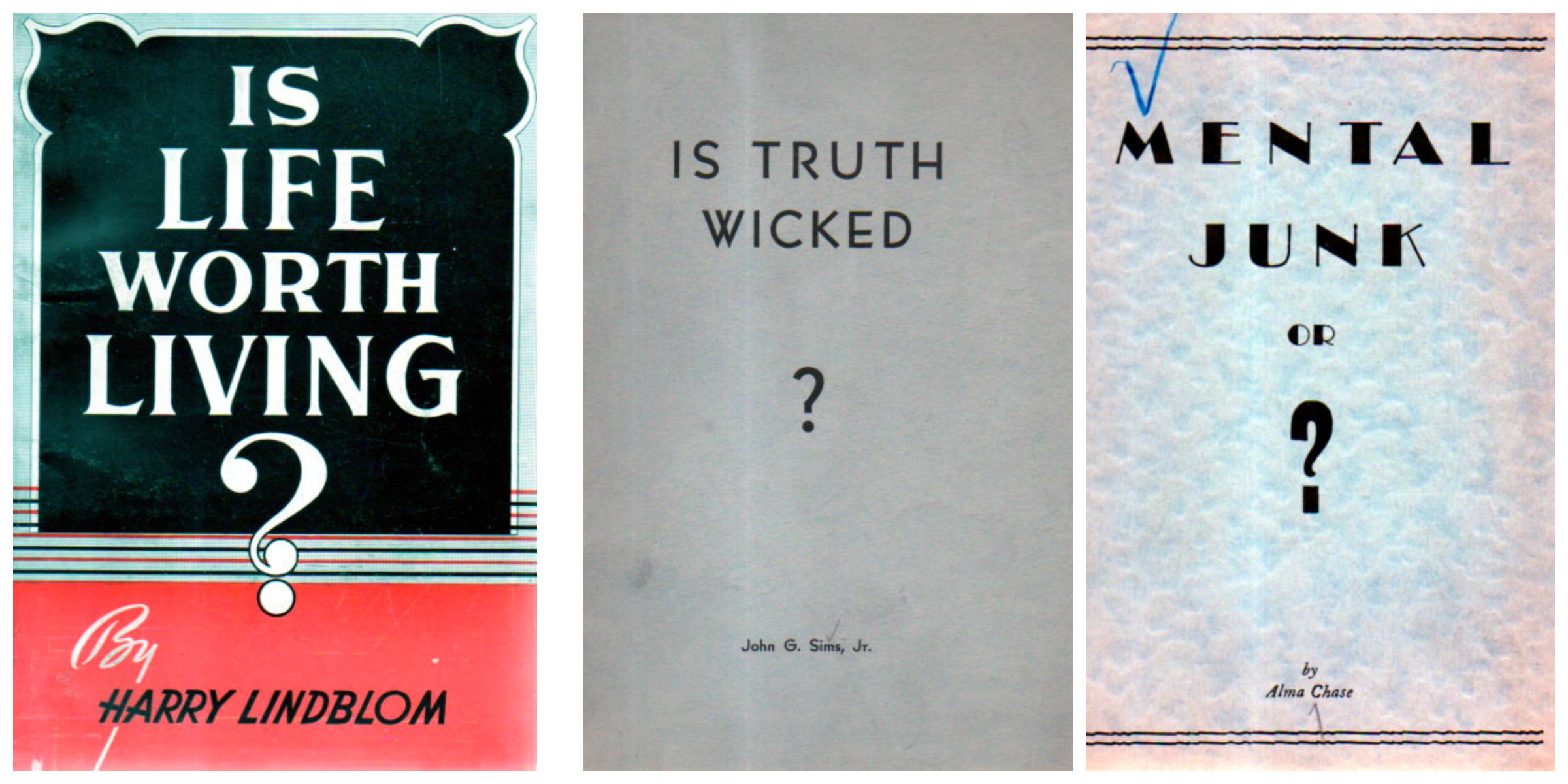
    Question mark trio

    Well, almost a post.

    In my haul of the 90,000-item Pamphlet Collection from the Library of Congress some number of years ago oh my brothers and sisters I created many standard and many odd categories into which the pamphlets would hopefully fall into some sort of wishful order. One of the straightforward categories was Titles with Questions, which was actually a combination of a great number of other categories, including the Found-Absurd, the Found-Surreal, and the Glibly Naive, including more-standard selections.  The Question Marks could stand on their own, though, because they were ungainly, so stark, and bizarre, and unexpected–they just demanded a certain consideration for themselves. 

    Sometimes these question marks could easily be an exclamation point. 

    For some reason these three were separated from the pack, but they’re good enough to stand as representatives of the collection, all of which gathered together might make for an interesting exhibition. But for now, three will do.

    They bring up a larger though perhaps not-very-interesting issue of other more interesting works in other fields where the title is a question.

    For example, here are some good questions, (one in translation):

    • “Is the inertia of a body dependent on its energy content?” (“Ist die Trägheit eines Körpers von seinem Energieinhalt abhängig?”)1
    • “Can quantum-mechanical description of physical reality be considered complete”2

    As a matter of fact, they’re  really good questions–and the person putting the question mark into the title of these papers was Albert Einstein in the first case and then Albert Einstein, Boris Podolsky, and Nick Rosen in the second.

    There are many others to be sure, but it is a difficult question to answer offhand, like this, and will take a much longer think.  (Another good question comes in the title of Richard Courant’s book, What is Mathematics?)

    There is a recent paper3 of questionable use for someone like me that looks at the rise of the use of question marks in scientific papers over the last fifty odd years or so. (I must commend the author though as he utilized more than 2 million papers in the comparison.)

    But then there are the great philosophical questions like “Why did the chicken cross the road?”,”Does God Exist?”, “If a tree falls…?,” “Is there Life after Death?”, “Father, Why Have You Forsaken Me?”, and “Where’s Waldo?”

    And of course great books have their fair share of questions–I can quickly come up with the following examples and no doubt some real thought will produce many more: P.D. Eastman’s Are You My Mother?, Horace McCoy They Shoot Horses, Don’t They?, Ed Albee Who’s Afraid of Virginia Woolf?, PK Dick’s Do Androids Dream of Electric Sheep?

    Political (Lenin, What is to be Done?), musical (“Will You Miss Me When I’m Gone?” by the Carter Family), and question marks in film (“O Brother, Where Art Thou?”, “Whatever Happened to Baby Jane?”), all need to be addressed for such a future post.  

    But not right now–for the moment, it is just these three delightful pamphlets.

    Notes:

    1.  One of the four miracle papers of 1905, published in the Annalen der Physik 18(13):639-641

    2. This is the EPR Partadox, a great contribution to physics published in the Physical Review in 1935,  47(10):0777-0780

    3.  “The titles of scientific articles have a special significance. We examined nearly 20 million scientific articles and recorded the development of articles with a question mark at the end of their titles over the last 40 years. Our study was confined to the disciplines of physics, life sciences and medicine, where we found a significant increase from 50% to more than 200% in the number of articles with question-mark titles. We looked at the principle functions and structure of the titles of scientific papers, and we assume that marketing aspects are one of the decisive factors behind the growing usage of question-mark titles in scientific articles.”– “Scholarly communication in transition: The use of question marks in the titles of scientific articles in medicine, life sciences and physics 1966–2005”, by Rafael Ball, in Scientometrics, June 2009, Volume 79 #3, pp 667-679,

  • The $5,000,000 Powur Fonetic Alfabet (1890)

    JF Ptak Science Books   Quick Post

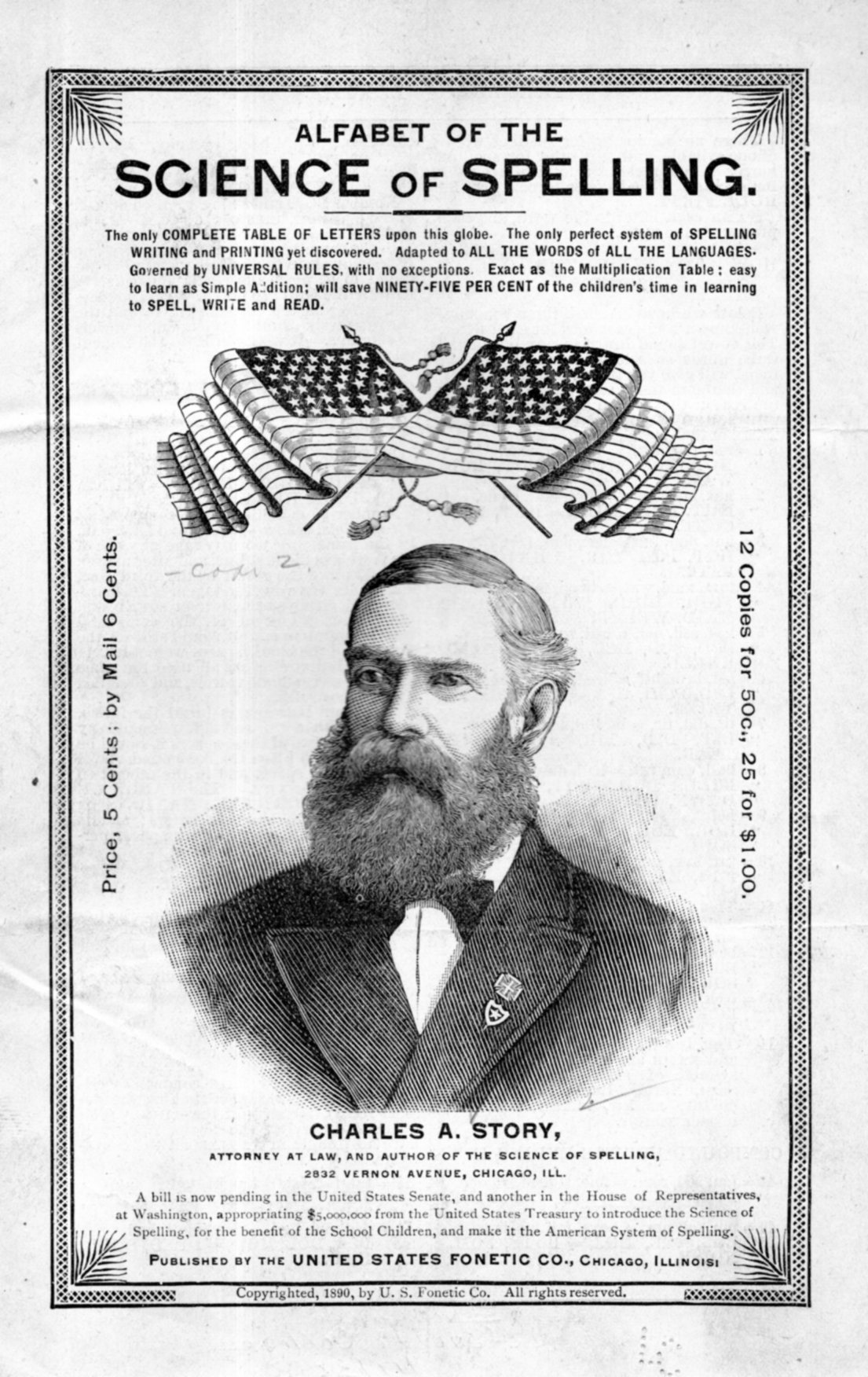
    Just two years before the 400th anniversary celebrating Columbus, and in the city celebrating it with a world’s fair (Columbian Exposition) of 1892, Charles A. Story set out on his own voyage, seeking support to change the way the United States wrote in ts native tongue. It seems high in the century for this sort of expedition, and Story was not nearly the first to get that, not even the first of 1890, as spelling reform has been a subdued meme in this country for a long time.

    Phonetic alphabet017

    What make’s Story’s story so momentarily interesting is that he sought government intervention to make his dream come true. He was preceded in this strategy by Robert Fulton (who received $300K+) and Samuel Morse ($30k), which was money well spent by  as usually very tight Congress; Story sought $5,000,000 1890’s dollars to change the alphabet, at the end of which you would get an alphabet of 66 letters of which only 45 were really necessary.  And 100 schools to teach the new alphabet. And so on.

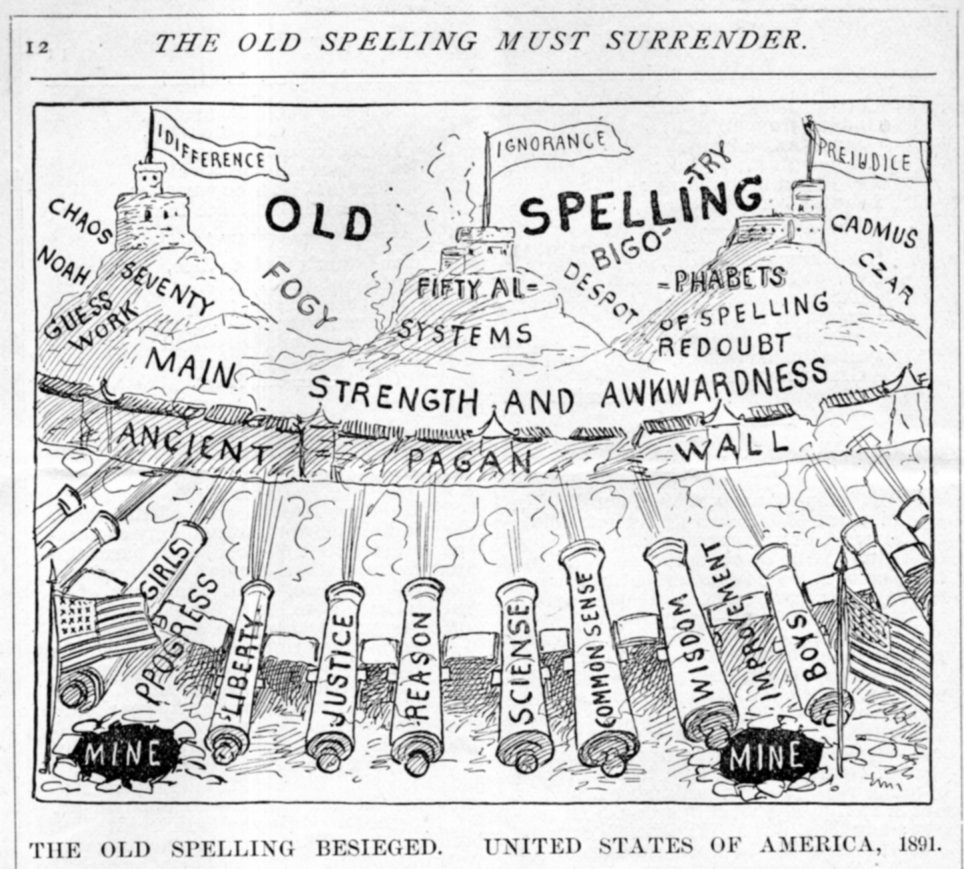
    A curious and Outsidery text illustration illustrative of some misty point:

    Phonetic alphabet016

    $5,000,000 was a h of a lot of money back then, and could have been spend of better things and maybe on some worse things (though perhaps not on the latter). 

    Mr. Story had a nicely designed cover for his plea; he didn’t do quite so nicely on the text illustrations. 

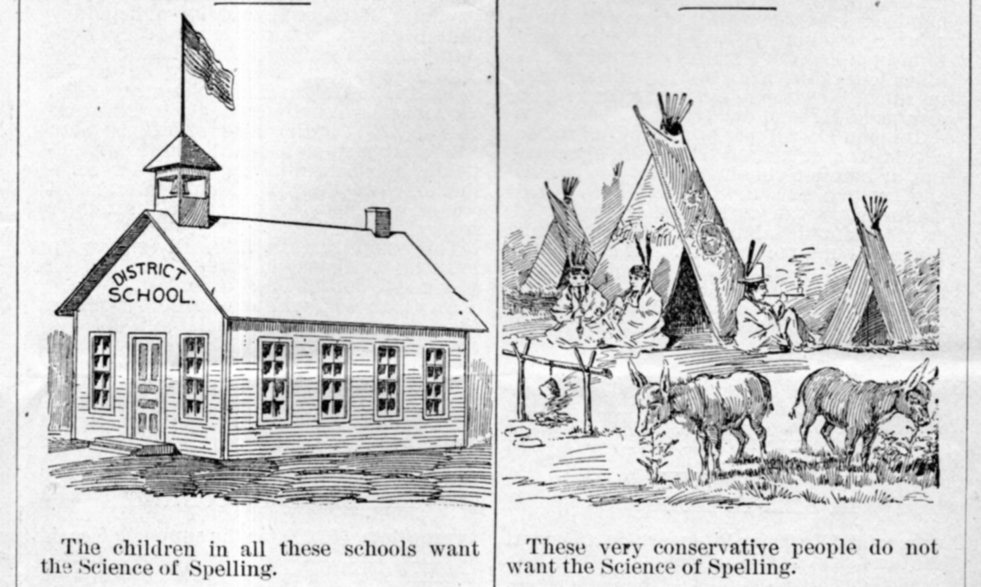
    Here’s another unfortunate text illustration; this one isn’t so much like an Outsider as it is just plain creepy:

    Phonetic alphabet018

    How this was supposed to enhance the language, or create new words, in the fine tradition of the development of the English language from the languages of the Aryan, Persian, Sanskrit, Greek, Latin, and so on, is a $500,000  mystery. 


  • Outsider Effort on the Gases of the Cosmos, 1883

    JF Ptak Science Books  Post 2488

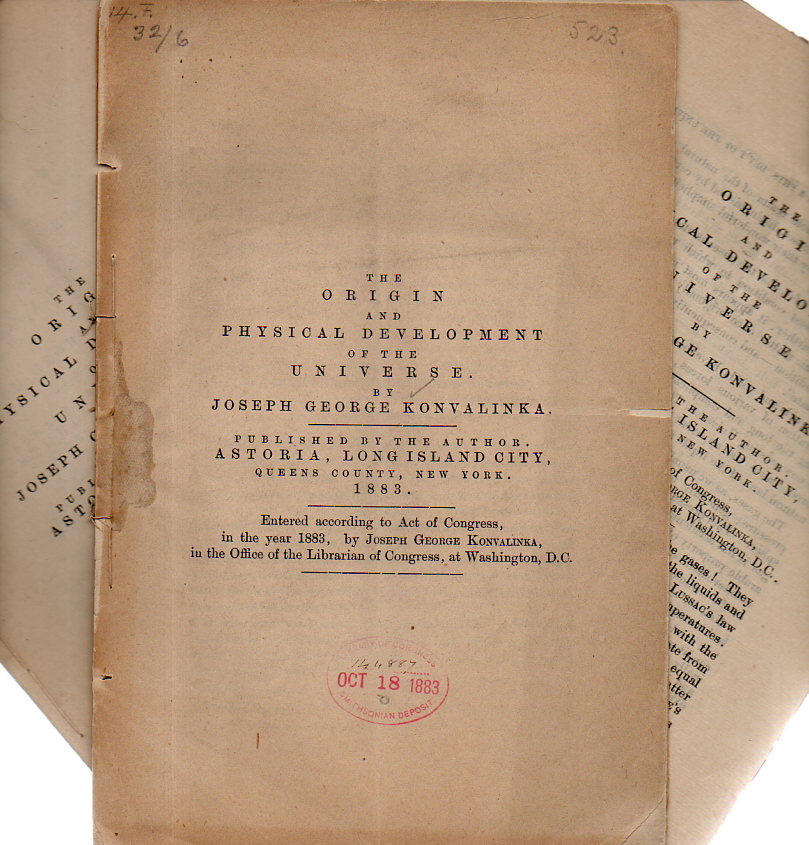
    I was researching a writer named Joseph George Konvalinka, who was the author of an Outsidery slimery called, The Origin and Physical Development of the Universe (1883). We travel through his interpretations of our physical stuff, and find that he was a curious man who seemed to be interested in his fair chunk of creation. Unfortunately his observations are not terribly clear, and he was willing to write about many of his conclusions before coming to any that were well-formed or supportable by scientific evidence. 

    Konvanlinka 3173

    For example, in section–which is actually a paragraph–on “Sun-Spots” describes the Sun as “not standing still” but “travels in a certain direction within the space of our solar system”, which is not a very scientific thing to say.  On the origin of “organic life” on Earth, the author asks himself the question and responds by not answering, but says that “all of mankind, which forms the basis of organic life, makes but a very thin cover upon the dead barren crust of Plutonic rocks” that form a “thin crust” on the surface of the Earth. And then something happens with carbon, hydrogen, oxygen, and nitrogen–which the author identifies as “all gases”–and they make vegetables and animal life.  

    And so on it goes. The interesting thing is how much ground Konvalinka covers in the fourteen pages of the pamphlet–and the curious thing is that I happen to have three copies of this semi-non-existent work, one for each eye and a spare. And for as thoughtful as he is, it seems to be almost entirely a self-contained gedankenexperiment, free from outside influence, and nearly entirely free from reference.  He wrote an earlier work in the 1860’s, and was still writing in the 1890’s (in a series referenced as his scientific memoirs), which includes a long section on aerial aviation and a proposal for a flying machine. Unfortunately he claims that flight was “a mystery” and described birds as floating in the air, which isn’t a good thing to have as a basis for understanding flight.  But he does offer several succinct and well-annotated patent-like drawings of his flying machine, which happened to be very squat, very heavy, and human powered.  

    Reading his work gives me the impression that he was an autodidact who I assume did not have the chances at an advanced education or perhaps access to the books necessary to understand physical systems that could have helped him form better foundations for his ideas. He wrote in interesting areas–and managed to have the finished efforts printed–and I can’t help but like the man because of his active mind.  


  • The History of Meat Maps: “Fluid Beef” Atlases

    JF Ptak Science Books   Post 2488

    • [Please be aware that there were 75 blog posts and another 30,000 words made on this blog in June, 2015–check them out by going to the Recent Posts block at right]

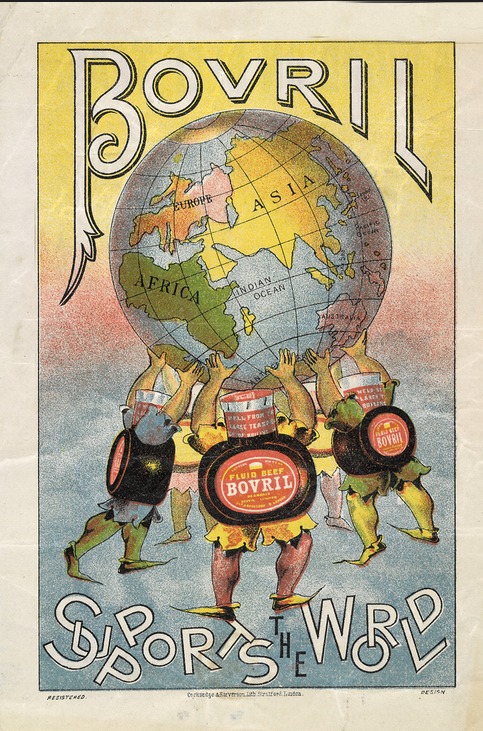
    Meat, seaweed, “beef fluid”, corn, pasta, spices, shrimp, bananas–have all served as a bases for the construction of maps–not maps of _____-producing areas, but the maps themselves being made of the actual thing (or image of it) itself.  Antique examples of this semi-anti-accomplishment are tough to find, with the Moderns being a little more common (as we can see on the Time magazine site, the background of the maps being negatives of antiquarian maps).  

    And so I just had to stop and collect up this image found on Flickr of the rectifying and emboldening Bovril “fluid beef” holding up the world, like an Atlas constructed of water and suspended beef-ish squeezings, which is a lot less appetizing than the original myth.  I can’t think offhand of another atlas-like entity made of meat-things holding up the world. 

    Maps of meat foodI do not know what the land mass is off the African west coast, except that it shouldn’t be there.  Probably it was supposed to be a too-close South America.  

    Also I should point out that the idea for constructing non-food things from food does go back a long way–there are numerous sculptural items in art and architecture that employ food/foodbits going back many century. The most famous of these maps, I guess, is the semi-magnificent The Porcineograph, produced by the Forbes Lithographic Manufacturing Company of Boston in 1876 or so, which defines the states and territories of the U.S. in terms of their regional foods.  

    This porcineograph

    [Map source:  the Library of Congress.]

    And before proceeding any further, I must at least make reference to another master in this field, an earlier, perhaps revolutionary figure (without producing a revolution), Giuseppe Arcimboldo (also spelled Arcimboldi; 1527-1593), who painted (in his non-conventional works) fantastic portraits and images using fruits, vegetables and other natural objects as the sole source of representation.  On the other hand his influence may not have been so very well known, as many of his works were stolen during war time in the mid-17th century, and he fell rather deeply into obscurity until being revived and resurrected by the Surrealists in the 20th century. 

    http://www.lessing-photo.com/p2/400706/40070643.jpg

    [Image source: http://www.giuseppe-arcimboldo.org/]

    Also in a nearby carrot patch lives some of the work of Nicolas de Larmessin (1640-1725)–an enormously creative and productive artist–who in his way created a genre similar to the great and ancient Dance of Death/.Danse Macabre/Totentanz--though his was the Dance of Life, and in some cases he used mostly food to construct and decorate his portraits.  

    There are more of these examples, to be certain, but that’s all there is time for today.  It is probably some sort of bona fide sub genre, although not a big one, and even there it may all be invisible.  


  • A Remarkable, Outsidery Effort in Economics, 1934

    JF Ptak Science Books   Quick Post

    Outsider depression ms

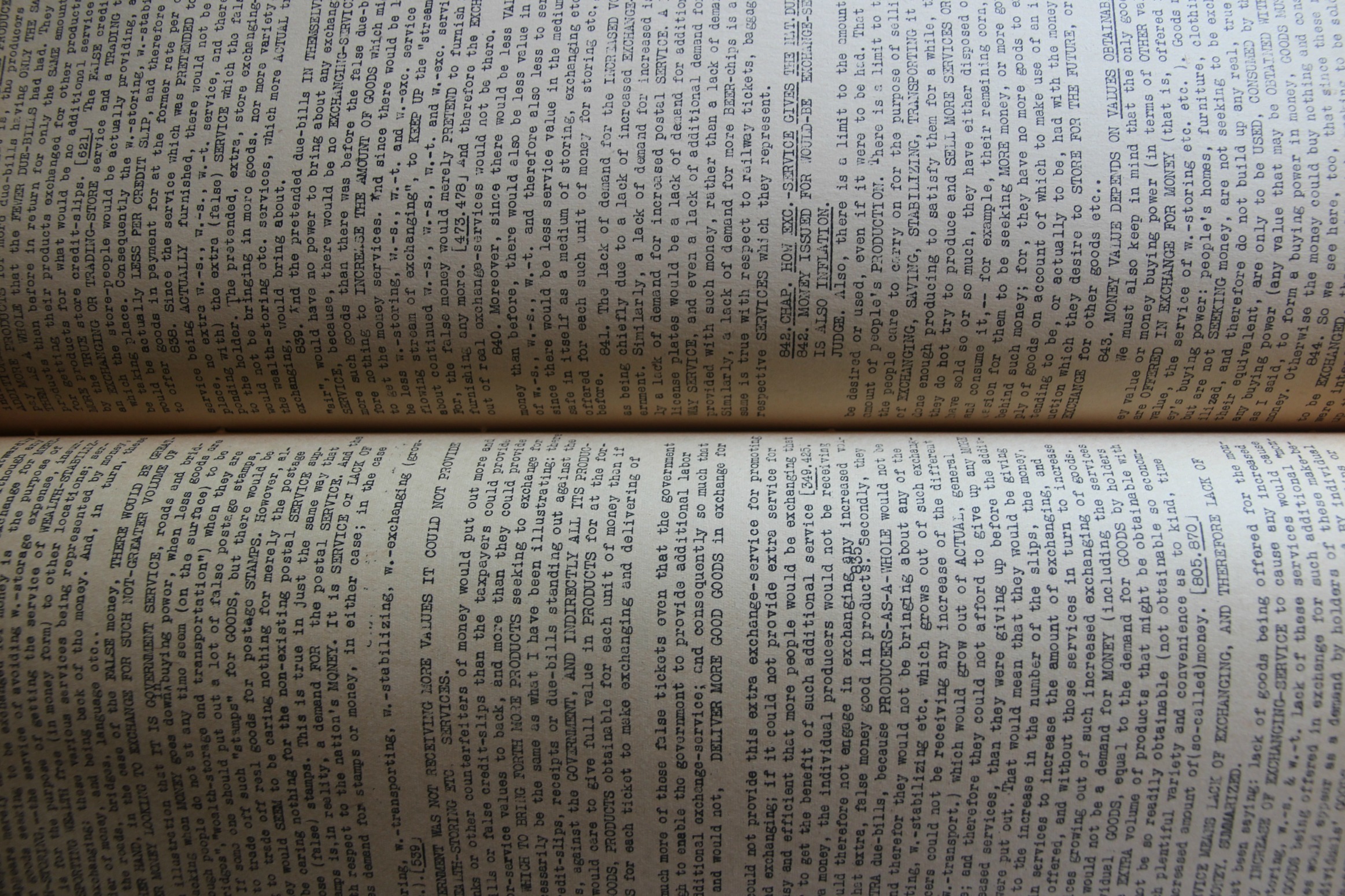
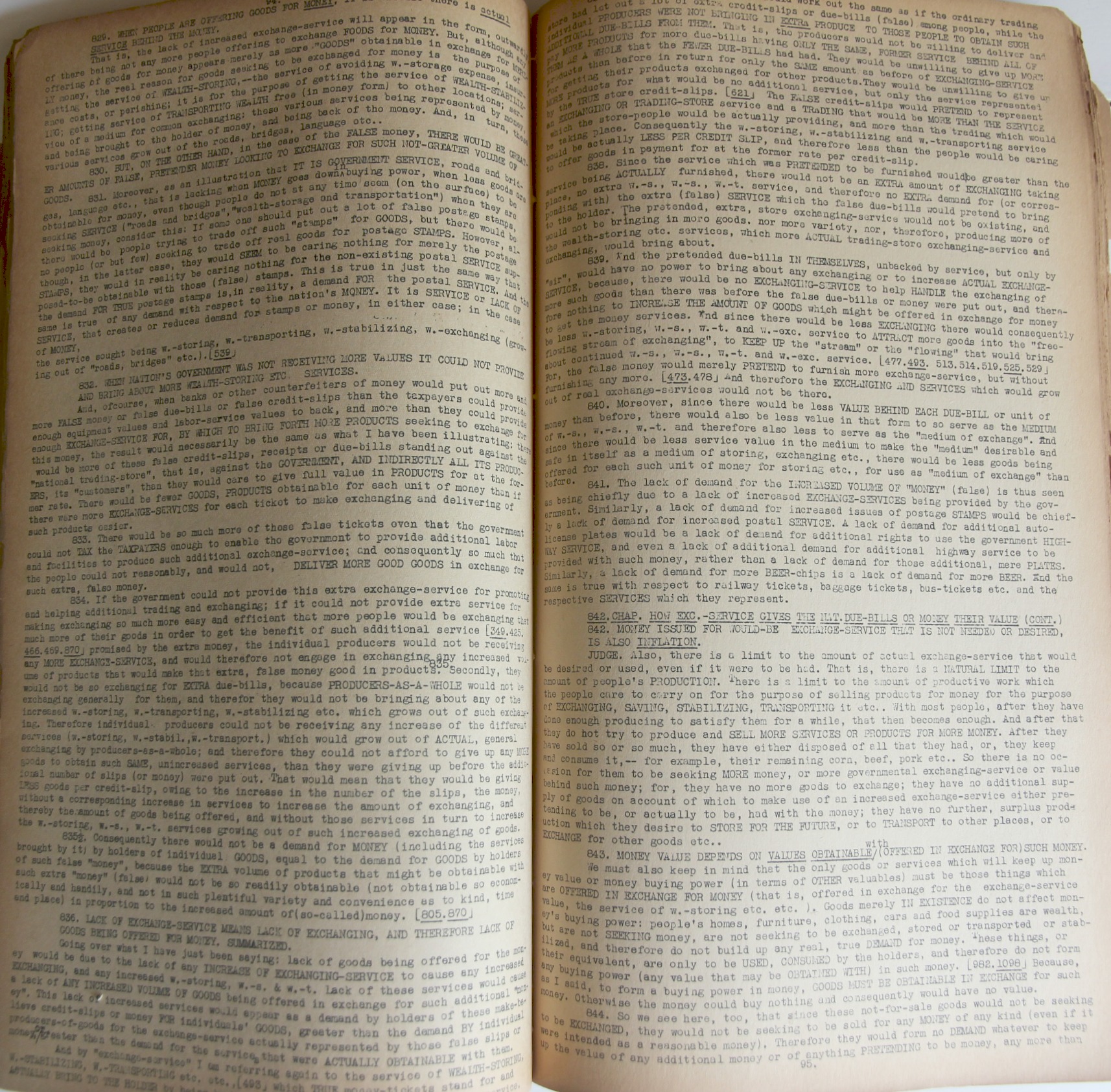
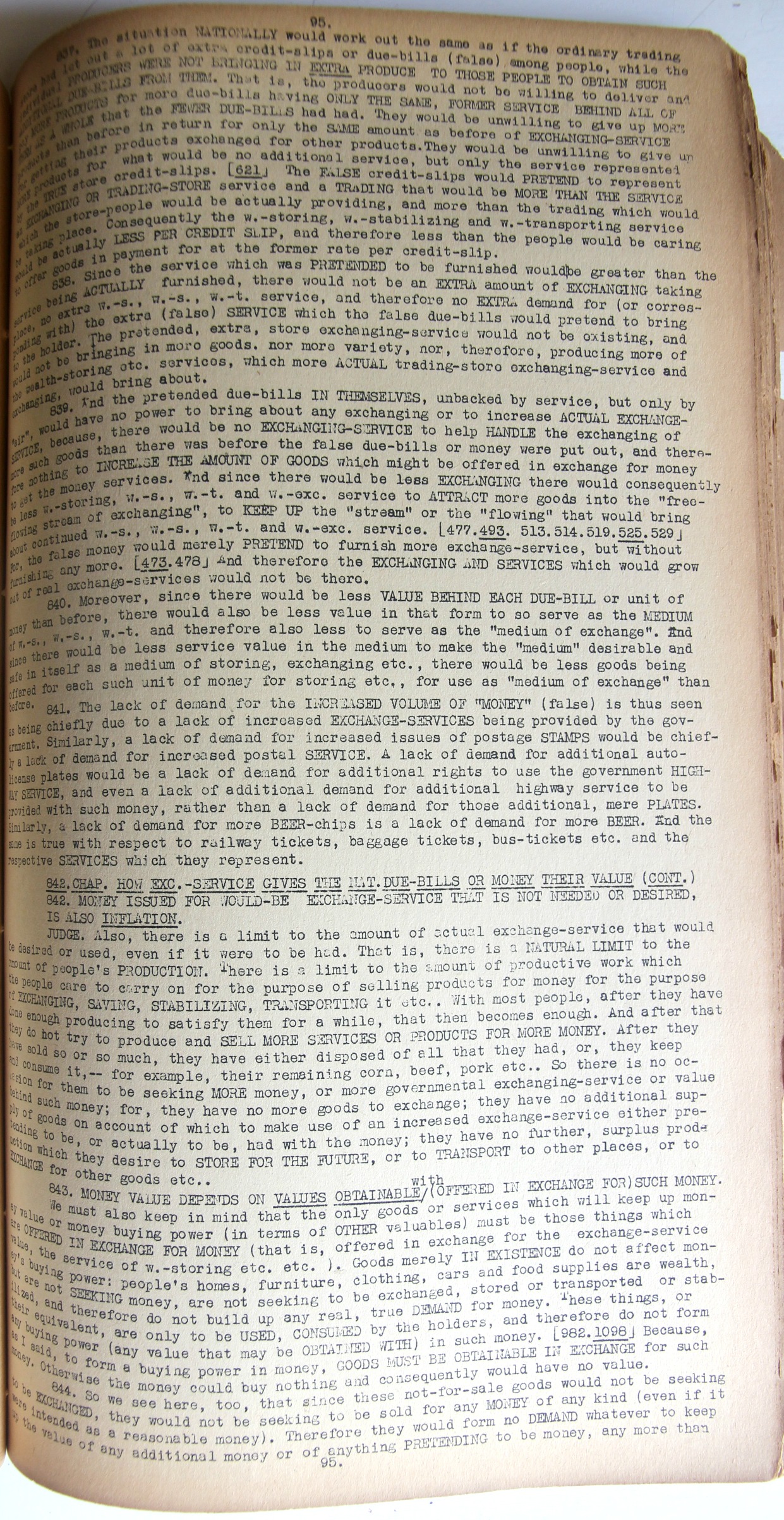
    Hard Times: Cause and Cure, a Bankrupt Farmer and an Honest Judge Talk it Over was written by Tolley Hartwick and published by him in 1934, in the near-height/depth of the Depression.  Hartwick’s work was extraordinary, though perhaps mostly within itself. From what I have read and understand, this may be a semi-private insight into the development of economic systems and the decline of the U.S. economy in 1929.  “Scientific Government/Scientific Taxation/Scientific Money” is the rallying point on the first page of this very long document that claims no title page and but scant  explanation of its origins.  The work is–in an odd and difficult way–an artwork in itself, mostly due to its dense and unrelenting design.  It is 15 inches high and 8.5 inches wide, typed single space so that on the page’s very narrow-margined self there are more than 90 cramped lines of text; and with approximately 15 words per line, that means each page is very heavily worded with something like 1100-1350 words, which is pretty impressive.  And at 210 pages, the document is about 250,000 words long, making it highly combative.  

    Outsider depression ms _2_

    I’ll never come to know what Mr. Hartwick was writing about because of the work’s secret complexities, which is too bad, at least for me.  

    But in its very dense, very full way,  printed on now-crumbling paper, and with a high degree of difficulty to decipher its message, the work presents itself as something larger than what it is–it has a certain look and feel of something very difficult to create, a certain “obviousness” of painstaking longevity that gives it more a feel of an artwork than a book.  

    In any event, I like it. 

    Outsider depression _3_[This may be a unique–with its provenance being the Library of Congress and one of the copyright deposit copies–as I can find no trace of it except for its entry in the Copyright Office publication for materials received in 1934.]


  • Stability and the Unintentionally but Quiet Absurd (1937)

    JF Ptak Science Books   Quick Post

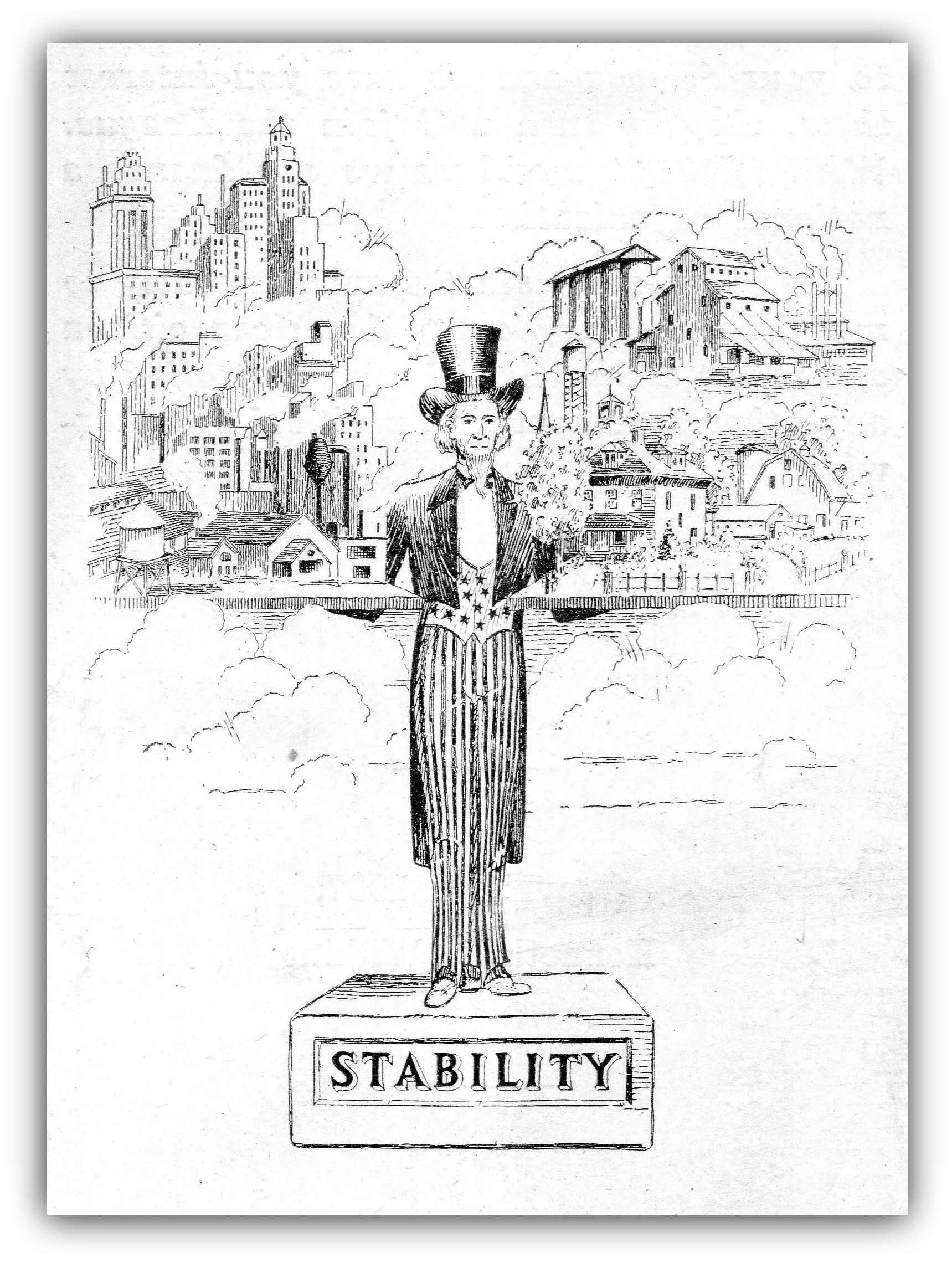
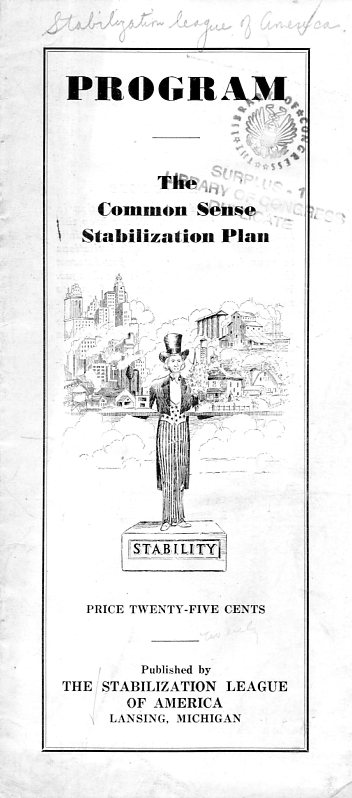
    This fine dream of “stability” decorated the cover of an unusual and grasping little pamphlet advocating “stability” in all corners, so t hat the wind compass would always point to “stable” no matter the origin of the breeze.  The idea of stability is really pretty good for kids and perhaps the elderly, but in between it might not be the most beneficial thing to the creative process.  Stable gets you only so far, except that it did once get the 2006 St. Louis Cardinals to the World Series with a win/loss average just barely above .500–an exception to the rule.

    Stable152

    Stable153The Stabilization League really meant it–“they” thought that by having everything balanced–trade, deficit, foreign matters, immigration, credit, etc–that the U.S. would be a better place, that taxes would be lowered, monopolies broken up, and stabilization of employment.  I’m not sure how, as this skinny pamphlet is only six pages long, and that includes the cover.  This was published in 1937 and copyrighted by Kenneth D. Wilkins–I don’t see any mention of this pamphlet anywhere, and my copy looks like one of the copyright deposit copies, so circulation of this work was restricted. 

    All from:

    Stable151

    The only thing I found looking up “The Stabilization League of America” was a reference to the work when its copyright was published, and that’s it.  The author was looking for “1,000,000” members to “finance a national organization”. I’m pretty sure that didn’t happen.

    There also seems to be something inherently ironic about a massive call-to-action on the idea of “stability”.

    ·Posted by :

    ·in:


  • History of Hair, Part 5: Hair Restoration and the Big Giant Suck

    JF Ptak Science Books

    I have written several times on this blog about hair: human hair maps, psycho-babble-istic brain vibrating finger hair restorations, and that sort.  (Just check out “hair” in the Google search box and you’ll find a number of posts.) The fact is that the patent/quack medicines/cures/fix-alls for hair are still entertaining–mainly because though the methods have changed the need still seems to be there and be a constant sorrow.

    Hair vacuum126

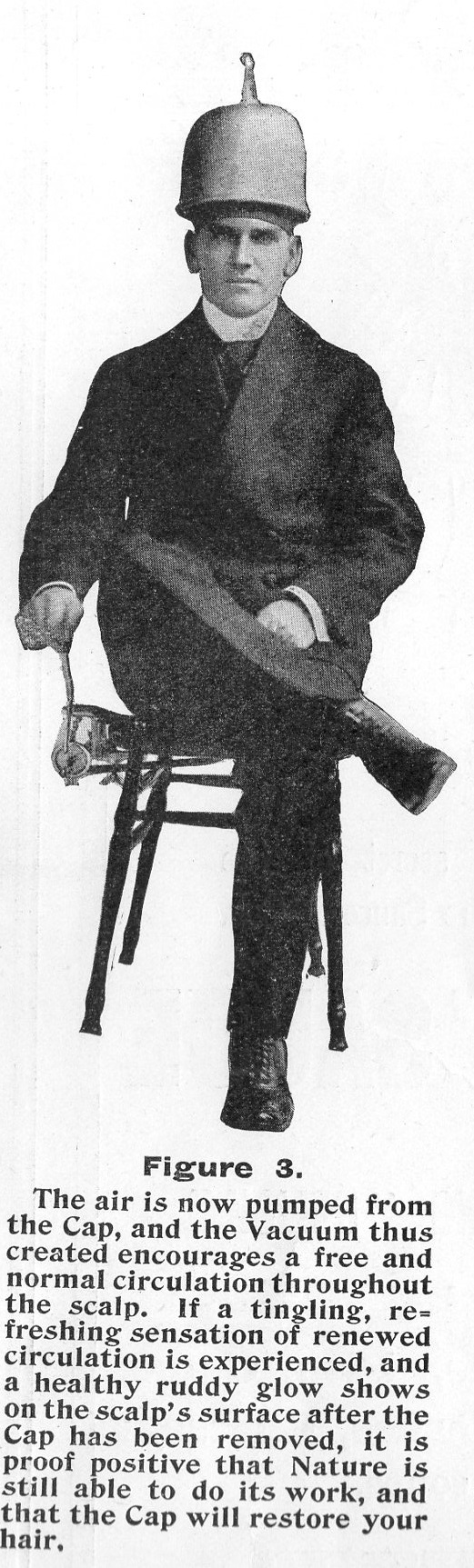
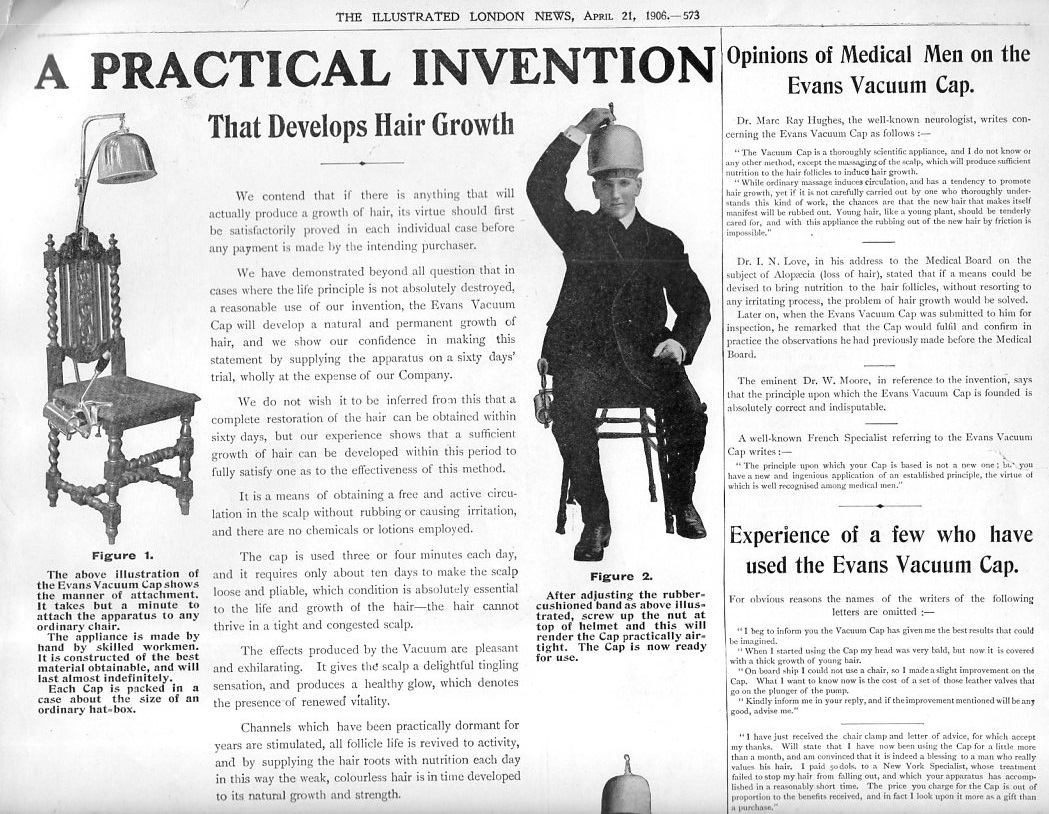
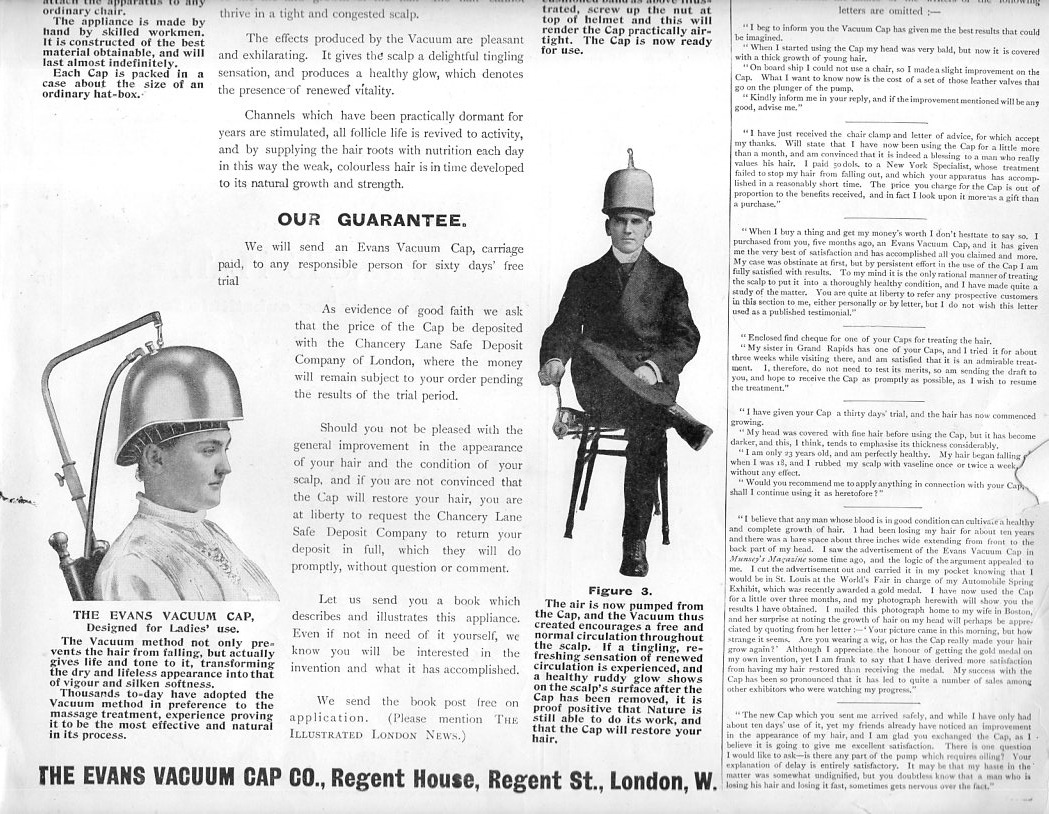
    There is not much to say about this advertisement except that it was a full page in the Illustrated London News (April 21, 1906, p. 573) and was therefore expensive.  The apparatus was basically supposed to suck the hair up and out of its Very Secret Place on the scalp and grow, so we know that the Evans Vacuum Cap Co didn’t spend very much money on research. And the product itself is a chair, the vacuum cap, and a pump, so the engineering part was not very expensive, either. The thing was offered money-back if not delighted after 60 days, so the vacuum must have at least been effective enough to stimulate some sort of sensation on the wearer and maybe even produce a scalp-hickey. Perhaps people were really surprised that after 90 or 900 days that the Hiding Hair was still so. 

    No mention of price, though–that would’ve been nice. 

    Hair vacuum124

    Hair vacuum125

    ·Posted by :

    ·in:

    —

  • “Fluid Influence”, Magnetism, Clairvoyance, and Chewing Gum (1910)

    JF Ptak Science Books   Quick Post     Daily Dose from Dr. Odd

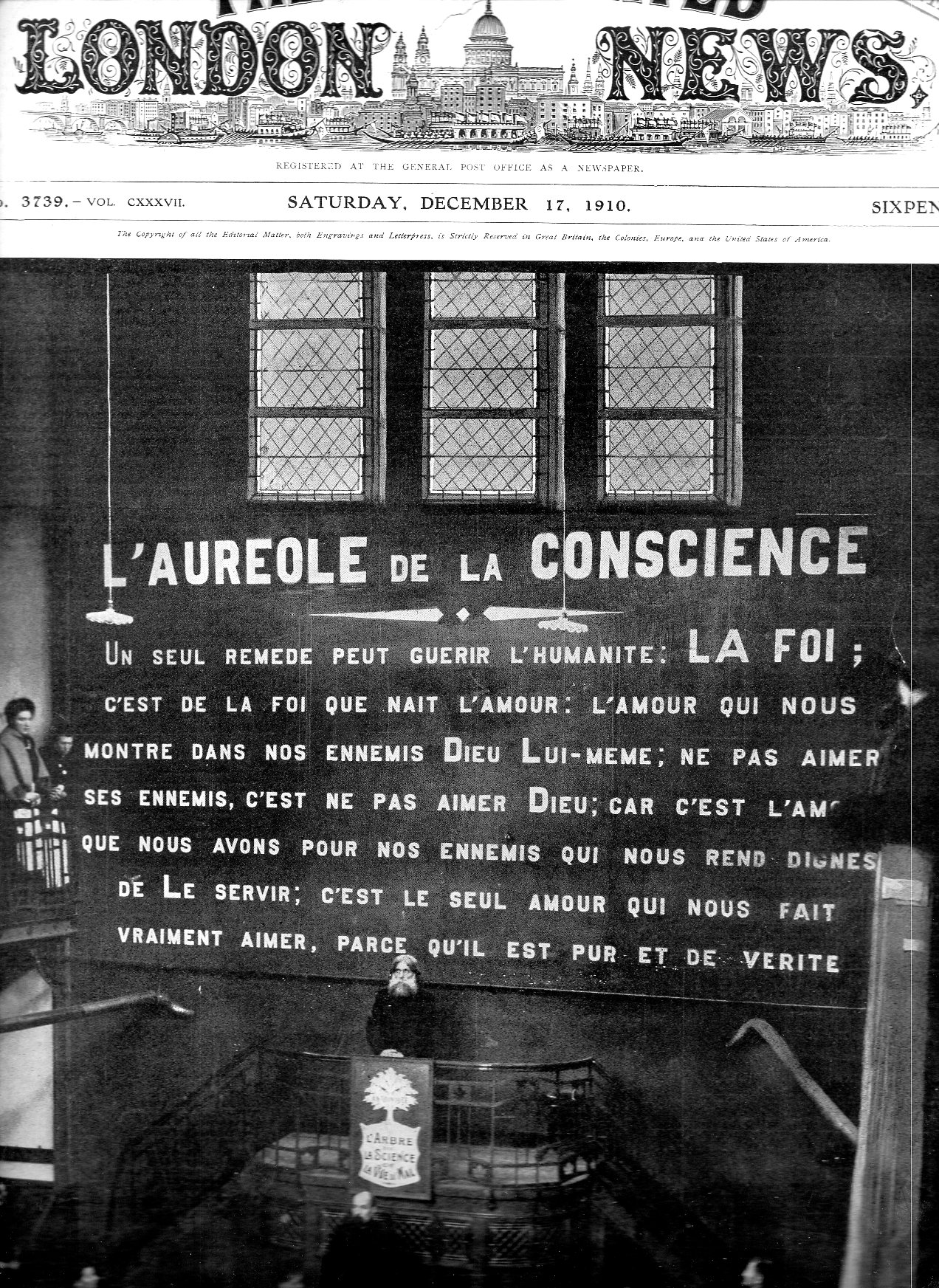
    I was quite taken with the sign behind the preacher in this picture. The photograph decorated the front page of the Illustrated London News, December 17, 1910, and showed the healing/clairvoyant “Antoine the Healer”, with a definite Rasputin-ish look to him. His deal was “fluid influence” in the good and evil fluid influence of magnetism, of reckoning the good/bad magnetism between people, and of course communicating with the good fluids in people.  Or something like that–I have no idea what he was talking about with the fluid/magnetism stuff.  In any event he collected 160,000 signatures of the faithful and whomever to present to the government of Belgian the case for Antoine and his fluids and Antoinettes as a recognized religion.

    Antoine088

    “Antoine’s followers obey him unhesitatingly in everything. In appearance he is a tall, rather round-shouldered man, with grey hair; he wears a black frock coat, but is always without a hat. He chews gum continually.”–The World’s News, January 14, 1911, pg 13. [Source: http://trove.nla.gov.au/ndp/del/article/128264839]

    In any event it was the enormous sign behind Antoine that attracted my attention–the fluid magnetism stuff is not so interesting, or attractive. 


  • A Giant’s Giant: Fr. Kircher, 1668.

    JF Ptak Science Books   Quick Post

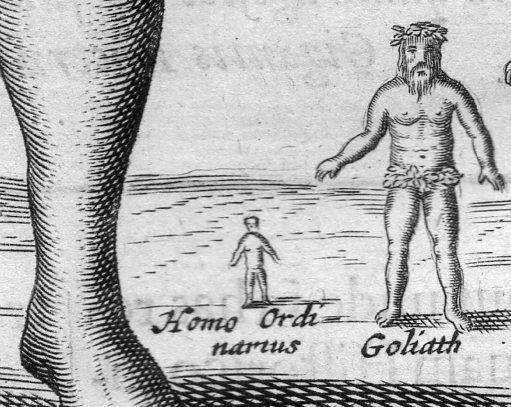
    Kircher Giant034[Detail of below]

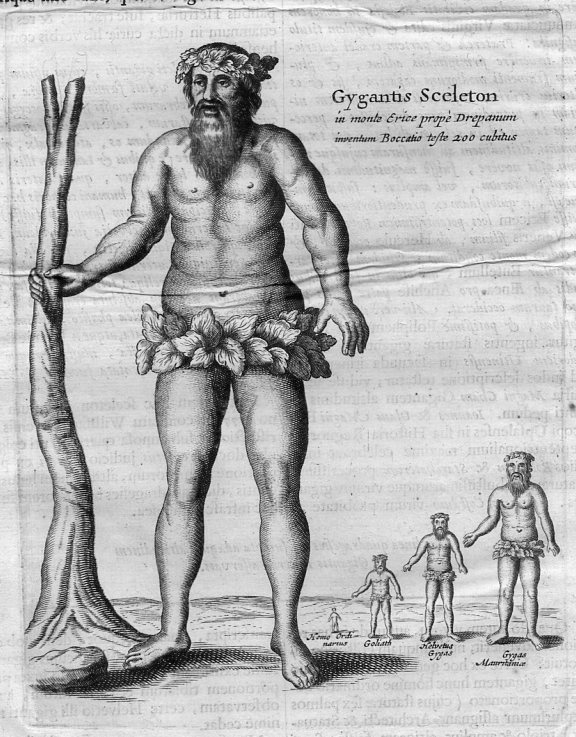
    The wonderful and occasionally problematic Fr. Athanasius Kircher (addressed numerous times in this blog, just check out a search under his name in the Google box at left) inferred by “anthropomorphic calculus” (so says Jan Bondesman, in A Cabinet of Medical Curiosities, pg 82) the size a human/giant must have been to accommodate (for example) an elephant tooth. So instead of dinosaurs you’d get these enormous creatures many time larger than a “Homo ordinarius”–as you can see in the scale, we have the enormous creature flanked by “homo ordinarius”, then Goliath (still puny), “Helvetius Gygas”, and “Gygas Mauritanius”, all quite tiny compared to the big boy, who stood 200 cubits. (A cubit was a measure from he elbow to the fingertips, so depending on where you were, the cubit could be 17-20 inches or so; in any event the giant would have been 300-400 feet tall.) This image appears in Kircher’s great Mundus subterraneus, quo universaw denique naturae divitae, published in 1668.

    • This original image is available for purchase via the blog’s bookstore, here.

    Kircher Giant033{This is a detail from the full image, following]