A Daily History of Holes, Dots, Lines, Science, History, Math, Physics, Art, the Unintentional Absurd, Architecture, Maps, Data Visualization, Blank and Missing Things, and so on. |1.6 million words, 7500 images, 4.9 million hits| Press & appearances in The Times, Le Figaro, Mensa, The Economist, The Guardian, Discovery News, Slate, Le Monde, Sci American Blogs, Le Pont, and many other places… 5000+ total posts since 2008.

Category: Absurdist, Unintentional

  • Putting “Art” into “Arithmetic” (1836)

    JF Ptak Science Books  Quick Post

    MultiplicaTION 292

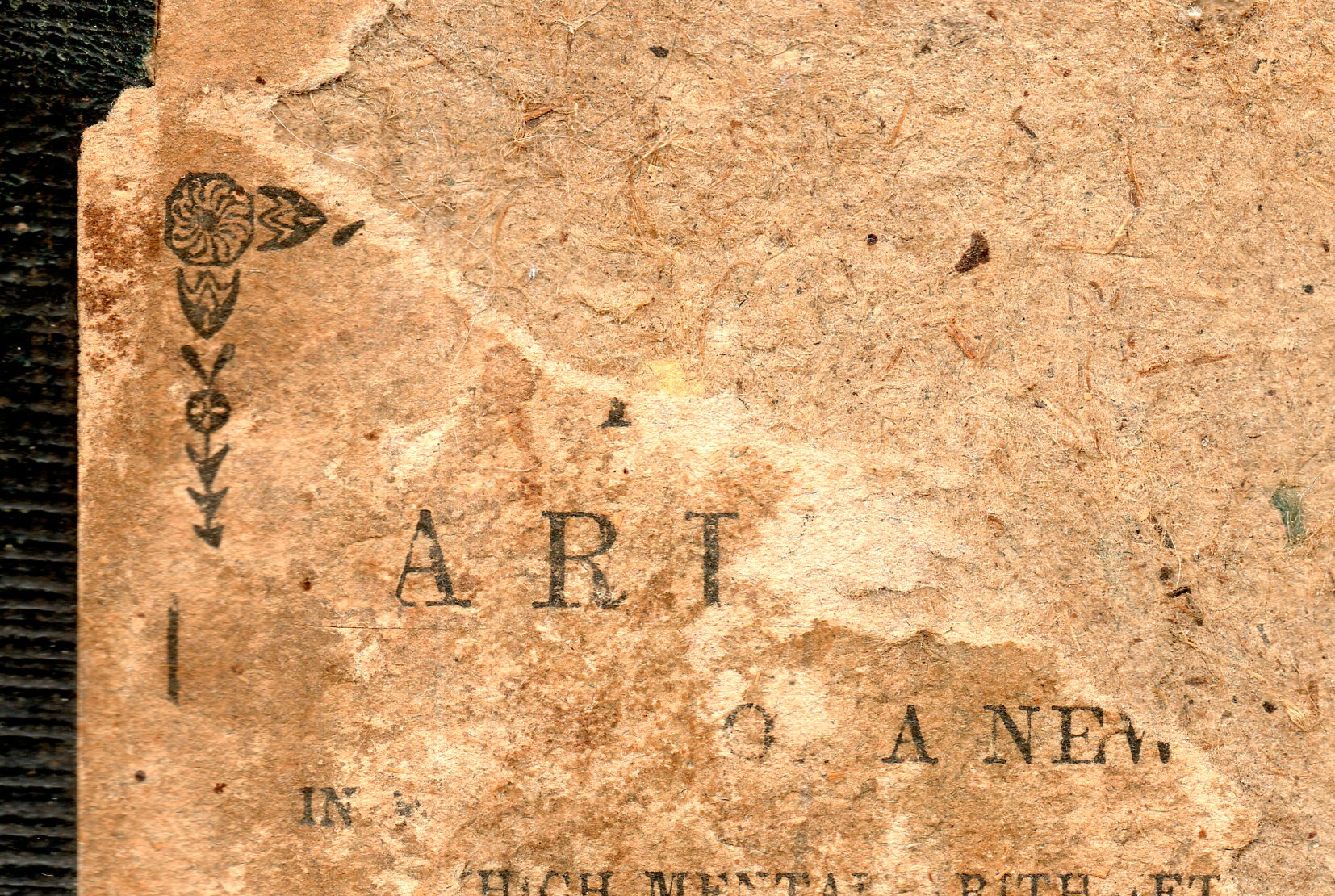
    I have a little pocket-sized book at home, a fine little arithmetic book by Roswell C. Smith, Practical and Mental Arithmetic on a New Plan in Which Mental Arithmetic is Combined with the Use of the Slate–it was published in Hartford, and this copy was printed in 1836, in its every energetic 53rd edition.  Mr. Smith wrote himself one fine and popular arithmetic tract, and the book is absolutely loaded with all sorts of info that could see a person through most aspects of figuring-life for years to come.  My copy is very very well worn, and although it is missing pieces of the paper cover and the surface of the books looks like the Somme, it is actually very smooth–worn and rubbed smooth from years of use.

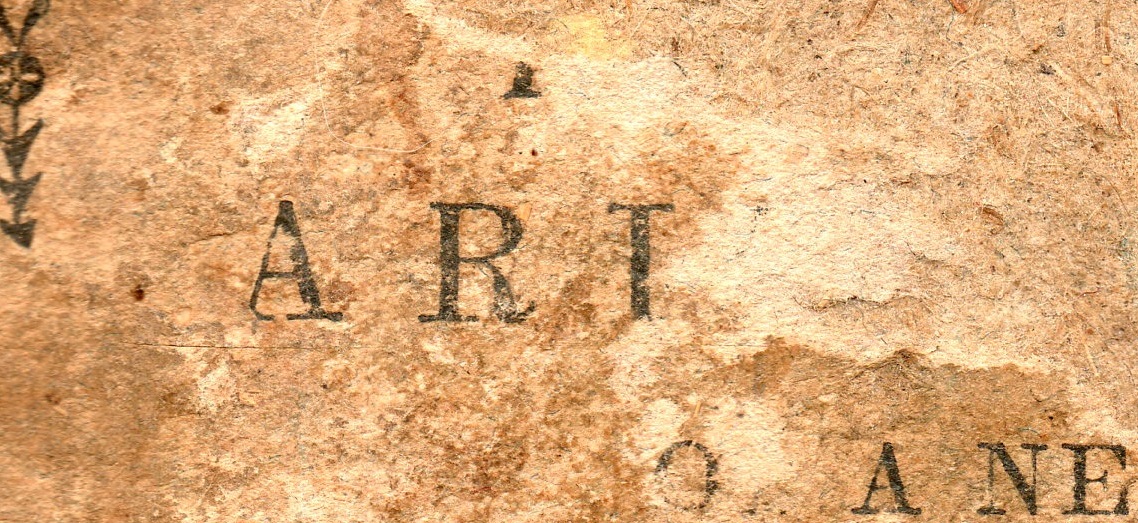
    And just about the only word left visible from these years of being handled by little hands is the fragment “ART” from “Arithmetic”, which I thought was a lovely thing. 

    Multiplication290

    As a matter of fact there is plenty in this books that is perfectly fine and applicable at the rudimentary math stages–of course some of the units of measurement have long since fallen into obscurity (even by the late 19th century) the lessons remain useful, if a little stiff, especially when you’re asked to work out some of the results on your slate.

    But the issue remains that this tidily compacted work is a pretty thing to work with:


  • Crazy Eyes and the Piano, 1904

    JF Ptak Science Books  Quick Post

    This is a rare entry in this blog’s “Crazy Eyes” series, and appeared in the Illustrirte Zeitung 17 March 1904.  In the original the ad measures only 1×3″, but it does have a strong impact, just because of those eyes.  Otherwise I would guess that most people would pass up the opportunity to “Teach yourself piano in a few days” via a method contained in a 25-mark book “that the world has never before known”.  I’ve got to say, it is a pretty effective little ad. 

    Crazy eyes piano270

    See this link for another bit on crazy eyes, including a crazy-eyed Mercedes driver, Barney Google, and Superman:  https://historyofideasblog.com/thesciencebookstore/2014/05/crazy-eyes-in-advertising.html

    Crazy eye mercedes

    ·Posted by :

    ·in:


  • The False Card Catalogs for the Library of Babel

    JF Ptak Science Books  Post 2538
    Books

    “Cataloguing is an ancient profession; there are examples of such “ordainers of the universe” (as they were called by the Sumerians) among the oldest vestiges of libraries.” ― Alberto Manguel, A History of Reading (and also translator of Borges and co-editor of A  Dictionary of Imaginary Places, a book worthy of high consideration as the The Book that you could have with you on a desert island.)

    • [On the other end of the infinite library, see an earlier post here on “The Library of One Book”, here: https://historyofideasblog.com/thesciencebookstore/2009/10/the-library-of-one-book.html]

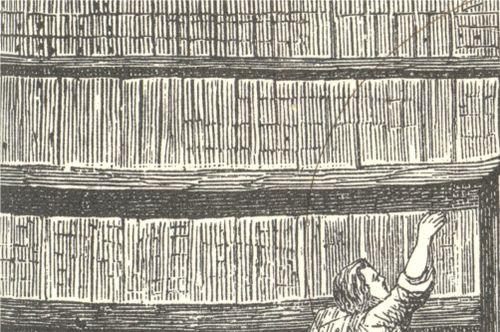
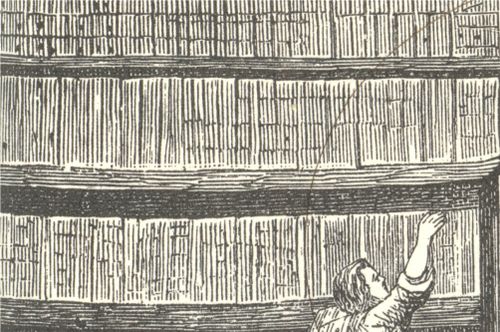
    In Jorge Borges’ “The Library of Babel” (published in 1944 and translated into English in 1962) we find that an infinity, or a universe, or a heaven, is declared to be a sort of endless library, stocked with hexagonally-shaped rooms books filled with books, all the same size, with the same number of characters. The rooms are endless, as are the books, which are written in every conceivable language and containing 29 necessary elements (including the alphabet, and the period, comma, and very interestingly concluding with the space). There are endless varieties of possibilities, and the place is staffed by librarians who have interests and obsessions from, well, A to Z, or Az^Z^Z^Z to ZA^A^A and so on, until we run out of time.  (Others have done some smart thinking on Borges’ great thought experiment/short story, and have estimated the size of the library in terms of stacked orders of magnitude beyond the atoms of the universe–but you can find all of that stuff elsewhere with a quick google search.)

    And then there’s this sample fro Borges on what sorts of books make up the library:

    “…the detailed history of the future, the autobiographies of the archangels, the faithful catalog of the Library, thousands and thousands of false catalogs, the proof of the falsity of those false catalogs, a proof of the falsity of the true catalog, the gnostic gospel of Basilides, the commentary upon that gospel, the true story of your death, the translation of every book into every language . . .”

    Here’s how you arrange an infinite library: you don’t.

    The books are not sorted to any sort of classification, only collected to the point that they are together.

    The many seem to be written in indefinable languages. Some of the librarians spent their time pursuing the holy grail–since all books that could ever be published would be present here, which theoretically include an index to library, or some sort of organizing principle.

    But since there was no verifiable organizing principle at play here, the library was useless as a “library”, though for the individual bits, it was perfectly fine. The structure though just turned into a long, endless, shelf.  This might explain why the caretaker/librarians of the place are so desperate.

    I cannot recall a mention of a card catalog, which I guess could be as all-powerfully impossible as the library, given that the library is not-classifiable. This is particularly true when you consider that there must also be a catalog of the arrangement of all possible false catalogs of all possible false books in the library, in addition to the true catalog. Perhaps the cards from this catalog would take up all of the space in the universe that would bump up against our own.  

    On the other hand, the logician W.V.O. Quine has written in a short piece that the Borges library is finite, because at some point there will come a time that all that can be written or will be written has been written:

    “It is interesting, still, that the collection is finite. The entire and ultimate truth about everything is printed in full in that library, after all, insofar as it can be put in words at all. The limited size of each volume is no restriction, for there is always another volume that takes up the tale — any tale, true or false — where any other volume leaves off. In seeking the truth we have no way of knowing which volume to pick up nor which to follow it with, but it is all right there.”

    He reduces this argument elegantly but completely without the humor of Borges, and says that all that is known can be represented in two symbols from which everything else can be derived–a dot, and a dash. He writes: 

    “The ultimate absurdity is now staring us in the face: a universal library of two volumes, one containing a single dot and the other a dash. Persistent repetition and alternation of the two is sufficient, we well know, for spelling out any and every truth. The miracle of the finite but universal library is a mere inflation of the miracle of binary notation: everything worth saying, and everything else as well, can be said with two characters.”

        “The ultimate absurdity is now staring us in the face: a universal library of two volumes, one containing a single dot and the other a dash. Persistent repetition and alternation of the two is sufficient, we well know, for spelling out any and every truth. The miracle of the finite but universal library is a mere inflation of the miracle of binary notation: everything worth saying, and everything else as well, can be said with two characters. It is a letdown befitting the Wizard of Oz, but it has been a boon to computers.” [Quine’s “Universal Library” is found at Hyperdiscordia, here: http://hyperdiscordia.crywalt.com/universal_library.html]

    Quine’s approximation cuts way down on the size of the library, which evidently would not fit in the known universe, which opens the gates for Heaven, which I think doesn’t depend on such restrictions–unless of course it was too big for that, which means believers would be in trouble, and none too happy with being kicked out of paradise to make space for a book.


  • The Unresolved Creepiness of “Indoor Man”

    JF Ptak Science Books  Quick Post

    There is an indeterminate quality of quiet malice in these pictures, somehow–they seem bland and also threatening in some way. Perhaps it is the assumption of these Human Types that is so off-putting, with this 1939 pamphlet happy to categorize people into three major “types”.  “Active Man” seems like an aspiring non-perspirer, eager to let someone else do it; “Thin Girl” seems to be daring her simple classification; the “Housewife” needs to prove her name is accurate not only with the apron, but with a pot as well; “Mature Person” is urgently directing attention to high-attentioned-bits while maintaining a stiff unwrinkled nature; and “Office Girl” is stiff-backed with a pencil knife at ready. The whole cover for this diet regimen just seems softly-defined creepy–perhaps not so much for the titles, or the postures, but for the aggressive contrasting color.  

    Indoor Man060


    ·Posted by :

    ·in:


  • 1/580,000th of the Shells Fired in WWI

    JF Ptak Science Books    Quick Post

    This striking photo shows the shell casings for one day’s worth of bombardment by the U.K., at a position somewhere in France, 1916.  I reckon that there are 3,000 105mm shell casings in this photo, which for one day’s work is a lot.  Throughout the course of the war it has been estimated that there were about 1.75 billion artillery shells fired, which makes this pile about .0000001% of the total; another way of looking at this number is that it would take about 580,000 of these piles to equal the 1.75 billion figure.  It is a vast number, and vast numbers are hard to understand in a daily language.  

    WWI Project !05 mm shells single day

    [Image source: RarehistoricalPhotos.com http://rarehistoricalphotos.com/shells-creeping-bombardment-on-german-lines-1916/]


  • Electropathic Pathology: the Invisible Quackhood of the Electric Brush (1884)

    JF Ptak Science Books

    Harpers A  Mistake139

    [Source: Harpers Weekly, November 4, 1882, pg 704.]

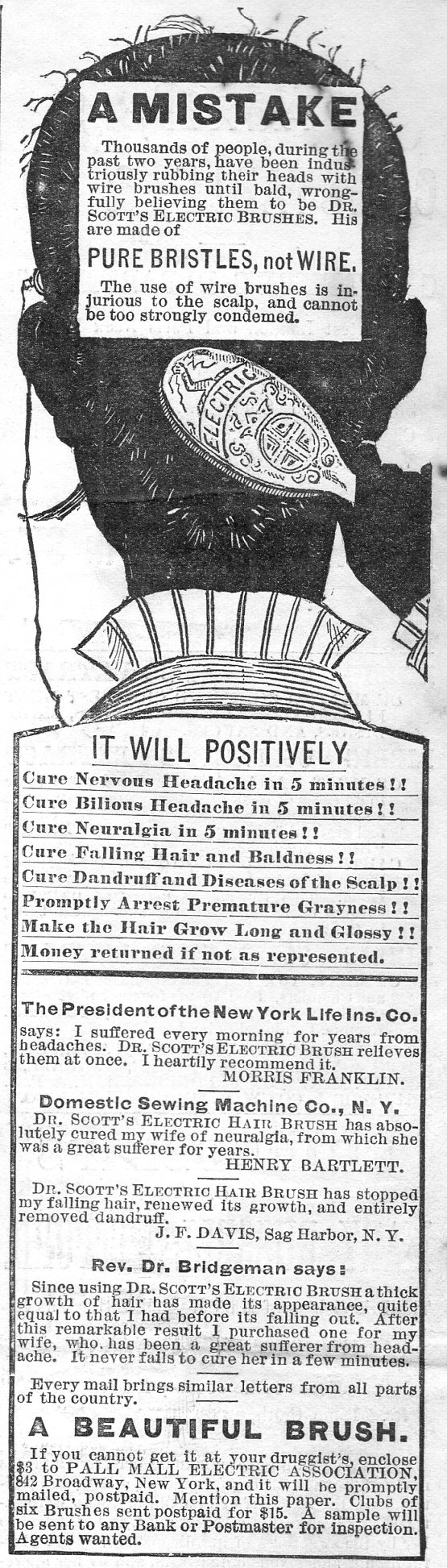
    This ad doesn’t say so, but the makers of this new electric miracle brush was competing with itself, or at least with products within it own production family.  The makers, Pall Mall Electric Association (close to “pell-mell” which would have been a more accurate description of this quack medicine outfit’s rush into the field of medical victories), claimed that their product would cure nervous and bilious headache, neuralgia, hair loss, dandruff, scalp diseases, as well as create a glowing head of long hair. There is no description of how electricity plays into this scheme–except that they are adamently saying that it does so through bristles, whereas a competitor stealing their idea for a non-existent cure-all for the head was using an electric brush with wire. 

    It turns out that the Pall Mall Electric Association also produced something called Dr. Scott’s Electric Hairbrush, which may or may not have been the same product as above, and which may or may not have competed with itself for a real clientelle buying not-real medical remedies.  “Dr. Scott” also produced an “Electric Flesh Brush”, an electric corset, an electropathic belt “for ladies”, and (among other things) an “electricpatent” sock.  

    As with other technological breakthroughs, the use of electricity in the 1880s-onward took advantage of the introduction of a new and probably not-understood technology (as with the electric lamp, phonograph, telephone, etc) in which quack businesses set up their tents in the shadows of the possibilities produced by the aura of the new tech. 


  • Art+Chemistry+Decomposition=Art

    JF Ptak Science Books  Quick Post

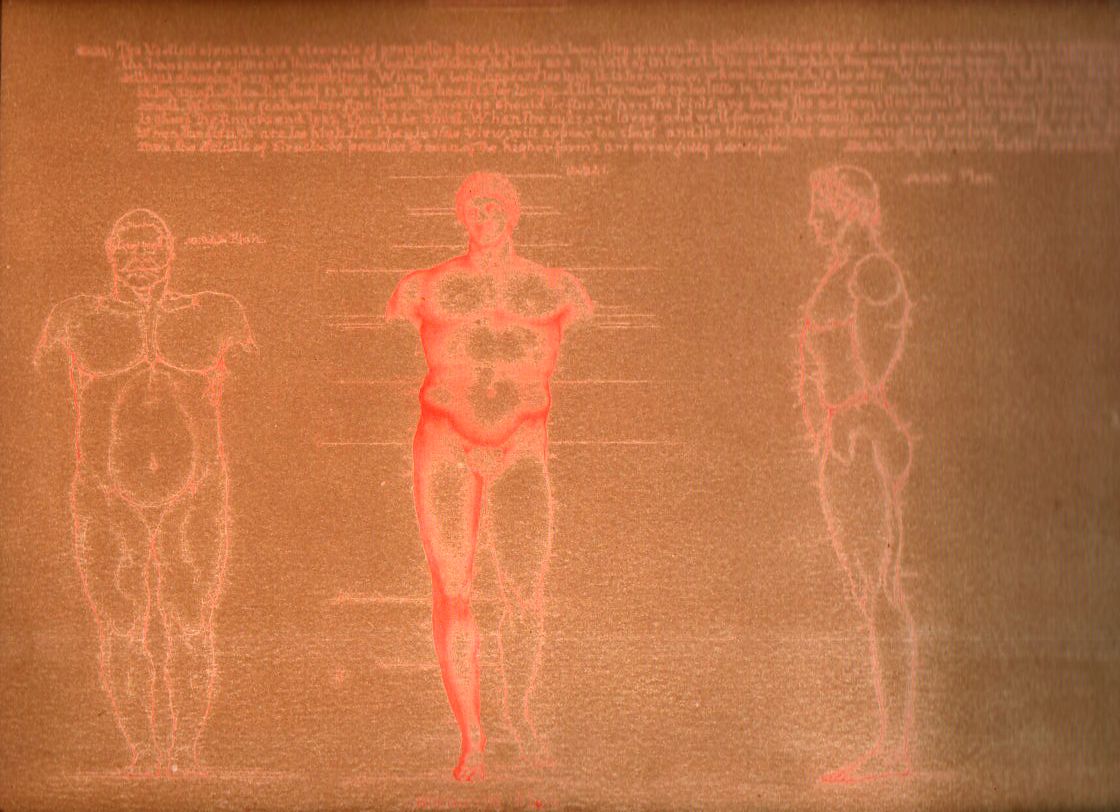
    I wrote earlier this month about the fantastic Leonardo-esque anatomy work by the prodigious William Rimmer (here)–I’m drawn back to him tonight after having stumbled upon a very unusual and interesting plate from his 1884 work.  There was an earlier edition of this work1, quite rare, that was printed in a limited edition of 50 for 50 dollars–which was a lot of money back at Centennial, a little less than what a carpenter might make in a month. (See another earlier post here “How Much is 50 Cents in 1876 Worth Today?”)

    Rimmer Odd137

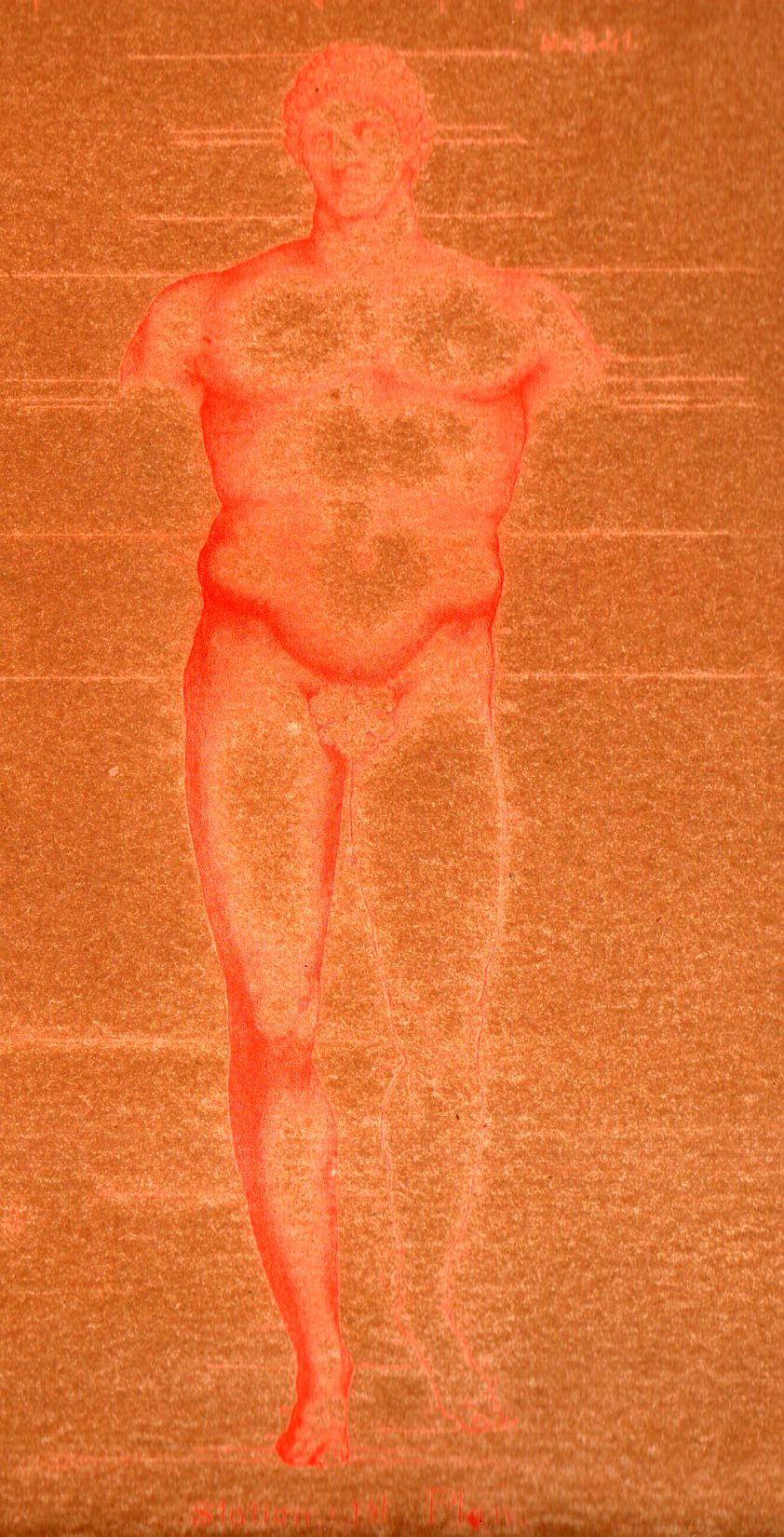
    Again, I am called back to Rimmer for this interesting decomposition.  There is some sort of deterioration of the printing process, some minor mystery of the ink/paper/time/conditions battle that is going on here, and it looks as though art is losing.  On the other hand, the deterioration is creating its own artwork, probably unexpected by the original artist and printer.  

    Rimmer Odd138

    Notes:

     1. 

    [Source: Literary World, volumes 7-9, 1876-7, pg 200. Google Books: https://books.google.com/books?id=x0kDAAAAYAAJ]


  • Color Blindness and Color Correction

    JF Ptak Science Books  Quick Post  

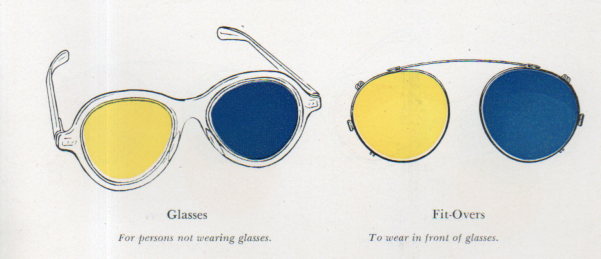
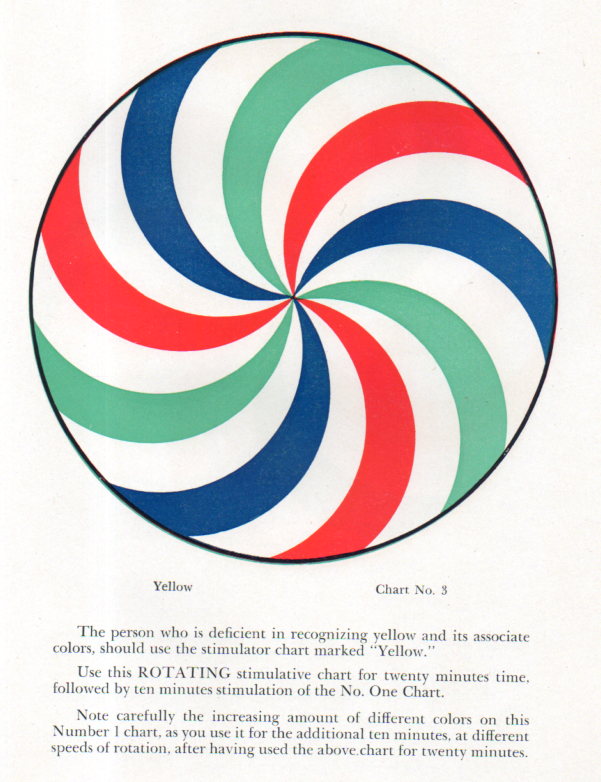
    “For this condition, I will prescribe, for your information, a marvelous cure, the result of my experience in such cases. Take a precious stone we call sapphire. Powder it most thoroughly in a metal mortar and store it in a golden vase. Put a little into the patient’s eye every day and he will soon be cured “– from the Medieval medical text De Oculis, by Benevenutus Grassus, Stanford University Press, 1929, page 58. 

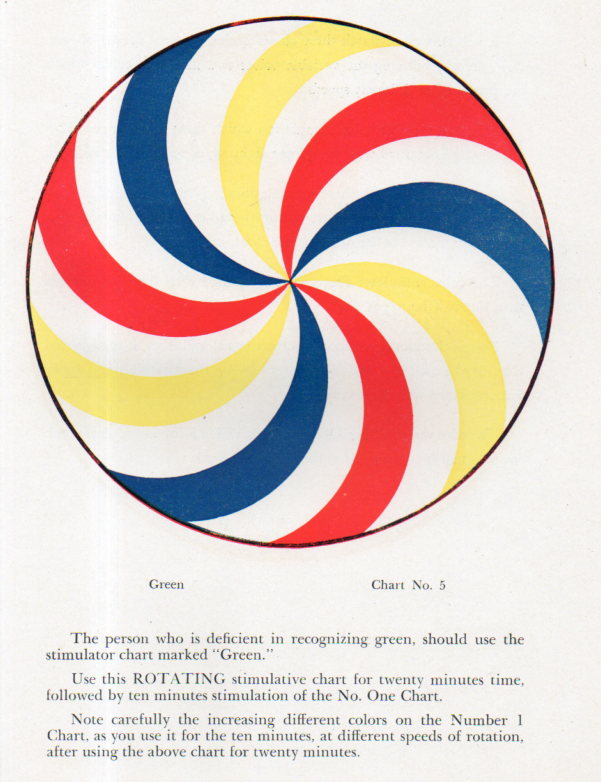
    Color wheels106

    Admittedly I was more interested in the illustrations in this work1 than the text, mainly (and obviously) because the images are so striking. The text is in its way a pre-scientific attempt at ‘curing” color blindness, which is a genetic disorder.  The color wheels (“variable speed rotary color vision stimulator”) were intended to be rotated to produce different color senses for “color vision stimulation”–it could be used to determine whether or not color vision was being “improved”.

    Most of the work was a sales vehicle for Dr. Newton’s color blindness color regenerators, or whatever, all of which could be obtained from his office in Oakland.  I guess Dr. Newton was trying, but…


    Color wheels103


  • Outsider Politics & the Apotheosis of Religico-Governmental Control

    JF Ptak Science Books   Post 2513

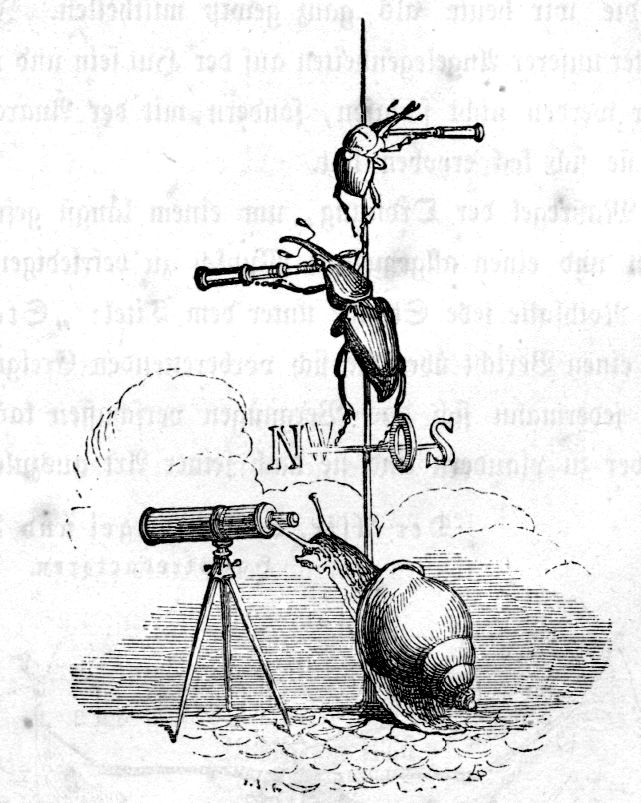
    Compass057[Woodcut image by J.J. Grandville, [Jean-Ignace-Isodore Gerard (1803-1847)] from Bilder aus dem Leben der Thiere (“The Public and Private Life of Animals”) vol II, p. 224  =>For a good summary of Grandville’s fantastic work, which is completely unrelated to this post, see Opinionated Art, here.]

    People's Party058

    This wisp of a pamphlet (printed in 1937), set out on a task to introduce the idea of a theocracy and government according to Christian revelation, winds up in a rather odd and unexpected place.  If you were to remove the religious aspect of the proposals and the “theomendments” of The People’s Party, you wind up with an extreme form of dictatorship in which “the Government” and “Government-Nation” is a sort of totally-dominating  Socialist-Scriptural-Brutalista melange.


  • Non-Observatory Telescope Houses and Rolling Homes

    JF Ptak Science Books   Quick Post   [Part of a series on the History of the Future]

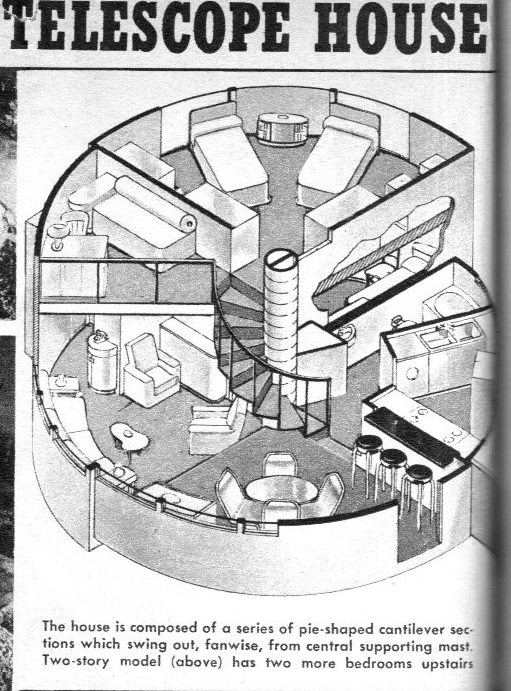
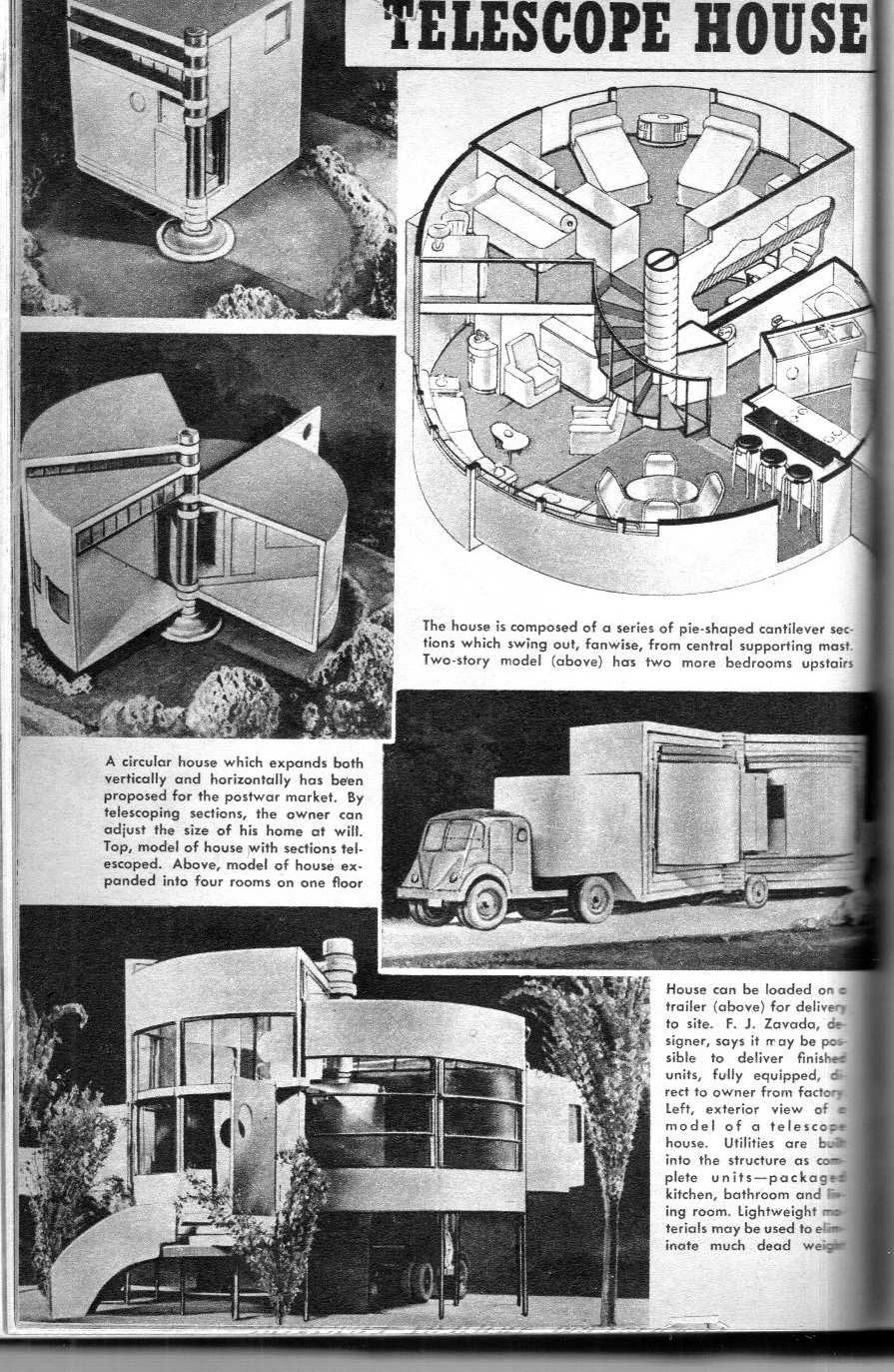
    Say “hello” to the “telescope house”, an unusual idea in small house design, found in Popular Mechanics for the March, 1945 issue, just before the end of WWII in Europe.  It was designed by F(rank) J. Zavada (1916-1998?), and it is a tidy little place:  four rooms on the first floor and two bedrooms on the second, the house is made to collapse and expand vertically and horizontally.  I don’t see area  mentioned, but it looks to be on the order of 400 sq ft or so. 

    Telescope house detail[Detail]

    Telescope house039

    This design put me in mind of a much-inferior idea: the rolling house of the future (offered in the September, 1934 issue of Everyday Science and Mechanics). Etienne Boullee it is not. The house does, however, roll, for whatever that is worth, and if that is a positive thing then that would be one advantage it would have over a non-rolling house. (I don’ get to write that phrase very often.) And it rolls exclusive of  some rolling platform, which somehow seemed like  a better idea than just having a more-traditional house with wheels.  Presumably the rolling house would be filled with E. Lloyd Wright nothingness, so there will be no displacement issues. 

    Rolling_house_large

    [Read more about the Rolling Houses and Glass Homes of Futurlandia here.]