A Daily History of Holes, Dots, Lines, Science, History, Math, Physics, Art, the Unintentional Absurd, Architecture, Maps, Data Visualization, Blank and Missing Things, and so on. |1.6 million words, 7500 images, 4.9 million hits| Press & appearances in The Times, Le Figaro, Mensa, The Economist, The Guardian, Discovery News, Slate, Le Monde, Sci American Blogs, Le Pont, and many other places… 5000+ total posts since 2008.

Category: Absurdist, Unintentional

  • History of the Future of Massiveness: Stadium-Seating Skyscrapers, NYC, 1938 [Part II]

    JF Ptak Science Books  

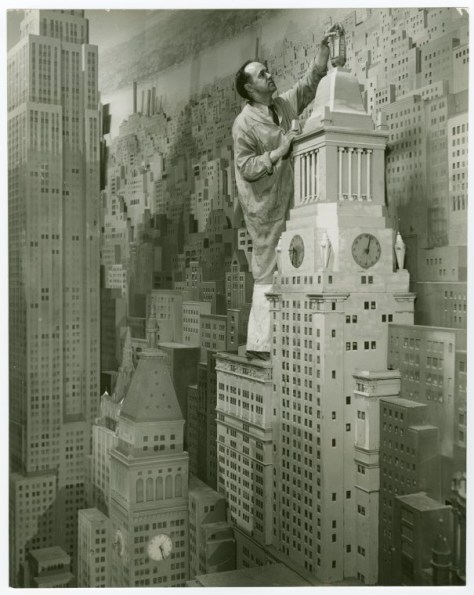
    I wrote earlier in this blog about a wonderful stadium-seating vision of New York City (here https://historyofideasblog.com/thesciencebookstore/2016/02/history-of-the-future-of-massiveness-stadium-seating-skyscrapers-nyc-1938.html)  produced by Con Ed for the 1939 World’s Fair.  What I didn’t realize was that this was a drawing of what was to be a 5,000 square foot model of the buildings of Manhattan, all made to fit on a single block.  The breakthrough for me came in a browse of the September 1938 issue of Popular Mechanics, where I saw a short article with a photo of NYC building models that looked very much like the jam-packed visionary cityscape of ConEd:

    NYC Architecture stadium seating


    Here’s one of the images I posted earlier:

    NYC stadium seating 1938

    It turns out that the first images that I posted were drawings for the models that were part of the Consolidated Edison “City of Light” pavilion at the fair, and which constituted the world’s largest diorama.  Here’s an interesting photo showing the scale of the project:


    NYC city of light 1939

    [Source for the image directly above from Architecturalogy which hosts a number of other interesting photos, here:  http://architecturalogy.com/new-york-diorama-the-city-of-light/]


  • Unusual Book Titles Department: “What Can the Women Do?” (1940)

    JF Ptak Science Books  Quick Post

    What can th e women do159

    I think that this pamphlet could stand without comment, but, well, here it goes anyway:

    Here’s an extraordinary title from the Found-Absurd/Surreal Department:  What Can the Women Do?  was published by the Extension Department of St. Francis Xavier University in Antigonish, Nova Scotia in 1940.  It is a odd, uncomfortably-phrased work that seems completely antiquarian today–and yet the work is only 75 years old, well within the lifespans of 10% of U.S. citizens alive today.  That such a question would and should be asked within the space of the lifetime of millions of grandparents is remarkable, and brings the past bursting into the present. This question did not die here in 1940, but would continue for several decades more.

    The other point here is that this is only 20 years after women were granted the rights to vote in the U.S., and in some ways was an advancement in showing the number of different sorts of occupations open to women besides her job as housewife and mother.  


  • Hitting Charles Babbage with the Art Stick–Poemitization Derived from the OED

    JF Ptak Science Books  Quick Post

    • Make your own poem with the first few words of the first twenty entries of definition quotations of Charles Babbage used in the Oxford English Dictionary. Actually, any name will do…

    I just happened to choose Uncle Chuckles while I was taking a peek to see which scientist was used most often by the OED in definition quotation–and also because he may be the least likely of the famous scientists to be associated with poetry. (I’ve written a number of posts here on “found poetry”–enter this phrase in the Google search box at right for results.)

    So here it is, the bones of poetry–I think that there may be a “something” in this nothing, though our 12 -year-old instantly identified this as “meaningless–they’re just pieces of phrases”, which of course is correct. Except sometimes you find the art where the art ain’t; and sometimes, you don’t, simply because it if ain’t art it just ain’t no matter how hard you hit something with the art stick.

    OED Babbage

    • On the east is adjustable
    • on the score of a fall
    • (the next morning at seven)
    • applied sense or meaning
    • the heat of an Argand lamp
    • med’cine makes, and gives.
    • And set me on the proofe
    • nine pair of bed-screws.
    • each’d on the happy Plains
    • bobbin-netted to imitate brussels lace
    • bittes and a brace
    • Brilliant requires
    • work. buhl-work
    • bull’s-eyeing a sheet of blown glass
    • tispasmodic, and sudorific
    • calendaring is scorned and abhorred
    • wheels of eccentric form
    • aft, drawn round by Horses
    • water through an opening
    • and retired grumbling

    ·Posted by :

    ·in:


  • Some Vastly Creative Titles by S. Dali (1930’s)

    JF Ptak Science Books  Quick Post

    Love him or not, there seems to be little middle ground with Salvador Dali. What I find probably-peripherally interesting in Dali’s writings are the titles of them…maybe more so than the written piece itself–perhaps that is because I enter such deep shallow pool in them where I become lost or bored or just cleaved up in misunderstanding…it is all a possibility.  One thing that is inarguable I think are the titles of some of his works.  For example, I wanted to share a few that are found in the Surrealist-laden but not-necessarily-Surrealist art magazine, Minotaure (1933-1939):

    • “Non-Euclidean Psychology of a Photograph”
    • “The Spectral Surrealism of Eternal Pre-Raphaelite Femineity”
    • “First Morphological Law relating to Soft Structure”
    • “A Paranoiac-Critical Interpretation  of the Obsessive Image of Millet’s Angelus“
    • “Concerning the Terrifying and Edible Beauty of Art Nouveau”
    • “The New Colouras of Spectral Sex-Appeal”
    • “The Aerodynamic Apparition of Object Beings”

    The Guggenheim notice on the Minotaure: http://blogs.guggenheim.org/findings/minotaure-surrealist-magazine-1930s/

    ·Posted by :

    ·in:


  • Captain Marvel and the V-1

    JF Ptak Science Books  Quick Post

    Captain Marvel was once upon a time in the 1940’s a superhero more popular than Superman, though Superman is the obvious victor over time (and a long time at that). I don’t know what Captain Marvel is doing here hawking a paper punch-out flying “buzz bomb”, particularly since it seems to have been produced during WWII.1 It does seem unlikely to me that a flying toy modeled on the buzz bomb would be sold to kids during the war. After all, the “buzz bomb” was the German advanced weapon called the V-1, or Vergeltungswaffe 1, (“retaliation”, or “vengeance” weapon), or Fieseler Fi 103,  or Doodlebug, and was a flying bomb (on the order of a very primitive cruise missile guided by a gyroscope autopilot) launched against population centers in England by the Nazis during the June 1944-January 1945 period.  The bomb was about 27’ long and 17’ wide, weighed 4,700 pounds, and reached 400 mph with an 1,800 pound warhead.  Thousands of people were killed in the 8,000+ sorties of this foul-sounding beast–there was only a general sense of where it was going and where it might land, so the death and destruction it caused was indiscriminate.  Given all of this I’m assuming that the guesses on the year of production of this are wrong, and that it is a post-war bit, which would be in less bad taste than had it been actually produced in wartime.  It seems to me that most superhero/action hero types were busy punching Hitler or some such thing, and not selling a toy based on Hitler’s weapons when they were actually killing thousands.  In any event, I’m sharing this unusual image with its unusual story. 


    Buzz Bomb Capt marvel cover

    Notes:


  • Earth Squared and Halved and Shrunken and Invisible and Doubled and Miniaturized

    JF Ptak Science Books   Post 1936 (expanded)

    This post is a part of overlapping categories, including:

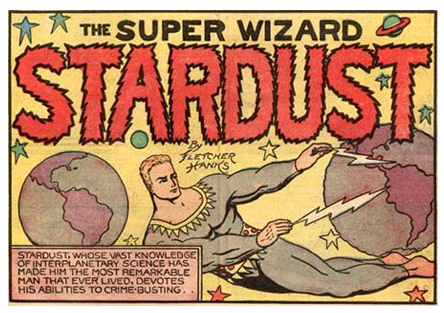
    Comics Hanks' double earthI don’t know if this is an actual Extra Earth that makes an appearance in a Stardust episode, or if it is just a repeated element of design–from what I have seen from Hanks, it could easily be either. 

    And now on the the rest:


    Earth strange half earth

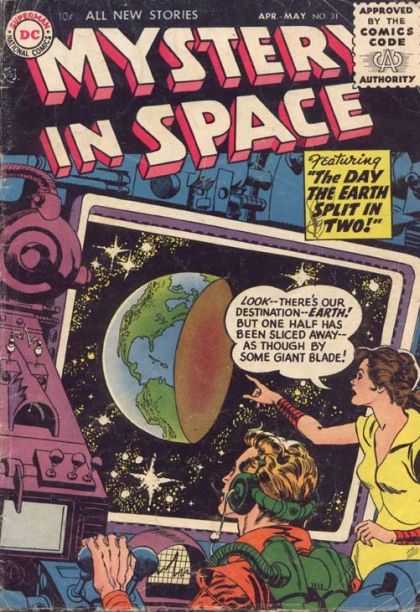
    In the eight years or so of collecting information and stories for the odd-bits section of this blog  I have never encountered so many choice visual examples in one place for strange/weirdly-imagined/impossible/high-SciFi of the Earth than with the comic book, Mystery in Space. The very dedicated keepers of Coverbrowse.com website have reproduced thousands (?) of covers of pulpily-published science fiction and exotic-thinking comics books, including the home base in which all sixteen-plus years of Mystery in Space live.


  • Outsider Emblemata, 1889

    JF Ptak Science Books  Quick Post

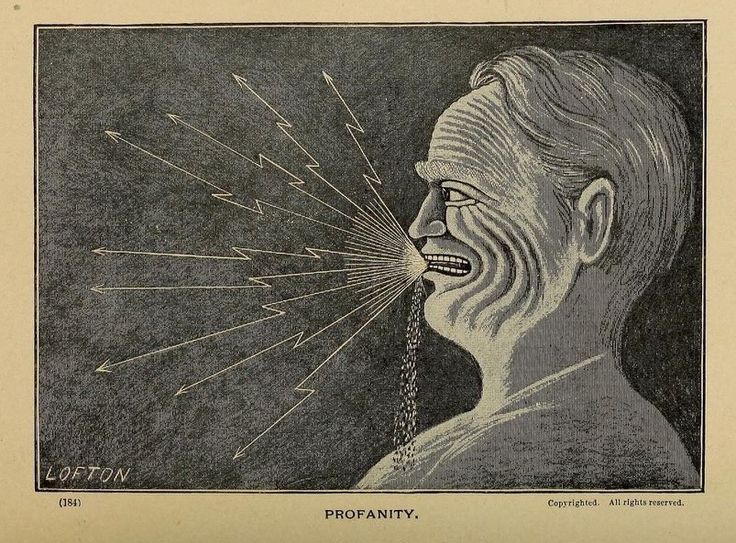
    Character Sketches or the Blackboard Mirror, a Series of Illustrated Discussions, Depicting Those Peculiarities of Character…Subjects Illustrated With Over Fifty Engravings, by George Augustus Lofton (1839-1914), is a peculiar but not necessarily transcendental religico-social-morality screed in the vein of more antiquarian emblem books.  The major attraction to the work were the very unusual, half-edgy, unschooled illustrations for the morals investigations made by the author–which do approach a sort of transcendental nature, all on their own. The text I’m afraid pulls the drawings down some, as I’d rather work the stuff out with just the image and a title, the descriptions becoming very quickly a preachy jaundice of judgment more so than insightful observation–though the descriptions of the images do have their moments from time to time. 

    Blackboard mirror profanity[Source for all images, plus the text and rest of the images, located at Internet Archive, https://archive.org/stream/charactersketche00loft#page/n11/mode/2up   ]

    I think the drawings by Lofton are remarkable for their  (probably unschooled) expansively unusual possibilities, all of which are very outre for the close of the 19th century.  The human figures are certainly very stylized, but the background and foreground bits are generally very oddly aggressive, and off-putting.  


  • Found Surreal–1868

    JF Ptak Science Books   Quick Post

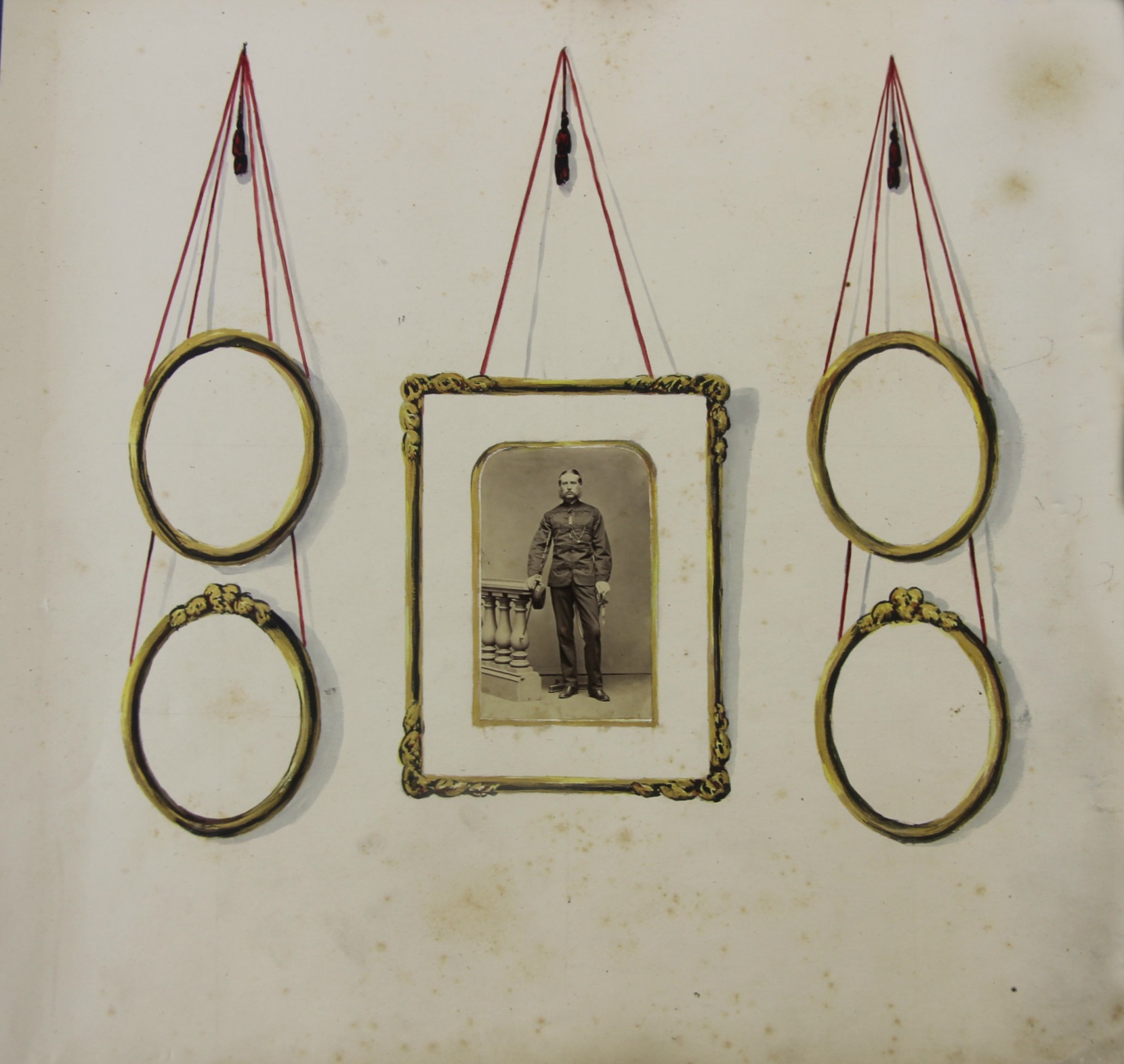
    This interesting image came from a collection of Victorian photographs, all ca. 1868 (one in the group was dated so). This example stands apart for me as an example of the Found Surreal–it has a certain artistic planned emptiness if you look at it in a certain way. Of course the original intention here was for someone getting the 18×18″ sheet ready to accept four more photographs placed in the hand-drawn frames.  

    Military photo odd


  • Atomic Jello and Henry Darger

    JF Ptak Science Books  Post 2566

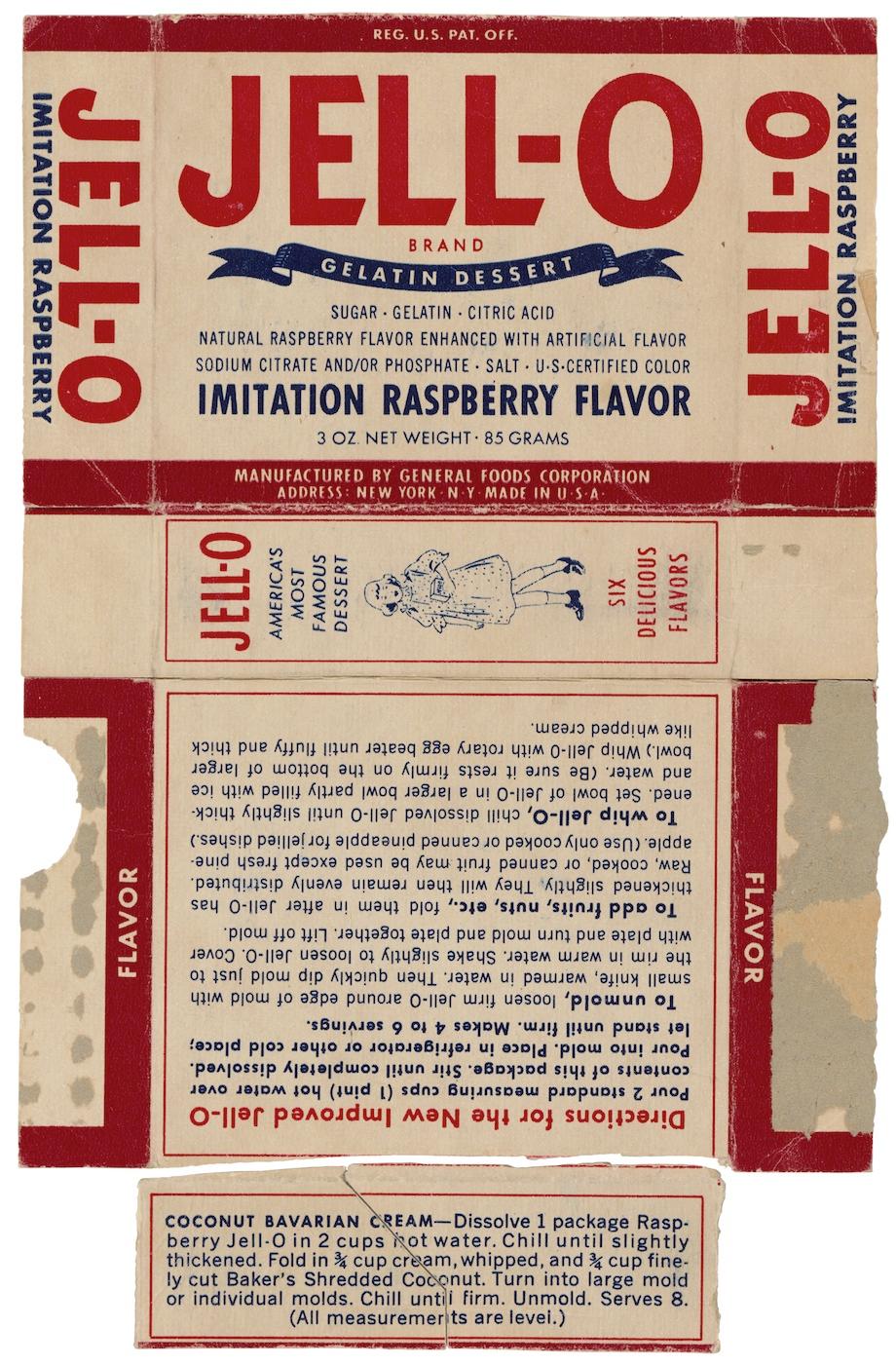
    Atomic Jello two point oneJello is a powdered gelatin formed of collagen, a cocktail of peptides and proteins from pig skin and cow bones, and “ready to eat”. 

    It is also basically what glue is.

    It is the “glue” part of this thing that brings us together here, to tell a story of atomic bomb secrets given to the Soviets and the U.S. traitors who made it happen.  

    The story of Harry Gold, David Greenglass, Ethel and Julius Rosenberg has been told countless times, and in some of them the hook for the story was this box of Jello. The Jello box was cut in half, and used as an innocuous way for Gold and Greenglass–who each possessed one half of the box–to match up, signifying that each man was communicating with his proper counterpart.  Why they thought it was innocuous to be walking around with Jello box parts in their wallets is not known, but they used it successfully, and under this cover of establishing their identities, they carried on their work.

    As I said, it is an old story. Back in the mid 1980’s when I thought I wanted to be a journalist one of the stories I dredged up was this one, and I tracked down the Rosenberg kids and interviewed them, and the janitor who cleaned up after the Rosenberg’s deaths in their execution in Ossining, and even to the Rabbi who was probably the last person to see them alive.  The story for them gets pretty weepy, and convoluted, but not so much anymore after you read the Venona transcripts regarding them.  And that pretty much tells the story, I think.

    Anyway, their stories are best told by others elsewhere.  

    All I wanted to do here was make the passing note that the girl on the Jello box has some resemblance to the girls populating the artwork of Henry Darger, the bleak, fabulous, impossibly-driven Outsider with what was probably a complicated and terribly unsavory fascination with young girls.   

    I don’t know if this is the exact type of Jello used by the conspirators, though this is what was entered into evidence at the trials of these people, a “replica” of what was believed to be the box, but it is good enough:
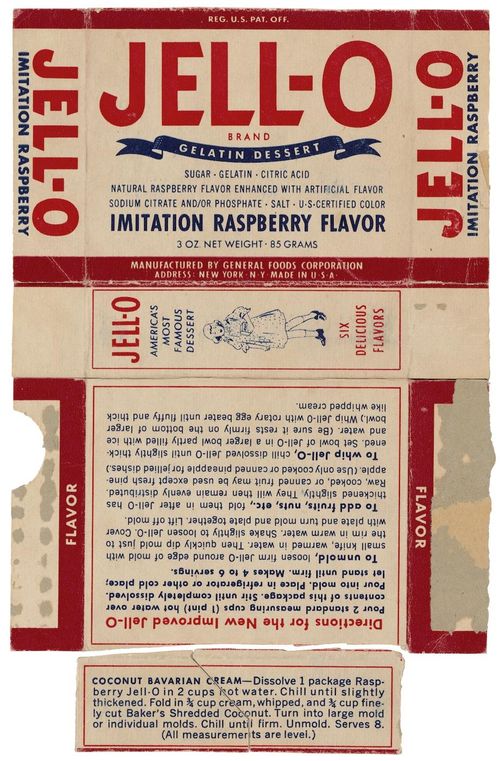
    Atomic Jello two[Source: National Archives, here: http://blogs.archives.gov/prologue/?p=4655]

    Here’s is an example of the (clothed) Darger Vivian girls. I know, I know, he is perhaps one of the great three/four great icons of Outsider art in the 20th century, but all I take away from him is a sense of very very complex creepiness:
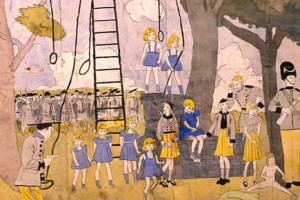
    Darger girls

    [Source: http://www.chicagostagereview.com/the-most-conceptually-encompassing-production-of-2008-%E2%80%93-as-told-by-the-vivian-girls/]

    • See an earlier post of mine on Henry Darger and the Campbell Soup Playhouse Schoolroom for Kids, here:  https://historyofideasblog.com/thesciencebookstore/2012/09/henry-darger-and-campbell-soups-kids-playitme-schoolroom-1955.html

  • Outer Space Space Music From Outer Space

    JF Ptak Science Books   Post 2561

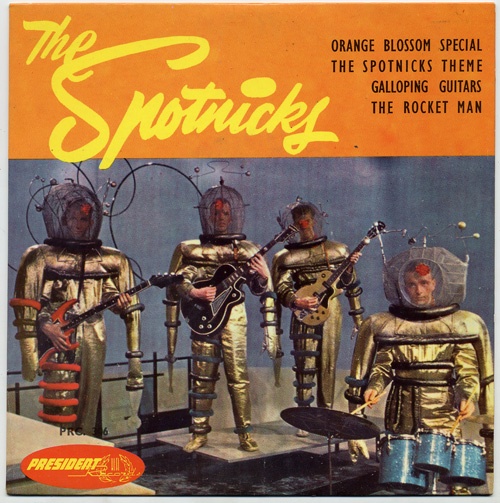
      Spotnicks

    Nothing quite sounds or looks quite so unusual as a forgotten piece of popular culture from a different generation, something that was stretching the boundaries in potentially cringeworthy ways.  Of course everything is removed from context, so the historical/cultural part isn’t immediately neuronally available, though with just a little bit of digging into memory or archives these things would fit the thing nicely in place and time and would recover their sensibilities.

    But as stand-alones, these exemplars of outre thinking might do little more than raise a surprised eyebrow to their unexpected appearance.

    So, while searching for exotica/tiki music online, I stumbled upon and over “The Spotnicks” (read “Sputnik”), a groovy 1961 Swedish band that I guess was a semi-equivalent to a 70’s hair band, except these guys appeared in space suits there at the hot part of the space race.  And:  they were actually very proficient musicians, though, proficiency (and even giftedness) don’t necessarily a good band make.  Never having heard of them before (I grew up in the era of The Rock and the Roll, though the music never really appealed to me much) I came to learn that the band is still around, and has made 42 albums, and sold 18 million copies of their music, which I would never have guessed to be the case.  So, while the music might not necessarily be the stuff of which memories are made, it wasn’t bad, and the players certainly seemed to have some chops.  (And their movement as they played seems to have come a decade or more before Devo.) 


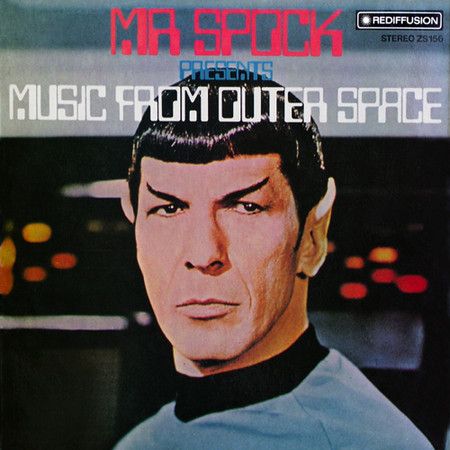
    It turns out that space–themed music was a popular bit in the late 1950’s and into the 1960’s, though it seems from my brief dip into that genre that not a lot of it was outery-spacey, though the album covers were.  (Sort of like “Atomic Cafe” or “atomic cupcakes”, where the idea of the “atomic” part was present but had nothing really to do with anything at all except for the name and signage.)  That this, I did find this album from 1967, produced and sold while Star Trek was experiencing a small spike in the ratings.  There are space-related themes here, present in Mr. Nimoy’s poetry and spoken word, so this at least has something to do with the music:

    Music from Spock

    If you’d like, you can listen to it a bit, here: http://www.maidenwine.com/lps.html

    So in my limited walk-about experience, genres like Exotica and Tiki seem to live up to their name beyond the album cover design; the sub-category of “outer space” Exotica  music probably does not, though that might not matter so long as the album design is wicked good.