A Daily History of Holes, Dots, Lines, Science, History, Math, Physics, Art, the Unintentional Absurd, Architecture, Maps, Data Visualization, Blank and Missing Things, and so on. |1.6 million words, 7500 images, 4.9 million hits| Press & appearances in The Times, Le Figaro, Mensa, The Economist, The Guardian, Discovery News, Slate, Le Monde, Sci American Blogs, Le Pont, and many other places… 5000+ total posts since 2008.

Category: Absurdist, Unintentional

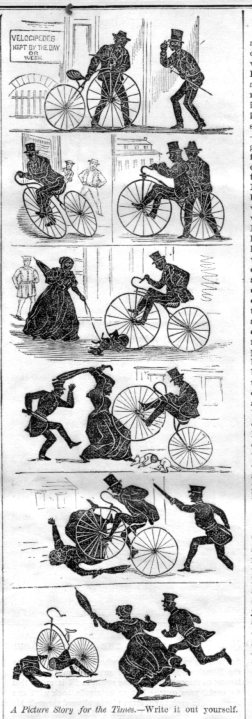
  • Bicycle Story Without Words, 1869

    JF Ptak Science Books   Quick Post

    I found this interesting story-without-words in a column in American Agriculturalist, April, 1869.    The velocipdes were fairly big, and fairly new-ish to be peddle-powered at the front wheel, and apparently not so welcome on urban streets.  (Within fifteen years the bike would take on a decidedly very modern look, easily recognizable as being a close family member to that Schwinn cruiser you owned in 1982.) I don’t have any insight about the editorial content of the segment…  

    Bicycle598


  • The Circle of Words Both Broken and Unbroken–Outsider Political Rants, 1912

    JF Ptak Science Books   Quick Post    Part of the Uninentional Absurdist series

    I’ve catalogued a number of pamphlets on this blog that  are on the Outsider/Found-Surreal/Uninentional-Absurdist spectrum, people who reveal their insights into the un-insightable, or their outsights into the great Outside world that is unseeable because it is unseen, or unknowable, or non-existent. Sometimes it is all-existent, though the insights bearing upon the issue are the unknowable, non-retrievable, self-referential, private-logic and private-language communications. Sometimes there is insight in that, but usually not.  

    This day’s installment has the feel and look of something from the 19th century, but is it comes from 1912, and the rants and razor-vision is localized on Teddy Roosevelt and Woodrow Wilson.  I’m not sure what the author’s point was, because it is all fairly circular, a circle of words filled with a another circle of words, and who knows really where they go. 

    Outsider Political497

    and

    Outsider Political498

    and

    Outsider Political499

    And the full front page of one of the pamphlets:

    ·Posted by :

    ·in:


  • Explosives as a Civilizing Force (1930)

    JF Ptak Science Books   Quick Post

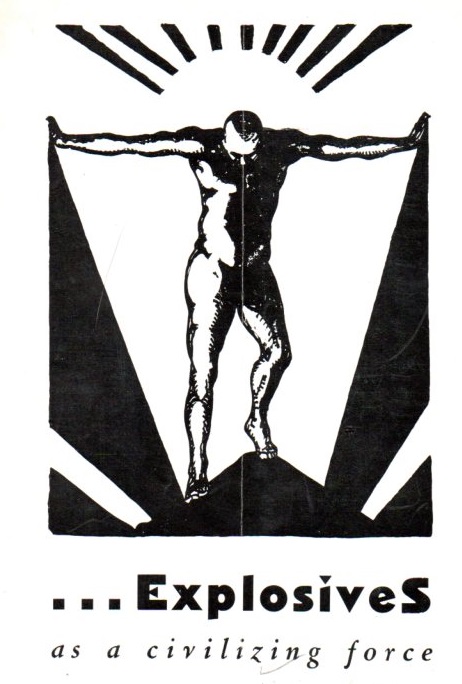
    This is the very striking cover design for a pamphlet written by Dr. Julius Klein (the assistant secretary of commerce) produced by the Institute of Makers of Explosives (103 Park Avenue, NYC, who of course made a large play for blowing stuff up as a positive driving force in the history of civilization.  And they are right in many cases, obviously, but the images and title taken out of context are very provocative. 

    Explosives civilizing423

     Dr. Klein starts off by disabusing the reader of the “bad press” of explosives:  “a good many of us, I imagine, labor under a misapprehension about the explosives industry…we conceive of explosives as an instrumentality of havoc.  But that conception is utterly wrong.”  Utterly?  The man does have a point of course,  which he explains in subject headings like “Dynamite the Liberator”, “Many Unusual Uses”and “Explosives Release Raw Materials”  But “utterly”?  Its a real piece of heavily worked propaganda that makes the case for the economics goodnesses and misunderstood destructive values of TNT. 

    ·Posted by :

    ·in:


  • Tech Quiz: Oblivious/Careless Chaos-Catcher, 1894

    JF Ptak Science Books   Quick Post      Tech Quiz/What is It? series

    This is an addition to the infrequently-seen What is It? series of this blog…

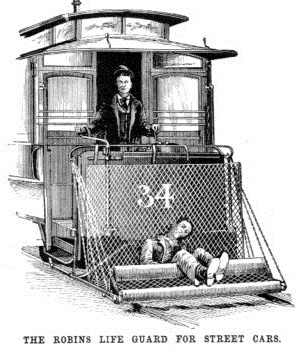
    Okay, so I’ve given it away in the title–if not for that, this wouldn’t be a very obvious contraption, would it?  

    People catcher detail

    There must have been a lot of people who had a problem with street cars in the 19th and early 20th centuries because in my meanderings through the Scientific American I have seen quite a few suggestions for dealing with the pedestrian vs the heavy moving metal problem. Many of them have to do with the humanified locomotive cow-catcher–that is an apparatus that would somewhat safely scoop up the unfortunate pedestrian before they became very fatally unfortunate.  Here’s just one example, found in the February 3, 1894 issue:


    Pepople catcher380

    Neither the scoopee nor the scooper look pleased.  

    This problem is better illustrated by an early film of street traffic–it is amazing in a way that the orchestration of non-fatalities is so seemingly superb, the coercive element of the destruction of liminal space pretty well hidden in the seeming confusion. 

     [Via youtube, “From trolley, down Broadway and Union Square. Street scenes, stores, crowds, carriages.–Early 1900’s”]


  • Babies, Gas, and War (1943)

    JF Ptak Science Books  Quick Post


    0 blog jan 12 baby gas380
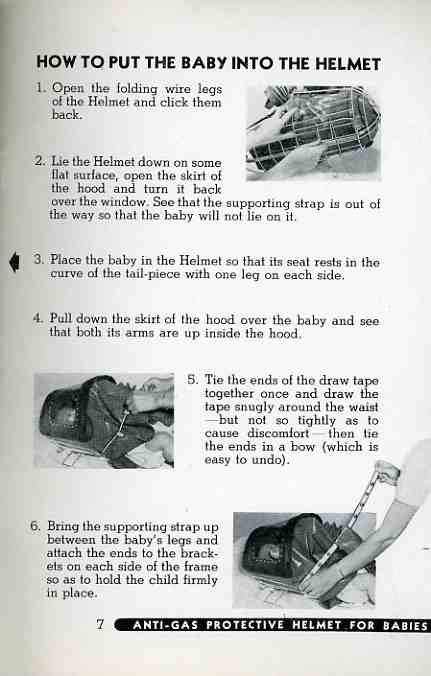
    There’s nothing that shouts “WRONG” with greater voice than images like this.  Like pornography and art, things that are just plain wrong are instantly recognizable, and this is a fine example of that thinking. Anti-Gas Protective Helmet for Babies, Manual of Instructions was prepared for the Office of the Director of Civil Air Raid Precautions of Ottawa, Canada, and published in 1943.  I’m not sure that the image of the nurse in the gas mask isn’t as disturbing, but the two of them together is just too much.  

    I wasn’t aware of the gas attack preparations in Canada–the situation was entirely different in Britain, where everyone was required to own a gas mask, and by 1940 more than 38 million had been distributed to the population.  But the planning was underway in Ottawa in ’43 for the worst, as removed and distant from the war as just about any other place on earth–but the Air Raid Precautions people pulled no punches in their hearts and minds campaign, and I’m sure that it was very effective.  This little pamphlet certainly caught my attention. 

    And it wasn’t as though the United States, the United Kingdom, Japan, and Germany weren’t doing anything about poison/nerve gas during WWII–they were.  There was very little use of CW during the war, though the Japanese military did use it relatively widely against Chinese troop,s guerrillas and civilian populations during several years in the war between Japan and China leading up to the outbreak of WWII.  There were large stockpiles of CW in the U.S, Great Britain, and Germany, though the weapons were allocated for last-ditch doomsday operations should the opposing side start using them first.  

    0 blog jan 12 baby gas381

    ·Posted by :

    ·in:

    —

  • Composite Nothingness and the Archaeology of Visual Errors

    JF Ptak Science Books  Post 2350

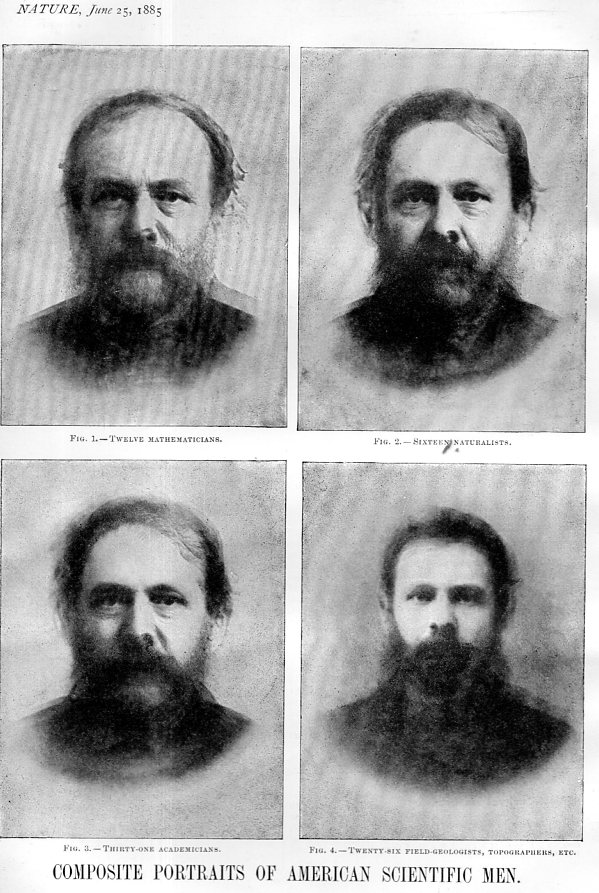
    Building on some reaching and questionable physical identification work of Sir Francis Galton, Raphael Pumpelly tried to make photographs of what scientists looked like. 

    At a scientific meeting of the National Academy of Science in Washington D.C. Pumpelly (along with Dr. (Thomas Mayo) Brewer and the Secretary of the Smithsonian Institution, (Spencer F.) Baird) undertook the experiment to determine whether or not there was a certain composite “type” in groups of academicians.  He employed the justly-named head of the photography department at the Smithsonian, Mr. (Thomas Mayo) Smillie, to make a series of 2-second exposures of the scientists upon a single glass plate.  Two seconds per portrait was not long enough to make a defined portrait for a single sitter, but if there 15 or 30 such exposures on the same plate it was seen that collectively there would be a strong impression.  The resulting portraits are interesting in their won way, but probably not without the backstory.

    Composite593

    ·Posted by :

    ·in:


  • The “Gentle Pressures” of Adolph Hitler (1936)–the Viewpoint of a Nazi

    JF Ptak Science Books  Post 2349                                                                                        

    Poster soviet america375

    I came to this pamphlet from a design/composition point of view, finding in it a peculiar attractiveness in its gritty-typeface and loud speculation.  That said, the title is of little use to tell us of its contents, and so opening to page 37 (in deference to my wife Patti Digh who finds much significance in the number) I found on the opposite page the “it does not matter that the German people of the Reich have a different form of State from America”, and that the form of state so far as the Germans were concerned was “a matter of fate”.  

    Interesting, and, well, unfortunate, because the publication date of the work is 1936.  The author, Mr. A.T. Fredex, implores the reader to consider that there is “no more a liberty-loving people than the Germans”, and that they are a free and liberated people.  The German state of today was subject of certain internal “troubles” and that successions of leaders–for the good of the people–were forced to keep the nation together with “more or less gentle pressure”.

    And so the skeleton of the fleshy produce of the pamphlet is revealed.  “Already the sneers of the yellow and black races are haunting us”, writes Mr. Fredex, who continues in just the next paragraph that all that remains to happen would be for Socialist France to “mobilize her millions of Negroes” along with the help of “Bolshevist-Mongolian Russia” against Germany, which would be the last refuge of normalcy in Europe, the thing protecting the Western world from who-knows-what.  

    All of this is in three paragraphs of one page.  Then comes the race part, the Teutonic purity and excellence part, and the horrors of race-mixing and “mixed blood” that will wind up dooming America.

    I skipped ahead, or behind, to the end, where we are warned by Mr. Fredex to awaken our Nordic interests should Germany fail to hold back the assaulting races.

    This is really quite a story to unfold in just two of the pamphlet’s 56 pages–the rest of which I think need no further exploration.  

    The pamphlet cover, though, retains its interest, forensically speaking, and can only hint at the pamphlet’s evil and filthy contents.

     

    ·Posted by :

    ·in:


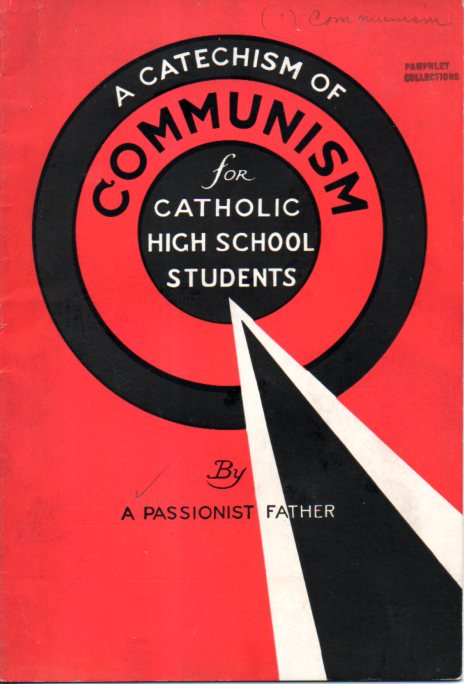
  • A Catechism of Communism, 1936

    JF Ptak Science Books   Quick Post

    This is a beautifully design object, and for a moment I thought that this might actually be a sympathetic-Communist pamphlet–something from the Paulist Press, for a Catholic high school system, and from 1936 when there were still plenty of Reds running around the U.S.–so I needed to look around the booklet a little bit. 

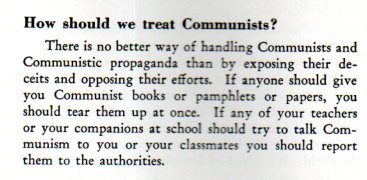
    Communism in catholic school009And of course I found out what it was really about just about instantly, and so there was no mistake about what the Passionate Father was really passionate about:

    Communism in catholic school text010

    This is pretty strong stuff considering that Communists weren’t terribly uncommon in the U.S. half-way through the Depression, though that can be mostly due to the absence of the real story about what was going on in the Soviet Union under mega-murderer Joseph Stalin.  But really it is more the Socialists who were more popular in the off-party politics in America in the mid-’30’s.  In any event the author hit the Communists pretty hard based on their anti-god and anti-Catholic positions, so, naturally, there was very room left at the table of philosophy for the Communists. 

    ·Posted by :

    ·in:


  • Mud, Abstract Expressionism, and the Brick Color Field

    JF Ptak Science Books   Post 2342

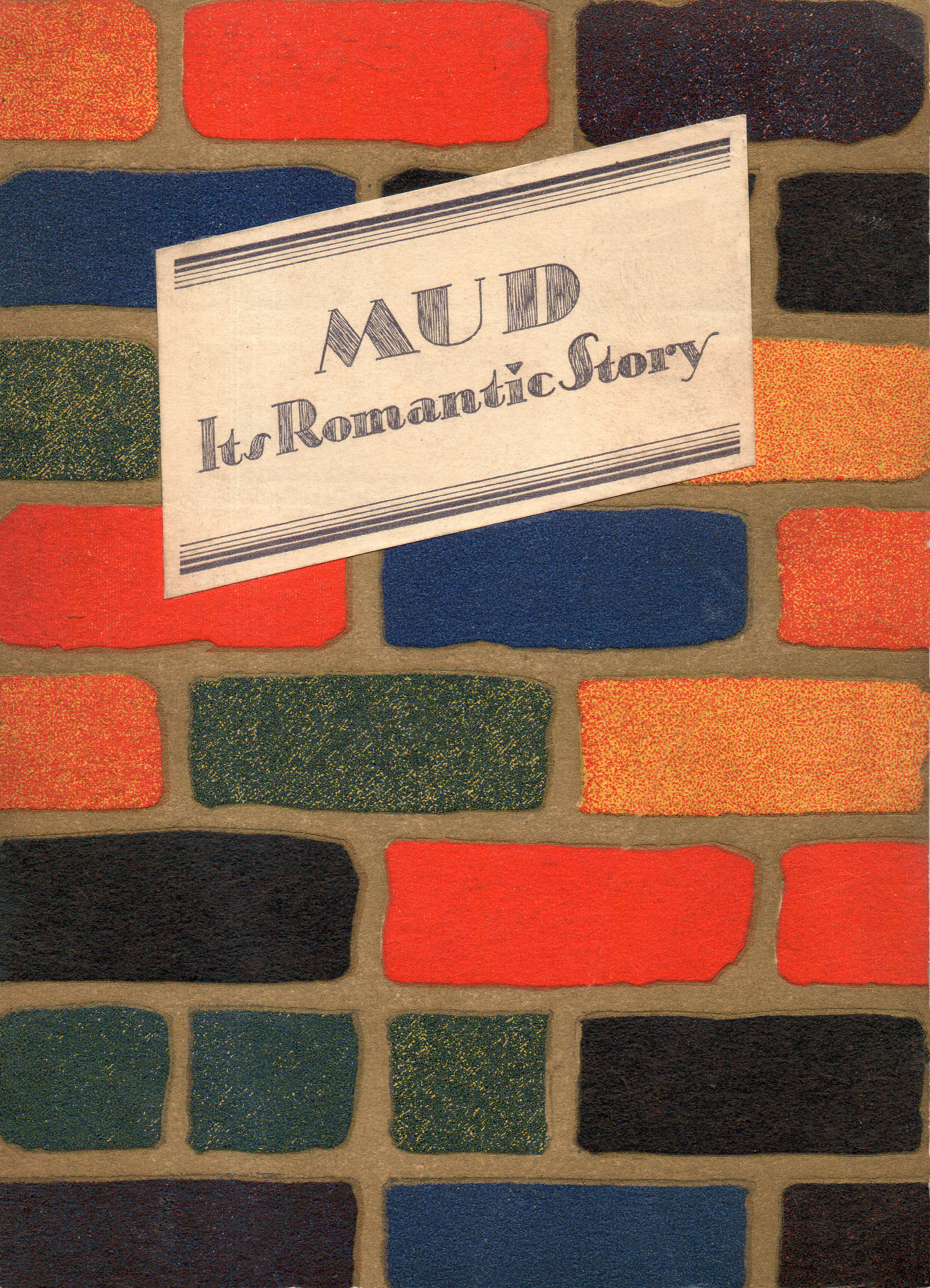
    Mud abstract


    Okay, so, this may only be a detail of a cover of a quietly-uncommon and proto-bizarre pamphlet on bricks, but when you look at it in a certain way, it may suggest a bit of found abstract expressionist art. Or even a Cubist-something.  I can see it as a color field–a very, very hard-edged Rothko detail comes to mind.  Perhaps if Pollock arranged entire bricks as his medium rather than dripped paint, he may have come upon an expression such as this. Or not.  

    Poster---MUD 364[This image is available as a 13″x19″ 600 dpi poster, here.]

    The pamphlet comes from my collection of fantastically-titled and creatively naive pamphlets and books.  After considering their reaching, speculative, bizarre, and surreal titles, they fall into a number of sub-categories, including:

    • titles with question marks “?” (like the two wonderful pamphlets simply entitled “What ?” and of course the two that have no titles but question marks);
    • titles with exclamation points “!” (these two marks actually don’t occur very often at all in titles, especially when the title itself already has a built in question/exclamation mark); 
    • titles that include the phrase “the history of…” or “the story of….” so long as that history/story is (very) unusual; 
    • titles that demand something or other of  “America”  (i.e., “Will America be Invaded?” or “America, Mussolini or Moscow” or “Sandbags, Worms and America”);
    • title pages with American flags.

    This excludes a lot of the general naïve-surreal and historical pamphlet collection, but these, I think, would make a great exhibition of book of books, simply because so many of them have an unquestionable “what in the _” reaction capacity to them.

    The found-abstract detail comes from Mud, its Romantic Story, (by Richard G. Collier, for the Common Brick Manufacturer Association of America, Cleveland, Ohio) and is a prime example for the collection:  a terrific title and a beautiful design that offers a lot more than a simple story about bricks (even though it does contain a lively little history of brick making in America–the good content almost takes away from the fantastic title, but so it goes).


  • A Quiet Image of Unusual Provocation (1942)

    JF Ptak Science Books  Quick Post   (Poster Series)

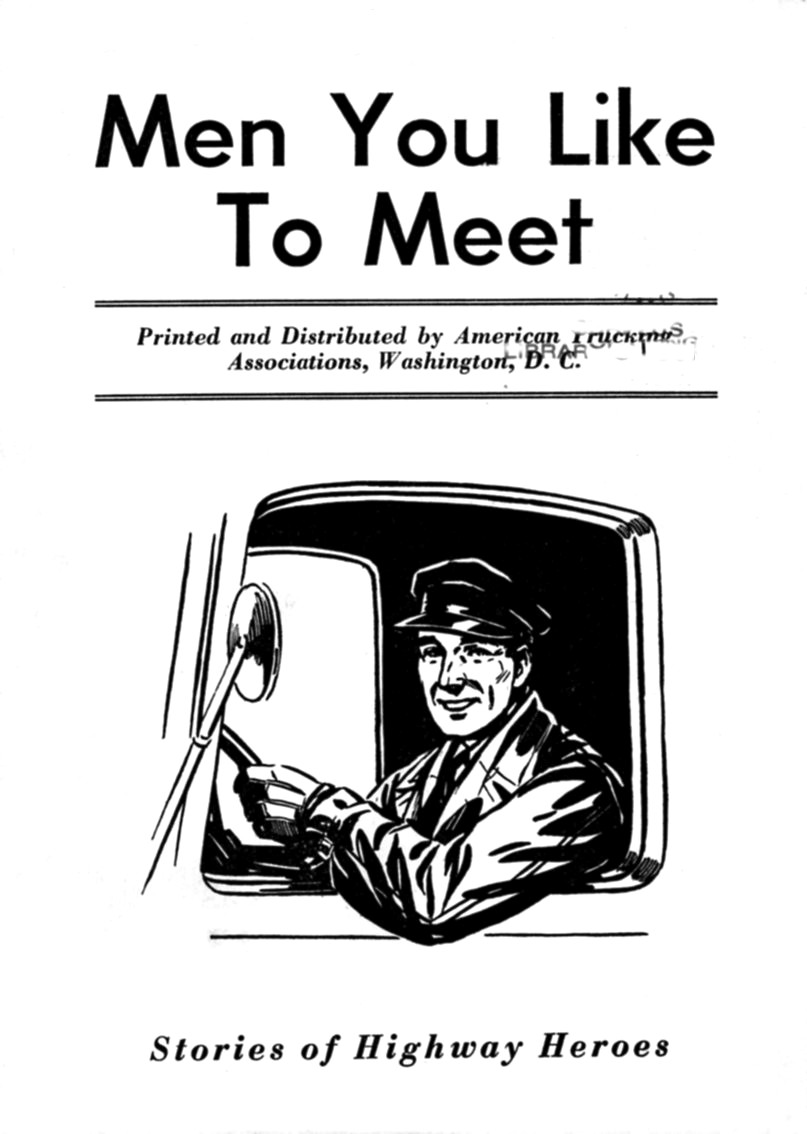
    Poster--Men you like to meet b+w detail363

    This is a detail from the cover to this oddly safe but slightly sotto voce absurdly-provocative Men You Like to Meet, a little pamphlet of happy tales published by the American Trucking Associations, published in 1942.  There are a few stories of known and unknown truck driving heroes, saving people, helping stranded motorists, so on–some quiet, some gallant, some ambitious, and all humble.  Just the sort of modern Cowboy you’d like to have on the highways. The full image is below (a poster of which is available from our Poster store, here):  

    Poster--Men you like to meet b+w362