A Daily History of Holes, Dots, Lines, Science, History, Math, Physics, Art, the Unintentional Absurd, Architecture, Maps, Data Visualization, Blank and Missing Things, and so on. |1.6 million words, 7500 images, 4.9 million hits| Press & appearances in The Times, Le Figaro, Mensa, The Economist, The Guardian, Discovery News, Slate, Le Monde, Sci American Blogs, Le Pont, and many other places… 5000+ total posts since 2008.

Author: JF Ptak

  • The Shock of (Color) Recognition (1939)

    JF Ptak Science Books   Quick Post

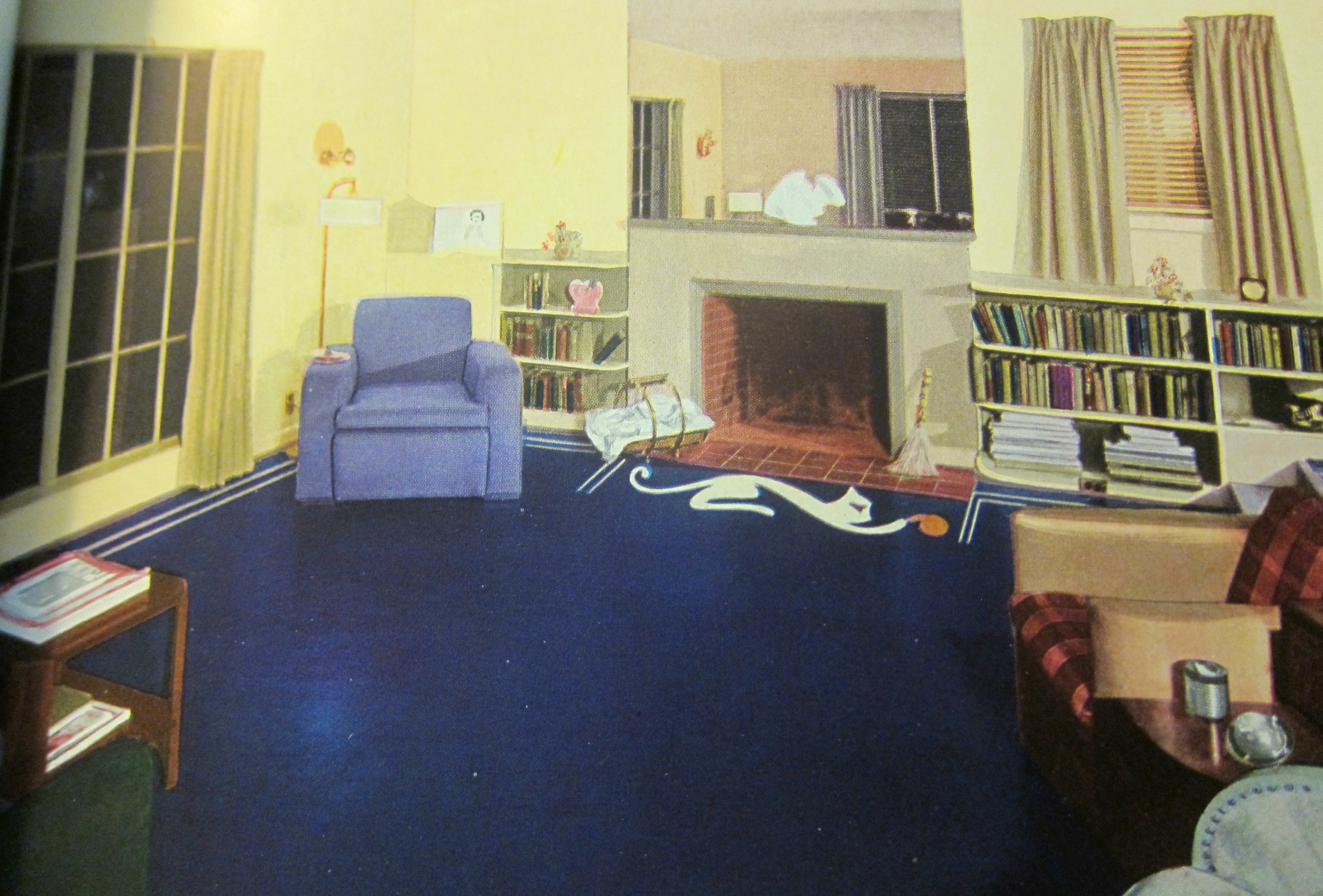
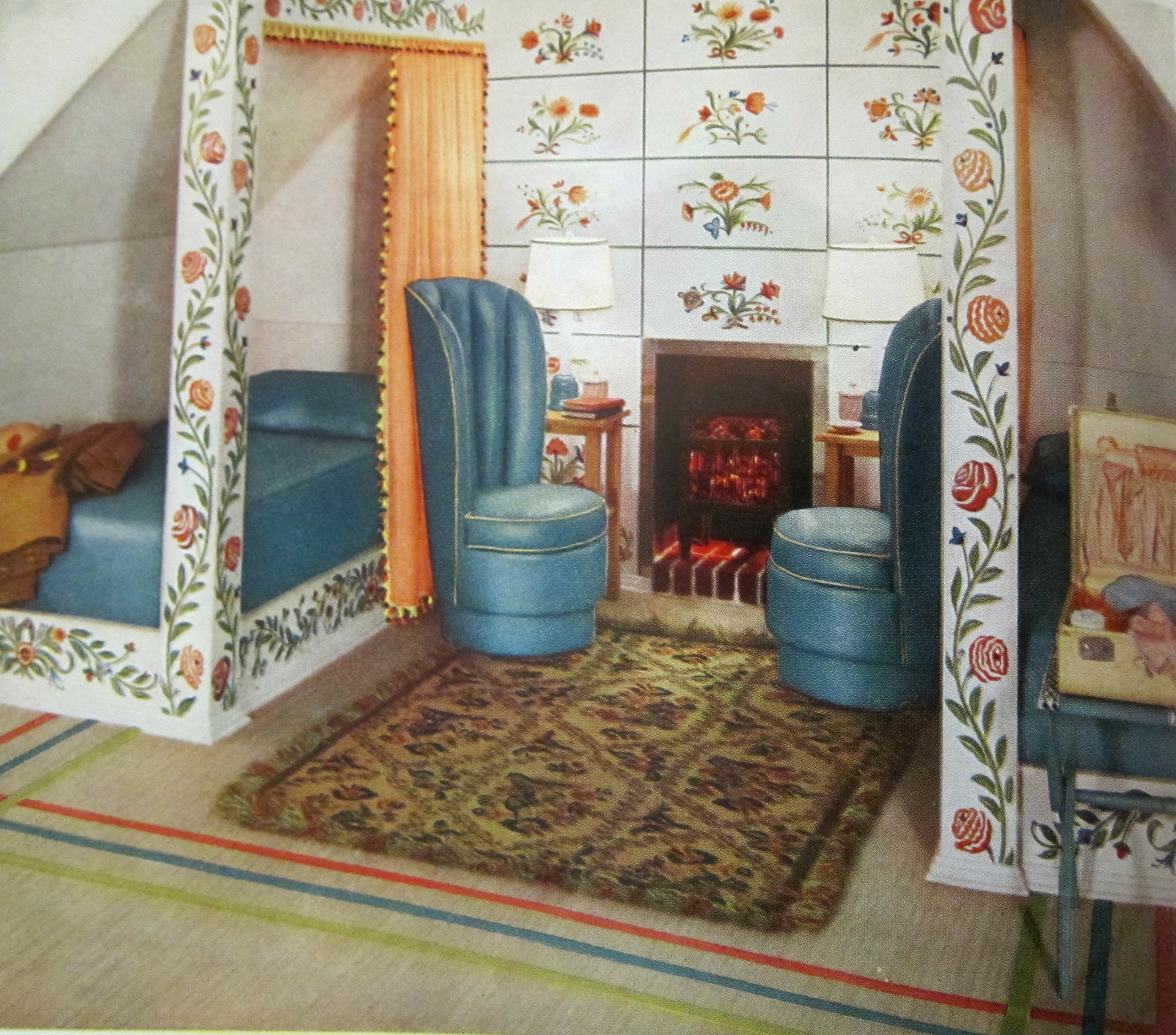
    Continuing a post from earlier today on the idea of applying a diacritical to an adjective expressing surprise (!) in the recognition of a color I share the following series of images appearing in the 1939 edition of Armstrong Cork Company’s Beauty Hints for the Home Decorator. Now, somewhere in there should be an exclamation point or two, liberally applied sentence enhancers. And that’s what I looked for, my little box of exclamation points (absent the non-existent diacriticals) when I saw photos of these spectacular rooms of distinction in the Armstrong catalog.  As I’ve written earlier, the colors (!) were quite a surprise, like seeing painted Roman statuary. For example, there is this magnificent (?) bedroom, with two twin beds, tall skinny chairs next to a tall skinny fireplace, and then those colors:

    Armstrong _3_


    ·Posted by :

    ·in:


  • Oddly Adjectival Color Plumpness, continued (1938)

    JF Ptak Science Books   Quick Post    Part of the Series on Color, Its Uses and Abuses

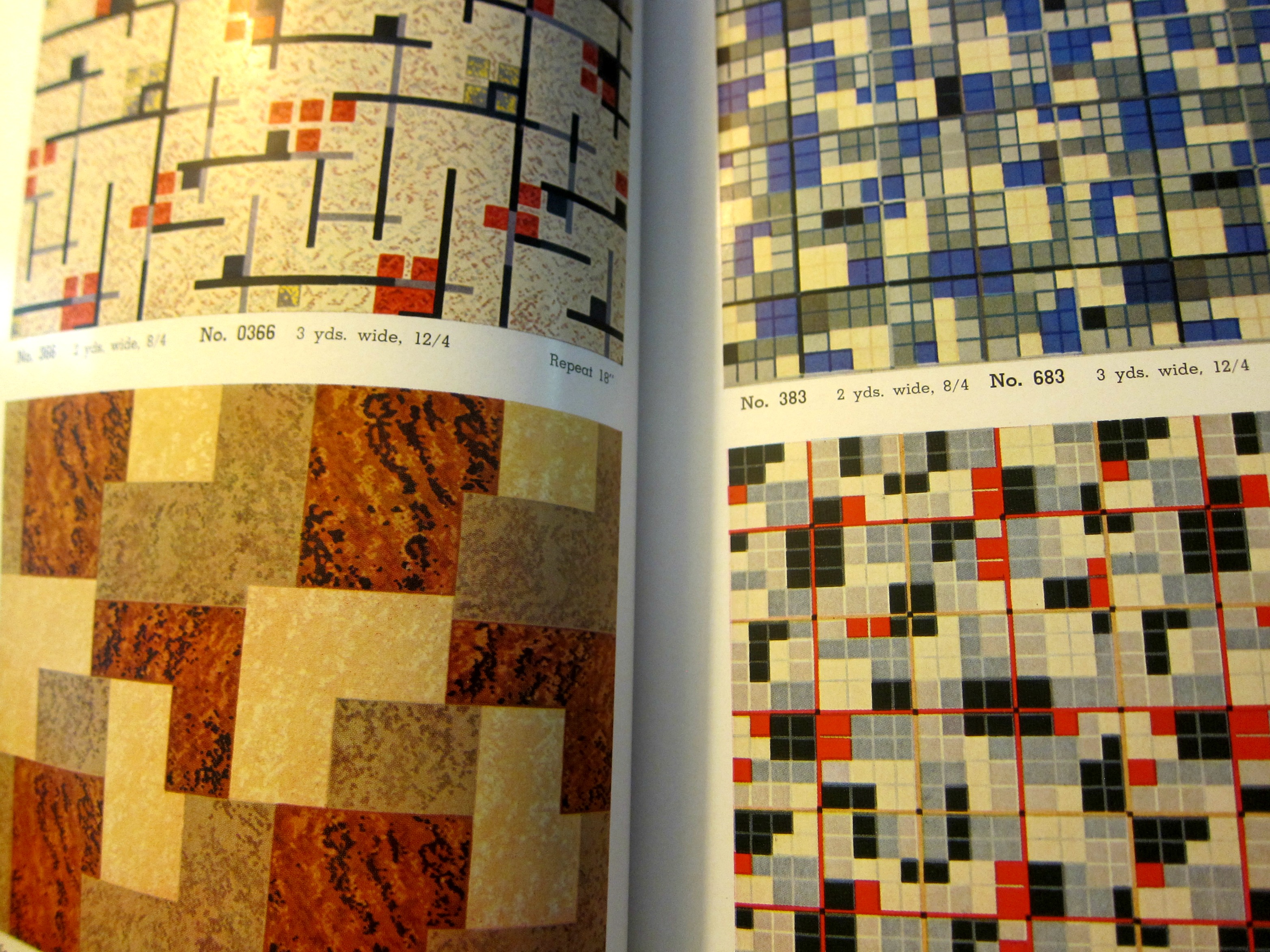
    I’ve written a number of times on what seems to be “extreme” color in the 1930’s  (as in “Oddly Adjectival Opposites: Color Plumpness and Color-in-Black-and-White, 1941” https://historyofideasblog.com/books/2011/02/odd.html) and come to it again today via the weirdly sublime color contrasts of rugs and floor coverings offered in the Bird Rug Catalog for 1938. I’ve thought about and seen so many of these images in luscious grays and stark blacks that it is difficult to think of these same images in gigantic color. It is just hard to picture Mr. Bogart’s eyes and his accusing/weary glance being framed by that blue chair and all of the colors bombarding it. There should I guess be a diacritical of some sort to attach to the vocabulary of colors to express “surprise”, as I could surely employ it in describing that blue linoleum floor:

    Bird catalog _7_

    Deep closeup of flooring:

    Bird catalog _10 detail_


    Flooring details

    Bird catalog _9_


  • When Did “The Great War” Become “World War I”?

    JF Ptak Science Books  Quick Post

    When does the Oxford English Dictionary establish the first uses of “World War I”, “World War One”, “First World War”, etc?

    World War, n.  

    A war involving many nations of the world; spec. that of 1914–18 or of 1939 45.First, Second, Third World War: see the first element.

    1848   People’s Jrnl. 4 250/1   A war amongst the great powers is now necessarily a world-war

    1864   G. Haven National Serm. (1869) Contents p.xx. (title)    The world war: aristocracy and democracy.

    1889   R. B. Anderson tr. V. Rydberg Teutonic Mythol. i. xxxiv. 139   From the standpoint of Teutonic mythology it is a world war [Sw. världskrig]; and Völuspa calls it the first great war in the world—folcvig fyrst i heimi.

    1900   N. Amer. Rev. Nov. 653   The South African war, following immediately upon the close of the Peace Conference at The Hague, has not yet reached its end, and already the horizon in Eastern Asia is lurid with the glare of a world-war.

    World War I  n. (also World War One, World War No.1) = First World War n. at first adj., adv., and n.2 Special uses 2b. Abbreviated WWI.

    1939   Time 18 Sept. 10/2   Exports of arms, munitions and related materials in World War I amounted..to only 25% of total exports to the Allies.

    1947   Time & Tide 29 Nov. 1269/2   The despair and cynicism that followed what it has now become fashionable to call World War One.

    ·Posted by :

    ·in:

    —

  • A Striking Example of Superior Marginalia (1923)

    JF Ptak Science Books   Post 2640

    I bought this pamphlet many years ago in a very large collection of other pamphlets. Pamphlets in stacks are nearly impossible to identify individually because, well, they are mostly indistinguishable from one another in their slim anonymity…especially so when their in boxes. Seriously, though, it is very easy to lose track of these when there are many thousands of them waiting or attention.

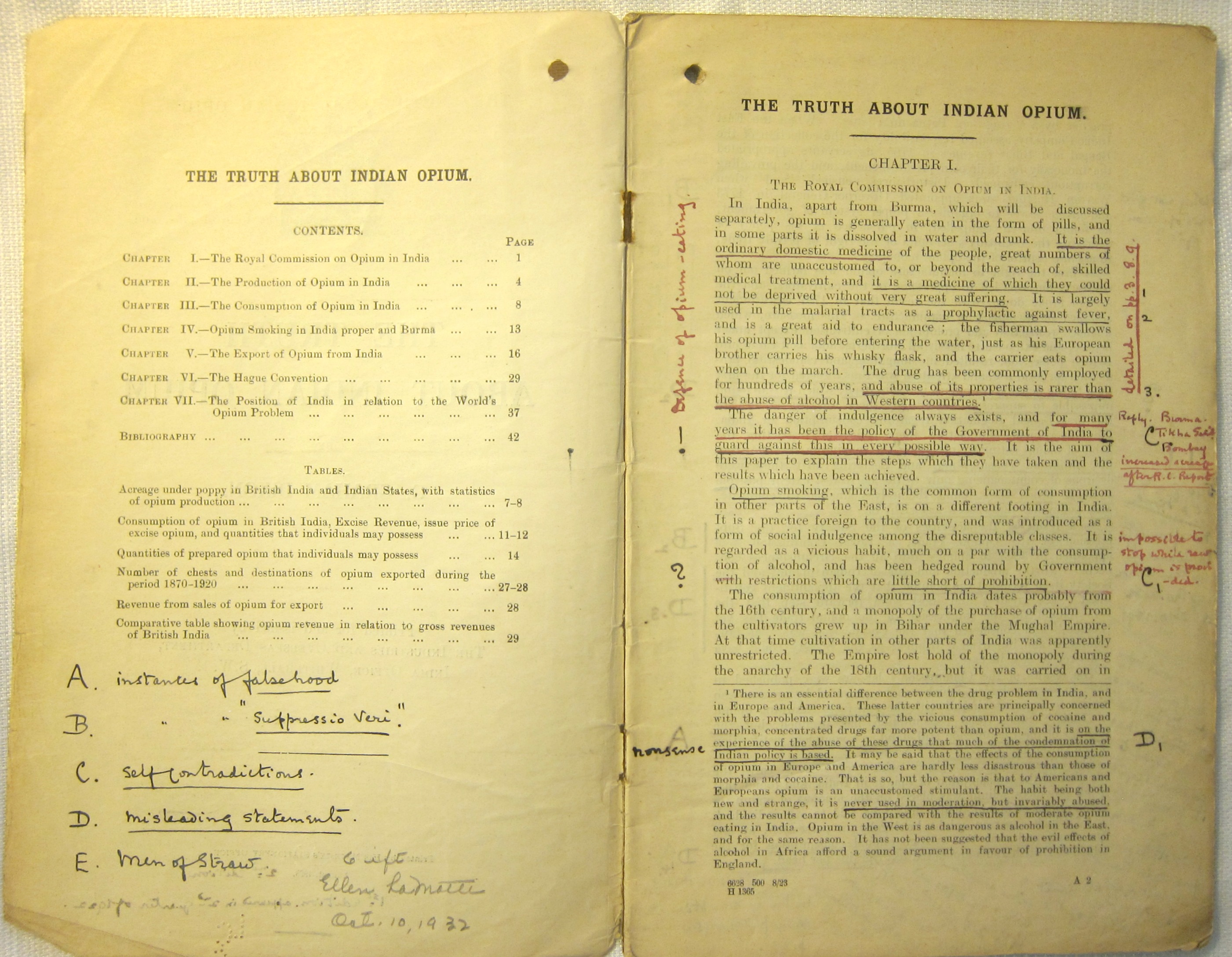
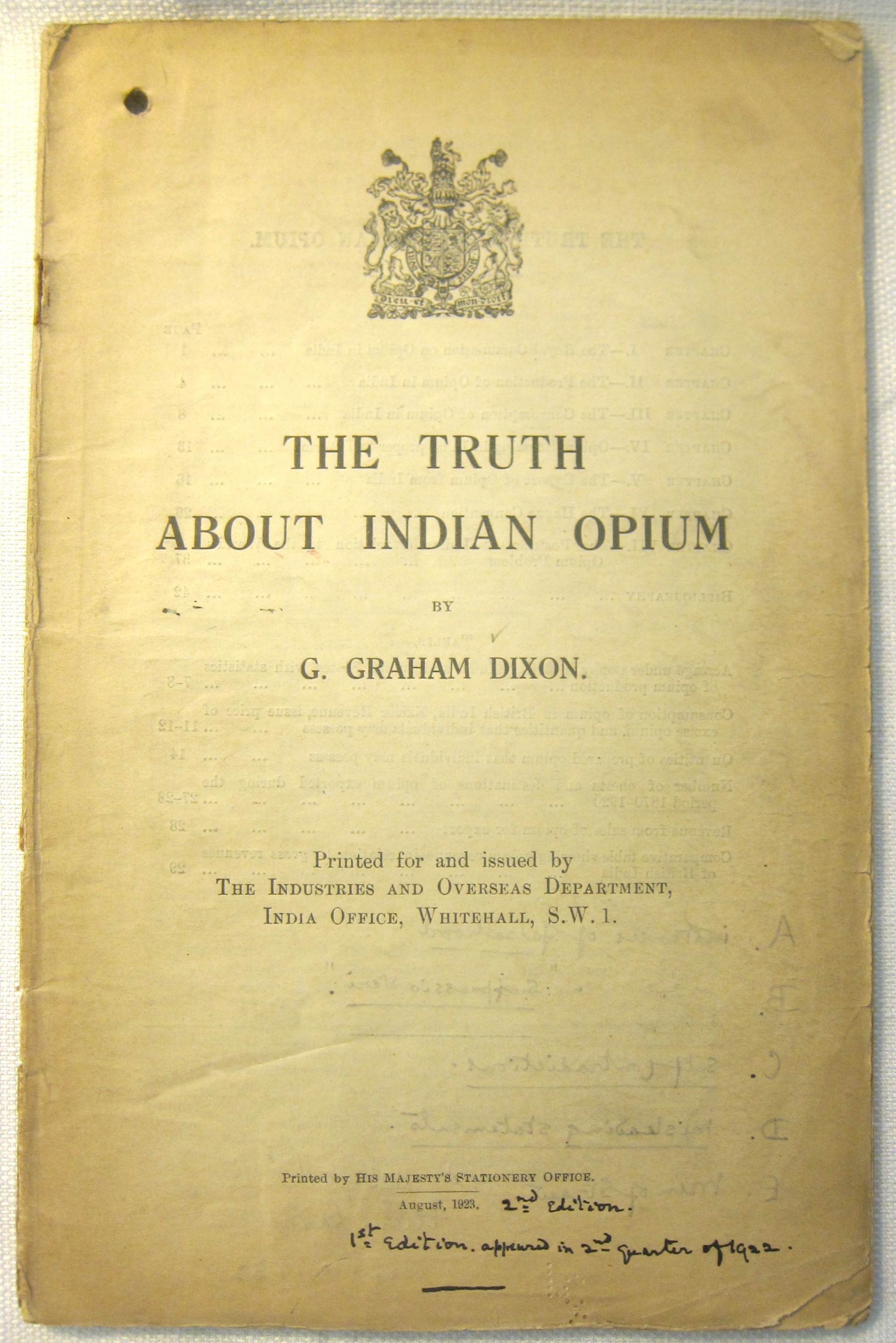
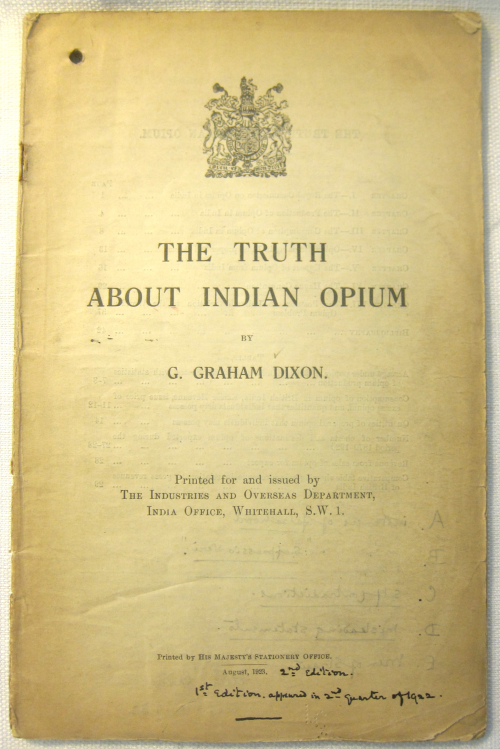
    And so with this one, an interesting-looking/sounding work written in 1923 by G. Graham Dixon, The Truth About Indian Opium, had its chance in the light yesterday.

    I ‘ve seen this pamphlet before, taking note of it, but never opened it.

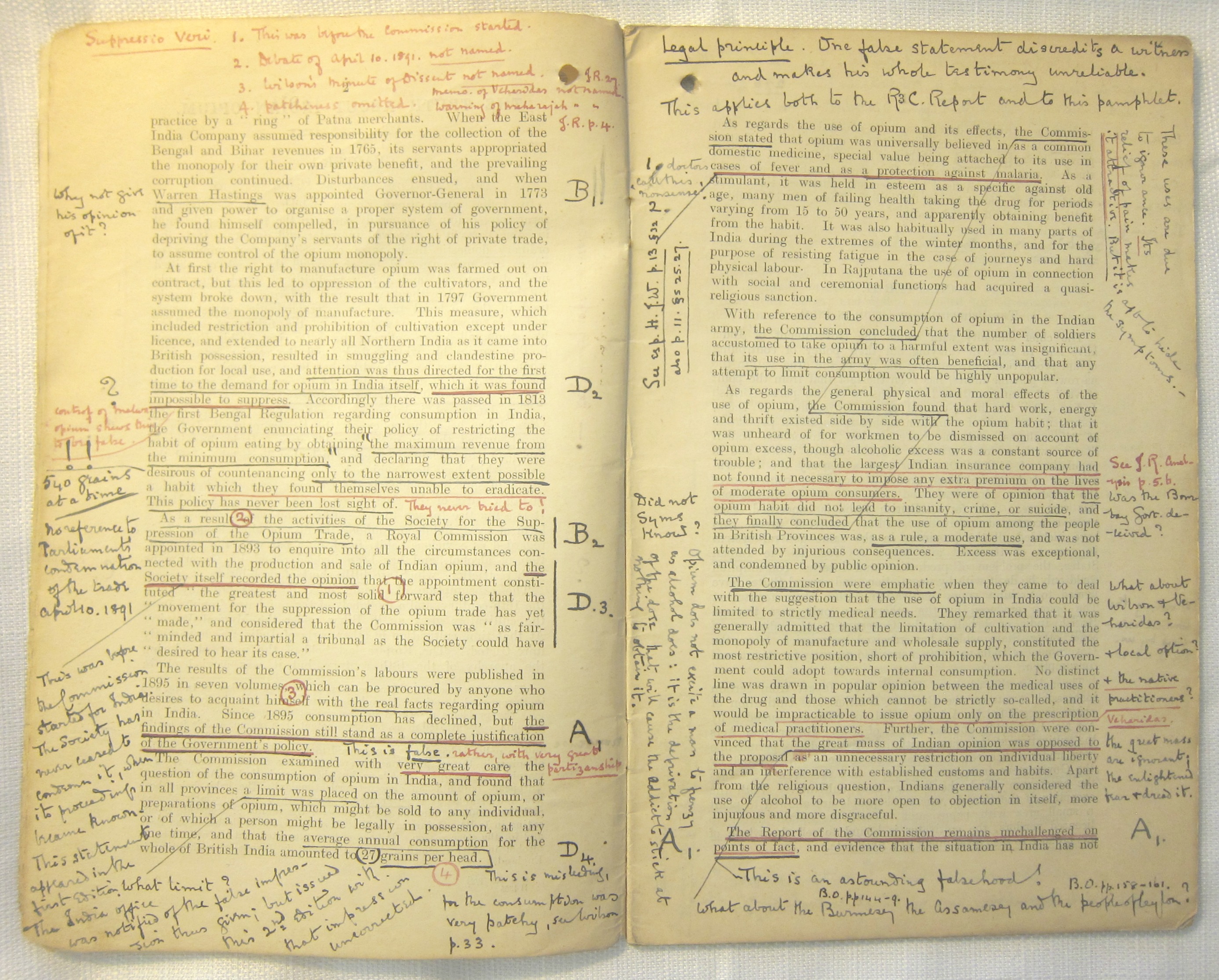
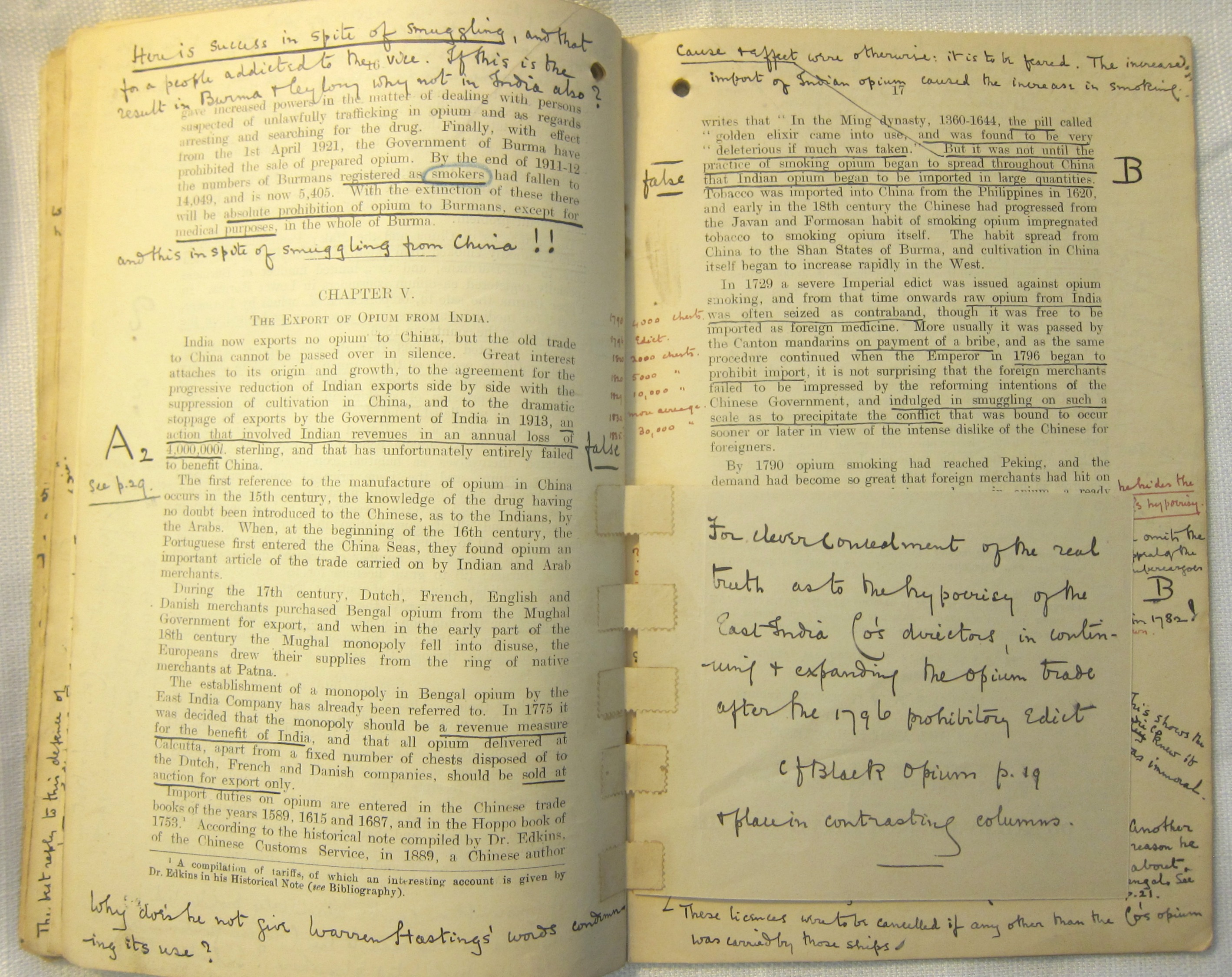
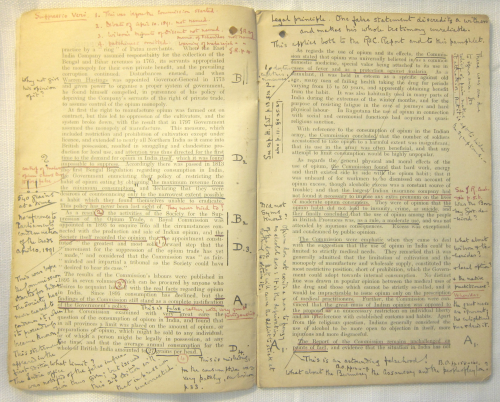
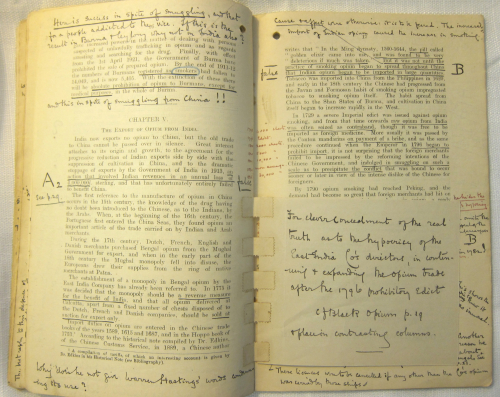
    When I did I was shocked to see that it was very heavily annotated by the last owner. As you can see, this was far beyond marginalia—the reader took the author to task on a lot, everywhere. This practice was so extensive that the reader/annotator had notations and marginalia for her (as it turns out) marginalia.
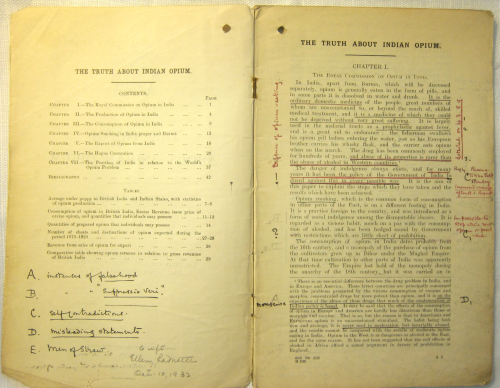
    LaMotte _1_

    The notes were provocative, insightful, incisive. My copy came from the Library of Congress, and I could see on the back of the title that the pamphlet was given to the LC by “Ellen LaMotte” in 1932. Ms. LaMotte, born in 1870, was quite a person: among other things she was a nurse who was among the first to U.S. Citizens to volunteer for battlefield duty in WWI, arriving there in 1915 (at age 45). Her experiences were wide and traumatic, and she expanded her diary into a book The Backwash of War, The Human Wreckage of the Battlefield as Witnessed by an American Hospital Nurse.
    LaMotte _2_

    that was published in 1915, though evidently it was too truthful and brutal a story for general consumption and was therefore lifted from publication, and didn’t see republication until 1932. There’s much in this book to recommend itself, from an overall sense of this nurse’s view of the war to the details of the minute. (For the later, I found out from Ms. LaMotte that in her experience lightning speed for the delivery of a severely injured man at the front line to an aid station where he could receive proper treatment for a major wound was six hours.)
    LaMotte _4_

    She went on to become an expert in the opium and drug problem then existent in England, publishing six books on the topic during the 1920’s and 1930’s. I assume that this was a source for a part of her work, and certainly explains the deep insight and knowledge evident in her annotations.

    She did not think much of this work by Graham Dixon, who it seems to make the argument that alcohol and cigarettes were a more pressing problem than opium—LaMotte did not agree, and pressed her opinions, questioning the unattributed quotations and statistics and assumptions and conclusions. As annotated/marginalia goes, this is a tour de force.
    LaMotte _5_

    Notes:

    LaMotte’s WWI book is available in full text online at Project Gutenberg http://www.gutenberg.org/files/26884/26884-h/26884-h.htm

    Also see: Hazel Hutchinson, The War That Used Up Words: American Writers and the First World War. New Haven, CT: Yale University Press, 2015.


    ·Posted by :

    ·in:


  • The Beauty of Contour Lines and on Missing Importance (1893)

    JF Ptak Science Books   Quick Post

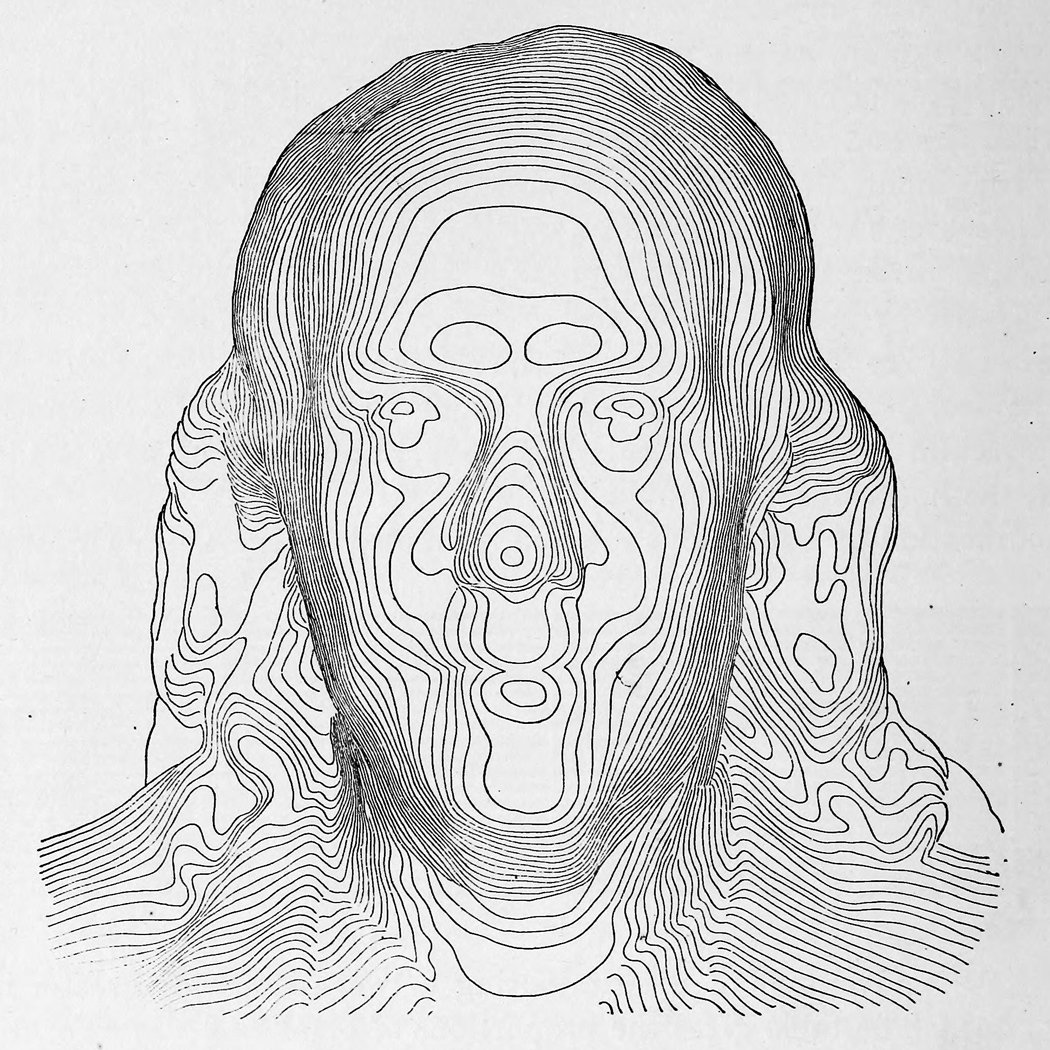
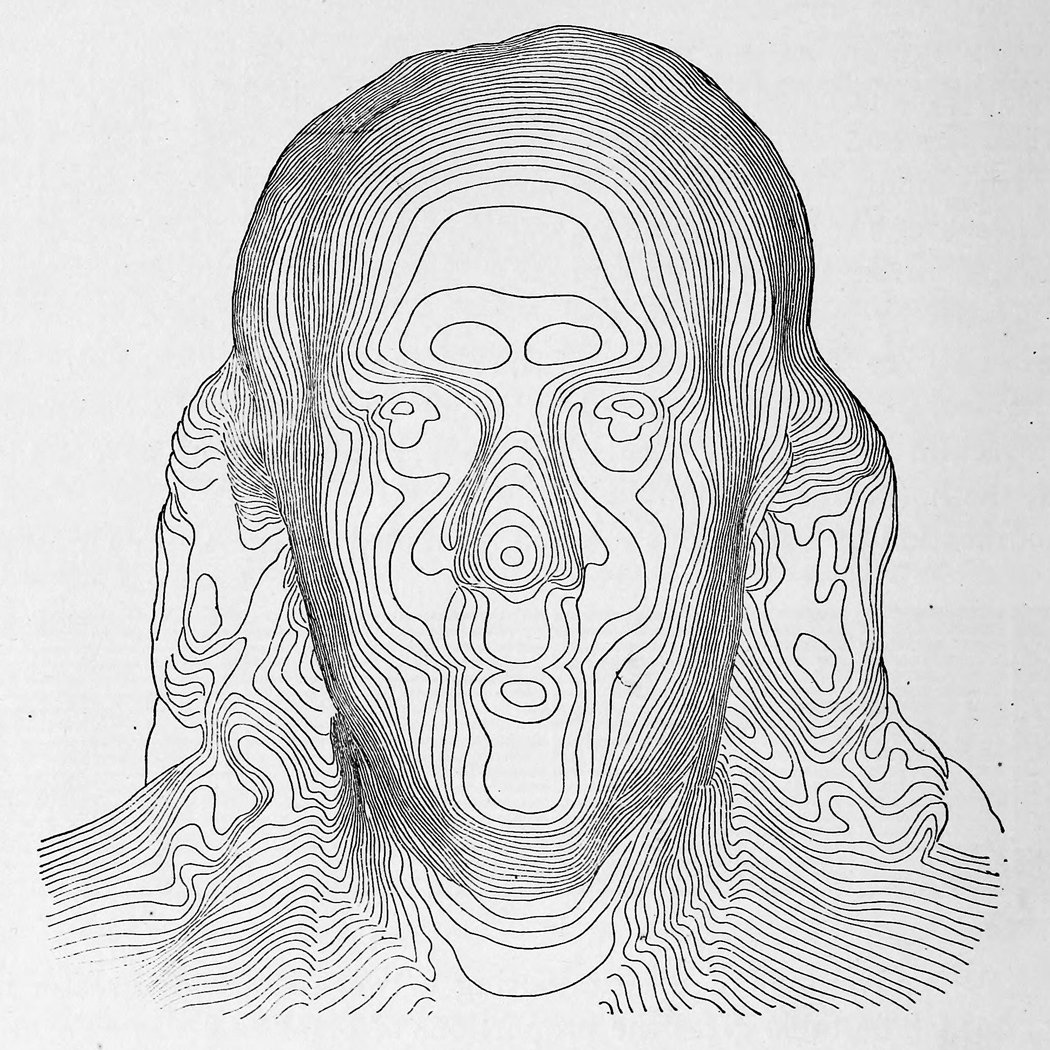
    Contour franklinI found magnificent and early contour image of Ben Franklin in a tweet from Tim Wallace (@wallaectim) who found it in Appleton’s Cyclopedia of Technical Drawing (1893). (The full text of Appleton’s is here: https://archive.org/stream/appletonscyclopd01wort#page/100/mode/2up/search/franklin and a larger image of Franklin is located below.)

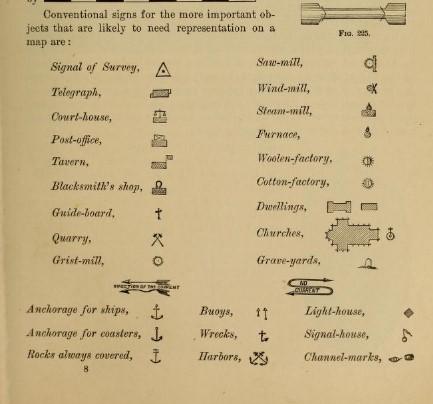
    While checking out the fascinating Franklin in the text, I found an interesting graphic that locates a certain History of Importance in one tidy display. The graphic is in the section on topological drawing, and contains “conventional signs for the more important objects that are likely to be represented on a map”, at least for 1893:


    Contour important objects

    All of this makes sense, of course, except perhaps for the surprise of locating taverns, which I think I’ve not noticed before in 19th map legends–it does make sense though, especially for more regional maps, as the tavern would be a central force for a small town, as well as operating as a possible hotel.  Many of the rest of the important things for a late 19th century map have slipped into obstructed memory, if not further. 

    Contour franklin


  • The Invasion of Musical Robots, 1929

    JF Ptak Science Books    Quick Post

    Robot music _2__0001

    There is little doubt that scribes and woodblock cutters and such absorbed the stab of the movable type printing press, and that stationers felt the stab of modernity when the telegraph came into play threatening sales of paper generally used for letter-writing, an art form that they felt would be diminished by the new technology. At about the same time though came the second revolution in mail delivery, which made it cheaper and more regulated in using a more-competent mailing system, which meant an increase in letter writing. Ditto that for the telephone, which again would threaten written communication. Movies too threatened the theater, and on and on.  

    And so too for music, the musician, and recorded music. I suspect that in the 53 years since Mr. Edison’s invention of the phonograph that not many musicians made very much in the way of royalties for their recorded music, at least not at this early date. (On the other hand my guess is that there was a different economic experience in the sheet music department.)  On the other hand, there was a popularization of music far beyond what had been possible in the period before recorded music, so there was at least that direct and enormous benefit.

    Then came recorded music in theaters, which was a different thing entirely, as there was no real direct benefit to musicians–in this instance, live accompaniment would disappear in favor of recorded music, and so to the jobs of thousands of players.  

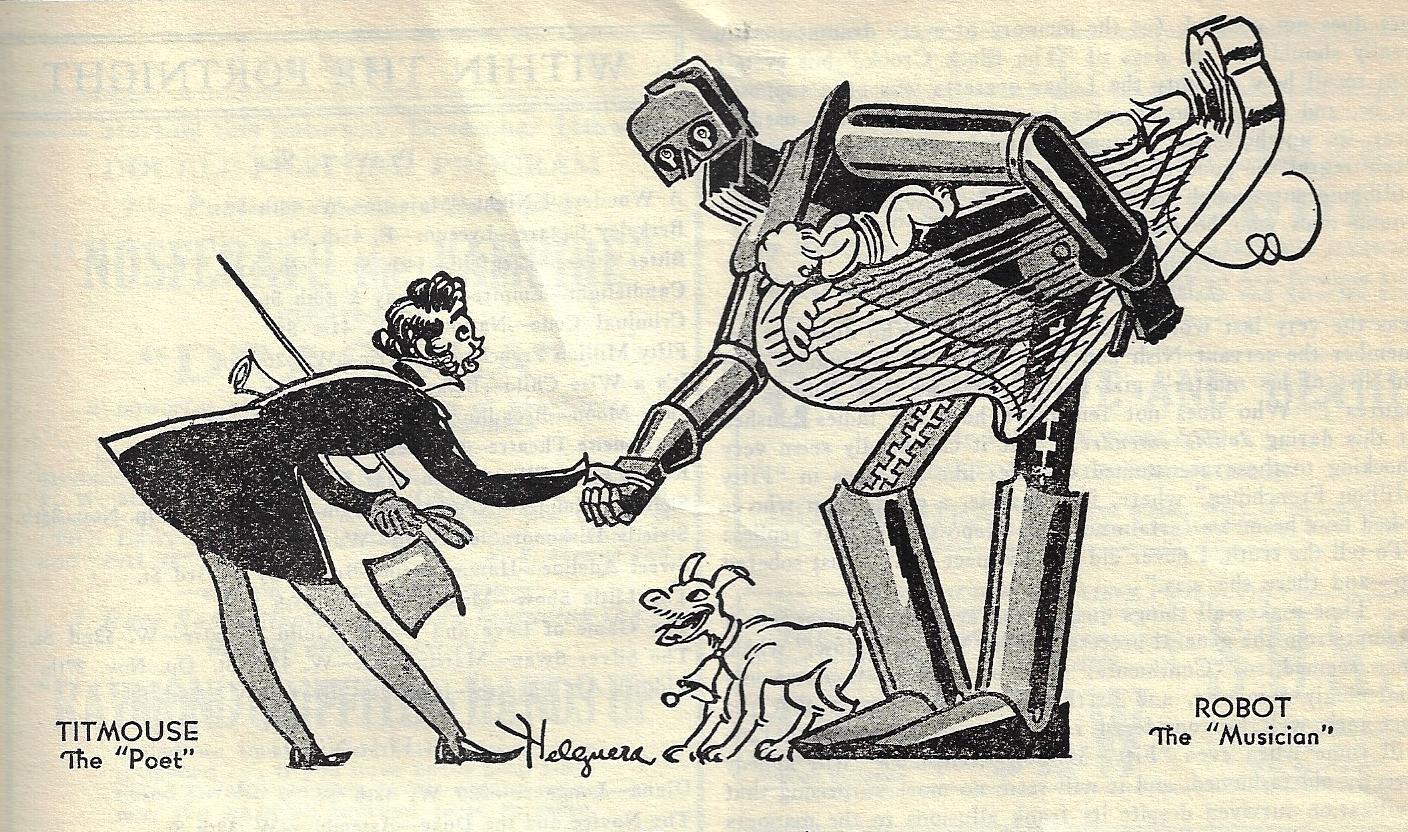
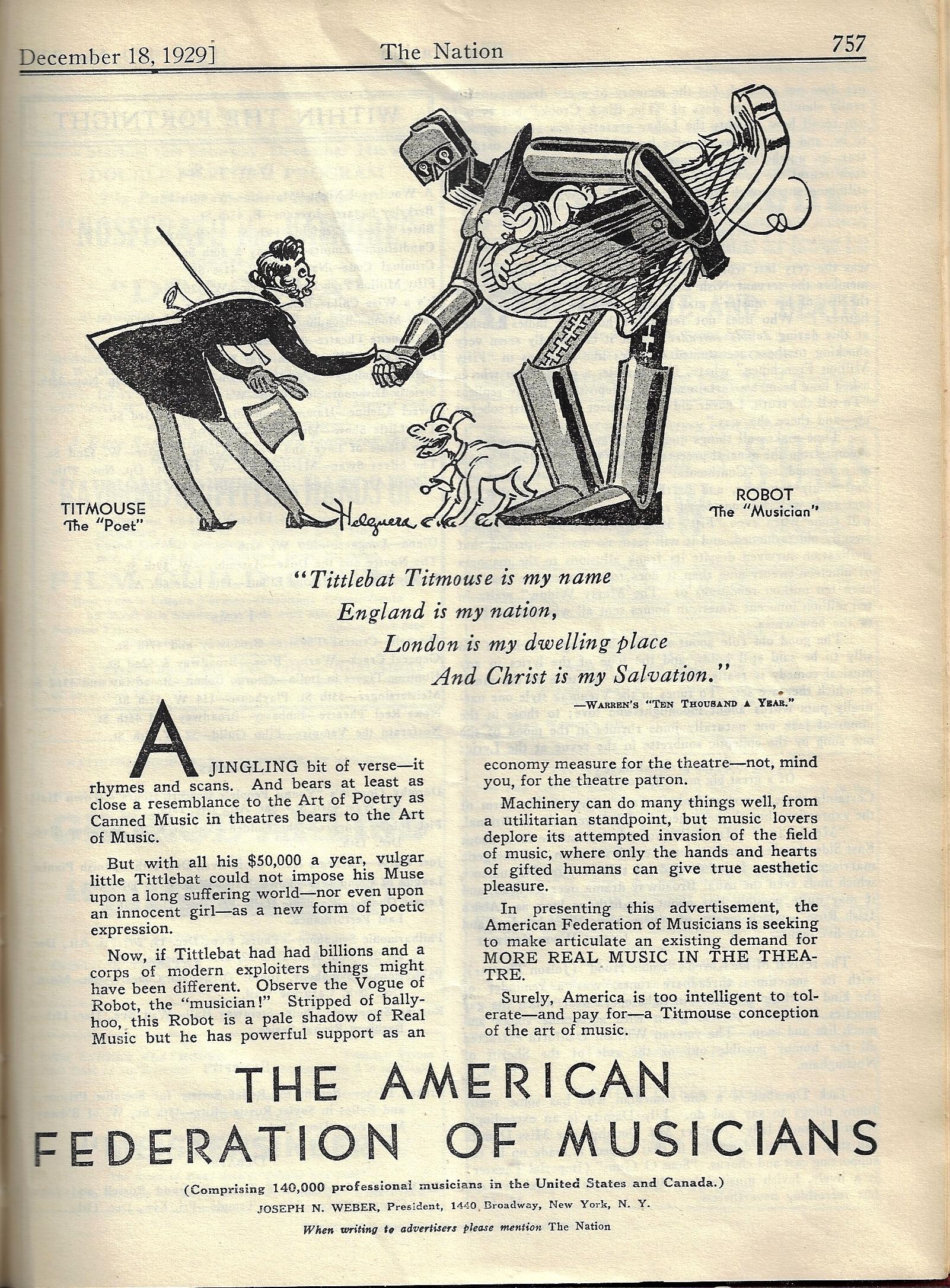
    And so the reason for this advertisement in The Nation, placed by the American Federation of Musicians, which found the idea of “canned music” to have nothing to do with “the Art of Music”, and representing it as a robot, “a pale shadow of real Music”. “Machinery can do many things well, from a  utilitarian viewpoint, but music lovers deplore its attempted invasion of music, where only the hands and hearts of gifted humans can give true aesthetic pleasure.”

    “Surely, America is too intelligent to tolerate–and pay for–a Titmouse conception of the art of music.”

    Robot musical _1__0001


  • Music as an Oil of the Industrial Machine (Muzak, 1941)

    JF Ptak Science Books   Quick Post 

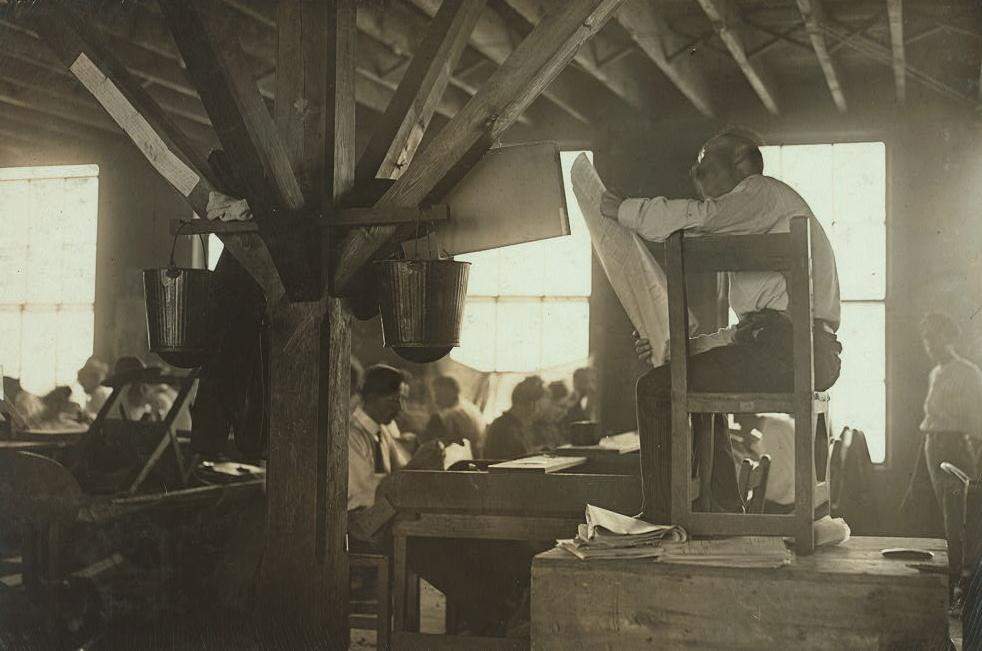
    Reading cubaEntertaining works for a happier labor force has certainly been a “thing” for quite some time–I don’t know the history very much1 but I know it extends back into the 19th c to some probably very small degree, and I do recall a Lewis Hine photo of a Lectore in Havana reading to cigar rollers (in 1909).  It makes sense to make your workers comfortable and to work to end intellectual monotony, though few employers proceeded that way. 

    And thus to Muzak, the improbable source of injecting music into the cooperation equation of industrial control of workers.  [Source: via the Library of Congress]

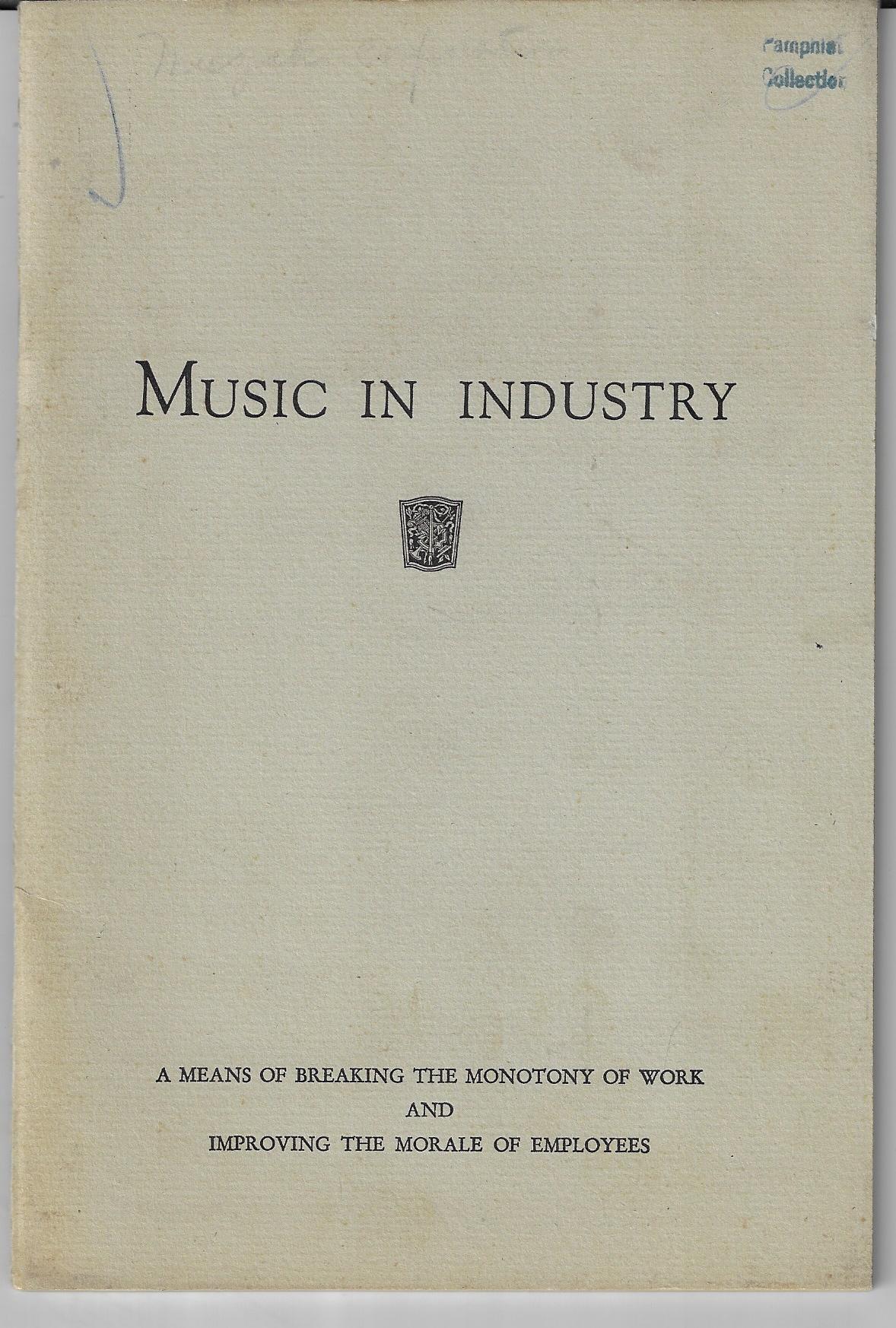
    MuzakI came to this quick realization–late to me–after finding a pamphlet in the warehouse, Music in Industry as a Means of Breaking the Monotony of Work and Improving the Morale of Workers. It was published in 1941–which is earlier than I expected for the Muzak Corporation–which adds to the surprise of the scope of the company’s long-lived impact, its history stretching back to the early 1930’s. It seems as though Muzak, which has a somewhat complex ownership and control history over its first 15 years or so, was a significant contributor to the sound landscape in the United States. It provided four  different broadcasting “networks” of selected musical patterns from the early days of wireless broadcast (at about a dollar a day per month) that provided a certain sort of architecture/design of a sound wall, though the music at this point was coming over telephone lines. In any event, Muzak started providing massive amounts of music into public and private spaces for some time, and their position was accelerated after the company’s war effort during WWII, and then becoming involved in U.S. post-war propaganda programs, and then into the Muzak that we think of today…all of which was happening a few decades before I thought it did. The fact is though that Muzak was filling silence in a controlling way in work and public places for a very long time. I imagine that one could think of this as a sort of early robotization of the human workforce–that is extreme, of course, but the thought worked its way through my head and came out here. 

    Notes:

    1. I don’t think I’ve ever mentioned this in the 4500-odd posts I’ve made to this blog in the last nine years, but the one rule I try to abide in writing one of these posts is that they take no more than an hour, start-to-finish. 
    • For an interesting read, see  Elevator Music: A Surreal History of Muzak, Easy-Listening, and Other, by Joseph Lanza.
    • There are no copies of this work found in WorldCat/OCLC, in spite of this being the second printing of the pamphlet. There are several other works by this title–generally being journal articles) and even a music in industry bibliography published in 1943, but no listings for the Muzak title. 

    ·Posted by :

    ·in:

    —

  • Grand Central Terminal, NYC,1939

    JF Ptak Science Books  Quick Post

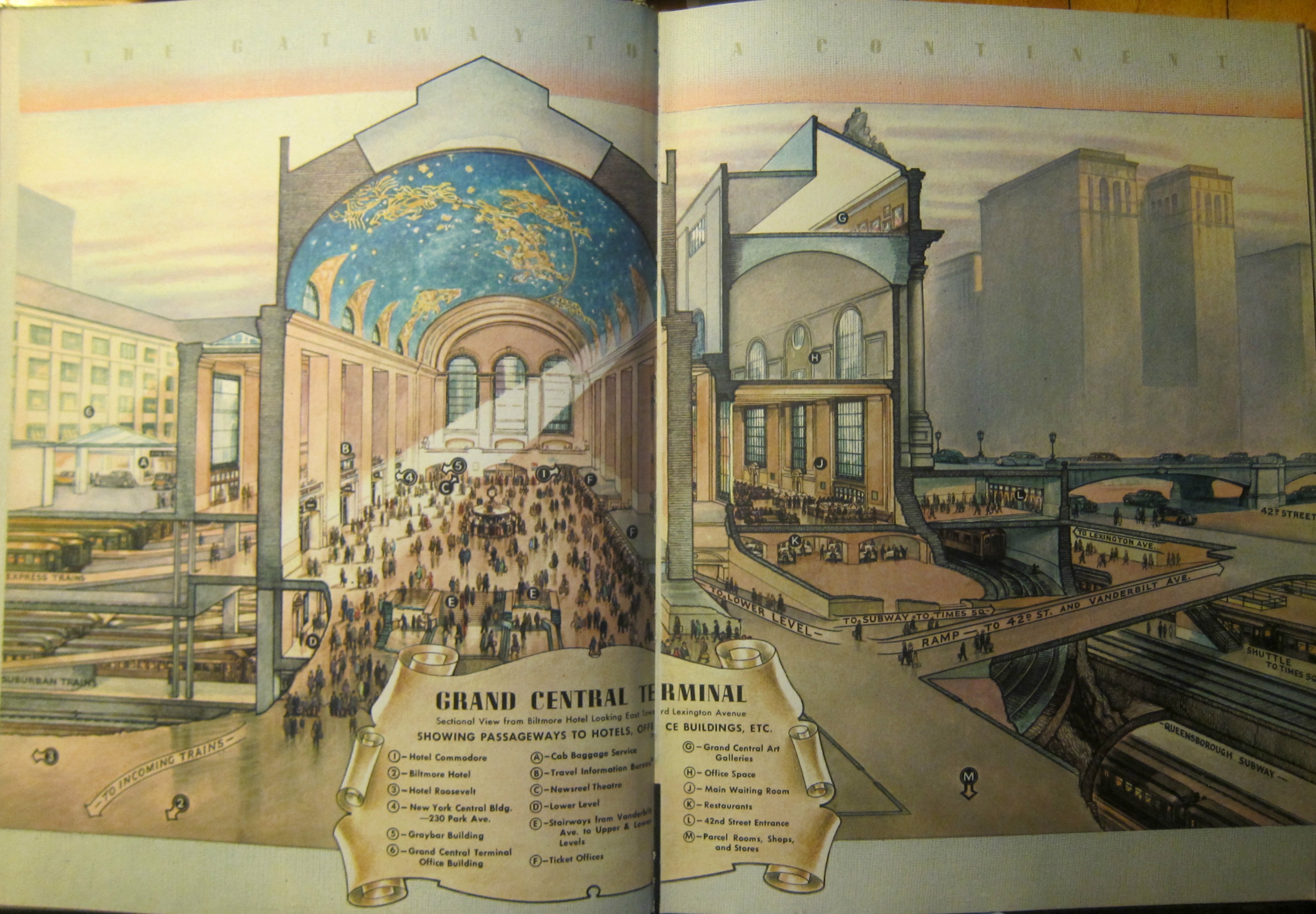
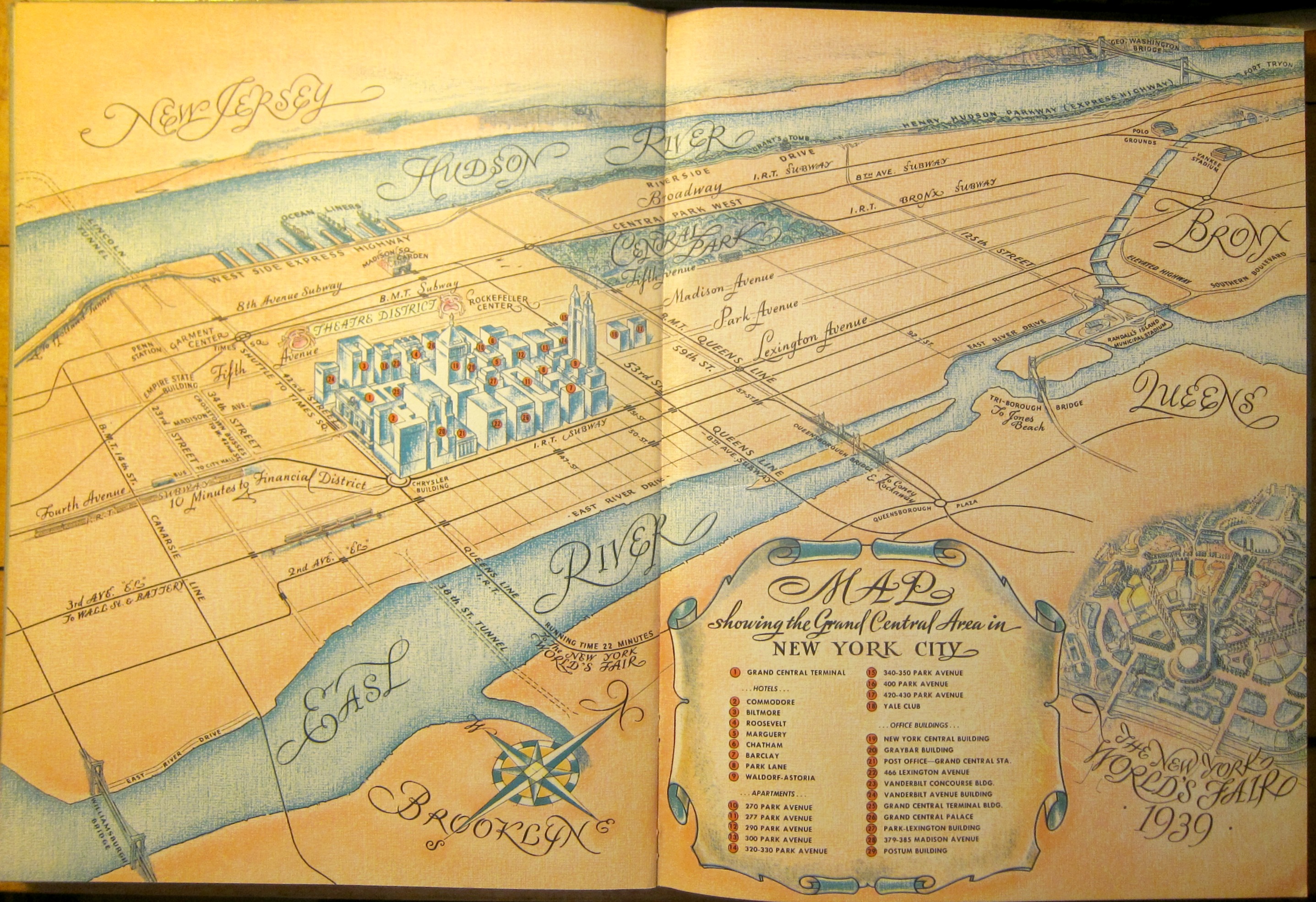
    This is a very Grand-Central_terminal-centric image of NYC–and rightfully so, being one of the great buildings of Manhattan. These images come from a promotional The Gateway to a Continent, published in 1939, which is a fairly luxurious publication which I think was intended for the appreciation of possible luxury accommodations for visitors to the 1939 New York World’s Fair. The result is an overview of the venues on Lexington/Park/Madison from 42nd-51st streets. There’s a great two-page map that shows this section in detail and which leaves out virtually everything else save the text mentions of some like “the Chrysler Building”, “the Empire State”, and “Penn Station” without images of them.

    NYC Grand Central Cutaway _1_


    NYC Grand Central Map of Manhattan _1_


  • Homes for Workers, 1943

    JF Ptak Science Books  Quick Post

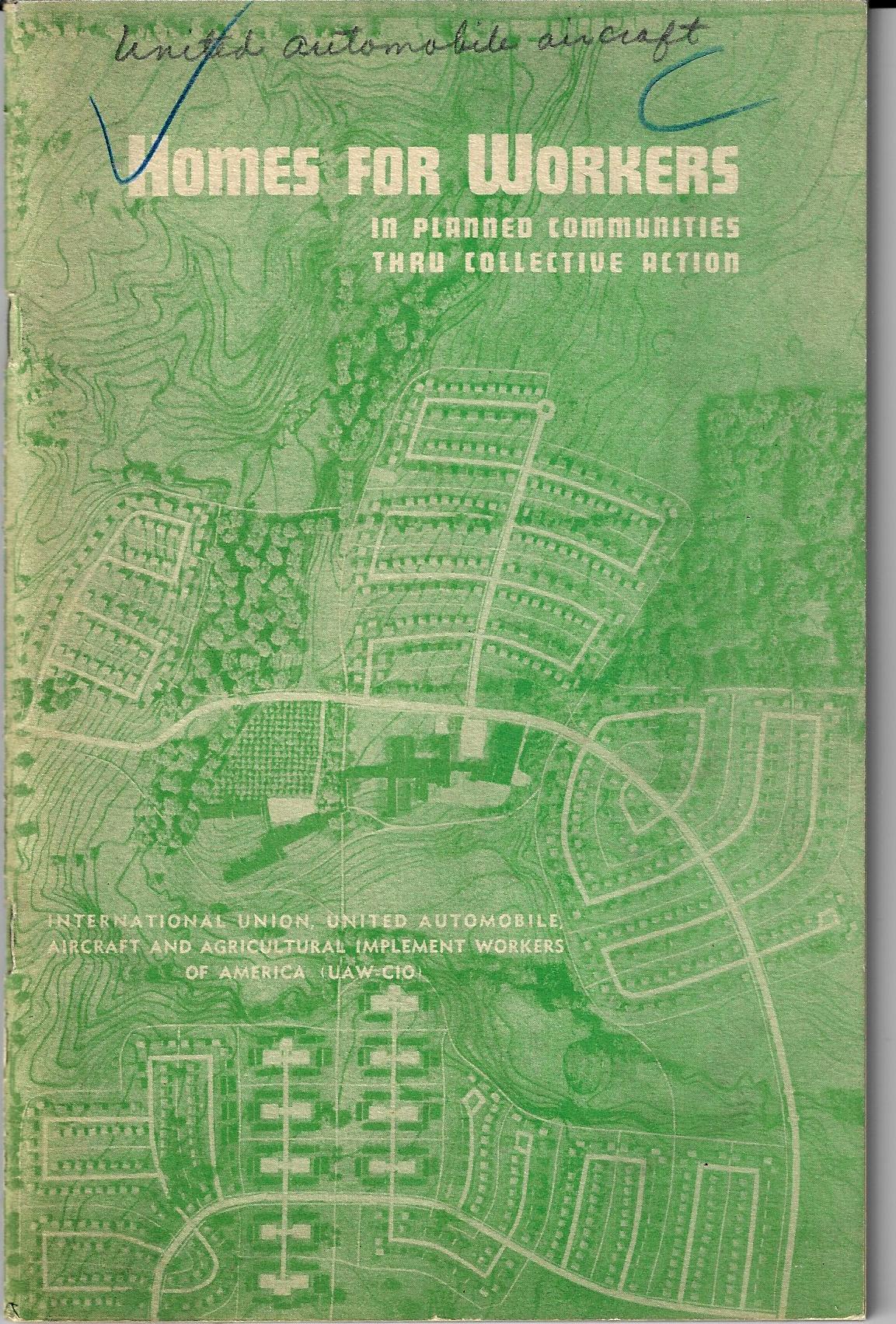
    Homes for Workers _3_


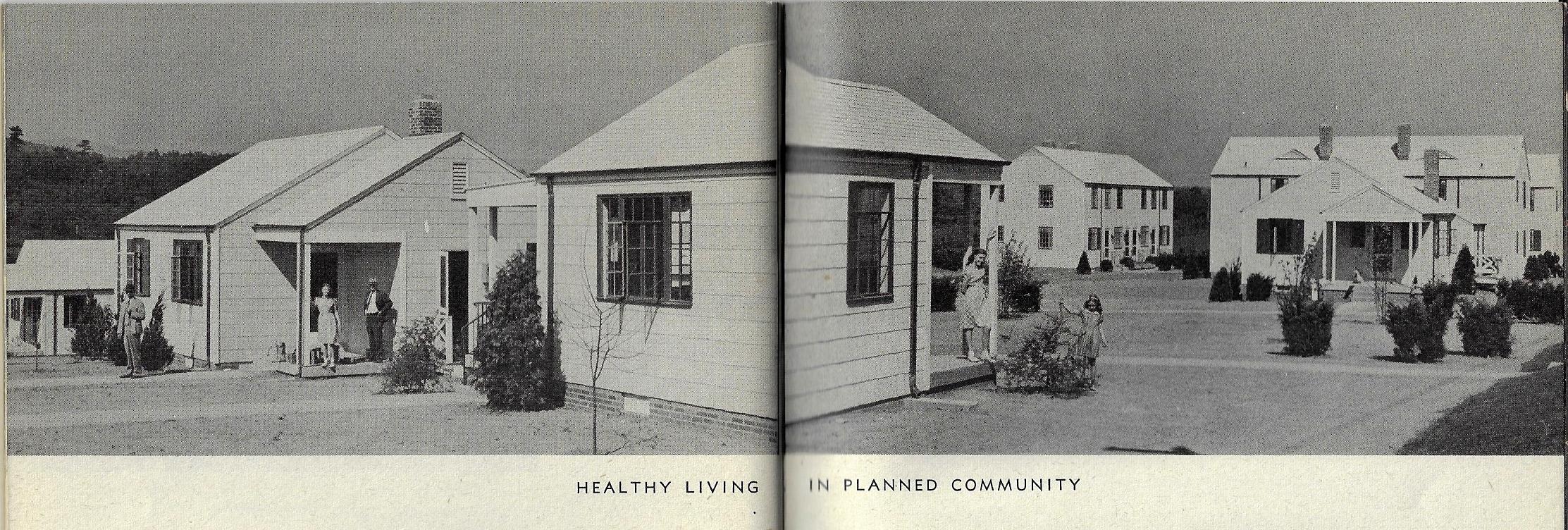
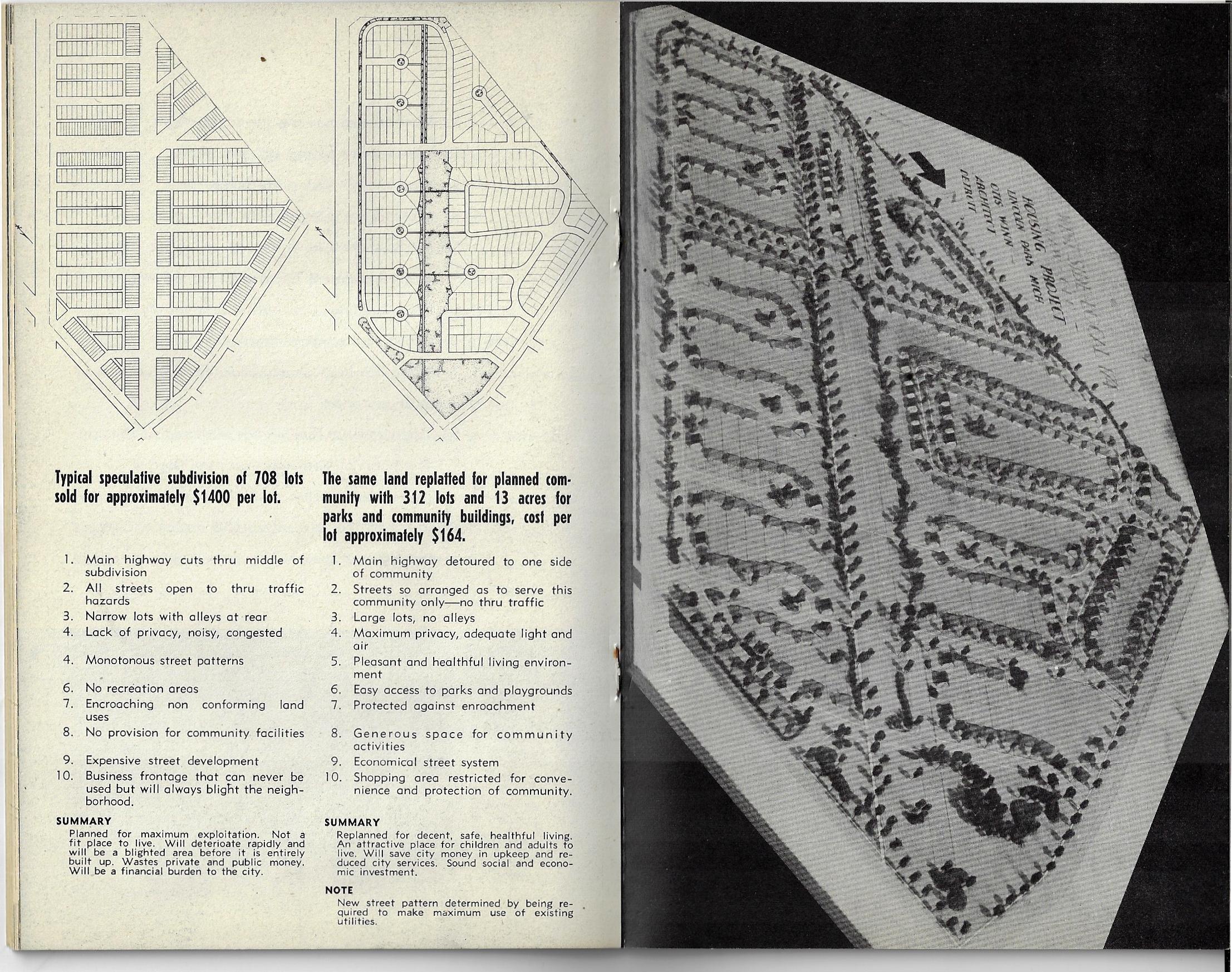
    Homes for Workers _1_This doesn’t ring quite true, nowadays, but this pamphlet, Homes for Workers in Planned Communities Thru Collective Action, published in 1943, was a work published by the massive unions UAW-CIO (United Auto Works and the Congress of Industrial Organization) in a very highly socially supportive way. The work outlines a way to organize more-or-less ideal communities for workers via collective action and pooled money, with large groups purchasing major lots of land and then contracting for construction.  No doubt there was also some thinking going on about the returning soldiers and the expansion of the general industrial base of the U.S. in a more international role. No doubt this sort of thinking would be thought of as Socialist in just a few years, once the Soviet Union had been recognized as a competitor and then an aggressive enemy.  In any event, this is an interesting pamphlet, with a certain allegiance to the general comfort of the working class. 


    Homes for Workers _2__0002

    Homes for Workers _3_

    ·Posted by :

    ·in:


  • One of the Earliest Popularly-Published Eyewitness Accounts of the Armenian Genocide (1916)

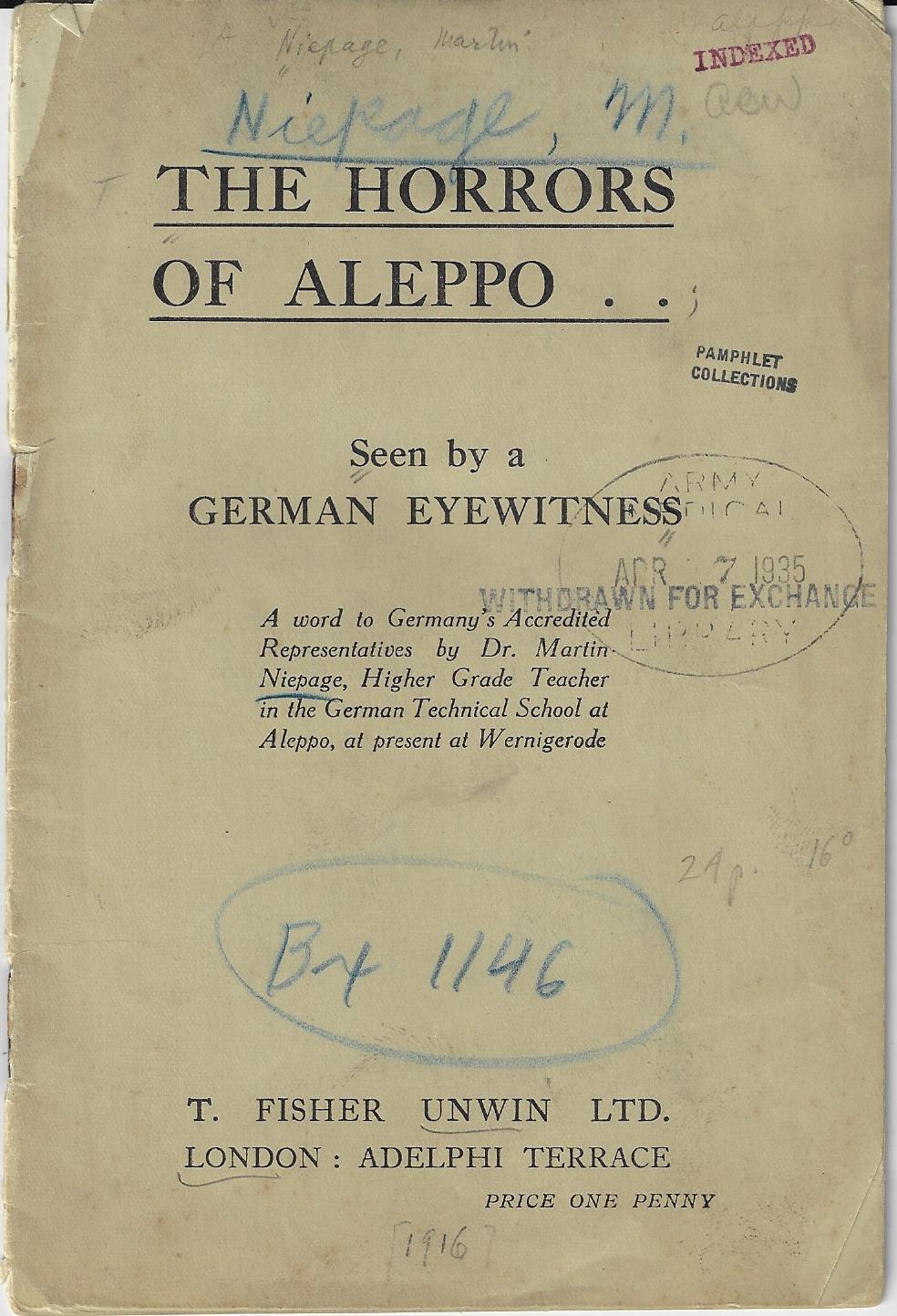
    Horrors of AleppoThis is a well-traveled pamphlet1, its face showing its miles.

    The author, the “German Eyewitness”, was Dr. Martin Niepage2, a school instructor at Aleppo, who wrote what was to become (apparently) the first popularly-published account in the West of the Armenian Genocide.  The pamphlet was published in 1916 and begins the story in 1915, getting quickly to the terror stories of chopped-off children’s hands. 

    “In April 1915 the Ottoman government embarked upon the systematic decimation of its civilian Armenian population. The persecutions continued with varying intensity until 1923 when the Ottoman Empire ceased to exist and was replaced by the Republic of Turkey. The Armenian population of the Ottoman state was reported at about two million in 1915. An estimated one million had perished by 1918, while hundreds of thousands had become homeless and stateless refugees. By 1923 virtually the entire Armenian population of Anatolian Turkey had disappeared.”–Armenian Genocide Organization

    The full text is located at archive.org  https://archive.org/stream/horrorsofaleppos00niep/horrorsofaleppos00niep_djvu.txt

    From the Niepage text:


    ·Posted by :

    ·in: