A Daily History of Holes, Dots, Lines, Science, History, Math, Physics, Art, the Unintentional Absurd, Architecture, Maps, Data Visualization, Blank and Missing Things, and so on. |1.6 million words, 7500 images, 4.9 million hits| Press & appearances in The Times, Le Figaro, Mensa, The Economist, The Guardian, Discovery News, Slate, Le Monde, Sci American Blogs, Le Pont, and many other places… 5000+ total posts since 2008.

Author: JF Ptak

  • Earbuds, 1891

    JF Ptak Science Books,  Post 2688

    Ernest Mercadier (1836-1911, electrical engineer and director at Ecole Polytechnique) may well have introduced the first “ear buds1” into the technical world.
    Bitelephone _2_


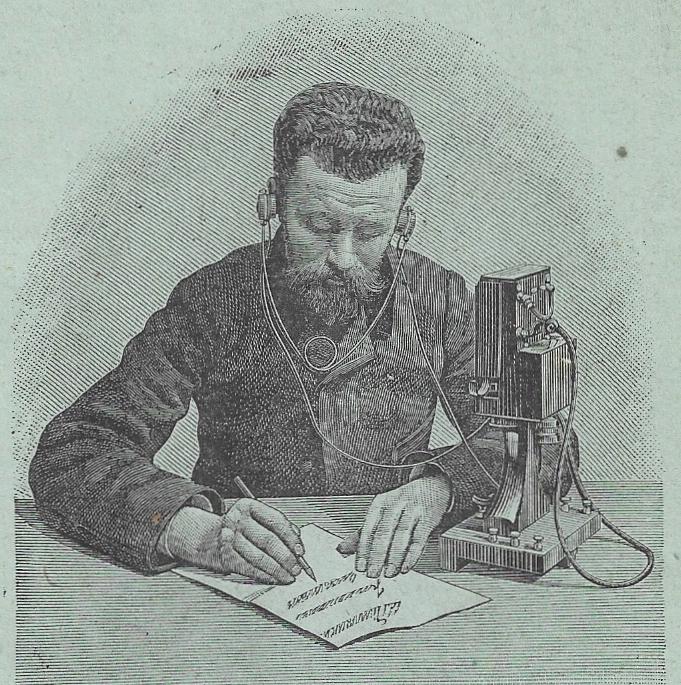
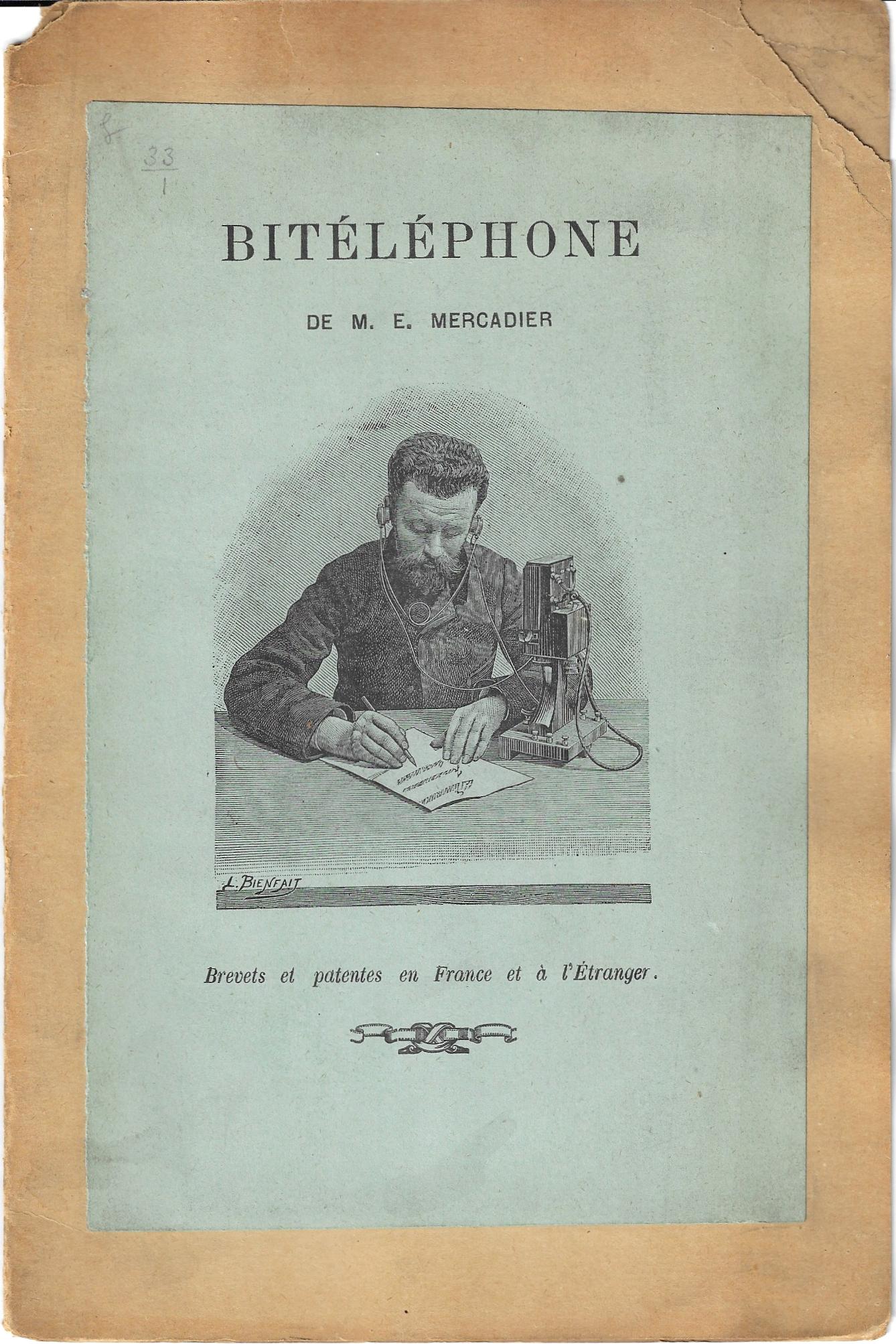
    Bitelephone His apparatus–small listening devices of 1.752 ounces that were padded and fit into the ear–was made for the operator of a telephone so that they could listen and speak and have free use of their hands for notes and such, as pictured on the front cover of this pamphlet. This would have been a shocking thing to see, I think, back there in 1891, only 15 years into the age of the telephone and about half of that for the time in which the still-a-luxury telephone could be accessed by relatively upper-middle-class folks. (In 1881 there were approximately 50,000 Bell telephone stations; in 1885, the year ATT was formed, there were about 150,000; in 1890, 200k and then 600k in 1900. It was in the first decade of the new century where telephone rental/ownership/accessibility really began to spread, with 2.2 million in 1905 and 5.8 million in 1910. Remember that the telephone was only one aspect of communication–all of the massive amount of infrastructure to connect thousands of telephones wasn’t yet created.) 

    Mercadier was well acquainted with the new device (having written Etudes Sur La Theorie Du Telephone five years earlier in 1886, plus other works on the telegraph and associated beginning in 1881), though what made his instrument so softly revolutionary was that it was one of the first entries into the world of communications microminiaturization–a concept we normally associate with computer development in the middle/late 1950’s. As a “headphone” this device is also extremely early though not the first3, though to my eye it is certainly the most elegant, at least that suited to its purpose. The earbud, even though it appears here in 1891, really takes another ten decades to come into its own.

    Notes:

    Ernest Jules Pierre Mercadier, Bitelephone.  Printed by Jamin in Laval, ca. 1891-3 (though no later than 1893). 21×13.5cm, 15pp, 6 text illustrations showing the device. The author announces that there are patents for his invention at home and abroad: “Brevets et patents en France et a l’Etranger”. This is the original pamphlet in wrappers, though at some very early point the pamphlet was bound into a larger manila-folder-like paper cover measuring 25x17cm; the front wrapper of the pamphlet was removed and pasted on the front cover of the new binding. The rear cover is intact. SO, that said, this is a not-perfect copy of the pamphlet, though the much-reproduced and striking cover is present. PROVENANCE: Library of Congress Smithsonian Deposit, accessed in October 1893. 

    1.  “Who Made that Earbud?”, NYT, May 16, 2014 https://www.nytimes.com/2014/05/18/magazine/who-made-that-earbud.html
    2.   From the Smithsonian Magazine on Mercadier’s invnetion:  “…improvements in telephone-receivers…which shall be light enough to be carried while in use on the head of the operator.” After extensive testing and optimization of telephone receivers, Mercadier was able to produce miniature receivers that weighed less than 1 3/4 ounces and were “adapted for insertion into the ear.” His design is an incredible feat of miniaturization and is remarkably similar to contemporary earbud headphones, down to the use of a rubber cover “to lessen the friction against the orifice of the ear… effectually close the ear to external sounds.”  : http://www.smithsonianmag.com/arts-culture/a-partial-history-of-headphones-4693742/#4c4flaaUUVCDrfVX.99  Also a nice notice in an article by The Guardian, “10 Most Influential Headphones”.  
       
    3. An interesting article in the SVG blog by Mark Schubin (http://www.sportsvideo.org/blogs/?blog=schubin-cafe&news=headphones-history-hysteria) points to the Mercadier device for being perhaps the third earliest headphone, following some others (issuing beginning in 1881) that were earlier but a lot more cumbersome. The Mercadier really were much smaller, more elegant, and a lot lighter than its 19th century companions. That said, the Mercadier device was more a candidate for the earliest earbuds more so than a straightforward headphone.  

    For a good timeline on the development of the telephone/telephone system, see: http://www.telephonetribute.com/timeline.html
    ·Posted by :

    ·in:


  • An Interesting Comment on Life in the Universe, 1933


    JF Ptak Science Books   Quick Post

    In the year that the human race started its very real plunge into the Wasteland, Frederick L. Leonard (Chair of the astronomy department at UCLA) had his eyes on another prize. In a short article in Popular Astronomy1, Prof. Leonard spent a few pages discussing the possibility of extraterrestrial life. He kept the discussion in one and two syllable words and was very straightforward, winding up talking about the possibilities of “life” in our own solar system. He quickly dismisses all of the planets as contenders save for Venus and mars, and then wasn’t really happy with that, at all, and opened the discussion more as to “life” might be. 

    There were several surprises in the article, including one about the authors of Astronomy ( Henry Norris Russell; Raymond Smith Dugan; John Quincy Stewart,  Astronomy: A Revision of Young’s Manual of Astronomy …) being “surprised” that there was no oxygen found on Venus. The bigger moment though was saved for Percival Lowell, who had long labored in support of advanced lifeforms on Mars, though the quote from him regarding extraterrestrial life was really very good. Leonard quotes him so:

    “If astronomy has taught us anything it is that man is but a detail in the universe, and the resemblants though diverse detail are inevitably to be expected…[humans] are destined to discover any number of cousins scattered through space.”

    The odds favor a statement like this, that human life is a “detail” of the universe and that there are not doubt other ‘details” to be found, resembling earth life or not. Odd as weren’t so much with Lowell in keeping with his intelligent lifeforms being on Mars, which is just a step or two away. In any event, I found the Lowell statement to be a pretty sober appraisal of the possibility of Life Elsewhere, in general.

    Notes:

    1. Frederick Leonard. “Life on Other Worlds”, in Popular Astronomy, May 1933, vol 41 no. 5., pp 260-3 in the issue of pp 239-294.

    ·Posted by :

    ·in:


  • The Almost-First Photo of Plutonium (October 1946)

    JF Ptak Science Books   Quick Post

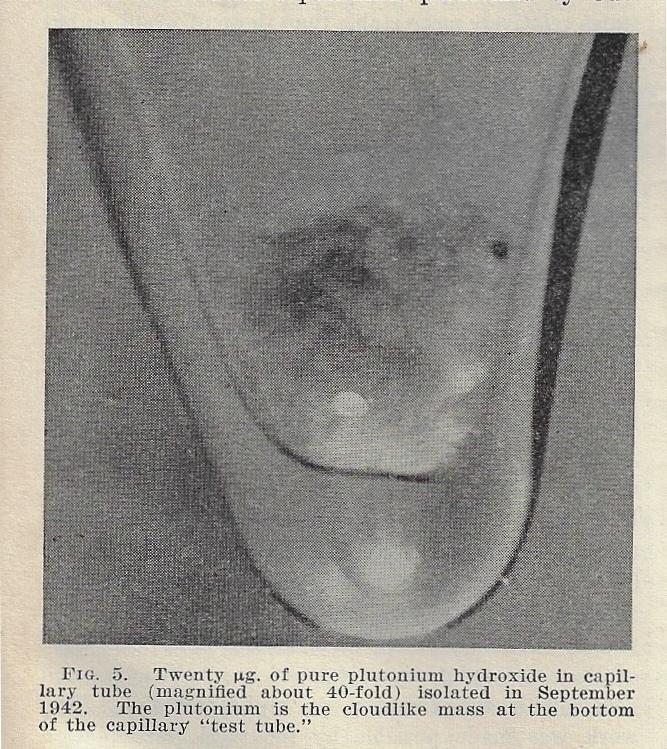
    Plutonium 1946 _2__0001While writing a post for the bookstore section of this blog on Seaborg’s “Transuranium Elements” article that appeared in Science in October 1946 I was struck by the home-made quality of one of the illustrations for the periodic table. Mainly I was curious to see the representation of the actinides (which at this point included up to Curium (synthesized in 1944) and was still three years away from Berkelium (synthesized in 1949). And since I have been on a small mission to define terms I looked up the discovery of actinium, which turns out to be a little complicated, but was perhaps first discovered by André-Louis Debierne  in 18991.  This distraction led immediately to another–a photo of a speck of plutonium (hydroxide) in a capillary tube (even at 40x it appears as a tiny white cloudy splotch).  Since plutonium after a certain date was not discussed for obvious security reasons in the Physical Review and  other journals (a date that I keep forgetting but I believe was in late 1940 when the nuclear/explosive aspect of Pu-239 was discovered), I wondered about when the first photo of plutonium appeared, anywhere..and if this was it.  But no, it turned out not to be, though it was close.  The “first” award seems to go to Fritz Goro (1901-1986), the great science photographer for LIFE magazine, who made an image for July 27, 1946, some three months before the Seaborg article appeared and just over a year after the Nagasaki bomb. In any event, I reprint the Science photo (left).


    Notes: 
    1. André Louis Debierne  (1899). “Sur un nouvelle matière radio-active”. Comptes rendus  129: 593–595.

    ·Posted by :

    ·in:


  • Study Guide to anti-Semitism, 1944

    JF Ptak Science Books  Quick Post

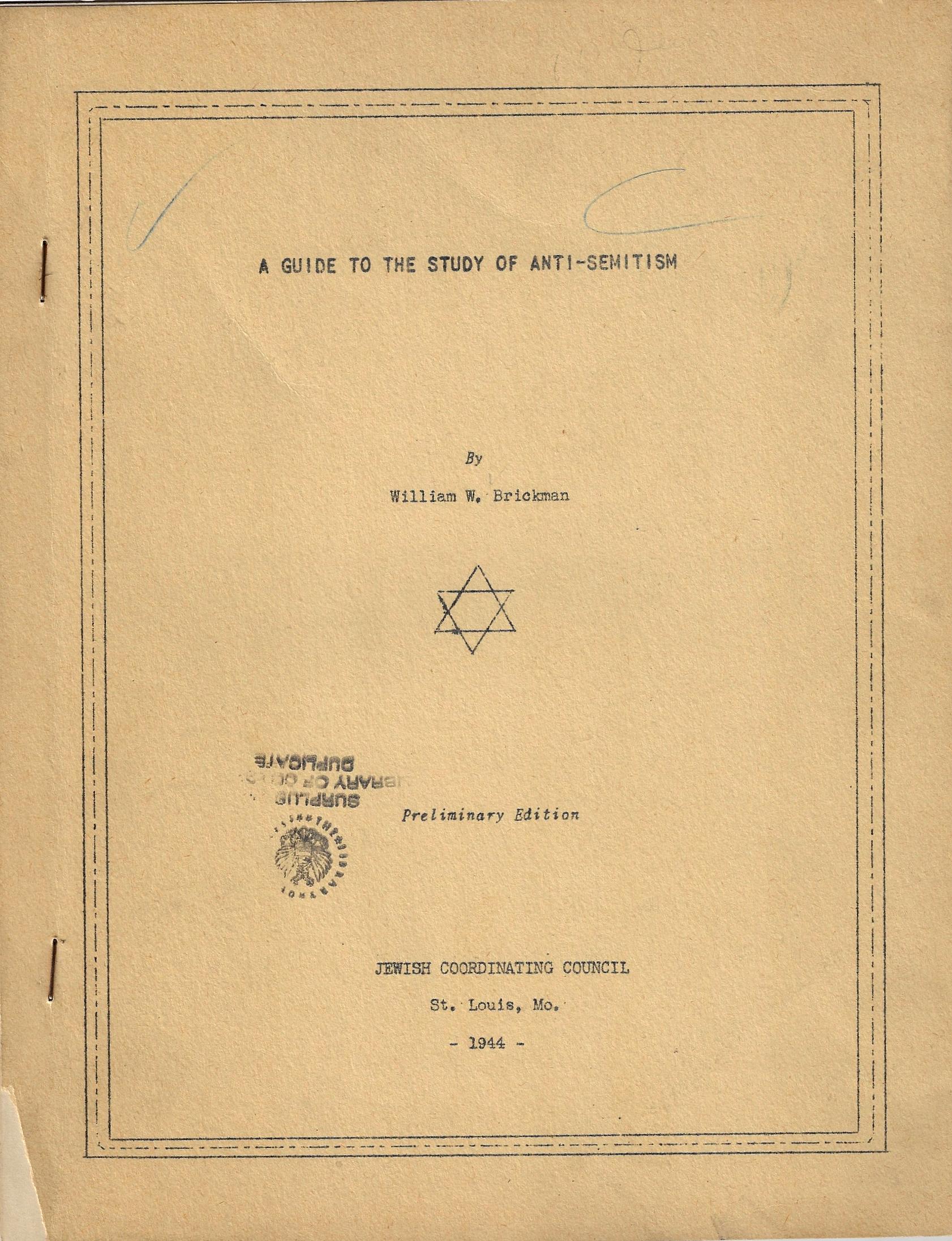
    I found something interesting in this study guide for anti-Semitism, something that may give a little more weight to some already pretty-weighty things.  The pamphlet was written by William R. Brickman1 in 1944, and in its 26 leaves about half was devoted to what I think is the jewel of the pamphlet–an annotated bibliography–and the first half or so formulated as a study guide.

    Jewish annotated bibliogr anti-semitism_0002In the “historical background” of the guide , in the between-the-wars section, there are eleven points, including the Russian Pogroms of 1915, the Petlura massacre in the Ukraine in 1919-1920, the Iron Guard of Romania… and then the KKK, and of real interest, “Ford and the Protocols”. that was Henry Ford of course and his connection and support of the fraud and forgery Protocols of the Elders of Zion, which in 1919 when Ford sunk his teeth into it was already at least 50+ years old as a malignant conspiracy theory of no value.  Ford went on to begin his own series of articles on the “International Jew” as having led the world into WWI and who was a general scourge of the civilized world, publishing a weekly called The International Jew, which Ford published and provided content for from 1920-1927. It was vicious conspiracy pap that finally caught up to Ford in 1927 when was sued ; to escape the coming troubles he claimed that he did not know the contents of the newspaper and basically blamed the editors for the content he never saw.  By that time, the damage had been done, while Henry Ford–even after having issued an apology for having been duped by the Protocols–would later maintain that the Jews had managed to start WWII for financial gain.  So, to be one point in an eleven-point study guard leads me to believe that the Ford business was loftier in the general social consciousness than I expected.

    The other detail of note comes in the next section, “In the shadow of the war” which is only four points long, though one of them is on the growth of anti-Semitism in the U.S. (during the war). This was a little surprising in the amount of weight given it in the study guide, or at least a little surprising to me.  

    I don’t have that much to say on these topics presently as it is a long and hard road, but I did want to at least pass along the notation. 

    Notes:

    See: the Jewish Virtual Library for background on Ford and the Protocols

    1.  Published by the Jewish Coordinating Council, St. Louis, Mo. 28cm, 26 leaves, offset printed from a type original, and bound in wrappers and staple-bound at left. PROVENANCE: Library of Congress, with their surplus/duplicate stamp on the front cover. 

    ·Posted by :

    ·in:


  • Quantum Mechanics Bibliographic Timeline–the El’yashevich List

    This is a handy and interesting timeline of QM placed in chronological order from the article by M A El’yashevich  ( “From the origin of quantum concepts to the establishment of quantum mechanics”, by M A El’yashevich, in Soviet Physics USPEKHI, 1977, 20 (8), 656–682.). I did not compose this nor did I add to it in any way—this is the sole effort of Prof. El’yashevich. I did make some slight compositional changes to make the list a little more accessible and usable to people like me, and condensed the list to only 1950 (whereas in the original the entries extend into the 1970’s), and made so that each entry is limited to a line or two;  but that’s it.

    I guess it would be easy to start the list with Planck if you wanted to give it a firm footing somewhere, though the history of quantum mechanics goes into development stages long before the 1900 Planck paper.  Be that as it may, this is just a quick exercise, and if an idea was formed or a lost memory found via a quick look at this list, then it is good enough for me.

    • M. Planck, Über irreversible Strahlungsvorgänge, Annalen der Physik, 1 (1900), 60–122,
    • Lord Rayleigh, Remarks upon the Law of Complete Radiation, Philosophical Magazine, 49 (1900), 539–540
    • M. Planck, Entropie und Temperatur strahlender Wärme, Annalen der Physik, 1 (1900), 719–737,
    • M. Planck, Über eine Verbesserung der Wienschen Spekralgleichung, Verb. Deutsch. Phys. Ges., 2 (1900), 202–204,

    • M. Planck, Zur Theorie des Gesetzes der Energieverteilung im Normalspektrum ibid., 1900, 237–245, 251–257)
    • M. Planck, Über des Gesetz der Energieverteilung im Nor malspektrum, Annalen der Physik, 4 (1901), 553–563,
    • M. Planck, “Über irreversible Strahlungsvorgänge (Nachtrag)”, ibid., 6 (1901), 818–831,
    • H. A. Lorentz, On the Emission and Absorption by Metals of Rays of Heat of Great Wave-Lengths, Proc. Amsterdam Acad., 5 (1903), 666–685
    • J. H. Jeans, On the Partition of Energy between Matter and Aether, Philosophical Magazine, 10 (1905), 91–98
    • A. Einstein, Über einen die Erzeugung und Verwandlung des Lichtes betreffenden heuristischen Gesichtspunkt, Annalen der Physik, 17 (1905), 132–148;
    • M. Planck, Vorlesungen Über die Theorie der Wännestrahlung, (Leipzig, Barth), 1906; (Leipzig, Barth, (2 Aufl.), 1913; (Leipzig, Barth, 3. Anfl.), 1919; (Leipzig, Barth, 4 Aufl.), 1921; 5 Aufl. (Leipzig, Barth), 1923;
    • P. Ehrenfest, Zur Planckschen Strahlungstheorie, Physikalische Zeitschrift, 7 (1906), 528–532,
    • A. Einstein, Die Plancksche Theorie der Strahlung und die Theorie der spezifischen Wärme, Annalen der Physik, 22 (1907), 180–190;
    • A. Einstein, Zum gegenwärtigen Stand des Strahlungsproblems, Physikalische Zeitschrift, 10 (1909), 185–193;
    • A. Einstein, “Über die Entwicklung unserer Anschauengen Über des Wesen und die Konstitution der Strahlung”, ibid., (1909), 817–825;
    • A. E. Haas, Über die elektrodynamische Bedeutung des Planckschen Strahlungsgesetz und Über eine neue Bestimmung des elektrischen Elementarquantums und der Dimensionen des Wasserstoffatoms, Sitzungber. Akad. Wiss. Wien, 2a, 119 (1910), 119–144
    • P. Debye, Der Warscheinlickeitsbegriff in der Theorie der Strahlung, Annalen der Physik, 33 (1910), 1427–1434
    • W. Nernst, Zur Theorie der spezifischen Wärme und Über die Anwendung der Lehre von den Energiequanten auf physikalisch-chemische Fragen überhaupt, Zs. Elektrochem., 17 (1911), 265–275
    • W. Nernst and F. Lindemann, “Spezifische Wärme und Quantentheorie”, ibid., 8 (1911), 17–827
    • M. Planck, Eine neue Strahlungshypothese, Verb. Deutsch. Phys. Ges., 13 (1911), 138–148
    • P. Ehrenfest, Welche Züge der Lichtquantenhypothese spielen in der Theorie der Wärme Strahlung eine wesentliche Rolle?, Annalen der Physik, 36 (1911), 91–118,
    • M. Planck, Die Gesetze der Wärmestrahlung und die Hypothese der elementaren Wirkungsquanten. Vortrag gehalten auf dem Solway-Kongress, Brüssel, 1911, 282–310)
    • A. Einstein, Zum gegenwärtigen Stand, des Problems der Spezifischen Wärme. Vortrag, gehlaten auf dem Solway-Kongress, Brüssel,
    • A. Einstein, Thermodynamische Bergründung des photochemisches Äquivalentgesetzes, Annalen der Physik, 37 (1912), 832–838;
    • Niels Bjerrum, Über die ultraroten Absorptionspektren der Gase, in: W. Nernst Festchrift, Halle, (1912), S. 90–98
    • W. Nicholson, The Constitution of the Solar Corona, II, Mon. Not. Roy. Astron. Soc., 72 (1912), 677–692
    • P. Debye, Zür Theorie der spezifischen Wännen, Annalen der Physik, 39 (1912), 789–839
    • M. Born and T. von Kármán, ÜberSchwingungen in Raungittern, Physikalische Zeitschrift, 13 (1912), 297–309
    • M. Born and T. von Kármán, “Zur Theorie der spezifischen Wärme”, ibid., 14 (1913), 15–19
    • N. Bohr, On the Constitution of Atoms and Molecules, Philosophical Magazine, 26:part D, 1–25, 476–502, (part II), 856–875 (part III) (1913);
    • P. Ehrenfest, Bemerkung betreffs der spezifischen Wärme zweiatomiger Gase, Deutsche Physikalische Gesellschaft, 15 (1913), 451–457
    • P. Ehrenfest, A. Mechanical Theorem of Baltzmann and Its Relation to the Theory of Energy Quanta, Proc. Amsterdam Acad., 16 (1914), 591–497,
    • N. Bohr, Om brintspektret, Fysisk Tidsskraft, 12 (1914), 97–114, (N. Bohr, Trudy 152–167)
    • M. Planck, Eine veränderte Formulierung der Quantenhypo-these, (Sitzungber. Akad. Wiss. Berl.), 1914, 918–923 ;
    • P. Ehrenfest, On Adiabatic Changes of a System in Connec tion with the Quantum Theory, Proc. Amsterdam Acad., 19 (1916), 576–597
    • A. Einstein, Strahlungs-Emission und-Absorption nach der Quantentheorie, Deutsche Physikalische Gesellschaft, 18 (1916), 318–323;
    • A. Einstein, Zur Quantentheorie der Strahlung, Mitt. d. Phys. Ges. Zürich, Nr., 18 (1916), 47–62;
    • N. Bohr, On the Quantum Theory of Line-Spectra, Kgl. dansk. vid. selskab. skr. IV, 1918–1922, 1–36, part D, 37–100 (part II) 101–118 (Part III); German translation in Über die Quantentheorie der Linienspektren, (Braunschweig), 1923
    • A. Sommerfeld, Atombau and Spektrallinien, 2. Aufl. (Braunschweig, Viewig), 1921, 1919; 3. Aufl., (1922); 4. Aufl., (1924);
    • N. Bohr, “Über die Serienspektra der Elemente”, Zeitschrift fur Physik, 2 (1920), 423–469; Über die Serienspektra der Elemente, I,
    • A. H. Compton, Secondary Radiations Produced by X-rays, Bull. Nat. Res. Council (pt. 2), 4:No. 20 (1922)
    • N. Bohr, Über die Anwendung der Quantentheorie auf den Atombau. I. Grundypostulate der Quantentheorie, Zeitschrift fur Physik, 13 (1923), 117–165;
    • A. H. Compton, A Quantum Theory of the Scattering of X-Rays by Light Elements, Physical Review, 21 (1923), 483–502
    • P. Debye, Zerstreuung von Röntgenstrahlen und Quanten theorie, Physikalische Zeitschrift, 24 (1923), 161–166
    • P. Ehrenfest, Adiabatische Transformationen in der Quanten theorie und ihre Behandlung durch Niels Bohr, Naturwissen-schaften, 11 (1923), 543–550;
    • L. de Brogue, Ondes et quanta, Comptes Rendus…de l’Academies des Sciences, 177 (1923), 507–510;
    • L. de Broglie, “Quanta de lumière, diffraction et interférence”, ibid., (1923), 548–550; (Usp. Fiz. Nauk, 93 (1967), 182–183
    • L. de Brogue, “Les quanta, la théorie cinétique des gaz et le principe de Fernat”, ibid., (1923), 630–632;
    • L. de Broglie, A Tentative Theory of Light Quanta, Philosophical Magazine, 47 (1924), 446–458; translation in this issue, 562)
    • S. N. Bose, Plancks Gesetz und Lichtquantenhypothese, Zeitschrift fur Physik, 26 (1924), 178–181 
    • A. Einstein, Quantentheorie des einatonigen idealen Gases, (Sitzungher. Preuss. Akad. Wiss.), 1924, 261–267 ;
    • L. de Brogue, Recherches sur la théorie de quanta. Thèse de doctoral, (Paris, Masson et Cie), 1924; (also in: Ann. de Phys., 3 (1925), 22–128,
    • A. Einstein, Quantentheorie des einatonigen idealen Gases, (Zweite Abbandbung, Sitzungber. Preuss. Akad. Wiss.), 1925, 3–14 ;
    • W. Pauli, Über den Zusammenhang des Abschlusses der Elektronengruppen im Atom mit der Komplexstruktur der Spektren, Zeitschrift fur Physik, 31 (1925), 765–783; Trudy, I, 645–660)
    • N. Bohr, “Über die Wirkung von Atomen bei Stössen”, ibid., 34 (1925), 142–157
    • M. Born, Vorlesungen über Atommechanik, (Bd. 1, Springer, Berlin), 1925, 1934;
    • G. Uhlenbeck and S. Goudsmit, Ersetzung der Hypothese von unmechanischen Zwang durch eine Forderung bezügluch des inneren Verhaltens jedes ienzelnen Elektrons, Naturwissenschaften, 13 (1925), 953–954
    • G. Uhlenbeck and S. Goudsmit, Spinning Electrons and the Structure of Spectra, Nature, 117 (1926), 264–265
    • E. Schrödinger, Zur Einsteinsche Gastheorie, Physikalische Zeitschrift, 27 (1926), 95–101; “
    • E. Fermi, Zur Quantelung des idealen einatomigen Gases, Zeitschrift fur Physik, 36 (1926), 902–912;
    • W. Pauli, “Quantentheorie”, Handbuch der Physik, Bd. 23, (Berlin, Springer), 1926, S. 1–278 ;
    • W. Heisenberg, Über quantentheoretische Umdeutung kinematischer und mechanischer Beziehungen, Zeitschrift fur Physik, 33 ([July 29] 1925), 879–893;
    • M. Born and P. Jordan, “Zur Quantenmechanik”, ibid., 34 (1925), 858–888, 27 Sep.;
    • P. A. M. Dirac, The Fundamental Equations of Quantum Mechanics, Proc. Roy. Soc. (London), 109 (1925 [Nov. 7]), 642–653,
    • M. Born, W. Heisenberg, and P. Jordan, Zur Quanten mechanik. II, Zeitschrift fur Physik, 35 (1926), 557–615; [Nov., 16 (1925)
    • H. A. Kramers, Eenige opmerkingen over de quantuummechanica van Heisenberg, Physica, 5 (1925 [November]), 369–377
    • W. Heisenburg, Über quantentheoretische Kinematik und Mechanik, Math. Ann., 95 (1926 [Dec. 21, 1925]), 683–705
    • K. Lanczos, Über eine feldmässige Darstellung der neuen Quantenmechanik, Zeitschrift fur Physik, 35 (1926 [Dec. 22, 1925]), 812–830
    • M. Born and N. Wiener, “Eine neue Formulierung der Quantengesetze für periodische und nichtperiodische Vorgänge”, ibid., 36 (1926 [Jan. 5]), 174–187
    • W. Pauli, “Über das Wasserstoffspektrum vom Standpunkt der neuen Quantenmechanik”, ibid., (1926 [Jan. 17]), 336–363
    • P. A. M. Dirac, Quantum Mechanics and a Preliminary In vestigation of the Hydrogen Atom, Proc. Roy. Soc. (London), 110 (1926 [Jan. 22]), 561–579
    • E. Schrödinger, Quantisierung als Eigenwertproblem (Erste Mitteilung), Annalen der Physik, 79 (1926), 361–376; [Jan. 27] (E. Schrödinger, Trudy;, 9–20; Usp. Fiz. Nauk, 122, 621)
    • L. Brillouin, Les spectres de rotation, dans la nouvelle mechanique des quanta, avec le calcule des matrices, Comptes Rendus…de l’Academies des Sciences, 182 (1926 [Feb. 8]), 374–376
    • E. Schrödinger, “Quantisierung als Eigenwertproblem (Zweite Mitteilung)”, Annalen der Physik, 79 (1926), 489–527, [Feb. 23]
    • K. Lanczos, Variationsprinzip und Quantenbedingungen in der neuen Quantenmechanik, Zeitschrift fur Physik, 36 (1926 [Mar. 1]), 401–409
    • W. Heisenberg and P. Jordan, “Anwendung der Quantenmechanik auf das Problem der anomalen Zeemaneffekte”, ibid., 37 (1926 [Mar. 16]), 263–277
    • G. Beck, “Comptoneffekt und Quantenmechanik”, ibid., 38 (1926 [Mar. 16]), 144–148
    • F. London, “Energiesatz und Rydbergprinzip in der Quanten mechanik”, ibid., 36 (1926 [Mar. 17]), 775–777
    • E. Schrööinger, “Über das Verhältnis der Heisenberg-Born–Jordanschen Quantenmechanik zu der meinen”, Annalen der Physik, 79 (1926), 734–756, [Mar. 18]
    • P. A. M. Dirac, The Elimination of the Nodes in Quantum Mechanics, Proc. Roy. Soc. (London), 111 (1926 [Mar. 27]), 281–305
    • G. Wnetzel, Die mehrfach peridoschen. Systems in der Quan tenmechanik, Zeitschrift fur Physik, 37 (1926 [Mar. 27]), 80–94
    • Lucy Mensing, “Die Rotations-Schwingungshanden nach der Quantenmechanik”, ibid., 36 (1926 [Mar. 29]), 814–823
    • I. Tamm, “Zur Quantenmechanik des Rotators”, ibid., 37 (1926 [Apr. 27), 685–696
    • P. Jordan, “Uber kanonische Transformationen in der Quanten mechanik”, ibid., (1926 [Apr. 27]), 383–386
    • D. Dennison, The Rotation of Molecules, Physical Review, 28 (1926 [Apr. 27]), 318–333
    • E. Fues, Das Eigenschwingungspektrum zweiatomiger Moleküle in der Undulationsmechanik, Annalen der Physik, 80 (1926 [Apr. 27]), 367–396
    • K. Lanczos, Uber die komplexe Beschaffenheit der quantenmechanischen Matrizen. Zeitschrift fur Physik, 37 (1926 [Apr. 28]), 405–413
    • O. Klein, “Quantentheorie und fünfdimensionale Relativitäts–theorie”, ibid., (1926 [Apr. 28]), 895–902
    • P. A. M. Dirac, Relativity Quantum Mechanics with an Appli cation to the Compton Scattering, Proc. Roy. Soc. (London), 111 (1926 [Apr. 29]), 405–423
    • E. Schrödinger, Dr stetige Übergang von der Mikro-zur Makromechanik, Naturwissenschaften, 14 ([May] 1926), 664–666; Handbuch der Physik,
    • E. Schrödinger, Quantisierung als Eigenwertproblem (Dritte Mitteilung), Annalen der Physik, 80 ([May 10] 1926), 437–490; Handbuch der Physik,
    • F. London, Uber die Jacobischen Transformationen in der Quantenmechanik, Zeitschrift fur Physik, 37 (1926 [May 22]), 915–925
    • C. Eckart, The Solution of the Problem of the Simple Os cillator by a Combination of the Schroedinger and the Lanczos Theories, Proc. Nat. Ac. Sci., 12 (1926 [May 31]), 473–47
    • C. Eckart, Operator Caclulus and the Solution of the Equa tions of Quantum Dynamics, Physical Review, 28 (1926 [June 7]), 711–726
    • W. Heisenberg, Mehrkörperprobleme und Resonanz in der Quantenmechani, Zeitschrift fur Physik, 38 (1926 [11 June]), 411–426
    • V. Fock, “Zur Schrödingerschen Wellenmechanik”, ibid., (1926 [June 11]), 242–250
    • G. Wentzel, “Eine Verallgemeinerung der Quantenbedingungen für die Zwecke der Quantenmechanik”, ibid., (1926 [June 18]), 518–529
    • E. Schrödinger, QuantentisieSung als Eigenwertproblem (Vierte Mitteilung), Annalen der Physik, 81 ([June 21] 1926), 109–139; Handbuch der Physik,
    • J. Waller, Der Starkeffekt zweiter Ordnung bei Wasserstoff und die Rydbergkorrektion der Spektra von He and Lĭ, Zeitschrift fur Physik, 38 (1926 [June 21]), 635–646
    • M. Born, “Zur Quantenmechanik der Stossvorgänge (vorlüufige Mitteilung)”, ibid., 37 (1926 [June 25]), 863–867
    • L. Mensing and W. Pauli, Uber Dielektrizitätskonstante von Dipolgasen nach der Quantenmechanik, Physikalische Zeitschrift, 27 (1926 [June 25]), 509–512
    • R. Kronig, The Dielectric Constant of Diatomic Dipole-Gases on the New Quantum Mechanics, Proc. Nat. Ac. Sci., 12 (1926 [July 3]), 488–493
    • L. Brillouin, “La méchanique ondulatoire de Schrödinger; une methode général de résolution par approximations successives”, Comptes Rendus…de l’Academies des Sciences, 183 (1926 [July 5]), 24–26
    • T. De Donder and H. van den Dungen, “La quantification dédnite de lagraphique einsteinienne”, ibid., (1926 [July 5), 22–24
    • P. Jordan, Uber kanonische Transformationen in der Quantenmechanik. II, Zeitschrift fur Physik, 38 (1926 [July 9]), 513–517
    • E. Fues, Zur Intensität der Bandenlinien und des Affinitätsspektrums zweiatomiger Moleküle, Annalen der Physik, 81 (1926 [July 9]), 281–313
    • C. Eckart, The Hydrogen Spectrum in the New Quantum Theory, Physical Review, 28 (1926 [July 17]), 927–935
    • M. Born, Quantemechanik der Stossvorgänge, Zeitschrift fur Physik, 38 ([July 21] 1926), 803–827; Russ. translation Handbuch der Physik, (Usp. Fiz. Nauk), 122, p. 632)
    • N. von Raschevsky, “Einige Bemerkungen zur Heisenbergschen Quantenmechanik”, ibid., 39 (1926 [July 21]), 153–158
    • W. Heisenberg, “Über die Spektra von Atomsystemen mit zwei Elektronen.”, ibid., (1926 [July 24]), 499–518
    • L. Brillouin, Sur un type général des problèmes, permettant la séparation dans la mechanique ondulatiore de Schrödinger, Comptes Rendus…de l’Academies des Sciences, 183 (1926 [July 26]), 270–272
    • L. de Broglie, “Remarques sur la nouvelle Méchanique ondulatoire”, ibid., (1926 [July 26]), 272–274
    • P. A. M. Dirac, On Quantum Algebra, Proc. Cambr. Phil. Soc., 23 (1926 [July 26]), 412–418
    • P. S. Epstein, The Stark Effect from the Point of View of Schroedinger’s Quantum Theory, Physical Review, 28 (1926 [July 29]), 695–710
    • V. Fock, Über die invariante Form der Wellen-und Bewegungsgleichungen für einen gelendenen Massenpunkt, Zeitschrift fur Physik, 39 (1926 [July 30]), 226–232
    • L. de Broglie, Les principes de la nouvella méchanique ondulatoire, J. de Phys., 7 (1926 [Aug. 5), 321–327
    • F. London, Die Zahl der Dispersionselektronen in der Un dulationsmechanik, Zeitschrift fur Physik, 39 (1926 [Aug. 19]), 322–326
    • P. A. M. Dirac, On the Theory of Quantum Mechanics, Proc. Roy. Soc. (London), 112 (1926 [Aug. 26]), 661–677 
    • F. Reiche, Die Quantelung des symmetrischen Kreisels mach Schrödingers Undulationsmechanik, Zeitschrift fur Physik, 39 (1926 [Aug. 26]), 444–494
    • Jane Dewey, Intensities in the Stark Effect of Helium, Physical Review, 28 (1926 [Aug. 28]), 1108–1125
    • J. Kudar, Zur vierdimensionalen Formulierung der undulatorischen Mechanik, Ann. d Phys., 81 (1926 [Aug. 30]), 632–636
    • H. A. Kramers, Wellenmechanik und halbzahlige Quantisie rung, Zeitschrift fur Physik, 39 (1926 [Sep. 9]), 828–840
    • R. Kronig, The Dielectric Constant of Symmetrical Poly atomic Dipole-Gases in the New Quantum Mechanics, Proc. Nat. Ac. Sci., 12 (1926 [Sep. 13]), 608–612
    • P. Ehrenfast and G. Uhlenbeck, Graphische Veranschaulichung der de Broglieschen Phasenwellen in der fünfdimensionalen Welt von O. Klein, Zeitschrift fur Physik, 39 (1926 [Sep. 16]), 495–498
    • G. Gamow and D. Ivanenko, “Zur Wellentheorie der Materie”, ibid., (1926 [Sep. 19]), 865–868
    • F. London, “Winkelvariable und kanonische Transformationen in der Undulationsmechanik”, ibid., 40 (1926 [Sep. 19]), 193–210
    • W. Gordon, “Der Comptoneffekt nach der Schrödingerschen Theorie”, ibid., 117 (1926 [Sep. 29]), 133
    • P. S. Epstein, The New Quantum Mechanics and the Zeeman Effect, Proc. Nat. Ac. Sci., 12 (1926 [Oct. 7]), 634–638
    • D. Iwanenko and L. Landau, Zur Ableitung der Klein-Fock-schen Gleichung, Zeitschrift fur Physik, 40 (1926 [Oct. 8]), 161–162
    • M. Born, “Das Adiabatenprinzip in der Quantenmechanik”, ibid., 167-192, (1926 [Oct. 16])
    • E. Fermi, “Zur Wellenmechanik des Stossvorganges”, ibid., (1926 [Oct. 23]), 399–401; Handbuch der Physik, I,
    • E. Madelung, “Quantentheorie in hydrodynamischer Form”, ibid., (1926 [Oct. 25]), 322–326
    • L. Pauling, “Die Abschirmungskonstanten der relativistischen oder magnetischen Röntgenstrahlendubletts”, ibid., (1926 [Oct. 27]), 344–350
    • J. R. Oppenheimer, Quantum Theory and Intensity Distribu tion in Continuous Spectra, Nature, 118 ([Oct. 30] 1926), 771
    • R. H. Fowler, General Forms of Statistical Mechanics with Special Reference to the Requirements of the New Quantum Mechanics, Proc. Roy. Soc. (London), 118 (1927 [3 Nov.]), 432–449
    • R. Kronig and I. I. Rabi, The Symmetrical Top in the Undulatory Mechanics, Physical Review, 29 (1927 [Nov. 4]), 252–269
    • W. Heisenberg, Schwankungserscheinungen und Quantenmechanik, Zeitschrift fur Physik, 40 (1926 [Nov. 6]), 501–506
    • E. Fermi and E. Persico, “Il principio delle adiabatiche e la nozione di forza viva nelle nuova meccanica ondulatoria”, Rend. Lincei, 4 (1926), 452–457, [Nov. 7]
    • E. Wigner, Über nicht kombinierende Terme in die neuen Quantentheorie (Erster Teil), Zeitschrift fur Physik, 40 (1926 [Nov. 12]), 492–500
    • L. Landau, “Zur Theorie der Spektren der zweiatomiger Moleküle”, ibid., (1926 [Nov. 13]), 621–627; Handbuch der Physik, I,
    • E. Fermi, Quantum Mechanics and the Magnetic Moment of Atoms, Nature, 118 (1926 [Nov. 14]), 876;
    • J. H. Van Vleck, The Dielectric Constant and Diamagnetism of Hydrogen and Helium in the New Quantum Mechanics, Proc. Nat. Ac. Sci., 12 (1926 [Nov. 15]), 662–670\
    • C. Eckert, “Note on the Correspondence Principle in the New Quantum Mechanics”, ibid., (1926 [Nov. 16), 684–687
    • G. Wentzel, Zur Theorie des photoelektrischen Effekts, Zeitschrift fur Physik, 40 (1926 [Nov. 19), 574–589
    • F. Hund, “Zur Deutung der Molekelspektren. I”, ibid., (1927 [Nov. 19]), 742–764
    • Burrau, “Berechnung des Eigenwerts des Wasserstoff-molekel Ions (H+ 2)”, Normalzustand. Naturwissenschaften, 15 (1927 [Nov. 22, 1926]), 16–17
    • P. Jordan, Über quantenmechanische Darstellung von Quantensprüngen, Zeitschrift fur Physik, 40 (1927 [25 Nov, 1926]), 661–666
    • E. Wigner, “Über nicht kombinierende Terme in der neuen Quantenmechanik (Zweiter Teil)”, ibid., (1927 [Nov. 26, 1926]), 883–892
    • J. S. Slater, Radiation and Absorption on Schroedinger’s Theory, Proc. Nat. Ac. Sci., 13 (1927 [Nov. 26, 1926]), 7–12
    • H. Radamacher and F. Reiche, Die Quantelung des symmetrischen Kreisels nach Schrödingerschen Undulationsmechanik. II. Intensitätsfragen, Zeitschrift fur Physik, 41 (1927 [Nov. 29, 1926]), 453–492
    • E. Schrödinger, Über den Comptoneffekt, Annalen der Physik, 82 (1927), 257–264, [Nov. 30, 1926]
    • P. A. M. Dirac, The Physical Interpretation of the Quantum Dynamics, Proc. Roy. Soc. (London), 113 (1927 [Dec. 2, 1926]), 621–641
    • O. Klein, Elektrodynamik und Wellenmechanik von Stand-punkt der Korrespondenzprinzip, Zeitschrift fur Physik, 41 (1927 [Dec. 6, 1926]), 407–442
    • E. Schrödinger, “Der Energieimpulssatz der Materien-wellen”, Annalen der Physik, 82 (1927), 265–272, [Dec. 10, 1926] (E. Schrödinger, Trudy, 145–150)
    • P. Ehrenfest, and G. Uhlenbeck, Die wellenmechanische Interpretation der Boltzmannschen, Statistik nehen der der neuen Statistiken, Zeitschrift fur Physik, 41 (1927), 24–26, [Dec. 15, 1926] (P. Ehrenfest, Stat’i, 79–81)
    • W. Pauli, “Über Gasentartung und Paramagnetismus”, ibid., (1927 [Dec. 16, 1926]), 81–102
    • P. Debye, Wellenmechanik und Korrespondenzprinzip, Physikalische Zeitschrift, 28 (1927 [Dec. 16, 1926), 170–174
    • L. Brillouin, Les moments de rotation et le magnetisme dans la méchanique ondulatoire, J. de Phys., 8 (1927 [Dec. 17, 1926]), 74–84
    • P. Jordan, Über eine neue Bergrüdung der Quantenmechanik, Zeitschrift fur Physik, 40 (1927 [Dec. 18, 1926]), 809–838
    • A. Unsöld, Beitrage zer Quantenmechanik der Atome, Annalen der Physik, 82 (1927 [Dec. 22, 1926]), 355–393
    • W. Heisenberg, Mehrkörperprobleme und Resonanz in der Quantenmechanik. II, Zeitschrift fur Physik, 41 (1927 [Dec. 22, 1926]), 239–267
    • L. de Broglie, L’univers a cinq dimensions et la méchanique ondulatoire, J. de Phys., 8 (1927 [Dec. 23, 1926]), 65–73
    • F. Slack, Die Intensitätsdissymmetrie beim Wasserstoff-Starkeffekt, Annalen der Physik, 82 (1927 [Dec. 24, 1926]), 576–584
    • J. R. Oppenheimer, Zur Quantentheorie kontinuirlicher Spektren, Zeitschrift fur Physik, 41 (1927 [Dec. 24, 1926]), 268–293
    • G. Beck, “Zur Theorie des Photoeffekts”, ibid., (1927 [Dec. 27, 1926]), 443–452
    • M. Sugiura, Sur le nombre des electrons de dispersion pur pour les spectres continues et pour les spectres de séries de l’hydrogene, J. de Phys., 8 (1927 [Dec. 30, 1926), 113–124
    • E. E. Witmer, The Quantization of the Rotational Motion of the Polyatomic Molecule by the New Quantum Mechanics, Proc. Nat. Ac. Sci., 13 (1927 [Jan. 15]), 60–65
    • P. Ehrenfest nd G. Uhlenbeck, Zum Einsteinschen “Mischungsparadoxon” Zeitschrift fur Physik, 41 (1927 [Jan. 25]), 576–582
    • J. C. Slater, Action of Radiation and Perturbations on Atoms, Proc. Nat. Ac. Sci., 13 (1927 [Jan. 29]), 104–111
    • L. de Broglie, La structure atomique de la matière et du rayonement et la Mèchanique ondulatoire, Comptes Rendus…de l’Academies des Sciences, 184 (1927 [Jan. 31]), 273–274
    • P. A. M. Dirac, The Quantum Theory of the Emission and Absorption of Radiation, Proc. Roy. Soc. (London), 114 (1927 [Feb. 2]), 243–265
    • F. Hund, Zur Deutung der Molekelspektren. II, Zeitschrift fur Physik, 42 (1927 [Feb. 7]), 93–120
    • D. Iwanenko and L. Landau, “Bemerkung Über Quantenstatistik.”, ibid., (1927 [Feb. 12]), 562–564
    • P. Jordan, “Anmerkungen zur statistischen Deutung der Quan tenmechanik”, ibid., 41 (1927 [Feb. 17), 797–810
    • F. London, “Quantenmechanische Deutung der Theorie von Weyl”, ibid., 42 (1927 [Feb. 25]), 375–389
    • J. H. Van Velck, On Dielectric Constants and Magnetic Sus ceptibilities in the New Quantum Mechanics, Part I. A Gen eral Proof of the Langevin-Deybe Formula, Physical Review, 29 (1927 [Feb. 28]), 727–744
    • G. Beck, Über die Strahlungreibung in der Quantenmechanik, Zeitschrift fur Physik, 42 (1927 [Mar. 8]), 86–88
    • J. Oppenheimer, “Zur Quantenmechanik der Richtungsentartung”, ibid., 43 (1927 [Mar. 8]), 27–46
    • A. Landé, “Spontane Quantenübergänge”, ibid., 42 (1927 [Mar. 17]), 835–38
    • A. Markoff, “Über eine Minimaleigenschaft der Schrödinger Wellengruppen”, ibid., (1927 [Mar. 18), 637–640
    • E. C. Condon, Coupling of Electronic and Nuclear Motion in Diatomic Molecules, Proc. Nat. Ac. Sci., 13 (1927 [Mar. 19]), 462–466
    • W. Heisenberg, Über den anschaulichen Inhalt der quanten-theoretischen Kinematik and Mechanik, Zeitschrift fur Physik, 43 (1927 [Mar. 23]), 172–198; Russ. translation Usp. Fiz. Nauk, 122, 651)
    • H. Bateman, A Modification of Gordon’s Equation, Physical Review, 30 (1927 [Mar. 30]), 55–60
    • L. de Broglie, La méchanique ondulatoire et la structure atomique de la matiè re et du rayonnement, J. de Phys., 8 (1927 [Apr. 1]), 225–241
    • N. Wiener and D. Struik, Quantum Theory and Gravitational Relativity, Nature, 119 (1927 [Apr. 2]), 853–854
    • G. Wentzel, Zur Theorie des Comptoneffekts, Zeitschrift fur Physik, 43 (1927 [Apr. 3]), 1–8
    • P. A. M. Dirac, The Quantum Theory of Dispersion, Proc. Roy. Soc. (London), 114 (1927 [Apr. 4]), 710–728
    • D. Hubert, J. von Neumann, and L. Nordheim, Über die Grundlagen der Quantenmechanik, Math. Ann., 98 (1927 [Apr. 6]), 1–30
    • E. U. Condon, Wave Mechanics and the Normal State of the Hydrogen Molecule, Proc. Nat. Ac. Sci., 13 (1927 [Apr. 18]), 466–470
    • P. S. Epstein, “The Dielectric Constant of Atomic Hydrogen in Undulatory Mechanics”, ibid., (1927 [Apr. 20]), 432–43
    • J. C. Slater, “The Structure of the Helium Atom. I”, ibid., (1927 [Apr. 26]), 423–430
    • E. Fermi, Sul meccanismo dell’emissione nella meccanica ondulatoria, Rend. Lincei, 5 (1927 [May 1]), 795–800; Handbuch der Physik, I, (E. Fermi, Trudy), 271–277
    • W. Pauli, Zur Quantenmechanik des magnetischen Elektrons, Zeitschrift fur Physik, 43 (1927 [May 3]), 601–623
    • G. Beck, “Über einige Folgerungen aus dem Satz von der Analogie zwischen Lichtquant und Elektron.”, ibid., (1927 [May 3]), 658–674
    • E. Wigner, “Einige Folgerungen aus der Schrödingerschen Theorie für die Termstrukturen”, ibid., (1927 [May 5]), 624–652
    • J. H. Van Vleck, On Dielectric Constants and Magnetic Sus ceptibilities in the New Quantum Mechanics, Part II. Appli cation to Dielectric Constants, Physical Review, 30 (1927 [May 5]), 31–54
    • C. Richter, The Hydrogen Atom with a Spinning Electron in Wave Mechanics, Proc. Nat. Ac. Sci., 13, 476–479, [May 9]
    • A. Unsold, Quantentheorie der Wasserstoffmolekülions und die Born-Landéschen Abstossungskräfte, Zeitschrift fur Physik, 43 (1927 [May 10]), 563–574
    • G. Wentzel, “Über Strahlungslose Quantensprünge”, ibid., (1927 [May 11]), 524–530
    • E. Fues, “Lebensdauer und Resonanzerscheinungen”, ibid., (1927 [May 11]), 726–740
    • W. Heitler, “Freie Weglänge und Quantelung der Molekültranslation”, ibid., 44 (1927 [May 20]), 161–169
    • J. von Neumann, “Mathematische Begründung der Quanten mechanik”, Gött. Nachr., (1927 [May 20]), 1–57
    • L. Sugiura, “Über die numerische Bestimmung der Mittel-werte zwischen Ortho-und Paratermen von He and Li+“, Zeitschrift fur Physik, 44 (1927 [May 23]), 190–206
    • G. Wentzel, “Zur Theorie des Comptoneffekts. II”, ibid., 43 (1927 [May 26]), 779–787
    • F. Hund, “Symmetriecharactere der Termen bei Systemen mit gleichen Partikeln in der Quantenmechanik”, ibid., (1927 [May 27]), 788–804
    • F. Hund, Zur Deutung der Molekelspektren., III (1927 [May 28]), 805–826
    • G. Kellner, “Die Ionisierungsspannung des Heliums nach der Schrödingersche Theorie”, ibid., 44 (1927 [June 1]), 91–109
    • P. Jordan, Über eine neue Begrüdung der Quantenmechanik, II:ibid. (1927 [June 3]), 1–25
    • D. M. Dennison, A Note on the SpecificHeat of the Hydro gen Molecule, Proc. Roy. Soc. (London), 115 (1927 [June 3]), 483–493
    • E. Schrödinger, Energieaustausch nach der Wellenmechanik, Annalen der Physik, 83 (1927 [June 10]), 956–968; Handbuch der Physik,
    • P. Jordan, Über die Polarisation der Lichtquanten, Zeitschrift fur Physik, 44 (1927 [June 16), 292–300
    • G. Kellner, “Der Grundterm des einfach ionisierten Lithiums nach der Schrödingersche Theorie”, ibid., (1927 [June 17]), 110–112
    • L. Rosenfeld, L’électron magnétique ondulatoire, Comptes Rendus…de l’Academies des Sciences, 184 (1927 [June 20]), 1540–1541
    • P. A. M. Dirac, Über die Quantenmechanik der Stossvorgänge, Zeitschrift fur Physik, 44 (1927 [June 28), 585–595
    • W. Heitler and F. London, “Wechselwirkung neutraler Atome und homöpolare-Bindung mach der Quantenmechanik”, ibid., (1927 [June 30]), 455–472
    • P. Jordan, “Zur Quantentheorie der Gasentartung”, ibid., (1927 [July 7]), 473–480
    • E. H. Kennard, “Zur Quantenmechanik einfacher Bewegungsty pon”, ibid., (1927 [July 17]), 326–352
    • L. Landau, “Das Dämpfungsproblem in der Wellenmechanik”, ibid., 45 (1927), 430–441; [July 27]
    • A. Landé, “Zur Wellenmechanik der Kontinua und Elektrodynamik”, ibid., 44 (1927 [July 28]), 766–772
    • C. G. Darwin, The Electron as a Vector Wave, Proc. Roy. Soc. (London), 116 (1972 [July 30]), 227–253
    • Jane Dewey, Intensities in the Stark Effect of Helium. II, Physical Review, 30 (1927 [July]), 770–780
    • H. Faxen and J. Holtsmark, Beitrag zur Theorie des Durchganges langsamer Elektronen durch Gase, Zeitschrift fur Physik, 45 (1927 [Aug. 6]), 307–324
    • E. U. Condon, Zeeman Effect of the Symmetrical Top Ac cording to the Wave Mechanics, Physical Review, 30 (1927 [Aug. 8]), 781–784
    • W. Elsasser, Zur Theorie der Stossprozesse bei Wasserstoff, Zeitschrift fur Physik, 45 (1927 [Aug. 26]), 522–538
    • M. Born and R. Oppenheimer, Zur Quantentheorie der Molekeln, Annalen der Physik, 84 (1927 [Aug. 28]), 457–484
    • L. Sugiura, Über die Eigenschaften des Wasserstoffmole-küls im Grundzustand, Zeitschrift fur Physik, 45 (1927 [Aug. 30]), 484–492
    • J. R. Oppenheimer, Three Notes on the Quantum Theory of Aperiodic Effects, Physical Review, 31 (1927 [August]), 66–81
    • P. Ehrenfest, Bemerkung Über die angenäherte Gültigkeit der klassischen Mechanik innerhalb der Quantenmechanik, Zeitschrift fur Physik, 45 (1927), 455–457, [Sep. 5] (P. Ehrenfest stat’i, 82–84)
    • Lucy Mensing, “Zur Theorie des Zusammenstosses von Atomen mit langsamen Elektronen”, ibid., (1927 [Sep. 13]), 603–609
    • P. Jordan and O. Klein, Zum Mehrkörperproblem der Quan tentheorie, Zeitschrift fur Physik, 45 (1927 [Oct. 4]), 751–765
    • P. Jordan, “Über Wellen und Korpuskeln in der Quanten mechanik”, ibid., (1927 [Oct. 11]), 766–775
    • W. Heitler, “Störugsenergie und Austausch beim Mekrkör-perproblem”, ibid., 46 (1927 [Oct. 12]), 47–7
    • H. Weyl, “Quantenmechanik und Gruppentheorie”, ibid., (1927 [Oct. 13]), 1–46
    • C. C. Darwin, Free Motion in the Wave Mechanics, Proc. Roy. Soc. (London), 117 (1927 [Oct. 25]), 258–293
    • J. R. Oppenheimer, On the Quantum Theory of the Polarization of Impact Radiation, Proc. Nat. Ac. Sci., 13 (1927 [Oct. 26]), 800–805
    • S. C. Wang, “The Diamagnetic Susceptibility of Hydrogen Molecule and of Helium in the New Quantum Mechanics”, ibid., (1927 [Nov. 7]), 798–800
    • E. Hulthén, Über nicht kombinierende Teilsysteme in den Bandonspektren. Zeitschrift fur Physik, 46 (1928), 349–353; [Nov., 9 (1927)
    • J. von Neumann, “Warscheinlichkeittheorietischen Aufbau der Quantenmechanik”, Gött. Nachr., (1927 [Nov. 11]), 245–272
    • J. von Neumann, “Thermodynamik quantenmechanischer Gesamtheiten”, ibid., (1927 [Nov. 11]), 273–291
    • A. Ruark, The Zeeman and Stark Effects of Hydrogen in Wave Mechanics. The Force Equation and the Virial Theorem in Wave Mechanics, Physical Review, 31 ([Dec. 4, 1927), 533–538
    • P. Jordan and W. Pauli, Zur Quantenelektrodynamik ladungs-freier Felder, Zeitschrift fur Physik, 47 (1928 [Dec. 7, 1927]), 151–173
    • R. Kronig, “Zur Deutung der Bandespektren”, ibid., 46 (1928 [Dec. 8, 1927]), 814–825
    • F. London, “Zur Quantentheorie der homöopolaren Valenz-zahlem”, ibid., (1928 [Dec. 9, 1927]), 455–477
    • L. Nordhe in, “Zur Theorie der thermischen Emission und der Reflexion von Elektronen an Metallen”, ibid., (1928 [Dec. 11, 1927]), 833–855
    • L. Mandelstam and M. Leontovich, “Zur Theorie der Schrödingerschen Gleichung”, ibid., 47 (1928), 131–136, [Dec. 15, 1927]
    • A. Sommerfeld, “Zur Elektronentheorie der Metalle auf Grund der Fermischen Statistik. I, II”, ibid., (1928 [Dec. 17, 1927]), 1–32, 43–60
    • A. H. Wilson, The Ionized Hydrogen Molecule, Proc. Roy. Soc. (London), 118 (1928 [Dec. 19, 1927]), 635–647
    • F. Slack, Intensities in the Hydrogen Spectral Series, Physical Review, 31 (1928 [Dec. 20, 1927]), 526–532
    • J. von Neumann and E. Wigner, Zur Erklärung einiger Eigenschaften der Spektren aus der Quantenmechanik des Drehelektrons, Zeitschrift fur Physik, 47 (1928 [Dec. 28, 1927]), 203–220
    • E. H. Kennard, Note on Heisenberg’s Indetermination Prin ciple, Physical Review, 31 (1928 [Dec. 29, 1927), 344–348
    • J. C. Slater, “Central Fields and Rydberg Formulas in Wave Mechanics”, ibid., (1928 [December 1927]), 333–343
    • J. R. Oppenheimer, “On the Quantum Theory of the Capture of Electrons”, ibid., (1928 [December 1927]), 348–358
    • P. A. M. Dirac, The Quantum Theory of the Electron, Roy. Soc. (London), 117 (1928 [Jan. 2), 610–624
    • V. Fock, Bemerkung zur Quantelung des harmonischen Oszillators im Magnetfeld, Zeitschrift fur Physik, 47 (1928 [Jan. 12]), 446–448
    • J. H. Van Velck, The Correspondence Principle in the Sta tistical Interpretation of Quantum Mechanics, Proc. Nat. Ac. Sci., 14 (1928 [Jan. 16]), 178–188
    • K. Niesson, Über die annäharenden komplexen Lösungen der Schrödingerschen Differentialglelchung für den harmonischen Oszillator, Annalen der Physik, 85 (1928 [Jan. 21), 497–514
    • P. Jordan and E. Wigner, Über das Paulische ÄAquivalenzverbot, Zeitschrift fur Physik, 47 (1928 [Jan. 26]), 631–651
    • W. Heitler, “Zur Gruppentheorie der homöopolaren chemischen Rindung”, ibid., (1928 [Jan. 26]), 835–858
    • J. H. Van Vleck, On Dielectric Constants and Magnetic Sus ceptibilities in the New Quantum Mechanics, Part III. Appli cation to Dia-and Paramagnetism, Physical Review, 31 (1928 [Feb. 1]), 587–613
    • P. A. M. Dirac, The Quantum Theory of the Electron (part II), Proc. Roy. Soc. (London), 118 (1928 [Feb. 2]), 351–361
    • J. Frenkel, Zur Wellenmechanischen Theorie des rotierenden Elektrons, Zeitschrift fur Physik, 47 (1928 [Feb. 3]), 786–803
    • J. Frenkel, “Zur Wellenmechanischen Theorie der metallischen Leitfähigkeit”, ibid., (1928 [Feb. 7]), 819–834
    • E. H. Kennard, On the Quantum Mechanics of a System of Particles, Physical Review, 31 (1928 [Feb. 10]), 876–890
    • W. Gordon, Die Energieniveaus des Wasserstoffatoms nach der Diracschen Quantentheorie des Elektrons. Zeitschrift fur Physik, 48 (1928 [Feb. 23]), 11–14
    • J. Holtsmark, “Zur Theorie der Streuung langsamer Elektronen”, ibid., (1928 [Feb. 27]), 231–243
    • C. G. Darwin, The Wave Equation of the Electron, Proc. Roy. Soc. (London), 118 (1928 [Mar. 6]), 654–680
    • L. Pauling, The Shared-Electron Chemical Bond, Proc. Nat. Ac. Sci., 14 (1928 [Mar. 7]), 359–362
    • D. Iwanenko and L. Landau, Zur Theorie des magnetischen Elektrons. I, Zeitschrift fur Physik, 48 (1928 [Mar. 8]), 340–348
    • A. Ruark, The Limits of Accuracy of Physical Measurements, Proc. Nat. Ac. Sci., 14 (1928 [Mar. 8]), 322–328
    • A. Ruark, “A Critical Experiment on the Statistical Interpre tation of Quantum Mechanics”, ibid., (1928 [Mar. 9]), 328–330
    • R. Kronlg and H. A. Kramers, Zur Theorie der Absorption und Dispersion in den Röntgengebiet, Zeitschrift fur Physik, 48 (1928 [Mar. 10]), 174–179
    • J. von Neumann, “Einige Bemerkungen zur Diracschen Theorie des relativistischen Drehelektrons”, ibid., (1928 [Mar. 15]), 868–881
    • C. Eckert, “Die Korrespondenzmässige Beziehung zwischen den Matrizen und den Formierkoeffizienten des Wasserstoff-problems”, ibid., (1928 [Mar. 16]), 295–301
    • E. Hylleraas, “Über den Grundzustand des Heliumatoms”, ibid., (1928 [Mar. 16]), 469–494
    • A. Landé, “Zu Diracs Theorie des Kreiselektron.”, ibid., (1928 [Mar. 24), 601–606
    • F. Sexl, “Bemerkung zur Quantelung des harmonischen Oscilators im Magnetfeld”, ibid., (1928 [Mar. 28]), 611–613
    • J. Frenkel, “Elementare Theorie magnetischer und elektrischer Eigenschaften der Metalle beim absoluten Nullpunkt der Temperatur”, ibid., 49 (1928), 31–45, [Mar. 30]
    • N. Bohr, Atomic Theory and Mechanics, Nature, 116 (1925), 845–852;
    • W. Heisenberg, Quantenmechanik, Naturwissenschaften, 14 (1926), 989–994 ;
    • E. Schrödinger, An Undulatory Theory of the Mechanics of Atoms and Molecules, Physical Review, 28 (1927), 1049–1070;
    • E. Schrödinger, Abhandlungen zur Wellenmechanik, 2 Aufl. (Leipzig, Barth), 1928, 192
    • M. Born, Quantenmechanik und Statistik, Naturwissenschaf ten, 15 (1927), 238–242;
    • Louis de Brogue, La mechanique ondulatoire, (Paris, Gautier-Villard), 1928
    • Louis de Broglie and Leon Brillouin, Selected Papers on Wave Mechanics, (Glasgow, Blackie and Son), 1928
    • H. Weyl, Gruppentheorie and Quantenmechanik, (Leipzig, Hirzel), 1928; 2. Aufl., (1931)
    • N. Bohr, Atom, (Encyclopedia Brittanica, 14th ed., v. II, London), 1929
    • A. Sommerfeld, Atombau und Spektrallinien. Wellenmechanischer Ergän-zungsband, (Braunschweig, Vievig), 1929, 1933;
    • J. Frenkel, Einführung in die Wellenmechanik, (Berlin, Springer), 1929
    • W. Heisenberg, Die physikalischen Prinzipien der Quanten theorie, (Leipzig, Hirzel), 1930, 1932;
    • P. Dirac, The Principles of Quantum Mechanics, (Clarendon Press, Oxford), 1930; 2 Ed. 1935
    • M. Born and P. Jordan, Elementare Quantenmechanik, (Berlin, Springer), 193
    • Louis de Broglie, Introduction a l’etude de la mécanique on dulatoire, (Paris, Hermann), 1930, 1934;
    • E. Wigner, Gruppentheorie und ihre Anwendung auf die Quan tenmechanik der Atmospektren, (Braunschweig, Viewig), 1931
    • J. von Neumann, Mathematische Grundlagen der Quanten mechanik, (Berlin, Springer), 1932, 1964; translated from the German Mathematical Foundations of Quantum Mechanics,
    • B. L. Van der Waerden, Die gruppentheoretische Methode in der Quantenmechanik, (Berlin, Springer), 1932, 1938;
    • W. Pauli, Die allgemeinen Prinzipien der Wellenmechanik in: Handbuch der Physik, (Bd. 24, Teil 1, Berlin, Springer), 1933, 1947;
    • L. de Broglie, L’electron magnétique (Théorie de Dirac), (Paris, Hermann), 1934, 1936;
    • E. Rutherford, “Forty Years of Physics. II. The Develop ment of the Theory of Atomic Structure”, Background to Modern Science, Cambridge, II, (E. Rutherford, Trudy), 1940, 47–74 479–492
    • A. Sommerfeld, Zwanzig Jahre spektroskopischer Theorie in München, Scientia, 72 (1942), 123–130; 
    • M. Planck, Zur Geschichte der Auffindung des physikali-schen Wirkungsquantums, Naturwissenschaften, 31 (1943), 153–159; 
    • A. Sommerfeld, Some Reminescences of My Teaching Career, Am. J. Phys., 17 (1949), 315–317;

    ·Posted by :

    ·in:


  • Very Early Projection of “Moving Pictures” (1883)

    JF Ptak Science Books   Quick Post

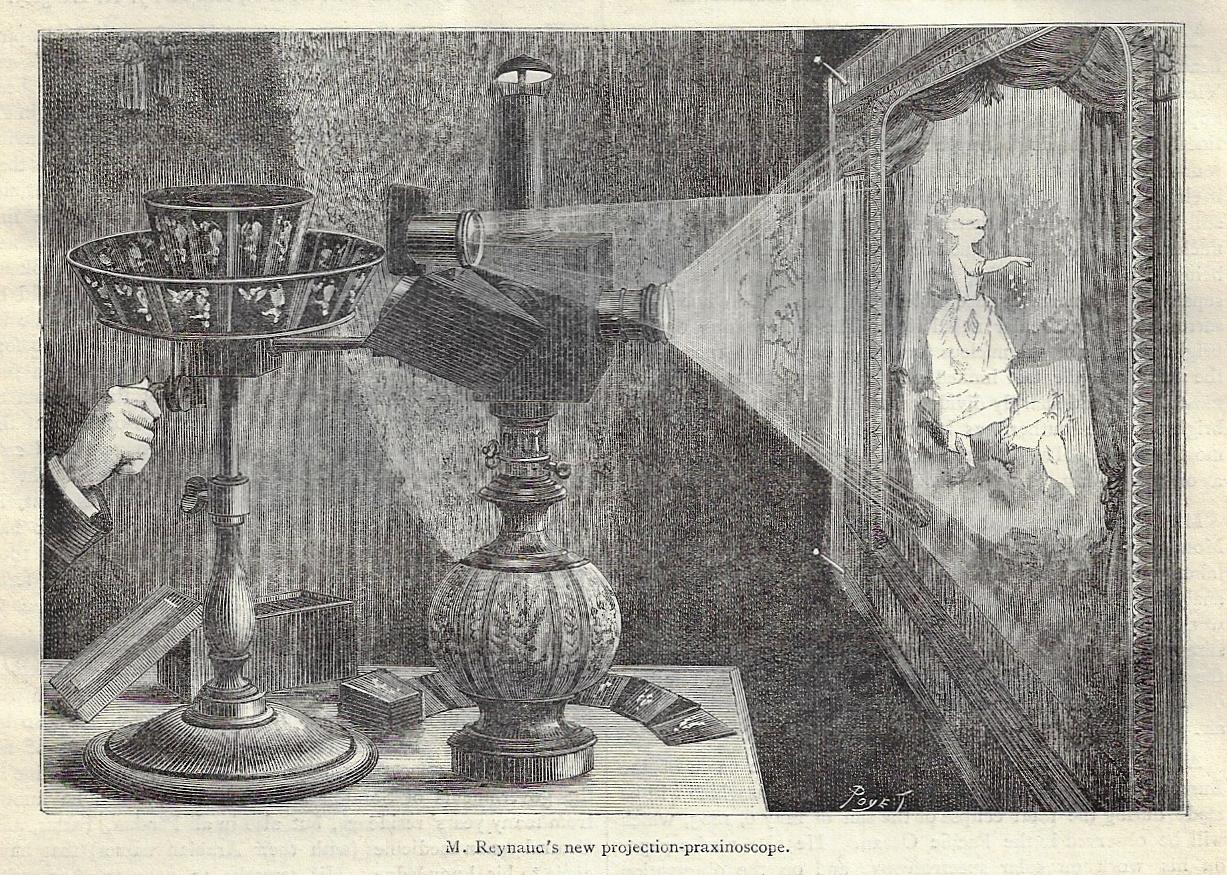
    I’ve written a number of times on this blog about the move from the static to the dynamic image and the early history of cinema. And so it came to me today by accident that I found this article in Nature reporting on the optical work of Gaston Tissandier who many people will remember more for his early aviation exploits than for his work in optics. Nature shares a post made in La Nature about his projecting praxinoscope (defined below1 from the Oxford English Dictionary)–and as it turns out, the Tissandier paper is a very early published use of “praxinoscope” with this very article referenced in the OED.  The baseline here: the demonstration image is just very neat. 

    The text of the article from Nature, (November 16, 1882), a short work on the earliest stages of cinema and “moving pictures”:

    “THE PROJECTION PRAXINOSCOPE”

    “M. GASTON TISSANDIER describes in La Nature an ingenious adaptation of the praxinoscope under the above name by means of which the images are projected on a screen and are visible to a large assembly. Our engraving will give an idea of the arrangement and the effect produced. By a modification of the lampp scope M Reynaud the inventor obtains by means of the ordinary lamp at once the projection of the scene or background by the object glass which is seen at the side of the lantern and of the subject by another object lass which is shown in front of and a little above the same lantern. For this the positions or phases which form a subject are drawn and coloured on glass and are connected in a continuous band by means of any suitable material. One of these flexible bands is placed in the wide crown of the praxinoscope which is pierced with openings corresponding to the phases of the subject.”

    Praxinoscope 1882

    “To understand the course of the luminous rays which go to form the image it is necessary to bear in mind the condensing lens which placed near the flame of the lamp is not visible in the figure then a plane mirror 45 degrees which reflects the rays and causes them to the figures filling the openings of the crown. These rays reflected once more by the facets of the prism of mirror finally enter tie object glass which transforms the vertical central image into a real image magnified on screen. In making the two parts of the apparatus converge slightly the animated subject is brought into the middle of the background where it then appears to gambol. A hand lever on the foot of the instrument allows a moderate and regular rotation to be communicated. This apparatus with an ordinary moderator lamp supplies well lighted pictures and curious effects It enables us to obtain with the greatest ease animated projections without requiring any special source of light by simply utilising the lamp in daily use.”

    Notes:

    1. From the OED:

    “Praxinoscope: A toy resembling a zoetrope, in which a series of figures representing successive positions of a moving object are arranged on the inner surface of a broad, shallow, cylindrical or polygonal drum which is open at the top and has in the middle a corresponding series of mirrors in which the figures are reflected, so that when the drum is rapidly rotated, the persistence of the successive visual images produces the impression of actual motion.

    • 1878   C. E. Reynaud Brit. Patent 4244/1877 1   An Improved Apparatus for the Production of Optical Illusions called the ‘Praxinoscope’… The object of this Invention is to produce the illusion of motion by means of Drawings representing the successive phases of an action.
    • 1882   Nature 16 Nov. 60/2   M. Gaston Tissandier describes in La Nature an ingenious adaptation of the praxinoscope,..by means of which the images are projected on a screen, and are visible to a large assembly.

    ·Posted by :

    ·in:


  • The Burning of the Books, May 1933

    JF Ptak Science Books   Quick Post

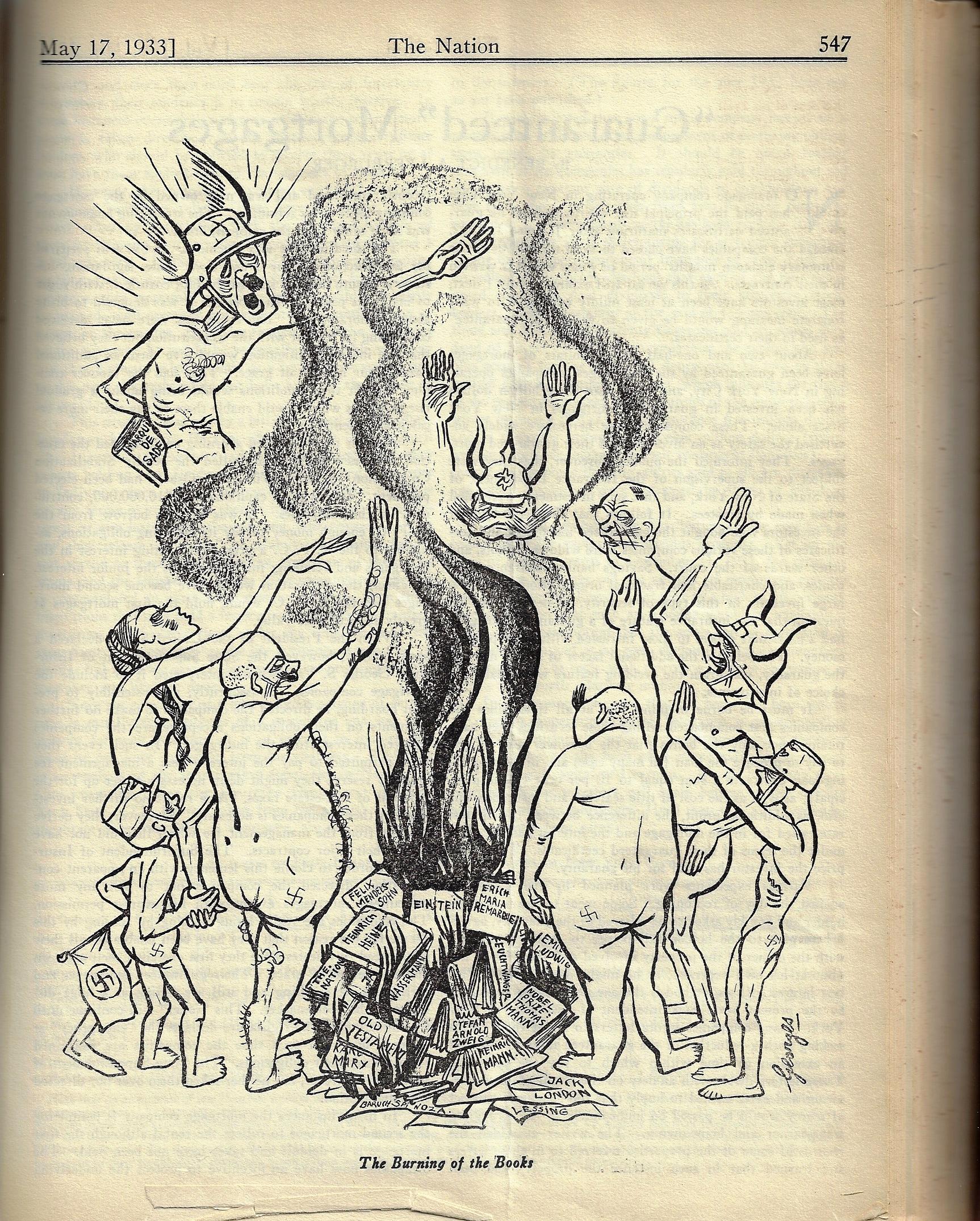
    The infamous book burnings as we knew them started in their earnest wickedness on German university grounds and city squares on May 10, 1933.  The attempt in destroying intellectualism, history, science, philosophy, beauty, and many other aspects of culture was to protect Germany from past and present destroyers of Teutonic legacy and anything that threatened Hitler’s brand-new German reich. So to that end the Nazis in control thought the best way to approach works like these was to burn it all.  

    In this editorial cartoon drawn by Georges Schreiber the Nazis are portrayed in a bestial, devilish,  and accurate light. The image appeared in The Nation (volume 136 no. 3541) on May 17, 1933, and as we can see a zombie-ish Hitler is seen in the upper left, with an aged Paul von Hindenburg to his right. The flames are built on a pile of some of the damned books, featuring Einstein front and center (as the representative of the “degenerate Jewish science”), surrounded by works id Remarque, Ludwig, Heine x2, Mendelssohn, Spinoza, London, and others:

    Burning books

    For an  example of the targeted books have a look at the following  list (from Wolfgang Herman’s “Prinzipelles zur Säuberung der öffentlichen Bücherein,”  Börsenblatt für den deutschen Büchhandel 100 (5/16/1933):, 356-358 [Principles for the Cleansing of Public Libraries] was for the use of librarians in keeping their collections free from various types of art/science/tech/literature/art/music, and needless to say anything that was written by a Jewish author):


    “1. The works of traitors, emigrants and authors from foreign countries who believe they can attack and denigrate the new German (H.G. Wells, Rolland) ; 2. The literature of Marxism, Communism and Bolshevism. 3. Pacifist literature. 4. Literature with liberal, democratic tendencies and attitudes, and writing supporting the Weimar Republic (Rathenau, Heinrich Mann); 5. All historical writings whose purpose is to denigrate the origin, the spirit and the culture of the German Volk, or to dissolve the racial and structural order of the Volk, or that denies the force and importance of leading historical figures in favor of egalitarianism and the masses, and which seeks to drag them through the mud (Emil Ludwig); 6. Writings of a philosophical and social nature whose content deals with the false scientific enlightenment of primitive Darwinism and Monism (Haeckel); 7. Books that advocate “art” which is decadent, bloodless, or purely constructivist (Grosz, Dix, Bauhaus, Mendelsohn); 8. Writings on sexuality and sexual education which serve the egocentric pleasure of the individual and thus, completely destroy the principles of race and Volk (Hirschfeld); 9. The decadent, destructive and Volk-damaging writings of “Asphalt and Civilization” literati! (Graf, H. Mann, Stefan Zweig, Wassermann, Franz Blei). [transl. note: a derogatory term for writers dealing with upper middle class urban society]; 10. Literature by Jewish authors, regardless of the field; 11. Popular entertainment literature that depicts life and life’s goals in a superficial, unrealistic and sickly sweet manner, based on a bourgeois or upper class view of life.”

    • [Source: When Books Were Burned, University of Arizona Library, for the source and for the translation:   http://www.library.arizona.edu/exhibits/burnedbooks/documents.htm#guidelines ]

    ·Posted by :

    ·in:

    —

  • When Did the Term “Computer Science” First Appear?

    JF Ptak Science Books   Quick Post

    Some time ago I wrote a post on the origins of some scientific words, just to see how long they have been around–some are well-known in their newness (like “scientist” coming along in 1834, 1  anonymously referenced in the Quarterly Review, volume 51, page 59), others not so.

    Babbage eyes

    And so when an interesting word relating to artificial intelligence appeared I wondered when AI itself did (J. McCarthy 1955 and then Marvin Minsky 1956)…which led to the question of how old the term “computer science” is, and so on. Not wanting to spend more than a half hour on this I decided to establish the Oxford English Dictionary as the baseline for earliness in the first (or at least very early) appearances in English of these words and let it go at that. So here’s the list, a quick shake-and-bake on the early origins of some standard and not-so-standard words in computer science.

    A footnote here is that 10 of the 38 words here appear during the life of Charles Babbage (whose eye are posted above). 

    Notes:

    1.  The word is provided to us in the text of an article on Mary Somerville by William Whewell who references the word “scientist” coming from “a gentleman” who was  I guess himself; he uses the word under his own name in 1840.

      • Computer Science. 1956   N.Y. Times 28 Oct. iii. 21 (advt.)    “Unparalleled opportunities to associate with the prominent pioneers of computer science, at outstanding salaries. Electronic engineers (circuit designers and magnetics engineers), logical designers, [etc.].”

      • Computer programming: 1952   Proc. ACM National Meeting (Toronto) 20/1   “In fact three principles should apply to computer programming and operation in general, and not just to code checking.” This was followed by “computer programmer” after three years.  

    • And so:
      • computationalism, n.1979

      • computationalist, n….1956

      • computatist, n.1611

      • computative, adj.a1538

      • computator, n.1591

      • compute, n.1483

      • compute, v.1579

      • computed, adj.1680


  • The Shock of (Color) Recognition (1939)

    JF Ptak Science Books   Quick Post

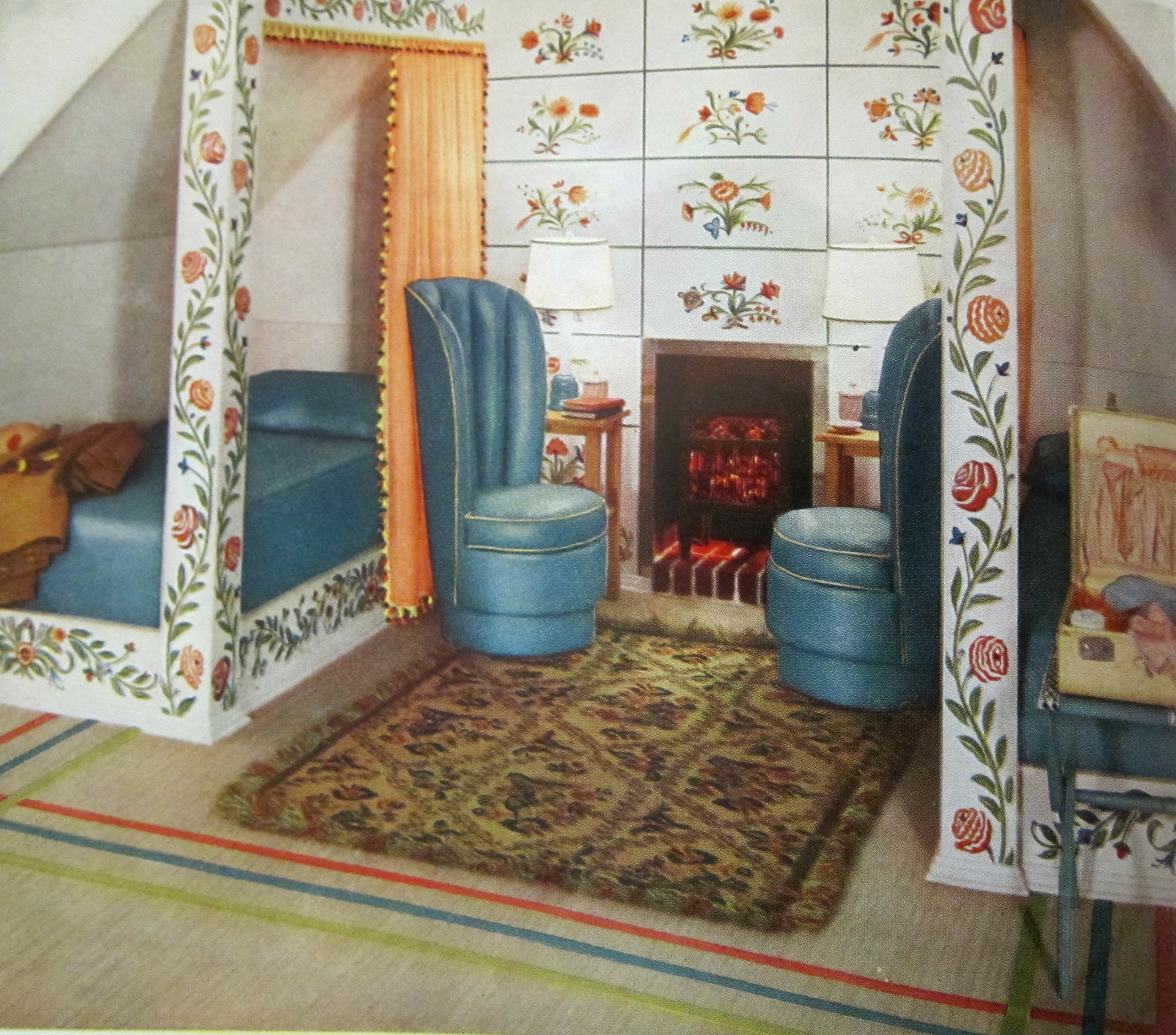
    Continuing a post from earlier today on the idea of applying a diacritical to an adjective expressing surprise (!) in the recognition of a color I share the following series of images appearing in the 1939 edition of Armstrong Cork Company’s Beauty Hints for the Home Decorator. Now, somewhere in there should be an exclamation point or two, liberally applied sentence enhancers. And that’s what I looked for, my little box of exclamation points (absent the non-existent diacriticals) when I saw photos of these spectacular rooms of distinction in the Armstrong catalog.  As I’ve written earlier, the colors (!) were quite a surprise, like seeing painted Roman statuary. For example, there is this magnificent (?) bedroom, with two twin beds, tall skinny chairs next to a tall skinny fireplace, and then those colors:

    Armstrong _3_


    ·Posted by :

    ·in:


  • Oddly Adjectival Color Plumpness, continued (1938)

    JF Ptak Science Books   Quick Post    Part of the Series on Color, Its Uses and Abuses

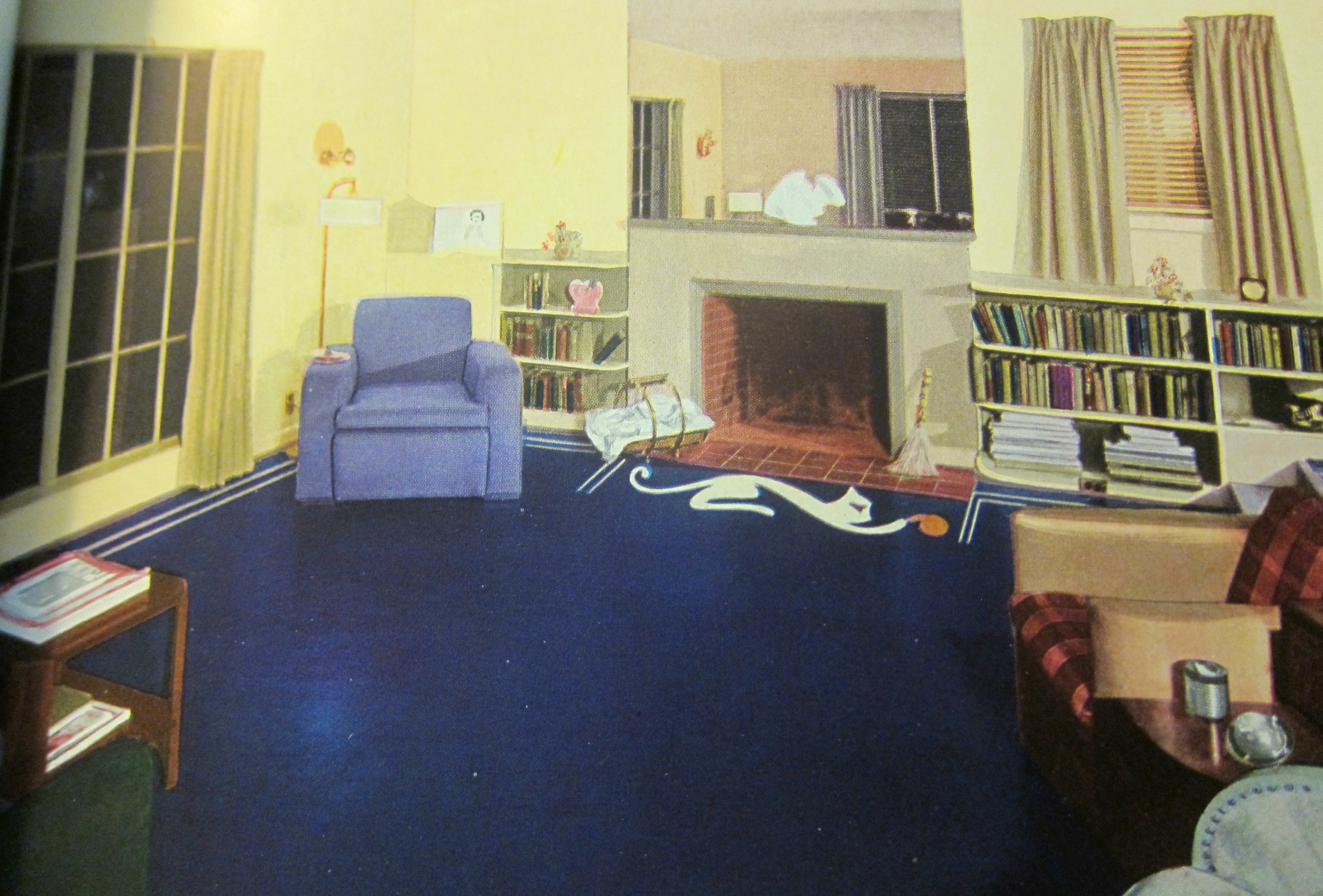
    I’ve written a number of times on what seems to be “extreme” color in the 1930’s  (as in “Oddly Adjectival Opposites: Color Plumpness and Color-in-Black-and-White, 1941” https://historyofideasblog.com/books/2011/02/odd.html) and come to it again today via the weirdly sublime color contrasts of rugs and floor coverings offered in the Bird Rug Catalog for 1938. I’ve thought about and seen so many of these images in luscious grays and stark blacks that it is difficult to think of these same images in gigantic color. It is just hard to picture Mr. Bogart’s eyes and his accusing/weary glance being framed by that blue chair and all of the colors bombarding it. There should I guess be a diacritical of some sort to attach to the vocabulary of colors to express “surprise”, as I could surely employ it in describing that blue linoleum floor:

    Bird catalog _7_

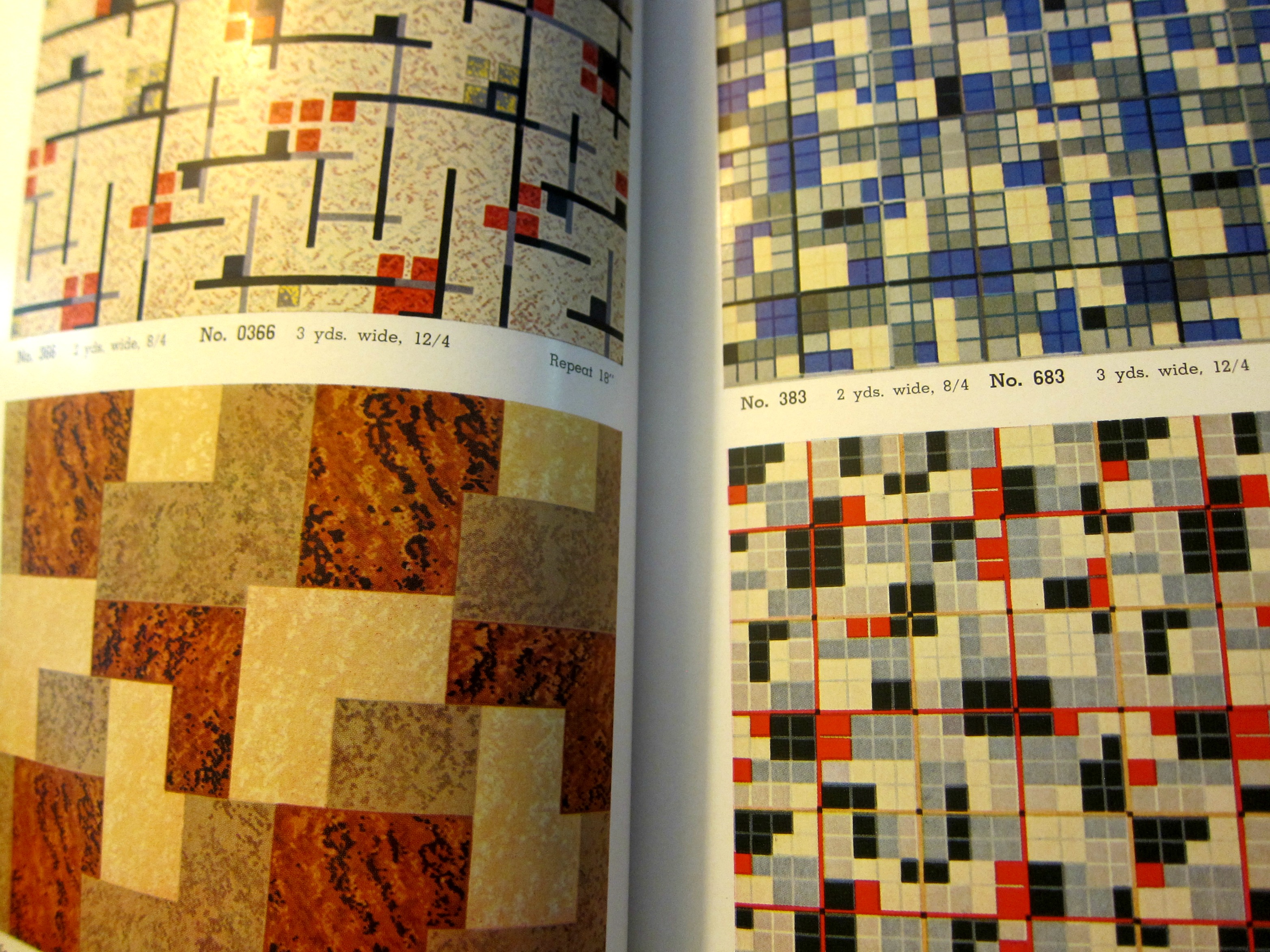
    Deep closeup of flooring:

    Bird catalog _10 detail_


    Flooring details

    Bird catalog _9_