A Daily History of Holes, Dots, Lines, Science, History, Math, Physics, Art, the Unintentional Absurd, Architecture, Maps, Data Visualization, Blank and Missing Things, and so on. |1.6 million words, 7500 images, 4.9 million hits| Press & appearances in The Times, Le Figaro, Mensa, The Economist, The Guardian, Discovery News, Slate, Le Monde, Sci American Blogs, Le Pont, and many other places… 5000+ total posts since 2008.

Author: JF Ptak

  • The Invasion of Musical Robots, 1929

    JF Ptak Science Books    Quick Post
    Robot music _2__0001

    There is little doubt that scribes and woodblock cutters and such absorbed the stab of the movable type printing press, and that stationers felt the stab of modernity when the telegraph came into play threatening sales of paper generally used for letter-writing, an art form that they felt would be diminished by the new technology. At about the same time though came the second revolution in mail delivery, which made it cheaper and more regulated in using a more-competent mailing system, which meant an increase in letter writing. Ditto that for the telephone, which again would threaten written communication. Movies too threatened the theater, and on and on.  

    And so too for music, the musician, and recorded music. I suspect that in the 53 years since Mr. Edison’s invention of the phonograph that not many musicians made very much in the way of royalties for their recorded music, at least not at this early date. (On the other hand my guess is that there was a different economic experience in the sheet music department.)  On the other hand, there was a popularization of music far beyond what had been possible in the period before recorded music, so there was at least that direct and enormous benefit.

    Then came recorded music in theaters, which was a different thing entirely, as there was no real direct benefit to musicians–in this instance, live accompaniment would disappear in favor of recorded music, and so to the jobs of thousands of players.  

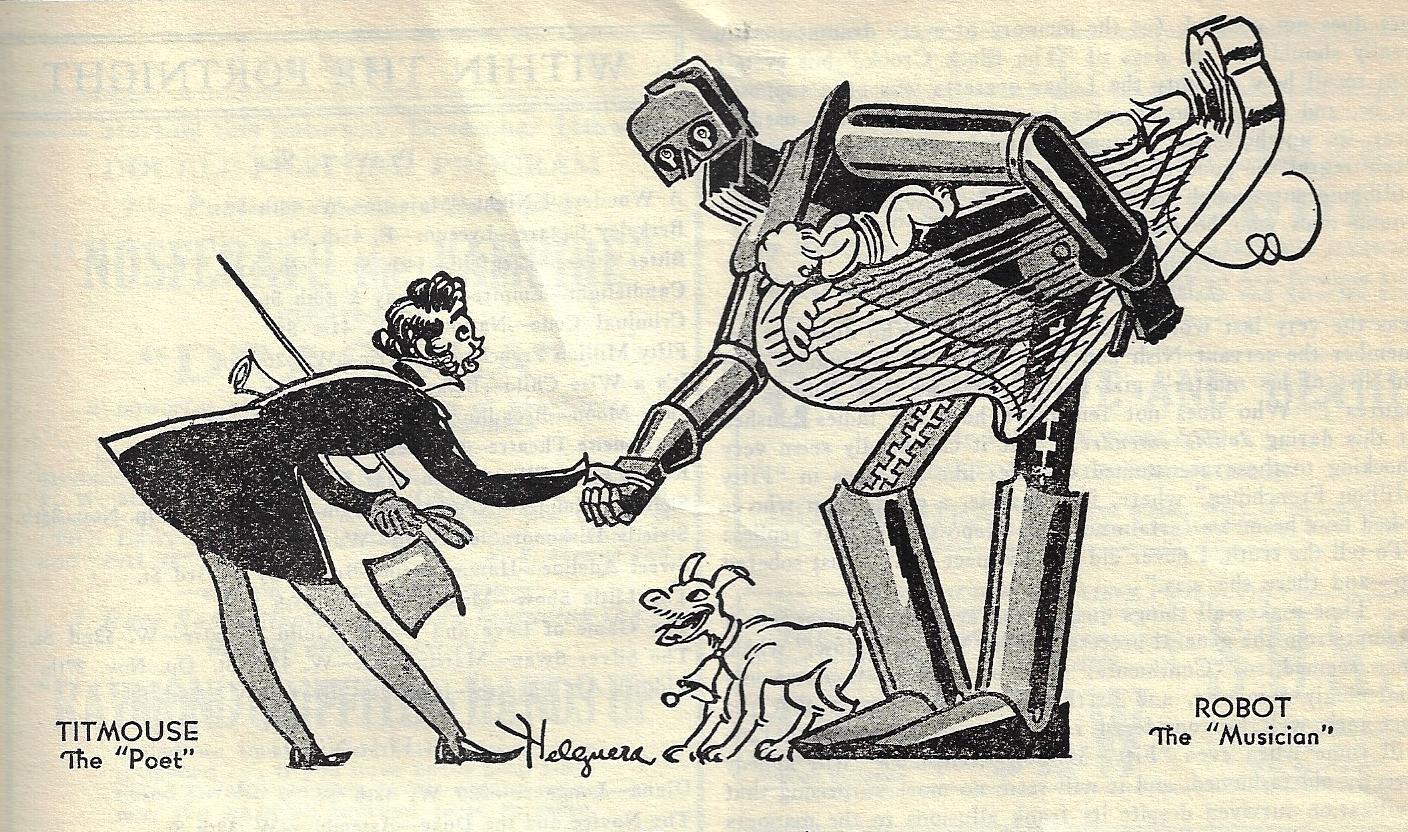
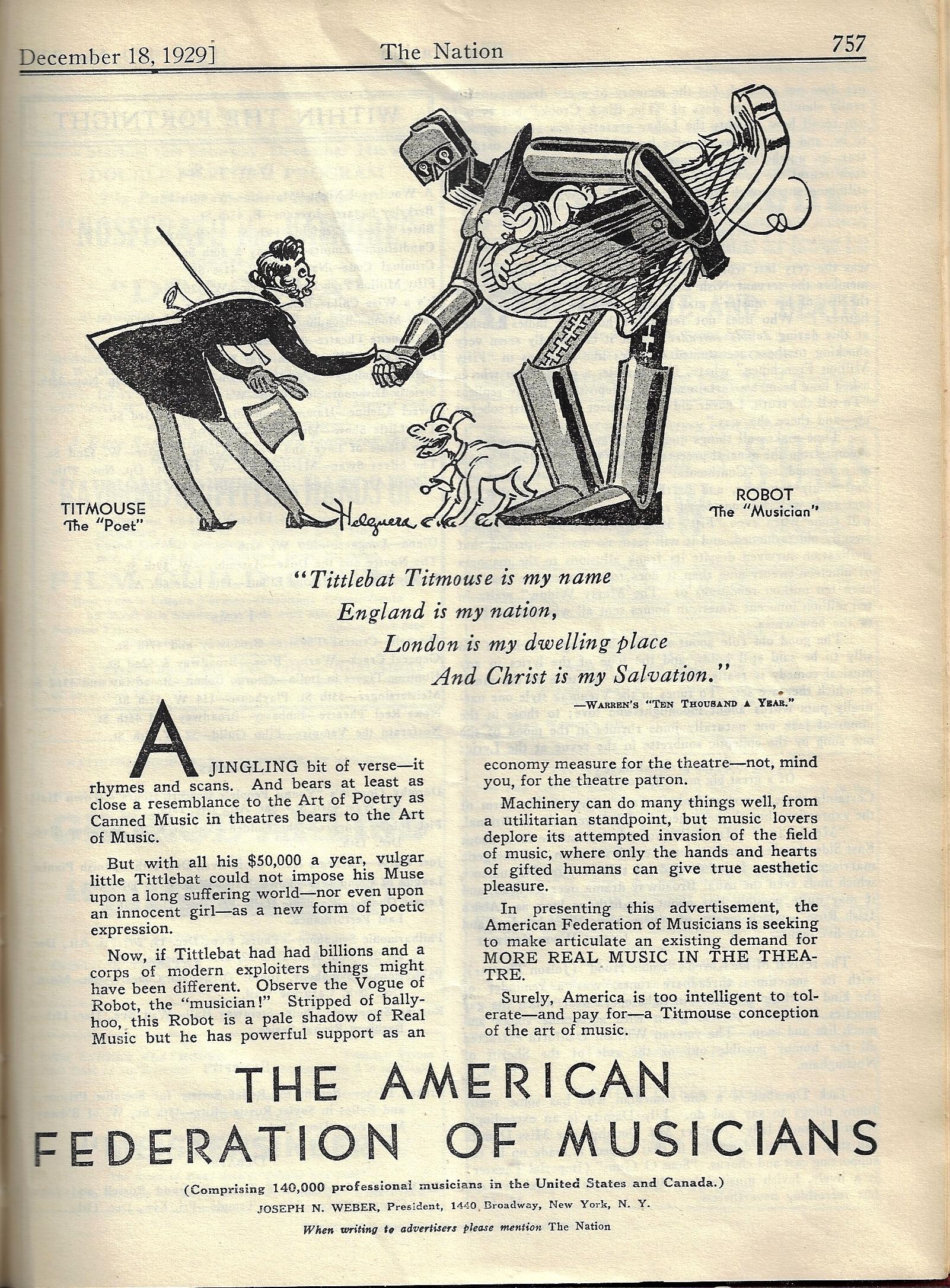
    And so the reason for this advertisement in The Nation, placed by the American Federation of Musicians, which found the idea of “canned music” to have nothing to do with “the Art of Music”, and representing it as a robot, “a pale shadow of real Music”. “Machinery can do many things well, from a  utilitarian viewpoint, but music lovers deplore its attempted invasion of music, where only the hands and hearts of gifted humans can give true aesthetic pleasure.”

    “Surely, America is too intelligent to tolerate–and pay for–a Titmouse conception of the art of music.”
    Robot musical _1__0001


  • Music as an Oil of the Industrial Machine (Muzak, 1941)

    JF Ptak Science Books   Quick Post 

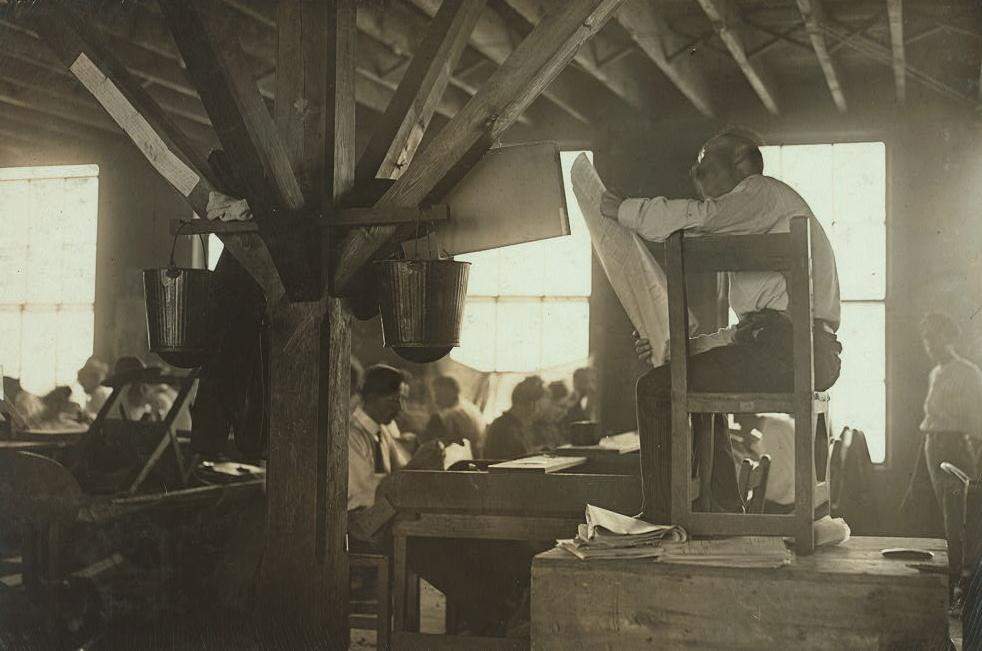
    Reading cubaEntertaining works for a happier labor force has certainly been a “thing” for quite some time–I don’t know the history very much1 but I know it extends back into the 19th c to some probably very small degree, and I do recall a Lewis Hine photo of a Lectore in Havana reading to cigar rollers (in 1909).  It makes sense to make your workers comfortable and to work to end intellectual monotony, though few employers proceeded that way. 

    And thus to Muzak, the improbable source of injecting music into the cooperation equation of industrial control of workers.  [Source: via the Library of Congress]

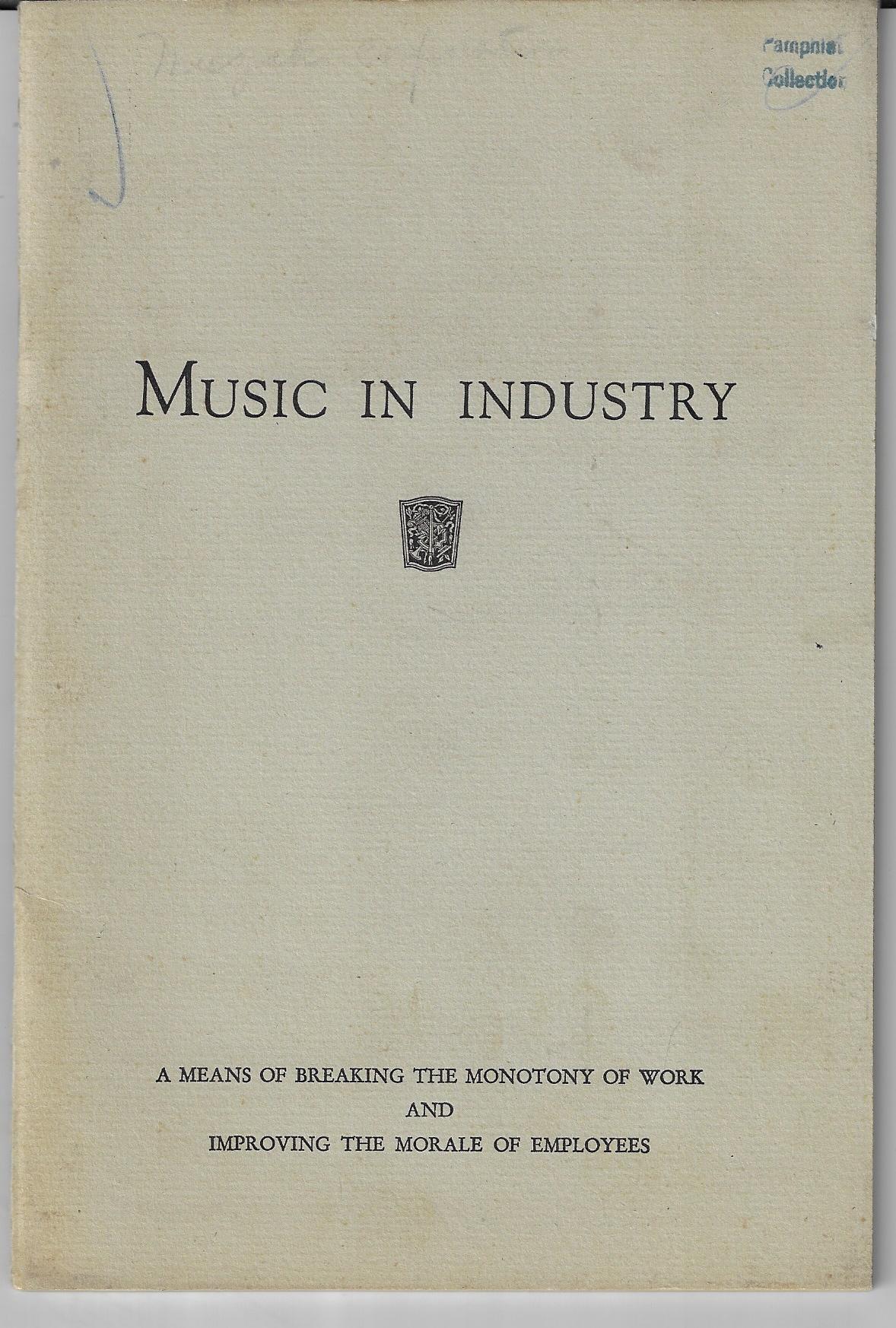
    MuzakI came to this quick realization–late to me–after finding a pamphlet in the warehouse, Music in Industry as a Means of Breaking the Monotony of Work and Improving the Morale of Workers. It was published in 1941–which is earlier than I expected for the Muzak Corporation–which adds to the surprise of the scope of the company’s long-lived impact, its history stretching back to the early 1930’s. It seems as though Muzak, which has a somewhat complex ownership and control history over its first 15 years or so, was a significant contributor to the sound landscape in the United States. It provided four  different broadcasting “networks” of selected musical patterns from the early days of wireless broadcast (at about a dollar a day per month) that provided a certain sort of architecture/design of a sound wall, though the music at this point was coming over telephone lines. In any event, Muzak started providing massive amounts of music into public and private spaces for some time, and their position was accelerated after the company’s war effort during WWII, and then becoming involved in U.S. post-war propaganda programs, and then into the Muzak that we think of today…all of which was happening a few decades before I thought it did. The fact is though that Muzak was filling silence in a controlling way in work and public places for a very long time. I imagine that one could think of this as a sort of early robotization of the human workforce–that is extreme, of course, but the thought worked its way through my head and came out here. 

    Notes:

    1. I don’t think I’ve ever mentioned this in the 4500-odd posts I’ve made to this blog in the last nine years, but the one rule I try to abide in writing one of these posts is that they take no more than an hour, start-to-finish. 
    • For an interesting read, see  Elevator Music: A Surreal History of Muzak, Easy-Listening, and Other, by Joseph Lanza.
    • There are no copies of this work found in WorldCat/OCLC, in spite of this being the second printing of the pamphlet. There are several other works by this title–generally being journal articles) and even a music in industry bibliography published in 1943, but no listings for the Muzak title. 

    ·Posted by :

    ·in:

    —

  • Grand Central Terminal, NYC,1939

    JF Ptak Science Books  Quick Post

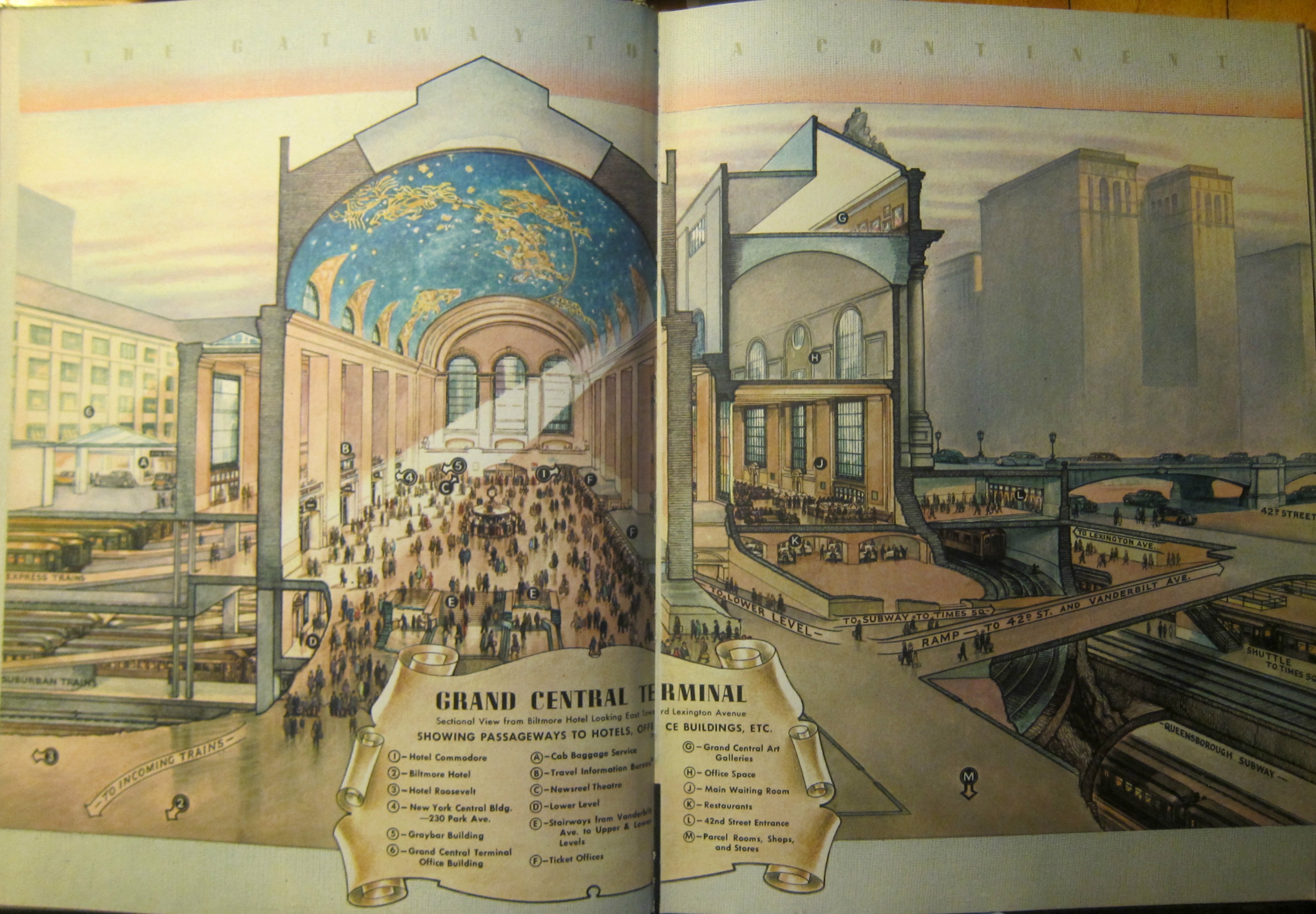
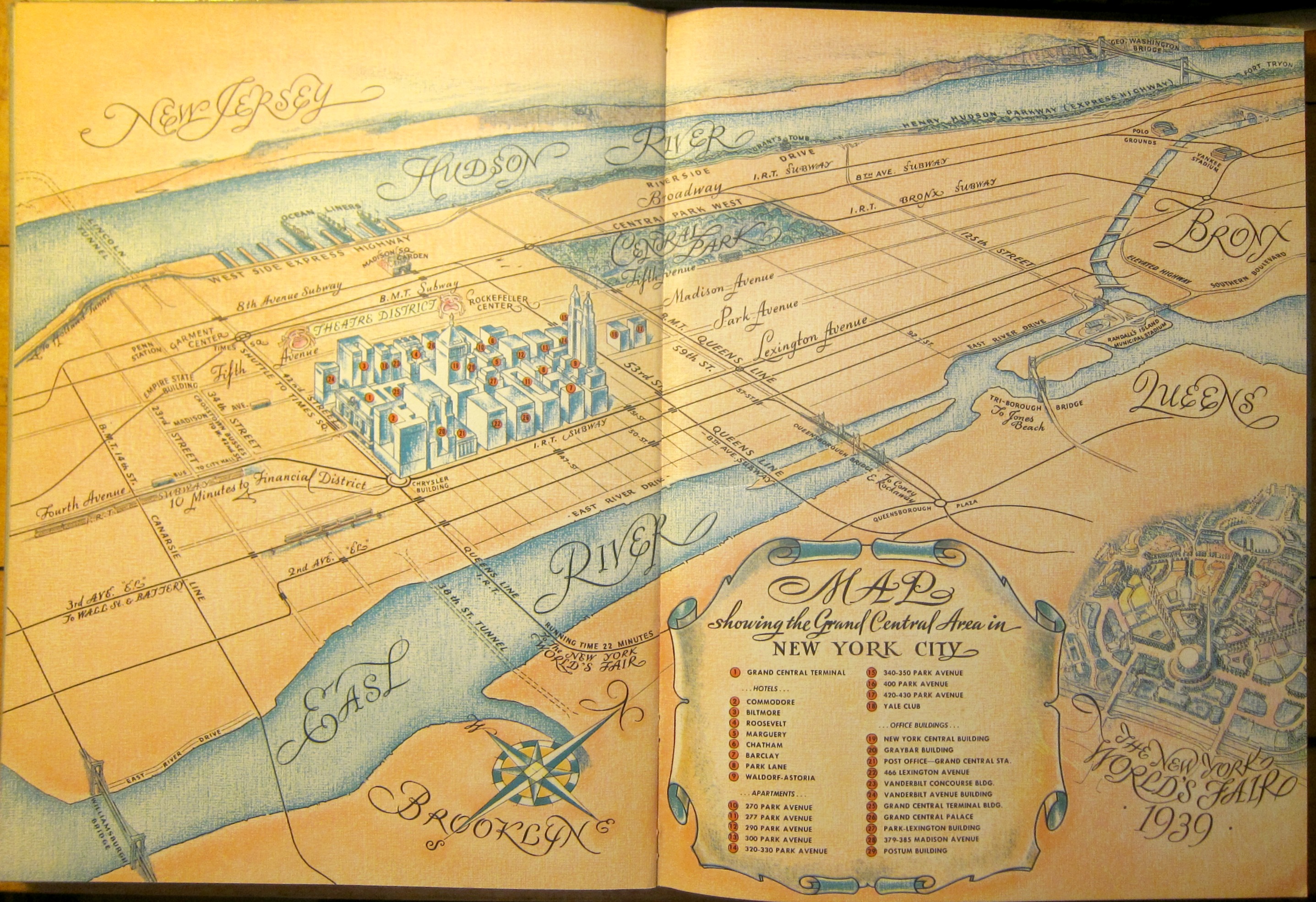
    This is a very Grand-Central_terminal-centric image of NYC–and rightfully so, being one of the great buildings of Manhattan. These images come from a promotional The Gateway to a Continent, published in 1939, which is a fairly luxurious publication which I think was intended for the appreciation of possible luxury accommodations for visitors to the 1939 New York World’s Fair. The result is an overview of the venues on Lexington/Park/Madison from 42nd-51st streets. There’s a great two-page map that shows this section in detail and which leaves out virtually everything else save the text mentions of some like “the Chrysler Building”, “the Empire State”, and “Penn Station” without images of them.

    NYC Grand Central Cutaway _1_


    NYC Grand Central Map of Manhattan _1_


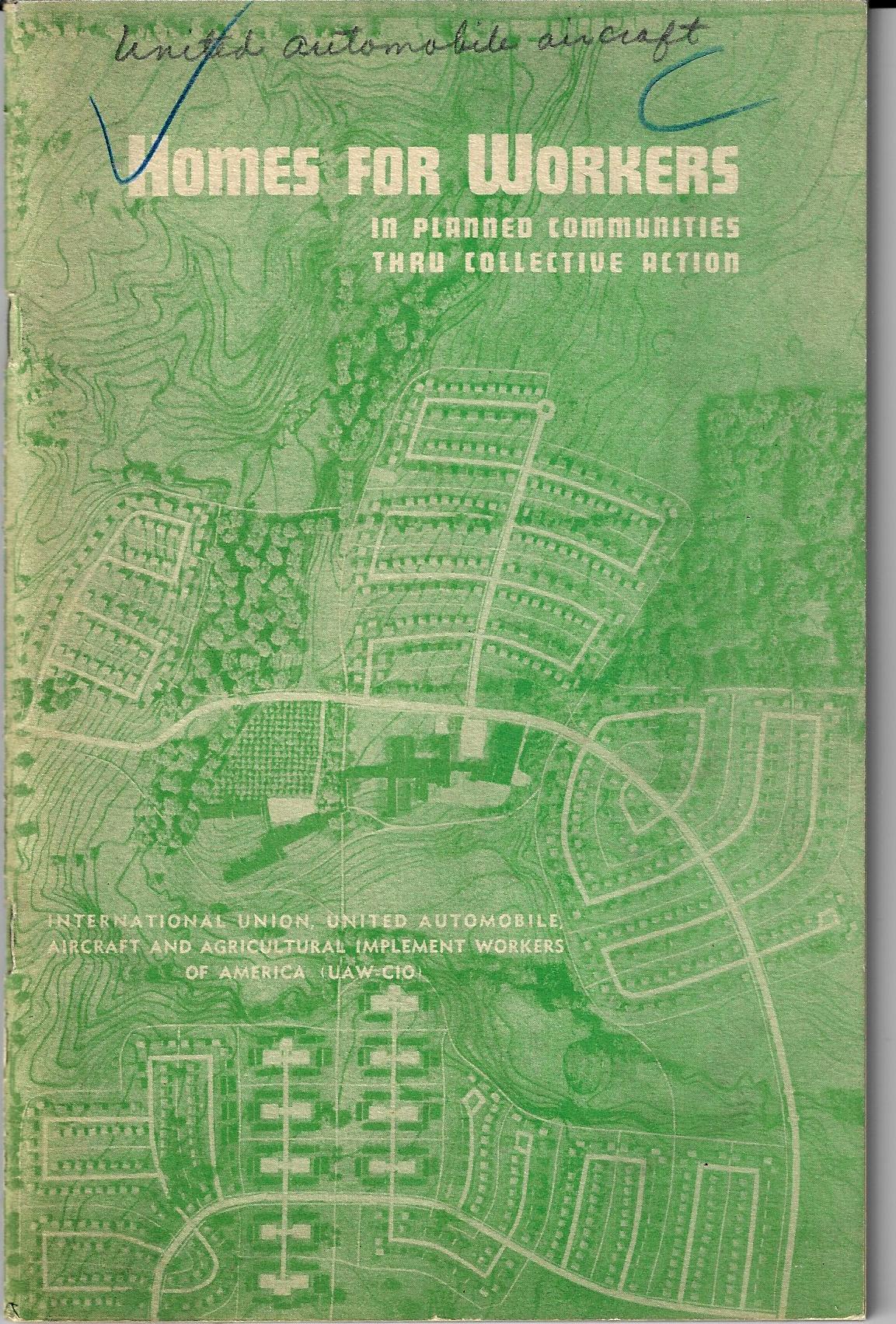
  • Homes for Workers, 1943

    JF Ptak Science Books  Quick Post

    Homes for Workers _3_


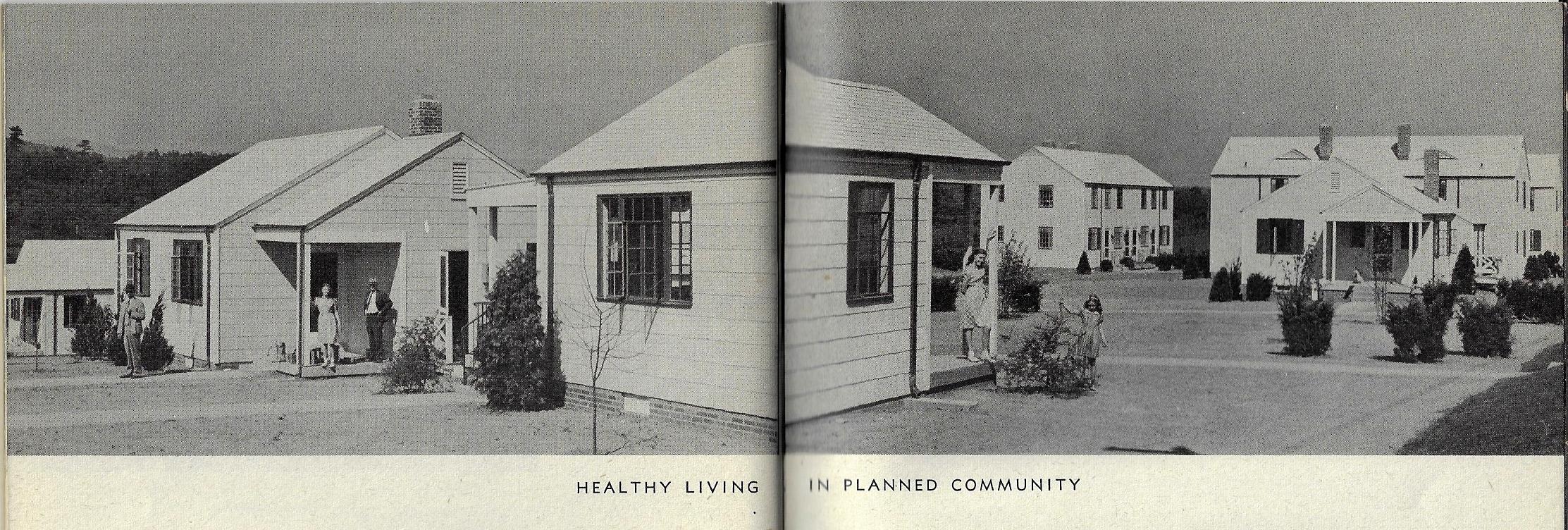
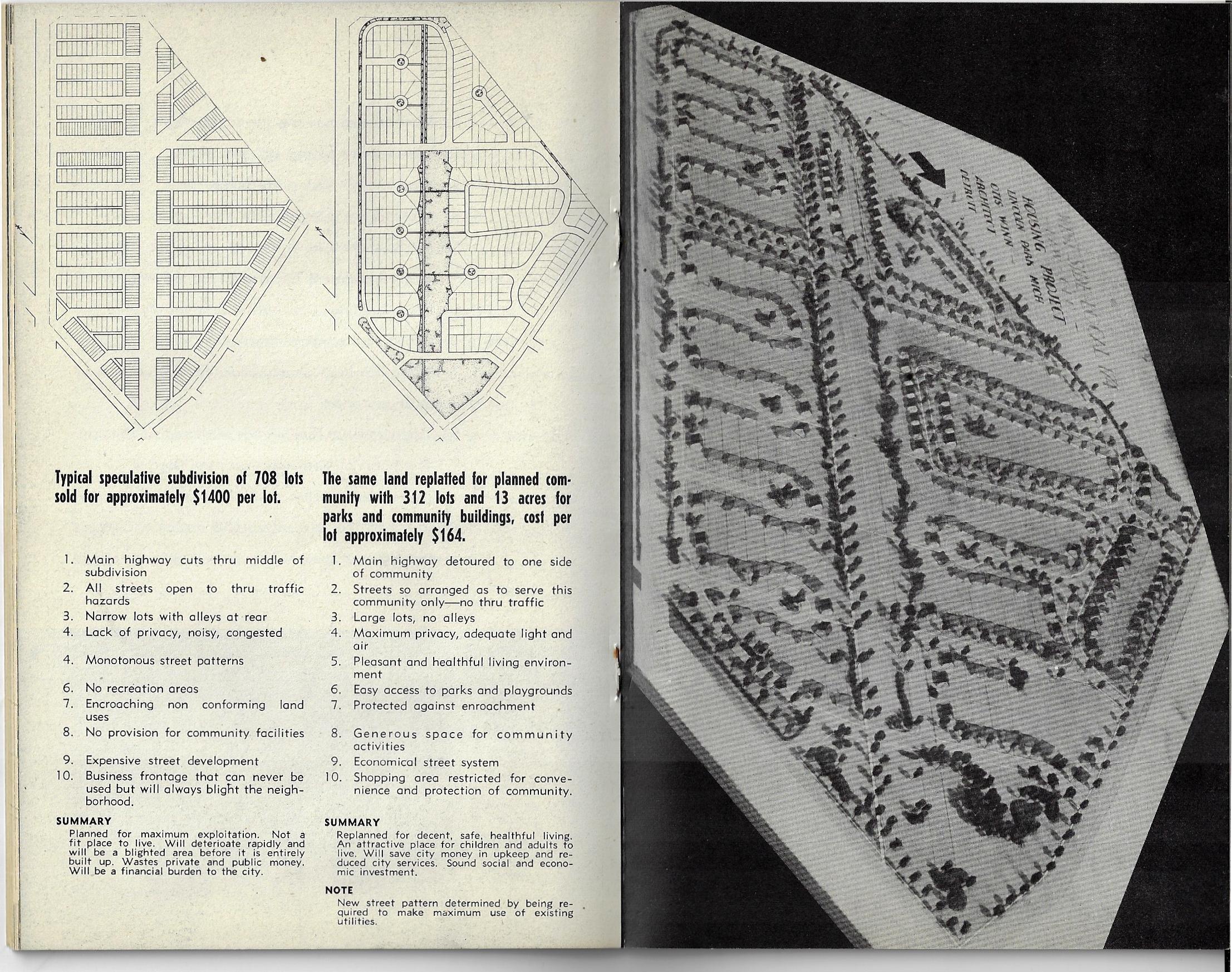
    Homes for Workers _1_This doesn’t ring quite true, nowadays, but this pamphlet, Homes for Workers in Planned Communities Thru Collective Action, published in 1943, was a work published by the massive unions UAW-CIO (United Auto Works and the Congress of Industrial Organization) in a very highly socially supportive way. The work outlines a way to organize more-or-less ideal communities for workers via collective action and pooled money, with large groups purchasing major lots of land and then contracting for construction.  No doubt there was also some thinking going on about the returning soldiers and the expansion of the general industrial base of the U.S. in a more international role. No doubt this sort of thinking would be thought of as Socialist in just a few years, once the Soviet Union had been recognized as a competitor and then an aggressive enemy.  In any event, this is an interesting pamphlet, with a certain allegiance to the general comfort of the working class. 


    Homes for Workers _2__0002

    Homes for Workers _3_

    ·Posted by :

    ·in:


  • One of the Earliest Popularly-Published Eyewitness Accounts of the Armenian Genocide (1916)

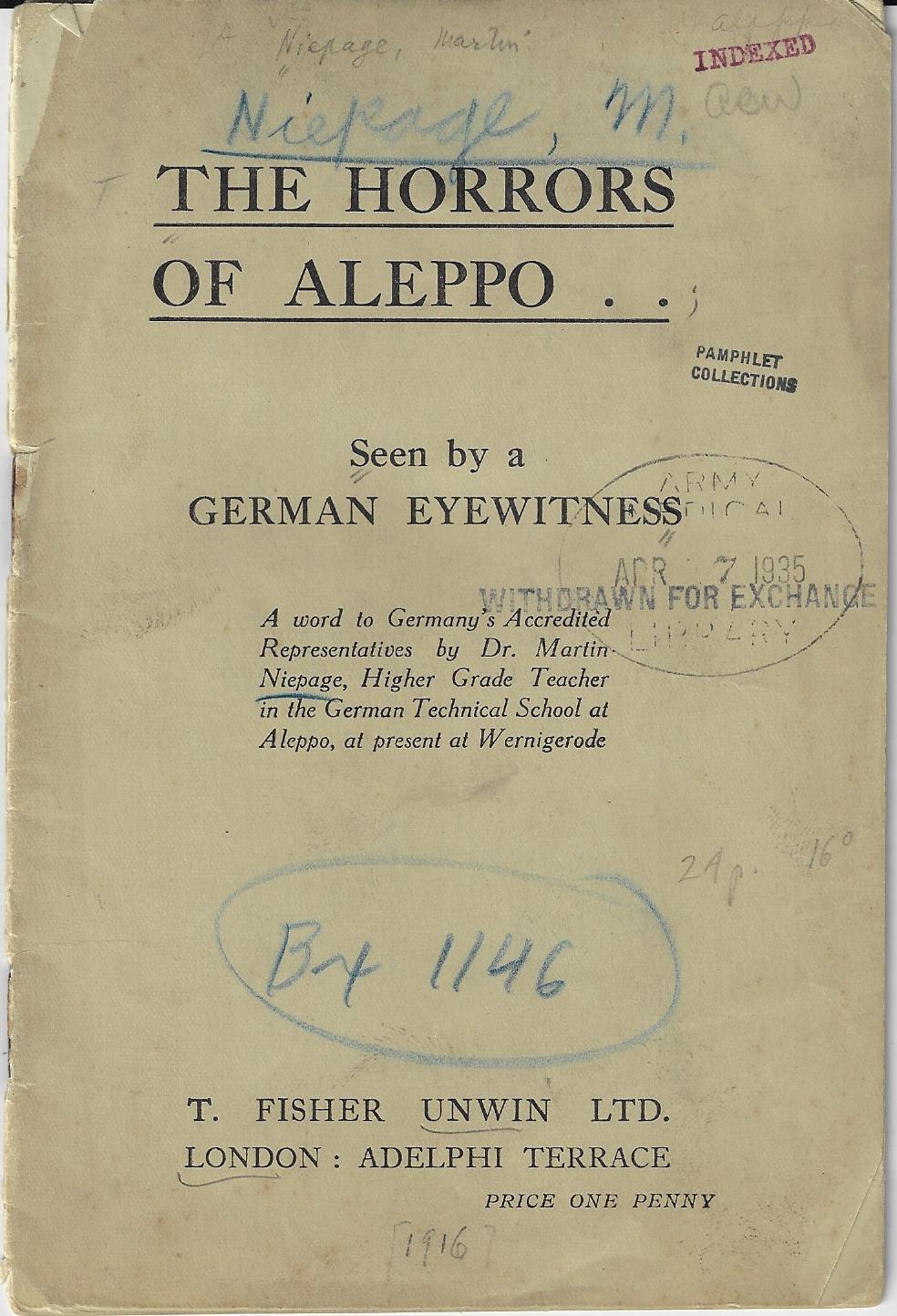
    Horrors of AleppoThis is a well-traveled pamphlet1, its face showing its miles.

    The author, the “German Eyewitness”, was Dr. Martin Niepage2, a school instructor at Aleppo, who wrote what was to become (apparently) the first popularly-published account in the West of the Armenian Genocide.  The pamphlet was published in 1916 and begins the story in 1915, getting quickly to the terror stories of chopped-off children’s hands. 

    “In April 1915 the Ottoman government embarked upon the systematic decimation of its civilian Armenian population. The persecutions continued with varying intensity until 1923 when the Ottoman Empire ceased to exist and was replaced by the Republic of Turkey. The Armenian population of the Ottoman state was reported at about two million in 1915. An estimated one million had perished by 1918, while hundreds of thousands had become homeless and stateless refugees. By 1923 virtually the entire Armenian population of Anatolian Turkey had disappeared.”–Armenian Genocide Organization

    The full text is located at archive.org  https://archive.org/stream/horrorsofaleppos00niep/horrorsofaleppos00niep_djvu.txt

    From the Niepage text:


    ·Posted by :

    ·in:


  • The Highways of Tomorrow 1937 (and 1938)

    JF Ptak Science Books    Post 2701

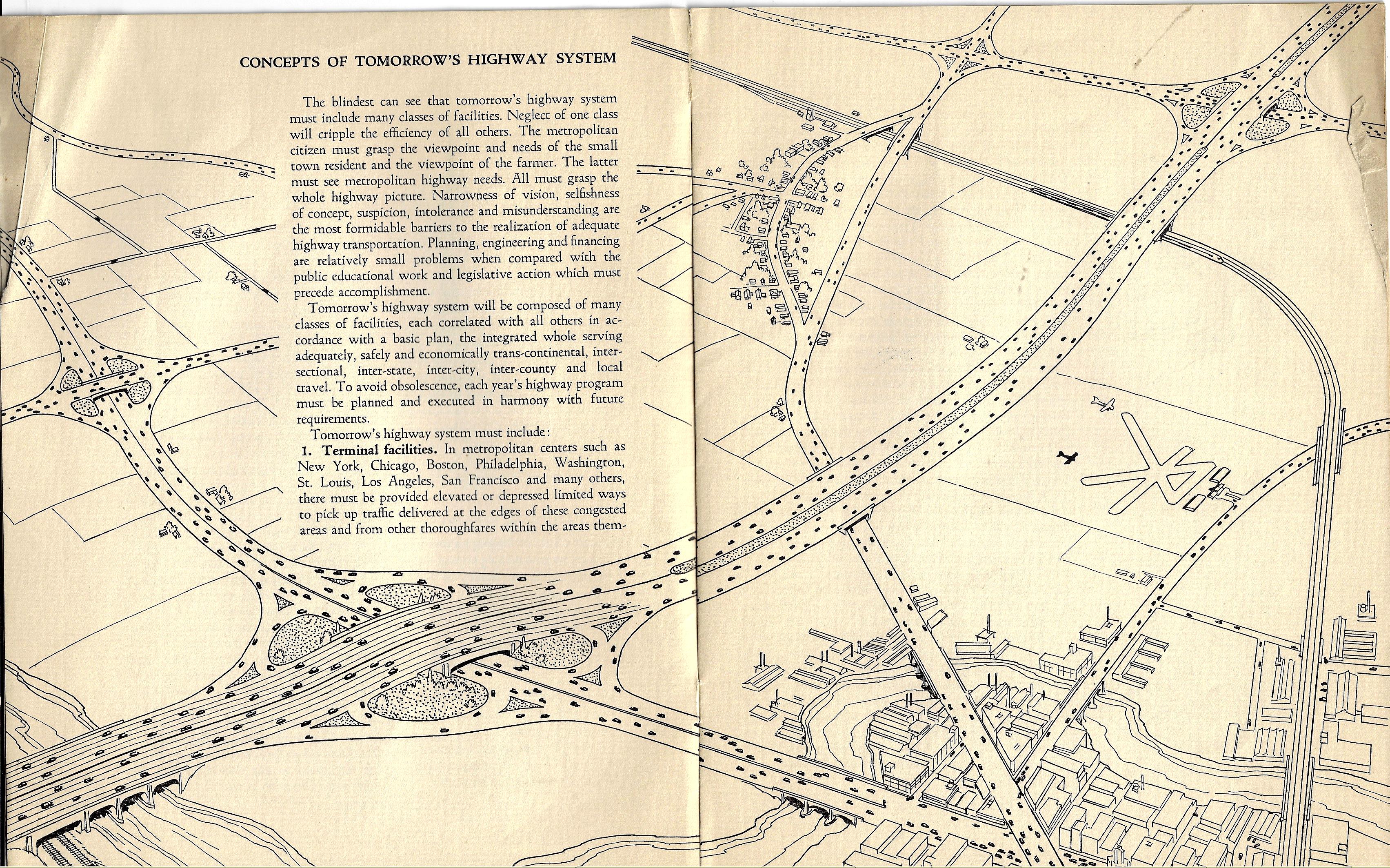
    The future–as presented in the following two pamphlets–was coming, and it was guided on a 100′-wide flat ribbon of cement, with a life-blood moving along it at 45 mph.  It is presented by Frank Sheets (president of the American Association of State Highway Officials), and the world looked like the cement that would be produced and purchased from the publisher of this pamphlet, the Portland Cement Company. And they’d be right, there would need to be something for the exploding auto market to get to and fro on the expanding horizon of city- and suburb-spread. To that end there exists in this work a proposal for 3 million miles of highways at a cost of $57,000,000,000, which was equal to about 75% of the entire budget of the U.S. government. It was a big plan–the proposal itself can’t be found in the pamphlet.

    Highway of the future

    [Source: Frank T. Sheets, The Highway of Tomorrow, Delivered at the Annual Meeting of the Greater New York Safety Council at Hotel Astor in New York City, April 14, 1937.] 

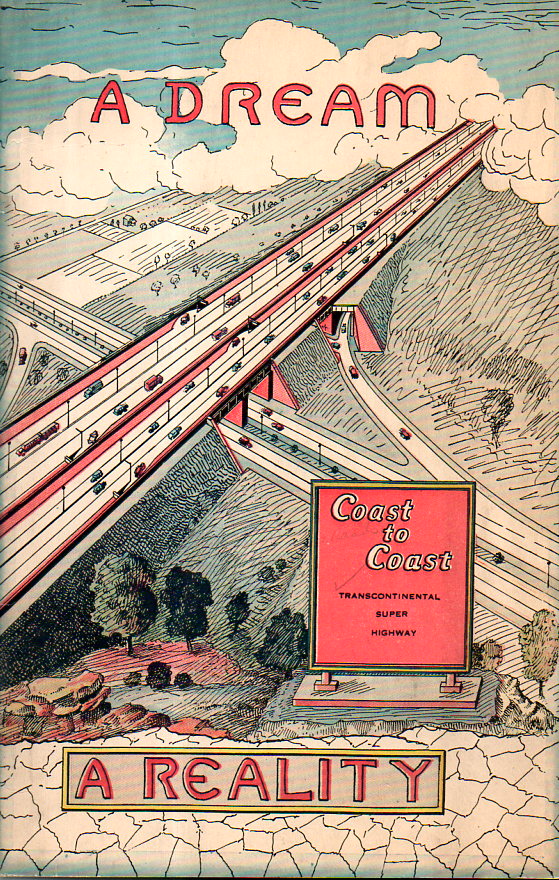
    Another vision of the future A Dream, a Reality” and/or “Coast to Coast Transcontinental Super Highway isn’t actually the title of this work even though they are on the cover; it is mostly a caption for an interior image though it somehow percolated topside.  The real title is The Highway of Tomorrow made Possible by the Ideal of Today, which gets to the subject of the work even though it is slightly unwieldy. It is difficult to say who wrote this though Mr. T.E. Steiner (“Sponsor”, of Wooster, Ohio) and which somehow found its way to a fourth edition in its two years of existence, published and promoted in undoubtedly small numbers by the “Transcontinental Stream-Lined Super Highway of the United States of America” in 1938.

    Highway visionary120

    This is all about super-highways, and mainly replacing the old roads with four new roads that are as straight as straight could be. A map of the proposals features one line of the highway is straight from San Francisco to Boston; another from Laredo, Texas (!) direct to International Falls, Minnesota (!);  a third not-straight shot from Boston-Allentown-near-Valdosta Ga-Miami; and another from near-Valdosta to Cleveland. A schematic of this map though drops near-Valdosta for Jacksonville, and has the Boston-Miami route further east to include NYC and D.C., which are omitted from the map.  Ah, well.

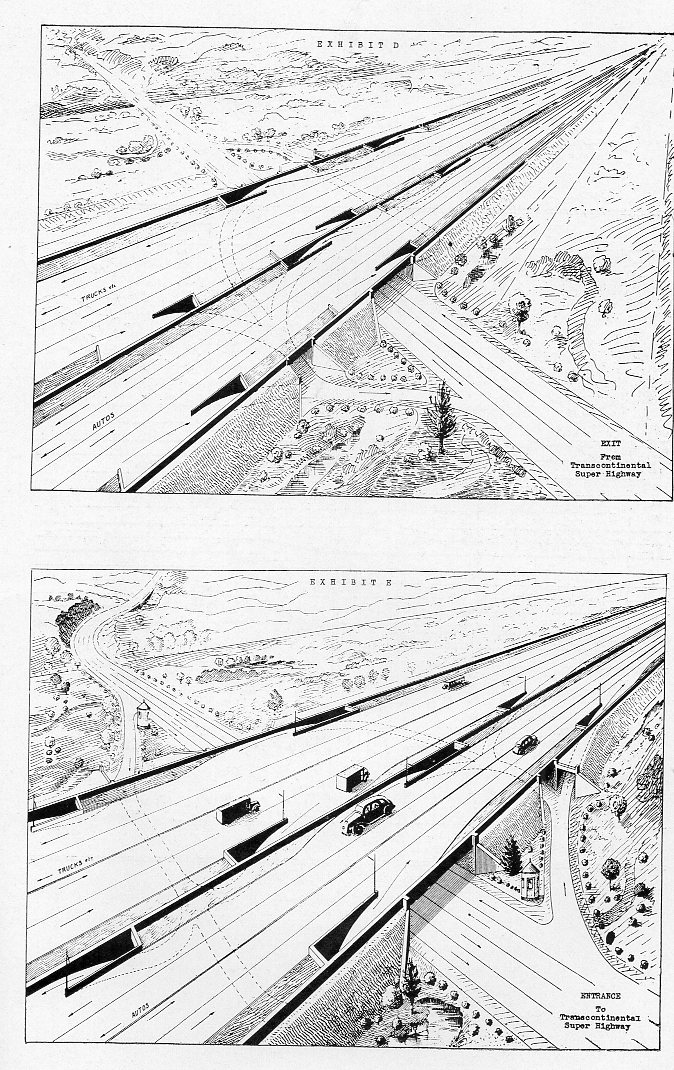
    I think that the author–an accomplished “business man” was was the head of a “manufacturing company” in Ohio and a coal company in West Virginia (and “employer of labor”) –was not much of an engineer, because the plan ignores topography and the highway design itself is pretty bad, especially the parts on exit/entrance (which the author takes particular care to note are separately copyrighted (?)) bits, which are killers. 

    Highway visionary121

    In any event, the super highway extending into the clouds on the cover is all I’m here for.  Mr. Steiner no doubt attracted some attention for the project because of the enormous pork and public works potential, what with the building of 6,000 miles or whatever of an 8-lane highway, which is billions of square feet of paving times some multiplier.  So a lot of money would be spent, which means, well, a lot of possible interest–after all, it did get so far as a hearing before the Committee on Roads, U.S. House of Representatives, on May 18, 1937.

    This no doubt was a “visionary”proposal of some sort, though the engineering aspects of it were more imaginary than anything else. 


  • Name, Rank, and Serial Number (1945, with the Audio for the Radio Play)

    JF Ptak Science Books

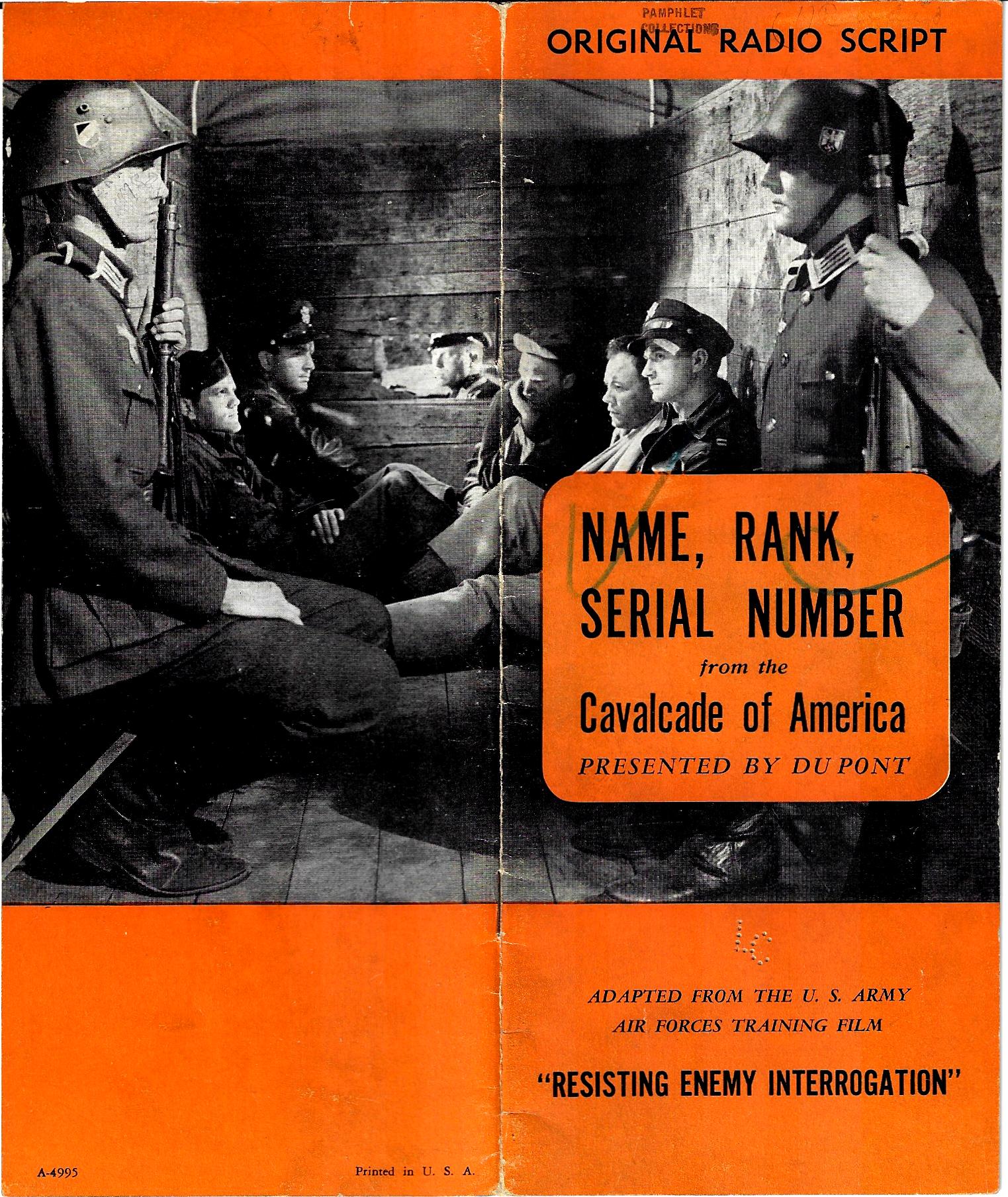
    Name rank serial numberName, Rank, and Serial Number is a tough-love drama produced by Du Pont (“Better things for better living…through chemistry“) for the Cavalcade of America, sharing the critical importance of leaked and mistakenly volunteered information and the foul end that might come to. The play was based on a training film for the USAAF called “resisting Enemy Interrogation”, which was one of certainly hundreds of such films produced by the armed forces during the war to try and prepare members of the military for situations A to Z. Name, Rank, Serial Number was the public demonstration of one of these films, and this slim pamphlet contains the script. There is nothing quite like listening to the original, though, which can be found on the American University Digital Archive site, here: http://auislandora.wrlc.org/islandora/object/hickman%3A250

    This is the story of four captured U.S. airmen  in a German POW camp, and how they faced skillful and then brutal interrogators, and how even the smallest bit of misspoken or half-volunteered mistake can lead to terrible consequences. 


    ·Posted by :

    ·in:

    — —

  • A Lovely Printer’s Device Honoring the Sciences (1724)

    JF Ptak Science Books  Quick Post

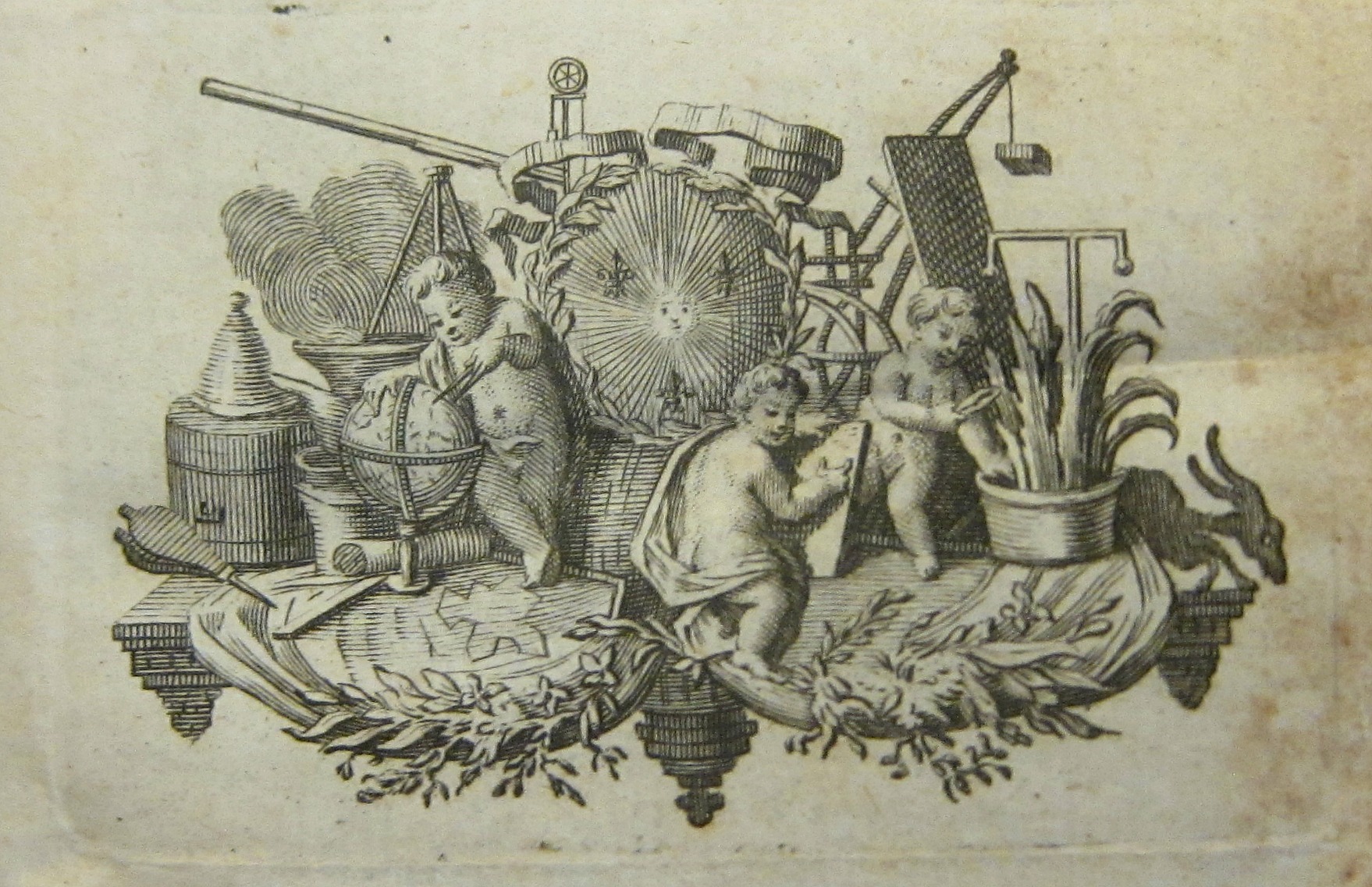
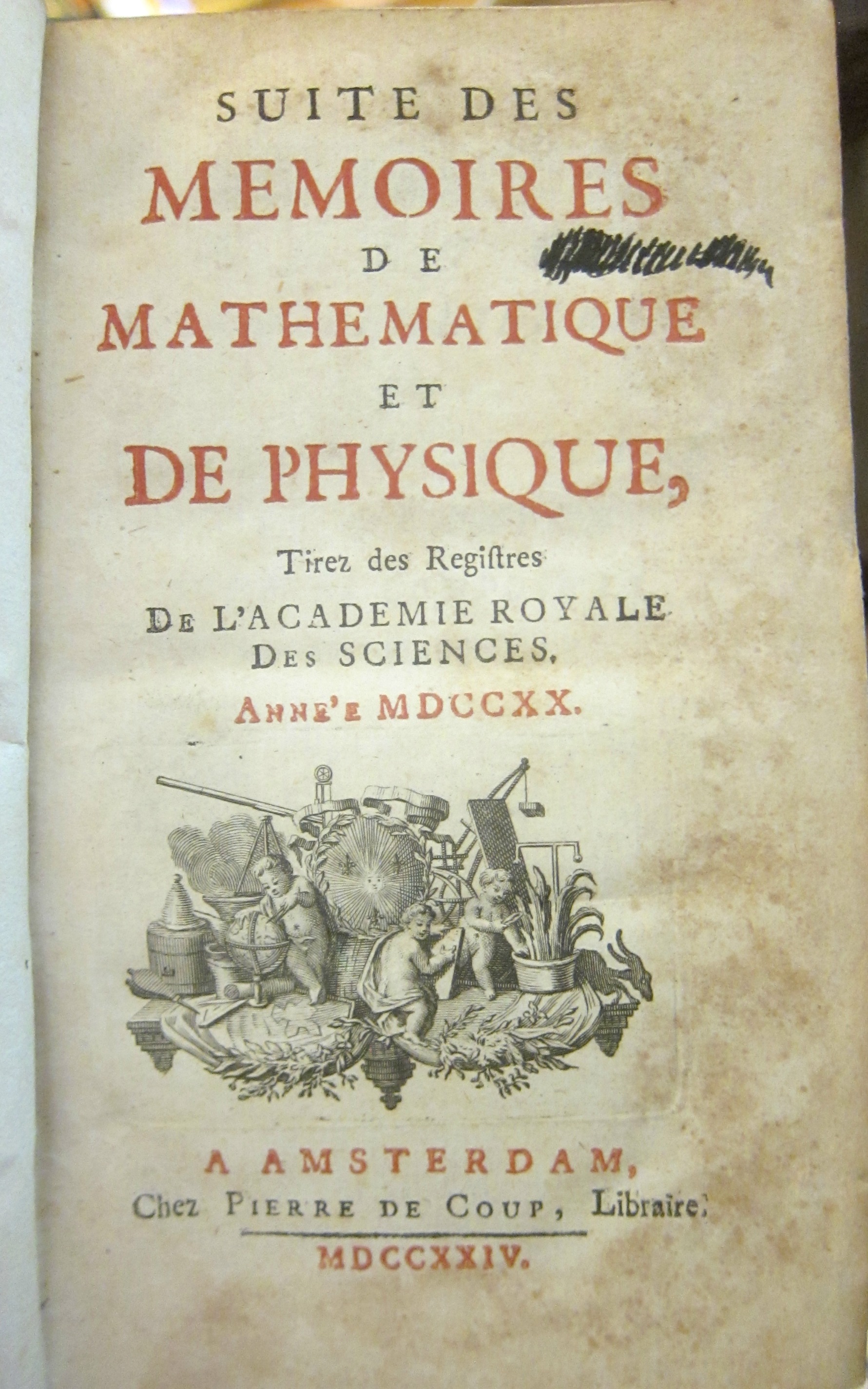
    Newly arrived here and new to my experience are some volumes of the journal Suite des Memoires de Mathematique et de Physique tirez des Registers d e l’Academie Royale des Sciences, a significant and beautifully-designed series of books which are small (only about 16cm) and very light, and their fine binding makes the book feel “correct” in your hands. I’ll be writing quite a bit about what I find in them over the next weeks and months, but the very first thing that stopped me was the scientific instrument-laden printer’s device on the title page–this the work of Pierre de Coup, of Amsterdam. The original is only about 3″ square (35x60mm), but it presents an abundant allegorical punch in a tiny space:

    Memoire de le Math


    And the full page:

     Memoire de le Math detail


    I can identify most of the instruments around the putti: right in the middle of it all is a crest with a blazing sun, no doubt indicating the reign of holy light on the impact of science and mathematics; to its rear and left is a telescope and to the right is a drawing table with a considerable balancing weight. One of the putti cuts a bit of the potted plant on the right, while another on the left works on a globe with a set of dividers (and may actually be standing on the plans of a fort).  The putto in the center (with an armillary sphere just behind him?) works on some sort of drawing, and looks down and away to the right. Additionally there are some bits an pieces: a right angle, a cauldron, perhaps an alembic, though I don’t know what that T-shaped instrument (on the right) is, or the clock-like-looking clock-like device at top-central…and I’m not sure why the bellows is figured so prominently (except for symbolic reasons). 

    For a full run of the journal see the Gallica site, here: http://gallica.bnf.fr/ark:/12148/cb32786820s/date


  • The Other Three German “B”s: Berlin, Barbed Wire, & Bayonets (1944/5)

    JF Ptak Science Books   Post 2700

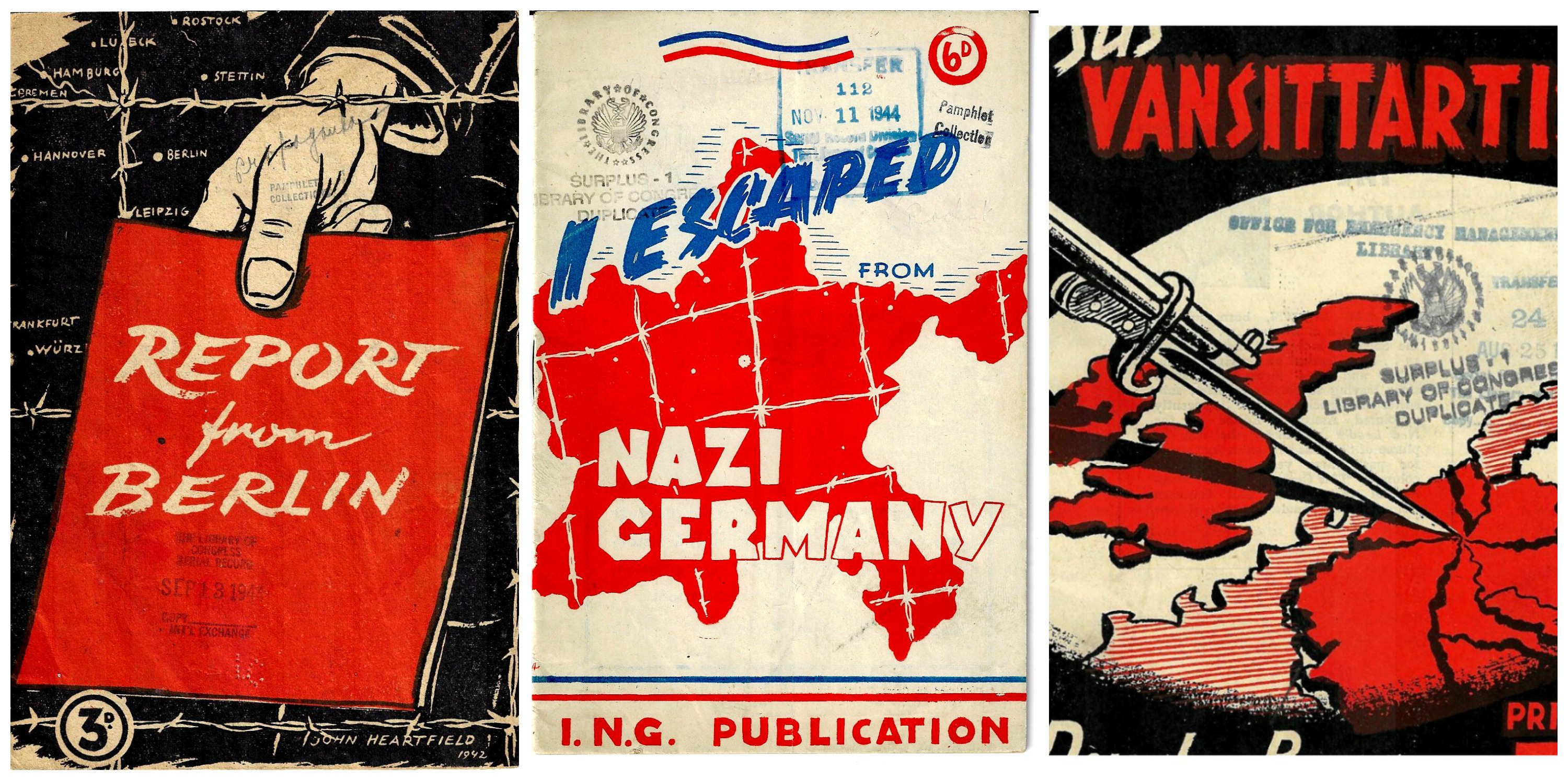
    There is probably no doubt that a lot of book and pamphlet cover art printed during the war would feature plenty of Berlin/Germany/Barbed wire/Bayonets and other sharp and pointed things leading their dagger-y way to the hearty of the country. I really hadn’t recognized it as a motif despite its pretty obvious design implications until I had three examples from my own collection right in front of me.  I’ve written about the first two on the blog before for various reasons unrelated to the sake of its design. The third, Report from Berlin ” by a German Communist” is something I thought I had addressed earlier but hadn’t, and presents a strong case in itself, as with the others.

    Germany 3 Bs


    The overall tenor in the pamphlet shows the position of doomed Germany from the inside out,  and starts the whole thing noting that “June 22 [1941] was the most fateful day in Germany’s history”, stating that “at 6 a.m.” Hitler gave a speech announcing the invasion of the Soviet Union, which the writer in 1942 finds the beginning of the end for Germany, and in this was mostly correct.  The author goes on to describe the food shortages, working conditions, morale and teh consequences of bombing, the fear and loathing of the secret police, and so forth.

    The “author” end of this equation is not clear: outside of “German communist” the writer isn’t explicitly identified. There is an “introduction” signed by Hans Kahle, who was a very prominent figure as an anti-fascist in the history of modern Germany, an impressive force, and he may well be the author of the entire text.  WorldCat/OCLC–which finds about ten copies of this work in libraries worldwide, and those mostly overseas–lists Kahle as an author, and then in another listing also lists the illustrator of the cover, the great John Heartfield, as an author as well. (Heartfield is remembered as with Georg Grosz as elevating the use of art as a political weapon, exercising it in both wars as well as the rise of Hitler and the National Socialists, and as a photo-montagist and Dadist.) In any event, the pamphlet was published by this German Communist whilst in exile in London in 1942, and was a general screed on the doomed damnation of the Nazis.  

    ·Posted by :

    ·in:

    —

  • Propaganda Maps–a Play for Greater Germany, 1938

    JF Ptak Science Books   Quick Post

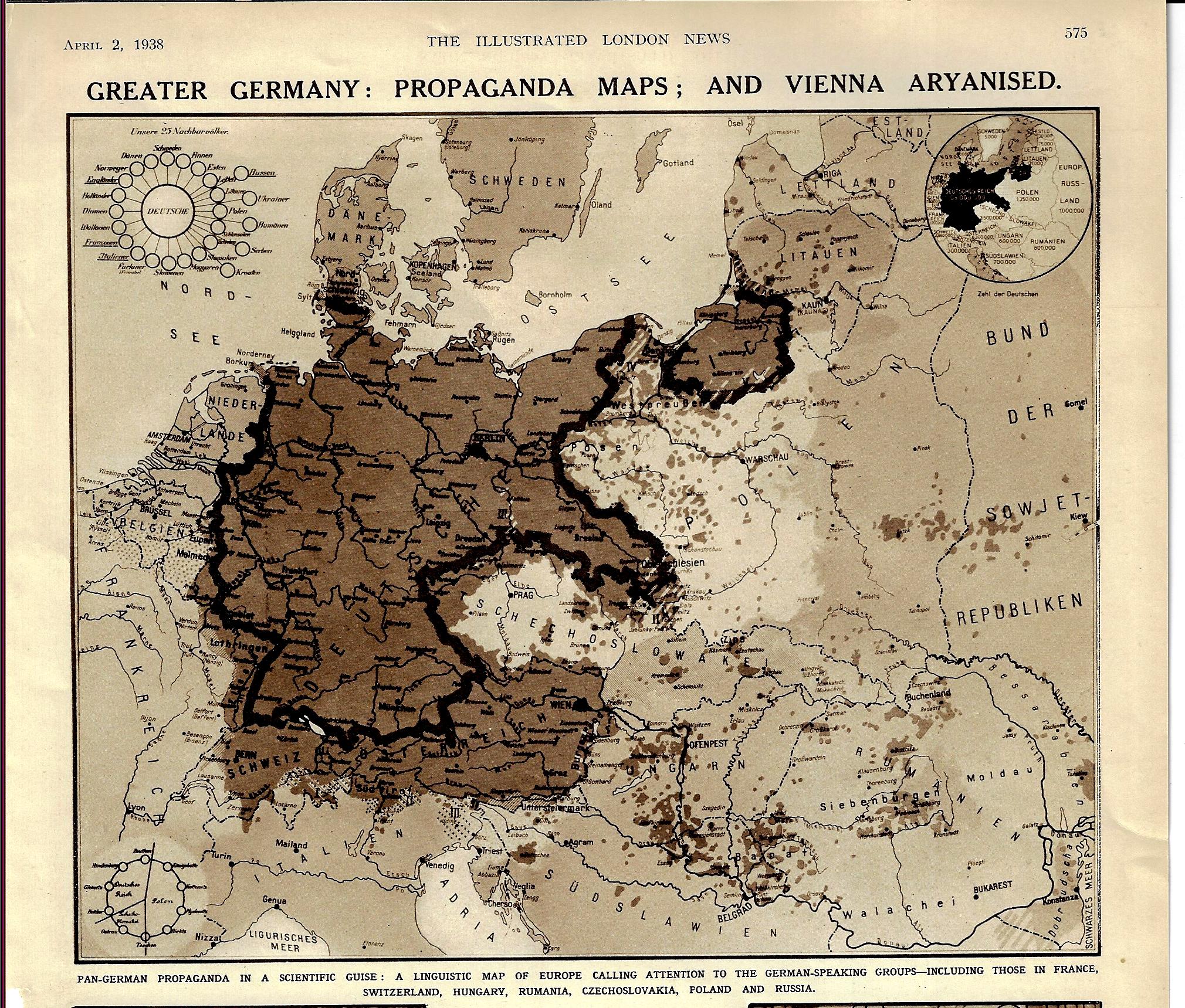
    Maps Propaganda German speaking 1938

    [Image: The Illustrated London News, p 575, April 2, 1938.]

    The title and the date of this map pretty much tells at least the partial story of the beginning of WWII. The “Aryanized” Vienna (Wien) shows up with the rest of Austria as German-speaking but also outside the boundaries of Germany, even though the Anschluss Österreichs occurred about three weeks earlier. “Pan Germany” was still figuratively so, in spite of the absorption of Austria.  Prague sits nearly surrounded by Germania irredentia, and of course Czechoslovakia was next, with Germany beginning the theft of the country that October, and then only about a year after the appearance of this article, Hitler was giving a speech at Prague Castle, also declaring Bohemia and Moravia to be the Protectorate of Bohemia and Moravia. This linguistic map certainly portrayed the gaping maw of the Nazi Kraken, Germany declaring that these actions was a natural right in the protection of Germans-outside-Germany.