A Daily History of Holes, Dots, Lines, Science, History, Math, Physics, Art, the Unintentional Absurd, Architecture, Maps, Data Visualization, Blank and Missing Things, and so on. |1.6 million words, 7500 images, 4.9 million hits| Press & appearances in The Times, Le Figaro, Mensa, The Economist, The Guardian, Discovery News, Slate, Le Monde, Sci American Blogs, Le Pont, and many other places… 5000+ total posts since 2008.

Author: JF Ptak

  • Pre-Columbian American “Exploration”–St. Brendan, the Island Whale, and All That

    JF Ptak Science Books LLC   Post #99
    Blogamericabrendan
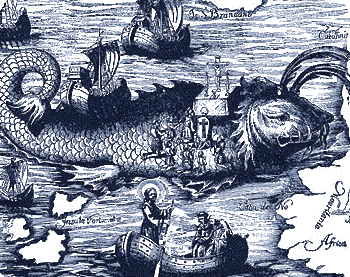
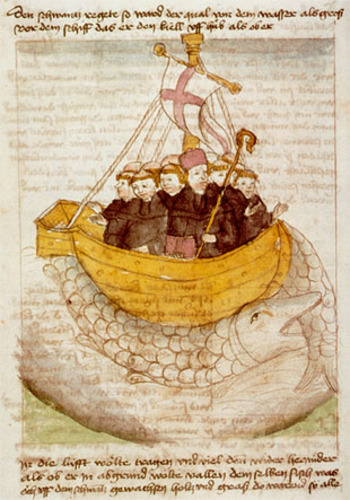
    The pre-Columbian voyages to the Garden of America– by the Phoenicians, the Vikings, the Irish, the Greeks (Euphemus the Greek navigator in the 2nd century ACE) the Welsh (Madoc), the Chinese (as found in the Shan Hai King or Shanhai Jing, adapted, enlarged, engorged fictional classic some 3,000 years old), the Japanese and English–mostly have frothy, creamy icings over a rich, textured legend.  One of the frothiest belongs to Saint Brendan, the Irish priest (of Clonfert or Bréanainn of Clonfert , c. 484 – c. 577, called “the Navigator”, “the Voyager”, or “the Bold”) whose voyage to America was particularly enhanced and layered as he arrived on the back of a whale sometime in the 530’s. His legend has him  exploring some of the high Texas country, though the Texans and most other won’t have him, be he one of the twelve apostles of Ireland or not.

    Blogamrewicabrenadan_manu

    Part of the problematic part of this Irish myth of North American exploration is Jasconius, the enormous fish/whale/island that Brendan made camp upon.  He and his followers (sometimes numbered in the 30’s, and other times in the 60’s), actually celebrated Easter on its back and only disturbed the creature after lighting afire on its back to prepare a meal.  I’ve always loved this engraving of St. Brendan celebrating Mass on the back of the beast, his trusty ship parked on the hindquarters of the accepting creature.

    There are other instances of adventurers or the lost mistaking a fish for an island and landing on it—this occurs in the tales of Sinbad, the Adventures of Baron von Munchhausen and also in the fibbing world of Pinocchio.  St. Branden’s is the only instance however of using a fish/island in an effort to reach America. 


  • Different Forms of Writing 2: Recording Movement. Dance Notation

    JF Ptak Science Books LLC Post #98
    Blogwritingdanceorch_tp

    It’s intriguing to think of writing systems standing for things other than words—for example, one has the whole of the mathematical sciences, chemical notation, Feynman diagrams, weather patterns, and on and on.  Lines and dots and squiggles and the like, not forming words, but something entirely else, an amanuensis for words. 
    Blogwritingdance

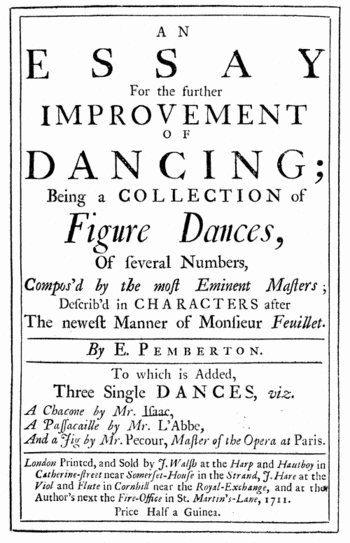
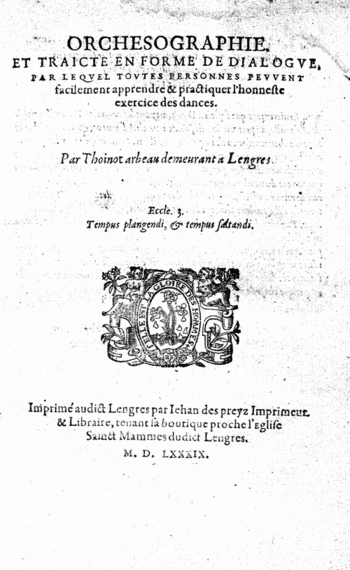
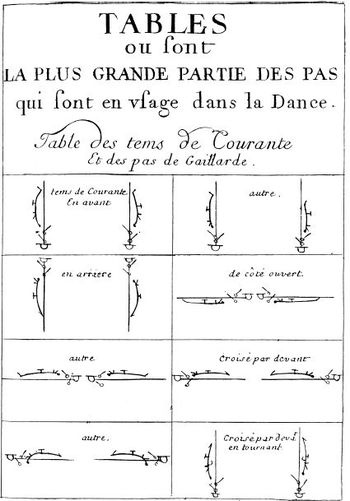
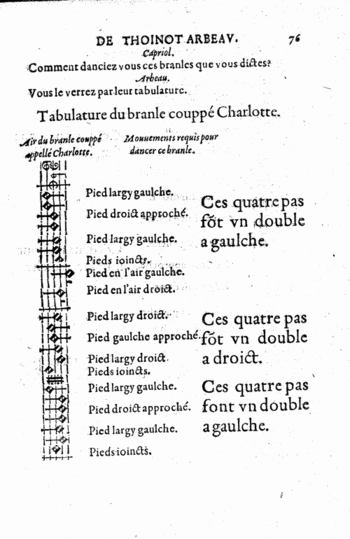
    The idea of adopting a written dance iconography—replacing drawings and written descriptions of dances—is nearly as old as the dance instructional itself.  The notation used by Lana in the 1920’s was the first image that came into my mind for this alternative wiring scheme, but in fact there were several systems for recording the simple movement and placement of the feet that reach back into the 16th century.  The first of these books to attempt to codify the movement of dance via non-descriptive writing is the letter codes employed by Thoinot Arbeau in his 1588 book Orchesographie.   In this Socratic introduction to dance Arbeau showed foot and movement patterns and linked them (visually) with the music.  What Arbeau was describing was solely the movements of the feet—everything else beyond that—position of the legs,
    Blogwritingdanceitlaian_1604

    arms, head, etc.—was left unaddressed in the iconographie though he did connect them with engravings showing how the rest of the body should look at some point during the dance.   

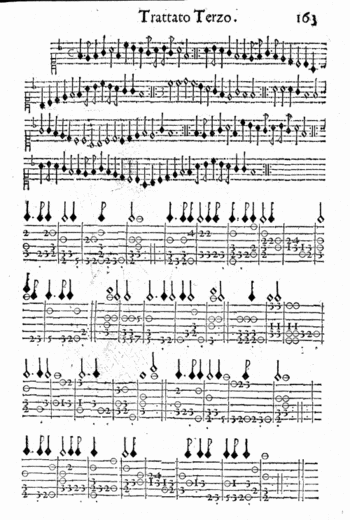
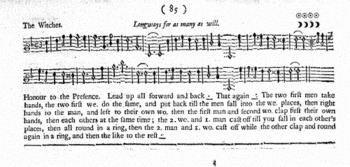
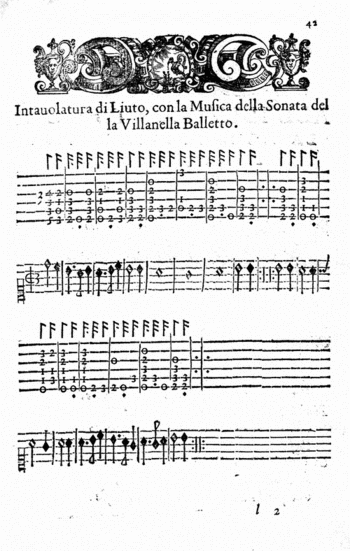
    A similar system was employed in the 1680 Nvove inventioni di balli; opera…(left) , and then again in The dancing master; or, Directions for dancing country dances, with the tunes to each dance, for the treble-violin, “10th ed. corrected; with addition of several new dances and tunes never before printed”, by Henry Playford (in London) in 1698 (below). 
    Blogwritingdancuingplayford

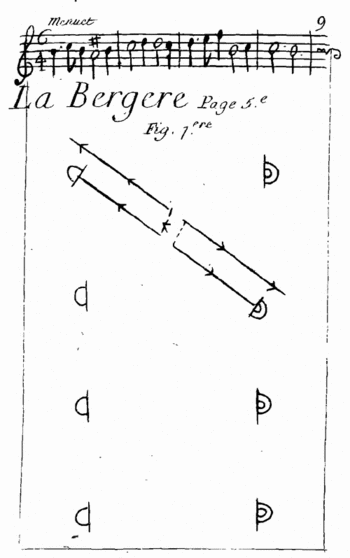
    A major development occurs in the Choregraphie of Pierre Beauchamps (and published by Raoul Feuillet, and known perhaps unfairly as the”Feuillet System”), which instituted a floor plan of sorts, showing the movement of the feet by symbol and viewed from . As better described by the Library of Congress site:   “Feuillet’s procedure was analytical; he broke up the steps into their mechanical parts, invented symbols for each of those parts, and organized them temporally by bars on the progression line. These bars reflect the temporal sequence of the steps according to the musical score.” (The Feuillet illustration is below.)
    Blogwritingdancefeuillet

    The view from above, or bird’s-eye view, was replaced in one 19th century system of annotation with stick figures, which were viewed from the front.  Again, from the Library of Congress: . “In his Stenochorégraphie, published in Paris and St Petersburg in 1852, Arthur Saint-Léon used a scheme consisting of five horizontal lines for the movements of the legs and one additional line for the actions of the upper body. The figurative notation signs appear directly above the musical score, relating them approximately to the musical values.”
    Movement was also recorded on whatr appears to be a musical template, using bars an staffs and musical-note-like notation to record movement, which seems to hjave possessed a more lyrical quality, with the potential for capturing more of the movemente than foot arrangements and speed of motion.  The Library of Congress writes about this in reference to the system of Vladimir Stpeanov’s 1892 Alphabet du Corps Humain, “…Procedures of sound notation are transferred to movement notation: addition (a movement is, just like a musical sound, the sum of several elements) and duration (the temporal value of a movement is indicated by the time value of the note). described the human body within a scheme consisting of nine lines, divided into three parts. The top two lines are used for the movements of the head and torso, the three middle lines indicate the actions of the arms, and the bottom four lines the movements of the legs. The position of the tail of a note indicates whether the movement concerns the left or the right body part: for the left parts, the tail is directed upwards, for the right parts, it is directed downwards. “

    In 1910 Vaclav Nijinsky published a very similar system of notation to Stepanov, using the basic template and then adding five more lines to the figure to denote movements throughout the core of the body.
    Laban

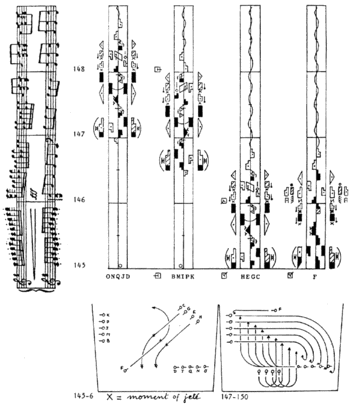
    It seems to me that the greatest pre-WWII advancements in all of this is Kinetography Laban  (and afterwards known as Labanotation), which belongs to Rudolf von Laban, who seems to have incorporated movement of the feet, the body, the head, arms, as well as expression and speed, as well as relating it all to music in his own (famous) writing system.  I call again on the authorless Library of Congress work on dance notation to for a superior and extended description of the notation:

    “Kinetography, and Labanotation use geometrical shapes as symbols that indicate not only directions, but also specific levels and duration. Direction symbols modify the basic rectangular shape and show the directions forwards/backwards and left/right as well as the diagonal directions in between; the shading of the shape indicates the direction upwards/downwards, and its length shows duration. The body is represented within a vertical system from behind that is to be read from the bottom of the paper towards the top: following the central line, the right side of the dancer is also the right side of notation. The central line represents the vertical centre line of the body, and also the progression of the movement. Next to this line, on both sides, there are the columns for all movements transferring weight. The body parts themselves are identified by particular symbols. Their various movements are observed and notated separately and then synchronized in the notation score.”

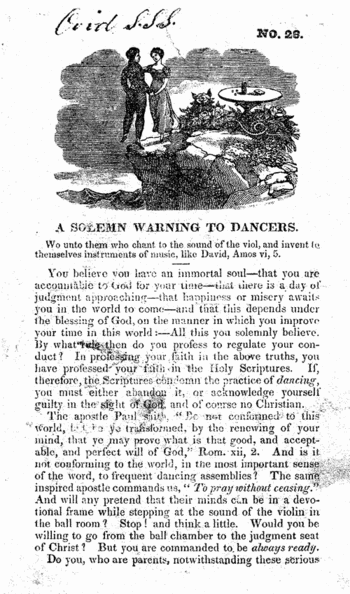
    This post would somehow seem incomplete without at least mentioning the contrary to this notation–the warnings by some religions that The Dance itself would lead humans directly to Hell.  So, not only should people not have recorded dance, but they shouldn’t be dancing in the first place.  OR thinking about dancing, for that matter.
    Blogwritingdancegoing_to_hell

    The article that I have quoted from here is found HERE.

    Some other interesting, and beautiful alternative means of writing in regard to recording dance include:
    Blogwritingdancearbot_notes

    Wilson, Thomas dancing master; An analysis of country dancing: wherein are displayed all the figures ever used in country dances, in a way so easy and familiar, that persons of the meanest capacity may in a short time acquire (without the aid of a master) a complete knowledge of that rational and polite amusement. To which are added, instructions for dancing some entire new reels; together with the rules, regulations, and complete etiquette of the ball room. By T. Wilson … Embellished and illustrated with engravings on wood, by J. Berryman; London, Printed by W. Calvert, to be had to Mr. Dutton [etc.] 1808

    Nvove inventioni di balli; opera vaghissima nella quale si danno i giusti modi del ben portar la vita, et di accommodarsi con ogni leggiadria di movimento alle creanze et gratie d’amore. Convenevoli a tutti i cavalieri, & dame, per ogni sorte di ballo, balletto, & brando d’Italia, di Spagna & di Francia. Con figure … in rame et regole della musica et intavolatura quali si richieggono al suono et al canto. Divisa in tre trattati …Blogwritingdanceitalian_note
    Blogwritingdance_tp_pember

    ·Posted by :

    ·in:

    — —

  • Different Forms of Writing 1: Big Writing With Light—Nollet, Citroen, Barnum and Packard

    JF Ptak Science Books  Post #97

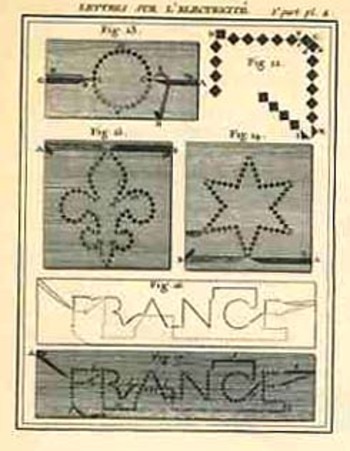
    The fabulously over-usage of light-polluting electricity in advertising finds its beginning 220 years ago with the work of a modest, family-friendly French country priest.  The image to the left is  the first example of writing via electricity—basically, the basis for the earliest electric signs, more than 110 years before Edison’s (et alia ) electric incandescent bulb, and about twenty years before the presumptive “first” electrical experiments of Sir Humphrey Davy) on the first arc/carbon filament electrical light in 1809).   \

    Bloglighting_nollet_2

    They were the product of the electrical mind of Jean-Antoine Nollet (1700-1770), a peasant boy who was educated for the priesthood (becoming Abbe), whose extensive curiosity soon led him to physics and then to electricity—he was well educated and taught at numerous prestigious schools, admitted to the Academy of Sciences as a member in 1742,  finally winding up in 1740 tutoring the dauphin at Versailles.  He published widely, was the first person to experiment with the Leyden jar in France, and made wide contributions in the conduction of electricity through different media. (He also had numerous public disagreements, some of which stood with Benjamin Franklin, whose theories Nollet referred to  as “les pretenetions de l’ecole de Philadelphie”.)  The image above was published in Lettres sur l’electricite, (part II), published in Paris in 17601 (with part I located at Gallica, here);  see the interesting Le Blog du Bibliophile, des Bibliophiles, de la Bibliophilie et des Livres Anciens, here, hosting some useful information and images relating to Nollet.  [Thanks to Jaime Day for pointing out the misattribution of the plate.]

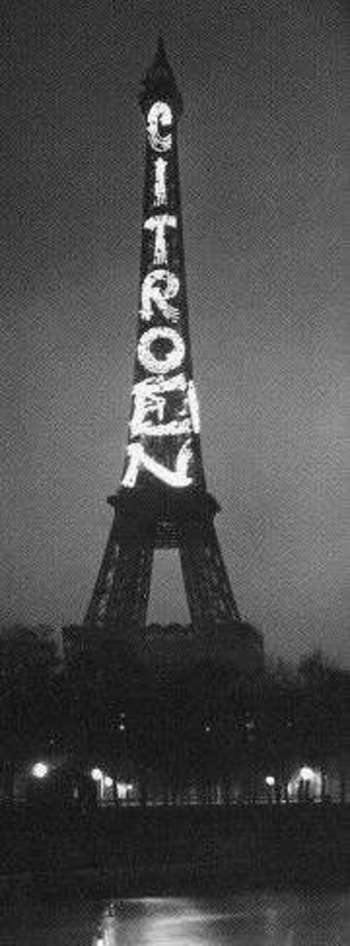
    The, um, adventurous PT Barnum contracted  the  first electric bulb writing (utilizing the Edison invention) in Manhattan in 1892 to envious attention, resulting in less than 15 years with the Great White Way.  The world’s largest electric bulb writing was on the Eiffel Tower, with Andre Citroen agreeing to light the outline of the tower if he could put his name on the rest of it.  I’m not sure how this was seen as a good idea, but the sides of the tower were used for this purposes until somebody wised up and put an end to it all in 1937.

    Bloglightingcitroen_2

    But as white and as bright as the light bulb was in advertising, it was completely overwhelmed by the invention of the bold, brassy (and with a high potential “trashy” factor) neon sign, which was first used in the United States by Earle Anthony’s Packard dealership in Los Angeles in 1924.

    Bloglightingpackard_2
    (Mr. Anthony paid $24,000 1924 dollars for the two “Packard” signs, which in today’s dollars, employing the kindest inflation factor in the comparative CPI, would be about $3,000,000.  Mr. Anthony could afford it, and the signs were a sensation.

    Notes

    1.  The full title:   Lettres sur LÉlectricité. Dans lesquelles on examine les dernieres Découvertes qui ont été faites sur cette Matiere, & les conséquences que l’on en peut tirer (part I), 1753; and Lettre sur L’electricité; Dans laquelle en soutient le principe des Effluences & Affluences simultanées contre la doctrine de M. Franklin, & contre les nouvelles prétentions de ses partisans. Avec Figures en Taille-douce. Seconde Partie, published in 1760. 


  • Missing People–[Addition]. Joachim van Ringelberg, 1541.

    JF Ptak Science Books LLC  Addition to Post #88

    I’ve
    found another extraordinary image that would fit just perfectly in an an
    earlier post, Missing People—Pelerin, Schoen and Marey and Picturing Absent and
    Empty People for the Study of Perspective
    .

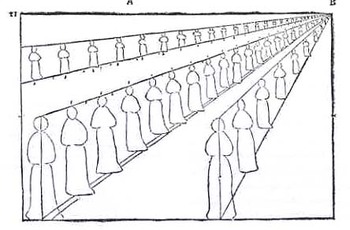
    Blogmissing_add107
    This
    wood engraving comes from the Flemish Joachim Sterck van Ringelberg’s (1499-1536
    or so) book Lucubrations, printed in Basel in 1541 Ringelberg was one of those famous wandering
    scholars from the first half of the 15th century, and the book was no doubt constructed for the use of his pupils. This is one of about 30 books that Ringelberg
    wrote–he intended to wrtie a thousand, but times being what they were, and
    living to only 37 or so, he fell short of the mark. He did produce quite a lot
    though given his youth, the hardship of travel, access to published works, and
    tools, and general annoyances of the 16th century traveler who was not a
    royal. It is really quite
    remarkable. Ringelberg taught a wide
    range of subjects belying his quest for M books–he was competent in astronomy,
    mathematics, literature, classics (of course) , and languages.

    This “missing people” image comes from a section of this book dealing
    with perspective. I’m just endlessly
    entertained trying to get inside the head of a 16th century student seeing
    these empty, missing, place-holder human forms for the very first time. As I’ve said earlier, these figures just
    don’t occur in Western art.   


    ·Posted by :

    ·in:

    —

  • The Beauty and Iconography of Title Pages: Frau Mauro’s Sphaera volgare novamente (1537) and a Very Early Glimpse of America on a Globe

    JF Ptak Science Books   Post #95
    Blogtpamerica105
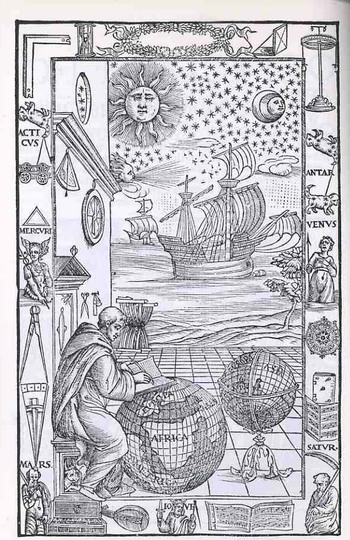
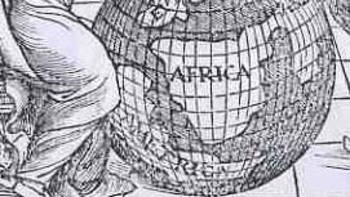
    This magnificent piece of tidy work was done for this new edition of Johannes de Sacrobosco’s Sphaera by Fra Mauro Fiorentino (1492-1556), and gives us all a chance to have a bit of fun reading late Renaissance iconography. The work is entitled Sphaera volgare novamente tradotta con molte notande additoni di geometria, cosmographia, arte navicatoria et stereometria (and so on), published in Venice in 1537, and as stated in the title this is an augmented edition of Sacrobosco with Mauro adding segments on geometry, cosmography, navigation and perspective.

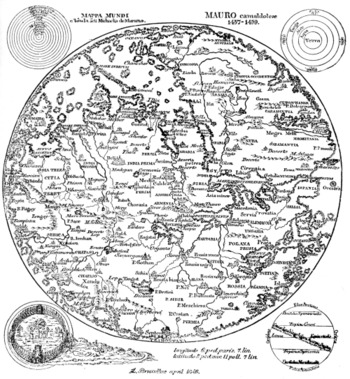
    The wood engraving is of particular interest because of the globe upon which Fra Mauro is writing—as you can more clearly see in the detail; shot (below) we can see a large continent labeled “America” just hundreds of miles off the coast of Africa.  The Americas still make only guest appearances on globes at this point, and seeing it here, as a bit of an afterthought, is a treat (considering how easy it is to overlook it).  There is another Fra Mauro, much more famous than our’s above, whose cartographic workshop produced a seminal, magnificent  map of the world in 1453, thus bringing the two Mauro’s together, if only slightly, via their maps (one great, the other incidental).
    Mauro_map

    Looking a little more closely at the elements of this image we find a number of interesting bits.  Working from the upper right hand corner across and down we find a right angle (for the architectural and building parts of the book), then a sand clock, a decorative laurel wreath with a pocket sundial (!) right next to it, ending with an object that looks as though it might be a physical sciences demonstration tool (I’m guessing).  Working down from the “what is it” we see the first cut of a three-times-repeated constellation that I think has nothing to do with the word “Antar” beneath it. 

    “Antar” probably refers to the famous Arab warrior-poet, subject of lots of attention over the centuries including two works by Bach and Rimsky-Korsikov (and also the name of Apollo as worshiped at Actium) Below Antar is an armed and clothed (?!) Venus, major domo goddess of love and beauty and for whom existed innumerable cults (witnessed by just some of the famous Venuses as Venus de Milo ,Venus de’ Medici, Capitoline Venus, Esquiline Venus, Venus Felix, Venus of Arles, Venus Anadyomene (also here), Venus, Pan and Eros, Venus Genetrix, Venus of Capua, Venus Kallipygos, Venus Pudica, and so on into the sweaty  night.)

    Blogtpamerica_detail

    Following Venus is, I think a complex compass rose, though it may also be a calendar—I can’t quite tell from the detail of the cut.  This is turn is followed by a heavily fortified book (actually this sort of bonding, meant for heavy use, was relatively common at this time)and a score of (5-line staff) music. 

    Returning to the right angle and moving down we se the same constellation under which hangs a very stable-appearing wagon, with a triangle beneath it , followed by a representation of Mercury, the messenger of the gods, who in turn is positioned over a large set of dividers.  On the wall over the head of Fra Mauro we see two precision instruments—a surveying tool and an astrolabe.  The two small tools near Mauro’s head seem to be a scale and a pair of scissors. 

    The central panel shows two caravans (approximately 100-footers?), being driven by a favorable wind to hospitable shores beneath a starry and benign firmament. 

    The bottom tier is the most emblematic of the set of images, as we see the related Saturn-Jove-Mars all together.  Saturn is also Kronos, which is why we see the old horned man caring the scythe of time’s reckoning; he is also the father of Zeus, also known as Jupiter (Juppiter Optimus Maximus Soter (Jupiter Best, Greatest, Savior)), also known as Jove, who stands here crowned and warning us with a sword and dividers.  Jove in turn was the father of Mars, who here doesn’t look terribly war-like at all.  Punctuating the spaces between these three are a keyboard instrument, a lute and a score of music.  I’m not sure that these lyrical/musical devices had anything to do with the three generations of super gods, but there you have it. 

    ·Posted by :

    ·in:

    —

  • Electrocution, the Electric Chair, and the Evil, Spiteful Genius of Thomas Edison

    JF Ptak Science Books LLC    Post #94
    Blogelectrocution_chair_empty
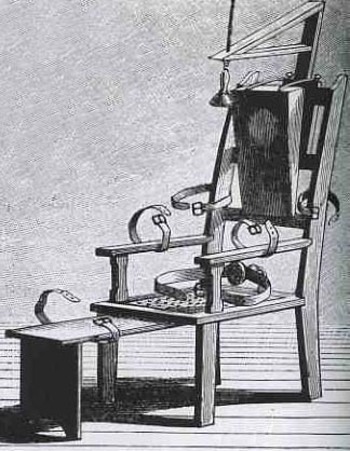
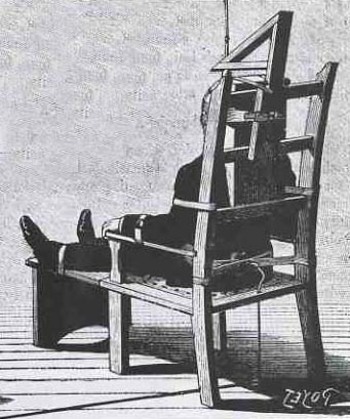
    It is ironic that the spiritual investment necessary for the electric chair—the ultimate legal act of revenge—was itself the product of an act of vengeance. In 1888 Thomas Edison, innovative and creative genius and social miscreant (and deep old friend and camping buddy of a howling intellectual horror, the anti-Semitic and fascist appeaser Henry Ford) brought his enormous weight to bear to wrestle public opinion in favor of his (that is the Edison General Electric Company) mode of power distribution (direct current or DC) versus that of his direct competitor, George Westinghouse (alternating current, or AC). 

    Things were not going well for Thomas Alva.

    At nearly the same time the New York State legislature, under a mandate of 1886 and a law of 4 January 1888, was seeking new ways to kill prisoners, it having been determined that hanging people caused too much suffering (to the hanged).  It was determined that death be best and less painfully delivered via electrocuting them.  (Actually the procedures of the day for electrocution were less “sophisticated” than they would be by the turn of the century; the people killed in this manner in the first two decades of use of the electric chair were basically cooked from the inside out.)  The dangling issue was the technology top be used to deliver the electricity.
    Blogelectrocution_chair_filled

    And this is where Edison gets brilliantly, terrifically, ugly.  He proposed that the state use Westinghouse’s AC system for electrocutions, and set up tests with the AC system to prove its superior qualities in providing power to the electric chair over the C technology.  He did this so that the gross population would equate the Westinghouse system with electrocution, which Edison referred to as being “Westinghoused”, and choose Edison’s own DC technology, which wouldn’t theoretically kill the consumer in their own house.  The state chose the AC system; Westinghouse refused the state’s orders for his production; and then Edison stepped in and manufactured the AC system for the state’s use in electrocution over Westinghouse’s loud complaints.  Evil genius.

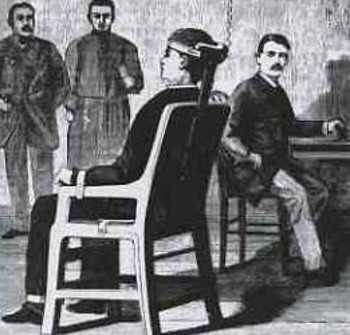
    This was also the start of Edison’s rather bizarre experience with filming electrocutions.  He made several films for the New York state officials showing how well the AC system worked—he did this by showing how well the Westinghouse system electrocuted the animals that he dropped on the electrified plate fed by the AC current.  Over and over again.  Edison also made a film of McKinley’s assassin, Czolgosz, being put to death by electrocution, in an early docudrama session, showing the condemned man fidgeting a little before coming to death.  Edison’s crowning achievement in electrocution films was his disgusting film of a circus elephant being put to death—I will not describe the film, and  say that only a monster would do and make such a thing.  Even in the present when we can see just about anything on the internet, watching this film is just impossible, it is just so horrific. (I do NOT recommend watching this,  not at all.  You will not be able to forget, try as you might and must.)
    Blogelectrocution_filled_another

    And if you couldn’t stand to watch something like this be done to an animal, why would it make sense to do this to a human?

    There is no doubt that some of the electrocutions of human beings removed the person relatively instantly and painlessly.  It would seem that this would be a minority.  When I was researching a piece about the Rosenbergs (yes they were guilty) in 1985 I happened to talk with the maintenance guy at Ossining State Prison who “cleaned up” after Julius was removed from the electric chair.  Quickly and quietly summarized, he said that his work with Julius’ remains were as gruesome as the execution.  “Was this, was Julius Rosenberg, a special case, was he treated differently?” I asked, a little naively.  “No”, he responded, “they were all like that”.

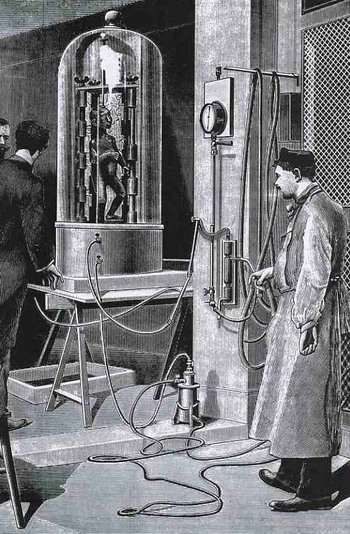
    And while we’re at it, let’s consider the work of Dr. Varlot (of the Paris Hospital) in electrocuting the dead.  Actually, what he proposed was another pretty gruesome use of electricity, only this time no one was hurt, as the receiver was already dead.  Varlot proposed to “metalize” the dead (as we see in this unsettling image of a child being electroplated) for, well, some purpose.  It just seems and seemed like a bad idea, al the way around.  The medical uses of an electroplated baby seem very limited, and I can’t imagine anyone wanting to do such a thing to a dead child of their own.  It is wrong on every level.
    Blogelectrocution103
     
    I know that electrocution is done and gone.  It replaced hanging, and hanging replaced beheading, and so on; but the effect is providing an incrementally less gruesome way of revenge—the point being that even though the next newest method is less grotesque, it is still, at base, grotesque.  Just less so. 

    ·Posted by :

    ·in:

    —

  • Color Music–Found Images and the Second Perfect Number.

    JF Ptak Science Books LLC  Post #93

    (Notes for a Future Post)
    Blogcolor_scales097
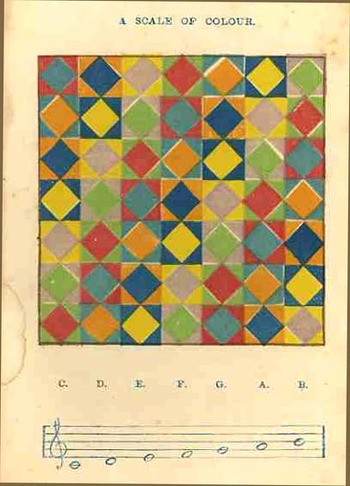
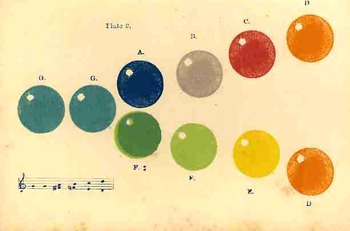
    I found these two beautiful lithographs a while ago—they are really quite gorgeous, and I don’t have a clue to their source.  They probably were printed in the 1860s or so, perhaps 1870s, which I thought—given their subject matter—would make their identification easier.  The subject matter is old, appearing hundreds of years before these images were published. For example, in 1690 the philosopher and constitutional muckrack John Locke reported on a blind synesthesiastic man “who…bragged one day that he now understood what scarlet signified … It was like the sound of a trumpet.” 

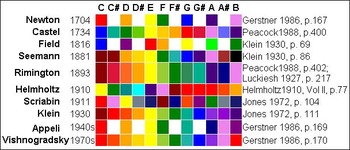
    Equating the frequency of sound waves with the corresponding wavelengths of light was a quest by Sir Isaac in 1704 (In the Opticks), while in 1742 the French mathematician Louis Bertrand Castel strengthened Newton’s proposal of a solid relationship between the seven colors and the seven units of the scale. Slightly later he  undertook the  construction of a clavecin oculaire–a light-organ–as a new musical instrument,. which would simultaneously produce both sound and the “correct” associated color for each note.  A century and a half later Bainbridge Bishop had constructed at least three color organs, while in 1893 Rimington had patented the name “color organ,” and had already toured with his own device, performing color tone presentations of the works of Chopin,
    Blogcolor_scales_bubbles098

    Bach, Wagner and Dvorak.  Experimentation of a new order took place in the early 20th century in the hands of Scriabin (who thought colors were associated with tonality, not with singular notes), Kandinsky, Schoenberg and Marc. 

    Now, getting back to the “scale of colour” illustration, we find our anonymous author equating the following scales thus, beginning with the first column, reading top to bottom, and looking first at the underlying color:
    C:  red, blue, orange, blue, yellow, violet and green.
    D:  orange, blue, yellow, violet, green, red indigo
    Blogcolo_rmusic_rimington
    E:  yellow, violet, green, red, indigo, orange, blue.
    F:  green, red, indigo, orange, blue, yellow, violet.

    And so on through the scales of G, A and B. 

    When you assign numerical values to each one of these colors (green=1, red 2, indigo=3, violet=4, red=5, green=6, yellow=7), the sum is 28. 
    28 is an interesting number in itself, being the
    Blogcolor_organ_bishop
    second perfect number (following the first perfect number which is 6)—a perfect number being the sum of its divisors, including unity but excluding itself (so 28= 1+2+4+7+14).

    The color systems proposed by Castel and Bainbrisge are as follows:

    Castel

    B (dark) violet Bb agate A violet Ab crimson G red F# orange
    F golden yellow E yellow Eb olive green D green C# pale green C blue

    Bainbridge
    B violet-red Bb violet A violet-blue G# blue G green-blue
    F# green F yellow-green E green-gold / yellow
    D# yellow-orange D orange C# orange-red C red

    Blogcolor_schemes

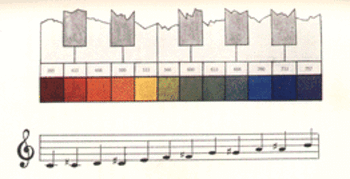
    The following chart is from the wonderful color/music siteVISUAL MUSIC.

    ·Posted by :

    ·in:

    — —

  • Beautiful Title Pages 6: Losing Your Head—St. Denis and the Cephalophoric Title Page

    JF Ptak Science Books LLC   Post #90
    Blogtphead_off096

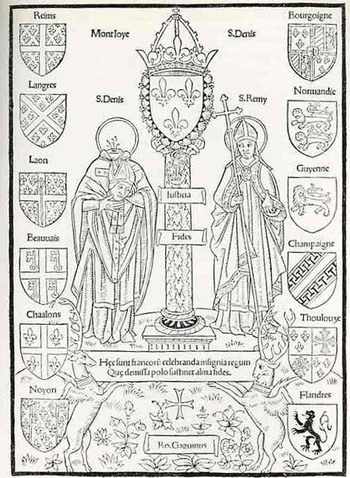
    Robert Gaugin (1433-1501) produced this fabulous illustration for his Compendium de origine et gestis Francorum, a 180-leaf history of France, printed in Paris in the second week of 1500.  (This is actually the fourth edition of this work which first appeared in the year 1495, which would officially make it incunabula.)

    St. Denis and St. Remy are pictured here standing on either side of a column supporting the fleurs-de-lys, and surrounded by the coats of arms of various French cities and provinces. 
    Blogtphead_off096_det

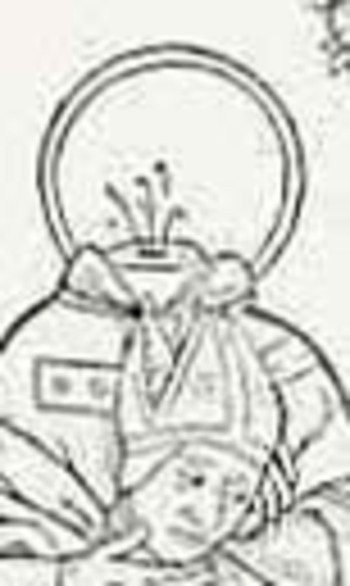
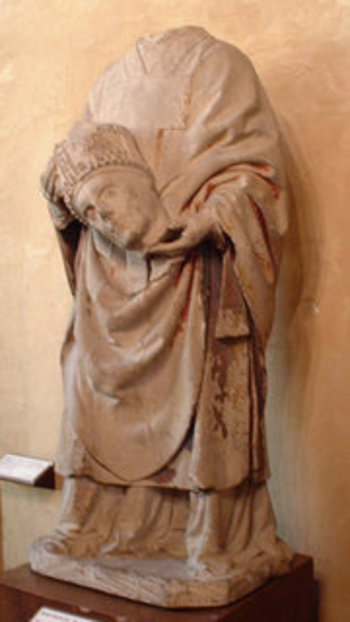
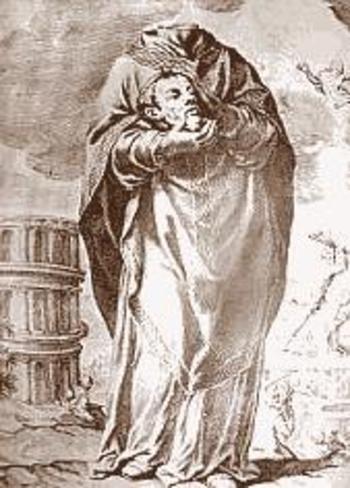
    So far as I can limitedly determine this is the first title page featuring a headless, or decapitated, human.  And that human is St. Denis of Paris, also called Dionysius, Dennis and Denys, the third century bishop of Paris who was martyred about the year 250.  It is said that after being beheaded by the Romans at the highest point in the city of Paris (now known as Montmarte, “mount of the martyr”), Denis picked up his head, held it in his hands, and walked two miles in this fashion, preaching all the way.

    St. Denis however was not the only beheaded person to carry his head, nor was he anywhere near being the only saint to do so. As a matter of fact there is an entire category of saints who carried their heads following beheading, called Cephalophores.  This special class of saints
    Denis_bertrand

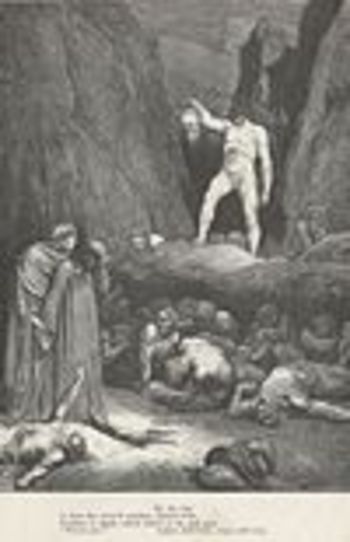
    include Paul of Tarsus, Saint Ginés de la Jara, Saint Gemolo , Aphrodisius of Alexandria, (pictured below)  Nicasius of Rheims,  Cuthbert of Lindisfarne and Oswald of Northumbria, while others of this category though not saints include Lucian of Beauvais, Nectan, , Osyth, Quiteria, Winefride and Wyllow. Cephalophores also make many appearances in literature, most notably in Dante’s Inferno (8th Circle, Bertrand, pictured left) St_denis_2
    ) and in Sir Gawain and the Green Night. St_denisaphrosdius

    But none I think appear on a title page of a book earlier than this 1500 example of St. Denis.

    As a very occasional note, St. Denis is pictured here with one halo–sometimes he has two. 

    ·Posted by :

    ·in:

    — —

  • Beautiful Title Pages 5: Chocolate, Morals and the Birth of the British Museum

    JF Ptak Science Books LLC   Post #89
    Blogtpchocolate095

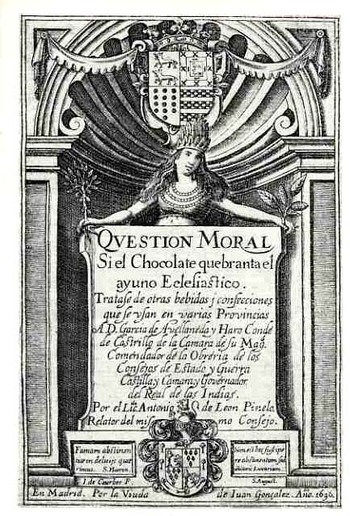
    This lovely title page is from the book Question Moral Si El Chocolate Quebranta El Ayuno Eclesiastico, (on the Moral Question of Chocolate…), printed in Madrid in 1636, and said to be the first book on American drinks.  León Pinelo. a Spanish-colonial historian (1589 – c. 1675), born in Cordova de Tucuman, (Argentina),  and educated in the College of the Jesuits of Lima (Peru), and then leaving for Spain by 1612, where he wrote this (and other) books.   HE was a significant scholar and an accomplished bibliographer, and compiled a very extensive dissertation upon the history, uses, preparation of chocolate, as well as other drinks in general of the Americas, touching on concoctions of Indians of New Spain, Peru, Nicaragua and Guatamala. 

    The title page is very dimensional, with the central figure, an Indian woman holding the scroll of the title, with a miniature coca tree in one hand and a four-leaved branch from the cocoa tree in the other. 

    Leon Pinelo in no way “created” the chocolate drink, but he was the first (and extensive reporter of it and certainly remained it most extensive annotator of the drink for centuries. Columbus was aware of the drink by his fourth voyage in 1502 but said relatively little about it.  The Aztecs had been using the cocoa been for a thousand years before that.  (It has been remarked that the drink was so extraordinary and special that it was served in one-serve golden goblets that were disposed of after the chocolate was consumed). 

    Perhaps the great King of Chocolate though was Sir Hans Sloane, who in addition to much else he did in his life traveled to Jamaica, where he assembled a fabulous plant collection for shipment back to England.  He also “discovered” chocolate there, improving the native presentation of the drink (which he evidently found to be nauseating) by perfecting a milky solution with it—and *that* it was brought great wealth to Sir Hans.  With that wealth Sloane continued to add to his extraordinary collection of natural artifacts, amassing one of the greatest cabinets of curiosity in England and the continent.  In addition to his own collecting and minor purchases Sloane used his chocolate money to purchase the fabulous collections of  William Courten (who, for example was an extremely wealthy Brit who financed the colonization of Barbadoes among other things before finally going bust), James Petiver, Nehemiah Grew, Leonard Plukenet, the Duchess of Beaufort, the rev. Adam Buddle, Paul Hermann, Franz Kiggelaer and Herman Boerhaave.  Death’s dance found Sloane in 1753, who left his entire collection to England, and it was this bequest that formed the opening, golden, sagacious nugget of the British Museum. 


  • The History of Stopping Time #1: A.M. Worthington, Ernst Mach and Doc Edgerton

    JF Ptak Science Books LLC Post #88
    Blogstopping_thing_splash087
    This will be the first out-of-sequence post looking at the intervals of stopped time (random or not), and how people and cultures were able to stop or save time, and how they could arrange to segment and store time over thousands of years.

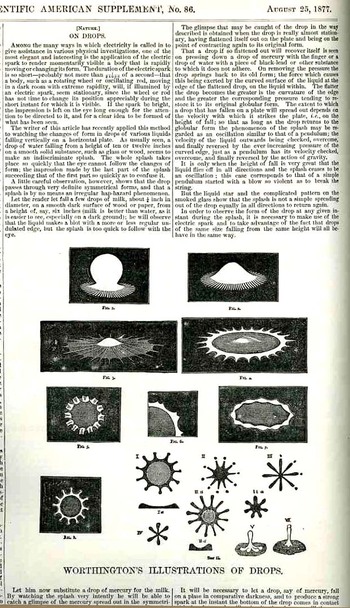
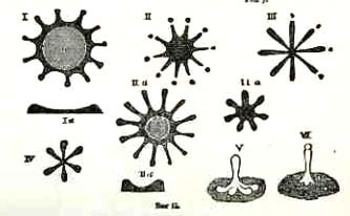
    The first entry is from the Scientific American from August 25, 1877 and records the experiments of A.M. Worthington. They are perhaps one of the first revelations on the quiet residence of energy in something as simple as a drop of water or mercury.  Much in the same way Robert Hooke revealed the microscopic universe to unsuspecting readers, so too did Worthington, in his way, reveal the explosive world of small, fast, and lost events. Worthington’s style is of course exceptionally restrained and free of exclamation, even while describing the first time any human has witnessed these events, like so: “…watching the changes of form of drops of various liquids falling vertically on a horizontal plane…the whole splash takes place so quickly that the eye cannot follow the changes of form…”   This report, “On Drops” follows Worthington’s own earlier effort of 1876 and 1877 “A Second Paper on The Forms Assumed by Drops of Liquids falling vertically on a Horizontal Plate” (Proceedings of the Royal Society, 174 and 177), chronicles his brilliant adventure in the newly discovered world of fast time—a world he was pretty much creating as he moved along.  (A particularly good description of the experiment as well as an image of the apparatus can be found on Martin Waugh’s lovely and arresting site—he is one of the leading modern practitioners making art in
    Blogstopping_thing_splash087_detail

    this genre of high-speed photography:  liquid sculpture calls it.)  )   It is particularly powerful to note that the illustrations here are drawings of the phenomena of his study of splashes—drawings, not photographs.  The photos by Worthington (On A Splash from a Drop of Milk) would not appear until 1894. (An entire book is dedicated to this subject by Worthington, who published, in 1904, the wonderful A study of Splashes.)  This means, I guess, like the heroic chroniclers of snowflake forms and such that he ran many, many experiments and painstakingly observe red different parts of the splashes and recorded them by hand.  Worthington wouldn’t be able to photographically record the images of his splashes until later after the application of inventions and advances by C.V. Boys and Lord Rayleigh.  Until that time his audience would have to depend upon his tenacious observational powers—or try the experiment themselves and make their own observations, as Worthington provided all the necessary data for his experiments to be replicated, of course.
    Blogstopping_thing_bullet_2gs086
     

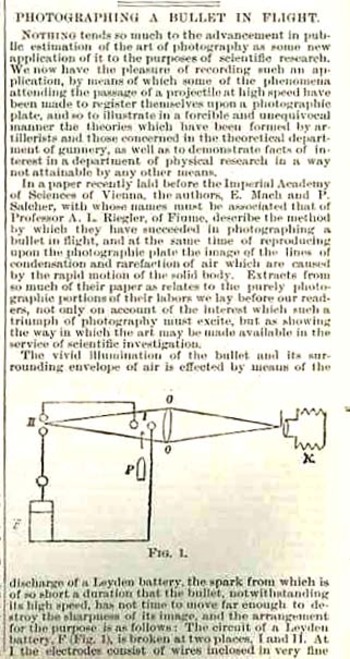
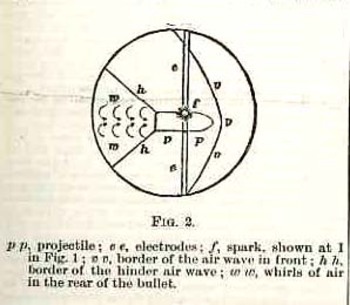
    The next paper relates the success of Ernst Mach and P. Salcher in creating an apparatus to illuminate and photograph a bullet in flight—this was again found in the Scientific American, but for 24 September 1887 (supplement 612).  Unfortunately, their results are rendered only by a drawing, even though the half-tone was available by this point to provide a high-quality reprint of a photograph, it took Scientific American another few years to start employing that breakthrough method.  (I’m not sure why this was so.)
    Blogstopping_things085_blluet_det_2

    The results were made available in the original Austria edition of his publication from which this article is drawn.  This paper “Photographische Fixierung der durch Projektile in der Luft eingeleiten Vorgange” presented to the Academy of Sciences in Vienna in 1887, was revolutionary in more ways than one, as it was really about the visualization of flow over objects, and in particular, the movement of media as a bullet traveled at supersonic speeds—and to which Mach would donate his name for the description of units of supersonic speed.  (The term was first publicized in 1929 when Swiss engineer Jakob Ackeret used Mach’s name for the first time in the description of these speeds.)
    Sudden_mach

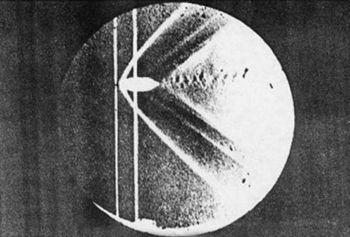
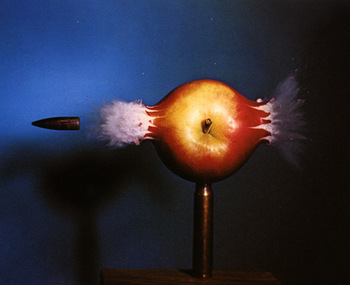
    This last photo is included just because of its sheer beauty—it is far in advance and way out of the continuum for a discussion like this, but this effort, produced by Harold Edgerton, just must stay.  This is the titanic blast of ingenuity that was the intellectual successor to the earlier works listed above, but the technical advancement is just so fabulously great that the earlier scientists could simply not imagine them.  This image was as much science fiction to them as their images were to scientists considering these ideas right there at the birth of photography in 1839.) Harold “Doc” Edgerton, 1893-1990, who would form EG&G and serve MIT for many years owned this field of photography for many years—time stopped for the venerable Edgerton right after he paid for his lunch at the faculty club at MIT. Failing life with a heart attack at  87.)
    Suddennessedgerton

    For an interesting look at videos of various sorts of splashes see the North Carolina School of Science and Math HERE.