A Daily History of Holes, Dots, Lines, Science, History, Math, Physics, Art, the Unintentional Absurd, Architecture, Maps, Data Visualization, Blank and Missing Things, and so on. |1.6 million words, 7500 images, 4.9 million hits| Press & appearances in The Times, Le Figaro, Mensa, The Economist, The Guardian, Discovery News, Slate, Le Monde, Sci American Blogs, Le Pont, and many other places… 5000+ total posts since 2008.

Author: JF Ptak

  • The Most Significant Invention or Discovery in the Prolongation of Human Life: the Flush Toilet (?)

    JF Ptak Science Books LLC    Post #112
    Blogtoiletcrapper

    This I think is mostly a nonsensical whimsy of a question, and answer, but here it is anyway:  what do you suppose is the greatest advancement in the prolongation of human life from 1842-2000?  Is it the discovery of Joesph Lister of the sterilization of surgical instruments and maintaining a sterile surgical environment?  Is it Alexander Felmings discovery in 1928 of the antibiotic substance penicillin (from the fungus Penicillium notatum) ?  W.T.G Morton’s discovery of anaesthesia in 1842 or Wilhelm Roentgen’s introduction of the X-Ray in 1895?  There is an entire time line of likeables for this category, but one that I don’t see is the invention of the indoor, flushable toilet. 

    Consider this—it is the invention of this device (and the associated treatment plants) that removed all kinds of human nastinesses and pestilence.  In a sense too it also enabled the industrial revolution and the development of large cities, as you cannot have a large metropolis supporting complex industrial grids without having the most basic necessity for living conditions for the workers. 

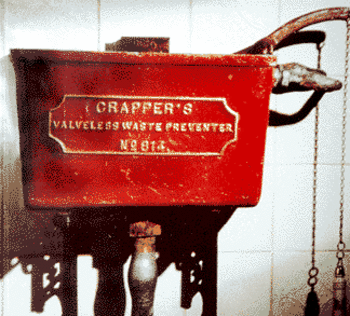
    Thomas Crapper (1837-1910) really did put his name on his invention—as did many other Victorian toilet makers with their own inventions—but he was about the first to introduce the remarkable and incredibly satisfying invention, and it was his name that stuck to the function that his invention relieved. 

    It is a little odd to me that the first truly functioning flush toilet seems to have been aboard the semi-submarine Merrimac in 1862; it sounds odd but I can easily see how it would be a  huge advantage to have one of these things on your ship than not.  (Walter Chrysler had a bathroom installed at the very top of his building in NYC, the top-most room, so that for a while, old Walter was able to do what no one else in America could do, higher.)
    Blogtoiletperforate

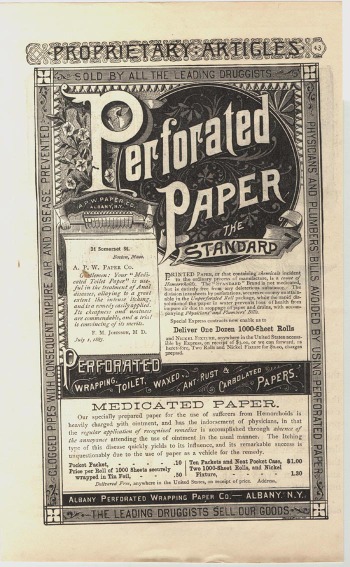
    As it turns out, what we popularly think of as “toilet paper” was invented at almost the same time as the flush toilet—there were earlier paper products appearing in large sheets and such going back hundreds of years, but the stuff that is readily and easily recognizable really is an almost simultaneous development.    “Gayetty’s Medicated Paper”, with Joseph C. Gayetty’s name imprinted on every sheet, made its first appearance in 1875 as the first of these necessaries. Rolled and perforated papers were to follow in another 20 years, the products of stiff competition for priority between the Scott Paper Towel Company and the Albany perforated Wrapping Paper Company, bringing their products to market just after centennial in 1877/8.   (For an interesting toilet paper history and tour, see here.)
    I know that the toilet really doesn’t quite come up to the Lister standard of astounding medical advancement, and the same can be said for the others—but I think you could make a strong argument for the flushable toilet to have as much an impact on prolonging life as any of them.  The argument might not be right, but it would be strong. 
    http://www.toiletpaperworld.com/tpw/encyclopedia/navigation/funfacts.htm 

    ·Posted by :

    ·in:


  • Head Replacement ca. 1700–the Baker of Eeklo

    JF Ptak Science Books LLC    Post #111
    Blogbaker_eeklo144

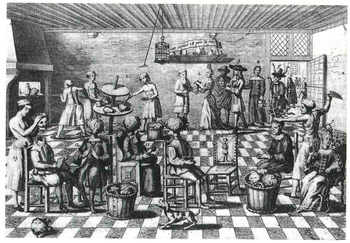
    Here’s a very curious engraving, a little on the light-noirish side, by the Dutch Philibert Bouttats de Jongere (1656-1728).  The copperplate is made from a painting called De Bakker von Eeklo (The Baker of Eeklo) which hangs in the Muiderslot castle in the town of Muiden, near Amsterdam—I found the reproduction in a very charming book by Midas Dekkers called The Way of All Flesh, a Romance of Ruins (2000).  Dekkers thinks about reflects (and I use this word in the clinical, autopsy-room way) on the way of all fleshly ruination—what happens to cause it, what the mechanisms of deformation are, and the effects of time on us all.  He comes to this engraving in a chapter of fighting the effects of the physical and biological mechanics of skin and plastic surgery.  It is a marvelous image—people coming to the bakers for a rejuvenation and reformation of their entire head.  How it seems to happen is this:  people arrive from far and wide and have their heads removed by a baker’s assistant (as at left), where a group of bakers work their wonders (with paints and other stuff) on a revolving table, when the head is sent to what looks like a bread oven for a firing and cooking.  In the meantime the cabbages that are kept in baskets an laying about on the floor are actually put to use—they are placed in the bottom/wound of the removed heads and also serve as replacement headholders until the baked heads are ready. (Cabbage head?)  For some reason all of the bakers are without shirts; it is after all a bakery and it probably is hot, but everyone else is dressed pretty heavily, and looking pretty calm, so maybe there’s something more to the shirtless bit than just heat.  And speaking of calm, most of the head-rejuvinatees are sitting very patiently, with their hands together, or fingertips touching, in classic aspects of ease, and I’m not sure about that, either. 

    But is that really the story here?  The odd part of this odd allegory is that the people in the upper right, entering the bakery, are already carrying heads.  It makes sense in an artful way to have a cabbage replace your own cooking head, but if you were coming to the baker with head-in-hand and set to go, then you wouldn’t need a cabbage head for your own decapitated noggin because, well, they’d lop of your own head and replace it with the new one right away; no cabbages necessary.  So perhaps there are two different things going on here:  one where you get your own head re-worked, and a second where you bring in a head to have put on your own body.

    The big question in the room then is where did these other heads come from? 


  • Upper Atmosphere In-Field Research, 1865: James Glaisher and his Balloon Ascent

    Big_archout_eiffeled140_detail_2JF Ptak Science Books LLC    Post #110
    Blogballoon_instruments142_2

    Horace Benedict DeSaussure (1740-1799) of Geneva
    (aristocrat, geologist, physicist and (maybe the first) alpinist) made
    the first truly scientific ascent in a balloon—he climbed into the
    ‘cockpit” of a hydrogen gas balloon with a few scientific instruments
    and flew to the incredible height of 15,000 feet, to the summit of Mt.
    Blanc.  He achieved a life-long dream in this ueber accomplishment and
    even did some science along the way—he was not going for height per se
    for stardom, but was in fact doing upper atmosphere research.  (He was
    strangely, or perhaps understandably, filled with nothing at the point
    of achievement:  “at the moment of my reaching the summit I did not
    feel satisfied; I was less so when I left.  I only reflected there on
    what I had not done…”)  In any event DeSaussure went aloft with not all
    that much in the way of recording and observational equipment.

    It is interesting to see the state of the art in upper atmosphere test
    equipment  in the article published by James Glaisher in the Popular
    Science Review* of 1865. Glaisher (1809-1903) was an all-around science
    guy—President of the Microscopical Society, founding member of the
    Aeronautical Club of England as well as the Meteorological Scoiety),
    and was an early and very determined balloonist/aviator and
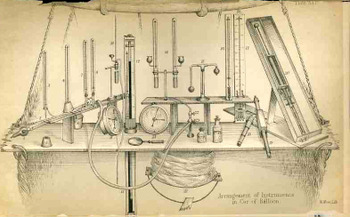
    meteorologist.  In the accompanying image to his article we find a
    relatively safe (but not necessarily comfortable) control panel in the
    balloon containing no less than 20 pieces of scientific apparatus for
    collecting air at different elevations, noting different types of
    clouds, determining the electric state of the air, making physiological
    observations and comparisons, sound research, and other atmospheric
    phenomena in general.

    For the record, the enumerated instruments are as follows:

    1-8:  various types of blackened bulb thermometers, with dry and wet bulbs as well, placed in different aspects to the sun;
    9:  chronometer
    10:  Regnault’s hygrometer with a single silver cup
    11 + 12 Mercurial barometers (Gay-Lussac siphon)
    13:  aneroid barometer
    14:  a second Regnault hygrometer
    15. Daniel’s hygrometer
    16.  spiral bulb thermometer
    17.  gridiron form bulb thermometer
    18+19: spectroscopes
    20: Herschel’s actinometer
    21.  bottled water and aether
    22+23:  stop cocks for aspiratior

    Glaisher as it turns out set a world record for a balloon ascension in
    1862—three years before this article was published—but was unable to
    conduct any experiments, as he passed out due to the lack of oxygen and
    cold at 35,000 feet. 

    *“Balloon Ascents, and their Scientific Importance” See the NYT article.

    ·Posted by :

    ·in:


  • Not the War of the Worlds II—Ripping Off H.G. Wells

    JF Ptak Science Books  LLC   Post #109
    Blogwelllsgoble

    Herbert George Wells’ War of the Worlds was one of the very first efforts in modern history to reverse the outward-bound human trend of reaching out—he introduced aliens and the big idea of aliens (other than god or gods) coming to earth and doing us harm.  He wrote WOTW in the third year of a very rollicking decade-long intellectual purge that would change the face of science fiction writing in Western lit, changing the idea of fantasy science, replacing burnt brain stems with powerful, well-written ideas.  (In the period 1895-1905 Wells wrote The Time Machine (1895), Island of Dr. Moreau (1896), The Invisible Man (1897), WOTW (1898), The First Men in the Moon (1901), When the Sleeper Awakes (1899), Anticipations (1901), the Discovery of the Future (1902) , A Modern Utopia (1905), among others*.)

    Wells (born a year after the American Civil War ended and died a years after WWII ended) was a huge thinker and a gifted craftsman, with big ideas that he was able to put into simple, well constructed forms that were enormously popular.  (Orwell remarked that Wells was the most read person in English in the 1900-1920 period.)

    The prescient, observant futurist, Wells sought to also protect his own future in regards to his work, particularly with the WOTW—he secured all serial and reprint rights to the work in the United States, where it was being published in installments simultaneously by two different magazines.  But rights be damned, as the magazine editors changed the story to suit their regional needs, painting the work in putrid reds and mauves to such a degree that the enraged Wells—who could do nothing about any of the changes–paid it a salty goodbye in the U.S.

    But I think the major intellectual theft occurred in the weeks following the finale of the installments.  An American popular science writer, Garret P. Serviss, was contracted by the Hearst Newspaper group to pick up the WOTW story where Wells had ended it.  It would be continued—rather the story was stolen so that it could be twisted into another form—as a short novelette, problematic because of its interesting reach, but a problem nonetheless.  Serviss was a popular but modestly gifted writer, both rising and falling to the occasion in the wake of Wells.  His work, Edison’s Conquest of Mars, an intrepid journey in another man’s shoes, featured Thomas Edison raising an army in space ships, hell bent on getting to Mars to extract revenge for a dismembered, fractured earth, rendered nearly impotent by Wells’ Martians attacks.

    Edison et alia make it, and all sorts of first-time stuff happens—the first “phaser” weapons are introduced, mid-space attack and counter-attack, asteroid mining, and lots of other things of concern in the originality of science fiction ideas.  Unfortunately it was all borne on the back of a stolen series of ideas and story, and those happened to belong to Wells.

    Here’s something worth noting, though—Serviss’ work may be one of the only instances of employing Wilhelm Roentgen, (the discoverer of the X-Ray (in 1895) and recipient of the first Nobel Prize in physics) and Lord Kelvin (perhaps the most eminent of English physicists of the late 19th century) as heroic members of a Martian attack force.  Throw in the magnificent but moral incompetent Thomas Edison, and you have a unique real-life triumvirate employed in the telling of a stolen fantasy who, fortunately or not, come up with some really good, and early, ideas.

    *The full 1895-1905 list from the HG Wells Society is very impressive, as is the whole of his output:
    1895
    Select Conversations With an Uncle
    The Time Machine
    The Wonderful Visit
    The Stolen Bacillus, and Other Incidents
    1896
    The Red Room
    Island of Dr. Moreau
    The Wheels of Chance
    1897
    The Plattner Story, and Others
    The Invisible Man
    Certain Personal Matters
    1898
    War of the Worlds
    1899
    When the Sleeper Wakes
    Tales of Space and Time
    1900
    Love and Mr. Lewisham
    1901
    The First Men in the Moon
    Anticipations
    1902
    The Discovery of the Future
    The Sea Lady
    1903
    Mankind in the Making
    Twelve Stories and a Dream
    1904
    The Food of the Gods
    1905
    A Modern Utopia
    Kipps: The Story of a Simple Soul


  • An Alphabetical Return to Fat:1920’s Fat (Reduction) Scams; Fat Soap, Strychnine Pills, and Sugar

    JF Ptak Science Books   Post 107
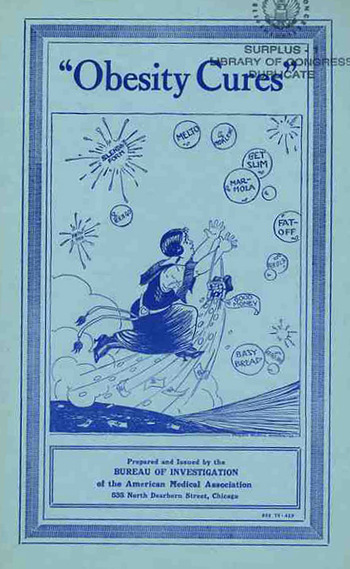
    Blogfatobesity_cures132
    Quackery in general has survived in spite of itself over many fields, not the least of which is astrology and creation science, cult religions and
    walking-with-the-dead.  In the U.S. in the 1910-1925 period however there was a attempt at investigating the most outrageous frauds in the medical profession by the American Medical Association, and of the many sorts of quacks and frauds-liver cures, neuralgia miracles, electro-vibrator hair restorers and lump removers, anti-droopy happiness pills, cocaine nervous system remedies, and so on-what I’d like to look at right now is concerned with “flesh reduction”, or, fat cures. 

    According to the AMA (in a 1934 retrospective) the chief stimulant to the obesity industry was the rise of womens’ fashions.  I think that the reasoning might wind itself around the growth of expendable money in the American rising middle class, where Americans, in general, had more money to spend on the non-essentials than any time in the history of the country.  That leads to more consumables, and that leads to more advertising, and that leads to more idealized images of what people should look like, and that leads to wanting to look like that, and that opens the door to scammers who offer a way to get to the not-actual ideal without effort and for little money.  And so in the ’20’s there was a spike in quack remedies for obesity, as there was little or no control over the content of what was being sold nor the claims about what the product did, medically speaking-there was general protection from fraud, of course, but the medical compliment for establishing what that actually was wasn’t quite yet in place. 

    There is a veritable alphabet (soup) of mondo bizarre cures that the AMA attacked and ripped apart during the 1920’s, publishing the findings of their labs on the ingredients of the cures and the possibilities of whether any of the hundreds (thousands?) of these things worked at all. 

    And what the AMA found was really pretty remarkable-lots of water, sugar, tartar, tinctures of useless this and that, desicated liver, seaweed, salt, lemon, and that sort of thing, none of which had any value for weight reduction whatsoever..  A major ingredient, for some reason, was focus vesiculosus, also known as bladderwrack, sea-wrack, kelp-ware and sea-oak-there was no indication of why this ingredient was so popular, especially since it was used in some farms as a pig feed to make the animals fat.
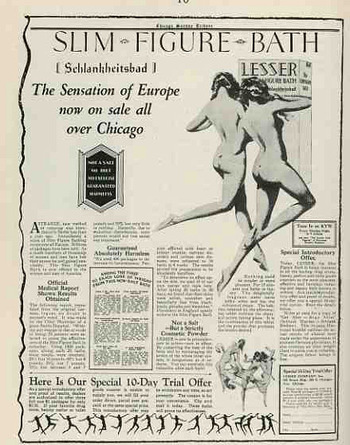
    Blogfat_slim_chicago133
     

    So, aside from the pig-fattening ingredient for human “flesh reduction”, we’ll have a quick alphabetical tour of some of the outrageous (and bizarrely-named) products and their components promising hope and physical happiness to the woman of 1925. (Let’s note that the following are just locally-applied or ingested cures-there’s an entire universe of external applications and devices that were used to solve the problem of fat.  For example, the Violet Ray Machine claimed that in addition to obesity it would cure “Problems with circulation of the blood, the heart’s action, bumps of the funny-bone, germ infections, weakness, the waste of the body, congestion, impaired physical development, pains and aches, complexion and skin diseases, facial and body blemishes, hair loss, headaches, inflammation of joints, muscles, nerves, Atrophy, circulatory disorders, constipation, deafness, goitre, high blood pressure, arteriosclerosis, insomnia (sleeplessness-Brain Fag), indigestion, dyspepsia, neuritis, nervousness, hysteria, melancholia, neurasthenia, neuralgia, obesity, pain, paralysis, prostate gland problems, scalp diseases, falling hair, dandruff, asthma, anemia, bronchitis, catarrh, hay fever, rose fever, colds and other inflammations of the upper air passages, and, of course, cancer.”  This quote with thanks from the Museum of Quack Meidcal Therapy Devices

    And so to the consumable and applied quack fat cures:

    A

    Absorbit Reducing Paste-one of my favorites.  This was a nighttime sleeping paste
    which was composed of 44% lard as well as beeswax, oil and milk.  After slathering
    yourself in this oily, waxy, milky fat cocoon (the sheets!) you were also supposed
    to ingest an accompanying night aid pill, which was 24% sulphur and 61% sugar.  So
    not only would you be oily milky waxy lardy, you’d also be stinky and, at the end of
    it all, hyper. 

    Allmans Anti Fat Anti Pon (?)).  According to its label, it was a “powerful and
    entirely harmless specific”, which the AMA revealed to be composed of citric acid,
    water and food coloring.  Sounds like Kool Aid. 

    Arbolone tablets.  These guys were made of desiccated thyroid, starch, lime and sugar.

    B

    Basy Bread was a “anti growth” bread which turned out to be just a course wheat bread

    C

    Clark’s Thinning Salts was almost entirely washing soda.

    D

    Dalloff’s Time Pills were made of lavender and bearberry.

    E

    Elfin Fat reducing Gum Drops (continuing its spectacular name by saying it was a
    product of the Pep-Giving Product Co., Inc.), was actually one of the only items
    that might have contributed to weight loss, if only for the fact that in addition to
    consuming its drops made of laxative and sugar you were supposed to adhere to a
    pretty regimented, difficult exercise routine.  Big sweat and potent laxative does
    in fact produce weight loss.  Maybe not a good weight loss, but aa weight loss
    nevertheless. 

    Elimiton (!) was a product made of caffeine and rhubarb.

    Every Woman’s Flesh Reducer promised a new figure with their mixture of Epsom salt
    and camphor.

    F

    Fatsoff, a soap product that you washed with, was not surprisingly made of soap.
    Fayro was another soap and washing flesh reduction “package” that asserted that by
    using their secret flesh reducing salve (i.e., “soap”), you would “open your pores
    to let the blood cells sweat off fat”.  I could just about see the AMA guy who was
    writing their description of this thing slamming his pen and screaming.

    Some other F’s included Fells Reducing Tablets (which were milk), Figurroids (salty
    baking soda), Floradona (sodium thiosulphate, the photographer’s “hypo”), and Folt’s
    Reducing Soap (which was, again, soap). 

    G

    Get Slim was a vile purgative of sugar, tartar and baking soda, plus perfumes.

    H

    Hall’s Tablet Triturates were ginger and a big shake of chalk; Hargreaves Reducing
    Wafers (bread and liquorice).

    J

    J.Z. Obesity tablets–were the same product as Absorbit which was the same as
    Zobeide (minus the ox mucus). 

    L

    LaMar reducing Soap (“to wash away fat”) was soap.

    M

    Marmola, “a thyroid-containing obesity cure” was composed of cornstalk, borax, baking
    soda and tartaric acid, with a special “constipation agent” (?), as well as a lot of
    salt. 

    Morlene would reduce goitersm neck fat, bust size and tumors, somehow, with the
    application of its cleansing elements (soap).

    N

    Neutroid seems to have been the most lethal of the hundreds tested, contaning bad
    dollops of magnesium carbonate and iodol, and was taken internally (where external
    application could prove fatal). 

    O

    Oil of Korein was pretty nasty stuff, containing sassafrass and about 75% petrolatum
    (a semi-solid mixture of hydrocarbons, or petroleum jelly), though it also offered
    some really good advice on foods to avoid if you didn’t want to actually gain
    weight. 

    P

    Phy-thy-rin was a calcium and sugar coated pill of iodine and dried thyroid, with
    plenty of sugar, and liquorice. 

    R

    Rusell’s Anti-Corpulent {reparation was a powdered added to water that would
    effectively produce orange Kool-Aid.

    S

    Sangra Bath Salts was perhaps the most outrageously simple, being just colored bath
    salt.  Slendaform (“just gently rub it in, and watch yourself get thin”), was a
    half-pound jar of oil of turpentine, white vinegar and milk curd.  Slyphine, which
    crowded its ads with tremendous claims to be “Absolutely The Best Weight Reducer
    Ever Discovered” and other very shouty claims (by somehow “attracting surplus
    fat”), was simply borax and talc. 

    V

    Dr. Vincent’s Anti-Stout Pills contained a pretty sounding mixture of aloes, jalap,
    cloves and bladderwrack.

    Y

    Mme. Yale’s Fertilizer Tablets-I’m not sure about the real use of “fertilizer”
    here.) was actually one of the earliest of these frauds to be attacked by the
    government, being charged with fraud by “misbranding” in 1909, as federal chemists
    could find no connection between weight loss and its sole ingredients of sugar,
    charcoal and cream of tartar. 

    Z

    Lastly, we offer Zobeude, which was just Absorbit Reducing Paste relabled for
    British consumption, though it seems to have contained an added ingredient of
    “purified ox bile”.  We are told in Bruce’s Materia Medica of 1884 that “Purified ox
    bile has the composition of fresh bile, less the mucus .”
    ·Posted by :

    ·in:

    — — —

  • Gigantic and Unbuildable Buildings: Leroy Buffington, 1889

    JF Ptak Science Books LLC   Post #106

    This is the first in a series taking a little look at some big buildings—very big buildings, that is, monstrously putting the “b” in “big”, altogether too-big, impossibly-big, buildings.)   There have been grotesquely, morph-aided, Babel-like buildings proposed that are bigger than the ones I’ve got in mind, but those tended to live in the science fiction world, or even more removed, in the self-published beyond-the-pale world—but what these later buildings have in common is that no one intended to actually build them, while the ones we’ll take a look at were serious proposals looking for real world serious money. 
    Big_arch136_2

    (For example of the former category, I own a 1935 pamphlet in which the self-published author proposed a 60-mile (?!) tall building with a bell on the top to summon all world peoples to celebration of unitary religion and other, odder, needs.) 

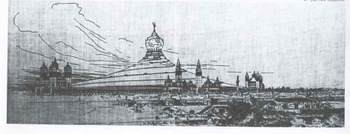
    The first of these intentional  buildings was a proposal of a busy, respected and advanced architect named Leroy Buffington, of Minneapolis.  His put forward this plan in 1889 to be considered for an exhibition building in the Chicago Columbian Exposition of 1893.  It was rejected out of hand because of the obvious expense, but when you take a closer look at the thing it just seems to have been an impossible structure to build given the contemporary technology.

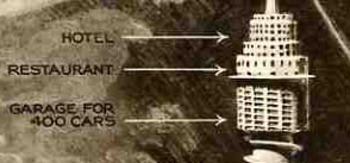
    The building was meant to be a “steel tent”, with a corkscrew-like electric railway winding its way around the building to a globe with a cross on the apex at the top of the structure.   (The detail  below is from about the exact middle of the building and shows the railway cars.)
    Big_arch136detail_2

    By my reckoning, the structure in this image is 150mm long; each of the railway cars on it seem to be about 3mm; if each railway car/pair  was a relatively modest 30-feet long in real life, this would make the building about 1500 feet long, with a height of about 400 (measuring to the base of the globe).  Since we know the structure was to be elliptical, this would give it a circumference of nearly a mile and an area of about 2 million square feet. Given that the skyscraper was basically invented at about this time, and that the idea of the steel skeleton was also practically brand new, and given the structure’s very odd shape and dimensions, and given the weight of the roof, well, thus building was just not getting done.

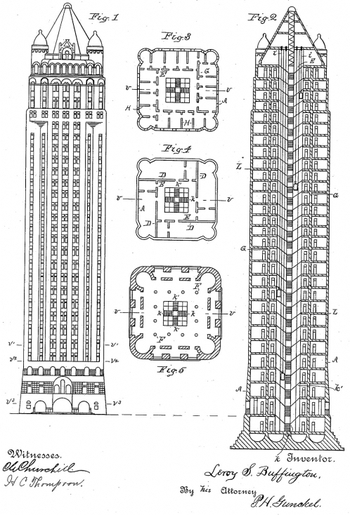
    As a matter of fact Buffington himself tried to patent the idea of a steel skeleton building (U.S. Patent No. 383,170, presented May 1888)—a claim which has been refuted and dismissed by modern scholars (such as Adam Lathrop, formerly of the University of Minnesota, who said that Buffington drew direct inspiration from LeBaron Jersey) with documentary evidence—Buffington should’ve known better.  Perhaps his proposal in 1889 was just a platform for publicity for his patent; perhaps not.  But it just seems that the state of the art for the big structure, as we see in the patent drawings for this imaginary 28-story building, was just nowhere near the realistic edge of being able to support a steel roof that was something like 1/12th of a square mile.
    Blogarchbuffington

    Even though the building was enormous, and impossible to build, it was also very not pretty.

    And for some reason Buffington just couldn’t get enough of his idea-that-wouldn’t die, as he presented it, again, for consideration for a pavilion for the 1933 Chicago World’s Fair.  It was rejected then, too. 


  • The Best Images of Horses, Ever: Hans Beham and Perspective, 1528

    JF Ptak Science Books LLC Post #105
    Blogmodel_bookhorses129

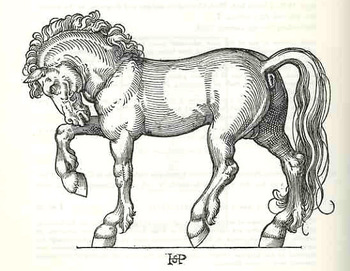
    Hans Sebald Beham wrote—produced, rather, the text and illustrated—Dises buchlein zeyget an und lernet ein mass oder proporcion der Ross, nutzlich iungen gesellen, Malern und goltschmiden, a tremendous, inspired model book for artists and observers, back there in 1528.  Amidst the heavy, blocky Gothic type of the book lie a series of just beautiful, proportional studies of horses.  It is probably the single greatest illustrated work on horses done in the history of printing to this time; and it has stood the test of time as a work of art, rather well.

    It is also, evidently, the work of an anti-Lutherian and certified “godless” painter, expelled by the city of Nurnberg (along with his brother and as it turns out the subject of yesterday’s Saturn post, George Pencz).  He, and his brother Barthel, and Pencz—with whom he shares birth and death dates of 1500 to 1550—were shaken by the city half way through his life in 1525 for having bad thoughts about religion and the proper way of not avoiding it. The decision by the city didn’t affect his art, as we can well see
    Blogmodel_bookhorses2130

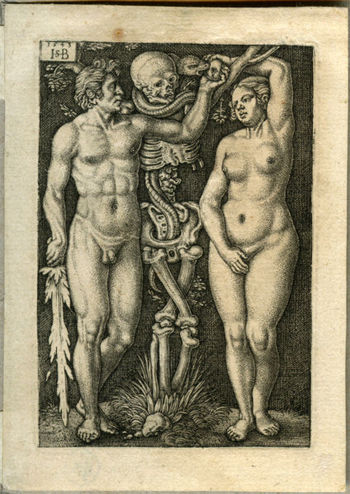
    Beham’s model book on the horse was followed by one on the human figure.  He was an extraordinary talent whose fine, deft touch can be recognized across the room, miniature or not.

    Behamadam_and_eve
     

    ·Posted by :

    ·in:

    —

  • Finding Hidden Images in Antique Prints: 18th Century Forensic Social X-Rays of Florence by Guiseppe Zocchi

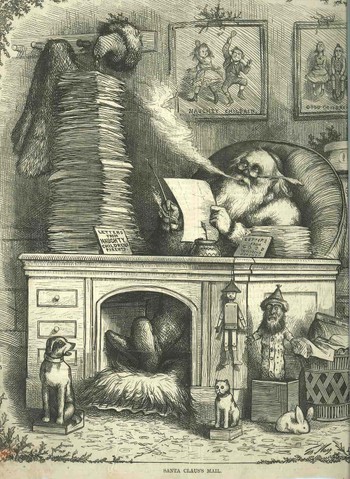
    Blogsanta121JF Ptak Science Books LLC   Post #103

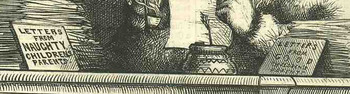
    I do love Santa.  But I was struck by something in this (30 December 1871) wood engraving—one of the very earliest of the now-recognizable form of Santa, created (his image that is , of course) by the incredibly prolific, and almost-entirely socially responsible (except for Catholics and the Irish) Thomas Nast.  (Nast created the standard, iconic image of Santa, plus the Republican elephant, the Democratic donkey, the Tammany tiger, and much more).  I’ve never noticed that the letters that Santa is reading are being taken *from* the piles on his desk, and that they are not from children, but from their parents.

    What?  How does this work out?  Were the “naughty” children being ratted out by their parents?  Does Santa really need to be told all of this?  And who on earth really is deserving of a lump of coal, anyway?  I’m guessing though that this was simply a warning cartoon to children, saying to them that they’d better damn well be good or a letter will be going out to Santa in the afternoon mail. 

    On the other hand this would make more sense if the cartoon wasn’t published five days after Christmas. 

    Blogsanta121detail

    These questions aside, the lesson yet again for me is to look very closely when looking at complex images like this—especially when you think that you already know what you’re looking at.

    Listen:  this is especially poignant when you think that you’re looking at not much at all. Having an antiquarian map (and print) shop puts me into contact with all manner of printed images.  As a result of this I have seen many thousands of images of important buildings in this and that city.  What I’ve found most interesting are the in situ images of the buildings, the structures as they were in the time of the artist, and situate din a street scene, showing other buildings, and other aspects of city life.

    It is all of this other stuff that can be extremely compelling, and sometimes, shocking, weird, odd, unexpected.  I have found that in big scenes of big buildings in big streets that the artist sometimes takes a little creative licenses with the people inhabiting the scene.  Sometimes it takes a magnifying glass to reveal the artist’s (or engraver’s) secrets and whimsies, but often the oddments are plainly there, just simply overwhelmed by everything else in the world that is happening.

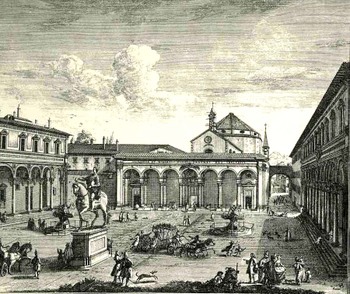
    Take for example the following two engravings, both by Giuseppe Zocchi (1711-1767) who was commissioned by he Marchise Andre Gerini at mid century to record the greatest of Florentine landmarks.  The first shown here is the Veduta della Piazza della SS Nunziata Statua Equeftre di Ferdinando Primo, Fonti, e Loggie Laterali.
    Bloglooking_closely_1_96123

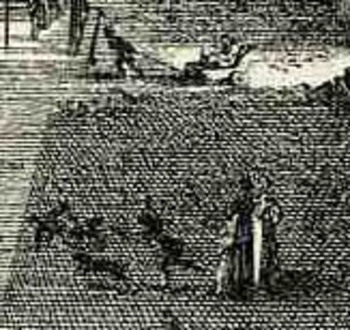
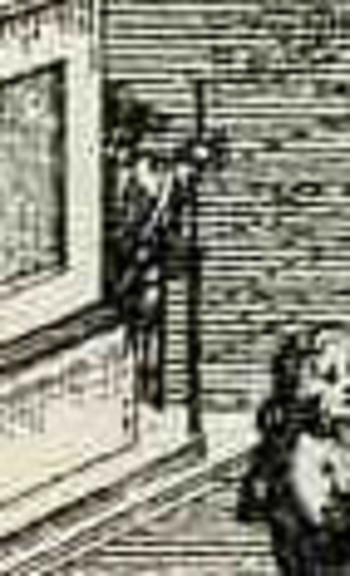
    It would’ve been easier certainly to leave the plaza empty, but Zocchi doesn’t, filling in the empty spaces with several dozen people, most of  whom are really rather busy.  In addition to royal coaches and animated discussions, we can find a number of unusual images.  There is a very curious sub-scene of a women with three children, one of whom seems to be falling, or leaping, the woman holding her hand straight out in front of her.  Directly above them we can see a man pulling a small carriage with another person in it.  Is this person a child?  Are they elderly?  Infirmed?  And what about the (probably elderly) figure who we can half see, leaning their back against the equestrian statue, holding a staff?  Why bother adding half of figure (from the rear)?  Why on earth did Zocchi choose to add

    Bloglooking_closely_1__carriage_2

    characters like these when it would be substantially easier to show a gent walking with a stick?  Is the artist expressing a little semi-invisible artistic freedom, or just using his powers of observation to make the commissioned part of the art more interesting?  Or perhaps Zocchi has nothing whatsoever to do with these tiny figures—perhaps it is all the work of the engraver, who was responsible for translating Zocchi’s paintings into metal, adding these figures as he went? 

    I think it is fascinating!  Perhaps what the story is here is that these were really just simple street scene, common street life, and the artist simply included them in the work?  That would make them 18th century snapshots of common life in Florence, something that wasn’t ordinarily captured by very many artists at all.
    Bloglooking_closely_1__man_cane

    Is it possible to collect all of these odd images—uncommon people, children playing (nameable?) games in the street, sellers of bits and pieces, people pushing homemade wagons, unusual modes of conveyance—and have a little bit of an unintended societal X-Ray of common life

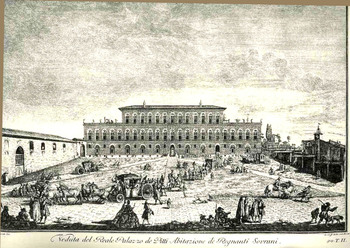
    Let’s look at another example from Zocchi:  Veduta del Reale Palazzo de Pitti Abitazione de Regnanti Sourani. Here we can see a rather long royal procession across a problematic grassy area, with most of the people not caring the least bit for the splendor.  As a matter of fact most of the people in the foreground of the image look to be homeless travelers, one of whom at the extreme bottom right) has a dog

    Bloglooking_closely_b124

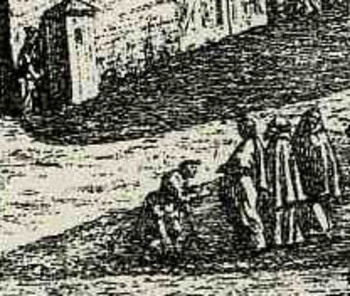
    on a leash, a backpack, and seems to be accompanied by a child.  Scurrying over to the left of the image, right before the procession, we can see a person on their knees seemingly begging for money from a more wealthy-looking group.  And above them is a singular little structure with a person entering—is this a guard’s shack, or a public convenience?  Probably it is the former as there is a very heavy door in a fortified wall just to its right (with some high weeds growing up against the wall as well).
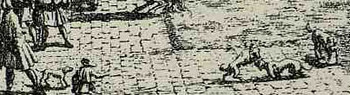
    Bloglooking_closely_b_dog_fight

    Why does the artist include this minutiae?  Why weeds?  Why the beggars, the homeless with children, the lazy?  Why did he include those dogs play fighting right in the middle of the scene?

    I think it is fantastic, and to me it is ultimately far more interesting looking for these bits than it is to see just another image of the Pitti.
    Bloglooking_closely_b_kneeling_man

    ·Posted by :

    ·in:


  • Early “Clip Art” Books: Amman, Vogtherr and the Mustard Seed Garden

    JF Ptak Science Books LLC   Post #102
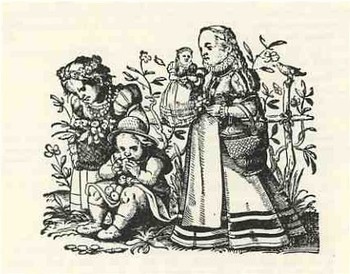
    Artists’ pattern books of the 16th century are, in a way, somewhat like our present
    clip art books.  They were certainly used by artists and students for details that
    they were not privy to as well as for inspiration; they were in some sense meant to
    be copied directly by those looking for bits and pieces to help flesh out a design
    for an armorial or coat of arms or bit of a title page.  So they were in fact intended to
    function somewhat like a clip art book. 
    Blogpattern_book_amman120

    One of the great pattern books printed in the second half of the sixteenth century belonged to Jobst Amman and began publication in Frankfurt in 1578: Kunstbuchlin.  Kunst und Lehrbuchlein fur die anfahenden Jungen Daraus reissen und Malen zu lernen Darinnen allerley Art lustige. ..(Art and instruction book for young beginners, from
    which to learn how to draw and paint; containing all sorts of cheerful and pleasant illustrations of men and women, also of little children, little animals and other
    subjects; published for the benefit of all young people who love this art
    ).  It really was intended for instruction in the arts for children but also served as a
    comprehensive pattern book for artists, jobber printers, craftsmen and the
    like-basically a clip art book of the 16th century, without the “clip” part.  (This
    book would’ve been studied, copied, and studied again, used for inspiration-it was
    not meant to have the images cut out and applied.)  There were 293 images in this
    book-each woodcut printed on its own page, with book standing about 12 inches
    tall-and for the most part featured women, children, pagan gods, religious leaders,
    emblemata, allegorical scenes, and perhaps most interesting from my point of view,
    scenes of people in different professions from all stations of life.  Amman was
    interested really in performing an artistic function, and really didn’t have a
    religious or moral authority that he was trying to sell to the reader.  So, in that
    way, his work was really pretty unusual, and, if you look hard enough, a delightful
    insight into some aspects of “common life” of 1578, from the styles of unpretentious
    clothing to how and where people worked.  His attention to detail and minuatiae
    makes this work a valuable, snap-shot like visualizations of tiny aspects of a past
    world. 

    In his later years,  Jost Amman created woodcuts for some of the greatest
    illustrated books of his time, including  titles as the Bible, Livy’s History of
    Rome, Flavius’s Jewish War, Reynard the Fox, the Kunstbuchlin, (1578), books on
    hunting, warfare, cooking and women’s fashion.>  He was truly prodigious, though it
    is unlikely that he created every work of art by himself-what probably happened was
    that he undertook all of the designs and then (again, probably) fanned out the work
    to be finished, with artists helping him to finish the original designs and
    woodcutters to actually make the woodblocks. 

    Sadly, A later edition of the Kunstbuchlin appeared in 1599-after Amman was
    dead-which was expanded to include previously-published Amman images that,
    beautiful as they were, had nothing really to do with the stated subject of the
    book, and seemingly undertaken to do a little cashing-out for the publisher.  The
    newly added images included images from Amman’s work on Turkey, horsemanship,
    =coasts of arms and pedigrees, horse breeding and a number of other unrelated
    things. 

    It is fitting that this book was reprinted in 1968 by the glorious Dover Publishers,
    as, so far as I can tell, they were the first mega-publishers of very affordable
    collections of clip -art art
    Blogpattern_book119
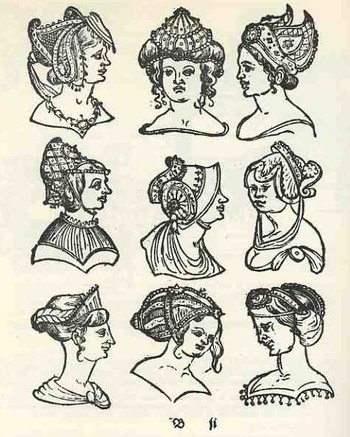
    Another example of an artists’ pattern book is Heinrich Vogtherr’s Kunstbuerchlin vonn Allerly seltzamen und wunderbarren frembden Stucken.published in Strassburg at around the same time as Amman (ca. 1575), but with an entirely different approach to the subject.  Vogtherr included hundreds of woodcut designs for workpeople in the
    arts (such  as “painters, sculptores, goldsmiths, stonemasons, and armorers” Heitz, Elsaessische Buechermarken) depicting the unusual and the semi-fantastical:  bizarre and extended headdresses for men and woman, incredible hairstyles (watch out, Ballmer), outrageous hands and feet, armaments real and imagined, as well as true but perhaps enhanced coats of arms, armorials, swords, halberds, and so on. 

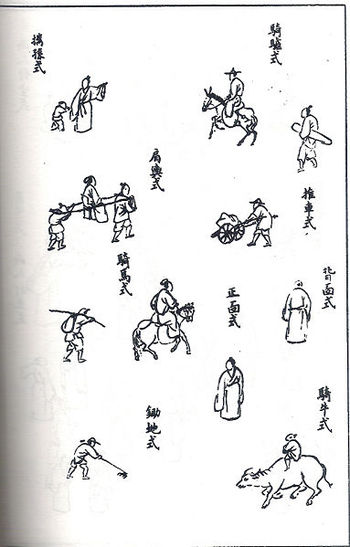
    Somehow and with perhaps very limited understanding is has led in my mind to the superb translation of the enormously revered manual of Chinese painting, The Mustard Seed Garden (Chieh Tzu Yuan Hua Chuan by Wang Kai,  first published in 1679) by Mai-Mai Sze, The Tao of Painting. A Study of the Ritual Disposition of Chinese Painting, 1956.  They’re not understating the secondary title whatsoever: this is basically a catalog which offers the student of Chinese art everything they need to know about forms  and shape and content and genre, along with how to draw these things, where to place them, how to establish the boundaries of the artwork, the different sorts of brushwork to use, and on to the end.
    Blogpattern_book_mustardIt describes the (eighteen) basic principles and rules, including the Six Canons (including the circulation of Ch’i), the Six Essentials (“action of the Ch’i and powerful brushwork go together” and “color (if used) should enrich” and “to exhibit originality even to the point of  eccentricity, without violating the LI of things”), The Three Faults (all concerned with brushwork), and  The Twelve Things to Avoid (“mountains without Ch’i, the pulse of Life”). 
    This is followed by notes on the preparations of colors and other materials used in painting.

    The next 600 pages or so is a very detailed visual description of how things should look and  takes up 15 pages of index in its very minute description.  For example, the section on trees discusses
    how trees should appear in the distance, methods for painting vines on trees, describing autumn willows,  dotting fruits in blossoms, and much more.  this treatment extends to rocks, humans, houses and structures, boats, furniture, city walls, palaces, waterwheels, and etc.  There is a longer section devoted to the painting of flowers and plants, where we see entries such as “rules of painting flowers phrased for  memorizing”, “flowers with eight and nine large petals”, “rules for painting sleeping birds phrased for memorizing” (a title for a poem if I’ve ever heard one), “painting thick leaves that withstand winter”, “a hanging and bent branch”, “plants with thorns and furry leaves”, and hundreds of other pages. 

    It is a stupendous work that I find beautiful and relaxing for reasons I don’t understand.

    The great Kenneth Rexroth said it most forcefully/grumpily, probably, when he reviewed the book for The Nation in 1957:
    “This is a book every American artist and art critic should buy and study—every night for several years.  Nothing could be a better answer to the problems and dilemmas of modern abstract expressionism.  Nothing could be a better antidote to the enervating poisons which have diluted modern painting.  This is a lucid, profound, exhaustive explanation of what you think you are doing, but aren’t, what you would like to do, but can’t.  Furthermore, the larger second volume consists of more than two hundred detailed pictures, with complete explanation of how it was done, long ago, by far better men than you.  It is all there—a complete alphabet of expression…”

    ·Posted by :

    ·in:

    —

  • Art Made of Fat: Boneless Sculpture in a Boney World

    JF Ptak Science Books   Post 100    [See also my latest post on fat:  Fat Redux, 1920’s Fat  Quack Cures].


    Luminousfatcvr111

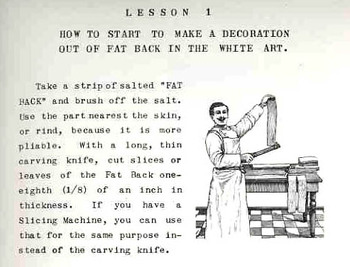
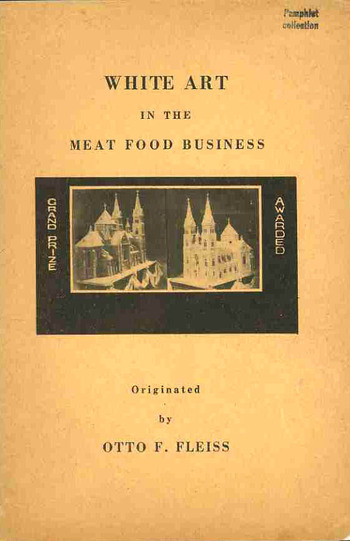
    In the world of found-book-objects, few I think are as deeply removed and as deeply obscure as the work by Otto F. Fleiss, a butcher and sculptor in fat. And lard.  The pamphlet’s title is a throw-back to an earlier day of titling, when the title page was pretty much fully overtaken by the title, though as a common practice it say its heyday 300+ years ago. Fleiss’ 50-word title: White Art in the Meat Food Business.  A Practical Handbook for Butcher, Pork Stores, Restaurants, Hotels and Delicatessens on How to Make Lasting and Transferable White Art Decorations out of Bacon Fat Back for Window Displays, Ornaments on Meat Food Cold Buffets and for Exhibits and Advertising Purposes.  Enrich yourself with Personal Knowledge. 

    Luminousfatman_top

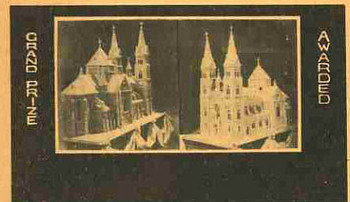
    If the title of this book could itself be described in terms of food, I think that I’d have to call it a (warm) Slim Jim Egg Frosty with a crust of French fries, baked.  Or something like that.  If the exhaustive, exhausting title didn’t stop you in your tracks, though, the slim pamphlet holds some indelible, indigestible, eyebrow-burning, flat-out remarkable images. Working your way through this pamphlet is as much fun as stringing together dirty diapers:  you can enjoy instructions on how to make a vase of roses out of strips of fat, or produce the reverse (?!) portrait of Santa Claus in slabs of fat, or marvel at the photos of Mr. Fleiss’ “first prize” (?) 200-pound fat sculpture of a cathedral done entirely in slips and chunks and strips of fat.

    Luminousfatcvr_detail This simply must be the most sublime work ever produced on Fat Art.
    And, in the annals of art, I should think that Black Velvet Sparkly Liberace paintings may have moved up a level from the most secret depths of the inferno to make way for Fat Art–or, dare I say it, “FART”.


    A Note on the Origin of this Pamphlet:

    The Fleiss work comes from a singular collection that we purchased of the Library of Congress some years ago.  It was called, simply, “The Pamphlet Collection”, and included 90,000 or so pamphlets stored in 2,355 blue document boxes.  They were all categorized and alphabetized, but not according to any truly discernible methodology.  Their greatest common denominator was that the great majority of them simply did not exist.

    By “they did not exist” I mean that they were not catalogued in the massive (70 million item)  database and librarian’s tool WorldCat/FirstSearch which lists books in libraries world wide.   And they continually do not show up in the mass bookseller databases, or in Google/Yahoo searches, and so on.

    The pamphlets in the collection also weren’t added, in large part, to the Library of Congress collection, nor were they ever circulated.  They were just kept in their blue boxes, waiting to a-moulder away.  But they didn’t, and here they are, and will be, making appearances over the next number of years.

    There will also be many other images from much more public and published sources that have simply slipped away from us here in our present—unexpected bits of revelatory history wrapped in a simple image that speak volumes from the dim, deep forgotten.

    Additional Images:

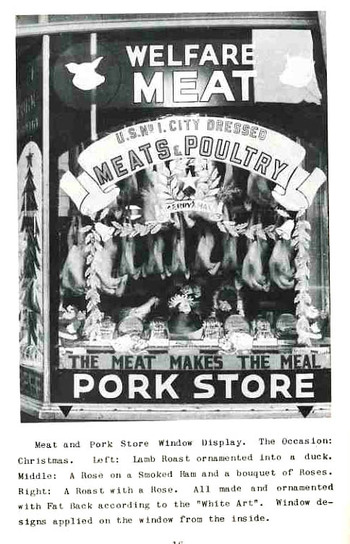
    Perhaps the most incredible of the photographs in this unleafy work by Fleiss is of that below, of the Welfare Meat Pork Store.  The legend describes “lamb roast ornamented into a duck”, meaning that all of the duck-like things hanging there in the window were actually made of lamb roast covered in pork fat.  (One doesn’t get to write that ever day.) Then we see a “roast with a rose” (and as we saw in the text the roses in the ornamentation were made out of fat), as well as a “rose on a smoked ham and a bouquet of roses”.  Again, virtually everything in the wind of this store was constructed of fat.Luminousfatlamb115


    Mr. Fleiss also did Christmas ornamentation.
    In fat.