A Daily History of Holes, Dots, Lines, Science, History, Math, Physics, Art, the Unintentional Absurd, Architecture, Maps, Data Visualization, Blank and Missing Things, and so on. |1.6 million words, 7500 images, 4.9 million hits| Press & appearances in The Times, Le Figaro, Mensa, The Economist, The Guardian, Discovery News, Slate, Le Monde, Sci American Blogs, Le Pont, and many other places… 5000+ total posts since 2008.

Author: JF Ptak

  • Sensitive Flames, 1874

    JF Ptak Science Books  Post #74
    Sensitive_flame

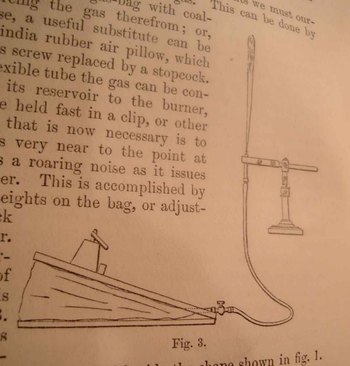
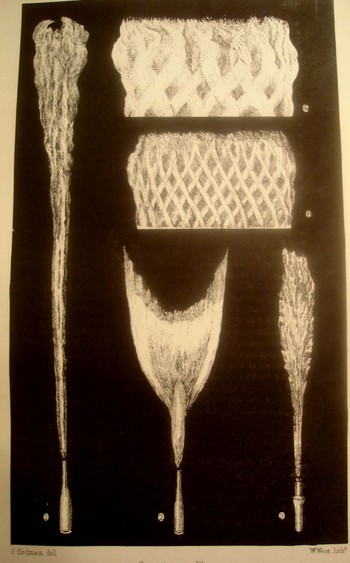
    I was drawn (like a moth to a …) to these images that appeared in the journal Popular Science (New York), 1874, in an article by W.F. Barrett entitled “Sensitive Flames”.  Actually I was more drawn to the title than the images, trying to conjure the differences between the other sorts of vaguely ethereal antiquarian flames that I imagined I was familiar with:  quiet flames, singing flames, and the present sensitive flames.  More or less “discovered” in 1857 by Joseph Le Conte (and then hammered in close comforting years soon after by Govi, Tyndall, Barry and Geyer), sensitive flames were noticed because they reacted to acoustic variations.  These gas flames changed their shape according to the sorts of sounds and music that they were subjected to.  (There are other factors involved here too of course, like the amount of gas used and the way in which the gas is released and so on—basically though they were the subject of change depending of their sensitivity to different sounds.)
    Sensitive_flame_appar
    Sensitive flames fall into a special category of  reactive agents like Kundt’s dust figures and Cholodni’s watery acoustic images (and maybe even the wonderful dances of Brown’s dust particles and Einstein’s Brownian motions—unexpected, interesting and arresting images to watch produced by sound in an unexpected medium).


    Early notices on the subject of “sensitive flames” appearing in the London-based journal Nature
    :

    (1)  Letters to Editor, Nature (03 December 1874)

    Sounding and Sensitive Flames by A. S. HERSCHEL  (Abstract)

    IN a letter which I have just received from Dr. A. K. Irvine, of Glasgow, my
    attention is drawn to a short abstract of some of his experiments with Barry’s
    sensitive flame, which appeared in the English Mechanic of Dec. 15, 1871, a few
    months previously to the appearance in the Journal of the Franklin Institute, and in
    the American Journal of Science, of the description, referred to briefly in my last
    letter (NATURE, vol. xi. pp. 6 to 8), of Mr. Geyer’s researches on the acoustic
    properties of the same flame, some particulars of which Dr. Irvine appears also to
    have noticed independently. The few lines in which his observations are recorded
    corroborate so fully the character and mode of action of the flame as now pretty
    perfectly established, that a short extract from them will scarcely be without
    interest, from the satisfactory support which it offers to the accounts and
    explanations that other investigators of this flame have elsewhere given ii graphic
    terms of its appearance.

    (2)  Letters to Editor, Nature 11, 45-47 19 November 1874) Sounding and Sensitive Flames, II
    (Abstract)

    ANOTHER example of a highly sensitive flame was recently described to me which seems to show that air-currents flowing through gauze at a proper speed are sensitive
    without the intervention or simultaneous superaddition of a flame. A special kind of Bunsen burner was made with a spiral mixing tube coiled in an inverted cup, at the
    centre of which is a small chamber covered with wire-gauze at the foot of a short
    tube or flame-pipe. The gas is admitted by a single jet passing through a cap of
    wire-gauze covering the conical opening of the spiral tube, the object of this cap
    of gauze being to distribute the air in its approach, and to protect the gas-jet
    from ignition. The gas-flame burns with a small bright green cone, surmounted by a
    larger envelope of pale reddish flame, and it is intensely hot. The green cone
    indicates combustion of the most complete explosive mixture of air and coal-gas, and
    when the burner is properly adjusted it can only burn on the top of the flame-tube,
    where it finds the additional required supply of oxygen; but it descends to the
    wire-gauze at the foot of the tube if the air-supply exceeds, or the gas supply
    falls short of the right proportion. In some of these burners the slightest noise of
    the kind that commonly affects sensitive flames causes the cone of green flame to
    retreat into the tube and settle on the wire-gauze at its foot, whence it rises
    again immediately to the top of the tube, when the sound ceases. The explanation
    seems to be that the air-current entering the mixing-tube through the outer gauze
    cap is in a sensitive condition, and that when thrown into disturbance by the
    external sounds, it is more quickly seized and is drawn into the mixing tube more
    rapidly by the gas-jet than when it is flowing over the jet in a tranquil state. The
    inventor of these burners, Mr. Wallace, assures me that some of them exhibit the
    most sensitive of sensitive flames, and that he has more than once thought of
    sending one of them as a most singularly effective illustration of such flames to
    Prof. Tyndall.


    ·Posted by :

    ·in:


  • Shaping Space and Controlling What We See—Determining What Color “Is”, Emily Vanderpoel and Pre-Kandinsky Art

    JF Ptak Science Books    Post #73

    Blogcolorvander_2poel_063
    The idea of how we put parameters to something like the visual field is a gargantuan topic—it is something that architects and geometers and physicists and mathematicians (in general) have dealt with forever.  Mapmakers have perhaps the most visualized aspect of this on paper, performing the semi-miracle of translating three dimensions into two; physicists have a more difficult time, taking the opposite approach, sort of , and translating two or three dimensional space into x-number of dimensions.  Anatomists had a difficult time of their subject until relatively recently in human history, what with the sublime religious curfews on messy knowledge and all coming into play, poking around into the heart and such as though it was an affront to the sanctity of the creator (M Servetus’ ideas on the circulation of the blood via the heart, making the heart a tool and not the brain or some odd conjunction of creative divine power, cost him his life, burning slowly alive at the stake…how mysterious the whole world of RNA Genotype-Phenotype Mapping and such would seem to him if he could have a peek into the future/present from wherever he is.)
    Blogcolorvanderpoel_062

    Color theory is old and pretty—as a matter of fact there is a very attractive gathering of color theory models (in black and white, though) displaying some two dozen or more color models from the last 400 years.  People like Della Porta (1593), our old friend and resident oddball polymath crank Kircher (1646), the smarter-than-you-could-believe Newton (1660), Waller (1686), Lambert (1772), the wide ranging and again polymathic Goethe (1792), Herschel (1817, who also ushered in our understanding of the other light-sensitive shape spacing medium of photography in 1840), the semi-forgotten Chevreul (1835), the beautiful Maxwell (1857), Wundt (1874, the early experimental psychologist who also looked for spirits/spiritmus and ghosts), von Bezold (1878), Rood (1879), Munsell (1918) Kandinsky (1914 and not decipherable by me) and Klee (1924), and so on towards the present, all tried to analyze the prospects of color.

    Not in this list is the very highly problematic Emily Vanderpoel, who in 1901 and 1903 produced (in two editions) a lovely but mysterious book called Color Problems for the Layman, in which she sought not so much to analyze the components of color itself, but rather to quantify the overall interpretative effect of color on the imagination.  I know this sounds begging and vague, but I really haven’t been able to make much headway in the work.

    Blogvanderpoel_1057
    I’m attracted to this effort because of its attempt at quantifying such abstract thoughts.

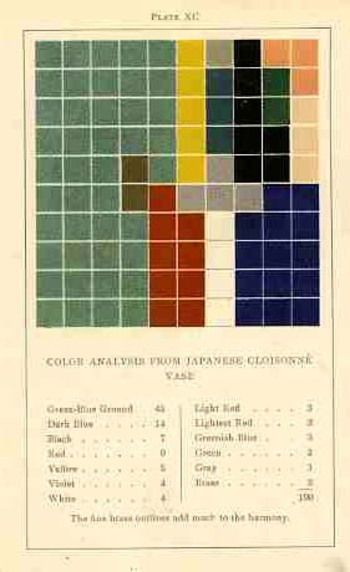
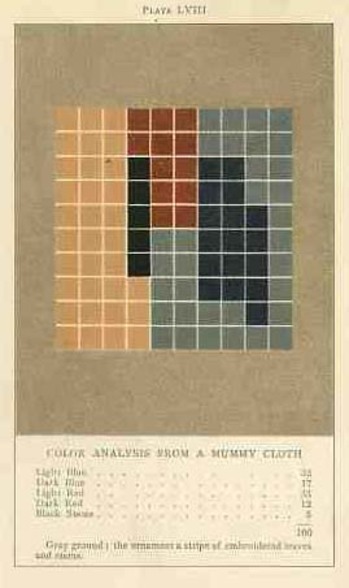
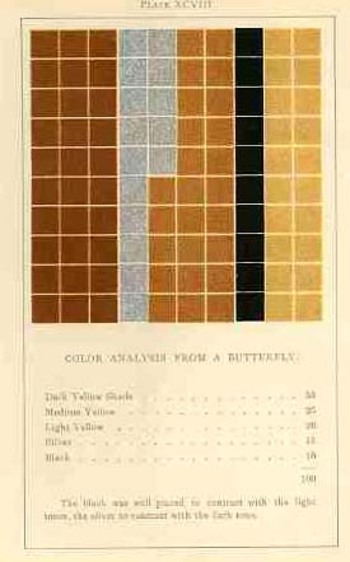
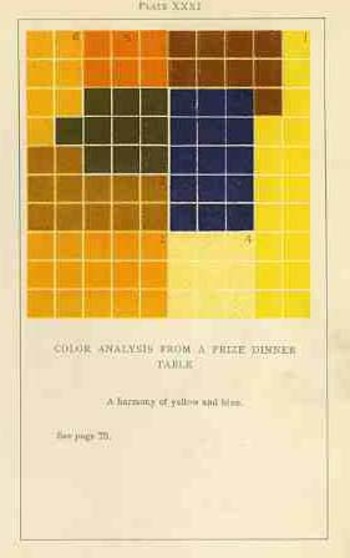
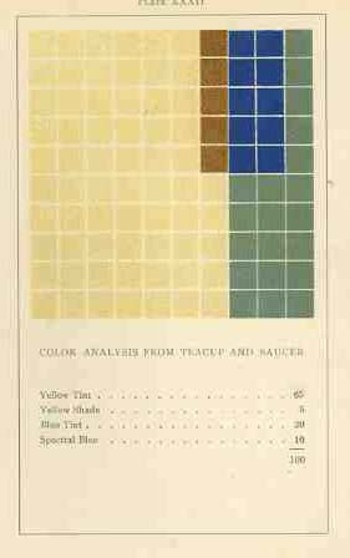
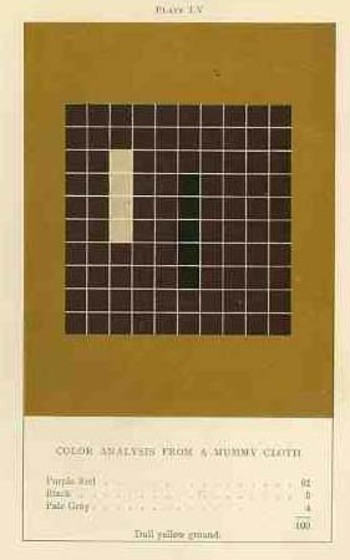
    By virtue of this effort, though, Vanderpoel had produced a strikingly illustrated book, with 118 color plates, all very intense, and beautiful, and in its way exceptional—unique perhaps.  Had the book been written thirty years or so hence we’d call it some sort of constructivist/constructionist artform.  But since the artwork in the book comes a decade before the first non-representational artwork in human history (or so), I don’t know exactly what to call it. 
    Blogvanderpoel_2058

    I really don’t know what it is, but I know that it is not entirely accidental, this pre-non-representational artform, because controlled geometrical color art is not accidental. 

    In trying to quantify the color images of the objects in her study, Vanderpoel establishes a 10×10 square grid, dividing all of the color in that object into individual units numbering to 100.  Then, somehow, she identifies the major colors and places them according to a system that I cannot understand within the grid.

    Blogvanderpoel_3059

    The net effect is glorious.  I just don’t know how she got there—which isn’t normally a consideration in art, except that this work is an instructional on how to understand color in art and nature, and the explanation of the procedure is ethereal.  Vanderpoel was and remains a respected author on porcelains and other applied and plastic arts.  In this work she looked at her fair share of porcelain, limogues, clay pots, burial urns, glass shards, and the like; she also analyzed clouds, mummy cloths (and casings), dew on morning grass, brocade, the eye of a blue jay, feathers, and another hundred or so poetic arragenments of the stuff of teh world.  I still do not know what this book is trying to tell me, but I do know that it is remarkable.   

    Blogvanderpoel_4060  

    ·Posted by :

    ·in:

    — —

  • Beautiful Circles in Science #1: the Astronomy and Cosmology of Fontenelle and the Plurality of Worlds, 1686.

    Blog26apfontenelleJF Ptak Science Books Post #69

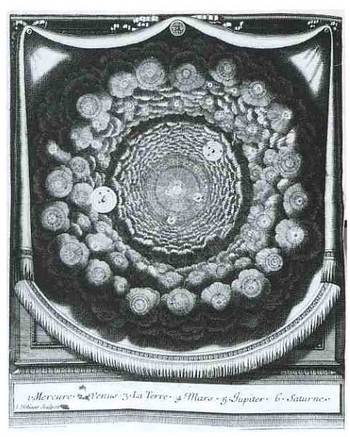
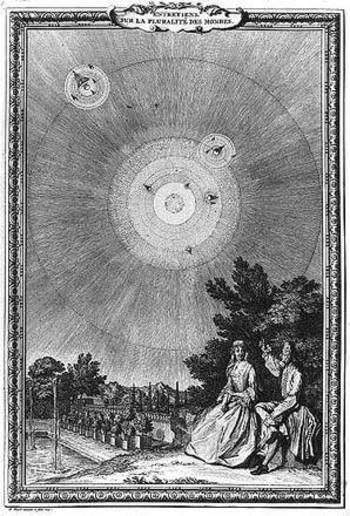
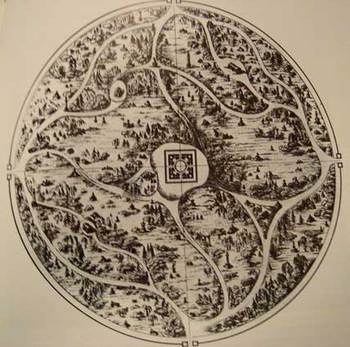
    This first lovely image belongs to Entretiens sur la
    Pluralitie de Mondes
    (Conversations on the Plurality of Worlds), written by the
    great French philosophe Bernard le Bouvier de Fontenelle in 1686 (just a year
    before publication of perhaps the greatest work in the history of science, Newton’s Principia
    Mathematica
    ). The Plurality was a
    best-seller by the best-selling Fontenelle. An excellent attempt by a rather
    restricted writer to engage the population-at-large, writing a high-pop book on
    what was basically the history of astronomy and cosmology of the preceding
    century. Copernicus was a major feature
    of his imaginary conversations with a muse as he wandered through a
    metaphorical garden of questions, with the observations of Galileo and Cassini
    also very prominently featured.

    Fontenelle’s Pluraltiy was amended, added to, and fattened
    up for a long time, the author adding material to it constantly for years to
    come—the book went through at least 33 editions during Fontenelle’s
    hundred-year-long life (1657-1757). This
    engraving was meant to be allegorical, illustrating a Copernican planetary
    system which was surrounded by galactic clouds comprised of other solar systems—prescient
    and forward thinking, as it wasn’t until the last 15 years or so that a solar
    system was discovered outside our own. (This until recently was a tremendously difficult
    feat to accomplish—instrumentation and practices now are advanced, but it is
    still an extremely difficult task to locate extra-solar system planets and
    systems.) 

    Plurality
    What makes this engraving so particular and attractive to
    me, and the reason why it is listed first in this series of scientific circles,
    is because of its beauty and “deep depth”. The artist certainly related the compound nature and depth of the
    universe, revealed to us from behind drawn curtains. Our solar system is featured prominently, with hosts of other solar systems borne on each puff of extragalactic clouds, reahcing, or descending, “all the way down Or up)”.  Fontenelle believed in the infinity of world
    and the enormous-by-reason possibilities of the universe, as we see in this
    extra from Plurality:

    I shou’d think it very strange, that the Earth shou’d be inhabited as it is;
    and the other Planets shou’d be so entirely desolate and deserted: For you must
    not think, that we see all the living Creatures that inhabit the Earth. For
    there are as many several species and kinds of Animals invisible as there are
    visible. We see distinctly from the Elephant to the Mite; there our sight is
    bounded, and there are infinite numbers of living Creatures lesser than a Mite,
    to whom, a Mite is as big in proportion, as an Elephant is to it. The late
    invention of Glasses call’d Microscopes, have discover’d thousands of small
    living Creatures, in certain Liquors, which we cou’d never have imagin’d to
    have been there. And it may be the different tastes of these Liquors, proceed
    from these little Animals, who bite, and sting our Tongues and Palates. If you
    mix certain ingredients in these Liquors, (as Pepper in Water,) and expose ’em
    to the heat of the Sun, or let ’em putrefie, you shall see other new species or
    living Creatures. Several Bodies, which appear to be solid, are nothing else
    but Collections or little heaps of these imperceptible Animals; who find there
    as much room, as is requisite for them to move in. The leaf of a Tree, is a
    little World inhabited, by such invisible little Worms:
    To them this leaf seems of a vast Extent, they find Hills and Valleys upon it:
    And there is no more Communication between the living Creatures on the one
    side, and those on the other, than between us and the Antipodes.
    And I think there is more reason, to believe a Planet (which is so vast a Body)
    to be inhabited. There has been found in several sorts of very hard Stones,
    infinite multitudes of little Worms
    ,
    lodg’d all over them in insensible varieties; and who are nourish’d upon the
    Substance of these Stones which they eat. Consider the vast Numbers of these
    little Animals, and how long a tract of Years they have liv’d upon a grain of
    Sand. And by this Argument, tho my Moon were nothing but a confus’d heap of
    Marble Rocks, I wou’d rather make it be devour’d and consum’d by its
    Inhabitants, than to place none at all in it.”

    CONTINUE:

    ·Posted by :

    ·in:

    —

  • First-Hand Observations of Isaac Newton–Humphrey Newton and the Principia Mathematica

    JF Ptak Science Books LLC   Post #68Newtontrinity_desk
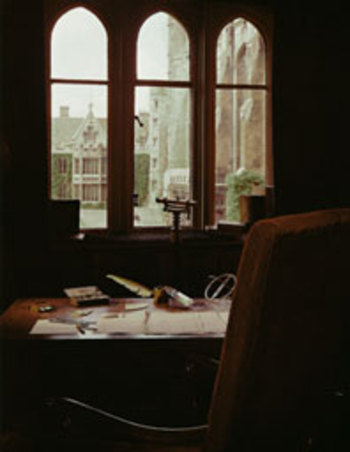
    I started to write an essay on Sir Isaac’s interest in alchemy–which was considerable, as he wrote more than a million words on the subject and fully one third of his library was devoted to it–chiefly to look at the reasons in pursuing the darker aspects of chemistry (in trying to master the ultimate secrets of the gatekeeper, finding the lost early magnificent knowledge, that sort of thing).  Newton felt that he really, truly, just didn’t know enough, and that there was something very big, and very hidden, that was escaping him. And so the background of these pursuits was to be tied to musical composition with color, and synesthesia, but I got sidetracked by two glorious letters by Newton’s assistant, Humphrey Newton, in which the personal life-style stuff of the Great Man is described.  I thought to post the two Humphrey Newton letters here, slightly annotated by me, before the thoughts left my head.  I’ll  return to the Newton/Color Music/Music of the Spheres stuff later.  (At right, Newton’s desk/study at trinity.)

    Thoughts and Recollections by Humphrey Newton, assistant and amenuensis to      Sir Isaac Newton (no relation), briefly annotated (in blue).

    Original transcription available from The Newton Project:  “King’s College, Cambridge, Keynes Ms. 135, two letters from Humphrey Newton (Newton’s amanuensis from 1683-89 and no relation) to John Conduitt, 17 January 1727/8 and 14 February 1727/8, with reminiscences of Newton”.

    We’ve followed this with the Newton’s Introduction to the Principia (1687)

    Humphrey Newton Letter 1

    (This letter also published in full in Memoirs of the Life, Writings, and Discoveries of Sir Isaac Newton,  by Sir David Brewster, 1832)

    Sir
    Receiving yours return as perfect & as faithful Account of my deceased friend’s {Newton, Sir Isaac, 1642-1727] Transactions as possibly does at this Time occur to my memory Had I had the least Thought of gratifying after this manner, Sir Isaac’s ffriend, I should have taken a much stricter view of his Life & Actions
    .
    In the last year of King Charles 2d [Charles  died 2 Nov 1685] Sir Isaac was pleas’d through the Mediation of Dr. Walker (then Schoolmaster at Grantham) [Grantham.  The King’s School, in Lincolnshire, an English educational institution,  endowed in 1528. Newton attended, and may have carved his name in the wooden walls of the library there] to send for me up to Cambridge, of whom I had the opportunity as well as Honour to wait of, for about 5Principia
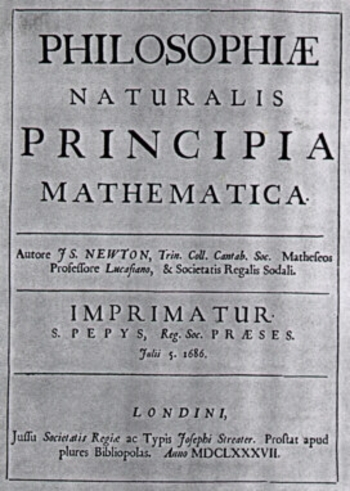
    years, in which time he wrote his Principia Mathematica, [Philosophiae Naturalis Principia Matheamtica published in 1687] which stupendous work, by his order, I copied out, before it went to the Press [of Joseph Streater].. After the Printing Sir Isaac was pleas’d to send me with several of Them, as Presents, to some of the Heads of Colledges, & others of his Acquaintance, some of which (particularly Dr. Babington of Trinity [Humphrey Babington, Fellow of Trinity, 1615-1692]) said That They might study seven years, before They understood any thing of it. His carriage then was very meek, sedate & humble, never seemingly angry, of profound Thoughts, his Countenance mild, pleasant & Comely; I cannot say, I ever saw him laugh, but once, which was at that Passage, which Dr. Stewkley mentioned in his Letter, to your Honour which put me in mind of the Ephesian Phylosopher, who laugh’d only once in his Life Time, to see an Ass, eating Thistles, when Plenty of Grass was by [not the “gathering thistles from figs” part of Eph 6:17]. He always kept Close to his Studyes, very rarely went a visiting, & had as few Visitors, excepting 2 or 3 Persons, Mr. Ellis of Keys, Mr. Lougham of Trinity [John Laughton, Fellow, d. 1712] , & Mr. Vigani, a Chymist, [John Francis Vigani was the first Professor of Chemistry at
    Cambridge University and taught at Queens’ College for three years up
    to 1705.]
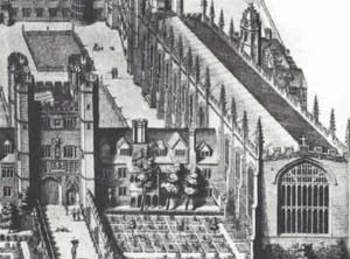
    in whose Company he took much Delight and Pleasure at an Evening, when he came to wait upon Him. I never knew him take any Recreation or Pastime, either in Riding out to take the Air, Walking, bowling, or any other Exercise whatever, Thinking all Hours lost, that was not spent in his Studyes, to which he kept so close, that he seldom left his Chamber unless at Term Newtontrinity
    Time, when he read in the Schoools, as being Lucasianus Professor, where so few went to hear Him, & fewer that understood him, that oftimes he did in a manner, for want of Hearers, read to the Walls. fforeigners He received with a great deal of ffreedom; Candour, & Respect. When invited to a Treat, which was very seldom us’d to return it very handsomely, freely, & with much satisfaction to Himself. So intent, so serious upon his Studies, that he eat very sparingly, nay, oftimes he has forget to eat at all, so that going into his Chamber, I have found his Mess untouch’d, of which when I have reminded him, would reply, Have I; & then making to the Table, would eat a bit or two standing, for I cannot say, I ever saw Him sit at Table by himself, At

    (Newton’s rooms at Trinity at lower right)

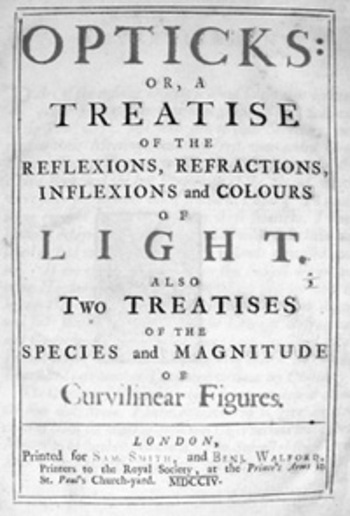
    some {seldom} Entertainments the Masters of Colledges were chiefly his Guests. He very rarely went to Bed, till 2 or 3 of the clock, sometimes not till 5 or 6, lying about 4 or 5 hours, especailly at spring & ffall of the Leaf, at which Times he us’d to imploy about 6 weeks in his Elaboratory, the ffire scarcely going out either Night or Day, he siting up one Night, as I did another till he had finished his Chymical Experiments, in the Performances of which he was the most accurate, strict, exact: What his Aim might be, I was not able to penetrate into but his Paine, his Diligence  at those sett times, made me think, he aim’d at somthing beyond the Reach of humane Art & Industry. I cannot say, I ever saw him drink, either wine Ale or Bear, excepting Meals, & then but very sparingly. He very rarely went to Dine in the Hall unless upon some Publick Dayes, & then if He has not been minded, would go very carelessly, with shoes down at Heels, stockins unty’d, surplice on, & his Head scarcely comb’d. As for his Opticks being burnt, IOptickstitle
    know Nothing of it, but as I had heard from Others, That Accident happening before he writ his Principia. He was very Curious in his Garden, which was never out of Order, in which he would, at some seldom Times, take a short Walk or two, not enduring to see a weed in it; On the left end of the Garden, was his Elaboratory, near the East end of the Chappell, where he, at these sett Times, employ’d himself in, with a great deal of satisfaction & Delight. Nothing extraordinary, as I can Remember, happen’d in making his Experiments, which if there did, He was of so sedate & even Temper, that I could not in the least discern it. He very seldom went to the Chappel, that being the Time he chiefly took his Repose; And as for the Afternoons, his earnest & indefatigable Studyes
    retain’d Him, so that He scarcely knewe the Hour of Prayer. Very frequently
    Newtonst_marys
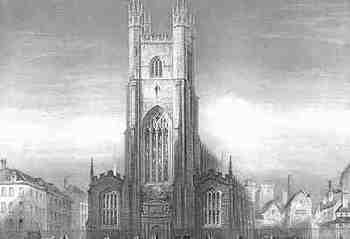
    on Sundays he went to St. Mary’s Church, especially in the fore Noons. I know Nothing of the Writings, which your Honour sent, only that it is his own Hand, I am very certain of, believing he might write Them at some leasure Hours, before he sett upon his more serious & weighty Matters. Sir Isaac at that Time had no Pupills, nor any Chamber ffellow, for that I presume to think, would not in the least have <4> been agreeable to his Studies. He was only once disorder’d with pains at the stomach, which confin’d Him for some days to his Bed, which he bare with a great deal of Patience & Magnanimity, seemingly indifferent either to live or dye. He seeing me much Concern’d at his Illness, bid me not trouble my self, for if, said he, I dye, I shall leave you an Estate, which he then mention’d.
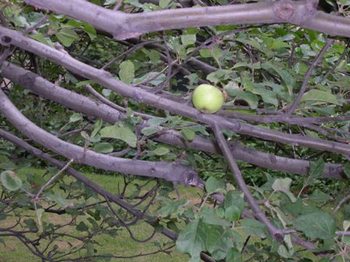
    Newtons_apple_tree_at_mit [Cutting from Newton’s “original” apple tree bearing fruit at MIT]

    Sir this is what I can at present recollect, hoping it may in some Measure satisfy your Quæries.
    My wife at this Time is brought to Bed of a son, whom I intent to Nominate after my dear deceased ffriend, would you please to honour me so far, as to substitute Dr. Stewkly to stand as witness, I should take it as a very singular ffavour, & would very much
    oblige, Sir, your most humble
    & obedient Servant.
    Humphrey Newton
    Ian.17. –27/8
    Grantham

    Humphrey Newton Letter 2

    Sir
    I return your Honour a great many Thanks for the ffavour you have done me, in deputing Dr: Stewkley to stand in your stead, as witness to my son. It is out of my Sphere to make any grateful Return, therefore doubt not but Your Goodness, will in that Point, excuse my Deficiency.
    I have bethought my self about Sir Isaac’s Life, as much as possibly I can.
    About 6 weeks at Spring & 6 at the ffall the fire in the Elaboratory scarcely went out, which was well furnished with chymical Materials, as Bodyes, Receivers, ffends, Crucibles &c, which was made very little use of, the Crucibles excepted, in which he {fused} his Metals: He would sometimes, thô very seldom,) look into an old mouldy Book, which lay in his Elaboratory, I think it was titled, – Agricola de Metallis, The transmuting of Metals, being his Chief Design, for which Purpose Antimony was a great Ingredient. Near his Elaboratory was his Garden, which was kept in Order by a Gardiner I scarcely ever saw him do any thing (as pruning &c) at it himself. When he has sometimes taken a Turn or two, has made a sudden stand, turn’d himself about, run up the stairs, like another Archimedes, with an Ε’ύρηκα, fall to write on his Desk standing, without giving himself the Leasure to draw a Chair to sit down in.
    At some seldom Times when he design’d to dine in the Hall, would turn to the left hand, & go out into the street, where making a stop, when he found his Mistake, would hastily turn back, & then sometimes instead of going into the Hall, would return to his Chamber again.
    <6>
    When he read in the Schools, he usually staid about half an hour, when he had no Auditors he Commonly return’d in a 4th part of that time or less. Mr Laughton, who was then the Library Keeper of Trinity College resorted much to his Chamber, if he commenc’d Doctor after that, I know not.
    His Telescope, which was at that Time, as near as I could guess, near 5 foot long, which he plac’d at the head of the stairs, going down into the Garden, buting towards the East, what Observations he might make, I know not, but several of his Observations about Comets & the Planets may be found scatter’d here & there in a Book intitled, The Elements of Astronomy, by Dr. David Gregory. He would with great acutness answer a Question, but would very seldom start one. Dr: Boerhaave (I think it is) Professor Lipsiae in some of his writings, speaking of Sir Isaac That man, says he, Comprehends as much as all mankind besides.
    In his Chamber he walk’d so very much, that you might have thought him to be educated at Athens among the Aristotelian sects. His Brick ffurnaces pro re natâ, he made & alter’d himself, without troubling a Brick-layer. He very seldom sat by the ffire in his Chamber, excepting that long frosty winter, which made him creep to it against his will.
    I can’t say, I ever saw him wear a Night-Gown, but his wearing Cloathes, that he put off at Night, at Night, do I say, yea rather towards the Morning, he put on again at his Rising. He never slept in the Day Time, that I ever perceived. I believe he grudg’d that short Time he spent in eating & sleeping. ’Ανέχου και ’χπεχου may very well & truly be said of him, he always <7> thinking with Bishop Sanderson, Temperance to be the best Physick. In a Morning he seem’d to be as much refresh’d with his few hours sleep, as though he had taken a whole Night’s rest. He kept neither Dog nor Cat in his Chamber, which made well for the old woman, his Bed-maker, she faring much the better for it, for in a Morning, she has sometimes found both Dinner & Supper scarcely tasted of, which the old woman has very pleasantly & mumpingly gone away with. As for his private Prayers, I can say nothing of them, I am apt to believe his intense Studying depriv’d him of the better Part. His Behaviour was mild & meek, without Anger, Peevishness or Passion, so free from that, That you might take him for a Stoick. I have seen a smal pasteboard Box in his study set against the open window, no less as one might suppose, then a 1000 Guineas in it crowded Edgewayes, whether this was suspicion or Carelessness I cannot say, perhaps to try the ffidelity of those about him. In Winter Time, he was a Lover of Apples, & sometimes at a Night would eat a smal roasted Quince. His thoughts were his Books, thô he had a large study, seldom Consulted with them. When he was about 30 years of Age, his gray Hairs was very Comely, & his smiling Countenance made him so much the more graceful. He was very Charitable, few went empty handed from him. Mr. Pilkinton, who liv’d at Market-Orton, died in a mean Condition (thô formerly he had a plentiful Estate) whose Widow with 5 or 6 Children Sir Isaac maintain’d several years together. He commonly gave his poor Relations (for no ffamilies so rich, but there is some Poor among them) when they apply’d themselves to him, no less then 5. Guineas <8> as they themselves have told me. He has given the Porter many a Shilling, not for leting him at the Gates at unseasonable Hours, for that he abhor’d, never knowing him out of his Chamber at such Times. No way litigious, not given to Law or vexatious suits, taking Patience to be the best Law, & a good Conscience the best Divinity.
    Says Seneca, some Body will demonstrate, which way Comets wander, why they go so far from the rest of the Celestial Bodies, how big, & what sort of Bodies they are, which had he been Contemporary with Sir Isaac he might have seen this Prophecy of his fulfill’d by that wonder of his Age.
    Could Your Honour pick some things out of this indigested Mass, worthy to be inserted into the Life of so great, so good, & so illustrious a Person, as Sir Isaac Newton! it would be of infinite Satisfaction to him, Sir
    who is Your Honours most
    humble & most obedient
    Servant
    H: Newton
    ffeb: 17. 1727/8
    Grantham
    ·Posted by :

    ·in:

    —

  • (Literal) Bits of History–the Softly Pedestrian Beginning of the Atomic Bomb

    JF Ptak Science Books LLC Dsc00015_detail
    My  rare/significant/non-existent scientific bookstore was in Georgetown for many years.  It was a few doors down from Alger Hiss’ house, a few less from Warren Christopher’s house, a few more further from Alex G. Bell’s house, diagonally away from a George Washington ____ here tavern,  just across the street from a children’s park built on top of a Revolutionary War cemetery, and just generally in the misty mist of interesting stuff. It was by virtue of my location (it took 15 years for me to actually get a sign for the store, and only then because my glorious wife, Patti Digh, bought it for me) that I was able to met a wide range of interesting folks–and this is how I came to meet Robert L. Walker.  Dr. Walker was retired and living in the desert near Santa Fe at that point, and had just happened to pop into the store because he was visiting a neighbor who shared his hobby of harpsichord building. 
    Blogwalkerfermi

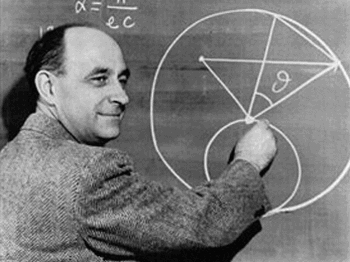
    Since he was a physicist and of a certain age, it was my custom to find out what this class of human was doing, oh, 55 years earlier.  Dr. Walker, as it turned out, was a graduate student at Cornell who was recruited to work at the Metallurgical Lab at U Chicago, beginning in 1941. 
    Dsc00015

    This of course was an incredibly interesting time to be where he was. Steps towards the realization of nuclear energy were being taken under the grandstands of Soldier’s Field (the “West Stands Laboratory”), with Enrico Fermi in charge–the atomic pile (code for a nuclear reactor) being constructed during the months of October and November 1942 and then becoming “operational” (becoming a self sustaining chain reaction initiating the controlled release of nuclear energy, as they say) for the first time (in human history) on December 2, 1942.

    Now what really captured me in all of this was Dr. Walker’s story of how he came to go from Chicago to Los Alamos—it is to me a magnificent story of collected smallnesses in a very, decidedly, not-small environment.

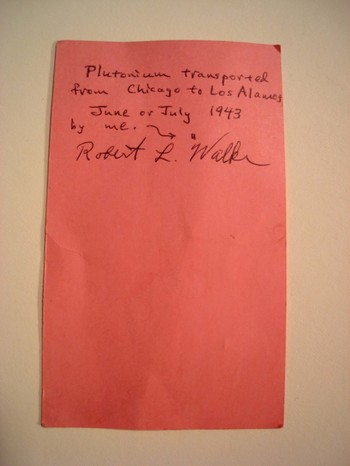
    Listen:  Dr. Walker said that he was tasked “in June or July 1943” with taking a bit of plutonium from the Chicago reactor to Los Alamos. Los Alamos was just being completed at the time.  The production of plutonium was very slow and produced minute amounts. It could well be that this was the first plutonium that was received at Los Alamos.

    Dr. Walker had the plutonium in a small glass vial in his pocket.  He traveled alone.

    He got on a commercial flight and had  several stops en route to the desert.

    Once he reached Santa Fe he waited for a JEEP; once it arrived, he hopped in and he and the driver trundled off to the brand new top secret facility in Oppenheimer’s nowhere.

    The plutonium was delivered.

    The story is just so incredibly sotto voce, so offhand and chance-filled, to transport such an incredibly rare and valuable commodity in someone’s pocket, without a guard, as to be unimaginable, at least in my mind.

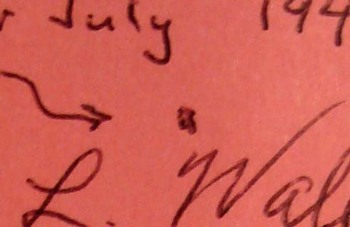
    I asked Dr. Walker to draw on a 3×5 card the size of the plutonium bit—the results are above.  The speck was a research speck to be used to determine fission quality and other preparatory tests—this was all pre –Hanford, when plutonium production really kicked in in 1944/5.  But in 1943, the speck was pretty much what we had.  And it was in Walker’s pants.

    I misplaced this card for years, and it surfaced again just today.  So, before I could send it off again to its Secret Place, I decided to write a bit about it and post its image here, just so that there is some record of this first momentous and bumpy trip.

    Earlier today I called the Los Alamos National Lab and talked history with Gordon McDonough just to make sure I wasn’t overlooking something big in the story, something that would make it more understandable for this plutonium speck to make the trip in someone’s pants.

    McDonough supported the rare nature of this trip, saying that the plutonium was very seldom transported, and that although Dr. Walker was noted in the official LANL history, there was no mention of this trip, nor it seemed was there any mention of the first plutonium received by the lab.

    I knew that there was no danger in carrying the plutonium in a glass vial in your pants, and Gordon—an animated and charming speaker—perked up further, mentioning that Glenn Seaborg quite often carried his plutonium around in an envelope in his pocket.  I really don’t know what to say.

    Seems to me that the first bits of the bomb would be moved around with a little more élan—though I am proven wrong.  Now I’m forced to try and think about a category of essay in a new and perhaps untouched genre:  great things of enormous importance that people carried in their pockets.

    Dr. Walker went on to a brilliant career and was a much-loved and highly respected, and generous, teacher and colleague.  The way in which he told his story of transporting what may have been the first plutonium to reach Los Alamos for the build of the atomic bomb will never leave me—the quiet, ultimate understatement of a man completing a task. 

    ·Posted by :

    ·in:

    —

  • The Beauty of Repair—Moving Heavy Stuff and Fixing the Impossible: Zabaglia and Fontana

    JF Ptak Science Books

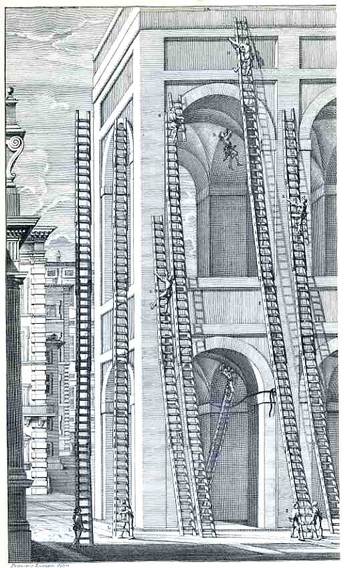
    Blogzabaggi043web

    This gorgeous, near-dadist image belongs to Niccola Zabaglia, who published it in his book Castelli, e ponti di maestro Niccola Zabaglia con alcune ingegnose practice, e con la descriziojne del trasporto dell’obelsico Vaticano, e di altri del cav. Domenico Fontana, in Rome, in 1743.  This is the literal and absolute height of pre-modern, pre-mechanized building construction in the soaring Roman Baroque, ordained by “maestro”, the master, Zabaglia (1664-1750), a spectacular (and necessary) proponent of practical mechanics as applied to the building trades.  Among the “Castles” and churches and bridges alluded to in the title of his book, Zabaglia was responsible for affecting the maintenance and repair of St. Peter’s (more particularly to the basilica and the vault)—specifically, he had to figure out how to get the workmen and materials into place, and into very difficult and very high places, without damaging or destroying any of the existing decoration, artwork, sculpture, frescoes, and so on.  This was no easy feat to perform back there in the dim, 265+ years-ago pre-electric pre-power past, with enormous technical and operational difficulties, and Zabaglia accomplished this was superior affect, devising complex and elegant moving and stationary scaffolds, hoisting and holding mechanisms for the ladders, and much else.  He did just beautiful work, and he is a patron saint in the history of repair. 

    Ladders and scaffolds were important of course but were among the least of Zabaglia’s numerous accomplishments and inventions—they were so plentiful and useful that two Pope Benedicts ago (Pope Benedict the 14th) ordered their publication with actual teams of artists and engravers performing specific tasks.

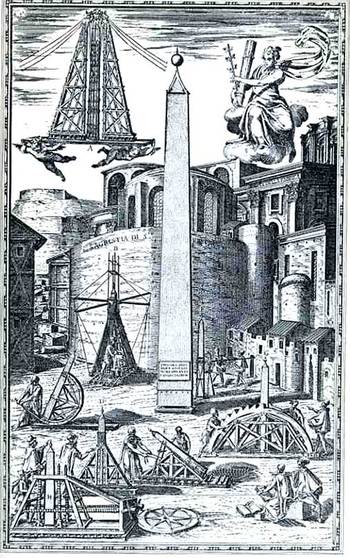
    Blogfontana045web

    This second image pertains to the tail-end of the Zabaglia title-page—the moving of the 500,000-pound Egyptian (carved during the reign of Nebkaure Amenemhet II, 1992-1985 BCE, and originally standing in the Temple of the Sun at Heliopolis) obelisk in 1586 by Domenico Fontana, which was one of the greatest engineering feats of the Renaissance.  Moving this enormous and relatively delicate object (from the Circus Nero, where it was placed by the emperor Caligula in 37 ACE,  to St. Peter’s Piazza del Popolo, 50 years or so before it would be more enveloped by Bernini’s flying wings) took years of (very) careful planning and months of motion and movement, not to mention an extra month to get everything into place and slowly raise the obelisk into its final position.  Fontana had to be cautious and correct, and he was, performing a not-so-minor miracle of pre-industrial magic to move the priceless 250-ton iconic relic and place it perfectly down in the center of Christianity.  now that must have been one hot Roman summer, especially for Fontana. 

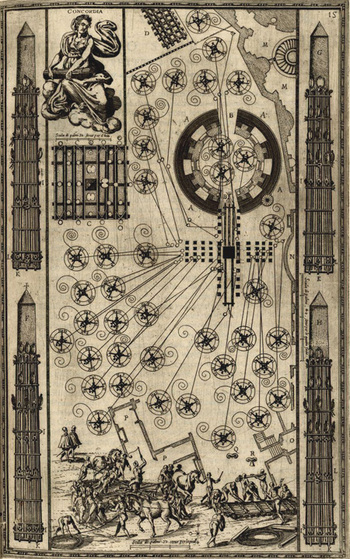
    This image comes from Domenico Fontana’s Della trasporatione dell’obelisco Vaticano…(published in Rome by Bassa in 1590), and shows some seven scale models for the armature of movement (in the foreground) of the great obelisk  An even more famous and luscious image is the plan of the moving implements as seen here, below:

    Blogfontana_moving

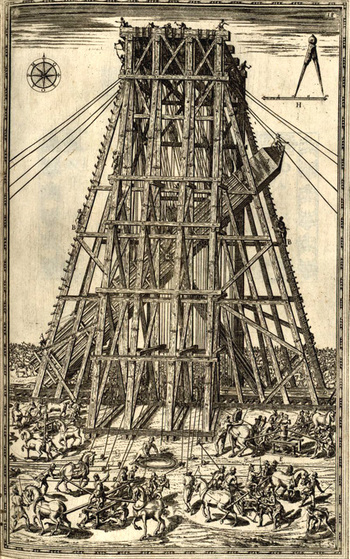
    And again, another beautiful engraving showing the placement of the obelisk:

    Blogfontana_placing


  • The Mathematical Garden—Alexander Pope and the Geometry of Natural Experience

    Blogdesirepope

    While sitting at the edge of a stream in a flowing dress and shading herself with a yellow parasol, my wife and  the jewel in the crown, the brilliant Patti Digh, wrote a superb essay on following the paths less marked. (Maybe I’m making up the parasol bit. And the stream. And flowing dress.) I’ve always been a happy observer of found geometries, and her essay heightened my awareness to them, along with the conscious efforts that we may daily make to enforce these lines or follow a new, multi-dimensional geometric path. 

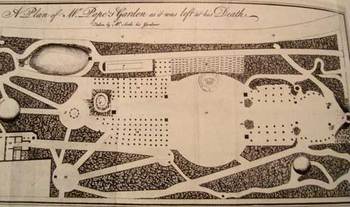
    So when I stumbled across this map of Alexander Pope’s garden and noticed the odd paths  winding their way through it, and  how much in contrast this was to the very sniffy upper  crust English garden of the 18th century, Patti’s essay  lit instantly to mind—and also because in addition to being a geometer of emotion and thought she was in a past life a U VA English Master. 

    Pope’s garden was an irregular path in an irregular garden, that garden being his leased property at Twickenham, where he came to live in 1717, along with his mother and his boyhood nurse, Mary Beach, and his dog Bounce. 

    Pope’s garden was an irregular path in an irregular garden, that garden being his leased property at Twickenham, where he came to live in 1717, along with his mother and his boyhood nurse, Mary Beach, and his dog Bounce.  (Actually that would be a series of dogs as he named them all “Bounce”.)  Pope was a poet and satirist and
    critic and general taste-maker-the social influence extending even to garden-making, as his was famous even during his lifetime, and not for the reasons that most English gardens were famous.

    Blogdesiregeometrical_4

    His was not the planned regularity of the gentility (and far of course  from the suffocating, critically flawed gardens at places like Versailles,  “Is there anything more shocking than the regularity of a planned  garden?” asks Batty Langley in his New Principles of the Gardening… 1728), and were removed from the “normal”, more articulated garden.  I’ve never really understood the formal garden, especially as it relates  to the ancient analogies of gardens and paradise-the Garden of Eden, Pliny’s Garden of Venus, Lucretius’ Earthly Paradise, seem as though  they might be some sort of paradisical thing (though we won’t address  Bosch’s Garden of Earthly Delights) , but the formal gardens and its  paradise relationship seems odd, what with the removal of nature’s “chaos” and all, unless that was indeed the Master Plan.

    But the mathematical garden was a desirous thing—still is—and none  other than Christopher Wren wrote that it was “naturally more beautiful than any irregular figure” (1750).  There were some critics of the math garden, like Mr. Langley, but most garden  designers wrote and argued in favor of it, coming to the similar  conclusion of John Dennis, in that the Universe, being “regular in all its parts”  would dictate that its beauty be found as regular  in other things too,  “and it  is that exact regularity that [the mathematical garden] owes its admirable beauty” (1704). 
    Pope didn’t seem to address (in print) the garden idea formally except for a few places–  Pope praised ‘the amiable simplicity of unadorned Nature’ in a famous essay, published  in The Guardian in 1713, and then again in his message to Burlinton in 1731.

    Blogdesirepopedetail_3

    The plan of Pope’s garden was somewhat irregular, but to me the  most appealing aspect was  the irregularity of the paths that curled and snaked their way through the garden. 
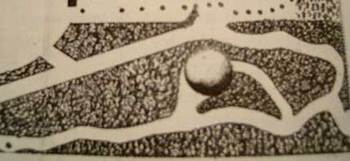
    And particularly,  what about the lower part  of the path along the bottom of J. Serle’s 1725 engraving?  What was that path in Pope’s garden  leading to, or from?  Was there a particularly nice tree there, a  favorite spot, a cool shade, an odd bit of sunshine at sundown?  Or was this  wall-clinging path just the workman’s route? 

    Perhaps these weren’t Pope’s principal desire lines in the garden—in fact, the garden desire lines  weren’t the garden at all— they might’ve been under it.  Pope’s famous grotto at Twickenham  may be better known than his garden-it certainly sounds  much more interesting. Followed his  own desire line, underground, in his famous grotto, which he began to build shortly after arriving at  Twickenham, and which was still under construction at the time of his death. 

    The unseen desire lines of  Alexander Pope seem more fitting to me, more poetic, what with  Pope needing to dig out the earth in order to find what  he was looking for, rather than a more  simple wandering around his fine, rustic garden. 

    Have a look at the materials house in the grotto/cabinet of curiosity here, along with a  commendable plan of the grotto itself.

    Blogdesirecircular


  • Books of Shadows—Trithemius, Bacon, Porta, & Falconer vs. a Make-Believe Derrida on How to Make Something Unintelligible. Secret Writing and Ciphers.

    JF Ptak Science Books LLC
    Trithemius_volvelle2

    Trithemius’  Volvelle (also called a wheel chart, which is a type of slide chart, being a paper constructions with rotating part(s), usually fixed one to the other with just small pieces of paper).

    Continuing on an earlier post on Trithemius’ beautiful title page , I’d like to look at some beautiful images of ciphers—writing systems that were meant to obliterate the original meanings of an original though so that it could be passed along in privacy and confidence—and I’m not referring (initially)  to a graduate student’s masters on post-modernist post-structuralism, just to secret writing systems.

    Theban2

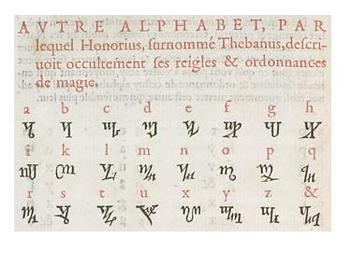
    Continuing with Trithemius we’ll look at a relative simple cipher—uncommon alphabets.  The Theban alphabet is a writing system of distant and mostly  unknown origins. It was first published in  Trithemius’ Polygraphia (1518), in which it was attributed to Honorius of Thebes. Trithemius’ student Agrippa (1486-1535) attributed it to Pietro d’Abano (1250-1316). [1] It is also known as the Honorian Alphabet or the Runes of Honorius
    after the legendary magus (Theban is not, however, a runic alphabet), or the Witches’ Alphabet due to its use in modern Wicca and other forms of witchcraft as
    one of many substitution ciphers to hide magical writings.

    Trithemius_falconer

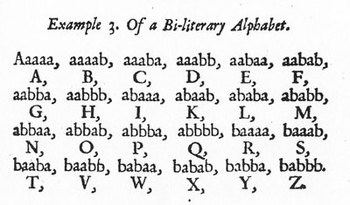
    In John Falconer’s Cryptomenysis Patefacta; or, The Art of Secret Information Disclosed without a Key (published in London, by Daniel Brown, in 1685)  Among such signs and gestures Falconer includes Egyptian heiroglyphs and finger alphabets (dactylology), as well as this example of a bi-lateral alphabet:

    Trithemiusporta
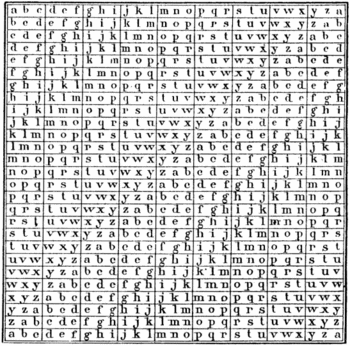
    Giovanni Battista Della Porta (1535?-1615), one of the founders of modern cryptology, wrote an encyclopedic work on ciphers and deciphering in De Fvrtivis Literarvm Notis. (Naples, Joa. Maria Scotus, 1563)—one of the great and most well-known ciphers in this work was the series of twelve alphabet ciphers in which the meanings of the letters of the second half of the alphabet are reversed to stand as the first half.

    Trithemiusbacon

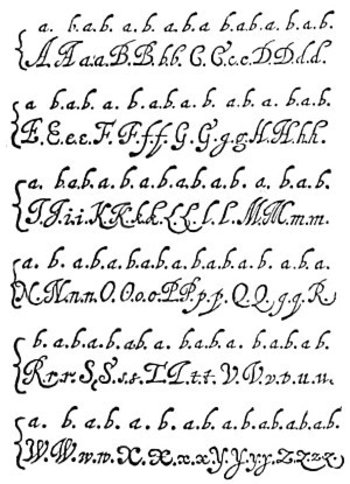
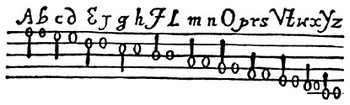
    This image (below)  is found in Bacon’s De Augmentis Scientiarum, and shows the two
    alphabets as designed by him for the purpose of his cipher. Each capital and small
    letter has two distinct forms which are designated “a” and “b”. The biliteral system
    did not in every instance make use of two alphabets in which the differences were as
    perceptible as in the example here given, but the two alphabets were always used;
    sometimes variations are so minute that it requires a powerful magnifying glass to
    distinguish the difference between the “a” and “b” types of letters.é.

    FRANCESCO LANA TERZI (1631-1687)
    Prodromo all’Arte Maestra.
    Brescia, Rizzardi, 1670

    Trithemius_maerti
    Terzi was a polymath who interests spilled over in every direction—he thought in big terms (on flying machines and aeronautics) and little (devising new micrscopes and writing on the proper uses of the instrument), large civil engineering problems and mechanical engineering in general, not to mention such diversifie attention spent on the problems of hearing and speech, proposing methods for the blind to read and the deaf to speak.

    Wilkins
    John Wilkins’ Mercury the Secret and Swift Messenger (published anonymously (of course!)  in 1641) was basically seen to be a warning to the Crown that secret messages could be easily and not-so-discretely passed along by th perpetraitors of Cromwell’s Rebellion—something that was not generally seen as being part of the arsenal of a combatant party.  As noted by Lois Potter in Secret Rites and Secret Writing Royalist Literature 1641-1660. (Cambridge,  1989)

    “The very existence of a science of cryptology was not taken seriously at least on the royalist side until very late. Hence even when a packet of royalist correspondence was seized in 1658 the authors did not think themselves in danger since ‘every Person’s Letter was written in a distinct Cypher and that contrived with great Thought.’ Until someone showed them their own letters in a deciphered state the conspirators simply did not believe that it was possible for anyone to perform such a feat”
    ALSO see this site.

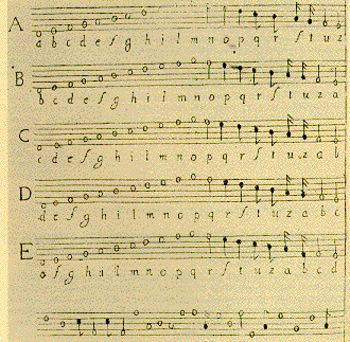
    Though largely based on the earlier works of Trithemius and Selenus, Wilkins did, among other creations in this book,  have quite a  lot to say on the musical cipher, a very small and non-complex version of which follows as an example:

    “Where the 5 Vowels are represented by the minnums on each of the five Lines being most of them placed according to their right Order and Consequence only the letters K. and Q. are left out because they may be otherwise expressed … By this you may easily discern how two Musicians may discourse with one another by playing upon their Instruments of Musick as well as by talking with their Instruments of Speech.”
    Musical ciphers can be just a simple impossibility—they can conceal a cryptogram without changing a composition in any way.

    Derrida and Reverse Cryptology

    These are all fine examples of images of cryptographic systems, which is really all I wanted to look at here.  The reach of cryptotology into other disciplines is wide an deep, though I ‘d like to point out one example in literature in which there is a cyrpto-like effect resulting from an attempt at clarity.  There are many examples of the use of cryptology as the basis for a novel–The Gold Bug, by Edgar Allan Poe; The Adventure of the Dancing Men, a Sherlock Holmes story by Conan Doyle; Cryptonomicon, by Neal Stephenson
    R. Harris’ Enigma; William Gibson’s  Neuromancer, and Ken Follett’s Key to Rebecca are just a few examples.  But seldom does there occur a cryptographic-like result from an attempt at clarity–this found in the work of Jacques Derrida. It is perhaps fitting that in a recently rediscovered catalog of the curiosity dealers Wiltin & Wanton (of Ashreville, North Carolina) there was discovered M. Derrida’s own “cheat sheet” to his own impossible vocabularly.  We attach it here:

    Jacques Derrida’s  10-Second Intellectual Monster-Turning Travel Kit of Wordy Words

    “Monsters cannot be announced.
    One cannot say: ‘here are our monsters’,
    without immediately turning the monsters into pets
    ”—JD, 1979

    “Words are nothing
    and nothing is nothing,
    then double nothing is words
    —JD, 1982

    Jacques Derrida, Algerian-born philosopher and non-historian, came into prominence in America with his critical approach or methodology or philosophy of deconstruction..  In the areas of philosophy and literary criticism alone, Derrida has been cited more than 14,000 times in journal articles over the past 17 years; more than 500 US, British and Canadian dissertations treat him and his writings as primary subjects.
    Owing to a monstrous schedule of speaking and writing it leaves little to wonder how M. Derrida infused his confusing private vocabulary.   The mystery was partially solved in 1996 when an attaché case was discovered in M. Derrida’s vacated Muncie (Indiana) hotel room.  Mysteriously the name tag on the old valise was that of Justice Louis M. Brandeis, but inspection of its contents revealed  additional documents naming the owner as “:Mine” and “Jacques Derrida”.  The valise, originally tied together with 150-year old paper, was filled with inscrutably marked papers-in-progress as well as notebooks written in non-discernable French and heavily ill-written English.  Of the highest interest though was the “Word Machine” taped to the lid of the attaché, the contents of which we outline below.

    Taped to the machine was the following note in which Derrida writes of himself in the third-person:

    The Hydra has many heads. You will not be able to choose between this one on the one hand, on the other that. And the play of differences between the right and the left hand that Jacques Derrida insists on in writing about Heidegger’s hand disrupts the demonstrability of the properly human as the being of pointing or monstration: Hands, that is already or still the organic or technical dissipation. Nonetheless, what is pointed out or towards, what may even be handed to you (t)here is an alpha-bête, an ABC of deconstruction and Derrida, a monstrous beginning, written without hands, and with the help of many hands.

    Below we offer the monster’s tool of arranging and affecting words into being.
    Assume that others will be confused by incorporating any combination of three-word phrases from the following constructions—just choose any one word from each of the three columns, put them together, and—voila—you’ve got the vocabulary that will confuse and delight your associates in the occasional way that Derrida did.

    “Meanings have some when their infused with the infusion of applicable privilege falsehoods which heterogenate the stratagem dilemmas of truth strangleholds.  Incipient speech sensates the implied messaging of  meaning of words; we and I mean to retrend those meanings discursive into their logocentric signs or irrelevant relationships.  That is my journey, and by journey I don’t mean journey.”  –JD, 1972

    For Deconstructionism, employ one word from each column

    A                               B                           C
    Alternate              Privilege                  Sign
    Structural             Truth                       Relationship
    Logocentric         falsehood               privilege
    Hierarchical          Communication    Language
    Phenomenological    stability           Strategem
    Discoursive          Dictible                  heterogeneity
    Sensate                 Didactic                  Dilemma

    So, for example:
    “The hierarchical didactic privilege…”

    For Post-structuralism,

    A                                 B                              C
    Hypenable             Structural              Discourse
    Lexic                     Metalanguage         Signifier
    Readerly                  Semiotic                   Strata
    Writerly                   Proairetic                  Code
    Non-being               Internal                  Opticon
    Interdisparity            Semic                  Literaticity
    French                     Structural             Observata
    Barthe-                   Bastioned            Postulatorium

    Hence, for example, using the above we can concoct:

    “when reading the journals last night I took issue with the writerly semic observata of the….”
    Or
    “The French semic observata of the …..”
    and so on, forever, into the night, with no one being the caring wiser, or wanting to be. It is sometimes easier to hide something in plain sight, especially in an encoded system like Derrida, where the self-referential bits allude to other items which have no common base for understanding–therefore when something is hidden in reference to something else that has no meaning, then, well, the “meaning” part is up for grabs, and so one is necessarily wrong, or right.

    ·Posted by :

    ·in:


  • Graphical Display of Data—Picturing BIG Numbers, U.S. Aircraft Production in World War II

    JF Ptak Science Books  LLCBlogwwiiplanes

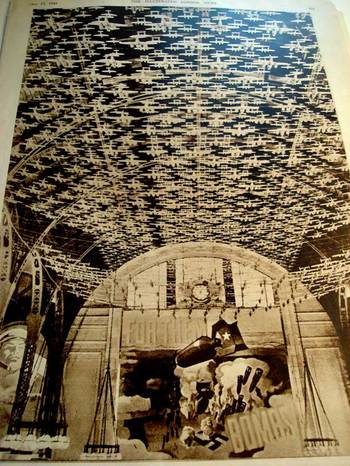
    This widely circulated and published photo appeared in 1942 (particularly in LIFE Magazine in 17 September 1942 and the Illustrated London News in the next month), and showed 4,500 aircraft models suspended from the ceiling of Chicago’s Union Station   It is the result of an inspiration derived from President Franklin Roosevelt’s assertion that America would produce 185,000 war-focused aircraft in 1942 and 1943. 

    The planes in this photo were hanging 60-feet above the floor of the station, with wing spans between one foot and four feet (for the bombers).  It was a fantastic, blustery, iconic effort to show what it meant to look at 4500 planes—and these paled in comparison to a drawing (which I unfortunately do not have) that appeared in the Illustrated London News on 21 February 1941, showing the entire production fleet of 185,000 aircraft—a column of planes one mile wide and 117 miles long.

    Blogworld_war_ii_airplanes_delano

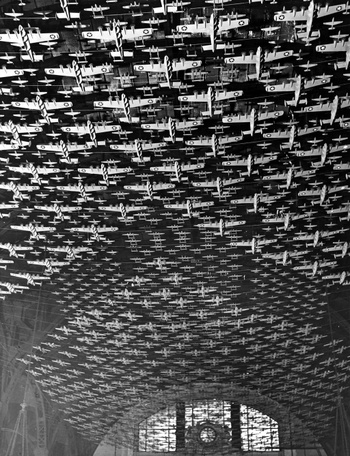
    Using this photo then to interpolate that full production figure of 185k, you’d have to piece 48 of these photos together to show full production, or a version of this photo that was 8 inches wide and 32 feet long.  (The second image of Union Station and the planes is by FSA photographer Jack Delano.)


  • Maps of Emptying Humans of Blood, II: Johann Stoeffler, 1518

    Blogbloodletting_stoeffler
    JF Ptak Science Books LLC
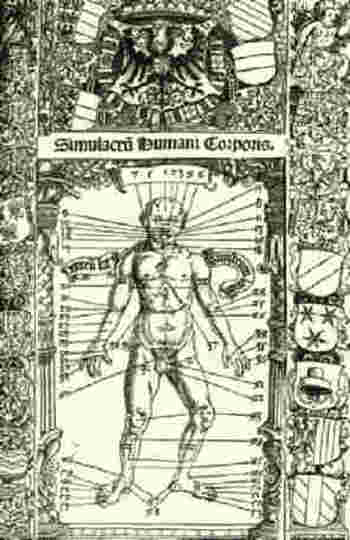
    I couldn’t let yesterday’s bloodletting images pass without reference to this excellent woodcut for Johann Stoeffler’s  Calendarium Romanum Magnum, printed in Oppenheym by the redoubtable  Jacob Koebel, (24 March) 1518.  It is a glorious display (entitled Simulcarum humani corporis) of seasonal (!) purgative and bloodletting locations on the body, meant to accompany a longish essay by Stoeffler on the practice in general.  The bulk of the book, however, had very little to do with this practice and was actually commissioned as a reform to the Julian calendar, provided with the impetus of the Lateran Council (1512-1517).  The result was a series of forty-one  propositions on the calendar and calendar-related practices, including work on eclipses, the zodiac, the occurrence of leap years, the Alexandrine and Roman calendars, the calculation of the occurrence of Easter, and so on, including the seasonal practices of bloodletting. 

    Blogblood_stoeffler_protraitsimbio3

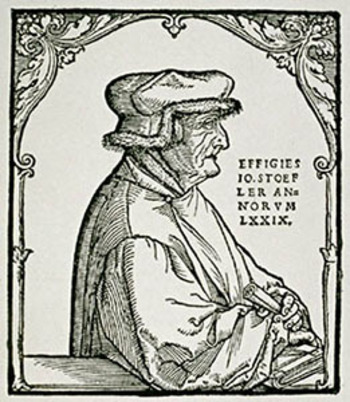
    Stoeffler was an astronomer and map maker, and among his other works are included 1482’s Ephemerides (being allocations for eclipses and astrological events to the year 1518), and the Elucidatio fabricæ ususque Astrolabii, published in Oppenheim in 1513, in which he presents a new astrolabe design and usage that was extremely popular throughout the 16th century.  Later, in 1536, he invented the Stoeffler quadrant, publishing on it in On artful measurement of all sizes, planes and declines in length, height, breadth and depth (1536), and which became a staple instrument in the surveyor’s intellectual and practical arsenal.   (Stoeffler’s portrait is on the right.)