A Daily History of Holes, Dots, Lines, Science, History, Math, Physics, Art, the Unintentional Absurd, Architecture, Maps, Data Visualization, Blank and Missing Things, and so on. |1.6 million words, 7500 images, 4.9 million hits| Press & appearances in The Times, Le Figaro, Mensa, The Economist, The Guardian, Discovery News, Slate, Le Monde, Sci American Blogs, Le Pont, and many other places… 5000+ total posts since 2008.

Author: JF Ptak

  • Maps of the Human Condition–Bloodletting, the Missing Man, and a 16th century MASH; Fabrizzi and Gersdorff.

    Blogmissing_man041_3JF Ptak Science Books LLC
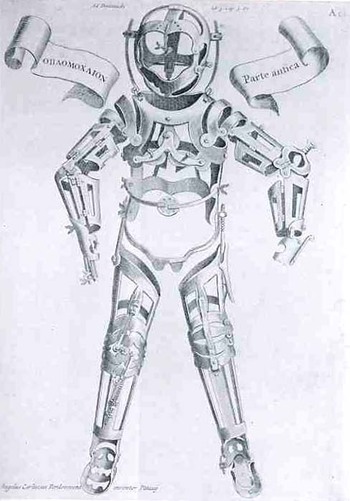
    A Map of Man’s Ability to Replace Himself, 1610-1723

    This woodcut of applications and applicators to injured humans, lacking the human, waiting for the human, the missing human, was made by Hieronymous Fabrizzi (or Jerome Fabricius, 1537-1619), and found in his Opera Chirurgica, printed in 1723.  Even though this is a pretty straight-forward image, it strikes me as a little odd, a little off,  looking a bit like inhuman trappings, the entrapments of a human waiting to be built, an artificial skin with artificial bones.  It was much less than that, and in its way, much more—it was a statement of the advances of medicine in the 16th century, a map of the ability of man to replace himself; a map of the artificial man. Perhaps the image of our own artificial man, showing our ability to replace organs, bone, skin, limbs, etc.may come to look to the people of the near future the same way that we here in the present look back on Fabricius’ mage. 

    A Map of Getting Wounded

    This map of the wounded man was a very popular, much reproduced
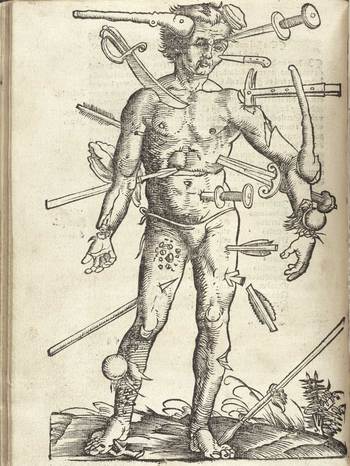
    Gersdorff_p21v_3image, seeing publication in many works since it first appeared in
    Johannes de Ketham’s Fasciculus Medicinae,  printed in the year Columbus set sail for India.  It was a battle map, really—a battle for the human body, showing the effects of what happened to that body when someone tried to erase its existence.  The image is graphic, realistic and fairly gruesome, and highly useful.  It was accompanied by instructions on how to deal with all of the trauma, and to save the man thus that he could fight again.  In its way, this might be the earliest issue of M.A.S.H.  This woodcut, as the next, appeared in Hans von Gersdorff. Feldtbüch der Wundartzney (printed in Strassburg, by  H. Schotten, in 1528).

    A Map of Letting the Blood out of the Human Body.

    Well, it really wasn’t like that, not how I mean by by snippy modernist viewpoint looking back on medical history with no contextual appreciation.  Bloodletting was an approach to healthfulness, as blood was seen as one of the four major elements (or “humours”) of the human body that needed to be kept in balance.  This was
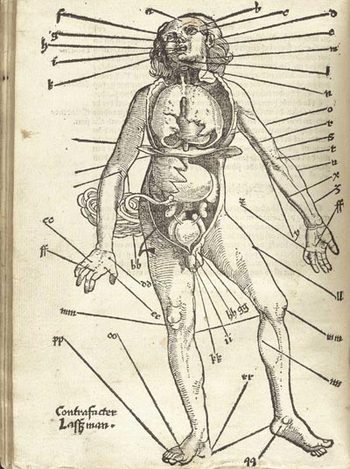
    Gersdorffx400jpg_other_2accomplished via the application of leeches or by the more common (and quicker) practice of venesection, or opening a vein to allow the blood to come out. (Let’s reference Steve Reich’s magnificent “Bruise Blood” creation of 1966 at this point—I don’t think that I’ll ever have a better chance to drop a reference to this piece of revolutionary music in regards to venesection again.)  Thus this map was map for the practiconers of bloodletting—the physicians, and more probably the barbers and other assistants who would inherit this lesser procedure from the more-busy doctors.  In the history of maps of anatomy and the general practice of mapping the human condition, this woodcut x-ray of the best places to drain human blood would not survive close to the age of modernity, disappearing almost entirely by the 18th century, and becoming much more scarce well before that.
    ·Posted by :

    ·in:


  • The Nature of Things & the Display of Information: Alhazen and Optics, 1572

    Blogoptics040

    JF Ptak Science Books LLC
    Alhazen, (pseudonym of Abu
    Ali Hasan Ibn al-Haitham), born in Basra, Iraq, and who
    lived from 965-1039, was perhaps the greatest of all the great Muslim
    physicists, and was also one of the greatest physicists with an interest in
    optics of all time. Considered to be “the
    father of modern optics”, he was an original thinker and an historian, an overall
    scientist,  preserving the ancient,
    accentuating the modern and creative in his own right.

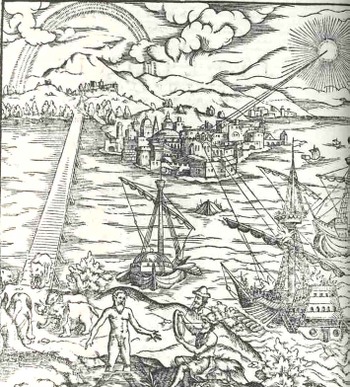
    The woodcut illustration—deceptively
    complex but rather simple once you focus– from his book
    Opticae
    thesavrvs. Alhazeni Arabis libri septem, nuncprimum editi. Eivsdem liber De
    crepvscvlis & nubium ascensionibus…
    demonstrates a number of optical principles–if
    you look hard enough. (The Opticae by the way was about the only one of his 200 or so books to have survived the destructive powers of time and neglect.)  In the foreground we see tow examples in the
    field of optics of keen interest to Alhazen. The man standing in the puddle up to his knees in water shows the
    distortion that occurs due to refraction (an area in which he greatly improved
    upon Ptolemy’s understanding) The guy to
    the right of naked knee-distorted man is probably using his mirror to keep an
    eye out on what was happening behind him (it looks as though the person he’s
    spying is not him but someone hiding behind the hillock). This small defensive use of the mirror pales
    in comparison to what was happening as a cause of mirrors directly behind
    him: the galleons are definitely being
    set ablaze by the Archimedean-like use of mirrors in the city on the far side
    of the harbor (like Syracuse), and we can see that one of the ships is already
    nearly sunken.

     The bridge (with the loitering
    elephants ?) is set to exhibit the knowledge of perspective, even though this
    is not the best example of receding background– it was through
    Alhazen
    that a very considerable part of that science found its way into Medieval and Renaissance
    culture, particularly in the artwork of  Ghiberti,
    Alberti, Leonardo, and later, Poussin.  Roger
    Bacon (13th c), Pole Witelo (Vitellio) and most of the other
    Medieval Western writers on optics based their optical work primarily on Alhazen’s
    work. ‘ (The use and choice of the
    elephant on the bridge is a mystery to me, particularly since we don’t see one
    on the other side of the bridge, which would’ve been helpful to illuminate the
    perspective bit.)  The rainbow in the background is there simply
    to remind us of the already well-known association of its formation and
    light. The
    setting sun might also hint at
    Alhazen’s discussion of the density of
    the atmosphere and the relation between it and  height—he would go on to discover that origin
    and breadth of twilight, the height of the atmosphere, and many other things
    back there one thousand years ago. This woodcut
    hints at only a few of his great achievements.


    ·Posted by :

    ·in:

    —

  • Visionaries: the Crowded Future of Albert Robida, the Jules Verne of SciFi Art

    JF Ptak Science Books

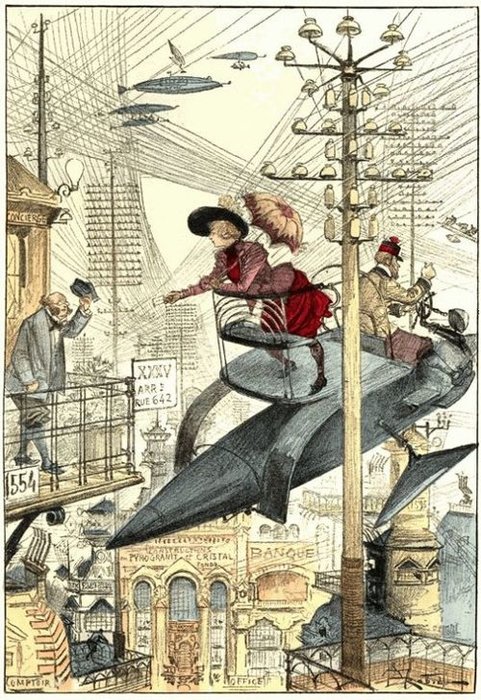
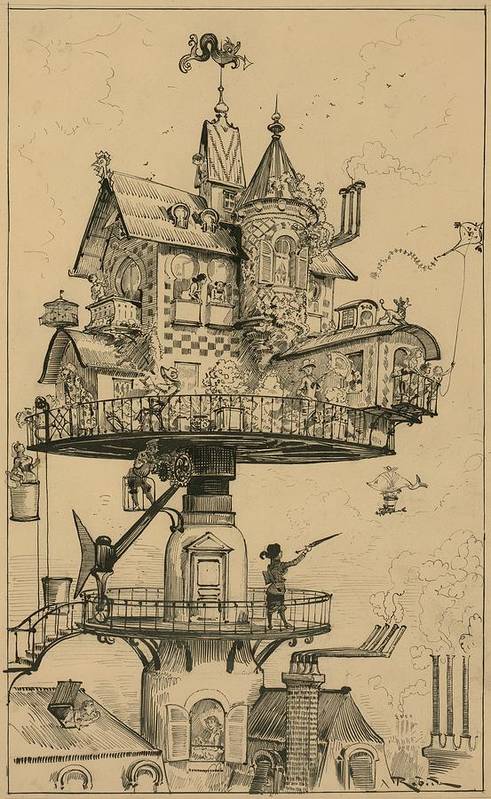
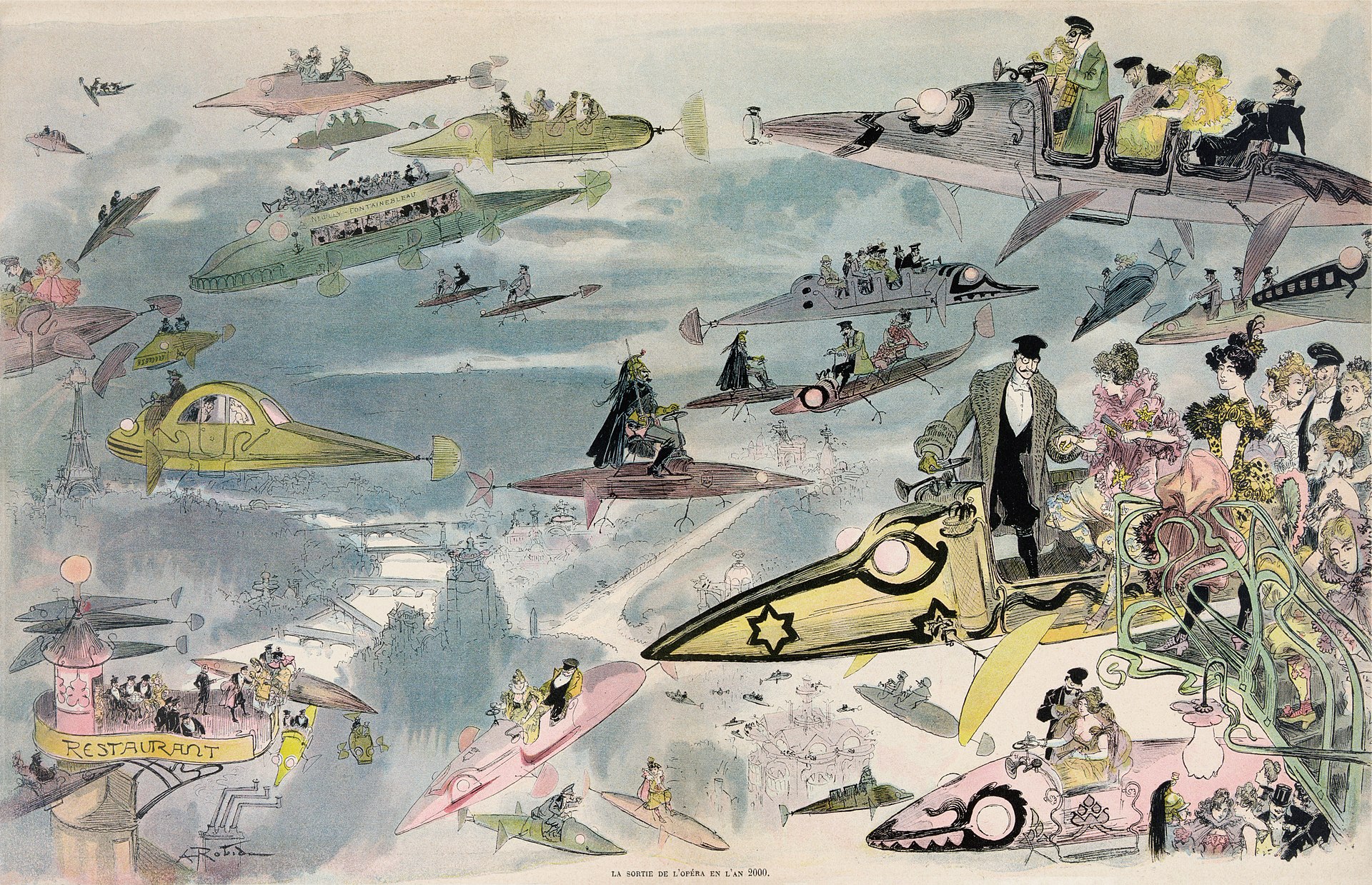
    Albert Robida, a fabulous visionary born in France in 1848 (dying in  1926) was an illustrator, etcher, lithographer, caricaturist, and novelist.  His greatest achievement is his futuristic trilogy, including Le Vingtième Siècle (1883), La Guerre au vingtième siècle (1887) and Le Vingtième siècle. La vie électrique (1890).  In general he has deep, realistic vision, the sort that puts him on a similar  plane as Jules Verne, but is differentiated from his  famous French compatriot, in that his creations seem more compatible with possibility, being more common, more fashioned to what the average person might come to expect of their future creature comforts.  In spite of a fantastic and perhaps unparalleled scifi imagination, Verne seems a little beyond the scope of the mortal future, maybe a little too much for their appreciation of whatever common class the future might hold room for.   

    La Sortie de l'opéra en l'an 2000

    [Source: Library of Congress]

    The future of Robida includes telephones (more in their application and use than in the invention itself, seeing far more accurately, I think, in the possible roles in society than people like Bell and Dolbear saw in their own inventions), televisions (the telephonoscope), bacterial warfare, emancipation and political empowerment of women, advanced submarines, transportation tubes, helicopters, and the like.   

    Robida La Vie Electrique

    Verne (born in 1828) had an exhaustive, exhausting, fantastically accomplished literary career—his bibliography is a sci-fi equivalent of William Shakespeare in that his accomplishments are so vast.  (Not of course actually as vast as the Bard, because Old Bill was totally impossible–an Einstein/Feynman/Newton/Chandra of literature, all rolled into one person.  For example, some of his fifty books include these recognizable nuggets: Five Weeks in a Balloon (Cinq Semaines en ballon, 1863), Journey to the Center of the Earth (Voyage au centre de la Terre, 1864), From the Earth to the Moon (De la terre à la lune, 1865), In Search of the Castaways or Captain Grant’s
    Children (Les Enfants), Twenty Thousand Leagues Under the Sea (Vingt mille lieues sous les mers, 1869-1870), Around The Moon (Autour de la lune, a sequel to From the Earth to the Moon, 1870). A Floating City (Une ville flottante, 1871). Around the World in Eighty Days (Le Tour du Monde en quatre-vingts jours, 1873), The Mysterious Island (L’île mysterieuse, 1875), Off on a Comet (Hector Servadac, 1877)

    They are deep and far-reaching, though Verne, unfortunately, did not find an artistic muse for his visions nearly as capable as those Robida produced for himself.  For example, in 1863 Verne wrote about Paris in the 20th century on many now-familiar things that in the heights of the US Civil War seemed impossible: skyscrapers, automatic and electric calculating machines, gas-powered cars, flying machines and a worldwide information and distribution network. 

    Futuristic-drawing-by-albert-robida-everett

    Blogrobidahowl

    What Robida did indeed have that Verne did not was an artistic talent, and it was here that he excelled—actually no one, in my opinion, had accomplished anything nearly as close as did Robida in imaging the future; few others in the 19th century comes close.  He was a Jules Verne of scifi illustration. 

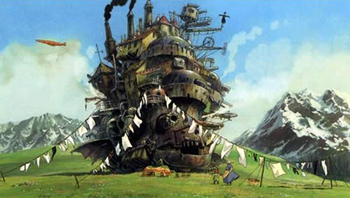
    (Hayao Miyazaki’s “Howl’s Moving Castle”, a Japanese anime film from 2004, has remarkable flying machine quite resembling Robida’s mannerism, and I think I’d be remiss for not mentioning it.)


  • “It’s ALIVE!” Scientists in Motion Pictures—Einstein, Godel & Dirac vs. Buck Rogers and the Bride of Frankenstein

    JF Ptak Science Books 

     [Via Youtube]

    (This snipet is from The Bride of Frankenstein, 1935–there are actually some excellent vignettes here, mostly the noirish grotesques, with bitter, stark black-and-white contrasts of faces at odd angles.  Parts of this are pretty good, in spite of the fact that it is what it is–the director just couldn’t help himself, it seems, and added some high-end cinematic nuggets before crying himself to sleep at the end of a long day, lamenting the thing he had made.)

    The search for early moving images of scientists started simply enough as a result of looking for something else.   I was looking for some you-tube “footage” of Richard Feynman’s O-ring-in-ice water performance before the Challenger Commission; and once I determined that it wasn’t around, I looked at other offers of the great physicist/magician, and found plenty.  From there I tried finding moving images of the earlier titans, and found a little more…

    Part I, Scientists in Movies:  Imagined, 1926-1939.

    Rotwang seems to be the first scientist/inventor in a feature-length film—he was also the first to produce  what might be the first robot in films, all wrapped into one futurist/expressionist magnum opus: Fritz Lang’s “Metropolis”. Rotwang’s problem with his robot is that it has no soul, and so he comes to transfer the soul of a woman named Maria, somehow causing the like-named robot to become evil.  Its all about souls and being lost in this movie—the future is heavily indebted to not having a soul, humanity an interior-featureless mass, the machines around them the same as they—and then along comes Rotwang to construct a souled-robot but then things go wrong.  This was the second decade of mass production of goods, as well as the second decade of Taylorism and other such humano-industrial ideas for exploiting the working class to suck out its frivolous extra breathing time.  Lang certainly saw the evil, soulless business of business, and exploited his insight. 

    1931 saw the first appearance of (Dr.) Victor Frankenstein in film, loosely based of course on the (originally anonymous) 1818 work by Mary Shelley.  It is allied with Lang’s along the lines of modern technology run amok.  Shelley’s work was sub-titled “The Modern Prometheus”; the Promethean  Titan in the 1931 film being Dr. Victor, who when he steals fire (but not from Zeus), induces tragedy to befall the human race, unlike the Greek original, where Prometheus’ wily intelligence was a benefit to early humankind…admittedly though he wasn’t encumbered by mad-scientistiana back then.

    In 1935 the evil Queen Tika—a herald of science and technology–of the lost city of Murania did battle with (of all people) Gene Autry in “Phantom Empire”  after the Singing Cowboy discovers her world 20K feet underneath his ranch.  Bela Lugosi creeps into the public eye in 1939 as a mad (no!) scientist in the robot-entwined The Phantom Creeps”;  Buck Rogers and Flash Gordon (beginning in 1936 and 1939) have their fair share of run-ins with scientists good and bad (but not indifferent) 

    Things heat up quite a bit for mad scientists in the 1940’s and ‘50’s, what with several real shooting global wars going on as well as a long bi-polar proxy Cold War raging as well.  Doctor Satan, The Perfect Woman, The Day the Earth Stood Still, Forbidden Planet, Plan 9 From Outer Space (!?), and a whole slew of others in the A+B movie genres offered scientists galore, though they were  mostly hi-calorie, low-substance, mostly-mad wild-haired mono-characters.   

    Scientists in Movies, Part II:  Real,  1927-

    One of the great tragedies in my book selling career was arriving too late to purchase an estate of a professional engineer who was charged with using and exhibiting the RCA Photophone—the world’s first successful simultaneously recording sound-on-film motion picture camera.  According to the heirs and some of the remaining archives, there should have been cans and cans of motion picture films made by this gentleman in England in 1926 of the leading scientists of the day.  Realizing instantly what this meant, I asked after the seemingly-missing films.  They weren’t “missing” at all—they were just “gone”, thrown away several days earlier, busted in the dumpster, because they were “nitrate”, and the heirs were afraid that I’d blow myself up;  so they threw away hundreds(!!) of old metal containers, and with them, probably the earliest and ONLY recordings of some of England’s leading scientific lights of the late 19th century.  Terrible but true story.

    Returning to my Feynman quest, I decided to expand my search and try to assemble as much of a list of motion picture images of older scientists that I could find on the web.  Seeing how much extraordinary material there was for classical music on youtube I thought that perhaps there might be something similar for the sciences—so far I’m wrong, overall, but I have found some very interesting stuff.   

    The Solvay Conference 1927–fantastic silent movie taken by Irving Lamgmuir, showing Schroedinger, Bohr, Picard, Brillouin, Kramers, Born, de Broglie, A.H. Compton, Plnack, Debye, Curie and Einstein.

    Richard Feynman on Teaching, Bedtime Stories and How to Find Stuff Out

    Hans Bethe, Haakon Chevalier and JRO

    Alamogardo + Oppenheimer

    Edward Teller

    ·Posted by :

    ·in:


  • Beautiful Title Pages 3–Roger Bacon’s “Novum Organum” and the Voyage of Discovery, 1620

    Blogbacon038JF Ptak Science Books LLC

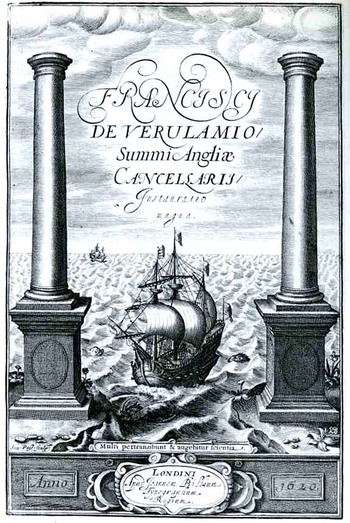
    This sweepingly metaphorical title page belongs to Francis Bacon’s (1561-1626) superb Instauratio Magna, printed in 1620.  Bacon, the privileged and brilliant son of Nicolas Bacon, the Lord Keeper of the Seal of Elisabeth, entered Cambridge at the age of 12 and never looked back, becoming one of the leading thinkers of the English Renaissance. 

    The Instauratio contains his Novum Organum  (The New Oganon [New Instrument], or true Directions Concerning the Interpretation of Nature) a monumental pronouncement and a new way of looking at scientific thought, looking to break away from the established Aristotlean methods that had been in place in England and Europe for centuries. The “new instrument” part directly relates to Aristotle’s own work called Organon, which in short was a work of inquiry and a treatise on logic and syllogism—Bacon would present his own new instrument of logic base upon a simpler process of reduction. (Bacon famously begins this work “Those who have taken upon them to lay down the law of nature as a thing already searched out and understood, whether they have spoken in simple assurance or professional affectation, have therein done philosophy and the sciences great injury. For as they have been successful in inducing belief, so they have been effective in quenching and stopping inquiry; and have done more harm by spoiling and putting an end to other men’s efforts than good by their own.”  He continues in this vein, getting to the real crux of the biscuit, and broadly states in the second paragraph “Now my method, though hard to practice, is easy to explain; and it is this. I propose to establish progressive stages of certainty. The evidence of the sense, helped and guarded by a certain process of correction, I retain. But the mental operation
    which follows the act of sense I for the most part reject; and instead of it I open and lay out a new and certain path for the mind to proceed in, starting directly from the simple sensuous perception…”  And how!) This new approach to knowledge was foremost in the mind of the designer and artist who produced this title page, which is deeply indebted to the analogy between the (very deeply ingrained and mature) age of exploration and that of intellectual discovery.
    Blogbacon_bits

    The ship in this scene is passing through the Pillars of Hercules, exiting the relatively safe waters of the western Mediterranean and heading out to sea—-to accent this point we see two sea monsters at either side of the ship right at the beginning of this new-world trip, just feet beyond the established safe perimeter.  The pillars had long since been recognized as the western end of the world, as recognized by Dante in the Inferno, observing the voyage of Ulysses past the pillars, endangering the lives of his sailors in the justifiable

    Blogbaconplus_ultra
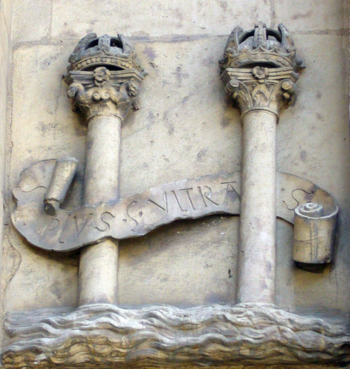
    search for knowledge of the unknown.  The Pillars appear in the coat of arms of Spain, originating with Charles V (the Holy Roman Emperor and also the King of Spain), with motto plus ultra (“further, beyond”) The plus
    ultra part fits nicely with the Bacon, even though the words are not there in the image, they really should be, emblazoned across the stern of the ship of Bacon’s imagination and intellectual enterprise.(The great voyage of discovery analogy and the  great new discovery in thought is probably painfully clear already.)

    Blogbacon_bits_latinThe image is captioned and summarized with the Latin phrase “Multi pertransibunt et augebitur scientia”, wrenched from the triumphantly problematic and slightly insane Book of Daniel (chapter 12, verse 4).  It is translated loosely as “many shall run to and fro, and knowledge shall be increased” or more elegantly “many will pass through and knowledge will be increased”—either way, whether by direct adventure and exploration or frenetic activity, the act of a new effort will be rewarded with a new knowledge.
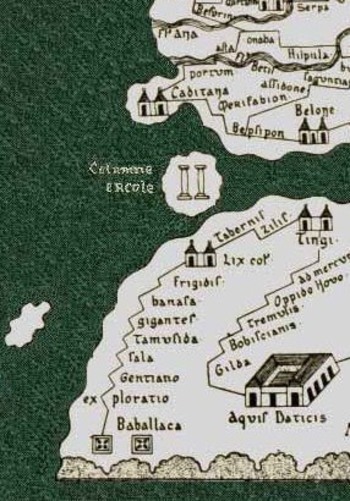
    The image below is from the Tabula Peutinger–basically a roman-era road map of the extent of Empire–and shows the location of the pillars.  They were mountainous metaphors existing at Gibraltar and Morocco, but folks were only too happy to relieve them in marble.

    Blogbaconpillars_2

    ·Posted by :

    ·in:


  • Beautiful Title Pages 2—Living Skeletons and Anthropomorphic Shells

    Blogunusual_design_elements0322
    JF Ptak Science Books LLC
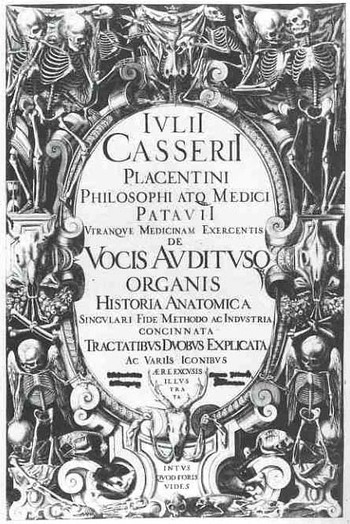
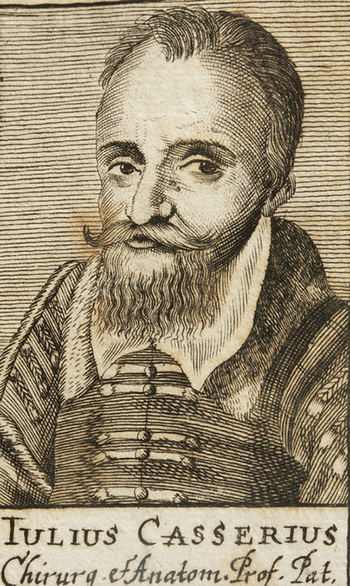
    The first title page here belongs to Guillio Casserio (c.1552-1616), De Vocis Auditusque Organis historia anatomica singulari fide methodo…, 1600-1601, an absolutely gorgeous illustrated monograph on the vocal organs and organs of hearing in man and animals. Casserio, a superb anatomist (and who was also signatory to William Harvey’s doctoral diploma from Padua in 1602), set the standard for accuracy and beauty in copperplate anatomical illustration just as Vesalius had set the standard for woodcut illustration.

    Casserio_1
    I cannot recall a title page illustrated with so many skeletons, especially so beautifully arranged, and posed in common, breathing, living situations.  Their placement is excellent, along with the other skull and bones—it seems to me as though they could not be re-arranged into a better assortment more pleasing to the eye, much like rearranging Joseph Cornell construction…it just cannot be done. 

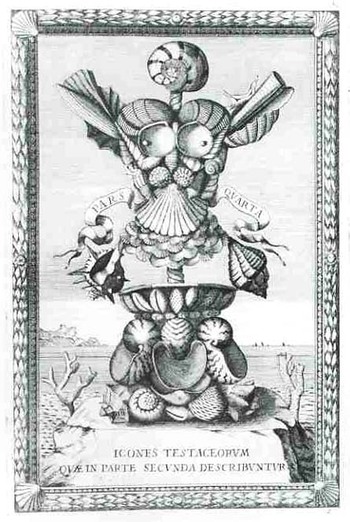
    Another fine example of title page design is Filippo Buonanni’s Museum Kircherianum sive Museaeum A.P. Athanasio Kirchero…printed in Rome in 1709, and it  belongs to the first published effort to catalog the scientific and miscellaneous
    Blogunusual_design_elements031_3

    collection of the vast 17th century polymath, Athanasius Kircher; the collection assembled in the Jesuit Collegio Roman, and assembled by Alfonso Donnimo.  Buonanni  was a student  of and successor  to Kircher at the Collegio  and catalogued the specimens of natural history, scientific instruments, geological items, Egyptian antiquities, and other items brought back to the school via networks of Jesuit missionaries.  His particular strength in study was conchology, and he displayed his knowledge in this intricate arrangement of shells from the collection in the title page.

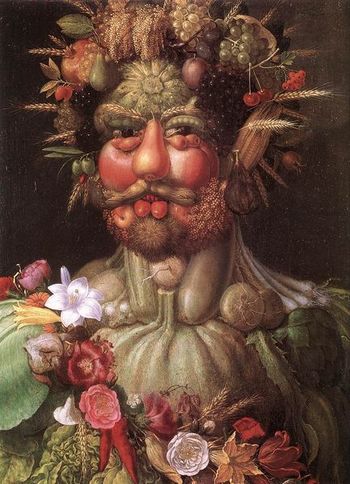
    Arcimboldovertemnus_3I cannot help but think that his artistic vision may have been  influenced by the extraordinary Giuseppe Arcimboldo (also spelled Arcimboldi; 1527-1593), who, one hundred or so years earlier, painted (in his non-conventional works) fantastic portraits and images using fruits, vegetables and other natural objects as the sole source of representation.  On the other hand his influence may not have been so very well known, as many of his works were stolen during war time in the mid-17th century, and he fell rather deeply into obscurity until being revived and resurrected by the Surrealists in the 20th century.  His work was so extraordinary–and this is true at any time in history but especially so during the time that he lived–that it would be impossible not to mention this unique talent in connection with Buonanni.

  • Typewriter and Anti-typewriter: Writing Systems of von Knauss, della Porta, Trithemius, Schotti

    JF Ptak Science Books Post #53

    Blogtypewriter_unwriter_2035

    Sometimes order brings disorder; and disorder, order, as in the following two examples of early versions of modern technology.    Take the typewriter—it has a curious display of the alphabet, designed to impede, while numbers are displayed along the tip, in order.  (The qwerty system may well have been put into place as the earliest typewriters, beginning even with Glidden and Sholes machine, could not absorb very fast typing due to their technical limitations, and so came the qwerty arrangement.)  So from this non-random arrangement we are able to direct all of our thoughts and intentions.

    Blogtypewriter_unwriter033_3

    (An interesting aside is this magnificent non-qwerty machine, found in F. von Knauss’ Selbstschreibende Wundermaschinen… (1780), a magnificent work on “wonder machines”, and which is recognized as the first “typewriter”.)

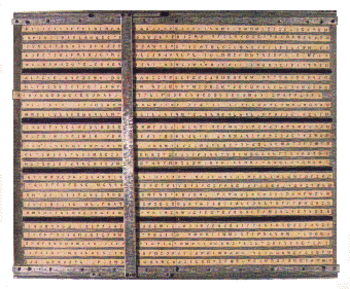
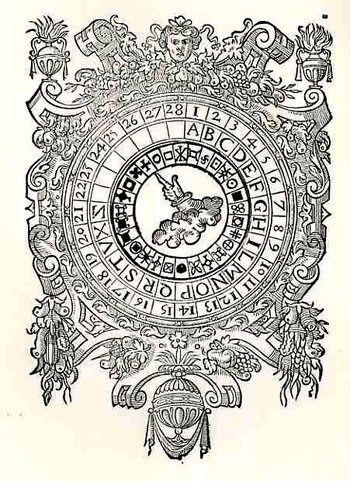
    The other elegant machine is the cipher. In the beginning of its use the alphabet is usually properly arranged, and placement of letters and numerals is very clear and precise.  The result however is anything but—the product being a beautiful randomness and a secure, secret language.   

    Cryptodiskscholarotularum

    This illustration features a lovely volvelle (two or more pieces of paper arranged so that they may be turned one on top of the other) from Giambattista Della Porta’s De furitvis literarum notis vulgo…, printed in Naples in 1591.  The volvelle was one part of the book which explained the art of steganogrpahy—the art of writing incomprehensibly except to those who possess the key—and was one of the most important works on the subject after the Polygraphia of Johannes Trithemius (This book was written in 1599, published in 1606 and condemned in 1609—ostensibly because the book was thought to be about the dark arts and black magic, though the offending volume, the third and last,  was really a deeper work continuing on cryptography.)   

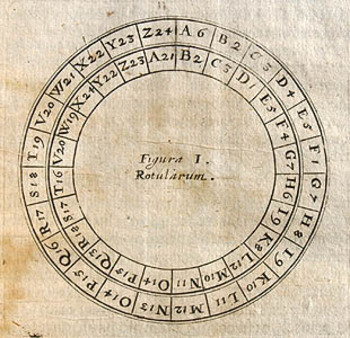
    This is another interesting paper volvelle device, called a rotularum, and can be found in P. Gasparis Schotti’s Schola Steganographia, and printed in 1680.

    Strip_cipher


    Closer yet to the order/disorder idea is the strip cipher, which begins the process of encoding with numerous aligned alphabets which are then put out-of-order to secure a deeper discontinuity between the original message and its encoded version. 

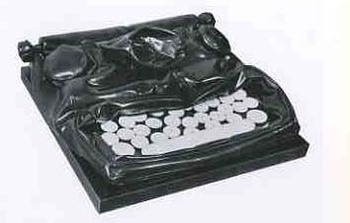
    A modern and imaginative version of a typewriter version of a cipher may be seen in Claes Oldenburg’s 1963 “Soft typewriter”–well, not really, but this may be the only time that I have a chance to use this illustration.

    Blogtypewriter_nwrriter_soft036_2  


  • The History of the Future 2: Henard touches on the Future’s Future Plan, 1911

    Bloghenard029JF Ptak Science Books LLC  Post #51

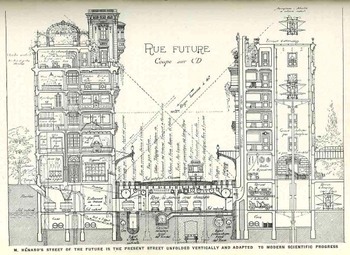
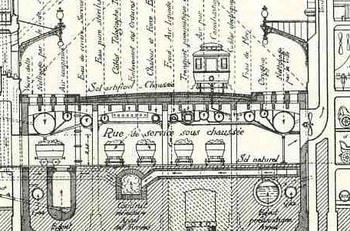
    This  cross section illustration (“Rue Future”/Future Street) is from E. Henard’s (1849-1923) article, “The Cities of the Future”,
    from American City, Volume 4, January, 1911. In this article Henard (architect of the city of Paris and from 1880 a life-long employee and advocate of public works in that city) looks into the future
    and sees the movement towards underground (or enclosed) vehicular traffic,
    “smart” buildings, pneumatic tubing for vacuum cleaners (“almost
    sure to come into general use”), an improvement in the system for water
    delivery and removal, replacing coal with natural gas, and more. He lays out a
    plan to implement his idea that, if implemented int he city of

    Bloghenard029_detail

    Paris, would cost $420,000,000 (or
    approximately $15 billion in 2006 money) over 100 years. [This part seems a
    little off given that the area for public roads alone in Paris at this time was 3,700 acres–nevertheless this was an interesting appearing plan, a significant
    portion of which has found its way into building and community planning albeit
    on a far smaller scale].

    Henard was also acutely interested in the future traffic problems of Paris and other major cities, proposing revolutionary radial traffic patterns for moving cars around major metropolitan areas–which was really quite visionary as the mass production of automobiles had not yet really taken place–certainly automobiles were far more common by 1911 than 1905, but their numbers would be vaulted higher int he next decade with the first true approach to assembly line production of automobiles, making them affordable to the millions.  His plan for a ring-lime system around the city of Paris was influential to some of the ideas in the early
    American planning reports for San Francisco and Chicago by the great Daniel Burnham.

    What is particularly interesting for me in the Henerad plan is the room that he left for his future’s future–he attempted to make his plan adaptable for the time when the future he was writing about was becoming the past.  And so he was leaving room in his underground plans (in particular) to accommodate some of what the future might hold in store for his city, leaving unused spaces and tunnels, so that the city planners in the future would not have to go through the enormous expense of putting these things in for themselves.  Now that is future-forward thinking. 


    For a good, long article on the plan see http://www.library.cornell.edu/Reps/DOCS/henard.htm


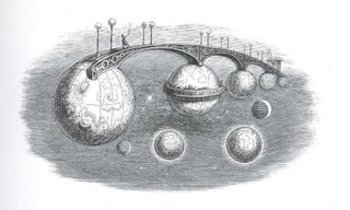
  • History of the Future 1: Caricature of the Future, J.J. Grandville and the Bridge Across Saturn, 1844

    BlogfuturegrandvilleJF Ptak Science Books LLC  Post #52

    Admittedly, J.I.I Grandville (1803-1847) didn’t conceive of this series of bridges as a plausible means of interplanetary travel and is in all probability an allegorical creation, but the image does–in an odd way–allow a dialogue on the idea of moving from planet to planet, which was still pretty solitary thinking in the mid-19th century. Although this didn’t have a direct effect on the perception of man’s place in the solar system, it did have a great and direct impact upon a vast number of illustrators and cartoonists who followed in his considerable wake.
    This image comes from Grandville’s Un Autre Monde, published in 1844.

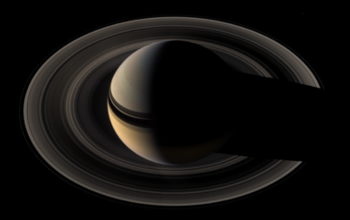
    In addition to an interplanetary bridge that there is another singular creation here in Grandville’s cosmos–a balcony constructed of the rings of Saturn (if indeed this was supposed to be Saturn–it is as advantageous as not to think of it in this way) and if we think of a balcony being a place to watch and observe, then we are brought instantly to W.G. Sebald’s Rings of Saturn, which is a textural masterpiece, and mostly I guess a novel about everything that Sebald observed in his walk through Suffolk.  (Another Saturn-related work of fiction is Sirens of Titan, by Kurt Vonnegut,  a very mature and insightful 1959 novel which really has nothing to do with anything here; I just needed to throw that in, what with him being a master storyteller, crank and human-caricaturist-observer and all…)  And so by 1844 it comes to pass that one French caricaturist/imaginist comes to draw an extraordinary and impossible land/space bridge between the planets only 234 years after Galileo Blogsaturn first glimpsed Saturn’s “handles”.  It would take another 65 years and accumulations of observations by some of the greatest names in the history of astronomy (Galileo, Casini, Hevelius, Huygens) to show that the disk (singular) on Saturn was actually a series of tings The first photograph of Saturn’s rings is not made until 1883.
    Grandville (Grandville ‘Gerard, Jean Ignace Isidore, born in Nancy, 1803 -1847) I see as more like a caricaturist of the future, seeing what might be possible, plausible, imaginable, and also see the grotesque royalness of it all as well.  In as much as thinking of such an image as interplanetary land bridges might seem, Grandville shows at the same time their innocent, clinging wrongness. 


  • Emblems of Featureless Faces–Philibert de l’Orme’s Architecture, 1568

    Web_blogbad_builder028
    Philibert de l’Orme’s book, Le Premier Tome de l’Architecture,
    printed in Paris in 1568, contains a singular illustration. L’Orme (who lived ca. 1515-1570), was perhaps one of the first modern
    architects, not only because of his superior engineering skills, but also because
    he was a superb organizer—a superior architectural tactician.

     He worked for Henry II and Charles IX, supervising the construction
    of Fontainebleau, Saint-Germain-en-Laye—where he built the
    Château Neuf, and the other royal buildings. As well as the Tuileries,
    in collaboration with Jean Bullant.

    The text explaining the illustration reads something like “to
    guard against persons who can do nothing right, cannot see what is to be done
    well, cannot hear what should be understood…” Perhaps l’Orme was talking about people in general; or, perhaps, as I
    suspect, he was referring to someone in his own profession, a builder, an
    engineer, an architect? In any event,
    this singular image is one of the few that I can recall in which a person is
    allegorically represented without  hands,
    eyes, ears or, perhaps a nose.

    There’s quite a bit of imagery showing unusually-featured faces–and I’m talking about emblemata rather than monsters or mythological/hypothetical beings meant to go creaking into the night. I’m also excluding medical images Blogorme
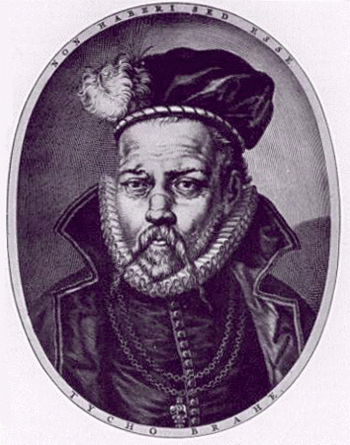
    (like this for an early form of rhinoplasty) and people who have suffered injury or are differentially abled (as in this image of the great Tyhco Brahe and his silver nose).  I’m Tycho_brahe
    hard put to think of other examples of representational humans with such features existing in the technical or scientific world, though–I think that l’Orme’s designer/engineer here is a very scarce creation.