A Daily History of Holes, Dots, Lines, Science, History, Math, Physics, Art, the Unintentional Absurd, Architecture, Maps, Data Visualization, Blank and Missing Things, and so on. |1.6 million words, 7500 images, 4.9 million hits| Press & appearances in The Times, Le Figaro, Mensa, The Economist, The Guardian, Discovery News, Slate, Le Monde, Sci American Blogs, Le Pont, and many other places… 5000+ total posts since 2008.

Author: JF Ptak

  • Beautiful Title Pages 1—Oswald Croll’s Chemistry, 1611

    Web_blogcroll3_2027_2

    Oswald Croll is a big name in the history of chemistry.  At a time where so many other Big Names were writing books about chemistry as a science, Croll wrote a scientific book of chemistry.  Paracellus, one of the greatest of these big names, wrote rather vaguely and in a sense secretively about his preparations and compositions, as well as their use and applications; Croll on the other hand writes in great and exhaustive detail about just such things that Paracelsus leaves out. 

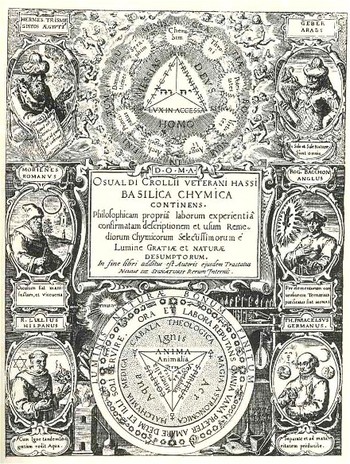
    The title page to his Croll, Oswald. BASILICA CHYMICA. Continens Philosophicam propriam laborum experientiam confirmatam descriptionem et usum Remediorum Chymicorum Selectissimorum e Lumine Gratiae et Naturae desumptorum. In fine libri additus est Auctoris ejusdem Tractatus Novus De Signaturis Rerum Internis, was printed in 1611—probably two years after Croll’s death—and is a gorgeous display of allegorical and historical images. The allegorical parts are a bit out of my range, but the historical figures are easy enough (being identified!), and include Hermes Trismegistrus, Geber, Morienes, (the great) Roger Bacon, (the magnificent) Ramon Lull and Paracelsus.

    I like the Croll as the beginning of a series of images of beautiful title pages in the history of science.


  • Titanic Understatement at the Alpha & the Omega–Two Big Bangs

    Blogalphaomega023
    The soft-sell of the generally recognized and understood
    propositions, stepping well around the main, central, controlling issue,
    hinting broadly along its perimeters, defining the emptiness by its shell, left
    to an undistinguished recognition, is what we’re hunting here.

    I have two examples of extreme examples of understatement occurring
    at the beginning and end of things—all things.

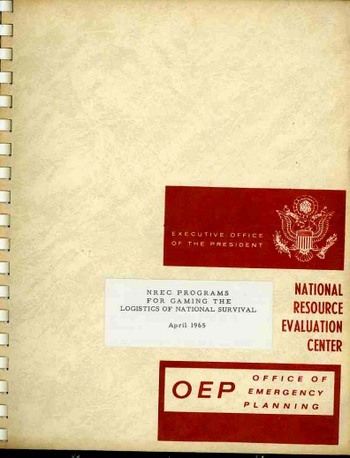
    The first occurs at the end of all things. Written by Joseph Coker, Chief of the
    National Resource Evaluation Center in the Office of Emergency Planning in
    Washington, D.C. in April 1965 (100 years to the month after the end of the
    U.S. Civil War), “NREC Programs for Gaming the Logistics of National Survival”
    is by its very title and appearance a startling looking and sounding
    document. Coker and his NREC worked
    within the Executive Office of the President (LBJ at the time), and his paper concentrated on a succinct appraisal of
    the existing gaming programs looking at survival of all aspects of the national
    life in the days following nuclear end-game.

    Blogalphaomega_2025
     

    In general the document is as dry and cardinal as bagel
    toast—it warms quickly and invisibly, however, and that bagel toast becomes a
    burnt and invisible cinder via Coker’s prose.

    The document wastes no time in getting directly to vast
    understatement, and stays there. In
    chapter one “Logistics of National Survival”, the second chapter opens:

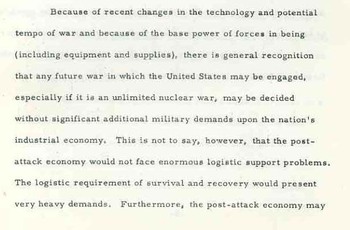
    “Because of recent changes in the technology and potential
    tempo of war and because of the base power of force is in being (including equipment
    and supplies), there is general recognition that any future war in which the
    United States is engaged, especially if it is an unlimited nuclear war, may be
    decided without significant additional military demands upon the nation’s
    industrial economy.” Hmm. He continues: “That is not to say, however,
    that the post-attack economy would not face enormous logistical support
    problems.” There is no human element of this equation. “The logistic requirements of survival and
    recovery would present very heavy demands.”

    Blogalphaomega_3_2026

    “Very heavy demands” reaches a very great height of
    understatement. How high is high? I don’t know. Remember: Mr. Coker was Chief of
    this division and working within the Executive Office. This was thinking at a very high level.

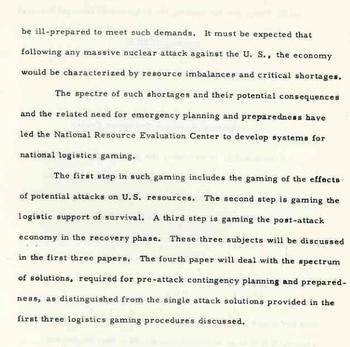
    He continues in this same paragraph: “Furthermore, the
    post-attack economy may be ill-prepared to meet such demands”. The paragraph ends in a tremendous horizontal soar: “It may be expected that following any
    massive nuclear attack against the U.S., the economy would be characterized by resource imbalances and
    critical shortages
    (italics our’s). 

    Coker’s papers meant to remedy the approaches to these “imbalances”. The NREC was up and running with ideas and
    computing fire—in the form of the CD 3600 computer and FORTRAN—to develop a “damage
    assessment system” called READY that would replace the existing programs named,
    with no evident imagination, JUMBO, STREAK and DART.

    Throughout this entire document there is no mention of overwhelming,
    catastrophic death and/or obliteration of the social structure, except that it
    must be implied that there must be “someone” to operate the essential
    industries that must be brought back on line.

    Curiously there is a discussion about the survivability of
    the Federal Reserve and the banking system. My guess is that in the ensuing giga-tons of holocaust of flame that
    paper money didn’t burn along with its human holders.

    Bloghubble
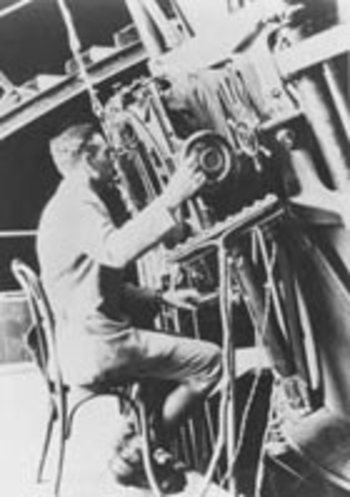
    The second understatement that we will look at here belongs
    in the last paragraph of the seminal paper by Edwin Hubble and Milton Humason,
    writing on the “discovery” of the Big Bang as they defined the Red Shift, which
    was actually a roughly proportional increase of distance traveled to red
    shift. They plotted a trend line for 46
    galaxies and in 1929 formulated the empirical Redshift Distance Law of
    galaxies, which is today known as Hubble’s Law, which was consistent with the
    solutions of equations of GRT.

     It is in a further report on their studies in The Velocity-Distance Relation Among
    Extra-Galactic Nebulae
      (Mount Wilson Observatory,  1931) ,
    that Hubble and Humason make their stupendous understatement: regarding their understanding of the phenomena
    and the expanding universe, they take many steps back, and say in the
    concluding paragraph “the writers are constrained to describe the apparent
    velocity-distance displacements without venturing on the interpretation and its
    cosmological significance”. They
    basically lay out the functioning of the universe and the best understanding of
    how we got to where we are in the cosmos (Vesto Slipher notwithstanding), and
    how according to their understanding that the universe is expanding and is consistent
    with all known laws, that they decide to not say anything, um,
    philosophical.

    And so, in the last paragraph of this paper discussing the Great
    Omega, the authors decided, in their modest and terrifically understated Bartlebian way, to not comment.

    Bloghubble_redshifts

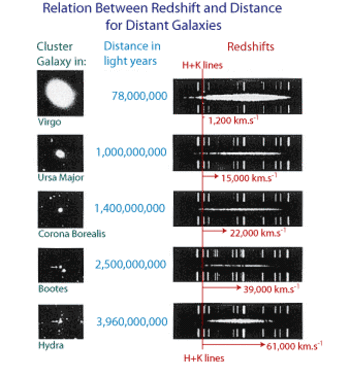
    The plot of the Hubble redshift findings is taken from the Australia Telescope Outreach and Education site, HERE.

    ·Posted by :

    ·in:


  • Graphical Representation of Data: Slavery in the U.S. 1854

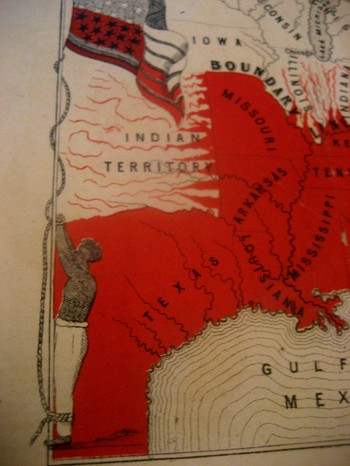
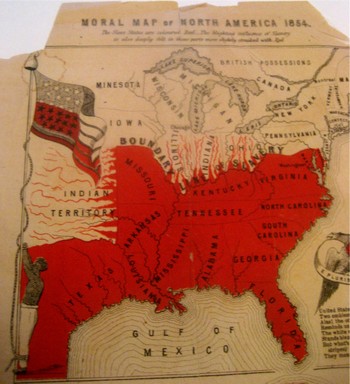
    Blogslavery_detailThis incredible, indelible image is another from our collection of graphical representations of data and ideas.  This map, is entitled Moral Map of North America, 1854; the Slave States are coloued Red, the blighted influence of Slavery is also deeply felt in those parts more slightly streaked with Red€.  I can find no record of this map, printed obviously by our Bretheren across the ocean–€”that and the fact that it was printed in 1854 is all the publishing data that I can find. 

    The poem at bottom reads:
    United States! Your banner wears
    Two Emblem €”one of Fame;
    Alas! The other it bars
    Reminds us of your shame.
    The white man’s liberty in types
    Stands blazoned by your stars;
    But what’s the meaning of your stripes;
    They mean your Negro-scars.

    Blogslavery

    Reciting this poem by Thomas Campbell before an abolitionist convention in 6 March 1851, William Wells Brown continued (as was reported in the National Anti-Slavery Standard) “The name of the United States is becoming a hissing and bye-word in the mouths of the inhabitants of every clime. My country is indeed the land of oppression. There is not a rood of territory over which the Stars and Stripes€ fly, on which William and Ellen Craft or myself could be protected by law. Wherever the American flag is seen flying on the continent of the New World it points us out as slaves; and we enjoy to-night a degree of freedom in your town that we could not if we were in the land of our birth. I often speak of America as my country, but in point of fact I have no country. In the language of one of the noblest of the Negro’s champions in the United States.  €œMy country is the wide, wide world; My countrymen are all mankind.”€

    Brown should know:  his mother was a slave and his father the plantation owner who later granted him his freedom.  Brown then worked the underground railroad and much, much more, working with William Lloyd Garrison and Wendell Phillips.  Among his published works included the incredible  Clotel, (1853), which was one of the first novels published by an African-American in the U.S.,  and which discusses in great detail the relationship between Thomas Jefferson and his slave/lover/mistress Sally Hemings.

    The map is definitely a tale of morality, showing a definite margin of slavery but also depicting slavery leeching its way through the border states. It is interesting to note that Washington D.C. is represented in red as it was indeed a slave-holding district, with a slave pen right on the Mall in the 1830’s. 

    The most striking feature to me of course is the slave who is lashed hand-and-foot to the flagpole on which the American flag is flying—this is the only time that I have seen the slave and the flag portrayed as a unit, together, the slave being tortured by the standard of our country. 


  • Graphical Representation of Data 2—What a Million Dead People Looks Like

    JF Ptak Science Books LLC

    Blogmarch

    The Illustrated London News
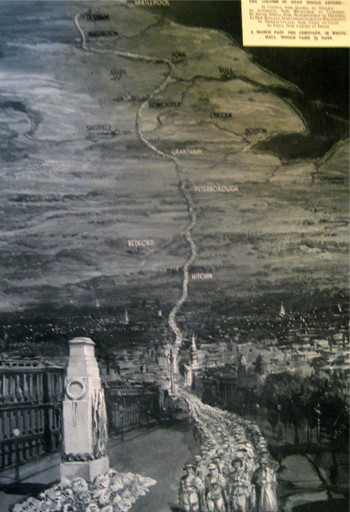
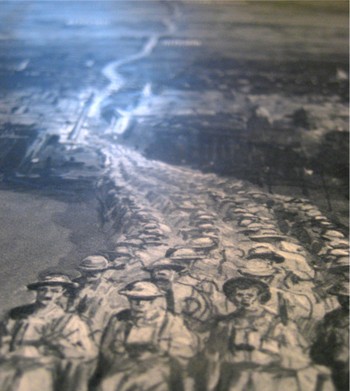
    published this very sobering image showing the general reader in London in 1933.  It is entitled “In Memory of the 1,104,890 British Dead of the Great War”, and was drawn by D. Macpherson.  It very graphically represents all of the war dead of the British Empire of 1914-1918, depicted as a line of men, four across, extending from London to Durhham.  The column passes from London through Hitchin, through Bedford and Peterborough and Grantham, past Sheffield and Leeds and York, and then on to Durham.  An extraordinary column of the war dead: 900,000 of the dead were not soldiers at the beginning of the war, but they sure died that way, and this map shows them all in a line, marching from  a point 269 miles distant.

    Blogmarching_2

    ·Posted by :

    ·in:


  • Graphical Representation of Data #1–England Invaded, 1908

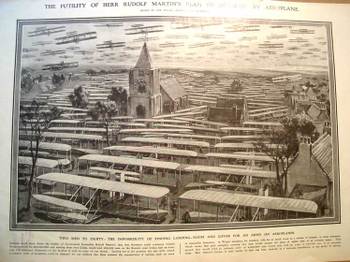
    Blogaeroplane_2


    Some of the most striking things in my collection/store/accumulation are the hundreds of images that portray data for display purposes–even more so, those that use a vernacular setting to bring closer to home an understanding of a statistic or finding.

    (One of the most popular books on this subject is The Visual Display of Quantitative Information by Edward Tufte, which uses a number of interesting images (good and bad) for the purposes of his book. Another, by fellow Asheville resident Peter Turchi (director of the MFA program for writers at Warren Wilson College) is Maps of the Imagination, the Writer as Cartographer,  which hosts a large number of interesting images the stories of which are richly and elegantly woven–this is a real piece of craftsman, and pretty, and useful, too.)

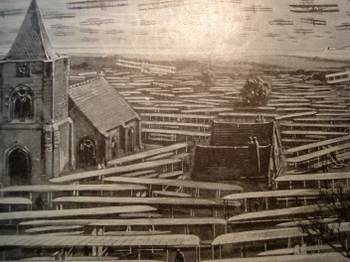
    The print that we’re looking at here appeared in the 19 December 1908  issue of The Illustrated London News and is entitled “The Futility of Herr Rudolf Martin’s Plan of Invasion by Aeroplane”. This fantastic piece of annonymous artwork graphically depicts what the author maintained was the impossibility of Germany to invade England by landing 50,000 flying machines and 100,000 men on the Kentish coast of England–impossible (quantly though realistically) because “of the impossibility of finding landing-room (for the planes) and cover for an army on aeroplanes”. The artist depicts a small town and what I guesstimate to be 60 planes in the air and 75 or so on the ground, leaving it to the imagination of the reader where the other 49, 875 might go. He DOES make a point, and very vividly.

    Blogaerooplanedetail “Nothing could show better the futility of Government Councillor Rudolf Martin’s idea that Germany could construct 50,000 flying machines for 50-million pounds…and land 100,000 men on the Kentish coast from Calais within half an hour.” Evidently Mr. Martin was very concerned with the invasion of England by Germany via airplane, and it was the editor’s job at the ILN to show him
    misguided. I would imagine that this illustration drove the point home
    to the folks who didn’t actually bother to read anything about the
    Martin defense plan. (It was in a similar way that Thomas Nast was able
    to control public opinion and sway political refuge and protection away
    from Boss Tweed. Tweed famously boasted that he didn’t care what the
    newspapers said about him because his power base didn’t read–he
    might’ve been and probably was correct here, so Nast took after Tweed
    via the political cartoon, and big too, and frequently; and the
    cartoons, even if the people looking at them couldn’t read, told the
    whole story graphically, and it was this that brought an end to Tweed
    more than anything else.)

    Martin fueled vast public concern with his procurement. Again in 1908 he granted an interview to the Daily Mail in which he outlined another plan by which he felt Germany could launch 3,500 “specially design” airships (I’m guessing dirigibles) and land 350,000 (!) men in England in, again, that half-hour time period. (I have no idea how you would do this, even today.) His speculations were well-discussed in the British press, and then found their way to Germany and Berlin,     where Rudolf’s plans against such an incredible non-existent attack by the Germans was ruefully considered. (The ILN was making the point by addressing Mr. Martin as “Herr” Martin that he was doing more harm than good in his yellowpapers.)  This evidently whipped itself into a frothy aeroplanitis in 1909, despite such efforts as this graphical reasoning by the ILN to dispense with the unreasonable fears.

    The airplane flown by the Wrights, the first powered heavier-than-air flight, occurred barely six years prior to these frantic events–the invention was still fresh (and basically “foreign”, as the Brits lagged well behind the other major powers in flight until WWI)–and understandable in a way that the fears were not understandable, not really, because of the newness and exotic aspect of the threatening invention.

    For a tour of the chronological history of the graphical representation of quantitative data as well as innovations in statistical and representational cartography, please have a look at Michael Friendly’s  magnificent site--it is an historical site the way it should be done, complete with all the trimmings, as well as the usually-absent but very important citations to the orginal articles used in the chronology. 

    ·Posted by :

    ·in:


  • The Strength of Iridescence–Visualizing Mental Calculations, Part II

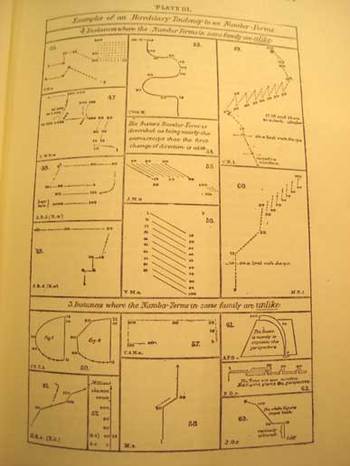
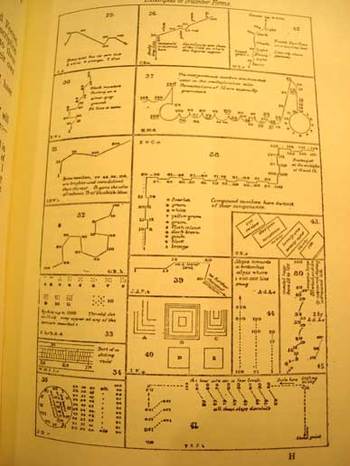
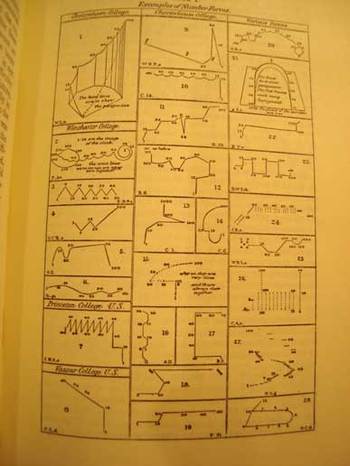
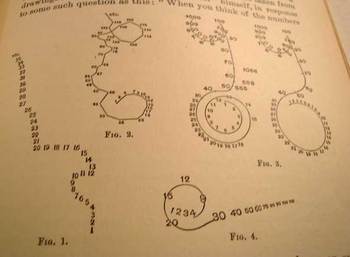
    I wanted to return and add a bit to an earlier notice concerning a series of drawings that I found utterly fascinating—the earliest illustrations of the active formation representing visualized human thought.  (I know that this titling is ungainly, but it seems to be the least inelegant solutions to stating the idea of what the images represent.)  It so happens that Francis Galton approached this same issue—though without pictorial representation—in an earlier paper with the unusual and provocative title of “Visions in Sane Persons” (1881).  Working further through this thesis and publishing an illustrated report in 1882, he continued, and greatly expanded, the study in a 26-page chapter called “Number-Forms” in his book Inquiries into Human Faculties and its Development (1883, with a second edition appearing in 1909).  Galton includes another 71 images of visualizing arithmetic, plus others on general images of mental images of numbers and letters—there is also a small but beautiful section on associations between colors and numbers and letters.  (These are all depicted in the first four images on this page.)

    Bloggalton1

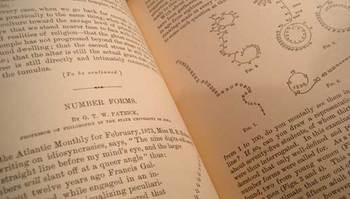
    G.T.W. Patrick (a professor of philosophy at the state university of Iowa) published one of the earliest papers in response to Galton’s work.  In “Number-forms”, published in the Popular Science Monthly in February 1893 (pp 504-515, and “illustrated”), Patrick addresses and expands Galton’s work somewhat, including another eighteen wonderful illustrations of similar images.

    But the path back to Galton is not quite a straight one.  Galton was initially concerned with imaging of numbers and numbers forms while people were performing mental calculations.  Patrick on the other hand asked his subjects if they had associative images in their mind of numbers—formally, he asked them if the number series of 1-9 presented itself in a visual, representative way in their minds.  In the second and third parts of his three-part inquiry, he asked the same question about letters and the alphabet, and then, thirdly, if they perceived any sense of color from letters and numbers, and what then what those exact relationships were.

    Bloggalton2_4

    It is interesting that in the studies of Galton and Patrick that over time in each of the subjects tested that (in Galton’s words) the images were “absolutely unchangeable except for a gradual development of complexity”.  Since I (like Galton, which is probably the only time I will ever be able to associate myself with this man
    in terms of familiar traits) have no such images in my head when I think about mathematics or numbers or letter or words in general, it is remarkable to me on the human scale that people who have these associations would have the same ones time after time.  A movable feast, as it were.  Of course it would make sense that this reference system would be constant—but for someone that doesn’t ‘see” these images at all, the fact that they are so flowing and lucid and unchanging is simply difficult for me to imagine. (In a few weeks I’ll return to this issue, looking at how some prodigiously gifted people “see” with their special attributes.)

    Bloggalton3_2

    Images below are from the Patrick paper:

    Bloggalton5

    Bloggalton6


    Bloggalton4blue

    ·Posted by :

    ·in:


  • Little Science—the Scientific Readiness of Water Bottles

    Blogmonolith
    There’s plenty of room for Big Science, as Big Science makes room for itself:  the Manhattan Project, RADLAB at MIT, CERN, Los Alamos, Human Genome Project are all examples of (really) big science, not to mention science cities like Oak Ridge, Tsukuda Academic Center (Japan)  and Akademorduk (Russia).  There’s  a much bigger list of big science, but what I want to get at right now is a look at Little Science, teeny-tiny science, and the home of the Good Idea.

    During the Anita Hill/Clarence Thomas hearings (which was constantly on the radio in the background) my friend Walter Johnson and I set out to move a half-ton piece of equipment,. in the dead of night, with no tools.  The object of course had no wheels, measured a very cubey 7x4x3 feet (or so), and presented itself in a primal crouch, like 6 refrigerators on their sides.  The Thing, a color photographic developer, needed to be put on its side, then moved down a 75’ hallway, then placed on end (!!) and then placed in a truck.

    We had a ratchet set and a few screwdrivers for tools—plus three roundish fence posts that we found in the trash outside.

    We removed as much of the innards as possible (it was a working machine so it needed to be put back together again), and were able to get it on its side so that it would fit through a door and down the hall.  I think that being bearish brutes we just muscled the thing over.  We of course used the logs to roll the beast down the hallway, a la the way we used to imagine the Egyptians moving monoliths.  We even knew how to get the thing upright—the big deal, though, was to get it back down again, horizontally, to get it into the truck.
    Monolithfz

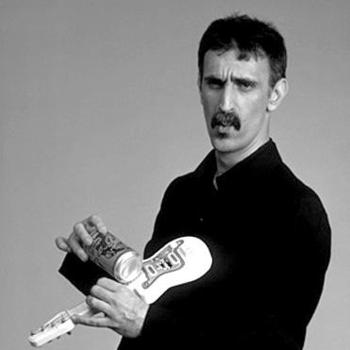
    This was, as Frank Zappa would say, the crux of the biscuit.

    Walter was and is a severely, acutely intelligent man with great creativity and a big sense of humor.
    Looking at our little bit of Stonehenge, trying to think of a way to move it from vertical to horizontal without damaging this slippery heavy stinking machine, and to continue using cave-man tools, was a thorny issue.

    Walter cracked it in an instant.

    We had five or six one-gallon jugs of water with screw tops—I think Walter had already consumed two gallons of it (he’s a big man, too)—that would serve the purpose.  Walter duct-taped the tops back on four of the empty jugs, taped the jugs across the top of the Beast, and then pushed the thousand-pound brute over.  The jugs acted perfectly, like shock absorbers; the caps stayed on, the machine never touched the ground, and we moved it into the truck and off into the night, celebrating our victory with warm Guinness. 
    Gallon_big

    It was a gorgeous and instant solution to a knotty problem, and a perfect application of a little sci and mechanics.  Of course you had to be able to see the simplest, most direct solution to the problem, which Walter did, and then have the necessary tools in the trash around you to make the dream come true.  But we hadn’t thought of that end bit, the lowering of the machine without damaging it part, which was such a heart breaker for the moment before Walter said that he knew how to do it.  But Walter was always like this, always hyper-smart and intuitive—he can master complex issues quickly and remember it all (I showed him Bergmann’s book on pi one day and without prompting he began to recite the pi through at least 50-places)—but the big deal was to recognize the shortest, best, most elegant solution to a problem.  And seeing that thousand pound behemoth fall safely to the ground as if on pillows is about the best exclamation mark that I can think of when talking about solutions like this.

    Happy 50th Birthday, Walter Johnson

    Monolithpi_2

    Here’s an unusual musical bit using the first thousand places of pi for a piano solo.

    ·Posted by :

    ·in:


  • Big Science, 1882–Hauling (Really Big) Ships Overland and up a Mountain

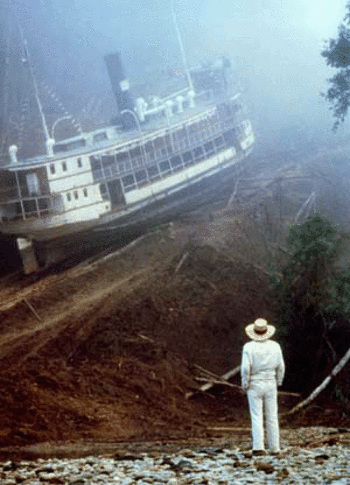
    Blogbig_sciencefitz In 1982 Werner Herzog, in what may have been the culmination of a weirdly fashioned and irresistible death-wish effort, released a film that he wrote and directed:  Fitzcarraldo.  It is a spill-over big, magnificent film about a would-be ice-making rubber baron bringing an opera house into the trans-Andes, trying to make his way into the dense forest in a huge (320 tons) steamboat on the Amazon to stake a claim in exploiting previously un-leased lands filled with rubber trees  The problem faced by Fitzcarraldo (played by the probably-slightly-insane Klaus Kinski1–just see Herzog’s 1972 Aguirre, Wrath of God and you’ll know what I mean) is that his path is blocked by unnavigable rapids–he can however reach his destination by hauling his very large ship up and over a mountain to get to a more pliant river and then to his goal.  Herzog actually does this for the film–no digital anything here2,3–in what is one of the most glorious things I’ve ever seen in the movies.  He really does have native people clear a path up the side of a mountain, and they DO haul this ship up and over.  It is truly magnificent, especially seeing the boat moving slowly up a mountain as background to a sweating Fitz.  

    The story is partially based upon the adventure of Carlos Fermín Fitzcarrald, who in 1890 attempted a similar feat, though with a much smaller vessel, and who also dismantled the craft to haul it overland. (Its not a bad idea, necessarily, to do this dismantling thing, especially if it has to be done and there’s no other way to do it. The North Vietnamese famously did the impossible by hauling artillery up through the jungle and up mountains to shockingly surround the French at Dien Bien Phu.) 

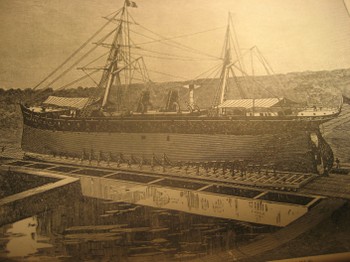
    Blogbig_sciencefitzcarraldo    The bigger and deeper back-story though is the effort–mainly by Elmer Corthell and James Eads–to build a combination railroad ship canal across the Tehuantepec isthmus in Nicaragua.  The idea of moving across Central America rather than taking the enormously long route around the tip of South America and up again is hundreds of years old.  The Corthell/Eads plan, begun in 1870’s and alive in the early ’80’s, was really the first feasible (and workable) initiative.


    Blog_big_large_ship

    It would have been a gigantic undertaking, and even though it was much longer (130 miles or so)  than the more-favored Panama location for the canal, it seemed more workable as there would be less digging and no need for a lock/canal system as required at Panama. 

    The French began a doomed attempt at conquering Panama shortly before this.  Ferdinand de Lesseps tried to build a canal in 1880, but the organization and general construction plan was truly inferior; also, the sanitary and medical conditions were terrible, with the French losing perhaps 22 thousand men in the failed process to disease (mainly malaria).  (The United States would lose 5,609 workers while building the Panama canal, on land granted as a payback for “helping” Panama release themselves from Columbia.)

    Blog_big_closeup

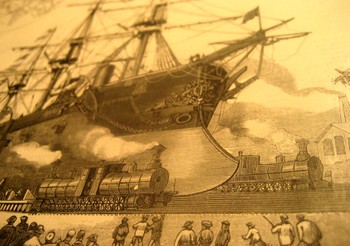
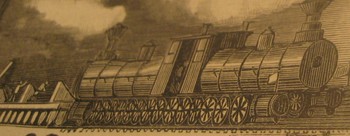
    The Corthell/Eads (who by the way was a master builder perhaps best known for his inspired masterpiece of a bridge at St. Louis) plan called for hauling the ships up and out of the water in a short canal and placing them on an enormous floating roundabout; the roundabout would then be raised, and the ship place on huge cradles borne upon vastly augmented railway lines.  Once on the cradle, the ship would be pulled and pushed by a team of four large locomotive teams which were in turn composed of two large engines.  Happily aboard, the ship would then be taken on the extended, expanded wide and augmented rail 130 miles overland and dumped into the Pacific.

    It was evidently not a workable deal all the way around, though, as the U.S. decided on the new Panama to works its engineering miracle.

    Blog_big_big_closeup

    There is something pleasing though about the Ship Railway, though, something that appeals to the little bit of Mr. Herzog in me.  Perhaps it was the appraisal of the very stiff-lipped Sir Edward Reed–who was the former master engineer for the British navy and consultant to Eads—that makes it all so irresistible.  “It would be best to avoid a very high rate of speed” when hauling the massive ocean-going and heavily laden cargo ships.  Indeed.

    Notes

    1. The original actor in the Fitzcarraldo role was Jason Robards, who had to give the film up after about a third or so the way through as he came down with dysentery. Kinski came into the role after that, and the film was re-shot. 

    2. There is a scene showing the steamboat being unmoored and sent down the rapids on its own–that is done with a model. So far as I know, that is the only bit of post production trickery for the film. 

    3. There’s an interesting documentary of the film also released in 1982, Burden of Dreams.

    ·Posted by :

    ·in:


  • Making Things Disappear–Kandinsky (and Nature) and Penzias (and Alpher)

    Blogdisappear_hart
    It’s odd that at just the moment in time that time is
    freezing in moments, that things are becoming more visible and definable, that
    the world of art, in its way, became less so. Etienne Marey and Ed Muybridge displayed the acts of motion in slivers
    of itself, captured and presented for study, images that had never been seen
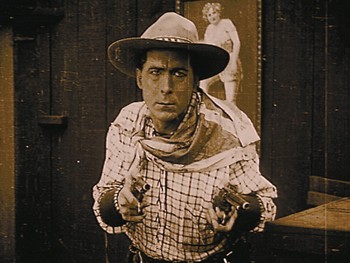
    before, while shortly after this William S. Hart transformed their intellectual
    heritage and wrestled it into train robbers and kissing thieves at 16 frames
    per second.  And just as the segmentation
    of motion had reached it highest modern heights, Marcel Duchamp, the great
    artist-like chess master and comedian, presented the world, in 1912, with his
    Nude Descending. This painting continued
    on the steady track laid down in the 1860’s by the Impressionists and Post-Impressionists, building on
    their sense images, their descending denial of “detail”, and made the human figure almost disappear.
    Blogdiappear_kandinsky
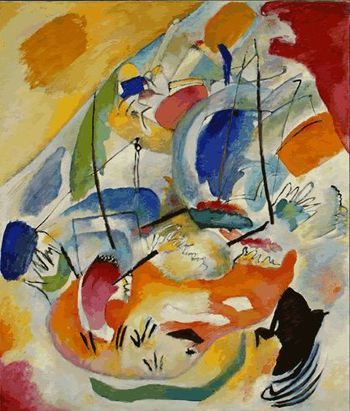
    It was Wassily Kandinsky in the next year who actually made
    everything disappear–everything that is but color and disparate forms.  In his painting
    Improvisations there were no human or natural forms–it was the first
    non-representational painting in history, with nothing at all being recognizable in his epochal work, showing people for the first time the “other” side of the mirror.   Making things disappear, en plein air, performing an emparquementage, if
    you will, is truly quite a work of art.

    Kandinsky tried to relate the philosophy of his
    approach in an inner-secretive, mysterious, occulty work called Concerning the
    Spiritual in Art
    (1912). It is a lovely
    book, with thick paper, very wide margins, beautifully printed, sumptuous even (in
    the original)–but it makes the innovation of his art ever more unreachable,
    more wispy–smoke without color, at least for me. The great Kasimir Malevich made a similar
    attempt with similar results–at least, again, to me–trying to explain how he
    eliminated natural forms and replaced them with rectangles, squares and
    circles. Later, Malevich would begin to
    replace color, working in white. He was
    sublime.
    Blogdisappear_herman
    Disappearance is not
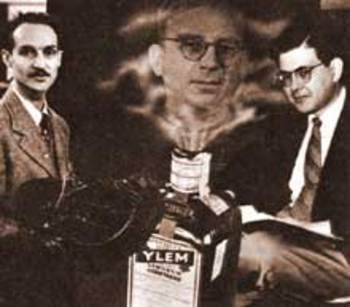
    necessarily sublime. Ralph Alpher and
    Bob Herman got disappeared. With George
    Gamow they hypothesized the Big Bang and predicted where the remnant of the heat
    of the explosion (the so-called background radiation) would, could, be
    found. Alpher and Herman were basically
    correct in thei research (over the period of 1939-1949 figuring it would be
    about 5-degrees Kelvin), but were basically a little sleepy over their results,
    or at least until the numbers proved out to be good, when the background
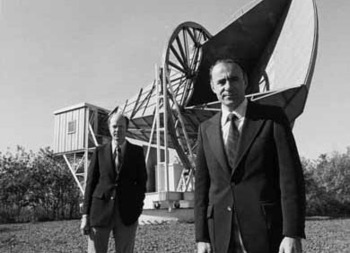
    radiation was “discovered” in 1964 by Penzias and Wilson with the Big Ear at
    Bell Labs in Holmdel, NJ. It all bore
    out, except, of course, their contribution—Penzias and Wilson got the Nobel for
    their work, and Alpher and Herman got, well, nothing. (For a long, lovely article about Alpher see fellow Asheville resident Joe D’Agnese’s article in Discover.)
    Blog_disappear_penzias_wilson_09060

    Penzias and Wilson did arrive at their
    findings independently of A+H, but that’s another story—that they were “Gone”,
    even when their contributions were made known in the thrill of the more modern
    discovery, was just not right. I met Alpher
    and Herman together in the late ‘80’s, coming into my store for a visit with
    books. Herman was pleasant and chuckly;
    Alpher, not. His pissed-offedness at the
    sleight of the background radiation work shone right through when discussing
    Penzias and Wilson. Herman was
    philosophical in discussing the great oversight:  “Yes, this is true, but
    we’ve been given plenty of honors since then”, he smiled, content. “Um. Yes. But not the Big One”, garumped Alpher.

    Einstein too slipped away a
    bit in what could have been a moment of monumental insight. Max Wertheimer, a colleague of Einstein’s who
    had a background in physics and was one of the founders of German gestalt
    psychology, had a chapter in a book of his called “Einstein: the Thinking that Went into General
    Relativity”. The chapter is coercively bland; basically nothing. Too bad, since
    Wertheimer was present at the creation, was friends with Einstein, had some
    sort of background and grasp for the material, and was a trained observer.  The great historian Arthur I. Miller in his
    book
    Insights
                      of Genius: Imagery and Creativity
                  in Science and Art
    (Copernicus, Springer-Verlag, 1996) thought the
    *promise* of the chapter heading to be phenomenal—he was deeply disappointed
    with the very little that was offered, which was basically a gestalt
    interpretation of E’s being at the time. (And psychology happened to be a “science” that Einstein would not admit
    into the scientific field—he had little use for the discipline.) The creativity, the intuition, the
    explanation, of some of the most creative thinking of the century, which was
    most probably on display for Wertheimer, was lost. Disappeared.
    Blog_d_isappear_man_ray


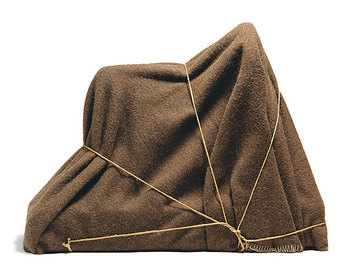
    Sometimes when things disappear they illuminate, as in the case of Kandinsky and Malevich and Duchamp and company.  Sometimes when they disappear we see the forms of the missing, making them further suggestive and capable of initiating inquiry. (A very bald example being The Enigma of Isidore Ducasse, a work by south-Philly-born-Emmanuel Radnitzky, otherwise known as Man Ray, the great Dadist, photographer and Rayographer, and 40 years before the work of Christo. He made Ducasse disappear and become mysterious by wrapping up a singer sewing machine, creating art and inquisition.) 

    And sometimes when things disappear, they just, well, disappear. 

    _________________________

    I can heartily recommend the following books by Arthur Miller, who has a very deep knowledge of numerous fields, and who brings them beautifully to bear in his books, as follows:

    Empire of the Stars: Friendship, Obsession and Betrayal in the Quest for Black Holes (Little Brown, UK edition; Houghton Mifflin, USA edition, 2005).
    Shortlisted for the Aventis Prize

    Einstein and Picasso: Space, Time and the Beauty that Causes Havoc (Perseus Books, 2001). Nominated for the Pulitzer Prize.

    Insights of Genius: Imagery and Creativity in Science and Art
    (Springer-Verlag, 1996 cloth; MIT Press, 2000 paperback).


    Albert Einstein’s Special Theory of Relativity: Emergence (1905) and Early Interpretation (1905-1911)
    (Addison Wesley, 1981: new edition SpringerVerlag, 1998)

    Imagery in Scientific Thought: Creating 20th-Century Physics (Birkhäuser, 1984; MIT Press, 1986; reprinted 2003, Dover Publications)

    Frontiers of Physics: 1900-1911
    (Birkhäuser, 1986)

    Early Quantum Electrodynamics: A Source Book (Cambridge University Press, 1994)

    Editor, Sixty-Two Years of Uncertainty: Historical, Philosophical and Physical Inquiries into the Foundations of Quantum Mechanics (Plenum Press, 1990)
    ·Posted by :

    ·in:


  • Transient Statues: Naming Clouds and Snowflakes

    Blogcloud_howard

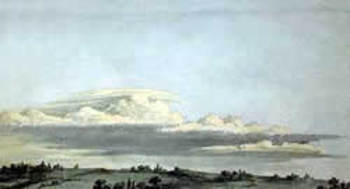
    It is odd to think among the great classifiers of nature, including even the lofty-namer Aristotle, that clouds were not scientifically classified until the early 19th century.   Here they are, just about the biggest thing we have as earthlings that are gigantic and close to us, and nobody offered a good classifications scheme until 200-odd years ago—a pretty slim margin of time  in the terms of recorded human history. 

    Clouds are of course problematic, what with floating around and all—but if you didn’t already know the relative newness of their recognizable names isn’t it shocking to learn this bit of history? For the most part I think clouds must have been thought as being too transient, changeable, whimsical, wispy, to be given proper names.   The great scientist and classifier Lamarck tried to do so in his  Annuaire Méteorologique of 1802, and really is the first to try this, but his ideas weren’t terribly good (especially compared to the rest of his work), and it seems as though he left his best thinking effort on clouds at home.  For example, he gave us Hazy, dappled, massed, broom-like and grouped clouds as classifications (in French, respectively, en forme de voile, pommelés, attroupés,  en balayeurs and groupés).  They seem quite “French” to me, but largely outside the scope of being useful. 
    Blogsnowflake_hooke

    It was the English pharmacist and chemist Luke Howard who in 1803 gave a greater bit of thought to structuring cloud names, classifying them according to size and shape and giving them Latin names—and this forms the basis of our naming clouds to this day.  Howard was perhaps the first, greatest, meteorologist, producing On the Modification of Clouds, (in which he describes his naming system, the “modification” part actually meaning classifying rather than changing),  The Climate of London, and the first textbook on weather,  Seven Lectures on Meteorology.  Howard’s system was expanded in 1887 by Abercromby and Hildebrandsson, who further classified clouds by height above ground as well as by appearance (and utilizing Howard’s naming system). 

    Howard began his system by identifying three basic shapes to clouds: heaps, layers, and curls.  Heaps of separated cloud  masses with flat bottoms and bulbous, splayed, tops, which he called cumulus, which is Latin for heap; the Latin stratus was applied to clouds in layers which were much wider than they were thick; and again to Latin for cirrus, which called out the wispy curls of clouds.  (Rain clouds were given the Latin nimbus, for rain, and so on.) 

    It is interesting and romantic to think of Howard being moved in his love of clouds as many Brits and Europeans were in the Volcanic Year of 1783 by the enormous eruptions of the Eldeyjar (Iceland) and Asama Yama (Japan) volcanoes—the force of their eruptions caused enormous changes in the skies (especially in Europe), creating vast sky-borne tapestries (the “Great Fogg” in England) and for such extended periods of time that it would have been impossible for the scientifically-minded Howard not to see them. 
    Blogsnowflake_bentley

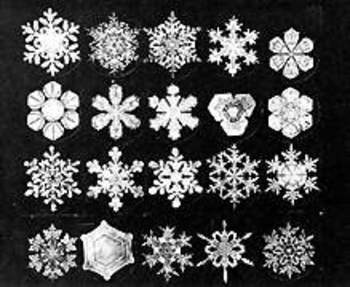
    Similar, in a way, to clouds is the snow crystal (snowflake)—they change forms in their lives from sky to ground, and may well disappear on contact with a warm surface.  Of course unlike clouds they may fall and be captured, kept even, though the ability to actually perform some sort of scientific something with them didn’t occur until 400 years ago, which means that snowflakes passed in and out of human existence being very simply named (in most languages) as a mass group, and not classified at all.

    Johannes Kepler thought very deeply in In 1611 publishing a short treatise called On the Six-Cornered Snowflake, thinking that perhaps their (mistaken) six-cornered symmetry revealed something much deeper about the basis of nature and the universe. The 26-year-old  Robert Hooke seems to be recognized as the first to throw the snowflake under a microscope, publishing drawings of them and just about everything else that he saw in his monumental (and tall, being 13-inches tall) Micrographia (1665)–the first truly scientific book of modern times.  The largest of the large images was saved for the flea, showing the unsuspecting public the great and beautiful nature of what seemed like a fantastical beast (under magnification).  Snowflakes appeared in the book, revealed in their intricate and seemingly-symmetrical nature.  Fantastic, unimagined images. This aside, he seems to have, um, borrowed these images from an earlier work, Thomas Bartholin’s  De Nivus usu Medico Observationes Varieae, 1661.  But so it goes. 
     

    The Galileo of the snowflake was Wilson Bentley (1865-1931), an autodidact Vermont farmer, seen by fellow hamlet-dwellers as odd and off, who figured out how to photographically and beautifully record the intricacies of the snow crystal world—no one had ever done this so dramatically, with such gorgeous results.  It really was as though he was able to record the heights of the mountains of the moon with a slender telescope in Pisa, 350 years earlier. The results of his decades of experience were published  in 1931 his book Snow Crystals, containing more than 2400 snow crystal images.  On the heals of Bentley’s accomplishments came the classically trained nuclear physicist Ukichiro Nakaya, who was truly the first person to apply a scientific classification to snowflakes, and who published his intrepidly-beautiful work in a 1954 book entitled Snow Crystals: Natural and Artificial.  His classification system of the various types of snowflakes would prove vastly more useful, interesting and appealing than that published by the 1951 the International Commission on Snow and Ice, and forms the basis of the discussion of snow crystals today—a classification system of a massively-occurring phenomenon that is younger than me. 

    ·Posted by :

    ·in: