A Daily History of Holes, Dots, Lines, Science, History, Math, Physics, Art, the Unintentional Absurd, Architecture, Maps, Data Visualization, Blank and Missing Things, and so on. |1.6 million words, 7500 images, 4.9 million hits| Press & appearances in The Times, Le Figaro, Mensa, The Economist, The Guardian, Discovery News, Slate, Le Monde, Sci American Blogs, Le Pont, and many other places… 5000+ total posts since 2008.

Author: JF Ptak

  • Blank & Empty Things 36: Sold Shadows and Fat Chairs (Peter Schlemiehl and Joseph Bueys)

    JF Ptak Science Books  LLC  Post 535
    22

    On the heels of my last post on the usefulness of constructing
    geologies of wrongness and on the extraction by Creationists of something from
    nothing comes today’s bit, where something really does come from nothing, and
    where (again) nothing of something is extracted from nothing. 

    1)  Something from
    Nothing

    How old are shadows? 
    Or, really, how old is the depiction of the shadow in the history of
    western art?  The shadow predates the
    modern re-discovery of classical perspective by a thousand years—little bits of
    shadows pop up here and there in deep antiquity, certainly way before Uccello
    and Alberti and the rest came along.  On
    the other hand shadows do escape notice of many painters in the 15th
    century (and during the period of being very comfortable with the century-old realignment
    of perspective), which is odd, unless all of those works were depicting scenes
    at high noon or thereabouts. 

    The something-from-nothing part with shadows comes from the
    odd and somewhat creepy story of Peter Schlemihl (Peter Schlemihls wundersame
    Geschichte,
    “Peter Schlemihl’s Remarkable Story”) written in 1814 by
    the semi-ruined Franco/German aristocrat Adelbert von Chamisso.  In one adventure, Peter,
    unfortunately poor in a land of the wealthy, makes an agreement with a
    mysterious grey man (who is probably the devil) to sell his shadow for a
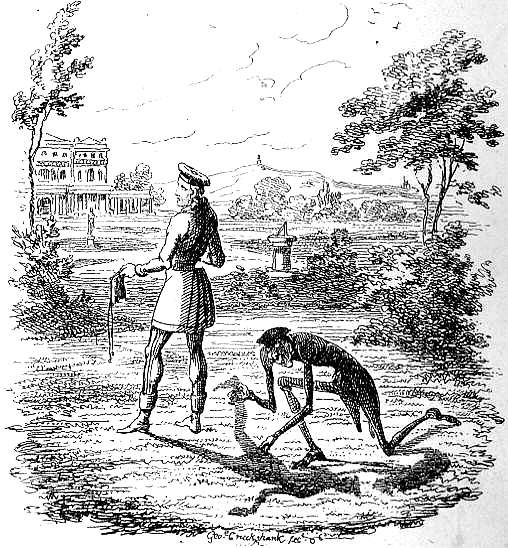
    bottomless purse of gold.  In an 1861
    British edition of this work, the great George Cruikshank portrays the very
    moment when the shadow is being literally lifted from the ground by the
    mysterious grey man—the point of contact between his hand and the shadow just
    gives me the willies.  The grey man’s own
    shadow, arching behind him, is also very threatening and terribly offputting to
    me.  Perhaps it is just a  great wrongness, making the shadow something
    from its vast nothingness.  (And the
    story goes that the gold is never-ending, but people are so repulsed by Peter
    not having a shadow that it makes his life supremely difficult—so much so that
    the grey man returns with a new deal, offering to Peter his shadow and the
    endless purse if only he would relinquish his soul when he died.  Peter begs off, throws away the purse, and
    lives without his shadow and without money.)

    Hans Christian Andersen also provides a scary fairy tale in
    1847 called “The Shadow”, in which a man’s shadow slips away and is replaced by
    another shadow which slips back (slowly) into the old shadow’s place—but it is
    not what it seems:  “I have gone through the most terrible affair that
    could possibly happen; only imagine, my shadow has gone mad; I suppose such a
    poor, shallow brain, could not bear much; he fancies that he has become a real
    man, and that I am his shadow.”

    2)  Nothing from
    Something from Nothing.

    Yes, this is terribly convoluted, but the title fits the
    subject, and the subject is Josef Beuys (1921-1986), a German artist (or
    perhaps he was a performer in art) who broadly dabbled in conceptual art.  He came to prominence in the 1960’s, when the
    acceptance of these art performances was as much a work of art as the art piece
    itself, and, I guess, he has remained, his appreciations now gaining an antique
    patina. 

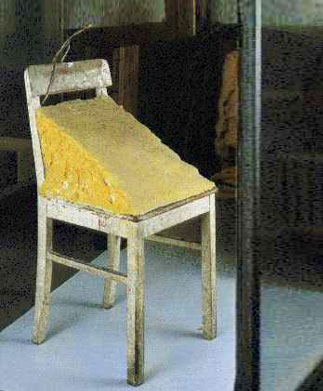
    I wanted to address his work, Fat Chair.  The title doesn’t quite describe the work,
    which is a chair with a wedge of fat on it. 
    Many a critic’s eyebrow has been plucked trying in deep intellectual
    desperation to see something in this work. Under the weight of these artistic
    appraisals of this work, I’ve just got to say, really, sometimes fat on a chair
    is just that.  I can appreciate Beuys as an artist and performer of his
    times, but the deep thought that has gone into Fat Chair is a bit much for my
    taste, praising observers biting off much more than can be chewed.  For example, from one website we see:
    0 fat

    “ ‘Fat Chair’ (1964) is much more about the
    physicality of the human body. To Beuys, fat as a material could be considered
    before form was considered… Fat…appealed to Beuys b

    ecause it was a composite
    with no internal structure…Beuys placed fat with its “chaotic organic
    energy”
    , symbolising warmth, in the cold, rigid,
    man-made form of a right-angle. This form, which represented the coexistence of
    instinct and intellect was placed in the right-angle of a chair between seat
    and back. The fat also occupies space on the chair that would be filled with
    our digestive and excretive organs if we were sitting on it.”

    Another website states “Fat…was an ideal material for Beuys
    to use to sign

    chaos and the potential for spiritual transcendence. Fat has
    the ability to exist as a physical example of two extremes: a flowing liquid
    when warm and a defined solid when cold. Beuys also believed that fat was
    psychologically effective, in that “people instinctively feel it relates
    to inner processes and feelings.”

    I’m
    sorry to not include the references for these opinions—it is just to painful,
    too embarrassing to ascribe them blame. 
    And they are hardly alone in this hagiographic myopia, pulling these
    strands of something from nothing about nothing. 

    I’d
    prefer to leave it all at nothing in regard to the Beuys (or to Andres Serrano
    or Damien Hirst and so on),  thinking
    about lovely Ludwig’s self-abandoned seventh proposition (“Where (or of what)
    one cannot speak, one must pass over in silence”).  Better yet, better to apply the one of the
    last lines of the great classic “The Street of Laredo” (the Johnny Cash version
    of course)—when the young dying cowboy is asked about who shot and killed him,
    he simply says, in the best cowboy fashion, “speak not his name, and his name
    will pass on.”. 


  • Blank and Empty Things: the Case of pre-Biblical “Missing” Eclipses, Refuting Darwin, and the Geology of Wrongness

    JF Ptak Science Books LLC  Post 533

    0 blog march 5 darwin refutation654 A History of Blank and Empty Things #35.

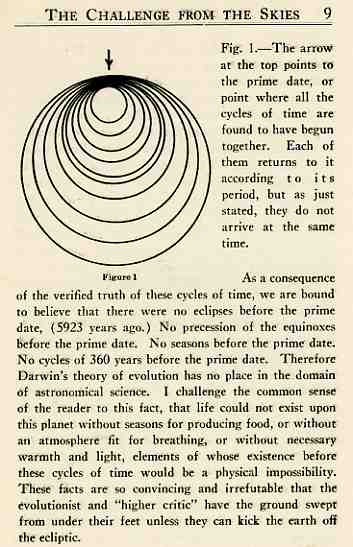
    Mr. R.R. Menke, the author The Challenge from the Skies, Planetary Motion and its Solemn Witness Against Evolution and Higher Criticism, self-published his biblico-religico-astronomical diatribe against Charles Darwin in Huntington Park, California, in 1925.  What he launches in 51 labored pages against one of the most elegant ideas in the history of science  is simply, well, shocking; shockingly eyebrows-catching-on-fire bad, so-bad-it-isn’t-even-bad bad.  Without reading the whole, um, thing, I do get the piercing whiff of a notion having to do with eclipses and the true date of seven (?) days of creation.  He uses some sort of chrono-alchemy layered in spreadable butter, the words made of microscopic asparagus, to prove his point that “as a consequence of the verified truth of these cycles of time, we are bound to believe that there were no eclipses before the prime date (5923 years ago)”.  No eclipses before creation.  AND no precession  of the equinoxes, “no seasons before the prime date, no cycles of 360 years before the prime date”.  Oh my.

    His conclusion, by virtue of this magnificently weighty evidence (and which he doesn’t even relegate to its own paragraph), is “Therefore Darwin’s theory of evolution has no place in the domain of astronomical science…”  And this is so not so much, evidently, that there were no eclipses, and no seasons, and no 360-year cycles (?!), but rather, at the base of it all, there was nothing. No earth.  And since the earth is only 60 centuries or whatever old Darwin just doesn’t work.  I have no idea why the eclipse business was necessary if Mr. Menke was going to argue that there was no “there” there for anything to happen, what with the impracticable nature of having something in nothing. 

    0 blog march 5 darwin refutation655

    There you have it.  There’s more, much more, but frankly it just isn’t worth the 20 minutes to dig out more.  I rarely read anything in Creation Sc__nc_ as there is nothing redeeming at all in it–I’m posting this today because it strikes me that this present work isn’t necessarily singularly bad, but rather representationally bad.  Since the entire belief/hope/prayer system or whatever the Creationists claim as the intellectual/moral basis to their Principa in explaining the stuff of the universe is painfully wrong, and bad, and potentially harmful, I wonder why we should distinguish the levels of badness and wrongness?  It isn’t as though  establishing a geology of wrongness will somehow categorize it all in such a way that something worthwhile could be discovered, like a miraculous toe-hold at the top of the  Sisyphusian hill they’re trying to slide up.  And so perhaps Mr. Menke’s work is just wrong, along with the rest of the others; perhaps the other side needs to deal with him as being one of their own more so than anyone else.  Certainly there are more elegant refutations than this unfortunate attempt, but that only makes the wrongness prettier:  a pig in a (white) wedding gown is still, after all, a pig.


  • History of Dots AND Blank & Missing Things: Particles, Galaxies and Missing Middles

    JF Ptak Science Books LLC Post 533

    0 blog march 4 cuyama 2647
    (Forcibly!) joining a continuing series of posts on Blank and Missing Things and a History of Dots, we’ll look today at intellectual hermorphiditism, alpha omegas, nuclear particle tracks, negative galaxies and the wanderings of a centenarian vegetarian pro-lefty Vermont commie’s middle-missing thoughts. 

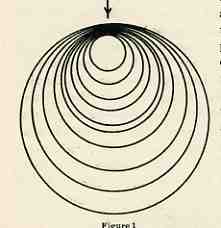
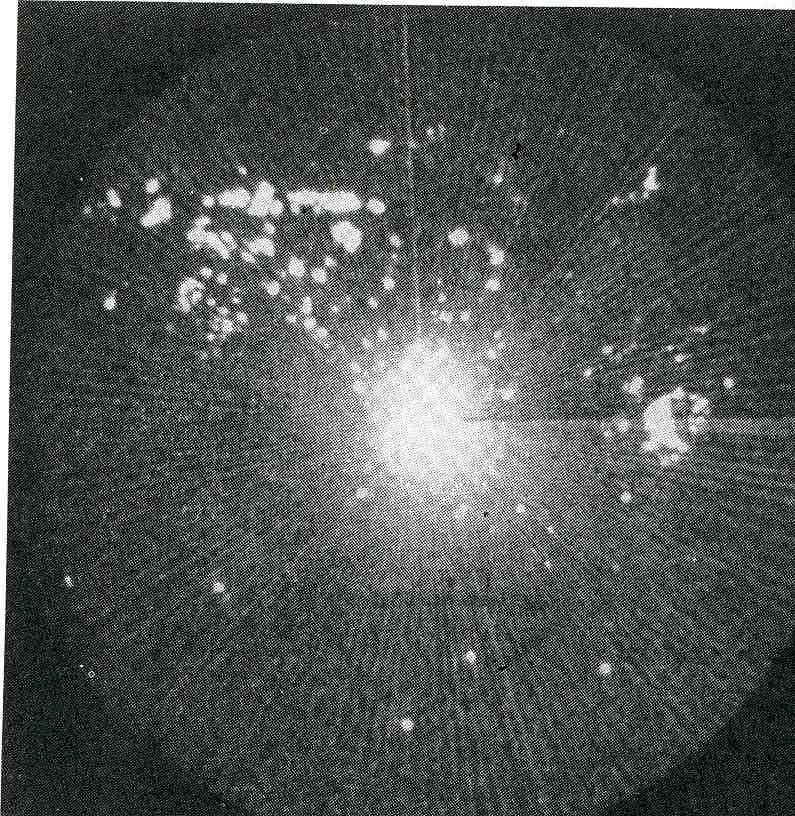
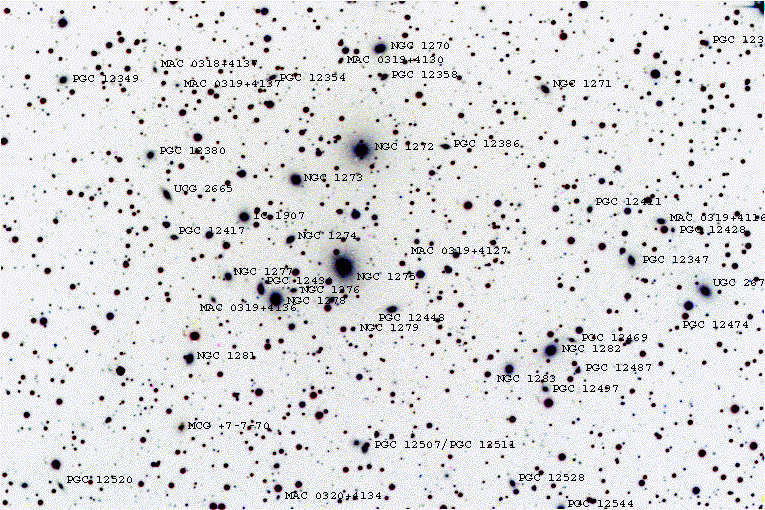
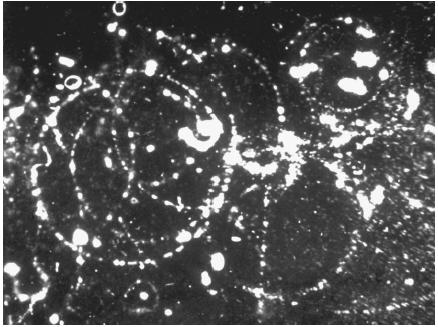
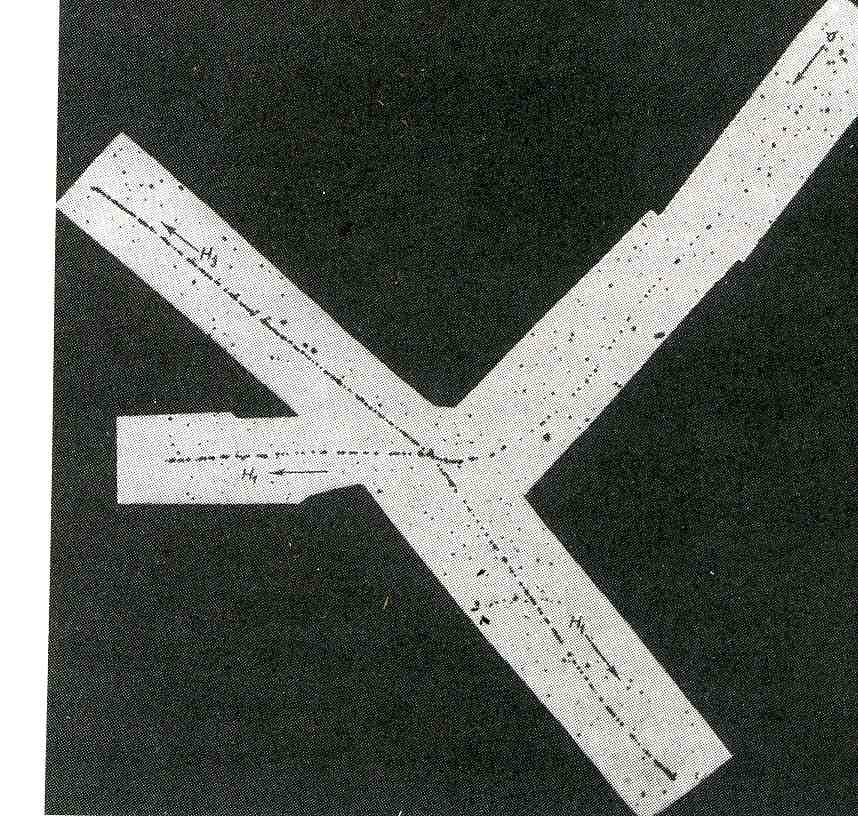
    I know that you can find dots everywhere if you look hard enough, or magnify things enough, or get far away from them enough….it seems that once you start on either route in the powers of ten game that getting to 10 (7th) things start to look very dotty indeed.  What was on my mind was the similarity between particle tracks (and particularly the photographs of the very earliest ones) and negatives of images of galaxy clusters.  The image to the left, to encumber things a little further, is another look-alike from 1947:  a moving target indicatorPerseus_GC_Neg_8_bit_14_Oct_2001 (showing the cluttered field of a Japanese freighter convoy at sea).  A negative photo of a section of a galaxy cluster in Perseus is directly below, while just below that is a cloud chamber of what is probably the first photo showing the track of a cosmic ray (1927 by Dmitry Skobeltzyn).

    Uesc_03_img0160

     The next image,  also from 1947, is the first observation of the disintegration by a negative meson (appearing in Nature Magazine #126 for 1947). 

    0 blog march 4 cuyama646

    The galaxy and particle images, at nearly-opposite ends of the existence spectrum:  from 10 (-10) meters (or .0000000001) to 10 (+14) meters (and actually 10 +14 through 10+25 meters, looking pretty much the same), the story is all pretty much dots, from the deepest buzzy  recesses of a proton to the outer reaches of the outermost bits of the outer universe.  The middle part is where all of the “stuff” is,  the (near) alpha and omega of whatever there *is*. 

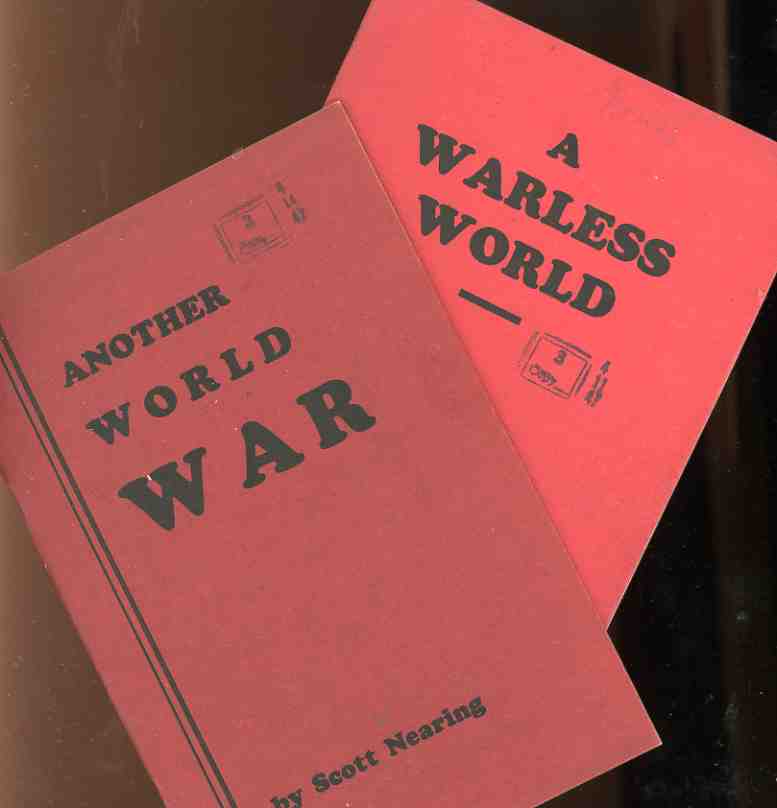
    0 blog march 4 cuyama 3 nearing648

    And somehow this gets me to the two works here, both issued in 1947, by Scott Nearing, our centenarian Vermonter communist, who manages his very own alpha and omega, who covers the very ends of the spectrum without getting bogged down with the slumpy middle part….which of course is just about everything. 


  • Blank and Missing Things 33: (Disembodied) Hands of Creativity

    JF Ptak Science Books LLC  Post 532

    0 abay feb 23scheiner623

    [Last year’s post for this day: The Wrong Stuff, Righted–the Attack on Darwin’s Descent, 1871]

    I wish that I had kept track of all of the images of “holy/phenomenal” disembodied body parts sprouting from nothingness or from pure creator-of-the-universe light that I have seen populating antique prints over the years.  Much more popular in displaying the indisputable are the images of the Primum Mobile,  the Hebrew word for Y_w_h, the smiling countenance of the creator itself, or doves arising from a shining star or sun–far less seen are the images featuring seemingly floating disembodied body parts.  Had I kept track of all of these magnificent things in the sky or air I’d really be able to compare them; but I haven’t, so I just need to rely on a generalized memory of what seems to me to be uncommonly seen images, and then wax away like a groaning and saggy Moon. 

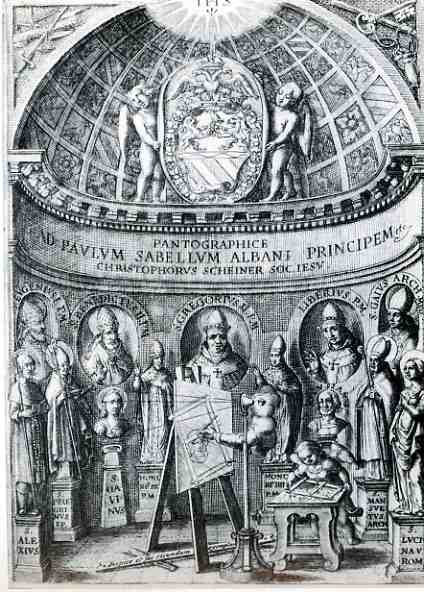
    The image to the left is the decorated title page of the great Christoph Scheiner’s (1573-1650) Pantographice sev ars Delineandi  res Quasilbet per Parallelogrammum Lineare..., published in Rome in 1630.  The book was about one of the most-employed inventions

    0 abay feb 23scheiner624

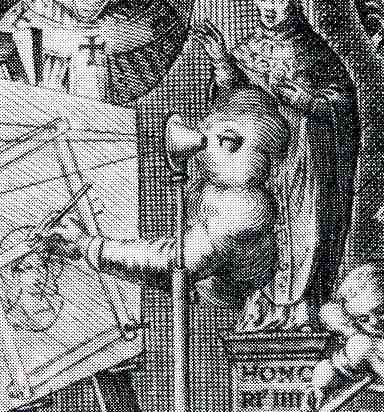
    of the 17th century,  Scheiner’s very own pantograph, which was/is a very versatile tool used to project an object from one scale to a greater one, and used by grateful sculptors and architects and mapmakers and astronomers and engineers for hundreds of years. What we see in detail in the engraving (right) is the disembodied squinty-eyed-cloud-arm of creativity, using the pantograph, and copying a painting (in a chapel?)  But is this the soul of creativity, really, since the arm-eye is using a device to copy something?  I’m not saying that there is no art involved in this practice, because if that was the case then I could use this device with positive results–but I can’t, and so there must be artistic merit involved.  Perhaps this curious image celebrates the art in the copied elements and not the use of the pantograph.  

    0 blog march 3 kircher635

    Another interesting example of disembodied genius occurs in the
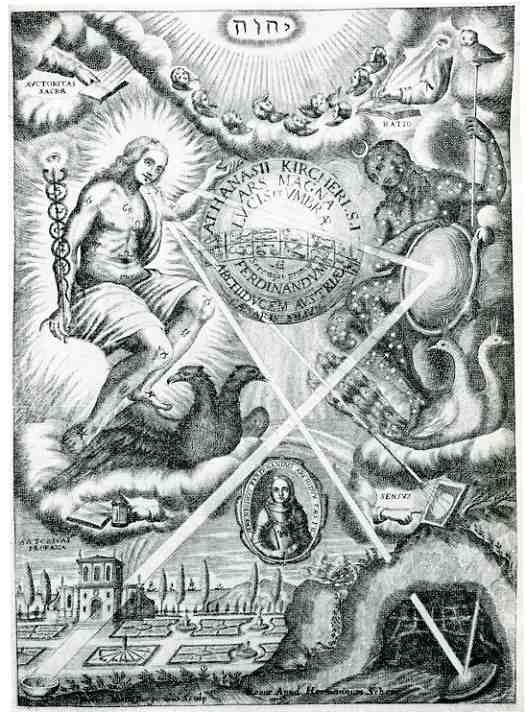
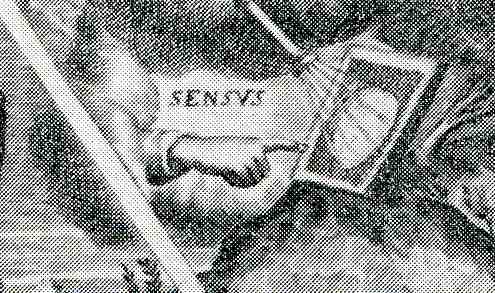
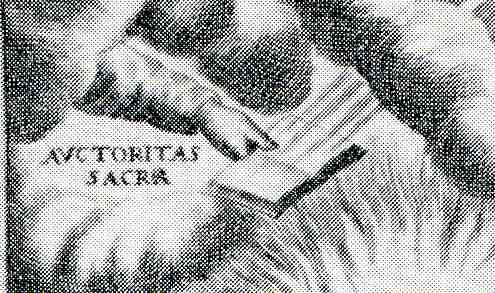
    title page (at left) of the transubstantiated and sometimes-impossible Athanasius Kircher’s encyclopedic Ars magna lucis et unbrae in decem libros digesta, published in Rome in 1646.  Of his very many works, this is perhaps one of the most important, and includes the first descriptions of (his discovery/invention?) of the magic lantern, of luminesence, and of the camera obscura.  (Among much else are Kircher’s drawings of his microscopic investigations, which were very major contributions, and which predate the works  of Hooke and Leeuwenhoeck.)  This complex and iconographically-layered title page engraving contains (almost offhandedly) three disembodied hands, the first of which displays camera obscura image.  Given everything else that is going on in the image, the holy hands are the those demanding the least amount of interpretative skill. 

    0 blog march 3 kircher detail636


    0 blog march 3 kircher detail637


  • Revolutions in the Color “Red”: Paul Gauguin and Edwin Hubble

    JF Ptak Science Books LLC  Post 531

    A circus passed the house—still I feel the red in my
    mind.
      Emily Dickinson, 1866

    Color expresses something by itself.  V. van Gogh

    Pure color!  You must
    sacrifice everything to it
    …  P. Gauguin

     
    Standing in my friends Lucy & Andy Archie’s store, standing near a
    window and catching some sun on a cold stinking day, a large red jar cast a
    long red shadow along the wall, causing me to think about the color. (It was a
    pretty nice shadow.)

    Red has turned up as an important color in terms of
    patriotic/vitriolic symbolism (as in the revolutions of 1848, Garibaldi,
    communism), Aztec cochinealial luxury,  important burial dress of the
    Cro-magnums,  signs of divine favor and
    condemnation, Roman red divine, Egyptian danger, royal cinnabar of China ,
    Indian bridal dresses, Japanese heroic figures, and on and on (into the lower
    realms of red tape, blood red, fire, blind anger, love/passion, evil, crushing
    impropriety,  and etc.)

    Red’s most important contributions, perhaps, at least in
    modern times of the past few hundred years or so, comes in the field of art and
    science—and its appearance really is pretty monumental, and weirdly
    coincidental in their placement in the chronology of Big Important Stuff.  The birth of impressionism (with Monet and
    the Salon des Refuses), the greatest change in the history of art since the
    rediscovery of perspective, and the solidification of spectrum analysis (Bunsen
    and Kirchhoff), both occurred around the period of 1859-1863—the great use of
    red for both of these developments would come somewhat later, though the red
    roots began here. 

    Img128
    The achievement of Bunsen and Kirchhoff, started in the
    epochal year of 1859 (the same year seeing the publication of the Origin), was
    nearly as spectacular as any other scientific achievement of that century.  The two men showed—and this would have been
    incredible to the mind of the 19th century—that individual atoms had
    their own spectral signature.  When the
    Englishman William Huggins absorbed their work, he realized immediately (as did
    Bunsen and Kirchhoff) that the spectroscope could be turned on the sun and all
    the rest of it—the results of the experiments of these three revealed the
    elements of what stars were made of, something that must’ve seemed like science
    fiction come true.  The second part of
    the second step* in this fabulous discovery and application came 65 years
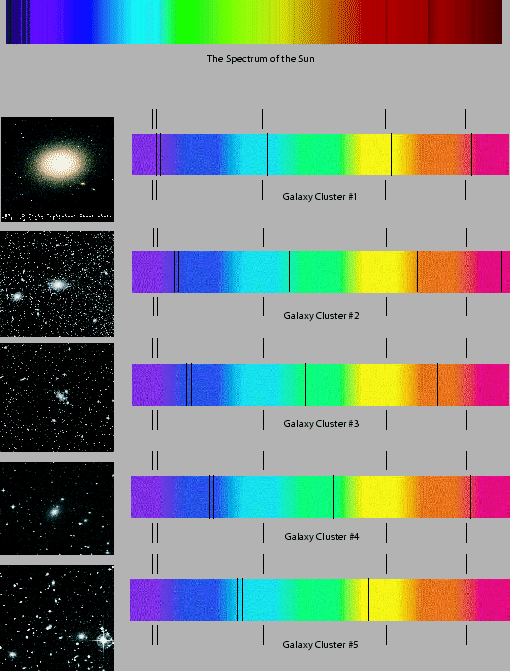
    later, when American astronomer Edwin Hubble** theorized and proved  that the red shift that occur in the spectra
    of all galaxies actually (a phenomenon which had been observed for years but
    not understood) meant that they were all racing away (at a speed proportional
    to their distance, Hubble’s Law) from the Earth—the basis of the Big Bang.  Cosmological significances aside, this was
    also a big deal for the advancement of color, as it really hadn’t played a very
    major part at all in the history of science to this point (excepting the
    brilliant occasional bits like Newton’s
    Opticks). Color just wasn’t a part of
    the great systems and ideas of Plato, Pythagoras, Aristotle, Euclid,
    Kepler, Newton
    and so on—it just didn’t come into play. 

    Blog--gauguin

     Now, as to the importance of Red in art.  It comes for me with Gauguin.  Gauguin and his red grass.  Red grass doesn’t mean anything today, but in
    the early 1880’s, well, red grass was, simply, everything.  It was a revolutionary idea to make the idea
    of what grass”is” subject to the color that the artist thought was demanded by
    it subject, and that all of this was an artistic variable in the control of
    each individual interpretation.  It
    happened right there in the middle of the Impressionist movement, and was the
    beginning of the end for representational art, the final blow to which would
    not occur until 1911 with Mr. Kandinsky.


    This was a lot to blow through in under a thousand words,
    and undoubtedly I’ve slandered several good ideas—but I think overall that this
    is a reasonable idea, this importance of the color RED.  There’s much more to be said about the
    Impressionists and a whole bunch more on the absence of color in the history of
    science, but that’ll have to come later. 

    Of no importance but of some smiling interest is the notion
    that the paintings that were rejected for exhibition in juried salons (in
    France in the 1860’s) and which were used in a new movement and in new “juried”
    shows called Salon des Refuses, were all stamped with an “R” on the back of
    their canvases.

     _______

    *the first great advancement coming in the solving of the
    so-called “ultraviolet catastrophe”, arriving through the Maxwell equations of
    1873 and riding into the quanta of Planck in 1899/1900 (and then to quantum
    mechanics).

    **Hubble, Edwin, “A Relation
    between Distance and Radial Velocity among Extra-Galactic Nebulae
    ”
    (1929) Proceedings of the National Academy of Sciences of the United States
    of

    America

    ,
    Volume 15, Issue 3, pp. 168-173


  • Return to the Poem-amatic: Tristan Tzara’s Dadaist Poetry Engine

    JF Ptak Science Books  LLC  Post 530

    Scan0001

    Each thing we see hides something else we want to see.
    –Rene Magritte

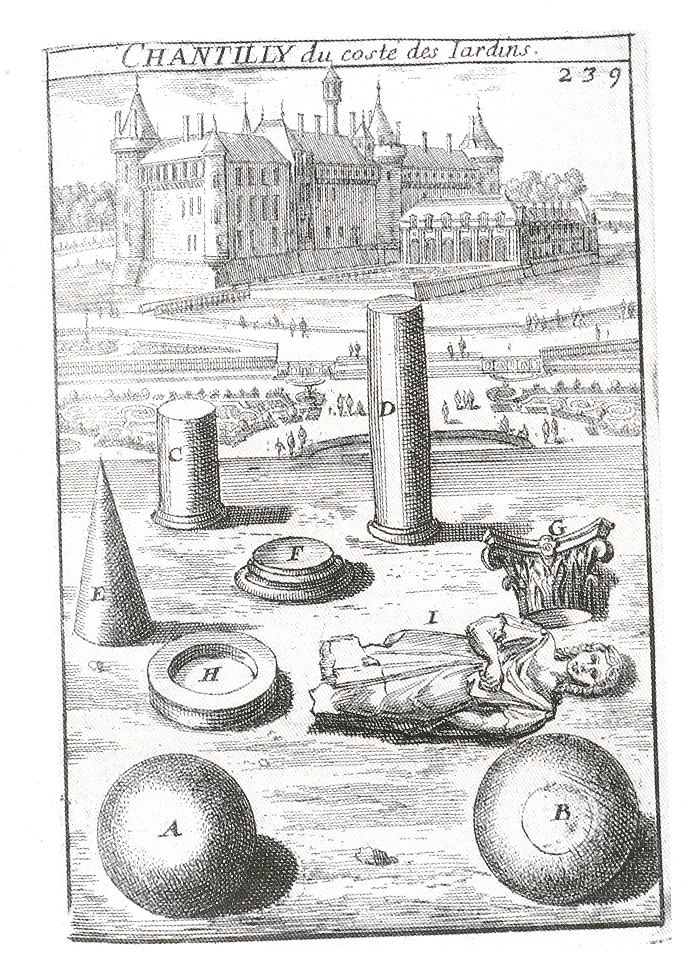
    I am very fond of images like this–images that show us  everything and nothing. The engraving was meant to show some of the ephemeral antique bric-a-brac collected by whatever collector was currently residing at Chantilly.  Remove that explanation, and the meaning of the engraving goes spinning into whatever space you open for it.  It is a wonderful thing to open these dis-associated image combinatorics to free interpretation, each viewer finding their own meaning in a mysteriously composed components. 

    This of course was an unintentional artifact of the artist and engraver.  Images like this–confusing, anti-intuitive, misleading–weren’t constructed to be so (at least not in a major and determined way) until the arrival of the Dadaists in the 20th century.   This was a short-lived, proto-archaic (?) group with a confusing history, a tumultuous existence, and a short and sure ending.  They were disengaging from the avant garde to form a group that went somewhat beyond*
    Dada

    (Even the naming of the group is a story of unusual ripeness and spoilage, no one being able to tell the truth of how it came into being.  Suffice to say that “dada” either was or wasn’t found by an accidental grazing through Larousse by Tristan Tzara in February 1916.  At least Hans Arp tells this as the true story, saying too that he was there, along with his 12 children and a brioche in his left nostril. Anyway the naming doesn’t seem to matter terribly much to a group like this that disposed of and twisted names proper and otherwise.)

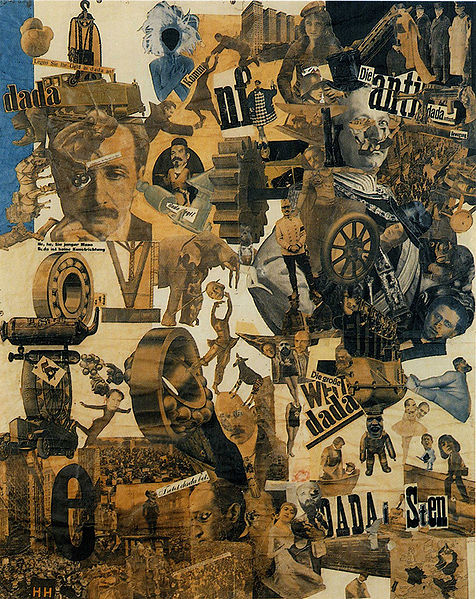
    An example of a Dadaist work is at right, by Hannah Höch, Cut with the Dada Kitchen Knife through the Last Weimar Beer-Belly Cultural Epoch in Germany, 1919)

    The Dadaists, born in the Cafe Voltaire, were interested first in the written arts, and didn’t move to painting and the plastics for a couple of years.  The first among these creative equals was probably Tristan Tzara  (born Samuel or Samy Rosenstock, also known as S. Samyro, 1896–1963) who was first a writer and poet before an artist.  True to the Dadaist great non-existent history, Tzara set forth a method of constructing poetry.  It was basically an engine for a simultaneous poem, as in the “bruitist” Futurists tradition, which built upon the work of Hugo Ball, who in turn was the inventor of the sound poem (Lautgedicht). And so tongue deep in cheek, Tzara set forth these principles:

    To make a Dadaist poem:

    • Take a newspaper.
    • Take a pair of scissors.
    • Choose an article as long as
      you are planning to make your poem.
    • Cut out the article.
    • Then cut out each of the
      words that make up this article and put them in a bag.
    • Shake it gently.
    • Then take out the scraps one
      after the other in the order in which they left the bag.
    • Copy conscientiously.
    • The poem will be like you.
    • And here you are a writer,
      infinitely original and endowed with a sensibility that is charming though
      beyond the understanding of the vulgar.

    Scan0002 (Some few weeks ago I made a post about an automatic poem-making device–the poem-amatic fist micrroscope–a
    fun little bit about making poems of ordinary printed pages by
    recording what you saw of them in the visual field seen through the
    barrel of a semi-closed fist. 
    Then there is the entry “Poetry from Found-Wordist and Book Pathologist
    Mr. Ignatio Norme
    , Found-Wordist and Page Number Collector (Boston, Mass.;
    1923-1988))” in my growing and imaginary museum catalog called Weltin and
    Wantin.
      Mr. Norme constructed poems in
    much this same way, except that he stripped his poems out of the lines of his
    books. His effort is here, called Primo VI, the Analysis of Man//Fantasies
    brillantes
    (by  “the man who found obscure
    phi-related connectivity between random word placement, page number and the poetic
    ideal”).

    Now.
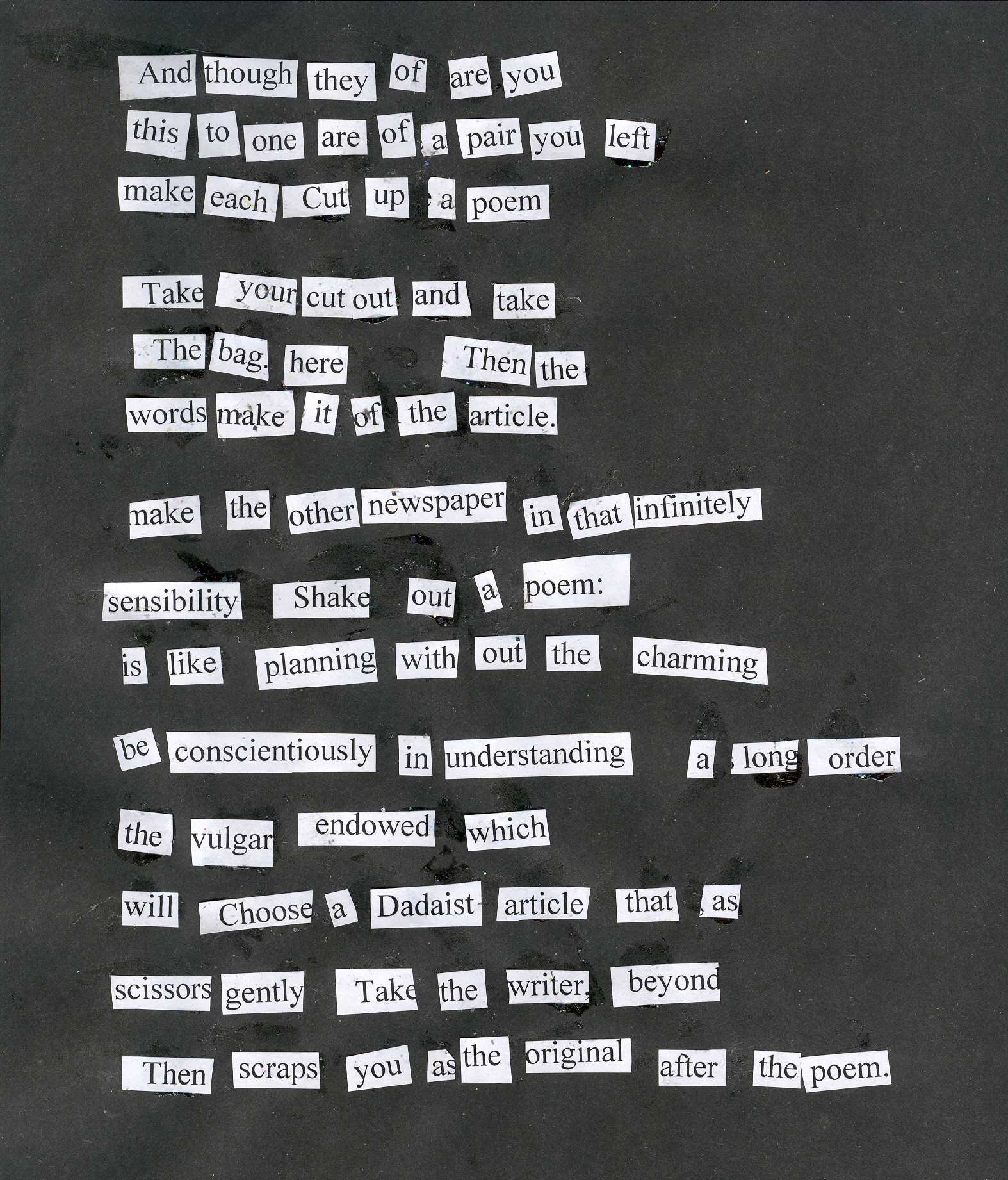
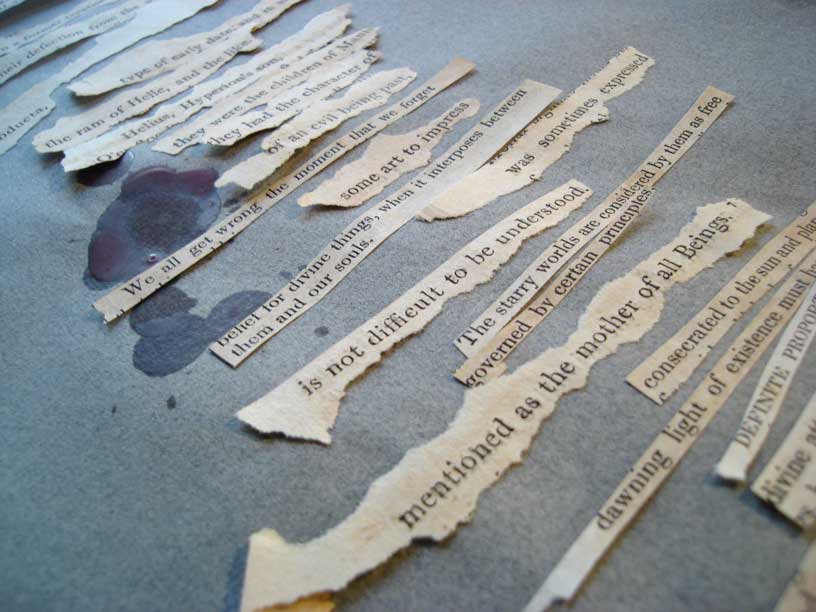
    I tried this out, but not with newspaper–rather I did it with Tzara’s instruction itself, and let me tell you, it doesn’t work.  There’s just too much left to chance, and, frankly, too many prepositions, too much grunting work.

    On the other hand, if you lay out the pieces before you and determine to allow yourself 15 minutes to select a poem from the scattered bits on the table, then the method does stand some sort of chance.
    Here’s what I came up with, and it is almost something or other; at least I think that  is probably not nothing.  In the very least, though, it is a very interesting exercise, trying to get your mind to find a poem in strips of paper.  In that way Mr. Tzara was perfectly correct. 

    (Below is a fragment of Mr. Norme’s work.)

    Blog--norme

    _______

    *  Dada is the groundwork to abstract art and sound poetry, a starting
    point for performance art, a prelude to postmodernism, an influence on
    pop art, a celebration of antiart to be later embraced for
    anarcho-political uses in the 1960s and the movement that lay the
    foundation for Surrealism.
    —Marc Lowenthal, translator’s introduction to Francis Picabia‘s I Am a Beautiful Monster: Poetry, Prose, And Provocation


  • God in Reverse: the First Painted View of Future Action (1912?)

    JF Ptak Science Books LLC  Post 529

    Jeff Donlan from Salida, Colorado, sparked this post with his comment from yesterday*.  I don’t think that Matyushin  really knew where he was going , either, even though he was writing in the years (1896-1916) when this issue of time and space and motion was being hammered on god’s holy anvil.  The thinking that the artist of this time were in some way responsible for shaping the social vessel necessary for the scientific development of these ideas has never been attractive to me.  Frankly this image wound up in the dead idea cemetery (along with the cemeteries of lost ideas, the cemeteries of blind ambitions, of fear, of lust-conquered-love and vice versa; the cemeteries of hollow illusion, near-achievement, and good will; the cemeteries of childhood despairs, of extra vowels, of dropped change, of the thoughts behind bad thoughts, and of ill-gotten gains.  There are no cemeteries evidently for incompetencies or mediocracies, as these things, in addition to being lifeless, cannot be killed.)

    This issue is strongly entertained by Linda Dalrymple Henderson in her Princeton-published doorstopper The Fourth Dimension and Non-Euclidean Geometry in Modern Art, where she prettily and exhaustively declares “nope” to the egg-chicken possibility of the space/time issue being born in art and nurtured-up in the sciences, which is fine with me. 

    That’s not to say that the art produced in the sciences to illustrate fourth- and nth-dimensional space weren’t without (great) artistic qualities.W.L. Stringham  (“Regular Fgures in n-Dimensional Space”, 1880), E. Jouffre  (Traite elementaire de geometrie a quatre dimensions, 1903), H.P. Manning (Geometry of Four Dimensions, 1914) are excellent and early examples of gorgeous illustration illuminating complex issues, and are also published many years before the works of Braque and Picasso and Metzinger and Gleizes and Le Fauconnier and of course Duchamp.  These artists are all producing their important work before 1912, but are also definitely coming after some of the major work in the history of the fourth dimension.  

    But getting back to Matyushin and to the title of this post:  I wondered when the first painted images depicting future action was painted. “God” comes into this because, I think, a case might be made for the depcition of future action via the depiction of the progression to life-after-death states (and marching towards heaven/hell.)  Removing god from the equation takes us,  maybe, to the backwards spelling of god:  “dog”.

    Blog--bella
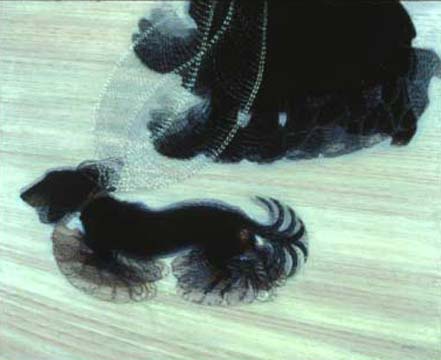
    Giacomo Bella’s  Dynamism of a Dog on a Leash (1912) may well be the god-reverser, the first painting of the future, with simultaneous views of space and time, wrapped up in the gift of speed.  Whether this is accurate or not I really don’t know–Duchamp’s Nude Descending was painted and almost and nearly exhibited in this same year (having been throw out of the art exhibition by friend and foe alike because his work was too risky)–I really like that this “first” involved the picture of a doggie, even though it is vastly inferior to the Duchamp and all.  

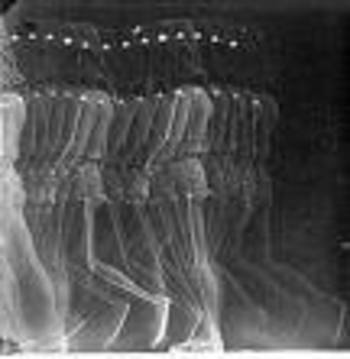
    This is a complex issue that I’m just passing quickly through–I’m not sure that this whole issue wasn’t dealt with first(artistically) in the comics, the space/time bit perhaps getting an early cover in places like Windsor McKay’s Little Nemo in Slumberland (1908) and Lyonel Feininger’s The Kin-der-Kids (1909).  Then there’s the issue of Etinne Marey’s beautiful studies of motion, which look a tremendous lot like the things to come in Duchamp et cie twenty years later, but that’s another story. But I think it highly poetic that this issue boils down to a stumpy dog, Little Nemo, a French polymath with a gun camera, and M. Duchamp (who didn’t take any of it seriously). 

    Blogmissingmarey_one

    __________

    * “Pictures
    like these are porn for the unhappy multitasker. What Matyushin could
    not know in 1915 is that when we rush fast enough, our left brain shuts
    down and the right brain takes over suffusing us with an intense
    feeling of oneness. We don’t really see the totality; we just feel we
    do. I don’t know that this is true, but I feel that it is as I rush
    through this so I can write my library column before I forget…”  This was said in response to the following: “
    Mikhail Matyushin, in 1915: “Only motion cystallizes outward appearance
    into a single whole…a speeding train fuses the separatness of the
    cars into a compact mass…”  He goes on to say that “when at last we
    shall rush rapidly past objectness we shall probably see the totality
    of the whole world”, though I think that he got that part of it
    backwards, or perhaps inside out.”

    ·Posted by :

    ·in:

    —

  • Inside-Out Privacy: Hermits, St. Simeon, and Cellular Phones

    JF Ptak Science Books LLC  Post 528

    0 blog feb 18 hermit600

    “Language is just no damned good.”–Marcel Duchamp


    0 blog feb 18 hermit601 It seems to me that when cellular telephones first appeared, they were to deliver a certain amount of privilege, a promise of speed in communication that would allow for more personal time and privacy.  But that was many years ago, back when paying for cable television meant no commercials.  The promise, or possibility, of privacy as a result of using this Ponzi scheme of constant data streaming is a demolished and smoldering pile, missing the smolder and the pile.  There’s just nothing in that smoking promise-hole:  no smoke, and not even a hole. 

    What it is, I think, is privacy turned inside out:  everything on the inside is now on the outside, a great big visible and vocal outside. 

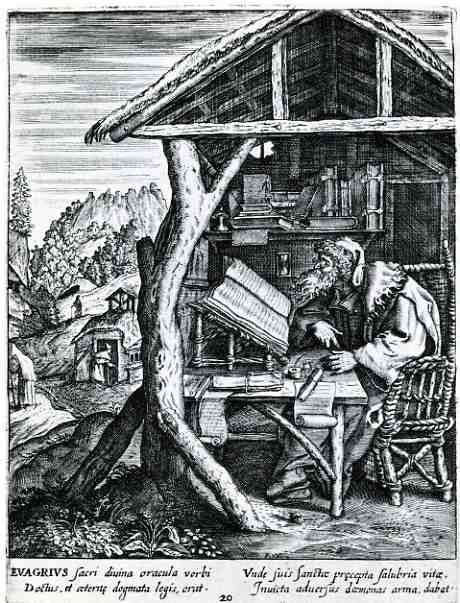
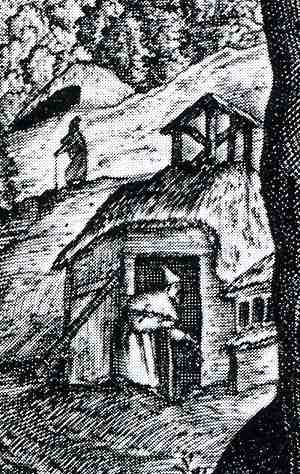
    Privacy, which means to me the promise of some time in which to do a little thinking, is much more in line, say, with the pursuit of a personal space:  not necessarily like that of the beautiful hermit in the image to the left here, but it at least represents the possibility of quiet, which represents a possibility of order and image-making, which in turn represents dreaming or thought or perhaps nothing at all.  It does mean something to the lead monk in this engraving, which belongs to the beautiful Illustrium Anachoretarum Elogia sive religiosi Viri Musaeum (“The Museum of Hermits”) of Giacomo Cavaccio (published in Venice in 1625).  This is a beautiful and remarkable book, with 32 full-page engravings punctuating 150 pages of text  surveying the literature and imagery of, yes, hermits.  Although living very simply, these hermits were all in order, living cleanly, with an impressive two-dozen or more books in their little huts.  St. Anthony, another very quiet thinker, lived in a similar fashion but without books and whose story was unknown until it came (post mortem by thirty years) to St. Augustine, appearing in his Confessions.

    On the other hand, in the history of quiet asceticism (athletae Dei, “athlete of god”),a hermit without the need of a hermitage, or quiet, or aloneness, a hermit who turned the concept of private thought inside out, was St. Simeon Stylites.  I’m sorry to say that he sounded to me like a person in desperate need to be seen being thoughtful and to display his quiet and dedication loudly.  Chained to an ever-heightening pillar, doing sit ups and reciting his conversations with the creator of the universe, Simeon made it into heaven as a saint after treading the earth as one.  Still he seems to have been the opposite of the expected.

    I wonder about this legacy of the invasion of the cell phone; I have little doubt that it is just the barest blink of future invasions of privacy to come, unstoppable and ultimately unwantable. M. Duchamp did say this about words–though he was talking about written and spoken, words–once they left the privacy of the brain, their meanings got all messed up. The interruption of privacy was what corrupted them and their meaning. (“I use it  (language) because I have to” Duchamp said.)  

    I can’t help but think about the speed of deliverables in the Brave New World.  It reminds me of an observation made by Mikhail Matyushin, in 1915: “Only motion cystallizes outward appearance into a single whole…a speeding train fuses the separatness of the cars into a compact mass…”  He goes on to say that “when at last we shall rush rapidly past objectness we shall probably see the totality of the whole world”, though I think that he got that part of it backwards, or perhaps inside out. 


  • Word Balloons (continued): an Early Version in a Printed Book, 1523

    JF Ptak Science Books  Post 527

    0 blog feb 18 balloon599


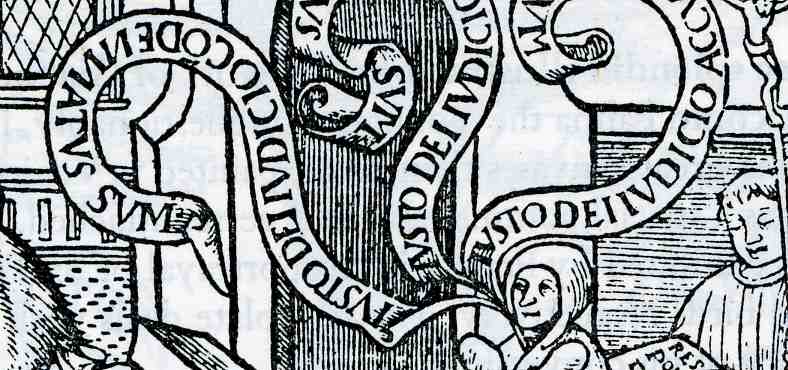
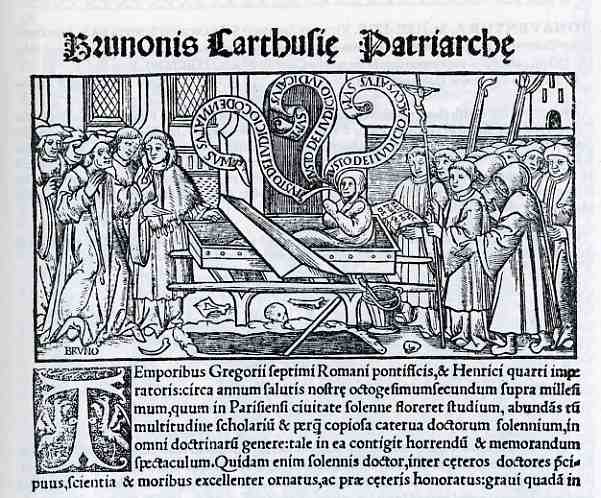
    Earlier in this blog I’ve touched on the history of the thought and/or speech balloon  (The X-Ray of the Imagination 2: Phrenology, Chinese Hell Scrolls, and the Beauty of the Thought Balloon–Internal Dialog, Demons, Humors, and Picturing the Stuff of Thought…) and I thought for sure that I had included some Renaissance examples of this very expressive additive to the medium, though it seems that I didn’t.  Everyone seems to be familiar with the idea, though perhaps it is a minority who know how old the idea is:  and it is old, the idea stretching back at least into Medieval times.  I know of at least one example from the 12th century:  an Evangeilstary from Lower Saxony, executed ca. 1190 (though the influences are Byzantine), where the Gospel texts are introduced with an illuminated page, at least two of which are further illuminated with speech banners.  (This was on display in the monumental exhibit called “1200”, shown at the Metropolitan Museum of Art in NYC in 1970 and pictured in the exhibition catalog.)

    0 blog feb 18 balloon598

    The idea must’ve been groundbreaking, though I wonder—as in the case of simultaneous sound-on-film talkies almost instantly replacing the silent film—if there were detractors who raised the issue of the device being a “cheat”, claiming that the art itself should be enough to convey the very thoughts or speech of it subject, which was now displayed in words right on the canvas. (Perhaps there was an implied threat to art itself?)    Is this the case with all new or different or revolutionary breakthroughs?  Were the minstrels threatened by the new professional theater?  Was the production of manuscripts put in jeopardy by movable type presses?  Was the Parisian water carrier, the purveyor of the coolest and freshest water threatened by municipal water systems? Radio by television; family cohesion by television; private thought by constant communication devices; symphony by recordings; telegraph by telephone; considered correspondence by email, and so on?  (I don’t think there was a “no” response to the above.) It seems as though the response is a time-compressed myoptically-evolutionary response.

    This example, printed in Paris in 1523, is an illustration for the work of Bruno Carthisienni. St. Bruno (who lived ca. 1030 to 1101) born in Cologne and educated in Rheims, was an influential academic with a wide accumulation of knowledge and a wandering spirit he used to establish monasteries.  This woodcut is one of the earliest examples of word balloons in a printed book, while the book itself is a monument to typography and illustration.  The word balloons in this case are really quite lovely, and seem to almost life their speaker from his casket. 


  • A History of Dots 4: Durer, Viennese Kids, Dalton’s Chemistry Table, and Scrofula

    JF Ptak Science Books LLC  Post 525
    0 abay feb 25 dots scrofula627

    In a continuing series on the History of Dots I’d like to add the
    following, disconnected though they are, so I don’t lose them in the
    coming mix.  It is also one of my few chances to actually need to use
    the word “scrofula”–a lonely, ugly word, a word as unpretty as
    “Susquehanna” is pretty, a word that should be as timid, but isn’t, a
    word that really exercises all parts of your mouth when you say it out
    loud.  (Try it–there’s like five or six movements involved in getting
    that past your lips.)

     To be truthful about it, it isn’t so much about scrofula as it is about the “curing ” of the disease with special little pills:  the Popular Pill!  This woodcut appears in a short sales treatise, published in London in 1675 or so, by Humphrey Nendick, (the delightfully titled)  A Compendium of the Operations Vertues and Use of Dr. Nendicks Applauded Pill, against all Chronick Diseases,m curing by the cleansing of the blood, That most successful medicine, which is so deservedly called, the Popular Pill.  For its Spcial vertues, safety and success, against the Dangerous and our Nations Popular Disease, the Scurvy.  I’m not so sure about what

    0 abay feb 25 dots durer628

    Dr. Nendick was up to with the pill, but I do know that is was obtainable from grocers, bakers, cutlers, gunsmiths and barbers all over England at three shillings for forty tiny dots of possible joy.  Its imaginary Galenical powers were supposed to bear against the tedium and insolence of all manners of scurvies and popular complaints–much like its contemporary dot/pill rivals like Pilulae Anti-Scurbuticae (sold at the Carv’d Posts in Stonecutter Street between Shoe Lane and Fleet Ditch (!)). 

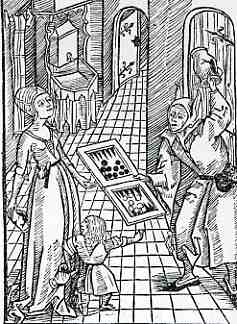
    Albrecht Durer doesn’t seem to have many dots at all in his works, though I did stumble upon this image from Sebastan Brant’s Navis Stultifera (Basle, 1497)–a fool interrupting a mother and daughter who were “discussing” their game of backgammon.

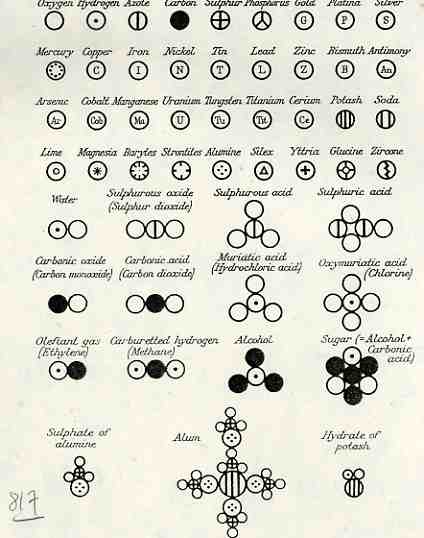
    On the other hand the history of the construction of the periodic table is necessarily filled with dots, as we see with the monarchical creation of John Dalton (1766-1844), in his New System of Chemical Philosophy (part II), and which was printed in 1810–these symbols were sued to visually represent the atomic structure of compounds, and were of vast importance and predictive powers, marking the true modernizing of chemistry.  It was in Part I of this work that Dalton first applied atomic theory to chemistry.

    0 abay feb 25 dots chem625

    0 abay feb 25 dots kids626

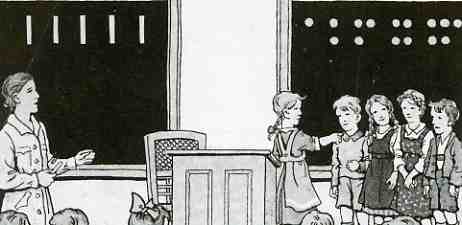
    This last element for this installment on dots simplifies things enormously, sort of, even though these dots represent the very building blocks of almost everything else.  They represent counting.  And they are beautifully present in this image from Franz Brauner’s Rechenbuch fuer osterreichische Volksschulen (published in 1953).  Funny that this “Rechenbuch” turns up again here in 1953–its been the major part of titles of books describing the laws of arithmetic for 450 years. 

    ·Posted by :

    ·in: