A Daily History of Holes, Dots, Lines, Science, History, Math, Physics, Art, the Unintentional Absurd, Architecture, Maps, Data Visualization, Blank and Missing Things, and so on. |1.6 million words, 7500 images, 4.9 million hits| Press & appearances in The Times, Le Figaro, Mensa, The Economist, The Guardian, Discovery News, Slate, Le Monde, Sci American Blogs, Le Pont, and many other places… 5000+ total posts since 2008.

Author: JF Ptak

  • Music, Math, and the Mathematical Piano: Pascal, 1645

    JF Ptak Science Books LLC   Post 524
    0 abay feb 23 pascal computer621

    Music is the pleasure of the human soul experiences from counting without
    being aware that it is counting. – Gottfried Leibniz

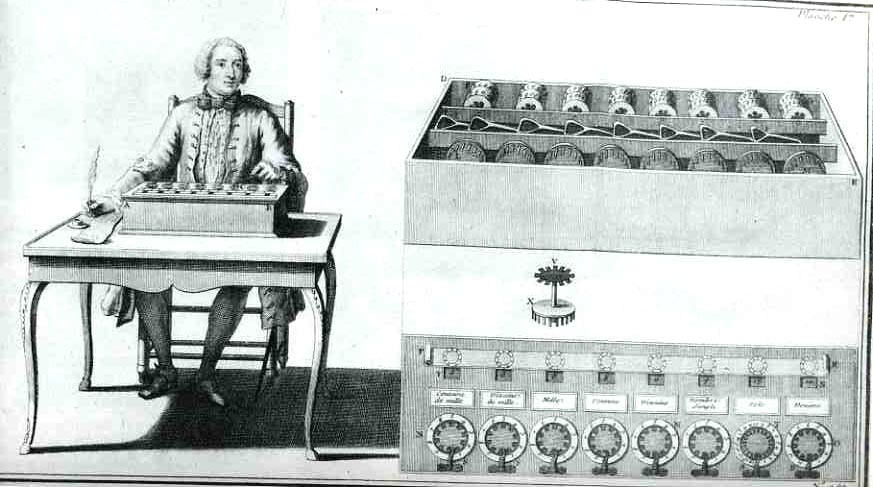
    Blaise Pascal (1623-1662), physicist and
    mathematician–rather, mathematician and physicist–and philosopher as well,
    invented the second mechanical calculator in 1645 (after that of Wilhelm
    Schickard (1592-1635) in 1623).  He had a
    phenomenal output in many different, difficult, and complex areas, all
    completed before he died at the improbable age of 39. (His predecessor in invention,
    Schickard, was dead at 43.)   We see him
    here, seated in front of his beautiful invention (called the Arithemtique, and
    the Pacalina), looking to be quite a bit older than his age at invention, which
    was 23.  He looked pretty content with
    himself, even though, I think, he didn’t care all that much for the machine–at
    least he didn’t care enough about it to perfect it, or to try to make real
    money on the thing.  But the picture of
    him here always looked to me as though he was playing an enharmomic harpsichord,
    or using some sort of musical instrument, or doing something more socially beautiful
    than the optical doing of arithmetic, though both were exhibitions of tuning
    the polyphonic sub-mysteries harmonies of nature.  His image seems to wed the millennial Pythagorian
    creation of the music of the spheres, and Leibniz’ scorn of Newton’s occult-y causes of nature’s
    phenomena, and of Augustine’s “distraction” of perfect creation—a polychord
    romance of science and music.
    Or, maybe, it was just a guy sitting behind a calculator.


  • Crowds #5: Clarity and Confusion in Displays of Human Masses.

    JF Ptak Science Books LLC  Post 523

    0 abay feb 23 crowd617

    I do enjoy looking at pictures of crowds–big crowds.  Images of the crowd are much easier to find in the 19th century and onwards (and particularly in photographs), though big displays of human seas (such as they were) began to show up in the late 15th century, and then, more as a matter of course, in the early 16th century.  What is enjoyable for me are the numerous vignettes that make up the whole, discrete visions within the larger visual field, a sweep of smallnesses that can seemingly stand on their own had they been bigger. 

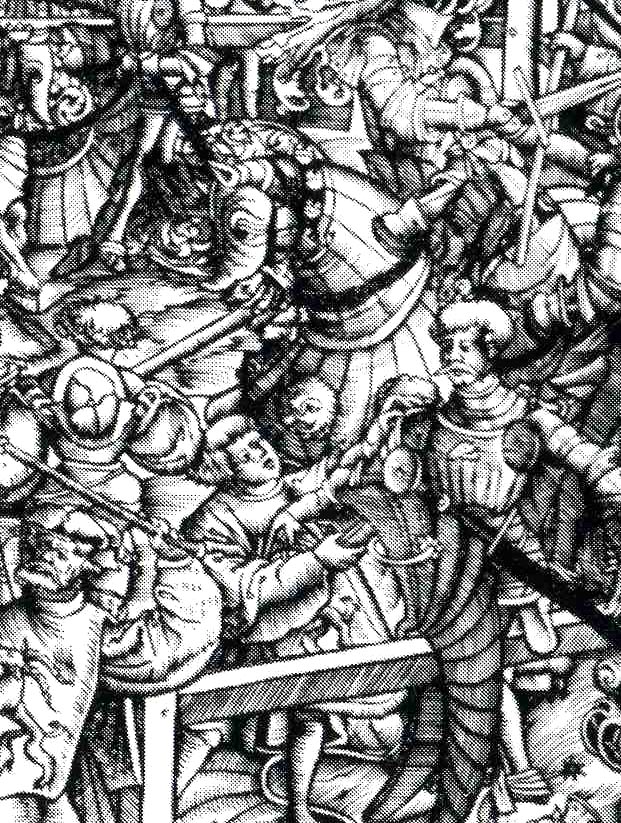
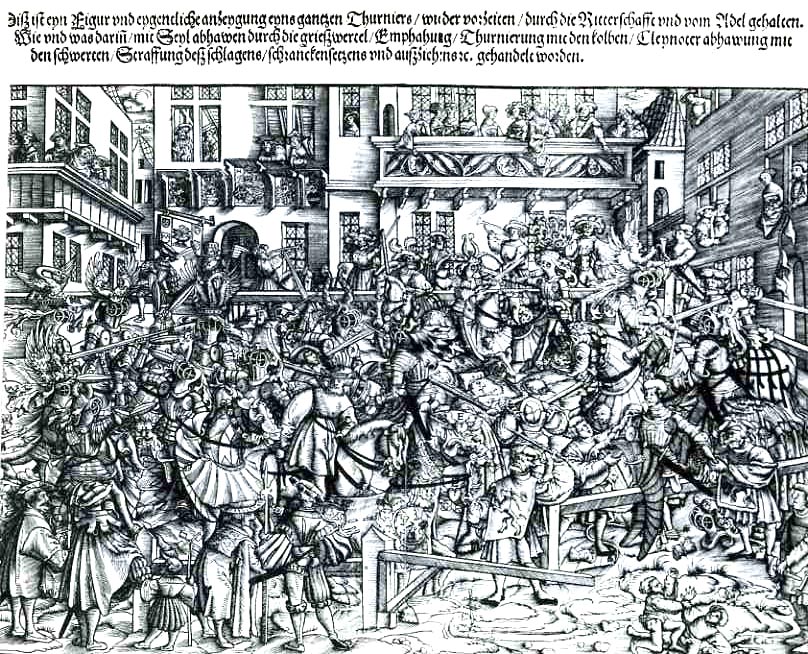
    Depicting crowds can be a chore successful and not–for example, the image to the left, an amalgamated porridge of controlled mock combat, a sweeping chaos with appreciative bystanders, is so busy, and has so many constituent parts, that there 

    0 abay feb 23 crowd618

    really isn’t a “whole”.  I can hardly see the thing, for crying out
    loud, for all of the disconnected action.  The artist who produced this
    remarkably good/bad image for Georg Ruexner’s fantastic Anfamg, Ursprung und Herkomen de Thirnirs in Teutscher Nation
    (published in 1530) clearly had interest only in the details of the
    action; and thus the overall image is a beautiful confusion of starts
    and fits, defiant in its general appeal to comprehension.  The impression to me is a miserably layered oneness of discordant activity, a sloppy relief of enormous detail, the whole worth far less than the sum of its parts. 
    The only place that your eye gets a chance to rest and focus is on the two dozen or so spectators who are in the windows and balconies overlooking the small square where the tournament was taking place–their appearance, and also that of the small assembly of musicians at center, offer a calming influence to the rest of the picture.
    One bit that leaps out at me, though, are the two small boys who seem to be having a fistfight, right there at the bottom-right of the image.  I can tell you that pictures of boys fighting finding their way into piece of renaissance art is a very rare thing.  Perhaps the artist was trying to send us a message, after all?

    (I know this is a pretty big complaint, particularly since the book is a monumental work on The Tournament, and it was done within the first 65 years or so of the invention of movable type printing, but I just found the thing so opitcally  corrosive that I wanted to surface it. )

    0 abay feb 23 crowd620

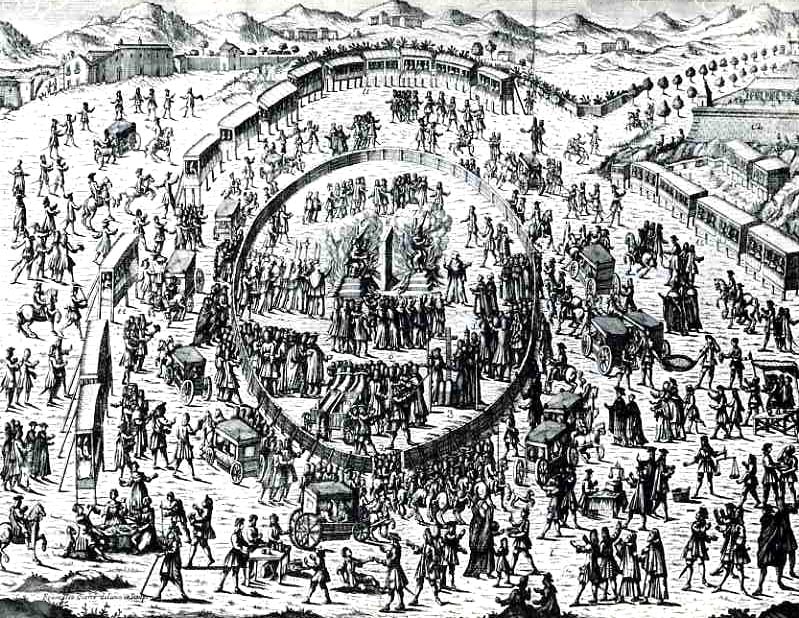
    The second example, coming to us from Antonio Mongitore (L’Atto Pubblico di Fede Solennemente Celebrato nella citta di Palermo, 1724) depicts an earlier scene, and one of complexity and order.  Unfortunately, the cohesion centers around the execution of two tried/convicted heretics–god knows what they did to deserve this cleansing sentence. It didn’t take all that much during the Inquisition to find yourself in deep black waters, as Mother Church seems to have been extraordinarily thin-skinned; the slightest abrasion to their slight slate of moral indignities could result in being hurt in foul way, and then burned alive at the stake. 

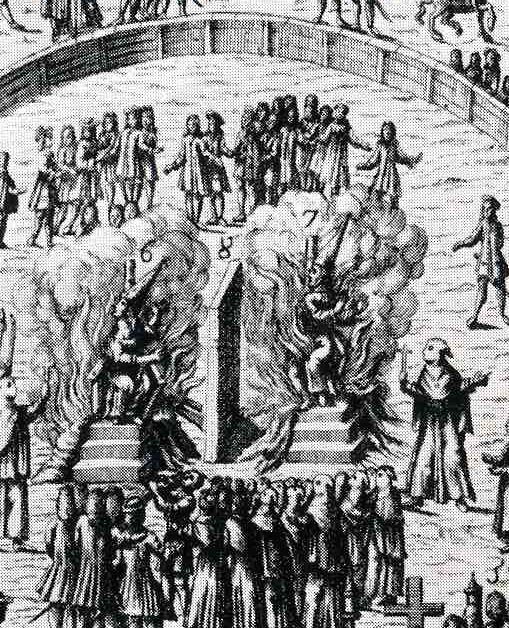
    But in looking closer at this image, I’m not sure sure that these two unfortunates were actually being burnt–it may be that they were being roasted alive.

    0 abay feb 23 crowd619

    They are seated, and the pyre seems to be only behind them–perhaps
    the flames hadn’t reached them yet; but people were in fact roasted,
    cooked alive, which may be even more girzzly than being consumed
    entirely by flames.  The two are being approached, or watched, or
    offered too-late benedictions by a line of clerics shielded by a
    crucifix–perhaps they were just reminding the condemned exactly who it
    was that they had pissed off. 

    There is no doubt that this was
    a popular diversion for those not in fear of being burnt at the stake,
    as there are probably hundreds of people in attendance, including those
    in a semi-circle of pre-modern “skybox” accommodations–undoubtedly the
    holier folks.  Piety of witnessing best in privacy and all that. 


  • A Beautiful Book of Terrible Things: Artillery, 1623

    JF Ptak Science Books LLC  Post 522


    0 blog feb 16 rockets596
    0 blog feb 16 rocket detail

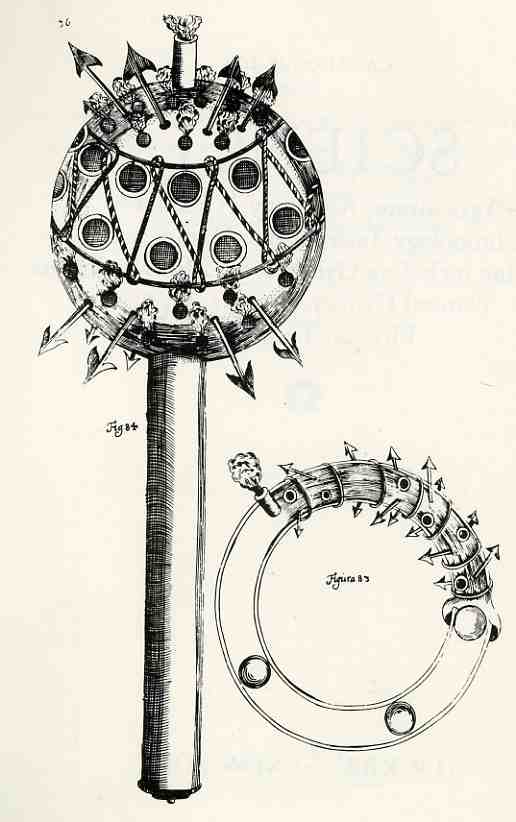
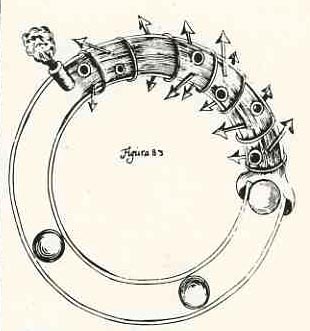
    Praxis Artolleriae Pyrotechnicae, printed in Osnabruck by Tilman
    Buchholtz for Johann Georg Schwaender, is one of those beautiful books
    of horrible things; beautifully designed and illustrated, with
    magnificent images of the horrifying necessaries that bind and tear
    nations and people.  Flying and land-based weapons o fall sorts filled
    these pages:  rocket, grenades, land mines, plus pyrotechnics and
    fireworks.  As jolly as this implement might seem, it is not a
    firework, at least not one for entertainment:  it was meant to
    dismember or kill.  Those “arrows” on the ring are not showing the
    direction of the flight of the module–they are spears.  This was a
    lethal weapon of the highest order–pretty, not-so-simple, and deadly.

    Some other beautiful terribles, published to about the year 1600, include: 

    Roberto VALTURIO 1472 Vérone De re militari

    Niccolo Fontana TARTAGLIA  1537  La Nova Scientia

    Vanoccio BIRINGUCCIO  1540 : De La Pirotechnia

    Conrad HAAS  1556 : Kunstbuch

    Girolamo CATANEO 1564 : Opera
    nuova di fortificare, offendere et difendere, et far gli alloggiamenti campali
    .

    Thomas DIGGES  1579 Arithmetical
    military treatise
    .

    Gabriello BUSCA 1584 Istruzione dei Bombardieri.   1585  Della espugnatione et
    difesa delle fortezze
    .  1606 :Della
    Architeltura militare
    .  

    Luys COLLADO 1586
    Practica manuale di artegliera.

    Jean BEAVIE 1591 Liège La
    pyrotechnie militaire

    Daniel DAVELOURT  1597 Briefve
    Instructions Sur Le Fait De L’artillerie de France
    .
    – 1606  L’Artillier.
    – 1608 : L’Arsenal et le magasin d’artillerie.
    – 1617  L’Art et la conduite des eaux sur le fait de l’Artillerie de 
    et ses dépendances

    Joseph BOILLOT.  1598 Modelles,
    artifices de feu et divers instrumens de guerre
     

    Gabriele BUSCA da Milano 1605 Della
    espugnatione et difesa delle fortezze
    .
    1598 Istruttione de’ bombardieri.
     

    Eugenio GENTILINI  1598 Instruttione
    di artglieri
    .

    David RIVAULT de FLURENCE 1605
    Les elemens de l’artillerie concernans tant la theorie que la pratique du
    canon
    .
    1608 L’invention description & demonstration d’une nouvelle artillerie
    qui ne se charge que d’air ou d’eau pure, & à neantmoins une incroiable
    force. Plus d’une nouvelle facon de pouldre a canon tres-violente qui se faict
    d’or, par un excellent & rare artifice non communiqué jusques à present.
    L’histoire du progrez & des premiers usages des armes à feu tant recentes
    qu’anciennes, est deduitte en l’avant-propos
    .  

    Leonhard ZUBLER 1608  Nova
    geometrica pyrobolia – Neuwe geometrische Büchsenmeisterery
    .


  • From the Man who Brought you Betty Boop and Popeye: Max Fleischer and Albert Einstein

    JF Ptak Science Books  LLC  Post 521

    Max Felischer (1883-1972) a
    nice Galician boy from Brownsville and employee of the Brooklyn Daily Eagle, the patentee of the rotoscope and
    arts editor of Popular Science, was an inventor, artist and writer who brought
    into being such iconic American creations as Popeye and Betty Boop.  (Fleischer’s cartooning efforts could hardly be
    confused with his later nemesis, Walt Disney. 
    Fleischer’s cartoons were almost always edgier, darker, surreal, and
    slightly hidden to young eyes.  Betty
    Boop, for example, was quite a dish until censors toned her down, way down,
    into her faded obscurity; Popeye on the other hand survived magnificently but
    was always saying something not quite intelligible that sounded a little blue.)
    He also made the first full-length documentary film in 1923 explaining to the
    great mass Einstein’s theory of relativity, the general theory coming into
    being in 1916 and the special theory in 1905.  
    The public reception of Einstein’s theory, in 1923, was mixed:  it was hallowed, and Einstein was
    ultra-famous, but the theory by and large was not understood.  That really didn’t matter, because it was
    important and it was proven and it worked; the taxonomy of the thing didn’t
    come into play in the daily grind.  
    (After bleeding fallow for 16 years, and that would be the length of
    time from his four epochal papers of 1905 of which the special theory was but
    one, Einstein was finally “given” the Nobel prize for physics in 1921—this was
    actually  awarded for his work on the
    photo-electric effect, which is an obvious manifestation of the quantum theory
    of light, brought into being by Max Planck in 1899/1900. The politics of the
    non-giving non-award in the meantime is simply not a pretty story.)

    The reception of the theory was still problematic in 1923, and
    Max Fleischer decided to have a stab at the story.  The result is the following 18-minute
    presentation—it isn’t as inspired as it is of historical peeping interest,
    basically a cartoon for adults that is now 86 years old, and its interesting
    enough just to know that it was done.

    ·Posted by :

    ·in:


  • The Staggering Beauty of Barber Shops: Naive Surreal Department #22

    JF Ptak Science Books LLC  Post 519

    0 blog feb 18 barber603
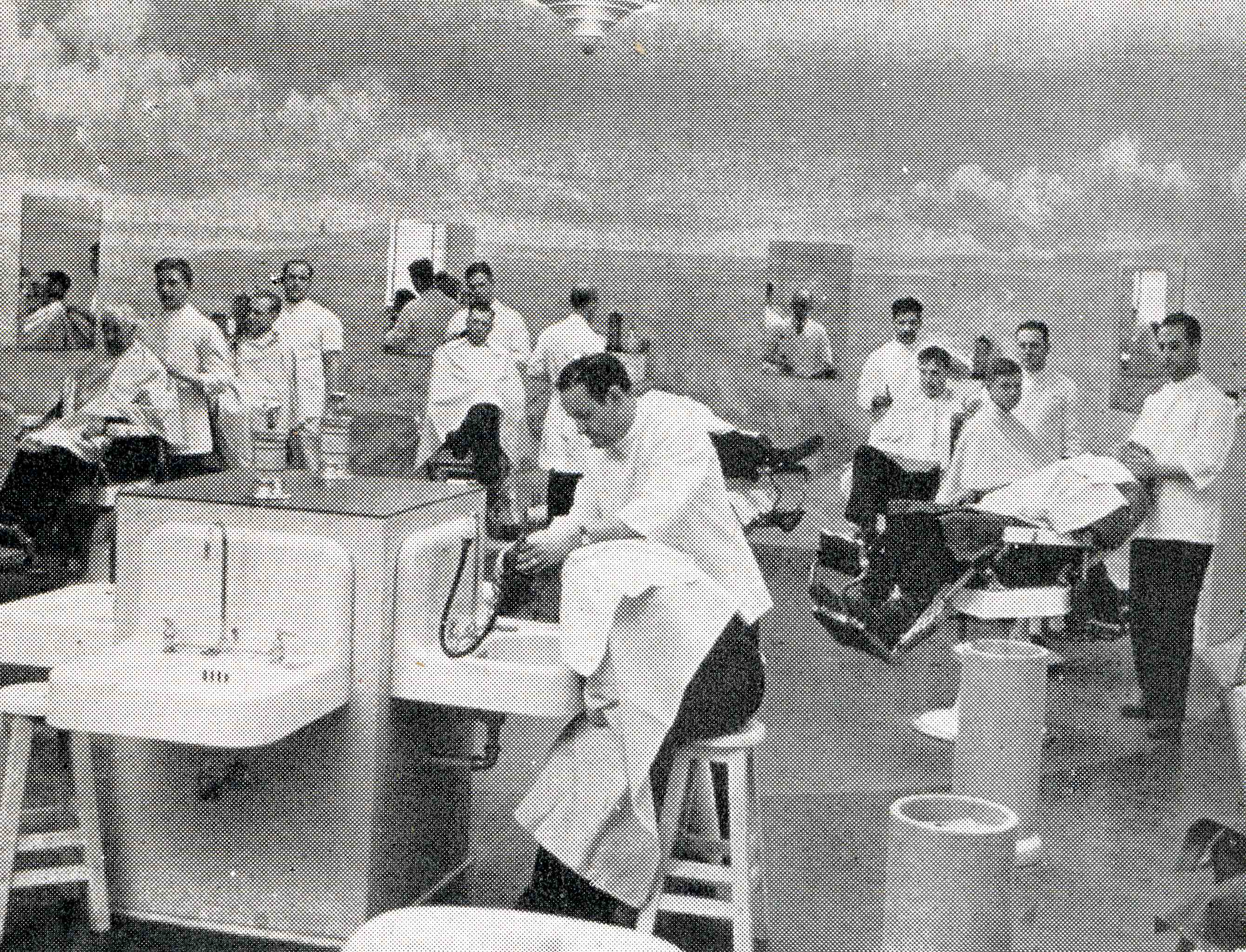
    If I didn’t already go to see Korean War Vet Mr. Jack for my (one) hair cut (and I really don’t mean “haircut”), I think that I could tear myself away from that wonderful experience to go back into time’s recent ankle-deep depths and go to this barbershop….or rather barber emporium.  The location or credit wasn’t given in the occupational pamphlet (The Canadian Census Classification Personal Service:  Barber) in which it appeared, which is altogether too bad.  I cannot recall (can you?) ever seeing such a Busby Berkeley arrangement of barber chairs, centered around a washing station, with clouds (!!) painted on the ceiling.  I would half expect to see Mr. Zero Mostel (oh well, not every did well at HUAC) lead them all in a dance routine where everyone finishes up very leggy and in a pool.  It may well be the case in this unnamed palace that we are seeing only half of the shop–evidence in my copy shows that there is the end of a chair in the foreground, meaning that there could be 15 chairs in there, making it one heck of a busy place, clouds on the ceiling or not.  (The clouds make sense, remembering that most men in 1946 would be going in to see the barber for a shave as he would a cut or trim–and why not look at something attractive when you’re on your back and someone is scraping your face with a very sharp tool?  Dentists should take heed…) 

    And while we’re at it, when exactly did womens beauty salons start to appear in earnest?  This pamphet states “But in 1913, when women took to “bobbed” hair, the barbers found a vast new market for their services.  In the last twenty-five years however a large part of this market has been lost to the hairdressers and beauty culture speciaists, most of whom are women.”  That would mean that–at least in Canada–men were doing this new “bobbed” styling  for their “vast” new clienetelle from 1913 to 1921. It would’ve been a very wide and languid hayride for barbers for those years, cutting the hair of both men and women.  I can imagine the shock of the first male barber seeing the first woman-operated beauty salon swing open its no-males doors–probably there on his street–and hear that glug glug glug sound of business being drained.  Bobbed hair giveth, and bobbed hair taketh away.  

    And now, speaking completely through my hat, I wonder about where women got their hair cut in the 19th century.  My guess:  they didn’t go “out” to have it cut; when they did cut it, they did so at home.  I cannot recall seeing any pre-WWI advertisements for hair cutting for women–as a matter of fact the overwhelming memory I have of women and hair going back into the mid 19th century is for hair care products showing women with enormously long hair adding balms and salves and lustreizers and so forth to it.  I can’t force a memory of an ad for anything having to do with cutting womens’ hair–not even an ad for shears.  Of course a very low percentage of women were in the workforce before WWI, and the women who were wealthier and could afford evening clothing could certainly afford to have someone come over and take care of their hair. Slipping back into the 18th century and slightly before, there was the issue of wigs and extenders–or whatever it was that society women would add to their hair to make it impossibly tall and full.  But that was a very restrictive percentage of women enjoying that privelege, and I’m not sure that it counts for my purposes here.

    My guess is that the money just wasn’t there.  Or it wasn’t there until women sorta started to work, and there was a shortish hairstyle that was not too complicated or time consuming to cut.   Again, I’m just guessing all of this out, but it does seem to make sense.  


  • Confusing Iconography from Out of Place Things in the Sky: Television, the Atom and post War America, 1946

    JF Ptak Science Books LLC  Post 517

    0 abay feb 16 allied radio594

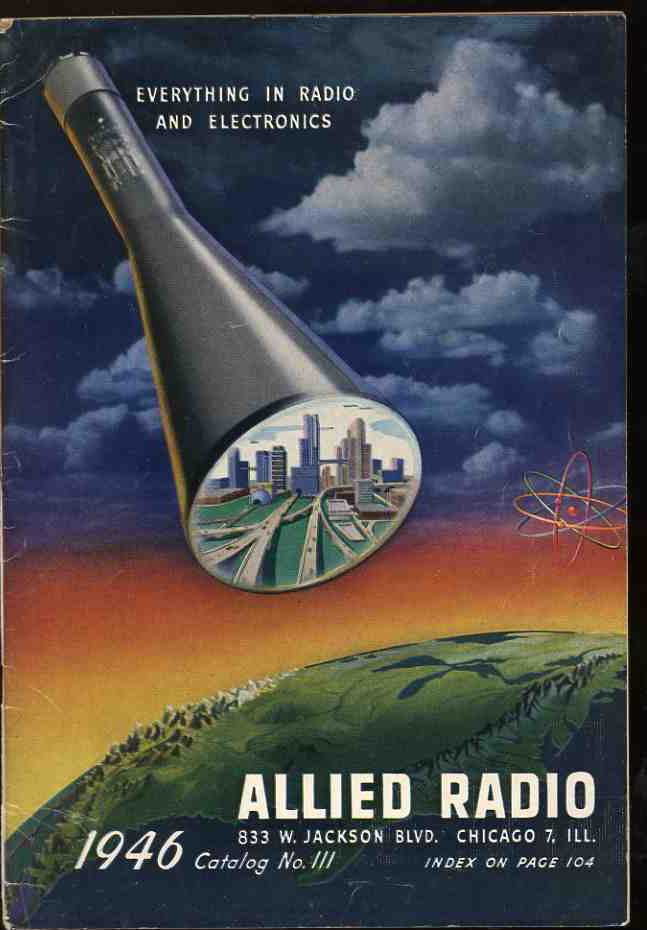
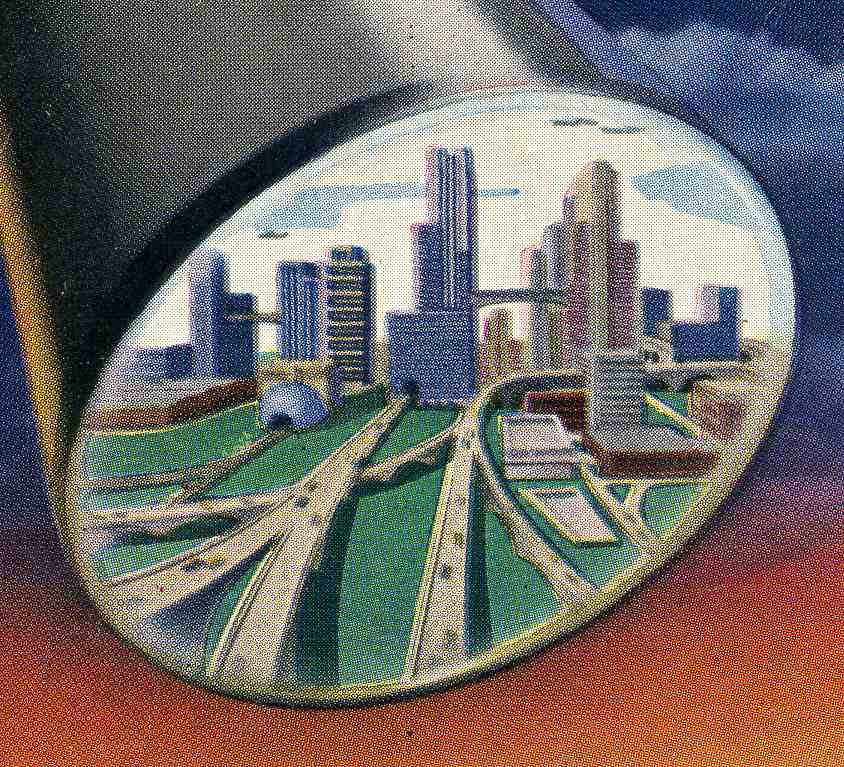
    The war was over for a year, the soldiers were pretty much home, the atomic bomb had been used (three times) to morph the coming future–a future that a quick-artist tried to show in this catalog cover for Allied Radio in 1946.  Probably the artist was just grinding out some more piece work when he did this cover, probably–though he did come up with something pretty interesting, whether he knew it or not.  He did get a good strong sniff of the Something that was coming, and that was the reflection, or capture, or incubation, of the city in the iconoscope tube as it hovered over a verdant America.  The tube was for the next generation of televisions in the post-War forties; by the 1950’s, the television had actually captured most of the United States.  The tube also looked a lot like the Mercury space capsule, but that I think doesn’t mean anything. 

    The growth of the television world in the U.S. was extraordinary:  from 6,000 sets in 1946 came the following growth:

    1947: 142,000
    1948: 977,000
     1949: 3.6 mil
    1950: 9.7 mil
    1951: 15.6 mil
    1952: 21.7 mil
    1953: 25.2 mil

    and by 1962, television set ownership reached 90% of the American population, or about 160 million sets. 
    So, the artist did capture something, though it wasn’t the slightly science fiction-y image of the city in the tube; it was the city in the tube, that t he tube wasn’t actually reflecting anything, but absorbing it. 

    In the 1950s there were at least 102 TV manufacturers in the U.S., which in light of what is going on in today’s world, is epic.  For example, I’ve included those companies beginning with ABC and S,T,U,W,Z to give you an idea of the scope of these companies:

    0 abay feb 16 allied detail595
    Admiral,  Aircastle,  Air King, Airline,AMC,American Television, Andrea
    , Ansley, Arvin, ATR, Automatic Radio Manufacturing, Base Television
    Corp, Bell Television, Bendix Brunswick, Capehart-Farnsworth,
    CBS-Columbia (Air King), Certified Radio Labs, Conrac, Cornell, Crosley

    AND

    Scott, Sentinel.Setchell Carlson, Shaw Television. Shevers, Harold,
    Gotham Television Corp., Silvertone (Sears), Singer, Snaider,Sonora,
    Sparton, Starrett, Stewart-Warner,Stromberg-Carlson, Sylvania,
    Tech-Master, Tele-King, Tele-Tone,Telequip, Television, Inc., Televista
    Corp. of America (TECO), Templetone Mfg. Co., Trad, Transvision,
    Trans-Vue, Truetone – Western Auto, TraV-ler, UST (United States
    Television), Vidcraft Television Corp., Video Corp. of America –
    Cornell Television Inc., Video Products Corp. – Sheraton Television,
    Warwick, Wells-Gardner, Western Auto – Truetone, Westinghouse,  and
    Zenith.

    It is just phenomenal.  This list is lifted from a wonderful site that provide PICTURES of all of these sets, at tvhistory.tv.


  • Stepping UP to Heaven: the Beautiful Dead of Los Angeles

    JF Ptak Science Books LLC Post 516

    0 abay feb 13 forest lawn DET583

    0 abay feb 13 forest lawn582

    DEAD, adj.

    Done with the work of breathing; done
    With all the world; the mad race run
    Though to the end; the golden goal
    Attained and found to be a hole!
          —Squatol Johnes (Amrbose Bierce in his Devil’s Dictionary.)

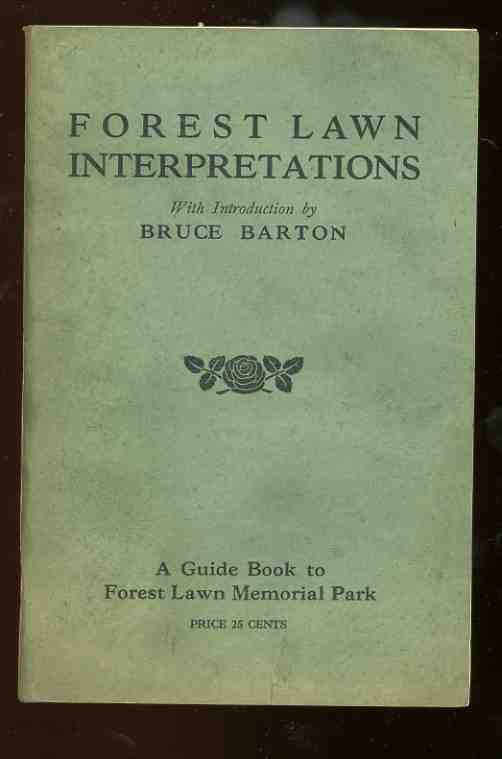
    A first step up toward Heaven? What was Mr. Barton thinking, outside, perhaps, of filling up pages with words so that he could collect 10-cents apiece for them?  His pen was so filled with sugar (I’m sure that I got a case of The Diabetes just from reading the words) and his exaltations of being in the cemetery were so gloriously and morbidly obese that one could only but fling oneself under the next trolley to Burbank  to get to the luscious dirtnap promised for the departed at Forest Lawn. I mean, dirt never tasted sooo good.  This pamphlet, published in 1935, was basically a sales brochure for tourists–the sales number made for prospective departeds would have to had been something far more enticing–at least it would have had to cost a lot more to print.  But what I think the Forest Lawn people were doing was trying to control a little bit of public attention and sympathy to generate ever more interest in the

    Lamp
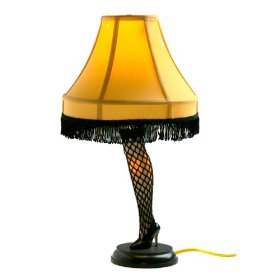
    sales of cemetery privileges and internment bric-a-brac for the noticables who could afford it.  It was still very expensive to sleep with the worms at Forest Lawn, even in the Depression–it seems as though the price of admission at the lowest end was in the order of a few thousand dollars, which was a lot in those days. But if a lot is what is cost to be dead in an expensive place, well, then so be it.  The place was decorated with casts of Renaissance statues and other High Art exuda that it was, well, perfectly awful.  (Or  in the words of Darren McGavin, who plays/was the wonderful father from A Christmas Story, when gazing for the first time on a spectacularly ugly table lamp made of a resin model of a woman’s (provocative) leg, gasps (just as you’re thinking he’s about to retch into his own hands): “Its…indescribably beautiful!“.).  Forest Lawn is just so.  I guess that it must be, because there’s a quarter of a million people buried in there, and a million people visit them a year.  What with sections called Eventide, Babyland (for infants, shaped like a heart),
    Graceland, Inspiration Slope, Slumberland (for children and
    adolescents), Sweet Memories, Vesperland, Borderland (on the edge of
    the cemetery), and Dawn of Tomorrow, how could this place not be indescribably beautiful?  Listen:  it is beautiful enough for people to get married there.  Ronald Reagan did.  Case closed. 

    ·Posted by :

    ·in:


  • A History of Smallness, Part 3: Dew and Space (Charles William Wells, 1814)

    JF Ptak Science Books LLC  Post 515

    0 blog feb 13 dew581

    Little things comfort us because little things distress us. Blaise Pascal

    Science is simply common sense at its best. ~Thomas Huxley

    Physics is imagination in a straight jacket. ~John Moffat

    Science does not know its debt to imagination. ~Ralph Waldo Emerson

    Moderation, which consists in an indifference about little things, and in a prudent and well-proportioned zeal about things of importance, can proceed from nothing but true knowledge, which has its foundation in self-acquaintance. Plato

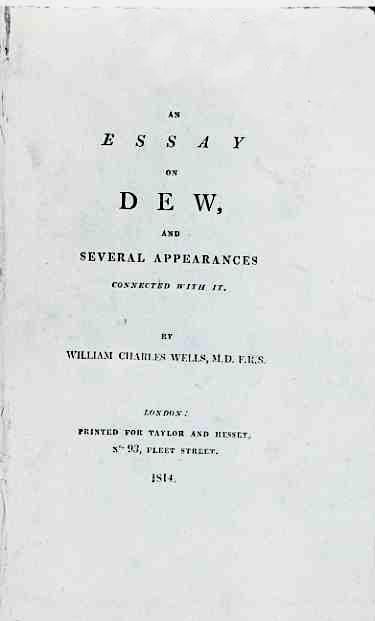
    William Charles Wells (1757-1817), a Charleston-born Londoner who was the physician to St. Thomas’s Hospital from 1800-1817, did one of those great, little experiments (sort of but not really like Charles Darwin crawling around on his imaginarily-sick tummy at Downs watching worms) from which big things were born. The experimentation, lovely and penetrating and elegant, took place over several years from 1812 to 1814, were published in this semi-slender, 146 page tract, which the great Thomas Huxley called “a model of wise inquiry and lucid exposition”. (Actually, 146pp on dew might seem like a lot until you consider what dew is all about.) What Wells so ably exposed about dew was its great terrestrial demeanor–that the movement of dew, its accumulation and dissipation, was due to nothing less than radiation from space, regulated (or interrupted) by the action of the Sun and clouds, ‘introducing a clear view of what is now called the radiation balance of the atmosphere”. (W. Middleton, A History of the Theories of Rain, pp 188-191).  So this is a bit of smallness, something small and seemingly insignificant, leading from its own bit of nothingness into a theory of radiation from space and a theory of the atmosphere, a result almost completely unanticipated.  It is too in its own way somewhat like Robert Hooke re-introducing the often seen and little liked flea–showing people what the flea actually was, under magnification for the first time, showing what sort of world was going on in front of us that was simply just too small to see. 


  • Van Helmont’s Lovely Title Page and his Sorry Slip into Curative Magnetism

    JF Ptak Science Books LLC  Post 514

    0 ebay feb 10 helmont553

    Joan Baptiste van Helmont’s
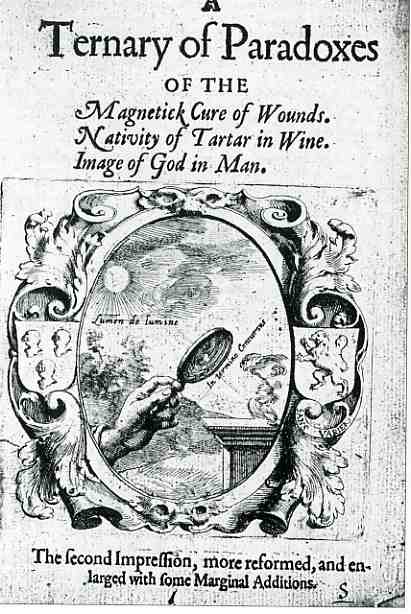
    A ternary of paradoxes : the magnetick cure of wounds, nativity of tartar in wine, image of God in man.
    (printed in London  by James Flesher for William Lee, 1650), offers its own unintended paradoxes (and joined the field of relatively few books with the word “paradox” in their title).  Purportedly a work of science, van Helmont offers the reader his views on the curative powers of the loadstone.  Of particular interest is Helmont’s (1579-1644) discussion of the weapon salve, a cure for injuries caused by knives and swords. The unique feature of this ointment was that it was not applied to the wound but to the weapon which caused the wound, though in the midst of other very problematic scientific observations, this wasn’t so bad.  For example, Helmont presented a recipe for making scorpions, which involved bricks, sunlight and basil, from which a scorpion would come. 

    And what exactly is Helmont’s place in the history of science?  Difficult to say:  he did make several important physical discoveries, and did present what some have called the modern approach to experimentation (firm insistence on relateable objects in empirical observation and so on); however, he was a reaching alchemist misty mystic who rejected syllogistic thought, mathematics*, human reasoning.  These are hard bits to let go.

    All this said, what with scorpions and magnetic treatment of wounds, he comes close to the generation of infection in wounds:  “Upon the solution of Unity in any part the ambient air…repleted with various

    0 ebay feb 10 helmont555

    evaporations or aporrhoeas of mixt bodies, especially such as are then
    suffering the act of putrefaction, violently invadeth the part and
    thereupon impresseth an exotic miasm or noxious diathesis, which
    disposeth the blood successively arriving at the wound, to
    putrefaction, by the intervention of fermentation. ” With his magnetic
    sympathy, Van Helmont expressed clearly the doctrine of immunity and
    the cure of disease by immune sera: “For he who has once recovered from
    that disease hath not only obtained a pure balsaamical blood, whereby
    for the future he is rendered free from any recidivation of the same
    evil, but also infallibly cures the same affection in his
    neighbour…and by the mysterious power of Magnetism transplants that
    balsaam and conserving quality into the blood of…’
    Problematic greatness just needs to be understood in greater detail
    than simply disregarding everything because someone disdains logic…

    Note:

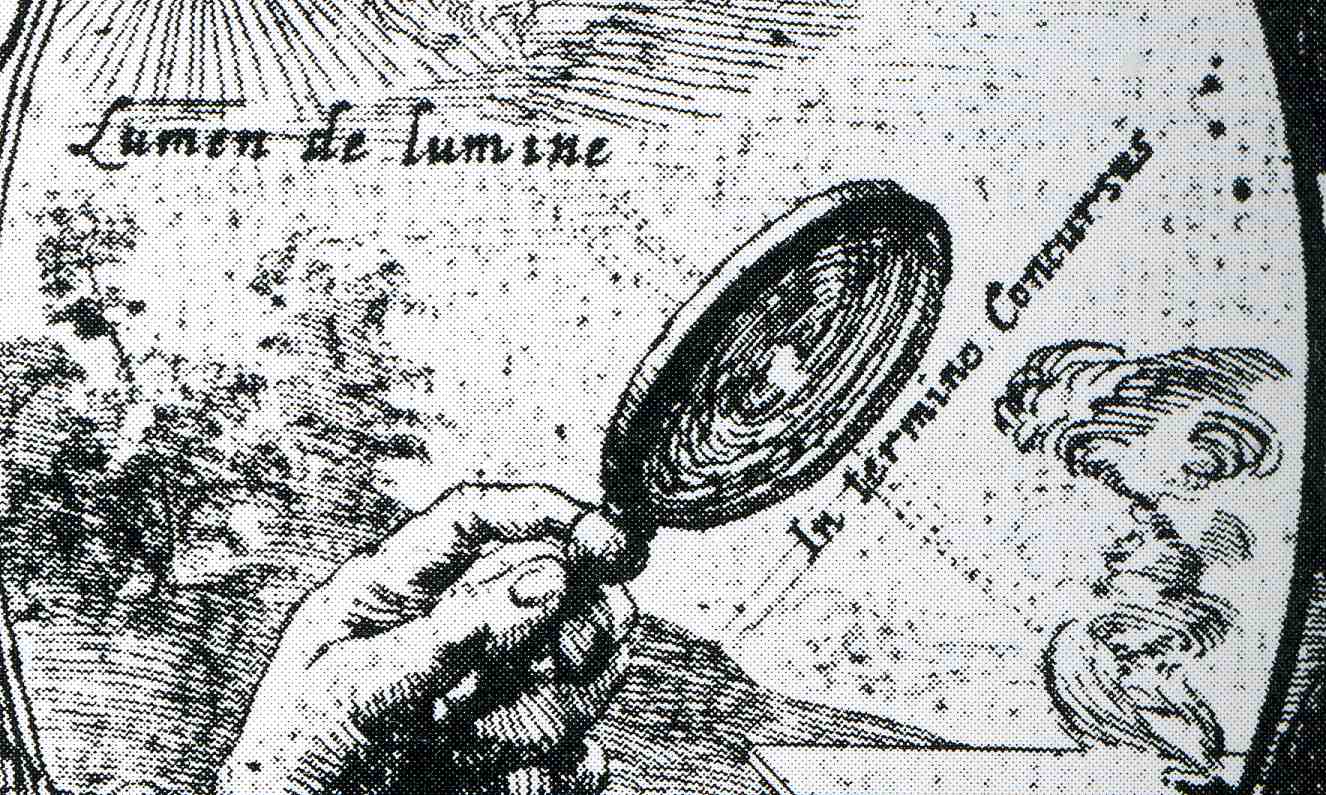
    The interesting image in the middle of the title page is more religious symbolism than what seems to be a straightforward physics reference, and the bulk of it lies in the “lumen de lumine” inference, which in the Nicene-Constantinopolitan Creed confesses faith in Jesus Christ as Lumen de Lumine (Light from Light).  Once you replace the optics with the divine, the rest of the image and its relationship to the contetns of the obok becomes more clear.

    *

    Helmont thought about the restrictiveness of mathematics, and that the quantitative aspects of things that math addressed missed their interior qualities, thus making mathematics not able to see what things are.  Oopsie.


  • The Discovery of Nothing: Things out of Place Deparment #4 AND a History of Blank and Empty Things #32

    JF Ptak Science Books LLC  Post 513

    0 blog feb 11things out569

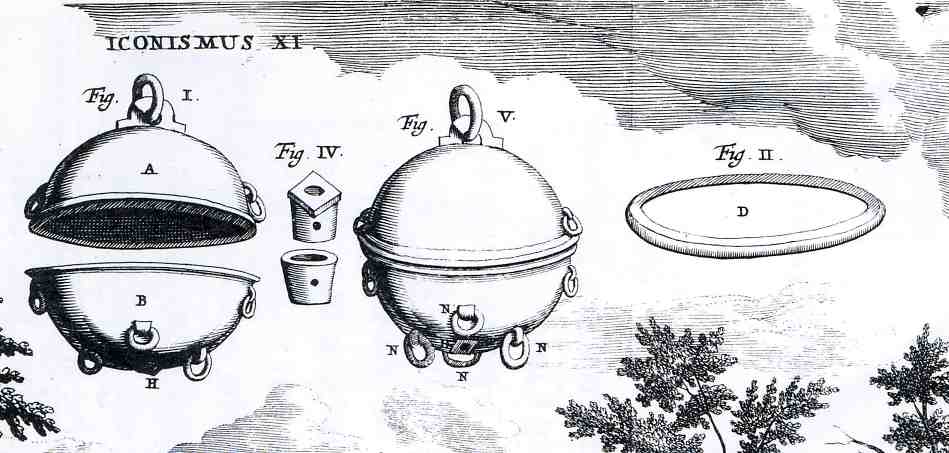
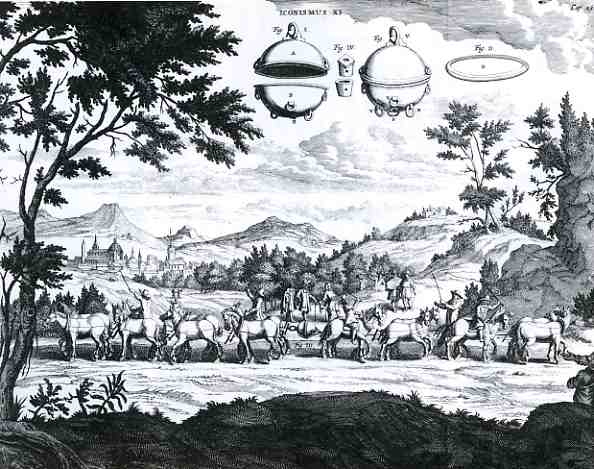
    This is really just another bit of fun–the four objects in the sky weren’t unrelated to the scene, not at all, though if you wanted you could certainly create a fantastically rigorous and bizarre story for them; they certainly did define the concept of “nothing” for the Blank & Empty Things thread of this blog.  here is no doubt that the image has a very quiet, possibly Dadist origin.  In fact, this is one illustration from one of the greatest experimental physics books of the 17th century, coming as it does from Otto von Guericke’s  Experiemnta nova (ut vocantur) Magdeburgica de vacuo spatio (Amsterdam, 1672).  In another minute department, this one is also I guess the greatest book ever written by a Mayor of anywhere (as von Guericke (1602-1886) was mayor of

    0 blog feb 11things out568 Magedeburg for 33 years).  The image shows the greatest of von
    Guericke’s efforts, and one of the greatest (or most important)
    experiments in experimental science–the dramatic demonstration of the
    vacuum, showing here that teams of horses could not pull apart two
    halves of an evacuated sphere, and of course the efficacy of air
    pressure operating against it (um, the vacuum). The “floating” bits in the sky were an exploded view of the sphere that was the subject of the experiment. 

    What was more important though, and what the general reader today might easily miss, was that von Guericke created something that many scientists and philosophers said didn’t, and couldn’t, exist:  the vacuum.  In modern times, Copernicus depicted the universe as a vast void; Descartes came in the back door (following the ancient and interesting though incorrect theory of Aristotle*), not liking the idea very much, and claiming that such empty space couldn’t exist.  Von Guericke provided the proof that the vacuum, that nothing, did exist. 

    _______

    *Aristotle (384-322 BCE) theorized that as air became thinner objects moving through it would move faster, which is true; he further speculated that if there was no air at all, that if vacuums did exist, then objects would move infinitely fast, which he correctly assumed was not possible, and thus the vacuum could not exist.