A Daily History of Holes, Dots, Lines, Science, History, Math, Physics, Art, the Unintentional Absurd, Architecture, Maps, Data Visualization, Blank and Missing Things, and so on. |1.6 million words, 7500 images, 4.9 million hits| Press & appearances in The Times, Le Figaro, Mensa, The Economist, The Guardian, Discovery News, Slate, Le Monde, Sci American Blogs, Le Pont, and many other places… 5000+ total posts since 2008.

Author: JF Ptak

  • Polywog Airmail of the Future

    JF Ptak Science Books  Post 1042

    000 sky mail015

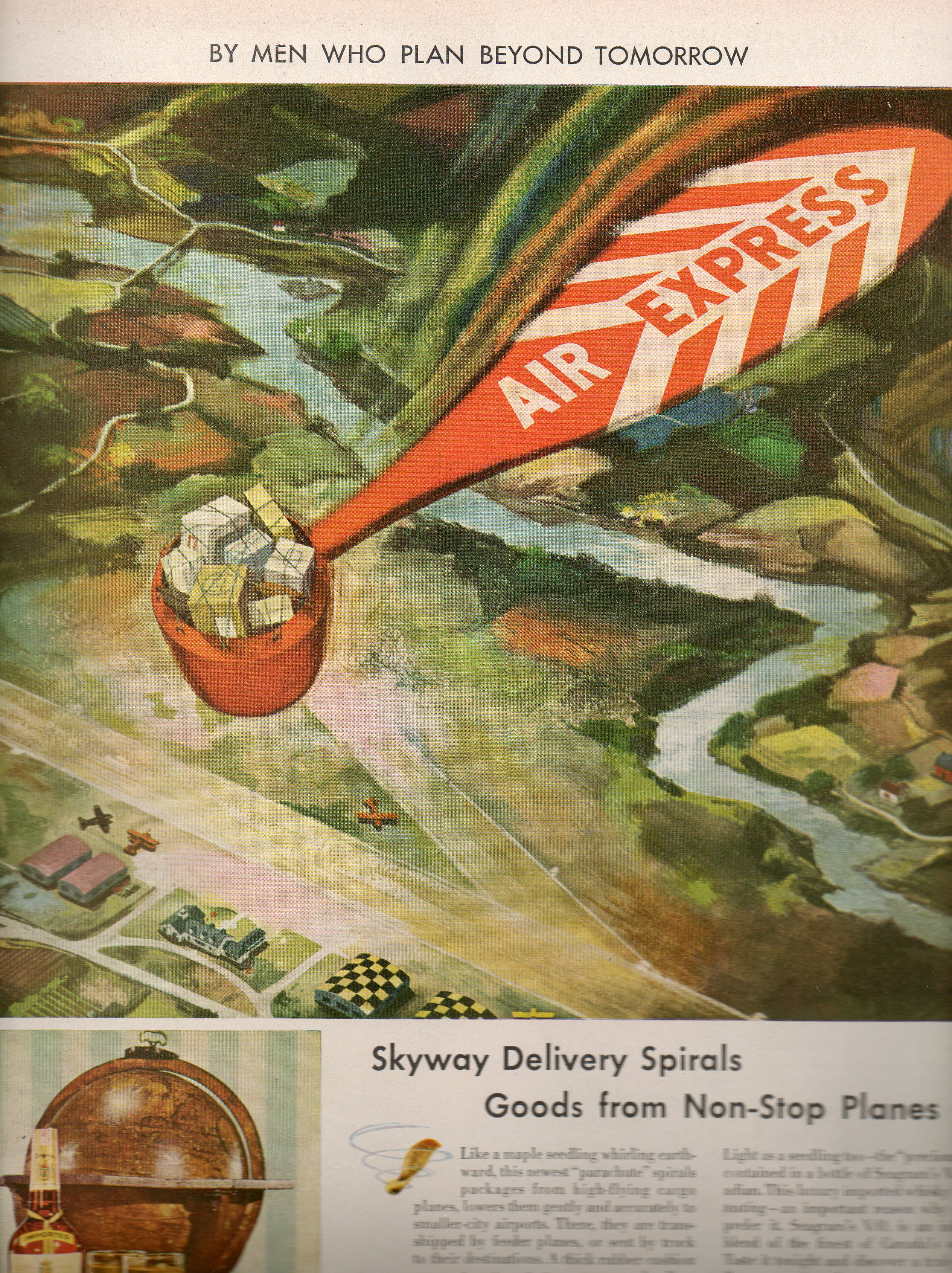
    The booze-driven future as seen by Seagrams (written about earlier in this blog as Atomic-Powered Farms) that appeared in the pages of LIFE magazine from 1945 to 1947 were quixotically science fictiony in the waterproof-duck department brand of invention.  Most of Seagram’s visions were goofy even though they all seem to have been serious statements on the future.  This example, the polywog air mail delivery system, seems to be as bad as any of them–worse even since the technology that the artist/designer was trying to circumvent was already far more sophisticated/logical/beneficial than this weird parachute delivery system for  the mail.  Once all the effort of packaging the mail into this contraption, retrieving it and then setting it up all over again for the next go is calculated, one would’ve been far ahead at all levels by just landing the bloody plane and getting rid of the mail.  That, or of course, just pushing the mail out in a container with a standard parachute also would’ve been a better solution than the one pictured. here. 

    Obviously Seagrams didn’t have their heart in futurology, except that which calculated the shortest possible time it would take to convince people to replace their empty Seagrams bottles. 

    Overall, this is just simply a very bad idea, no matter where you are in the timeline. 


  • Selling the Memory of Missing Things: Camel Cigarettes, 1947

    JF Ptak Science Books  Post 1041

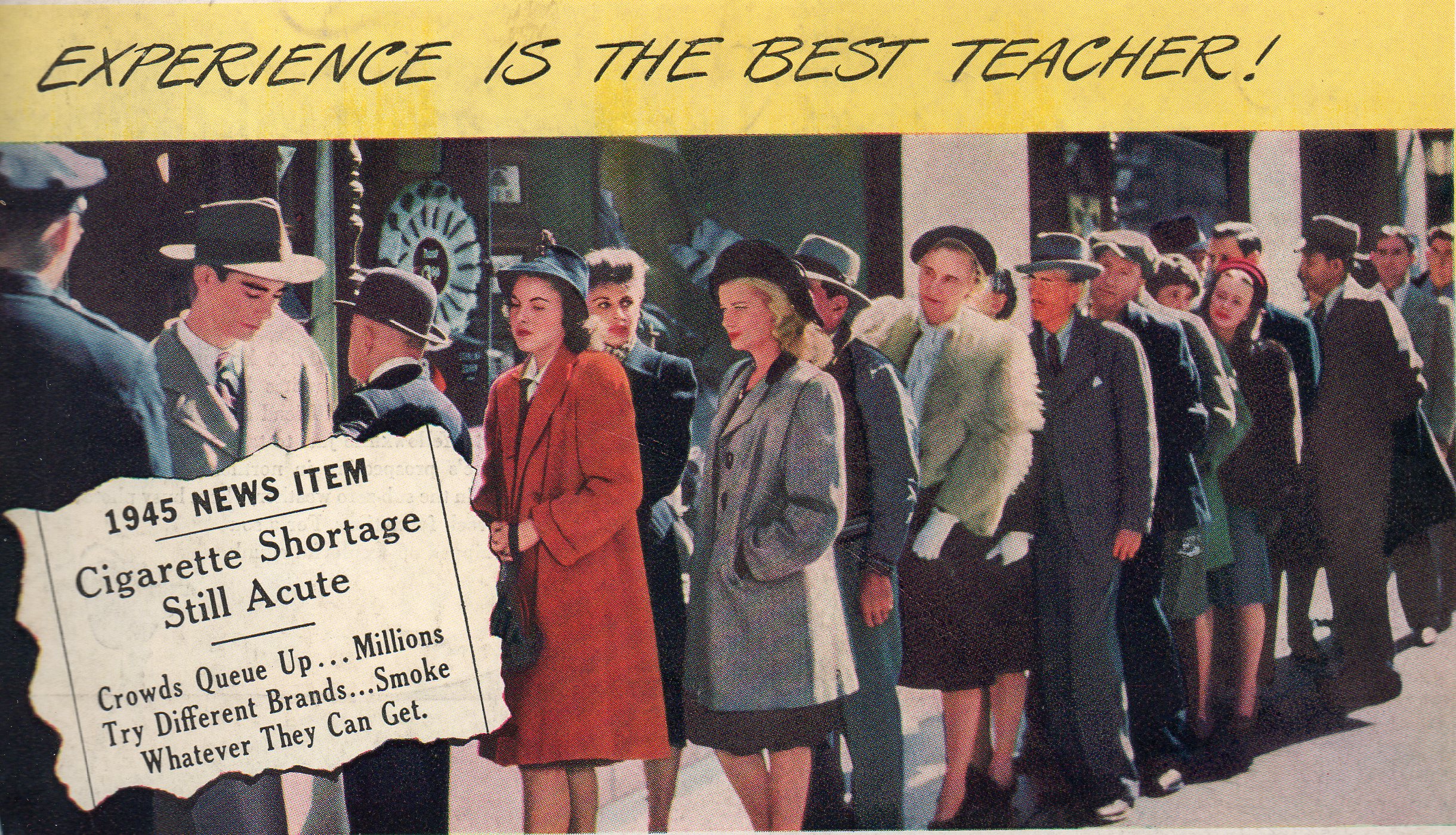
    Here I think is another instance (following yesterday’s post on “The Ineffable Religiosity of American Meat Memory”) of tweeking the American consuming memory, an advertisement bringing out the recollection of past shortages to make the present consumer want the now-abundant item even more.  In this case that item is the cigarette–Camel cigarettes to be specific.  The ad correctly refers to the two-year-old memory of cig

    000 cigarettes013

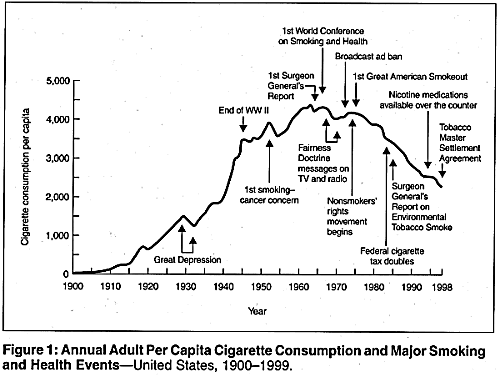
    shortage in the U.S.  Cigarettes became increasingly scarce during the war–soldiers were given smokes with their C-rations, exports increased, and so did general consumption.  At the beginning of 1940, 181 billion cigarettes were made in the U.S., with a per capita intake of 2,558 cigs a year; 1945 saw production spike to nearly double. By 1950, the production hit 370 billion, with the per capita use at 3,522 cigarettes a year, about a half-pack for everyone in the country.  In fact nearly half of the adult population smoked in 1950, making for more than a pack-a-day habit.  And it was Camels who lead the smokey way, comprising nearly 28% of all cigarette sales in the country (followed by Lucky Strikes and Chesterfields, their combined totals making another 42% of the market share).  In short, there were three giants who ruled the industry, and that for decades.  And before 1950, only 2% of all of those cigarettes had filters, so all of the harmful stuff got to the lungs cleanly.

    Back to the ad–I’m sure that these hatted folks weren’t smoking “whatever” they could get, especially with the cop standing at the front of the queue.  But in 1947 (the year this ad appeared in LIFE magazine advertising Camel cigarettes) the ciggie shortage experienced at the end of WWII was long dead and gone.  Camel just wanted to remind people of the craving for their missing cigarettes, especially the ones they enjoyed, and of course especially Camels.  The ad brought up the memory of smoking the off brands like Ramses and Pacayunes and how they tasted, and how “good” Camels were in comparison–and now one could buy Camels with reckless abandon, the freedom to consumer right to the edge of the grave. 

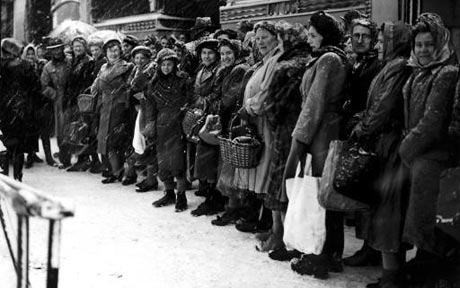
    The advertising message pricked the American memory of shortage; the U.K. on the other hand was experiencing the real thing, with massive amounts of shortages of nearly everything (from petrol to medicine to white linen), and queues and ration books were supplied to deal with the real problem.

    A “real” line in London, 1947, for food::

    000 winter-1948_798431c

    0000 cig consumption


  • Alpha & Omega Department: Leashed Women

    JF Ptak Science Books   (Picture Post)

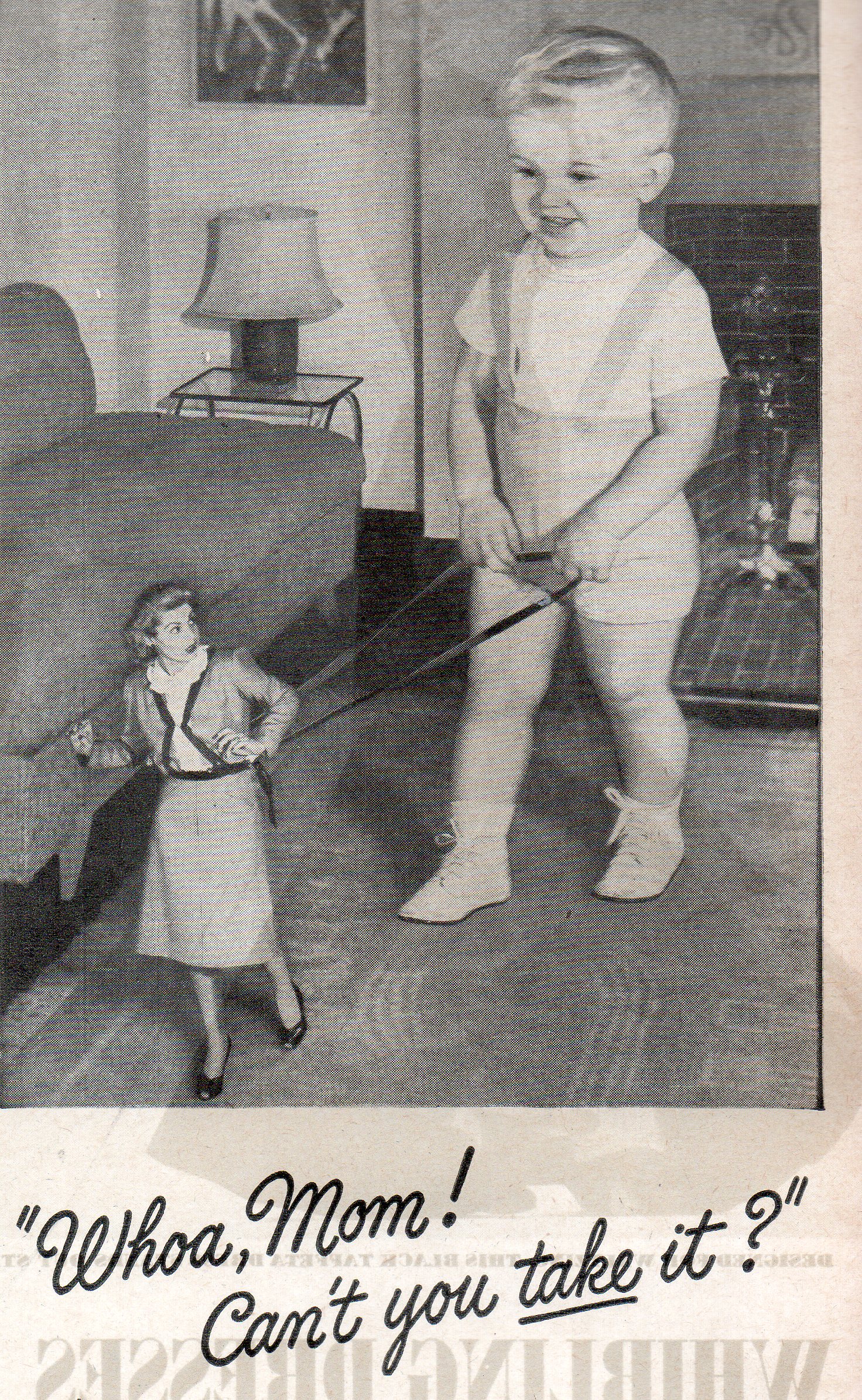
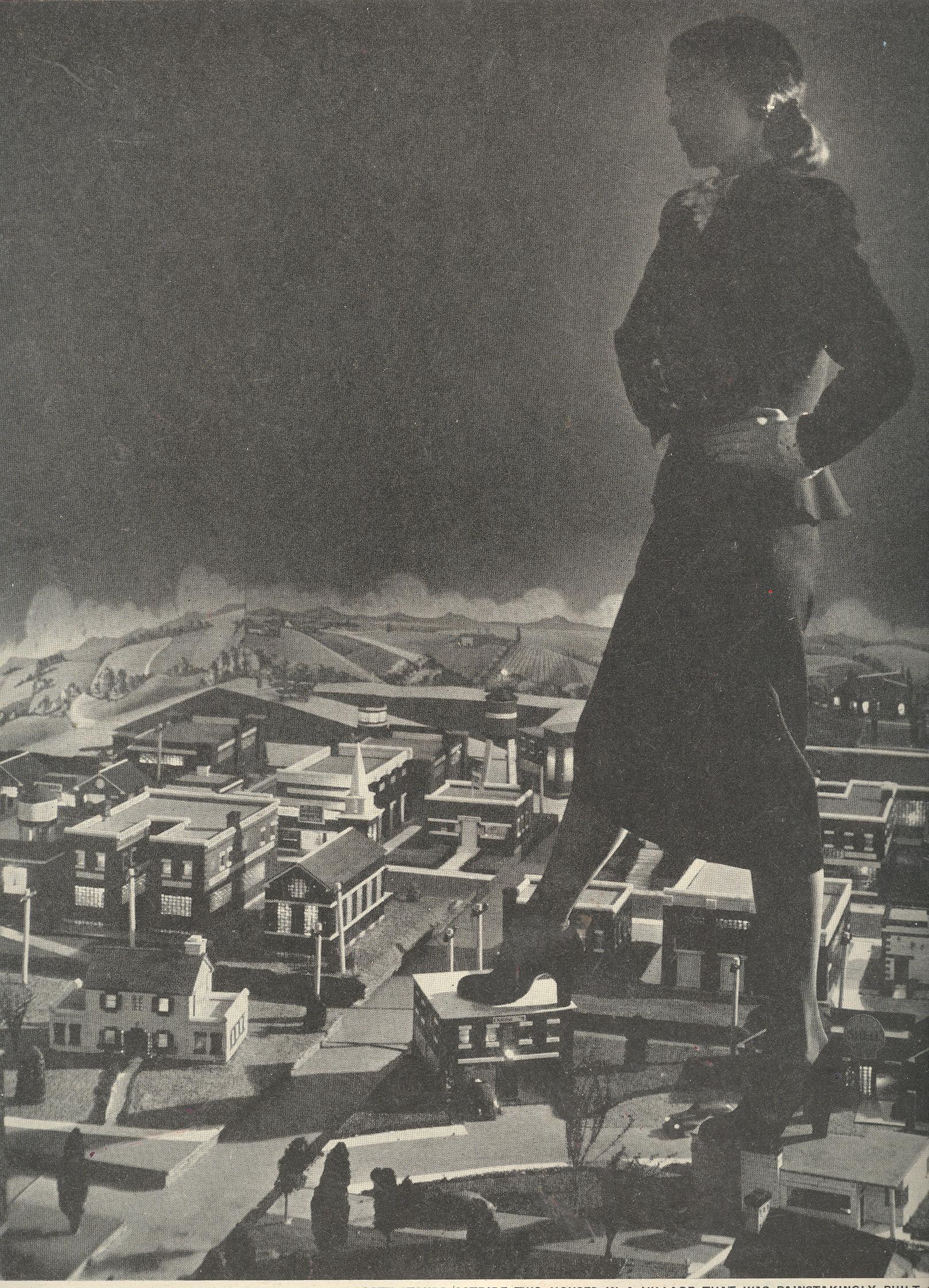
    This would also go nicely with my 200′-Tall Woman post, making the long and short of things and rounding out the other end of the spectrum for the greatest difference in hemline-to-ankle distance.

    000 women on a leash012 

    000 big woman


  • The Ineffable Religiosity of American Meat Memory: PREM, 1947

    JF Ptak Science Books   Post 1040                                                 


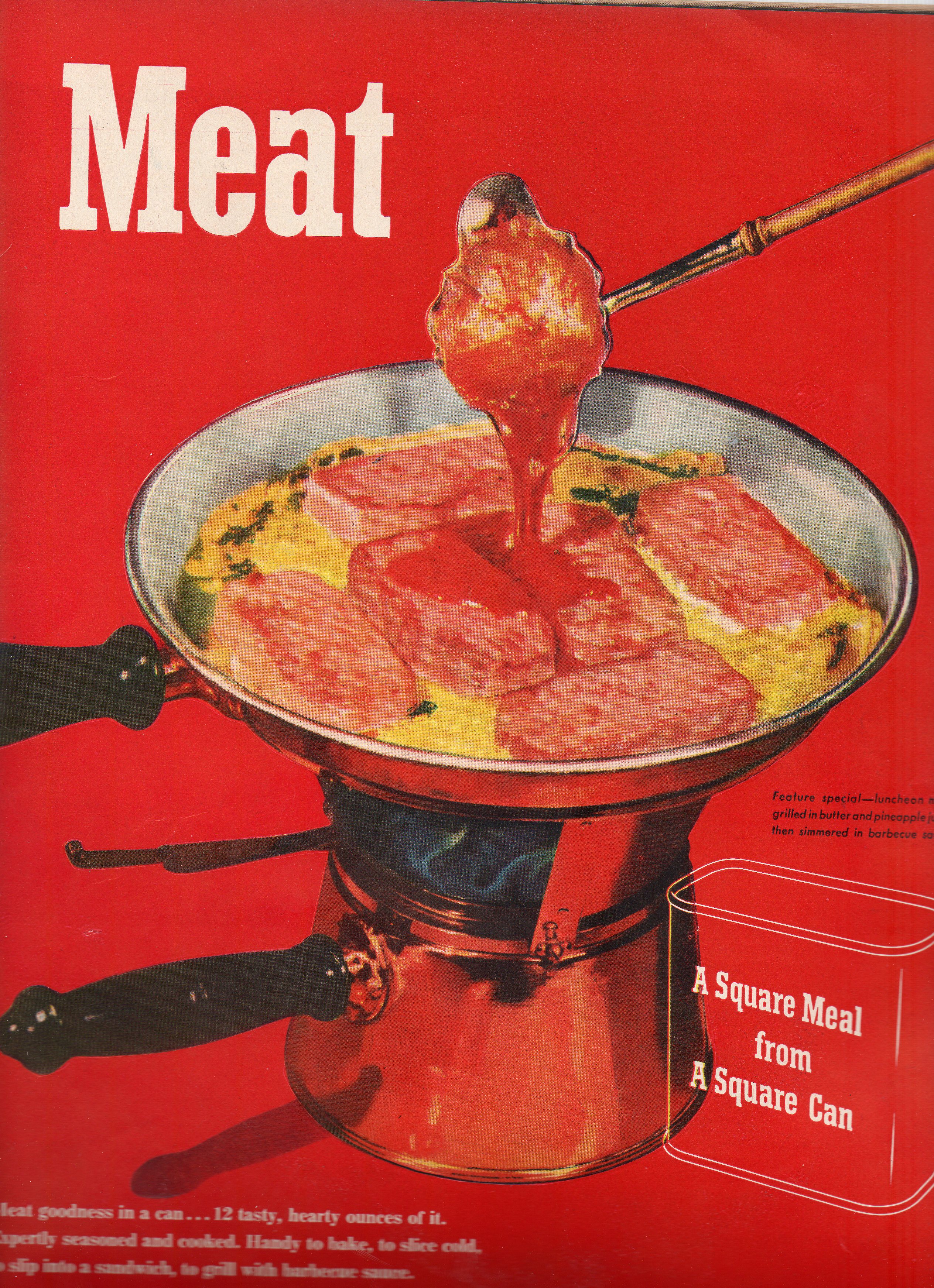
    The category of the specialty meat, the meat that both is and isn’t meat, is one that holds a particularly high place in the religico-belief system of consumption in America—and particularly so in the historical American meat memory.  For it is here, in this very purply ad in LIFE magazine in July 1947 that we find a reminder for a meat product being sold as such, printed with the statement that the meat is being sold with meat in it, which is odd because it suggests the rejoinder that the opposite is true, too.

    000 meat prem014

    The ad is magnificent in its own special way, falling just short of  reading “Prem Meat: Now with MEAT!”.

    The adipose-y Prem meat-like clone sprung from the mind of Elmer Gantry-looking Joe Hormel,  who I wrote about earlier in this blog under the title “Spam, Smeat, Spic, Prem, Mor & Arf: Food by Any Other Name”.   Prem was a Spam-like product, a waste-meat issue of food that was packaged as a molded solution for the lower-middle-class American family.  The belief in Prem and such things as meatfood must’ve been strong; I doubt that anyone who had the remotest imagination would have thought of it as an adhered-jell byproduct which nearly ended its life on the slaughterhouse floor waste grate before it was thought of as something that could be scrubbed off the metal grid, loaded with other extreme leftovers, loved up with coloring, solidifiers, sugars, preservatives and flavorings and then sold as an ingestable commodity.  The romance of Prem is lost if you drain it of its belief system and expose it as the salvaged refuse bin
    material that it was. 

    000 meat red010

    As a 20-year vegetarian I’m strangely attracted to these ads, just as I would be any other piece of quackery from the sciences or medicine. These odd meat things were fortified with splashy store displays and crisp metal packaging.  It certainly looked okay in the pictures; could digestive goodness be far behind?

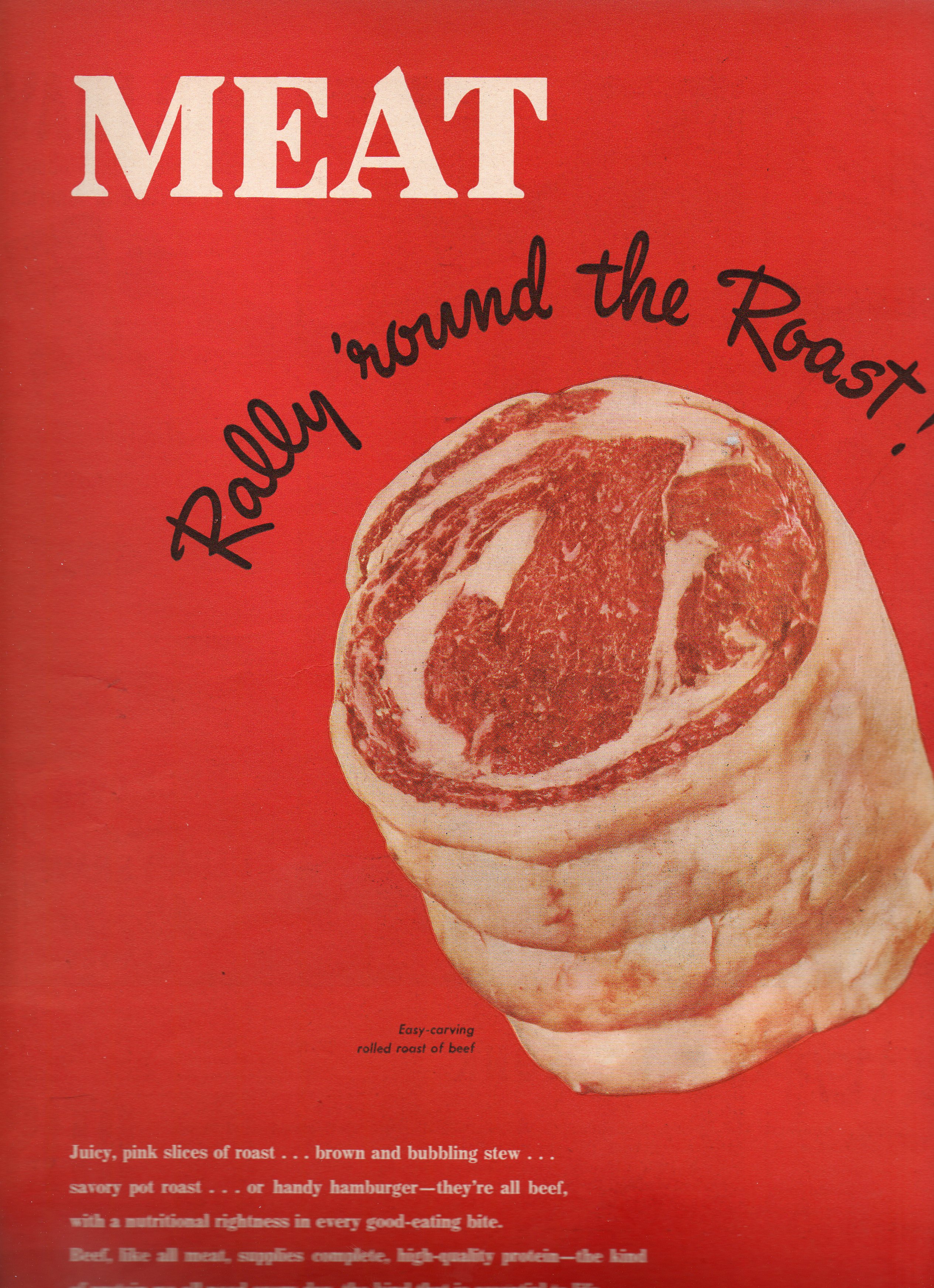
    The other bit that runs far and wide through LIFE that reminds Americans that the meat that they are eating is meat  , red meat, and the RED MEAT ads–these things are incredibly red, and big, and make quite the bloody splash considering that the ads were about 14 inches tall. 

    Anyway, reminding someone that they were eating more of their memory than the actual thing itself seems as though it would’ve opened more dangerous doors to unsavory discussions rather than closed them–but close them they did, as the new-old memories posted by these ads seem to have worked their sensate magics.


    000 meat red 2011


  • Dis-inventing the Left-Hand Turn–City Planning with Le Corbusier

    JF Ptak Science Books  Post 1038

    Somebody must’ve invented the automotive right-hand turn, and someone too must’ve come up with the idea of dis-inventing the left-hand turn–for the sake of this post and brevity that person might as well have been Le

    Right hand turn 2006

    Corbusier.  I know that city planners and traffic engineer types must’ve been working on the idea of how to push new traffic through old city streets, and the notion of making traffic not cross against itself must’ve come fairly early on, but I just offhand don’t know when.  It makes sense to me to not have cars make left-hand turns against oncoming traffic–it adds immeasurably (?) to the gas guzzling stop-and-go adventures in driving, the chain reaction of so many cars stopping and piling up behind one solitary driver waiting to make a left-hand turn against a stream of oncoming cars is just enormous.  Restricting the left-hand-turn to three right turns would slash the waiting/idling business and allow traffic to proceed quicker. (In a similar line of thinking my friend Richard Rudman from New Zealand points out that studies prove that restricting highway lane changes also makes enormous sense as well–it gets people to were they’re going quicker and with greater fuel economy if the flow isn’t interrupted by constant starts and fits of changing lanes.)            

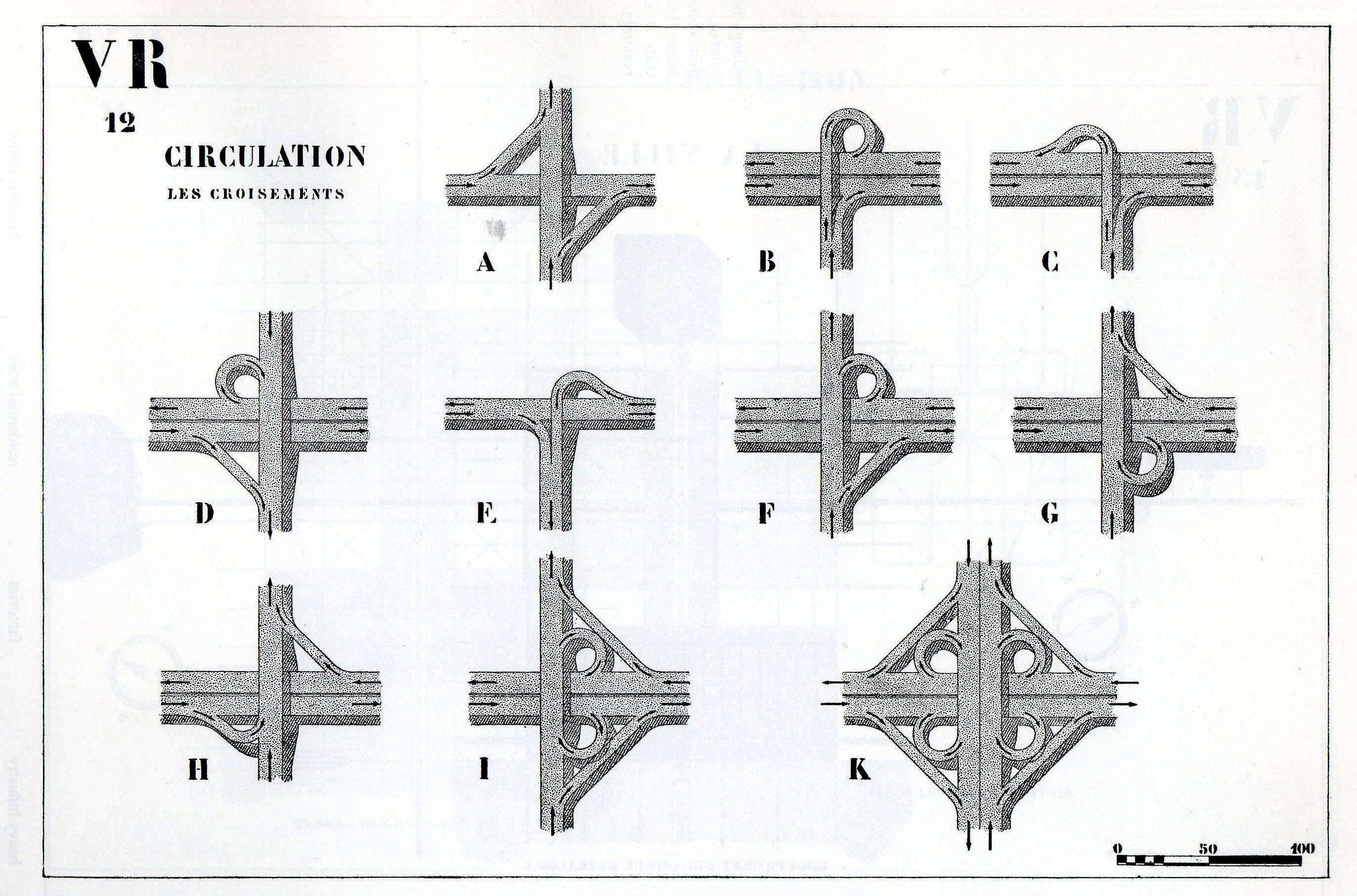
    Further on in The Radiant City we find this visual encyclopedia of right-handed turns:

    Right hand turn 10

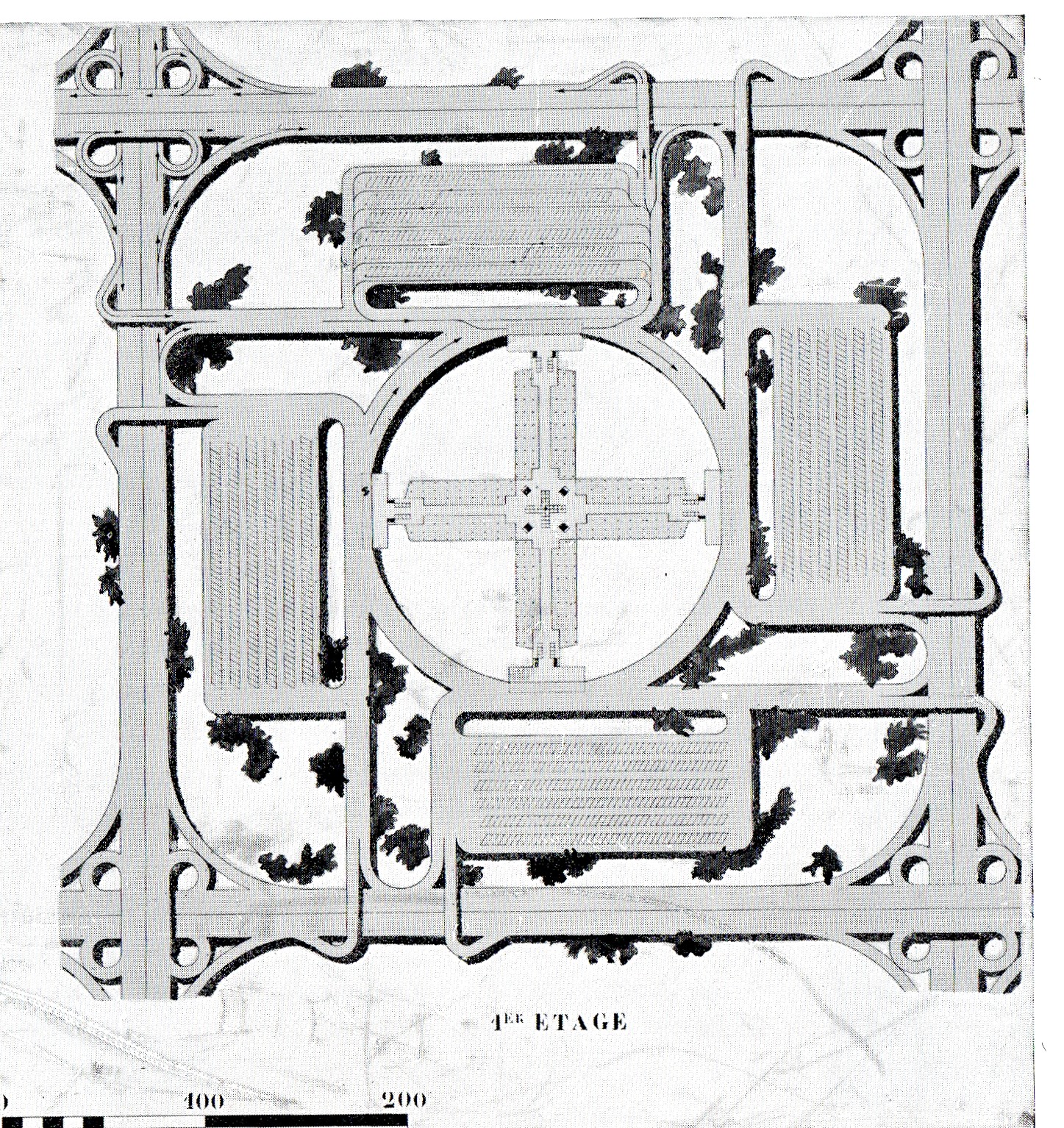
    And so we come to this plan, a part of the 1930’s Radiant City of Le Corbusier.  It is a section of a series of “horizontal skyscrapers”, “Cartesian (works) in steel and glass”, 220 meters tall buildings set in 400 meter square sections.  All of the architecture aside, the street plan is what interests me–all of the traffic here in this section of the Radiant City is in one direction along streets that are largely lacking right angles.  Elsewhere in the book Le Corbu presents his ideas for intersections for large cities–all of the designs remove the cross-traffic turn, keeping traffic flowing without those series of infinite stops.

    I’ve not been a very big fan of this man, but this is the stuff that seems to make sense to me. 

    These ideas are also in vast contrast to the city plans of linear cities (which I wrote about earlier here), seen in the 1910 Chambless image (below) and the 1932 Popular Science city (below that).

    Linear cities 2

    Linear cities

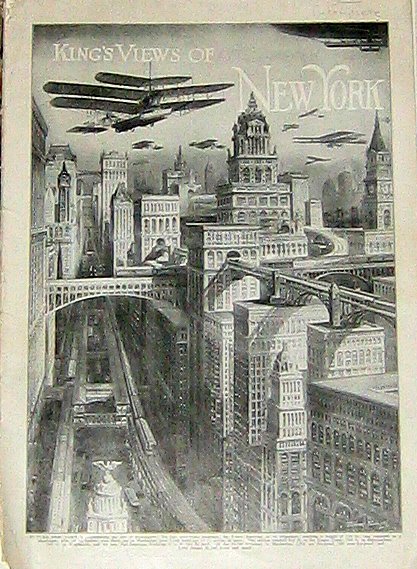
    It is also entirely different from the methods of dealing with traffic that were seemingly very popular in the early/first-third part of the century–massive 12-lane roadways, suspended garganutan affairs with traffic turning everywhere, some of which took place high in the air and in the interiors of massive skyscrapers. (Some of which I wrote about here.)

    Kings new york


  • Imprisoned and Force-Fed Suffragists, 1910

    JF Ptak Science Books   Post 1037 

    {This is part of our History of Women series)

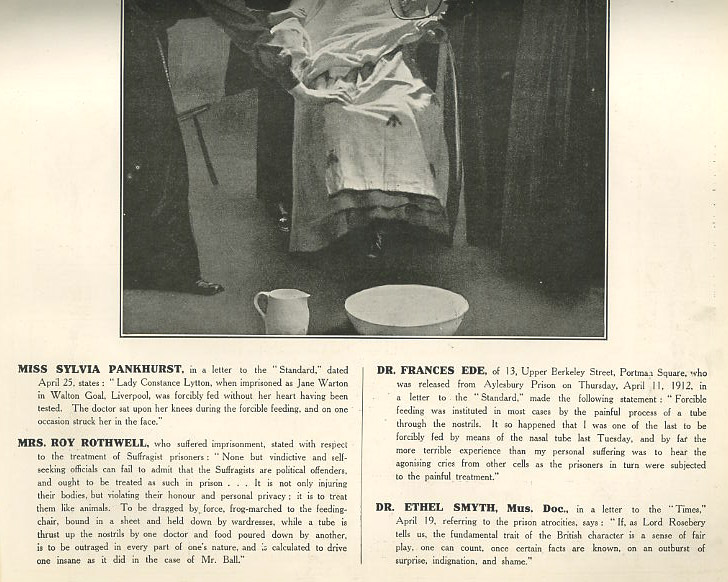
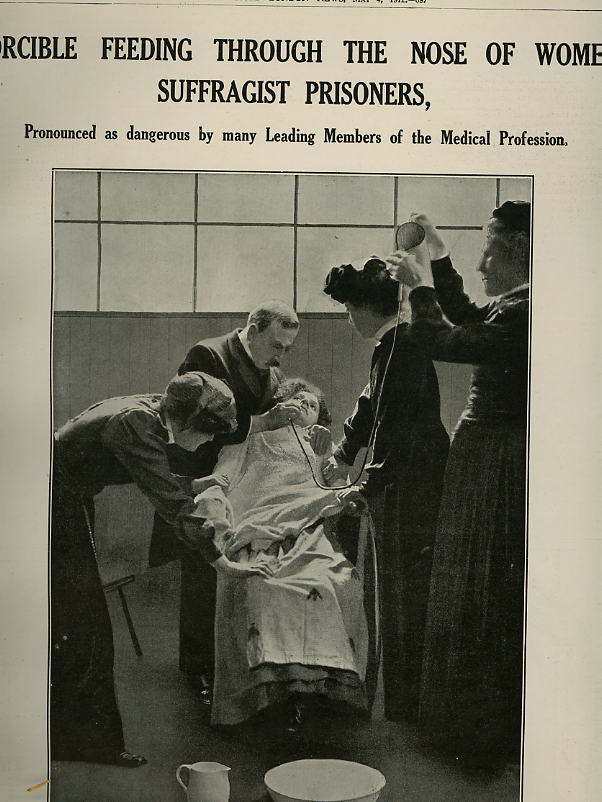
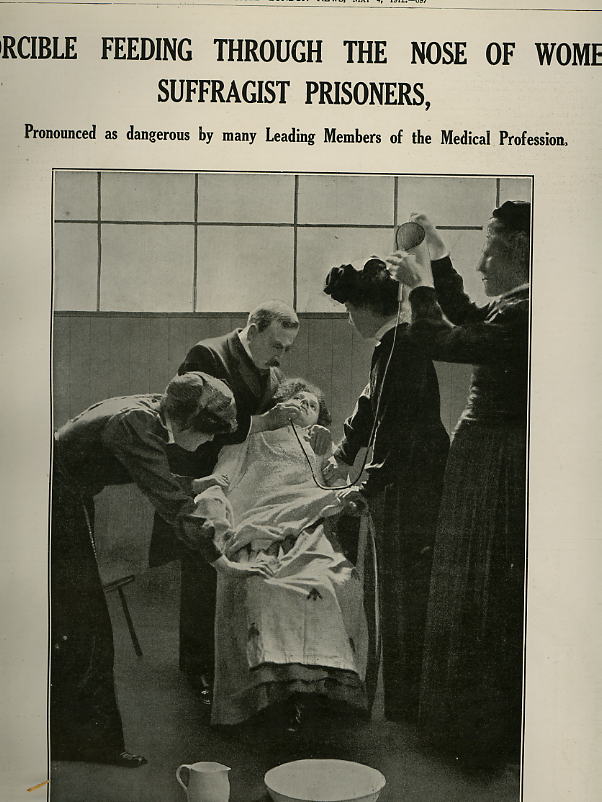
    In January 1910 the Illustrated London News (perhaps sympathetically) reviewed the case of the forced feeding of a leading female suffragist–very forced, very forcible, feeding-tube-up-the-nose-and-into-the-stomachDetail face forcible, the work of a grappling prison doctor and assistants.  The full-page illustration was entitled:
    “Forcible Feeding Through the
    Nose of Women Suffragist Prisoners”

    and then pointing out:

     “Pronounced as dangerous by many
    Leading Members of the Medical Profession…”

    It is the story of medical indulgence and state insistence of not recognizing any displays of independence while imprisoned–feeding a woman against her will, a 
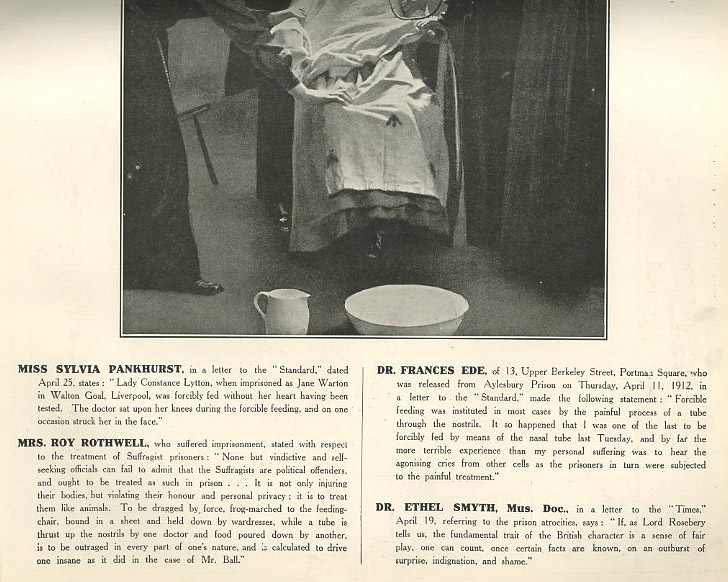
    woman prisoner at the hands of what sounds to be cruel warders and an insistent doctor. The woman in question was Lady Contance Lytton (b. 1869, imprisoned in disguise as “Jane Warton”) in Walton Goal, 
     

    File0505

      
    File0507

    Liverpool. She was arrested and placed there for minor offenses to the civil code while protesting for the rights of women to vote in England. She carried her struggle further in jail, doing about the only thing she had left to do while she was put away–make herself into a political statement by refusing to eat or ingest  liquids.  Walton Goal would have none of it, and resisting the entreaties of professionals, decided to feed the woman themselves at whatever cost.  The doctor who administered the fluid
    evidently sat on her knees and slapped her until the Lytton’s resistance
    failed. My guess is that the white cloth covering her in the photo is not for drips and drops, but was used to cover restraints–I hardly think that the two female attendants would’ve been able to hold down Lady Lytton’s arms by themselves, especially in that posed posture. There are three other accounts of women being bound, restrained,
    held by wardresses, and in general being badly treated.  (There is a
    continuation of the story of Lytton, below.)

    The vote did not come until 1918 with the Representation of the People Act, which in June 1917 passed the House of Commons and which went through the House of Lords in February of the next year, granting full enfranchisement to all women (over the age of thirty. This is about two years before American women were given the right to vote–on August 26, 1920–and 25  years after women won the vote in New Zealand, which again was first on the scene like it has been so many times). Lady Lytton would do badly in prison after this, suffering a heart attack and then a stoke by 1911, and never really recovered–she was half-paralyzed , was hardly robust, and wound up in her grave in 1923, aged 54.

    The Story of Lady Constance Lytton:

    “I was visited by the Senior Medical
    Officer, who asked me how long I had been without food.  I said I had
    eaten a buttered scone and a banana on Friday about
    midnight.  He said, “Oh, then,
    this is the fourth day; that is too long, I must feed you at once.”

    “He urged me
    to take food voluntarily.  I told him that was absolutely out of the
    question, that when our legislators ceased to resist letting women vote then I
    should cease to resist taking food in prison.

    “Two of the
    guards took hold of my arms, one held my head and one my feet.  The doctor
    leaned on my knees as he stooped over my chest to get at my mouth.   I
    shut my mouth and clenched my teeth.  He seemed annoyed at my resistance
    and he broke into a temper as he plied my teeth with the steel implement. 
    He dug his instrument down and it pressed fearfully on the gums.  The pain
    of it was intense and at last I must have given way for he got the gag between
    my teeth, when he proceeded to turn it much more than necessary until my jaws
    were fastened wide apart, far more than they would go naturally.

    “Then he put
    down my throat a tube which seemed to me much too wide and was something like
    four feet in length.  The irritation of the tube was excessive.  I
    choked the moment it touched my throat until it had got down.   Then the
    food was poured in quickly; it made me vomit a few seconds after it was down
    and the action of my sickness made my body and legs double up, but the guards
    instantly pressed back my head and the doctor leaned on my knees.  The
    horror of it was more than I can describe.  I was sick over the doctor and
    the guards …

    “When the
    doctor had gone out of the cell, I lay quite helpless.   The guards were
    kind and knelt round to comfort me, but there was nothing to be done.  I
    had been sick over my hair, all over the wall near my bed, and my clothes
    seemed saturated with it, but the guards told me they could not give me a change
    that night as the office was shut.

    “Before long
    I heard the sounds of the forced feeding in the next cell to mine.  It was
    almost more than I could bear, it was Elsie Howey.  When the ghastly
    process was over and all quiet, I tapped on the wall and called out at the top
    of my voice, which wasn’t much just then, “No surrender,” and
    there came her reply, “No surrender.”

    — above taken from “Eyewitness to History” by
    John Carey, 1987,
    Avon Books,
    page 423
     

    ·Posted by :

    ·in:

    —

  • The Message is the Medium, 2: Land Mines, Palestine, 1943

    JF Ptak Science Books LLC  Post 1036

    [An extension of the History of Holes series–things that are put into holes.]

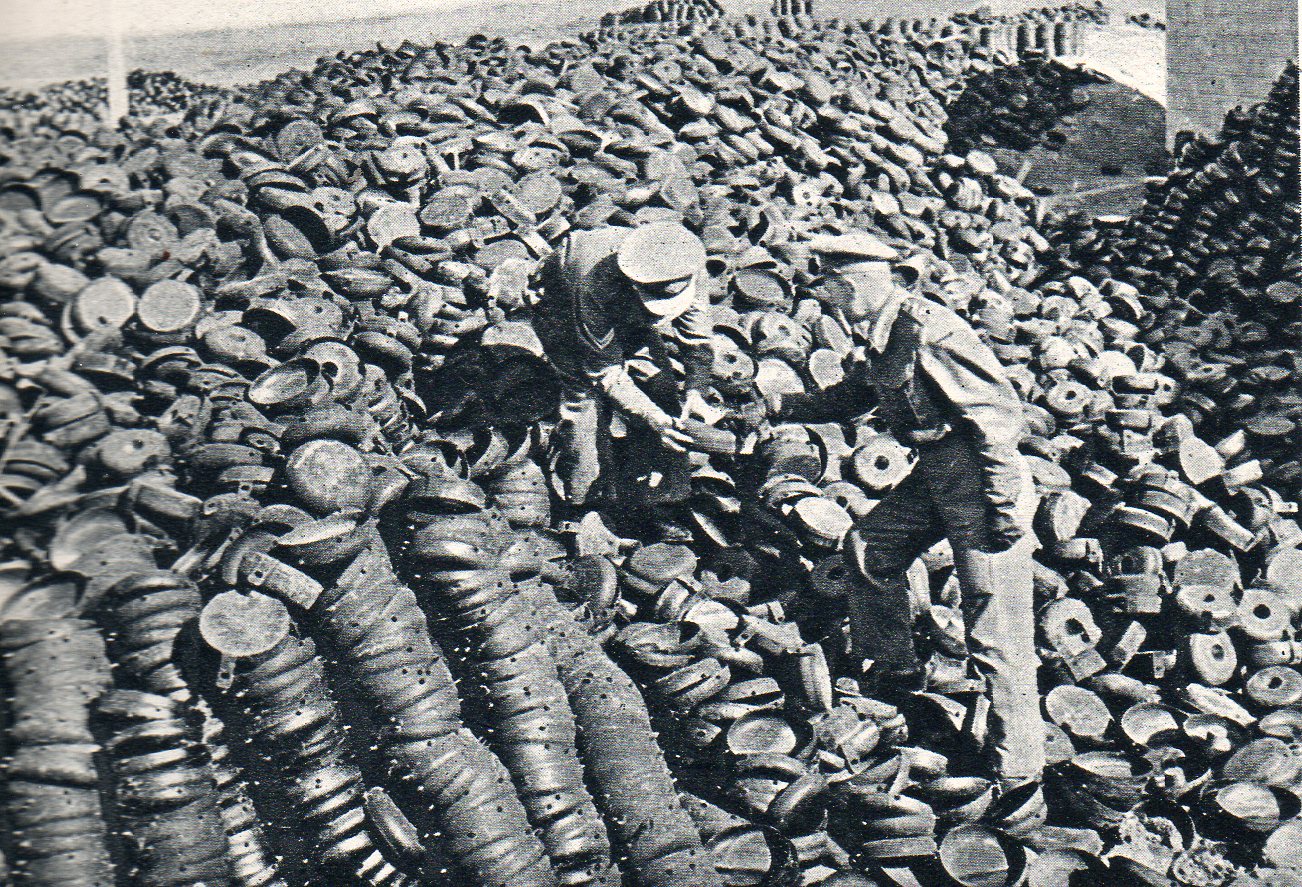
    Continuing a stroll through the Illustrated London News for 1943 I came across a series of photos of Britain’s “dependencies and friends” helping out in the war effort. This one is particularly remarkable and shows a vast

    Land mines004

    pile of yet-to-be-filled land mine canisters being serviced and readied for action in Palestine.  Its hard to imagine this sort of a scene, and this is only a part of the canister dump.  I reckon there to be easily 20,000 land mines just in what we can see, which represents about 1/1000th of all of the land mines used during the war. It also represents about 1/10,000th of all of the land mines that are in the ground right now around the world–in other words, this pile but 10,000,000 square feet worth. A pile like that could cover the square footage of the Empire State Building four times. 

    Emily Dickinson said that the brain was “the weight of god” (“wider than the sky” etc.)–if that’s so, what are these things the weight of?


  • The Message is the Medium–Children and Bombs, London, 1943

    JF Ptak Science Books  Post 1035

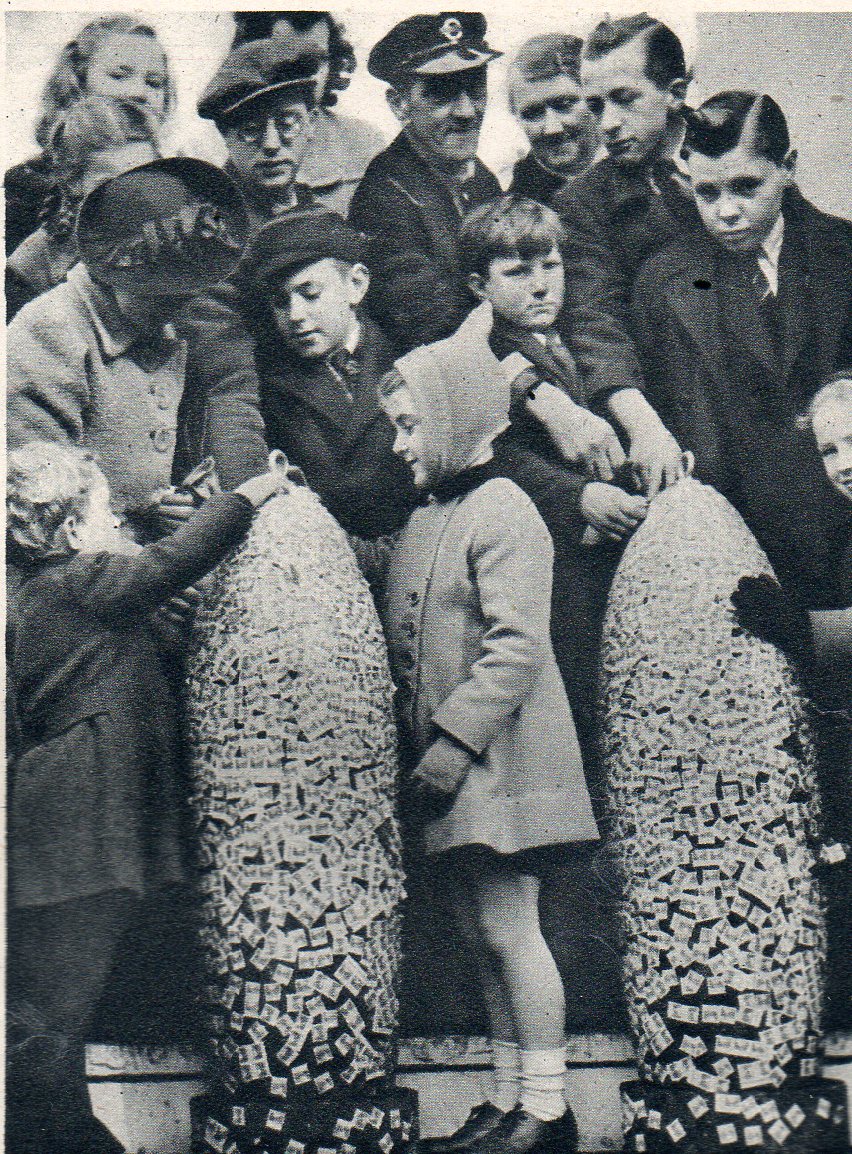
    I have no doubt that the history of decorating “bombs” reaches far back into dim history–decorating launched explosives I guess must be as old as the medium itself, though I’ve gotta say that the earliest photographs of decorated bombs goes back only to WWI.  In “reading” the Illustrated London News for the WWII years I found this image of children in Trafalgar Square fixing savings stamps to 500-pound bomb shells, part of a significant mile-long parade and will-to-win display–the “Wings for Victory” campaign– illustrating the Empire’s aeronautical might hat took place in London on 8 March 1943 and published a week later in the ILN.

    Children bomb003
    The “Wings for Victory” campaign targeted raising 150 million pounds; by this point more than 50 millions had been raised via monies being placed in War Bonds, Savings Bonds, Saving Certificates and Defense Bonds. My guess is that you’d get a sticker saying that you had invested x-pounds–these were the stickers placed on the bombs by the kids, I think. 

    It was pointed out in the accompanying text that the bombs would “at the end of the week…be dropped on Germany”.


  • Archaeology of Concentration: Patti Digh’s Childhood Pencils

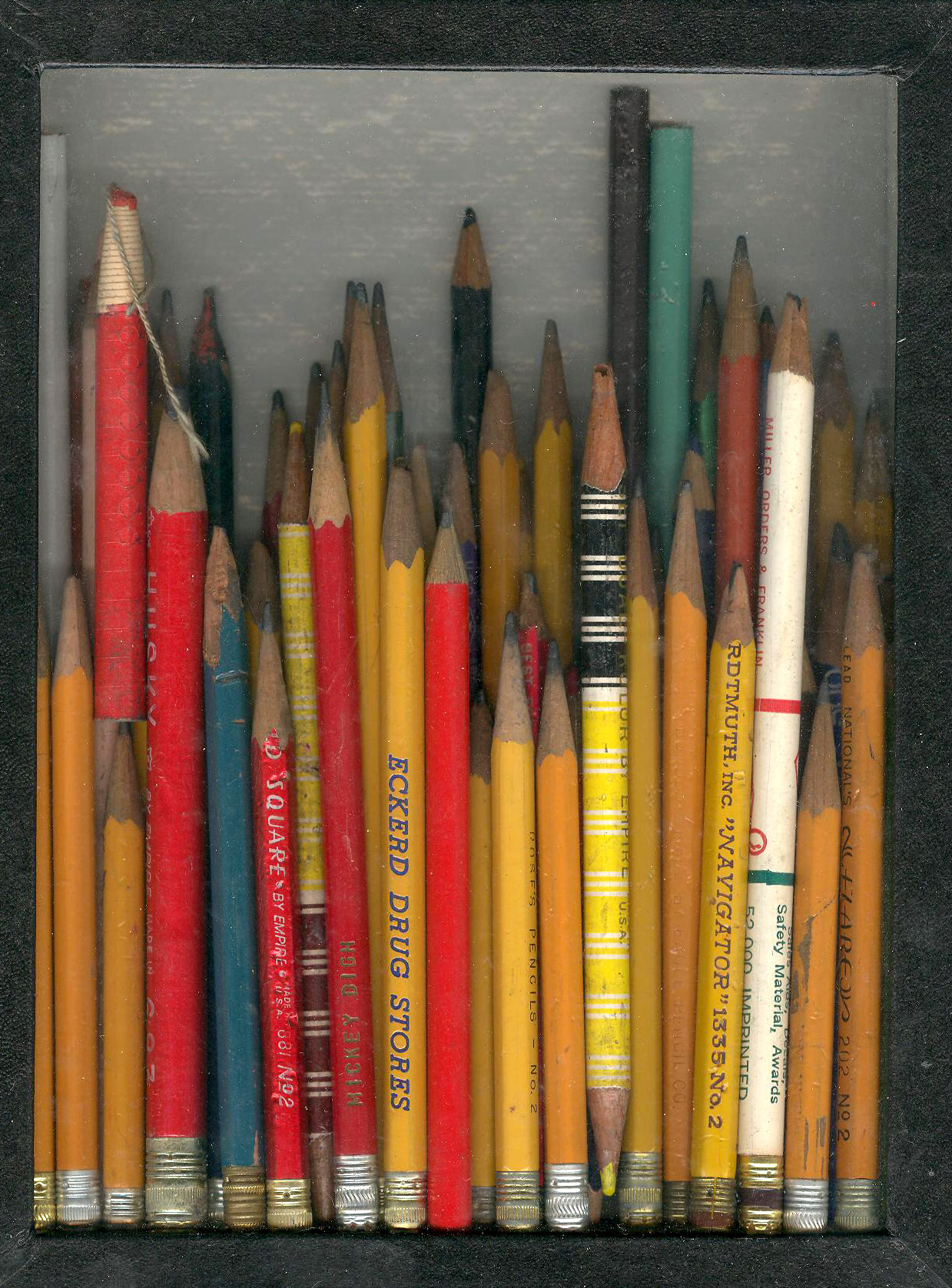
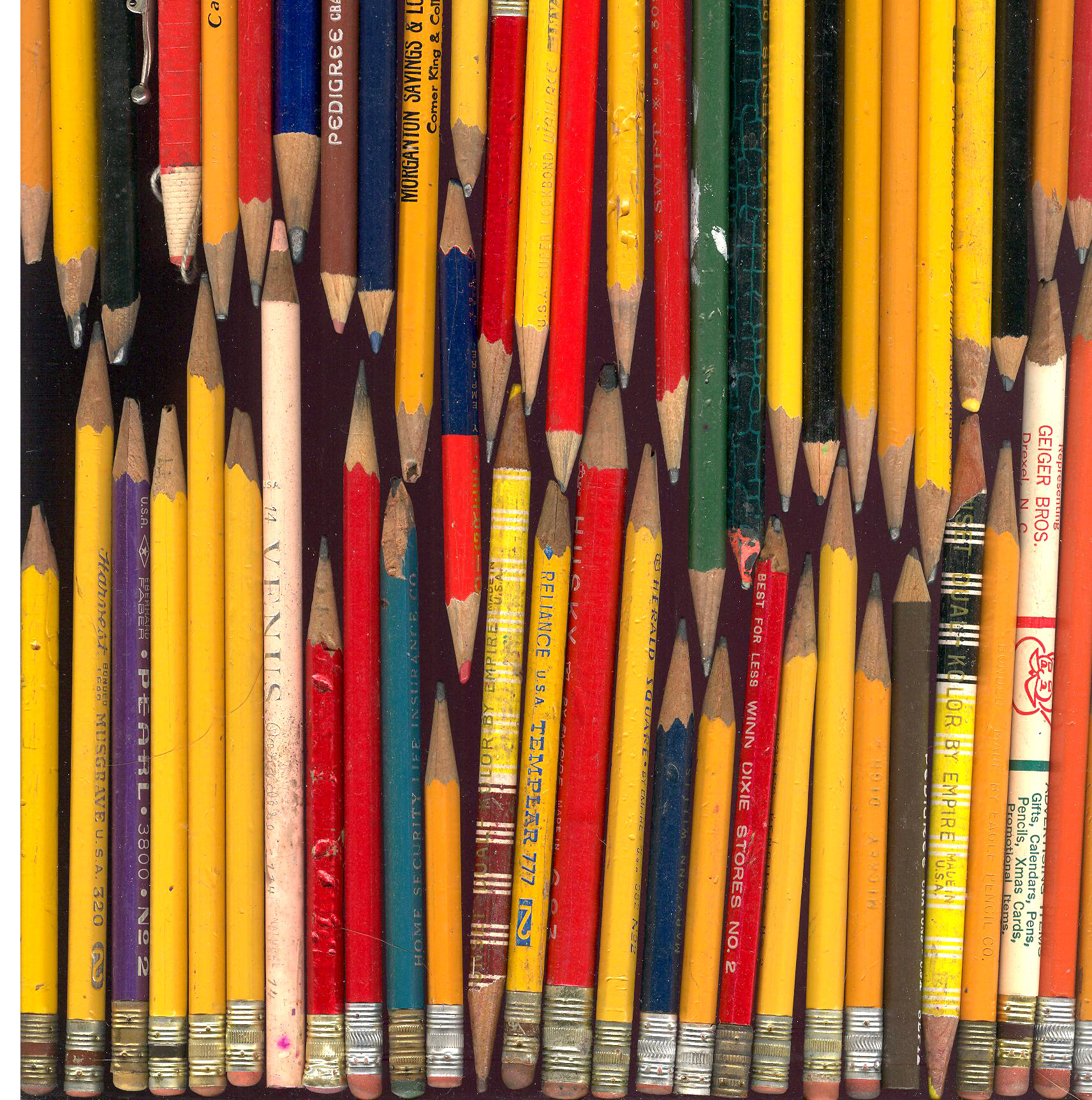
    My wife Patti Digh is an artist, and though she has great musical and painterly talents the greatest expression of her creative sensibilities is through words. And so I think that it is extraordinary that her childhood pencils have somehow made it here, into their future.  They are beautiful monuments to childhood creativity, their bite marks, gouges, scratches and just general wear and tear are testaments to Patti busily producing something from her mind, committing it to paper, back there in her deep past when she was only a couple of thousand days old.

    Patti--childhood Pencils points

    Patti--childhood Pencils
    Patti--childhood Pencils 2 det
    Patti--childhood Pencils corrections 

    A detail of Patti’s crayons, which I have written about elsewhere on this blog:

    Patti crayons 2

    Patti and I have saved virtually every bit of our daughters’ artworks–the really interesting stuff has been collected in one place, and then there’s the boxes of other artwork that they’ll have to deal with in their future. 

    And yes a Patti pencil box has also survived.

    ·Posted by :

    ·in:


  • The Edenless World: the First (Metal) Woman Robot, Maria of Metropolis, 1927?

    JF Ptak Science Books   Post 1034

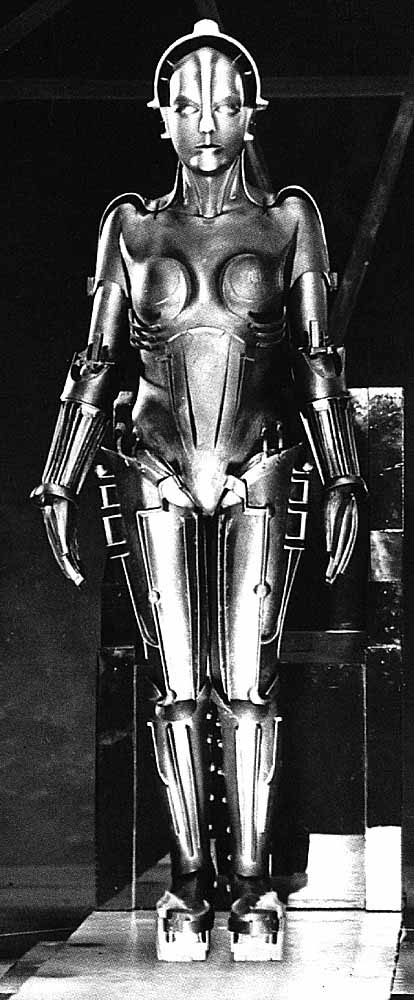
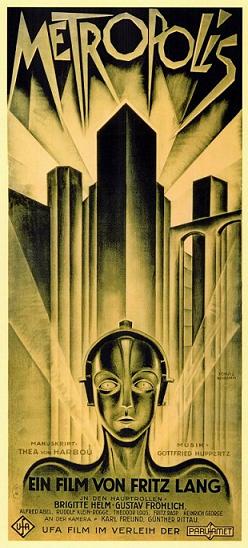
    No doubt that minds were sent reeling by Fritz Lang’s vision of the near-future (the year 2000) in his 1927 science fiction classic, Metropolis.  Life and work were one for the vast mass of humans, the drudgery of a cog-like existence in a vast underground machinery set to run a lifeless topside mother-of-all-cities was pressed and punched into the hearts and minds of the viewers.
    Maria-large
    The creation of a female robot in this movie is one of the earliest that I know of, surprising as there were male robot-like creations going back fairly deeply into the 19th century.  Perhaps the creation of female robots was verbotten because of the possibilities for unacceptable sexual fantasies in the high- and post-Victorian world, struggling under the weight of many and multiply-applied inhibitions.

    Or perhaps it came too close to some part of the truth of women as captives of their society, with unequal protection of the law, scant political representation, belligerent educational policies, and subjugated sexual vessels,  a comparative cog in the male machinery  pushing the world around. The disposable nature of the woman worker had already been manifestly and callously displayed in tens of thousands of instances.  In cases like the Triangle Waistcoat Factory disaster–in which women were treated no better than their machines, costing the lives of hundreds in a devastating fire–or in the replacement of Rosie the Riveter (as soon as the job-hunting soldiers returned from WWII), and on and on towards the horizon, it has been demonstrated to generations of women that they are inferior bits of apparatus.

    Metropolisposter

    The first use of the word “robot” occurred in the science fiction novel/play  R.U.R (by Karel Capek) just seven years earlier than Lang’s film; perhaps this in combination with the Expressionist and semi-decadent Berlin Weimar culture and overall indulgences of the 1920’s helped create  the possibility of the Eden-less woman-as-robot. Granted the robot’s name wasn’t “Eve”, though it does have the name of the Christian mother of mothers, the seat of early hyper worship, and more popular than Jesus’ name for centuries:  “Maria”.


    ·Posted by :

    ·in: