A Daily History of Holes, Dots, Lines, Science, History, Math, Physics, Art, the Unintentional Absurd, Architecture, Maps, Data Visualization, Blank and Missing Things, and so on. |1.6 million words, 7500 images, 4.9 million hits| Press & appearances in The Times, Le Figaro, Mensa, The Economist, The Guardian, Discovery News, Slate, Le Monde, Sci American Blogs, Le Pont, and many other places… 5000+ total posts since 2008.

Author: JF Ptak

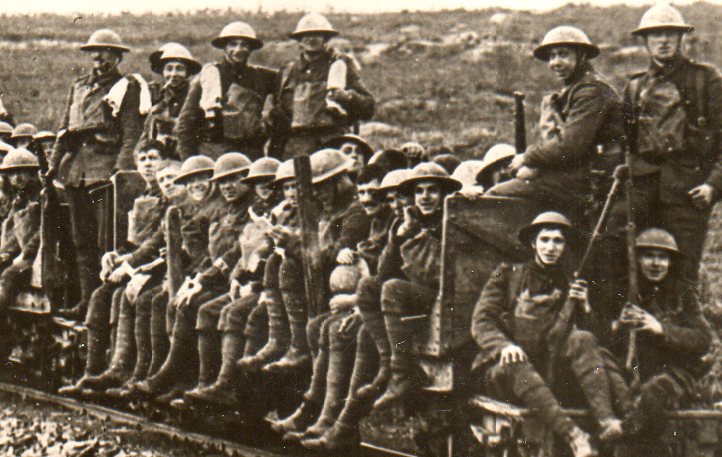
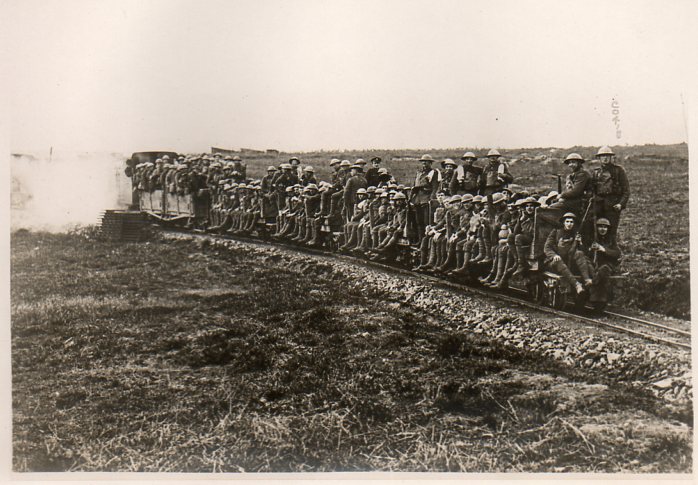
  • Survivors on the Little Train to Hot Showers–WWI Photographs, 1918

    JF Ptak Science Books  Post 1329

    I suppose there there was little to lift morale more than to have troops return to divisional from the front line to enjoy a hot shower–outside of course than to be brought home away form the fighting, entirely.  These soldiers were about to enjoy what I am sure was a well worn break from the action. (The original photo is available for purchase at our blog bookstore.)

    Marching railway car355
    The soldiers were riding a narrow gauge railroad, brought to France from Canada, headed back to safety and “the baths”. 

    [Also, in keeping with my previous post, to represent all of the casualties of WWI you would need this trainload of men to extend from NYC to L.A. and almost all the way back again, about 6,000 miles of people.]

    Marching railway car356

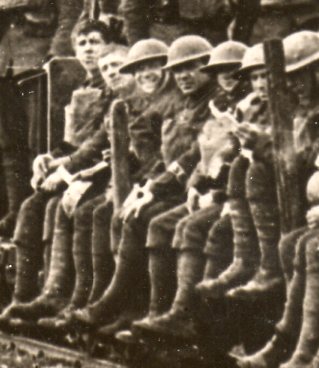
    And this, below–I see the soldier at the far right is reading a letter, I’m guessing a letter from home, as he has his knees tucked up maybe trying to protect its contents from prying eyes.  The soldier to his right is engaging in the age-old custom of reading someone else’s mail over their shoulder, desperate for any news from anywhere.  Who knows–maybe the guy was sharing. 

    Marching railway car357

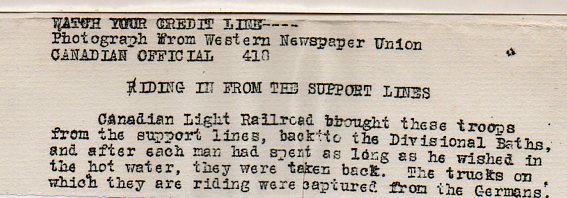
    And then–as we are told in the caption for the photograph–they were given as much time in hot water as they wanted. And then:

    Marching railway car txt361

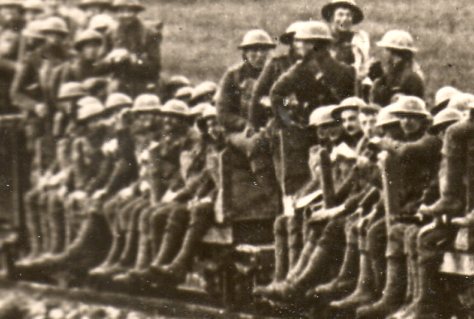
    I think the return trip would’ve looked much different.

    Marching railway car358

    Marching railway car txt360


  • Ghost March–Doughboys in London and Four Years of Mist, 1918

    JF Ptak Science Books   Post 1328

    .003%  That’s what I reckon this column of soldiers would represent of the total casualties of WWI.

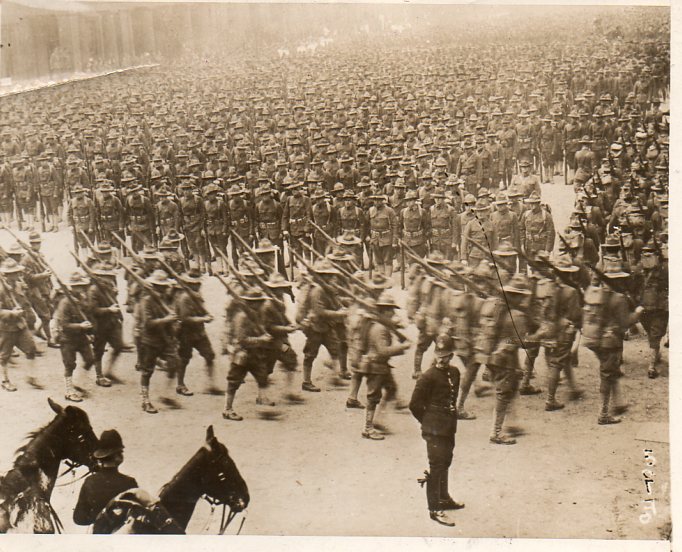
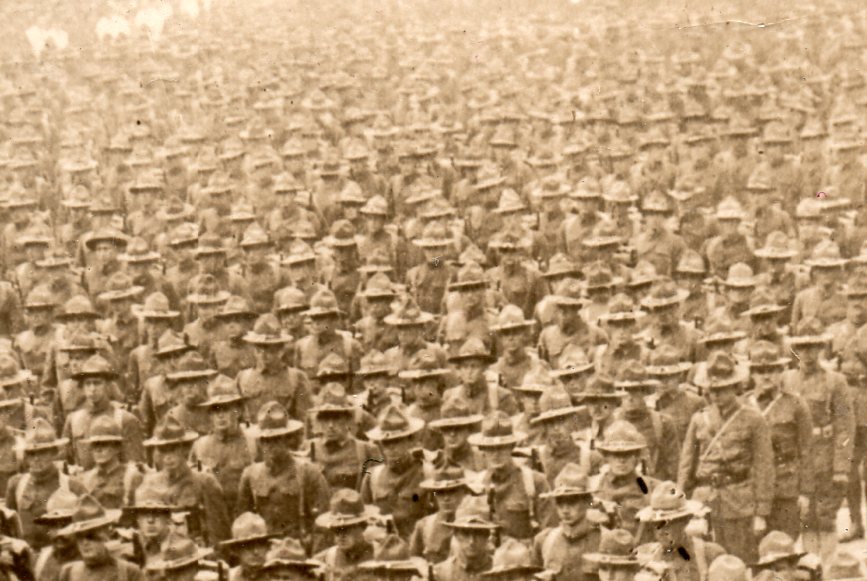
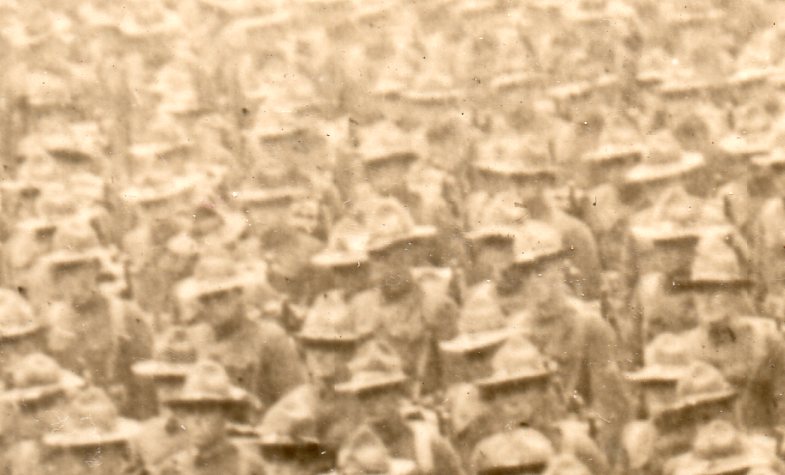
    Generally images like this are a virtual image-host for me, a bucket of ice cold water thrown onto a sizzling summer sidewalk, all sorts of ideas steaming from it.  But for photographs of Doughboys1 marching, especially assembling for parade, this one struck me a little more oddly than most, giving instant pause, making me concentrate on the haze, or dust, that allowed the columns of soldiers to blend into one another and fade, losing their boundaries with their mass receding into a dull blur. 

    Marching london 350

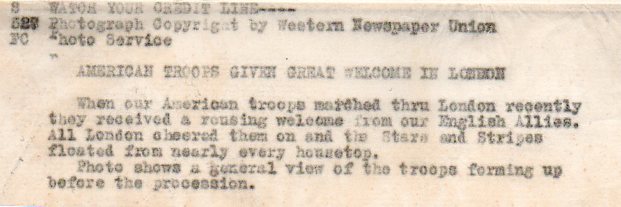
    The Western Newspaper Union was selling this image for insertion in newspaper or journal stories about the war, for a small use fee.  There were a few American organizations like Western Newspaper that were created to photographically cover the war, using pools of photographers who would distribute their work anonymously and which was available for common, general use for a small charge.  The photographs allowed out were certainly restricted and censored, though in my stash of these of objects (numbering about a thousand) I’d say that 10% of them look pretty edgy to my eyes.  Most of the action of war was not covered, but then again this aspect was still fairly technically difficult in 1918.  Images of pain were almost never allowed, and certainly not pain of Allied troops.  Aid stations were almost never covered as well, as were dead bodies, or at least those again of Americans or Brits or French or Canadian.  The imaging of the war was certainly under a fair amount of supervision and control. (The original is available for purchase through our blog bookstore. here.)

    Marching london det352

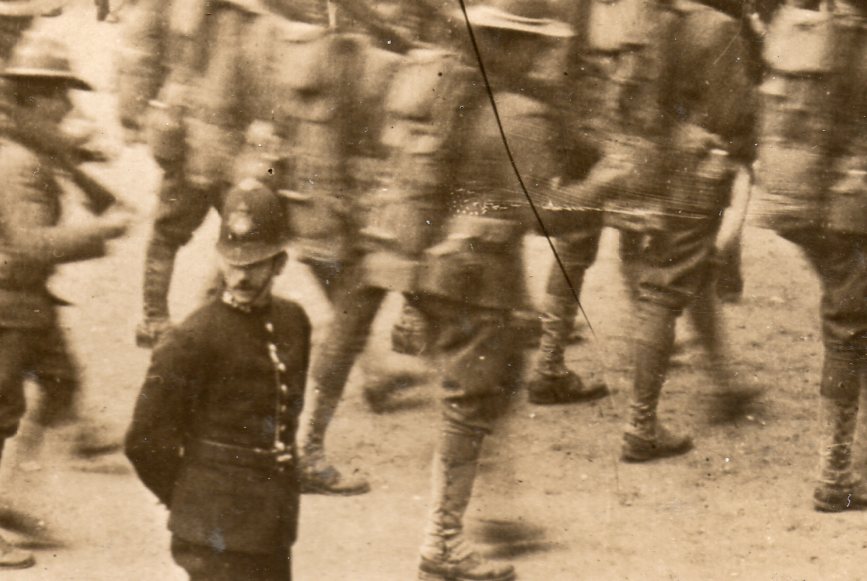
    The image shows American troops assembling for a parade through the streets of London before being deployed.  The mistiness of the composition looks like a statistic to me, these men standing for those who had come before and fallen.

    Marching london det353

     The U.S. lost .13%  of its population to casualties (125,000 killed and 205,000 wounded) during the war–a war which by the time America got here had already been visciously fought for three years, costing dozens of millions of lives.  The figures for everyone else weren’t nearly so “fortunate” as the U.S.:  New Zealand’s 18,000/41,312 killed/wounded amounted to 1.6% of its population.  The U.K. lost 2.19% (964,000/1,663,000), Italy was 3.48% (650,000/953,000 plus 650,000 civilian casualties), while France suffered a 4.29% (1.4 million/4.27 mil) blow of its total population to war.  Things were worse on the other side:  Germany 3.82% (2 mil/2.4 mil plus 426,000 civilian deaths, and the Ottoman Empire 12% (400,000/771,000 plus 2.1 million civilian deaths.   Worst of all was the Ally  Serbia, suffering a catastrophic 16% loss of its population to war, including 275,000/725,000 plus 426,000 civilian casualties.  As gruesome as the numbers were, the Americans felt only a small percentage of the total sting of war–by 11 November, more than 21 million soldiers would have been wounded, with 9.7 million soldiers and 6.8 million civilians killed.  It was an enormous price.

    And that’s what I see in the mist of what may be something like 10,000 soldiers on display n this photograph.  .003%  That’s two of these columns every day, twice a day, for the entire 1550 or so days of the war.   

    Marching london cop351

    Marching london txt354

    Notes

    1.  The origin of the term “Doughboy” is unclear, or varied, or rich, but it is at least pretty oldm beginning around the time of the Mexican American War in 1846-1848–evidently when the soldiers marched through dry, tough terrain they wound up being covered by earth with the color of dough.  Doughboy.


  • The Guts of Mathematics, Archimedes’ Dog, and the Greaseless Anatomy of Machines

     JF Ptak Science Books  Post 1326

    “…with his blood he confused the lines of his art”—On the death of Archimedes, in Valerius Maximus

    “….Bark, bark bark!”–Archimedes’ dog

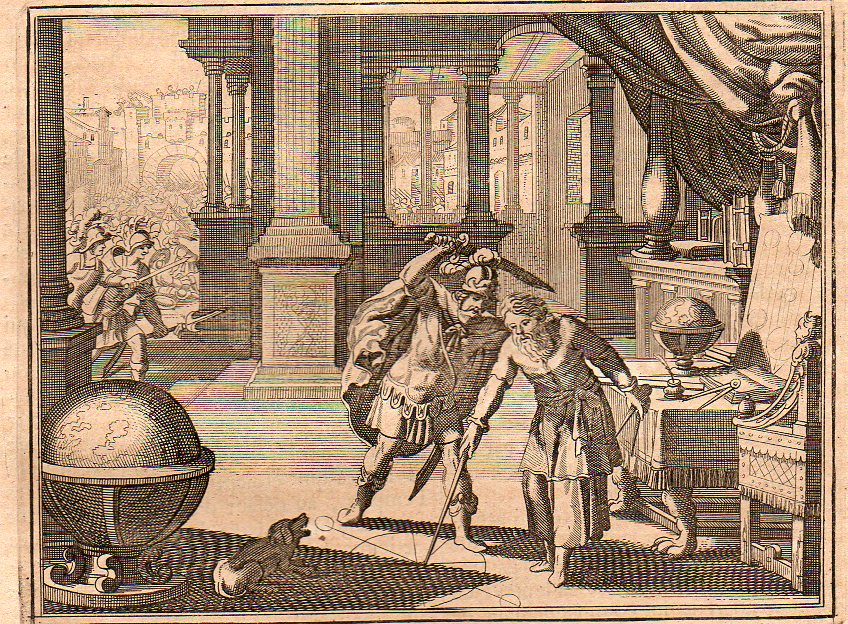
    I came across this unusual and not-web-reproduced image of an infamous scene in the history of mathematics, the murder of Archimedes.(The original is available for purchase from our blog bookstore.)  There have been a number of depictions of the event, a few dozen artists it seems–including Daumier and Delacroix and others whose name do not begin with “d”–who have chosen to try and capture the moment.  (The website at  NYU reproduces some of them;  Drexel also has a very good space devoted to Archimedes and is a great source for quotes dealing with the event.) This one comes from (I think) Histoire Universelle published by the ubiquitous Peter van der Aa in Amsterdam at the turn of the 18th century, and falls in line with many of its comrades in that it depicts the tragedy in the second before it occurred.  One thing it has that other scenes do not–a barking dog.  Maybe it belonged to Archimedes, maybe not.  But there was a dog depicted here, and it was barking at the scene, probably barking at the man about to stab the mathematician, which means it would’ve been the mathematician’s dog.  But Archimedes certainly didn’t hear the dog if he couldn’t be interrupted by the battle outside his door or the Roman who yelled at him to turn.  (I believe Roger Clemens when he says that he didn’t realize he was throwing that bat fragment at someone, saying he was in the zone.  It happens.)

    Archimedes 1705348
     Archimedes dog 1705349

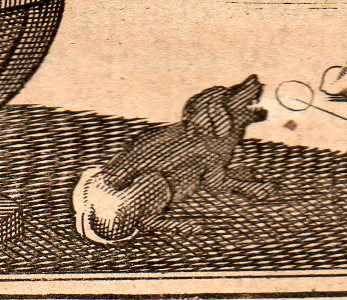
    And a detail of the dog: shows him barking from a reclined position.  Jarred awake by the intruder, he sees the  action just before the critical motion–not quite awake, no time to stand, the dog (snarling with teeth barred) tries its best. (I am romanticizng the dog part of course. My own dog, Bluey, now 14 or so, simply stared at the people who walked into my house last night with their luggage, thinking that mine was the bed and breakfast where they had their reservations.  He sat and stared, and they stared at him.  Missing their destination by one house, how disappointed they must’ve been to think that their retreat was filled with an old dog, kid toys, a dead Christmas tree, and the rest of the jumble.)

    I’m not aware of any artist who steals the moment quite so graphically at Jost Ammon (below) does, though. He also makes no effort to remove the millenium-old event from his own Renaissance environment.

    ==blog==july 8==arch 2

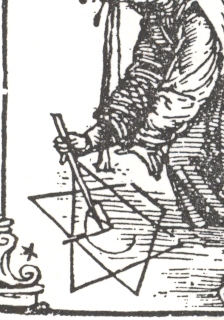
       Seldom do we see a maxim so vividly depicted as with these lines from Valerius Maximus:  Archimedes trying to hold a thought in his head while a Roman soldier comes tugging at him, Archimedes pushing the soldier away to protect the geometrical work that he was scribbling in the sand, and then having his head full of thoughts spilled onto the drawing he was trying to protect.  What we see in the detail is almost exactly (or on the verge of being exactly) from the Valerius quote fragment  “…with his blood he confused the lines of his art”:  Archimedes has spoiled his geometry in the moment before his cleaved head releases the control of his muscles.  It is a nasty image, the pissed-off Roman soldier—who theoretically was just looking for spoils in the looted city of Syracuse—having had enough of the three-second hesitation by the old man and reacts badly, beheading him the hard way. (I’ve written about this pirnt earlier in this blog, here.)

     ==blog==july 8==arch This is definitely the great CSI moment in the history of mathematics, so far as Mr. Ammon is concerned.  There is no chance not to see that there is no heraldry to the moment, no faint-away moment, just blood in the sand. 
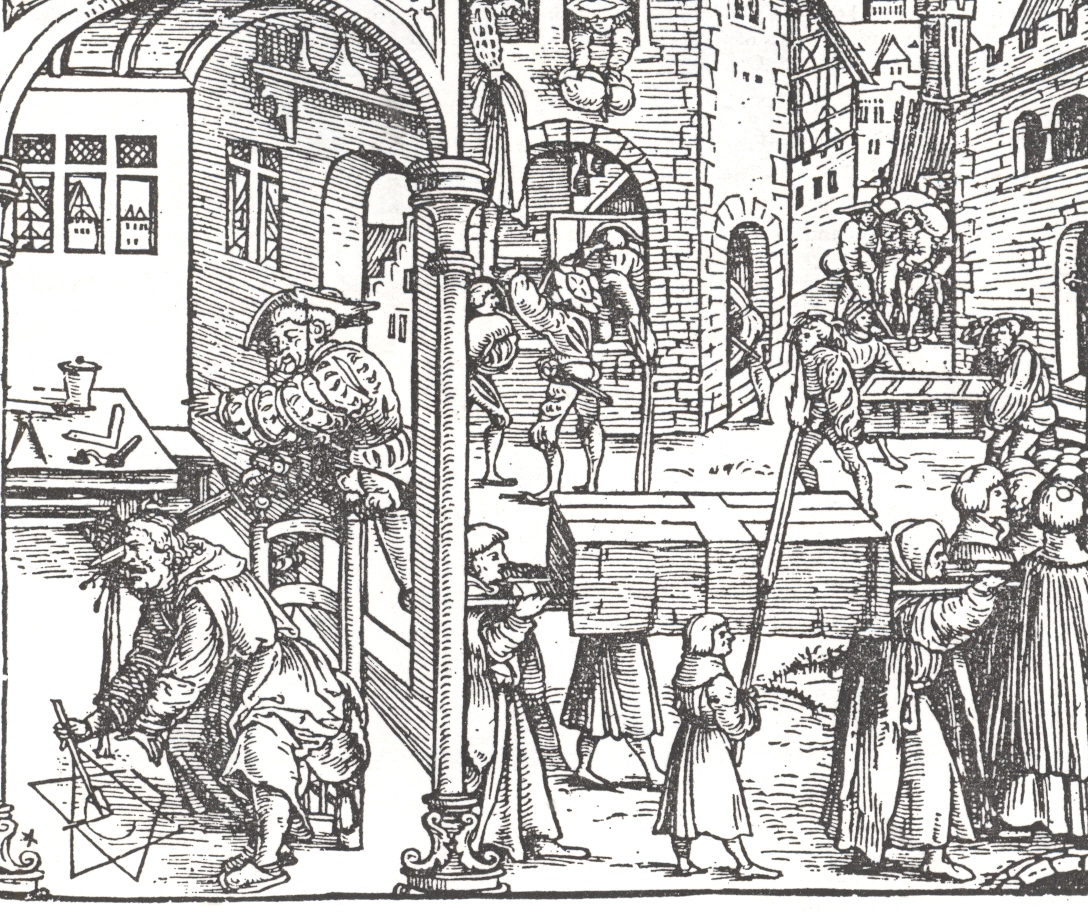
    And for some reason–except for the dog part–all I can really think about here is the anatomy of the machines that were shown by the great Precisionists of early 20th century art, the artists who depicted the modern industrial landscape and its tools with fantastic precision and modern-Gothic-y grace. 
    The artists who found modernity–a modernity found mostly in America–in massive factories, and shining metal, and spokes and gears and all of the other components of factories. There was of course the Marinetti manifesto preceding all of this, and the 1913 69th St Armory Show,  and the coming of the French (Duchamp and Picabia  & Co.) in 1915 and the Tzara/Huelsenbeck/Ball Dadaist 1916 movements and the rest….but what I’m reaching for is the slightly later work, the early ‘twenties, with Hartley and Stella and Sheeler And Demuth and Schamberg (and even the early O’Keefe).  This is where I think we see machine art, an oddly realistic semi-cubist something, depicting the power and form and grace of the machine itself rather than the expression of its dynamism. 
    But what happens (for me, anyway) is this–that when the guts of the machines are revealed, that when we see inside to the components, the very anatomy of modernity, we see a clean, rustless, oil-less, greaseless, world.  Big and heavy, massive things of terrific density, and they smell like nothing except their own immobility, which so far as I know smells like nothing.  As much as I find these artworks beautiful, I miss that their core wasn’t represented–I’d would’ve liked a little more mess.  This is antithetical I’m sure to the message, but it is the essence of the machine. 

    Zoom Image
    [Charles Sheeler, Stacks in Celebration, 1954.] And humans didn’t often make it into these images–as much as I like the artwork of Louis Lozowick, I like it more when he peoples-up his ultra-tech/urban images.  That’s another story. 

  • The Importance of Mistakes: Kircher’s Table of Transformations, 1664

    JF Ptak Science Books   Post 1325

    The great semi-mystifying polymath Athanaseus Kircher (1602-1680) lived for a long time and filled his life with ideas and words,  producing dozens of books during his time on Earth, some of which were never published even though written, some manuscripts lost forever. His was a massive output of extraordinary breadth.  He wasted little time what I can see, writing on a spectacular range of subjects, enlightening people, confusing people, generating great theories and some bad ideas. 

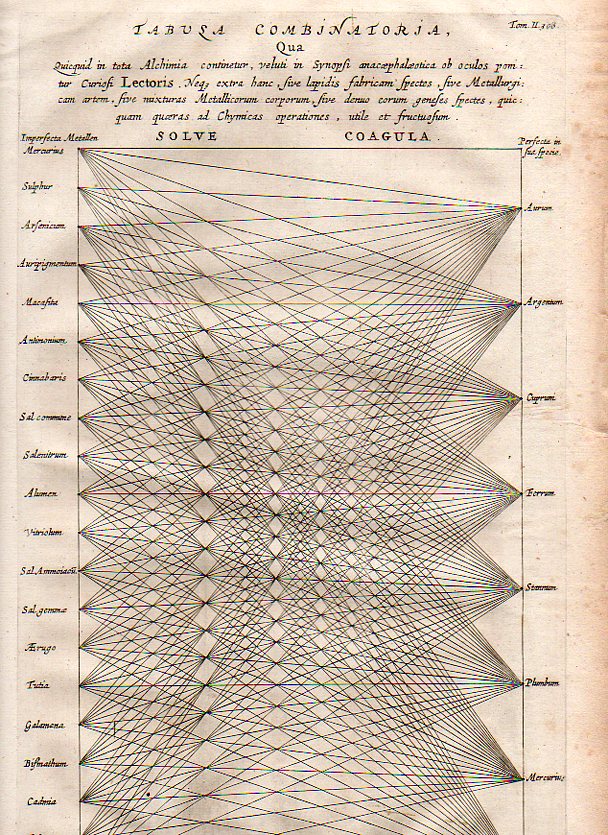
    The image below comes from his Mundus Subterraenus, published in 1664, and which was concerned mainly with geology and the theory of the Earth.  He postulated the structure of the interior of the Earth, the origin of heat, the source of the tides, the composition of light, and of course the existence of the Virgin Mary in amber.  There was also a fair amount of work on one of his side interests that populated a number of hs works, alchemy and the search for the organization of materials. 

    This image, “Tabula Combinatoria” (combinatory table or table of combinations) was an attempt to classify the alchemical transformation of metals and nonmetals via solve and coagula (mediante igne solvuntur et coagulatur),  of solution and coagulation, a Curiosi Lectoris of  Chymicas operationes, in a search for the key to all transformations, the prima materia. [The original erngraving is available from our blog bookstore, here.]

    Kircher as I said exceeded his learning and logic all throughout his life, usually with positive results to us here in his future; but in this case, his alchemical quest–like the million words and countless hours and lead-based brain damage undertaken by Sir Isaac–proved to be a dry hole.  But dry holes like mistakes in general are not necessarily without importance–they are valueless if and only if nothing comes of them, or nothing is recognized in i n the method of leading to the mistake, or if by our using the mistake it didn’t allow you to pursue something else.  Science life is filled with almost nothing but error to the observer–it is our job to do something with the stuff that doesn’t work. 

    Kircher tabula345
     [the image is continued but trailed off of my scanner.]

    Kircher tabula b346

    Kircher tabula c347


  • Tramp-Speak of Antiquarian Road Warriors: ABC’s of Tramps, Hobos and Vagabonds

    Elsewhere on this blog I’ve written a little about dictionaries and words–Sam Johnson, Ambrose Bierce, specialized dictionaries, canting dictionaries, dictionaries of vulgar and coarse language, dictionaries of first uses, dictionaries in distinct fields.
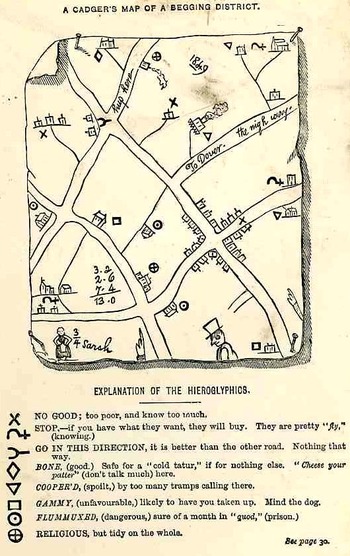
    Bloghobo_b200Hobo dictionaries, guides to hobo slang, are different from those of robbers and thieves and rogues.   They may borrow from one another, but the hobo language seems a little more dignified, and not as directed towards crime as that of, well, the criminals.  An even greater distinction is the hobo alphabet, a Morse Code if you will, a hieroglyphics, for hobos-to-hobos, written in chalk without the benefit of electricity. (I’ve written about that phenomenon here, though I’ll at least reproduce an extraordinary map of a “begging district” found as the frontispiece to the lusciously-titled The Slang Dictionary; or, the Vulgar Words, Street Phrases and Fast Expression of High and Low Society… printed in London by John  Camden Hotten, in 1870.)

    Back to words.

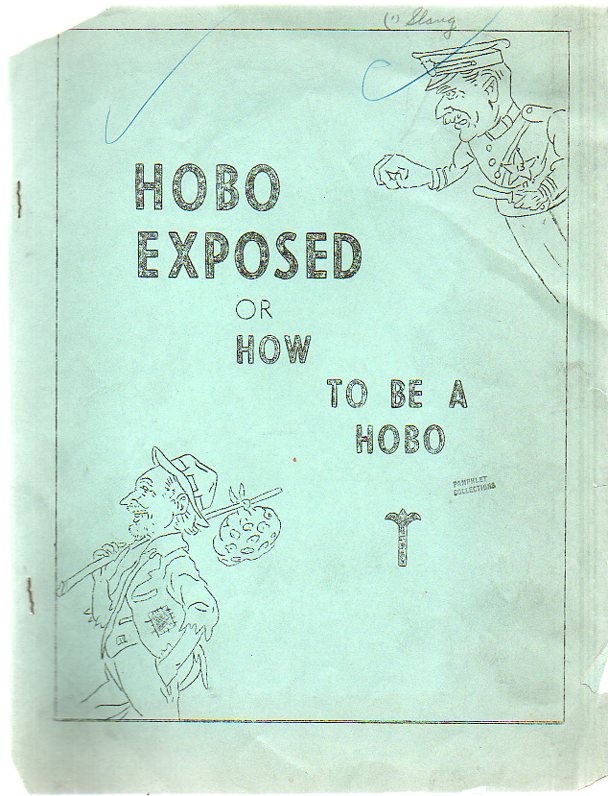
    Part I:  Hobo Slang Collected by a Common and Perhaps Hobos lingo title344 Make-Believe Hobo
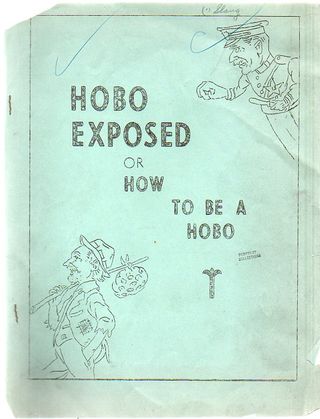
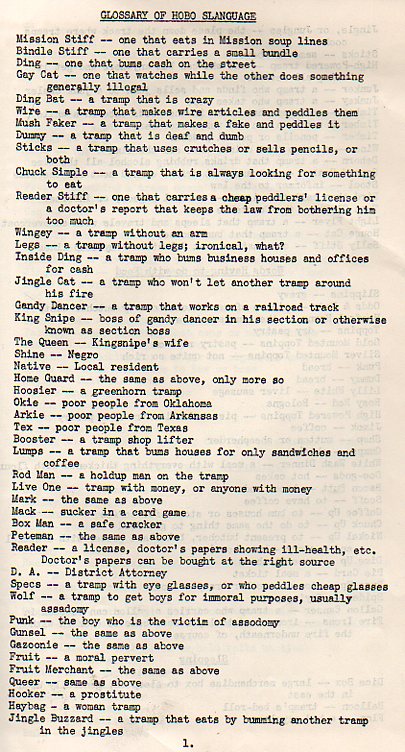
    Hobo Exposed, or How to be a Hobo, at pamphlet  with no claim for a writer but copyrighted by “Kelly’s Specialities” in 1946,  is dedicated to Sun Down Slim, Boston Blackie, Sticks Red and Commissary Blackie.  [This item is available at our blog bookstore.] It gets right to the point of my interest, the Hobo Slanguage.  The collection here is not quite as road-elegant as the collection of the Hobo King, below–not that it is less “regal”, just more common and less imaginative. 

    For example, “Wingey” is the name for a hobo without an arm; “Sticks” is a tramp who sues a crutch; “Legs”, well, you know.  On the other hand I find “grouch bag” (which was a bag of Bull Durham tobacco worn around the neck, which was either valuable enough to be worn that way to keep people out of your pockets or you just didn’t have any pockets), “hogger” (a railroad engineer), “dice box” ( a large discarded merchandise box to sleep in), “slippins” (gravy), “canned heater” (an unfortuate tramp who drinks sterno), “Jingle Buzzard” (a tramp who begs food from other tramps) and so on.

    There are many others:
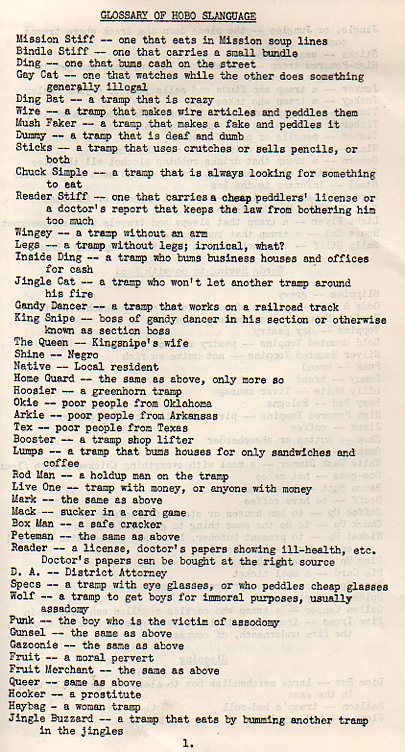
    Hobos lingo a341
    [This section continued below.]

    Part II: Hobo Slang Collected by the King of Hobos
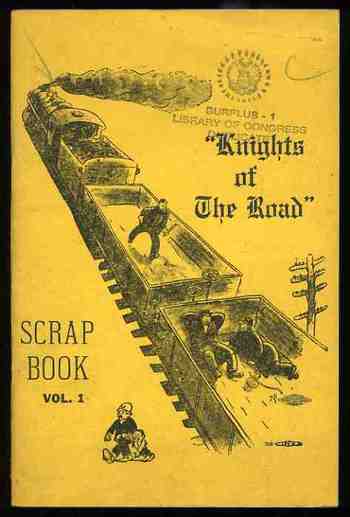
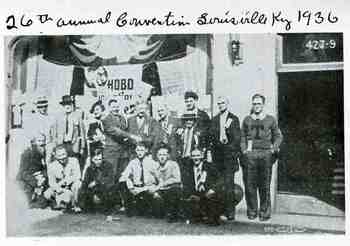
    1blog_oct_8_hobo_cvr785 There have been many Kings of the Hoboes, and Emperor of the Hobos, in the history of American Hobodom.  The most widely recognized of all this royalty is, probably, Mr. Jeff Davis, who was elected King of Hobos each year from 1908 to 1935, until in 1935 at the Pittsburgh meeting of the annual “Hobos of America” his minions gave up elected him King for Life. Of hobos, that is, the Knights of the Road; he was also a real hobo, unlike the pretenders, who in general were not. (Nels Anderson in his Men On The Move, written just as the Depression was broken, (1940) observed: “Whatever else may be said of King Jeff, his romanticizing the hobo is not without a basis in reality, and his poetic interest in the species arose from experience. But King Jeff has placed on a pedestal a man who belongs to the past. The hobo belongs with the pre-Hollywood cowboy and the lumberjacks of the Paul Bunyan legends.”)

    Mr. Davis was certainly very effective in getting the message out—on freedom and responsibility to irresponsibility—and was a great organizer and popularizer. He helped to establish hobo meetings, newspapers and literature (a sample of which is at left). He also had a few movie appearances: in The Arkansas Traveler, 1938 and The Bridge of Sighs, 1915, he ably played the role of a hobo.
    1blog_oct_8_hobo_cvr786

    And what about the missing counterpart of Jeff Davis–Queen of the Hobos? There were certainly allot of women hobos during the Depression; Harry Hopkins estimated that there were something like 13,000 “sisters of the road” who were out and about in the 1930’s. I guess the most famous of them though was one who did not exist; and what parts of her that were real were mostly those of one man: Ben Reitman. Sister of the Road (1940) was supposed to be an autobiography of legendary Boxcar Bertha, but it was really an assimilation of Reitman’s own experiences sprinkled about those of women from his life. Reitman, who was described (by himself) as a “hobo, whorehouse physician, musician and tour manager/lover of Emma Goldman” (??) was probably not without enough experiences to float another character or two, had his story of Bertha wind up in the hands of exploitation movie maker Roger Corman. The good news about that though was that Corman gave the project to the very young Martin Scorcese who produced an odd and not bad film on no budget, and Boxcar got to live again.

    But what brought me here to begin with was Davis’ breakdown of some very colorful hobo slang, all of which was found int eh little yellow pamphlet (pictured above), and published as a “reference manual” in 1947.  And so:

    Gay Cat.  Someone who “beats it from town”, settles down with a job and puts together some money so that he can get on the road again.

    Gandy Dancer. “Is a hobo shovel stiff, a muck-stick artist”, a common laborer

    Pearl Diver. A hobo dishwasher and who works for his meal.

    Mush fakir. A hobo umbrella mender with a patch kit and a second-hand umbrella strapped to his back. (Evidently these guys were put out of business when larger stores began offering umbrella repair on their own.)

    Bindle stiff. A hobo who carries his stuff in a sack on a stick, including toothbrush, “but he does NOT carry blankets”.

    Kywah. An honest hobo pitchman peddling soap, perfume, jewelry, novelties, pens, knives and potatoes peelers.

    Kewah. :Makes and sells articles such as willow stands…”

    Scenery Bum. “A young tramp who bums it around the country, just for the fun of it.”

    Ring-tail. “An ignorant, harmless tramp.”

    Fuzzy tail. “A smart aleck tramp, jack of all trades, a fourflusher, big bluff, false alarm, and piker of the worst sort, who most always carries a “punk kid” or “road kid” (a runaway boy).”

    Dingbat. “An old tramp professional beggar who dings the main stem (begs on the main street).”

    Stew bum. “An elderly tramp who wastes his time continually drinking rot booze.”

    Jungle Buzzard. “A tramp who loves to eat but is too lazy to get the ingredients for a mulligan stew. He eats what is left when the gang leaves the jungle fire.” Yum.

    Road Yegg. “A vicious tramp of the petty larceny type, a cheap crook.”

  • Blank & Empty Things Series: The Militant Christian Patriots, Hitler and Saving Britain from Itself, 1938

    JF Ptak Science Books  Post 1323

    [Part of our series on the  History of Blank, Empty and Missing Things]

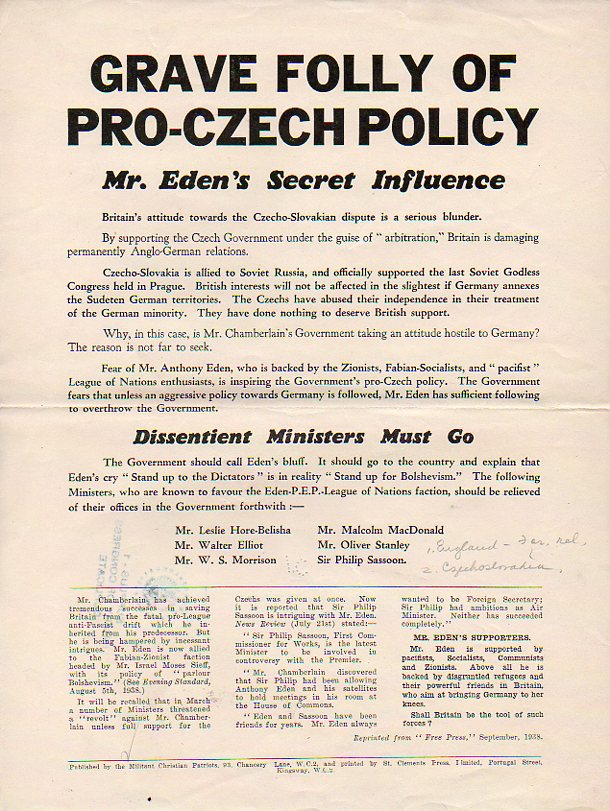
    The flag of the group Militant Christian Patriots may tell you something about them faster than even their name:  it was a large bright red field, with a white circle in the center, in the center of which was a simple black cross.  Drop the horizontal bar to the middle, elongate it, shrink the vertical just a tad, and turn the ends of each bar 90-degrees at 75% of their length,  et voila, you have the Nazi flag. 

    This unsigned circular blasts the “appeasers” from inside the government of the valiant Mr. Chamberlain, who is supported by the Militant Christian Patriots in his stance to keep Britain out of the developing (and developed) trouble brewing between the Nazis and the Czechs.  The piece of paper that Chamberlain held aloft at the airport, claiming victory with his appeasement of the Nazis and happy with the firm trust in Hitler’s signature, was a good document to start with for this extremist group.  Next, they would have Mr. Anthony Eden (who wound up resigning his position until recalled by Churchill when he finally and thankfully took over the office of PM from Chamberlain in May 1940) removed, what with his alliances to Fabian-Zionists and all.  The other ministers targeted by the Militant Christian Patriots were among those others who supported Eden and worked against Chamberlain–undesirables, “pacifists, Socialists, Communists and Zionists”.   The other branch of their unholy alliance were “the disgruntled refugees and their powerful friends in Britain, who aim at bringing Germany to her knees”, because, somehow, members of Parliament were somehow responsive to disgruntled refugees.
      Fascists--czecholosvakia document340
    [The original document is available for purchase from our blog bookstore.]

    File:MunichAgreement .jpg

    This is a photo of Chamberlain at the airport with Hitler’s signature, telling the world, basically,  that “it was up to the Czechs, now”, somewhat confident in the fatal Munich Agreement, trusting Hitler to end his European territorialism .  The occupation of Czechoslovakia came just months after the Austrian Anschluss of March 1938, but, well, the Prime Minister had Hitler’s signature.  It would not take long for this picture, and for the newsreel, and for Mr. Chamberlain’s face and even his very umbrella, to be used as iconic symbols of disastrous failure. 

    The Militant Christian Patriots were faithful to none of the words they used to identify themselves–after all, calling yourself something does lead to some sort of expectation…


  • World War I Photography–Heavy and Stuck

    JF Ptak Science Books 

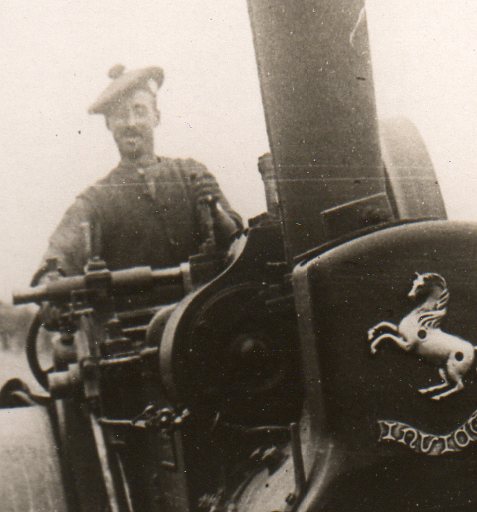
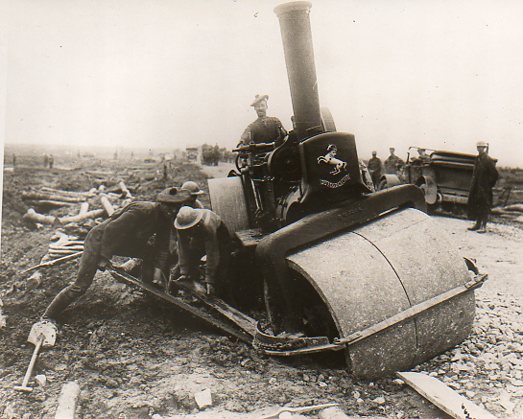
    What is this man smiling about?

    WWI--steamroller detail smile336

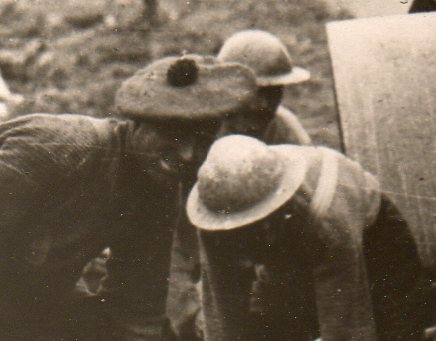
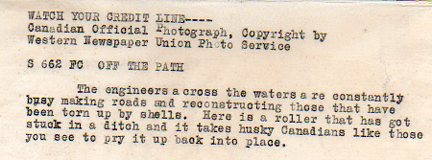
    He’s satisfied with his place there in the tractor, rather than his soldier brothers whop were trying (impossibly) to leverage the beast out of a shell-made muck hole. At least the guys on foot had a comic sense of what their task was supposed to be. [This original photograph is available for purchase at our blog bookstore.]

      WWI--steamroller detail smile338

    WWI--steamroller334

    WWI--steamroller text335

    ·Posted by :

    ·in:

    —

  • World War I Photographs–German Prisoners, the Somme, 1916

    JF Ptak Science Books   Post 1322

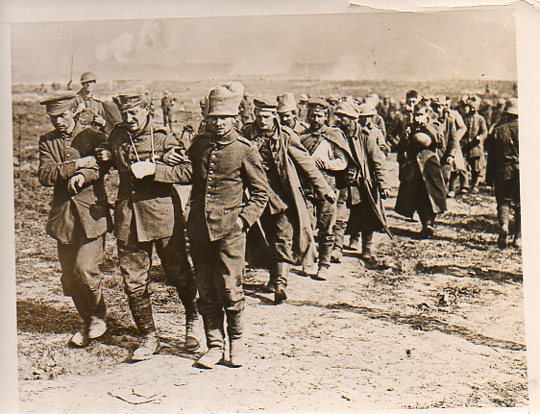
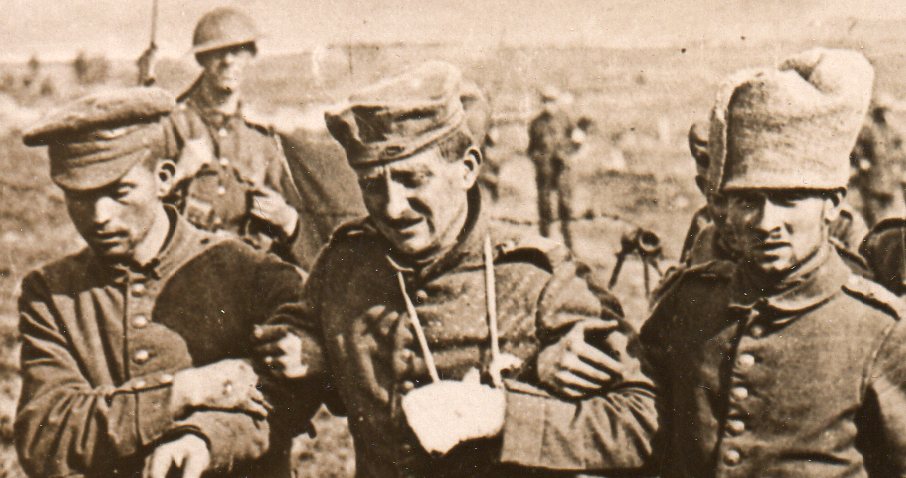
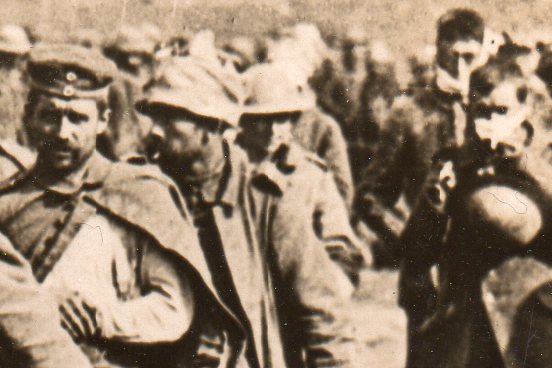
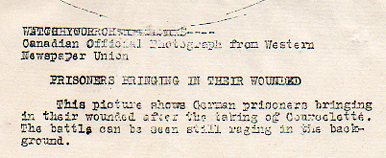
    This news service photograph (a Canadian Official Photograph from the Western Newspaper Union) shows a line of German prisoners of war in the Canadian lines at the battle of Courcelette, France. [The original is available at our blog bookstore.]

    WWI--German prisoners--marching328

    It was a battle that took place within a battle,  in the last third of the enormous 18-week series of battles and actions known as the Somme Offensive. The photograph was made between early September and mid-November 1918, which is when the Canadians joined the British offensive.

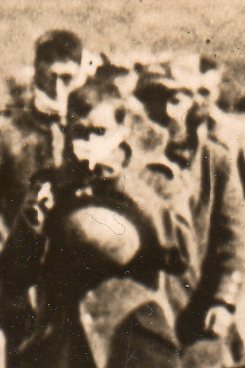
    The landscape is bleak, the soldiers worn.  I rarely see expressions of pain in this series of 1500 photographs from a collection of war images that I purchased.  This is one of a very slim minority.

    WWI--German prisoners--marching 330

    WWI--German prisoners--marching 331
    WWI--German prisoners--marching 332

    WWI--German prisoners--marching text329

    ·Posted by :

    ·in:

    —

  • World War I Photography–Soldiers at the War’s End, Germany, November 1918

     JF Ptak Science Books   Post 1321

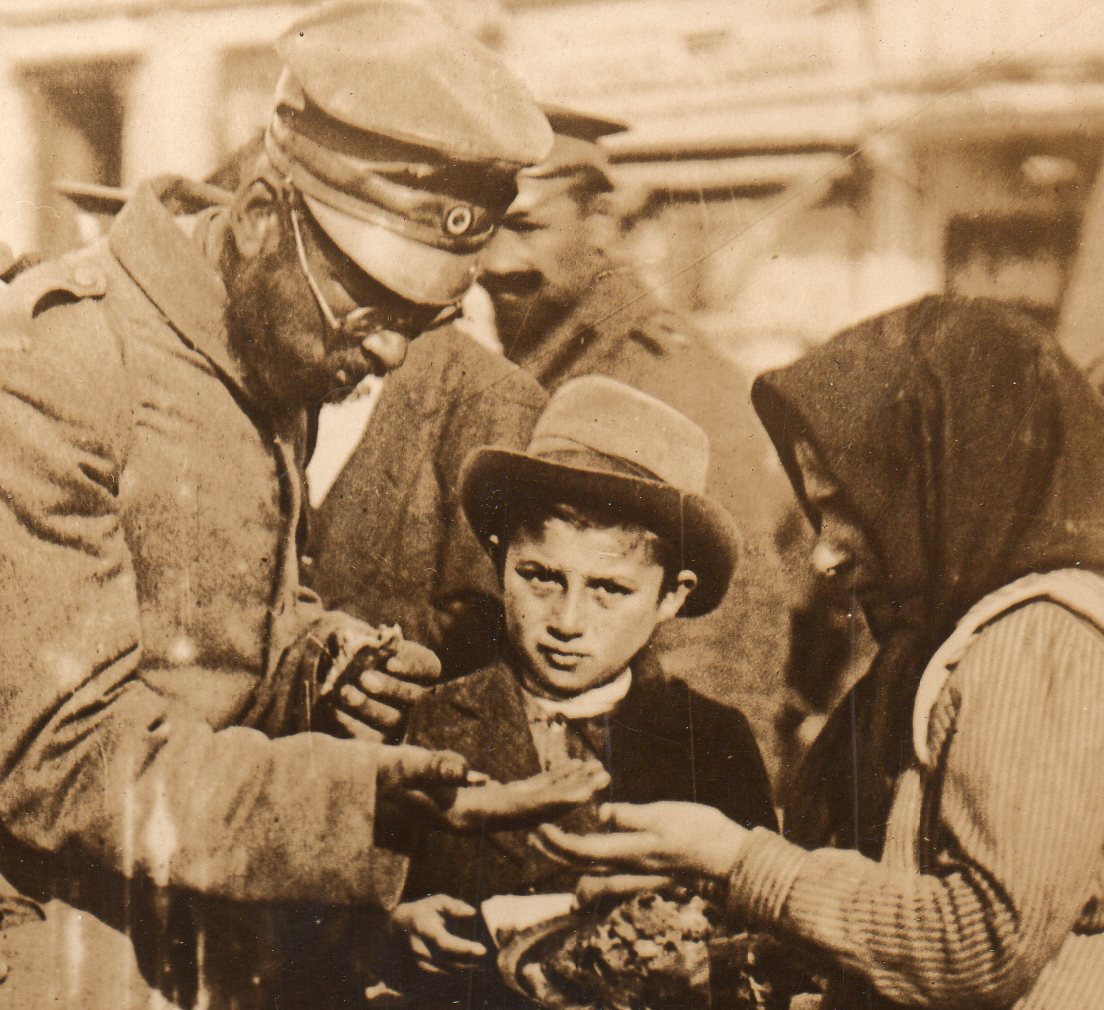
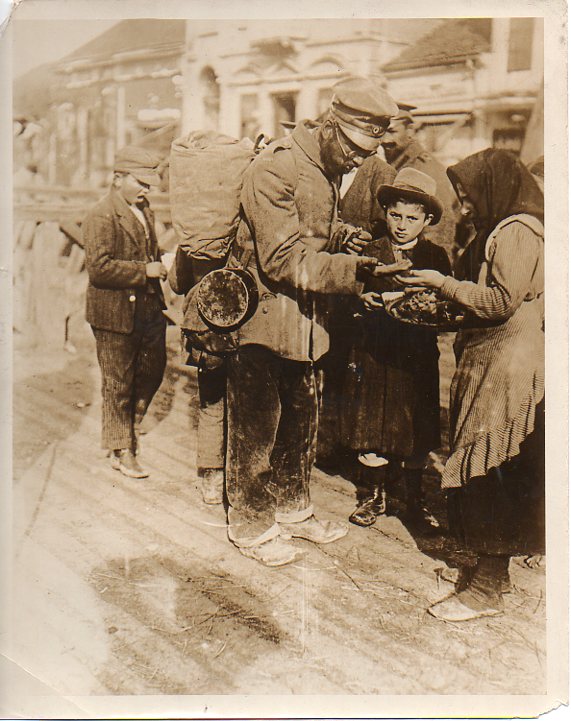
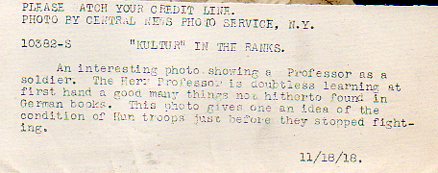
    I’m not sure what this photo depicts specifically but in general it sends an image of exhaustion and wear.  The caption for the image says that it shows “the condition of the Hun troops” and that the subject “Herr Professor” is learning “a good many things not hitheroto found in books”.  Maybe he was a teacher, maybe not.  Machts nichts. His pants looks velour-like and his boots (if that’s what his footware was) look very thin.  He is ragged, his double-fold glasses look like they’re at their limit, his face looks swollen behind his beard, and he just looks “done”, in general. 

    WWI--german--beggar det326
    [The original of this photograph is available at our blog bookstore.]

    I’m not sure what he is doing, or where he is.  He may be trying to figure out local currency to purchase whatever it is the vendor-woman has on the tray at her hip–she os holding out her hand, and looking at his.  The soldier definitely has something there, and he looks basically too weary to comprehend it.  the hand language is ambiguous to me.  He may have received something already, some sort of food, and he is staring at it now, thinking perhaps how little of it there was.  He’s eating, and already has taken a bite of whatever bread-like thing is in his left hand.  I’m not sure what attracted the attention  of the boy in the center–perhaps it is simply the camera, and he wanted to be in the shot. 

    WWI--german--beggar325

    There’s a shadow in the foreground-left of what looks like someone making a photograph of teh scene–probably not our photographer, but another, with a brownie or some such smaller camera.

    At the end of years of fighting every general soldier deserves respect and, at least, some free food–I hope this guy got his.

    And the accompanying text to the news photo service image, to be used if published:

    WWI--german--beggar text327

    ·Posted by :

    ·in:

    —

  • Brevity and Complexity–Radio Programming, 1940

    JF Ptak Science Books   Post 1320

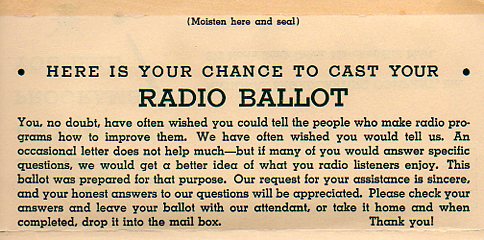
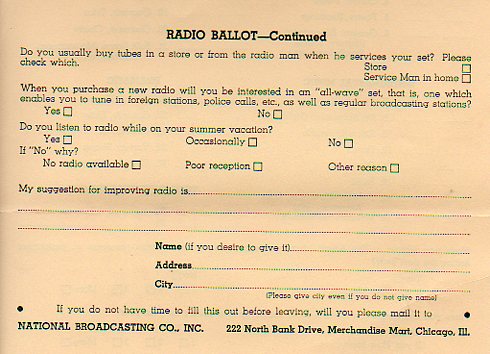
    Radio Ballot c cvr323   I think that if a grown-up kid in 1940 was offered the chance to have a working-man’s Super Power,to be suddenly endowed with a non-heroic Super Something, a popular choice could have been to possess  radio repair vision (RRV).  Or that’s what it seems like.  The popularity of radio was so fantastic that ownership of radio sets doubled in the United States from 1931 to 1938, when houses with radios rose from 40% to 80%. Radio was everything.  There were many contributory factors to this phenomenal increase in popularity, not the least of which was the Great Depression–once you got your radio the listening was basically free except for the power that it cost to run the radio.  Recorded disks on the other hand suffered tremendously, with sales falling from $75 million in 1929 to 23 million in 1938 (with a low point of $5 million in 1933), and that would be due to the Depression and the the popularity of free stuff on the wireless, as well as other things.

    Radio Ballot a321

    People maintained their radios, kept them in good order, tinkered with them, cleaned the tubes, replaced the tubes, kept things going.  Those early units were pretty hearty, overall, but there was a certain percentage of folks who couldn’t do the basics for themselves, and so would bring in their radio repair man.  He was an important fixture in a community–not quite like the milk man or the ice man, who would be seen everywhere every day, but popular enough.  TO be able to fix radios with supervision and kept millions of people connected would’ve been a big deal, especially if you thought about it with the mind of a ten year old.

    Radio Ballot b322

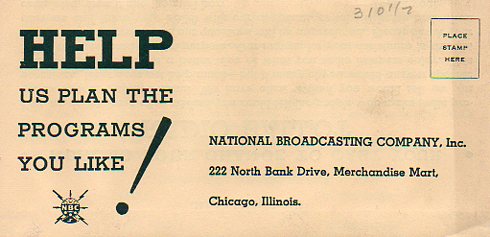
    I’m just trying to establish the popularity of radio with this aside to get at the main point of this post–how radio executives at NBC tried to access the common knowledge base of what people wanted to hear on the radio, and when.  And one aspect of that was seen on this single piece of paper: [The original is available for purchase at our blog bookstore.]

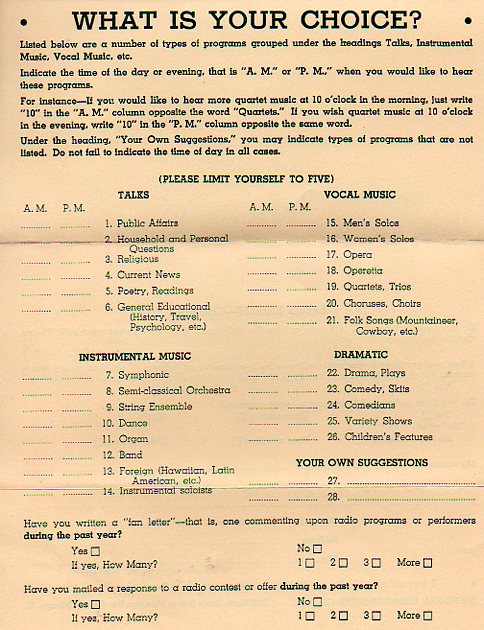
    The National Broadcasting Company sent out self-adhesive mailers to people to probe their listening needs.  This would seem prehistoric by today’s standards of estimating what television/video watching people were like and what they would want to see, and perhaps to pay for.  But in 1940*–or perhaps a little earlier–this was one method of making this determination, with a gentle survey about what the listener wanted to hear, and when.   And they were expected to pay for the privilege, as well, as these self-,mailers weren’t pre-stamped. 

    On the questionnaire of listed types of programs we find 26 examples, including six for “talk radio”, sixteen for music (eight for  instrumental and seven for vocal!), and then only five for the dramatic stuff (comedy shows, drama, variety shows, and even one for children. (An historian of radio programming would probably know instantly the age of this flyer given the number of slots slated for the drama shows, I’m sure.) The division  of the music is also interesting, particularly for me since “string ensemble”  is one of the 26 overall programming selections, though I doubt that they were talking about the late quartets of Beethoven–I think they might have been referring to sweeping, thousand-string “beautiful” music.  Also the division of “opera” and “operetta” is unusual.
    Radio Ballot d324

    The “brevity” part of listen surveys is certainly attained here–the complexity part will come a little later.  Radio surveys became very sophisticated in the mid-1950’s when radio’s existence was threatened by television, which completely dominated the market for talent and advertising dollars and listeners by the late’50’s. 

    Notes

    There’s no direct mention of FM radio, which came into some restricted use by 1938-1940 and which is not mentioned explicitly here.  Perhaps this means that this was issued before FM–or perhaps it is later, as I said, and simply just not mentioned.