A Daily History of Holes, Dots, Lines, Science, History, Math, Physics, Art, the Unintentional Absurd, Architecture, Maps, Data Visualization, Blank and Missing Things, and so on. |1.6 million words, 7500 images, 4.9 million hits| Press & appearances in The Times, Le Figaro, Mensa, The Economist, The Guardian, Discovery News, Slate, Le Monde, Sci American Blogs, Le Pont, and many other places… 5000+ total posts since 2008.

Category: Militaria

  • Japanese Propaganda: the Invasion of China, 1931-1938

    JF Ptak Science Books Quick Post

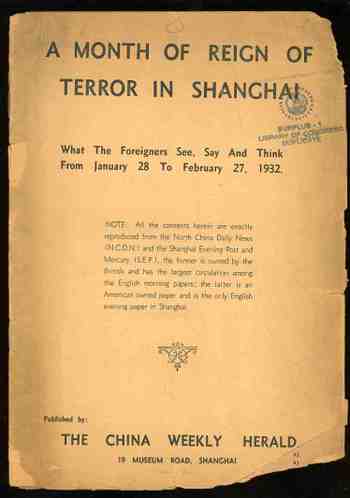
    Blog1sept_8_japanese_prop517 This Why/Who/How pamphlet on the Sino-Japanese War fully and incredibly lays the blame for the war in the hands of China, reminding me a lot of an earlier propaganda pamphlet that I wrote about here on the threat of Poland to Nazi Germany (1939).   Even the title of the war “the Sino-Japanese Conflict” is misleading–placing the Chinese first in the description of the fighting invests the idea with the primacy of the Chinese role simply because it is before the hyphen.  Japanese-Chinese Conflict certainly sounds different, yes?   (Click on image for a readable size; also see below for the rest of the pamphlet..)

    The Chinese tried to tell their story, but I think not nearly as successfully as the Japanese–also this was complicated by the fact that Europeans had been mucking around in China for almost a hundred years by the time the Japanese got to it in 1932, so their voice raised against a foreign intruder was definitely not as loud as it might have been had the foreigners not been devastating China for such a long period of time beforehand. 
    Blog1sept_8_japanchina_side521

    When this pamphlet was published, the war-in-earnest had been waged already for a year, mostly through engagements over a cresting wave of “incidents” in which Japan found it more and more necessary to “protect” itself from China while at the same time trying to harness/steal as much of China’s natural resources as possible.  It would take another six years for total war to set in, the end result of which (in the 1937-1945 timetable for the event) found 20-35 million Chinese soldiers and civilians dead and wounded, while the Japanese lost in the vicinity of 2 million.  This war was basically folded-in to WWII after 7 December, though it is by far the bloodiest war fought in Asia in the 20th century.

    ·Posted by :

    ·in:


  • Manuscript and Carbons on the U.S. Naval Bombardment Survey, July 1945

    JF Ptak Science Books   Quick Post

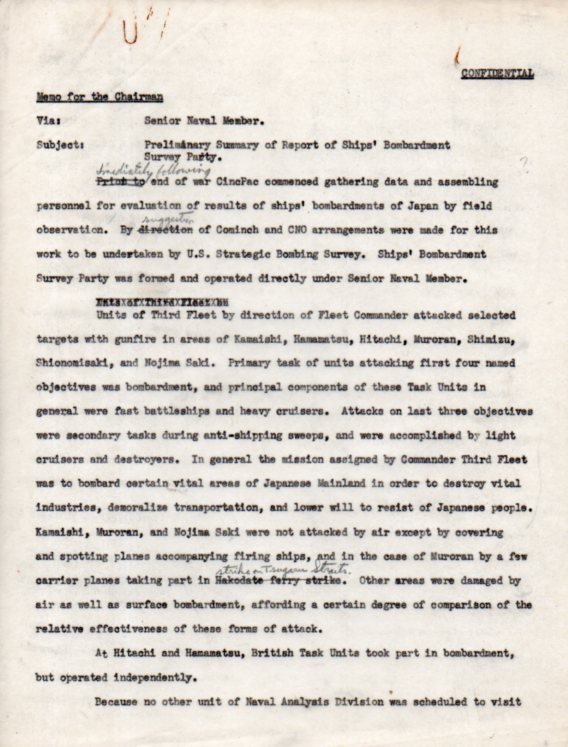
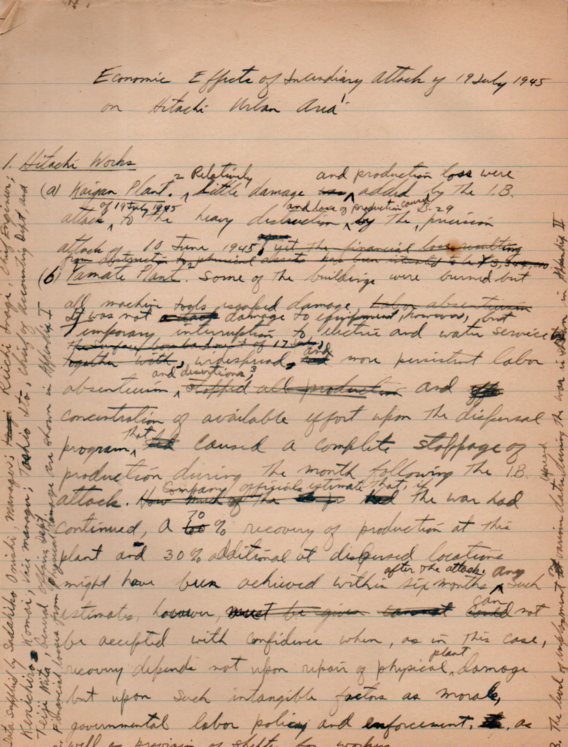
    I just wanted to point out that over in the books for sale section of this blog I posted a bit on a small archive of manuscript and carbon copy material that comprise what seems to be the summary of the U.S.Navy (and Allied) bombardment of Kamaishi, Muroran, Hitachi, Kushimoto, Shimizu and Hamamatsu, forming the Navy Bombardment section of the U.S. Strategic Bombing Survey.  This was about the extent of the Allied naval bombardments against Japan, as it was not possible for battleships to maneuver close enough to the Japanese homeland to fire against industrial and production centers.  (It may have also been the case that the aircraft used to protect the assaulting ships could have perhaps done as much damage to the targets as the ships themselves.)

    For those of you with an interest in these things I’ve posted the entire working copy of the “executive” summary of the report, as well as covers of some of the rest of the sections of the survey, here. 

    USSBS 1176

    USSBS economic effects189

    [The archive is from the estate of J.D. Coker, who served in the U.S. Navy on the US Strategic Bombing Survey Ships’ Bombardment section, and who later became a leading official in the U.S. Atomic Preparedness programs (such as the President’s Committee on Emergency Preparedness).]

    ·Posted by :

    ·in:

    —

  • Philippine Announcement of one of the Last Japanese Surrenders, 15 September 1945

    JF Ptak Science Books   Post 1714

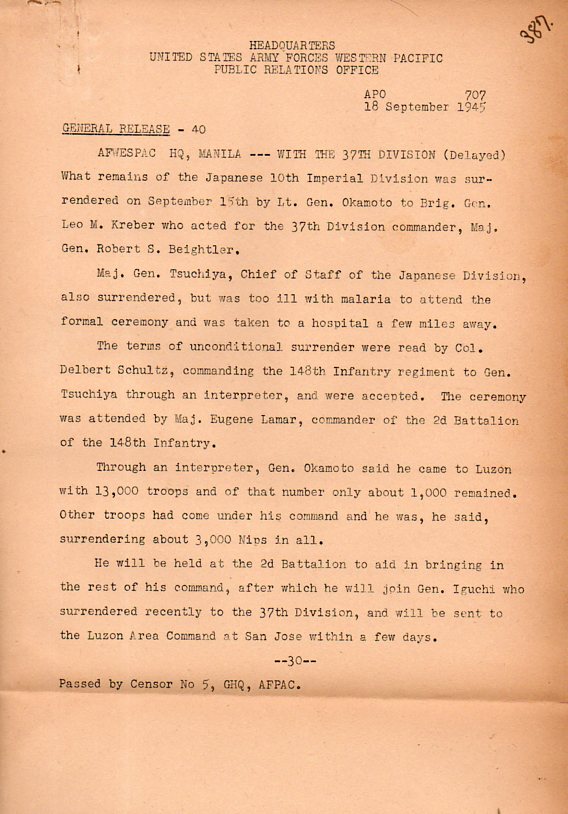
    This announcement comes from the U.S. Army public relations office in Manila (“General Relsease  – 40”) and dated 18 September 1945.  It states that “what remains of the Japanese 10th Imperial Division was surrendered September 15th by Lt. Gen. Okamoto to Brig. Gen. Leo M. Kreber”, this coming weeks after the formal signing of the Instrument of Surrender aboard the U.S.S. Missouri on 2 September 1945.

    WWII  Japanese surrender160
    The 10th Division of the Imperial Japanese Army (formed 1898) was transferred to the Japanese 14th Area Army in the Philippines from China. There it was involved in the Battle of Luzon (9 January to 15 August 1945), where the “what remains” of it statement comes from.  In that battle, more than 250,000 Japanese troops were engaged, with more than 205,000 killed (with only 9,000 captured). On the Allied side, 175,000 troops were engaged, with 8,000 killed and 29,000 wounded. 

    The surrender of the Japanese forces in Manila was one of the last of the major surrenders of armies and army groups would surrender: the Japanese army would surrender at Singapore on 12 September, Saigon on 13th September, and Hong Kong on 14th September. There were pockets of resistance that would hold out for years afterwards, but so far as large organized forces were concerned, this was pretty much the end of the fighting. 

    {The original is for sale in our blog bookstore, here.]

    ·Posted by :

    ·in:


  • Flying Tanks, 1930’s-Style

    JF Ptak Science Books   Quick Post

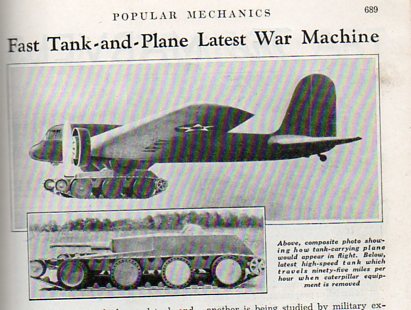
    There wasn’t much pretty in the physical outcome of this thinking–to construct “flying” tanks for quick maneuvers into battle situations–but I think that I like the thinking in it, especially as it seems that the aircraft-end of the tank was re-usable. Still, there was the whole “landing” part of the operation, which meant that (at this time, anyway) the tanks had to be placed and not parachuted to the ground, which also means that the armor would be relatively removed from the field of battle.  But this would be better than driving the things there, or hauling them all on a train  for quick transport.

    Ank158
    [Source:  Popular Mechanics, vol 65, 1936.]

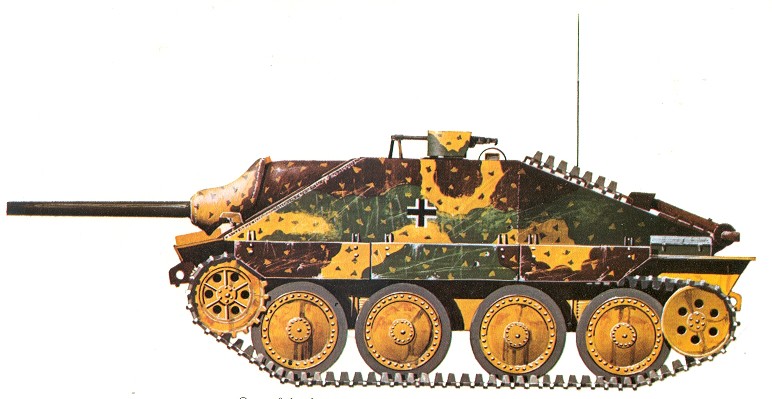
    Also I guess I’m partial to the design of the tank–which I’m guessing was a fixed-position mobile canon–because it seems so strikingly modern. (Except for the tread and wheels part, which is the place where battles are won and lost, at least according to Heinz Guderian.)  But I like the design, which at first glance reminded me of the great T-34, the Russian workhorse of WWII, sort of, at least for its low-profile sensibility, but really more like the contemporary   The Russian Chyorny Oryol (“Black Eagle“).  It really looks a lot more like the STUG assault gun, here:

    [Source: combatreform.org, here; a truly excellent site.]


  • A Managerial Directive on How to Present War News: PM Newspaper, 10 Dec 1941

    JF Ptak Science Books   Post 1694

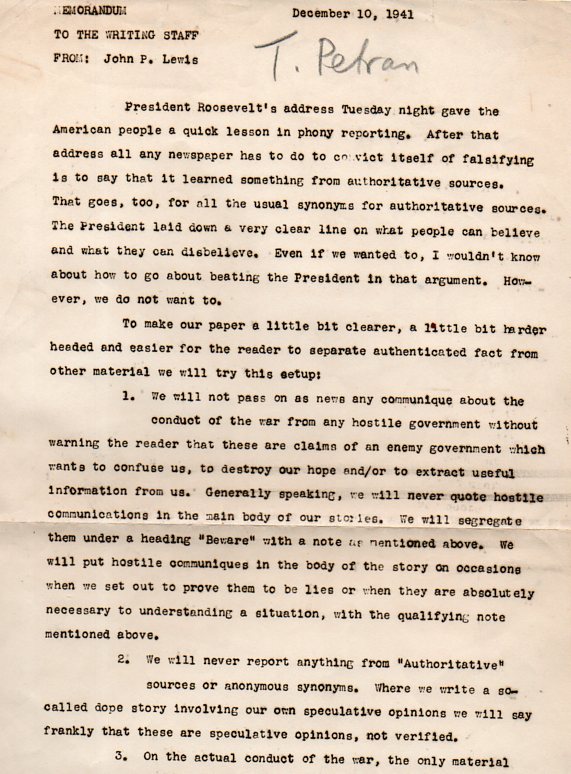
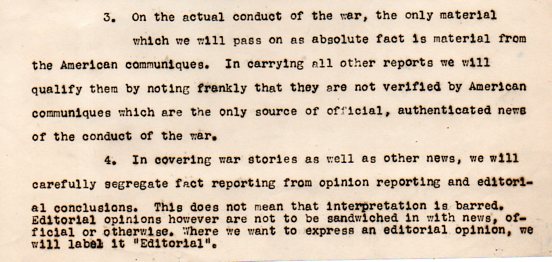
    PM (short for “Picture Magazine, evidently) newspaper1–begun 18 June 1940 and ended 1948–was a very strong, left-wing newspaper in NYC, a short-lived daily with a long pedigree of contributors2.  The “Memorandum” reproduced here, sent by the Managing Editor John P. Lewis “to the writing staff”, was a powerful and interesting directive on how to present the news, and addressed the speech of President Roosevelt of the night before. 

    Lewis felt that here, at the beginning of the American end of the fighting war, was the appropriate place to set out a war strategy for reporting and publishing regarding information received from overseas, or unverified sources, or from dispatches from the countries against which we were fighting.  He was clear and very concise–the whole of the memorandum fitting on one side of a single sheet of paper. 

    PM Newspaper136
    [This piece of ephemera may be purchased through our blog bookstore, here.]

    The Roosevelt speech of  9 December 1941 can be found  here.  Some interesting extras as follows:

    “Your Government knows that for weeks Germany has been telling  Japan that if Japan did not attack the United States, Japan  would not share in dividing the spoils with Germany when peace  came. She was promised by Germany that if she came in she would  receive the complete and perpetual control of the whole of the Pacific area…This alone if true could be a justification for war with Germany.”
    //
    “Our policy rested on the fundamental truth that the defense of any country resisting Hitler or Japan was in the long run the defense of our own country.”

    But the main thrust that Lewis was addressing was this:

    “I cite as another example a statement made on Sunday night that a Japanese carrier had been located and sunk off the Canal Zone. And when you hear statements that are attributed to what they call “an authoritative source,” you can be reasonably sure from now on that under these war circumstances the “authoritative source” is not any person in authority.”

    “Many rumors and reports which we now hear originate, of course, with enemy sources. For instance, today the Japanese are claiming that as a result of their one action against Hawaii they hare gained naval supremacy in the Pacific. This is an old trick of propaganda which has been used innumerable times by the Nazis. The purposes of such fantastic claims are, of course, to spread fear and confusion among us, and to goad us into revealing military information which our enemies are desperately anxious to obtain.”

    Lewis was quick to the point:  “President Roosevelt’s address Tuesday night gave the American people a quick lesson in phony reporting.  After that address all any newspaper has to do to convict itself of falsifying is to say that it learned something from authoritative sources.”

    He continued: “The president laid down a very clear line on what people can believe and what they can disbelieve…” and then outlined four major points for his writers to follow:

    “1. We will not pass on as news any communique about the conduct of the war from any hostile government without warning the reader that these are claims of an enemy government which wants to confuse us…

    “2. We will never report anything from “Authoritative” sources or anonymous synonyms. 

    “3. On the actual conduct of the war, the only material which we will pass on as absolute fact is material from the American communiques.”

    “4. In covering war stories as well as other news, we will carefully segregate fact reporting from opinion reporting and editorial conclusions.”

    PM Newspaper137

    Lewis was also particularly demanding in his policy regarding personal opinion in news stories: “Where we want to express an editorial opinion, we will label it “Editorial.”

    And Lewis meant it, too. Unlike almost all newspapers, PM editorials  were signed.  The newspaper also took no advertising, hoping to keep the paper running on sales and subscriptions.  And so it did, for eight years–not long by long-running standards of  newspapers, but fairly long for the times, and for the type of business plan practiced. 

    In any event I enjoyed the crispness and clarity of Lewis’ directive.

    Notes:

    1. The publisher was Ralph Ingersoll (1980-1985), who before coming to PM was the managing editor of Time-Life, and who was also the business plan designer and then managing editor of Fortune magazine; and the silent partner in the whole thing was MArshal Fields III, who pretty much bankrolled the newspaper from a distance.

    2.  It was a very considerable staf.  From Wiki:  “Journalist I. F. Stone was the paper’s Washington correspondent. His award-winning series on European Jewish refugees attempting to run the British blockade to reach the Jewish homeland in Mandatory Palestine became the book, Underground to Palestine. Staffers included theater critic Louis Kronenberger and film critic Cecelia Ager. Weegee, Margaret Bourke-White and Arthur Leipzig were the photographers. The sports writers were Tom Meany, Tom O’Reilly and George F. T. Ryall (who covered horse racing). Elizabeth Hawes wrote about fashions, and her sister Charlotte Adams covered food. Other distinguished writers who contributed articles included Erskine Caldwell, [Myril Axlerod], McGeorge Bundy, Saul K. Padover, James Wechsler (eventually the paper’s editorialist); Penn Kimball, later dean of the Columbia University School of Journalism; Heywood Hale Broun; James Thurber; Dorothy Parker; Ernest Hemingway; Eugene Lyons; Ben Stolberg; Malcolm Cowley; future Speaker of the House Tip O’Neill and Ben Hecht.


  • WWI–Post-War Photographs, November/December 1918

    JF Ptak Science Books   Quick Post

    I have made numerous posts on this blog using images from my archive of American news service WWI photographs, though there are few depicting scenes just after the end of the war’s end on 11:00 a.m. on 11/11/11. These photographs below do so, and all come from the National Library of Scotland (which can be accessed here). They are all “British Official War Photographs”, which was a service similar to its American cousin–various news and photo agencies were given access to images produced by a pool of photographers, all of which passed by the eyes of a military censor. They were for the most part aimed at the “correct” version of the news, though given the subject matter there were plenty of images that were extremely powerful.  In a war that claimed 100,000,000 casualties, the photographic image was a powerful war-time propaganda tool. 

    (1) C.2450 - German trophies from Vimy Ridge and Messines

    [Original reads: ‘SCENES ON THE WESTERN FRONT. WAR TROPHIES SECTION. German trophies from Vimy Ridge and Messines. In centre is Prussian Guards drum.’]


    ·Posted by :

    ·in:

    — —

  • On the Cost-Effectiveness of Killing: Poison Gas (1921) and Atomic Bombs (1945)

    JF Ptak Science Books   Post 1678
    Chemical warfare

    Atomic bomb eco detil

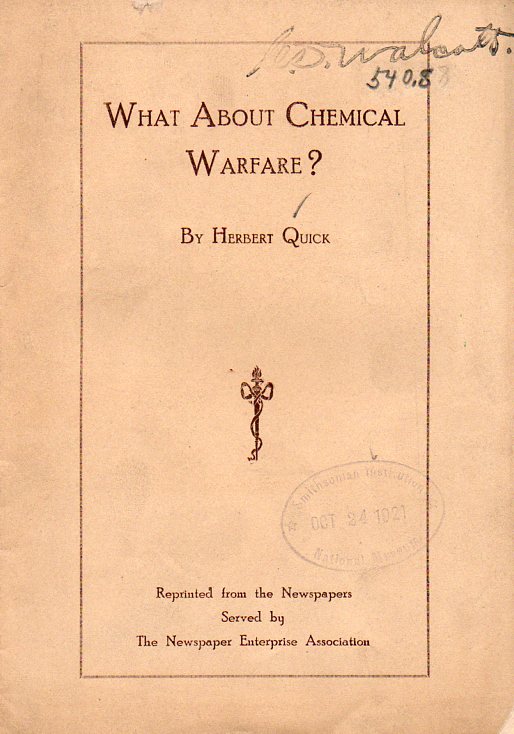
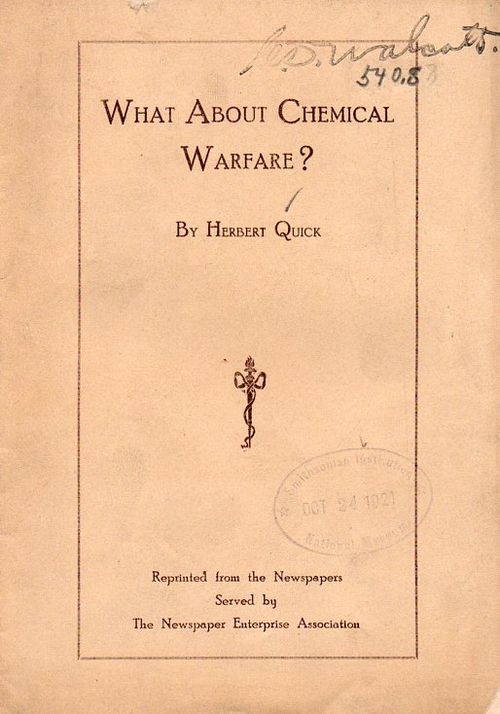
    Herbert Quick did a fair amount of thinking about the military use of poison gas, and it winds up, in the final analysis, thinking that it was tolerable.  What About Chemical Warfare? (published by the Newspaper Enterprises Association in 1921) is certainly a possible title for a Duck-and-Cover A-Bomb or You and Your Hormones kind-of-film–it has that certain stripe to it, bearing the certainty of wrongness that becomes more visible with each passing month.  (The pamphlet is available for purchase from our blog bookstore, here.)  But Mr. Quick took the slow boat around his issue, thinking about it a little long and out loud, before coming to his final conclusion in the chapter titled “Gas Warfare Cheapest and Most Effective Arm of Defense”.

    {See here for my post on Willis R. Whitney’s letter/proposal for establishing the American chemical warfare capacity, 1917.]

    He points out the enormous impact in the war effort that relatively small chemical corps played in WWI–something on the order of hundreths of one percent of all serving soldiers were employed in the combined chemical corps, saying “how small a body to produce such great results!” Which is true, assuming that by “great” he meant ‘widespread’, though it is unclear exactly what he was talking about.

    Mr. Quick (born in the first year of the American Civil War and dead four years after the publication of this pamphlet, writing evidently from the cushion of old age) does make a case for poison gas being not so inhuman as presented by most civilized people, pointing out both its high quick-death rate and survivability/recovery rates, which seems to be giving/taking at the same time. No matter:  “But woe to the army or nation that does not keep up with the times.  The Angel of Death will breathe in their faces” he writes. 

    The author alsoAir raid885 warns that though Germany was “stripped” of her war-making capacities, he thought it was not so of the industries necessary to produce poison gas. He points out that Germany can produce these munitions in secret, and that if any “militaristic nation conquers the world in the future”, it will be through the use of the poison gas it developed in secret. 
    Defense was also important:  “in the absence of efficient defense worked out beforehand, our great cities might be wiped out with gas bombs dropped from aircraft”.  Mr. Quick believes that protecting cities is possible, writing simply “preparation will prevent such a crisis”.  Indeed.  Unfortunately no ideas about this defensive posture were forthcoming, though he did bring himself around to writing about gas as a defensive tool.  Against looters. And rioters. And snipers.  “Gas puts the sniper in the power of his enemy” Quick writes, using the Marine action in Vera Cruz, Mexico, as a good example of where gas (“gas grenades”) would have come in handy.

    The bottom line is of course the bottom line, practically stating that poison gas as a weapon was indisputably more cost-conscious than anything else, by far, each dollar spent on chemical warfare being worth “from three to five hundred for the army”.  Poison gas services Quick says should be pursued, because “gas warfare cannot be stopped until all war is stopped”.

    Gas warfare “gives the educated, intelligent nations the advantages over the people of lower civilizations”.

    “When both sides are prepared it is much less inhumane than war with bullets and high explosives; but it means horrible annihilation to the army which is unprepared.”

    It is an interesting exercise to replace “poison gas” with other types of weapons, just to see how it reads.

    Mr. Quick was up and down in his treatment of poison gas and war, though almost entirely down.  One thing he didn’t see, that no one saw, really, was the use of a particular gas that was used to destroy millions of people, and which was developed quite in the open in Germany for many years, used for killing rats.  The Nazis simply used it instead on people.  No one saw Zyklon-B coming, and no one could have, even when they did.

    See also my post here on Hermann Goering and Zyklon-B.

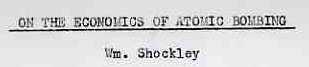
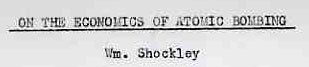
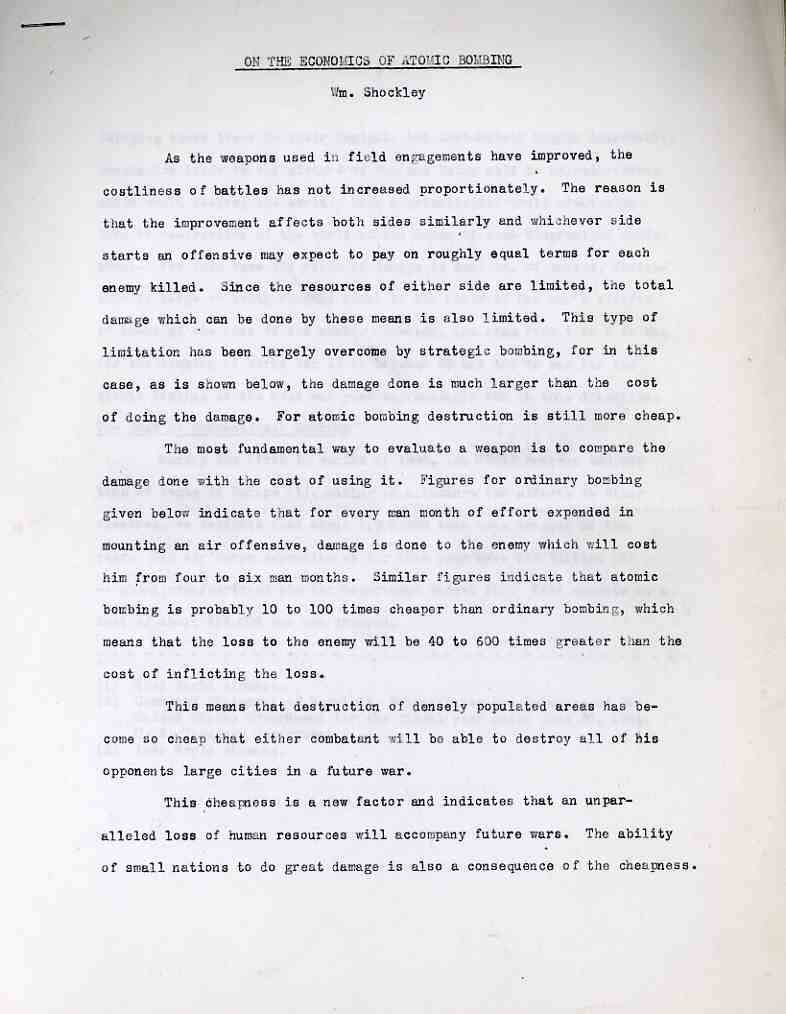
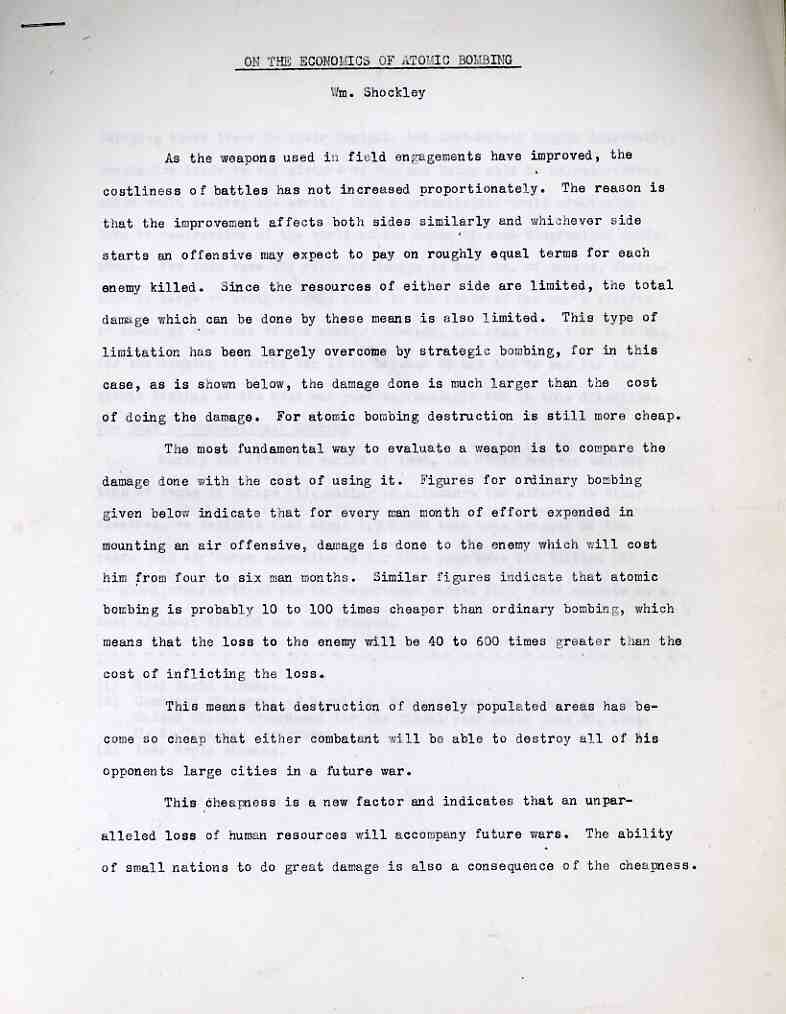
    William Shockley–a future Nobelist and probable weak member of a Nobel-team that invented the transistor and which included John Bardeen and Walter Brattain, or I should say rather a team of Walter Brattain and John Bardeen including William Shockley–sent forth a memo on the mathematics of destruction and the use of the atomic bomb.  He was part of a largish team working on what to do with the new technology once the bomb had been used and the war won.  (I’ve written more on this paper here.)
    Shockley atomic


    This paper was written towards the end of 1945 and is on five pages and runs about 1500 words, and is an extension of work he had already been doing for Henry Stimson with Quincy Wright on evaluating the combinations of casualties that would lead the Japanese to surrender.  He begins this paper with a logical statement of the issue of the economics of conventional and atomic bombing, ending with the sentence “For atomic bombing destruction is still more cheap”.  What Shockley is getting to is the overall cost of the amount of destruction caused per square mile, and the conclusion that he draws over these five pages is the destruction caused by the atomic bomb is 1/100th the cost of conventional bombing per square mile destroyed (“atomic bombing is probably 10 to 100 times cheaper than ordinary bombing”).

    Shockley also recognizes that the problem in the near future will be the increasing cheapness of producing atomic (and greater) weapons, and their developing accessibility to small nations.  “This cheapness is a new factor and indicates that an unparalleled loss of human resources will accompany future wars.  The ability of small nations to do great damage is also a consequence of the cheapness.”  He writes further that taking this thinking to its “logical conclusion”, that at some point in the future a single individual will be able to use this new technology to destroy the world.  The main point though that he was making in this line of thinking was the dispersion and proliferation of the new technology–that an arms race would occur, and that it would be dangerous, and that it could be very very bad.  Shockley has of course nothing to say about any of that or the implications of his finds as that was not his charge. 

    After figuring that the cost of destruction by the atomic bomb was about $600,000 per square mile (compared to $6,500,000 per square mile for conventional bombing), Shockley concludes that “since the atomic bomb art is in its infancy, we may well expect future economies of a factor of 10 in cost per square mile destroyed…”

  • Map of Nazi Invasion from Uruguay

    JF Ptak Science Books   Quick Post

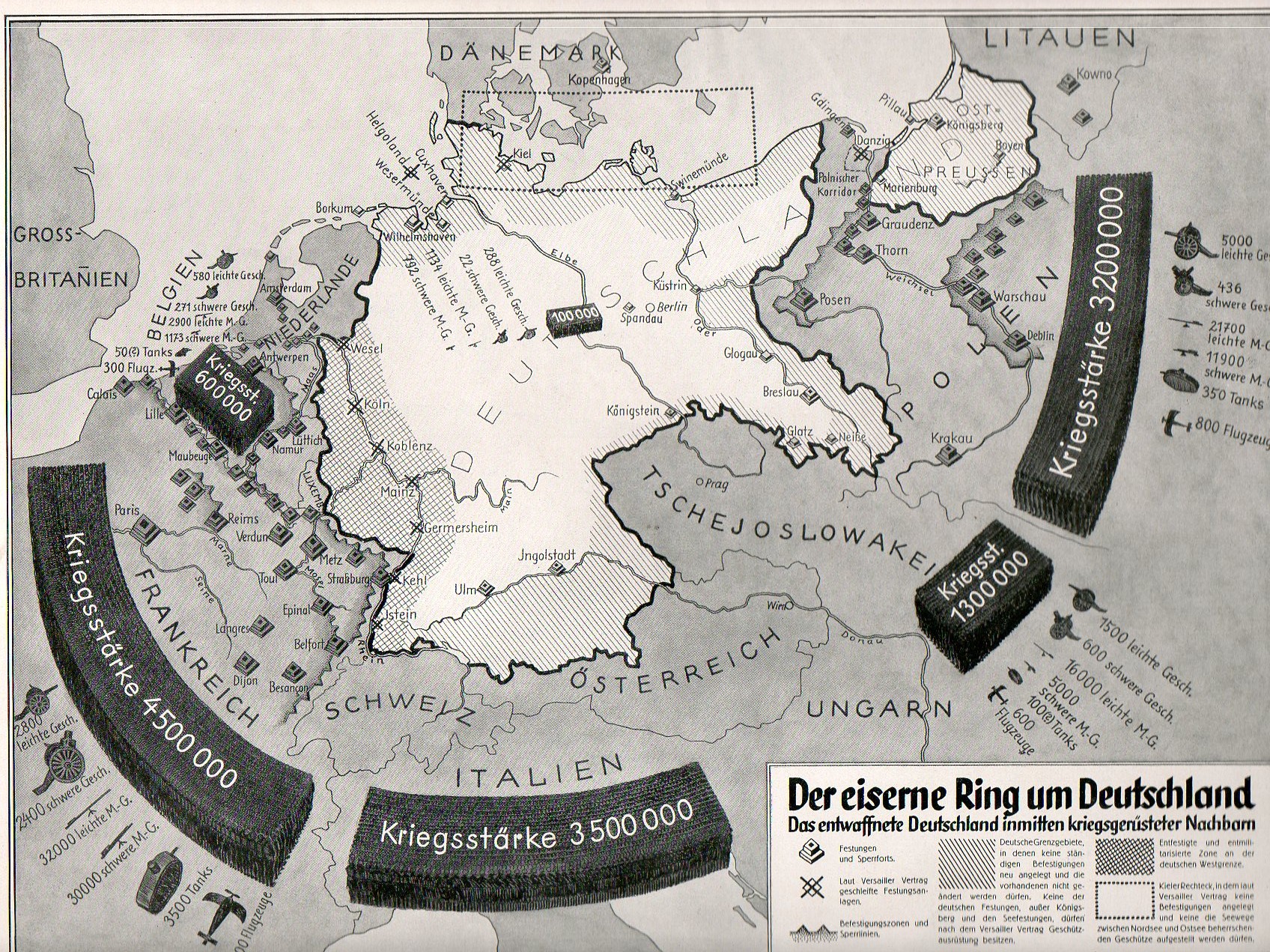
    I’ve post a number of thing son this blog relating to Nazi invasion routes to America and the potential threat of Poland to Nazi Germany, all stories more vividly enhanced (whether true or not) by maps–as a matter of fact, maps seem to be validity enhancers to just about any story, for it seems that maps represent a will of some sort, and where there’s a will, there’s a way, and so there must’ve been a good Nazi plan for attacking South America via Uruguay.  Except that there wasn’t.  But the map looked good, and certainly it made people think.


    [Map source from the Bahia Sin Fondo blog, here.]

    For example, see the posts Invasion Routes to America:  Nazi Invasion Scenarios of the U.S. and Germany Surrounded (map below).

    Nazi Prop surrounded538

    http://sm.headweb.com/factualtv/title_pix/Why_We_Fight_The_Battle_of_Britain.jpg

    [Source:  Why We Fight, the Battle of Britain.]


  • The Children’s Battalion–Santa and Guns, 1916

    JF Ptak Science Books   Quick Post

    Children battalion006
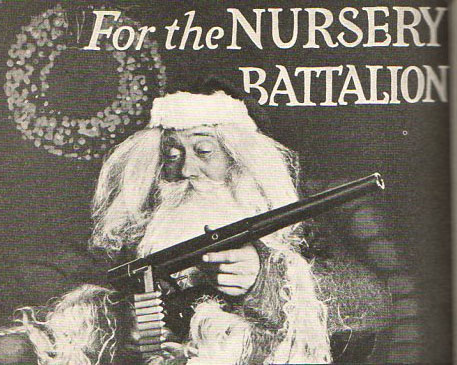
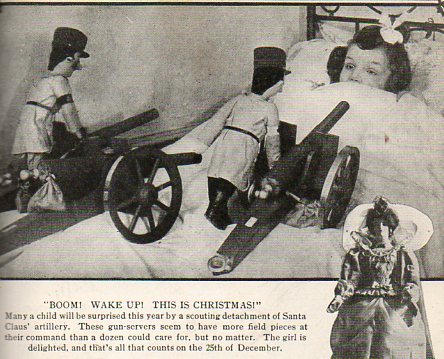
    I don’t know the Illustrated History of Santa and Gun Gifts, but I guess that a book could be written if one already doesn’t exist.  Well, that or something associating Santa with unusual, or questionable, gifts in his bags of joy could be made into something, something disappointing.  I’m not that person to collect those sorts of images because I have always held Santa in very high esteem, and I don’t care to have too many of those images floating in my mind, exploiting some dark corners of unknown memories, disturbing the happy bits with unneeded and unwanted visual info.  But, well, these pictures below, found in the December 1916 issue of the uncommonly-seen journal, Illustrated World, provides a little glimpse into the manufactured desires of kid-wishes for toys during wartime, and so I’ll pass them along.  These things do tell us something about the period–like the famous multiple images of Santa hanging cigarette carton Christmas ornaments (seen here in the post on Gift Porn, 1954), or a smoking Santa stuff a stocking with a box of Lucky Strikes–so it makes sense to make sense of them.

      Children battalion008

    I guess kids have fairly well always wanted toys (or not) guns for Christmas,  gifts from Santa, or at least so long as Santa has been around or identified as so, and to see Santa with a rifle would not be so unusual, especially given that this was deep into the second year of the bloody Great War.  (I have another interesting image here, somewhere, showing Santa distributing presents to British troops in trenches, riding a tank, but presently I can’t find its stack in a stack of stacks.)

    Perhaps the issue of playing with guns and cannons and so on was a way of easing fear and distress during wartime; perhaps it meant something soothing for the developing mind of a child.  I don’t know.


  • An Episode in the History of Bread Photography: Monumental Bread and Infographics, 1914

    JF Ptak Science Books   Post 1662

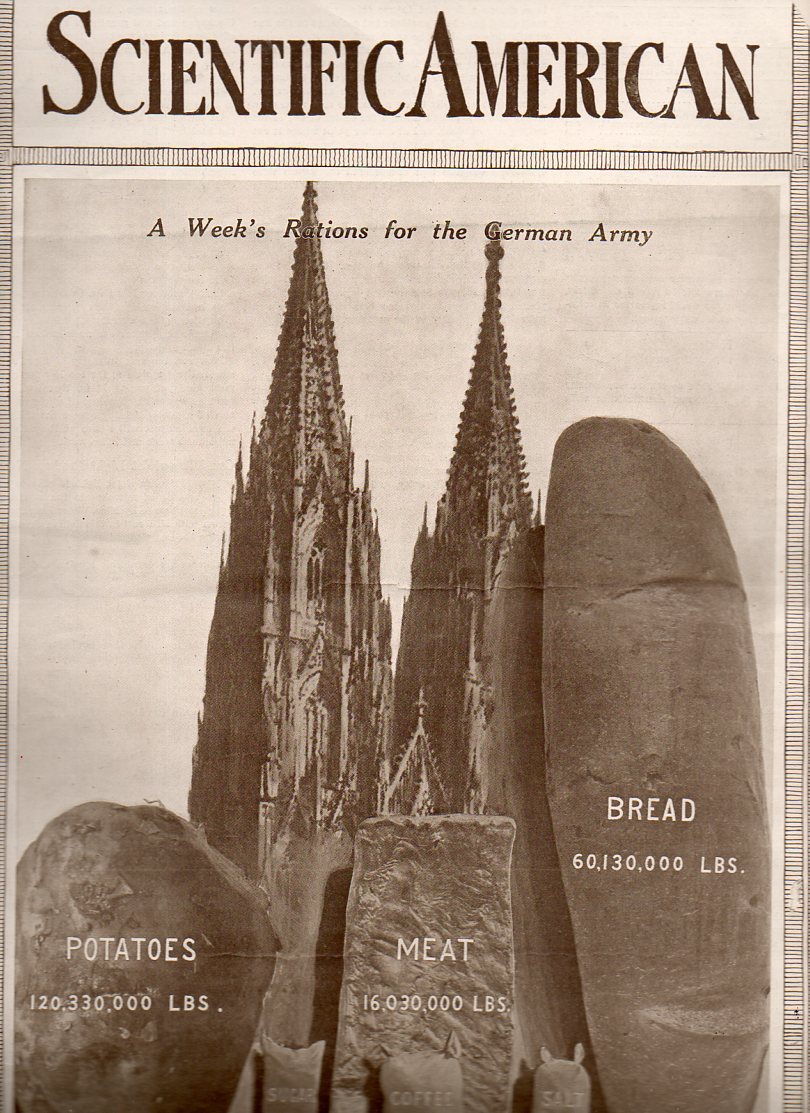
    Infographic999
    In the history of pictures of bread, this loaf seems to be about the biggest.  The 60-million-pound loaf is meant to represent a week’s ration for teh newly-fighting German army.  The war, the Great War, WWI, was just beginning when this article hit the newsstands on 22 August 1914.  There wasn’t much yet printed in the Scientific American regarding the war, and it seems as though this was the first cover of the magazine to deal with the new world-ender.  But in the blazes of the guns of August (B Tuchman) the end of the conflict might’ve looked a little close at hand.  I doubt that many would’ve seen the 100,000,000 dead and wounded that would come as a result of the war, at this point just finishing its first month.

    I am not sure why, but the editors of SA chose to think about supply for their first stab at making a cover-comment about the war.  It does give some idea of the sheer numbers of people involved, at least on the German side.  Hoiw this is iterated by a 400-foot-tall loaf of bread, I can’t exactly say.

    (Are potatoes one tenth the density of :”meat”?  The potato sack and the meat chunk look to be about the same size, though the meat bit is less than a tenth of the weight of the potatoes.) 

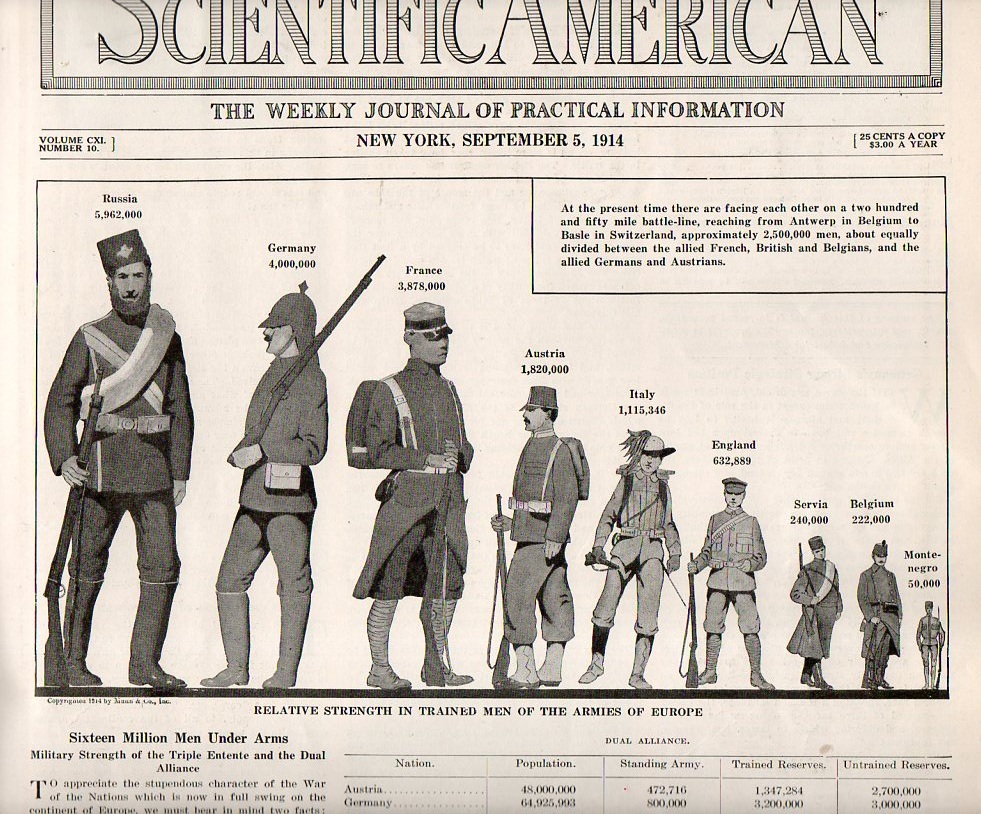
    Two issues later–5 September 1914–we see the following artistic display of quantitative data, a much more effective way of generating understanding on the differences in troop strengths among the waring countries:

    Infographic army size001


    The United States would not get involved in WWI until 1917, and so American statistics were not included in this image.  But if they were, the U.S. Army’s size would be somewhat larger than little Montenegro there at the far right.  Given the American population of 92,000,000, the army was quite small, with barely 98,000 soldiers under arms (half of whom served overseas). (Montenegro’s force of 50,000 was somehow pulled out of a population of 350,000 people–Belgium, with a population of 7 million, had an army more than double the size of that of the U.S.)  Of course this was a peacetime, hands-off army for the United States, and by the end of 1914 President Wilson expanded the standing army to 140,000; by 1918, when the newly-instituted draft1 really kicked in, more than 4,000,000 people would be in the armed services, half of whom would serve overseas. 

    Notes

    1. Beginning in 1917 all males between the ages of 21 and 30 were required to register for the draft/military service, and by September 1918 more than 23,000,000 men had done so.  This was an extraordinary leap from the Army totals for 1914.