A Daily History of Holes, Dots, Lines, Science, History, Math, Physics, Art, the Unintentional Absurd, Architecture, Maps, Data Visualization, Blank and Missing Things, and so on. |1.6 million words, 7500 images, 4.9 million hits| Press & appearances in The Times, Le Figaro, Mensa, The Economist, The Guardian, Discovery News, Slate, Le Monde, Sci American Blogs, Le Pont, and many other places… 5000+ total posts since 2008.

Category: Blank and Empty Things; A History of

  • The History of Missing and Blank Things #35: The Disappeared Solids of Johannes Kepler

    JF Ptak Science Books LLC    Post 548

    (Continuing the thread on a History of Blank and Empty Things…)
    Spheres_Euclids5solidsKepler
    The great Joahnnes Kepler, conceived at 4:27 on the morning
    of his parents’ holy joining, was raised a disagreeable boy by disagreeable parents,
    and that in spite of being supremely gifted, mutually dependent on his
    hypochondria, intellect, and astrology. 
    He was perhaps one of the dozen most influential scientists of the last
    500 years, and had an over-assuming and awful disposition.  

    The man who brought about the final loosening of religion’s grasp
    on astronomy and the development of cosmology had a difficult time in his childhood,
    sounding lonely and exiled.  His father was
    irritable and irritating, but his mother, described by some as garrulous and quarrelsome
    and of a “vile disposition”, seems to have been in a class by herself, and left
    an indelible mark in her son.  The full
    truth of Kepler’s mother was that if you described her as being like  a ”witch”, you may have been correct:  the old woman, at 74, after years of being
    suspected of being a witch, was arrested, finally, and hauled away under this
    suspicion.  In a posthumously-published
    work called Somnulum, Kepler himself writes of his mother as being in contact
    with devils from the Moon (among many other things).  His childhood left a long shadow on his
    social life.

    It is remarkable to note his nearly alphabetical diatribe on
    his schoolday associates; I’m not o sure how you leave behind ideas and feeling
    like this later in life, and I suppose that you don’t.   It has nothing to do with his development as
    a scientific icon, but I

    He rattles off his chums as follows:

    “Holp openly detested me and on two occasions we got into
    fist fights….

    Molitor dislike me because I betrayed him…

    Kollin didn’t hate me, but I hated him…

    Braunbaum turned from friend to foe because of my
    boisterousness…

    Huldenbach became hostile because of my rash accusations…

    Seifer disliked because everyone disliked him…

    Kleber detested me because he thought I was a rival…

    Redstock was ticked off whenever someone praised my
    abilities…

    Husel tried to block my progress…

    Between Dauber and myself there was quite a jealousy…

    Lorhard would have nothing to do with me….

    After Jaeger had lied to me I was insulted for two years…

    The rector became my enemy because I did not accord him
    sufficient honor…

    Murr became my enemy because I reprimanded him…”

    And on and on.  Kind
    of incredible if you ask me, but from this did greatness come. 

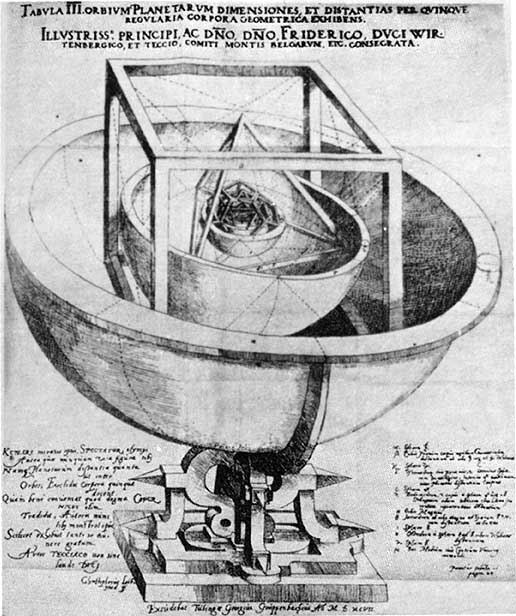
    On the way to restructuring the universe with his Harmonicae mundi and Epitome astronomiae, Kepler made a first
    abbreviated stop in his Mysterium Cosmographicum—it was an interesting work, but
    as substantial as it was it had as many flaws. 
    Galileo received a copy, and wrote politely back, but was very guarded
    in his opinion of the work.  Part of the
    problem was Kepler’s sustained interest in his astrological callings; another
    part came with his great reverence.  He
    thought that god was perfect, and that the universe he created as perfect, and
    so it all could be explained perfectly with a perfect method, which in this
    case was geometrical.  Explaining the proportions
    between the sun and its planets, Kepler devised a system in which spheres and
    squares and other objects were described within one another, separating the planets
    via distances determined by their points of contact.  It wasn’t a winning system, but it did abide
    the Copernican system, even as his forms disappeared into nothingness..  Kepler went on to
    bigger and greater things.

     Einstein, who much admired Kepler, said of the man: “[He]
    was one of the few who are simply incapable of doing anything but stand up
    openly for their convictions in every field.” 


  • Bizarre & Naive Surreal Maps and Views: the North Pole

    JF Ptak Science Books LLC   Post 545

     blog 12 maps north pole692[Read last year’s post, 12 March 2008: Dr. Seuss and the 236 Words...]

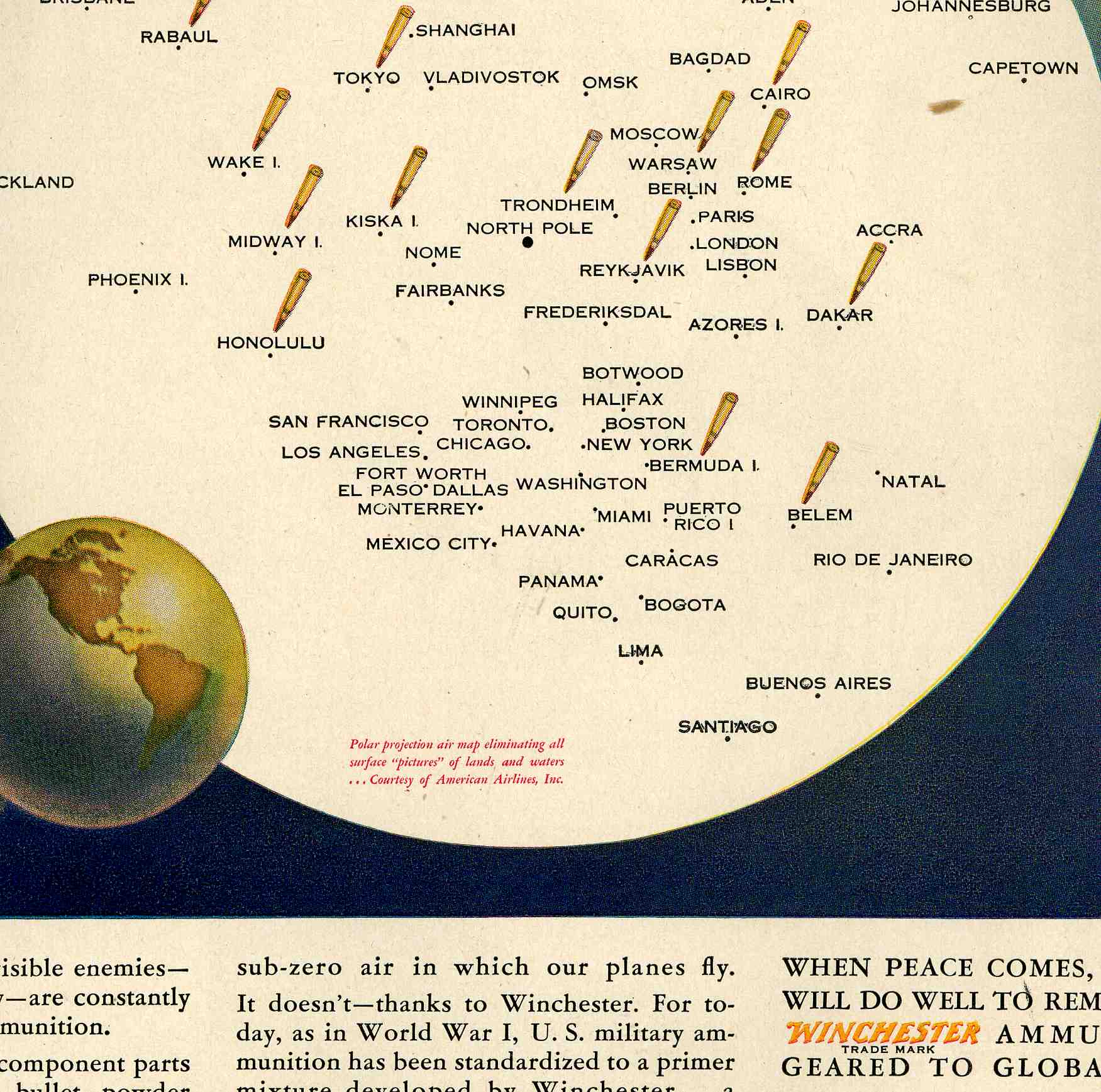
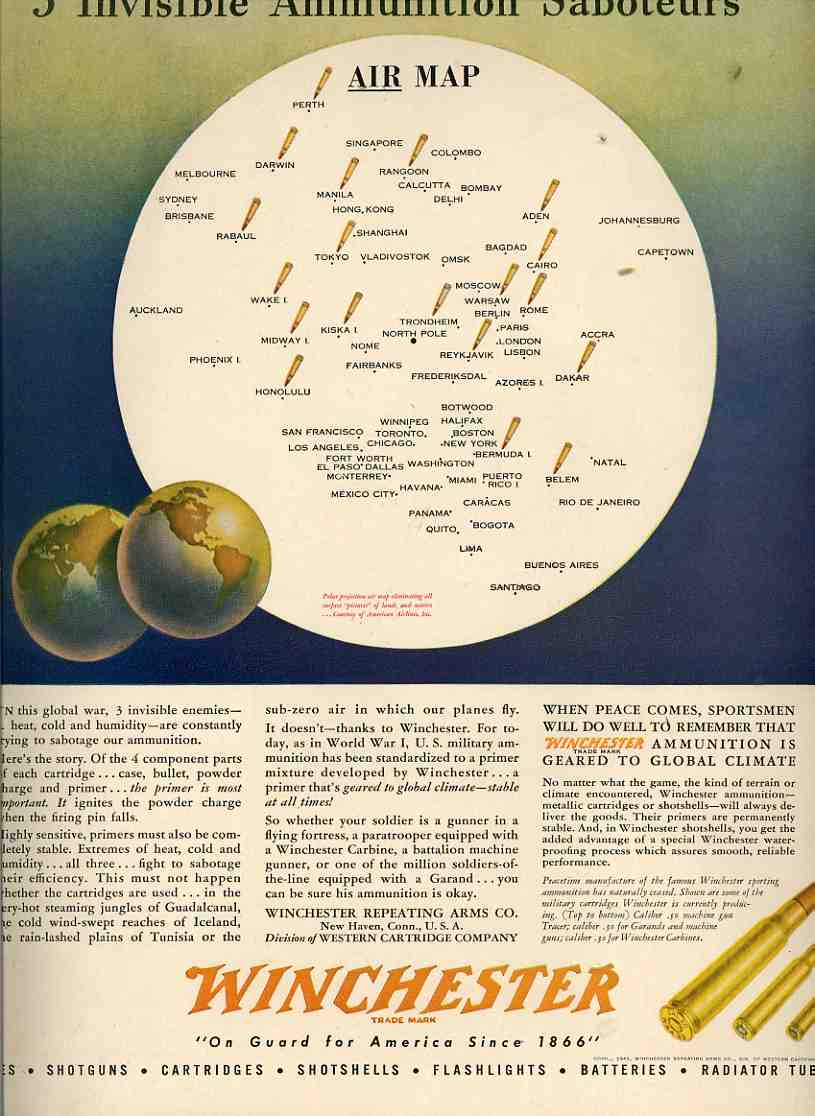
    These two maps were printed within a few weeks of one another in LIFE magazine in October/November 1943, which is unusual to my experience, as I haven’t seen too much in the way of unusual 20th century North Pole maps (especially as advertisements).  The first is a placement for Winchester  Arms, concentrating on the dependability of its ammunition, and assuring the readers of the magazine that if “your soldier” was carrying a Winchester carbine, or a Garand, or whatever Winchester product it was, “that you can be sure his ammunition is okay”.   The map is pretty odd and completed in a projection unknown to me:  it centers itself at the North Pole and includes cities in both the northern and southern hemispheres, which is an unusual thing to do on a single-hemispheric projection.
     blog 12 maps north pole693

    I know that Winchester was just trying to graphically present the notion that the ammo was suited to “global climates”, and did so using an impossible image; but, since it was wartime…

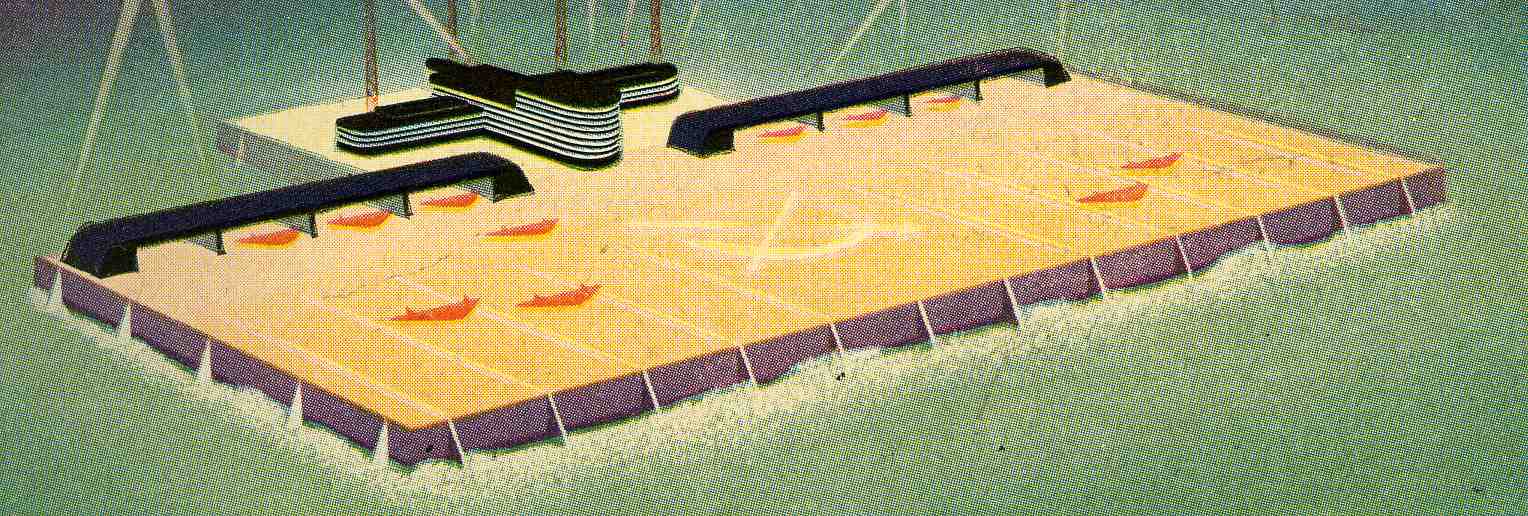
    The second image could also slide into the History of the Future category, Seagram’s Whisky somehow aligning itself with trans-polar future flight.  The airport in the ad’s image was at the North Pole, and was the layover/refueling point for the Chicago-Moscow run at some point in tomorrow.  Those little horizontal yellow rectangles are actually windows, and in my original you can see dozens of heads in there, making this one big stinking plane.  By my calculations, the plane was something like 1500′ wide, giving it a surface area of something like two square acres. In comparison, the Boeing 777 has a wingspan of about 200′ and a 4,600 square-foot wing surface, which means that five 777’s could be placed wing-tip-to-wing-tip along the visible part of this Seagram’s monster.  (And I’m being generous.) 
     blog 12 maps north pole690

    Then there’s the problem of the runway, which looks about 15,000 feet long–way more than enough for a 777, but nowhere near enough for this beast, unless of course there was some hidden sumpin’ sumpin’ that I don’t know about.  Lastly, there are eleven aircraft on the ground at this North Pole airport, which more than filled it up.  The terminal looks possibly more (relatively speaking) mammoth than the planes, and could undoubtedly provide rooms if not houses for everyone traveling  around in these Big Berthas.  Judging the building against the aircraft, it looks like it is 800 feet tall by 4500 feet by 6500 feet.  I’m not sure how many Malls of America you could fold into this thing, but it would be a lot. 

    Now I’m not saying that something like this structure wouldn’t ever be built, because “ever” and “never” are big words; as a matter of fact, I would say that it was probable that something like this would come into existence so long as we here on Earth lasted long enough. 

     blog 12 maps north pole691


  • Blank and Empty Things: Disembodied Celestial Hands and Arms, Part 3.

    JF Ptak Science Books LLC    Post 538

    0 blog march 5 missing arm656
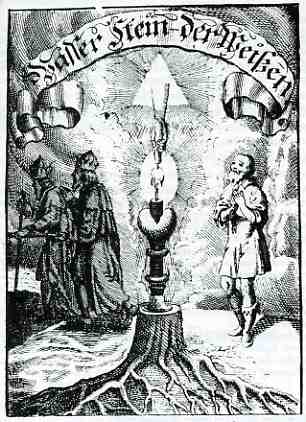
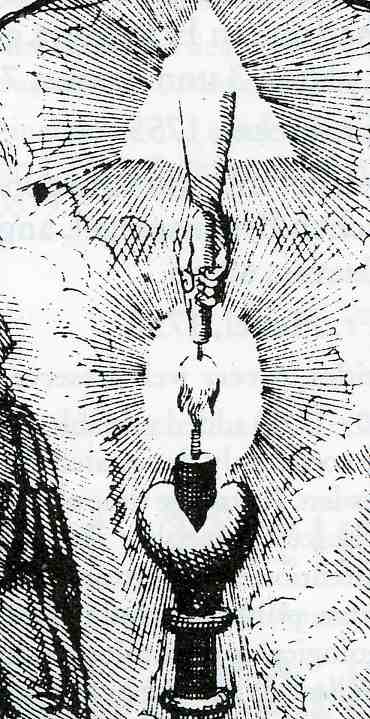
    This wonderful and dimly provocative image from Johann Siebacher’s Wasserstein der Weisen, oder chymisches Tractaetlein…. *, a curious alchemy book of obscured pubom Johann Ambrosius  Siebmacher’lishing heritage, printed around 1660, is a sort of standard celestially-disembodied standard, though in this case the torch-holding hand may be coming through a trinitarian window/hole in the sky, straight from the body of the Der Herr Gott.  Or perhaps not: perhaps this is an illustration of alchemical genius emerging from a Biblical interruption in the sky, igniting a heart-held philosopher’s stone fixed to a well-rooted sepulchre, the very tree of life.  The religiously-robed folks are retreating into the deeper shadow without the sight of the gloriously-enlightened lump, plainly visible to the plain observer.  

    Or not.  Siebacher uses an epigram at the end of his book calling the whole chymical art into question:  “It is an easy matter to prepare gold in the furnace out of metals:
    at times there is found a man to whom the secret is revealed. Why is not
    every alchemist rich? The reason is that one thing is wanting which many
    seek with anxious care. Common gold is not fixed, and, when brought to
    the test of fire, quickly disappears and perishes. But he who knows the
    tired gold, which at all times remains the same, and from which nothing
    is lost, he is the possessor of the true Art, and may be called a good
    and practical Sage and Chemist.” Rich in vision, and in spirit, with holes in the pockets.

    0 blog march 5 missing arm657

    *Johann Ambrosius Siebmacher.
    Wasserstein
    der Weysen, das ist, ein chymisch Tractätlein, darin der Weg gezeiget,
    die Materia genennet, und der Process beschrieben wird, zu dem hohen geheymnuss
    der Universal Tinctur zukommen, vor diesem niemalen gesehen. Darbey auch
    zwey sehr nutzliche andere Büchlein der Gleichformigkeit und Concordantz
    wegen angehenckt, nemlich, 1. Iohan von Mesung. 2. Via veritatis der einigen
    Warheit…
    , Frankfurt, 1619, 1661, 1703, 1704, 1709, 1710, 1743, 1762.

    Or,

    The Sophic Hydrolith; or Water Stone of the Wise, That is, a chymical work, in which the way is shewn, the matter named, and the process described;
    namely, the method of obtaining the
    universal tincture. Chapter
    One:  A BRIEF EXPOSITION OF THE WONDERFUL WATER STONE OF THE WISE, COMMONLY
    CALLED THE PHILOSOPHER’S STONE.


  • Blank and Missing Things: Missing Horizons, Giant Women and Edouard Manet

    JF Ptak Science Books LLC  Post 536

    Blog--march 7--descartes
    The Nine Foot Woman and the Nine Inch Man

    Manipulating perspective in the post-re-discovery of
    perspective world infrequently happened on purpose (except to accentuate
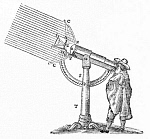
    another aspect of  perspective), and was usually the result of artist or artisan failure or naivety.  A famous example is in Rene Descartes La Dioptrique (1673), in which this image of his compound
    microscope was somehow confused with a telescope—probably the result of the
    illustrator’s misunderstanding of the concept and a mistake in the proofing
    period.  This does sort of look like a
    telescope, if viewed with your squinty-eye specs,  at least in the hands of the illustrator—if the
    microscope-and-man was pictured in this scale was really this large and
    collecting THAT much light it would’ve fried the retina of the viewer and
    whatever specimen was being looked at.  If
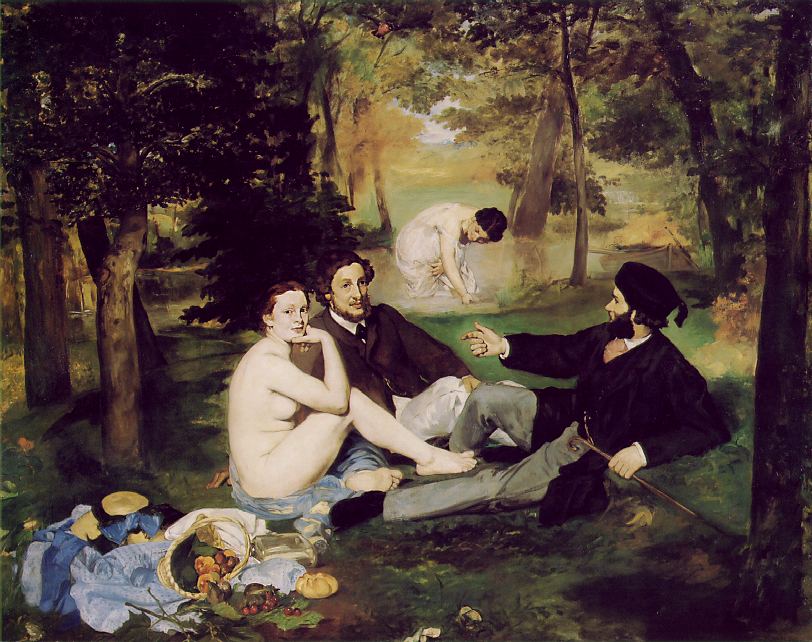
    the scope was that big then the man using it would’ve been about 9 inches tall.  In any event, it was an accident (and one of
    fairly high order)—the nine-foot-tall woman in Edouard Manet’s Le Dejeuner sur
    l’Erbe
    (1863) was an entirely conscious decision, and one that helped initiate
    the birth of Impressionism.  Of course
    there was a lot of other stuff going on in Manet’s mind beyond the giant woman—he
    abandoned entirely the very accomplished and polite work that he had been doing
    (trained by Thomas Coutre) celebrating his independence on his 27th
    birthday by burning all of his old work.

    Blog--march 7--manet bathers
    Le Dejeuner was a scandal when it was exhibited in 1863—Manet
    painted what he wanted to, unbound by perspective, by color, by composition,
    and on and on. The folks in the painting were not connected to anything,
    really, and were unconnected to each other, no one paying any of the others any
    mind, even when the women were naked. 
    Nothing seems to be going on—the people are just simply there.  This is in itself was a disconnect from
    previous practices, the vision in painting was about something, and was directed.  Light seems to be coming from a number of
    different places, and the shadows from the trees reflect this, simultaneously stretched
    towards and away from the light sources. 
    The bathing woman in the background, or what used to be background, had
    she been drawn using proper perspective, would’ve been about nine feet
    tall.  But what happens here is that
    there is no foreground or background in this painting, just middle.  It was this collection of abandonments, starting here in the Le Dejeuner in 1863, that ushered in the modern in art.  


  • Blank & Empty Things 36: Sold Shadows and Fat Chairs (Peter Schlemiehl and Joseph Bueys)

    JF Ptak Science Books  LLC  Post 535

    22

    On the heels of my last post on the usefulness of constructing
    geologies of wrongness and on the extraction by Creationists of something from
    nothing comes today’s bit, where something really does come from nothing, and
    where (again) nothing of something is extracted from nothing. 

    1)  Something from
    Nothing

    How old are shadows? 
    Or, really, how old is the depiction of the shadow in the history of
    western art?  The shadow predates the
    modern re-discovery of classical perspective by a thousand years—little bits of
    shadows pop up here and there in deep antiquity, certainly way before Uccello
    and Alberti and the rest came along.  On
    the other hand shadows do escape notice of many painters in the 15th
    century (and during the period of being very comfortable with the century-old realignment
    of perspective), which is odd, unless all of those works were depicting scenes
    at high noon or thereabouts. 

    The something-from-nothing part with shadows comes from the
    odd and somewhat creepy story of Peter Schlemihl (Peter Schlemihls wundersame
    Geschichte,
    “Peter Schlemihl’s Remarkable Story”) written in 1814 by
    the semi-ruined Franco/German aristocrat Adelbert von Chamisso.  In one adventure, Peter,
    unfortunately poor in a land of the wealthy, makes an agreement with a
    mysterious grey man (who is probably the devil) to sell his shadow for a
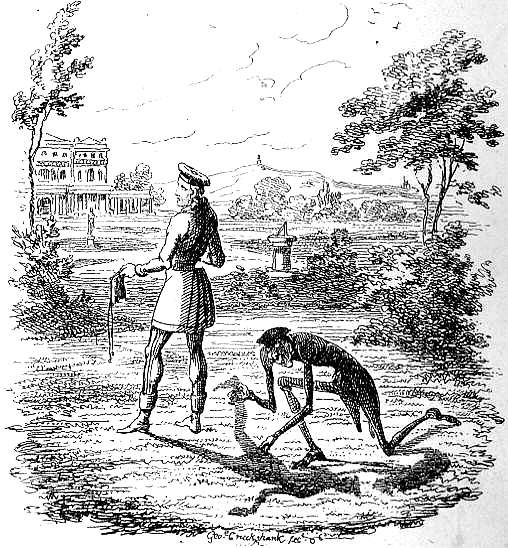
    bottomless purse of gold.  In an 1861
    British edition of this work, the great George Cruikshank portrays the very
    moment when the shadow is being literally lifted from the ground by the
    mysterious grey man—the point of contact between his hand and the shadow just
    gives me the willies.  The grey man’s own
    shadow, arching behind him, is also very threatening and terribly offputting to
    me.  Perhaps it is just a  great wrongness, making the shadow something
    from its vast nothingness.  (And the
    story goes that the gold is never-ending, but people are so repulsed by Peter
    not having a shadow that it makes his life supremely difficult—so much so that
    the grey man returns with a new deal, offering to Peter his shadow and the
    endless purse if only he would relinquish his soul when he died.  Peter begs off, throws away the purse, and
    lives without his shadow and without money.)

    Hans Christian Andersen also provides a scary fairy tale in
    1847 called “The Shadow”, in which a man’s shadow slips away and is replaced by
    another shadow which slips back (slowly) into the old shadow’s place—but it is
    not what it seems:  “I have gone through the most terrible affair that
    could possibly happen; only imagine, my shadow has gone mad; I suppose such a
    poor, shallow brain, could not bear much; he fancies that he has become a real
    man, and that I am his shadow.”

    2)  Nothing from
    Something from Nothing.

    Yes, this is terribly convoluted, but the title fits the
    subject, and the subject is Josef Beuys (1921-1986), a German artist (or
    perhaps he was a performer in art) who broadly dabbled in conceptual art.  He came to prominence in the 1960’s, when the
    acceptance of these art performances was as much a work of art as the art piece
    itself, and, I guess, he has remained, his appreciations now gaining an antique
    patina. 

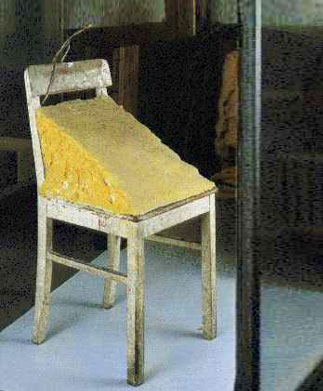
    I wanted to address his work, Fat Chair.  The title doesn’t quite describe the work,
    which is a chair with a wedge of fat on it. 
    Many a critic’s eyebrow has been plucked trying in deep intellectual
    desperation to see something in this work. Under the weight of these artistic
    appraisals of this work, I’ve just got to say, really, sometimes fat on a chair
    is just that.  I can appreciate Beuys as an artist and performer of his
    times, but the deep thought that has gone into Fat Chair is a bit much for my
    taste, praising observers biting off much more than can be chewed.  For example, from one website we see:

    0 fat

    “ ‘Fat Chair’ (1964) is much more about the
    physicality of the human body. To Beuys, fat as a material could be considered
    before form was considered… Fat…appealed to Beuys b

    ecause it was a composite
    with no internal structure…Beuys placed fat with its “chaotic organic
    energy”
    , symbolising warmth, in the cold, rigid,
    man-made form of a right-angle. This form, which represented the coexistence of
    instinct and intellect was placed in the right-angle of a chair between seat
    and back. The fat also occupies space on the chair that would be filled with
    our digestive and excretive organs if we were sitting on it.”

    Another website states “Fat…was an ideal material for Beuys
    to use to sign

    chaos and the potential for spiritual transcendence. Fat has
    the ability to exist as a physical example of two extremes: a flowing liquid
    when warm and a defined solid when cold. Beuys also believed that fat was
    psychologically effective, in that “people instinctively feel it relates
    to inner processes and feelings.”

    I’m
    sorry to not include the references for these opinions—it is just to painful,
    too embarrassing to ascribe them blame. 
    And they are hardly alone in this hagiographic myopia, pulling these
    strands of something from nothing about nothing. 

    I’d
    prefer to leave it all at nothing in regard to the Beuys (or to Andres Serrano
    or Damien Hirst and so on),  thinking
    about lovely Ludwig’s self-abandoned seventh proposition (“Where (or of what)
    one cannot speak, one must pass over in silence”).  Better yet, better to apply the one of the
    last lines of the great classic “The Street of Laredo” (the Johnny Cash version
    of course)—when the young dying cowboy is asked about who shot and killed him,
    he simply says, in the best cowboy fashion, “speak not his name, and his name
    will pass on.”. 


  • Blank and Empty Things: the Case of pre-Biblical “Missing” Eclipses, Refuting Darwin, and the Geology of Wrongness

    JF Ptak Science Books LLC  Post 533

    0 blog march 5 darwin refutation654 A History of Blank and Empty Things #35.

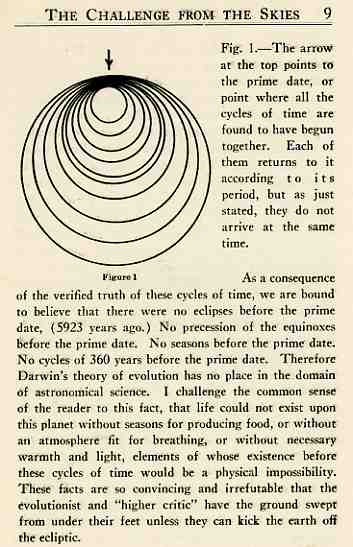
    Mr. R.R. Menke, the author The Challenge from the Skies, Planetary Motion and its Solemn Witness Against Evolution and Higher Criticism, self-published his biblico-religico-astronomical diatribe against Charles Darwin in Huntington Park, California, in 1925.  What he launches in 51 labored pages against one of the most elegant ideas in the history of science  is simply, well, shocking; shockingly eyebrows-catching-on-fire bad, so-bad-it-isn’t-even-bad bad.  Without reading the whole, um, thing, I do get the piercing whiff of a notion having to do with eclipses and the true date of seven (?) days of creation.  He uses some sort of chrono-alchemy layered in spreadable butter, the words made of microscopic asparagus, to prove his point that “as a consequence of the verified truth of these cycles of time, we are bound to believe that there were no eclipses before the prime date (5923 years ago)”.  No eclipses before creation.  AND no precession  of the equinoxes, “no seasons before the prime date, no cycles of 360 years before the prime date”.  Oh my.

    His conclusion, by virtue of this magnificently weighty evidence (and which he doesn’t even relegate to its own paragraph), is “Therefore Darwin’s theory of evolution has no place in the domain of astronomical science…”  And this is so not so much, evidently, that there were no eclipses, and no seasons, and no 360-year cycles (?!), but rather, at the base of it all, there was nothing. No earth.  And since the earth is only 60 centuries or whatever old Darwin just doesn’t work.  I have no idea why the eclipse business was necessary if Mr. Menke was going to argue that there was no “there” there for anything to happen, what with the impracticable nature of having something in nothing. 

    0 blog march 5 darwin refutation655

    There you have it.  There’s more, much more, but frankly it just isn’t worth the 20 minutes to dig out more.  I rarely read anything in Creation Sc__nc_ as there is nothing redeeming at all in it–I’m posting this today because it strikes me that this present work isn’t necessarily singularly bad, but rather representationally bad.  Since the entire belief/hope/prayer system or whatever the Creationists claim as the intellectual/moral basis to their Principa in explaining the stuff of the universe is painfully wrong, and bad, and potentially harmful, I wonder why we should distinguish the levels of badness and wrongness?  It isn’t as though  establishing a geology of wrongness will somehow categorize it all in such a way that something worthwhile could be discovered, like a miraculous toe-hold at the top of the  Sisyphusian hill they’re trying to slide up.  And so perhaps Mr. Menke’s work is just wrong, along with the rest of the others; perhaps the other side needs to deal with him as being one of their own more so than anyone else.  Certainly there are more elegant refutations than this unfortunate attempt, but that only makes the wrongness prettier:  a pig in a (white) wedding gown is still, after all, a pig.


  • The Discovery of Nothing: Things out of Place Deparment #4 AND a History of Blank and Empty Things #32

    JF Ptak Science Books LLC  Post 513

    0 blog feb 11things out569

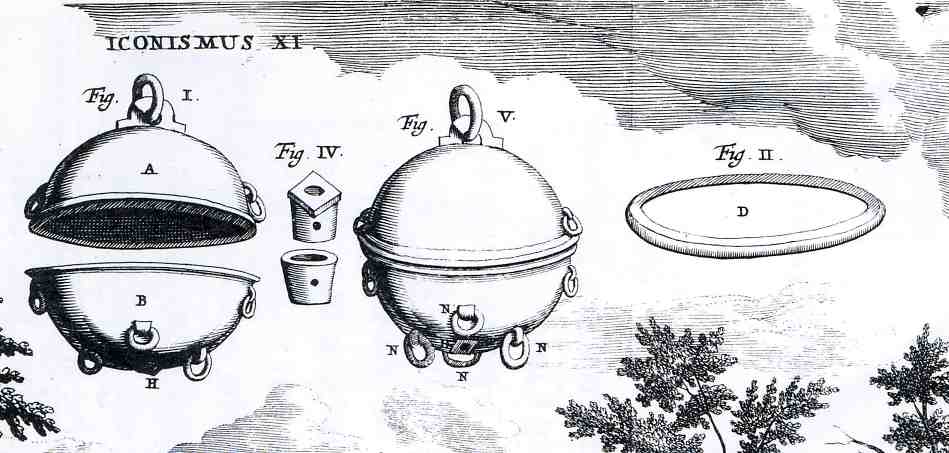
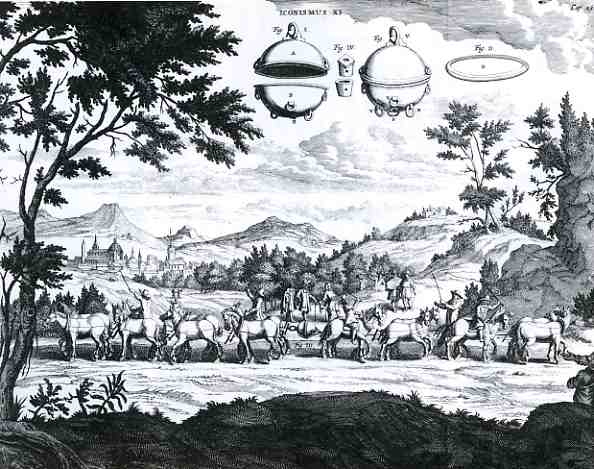
    This is really just another bit of fun–the four objects in the sky weren’t unrelated to the scene, not at all, though if you wanted you could certainly create a fantastically rigorous and bizarre story for them; they certainly did define the concept of “nothing” for the Blank & Empty Things thread of this blog.  here is no doubt that the image has a very quiet, possibly Dadist origin.  In fact, this is one illustration from one of the greatest experimental physics books of the 17th century, coming as it does from Otto von Guericke’s  Experiemnta nova (ut vocantur) Magdeburgica de vacuo spatio (Amsterdam, 1672).  In another minute department, this one is also I guess the greatest book ever written by a Mayor of anywhere (as von Guericke (1602-1886) was mayor of

    0 blog feb 11things out568 Magedeburg for 33 years).  The image shows the greatest of von
    Guericke’s efforts, and one of the greatest (or most important)
    experiments in experimental science–the dramatic demonstration of the
    vacuum, showing here that teams of horses could not pull apart two
    halves of an evacuated sphere, and of course the efficacy of air
    pressure operating against it (um, the vacuum). The “floating” bits in the sky were an exploded view of the sphere that was the subject of the experiment. 

    What was more important though, and what the general reader today might easily miss, was that von Guericke created something that many scientists and philosophers said didn’t, and couldn’t, exist:  the vacuum.  In modern times, Copernicus depicted the universe as a vast void; Descartes came in the back door (following the ancient and interesting though incorrect theory of Aristotle*), not liking the idea very much, and claiming that such empty space couldn’t exist.  Von Guericke provided the proof that the vacuum, that nothing, did exist. 

    _______

    *Aristotle (384-322 BCE) theorized that as air became thinner objects moving through it would move faster, which is true; he further speculated that if there was no air at all, that if vacuums did exist, then objects would move infinitely fast, which he correctly assumed was not possible, and thus the vacuum could not exist. 


  • Things out of Place Department: a Cloud of Magnetism in the Sky Poked by the Needle of God

    JF Ptak Science Books LLC  Post 508

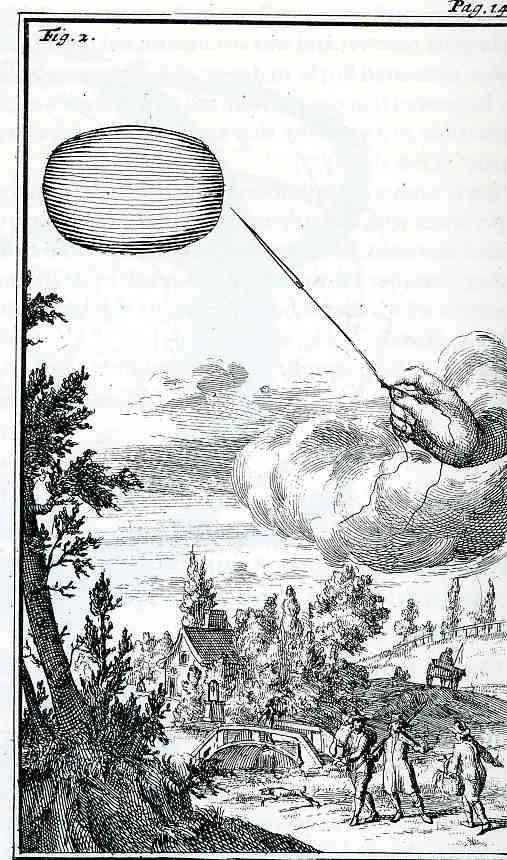
    0 blog feb 9 missing magnet543“And even though I’m sitting waiting for Mars

    I don’t believe there’s any future in cause

    Hole in the sky, gate way to heaven

    Window in time, through it I fly…”

    Black Sabbath, “Hole in the Sky”, 1975

    Well, there were many liberties taken with this title, though on the face of it, the title is correct (sort of).   This image comes from a relatively obscure (or at least quite rare) copy of  Joachim Dalance’s work Traite de l’Aiman, divise en deux parties, la premiere continent les Experiences et la seconde les raisons que l’on en peut rendre... which was printed by Henry Weinstein in Amsterdam in 1687 (just across the waters in London Isaac Newton’s fantabulous Prinmcipa Mathemtica was being printed in the same year).    This important work on magnetism featured a number of good and useful observations on magnetism, interspersed with some semi-useless bits:  the magnetically floated coffin of Mohamets is mentioned and disproved, the origin of magnetism is asserted by hypothesis and is not pretty, along with some “fanciful conception(s) of the magnet’s potential”*; on the other hand, there is a mention of the invention of the compass, the real use of magnets, a mention of declination, and the orientation of a compass needle in a magnetic field is shown.  All pretty good stuff, considering the time.  (The magnum opus on the magnet was published in 1600m by William Gilbert and was called De Magnete, Magneticisque Corporibus, et de Magno Magnete Tellure (On the Magnet and Magnetic Bodies, and on the Great Magnet the Earth), though folks have been writing on magnetism since Aristotle and Thales)

    M. Hofer, the author of the quote above, mentions that the pamphlet’s images “are particularly good scientific illustrations”, though doesn’t mention this, figure 2, as being anything significant.  Trying to dissect the phenomenal imagery, which purports to depict the origins of the sources of magnetism, we see something like a “magnetic cloud” in the sky, about to be pricked by a needle held by the primum mobile.  That, or it is a missing piece of sky, a gapping hole, though not in the sense of what we’re getting now in the ozone layer, or in the fantastic billion-light-year wide swath of nothingness in the foamy universe.  Perhaps it is more like the Black Sabbath lyrics after all, a hole in the sky, pricked by the creator, to loosen the fabric of magnetism and getting a glimpse of heaven.    Or something.  

    [I should point out that Dalance was an out-and-about guy, with high-level correspondence, and who seemed to be at the right places at the right time.  Among many contributions to the sciences, Dalance–who was a friend of Henry Oldenbourg, helped introduce Huygens to the Royal Society as well as to the French Academy of Sciences, acting as an intermediary for the most part.  He seems to be an interesting guy.]

    *–Ph. Hofer, Baroque Book Illustration, page 42


  • A History of Blank & Empty Dots: the Discovery of (Smooth) Muscle, 1700

    JF Ptak Science Books LLC  Post 506

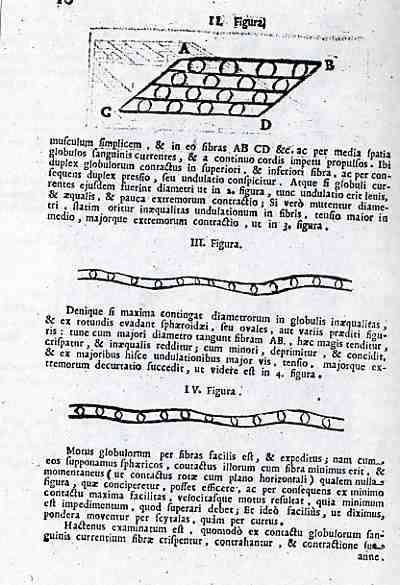
    0 patti horse533In a rare confluence of odd bits, today’s post joins the categories of Blank and Missing Things with A History of Dots to form a probably-not-to-be-used-very-often category of A History of Blank and Missing Things:  Dots.  These text illustrations come from (page 10) of the great Girogio Baglivi’s De Fabra Motrice et morbosa..., a 58-page section found in Alessandro Pascoli’s Il Corpo-Umano o Breve storia…., all published in Venice in 1700.  Baglivi (1668-1707) was an ethnic Armenian raised in Italy who rose to the rank of physician to Pope Innocent XII, and who was also a distinguished author and professor of anatomy at the Sacred College at Rome.

    In spite of living only 39 years (dying,  probably, from the consequences of a severe malarial attack) Baglivi had a long list of accomplishments, primary among these was his description and distinction of the smooth and striped muscle, the subject of the engraving at left.  This is one of the giant milestones in the history of physiology in general, also making crucial contributions to medical/clinical education.  It is the illustration of these muscle types that display the “empty dots”, not so much empty, of course, but just devoid of detail for the sake of illustration–but for my purposes, these simple empty spheres signify so much with so little.  Nothing, really. 

    Some sort of interesting and perhaps overall numbing quotes of Baglivi:

    Let the young know
    they will never find a more interesting, more instructive book than the patient
    himself. …

    The doctor is the
    servant and the interpreter of nature. Whatever he thinks or does, if he
    follows not in nature’s footsteps he will never be able to control her.

     De
    Praxi Medica
    (1696).

    The origin and the causes
    of disease are far too recondite for the human mind to unravel them.
    — Giorgio Baglivi  Praxi Medica (1696).

    The two fulcra of medicine
    are reason and observation. Observation is the clue to guide the physician in
    his thinking.
      — Giorgio Baglivi Praxi
    Medica
    (1696)


  • Blank and Missing Things #31: Missing Earth

    JF Ptak Science Books LLC     Post 504


    Scan0001
    In 1830 when Amos Eaton, filling up his chair and burning
    the  midnight oils in his home in Albany New York, was figuring out the
    insides of the earth  He had but little direct evidence to go on, and the publications on the topic of the center of the earth were left to speculation not much better then than science fiction (a term which had not been invented yet; neither for that matter had the word “scientist”).  
    A  very careful  observer, Eaton applied what he knew about the strata
    of the earth to a theory of how the landforms of the upper/outer mantle
    were formed. (Eaton (1776-1842) was as influential a teacher as he was a
    theorist and observer:  some of his
    students include the following Big Names (for which many buildings on university
    grounds are named for ):  James Dwight
    Dana
       (geologist, zoologist), James Eights
     (Antarctic
    explorer), Asa Gray
    ( greatest 19th c American botanist), James Hall 
    (first New York State Geologist), Joseph Henry
    (developed electromagnetism, all-around smart guy who
    communicated with everyone, secretary of the Smithsonian and so on.)

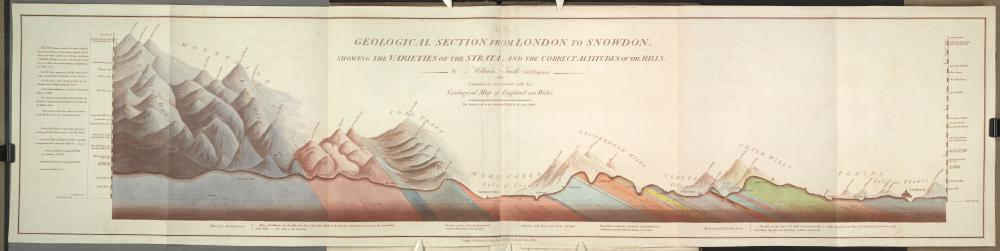
    He applied the discoveries of stratum of William Smith (1759-1839, the “father of English Geology”) drawing on a number of maps of his, such as “Strata
    Identified by Organized Fossils. : Containing Prints on Coloured Paper of the
    Most Characteristic Specimens in each Stratum” of 1815  and “Geological section from London to Snowdon; showing the varieties of the
    strata, and the correct altitude of the hills” of 1815 (pictured below), plus much else.  

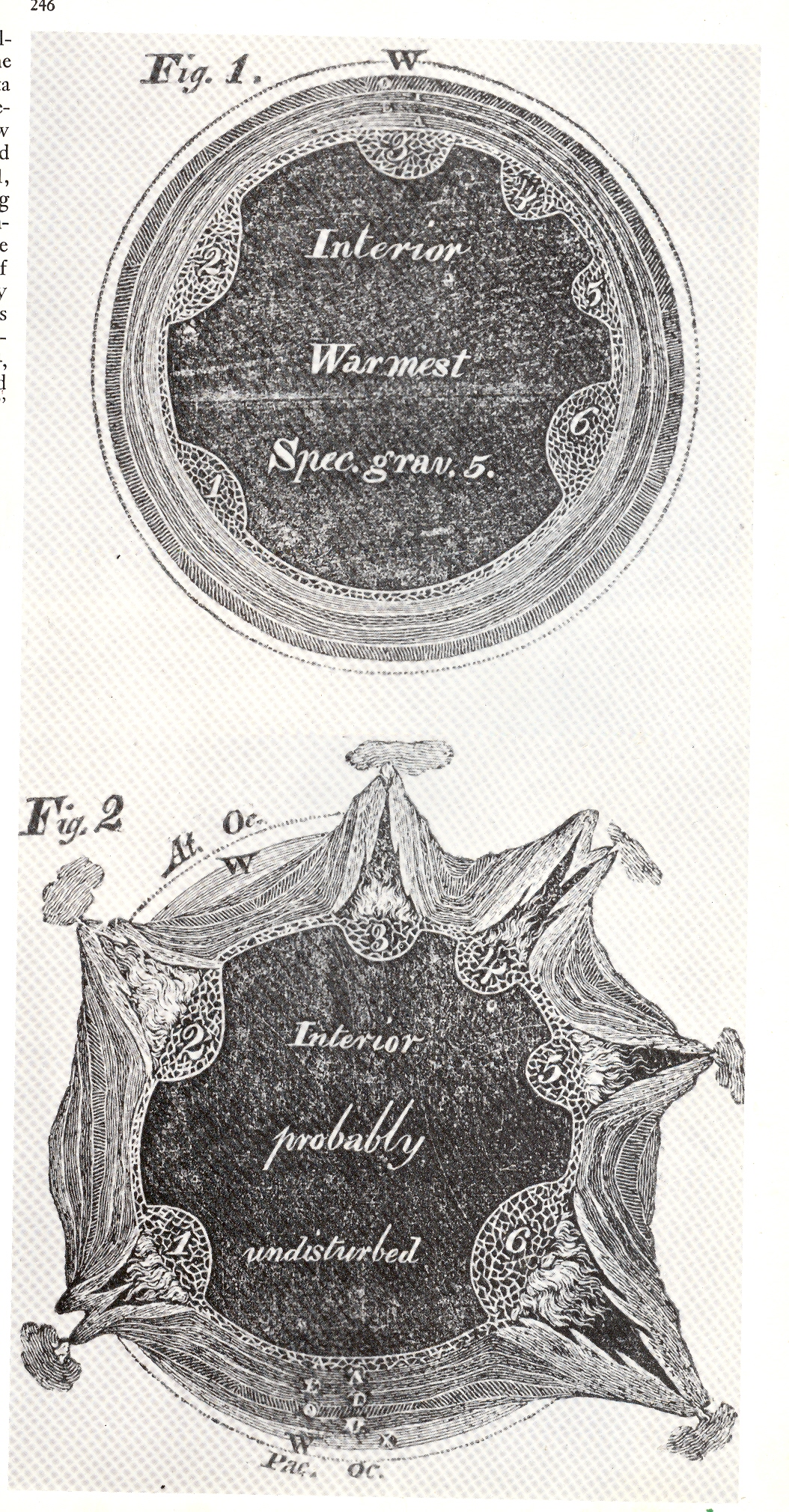
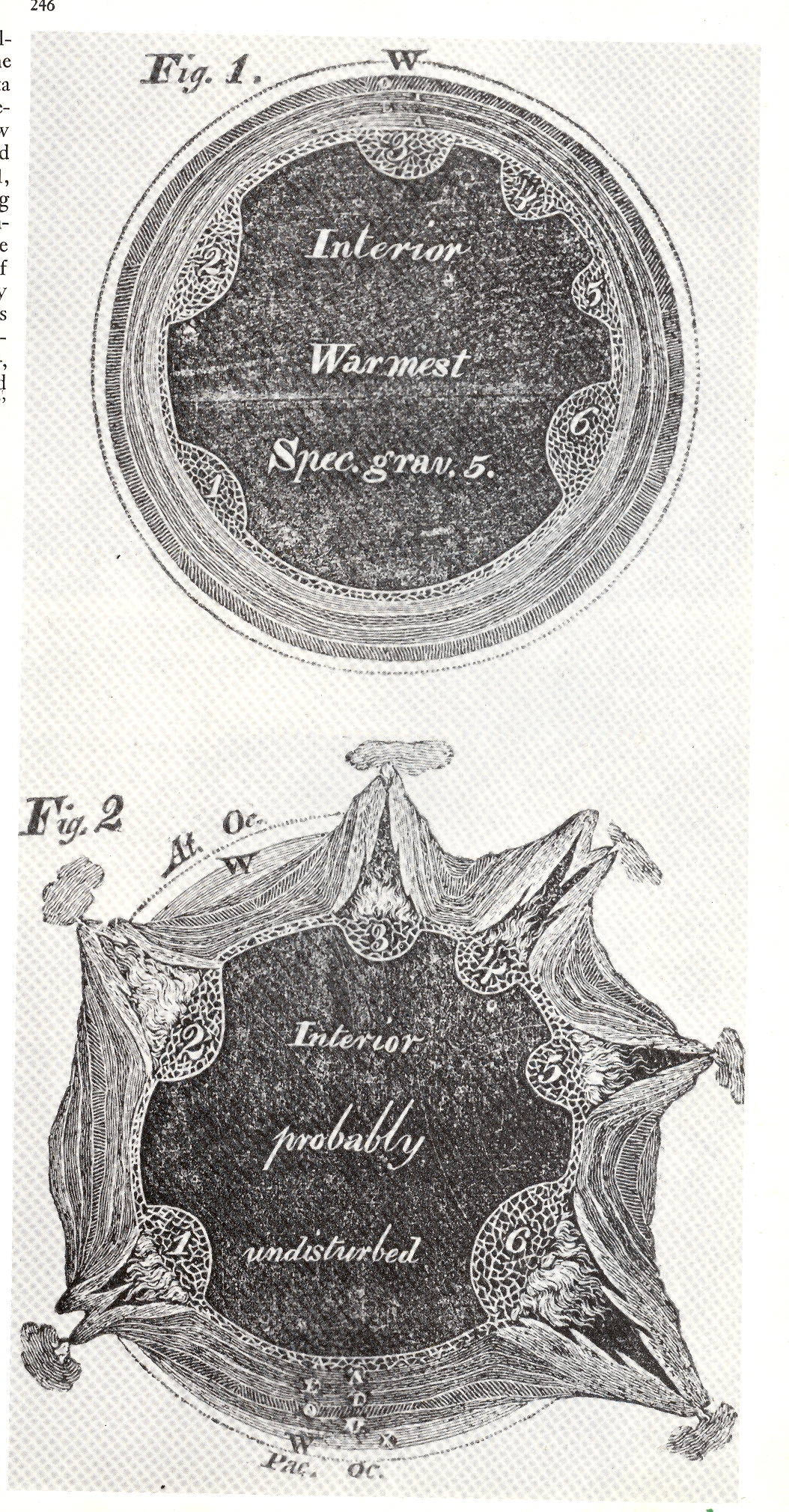
    These two images (left) of cross-sections of the earth appeared in Eaton’s Geological Textbook, (1830). The top shows the earth in perfect harmony and in cross-section, depicting the strata in six layers beneath a calm and palcid ocean.  There was trouble though located inside the six bulbous bulbs on the interior of the innermost strata:  as we see in the second image, the six bulbs, filled with
    Scan0003
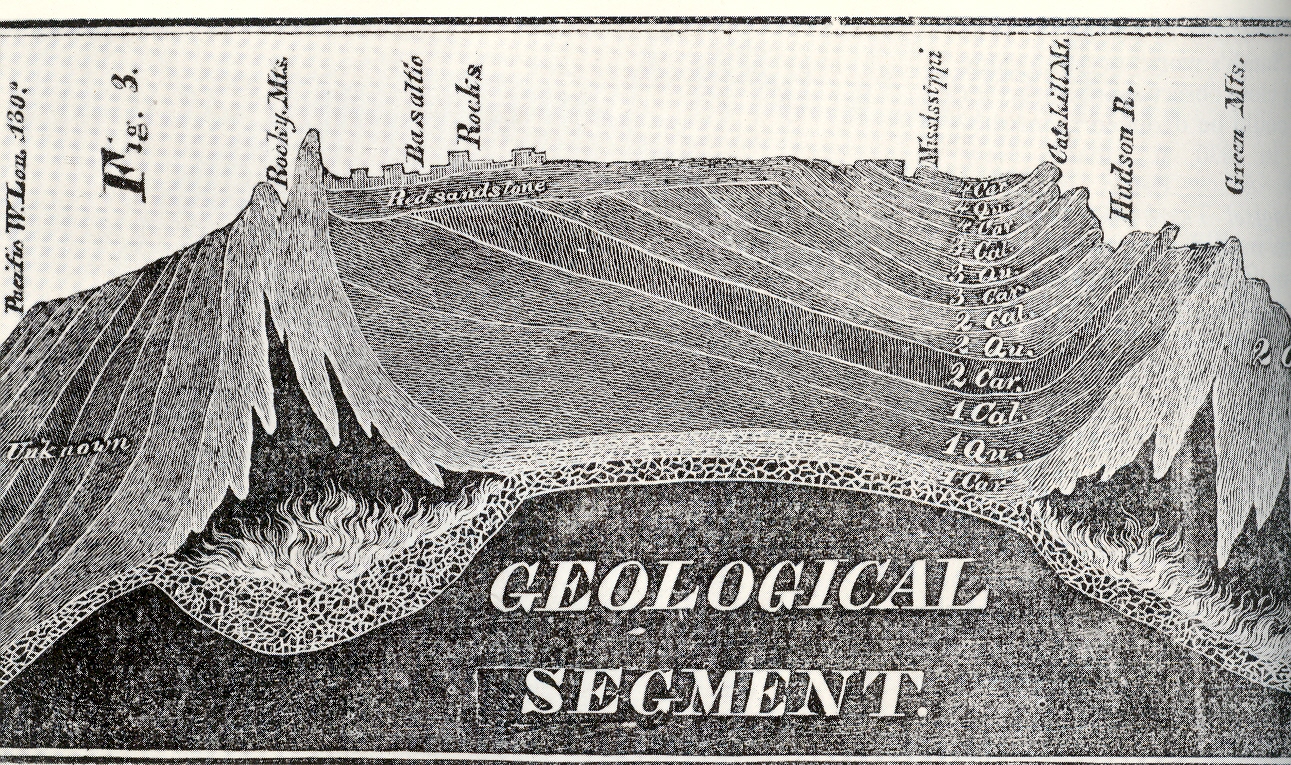
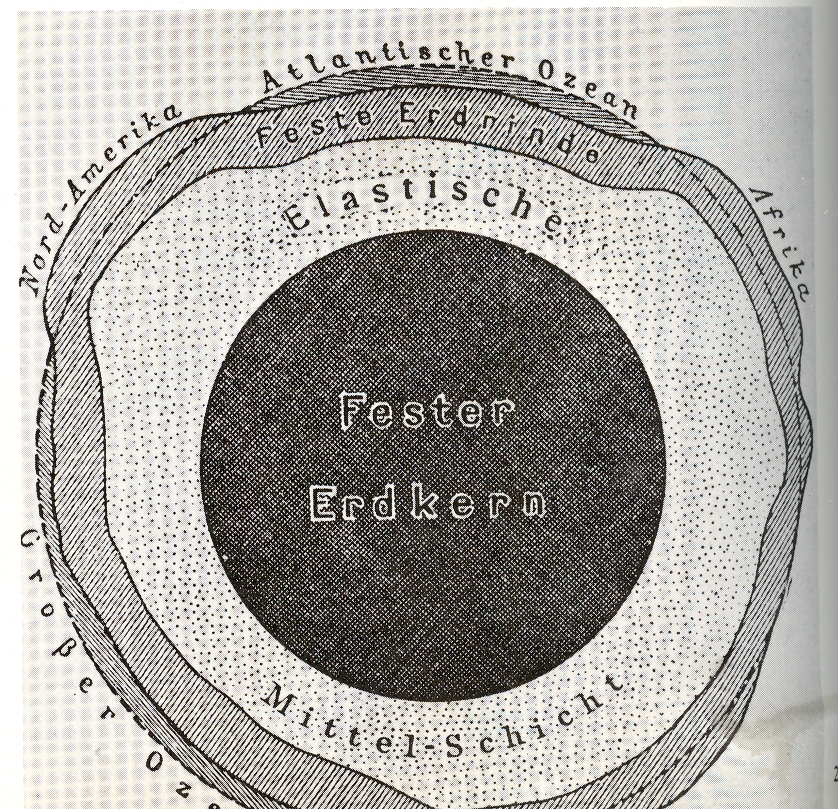
    “combustible material”, combusted, forming volcanoes and such, thereby parting the waters and forming the continents. It was some pretty  good thinking for the time.  But what attracted me to these images was the labeling of the interior of the newly-exploded earth, “interior probably undisturbed”, and blank beyond that point.  a dark, blackish mass, unknown and from where Eaton sat, unknowable.  But Eaton did do an extraordinary job in trying to imagine this stuff, piecing things together from the geological record in those pre-Darwin, pre-Lyell days.  The woodcut at right appeared in the same publication as that above–this incredible rendering depicts the entirety of  North America  in profile, which was a vast leap of faith, an image so severe in its accomplishment that it is difficult today to realize how shocking it must’ve seemed to the readers of 1830.  I believe this was the first time a true geological cross-section like this was attempted–again to see an X-ray (pre-dating that discovery by 65 years by the way) of the earth and to have it be not so terribly bad (compared to today) was just a phenomenal achievement

    ________

    Just for the record, Smith’s map of the London area–which presages the Eaton map somewhat–appears below:

    Blog--earth nothing smith