A Daily History of Holes, Dots, Lines, Science, History, Math, Physics, Art, the Unintentional Absurd, Architecture, Maps, Data Visualization, Blank and Missing Things, and so on. |1.6 million words, 7500 images, 4.9 million hits| Press & appearances in The Times, Le Figaro, Mensa, The Economist, The Guardian, Discovery News, Slate, Le Monde, Sci American Blogs, Le Pont, and many other places… 5000+ total posts since 2008.

Category: Blank and Empty Things; A History of

  • Blank and Empty Space: Tobias Stimmer’s Spare Portraits

    JF Ptak Science Books LLC  Post 713  Blog Bookstore

    This is part of a continuing series of posts on Blank, Empty and Missing Things.


    ===blog==aug 13==stimmer2


    Paolo Giovio’s (also known as Paulo Jovio, 1483–1552) Elogia vivorum bellica
    virtute illustrium
    (or "Praise of Men Illustrious for Courage in War") published
    in 1554 and Elogia virorum literis illustrium (1577) are two of the most
    beautiful woodcut productions of the later 16th century. They were illustrated
    galleries, a sort of supra-advanced Renaissance LIFE magazine of famous
    people in the arts and military. They were, in general, the first time the portraits
    of the vast majority of these 180+ people had been seen in a printed forma,
    the mysteries (if any) of their appearance revealed to the public. The work was
    more than thirty years in the making, with the woodcuts (after the paintings by
    Giovio) being worked by Christopher van Sichem, Bernhard Jobin and the great
    Tobias Stimmer. The portraits included authors, poets and various other
    humanists, as well as military people and their support, plus natural scientists
    and medical people.

    I like these images because of their determined simplicity—at least the portraits
    themselves were simple (done with a real respect for open, blank space), though
    the borders were anything but.
    This portrait by Stimmer,for
    example, shows very wide spaces of white, un-tapped pieces of the woodblock,
    leaving them open for
    interpretation.

  • Nothing as a Weapon—American Acquiesence in the Holocaust

    JF Ptak Science Books LLC   Post 697  Blog Bookstore

    “It may perhaps seem strange, that I treat as often in my
    works of the same matter…the contempt of the world, and the meditations of
    Death: but if the importance of the subject be considered, and the profit to be
    derived thence, a Man will never be wearie of seeing such faire truths under
    different presentations.”
     

    Jean Puget de la Serre, The Mirrour Which
    Flatters Not
    , 1639.

    Following up on yesterday’s post on lethal number
    (in Japan,
    1945) I thought I’d have a quick look at another devastating weapon.  In the arsenal of human weapons, man’s tongue
    must rank quite high, right there with ignorance and knowing conceit.  The seven deadly sins must also be considered
    lethal weapons, once they turned on themselves, unleashed from the human
    condition. 

    I’d like to focus on self-deception, the welcoming of not
    knowing something, of not wanting to know, of stopping: of doing nothing in the face of something needing to be done.

    The destruction of the Jewish people during World War II is a history with many
    bearings, a complex of actions that seem to have been both elusively
    unstoppable and eminently addressable.  The psychology of why this
    occurred is forensically comprehensible; the ultimate question, after
    everything is said and done, is why the extermination was allowed to continue
    for years on end. There is a considerable catalog of demons of nonactions and deceits
    that I just can’t address now in a short post like this. Though I would like to
    know why was it so difficult/impossible for the British government (and in
    particular, Anthony Eden)
    to allow Palestine
    as a safe haven for desperate Jews, engaging in torturously long non-decisions
    and bureaucratiuc inscrutabiulity to emergency situations?  Why did Franklin Roosevelt
    take so long to come acknowledge the documentation of the Holocaust and then
    cause almost nothing to be done about it?  Why did Sumner Welles act decidedly against any real
    action in presenting the full case of the Holocaust to American leaders? 
    Why would the War Department (represented by Assistant
    Secretary McCloy) respond in 1944 that  Auschwitz
    was both beyond the reach of tactical bombers and not be of sufficient military
    interest to divert Air Force resources away from other areas of interest? 
    The knowledge of vast extermination of Jews in Europe
    was known by early 1943, and yet, there was little action taken to do anything
    to stop it.  Not only that, the issue of emigration for Jews to the United
    States or any other country that would have them was caustic and slow; it was
    in short a history of the use of the word “no”. 

    Henry Morgenthau (1891-1967), an old-line politician, was
    secretary of the treasury under Roosevelt and
    was also the only Jew in the cabinet.  It
    was he who produced one of the most compelling, and damaging, documents questioning
    the American government’s culpability in doing nothing concerning the
    Holocaust, when “officials dodged their grim responsibility,
    procrastinated when concrete rescue schemes were placed before them, and even
    suppressed information about atrocities.”

    Its title left nothing to question:

    “Report to the
    Secretary on the Acquiescence of this Government in the Murder of the Jews”

     It starts so:

    “One of the greatest crimes in history, the slaughter of the
    Jewish people in Europe, is continuing
    unabated.

    “This Government has for a long time maintained that its policy is to work out programs
    to serve those Jews of Europe who could be saved.

    “I am convinced on the basis of the information which is available to me that
    certain officials in our State Department, which is charged with carrying out
    this policy, have been guilty not only of gross procrastination and wilful
    failure to act, but even of wilful attempts to prevent action from being taken
    to rescue Jews from Hitler.

    “I fully recognize the graveness of this statement and I make it only after
    having most carefully weighed the shocking facts which have come to my
    attention during the last several months.”

    The full document is reproduced below.

    It is a damning document outlining the power of doing
    nothing.


  • Blank & Empty Things #50: Empty German Soldiers, 1908

    JF Ptak Science Books LLC   Post 689  Blog Bookstore

    This post–image only, really–is part of a series in this blog relating to the empty, and the blank, and the missing. 
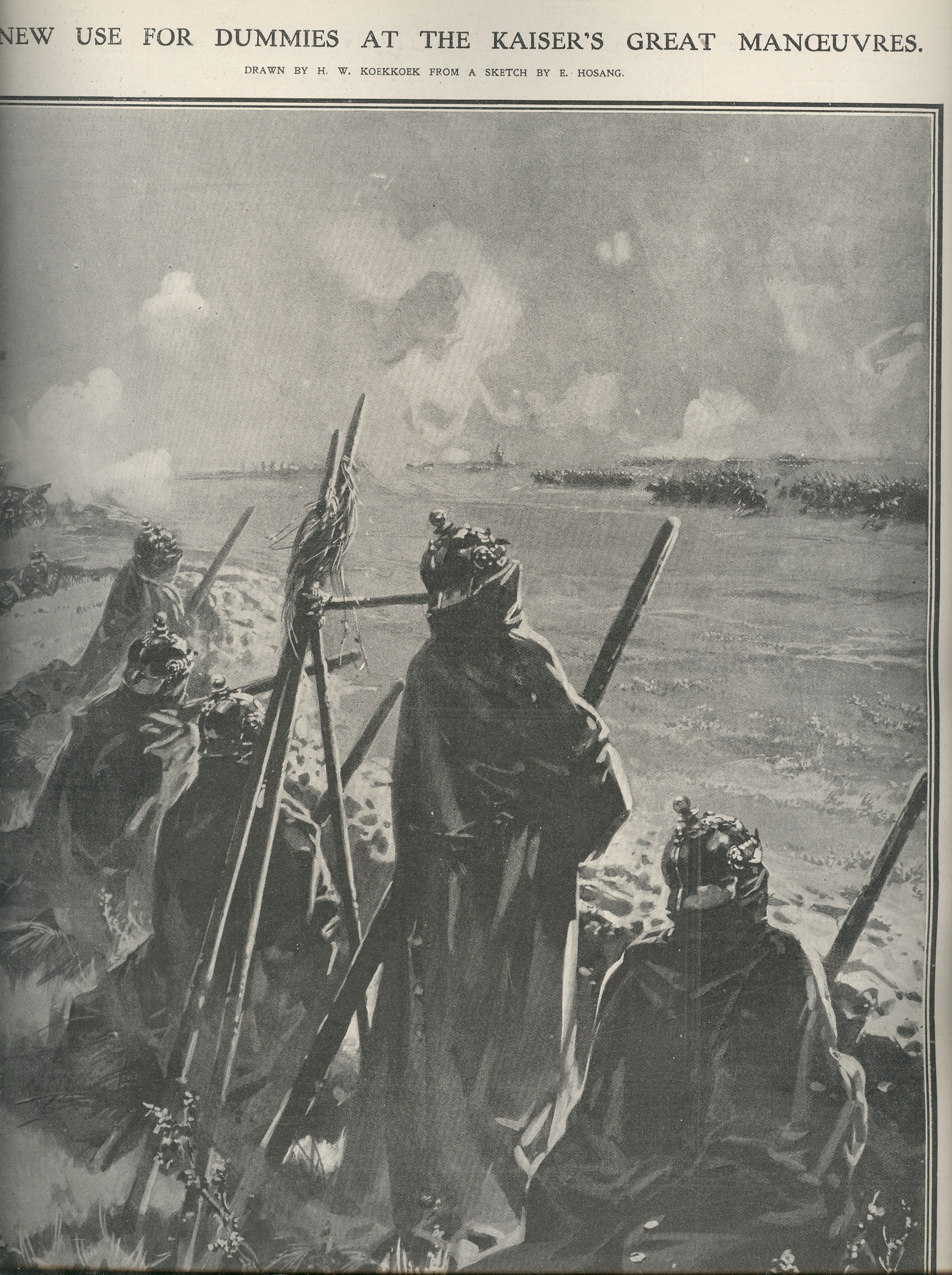
    “Bogus Supports for Artillery in the Great German Manoeuvers in Alsace” reads the subtitle of this odd drawing that appeared in the Illustrated London News for 1908.  “A New Use for Dummies at the Kaiser’s Great Manoeuvers” reads the title, describing a practice action by the German army on the fields of a famous battleground of the Franco-Prussian War (1870-1871).  The empty soldiers were made to support the artillery:  realistic, uniform-clad straw figures made to accept the bullets of the attacking practice force. Dead soldiers being killed in mock battle by living ones whose own fates would be sorely tempted in six year’s time.==Blog July 17==empty solder


  • Lost-topia: Looking for the Birthplace of Recorded Country Music

    JF Ptak Science Books LLC  Post 682  Blog Bookstore

    Looking for 412 State Street, Bristol, Tennessee.

    A History of Blank, Empty & Missing Things, #50 

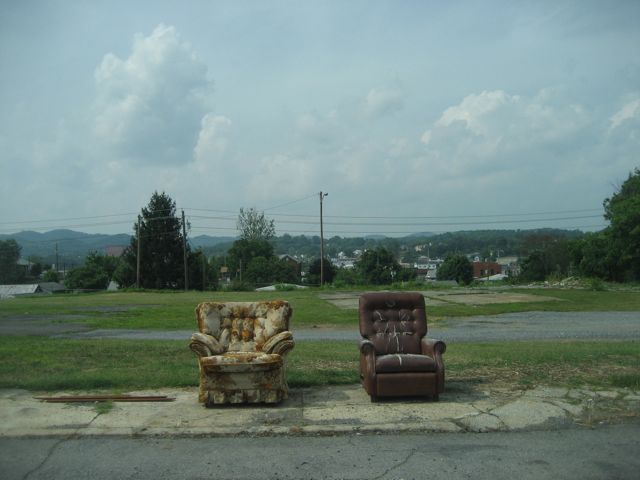
    Bristol JP 2 chairs

    Driving through Forks of Ivy, topping Sam’s Gap, crossing the Nolichucky, passing through Unicoi County and into the Watauga watershed, I found myself in Bristol, Tennessee, in the north-east part of the state at corner of southwest Virginia.  Bristol is actually on the state line, with half of the city in Tennessee and the other half in Virginia. The dividing line is the main thoroughfare, State Street, a tight avenue lined with early-ish building that hint of the age of the place, but not nearly so.  This used to be frontierland, the area surrounding being largely found in the 1750-1775 or so, at a time when the Blue Ridge and the Southern stretches of the Appalachians were the Far Western frontier.

    I was after a different sort of frontier adventure on State Street today—a musical one.  State Street was the home of the “recording studio” for the renowned “Bristol Sessions”, which is recognized far and wide as the veritable Big Bang of country music. 

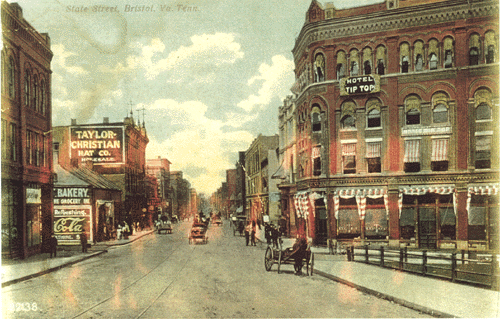
    Ralph Peer (of Okeh Records fame), an entrepreneur/musical spelunker, came to Bristol in July1927 looking for local music played by its hidden talent. There was a large interest in original American music—gospel and blues–from the far reaches of the country at this time, and Peer sought those genres in addition to secular music tat fit neither category–that would be “country music”.  He was alerted to the area by his friend, the musician Ernest Stoneman (of an equally musically-rich area in Galax, Virginia), guided by the assertion that the Bristol/Johnson City/Kingsport area was a magnet for the musical talent of the region.  He set up a temporary recording studio, renting the top two floors of the Taylor-Christian Hat Company (seen in the postcard image below, just beyond the Tip Top Hotel) at 412 State Street.  Statestreetcirca1900 The initial react to his advertisement was underwhelming, but when an article appeared in the local newspaper in the second week of his two-week stay touting the $3600 that Stoneman received in royalties in 1926 for his recorded music, the floodgates opened, and suddenly Peer was completely booked.

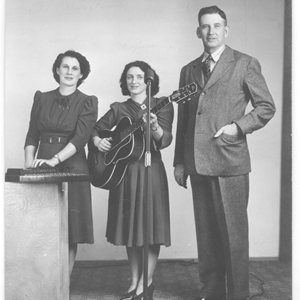
    The recordings that Peer made at 412 State Street were spectacular.  Among those who showed up was the young Jimmie Rodgers. And Uncle Eck Dunford and Ernest & Hannah Stoneman. And A.P., Sara and (Mother) Maybelle Carter, who recorded their oh-dear-god-beautiful “Single Girl, Married Girl” (and “Bury Me Under the Weeping Willow”, “Little Log Cabin By the Sea”, “The Storms are on the Ocean”, “The Wandering Boy”) there on the second floor. 

    There were 19 performers who recorded 76 songs in an altogether singular moment.

    Carter-family

    And so, being near  Bristol today I went looking for 412 State Street.  I must say that it looks as though Bristol was prosperous at some pre-WWII point in the past, the city looking like it needed a scrubbing, with lots of store-front vacancies on its most famous street.  Also there seemed to be no 400 block.  Having the postcard image of where the hat factory was, I started comparing the buildings on the 500 block to those in the picture, and I had half-convinced myself that the city must’ve changed the numbering system for the street to accommodate what my brain was telling me was the missing building.  The match looked pretty good, except for the number of windows. 

    There were only a few businesses open that I could see, and I popped into one—a music store, its open door allowing the loud rock music from the inside, out—and asked the young woman where the Bristol sessions building was.

    She instantly looked sad.  “Come with me, I’ll show you” she said, as we walked out to the sidewalk.  It was not a good feeling.  She looked north on the street, towards the open area of State Street that seemed to have been urban blighted, and I tried to get her to look south, to where I hoped the building was. 

    Bristol JP recording studio place

    “No, no, I’m sorry to say.  She pointed north, to a bad 1970’s brick single-story building about 20 0feet away.  “That’s it.  Or that’s where it used to be.  Actually that’s the second building that got built on the site.  The one that replaced Taylor-Christian got torn down too.”

    She had told the story before, a lot of times.  I think that she watched my eyes closely as I tried to focus on the foul building—maybe she saw my eyes get smaller and smaller, trying to size the three story hat factory down to this speckly brick thing.  She had to have seen the disappointment, and then the wincing reaction to the building that replaced the iconic structure.  I wondered to the woman if it was hard for her to break the news to the folks that came to finds the building.  “Used to” she said, “but now I’m used to it”. 

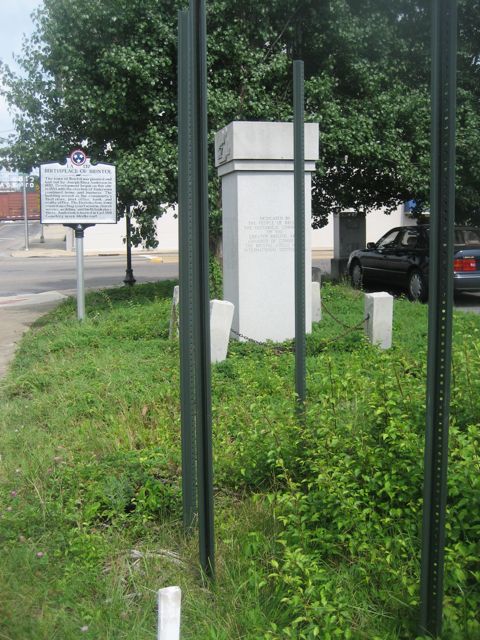
    Bristol JP monument It’s a sad end.  Especially when I found the little monument erected by the Oddfellows nearby, commemorating the Sessions.  It sits on a funny little piece of land, badly overgrown.  For some reason there’s a half-dozen sign-less traffic sign utility poles haphazardly placed bizarrely next to it. There’s a parking lot ten feet away.  It looks hot and unwanted, like a small graveyard scooped out of its pleasantness and surrounded by traffic (like the Fitzgeralds up in Maryland).

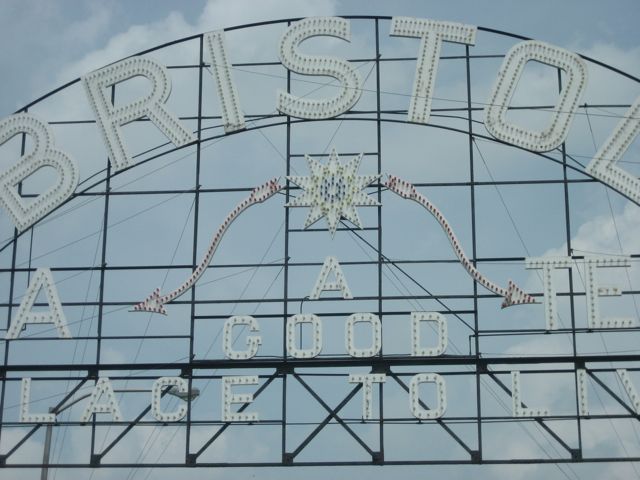
    As I drove out and away from the city, I took a few pictures of buildings that were probably once happy and visited. I should point out that once Peer was done, so too was the recording business.  The fact that this music was recorded and brought out to the world from Bristol left no real shadow on the Bristol JP Peer Stcity, until recently. 

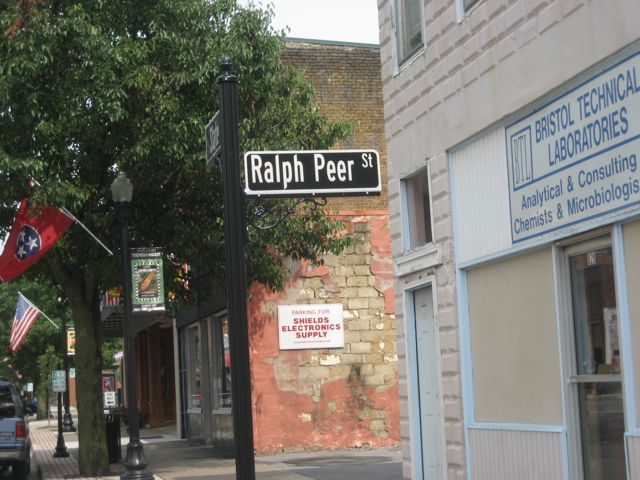
    Fitting, unfortunately, tightly with the end of 412 State Street is the street named for Mr. Peer.  It has a lovely, old-timey street sign (off State), but the street itself, well… This is just not right.

     Bristol JP Peer St2

    I was shocked by the unbearable beauty of this little business:

    Bristol JP Dentures

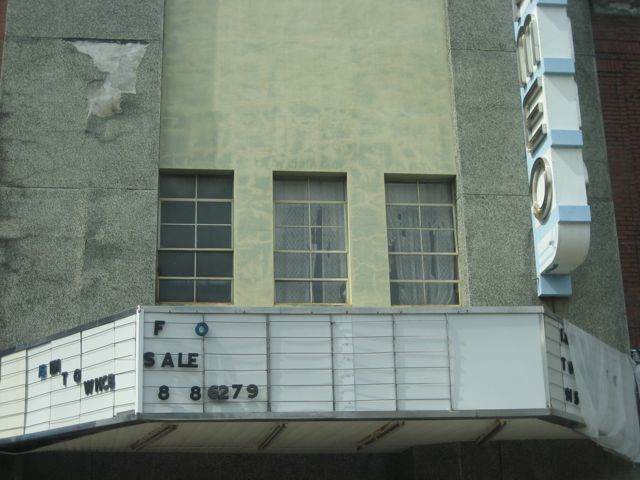
    One of the three movie theatres in a two-block span:

    Bristol JP theatre2  

    Bristol JP sign close up

    Bristol JP tires  


  • A History of Blank, Empty and Missing Things #49: Yves Tanguy’s Empty Skies

    JF Ptak Science Books LLC  Post  675  Blog Bookstore

    Blank & Empty Things Department #49

    [For another interesting example in this series see: Maps of the Cosmos of Moles, 1671: Astrology, Pseudoscience & Furious Belief]

    Tanguy--mama 1927 Surrealist, spider-eating, red-ink-drinking, bohemian template
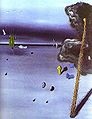
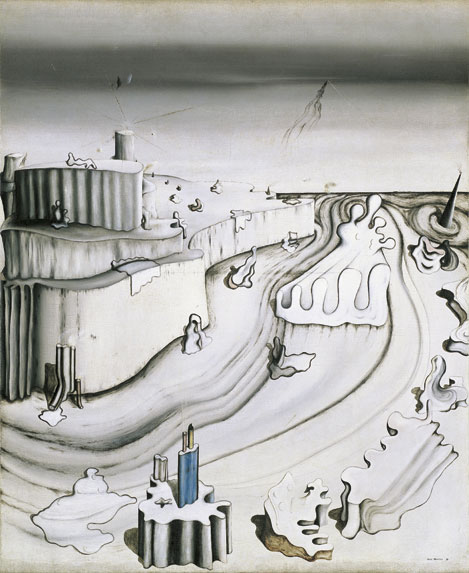
    Montparnassian Yves Tanguy (1900-1955) is perhaps the blankest, loneliest,
    emptiest painter of the Surrealist movement. 
    It seems odd to mare that statement, even to me, what with the
    tremendously lonesome images of the somewhat-earlier Giorgio de Chirico (1888-1978), but
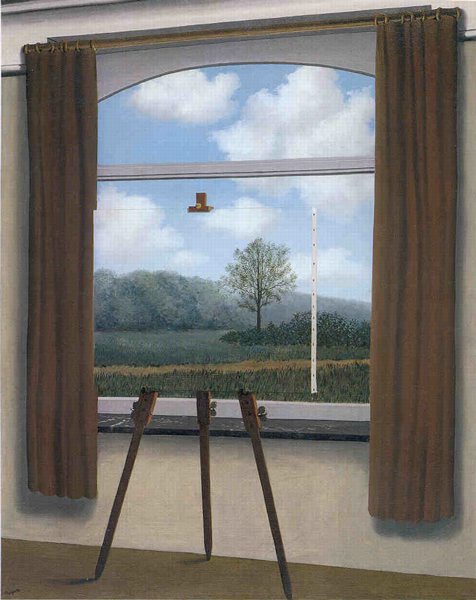
    Tanguy has a different lonesomeness/empty quality to him partially because of his very restricted color palette.  Whereas de Chirico’s
    (pictured just below) paintings are alive with color, Tanguy seems to put the unused

    Magrittecolors back into
    their tubes, painting in his all-white and unblemished studio.  He gives his paintings an odd quality, milky
    somewhat—especially in his skies, which to me look particularly empty, even
    though they have substantial texture.(This is differentiated from earlier posts in this blog that deal with blank skies in Renaissance prints, which were truly, completely blank and without any detail whatsoever.)  The
    play and wash of it all in his paintings gives me the sensation of a taste, and
    not a good one—seeing some of his work elicits a metallic, coppery taste, high
    in the back of the mouth.  I don’t get
    any of that sensate confusion form the others like de Chirico, or Magritte, or  Francis Picabia, or Marcel Duchamp, or Max Ernst, or Jean Arp, or Man Ray, and etc (though De Chirico does come close).

    Tangu--promotory


    Tanguy was undoubtedly influenced by de Chirico early on in
    his life, even before his painting career began.  The standard story is that in 1923 while
    riding a bus Tanguy saw an unusual, arresting image in the window of a store—he
    jumped form the bus, rushed back to the image and saw that it was a painting by
    de Chirico in the window of Paul Guillaume’s gallery.   He was much taken by it, and very soon
    afterwords began his painting career in earnest, becoming recognized and
    semi-established within a few years.  (It
    is interesting to note that the critic who first gave him positive feedback, F.
    Fels, very soon thereafter wrote to Tanguy “You’re finished.  You’re going to wind up a surrealist.” ) He
    did “wind up” a Surrealist, but he was hardly “finished”.

    And what I’m talking about here with the Big Lonely is just limited to the Surrealists–there are plenty of other operating in this millieu (intentional or not), not the least of whom (and painting at about the same time) is the sensationally lonely Edward Hopper, the man who invented shadwos for shadows.  But that’s another story.


  • Missing Images in Art: Depictions of Art by Children

    JF Ptak Science Books LLC  Post 668

    Blog==June 29-nurses I think that I can safely say that artwork by children does not make very many appearances in Western art prior to the 20th century.  Nor do the originals–considering the ephemeral nature of the effort at art by children, their work just don’t seem to survive.  Some of that reason–particularly in America–was the scarcity of materials for kids to produce art with: paper was not inexpensive, and neither brushes and paints.  Crayons, invented for chubby and reachy fingers, were not invented for the mass market until 1903.  (Crayola sold eight crayons in a box for a nickel.  The colors?  Black, brown, blue, red, purple, orange, yellow, and green.)   Then of course the artwork would have to be saved, somehow, for generations.  As much as it would be fascinating to find artwork done at age 4 by your great-great grandparents, it would have to survive the cleansing tendencies of four generations of clean-up.  End result:  there’s just not that much antiquarian chldrens’ art floating around.

    It also doesn’t appear as art in artwork.  It is possible to find numerous examples of kids’ scratches in stone and such in ancient graffiti, but it doesn’t appear as elements of fine artwork, or, for Blog==June 29-nurses detthat matter, in book illustration. 

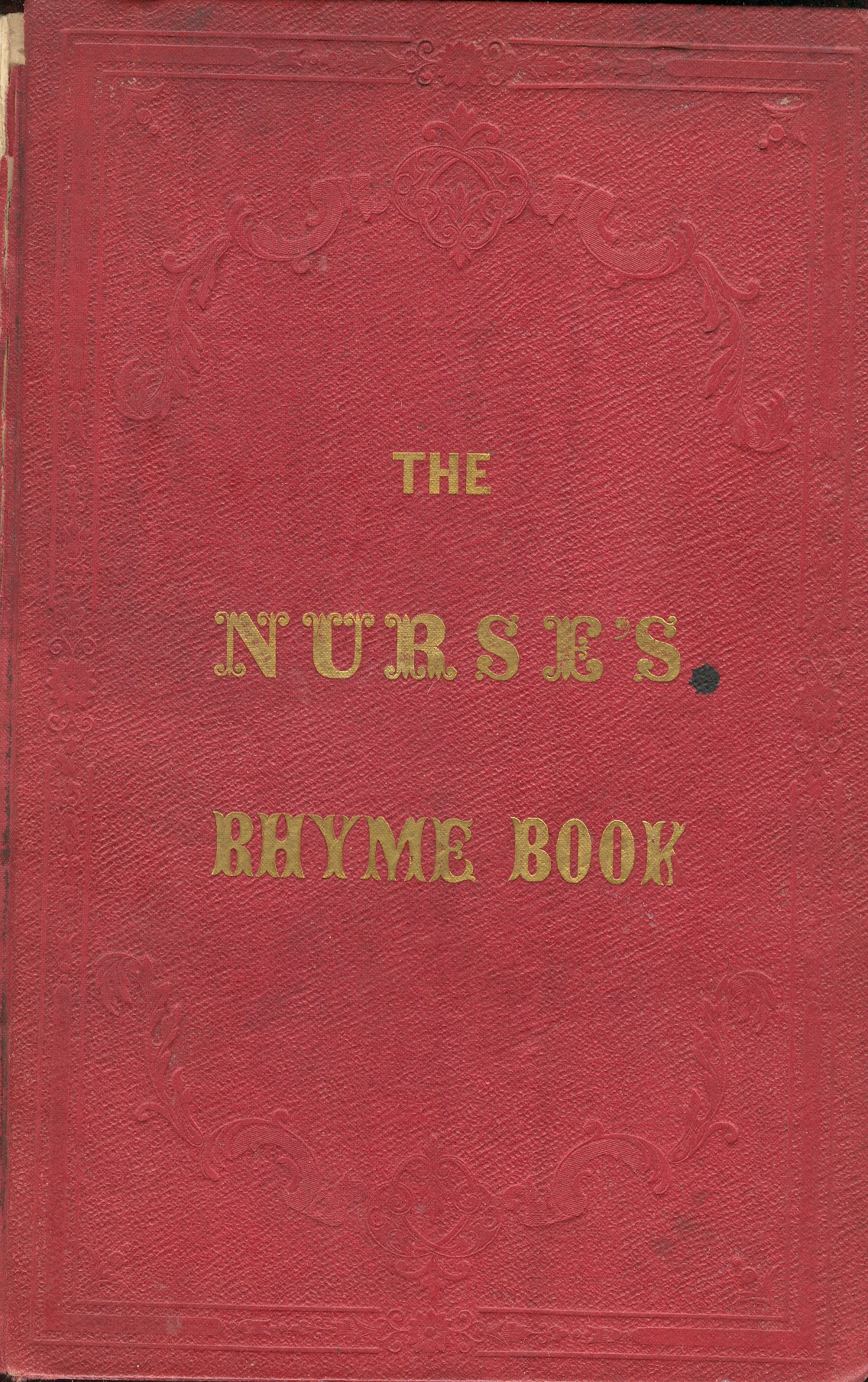
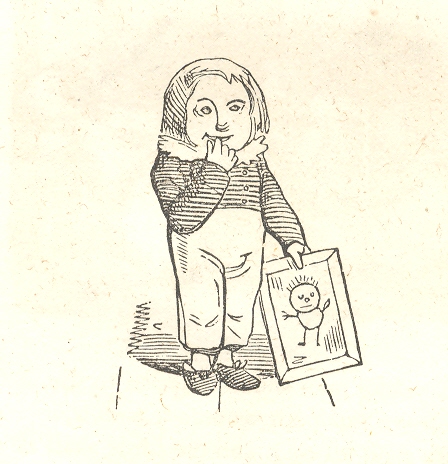
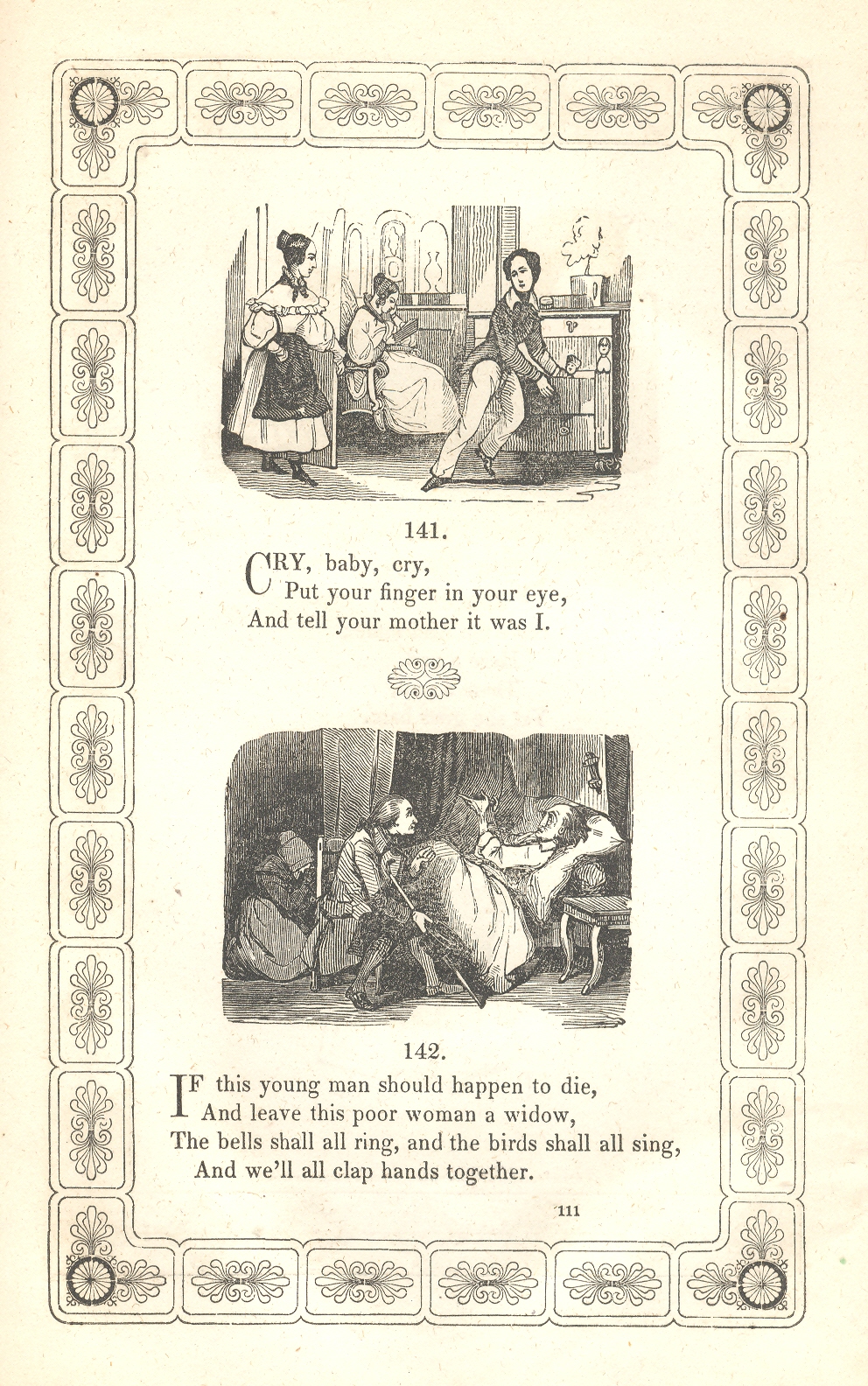
    There is an example however in Thomas Truman’s The Nurse’s Rhyme Book, a New Collection of Nursery Rhymes, published in Philadelphia in 1847.  The book is filled with unusual illustrations and fantastic ornamental borders, all used in support of some odd, scary, mean and occasionally pretty mid-century posies meant as night-time entertainment for the young ones.  Our prize is found on the very last page, the final slug of an illustration to a more-finely illustrated book: a coy, small boy, holding an example of his art, seemingly drawn on a framed slate. He looks happy, pleased, proud to me–on the one hand he is interested in sharing his achievement and on the other is really too shy to share, an emotion I’ve seen from time to time with my girls. As a matter of semi-fact, this is a rare emotion to see displayed in art, the too-shy-to-share routine saved more for fluttery self-conscious Victorian grown-ups more so than for children.. 

    Believe me, after having dealt with books and prints as an antiquarian for almost 30 years, and also having a collection of sorts of antiquarian childrens’ arts, pictures like this just don’t surface very often at all.  Over the years I’ve made some annoying phone calls and emails to librarians at art galleries (especially at the National Gallery in DC where I was a pester) explaining my interest and trying to find out if this struck any bit of memory in their brains–I never once had a positive answer. (I expected at some poin tthat someone would say, “Oh yes, of course–there’s a census of that that Mr. Kemp of Yale did in 1977. Or something, some sort of memory for this kind of image.) This is hardly an academic pursuit, but my occasionally ritualistic clawing seems to bear out that these things are just not available.

    And why this interest?  There is a simple, inherent sweetness in all of this, full of life and hope; something that crosses the generations, looking pretty much as though the emotion in the art was produced yesterday, if not for some of the content. . And that is another charm–like giving a small child a camera to photograph what they see (as in the case of my daughters Emma and Tessie) and see the remarkable results of their 40-inch tall version of my adult world.  The insights can be remarkable–not only do we see things from a new physical angle, but also the things of interest, the center of attention in the picture, the stuff that has aroused their interest and curiosity enough to take a picture of, can be incredible and totally unexpected.  That is perhaps the greatest interest for me in looking at children’s artwork:  it has the continued potential to be slam-brake innovative and filled with the unexpected insight; and it is just not a”normal”view of the world. And in a way the art can hold a key to your own antique memory of childhood; every picture has a possibility for the recovery of your own forgotten insight. 

    Blog==June 29-nurses full pg


  • Animal Imitation, Tight Corsets, and Perdition: Physiognomy, 1873

    JF Ptak Science Books LLC  Post 658  Blog Bookstore

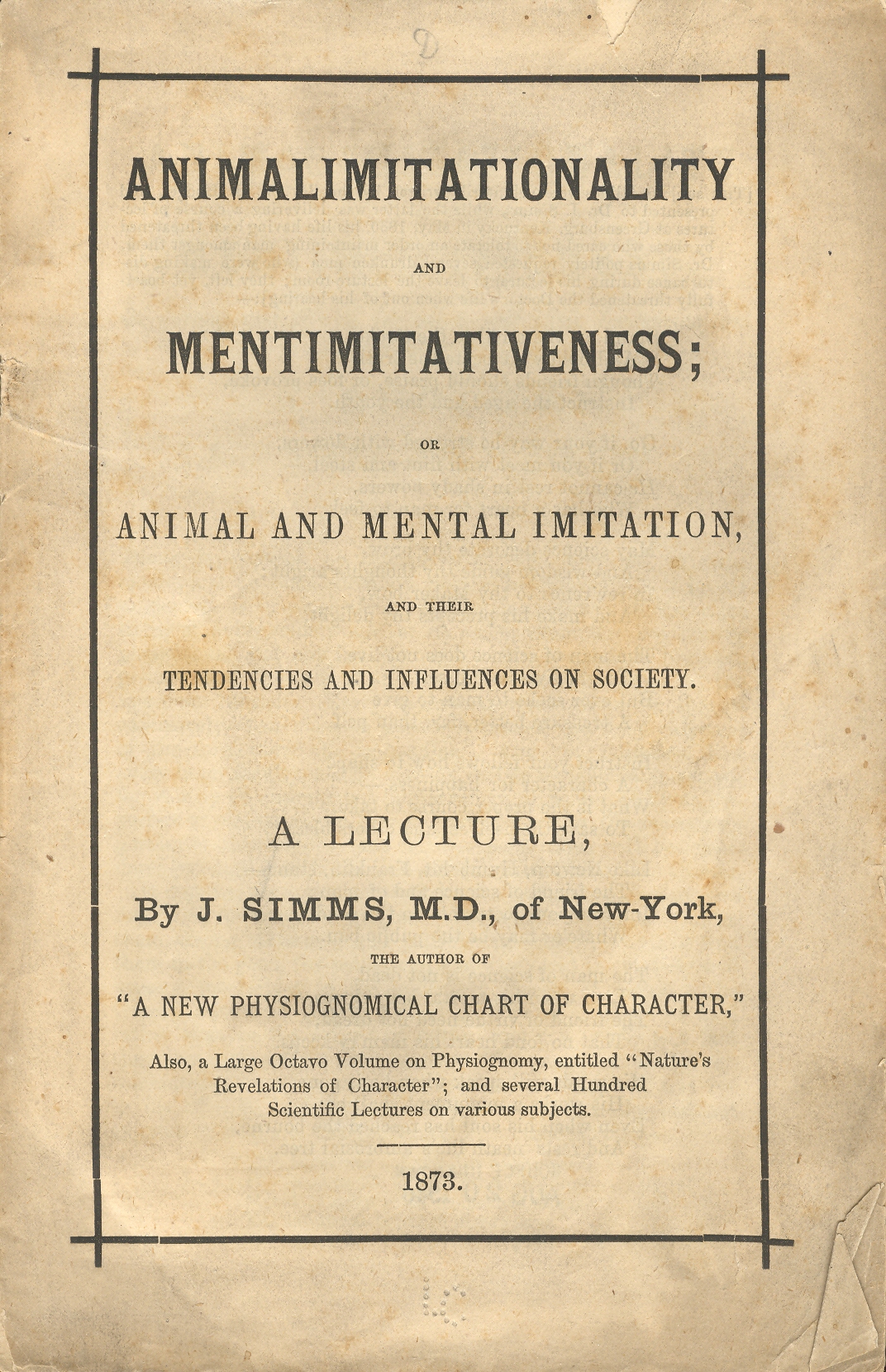
    Blog--jun 16--simms The fabulouslessness and learned foolishness of J. Simm’s horribly-named Animalimitationality and Mentimitativeness; or Animal and Mental Imitation and their Tendencies and Influences on Society, a Lecture, seems a poor-man’s ramble in a polysyllabic scribble.  At it base, J. Simms (listed as “M.D”., and who was also the author of A New Physiognomical Chart of Character) presents a two-paragraph idea and published it over twelve pages that seem twelve pages too many.  The idea is basically so:   humans at time resemble animals because animals imitate what they see, as do humans.  That is principally the entire deal, though it evidently was the cause of numerous lecture bookings for Mr. Simms.  And what Mr. Simms talks about are the problems of imitation, the results of which are found in tight shoes, tight corsets, big hats, and bad walking, all leading to debauched society and wrecked personal dreams. 

    There are many things the Simms work is not.  It is not a work that encompasses the social geometry found by other people later in the century–those who came across the study of people and immitation and the like legitimately, such as Gebriel Tardem Emile Durkheim, Scipio Sighele and Gustave Le Bon, for example.  These folks worked with capable data and reasonable assumptions in looking at how the transmission of data and knowledge takes place between people, and sought to explain the construction of the social membrane in logical and scientific ways.  They were trying to address what Marcel Proust would call (somewhat later) “a new distance between ourselves and things”. 

    Simms was interested in did this too, but did so in terms of how people imitated animals, and how that imitation spread to imitating people, and then fashions, and then resulting in too-tight corsets and too-tight shoes, and wanton neediness, all eading to advanced imitation and, finally, to perdition.  The man had an odd vision which obviously appealed to some. And so it goes.  There’s not that much difference in the set of assumptions of Simms and those of Dr. Freud, is there?


  • Maps of the Cosmos of Moles, 1671: Astrology, Pseudoscience & Furious Belief

    JF Ptak Science Books LLC  Post 646  Blog Bookstore

    “The first principle [in science] is to not fool yourself.”  R.P. Feynman

    “The Woo-woo
    is all the same, everywhere, anytime, everytime.”
    —James Randi on the
    history of   the pseudosciences .

    Self-deception and belief in Woo-woo (spurious pseudo-scientific beliefs) is some of the stuff that separates humans from animals.  And not in a good way, unless it was all chalked up to an expression of creativity and imagination.  I started this post as an entry in the History of Dots category, then in the Blank and Missing Things department, and then simply to the Bad Ideas category.  But the more I thought about mole mapping and how extraordinary it was, the less extraordinary it became, especially once the veil of age has been removed. As it turns out, mole mapping is neither more nor less extraordinary than any other system of belief.

    Here’s
    a sentence one doesn’t get to write very often: 
    Richard Saunders (1613-1692) was perhaps the foremost historian, astrologer and seer
    of human moles and their predictive forces who ever lived.  He was far from being the solitary member of
    a one-unit class:  the use of moles as
    predictive and interpretive agents stretches back dozens of
    Blog--jun 11 circ mole

    centuries, so the
    claim of Saunder’s being its most famous practitioner is not empty,
    mega-pseudo-scientific or not.  The
    mystical commentary on the Torah, the Zohar (a part of the Kabbalah), gets
    right to the point of the significance of moles (“the stars of the body”),
    transferring the structure of the cosmos and the constellations to the
    skin.  The seer and soothsayer Melampus
    from Greek mythology, in one of his necessarily pseudographic works, writes on
    the importance of moles of the face and their zodiacal relations—an idea that
    was picked up 2000 years later by the extremely significant mathematician
    Jerome Cardano.  There was a decent
    amount of argument regarding the location of zodiac symbols on the face, as it
    turned out.

    But
    the leading exponent of moles is Saunders, who was also one of the leading
    figures in a wide and very powdery period of European non-scientific
    sciences.  These wonderful images come
    from the second (!) edition of his cumbersome but accurately-titled work Saunders Physiognomie and Chiromancie,
    Metroscopie, the Symmetrical Proportions and Signal Moles of the Body, Fully
    and Accurately Explained; With Their Natural Predictive Significations Both to
    Men and Women
    (published in London, 1671, by Nathaniel Brook), in which he
    divines the psyche and the future with peoples’ moles. 

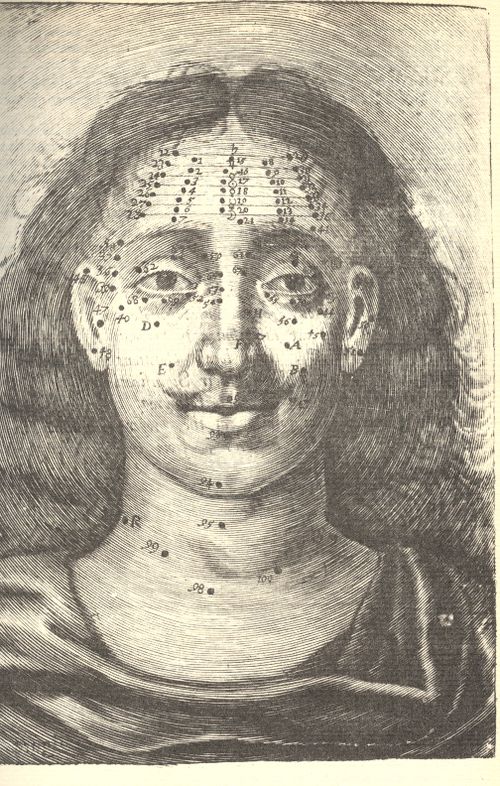
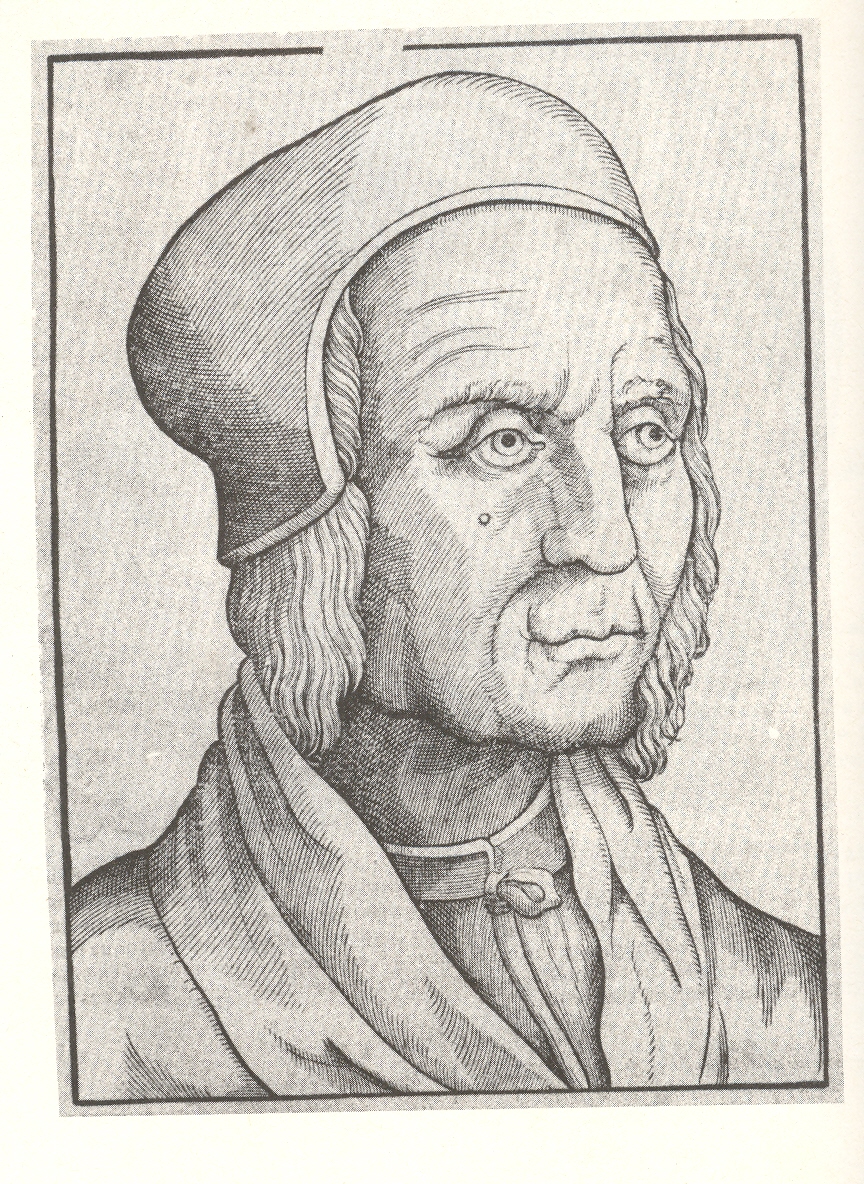
    The
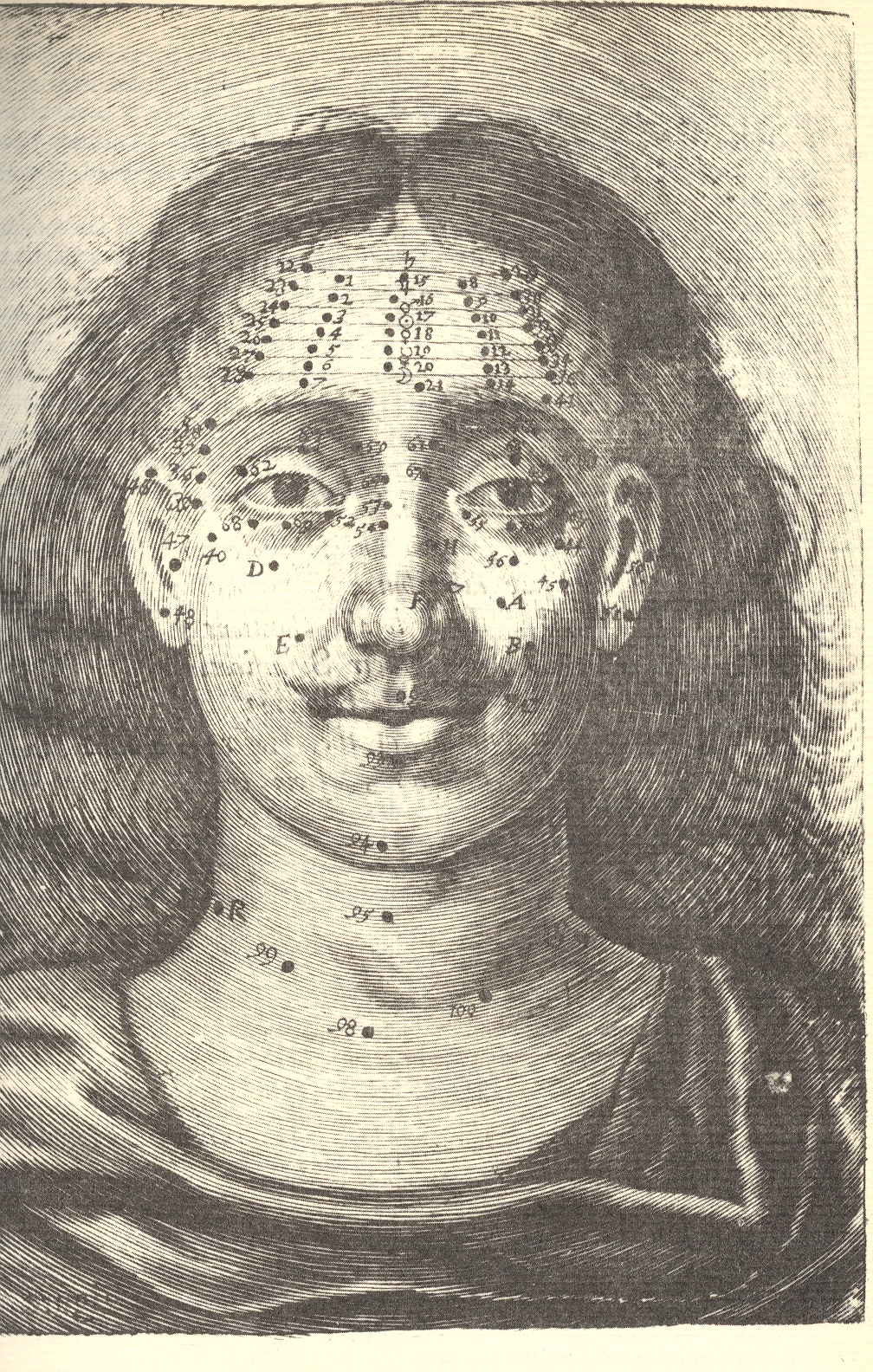
    first figure, detailing the mole locations of a man’s face, is a remarkable,
    weird accomplishment, not only because of the exhaustive treatment that is
    given to every location of every mole (g_d help us), but also because of the
    manner of the engraving.  If you look
    closely, you can see that it is Fresnel lens-like—it is an engraving composed
    of (almost) concentric circles.  I cannot
    recall seeing such a thing before—needless to say the practice of engraving
    would be laborious, and not much practiced. 
    I’m not even sure what great good it causes, though it does give a
    little different idea of depth and dimensionality to the image.  The effect that it achieves here though is to
    give a solar-system-like background to the moles—something that is much more
    spectacularly achieved in the next image.
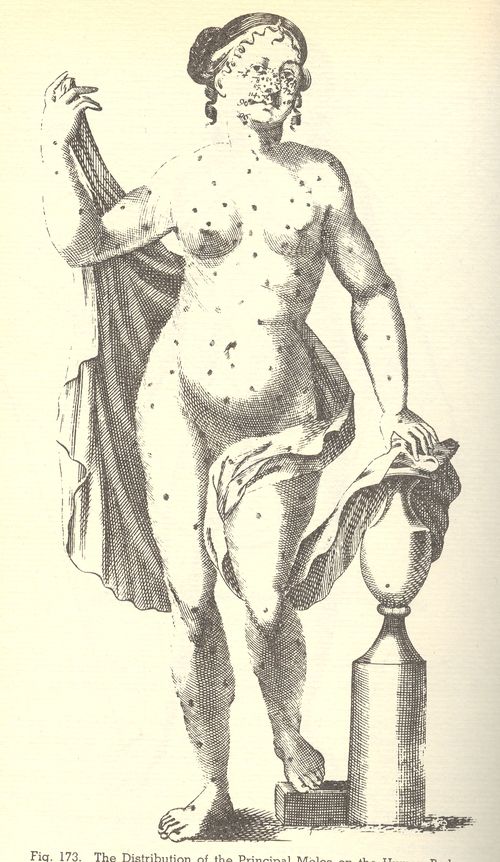
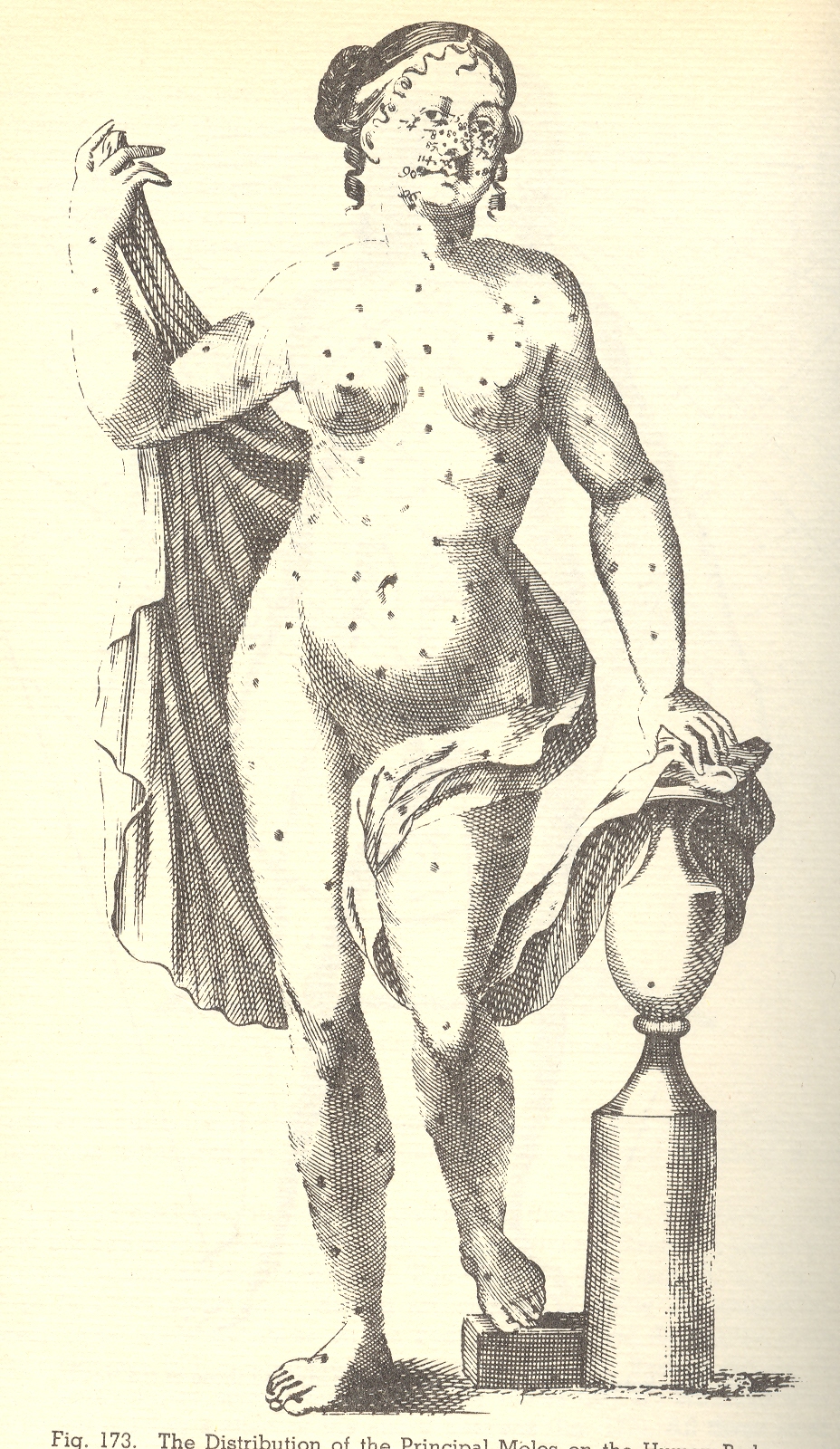
    Blog--jun 11 mole lcosmos The
    map of the moles of this woman’s body looks to me just like a constellation—and
    a constellation is just what they were for Saunders, who viewed the arrangement
    of moles on the body like an astronomer searching the night sky for a new
    comet.   But an astronomer would not be
    trying to force governing connections in the starry realms to occurrences on
    earth (or heaven, or whatever)—that would be the job of an astrologer, whose
    job would be enormously simplified since everything it conjures is
    fictional.  Had Robert Hooke been Richard
    Saunders-like when he made virtually the first microscopic investigations in
    human history, he would have been correlating the hairs and pores of the flea
    rather than making his minute and beautiful observations.

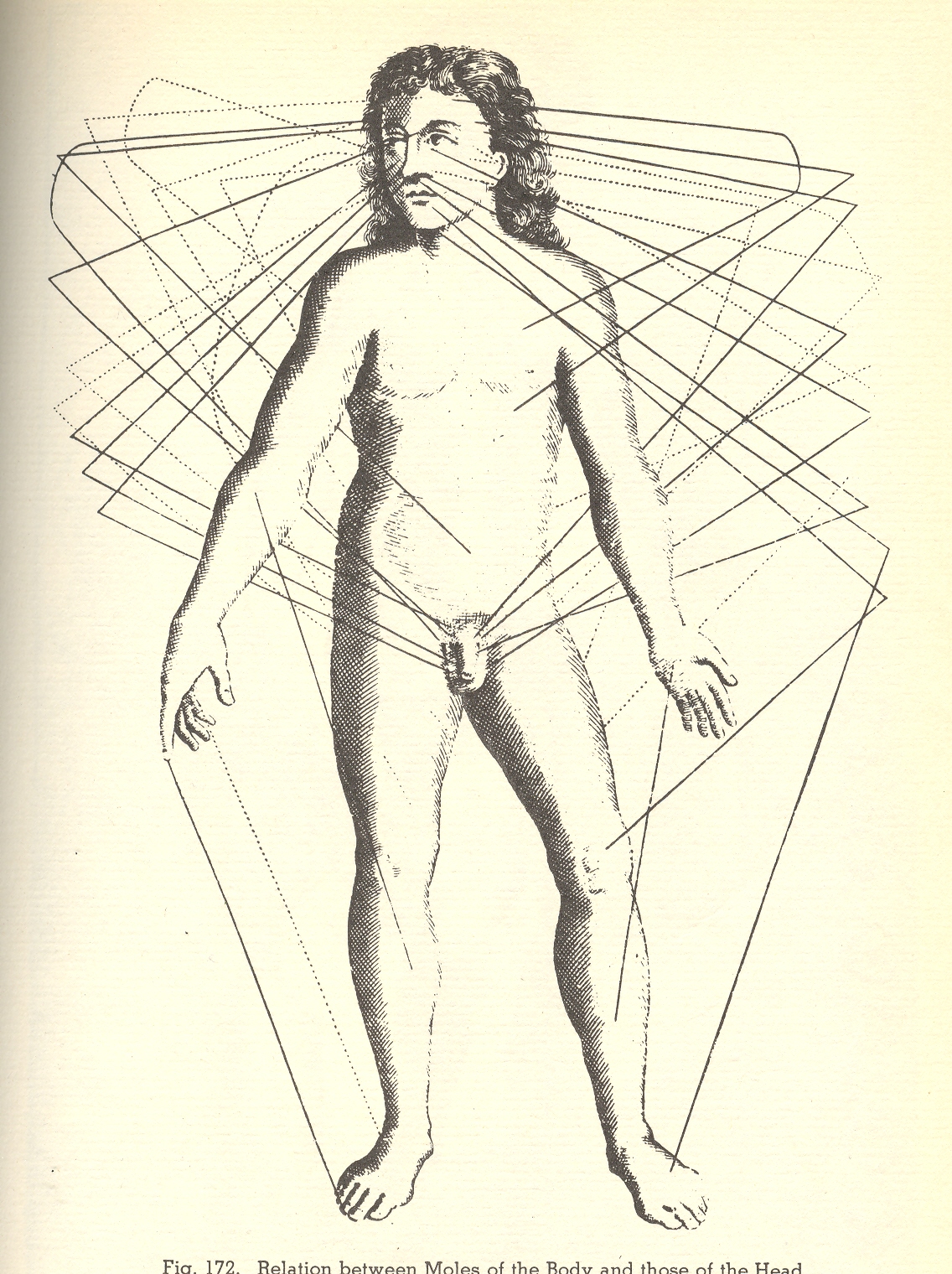
    Saunders
    sees mole connections everywhere, even developing sub-classifications to
    sub-classes: this is seen in the lovely relational map of face moles to moles
    on other parts of the body. (I like the spare curved lines most.)Blog--jun 11 mole lines
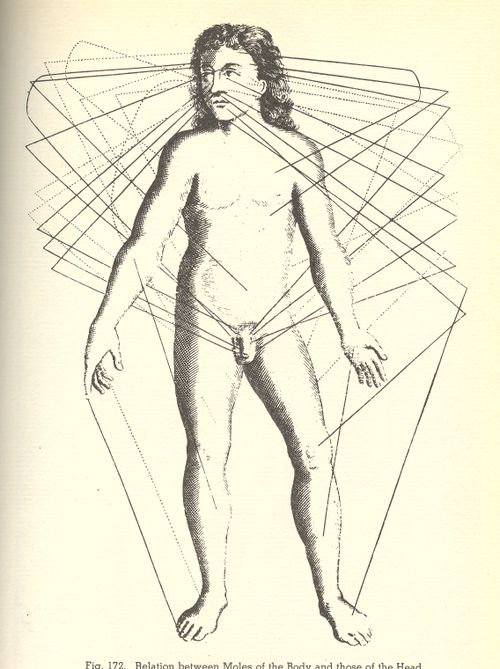
    This
    all looks perfectly phenomenal, unbelievable even,  from out here in 2009.  The fact remains though that the vast
    majority of newspapers in his country still carry horoscopes, and most Americans
    believe in UFOs, and a not-small percentage of those folks say that they’ve
    actually been abducted by Outer Space Aliens. (I calculate that from the
    “first” UFO sighting near Roswell 50 years ago that a sighting has been made about every ten seconds since
    then.  Why all of this interest?  And here’s a question among the many that I
    have about this stuff–outside the astronomical chances of actually
    encountering the other life forms in the universe that do undoubtedly
    exist:  why do these crafts, which have
    spectacular, beyond-physics capacities, have little dotty lights on them?)

    And
    so as bizarre as images like this might look, many (most?) folks in the present
    really haven’t left these ideas behind—they just get changed a little,
    upfitted, retro-ripped, and outfitted with flashing lights.

    In a
    very long career of getting people to think  in spite of themselves, James Randi (scientific
    investigator, keeper of the scientific method, head of the James Randi
    Educational Foundation
    , and formerly “The Amazing Randi” from years ago) has
    one particular mythbust-lecture that I find phenomenal, with a very large “oh
    my good god!” capacity for the students at the end of it–if they would but allow it.  Listen: 
    Mr. Randi would explore the possibilities of astrology, asking the group
    or class who there believed in it, taking a census of belief.  He would then make a very strong, convincing
    case for the application of this hope in astrology (he is a very determined and
    logical speaker), and then give astrological “readings” to each member of the
    group.  The readings would turn out to be exact and persuasive—a second tally would be taken of  believers, with
    the usual results being that (unless they knew who Mr. Randi was or was already
    a skeptic or logically un-needy thinker) the class would now consist of an
    overwhelming percentage of astrology-believers.

    Then
    Mr. Randi lets the high-wind boom swing free: 
    everyone received the same reading. (You can see a short snippet for one of these experience HERE–Mr. Randi has conducted this lecture many times for many different audiences.)  The shock of realization is palpable.

    On
    the telephone this morning Mr. Randi graciously explained this lovely lesson—he
    also explained that even after the key ingredient of the lesson was revealed,
    and even after he lectured on thought and belief and superstition and logic and
    so on, that the people who had already believed in astrology would almost in every circumstance still
    maintain that belief.  Even in the face
    of overwhelming evidence, the idea of belief was no match for fact.  Truth, fact, explanation, method, logic—none
    of these could put a chink in the armor of belief, and is no match for self-deception.

    “The
    Woo-woo is always the same, everywhere, all the time.  If its not astrology its something else, the basis for all of it is the same” (my
    paraphrase) says Mr. Randi. After approaching belief
    systems like UFOs and astrology and mentally bending spoons and mind-reading
    and on and on, Mr. Randi says that at their base, the stories have a common heritage of need.
    And they’re unbendable, and certainly unbreakable, for all of those who need
    the belief.  There’s no room for
    constructive debate and exchange in such belief systems, whether it is
    astrology or creationism (I just can’t call it by its other, cleaned-up
    name), as they cannot satisfy the basic tenets of knowledge growth and scientific inquiry which, according to RP Feynman, is the willingness to test your beliefs against falsity and to investigate all possibilities that might make them invalid.*  Mole mapping predictions and the
    fate of a life is no different from any of these other derivations in wishful/hopeful pseudosciences, either—just a different name
    for the same underlying system of beliefs, though the moles are a little long in the tooth. 

    Anyway, creationism or astrology or life-after death–they might as well all be mapping moles.

    As Feynman said:

    The first principle [in science] is that you must not fool yourself — and you are
    the easiest person to fool. So you have to be very careful about that.
    After you’ve not fooled yourself, it’s easy not to fool other
    scientists. You just have to be honest in a conventional way after that.

    * Feynman on the scientific method:  “It’s a kind of scientific integrity, a principle of scientific thought
    that corresponds to a kind of utter honesty–a kind of leaning over
    backwards. For example, if you’re doing an experiment, you should
    report everything that you think might make it invalid–not only what
    you think is right about it: other causes that could possibly explain
    your results; and things you thought of that you’ve eliminated by some
    other experiment, and how they worked–to make sure the other fellow
    can tell they have been eliminated “
    RP Feynman quoted by Ralph Leighton,  1985, p. 341
    ).

  • Blank & Empty Things #46: Languages of Tree Structure

    JF Ptak Science Books LLC  Post 641  Blog Bookstore

    A History of Blank & Empty Things , #46

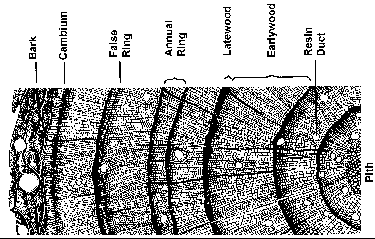
    Messages and information, silently displayed data and the announcements of the state of all things are everywhere, all of the time:  these things only become part of the language and systematically codified once they are recognized and understood, or at least once the thrust of the message becomes distinguished from the surrounding noise. 

    Blog--jun 8 tree
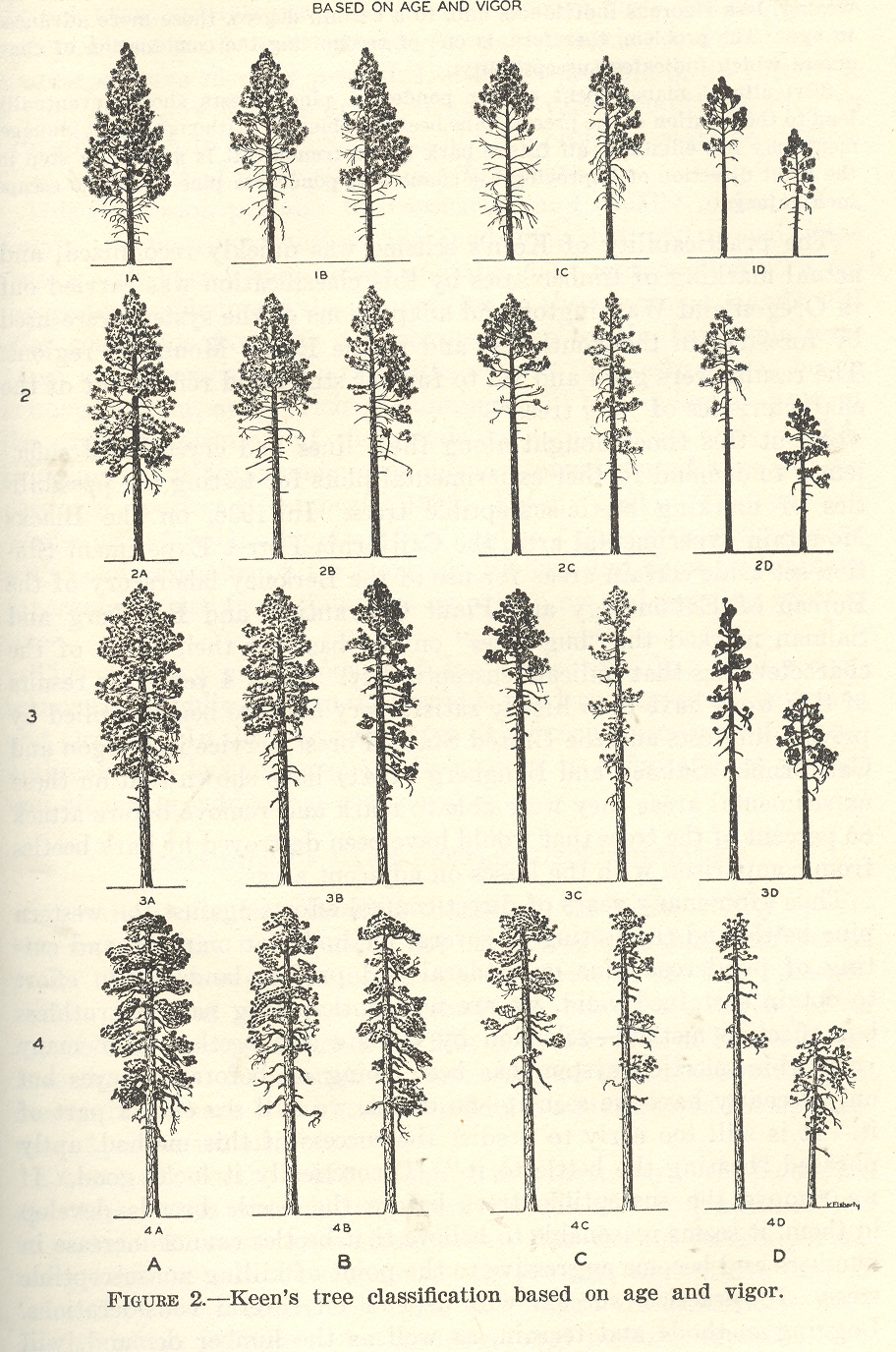
    One elegant interpretation of above-the-noise display was made by E.P. Keen in 1936 (“Relative susceptibility of ponderosa pines to bark beetle attack”, published in the Journal of Forestry)  who established a simple and practicable standardized vocabulary for the discussion and communication of tree health.  It is a relatively straightforward idea–based upon many years of keen observation and understanding–which used a pictorial schematic to establish a common baseline for the discussion of tree health/growth. Later on Keen would pioneer the use of aerial photography using various films and filters to determine the extent of damage done to stands of trees (and forests) brought about by drought, pests, diseases and other harmful stimuli–especially when the damage was done not in the visible spectrum. 

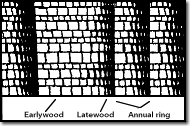
    The Blank & Empty part of tree language comes in the form of cells in the trunk of the tree which reveal–in cross section–the age of the tree and some climatic indicators of during the tree’s growth.  This comes in the form of tree rings–the rings are formed by the growth of the cells, the first of which in a new season respond with expansion, and depending upon water conditions will either grow somewhat less slowly than at first or stop growing altogether at the end of the season, and die; the new cells growing in the new season, and the demarcation being what we call a “ring”.  This was a fantastic idea, the brainchild of A.E. Douglass at the University of Arizona. 
    Blog--june 8--tree cell
    Andrew Ellicott Douglass (1867-1962)  was , ironically, an American astronomer at work at the Lowell Observatory in Flagstaff when, in 1911,  he began his experimentation with tree rings.. (I believe that he came to this end trying to ascertain terrestrial climatic conditions in his sunspot research.) The resulting effort was the clarification and near-founding of dendrochronology, with the resulting climatic understanding applicable across many different fields, and all from expanded/contracted cells.  Douglass perfected his observation and theory in a three-volume masterwork Climate Cycles and Tree Growth, which was published in 1936.
    Blog--june 8--tree 2

    For an interesting appraisal, see George E.Webb  Tree Rings and Telescopes, (the University of Arizona Press), Tucson, Arizona, 1983.


  • Michelangelo v. Leonardo, Blake v. Newton: Famous Contraries Chess Set

    JF Ptak Science Books LLC  Post 638  Blog Bookstore

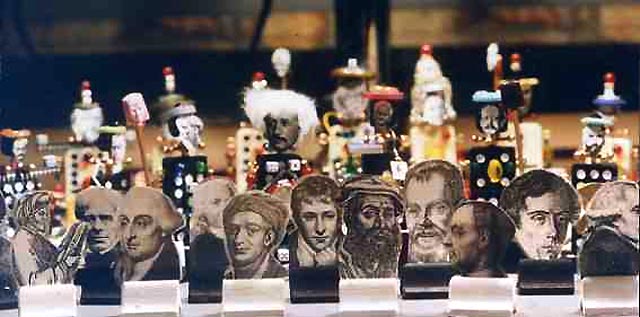
    Some years ago I made a chess set whose pieces forced a
    battle between mathematicians and physicists. The pieces were constructed with
    a mélange of bric-a-brChess ac and junk, all with the same bases of dominoes.  Each piece was an identifiable person from
    the history of their respective fields.  And
    while the two divisions of science have become necessarily more porous over the
    years, there remains no difference that there still is a difference between
    math and physics. I brought this set with me when exhibiting my rare bookstore
    stock at national meetings for the American Mathematical Society  and the American Physical Society, and it
    attracted a lot of attention—more so for the choice of who was what piece than
    any game that was ever played on it. (The mathematicians were much more
    ambitious in offering their opinions on the choices of mathematicians per
    position.)   There are chess
    sets of “contraries” on the mass production market, though it is usually
    limited to Star Wars and Civil War figures—and there it is generally generic
    figures for anything outside the King and Queen. 

    I was intending on doing a post today on the unpleasant
    contrariness of Michelangelo and Leonardo. (These guys are two of a small
    number of people who are instantly identifiable by one name only, though a very
    popular and vastly oversold modern author chooses to use Leonardo’s second name
    as the identifier, a distinctly minority position….like referring to Michelangelo
    as Buonarotti of Florence.)   And then it struck me how interesting a
    chess set would be made up of such opposed figures, happily or not squaring off
    against one another on the 64s. 

    Finding the
    contraries is not so simple.  Skipping
    past Leonardo/Michelangelo (I’ll get to them in a minute) I went to the most
    famous of all contrarians in the world of science—Isaac Newton.  (Is the “Isaac” really necessary?) During his
    famously grumpy and combative lifetime
    Newton battled a night sky of most shining stars of
    his day:  Hooke and Leibniz being two of
    the greatest of these figures.  But I
    think for this chess set I’d have
    Newton squared up against a man who wasn’t even
    born during his lifetime—William Blake. 
    Blake was an impossible anti-Newtonian, making a career of being a
    spectacular (and perhaps insane/manipulative) anti-rationalist,  a weaver of smoke, playing with and
    distorting images like a theramin player, using language to produce dichotomies
    in even the most standard of sensate ideas. 
    Blake was the poster child for thing anti-tech, an anti-scientist out to
    save the world from its scientific self, 
    the rationalist world set to destroy imagination, the “Antichrist
    science” hell bent on destroying the soul of art and religion. 

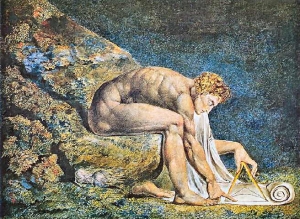
    “Art is the tree of
    life; Science is the tree of death” wrote Blake, and so he chose the
    “Athesistic”  Sir Isaac to stand for the
    beast, depicting him in art as a naked geometer intent on subjugating the world
    with a compass and a keen brain, reducing glory to quantification, the work of
    Satan..  For most of my life I thought
    that this image by Blake was celebrating
    Newton—I knew little of the poet/artist/poet, and
    thought the painting a reverence.  When I
    understood Blake a little,  I saw that
    the image was intended as a mockery of
    Newton and the idea of science—this was an unusual
    sensation, because absent the unspopken intention of the artist,  you could still take the subject matter of
    the artwork two ways. 

    Blake’s writing
    leaves no doubt about where he stood on the issue, even though much of it (to
    me) seems not terribly understandable due to its repeated and visceral
    self-reference and private language (“Reason is the bound or outward
    circumference of energy”, the “ratio of the things of Memory”:

    The Spectre is the Reasoning Power in Man,
    and when Separated from Imagination and enclosing in steel a Ratio Of the
    Things Of Memory, It thence frames Laws & Moralities To Destroy
    Imagination.   

    Science—embodied
    here in Newtonian mechanics, there in Renaissance rediscovery of classical
    perspective—was killing the “eternity of the imagination”.

    I could well imagine
    a “conversation” between the two men: 
    Blake saying Things, and
    Newton not able to find any space in his head for
    them, answering in silence.  OR perhaps
    he would be vicious.  God knows.  Newton died in 1727 when Blake was still in
    ueber-dimensional pre-pregnancy, waiting his turn to descend from the heavens,
    which was not bound to happen for another thirty years.

    Newton_blake

    In his otherwise
    brilliant book, Art & Physics,
    Leonard Shlain refers to Blake as a Cassandra, having the ability to see the
    future but not being able to say or do anything about it.  To think that Blake was “correct” in  foreseeing the problems that technology would
    bring to people’s lives leaves me baffled: 
    it is certain that people became more cog-nified with the advance of
    technology, but it also allowed for the birth of “free time” for the masses,
    giving them some soul and imagination that they would’ve have had if they were
    in a flat field in Poland pulling potatoes out of the ground for 18 hours a
    day.  Perhaps Blake was just referring to
    those lucky enough to wear clean white shirts and have a benefactor; perhaps
    all of those Others didn’t exist in his many scheduled god/heaven visions he
    had every day.   (
    I should point out that Blake published Songs of Innocence and of Experience:
    Shewing the Two Contrary States of
    the Human Soul
    in 1794, which was actually a varied republication of his
    1789 Songs of Innocence with the
    addition of the Songs of Experience.  Blake exposes the duality of experience and
    innocence, of their opposing nature in human existence, neither negating the
    other, both trying to survive simultaneously. 
    His engraved poems really are striking and gigantically, unreservedly, ars-religico-veritas
    of the highest Romantic order. And then some.)

    Back to chess and
    picking out the first pieces: :  Blake
    and
    Newton.  I’d
    have to give
    Newton the nod for Queen for the sheer enormity of his abilities.  Blake gets a pawn’s position, the first piece
    sacrificed. 

    Chess Contraries,
    Piece Two:  Michelangelo and Leonardo.

    It is odd that even
    though Michelangelo (1475-1564) and Leonardo (1452-1513) lived in the same city
    (Florence) for several years that the only thing that developed between them in
    the smallish societal/artist communities was a brew of mutual disdain.   Diplomatically speaking, the men did not
    care for one another, though it seems that the junior of the two,
    Michelangelo–who was a well-established rising star of 35 or so to the more
    famous Leonardo, who was 55—possessed the young man’s temper and was more
    outspoken in his dislike of Leonardo.  It
    does seem spectacular that the two greatest talents of the Renaissance could
    live so close together for several years and have no working or collegiale
    relationship, no exchange of ideas, nothing. 

    They did, however,
    almost work together in the same (big) room, though that too never came to
    fruition.  Both men received a commission
    from Piero Soderini to decorate the walls of the Council Hall of the Palazzo
    Vecchio with massive  (20×50’ !) paintings
    of great Florentine military victories:  Leonardo would paint the
    Battle
    of Anghiari
    and Michelangelo the Battle of Cascina.  Like much else in the careers of both of these men, the projects were unfinished–Michelangelo not even getting beyond the cartoon stage in preparation; Leonardo actually got paint on the wall,s but made an error in trying to quicken the slow drying time, and heated the wax undercoating enough to make the paint run down the wall and puddle on the floor.   It is interesting that  it would be Guiseppe Vasari–the man who wrote one of the earliest biographies of renaissance painters, and the creator of the Ufizzi Gallery, and a large talent in his own right–who would be brought in to produce one of the large paintings.  It seems to some that Vasari, ironically, painted his own work over that of the started  and probable masterpiece of  Leonardo.  (As a matter of fact, there is an art historian who thinks that some of the Leonardo might have survived under Vasari’s work; that story can be seen here.)

    I don’t mean to set out for pure contraries (like Ovid’s question
    of water and fire–cunctarum contraria semina rerum, Fasti, IV, 783, f–the
    yin and yang, and other entities combative at all points. The question here is
    for entertaining contraries at some interesting points—that’s good enough.  All aspects needn’t be the mutually exclusive
    of the other such that if one is true the other must be false.  There’s room enough for neither-true-nor-false,
    at least for this game, a wide-open Wittgensteinian arbitrary contrary.


    It might be interesting to have a look at Vasari’s estimation of Leonardo and Michelangelo; I’ve reprinted the first tow paragraphs for each from Vasari below.