A Daily History of Holes, Dots, Lines, Science, History, Math, Physics, Art, the Unintentional Absurd, Architecture, Maps, Data Visualization, Blank and Missing Things, and so on. |1.6 million words, 7500 images, 4.9 million hits| Press & appearances in The Times, Le Figaro, Mensa, The Economist, The Guardian, Discovery News, Slate, Le Monde, Sci American Blogs, Le Pont, and many other places… 5000+ total posts since 2008.

Category: Blank and Empty Things; A History of

  • Things out of Place Department: a Cloud of Magnetism in the Sky Poked by the Needle of God

    JF Ptak Science Books LLC  Post 508
    0 blog feb 9 missing magnet543“And even though I’m sitting waiting for Mars

    I don’t believe there’s any future in cause

    Hole in the sky, gate way to heaven

    Window in time, through it I fly…”

    Black Sabbath, “Hole in the Sky”, 1975

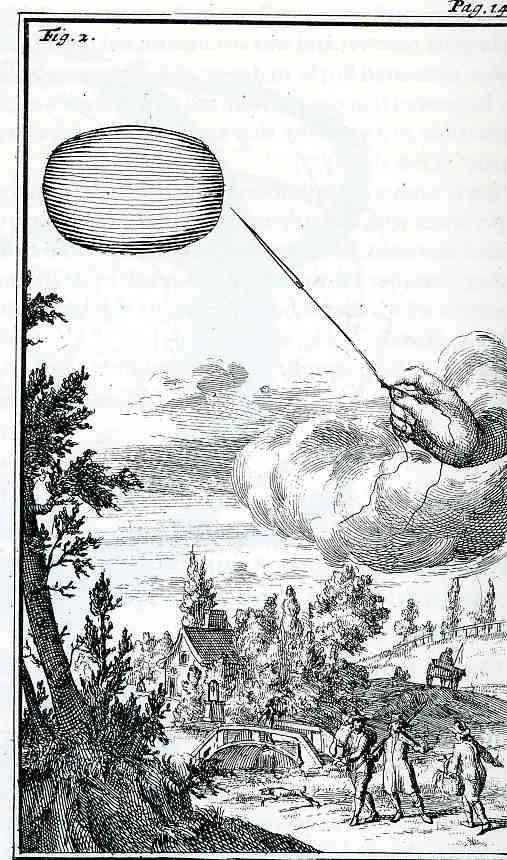
    Well, there were many liberties taken with this title, though on the face of it, the title is correct (sort of).   This image comes from a relatively obscure (or at least quite rare) copy of  Joachim Dalance’s work Traite de l’Aiman, divise en deux parties, la premiere continent les Experiences et la seconde les raisons que l’on en peut rendre... which was printed by Henry Weinstein in Amsterdam in 1687 (just across the waters in London Isaac Newton’s fantabulous Prinmcipa Mathemtica was being printed in the same year).    This important work on magnetism featured a number of good and useful observations on magnetism, interspersed with some semi-useless bits:  the magnetically floated coffin of Mohamets is mentioned and disproved, the origin of magnetism is asserted by hypothesis and is not pretty, along with some “fanciful conception(s) of the magnet’s potential”*; on the other hand, there is a mention of the invention of the compass, the real use of magnets, a mention of declination, and the orientation of a compass needle in a magnetic field is shown.  All pretty good stuff, considering the time.  (The magnum opus on the magnet was published in 1600m by William Gilbert and was called De Magnete, Magneticisque Corporibus, et de Magno Magnete Tellure (On the Magnet and Magnetic Bodies, and on the Great Magnet the Earth), though folks have been writing on magnetism since Aristotle and Thales)

    M. Hofer, the author of the quote above, mentions that the pamphlet’s images “are particularly good scientific illustrations”, though doesn’t mention this, figure 2, as being anything significant.  Trying to dissect the phenomenal imagery, which purports to depict the origins of the sources of magnetism, we see something like a “magnetic cloud” in the sky, about to be pricked by a needle held by the primum mobile.  That, or it is a missing piece of sky, a gapping hole, though not in the sense of what we’re getting now in the ozone layer, or in the fantastic billion-light-year wide swath of nothingness in the foamy universe.  Perhaps it is more like the Black Sabbath lyrics after all, a hole in the sky, pricked by the creator, to loosen the fabric of magnetism and getting a glimpse of heaven.    Or something.  

    [I should point out that Dalance was an out-and-about guy, with high-level correspondence, and who seemed to be at the right places at the right time.  Among many contributions to the sciences, Dalance–who was a friend of Henry Oldenbourg, helped introduce Huygens to the Royal Society as well as to the French Academy of Sciences, acting as an intermediary for the most part.  He seems to be an interesting guy.]

    *–Ph. Hofer, Baroque Book Illustration, page 42
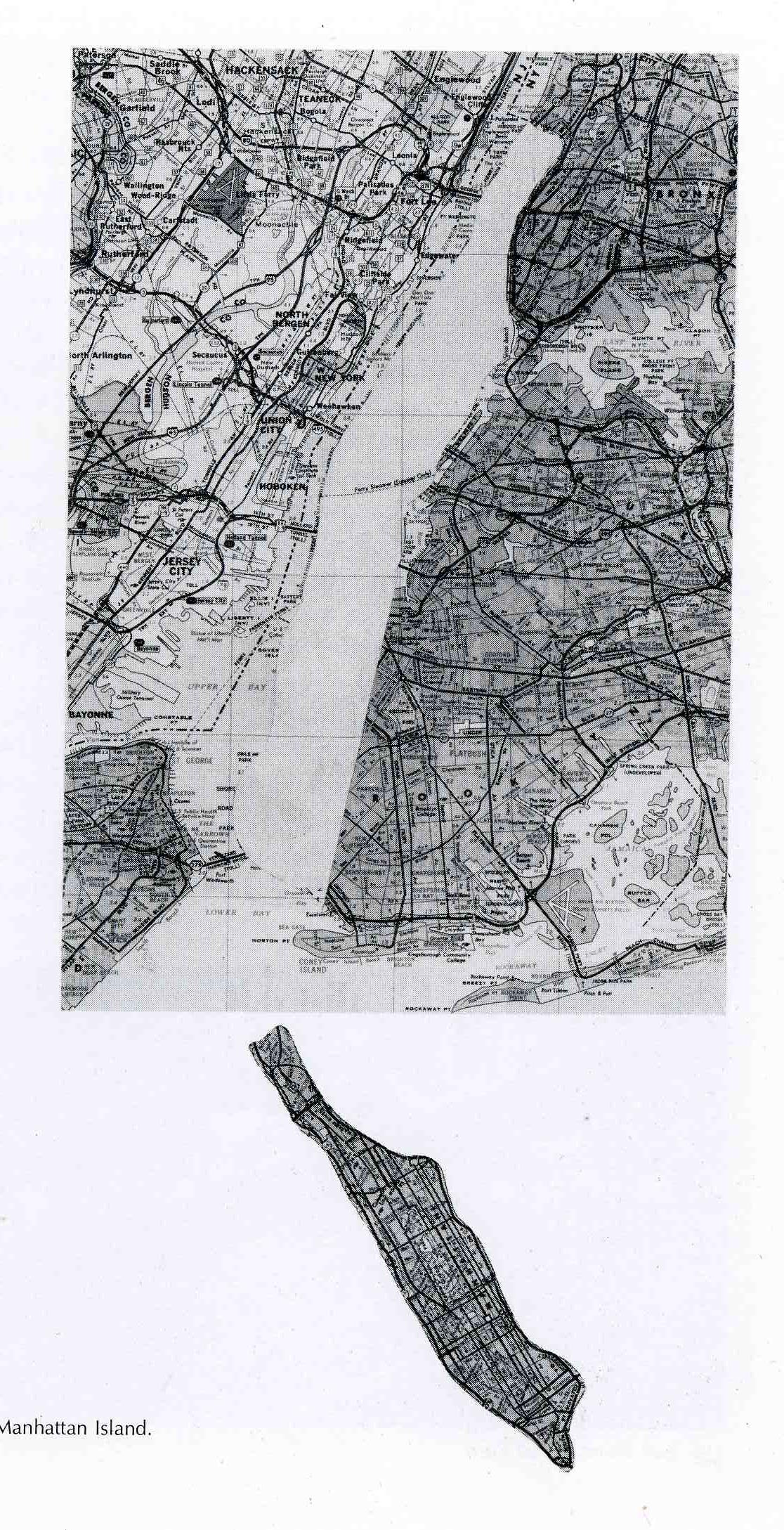

  • Great and Unbuildable Department: Floating a Missing Manhattan (1975)

    JF Ptak Science Books LLC  Post 470

    “Heard melodies are sweet, but those unheard
    Are sweeter…” John Keats,
    “Ode on a Grecian Urn”

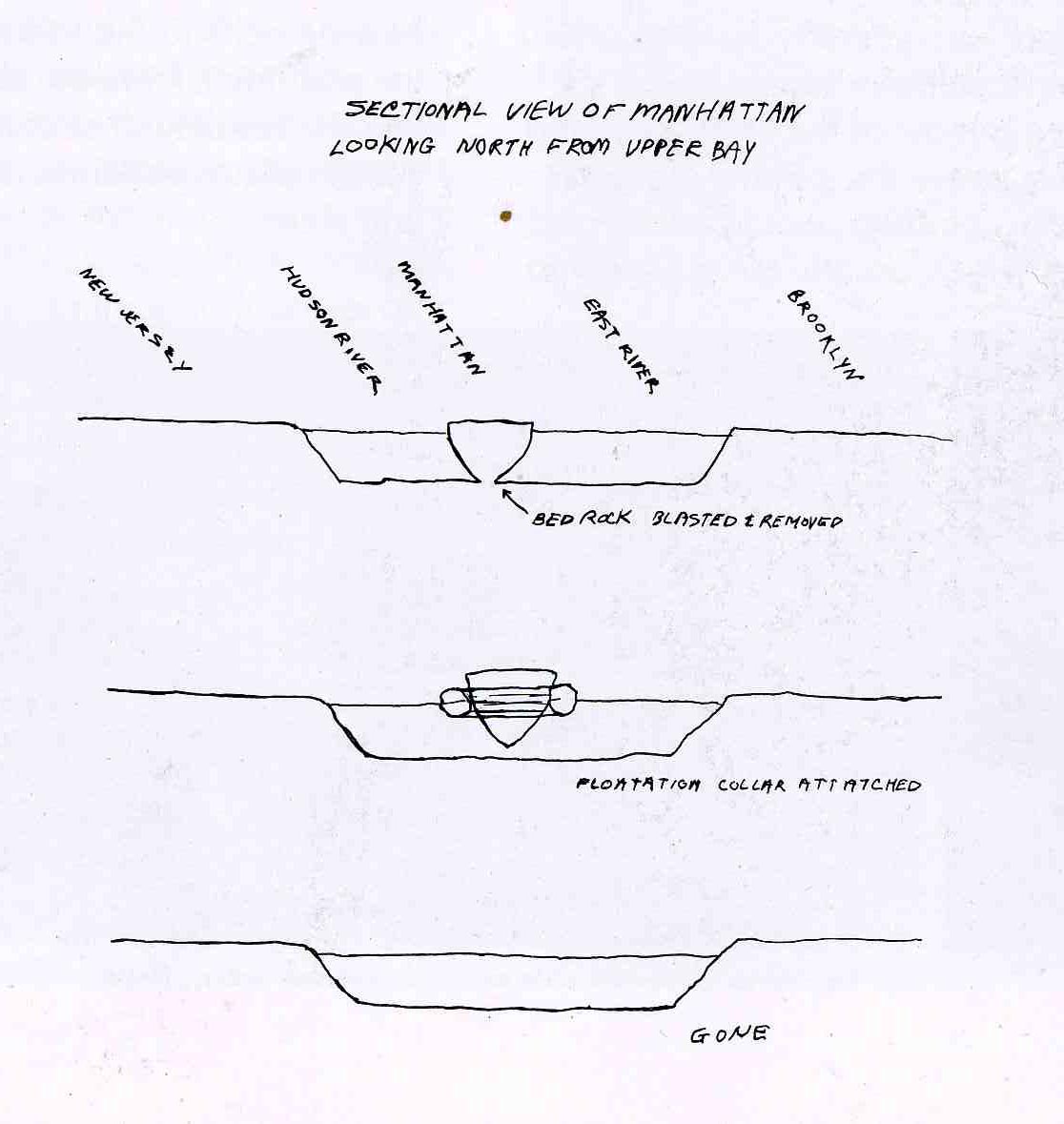
    0 blog jan 16 manhattan386 Agreeing with Mr. Keats or not, Robert Grosvenor had a delectable and memorable idea for a project in 1975:  testing the sea-worthiness of Manhattan island.  Grosvenor (b. 1937) was a well-known kinetic sculptor in Manhattan by the time of his detaching-Manhattan idea.  I found the summary of his project in Unbuilt America, by Alison Sky and Michelle Stone, of SITE, Inc. (seventh in a series called ON SITE), and published in 1976.  The book is a treasure trove of the unbuilt and the unbuildable, or the undoable, or the unnecessarily unattainable, though Grosvenor’s part in this book is clearly one of the very few who did not (really) take his/her project seriously.  I do though like the simplicity of the presentation of the project, right down to the “Step 2” of preparation, which was the umbilical snipping of the bedrock of Manhattan and the attachment of the “flotation collar”, which, I guess, would allow it to be moved around so long as flotation devices were attached. 

    I’m not sure, but I don’t think that Manhattan ever learned how to swim.  I’m also not so sure about where Manhattan would “go”,exactly; but what would it matter, since the people living in Manhattan were already where they wanted to be?

    0 blog jan 16 manhattan387


  • A History of Dots, Part II: the Dot Cipher, 1810

    JF Ptak Science Books LLC  Post 458

    0 blog dec 31 dot cipher335

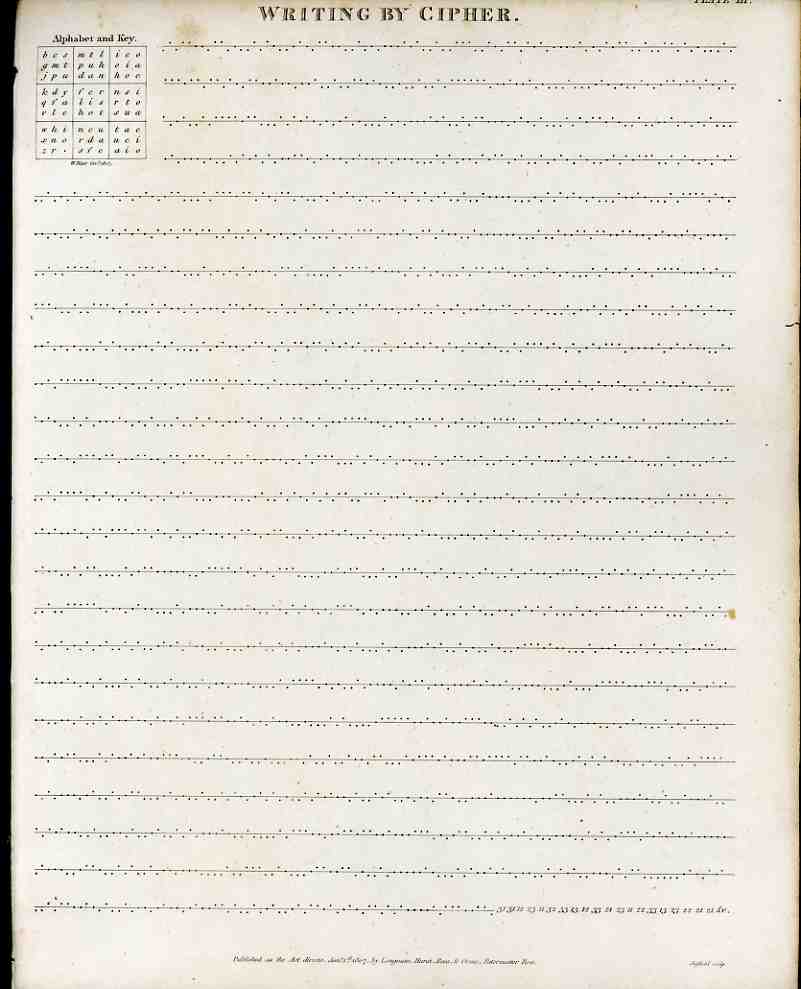
    This is
    the second in a series on the History of the Dot.  This engraving of the ingenious and very
    once-upon-a-time difficult-to-break cipher appeared in the mammoth (45-volume) Cyclopædia
    ,
    or The New Cyclopaedia, or, Universal Dictionary of the Arts and Sciences, edited by Abraham Rees (1743-1825).  The
    book was published between 1802 and 1820, and was the work of 100 contributors,
    who generally wrote monograph-length entries, as the completed effort ran close
    to 40 million words.  I’ve particularly enjoyed
    the illustrations—some of which have become iconic—and especially the fine and
    deep engraving of Wilson Lowry. 

    The engraving, “Writing by Cipher”,
    employs dots placed above, on and below a line, representing the numbers 1,2
    and 3, respectively, which in turn form one of four numbers which are letters;
    a key would then be transmitted to reference the letters formed by the dots to
    the alphabet.  It was a tough bugger to
    break, and survived most of the 19th century without being
    broken. 


  • Extra-Earth Humano-Alien Souls From Outer Space Repopulate Earth-Hell!!(??) Blank & Missing Things XXVII

    JF Ptak Science Books  LLC Post 401


    (Extra-Earth alert! This is the third time that I have found a pamphlet illustrating a view of the earth with an extra alien-earth in the background.)

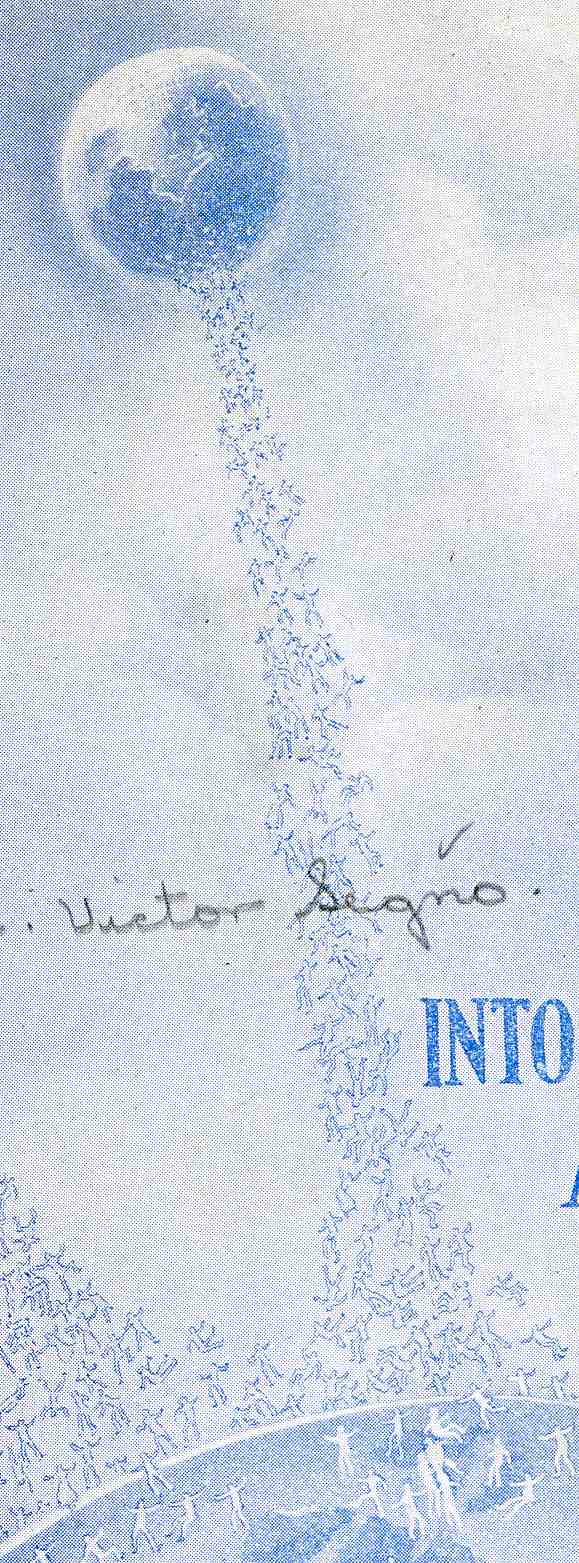
    This 1929 pamphlet by Dr. (?!) Victor Segno is the poster child for  the sub-category of Advanced Strangeness in the Naive Surreal Collection of our store. Segno is no stranger to dislocated and fractured ideas, and has a long history of preaching and extracting money from the preached-to.  Early on in his career he spawned a not-terribly original idea called “mentalism” which involved getting your “brain waves” correct and “harmonizing” your surroundings with them, which somehow also had something to do with leadership and success.  But all of that involved sending Segno a dollar for a pamphlet on brain-wave distribution.  According to Segno’s home-town paper, the LA Tribune, there were something like 12,000 people who were part of the runaway Segno train wreck–the Tribune couldn’t understand why, and didn’t much care for Segno’s quacky successes.

    0--blog---Nov 29 into this world149

    Suffice to say that quite a bit happens between 1902 and this 1929 effort, some of which involves considerable success and tiny-empire building in Echo Park.  But Segno really does break the bonds of treacly abnormalism with “Into this World and Why”, which offers a curriculum of soul/ghost extra-terrestrial astrological-astro dead/reborn beings to come and re-(!!) populate humans on earth.  (Wait a minute–that idea gets picked up by L. Ron Hubbard, yes?  Except that when L. Ron gets a hold of this idea there are 10,000 atom bombs involved and a new added process called “the clear”. But that’s another story.)  After kind of reading this pamphlet, I have come to determine that the best thing about it–bizarro ideas or not–is the cover. 

    0--blog---Nov 29 into this world151The cover, though is magnificent.  Look closely, and you’ll see that there are five other earth’s floating above the earth, all of which are contributing not bodies but souls, souls a-piling up like clustered grapes in places, souls being deposited back on earth for another go around in existence. Segno explains to the humble reader that the universe is divided into twelves sections, each populated with a planet that looks like earth, all of which are superior to the earth.  These are soul-abodes for the dead of earth whose souls leave and travel blah blah blah along the means of an undescribed process called “radiography” of the brain waves. As you can see the humanish forms falling onto earth are empty, waiting as they were to fill up a body.  Oy, vey.


    And so the thing drags on for 52 pages, a length probably determined by the paper on hand.  (But that wouldn’t stay the case, as this  pamphlet went into a self-stated 26th edition…if true, then there is no justice in publishing,)  The only reasonably entertaining and proto-sci-fi idea that comes into play here is that in all of the universe it is the earth that is Hell.  Earth is the place of punishment that souls are sent to until they get things right, at which time they leave for one of the other twelve earths.  So it goes.  

    0--blog---Nov 29 into this world150

    The other interesting bit on the cover is the representation of the giant mountains of Europe, which erupt above the earth’s horizon.  I figure that for these bumps to be so prominent that the mountains needed to be at least a hundred mile high. 


  • Blank and Empty Things XXV: Magnetizing Thought

    JF Ptak Science Books LLC Post 398

    0-blog---Nov 19blank083

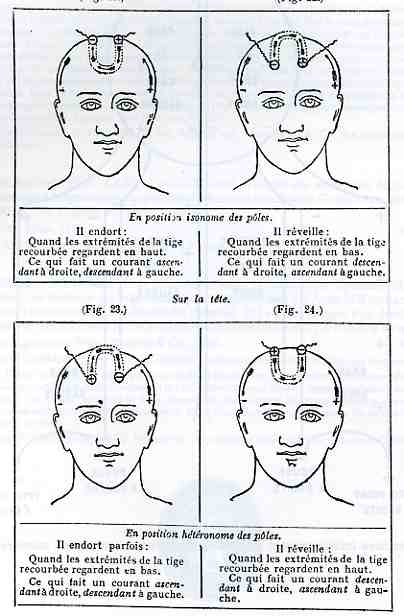
    The imagines of this “empty man” (25th in a series on Blank and Empty Things in this blog)
    is taken from one of the physio-electrical works of Auguste Forel
    (1842-1931), a eugenicist, sexologist, socialist, myrmecologist,
    neuroanatomist, shrink, social moralizer and member (at the very end)
    of the Bahai’i faith…and also a man very much taken with himself.  I
    don’t much like him.  (Outside of his racist views and semi-bizarre
    socialist theories, he managed to politically opiate a four-volume work
    on ants with vague wrappings of political theory and ant behavior. 
    Freud liked him. Case closed.)

    I’m not so sure about what exactly these diagrams were supposed to
    illustrate in the real-life of Forel’s scientific experience, and I
    don’t care that much.  What I do like is the imaginative taste it
    implies, this blank-expressioned person waiting for the electricity to
    do its work, giving him/her an idea, helping whatever currents exist
    along the hemisphere of the brain to deliver its electrical-best. 
    All-in-all, if explanation was removed, the images would perfectly
    depict a person devoid of thought; or, a person whose thought was being
    directed.  Plus a myriad of other things; base of it all though is that
    there is a fair amount of blank/empty experience going on here.


  • Blasting Stumps with Stump Blasting Farm Dynamite

      JF Ptak Science Books LLC  Post 386

     0-blog---Nov 21 dynamite086                                                                                                           
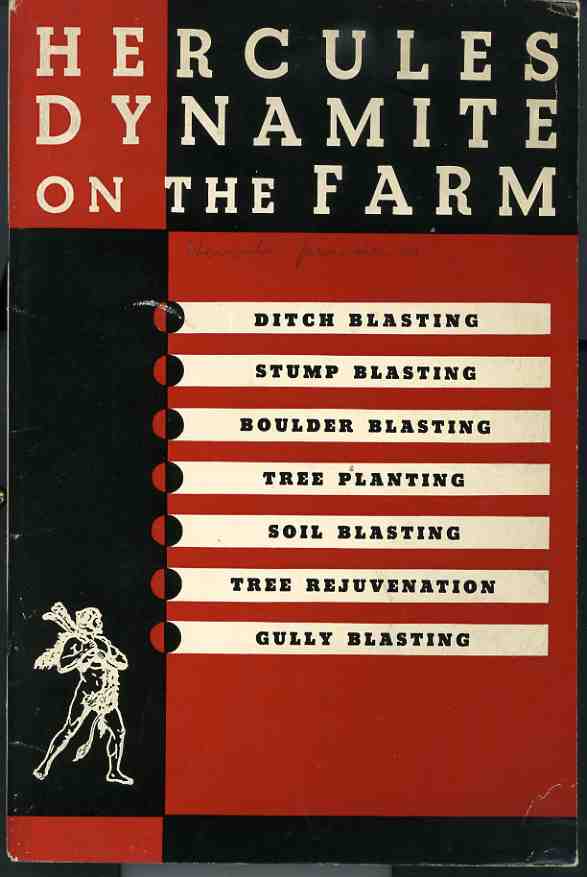
    Hercules Dynamite on the Farm (published by the Hercules Powder Company in 1943)–isn’t that a title that just begs to be read?  “Ditch Blasting, Stump Blasting, Boulder Blasting, Soil Blasting, Gully Blasting, Tree Planting, Tree Rejuvenation”–keyword:  blasting.  Actually, the tree planting and rejuvenation parts also involved blasting:  blasting was done to create the holes for planting tree; blasting was also done deep near the deepest roots of a stumpy tree to help create space for root growth. I have no idea if this was actually a good idea or not, but on the face of it, the blasting part seems to make sense.

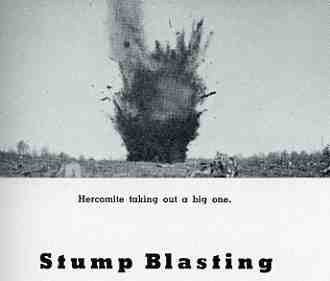
    It is a tidy and well written account the foundations of which are terrific understatement and adverbial creationism.  We read that “success in stump blasting is a matter of ordinary care and discretion” and this pithy little sentence, “Every stump is a problem to itself.”  And: “The size of the hole depends on the size of the stump.”  Actually, aside from the extraordinary number of times that the word “stump” appears in these pages, I feel quite confident (after having sort-of read this thing) that if

    0-blog---Nov 21 dynamite089need be I could go out and blow the crap out of one, and correctly:   considering the age of the stump, the
    type of tree,the SIZE of the stump, the depth of the roots, the type of soil; I believe I
    (and by “I” I mean “all of us”) could calculate the amount of the charge, the placement (depth and
    angle) of cartridge, use of stemming and fuse, and get the stump the
    bleep outta there. There’s much much more, of course, but it is the
    stump blasting that caught my eye…and the root blasting rejuvenation
    as well 

    0-blog---Nov 21 dynamite087 


  • Blank and Empty History: Disappeared Legions of The Wrong

    JF Ptak Science Books LLC  Post 375

    0-blog---Nov 13 doriot070

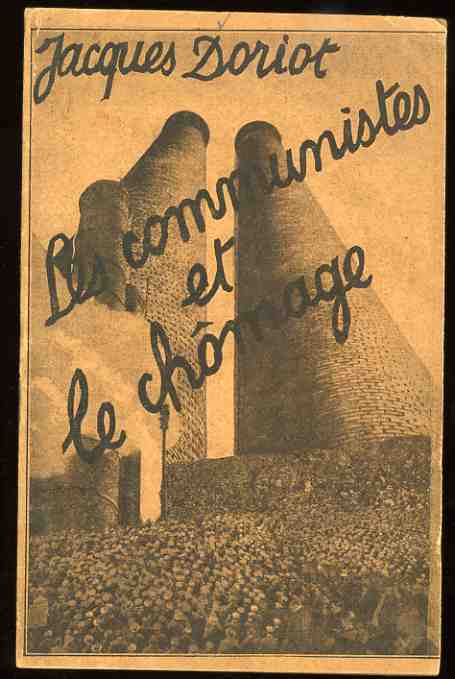
    Continuing my series of posts on The History of Blank and Empty (and Missing) Things, I come to this beautifully designed French  pamphlet of 1931.  The design is of less interest than what happened to its author, the exceptionally problematic and traitorous Jacques Doriot.  Now Doriot (1898-1945) started off liberally enough, shooting out soon thereafter to explore the very furthest reaches of The Deep Left, and then, when that didn’t quite work out for him, blasting off to the nether regions of the wincingly bad singularities of The Deep Right.  He scratched at the edges of political extreme idealisms, waiting for something to happen, something that would get him greater fame or more-reaching political power, but his fate would intercede. 

    Doriot began his career as a Communist and would do fairly  well, politically speaking.  A member of the Communist Party since 1902, he would become Mayor of St. Denis (near Paris) and a member of the Chamber of Deputies.  A difficulty would arise and he quit the party, becoming a Fascist over the next few years.  On the invasion of France, Doriot became a Nazi firebrand, committing himself to the cause, and living in  lickspittle Vichy France. 

    Like another fellow ex-pat (Ezra Pound), Doriot made vicious anti-French/communist and pro-Nazi radio broadcasts from Paris in 1940 and 1941.  In that year Doriot would take an uncommon step, a step towards disappearing, when he and Marcel Deat founded the Legion des Volontaires Francais (contre le Bolshevisme) (LVF)), which was a combat unit of French Nazi sympathizers that fought with the Wehrmacht.(Over time and the wear of war it was also known as The 33. Waffen-Grenadier-Division der SS Charlemagne (französische Nr. 1) and Charlemagne Regiment, as new elements were formed to replace the lost.)  I could imagine that no one saw them as anything but pathetic, even their Nazi commanders, who would put them into the meatginder on the Eastern Front.  The LVF was decimated and all but gone by the end of the war, though Doriot, somehow, survived it (with an Iron Cross awarded him in 1943), until he was killed by a strafing plane on 22 February 1945.  The survivors of these groups met bad ends at the hands of the French (and the Soviets of course); some were imprisoned and sentenced to hard labor; many were summarily executed. 

    Groups like the LVF take their members and spin off towards oblivion, much like the Spanish pro-Franco troops that went to fight for the Nazis and were disappeared, or the poor black slaves of the (Western Band of) Cherokees who were made to fight with their Indian masters for the Confederacy, a deeper, darker place I could not well imagine. 

    (A  detail of the crowd scene of the pamphlet on Communism and Unemployment.)0-blog---Nov 13 doriot071


  • Blank and Empty History: Patrick Starfish, The Sopranos, Kasimir Malevich and Disappeared Madonnas

    JF Ptak Science Books LLC  Post 374    Removing the object from imaging is serious stuff

    Empty--patrick
    “This pencil is broken, why won’t it make words?” said Patrick Starfish in Spongebob Squarepants.  “I can do this…I can use, my, um….brain!!” he declares, hopefully, with an intensifying anxiety and sweat. After some squirming and smoke and some not pretty inside looks at Patrick’s brain working, (Mr.) Squidward (Tentacles. who never wore paints, ever) )comes in and sniffs the room:  “It smells like something broke in your brain and died” he says, removedly.   “ THAT’S the creative process!” says Patrick happily.  Indeed!  Empty--squid

     
    In The Sporanos. one of the guys, Christopher (“Chris tu fuh”) Moltisanti, decides to write a screenplay about his um business life and buys a laptop for the process of creativity.  He’s upset when he has a hard time of it, brick walls and all that, explaining to one of his cronies that “I even bought this computer, I thought the thing would come up wit sumthin’”. 
     Empty--christufuh 

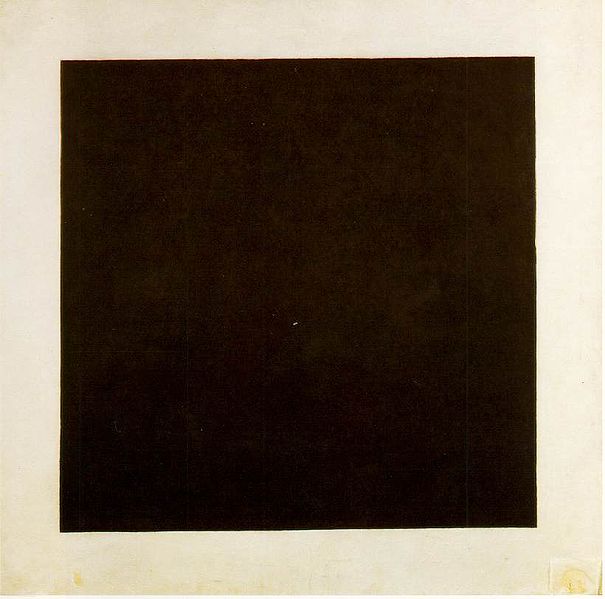
    In a sense, Kasimir Malevich  was coming to this sort of non-objectivity, but instead of removing himself from the process like Christufuh and the beautiful Patrick, he removed the reality from his painting.

    The Russian-born,  ethnic-Polish Malevich (1878-1935) , the first of fourteen children, introduced the genre of Suprematicism in 1915, just a  few years after Kandinsky’s first effort in abstraction (and the modern world’s first foray into non-representational art).   His first exhibition was exceptional and large—there were some many pieces that it must’ve been the case that he had been working for years with this idea.  This was the “0.10” exhibition, and photos of the show in Petrogard, shows the famous Black Square in a place of honor, in the high corner of the room, like a religious icon. (When Malevich finally was laid down from cancer in 1935 the Black Square was hung above his body as he lay in state.  It saw him into his world, and saw him out.  And, as a matter of fact, his grave is decorated by the Black Square as well.)  So many of these pieces are utterly recognizable that it seems almost impossible that they appear for the first time in the same, opening, introductory, show.
    Empty--maelvich

    Malevich wrote later about the Black Square:

    “The black square on the white field was the first form in which non-objective feeling came to be expressed,  The square = feeling, the white field = the void beyond this feeling.” (See Roger Lipssey, An Art of Our Own, 1988)

    Malevich’s vision on the emptying of form comes again from the 0.10 show:

    “Only when the conscious habit of seeing nature’s little nooks, Madonnas, and Venuses in pictures disappears will we witness a purely painterly work of art.
    “I have transformed myself in the zero of form and have fished myself out of the rubbishy slough of academic art.
    “I have destroyed the ring if the horizon and got out of the circle of objects…”
    Emopty--malevich

    Three years later Malevich would advance the idea to its logical end came Malevich’s  “Suprematist Composition, White on White, 1918”.  I’d reproduce it here but it is a little pointless, especially digitally, what with its incredible subtleties lost in the electromagnetic sauce.  I had the please and opportunity to see this in D.C. at the National Gallery’s homage to Malevich in the early 1990’s, and I can say that the painting is absolutely magnificent.

    Malevich didn’t see as much as he sensed the world (so he wrote), and made the structures go blank and empty to fill them again with what he knew.

    “And knowledge is of two kinds, one turning its eyes towards transitory things, the other towards things which neither come into being nor pass away, but are the same and immutable forever.  Considering them with a view to truth, we judge that the latter si truer than the former.”  Plato, Philebus


  • An Early, Complex Picture of a Really Cold Sky: 1550

    JF Ptak Science Books LLC  Post 357

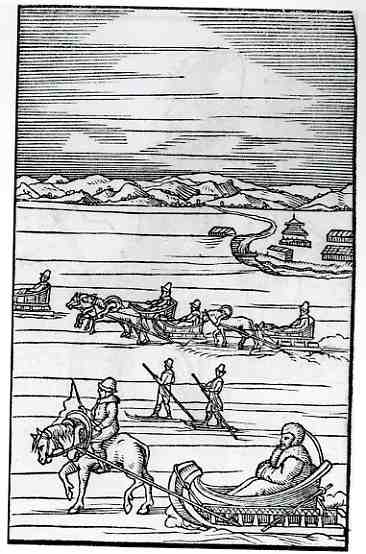
    000-ebay--Nov 4--cold994This woodcut engraving from the Italian edition of Sigismund Herberstein’s Rerum Moscoviticarum Commentarii (literally Notes on Muscovite Affairs) is a fantastic and early image of a terrifically cold scene in deep bleak Russia.  Herberstein (1486-1566) was a Cariolan/Slovene writer, explorer, ethnographer and exceptional diplomat of 69 missions who write this book full of observations of customs, village life, the military–and of course sleighing on frozen rivers and lakes.  But what exactly is going on in the sky? Is this  the aurora borealis?  Or a diffused sunset? Or are these simply clouds in an enormously dry and frigid environment?  I’m not sure precisely what we’re looking at here, but I do know that it is a very *cold* picture.

    See here for a digital version of this work. work.


  • Blank and Empty History: a Map of the Village of Missing Slaves

    JF Ptak Science Books LLC Post 373

    We no sen

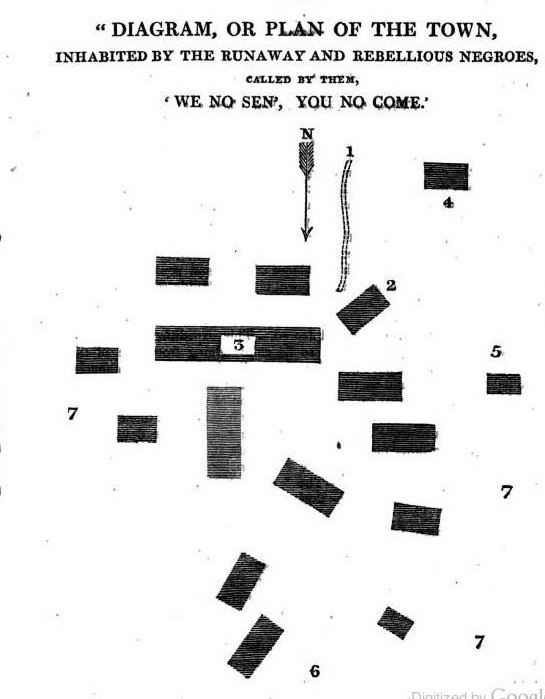
    In another (twentieth) in this blog’s series on Blank, Empty and Missing Things, I offer this map, a heartbreaking map, of an empty, abandoned village of peacefully-living runaway slaves in Jamaica, in about 1825.

    The name of the town, extraordinarily, was “We No Sen, You No Come”.  It meant, basically, that the slaves living there would not leave their town, wouldn’t seek anything from the outside, would not interact, would not interfere; in return, they didn’t want anyone visiting, coming to them. interfering in any way; just wanted to be left alone, to live.  And from the account of this supportive, understanding and sympathetic publication, that is exactly what these people had done for eleven years.

    But then something happened.  The owners of the enormous estate wanted the “banditi runaways” gone.  The slaves evidently had 200 acres under domestication, hidden in the far reaches of an enormous 100,000 acre estate.  The “hunting party” left heavily armed, accompanied by 250 troops, as well as “confidential and baggage negroes”.  (The term “baggage negroes”, as impossible as it might seem today, was a well-worn, heavily used term through the 18th and mid-19th centuries.)  They approached the small town and encountered a very slight resistance, something like a guard, and killed them.  Retreating somewhat after the initial attack, the scouting party returned, and then found the village completely empty.  (Some reports say that there was more limited fighting, with casualties on both sides; some say that there were more slaves killed.) After whatever happened happened, though, the return to the little village found it abandoned, with everything still in place.  The members of the village had “disappeared”.  Or at least I hope that they did, and didn’t get “disappeared”, men, women and children all, as in the famous Floridian “Negro Fort” case and Andy Jackson.  Perhaps these people were fortunate to actually escape. 

    Key to the numbers on the map:

    1 The track of the Militia and Maroons.
    2 House built of cedar, shingled and floored.
    3 The largest building, 70 feet long, and open in the centre.
    4 A hut.
    5 Hogsties.
    6 Wood.
    7 Provision Grounds and Coffee Piece.
    With the exception of No. 2, the houses were all wattled and thatched, the
    floors terraced.

    Two Contemporary Accounts

    From the British Slavery Record, 1825:

    “WE NO SEN’, YOU NO COME.”

    “Some years ago a number of Negroes, in Jamaica, escaped fromthe cruel bondage of their task-masters ; and, retiring into an uninhabited part of the island, built a little town, which they called, ” We no sen\ you no come.” Here they lived some years peaceably, industriously, and comfortably, upon the fruits of their labor ; having about two hundred acres of land, thickly planted with provisions, in the finest condition, with abundance of hogs and poultry. They thought that, if they kept themselves at home, ihey could not be discovered ;
    and if they did not meddle with others, others could not meddle with them. However, in the year 1825, they were discovered by the whites, who sent out an armed force against them, destroyed their  town and provision-grounds, and killed, took prisoners, or dispersed, the whole of this happy and peaceable community.”

    A less-sympathetic position appears in the Montego Bay Gazette: 

    “THE RUNAWAYS IN TRELAWNY.
    [From the Montego Bay Gazette, j “
    We have been favoured with a perusal of a letter from a respectable gentleman
    at Dromilly, who has taken the earliest opportunity of relieving the
    anxiety of the community respecting the [second] party who went after
    the runaways in Trelawny. It states, that about 4 o’clock on Monday
    evening, the party entered the town belonging to the runaways, when they
    were fired upon by them, but happily without effect. The fire was returned
    by the Militia, when two of the runaways fell, and another was taken prisoner;
    the remainder dispersed. They had about 200 acres of very fine
    provisions, in full bearing, with abundance of hogs and poultry. The Maroons
    were left in possession of the town, and the Militia returned to Dromilly,
    from whence Col. Scott proposed sending a gang of negroes to destroy
    the provisions, &c. The houses appear to be of considerable magnitude,
    are well built, shingled and floored. This expedition then, if such
    it may be called, has succeeded in so far as dislodging from one of their
    haunts a Banditti that have been for years collecting; but we fear much is
    still left to be done; and we think, that instead of destroying the provisions
    and houses at the settlement, now in possession of the Maroons, it would
    have been better to have sent troops to occupy it, and from thence to send
    out detachments to scour the woods, as there cannot be a doubt of the
    runaways having other places of retreat, and are still in possession of arms
    and ammunition ; and until they are totally routed or destroyed, the pursuit
    should not be abandoned. — The bodies of Mr. Sutherland and Mr.
    Gallimore, who were shot on the 26th ult. were found within a few yards
    of each other.
    It would appear, from a plan taken by order of Lieutenant-Colonel
    Scott, that the number of runaways is very great, or that they have been
    many years in constructing the buildings : one is 70 feet long, another
    40, and few under 25: and we again repeat, that instead of being destroyed,
    they ought to have been preserved and occupied as a military post for
    some time at least, or until the whole of the Banditti are properly accounted
    for.”