A Daily History of Holes, Dots, Lines, Science, History, Math, Physics, Art, the Unintentional Absurd, Architecture, Maps, Data Visualization, Blank and Missing Things, and so on. |1.6 million words, 7500 images, 4.9 million hits| Press & appearances in The Times, Le Figaro, Mensa, The Economist, The Guardian, Discovery News, Slate, Le Monde, Sci American Blogs, Le Pont, and many other places… 5000+ total posts since 2008.

Category: Bad Ideas

  • The Big Lie Department: Japan and its Version of Chinese “Aggression”, 1937

    JF Ptak Science Books  Post 1319

    This little  pamphlet is a great example of The Big Lie–propaganda so vast and so vicious and so far from the truth that people tend to believe it because, well, because no one would or could tell lies so Gargantuan and Pantagruelian and expect to get away with it. They were statements so spectacular and seemingly untrue that their very reverse weight gave them weight enough to necessitate “truth”.  Mostly on this blog the Big Lies I’ve dealt with came out of Germany–these had to do with the International Jewish Conspiracy, the plot of Poland to attack Germany, the resettlement that was going to be provided for French workers who came to the Nazi’s side to do technical work for the Wehrmacht, and so on. 
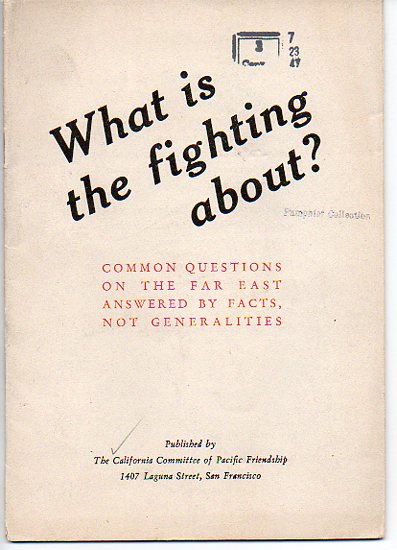
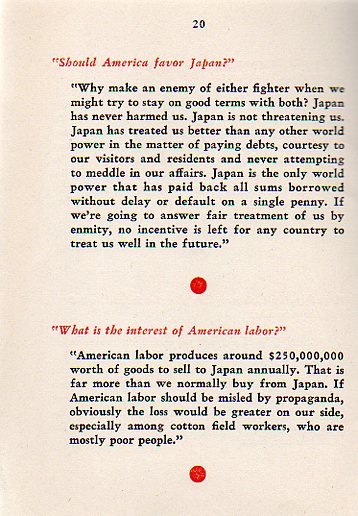
    Big Lie--Japan319 In this case it is Japan’s turn at The Big Lie to make its case to justify its already long and very bloody attack and occupation of China.  In short, what the publishers–the California Committee of Pacific Friendship (located at 1407 Laguna Street in San Francisco, the site of which today is ironically occupied by the Chinese Consulate)–tell their American audience is: that the Japanese are not aggressive; that China was planning to attack Japan to help unify their own country; that Japan needed to occupy Manchuria to protect Japanese citizens; that at the same time Japan was invited into China and was not going to leave because no one else does; and that is it is in the best interest of the U.S. to continue its valuable trade with Japan in order to protect the  poor people who pick cotton that goes into essential American-Japanese trade.  Virtually everything in this report is nothing.   Thats what makes it a Big Lie. [This pamphlet is available at our blog bookstore.]

    Part of the issue of invading China’ was to prevent Chinese aggression towards Japanese citizens, which was “a politically attractive campaign” and a cause of :China’s backwardness”. 

    There is no mention of Japan’s invasion of Manchuria in September 1931 following the Mukden Incident, an earlier version of a Gulf of Tonkin incident, a manufactured bit of terrorism by the Japanese military perpetuated against itself to give the Empire a reason to attack China. .  Manchuria was subdued by 1932 and  renamed Manchuko, and then used by the Japanese for its fantastic assembly of raw materials.

    In the same vein it was alleged in this pamphlet that it was China which bombed itself at Shanghai (Songhu), not the Japanese, starting what would be months of fighting in one of the largest and bloodiest battles of the 1937-1945 war.  It doesn’t make much sense for this top be the case, as the  National Revolutionary Army of the  Republic of China was vastly over matched by the  Imperial Japanese Army of the Empire of Japan.  (The Chinese enjoyed a 2:1 advantage in troop strength, but totally overwhelmed by Japanese tank and aircraft numbers and tech superiority.)  This pamphlet was published in November 1937, so the end of this battle–the first really of that would be twenty-two or so major engagements of the war–was still months away.  No doubt that an updated version of this pamphlet printed in 1938 would note the 70,000 Japanese soldiers killed without mentioning their own belligerent status or the 200k Chinese killed during the same time.     
    Big Lie--Japan text320
       

    The Japanese wouldn’t have to bother with this sort of propaganda after 7 December 1941.  It would’ve been hard to explain it all, especially the 17,000,000 Chinese civilians being killed in the process. And the 3 million Chinese soldiers1. Quite a long and twisting road from protecting Japanese citizens in Manchuria in 1931.

    Notes       

    1. Nationalist Chinese military forces included 1,320,000 killed in action, plus 1,797,000 wounded, with another  120,000 MIA. The Communist Chinese forces included another : 500,000 total casualties. Japanese forces include about 396,000 KIA plus another 430,000 MIA and WIA. Another estimate from the Japanese side gives the figures for Japan’s losses at ( 1937–1941) 185,647 KIA. 496,000 wounded, and 430,000 incapacitated; plus for the  1941–1945 period,  another 202,958 dead.   Nationalist Chinese estimates for Japan’s losses for 1937-1945 were 1.77 million KIA and 1.9 million WIA

  • What Free Things Cost–The Washington Times and the Eugenics Society

    Years ago when I lived in DC a new, upstart newspaper, The Washington Times (a conservative, Sun Yung Moon Unification Church organization-owned entity that is painful to italicize) spent years trying to establish a toehold in the area readership.  For years they spent a dollar per daily reader trying to get their message out–the cult leader himself, Rev. Moon, has stated that the paper has cost over a billion dollars to keep “competitive”. Since its founding in 1982 the paper has always lost money but has kept its focus on target–recently though there have been breaks in its rigid far-right exterior, changing some of its rhetoric to be more accommodating, like for example in 2009 deciding to use the word “gay” rather than “homosexual”.  The paper was owned by New World Communications–a branch of the Unification Church–from 1982 to 2010, when the paper was sold directly back to Moon for $1.  The paper is still in publication a,most 30 years later.  And even though the Unification Church says that the paper is independent from editorial control, former editors of the thing have said otherwise.  [New World Communications owns UPI by the way. Happy Happy World World]

    Eugenics soc316

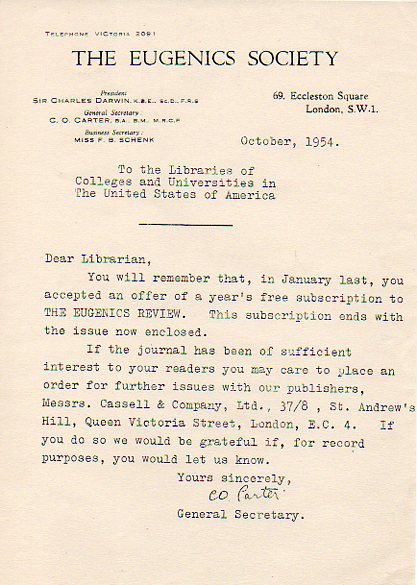
    For several years running as a matter of fact the Washington Times threw their newspaper onto my lawn, a freebie, news gratis–they just kept coming, day after day, even after I called them requesting that they stop the free delivery.  They didn’t.  I simply didn’t want to be included as a statistic as a “reader”, because grass-reading was evidently a statistic they could deal with. Had I been a lawyer I think I would’ve sued them for littering, as that was about the extent of the value of their newspaper, to me.  I guess if you give something away long enough, people get used to it, and then, after many years, they are guilt ridden to buy, or–like a phantom song from the radio that you’ve heard so many times that you know it by heart even though you don’t like it–it becomes part of your routine.

    That’s what I thought of when I saw this circular slide out of one of the volumes in the warehouse of the Journal of the Eugenics Society.  It warned librarians that the free ride their library had been given by the society was about to end–maybe–and that if the institution wanted to receive any further issues, they would need to buy them.

    Unlike  the Washington Times–still in business today–the Eugenics society didn’t make it.  It died decades ago. Died a death long overdue, died in its seventh decade.  Pieces of it lived from ancient times, famously with Plato, developing in more modern times into a societal, philosophical, scrapingly biological branch of pseudoscience, aimed generally at improving the human population through a more-or-less longitudinally dreamed belief system.  It was squared away and rounded up with social stats of Karl Pearson and number crunching of Francis Galton (who misunderstood the writing of his cousin, the beautiful Charles Darwin). And in spite of coming into a sort of Renaissance in the early twentieth century, it was mostly put away by Nazi monsters, who broke whatever basis in reality that eugenics had, almost entirely dealing the belief system a mortal blow.  Some people still felt comfortable with it enough to use it to continue a practice of population control by sterilizing anti0social elements–including prostitutes and drug addicts, and people of low IQ, but mostly, almost entirely, poor people–up until the 1970’s. 

    It looks like a desperate thing to me, this flyer (available from our blog bookstore, here).  It may well have been real, it may have been the case that it wasn’t this piece of propaganda that I see  it as to help sell a fatal science…but I don’t think so.  It looks pathetic, paper collar and starched shirt and doctorates and cufflinks and privileges notwithstanding.  And it reminds me of the desperate attempts of propaganda machines like The Washington Times to get its message across–even when it is very clear that there are not nearly enough people to fund it, a message machine in desperate search of an audience.


  • The Future of Sucking: Vacuum Express Train, NYC to Philly, 1945

    JF Ptak Science Books    Post 1315
    Follow Me on Pinterest


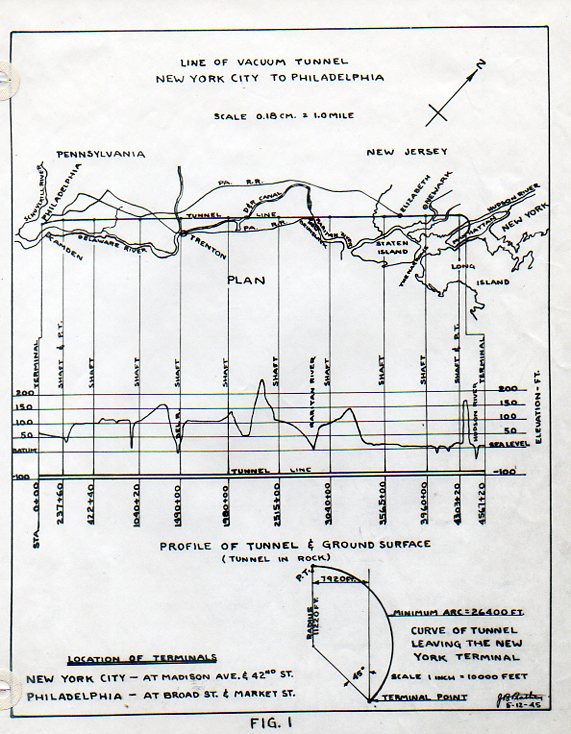
    John B. Prather launched an idea in 1945 for building a high-speed pneumatic passenger/freight train connecting New York City to Philadelphia.  His New York-Philadelphia Vacuum Tunnel, Preliminary Design Features and Economic Analysis (the original available on our blog bookstore) was exceptionally hearty. The idea is interesting in a removed, lets-not-do-it way because, well, it just doesn’t seem to make sense in the long run, at least beyond the building of the thing to show that it could be done.  And I don’t doubt that could be the case–I just don’t know why it was necessary. 

    Vacuum tunnel318 Mr. Prather’s approach seems to be the work of an engineer, or at least he had some help.  I doubt though that he had any help from a structural engineer or site geologist–his proposal was to build this tunnel 100′ down through bedrock when it could be found, a level hundred-feet  below the surface, from NYC to Philadelphia.   The tube would accommodate an aluminum-shelled  400′-long train that would be hauling 350 people and 175 tons of freight at speeds of 400-600+ mph, making the run between the two cities in about 20 minutes.  Not bad.  He figures too that all of the freight could be offloaded in 7.5 minutes.  This would make for  a very busy train, though Prather doesn’t tell us how many runs a day it would be making. This was all preliminary.

    The 16.2′-wide  tunnel would be 456,720 feet long, and would cost $173 million to excavate and $41 million to line with cement–according to the author.  The total cost for the ordeal would be about $334 million and would take 6 years, start to finish–that includes all of the tunneling, which would swallow/excavate/face 300′ per day. 

    I don’t see, really, how this could be so narrow a tunnel–I’m not an engineer but it would seem that wear, heat and the abuse and so on that a massive and dense 400′-long missile going 400+mph would require something that was more than 125% of the width of its trains. 

    There is however  precedence for a massive tunnel of something like this size being built in something like this time–the Delaware Aqueduct is 82 miles long and 13 feet wide, and was built during the Second World War (1939-1945) , so, perhaps if enough people and money were thrown at a project like the vacuum tunnel could actually be built (barring geological problems). 

    But it would all be worth it:  Prather suggests that the overall revenue from the operation of the train to be $196 million/year with $32 million in yearly operating expenses.  Which means that the whole thing could be paid for in three years or thereabouts.  So if the things was started in 1946, it would all be finished and paid for by 1956.

    I can understand his thinking, though, especially when you consider the impact of the year (1945) in which this paper was written.  The U.S. was came away from WWII by far more strong than any country on Earth, with its GDP being about 50% of that of the entire world–on the other hand, the federal deficit was 125% of the GDP, so perhaps in addition to being in an extraordinary position, investment was also somewhat gunshy.  And of course there’s the problem of whether Prather’s idea made any sense at all.  But I can understand the high times during which his project was announced. 

    I’ve looked at a number of proposals like this over the course of this blog–like almost filling up the Narrows between Staten Island and Manhattan with an airport and seaport, and making a series of transoceanic airports for flights between the continents, and dropping a gigantic shell filled with people from the top/interior of the Eiffel into a narrow hole filled with water, and covering Midtown Manhattan with a rooftop airport, and covering Midtown Manhattan with a glass-ish dome, and so on–and I know that it is good for at least one thing:  superb classroom discussion fodder of why something like this does or doesn’t make good physical/economic etc. sense.


  • Dividing by Zero: David Byrne and Herman (“the Fat Man”) Kahn Sing the Future Blues

    JF Ptak Science Books  Post 1312

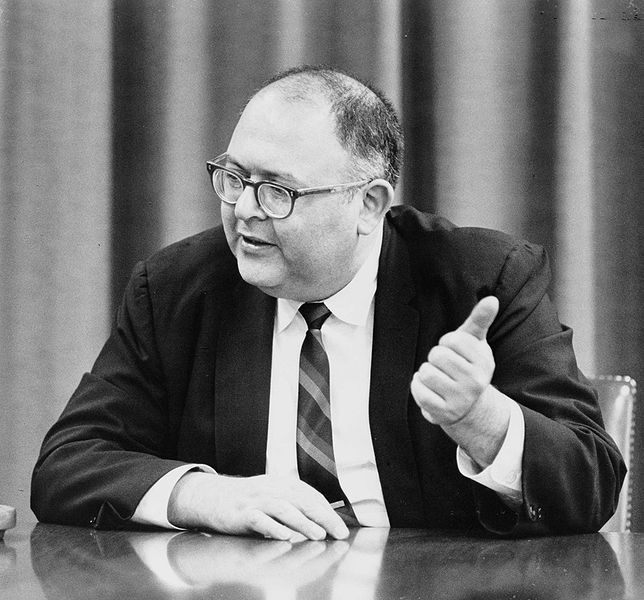
    Earlier in this blog, about two years ago, I wrote a piece on David Byrne’s beautiful Knee Plays, which included a song “In the Future”.  The post was about Byrne’s vision of the future which was bounced off the belly of “futurist” Herman Kahn, a man who was widely influential and whose thinking (I do believe) was widely incorrect.  He was also a proponent of possible first-strike (that is, American-initiated) nuclear warfare, deeming the scenarios “winable”., a broad thinker on Thinking-the-Unthinkable, and coiner of the word “megadeath” when used in conjunction with his nuclear end-game games. A main component of the template for Dr. Strangelove in Kubrick’s movie by that name,  Kahn and the think tank he helped found (the Hudson Institute) had the ear of the Reagan administration, among others, and it shows.

    Here’s the revised post, expanded some.

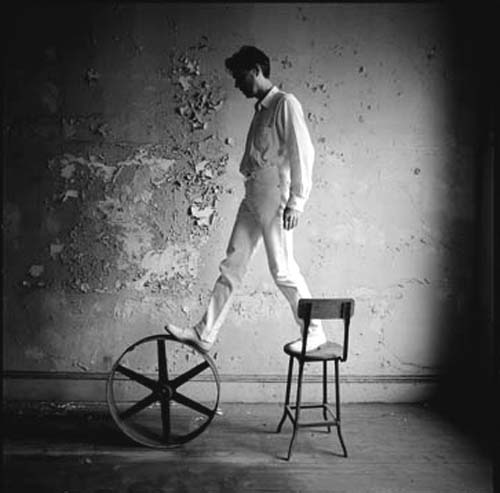
    0-blog-dec 3 byrne David Byrne, former Talking Heads member, produced a series of twelve short pieces to be used in the Philip Glass (and Robert Wilson*) Opera CIVIL warS  in 1985. (“Opera” may not be the right word for this piece, as I think it was one only in so far as the composition needed an opera house to be performed in.)   The Byrne pieces, called ”Knee Plays”, were meant to fill in the spaces, the spaces in-between,  place holders, between the sections of the day-long multimedia production..  Glass had used this idea of inter-pieces to the whole earlier in 1976 in his at-the-edge Einstein on the Beach, in which the connective elements were meant to not only join the pieces of the production together, but were also meant to stand alone, as a cohesive unit, if removed from the opera.  (Glass said they were “short connecting pieces which appear throughout the work much as prelude, interludes and post-ludes. Taken together they form a play in themselves”)

    0-blog-Dec 3 David_Byrne1991

    One of the Knee Plays, “In the Future” (Knee Play Number 12) is a slippery, stacatto brass section accompanying Byrne’s 51 sophisms about life in the future.  About thirty years earlier, “futurist” and think-tank-filler (or maybe it was “Think Tub”?) Herman Kahn (1922-1983), occupying a lot of space at the RAND and Hudson Institutes  (he was also known in many circles as the “Fat Man”), diligently recorded his myopic views of the future. He is generally regarded as a systems theory and military strategy guy, and is most remembered for (as he claims, perhaps) introducing the term “Vietnamization” which described the ultra-failed de-escalation (?) process and withdrawal for the United States from Vietnam (attention Obama administration).  Superluminarily speaking though his contribution to thought on constructing and implementing thought regarding nuclear weapons exchange (pointless to refer to this as “war”) in several books, including On Thermonuclear War (1960), Thinking About the Unthinkable (1962) and, On Escalation (1965), where he famously put The Bomb on the table of use possibilities.  In addition to these books—which he is busily trying to forget out there in his afterlife, somewhere, maybe in a penitential place where you are forced to think endlessly about paths-to-bad-decisions) is that 1967 peek into the future, The Year 2000.  Petroleum and oil are not issues.  Computers are of minor societal importance.  And then other things of no importance happen.

    0-blog-dec bryne kahn When you take Byrne’s Knee Play 12 and place it next to Kahn and other mis-spent prognosticators, the musician looks positively brilliant.  Some of the stuff has come to pass, some hasn’t; some will, and some won’t.  Some are open to a little interpretation, and some, a lot.  Overall, though, if you think through these little future bullets a little carefully, David Bryne looks very good.  Byrne’s lyrics/list is below.

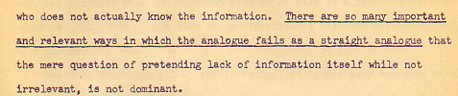
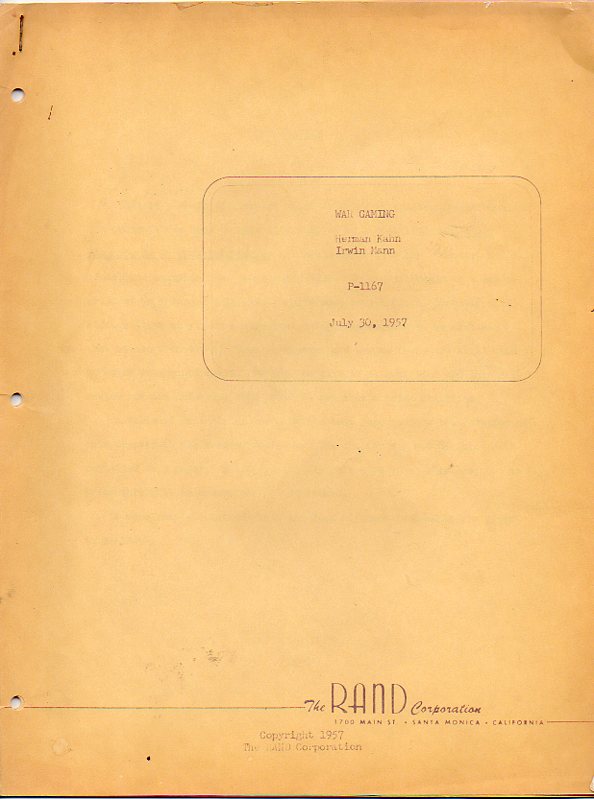
    Kahn’s writing is necessarily less elegant than Byrne’s, and probably less elegant than most other people in general including those who don’t write, though it does lower itself to some height of governmental semi-speak.  For example, from his July 1957 RAND paper “War Gaming” (available at our blog bookstore, HERE), we find this nugget:

    Kahn314

    Kahn315

    I have no doubt that Kahn looks like a warrior to many people–he no doubt was something of one, so long as that warrior could wear a white button-down shirt and not get dirty.  Simply because a person is thought of as a “warrior” doesn’t make them a ‘good” one, either, and I think that I would nominate Herman Kahn as an example of one:  in my own approximation of Kahn-speak, he would  “generate the apparent non-non appearance in definable though undefined parameters as  a non-good non-warrior in circumstances that defined or not define him/them in this semi-stable manner”.

    I think it is important to look at documents like this–documents that helped establish military policy–to see how their authors were able to convince people in government that they could divide by zero.


    *Robert Wilson is a phenomenal conceptualist and theatrical designer.  On the liner notes to CIVIL warS is found the interesting note on Wilson and Byrne:  “At first, Robert Wilson asked David to compose pieces for several sections of The CIVIL warS, but on account of David’s limited time, he composed only The Knee Plays part. The CIVIL warS was supposed to be played in its complete form at the Olympic Games in Los Angeles, but if one plays every part, it takes at least eight hours. There was also a financial problem for playing every part. So only some parts of it were staged there. David himself was very interested in composing for such a play and dance and this time again he enjoyed this work very much. Last time, for The Catherine Wheel, he used recorded tape, but this time he made musicians play on the stage.”

    (Featuring a prominent role for The Tuba)

    IN THE FUTURE (KNEE PLAY 12)

    In the future everyone will have the same haircut and the same clothes
    In the future everyone will be very fat from the starchy diet
    In the future everyone will be very thin from not having enough to eat
    In the future it will be next to impossible to tell girls from boys, even in bed


  • A Note on the History of Bad Beds (Bedlamia 2): the Utica “Crib” and Putting the Insane to Sleep, 1880.

    JF Ptak Science Books  Post 1349

    Following an earlier post that I made here on the History of Bad Chairs (including a contrivance made by Declaration-signer Dr. Benjamin Rush that immobilized the body, dulled the senses and kept the feet of its mental-patient-occupant in cold water for “treatment”) I’d like to start a short series on bad beds.  This part was excited by another historic psychological/shrinkological tool from the arsenal of doctors who treated the insane: an instrument of torturous treatment called the “Utica crib”. 

    It was a device used, obviously, to constrain the person placed in it–so that they could be controlled during the day if drugged and still not controllable, and to be used at night if the patient wouldn’t stay under their covers.  It looks pretty terrible, a squashed baby bed with a prison door for a top.  It comes as one in a long line of bad beds, including psychiatric hospital”tumbling beds”. centrifugal beds, and of course spiked beds of the inquisition, stretching beds form the same, Aushwitz  “beds”, and on and on, devices of torture made from places of rest.

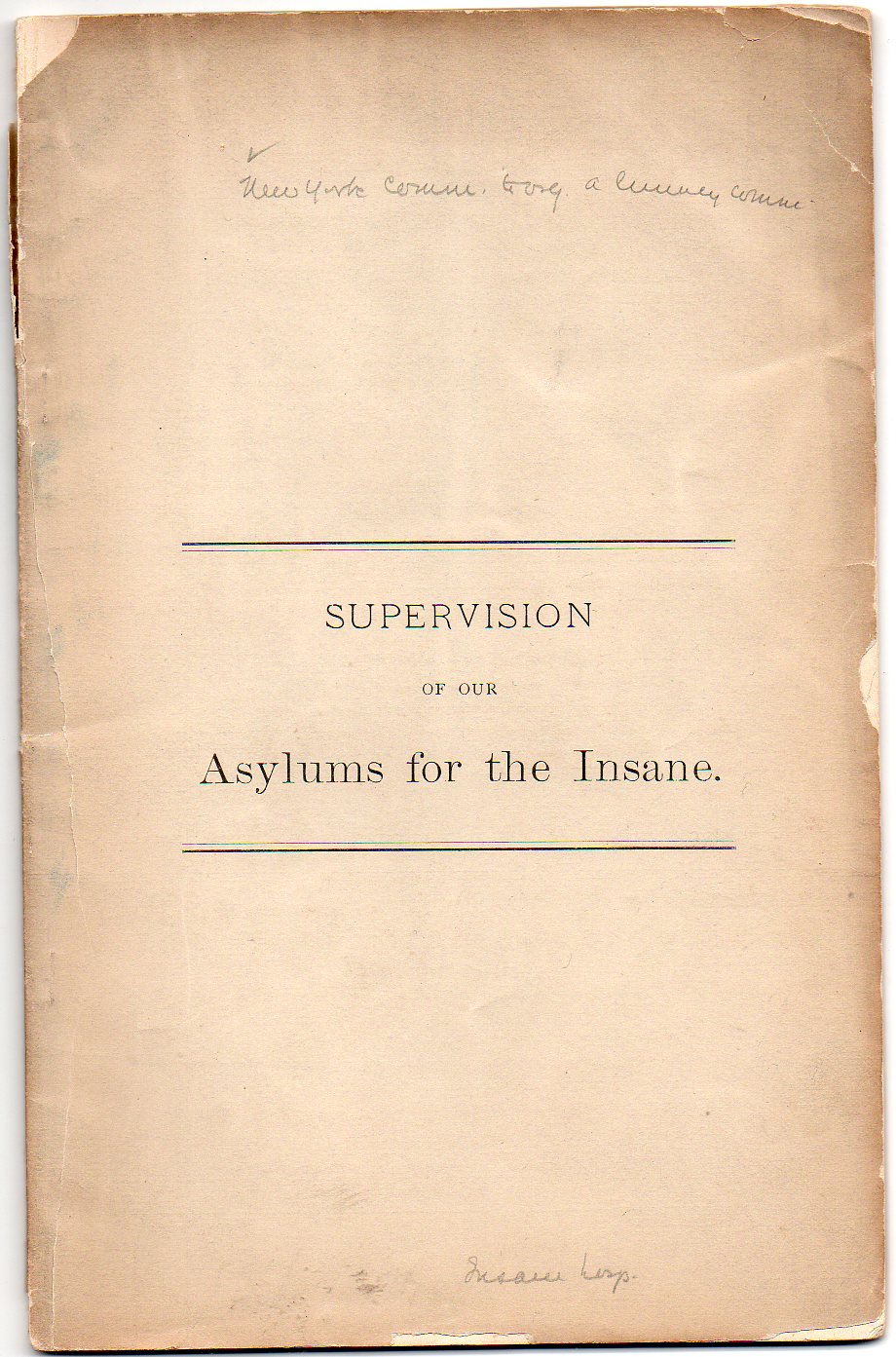
    Insane supervision453 The Utica Bed of the New York State Lunatic Asylum at Utica–if not actually constructed in Utica it was popularized  there–was put into use at about the same time that the facility was opened in 1843.  According to the numerous reports of New York State asylums directors in Supervision of our Asylums for the Insane1, it was about time (in 1880) that folks in control of the state institutions start to deal with their charges in a medical, treatable, fashion; to try and remedy the effects of mental illness rather than just use the asylums to warehouse societal outcasts.  And it was in this paper that the Utica Crib (and other retraining devices) came under very severe criticism. (The original pamphlet is available at our blog bookstore.)

    Edward C. Spitzka makes the point that the institutional that use devices like the Utica Crib–which was supposed to prevent patients from injuring themselves–actually had far more incidences of  patient injurious than those institutions which–with a similar clientelle–didn’t use them at all.  Spitzka made a very compelling case the the Utica Crib and other devices were archaic remnants of an earlier and darker time in the treatment of cases outside mental health, and they they were far more injurious to patients than not having them at all.  They also, he said, demoralized the staff of the hospital and depressed the medical supervision, making a mockery of treatment. All in all, Spitzka’s insights were accurate and prescient. 

    Notes:

    1.  Report of the Proceedings for Establishing a Board of Commissioners in Lunacy for the State of New York, published by Sherwood & Co., NYC, in 1880.  55pp.


  • SuperBad Ideas: Superhighway Through the Center of Washington D.C., ca. 1925

    JF Ptak Science Books  Post 1346    

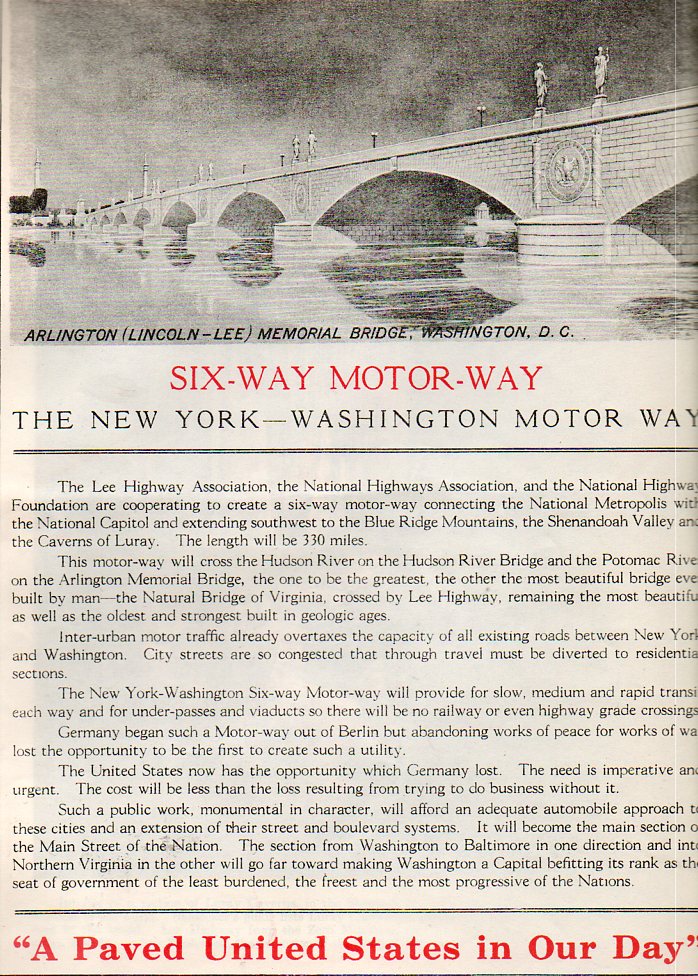
    “A Paved United States in Our Day”

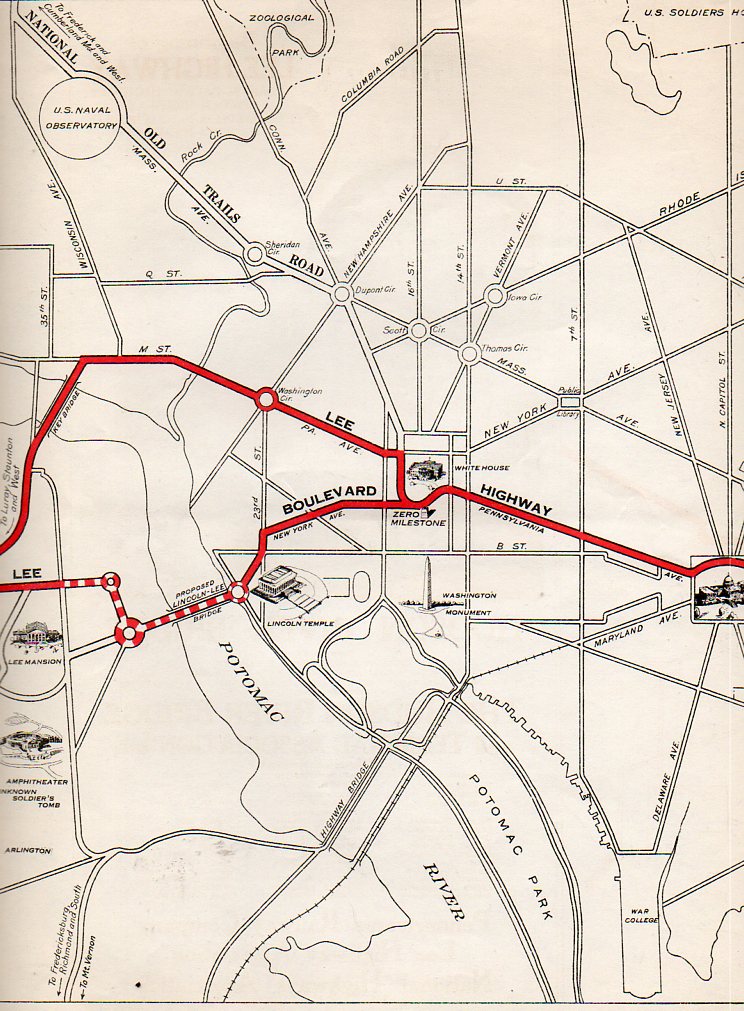
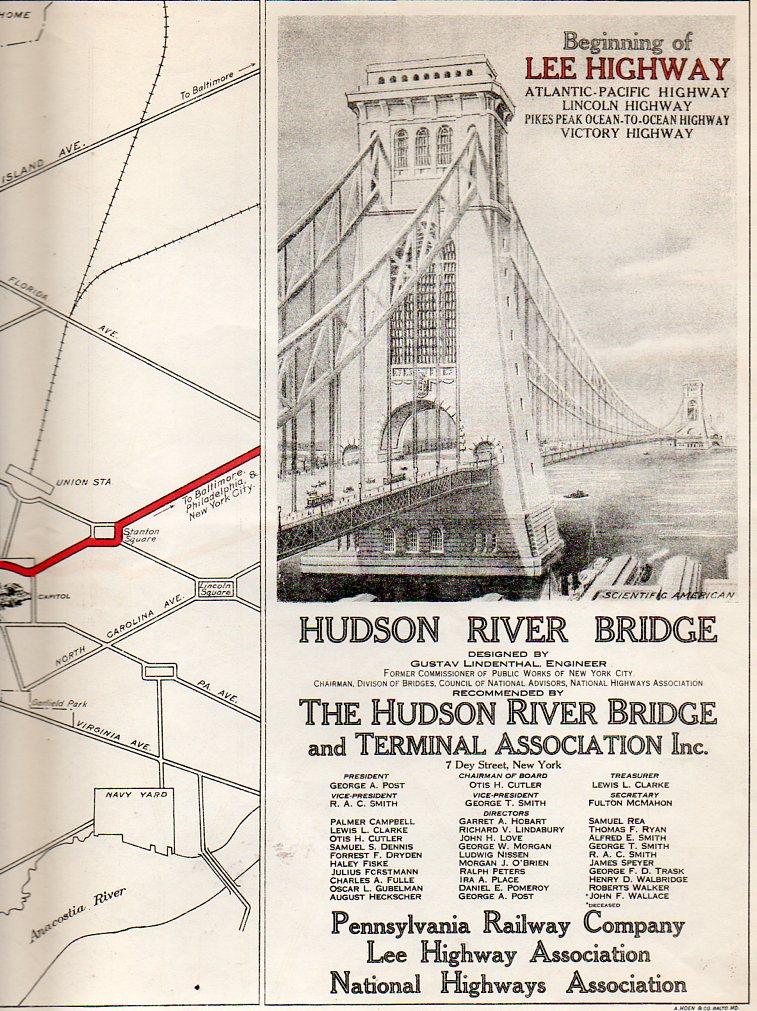
    If the planners of this highway had a crystal ball to see deep into the future–say, 1955–they would have been horrified to see the errors in their ways.  The equivalent of this plan might be something like picking up the Beltway, straightening it out, and running it  through D.C. along 16th street, with massive flyovers for the White House and other associated et ceteras.  This idea was published in an odd source, published by the Pennsylvania Railway Company/Lee Highway Association/National Highway Association auspices and the Hudson River Bridge and Terminal Association in about 1925, or thereabouts, just prior to the construction of the George Washington Bridge in NYC.  

    Lee Highway443 Lee Highway444


    The plan was for a six lane (“six-way”) motorway from New  York to Washington, starting with the Lee Highway (or King’s Highway, Route 1, one of the south’s oldest roads, and part of what was supposed to be a national autotrail connecting New York with San Francisco) and taking that highway across the proposed Arlington Bridge (called Lincoln-Lee here, without irony), up New York Avenue to the ellipse, rounding the White House, going down Pennsylvania Avenue to the Capitol, and then out again to Baltimore and NYC.  Another version called for the highway to go across Key Bridge, dumping everything in Georgetown, hooking right on M Street to Pennsylvania and on out again.  Having lived in D.C.(with my store in Georgetown) for 29 years, I can say without fear of ____  that this would ave been a massively bad idea then and in every decade since then, and probably would have been removed by 1960 just to recognize and correct the sheer, overwhelming badness of its conception. (The original of this map is available for purchase from our blog bookstore.)

    Lee Highway445
     The Memorial Bridge wound up being pretty close to this design–lacking the statuary, especially–and is quite a beautiful thing, especially when the designs for its rivals were considered.  The bridges in DC are almost all lovely, or at least those built before 1950. 


  • Fantastic Contrivances of Massive and Unneeded Difficulty–Bikes in War, 1897

    JF Ptak Science Books   Post 1345

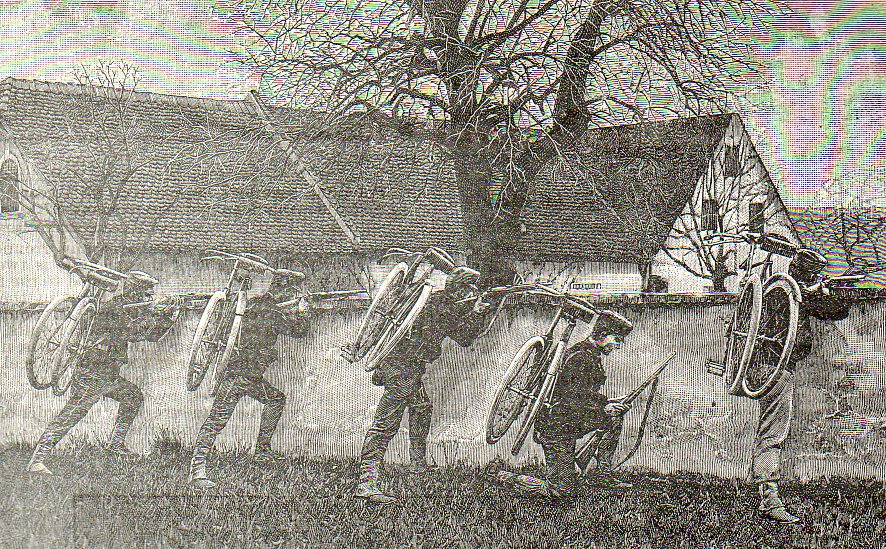
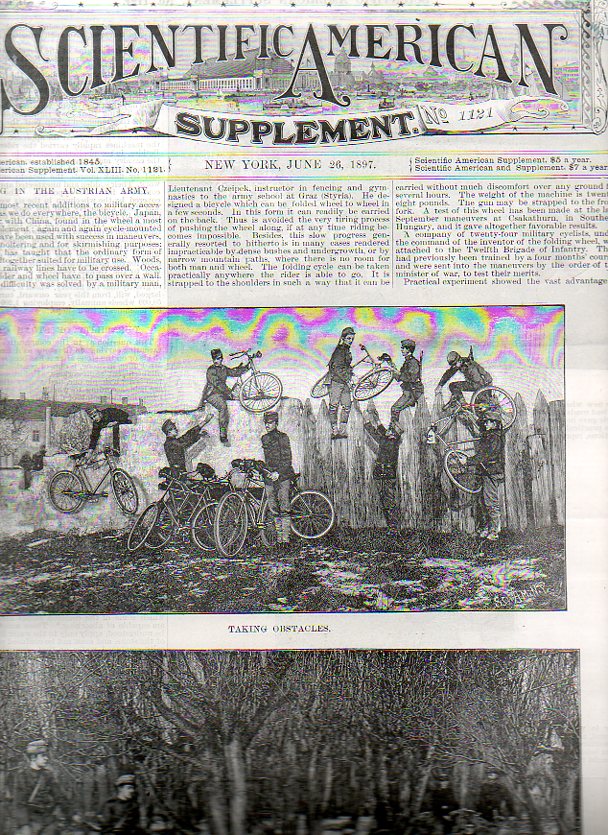
       Bike army 439

    When I see images like this, I can feel a symphony of bad ideas rattling  my bones.

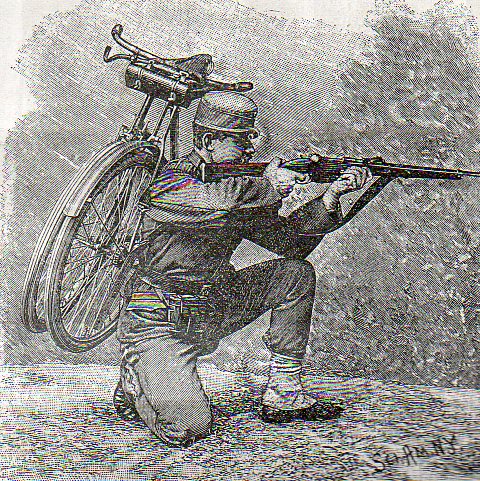
    Of contrivances great and unnecessary,  that of bringing the bicycle into the field of war–banking on a fabulous interest in the machine and riding a wave of enthusiasms enjoyed by millions–is among the loftiest of lofty unnecessaries of the past 150 years or so. When these pictures were published in 1897 interest in the bicycle was shattering; it was a popular conveyance, and then in just two or three years, an explosion:  millions of people suddenly needed one.  Bikes seemed to be everywhere,  which forced people to imagine new and different uses for the machine.  And so the Austrian army came up with a plan to include the bike in its plans of war, and it proved to be as about as useful as a double-decker horse.  And just like that–poof–the fragility of the bike’s expansive uses fell right off the table, along with the popular interest in it, which by the turn of the century saw the millions who had turned towards the bike turn away. 

    Bike army 440
    It is difficult to image a more unpleasant (real) use for the bike than this.  The pictures seem as though they are part of a Monty Python montage, but they were indeed deadly serious–though I do need to credit someone, anyone, who came up with the idea of a folding bike to make it slightly more transportable.  (Overall though it seems almost as useful as a folding tuba.  Or sousaphone.)  If employed I think the idea would’ve proved to be more deadly to the biker than whomever the biker was attacking.  Or, more likely, fleeing.

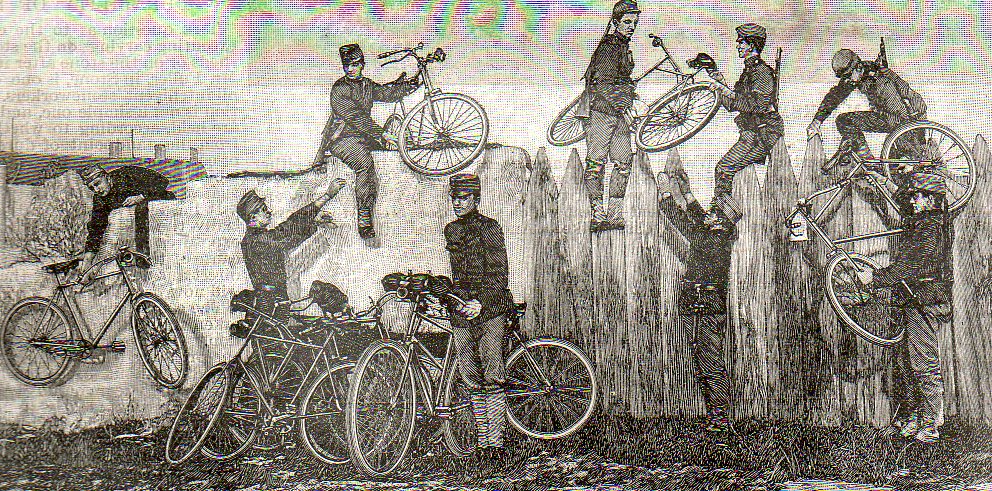
    Bike army 436
    One can only shudder and what it must’ve been like, sitting on top of that fence, handing bikes (with lights and horns) from one side to the other, bullets flying, attempting an attack with 75 pounds of cumbersome trouble slapped to your side.  It must have felt insane.

    Bike army 441

    (The original print is available from our blog bookstore, by the way.)

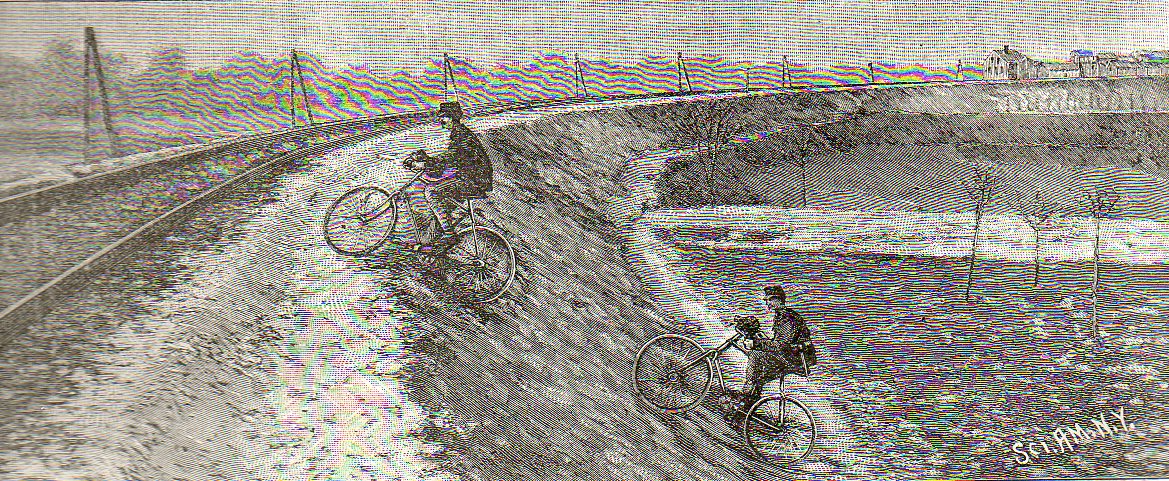
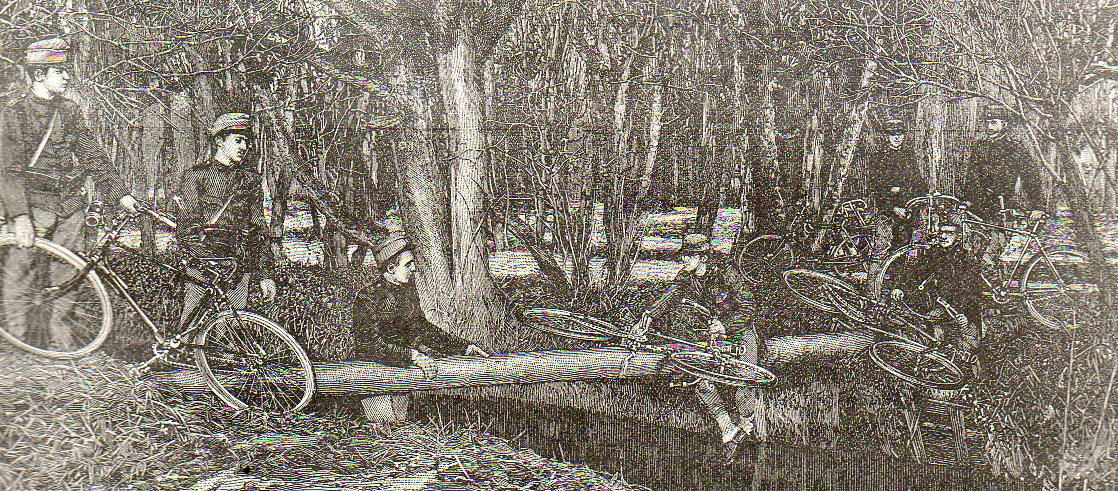
        Bike army 435

    Bike army 437

    I think these men would have heard the music too as they slogged their ways through brush and trees and muck and the like, sliding their bikes along that log to keep them dry while the men stood in the wet. They would’ve heard the music too, a short little symphony played on folded instruments, which sounded as bad as it looked.


  • The Kindle vs. Books vs. Frankenstein’s Monster. A Short Rant.

    JF Ptak Science Books  Post 1339  

    Kindle and Co seem ready-made for a morality tale…except that it has been written, already, many times.  Digital reading appendages like the Kindle seem to me a future history of magnificent semi-failures, another episode in a long series of stories on how machines have corrupted their users I’m not a Luddite by any stretch, but I can’t help but think of the weaknesses of these devices when compared to a simple book, or stack of books, or bookcase, or library–I think that the Kindle is perfectly fine used in conjunction with these other things, but what seems to be the case for me is that Kindle & Etc. are replacing them–the real nuts and bolts of learning—and that I think is an enormous error.  Perhaps more important still is that the glorious possibilities of serendipitous discovery are being lost when you have such directed interaction as with a Kindle, compared to walking down an aisle of books in a  library (or g_d help us, in a bookstore).   What these digital tools can’t replicate is the incredibly varied sources for possible inspiration that you have when you walk yourself down between two walls of books.  You might start out looking for X, see something Y out of the corner of your eye, it reminds you of Z, which takes you to another range of books where you stumble across the “A” that you didn’t know existed and that you needed it. 

    Bookstores are closing in droves, books in libraries are being replaced by stuff that enables social networking to occur while at the same time library hours/staff are being trimmed.  (A big percentage of libraries are already closed or closing on Sundays, which is a day when working class people might actually have to themselves to get to the libby.)  Magazines and newspapers are already abandoning print publications  and settling in for their run exclusively online.  The process of virtual replacement is already well underway. 

    Hans Andersen’s (1805-1875) The Nightingale (1844) comes close to the mark in telling the future of these devices. The Emperor of China has a perfectly lovely, living nightingale which is replaced over as short time by a mechanical one; the robot-nightingale fails after a bit, but by that time the real nightingale has taken flight, no longer I service, vanished.  The Emperor is full of remorse, slipping into melancholia and depression, headed to death for the lack of the song of is nightingale–until the living one returns, restoring the Emperor to health. And sanity. 

    Other, older lit tells similar stories of inception, confusion and lost purpose–though without the redemption part of the Andersen: an automaton appears in E.T.A. Hoffmann’s (1766-1822) Night Pieces (1816 ) in the short story “The Sandman”, an ingenious mechanism which happens also to be lifeless and soulless. Mary Shelley’s Frankenstein (1818) s another soulless creation, though it was of biological, human pieces rather than metal, crunching the recent work in the manipulation (like that of Galvani) into something not recognizable….another piece of the coming world of electricity which in its essence has gone totally awry. 

    Heinrich Heine’s On the History of Religion and Philosophy in Germany and Other Writings (1834) has a short story in which an accomplished mechanic/inventor decides to invent a man–and succeeds He builds himself an English gentleman, the description of which Heine uses to skewer the English1, the inventor building a machine like a man who behaved and like and had the emotional range of a British person, though who lacked anything to back it up–in short, the machine lacked a soul Heine takes more than just the Brits on this, exploiting the engineers soulless invention as a standard for the emptiness of some aspects of the Industrial revolution.
    Then there’s Hadaly, a mechanical electric  woman run found running around in Auguste Villiers de l’Isle-Adam’s The Future Eve (1886) , with its high-Victorian nod to imaginary naughtiness with the no-tell robot. Talus, the “iron man” in Spenser’s Fairie Queen, the crystalline man in Goethe’s Faust, the creation of “robotic” homunuclus in the philosophers eggs of many alchemists, plus a wide, encyclopedic assortment of other sorts of non-mechanical man-made-men.

    And this of course is all before we get to the twentieth century.

    I guess I’m just annoyed by the possible destructive nature of a supplemental tool becoming the primary object, a supplement to itself rather than something richer and fuller.  The Kindle and its assorted lot might seem less Nightingale-y to me and more like the sub-title to Shelley’s work, The Modern Prometheus.

    Notes:
                       
    1. “…a human feeling in that leather breast, which are not usually to be found in the English, and it could articulate tones about its feelings and impart them, even with an audible sound, and it gave these tones a real English pronunciation; in short, this robot was a complete gentleman, and for being true man, he lacked only a soul…”

    ·Posted by :

    ·in:


  • Replacing Clay Pipes with Glass, 1849

    JF Ptak Science Books   Post 1338

    Glass is best left to its best uses–in lighting, decoration, ,chalcogenide glasses (in the construction of rw cds),
    and even music (Beethoven, Mozart, Donizetti, Bach and many others have composed for the glass harmonica, armoinca, hydrodaktulopsychicharmonica)…and son on and on  But perhaps the use less thought of in general has been the use of glass as the conduit for aqueducts.

    A 180-mile-long conduit.

    Glass397 I found this notice in the 20 January 1849 issue of Scientific American  The idea of making a glass pipe for transporting water to transport the special waters from Saratoga Springs, New York down to Manhattan, 180 miles away.  The backers for this plan were going to encase the glass piping in clay bricks, which makes sense of course, but then burying all of that in a coffin of cement…well, that present all sorts of problems if the pipe ever broke.There is some irony in the silica connection between the clay pipes the glass would’ve replaced and glass itself, but this is still just an awful idea.


    ·Posted by :

    ·in:


  • Hitler, Big Room, Little Desk, 1931

    JF Ptak Science Books   Post 1336

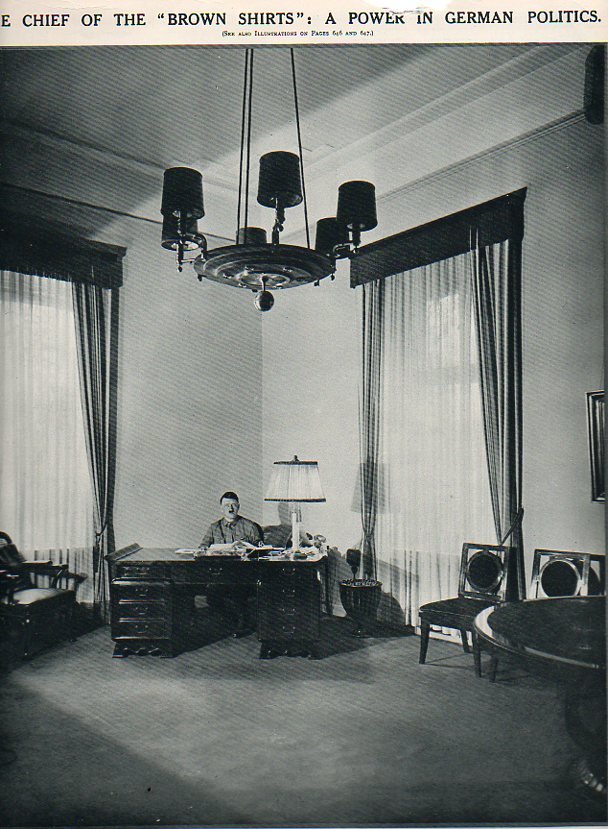
    It is difficult to think of Hitler as just some guy sitting behind a desk.  But there he is, in 1931, sitting behind a desk with an enormous, pleated lamp sitting next to him, just Hitler in the paranoid-position (back to the corner of the room able to see anything that moves but being still in a secure position), at the edge of a big room with tall ceilings and a few chairs, looking a little grandmothery–if the grandmother wore a swastika armband.  But this is 1931, and Hitler was in the  developed stages of amassing votes and power, outfitting his political organization in uniforms and along military lines, drinking deeply of his hateful autobiography/social road map, biding his time.  He was still years away from the nation-destroyer he would become, looking small here, looking like a human being.

    Hitler 1931390
    Its a good thing to be reminded of the common basis of people who became Gargantuan monsters, before their human nature was replaced by the horrifica of their thoughts and deeds, setting them apart from the rest of us.  The point in fact though is that Hitler and Pol Pot and Stalin and Mao and the other people-eaters of this century were “people” too. To make them somehow extra-human is to relieve ourselves of the responsibility of them; that what they have done was somehow outside the sphere of human ability.  They were just people, though people with no humanity.

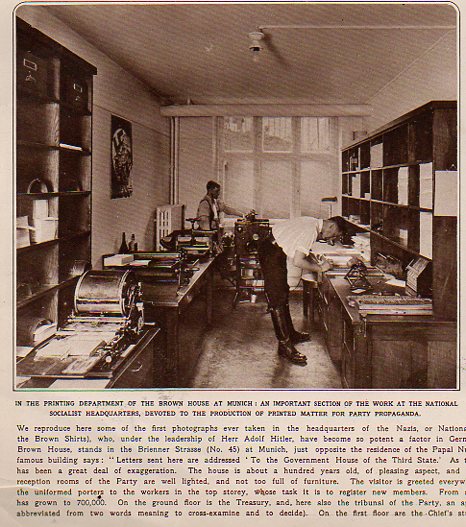
    The Nazis were sprung of the simplest elements–fear, hope, hate, revenge, and of course delusion.  But simple.  Part of the earliest mass of NSDAP literature, the stuff that helped fuel Hitler, was printed in this little shop.  One jackbooted man is doing the typesetting, another other running one of the tabletop presses. Two guys, a few machines, a paper cutter, a few trays of type. A dynamic speaker.  One radiator. One light bulb.

    And of course someone willing to listen, as well as a greater mass of someones who chose to hear but not do anything about what it was they heard.

    Hitler 1931b391

    ·Posted by :

    ·in:

    —