JF Ptak Science Books [An earlier Post from 2014, expanded]
- “Did I request thee, Maker, from my clay
- To mould Me man? Did I solicit thee
- From darkness to promote me?”–John Milton, Paradise Lost (X.743–5)
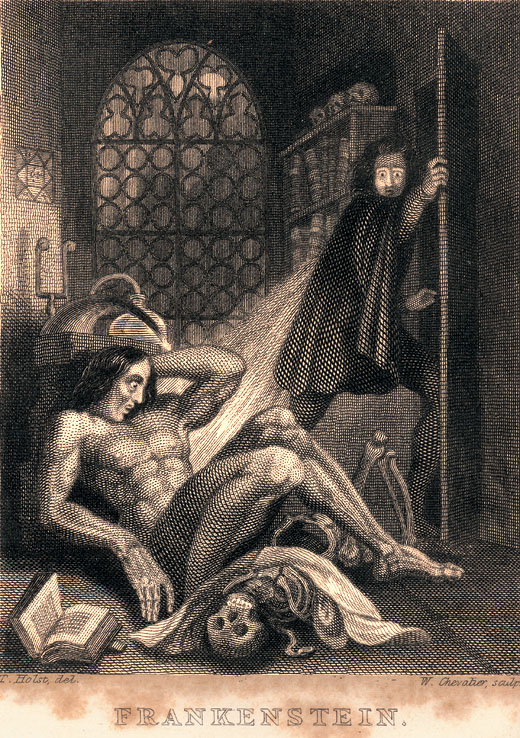 The animated human created by Victor Frankenstein in 20-year-old Mary Shelley’s anonymously published Frankenstein, or the Modern Prometheus (1818) was a far more intelligent being than portrayed in the many movies and stage productions that made the novel famous. “Frankenstein” usually refers to Dr. Victor, not the creation, who refers to himself as the possible “Adam” of his maker’s labors (and then later as Victor’s “Fallen Angel” following his murderous and nearly-uncontrollable rage), while elsewhere in the book he is called “it”, as well as “being”, “creature”, “daemon”, “Fiend, “monster”, “vile insect” and “wretch”, among other adjectival variants.
[Illustration at left by Theodor von Holst for the 1831 edition of Shelley’s book.]
He has been “Frankenstein” as much as he has been the “monster”, and portrayed so in so many films and other adaptations that there is a virtual dictionary of the actors who have played the role. So many, in fact, that there are near duplicates of the actors’ names (as with for example “Gwynn” and “Gwynne”, and “Sarazin” and “Sarandon”). Actors have changed in the role but the iconic makeup first worn by Karloff remained the same after Karloff signed off from the role, though in a twist he returned to play Victor in a later movie. In another variation “Frankenstein” remarks that Dracula is his “master” (I think this is in Abbott and Costello Meet Frankenstein), and in a Hollywoodish irony Lugosi the master tries his hand in one film to portray Frankenstein himself. There are very few instances where Victor’s creation is portrayed sympathetically, at least before the 1980s. Generally he has been slow-witted, slow-footed, unintelligent and unremarkable, with little reasoning power and almost no verbal skills, none of which have anything to do with Shelley’s character. The adaptations seem to just appropriate the horror aspects of the novel, detach them, and sink them solely into the Boris Karloff character, which seems to have sold a lot of popcorn.
“Remember that I am thy creature; I ought to be thy Adam, but I am rather the fallen angel, whom thou drivest from joy for no misdeed. Everywhere I see bliss, from which I alone am irrevocably excluded. I was benevolent and good; misery made me a fiend. Make me happy, and I shall again be virtuous.”
Mostly the creation in Shelley’s text is referred to as a “monster”–the word being used 35 times, mostly in reference to Victor’s animated man.
It is difficult to refer to the creation as a “monster” once you get to know him a little—he is exceptionally smart, teaching himself to read, and then reading difficult and complex works with deep understanding, which is hardly something that is expected from what Boris Karloff gave to us.
This man is deeply conflicted, and in chapter 13 he says:
“Was I, then, a monster, a blot upon the earth, from which all men fled and whom all men disowned?”
“I cannot describe to you the agony that these reflections inflicted upon me; I tried to dispel them, but sorrow only increased with knowledge. Oh, that I had forever remained in my native wood, nor known nor felt beyond the sensations of hunger, thirst, and heat!”
And then, in a couple of pages in chapter 15, we are given a great insight into this man, as he is about to understand these agonies via a discovery of three books in a portmanteau. These included The Sorrows of Werter by Goethe, a section of Plutarch, and John Milton’s Paradise Lost. The reading appears to elevate his state of understanding and of his misery, particularly with the Goethe.
![Sanatoir_aérien_du_docteur_Farceur_[...]_btv1b53024091c (1)](https://historyofideasblog.com/wp-content/uploads/1970/01/6a00d83542d51e69e2022ad3a4383a200d.jpg "Sanatoir_aérien_du_docteur_Farceur_[...]_btv1b53024091c (1)")