A Daily History of Holes, Dots, Lines, Science, History, Math, Physics, Art, the Unintentional Absurd, Architecture, Maps, Data Visualization, Blank and Missing Things, and so on. |1.6 million words, 7500 images, 4.9 million hits| Press & appearances in The Times, Le Figaro, Mensa, The Economist, The Guardian, Discovery News, Slate, Le Monde, Sci American Blogs, Le Pont, and many other places… 5000+ total posts since 2008.

Category: Anticipation, History of

  • The Clean, Wide Beauty of Concrete

    JF Ptak Science Books Quick Post

    Concrete Streets for Your Town, Concrete for Permanence is a substantial sales vehicle for using concrete to modernize U.S. towns and cities and is not surprisingly produced and distributed by the Portland Cement Association. There is no date of publication, but the the feel of the pamphlet plus the images of the vehicles and the dress of the few people represented in the many photos of concrete-improved streets place this around 1922 or so. In any event, I was attracted to this pamphlet by the images, not the least of which is the cover, which so (in its no-doubt enhanced whiteness) the newly concretized street grid for Pipestone, Minnesota. There are a number of pictures of bringing certain small-ish cities into the future of paved non-dirt streets, brought to them by concrete. And so That said I’ve reproduced four images, below (please note that all of the images are expandable and actually become clearer as they get larger):

    Concrete streets cover


  • A Fine Moment in the History of Mistakes: Attacking California, 1842

    JF Ptak Science Books  Quick Post     Part of the series on the History of Anticipation

    Catesby ap JonesOops!

    The wonderfully-named Thomas ap Catesby Jones (the “ap” evidently a Welsh patronymic indicating “Thomas, son of Catesby”) was a Commodore in the U.S. Navy in 1842 when a Short Series of Unfortunate Events occurred. Jones (1790-1858), a War of 1812 veteran, commanded a group of three naval vessels (including his frigate the USS United States and two sloops of war) from Lima Peru to upper California after understanding that the U.S. Was at war with Mexico and that there was a fear that the Brits were on their way to take over the middle-western coastline. So off he went, arriving at Monterey1 in October 1842, about four years ahead of the war. He settled off the cost and demanded the surrender of the Mexican gallery there, which consisted of about 60 soldiers in an old fort. The Mexicans, outnumbered and no doubt confused, surrendered the port the next day. The day after that, Jones received word that he had jumped the gun, somewhat, and withdrew from Monterey, with his apologies. From there, he went off to chase the British away from Hawaii, and somewhere in this course of events transports the deserter Herman Melville back to the U.S.

    I cannot leave this without mentioning that Jones’ nephew was named Catesby ap Roger Jones (1821-1877).

    Notes:

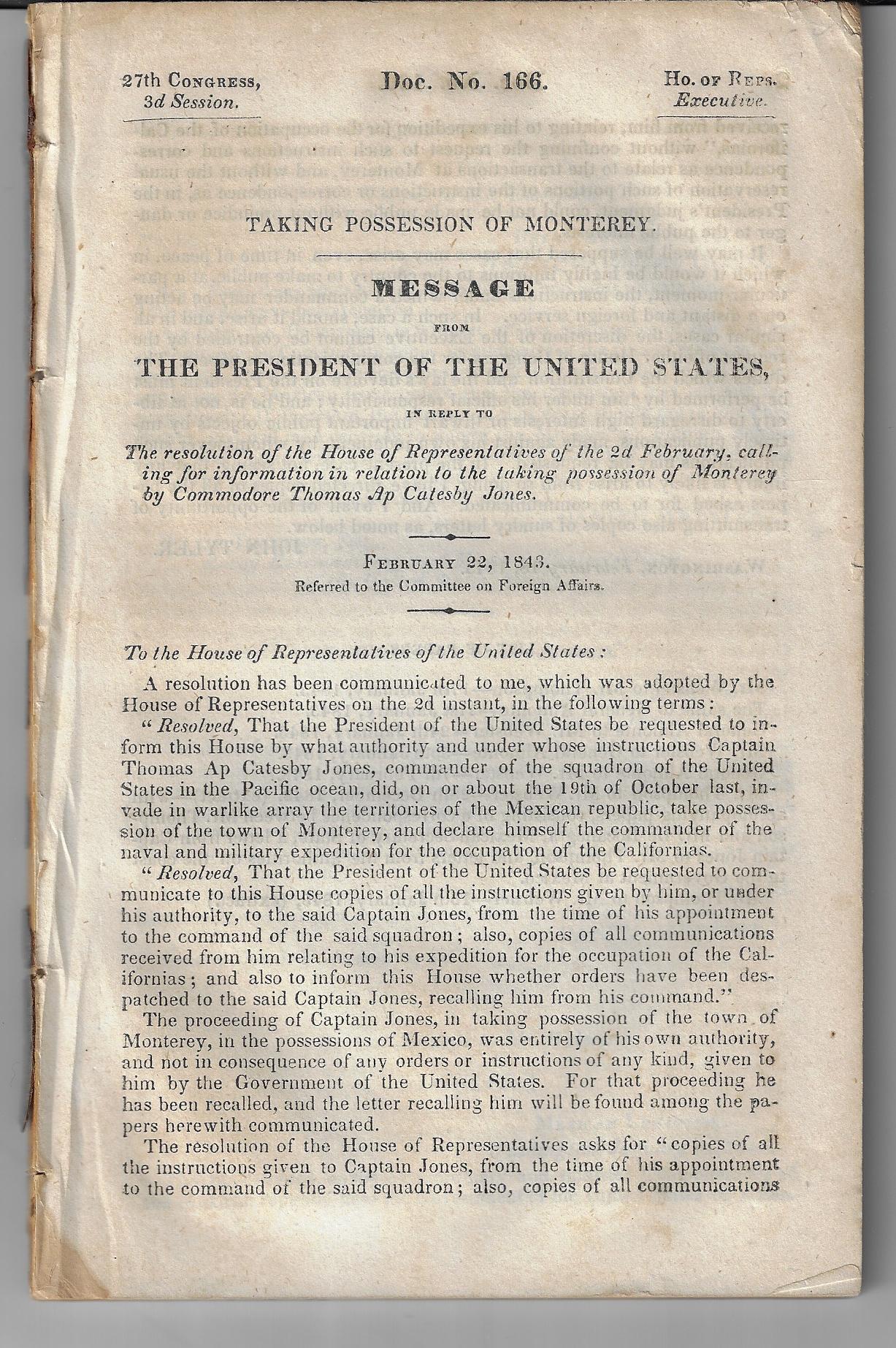
    1.  A good source of information on this action: Taking Possession of Monterey. Message from the President of the United States in rely to the resolution of the House of representatives…calling for information in relation to the taking possession of Monterey by Commodore Thomas Ap Catesby Jones. February 22, 1843. House of representatives Executive Document Number 166, 27thCongress, 3rd session. 9X6”, 117pp. Howes M 740aa. Cowan 317


  • The Poisonous Miasma of the U.S. Capitol as Found Poetry (Fred. Law Olmstead, 1882.)

    OlmsteadJF Ptak Science Books  Quick Post

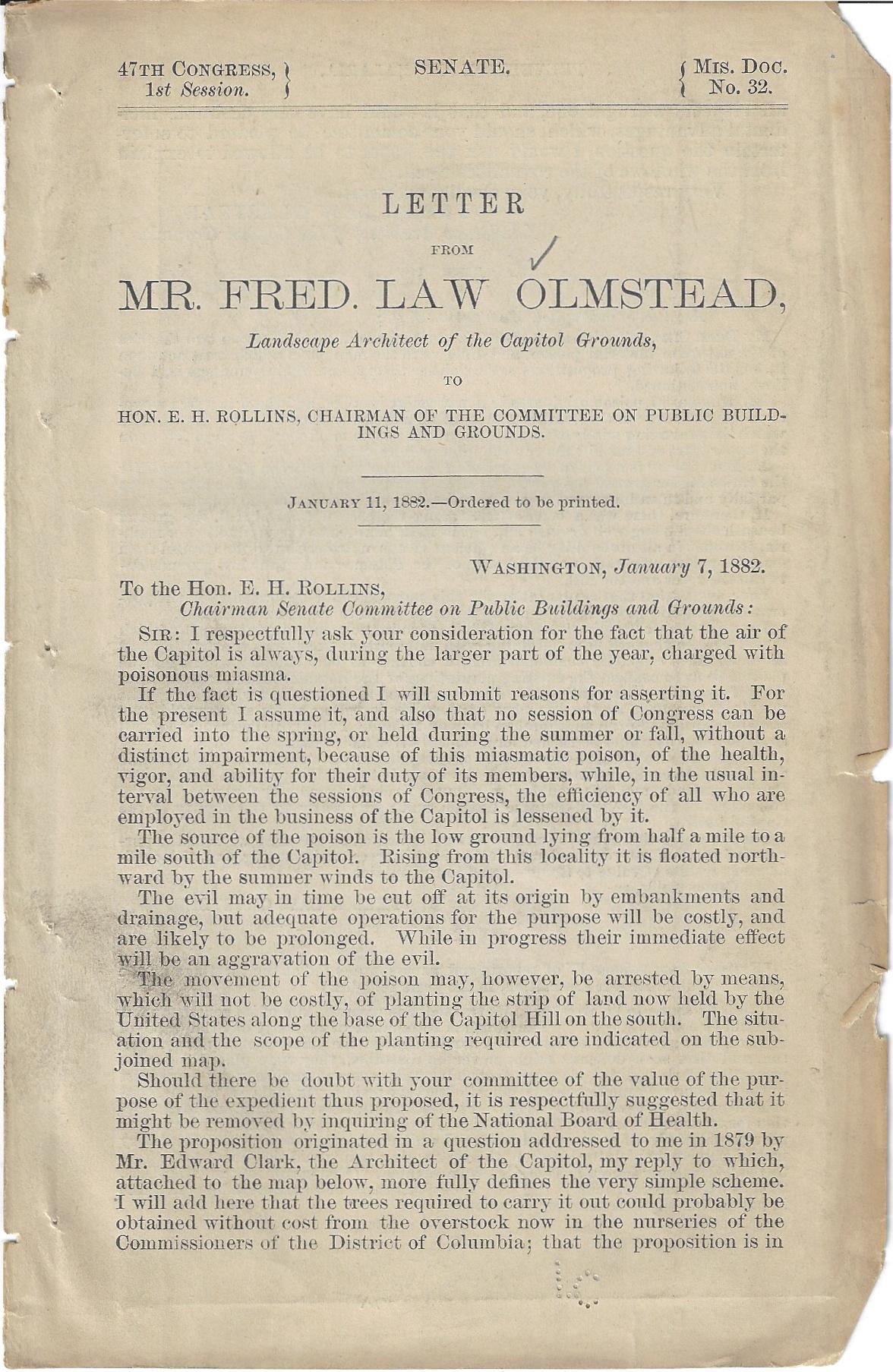
    Yes, that is pretty much a direct quote (full quote to follow) by the great landscape architect and engineer of the Capitol grounds, though it is in reference to the miasma going into the Capitol and not that coming out of it.  Olmstead reports that there’s some wicked “evil” stuff in the low-lying areas just east of the building, and recommends that for the sake and pity of all that is holy that the problem be addressed, and quickly. His immediate solution is to transplant and grow a wide row of bushes and trees in between the Capitol building and the evil stuff.  The text of the lead of the appeal follows, rendered intact, but lofted into a poetic structure that probably doesn’t work–it would work out better though if you can listen to it in your head being recited by Billy Collins:

    I respectfully ask your consideration for the fact

    that the air of the Capitol is always during the larger part of the year

    charged with poisonous miasma.

    If the fact is questioned I will submit reasons

    for asserting it.


    For the present I assume it and also that no session of Congress can be carried into the spring or held during the summer or fall without a distinct impairment because of this miasmatic poison of the health vigor and ability for their duty of its members while in the usual interval between the sessions of Congress

    the efficiency of all who are employed in the business of the Capitol is lessened by it.

    The source of the poison is the low ground lying from half a mile to a mile south of the Capitol. Rising from this locality it is floated north ward by the summer winds to the Capitol.

    The evil may in time be cut off at its origin by embankments and drainage but adequate operations for the purpose will be costly and are likely to be prolonged. While in progress their immediate effect will be an aggravation of the evil.


    And so on. The “regular” text version is below. 

      • “Chairman Senate Committee on Public Buildings and Grounds: Sir: I respectfully ask your consideration for the fact that the air of the Capitol is always during the larger part of the year charged with poisonous miasma.”

      • “If the fact is questioned I will submit reasons for asserting it. For the present I assume it and also that no session of Congress can be carried into the spring or held during the summer or fall without a distinct impairment because of this miasmatic poison of the health vigor and ability for their duty of its members while in the usual interval between the sessions of Congress the efficiency of all who are employed in the business of the Capitol is lessened by it. The source of the poison is the low ground lying from half a mile to a mile south of the Capitol. Rising from this locality it is floated north ward by the summer winds to the Capitol. The evil may in time be cut off at its origin by embankments and drainage but adequate operations for the purpose will be costly and are likely to be prolonged. While in progress their immediate effect will be an aggravation of the evil. The movement of the poison may however be arrested by means which will not be costly of planting the strip of land now held by the United States along the base of the Capitol Hill on the south…”

    Source: Letter from Fred. Law Olmstead, Landscape Architect of the Capital Grounds, to Hon. E.H. Rollins, Chairman of the Committee on Public Buildings, Washington, D.C., Senate Miscellaneous Document No. 32, 47th Congress, 1st session, January 11, 1882.  9×6″, 2pp, simple folding diagramatic map.  


  • Moving Stationary People on a Moving Sidewalk and Not Moving People on a Stationary Sidewalk (1903)

    JF Ptak Science Books   Post 2684

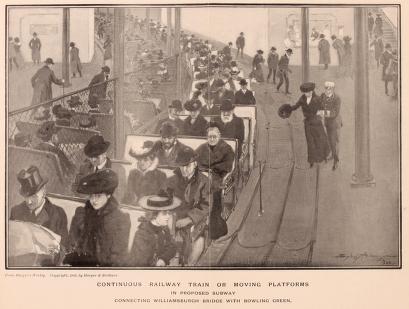
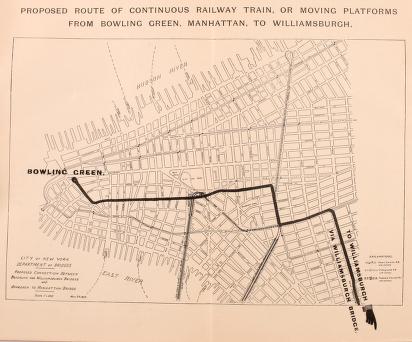
    I came upon this interesting pamphlet and thought to share it: Transportation of Passengers in Greater New York by Continuous Railway Train, or Moving Platforms.  Argument in favor of equipping the East River Bridges, and connecting subway to Bowling Green, Manhattan, with a continuous railway train or Moving Platforms. It was prepared by Schmidt & Gallatin, of New York, and printed in 1903. (Oddly it is the pamphlet that I started working on directly after working through a 1903 double-brick volume of the Journal of the American Chemical Society.) It is only 20 pages long, but decorated with four folding plates, including two maps, and two drawings of the envisioned walkways. 

    Sidewalks 3

    This seems a wonderful example of future thinking and city planning–but just not a very good idea.  It is hard to imagine a continuously moving sidewalk functioning in lower Manhattan. 

    From the pamphlet: 

    “Moving Platforms for the conveyance of passengers were recommended by Mr. Horace Greeley thirty years ago. They were successfully operated, first, at the World’s Columbian Exposition of 1893, where 2,700,000 people were transported. In 1896 they were installed at the Berlin Exposition, and again at the Paris Exposition of 1900, where they carried over eight million passengers. Few persons know what Moving Platforms are. From the face that sometimes they are called ” Moving Side- walks,” it is believed that they must be some sort of a pavement on rollers, on which it is difficult to step with safety and maintain equilibrium. The Moving Platforms are to all intents a railway, operated like other railways, propelled by electricity, with cars, seats, motors, passenger stations, ticket booths, guards, electric lights — in fact, everything belonging to a first-class railway.” 

    Sidewalks map

    “Where it differs from the ordinary railway is that the cars, or trains, are not running at intervals, but are coupled up continuously, so that there is no interruption of traffic at any time, but a large seating capacity at all times. It differs also in the construction of the cars, which are mere flat cars, provided with seats placed crosswise, and so arranged that all passengers face in the direction of motion. Each of these seats may be made wide enough to accommodate one, two or more persons. The most approved plan is to provide seats on one side of the cars only and leave the other for passengers to walk, thus giving them an opportunity to further accelerate their speed if they so desire…”


  • Striking Unintentional Proto-Modernist Image (1853)

    JF Ptak Science Books  Quick Post

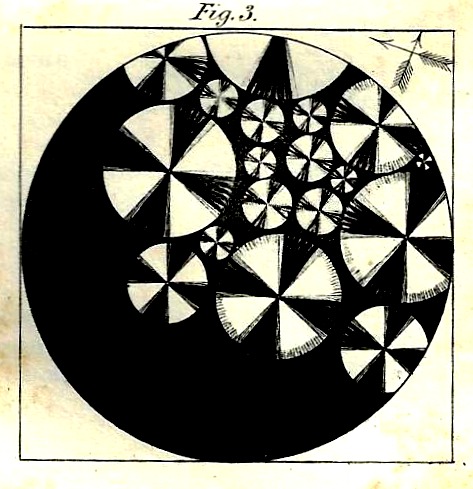
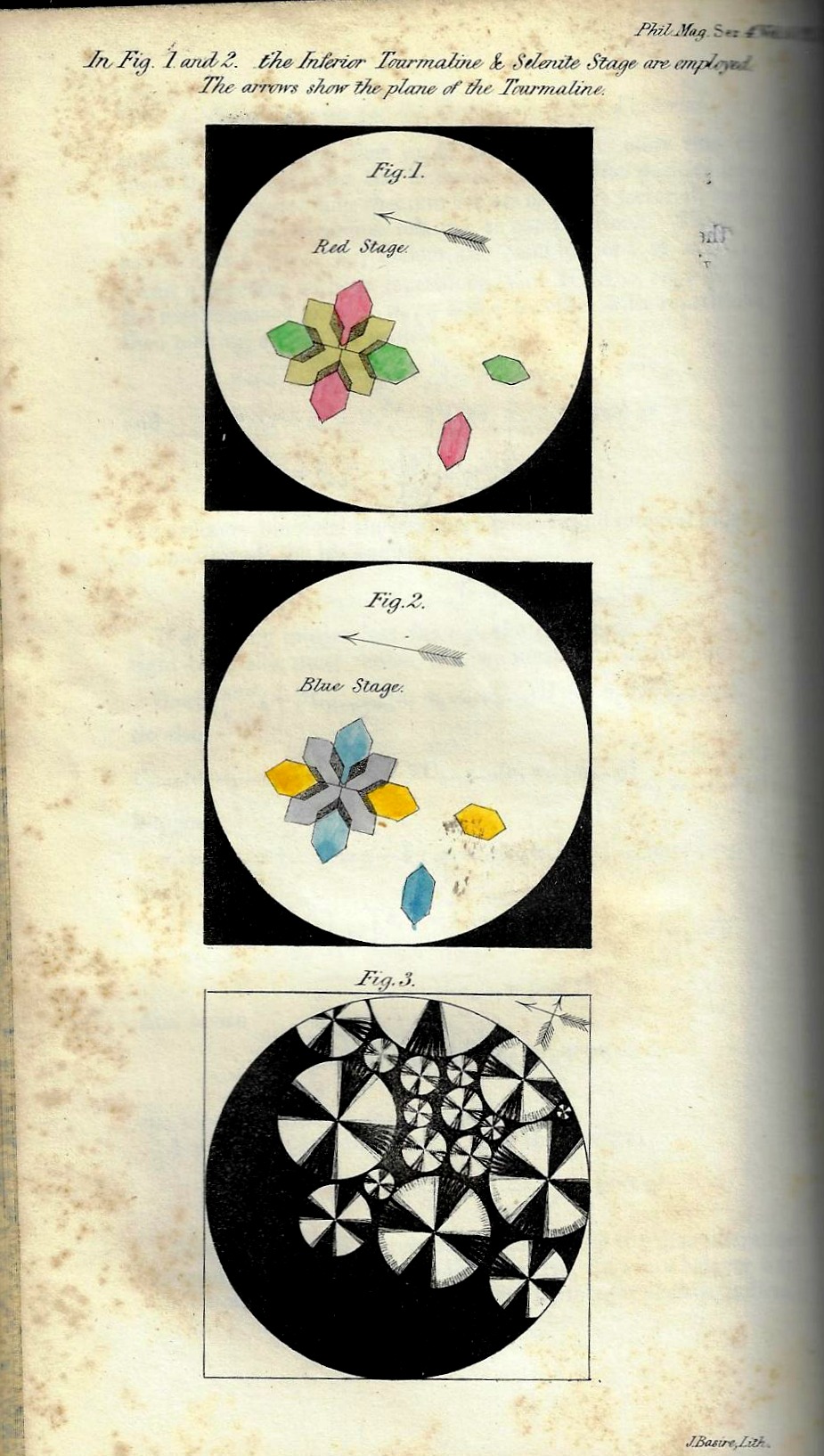
    I thought to share this image, a detail of an engraved plate illustrating and article by the I-can-do-anything David Brewster, “On the Optical Phaenomena of Tourmaline, &c., within Mica and other Minerals”, appearing in the Philosophical Magazine for 1853 (plate opposite page 185). I believe it is a magnification of titanium set in mica: “…the transparent groups are much more beautiful than the opake ones, the crystalline ramifications having the most diversified forms, resembling often regular organizations (page 265).

    The detail:

    Phil Mag 1853 detail

    And the full engraving:

    Phil Mag 1853

    ·Posted by :

    ·in:


  • Cutaway of an Airship-based Hospital, 1930

    JF Ptak Science Books   Quick Post

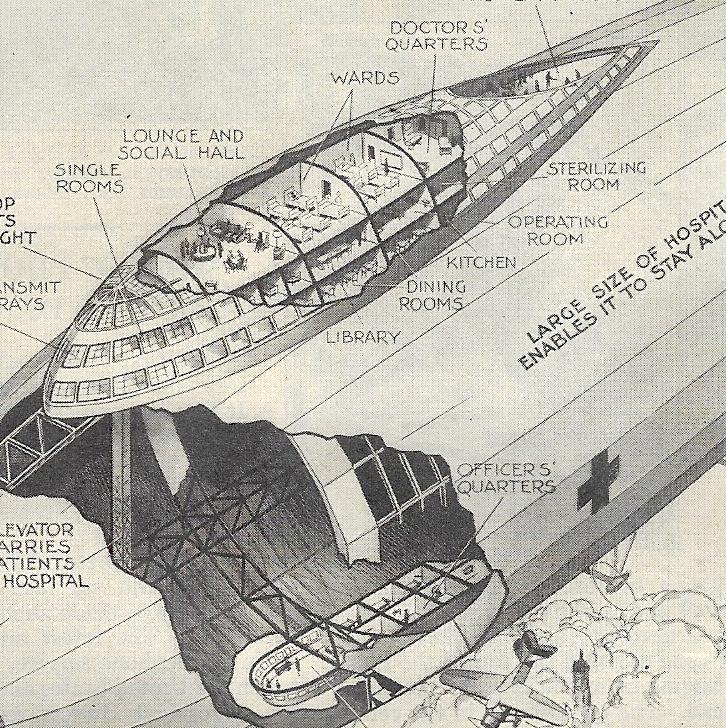
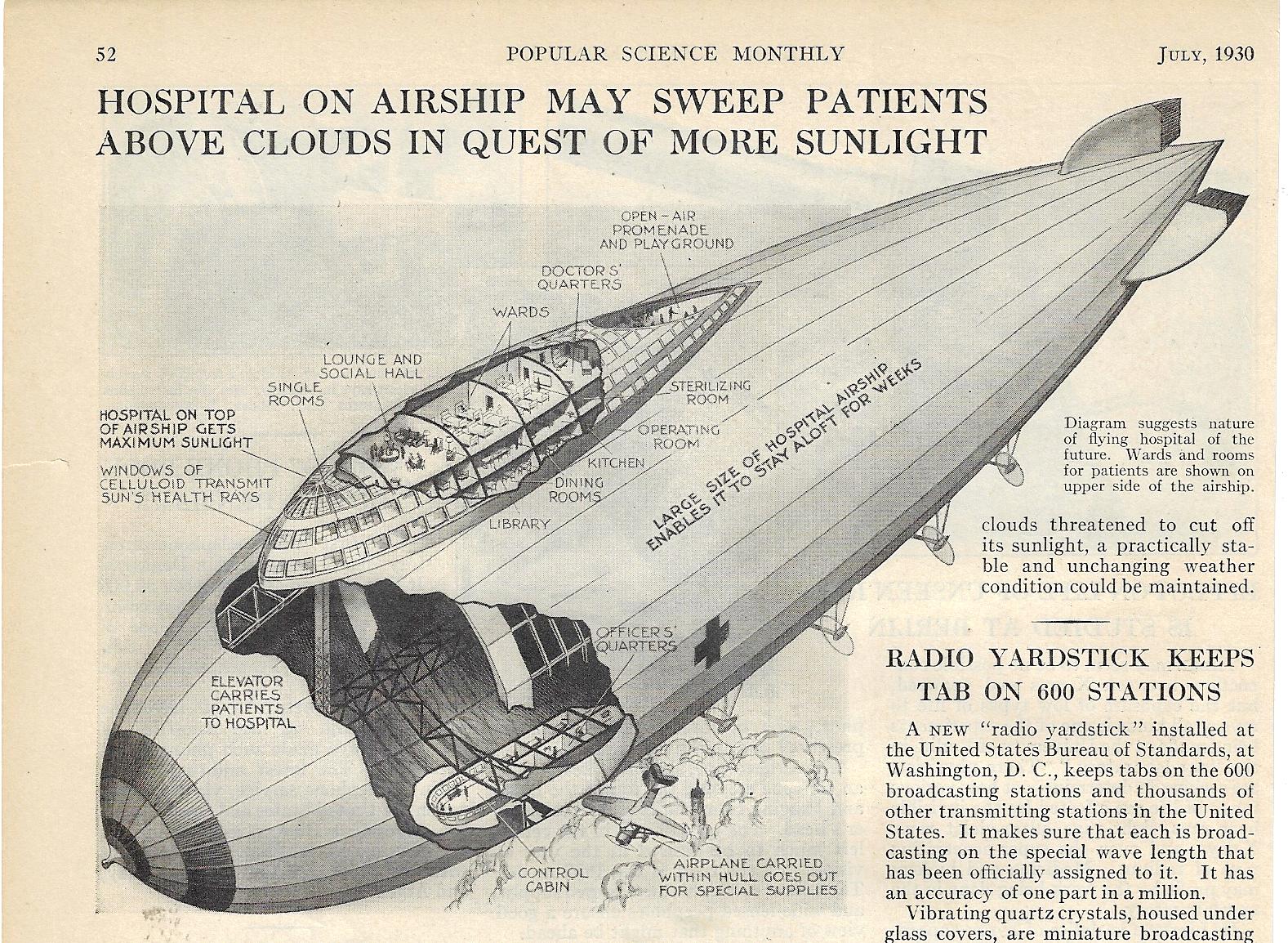
    “For people suffering from tuberculosis, or just from nerves, will physicians soon prescribe a trip to the clouds in a flying clinic hospital instead of a visit to the mountains?”  That was the leading sentence in the PSM issue on the flying clinic, appearing in July 1930.  The thinking was that if people were removed to high altitudes to get a “change in the blood” to being in such an atmosphere with a lot of sun, then the higher up, the better, And so the great airship hospital idea perked up for a few years, the idea getting a big boost from French physician Charles J. Juillot. who wrote on the benefits of a floating high-altitude clinic. The hospital/clinic (“aerial sanatorium” part of the airship would be situated on the top of the airship “like a big blister”, the patients taking the sun under large celluloid windows, enjoying their stay for weeks at a time between re-supplies. 

    Hospital airship, Popular Science Monthly, 1930:

    Cross section 1930 hospital airship detail


    Cross section 1930 hospital airship


  • “Coming Events Cast Their Shadows Before” (1878)

    JF Ptak Science Books   Quick Post

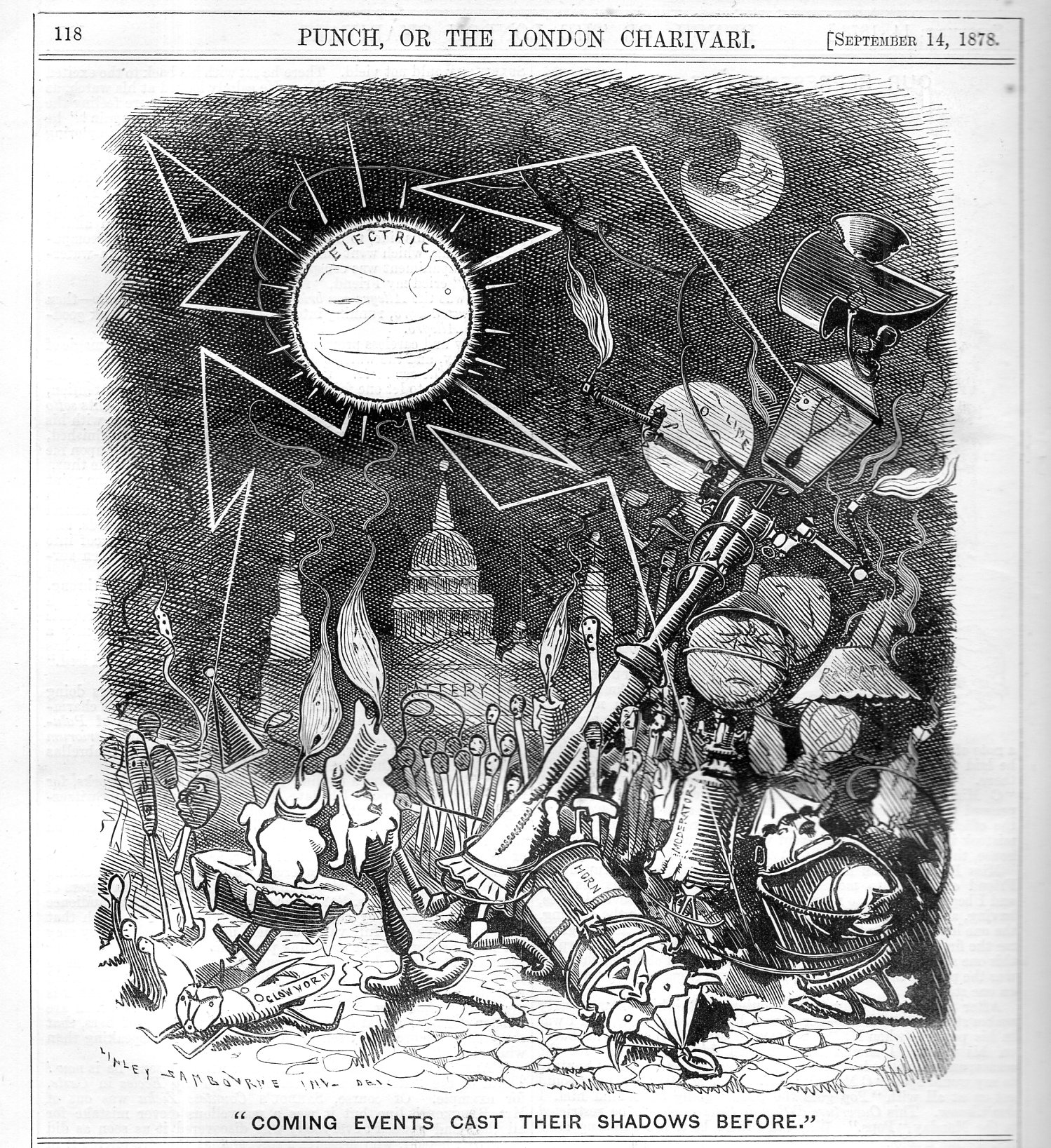
    Punch etectric  1878818The “coming event” here, as depicted in a satirical bent-future speculative cartoon by the ever-present Linley Sambourne (1844-1910) in the journal Punch in 1878, is electricity. The shadows cast by its own approach are many, and though we don’t have a pre-historic campfire, we do see candles, and a gaslight, and oil lamps, and plain matches, all sadly scurrying their paths away from the sharp War of the Worlds legs of electricity. An interesting bit here is that what is generally seen as the common capstone for the invention of the electric light–with the first practical incandescent light bulb–was achieved by Thomas Edison about a year after this graphic was published. There are numerous inventions of different sorts of electric lights prior to that which Sambourne is no doubt referencing, and he certainly knew enough of his recent history of technology to guarantee that his vision of the importance and standard of electricity for the future was absolutely correct.  

    Source for the idiom in the title: 

    Lochiel, Lochiel! beware of the day;
    For, dark and despairing, my sight I may seal,
    But man cannot cover what God will reveal.
    ‘Tis the sunset of life gives my mystical lore,
    And coming events cast their shadows before.
    I tell thee Culloden’s dread echoes shall ring
    For the bloodhounds that bark for thy fugitive king.  

    –Thomas Campbell, (d. 1844)  Loichiel’s Warning, (1802).                                                                                                                                              .


  • Found-Surreal Art, Elevated (London, 1876)

    JF Ptak Science Books  Quick Post

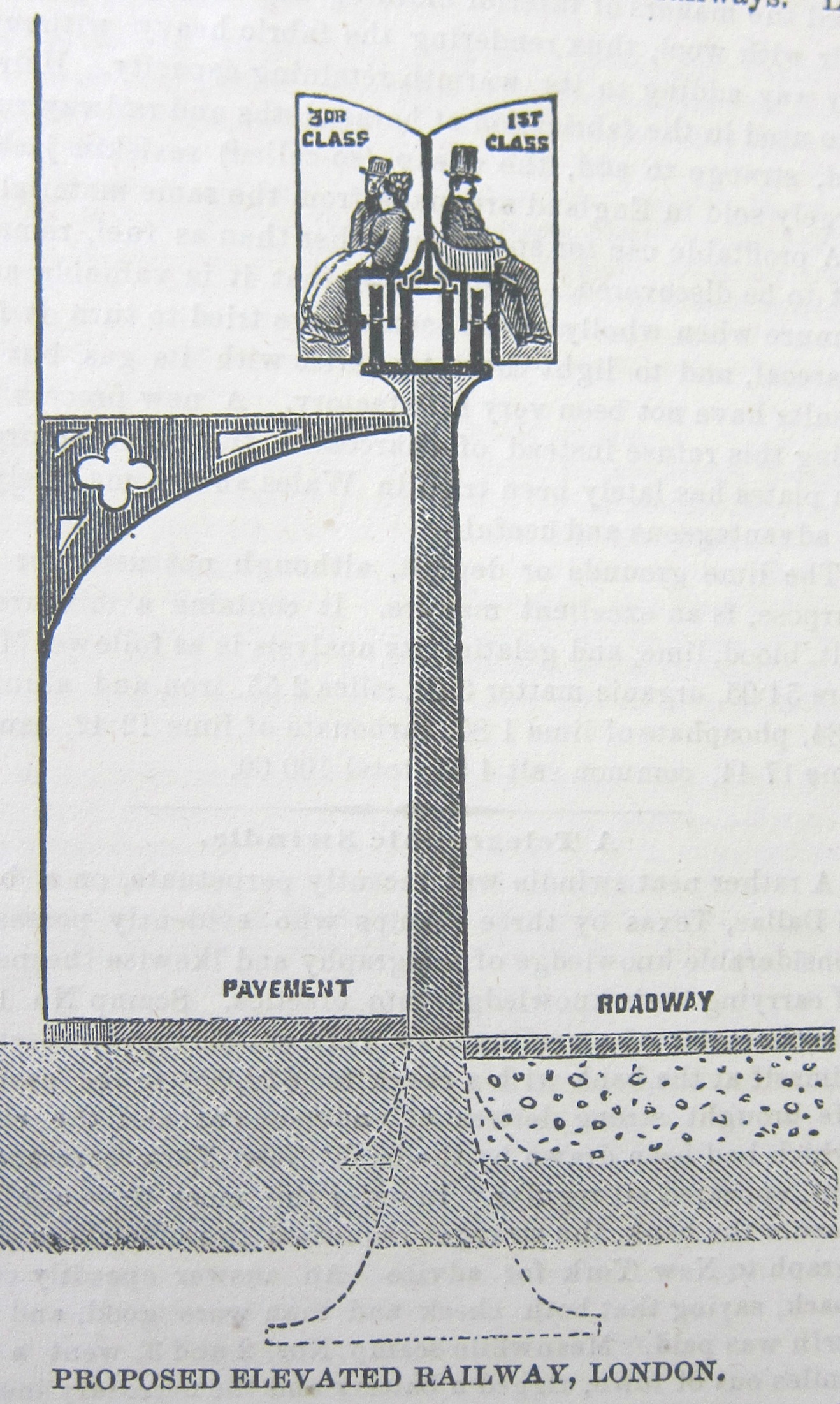
    The difference between first and third class in an elevated train seems to be (1) a chair with arms, (2) a taller hat, and (3) a big moustache.  Undoubtedly, there were actual creature comforts, though I suspect first class was meant to accommodate first-class people who would prefer not to be with not-first-class people, and enjoy the extension of that privilege in a comfortable seat.

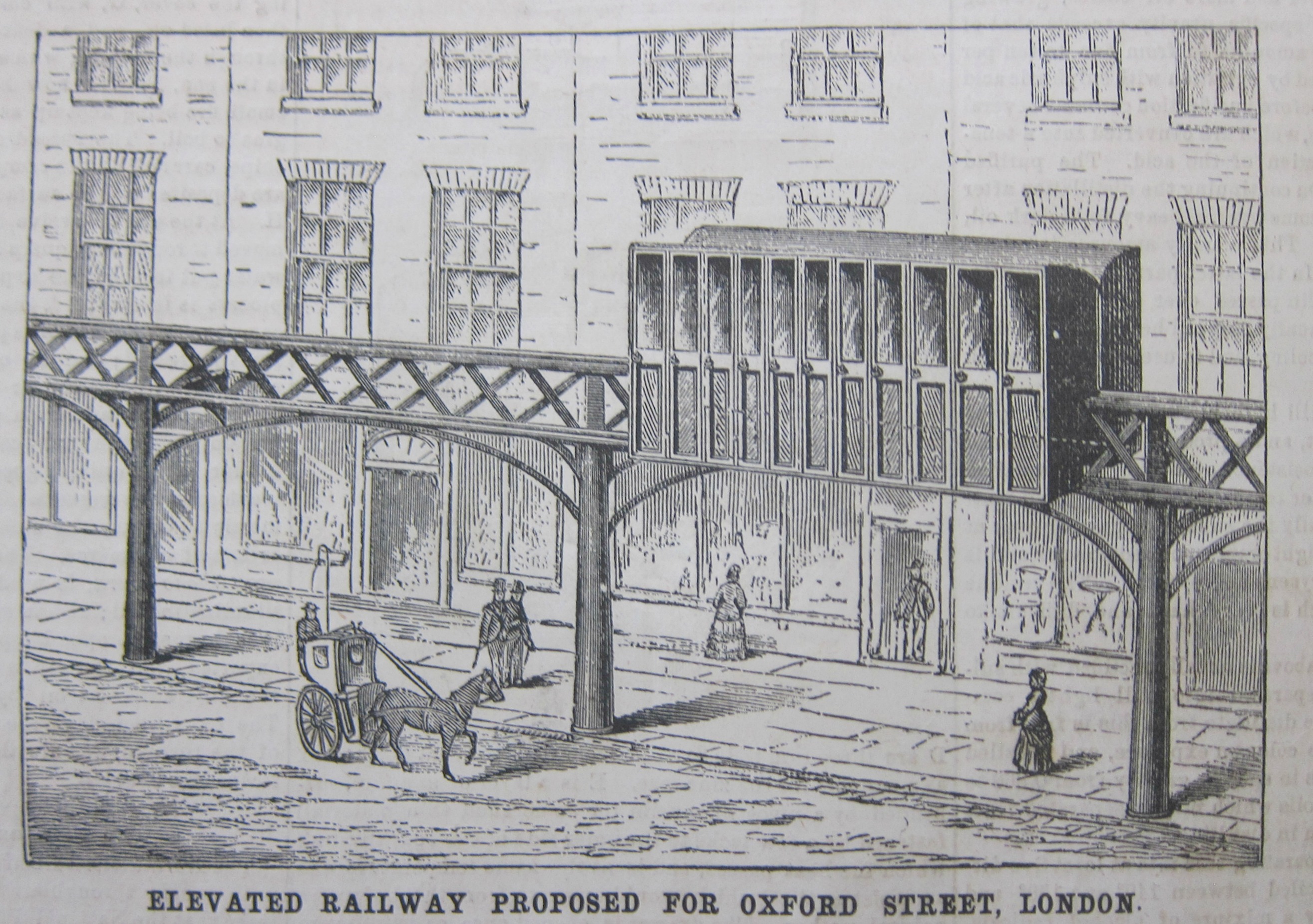
    What attracts me to this image is the way it rubs up against the accoutrements of modernity, looking like a piece of surrealist art.  Since the image was printed in 1876 this would be “found-Surrealist art” as the existence of non-representational art was still 35 years away and the man who basically created the Surreal movement in NYC in 1924–Andre Breton–wouldn’t be born for another 20 years. In any event, this is what this looks like to me, a piece of unintentional, out-of-context art with no contemporary name.

    Sci Am 1876 elevated London

     [Source, above and below: Scientific American, February 8, 1876.  The image above is a cross section of the image below.]


      Sci Am 1876 elevated railway


  • The Phonograph as a “Philosophical Toy” in April 1878, and then not so in May.

    JF Ptak Science Books    Post 2568

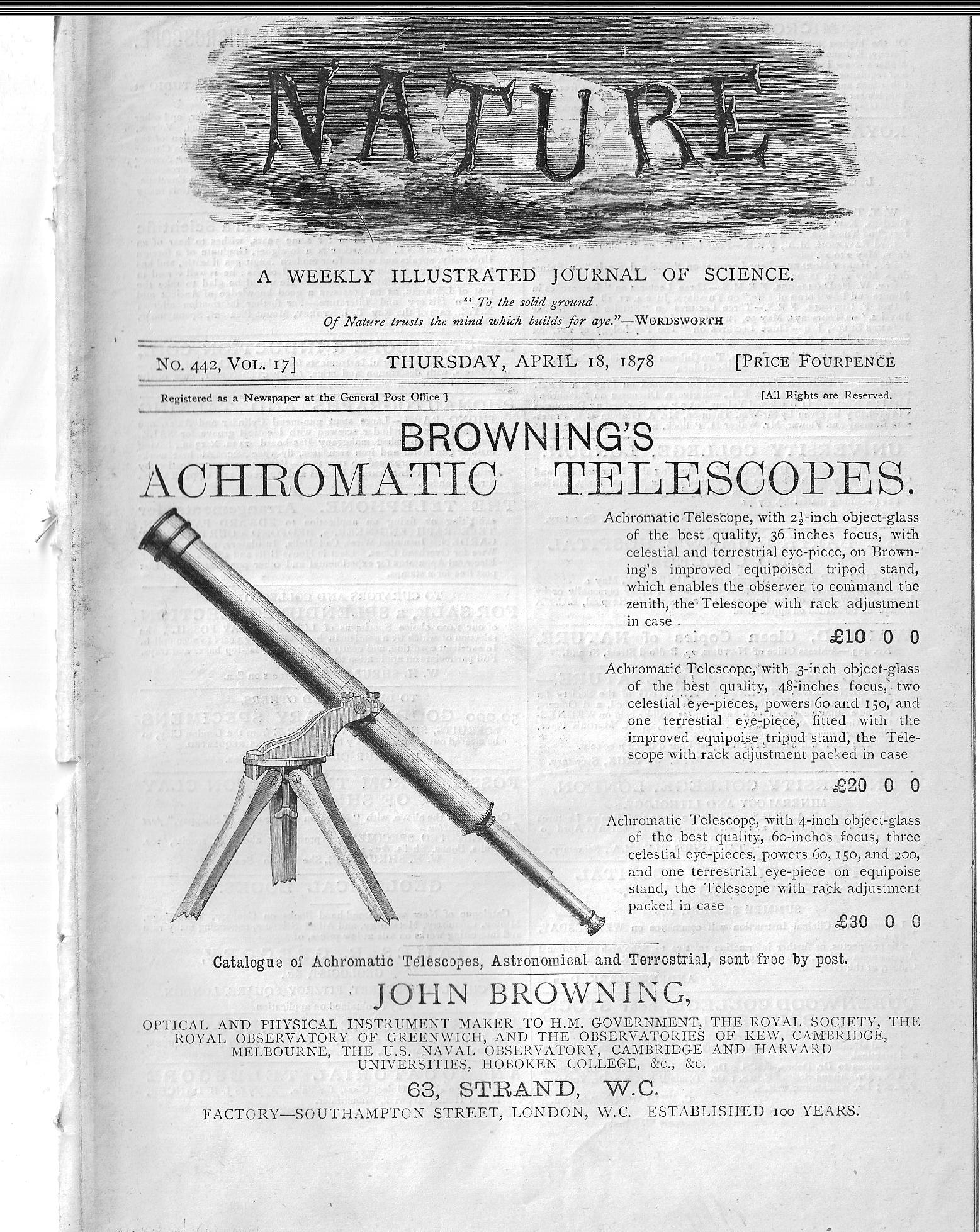
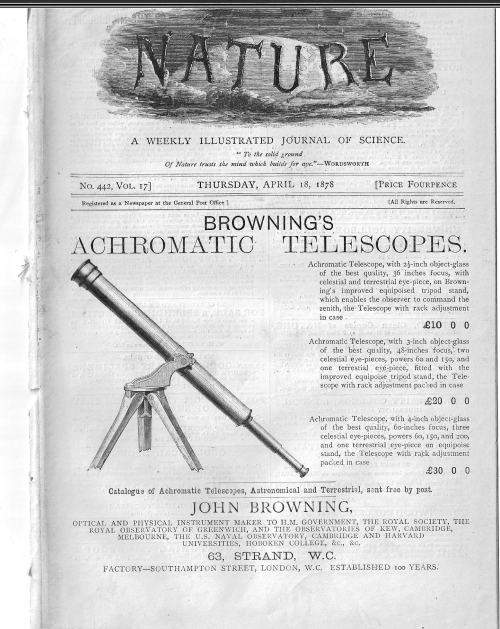
    Only months into the invention of the phonograph by Thomas Edison (at Menlo Park in December of 1877 and patented in January 1878) Alexander J. Ellis reviewed a version of it constructed in London by Mr. Stroh, and found it, well, wanting.  Ellis (1814-1890) was a product of Eton, Cambridge, Trinity, and was a gifted mathematician, philologist, and a groundbreaking ethnomusicologist, and did see some limited utility of the machine to restricted areas of his research. In the short note he wrote for Nature in their April 18, 1878 issue1, he mostly found that the phonograph was generally flawed in its reproductive capacity, and did not venture far from this interpretation so far as the possible applications of the machine was concerned, which seems iconically short-sighted from my perch here in the future. Even though Ellis recognized that “the effects produced are sometimes startling (as in cries, coughs, laughter, music), the philosophy of the process (making a permanent impression of a very complex compound vibration, and using it as a mould to reproduce that vibration is exceedingly attractive, but at present the instrument–at least the one that I saw…” he concludes that the status of the invention “…has not risen beyond a lecture illustration or a philosophical toy”.  
    Nature 1878 phonograph _good_

    That said, Mr. Bell himself didn’t see that much utility in the invention at the time, although with time it became his favorite invention, his “baby” so to speak.  In 1878, though, the the use of the phonograph was pictured in exceptionally narrow terms.

    Mr. Ellis was cautious enough though to qualify his statements in the April Nature issue by restricting his phonograph experience to the one constructed by Mr. Stroh.  And then, a month later, Ellis returns to Nature with a new appreciation of the phonograph–this one constructed by the beautifully-named Fleeming Jenkin, which evidently was superior to the Stroh machine, as Ellis has a newer appreciation for the invention, though its future still seems limited to the study of phonetics and speech. 

    • “The phonograph as I have said resembles rather a worn print than a proof of the human voice. This means of course that the delicate upper partial on which all brilliancy depends are absent In some respects this is advantageous for the very elaborate inquiry which Prof Fleeming Jenkin has instituted for it enables him to catch the bold outlines en which genera depend without being at first bewildered by the delicate details which give specific differences. Our speech sounds are of course individual and what is recognised as the same speech sound varies in the same speaker within the limits of its genus almost every time it is used. We shall do much if we establish the genus. The extent of Prof Jenkin’s researches as he contemplates them end the ease with which his initial experiments tracings and analyses have been conducted lead us to hope that we have at least got an instrument which will enable us to solve the elementary problems of phonetics that have hitherto almost baffled us although it is not suited as yet to fix those delicacies of utterance which were my own special object of investigation.” (Nature, May 9, 1878.)

    Mr. Ellis does rescind many of the negative things he had found in the phonograph in this new May letter, though he still seems not so happy with it, and can see thus far in two letters that see only a very limited history for the invention.  At the very least though Mr. Ellis did say that the new machine constructed by Jenkin was definitely no longer merely a philosophical toy.  

    Notes:

    1. “The Phonograph”, being an article in the April 18, 1878 issue of Nature, volume 17, No 442, pp 485-6 in the weekly issue of pp 481-500. This issue comes complete with the scarce outer wrappers and ads, comprising another 7pp.  The issue has been removed from a larger bound volume, and shows that effect on the spine; that said the weekly is in crisp and bright condition. 


  • The Sorceriies of Modern Science (1878)

    JF Ptak Science Books   Quick Post

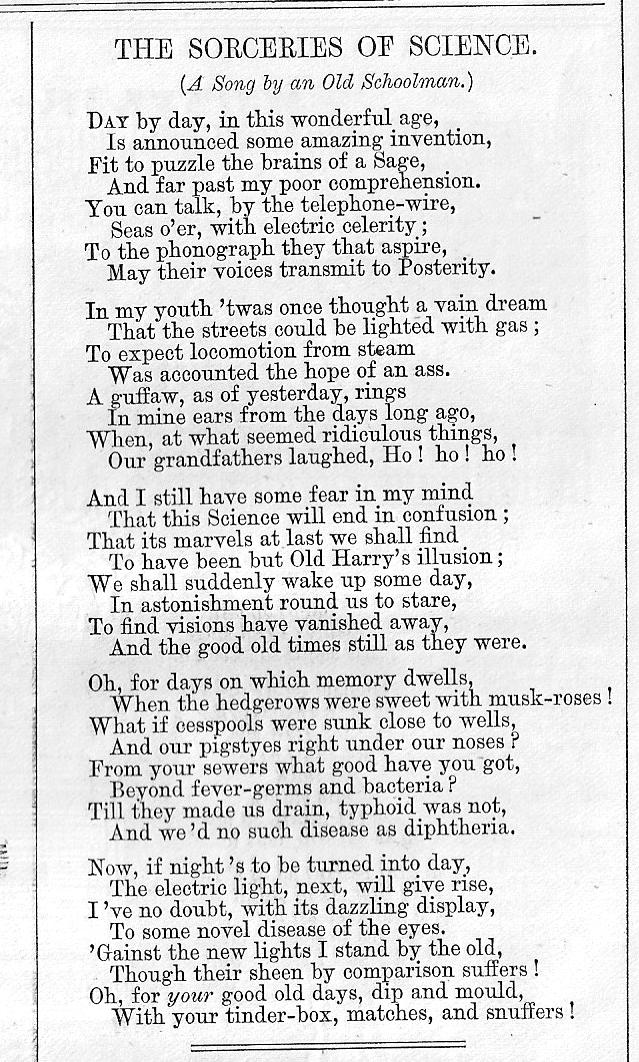
    The writer of this poem to the inconveniences to the status of old technology didn’t much care for modern additions in the history of applied science. The age of electricity had really just begun, and the telephone (by Bell in 1876) and phonograph (by Edison in 1877) mentioned in the complaint were just each a few years old, as was the electric light, which according to the Old Schoolman may very well give rise to some disease yet unknown of the eyes.  At the end of the  day the writer prefers to “…stand by the old/though their sheen by comparison suffers” which I guess is fine, so long as they didn’t need anything that the new-tech could provide.  

    Punch Science poem 1879

    [Source: Punch, or the London Chiarivari, December 8, 1878.]

    ·Posted by :

    ·in: