A Daily History of Holes, Dots, Lines, Science, History, Math, Physics, Art, the Unintentional Absurd, Architecture, Maps, Data Visualization, Blank and Missing Things, and so on. |1.6 million words, 7500 images, 4.9 million hits| Press & appearances in The Times, Le Figaro, Mensa, The Economist, The Guardian, Discovery News, Slate, Le Monde, Sci American Blogs, Le Pont, and many other places… 5000+ total posts since 2008.

Category: Anticipation, History of

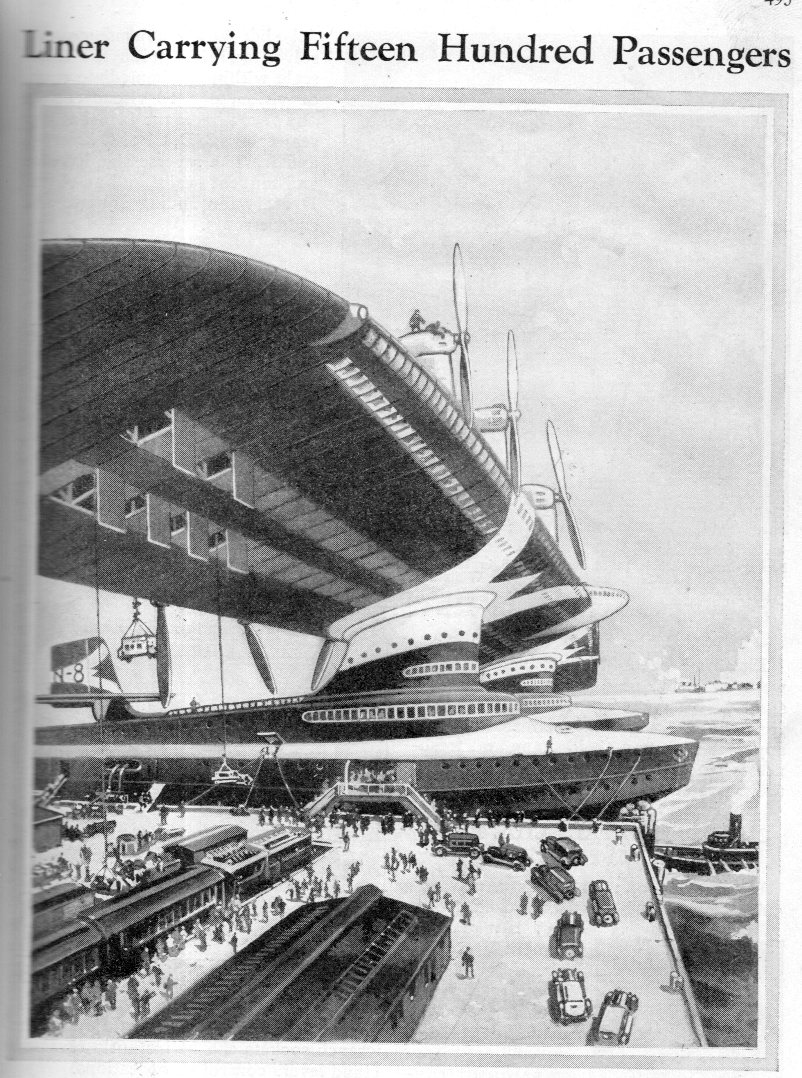
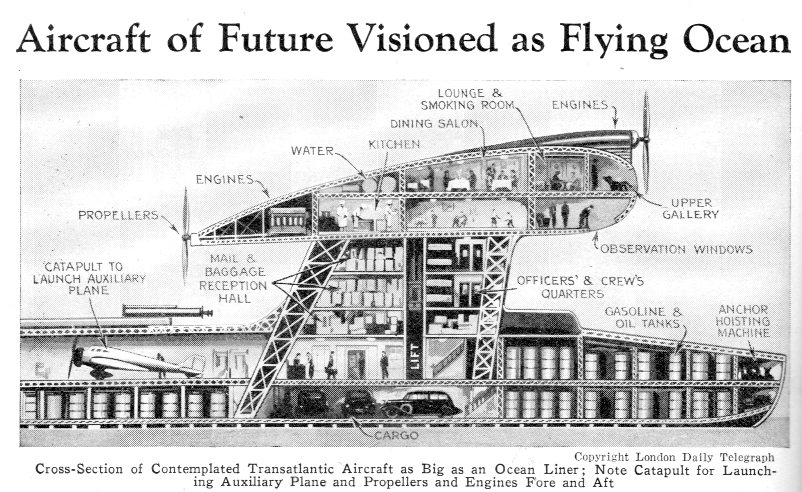
  • The Mother of All Mothers of Massive Airlanes (1934)

    JF Ptak Science Books  Quick Post

    It is a little difficult to get a realistic idea of how big this plane is–beyond it being really big–but by using the height of people and the stairs used to gain access to the aircraft it seems as though the height from the street/wharf to the bottom of the massive wing is at least 80′.  Since this is a seaplane and there is still plane-enough below the wharf level, level, so it may well be that from the top of the wing to the water may be closer to 100′.  That’s a tall plane.  The wingspan is more difficult to guess, but it seems as though there’s room enough for a loose line of 75 people  to fit under it comfortably with ample personal space, meaning that this section of the wing–probably 40% of the entire wingspan–may be on the order of 200′, meaning the overall width would be in the neighborhood of 500′.  

    Aircraft giant 1934_826

    According to the technically-light description of the aircraft (found in Popular Mechanics, April 1934) this beast was meant to carry 1500 people and several hundred tons of cargo on a Transatlantic flight that would go from Southampton to New York “at a speed of 200 miles an Hour” in “less than fifteen hours”.

    The odd thing about this is that the imaginateers (“visioned by British Aeronautical Engineers”) didn’t see more powerful engines for their gigantic aircraft that could push the envelope at 350 mph.  Why not?  If you could give an aircraft an acre or two of thick wings, why not press the imagination a little further and assume that there would be unseen developments in powering the thing?  

    In any event, the artwork has a certain “Wow!” factor to it, and that someone, somewhere, was coming up with a mostly-big idea. 

    Aircraft giant 1934_827


  • A Circular Debtors’ Prison and other Interesting Bits, 1818

    JF Ptak Science Books   Post 2645

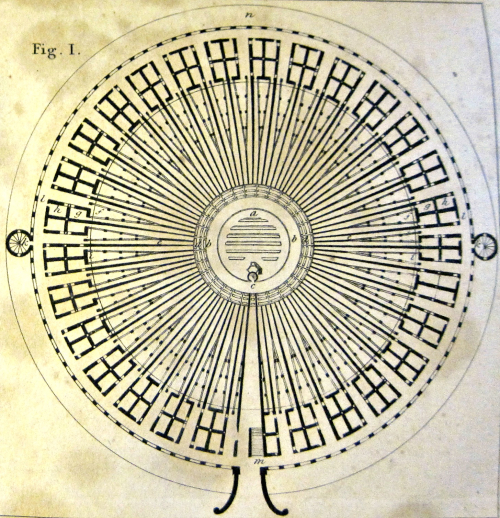
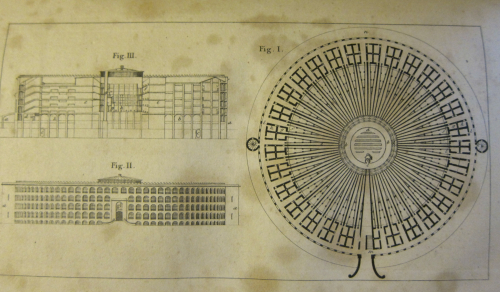
     In cataloging the following volume of The Quarterly Journal of Science and the Arts (volume IV, 1818) amidst a spray of very interesting papers I found J.C. Loudon’s effort, “On the Construction of Prisons”.  Loudon was interested in a different sort of prison for debtors, something a little more removed from the punishing existence for criminals and such. It was also illustrated with two engraved plates, the detail in one in particular is striking and calls for sharing:

    Prison 1818 detail

    The image is a plan for a debtor’s prison, a circular affair with the cells along the circumference. This being a prison distinct from the criminal elements the debtors were given two cells, one for sleeping and the other for work and cooking…

    This is the detail from the full image:

    Prison 1818


    The volume I was working my way through was Quarterly Journal of Science and the Arts (of the Royal Society of Great Britain); London, printed by John Murray,  volume IV, 1818; 8.5×5”, vi, 416 pp, 9 plates 5 of which are folding. (Also–three of the folding plates are lithographs, which is an extremely early appearance of this process which was invented by Alois Senefelder in Bavaria in 1796, though the process really was comparatively very little used in book production until the first quarter of the 19th century. These images were made at the lithographic press of Moser and Harris and frankly show a number of the early problems–at least at this press–with the process, as the images here are not very strong.)  

    The volume contains a few dozen contributions (plus many more in shorter abstracts), though some of the most interesting include the following:

    de Candolle, “On the Effect of Elevation above the level of the Sea upon the Geography of Plants in France”;

    Michael Faraday, “On the Sulphuret of Phosphorus”, p. 361-2; 

    William Scorsby, “On the Greenland or Polar Ice”, pp 247-268;

    M.C.F. Brisseau Mirbel, “On the Dissemination of Plants”, 1-7;

    M.C.F. Brisseau Mirbel, “Of the Death of Plants”, pp 7-13 (these two papers being the first appearance in English from the French);

    And also the following two interesting pieces by John R. Park:

    J.R. Park, “An Inquiry into the Influence of Corporeal Impressions in producing Change of Function in the Living Body”, pp 13-30; AND

    J.R. Park, “On the Influence of Mental Impressions in producing Change of Functions in the Living Body”,  pp 307-327; 


    And one detail of the emotional aspect and its physiological impact on the rest of the body:

     Catalogue of Scientific Papers (1800-1863) lists the following supporting and continuing paper on this subject by Park:


  • Picturing What a Nightmare Looks Like Outside Itself (1878)

    JF Ptak Science Books   Post 2650

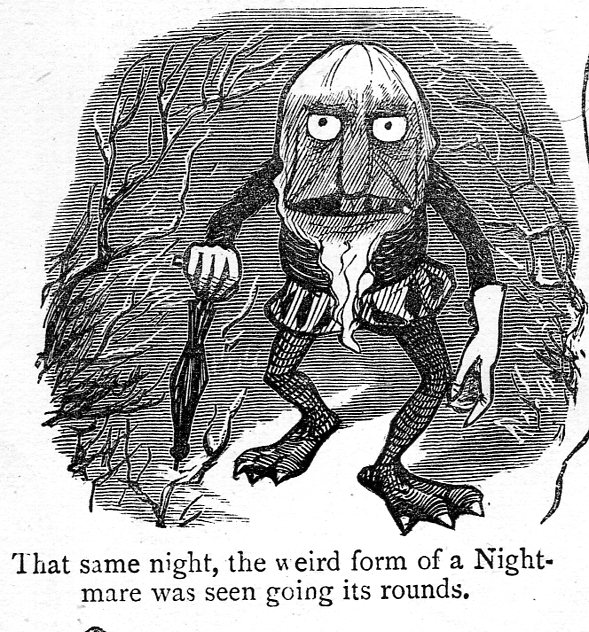
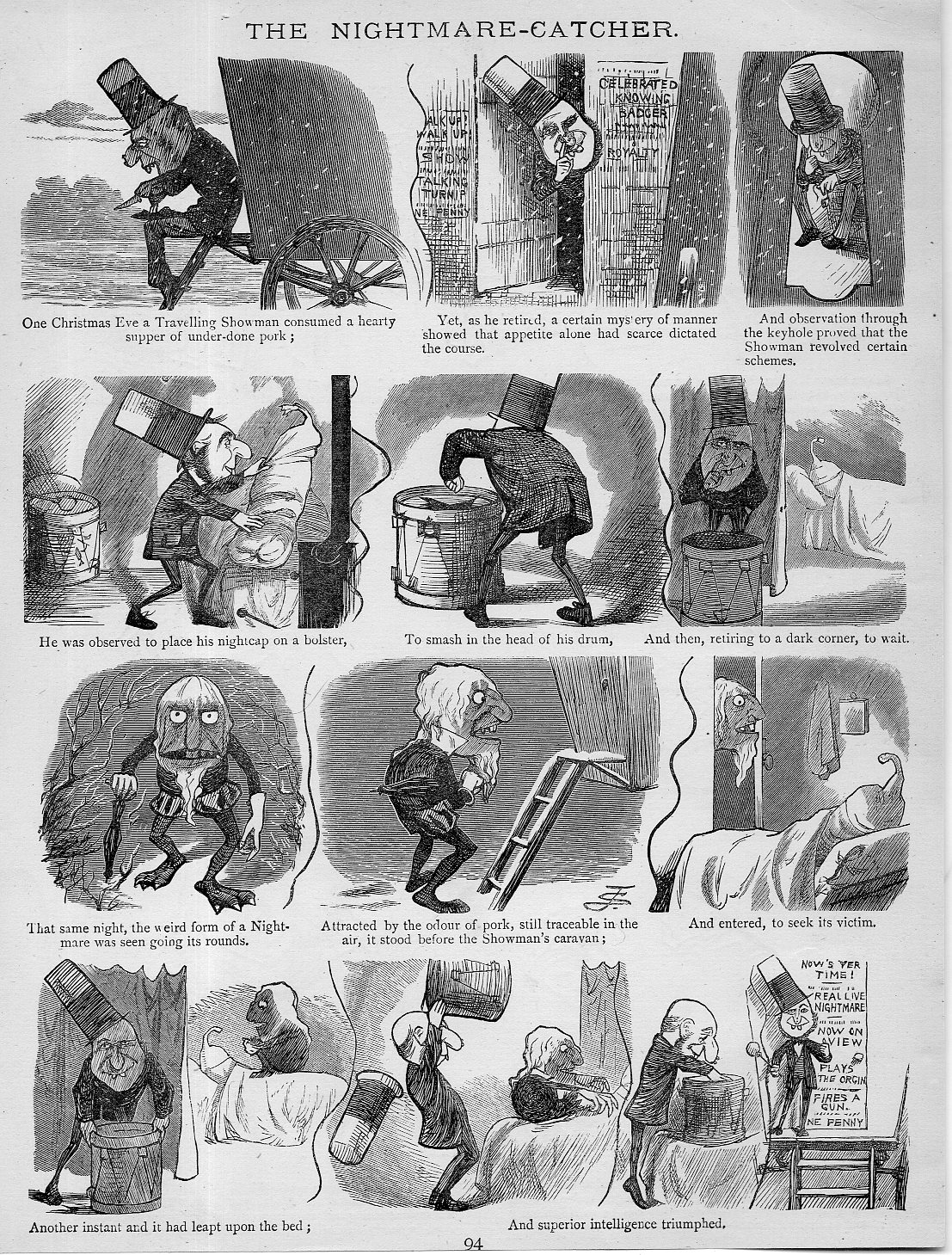
    In my career of looking-at-things it is becoming an easier job to recognize something that is out of place, or uncommon, or wrong–far more so I think than the opposite, because the “expected” happens to be expected, and so fits right into place, somewhere.  So it came to be that this cartoon featuring the depiction of an anthropomorphic nightmare stood out so clearly and oddly. It is the work of James Francis Sullivan (and published in 1878 in a volume of his darkly humorous single-page six-ten panel cartoons ungainly titled The British Working Man by one who does Not Believe in Him, and other Sketches) and in my experience is a very early depiction of the nightmare itself as a corporeal thing. There have been untold numbers of depictions of the contents of nightmares in literature and art and such, but I’m having a hard time of picturing another source that would stand as a dictionary illustration of what a nightmare looks like devoid of its content. 

    Nightmare803

    I checked in with the Oxford English Dictionary and found to my surprise that the nightmare started out at some point in English to be a “female spirit or monster”–it was not surprising to see the definitions stretching back to Chaucer and earlier1. Next stop was the cataloging and reference tool WorldCat, where I searched for the appearance of “nightmare” in the title of a book and found nothing (seemingly) published so until John Bond’s  An essay on the incubus, or nightmare, in 1753. This is just a casual search, and nothing very scientific, but at least at this level there isn’t much to see, perhaps six titles only until 1800, after which the use of the word grows. In contrast, titles appearing using the word “dream” are a solid+ order of magnitude beyond “nightmare’. 

    Nightmares and dreams abound everywhere but in the titles of books, and sometimes actually lead to a chain of events in the waking world.  Ramanujan famously dreamed mathematical dreams (in addition to hearing solutions to massively complex problems from “angels” in a waking state); R.L. Stevenson dreamed the premise for Mr. Hyde; Socrates used the medium (dreampt or not); Mary Wollstoncraft nightmare lead to her big nightmare book, and so on, on and on, into the dream/nightmare-filled night.  In my memory of such stories, though, the nightmare or dream never seems to have its own face, and that nothing exists beyond the contents of the thing beyond itself–this is what makes the nightmare-catcher story by Sullivan so unusual to me.  

    I don’t have anywhere to go with this, presently, beyond simply reporting it.

    In any event, the cartoon goes as follows: a travelling showman (already evidently entertaining people with a “talking turnip” and a “celebrated knowing badger”) resolved to capture a nightmare for his show. In that he mocks up a sleeping version of himself in his bed, and waits upon the nightmare, and when the nightmare makes his appearance the showman captures him with a broken drum. The nightmare is then put on display in the travelling show (also playing the “orgin” and firing a gun) for all to see for the cost of one penny. 

    This all happens on Christmas Eve–I can think of better stories than this to share on that or any night.  

    Nightmare802

    Notes:

    1. “Nightmare” from the OED:

     a. A female spirit or monster supposed to settle on and produce a feeling of suffocation in a sleeping person or animal. Also fig. Now rare.

    c1410  (▸c1390)    Chaucer Miller’s Tale (Cambr. Dd.4.24) (1902) 3485   Blisse this hous fri euery euyl wyght ffor the nyghtesmare [c1390 Hengwrt nyghtesuerye] the whȝt Pater noster.

    1440   Promptorium Parvulorum (Harl. 221) 356   Nyghte mare [v.r. Nyhtmare], Epialtes.

    1530   J. Palsgrave Lesclarcissement 248/1   Nightmare, goublin.

    1608   E. Topsell Hist. Serpents 173   The spirits of the night, called Incubi and Succubi, or else Night-mares.

    1696   J. Aubrey Misc. (1721) 147   It is to prevent the Night-Mare (viz.) the Hag, from riding their Horses.

    1770   T. Chatterton Compl. Wks. (1971) I. 211   The dethe-owle loude dothe synge, To the nyghte-mares as heie goe.

    1804   J. Collins Previous Apostrophe in Scripscrapologia p. x,   Let thy Pegasus then, spurn the Nightmare of Sloth, Nor by Day let her hag-ride thy Pen.

    1822   Shelley Prince Athanase in Posthumous Poems (1824) 110   Like an eyeless night-mare grief did sit Upon his being.

    1851   N. Hawthorne House of Seven Gables xvi. 270   So heavy and lumpish that we can liken him to nothing better than a defunct nightmare, which had perished..and left its flabby corpse on the breast of the tormented one.

    1886   R. L. Stevenson Kidnapped x. 92   There was that tightness on my chest that I could hardly breathe; the thought of the two men I had shot sat upon me like a nightmare.


  • Hardware Store Hieroglyphs 1869

    JF Ptak Science Books  Quick Pos

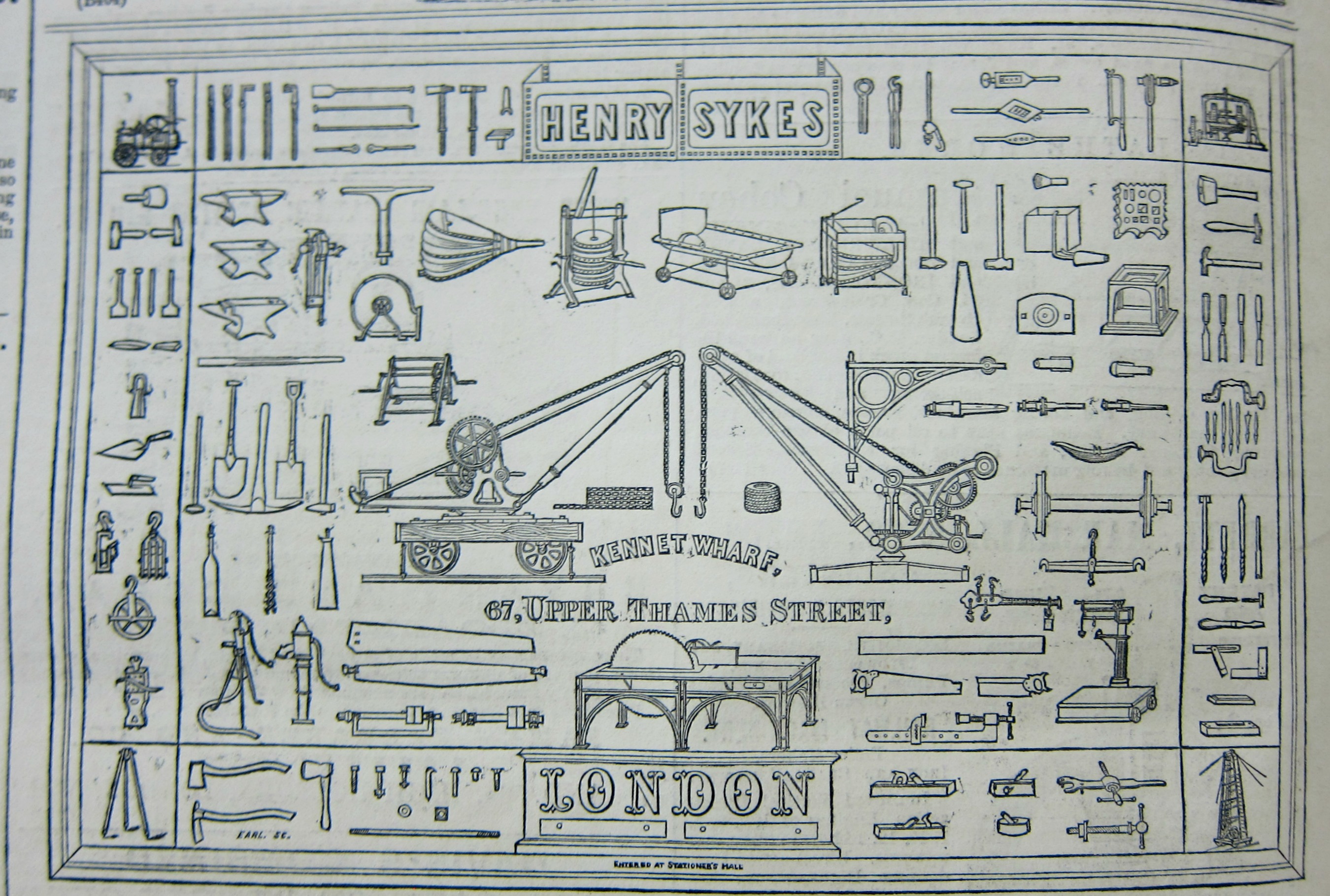
    Maybe you don’t see it, but the first thing I thought of when I saw this small (and here enlarged) ad in The Engineer for 1869 was its remarkable-ish similarity to hieroglyphs. The point is fairly strong, and a person can get a very good idea of how things were being built in 1869–especially if you were an alien and had deciphered what the purpose of all these things was. Granted it isn’t as simple or complex as the SETI plaque on the Pioneer 10 and 11, but it does have the flavor of a message to the future, or to another life form in another place.  

    Engineering 1869 Hardware hieroglyphics


  • Underground Military Airbases, 1938

    JF Ptak Science Books  Quick Post

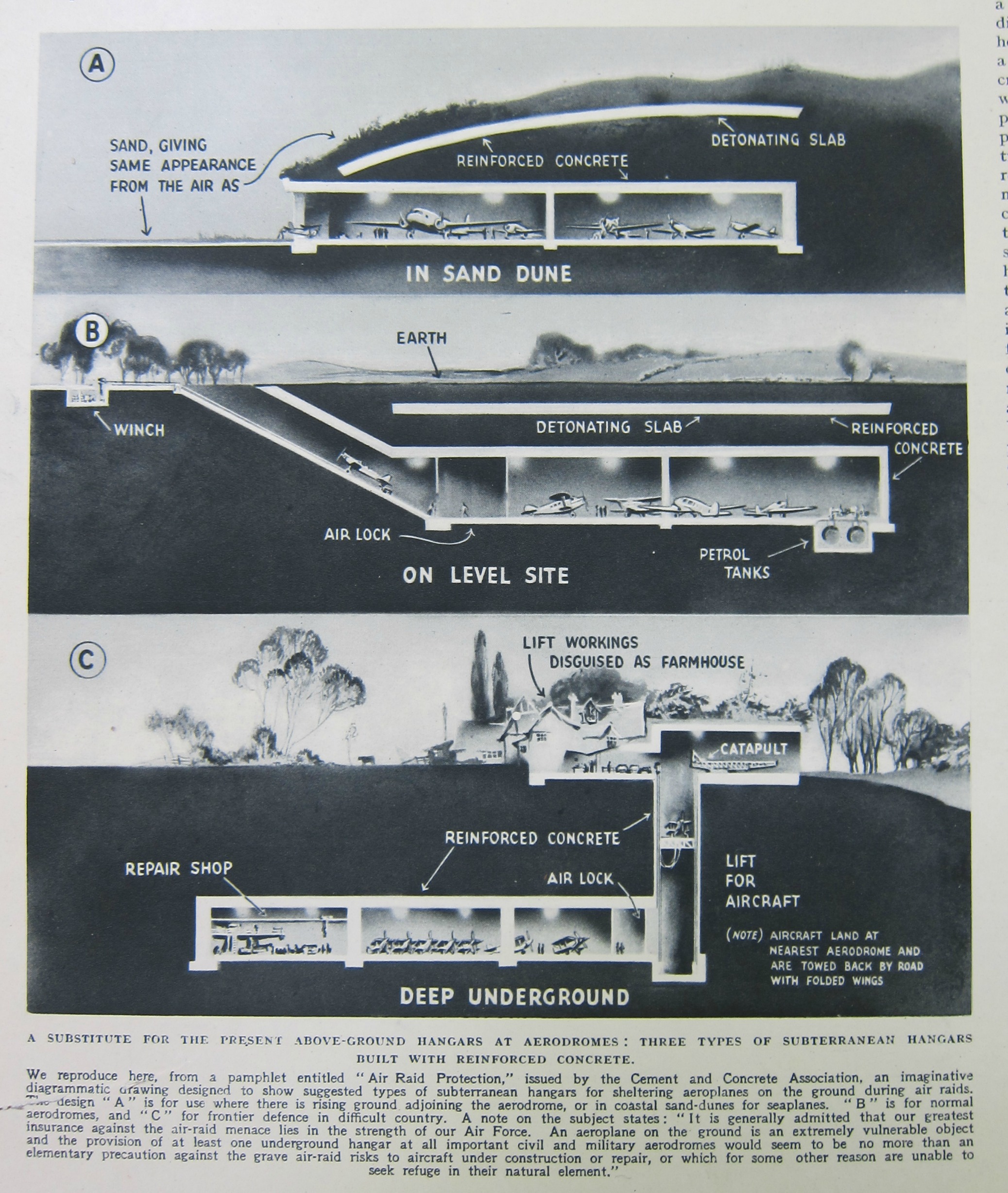
    The Cement and Concrete Association of Great Britain had issued several pamphlets in 1938 regarding air raid shelters for the protection of individual families, groups, and  cities.  In the pages of the Illustrated London News, writer and war correspondent John Langdo-Davies (1897-1971) reviews (or at least shares) the associations plans for underground fortified military airfields, the illustration for which I reproduce below:

    AIrport undergrouned 1938

    Langdon-Davies saw utility in these ideas, no doubt tempered by his experience covering the Spanish Civil War, which saw the first modern wide-scale use of bombing from aircraft, including the work done by the German Luftwaffe the impact of which was not lost on too many people. In any event, the aviation facilities were not moved underground for a variety of general reasons, some of which have to do with the utility of  the vast scale of the operation versus the introduction of replacement aircraft.  This doesn’t address some of the most adventurous ideas shown in the drawings, like the (assumed to be) very large hangar “deep underground”, the planes hauled up and shot into the air on a catapult, which is a different matter entirely.  The overall interest here though is the recognition–growing in 1938–that there is something going on in Germany that requires this sort of response.  


  • “Indian Title Extinguished”

    JF Ptak Science Books  Quick Post

    Indian title has been extinguished711

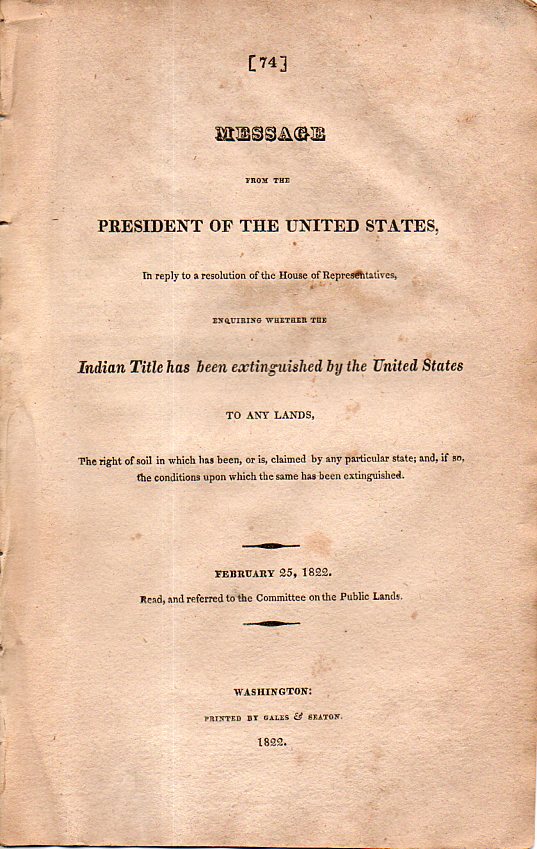
    That’s part of a short (12pp) and stiff little report from President James Monroe asking if Indians of all sorts did indeed have title to their lands within the United States, which means, I guess, that this was really a question in 1822.  Given the number of treaties and the number of treaties with the Indian Nations abrogated and annulled, it still didn’t set me up for this basic question, which really surprised me.  The publication comes a few years after the end of the first Seminole War (1816 or so to 1819), the aim of which was to move the Seminoles from north Florida (Florida having just been ceded to the U.S. a few years earlier) to, well, somewhere else–this occurred in 1819, when the Indians succumbed and were forced to live in central-ish Florida. This didn’t last for long, though, as the Second Seminole War (a much more expanded conflict fought 1835-1842) decimated the Seminole population, the remaining people subsequently were removed from central Florida completely away to Indian Territory.  This was all before the official “removal policies” begun under Monroe and John C. Calhoun (and many others), something that people like Ben Franklin and George Washington were against back in their late days.  

    Indian title has been extinguished712

    The answer seems to be that the question was too big for an answer. and that each treaty had to be treated individually–in short to me it reads like a null response.  


  • Communism Questions, Asked and Answered (1937-9) Concerning the Commie New Deal, Commie FDR, and Frank Zappa

    JF Ptak Science Books  Quick Post

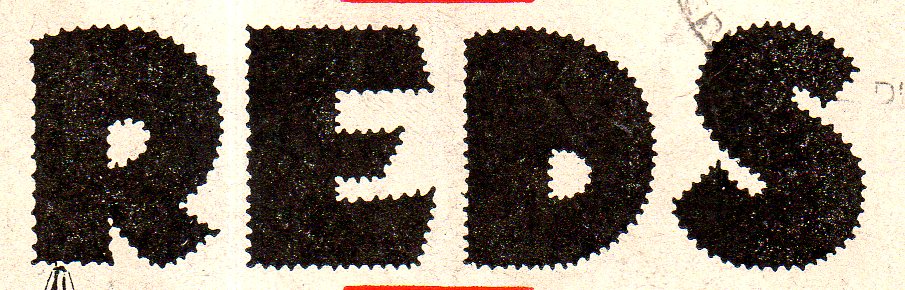
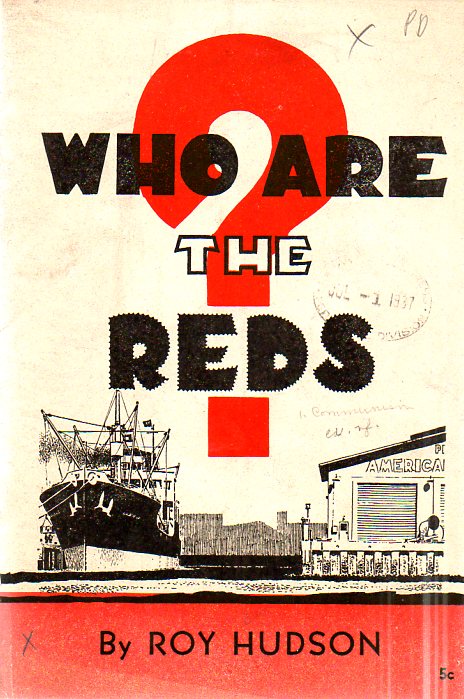
    The question asked by Roy Hudson in 1937 (with the striking red-question-marked cover and the germ-y, bacterial typeface for “Reds”:

    It has happened here695


    Who are the reds692

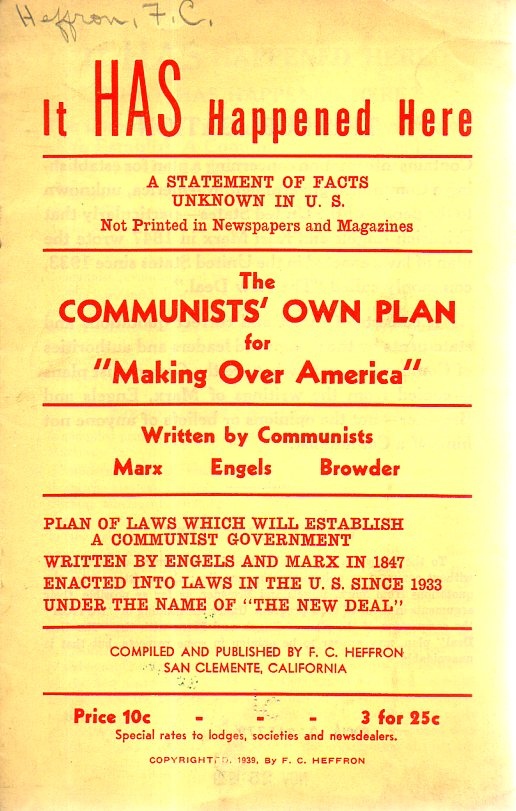
    And the answer–the Reds are us, the U.S. turned inside out by none other than Franklin Roosevelt by using The New Deal to incorporate Marx/Engels Communism and scuttle Capitalism and Democracy:

    It has happened here693

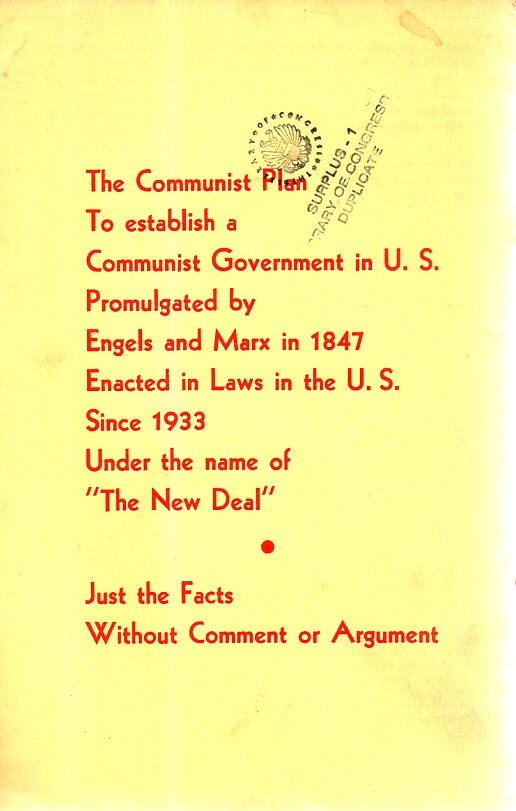
    And the rear cover:

    It has happened here694


    It Can Happen Here is an early version of a title of numerous variants, including the pre-trumpian 1935 Sinclair Lewis novel It Can’t Happen Here, the 1964 movie It Happened Here (where Hitler has taken over England, and includes machine-gunning murders of children), and of course Frank Zappa’s “It Can’t Happen Here” (which has nothing to do with the previous bits or anything else, except “Suzy”) to name a few.  It Can Happen Here is a bit of a lie, as the case is made that Can=Did.


  • Collecting Last Words for a Poem Using Nothing But Them

    JF Ptak Science Books    Post 2640

    No, not my last words, and not the last words of a dying person that hangs like concrete in a cloud-like word-balloon above the speaker’s head, and not an obituary, but the last words of a great (or any) book. Not the last line, mind you, but the last word, or two.The plural is mainly added to accommodate the one entry in particular (the last page of Lewis Carroll’s Euclid and his Modern Rivals, a find made by Jeff Donlan out at high altitude in Salida, Colorado)–in this wonderful book, the last page is occupied by the very lonely but definitive “The End”, and it would be a little uneven to display he page with the two words in a post about single words.  In any event, I’m going to try two examples out today and then add some others over time, and see if there is enough material of last words to use as the available tools for a poem about last words.  

    [By the way I did a post related to this, in a way: “An Alphabet of Opening Lines of Charles Dickens’ Works”, here: https://historyofideasblog.com/thesciencebookstore/2015/10/an-alphabet-of-the-opening-lines-of-charles-dickens-works.html]

    Lewis Carroll, Euclid and his Modern Rivals:

    Carroll Euclid Modern Rivals last


    Neither Jeff or I could tell what the little figure/anagram is before “the”, but under magnification it looks to me a little like a running figure.  

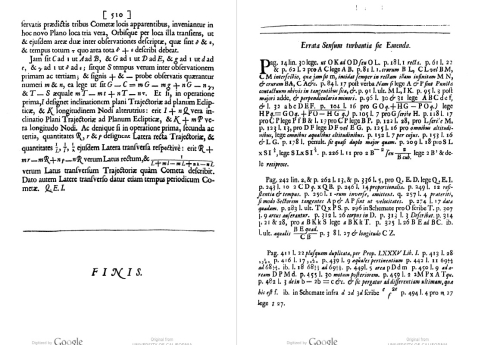
    I might have to manipulate the findings a little with a few rules, like eliminating FINIS or THE END as necessarily last words, and ignoring errata pages, and perhaps indexes–I guess that would mean staying with the last word of the text of a book. For example, Isaac Newton’s Philosophiae naturalis principia mathematica… (1687):

    Last words newton principia

    [Image source: https://babel.hathitrust.org/cgi/pt?id=uc1.31822005223383;view=2up;seq=510]

    Here we have the last “words” being “Q.E.I.” as in 

    QEI: quod erat inveniendum (latin), which was to be found (or what had to be discovered);
    QEF: quod erat faciendum (latin), which was to be done;
    QED: quod erat demonstrandum (latin), which was to be demonstrated.

    which of course is something that can really be worked with, and something of high potential poetical application (HPPA). Perhaps it will wind up being the last three words (used together as a word unit), as there would be more of a possibility of cadence and proto-beauty.

    Here are a few examples, heavy on the books near me:

    • William H. Gaddis, The Recognitions (1955): “…with high regard, though seldom played”. 
    • Charles Dickens, Great Expectations:  “…parting from her”.
    • Ernest Hemingway, The Sun Also Rises (1926: “Isn’t it pretty to think so?” 
    • Herman Melville, Moby-Dick (1851): “…only found another orphan.”
    • Herman Melville, Bartleby the Scrivener (1853): “Ah Bartleby! Ah humanity!”
    • Not that there is a beginning or end to this one, but– James Joyce, Finnegans Wake (1939):  “…a lone a last a loved a long the”
    • Popular Mechanics, volume 50, July-December 1928: “…simplicity of the walls”. [Unexpected!]
    • William Cobbett’s Political Register, February, 1831,: “…up in his house”. 
    • Institution of Civil Engineers, Proceedings, volume 4, 1845,  “American Excavations”: “…portable five feet staff”. 
    • George Orwell, 1984 (1949): “…He loved Big Brother”.
    • A. A. Milne, The House at Pooh Corner (1928):  “…a little boy and his Bear will always be playing”.

     No doubt it will take dozens of these Last Words to have enough material for something that looks like a poem–we’ll see what happens. Stay tuned.


    ·Posted by :

    ·in:


  • Benjamin Franklin, in Love with the Sea, 1786/7

    JF Ptak Science Books   Post 2632
    Franlin b631

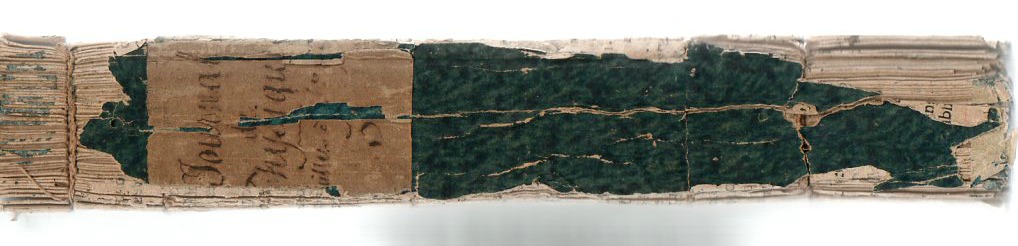
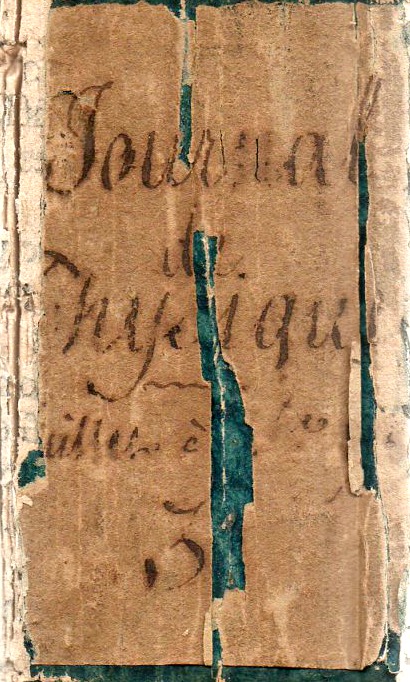
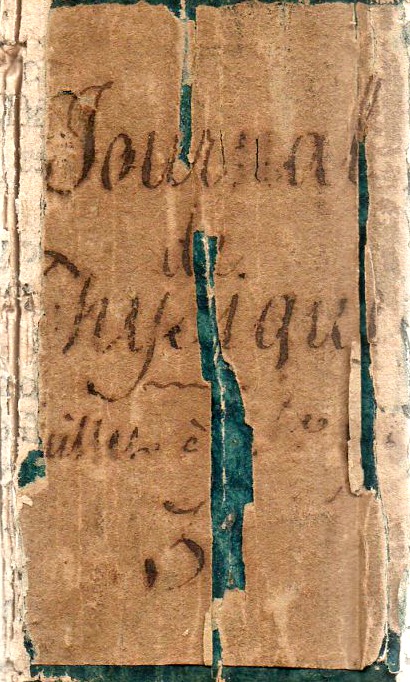
    Franklin, Benjamin. Suite de la Lettre de M. Benjamin Franklin, a M. David le Roy, Membre de pluisseurs Academies, Contenant Differenres Observations sur la Marine, a three-part series printed in Observations sur la Physique sur l’Histoire Naturelle et sur les Arts, avec des Planches en Taille-Douce.…dedicated to M. Le Comte d’Artois, and edited by l’Abbe Rozier, J.A. Mongez, and M. de la Metherie, in the issue for July-December 1787, volume 31, and Printed in Paris at the Bureau of the Journal de Phyique, 1787. (he title of the Franklin, translated: (A) Letter(s) from Dr. Benjamin Franklin, to Mr. Alphonsus le Roy, member of several academies, at Paris. Containing sundry Maritime Observations.) The papers appeared in  September  pp 224-231; October, pp 254-264;December pp 456-468.
    Franklin

    By the time Benjamin Franklin published these three pieces—letters he had written at sea— he already had a lot of experience with the voyage, having made numerous trips oversea since 1754. At this point he was the American envoy to France, and had been (very successfully!) busy at securing arms and agreements from France, and put his time during the crossing to some concentrated use.

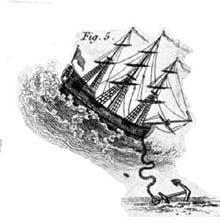
    These three letters by Franklin to le Roy are remarkable for their insight and invention, describing new types of ship sails and anchors, propulsion systems, hull and planking designs—and of course the first description in a scientific publication of the Gulf Stream. And in all of this Franklin as shipboard, biding his time at sea, thinking and experimenting, coming up with ideas that were of high interest though not necessarily workable, and some just frankly beyond his big grasp.
    Franlin c632

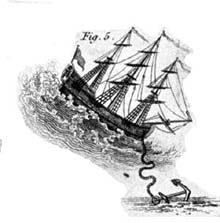
    I was really shocked when I started piecing my way through this volume, and finding the Franklin. Honestly, I didn’t know the significance of the Franklin starting into it, the thing only dawning on me as I got half-way through the second letter, and with a squint recognizing that what he was talking about in the waters off of the coast of “Floride” was in fact the Gulf Stream. “Oh” is what I said to myself. This is that paper. At least it wasn’t a terribly obvious overmiss—this version of the famous description of the Gulf Stream didn’t come with a map, and the illustrations were little bits showing flouncy sails (of dubious application, sorry) and sea brakes. Even when I realized that this was the Gulf Stream Paper, its significance still wasn’t significant, as the great report occupies just a small portion of one of three letters. So it goes.

    The first publication of these letters appeared in the Transactions of the American Philosophical Society of Philadelphia (the society founded by Franlin in 1743) about a year earlier, and which contained the famous map (15×8” or so,  A Chart of the Gulf Stream with Remarks Upon the Navigation from Newfoundland to New-York In order to avoid the Gulf Stream . . . and nor included here) which he completed with the help of his first cousin Thomas Folger. Actually the two had printed an earlier version, in 1769/70, though the map received basically no circulation and was famously disappeared for 200 years before being unearthed.

    There were earlier references to the Gulf Stream—as with the ignored Walter Haxton chart of 1735—though nothing nearly so complete and accurate as the Franklin map.

    This is the first French version of the letters, and so the first French translation of the description of the Gulf Stream; it was also the first appearance of the article in Europe.

    It has been said that the work by Franklin was ignored and associated with inferiority by the Brits because of the adolescent nature of the American Republic and the inexperience of its navy, especially in regard to the Royal Navy. The Gulf Stream simply couldn’t be a discovery of a “river in the ocean” as described by a bunch of fisherman in a colony far from the birthright of a proper navy and scientific inheritance. But of course the Brits were wrong.

    Here’s a bit from the letters on the Gulf Stream, appearing in my journal on page 460-1, translated:

    “This stream is probably generated by the great accumulation of water on the eastern coast of America between the tropics, by the trade winds which constantly blow there. It is known that a large piece of water ten miles broad and generally only three feet deep, has by a strong wind had its waters driven to one side and sustained so as to become six feet deep, while the windward side was laid dry. This may give some idea of the quantity heaped up on the American coast, and the reason of its running down in a strong current through the islands into the Bay of Mexico, and from thence issuing through the gulph [gulf] of Florida, and proceeding along the coast to the banks of Newfoundland, where it turns off towards and runs down through the western islands. “

    Well, sheesh. There was a lot of thinking going on in this letters—not bad for a guy with other things going on in his head regarding the founding of a new nation.


  • Targeting Communism in Cover Art, 1930’s

    JF Ptak Science Books  Quick Post

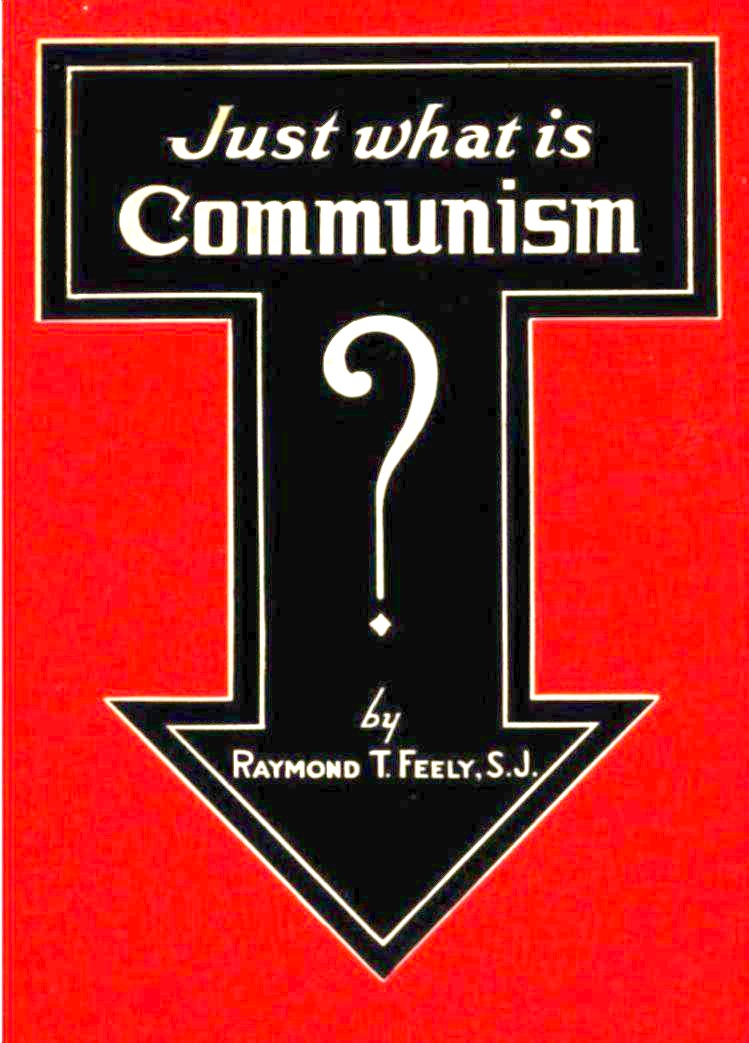
    This is just a quick picture-post sharing the cover art for anti-Communist works by the Jesuit priest, Raymond Feely.  Fr. Feely was not a fan of the Communists, who he felt amidst all other things raised the importance of the state to a religion and beatification of the State, and that of course just would not do. He wrote these in the mid-1930’s before the bestial stuff of Joseph Stalin had come out popularly in the West, and also before the Great Terror enveloped the U.S.S.R. There was still some interest in Stalin’s brand of Communism in the U.S., though that was the left-over mythological and chromed-over trumpian gilted Communism that people thought existed earlier, but actually didn’t.

    Anyway, Feely had no use for that, and wrote about it–you can pretty much tell by the cover art what he thought of Communism.  

    Communism Today or Red535


    JustWhatIsCommunism1935_0000