A Daily History of Holes, Dots, Lines, Science, History, Math, Physics, Art, the Unintentional Absurd, Architecture, Maps, Data Visualization, Blank and Missing Things, and so on. |1.6 million words, 7500 images, 4.9 million hits| Press & appearances in The Times, Le Figaro, Mensa, The Economist, The Guardian, Discovery News, Slate, Le Monde, Sci American Blogs, Le Pont, and many other places… 5000+ total posts since 2008.

Category: Anticipation, History of

  • Francis Galton, Life on Mars, and Extraterrestrial Communication (1896)

    JF Ptak Science Books   Post 2761

    Nature 1896 Galton MArs
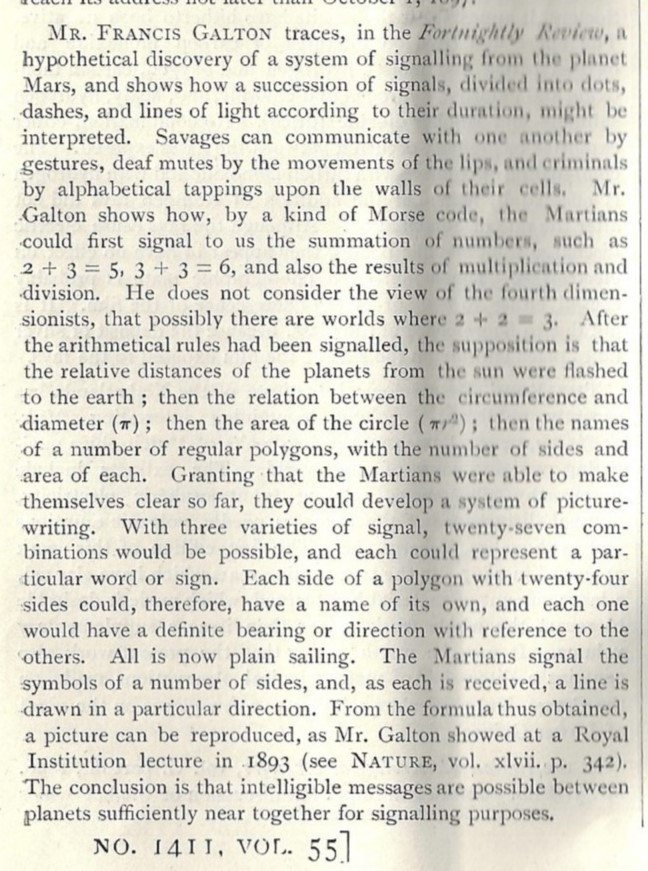
    Okay, these two images1 at the head and foot of this post have almost nothing to do with Mars and Francis Galton, except that they were advertisements in the issue of Nature (November 12, 1896) in which his notice on the possibility of extraterrestrial communication is discussed. That, and that the ads are very engaging, as is the report on Galton. Actually this is a report on a Galton paper that appeared two weeks earlier in the Fortnightly Review (“Intelligible signals between neighbouring stars”, volume 60, pp 657-64, November 1, 1896), and shared to a more scientifically-centered reading population than the other journal.  (Full text: https://galton.org/essays/1890-1899/galton-1896-fortnightly-review-signals-stars.pdf)

    It seems to me that the Galton—a genius who worked across many diverse fields—was having at a thought experiment in interstellar communication. Given the contemporary mileu of possible/expectant life on Mars, Galton thought about ways in which we could send some sort of communication, and what the logic of that “language” might be. He presents the idea of symbols, picture writing, with a combined arithmetic etymology to display an additive language that would show Martian observers a level of intelligence on Earth.

    Galton was hardly alone in figuring out a communication system though from what I can tell seems to stand out in his thinking on what was actually being said. The system itself was one of reflected light from the sun using a vast array of mirrors, an approach that would also be worked on by A. Mercier a few years later in 1899 and by W. Pickering (with a very mechanically-ingenious and enormous display).

    In any event it seems that at this point of the decade that the possibility of life on Mars was very distinct–almost in some cases a foregone conclusion.  To illustrate this, here is a short story about a short notice of a considerable prize offered by a citizen of France for scientific achievement. It was intended for astronomical and medical achievement, and was established by Anne Emile Clara Gouget (d. 1891), the wife of Marc Guzman, in memory of their son, Pierre Guzman. The amount was a very hefty 100,000 francs, which went a long long way in turn-of-the-century France, and which today would be equivalent to about $1 million or some such.

    The preference for the award is in astronomy—specifically, to the person/s who could successfully contact an alien civilization. That contact however does not include Mars. It was during this decade especially that there was much debate about the atmosphere on Mars, and whether it was vegetative, and whether there was an intelligent and advanced society capable of construction was what was seen by some as a massive system of canals across the planet. So with this in mind, Mme. Goguet-Guzman like many others assumed that there was some sort of life on Mars, and so Mars was excluded from the prize for contacting an extraterrestrial civilization.

    I’ve read in some sources that the astronomer/popular writer Camille Flammarion2 “announced” the prize in 1891, though the first published account that I can find appears in the Comptes Rendus in 1900. The notice states that Mars is excluded from consideration of the 100,000 franc prize, and in the event that no one wins another award would be generated from the interest compounded by the prize deposit every five years to a deserving person in science and medicine.

    Here it is in translation:

    “Mrs. Clara Goguet, widow Guzman, bequeathed to the Academy of Sciences a sum of one hundred thousand francs for the foundation of a prize bearing the name, Pierre Guzman, in memory of her son, and will be awarded to [the person] who finds a way to communicate with a planet other than the planet Mars.”

    “Foreseeing that the prize of one hundred thousand francs has not yet been awarded. The founder wanted, until this prize was won, that the, capital, accumulated for five years, constituted a price [in itself], always to be given in the name of Pierre Guzman, which would be awarded to a French scientist or foreigner who makes an important advance to Astronomy.

    The five-year prize represented by the interests of the capital, will be awarded,for the first time, in 1905.” (See the original French version, below.)

     Getting back to Galton, here’s the Nature summary in full:
     

    Francis Galton mars  _1_

    ·Posted by :

    ·in:

    —

  • Found-Abstract Art in Acoustics (with a Nod to Duchamp)

    JF Ptak Science Books  Quick Post 

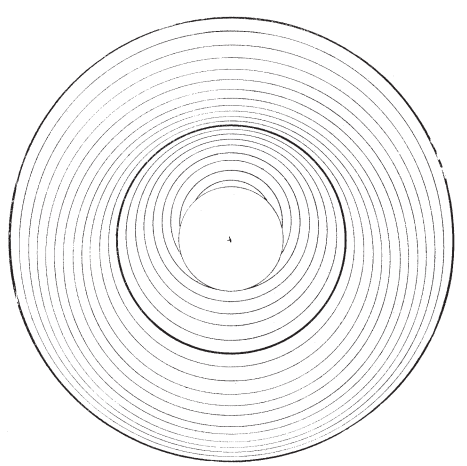
    Just yesterday I posted on Found-Abstract art  (https://historyofideasblog.com/thesciencebookstore/2018/10/found-art-in-electrical-hardware-1885.html) in a cross section of a conduit of telephone wires from 1885. Just now in research a bit on Tesla I found the following diagram for a classroom demonstration in acoustics (appearing in Nature, 11 February 1892) which could easily be added to a list of unintentional/unrecognized pre-Abstract Art art. If you varied the disks in black and white and motorized the whole thing you could imagine it another decade in the future as a work by Duchamp. As it is, it is an ingenious piece of thinking (the whole article follows):

    FOUND ABSTRACT ART 1892 nATURE CIRCLES

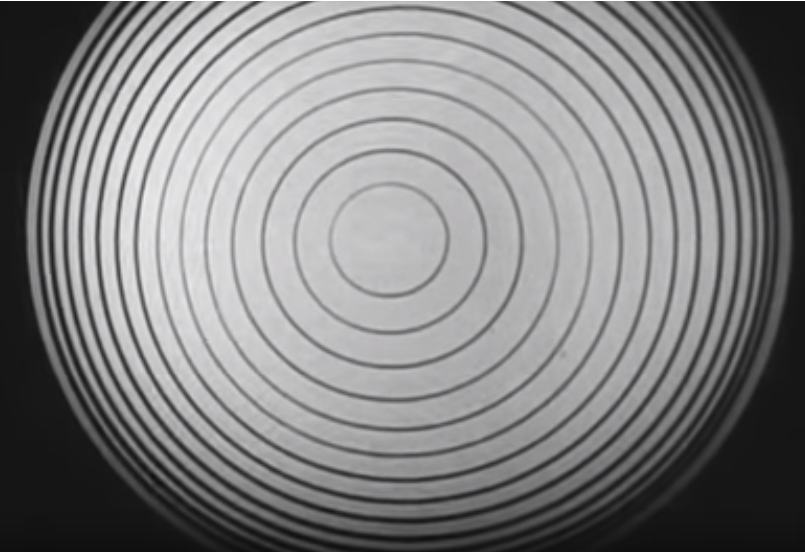
    And one still of many from Mr. Duchamp’s “Anemic Cinema”, 1926: 

    Duchamp circles

    For a video of the film: https://youtu.be/dXINTf8kXCc

    Also a nice piece on Duchamps optical experiments from Hyperallergic: https://hyperallergic.com/323582/duchamps-spinning-optical-experiments/


  • A Note on the Pledge of Allegiance–Excluding “Equality”, and Including “God”

    JF Ptak Science Books  Post 2749

    The Pledge of Allegiance was written by Francis Bellamy1 (1855-1931) in 1892 for the 400th anniversary of the arrival of Christopher Columbus to the Western Hemisphere.  The Christian Socialist Baptist Minister Bellamy started the pledge out as a simple confirmation, and at one time considered the inclusion of the word “equality” in the message, but backed away after he saw potential difficulties with the word, what with the social and legal exclusions of women and people of color getting in the way of the concept. 

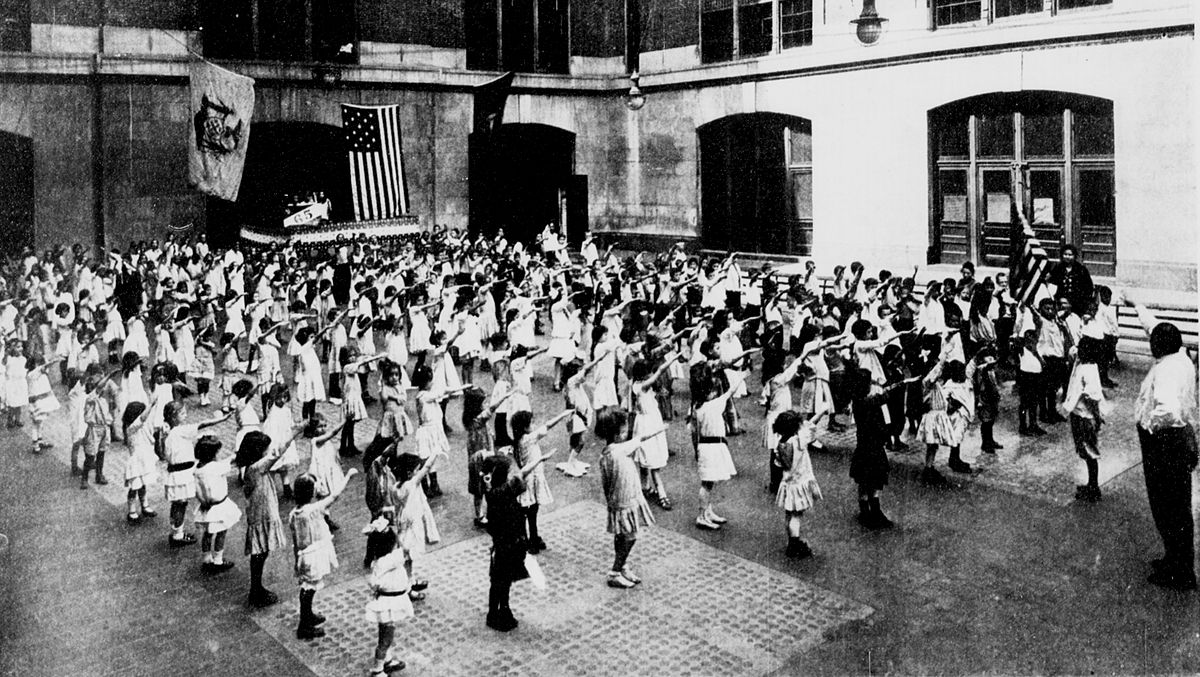
    Bellamy salute

    • Image source: Wikipedia, “Pledge of Allegiance”, ca. 1930. There were several salutes to the flag that were adopted over the years, including this the, the “Bellamy Salute”, which of course faded away quickly with the coming of WWII. Another version of this salute ended with the palm up.

    Bellamy’s original version was non-secular, and, just like the Constitution2 and all of its Amendments, did not mention the word “God”. (“Lord” is used describing the date that the Constitution was signed, but this was another way of saying “1777 A.C.” or even “1777 A.C.E.”. The Declaration of Independence uses the word once, in the phrase “Nature’s God”.)   This does not mean that the Founding Fathers were a-religious–hardly so.  All it means is that they sought to differentiate religion and government, and to form a government separated from religious practice and observation, and to ensure that there was no preference to any particular religious sect.  On the other hand the Framers provided security for the practice of religion, any religion, by any person, in a very elegant and succinct statement:”Congress shall make no law respecting an establishment of religion, or prohibiting the free exercise thereof” in the First Amendment, Bill of Rights.  The concept is given further freedoms by the fact that “religion” is not defined anywhere in the Constitution.

    I think that a concise way of viewing the matter of religion and government can be seen in the Supreme Court ruling in the (landmark) case of Reynolds v U.S. (98 US 145 [1878]) which said that making religious rule or law superior to civil law would encourage everything and nothing, making each person a “law unto himself”, meaning that there would be all law and no law, with government having no say in the matter3.

    In 2000 a case was filed in the U.S. District Court, 9th Circuit, by Dr. Michael Newdow, on the use of the word “God” in the Pledge, and in 2002 that court upheld Newdow’s case, deciding in his favor 2-1.  The case went to the U.S. Supreme Court which skirted the issue entirely–in their Elk Grove v Newdow ruling on March 24, 2004, finding that Newdow did not have the standing to speak for his daughter (for whom the case was originally brought) because she lived with her mother, and not with the her father who initiated the case.  Case dismissed, 8-0, though the issue itself was left untouched. On the other hand (long story short) Newdow returned to the same court on March 12, 2010 with a similar argument, though the court ruled against him in a 2-1 decision…ruling on the same day, but in a different case, the court found in favor of the use of “In God We Trust” on American money.

    And so it goes.  And on to the Pledge:

    Pledge of Allegiance, 1892

    • ‘I pledge allegiance to my Flag and (to*) the Republic for which it stands, one nation, indivisible, with liberty and justice for all.’ [ * ‘to’ added in October, 1892. ]

    31 years later came the adopted variation:

    Pledge of Allegiance 1923/4

    • ‘I pledge allegiance to the Flag of the United States of America, and to the Republic for which it stands, one nation, indivisible, with liberty and justice for all.’   

    The Pledge changed against the interests of Francis Bellamy by the American Legion and the DAR, replacing “my flag” to “the flag of the United States of America”.

    31 years after this came the “God” change, which Bellamy certainly would have objected to:

    Pledge of Allegiance, 1954

    • ‘I pledge allegiance to the Flag of the United States of America, and to the Republic for which it stands, one nation, under God, indivisible, with liberty and justice for all.’ 

    The words “under God” were added after diligent prosecution of religious and political interests by the Roman Catholic organization, the Knights of Columbus, to help fight the Communists. The change was approved on Flag Day, June 14, 1954, at which time President Dwight Eisenhower remarked: “In this way we are reaffirming the transcendence of religious faith in America’s heritage and future; in this way we shall constantly strengthen those spiritual weapons which forever will be our country’s most powerful resource in peace and war.”

    The inclusion of “God” in the pledge and the exclusion of “equality” seem to be the reverse of the original intention of the pledge–unless of course the necessity of counterplay against godless Communists is still a requisite for a statement of fidelity to what the American flag represents–not to mention the separation intentions of the Founding Fathers.

    Notes

    1. Like many others Bellamy was thrust into this position by peculiar circumstances.  He was also a writer and did work on Shay’s rebellion, which I must point out found one of its birthplaces was Great Barrington, MA, where my father’s family comes from, though not from that far back. 

    2. Jefferson had no hand in writing the Constitution per se, but we can see his thinking at work. For example, as a legislator from Virginia, Jefferson drafted a bill that was to stop government from proposing a tax to help pay for religious education:. “… no man shall be compelled to frequent or support any religious worship, place, or ministry whatsoever, nor shall be enforced, restrained, molested, or burthened in his body or goods, nor shall otherwise suffer, on account of his religious opinions or belief; but that all men shall be free to profess, and by argument to maintain, their opinions in matters of religion, and that the same shall in no wise diminish, enlarge, or affect their civil capacities.”

    3.  Part of the ruling reads as follows:

    “In the context of the Pledge, the statement that the United States is a nation “under God” is an endorsement of religion. It is a profession of a religious belief, namely, a belief in monotheism. The recitation that ours is a nation “under God” is not a mere acknowledgment that many Americans believe in a deity. Nor is it merely descriptive of the undeniable historical significance of religion in the founding of the Republic. Rather, the phrase “one nation under God” in the context of the Pledge is normative. To recite the Pledge is not to describe the United States; instead, it is to swear allegiance to the values for which the flag stands: unity, indivisibility, liberty, justice, and — since 1954 — monotheism. The text of the official Pledge, codified in federal law, impermissibly takes a position with respect to the purely religious question of the existence and identity of God. A profession that we are a nation “under God” is identical, for Establishment Clause purposes, to a profession that we are a nation “under Jesus,” a nation “under Vishnu,” a nation”under Zeus,” or a nation “under no god,” because none of these professions can be neutral with respect to religion.”

    It is interesting to note that from the beginning of the pledge in 1892 the flag was saluted by non-military personnel by starting with right hand placed over the heart, and when the phrase “to the flag” was reached, the right arm would be extended outward, palm down, arm slightly raised.  When WWII began it was decided to keep the right arm/right hand firmly over the heart.

    ·Posted by :

    ·in:


  • On the History of Kindness to Children (1687)

    JF Ptak Science Books   Post 2745

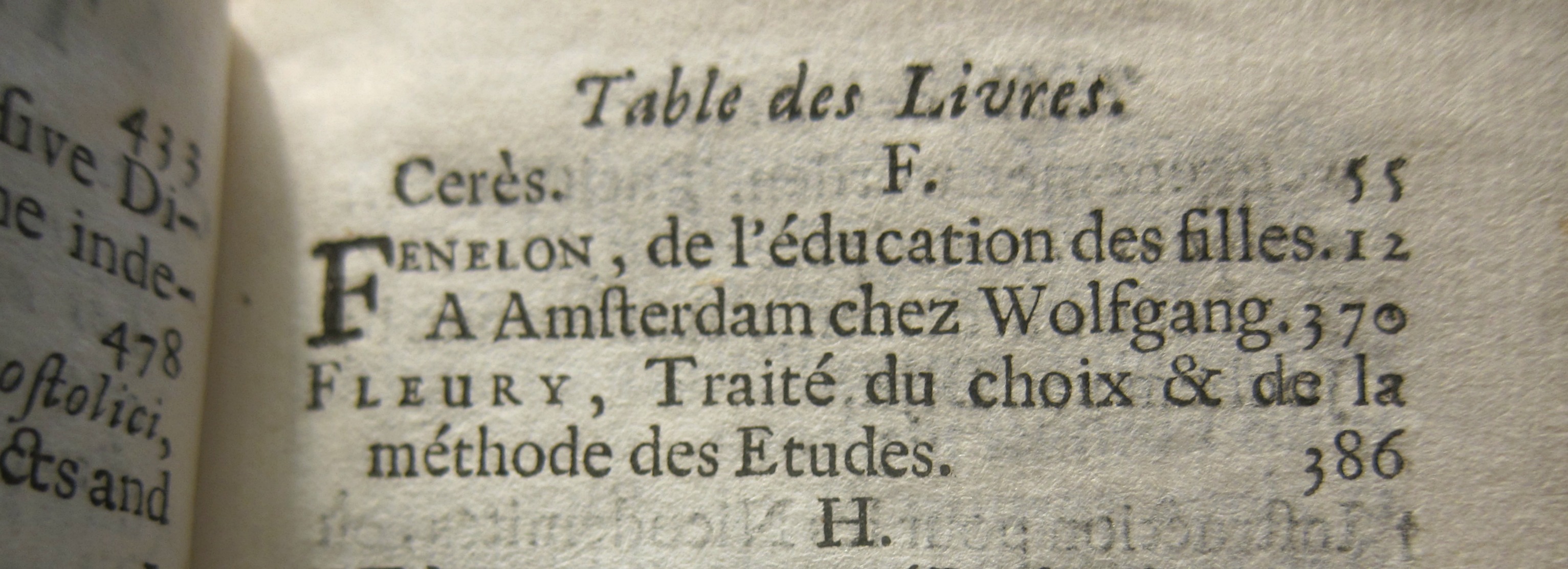
    Bibliotheque Universelle 1687

    Another piece of great serendipity fell from the sky, again this week, this time on the idea of the history of childhood–more accurately, it is on the history of kindness extended to children. The idea of looking at childhood in that way lies in the work, for example, of Phillipe Aires (Centuries of Childhood, first French edition 1960) and Lloyd deMause (The History of Childhood, 1974), among others, who maintain that kindness towards children is a modern invention. (This is kind of wildly brief statement of this idea–suffice to say though that the treatment of children through long history has not been necessarily “kind”. For example, the word “childhood” appears only twice in the Bible (KJV), and really only once in reference to what childhood might have been rather than a simple statement regarding a period of human life. That occurs in Ecclesiastes 11:10: “Therefore remove sorrow from thy heart, and put away evil from thy flesh: for childhood and youth are vanity.” This is in line with an older variety of that book, the Cloverdale Bible, in Ecclesiastes xii. “A   Childehode and youth is but vanite” which again makes the point of childhood being something to get away from rather than a chance to improve the life of the new person. The Oxford English Dictionary takes the word back to Middle English times, but even into the 19th century I can’t really point to an applicable use of the word in connection to this discussion.)

    The issue came up while listening to a public reading by my wife’s (Patti Digh) favorite living author, Richard Powers. He was taking questions after a lovely read from his newest, called The Overstory, when a question came to him regarding human-like senses in animals. Powers responded saying that all was possible, seeing as how people question those human qualities in other human beings. He used the term “Anthropomorphism of Man”, which I found fantastic, as he was correct. For centuries certain people simply weren’t regarded on the same human level as other people (those people doing the judging). For example, in the U.S., women, African Americans, the poor, Asians, and so on from a long list, have only recently been elevated to the prospect of “sameness” with those in power in this country. Before this, they were something “lesser”. And it was here that Powers offered “children” as not being children, not even a full human, for most of the history of humans, and so only recently come into their own as full humans.

    Then came the serendipity.

    I was browsing through one of the 30 volumes or so of an Amsterdam-published 17th century magazine/journal called Bibliotheque Universelle looking for articles of scientific interest. There’s a lot in these little bricks of books, and they do have some occasionally good (and great) scientific efforts in them, the one I was working on, one of several volumes for the Principia year of 1687 (July 5), yielded nothing of any great sci-interest in its 500+ pages. Then, I spotted it, just a simple four lines of 6-point type in the 5”-tall book: “Fenelon, de l’Education de filles…” That’s François de Salignac de La Mothe- Fénelon, of Telemachus (son of Ulysses, etc.) fame, and his book was on the education of daughters. It was published the year before, in 1686, and the editors of the Bibliotheque gave it 14 pages or so of review and explanation.

    It seems to me from this reading that in this account—really on education of children in general–M. Fenelon was an advanced thinker, a human human-rights person, treating children and their education as individuals, with understanding, and kindness.

    Evidently the man speaks to curiosity and rational amusement in the book—that curiosity must precede the rational, and that one must be careful in doing that, because there is a danger of “imitation”–curiosity is the thing that banishes ennui.

    At the same time instruction must be realistic, so that once mature and grown that the real world is not a total shock, and that once subjected to the daily routine of “housewifery” there will be no denouement from the dreams of childhood—all of that seems like a pretty sticky wicket. Fenelon did seem to insist on the beginning of education from infancy, but not to overdo the instruction as that would “oppress the facilities”.

    Perhaps the most surprising positive thing of them all to me was Fenelon’s insistence on being careful with your words with the mature child, and to never be guilty of a falsehood with children, which is pretty good and sane advice.

    There’s other stuff that doesn’t translate any longer into where we are today, but there seems to be a lot of material that is timeless.


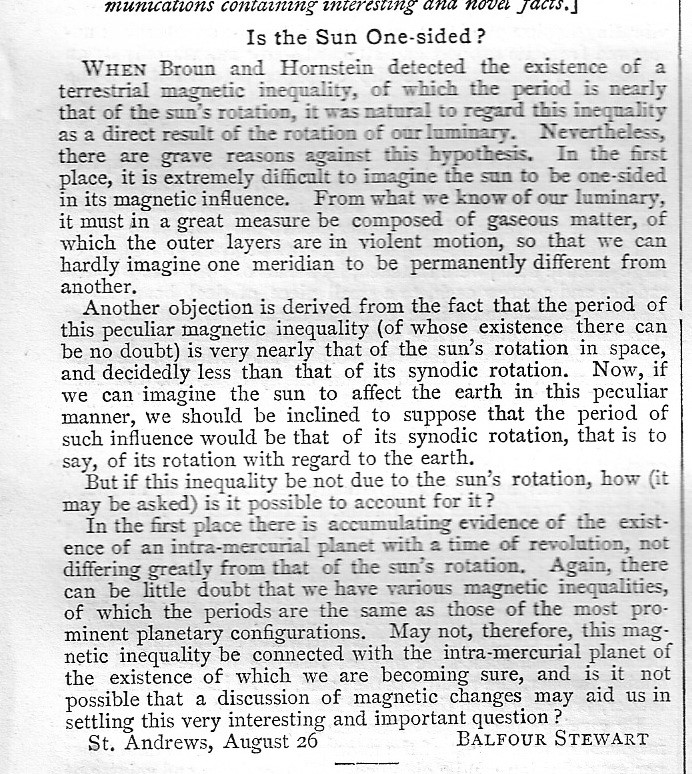
  • The Department of Unexpected Questions: Is the Sun One Sided? (1878)

    JF Ptak Science Books   Quick Post

    I found–or bumped into–the following short note in Nature (September 5, 1878) .  At first glance it has a flat-earthy/Nazis-on-the-dark-side-of-the-Moon quality to it, or at least to me it did. It is a very unexpected question, though it isn’t quite what it seems at the outset before you try to think about what part of one-sidedness the author, Balfour Stewart, is addressing. Read the note, and then the title will make sense.  

    DocFile (2)

    “Balfour Stewart, (born Nov. 1, 1828, Edinburgh—died Dec. 19, 1887, Drogheda, Ire.), Scottish meteorologist and geophysicist noted for his studies of terrestrial magnetism and radiant heat. Stewart pursued a mercantile career for 10 years before becoming an assistant at Kew Observatory and later an assistant to James Forbes at Edinburgh University, where Stewart conducted his research on radiant heat. In 1859 he became director of Kew Observatory, and in 1870 he became professor of natural philosophy at Owens College, Manchester. In his work on radiant heat, Stewart was the first to discover that bodies radiate and absorb energy of the same wavelength; his work in this field was soon surpassed, however, by that of the German physicist Gustav Kirchhoff. In his studies of terrestrial magnetism, Stewart discovered that daily variation in the magnetic field could be explained by air currents in the upper atmosphere, which act as conductors and generate electrical currents as they pass through the Earth’s magnetic field.”–Encyclopedia Britannica

    ·Posted by :

    ·in:


  • Pre-History of the A-Bomb: Arming Nukes with Your Teeth, 1914.

    JF Ptak Science Books   Post 2741

    “Atomic Bomb” appeared in print for the first time thirty years before there was one. It appeared in H.G. Wells’ The World Set Free, written in 1913 and published in 1914, evidently before the appearance of the guns of August later in that year. The “set free” part of the world in Wells’ hands doesn’t come without an atomic struggle, though, much of the novel being a stage-up for the last bit in which people realize that atomic-bombing everything everywhere is not the way to go.

    There are other atomic-conjoined terms in this book besides “bomb”, and they are somewhat telling of the period. Wells does make a good strike with “atomic bomb”, “atomic ammunition”, and “atomic power”, and then goes on to describe the other bits that could benefit from this atomicity, including “atomic aeroplanes”, “atomic hay lorries”, “atomic traction engines”, “atomic riveters” (riveting at twice the pace of a human), and “atomic smelters”. So there are some weak spots here and there in his 57 mentions of “atomic-something”, and that’s okay—he did some pretty good sightseeing into the future with the bomb.

    And he was definitely the first to use “atomic bomb”, according to many sources and not the least of which is the OED (which also provides another interesting example of the word in use, quoting the Yale Review in 1917 “When you can drop just one atomic bomb and wipe out Paris or Berlin, war will have become monstrous and impossible”.) “Atomic-bombed”, “atomic bombing”, and “Atomic bomber” do not make their appearance in the English language until after August 6 in 1945.

    The first view of the atomic bomb in Wells finds that there not one but three of them, all contained in a “coffin-shaped box”, and even with a 2′ diameter were small enough to be stored under a person’s legs. The “essential element” in its construction was a substance named “Carolinum1”, which thus far had been “tested only in almost infinitesimal quantities within steel chambers embedded in lead”.


  • An Early Indictment of the Japanese Invasion of China, 1931

    JF Ptak Science Books  Quick Post

    Here’s another bit of graphic design, a very aggressive cover from 1932 for Krieg in China! by Ernst Schneller1.   Schneller–a long-time KPD member–wrote this short work as an expose on the “war” and in support of the Chinese, published it seems just months after the Japanese invasion and conquest of Manchuria and another few months after the battle known as the January 28 Incident, all of which was foundational for the war that would officially be declared in 1937 (and last until the end of WWII). 

    Schneller was himself a persecuted communist intellectual who was arrested became among the first to be imprisoned in the Nazi KZ system in 1933, and who would stay in the system until he was executed at Sachsenhausen in 1944. 

    It is interesting to note that in one chapter heading the pamphlet refers to the war as a new threat to the world (“eine neue welt droht”).

    DocFile (4)

    Notes

    1. Berlin : Kommunistische Partei Deutschlands, [1932] 9×6”, 15pp. A little confusing, though it seems that there are only three copies of this book located in WorldCat/OCLC. Provenance, Hoover Institution, and then in 1933 to the Library of Congress.


  • A Note on Speculative Scientific Writing on “Infinitely Probable” Extraterrestrial Life, 1897

    JF Ptak Science Books   Quick Post

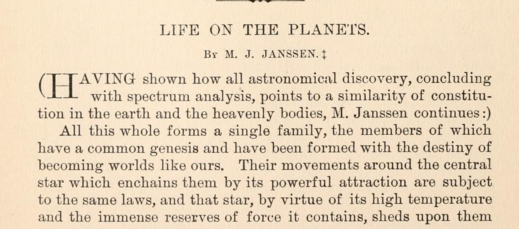
    Deep into a stellar, pioneering, and very productive 350-paper career  (Pierre Jules Cesar Jules Janssen, 1824-1907) wrote this interesting paper that appeared in Appleton’s Popular Science Monthly (volume 50) in 1897 (translated from his address to the French Academy of Sciences on 24 October 1896), speculating on the possibility of teeming life elsewhere and on the unity of the laws of science and nature. He was a great traveler in the name of astronomy, an independent researcher with a house in Montmarte and a maker of his own telescopes and spectroscopes (that in the first decade of the science), who via a mistaken identification of finding oxygen in the spectrum of Mars1 (1867-1869, in the middle year of that discovering helium), came to a realization that life existed on Mars. And from there Janssen went on to create the possibility of worlds throughout the universe, all brought about by the creation of the science of astrophysics in which he made such important contributions.  There’s a lot in these few short pages, including this interesting speculation:

    • “I say further that what we know of the unity of the chemical composition of the matter of the sun, the stars,
      and the nebulae permits us to make new inductions respecting the part performed by the bodies which are
      on the earth the most important factors of the phenomena of life. It is thus infinitely probable that hydrogen,
      oxygen, nitrogen, carbon, and especially water, which on the earth are the indispensable constituents of
      vegetable and animal life, fill a like office not only in the planets of our system, but throughout the universe.”

    Janssen is one of many who speculated on life in the universe, even among spectroscopists of Janssen’s time (including William Huggins, Angelo Seechi, Heinrich Schellen), part of a continuum of thinkers reaching back to Bruno (1584), Kepler (Somnium, 1634), Wilkins (Discovery of a World in the Moone..., Borel (1657), Fontenelle (the great Pluralitie des mondes, 1686), Huygens (1698), Derham (1714)…the list begins to get pretty crowded in the 18th century.


    Janssen life other worlds _a_

    • [Images sources all via Internet Archive, here: https://archive.org/stream/popularsciencemo50newy#page/812/mode/2up]

    ·Posted by :

    ·in:

    —

  • Cancer and the Psychology of Buying Stuff

    JF Ptak Science Books  Post 2713

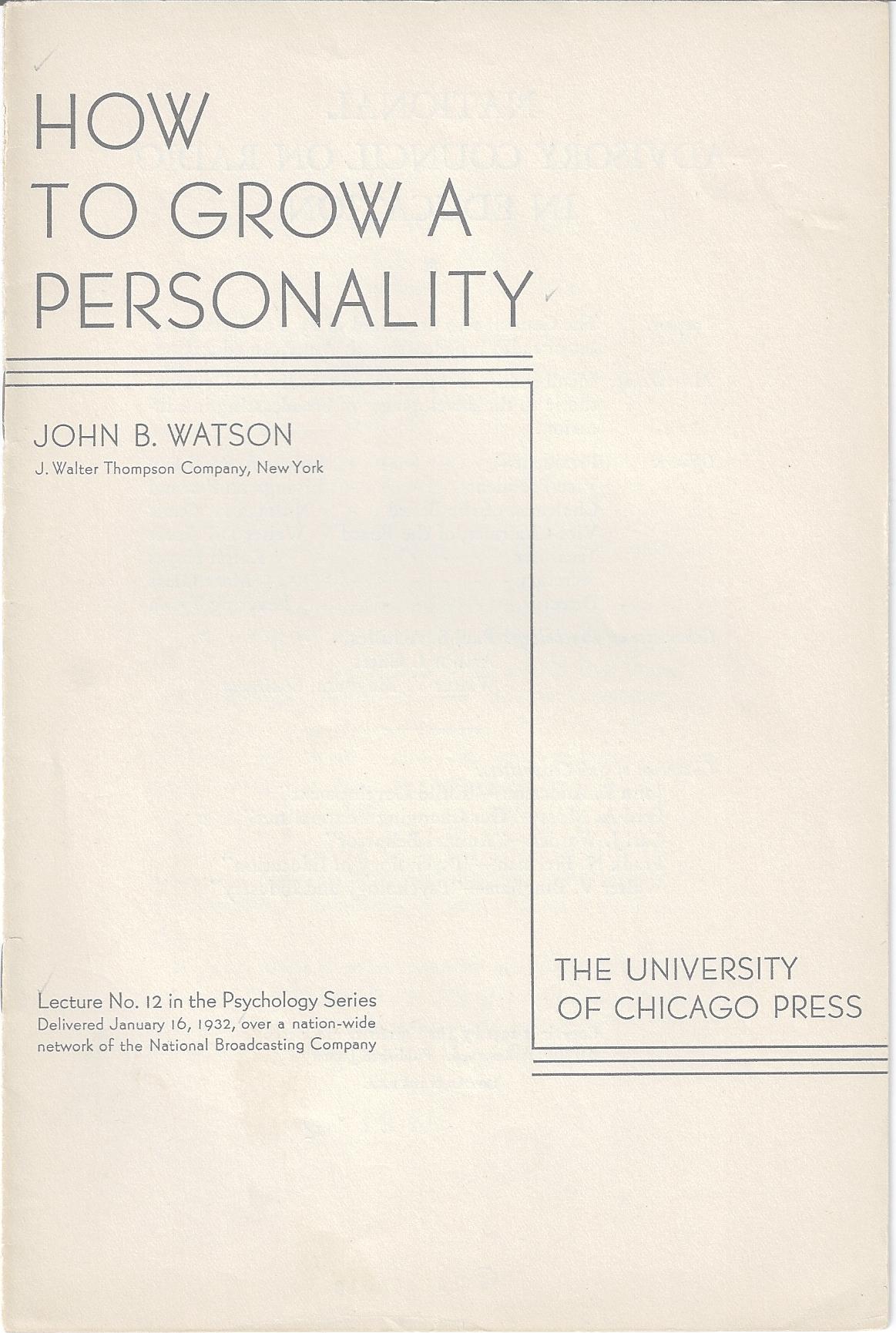
    WatsonWhen John Watson began his radio talk on NBC on January 12, 1932, on “How to Grow a Personality”, he meant it…literally and figuratively. Watson (1878-1958) is considered to be one of the founders of psychological school of behaviorism, which stated simply is the theory that all of human and animal behavior is derived or implied or controlled by “conditioning” or the stuff that happens to/in-and-around the being, and that emotions and thinking (such as they are) have little or nothing to do with forming the response to a stimulus. He claimed that he could train 12 infants to become 12 different sorts of people–lawyer, doctor, engineer, thief, etc.–if given access to training the infants/children–he never got too terribly close to doing that, though he did with a human experiment with the infamous case of “Little Albert”, which is a sodden story of questionable ethics. 

    In the case of personality, Watson defines it so: “Your personality at any age is just a cross-section of the things you can do at that age. There is nothing mysterious about it–it is just a steady growth coming out of your past.” And evidently that means that you can grow your personality by growing the things that you can do, thus training yourself by the stuff you can get done.  Sounds a little circuitous and has a strong scent of a napping carny in a big sweaty revival tent, but it did pass great psychological barriers, as Watson is held in very high regard in the history of 20th century American psychology.

    This is no doubt a rude and crude assessment, but so it goes. 

    One thing is without doubt–he did figure out how to create a “demand” for something. After he was fired from his post at Johns Hopkins (for having an affair that resulted in an enormously popularized divorce trial) Watson took himself and his intellectual toolkit and began work at the J. Walter Thompson advertising agency. He put his two decades of experimental research to hard use, and “discovered” that he could make something desirable by making it familiar and memorable, selling more a positive memory of (or surrounding) a particular thing more so than teh need or use for the thing itself. One example of the use of his behavioral talents was in selling cigarettes.  Billions of them. In keeping with his idea, he created a tremendously repeated slogan for a cigarette, and found that he could basically sell the thing wrapped in its memory/slogan layers. The product was Camel ciggies, and the slogan was “I’d walk a mile for a Camel”.  The slogan could’ve been for Cigarette X, or a rope, or a hammer, or sugar, or whatever–the object didn’t matter; only the environment and landscape created for it did.

    So there’s that.


  • A Dancingly Anthropomorphic Kinematic Instrument (1912)

    JF Ptak Science Books   Quick Post

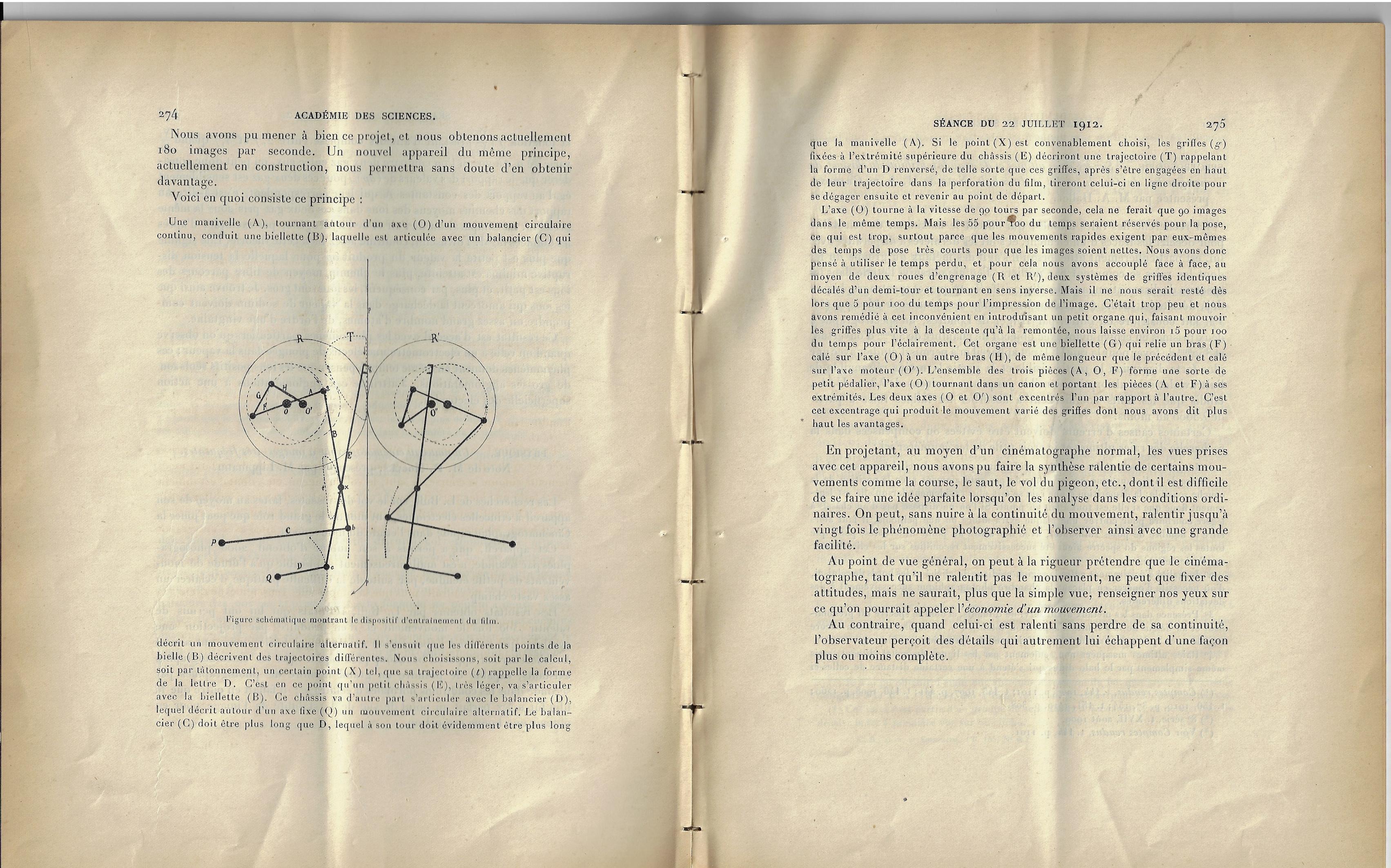
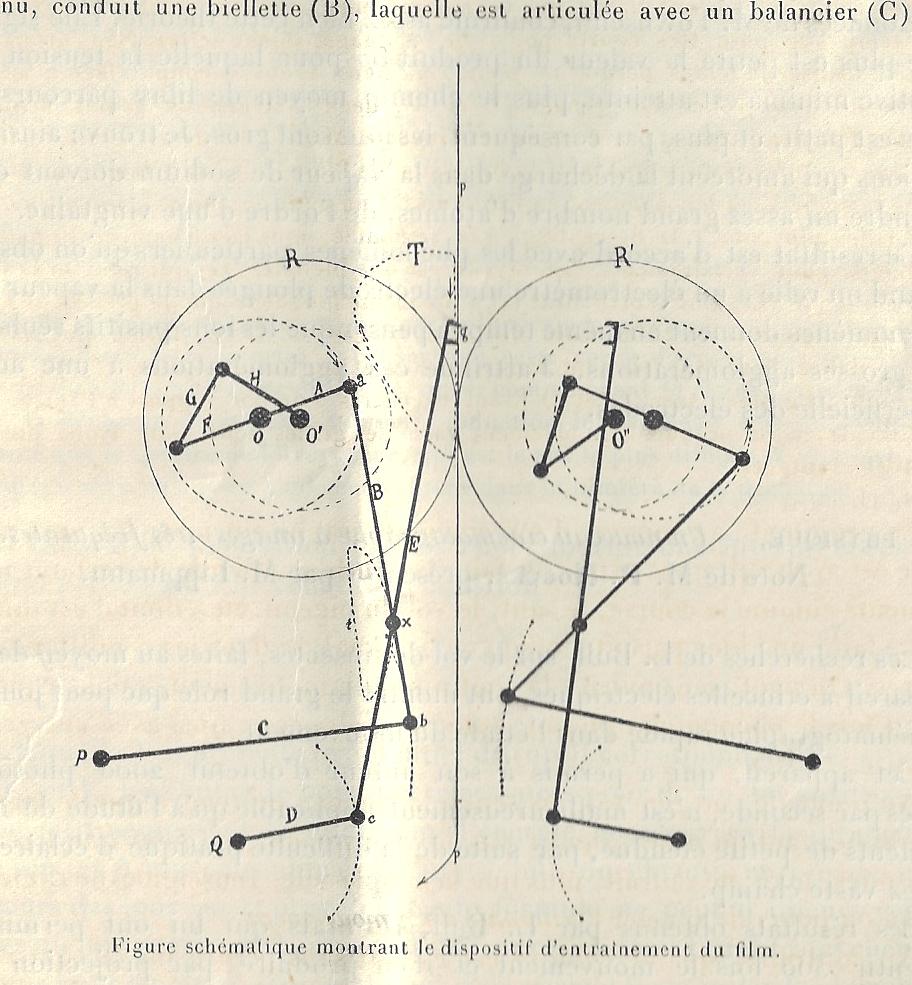
    CR 1912 Nogues kinematographThis is one of those posts where I was looking for something in the Comptes Rendus and then found something completely different. The what-it-was was something about Poincare1, at this point dead for just a week, the second titanic to disappear this year–it is really impossible to understand how he was able to do what he did in a lifespan of 58 years…of course he was a master of nearly every field, and was able to work his math problems out in his head first before writing them out, so it helped to be a multi-genius–and while not finding a notice on his death in the weekly issue I did “discover” an intriguing (and unrelated to Poincare) illustration. 

    At first I thought it would be related to an article on the depiction of motion as the drawing seemed to represent the anatomy of two dancers, and have some sort of fourth dimension/art/science relation, or whathaveyou, but then I saw it was a schematic for a part of motion picture camera–a kinematograph/cinematograph–that made 180 images per second, and would be just the sort of instrument used to study fast-moving objects in minute detail. So the schematic really did portray the essence of what the machine did, exploring the designs of motion.  

    CR 1912 Nogues _detail_

    ____________

    Notes:

    1. Poincare knew basically everything…here’s a toss-off from him that has stuck with me: “To doubt everything, or, to believe everything, are two equally convenient solutions; both dispense with the necessity of reflection.
    2. P. Nogues, “Un nouveau cinematographe a images tres frequentes”, in Comptes Rendus de l’Academie des Sciences, 22 July 1912, pp 273-275.