A Daily History of Holes, Dots, Lines, Science, History, Math, Physics, Art, the Unintentional Absurd, Architecture, Maps, Data Visualization, Blank and Missing Things, and so on. |1.6 million words, 7500 images, 4.9 million hits| Press & appearances in The Times, Le Figaro, Mensa, The Economist, The Guardian, Discovery News, Slate, Le Monde, Sci American Blogs, Le Pont, and many other places… 5000+ total posts since 2008.

Category: Anticipation, History of

  • From the Department of Hopes and Dreams: the Red Cross, St. John, and POWs (WWII)

    JF Ptak Science Books   Post 2798

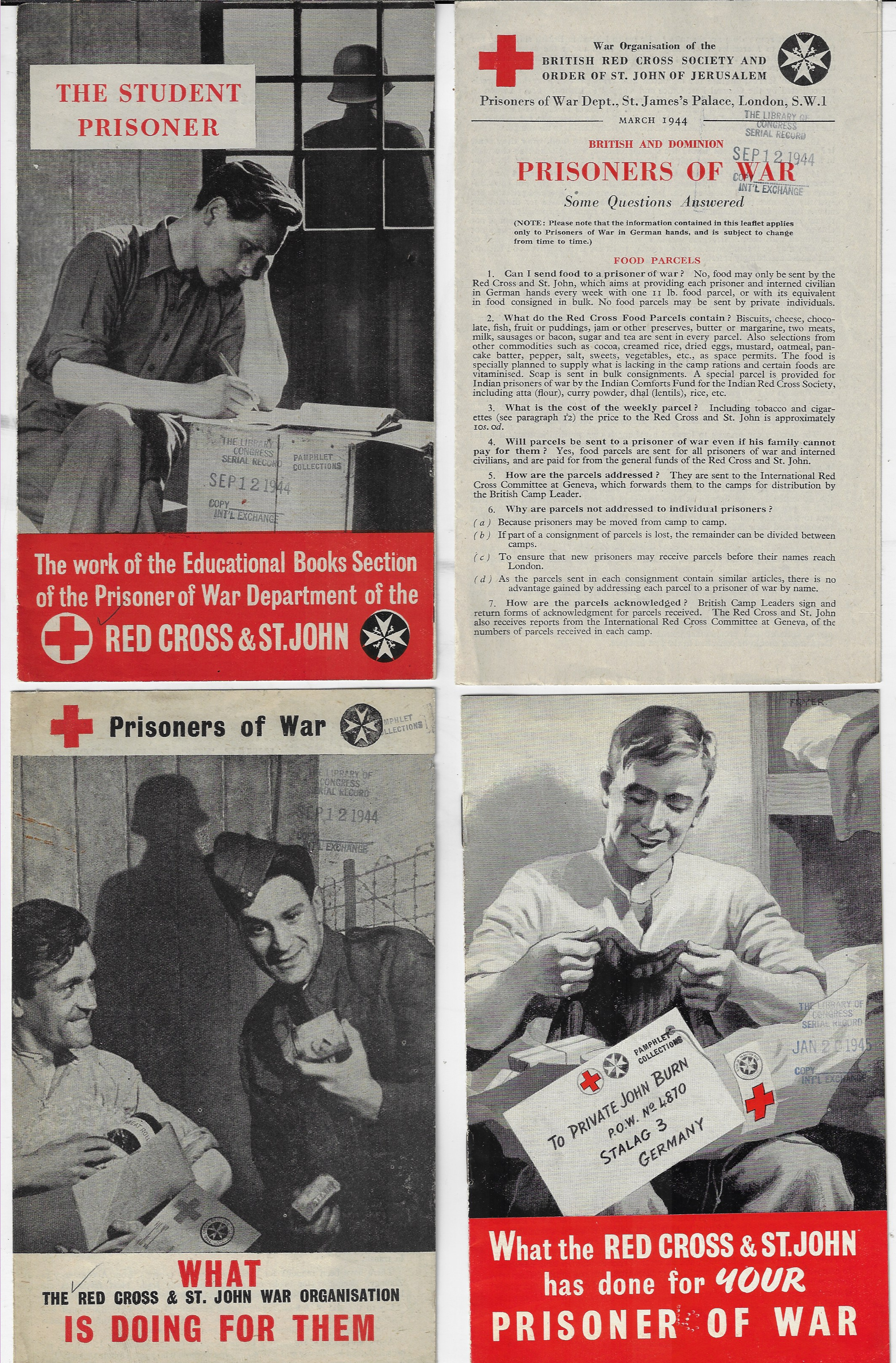
    I assembled a little collection of WWII Red Cross and St. John charity pamphlets–what they all share is a sense unity, duty, perseverance, and hope. They are all published between 1942 and 1944, the majority coming in the summer of 1943–a wicked bad time for the Allies, perhaps the worst time since the Nazi onslaught of Europe. Five of these pamphlets directly addressed trying to help the prisoners of war held by Nazi Germany, and portrayed some healthy and sustaining images of the possibilities of POW life, as well as what would seem to be a high chance of delivery all manner of goods to the prisoners to make their time behind barbed wire somewhat more bearable. (Several of these short pamphlets are reproduced below, while the covers of four of them follow):

    Red Cross POW _1_ (1)


  • Using Darwin to Sell Stuff–an Early Appearance of Marketing Darwin (1877)

    JF Ptak Science Books  Quick Post

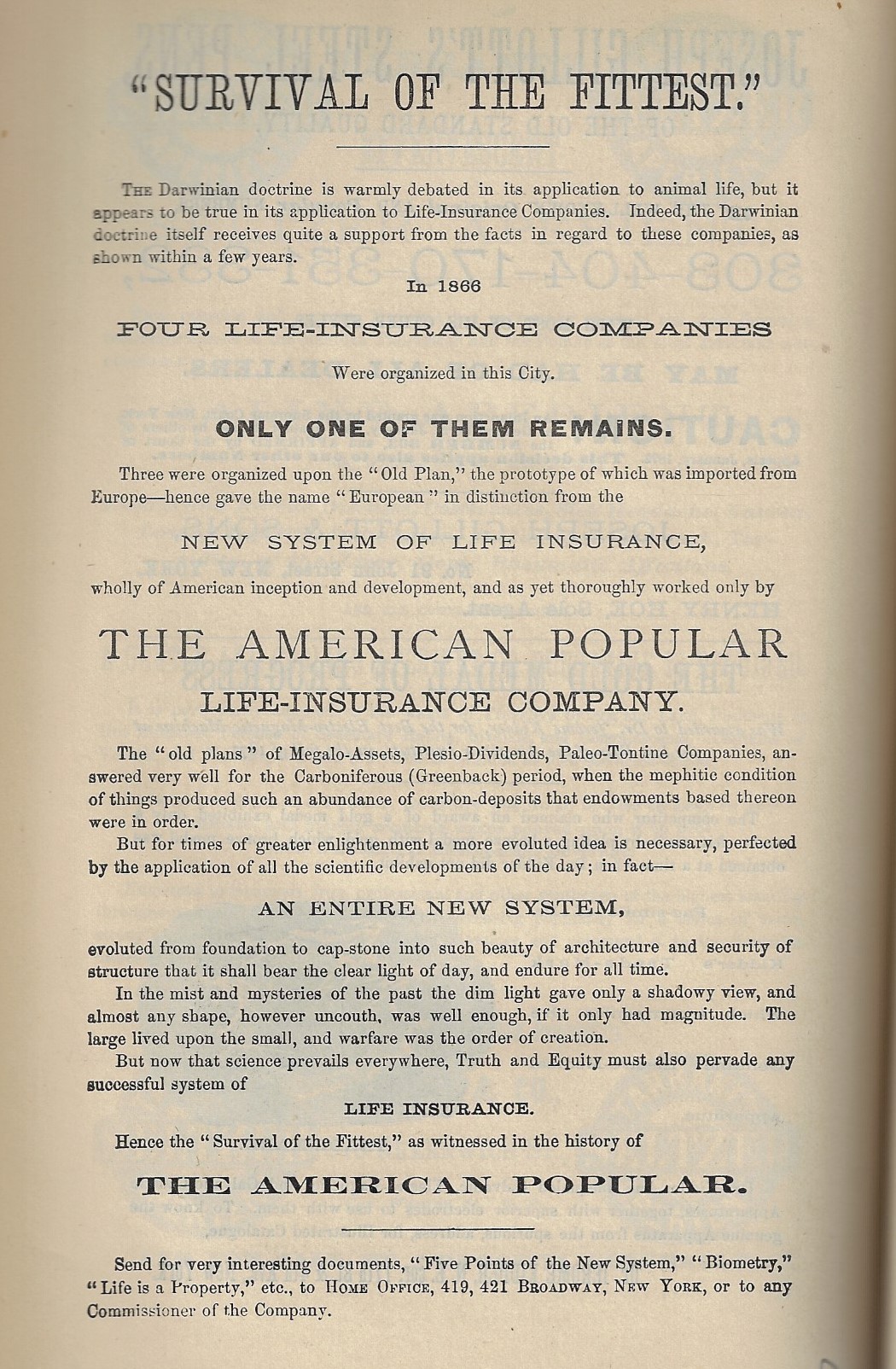
    I can’t be sure of where this stands overall, but it certainly seemed to my reading over the last x-yearsx that using a quote or idea from our Mr. Darwin to sell something in the first decade or two after the publication of On the Origin of Species…. is a rare thing. So seeing this ad in the back of the volume of Popular Science Monthly (1877) was really surprising, as it was taking the phrase we find in Darwin to sell the long-lasting qualities of a life insurance firm.  (Well, the phrase actually starts out with Herbert Spencer as he was influence by OTOOS, writing it to express an idea in economics in his Principles of Biology in 1864; Darwin himself adopts it in Variations of Animals and Plants under Domestication in 1868 and then in the fifth edition of OTOOS in 1869. I’ve included a lengthy quote from the Spencer, where the phrase turns out on page 444.)  I do have a recollection of a drawing in Punch of a crying Mr. Darwin in a quarter illustration promoting kindness to animals or some such…but offhand there’s no memory of using the man/ideas as a sales vehicle before this. Again, that’s not my field so I may be missing a lot–if you know of other ads like this please let me know.  

    Pop Sci Mo 1877 survival fittest full


  • Technical Criticism of an Early Space Flight Sci Fi Movie (1937)

    JF Ptak Science Books  Quick Post

    Massive, monster cannons have existed for many years in idealized and theoretical, speculative worlds, like Tom Swift and his Monster Cannon.  In the history of early imaginary big guns H.G. Wells’ Babel-like space cannon (pictured below in a still from the movie Things to Come,1936), an adaptation his The Shape of Tings to Come (from 1931) is monumentally fabulous –1500 feet tall, with what looks like a  750′ base, all of which launched a 75′ tall capsule beyond the Earth’s gravitational pull with a spectacular explosiveness that would’ve made its occupants into jelly.  (Tangentally-speaking here the launching of an object to escape the Earth’s gravity didn’t occur until 1946 when the highly-problematic but nevertheless-genius Fritz Zwicky fashioned a device to an experimental V-2 and via an electric explosive charge punched some object into space.)

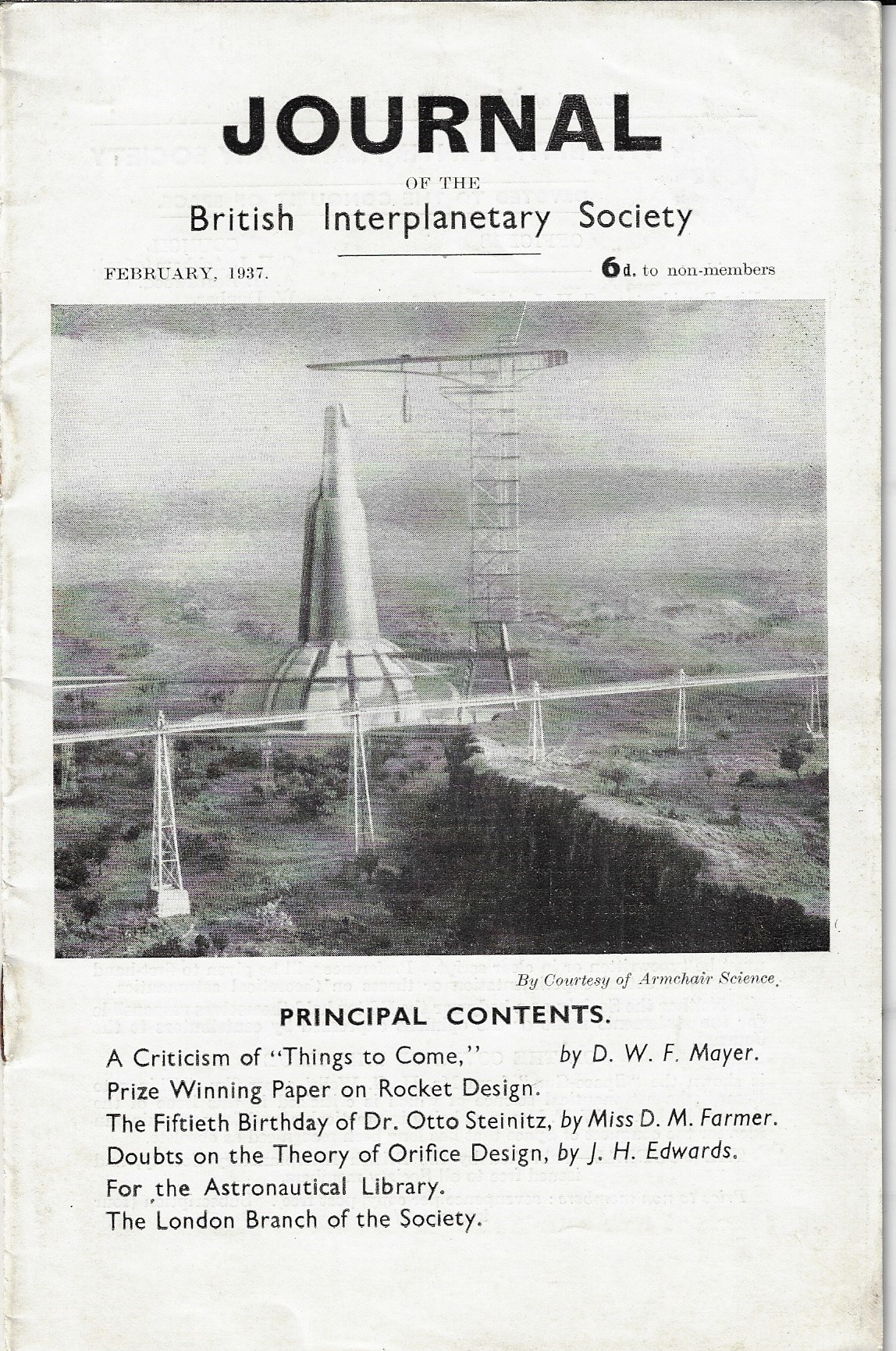
    In any event D.W.F. Mayer registered his objections to the Wells spaceship in the Journal of the British Interplanetary Society from February 1937, which you can read below. 

    British Interplanetary Soc 1937 _2_


  • A Note on the History of Backwards (1878)

    JF Ptak Science Books  Quick Post

    This is a tiny note on the idea of seeing/listening/thinking backwards–I’m not even sure what that means, except for teh obvious cases, especially when you throw technology into the mix to spice up the possibilities of investigation of a backwards form. First of all, the words “backward” and “backwards” go all the way back in the history of English, as we can see in these two pretty examples from the OED:

    • 1398   J. Trevisa tr. Bartholomew de Glanville De Proprietatibus Rerum (1495) xiii. xxvi. 456   “By vyolente puttynge of ayre bakward the body of the byrde meuyth forwarde.”

    •  1697  Dryden tr. Virgil Georgics iii, in tr. Virgil Wks. 101   “Clouds of Sand arise; Spurn’d, and cast backward on the Follower’s Eyes”

    • 1953 “When I go backwards I’m generally backing up”–Not Yogi Berra

    With technology I’m referring to the more subtle ways of exhibiting something/someone in backwards motion rather than the reserve of raising an obelisk–it would be more like seeing a fire burn a house in reverse or rain falling up or a locomotive recovering itself from a head-on collision with a tree via motion picture recordings, things can can’t be reproduced backwards simply by reversing the motion. 

    As long as I’m at it, I think this sense of “backwards” is differentiated from a reverse chronology.  Citizen Kane starts at the end and works it long and angled-dark ways from the beginning to the opening shot; the movies Momento and Eternal Sunshine… are fuller in their reverse chronology, as is the occasional episode of Seinfeld and the book (and movie) Benjamin Button, to name a few examples. 

    What brought me to this place was an article  by Fleeming Jenkin and J.A. Ewing on the new invention, “The Phonograph” in Nature (1878), where their entire interest in the short note was the use of the machine in playing recorded speech backwards. This would be among the first uses of the new technology in a way that displayed info in a new way from all other previous human experience. This leads me to think about the next step in the development of the motion picture, where people could “unwatch” a developed motion of something and have it reconstitute itself right before their eyes. No doubt that was an extraordinary experience. So far as the motion picture goes, it would be almost another twenty years before a motion picture would be exhibited popularly that showed an action in reverse–and that honor goes yet again to Louis Lumiere and his “Demolition of a Wall” in 1896, still in the first decade-ish of the invention of what we would think of as a motion picture film.  

    In any event, these are just some loose thoughts on the subject of “Backwards”. 

    Here’s the short article by Jenkin and  Ewing: 


  • Stacked-Tech: Things on Top of Other Things (1926).

    JF Ptak Science Books  Quick Post

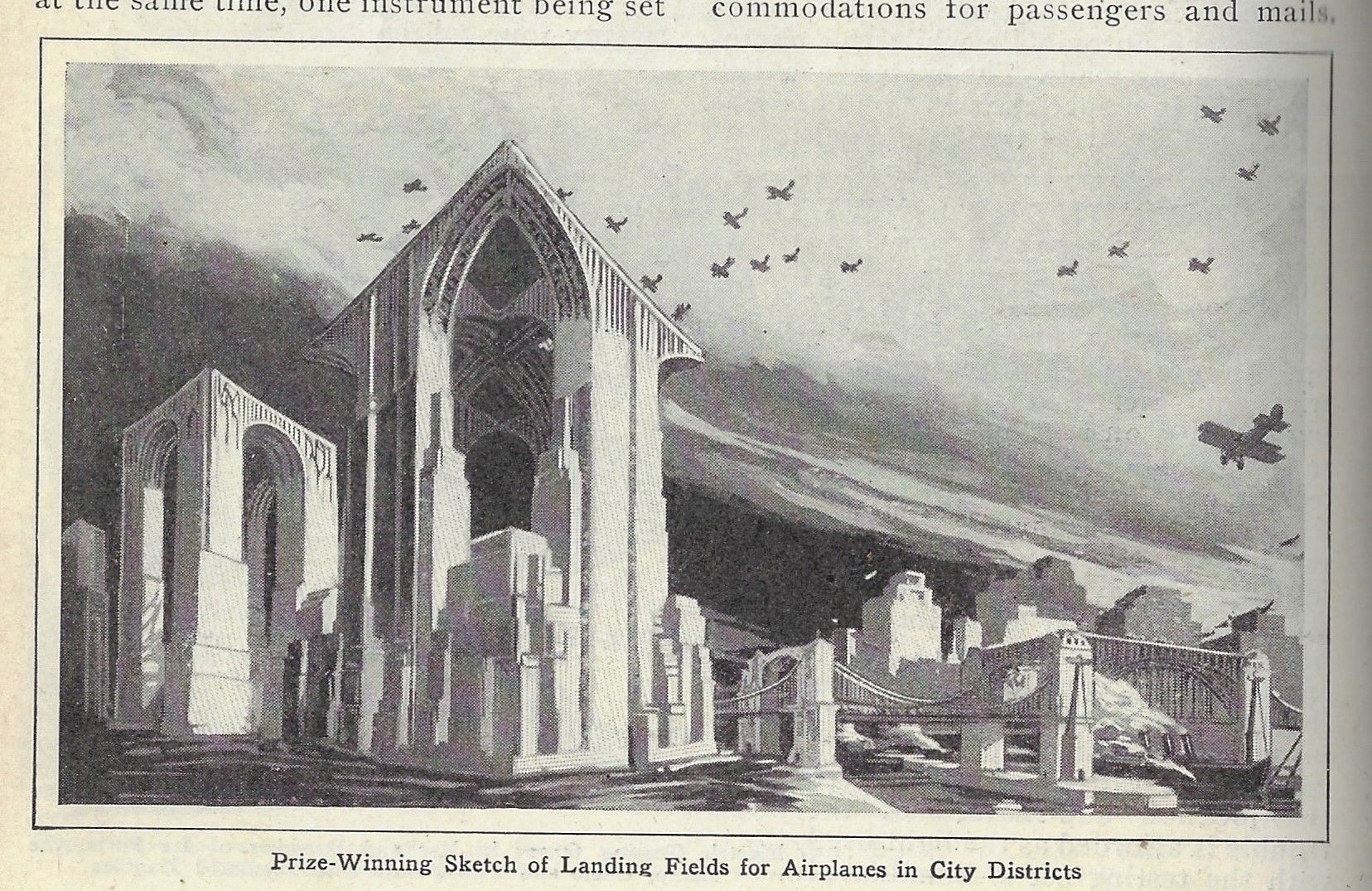
    In just three or four decades into the skyscraper era and heavier-than-air powered flight there was a certain sense of planning to join those two technological (series of) achievements. This sense of enlightenment though didn’t seem very enlightened, or practical. The idea of locating airports on the tops of tall buildings, or on structures covering rivers (like the Hudson or Thames), or on long and wide structures built over expanses of shorter inner-city buildings, seem to have had a life from the late ‘teens into the 1940s.  They were struggling ideas that struggled. 

    I found two more examples of this stuff-on-top-of-other-stuff tech thinking today. The first shows a structure 950′ tall made to accommodate a strained amount of air traffic in the heart of a large metropolitan center. (There are numerous examples of this idea sprinkled throughout this blog–just pop the word “airport” into the Google search box at upper right and you should find 10 or so posts on the topic, all with great illustrations.) By the way, this was one busy dream of an airport, what with 20 planes coming and going. 

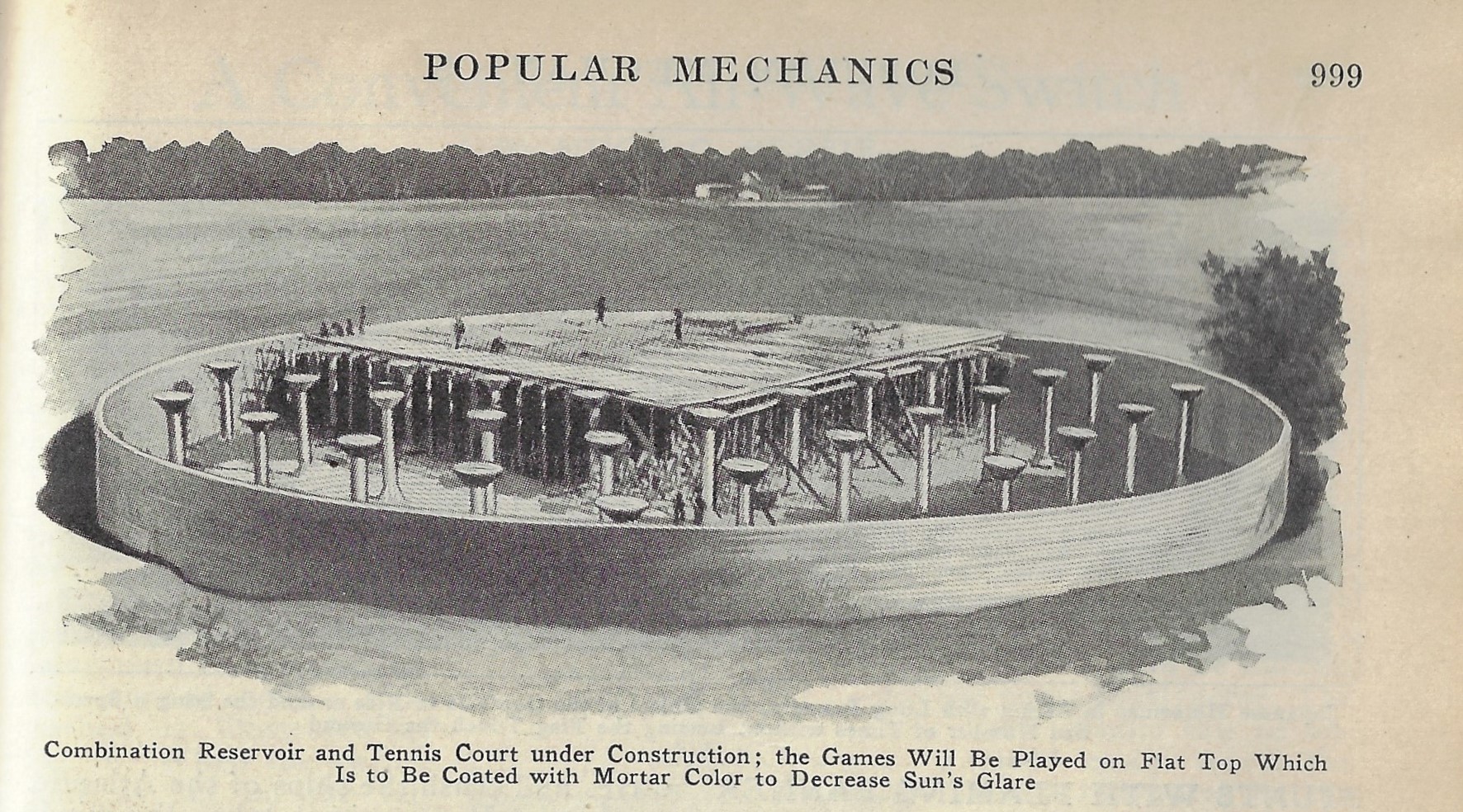
    Pop Mech 1926 tennis court resevoir

    The second image is unusual but less-techy: a tennis court built on top of a reservoir:

    Pop Mech 1926 tennis court resevoir

    I ‘m not sure how hurting people were for spaces for a tennis court in 1926, but the competition for the open land for such a thing couldn’t’ve been that severe. 


  • “America Asleep” (1923) and “Awake and Act” (1935)

    JF Ptak Science Books  Post 2700

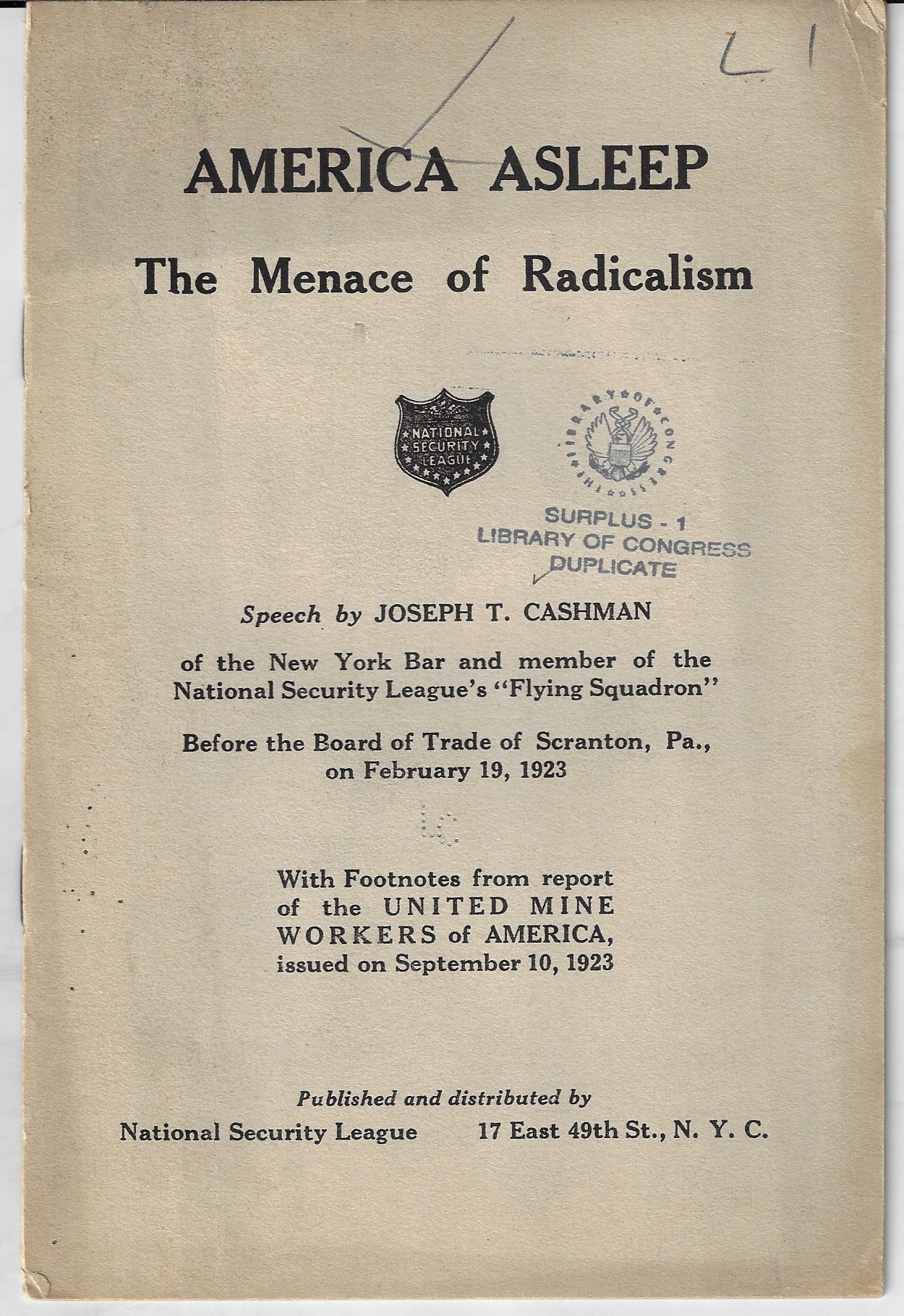
    Books covers america asleepThe “radicalism” that was a menace to America outlined in this slim pamphlet by the attorney Joseph T. Cashman (died in 1936 at 59) launched into the public consciousness in Scranton, Pa., in 1923, was Communism. Communism came in many flavors, and the author, as a member of the National Security League1, outlined some of them finding Commies in the United Mine Workers and the American Civil Liberties Union, to name two. The UMW was taking orders from the Third Internationale, which was also on its way to take over other trade unions. Then there was the larger issue of national security that was the base concern of the National Security League, which evidently went a little overboard with their issues, at one point in 1918 accusing the entire state of Wisconsin of treason.

    So, the “asleep” part is the USA not paying attention to the Communists taking over the unions newspapers, and having an influx of immigrants who were not American enough who were destined to cause trouble to our way of life, and for not recognizing that teaching foreign languages in school would lead to division, and so on. For them what was going to save the country was uniformity, obedience, pledges of all sorts (like the Lusk Law in New York where teachers had to swear to their piety, patriotism, an wholesomeness), mandatory military service, and a vast increase in military funding to secure our borders. Welcome to 1923.

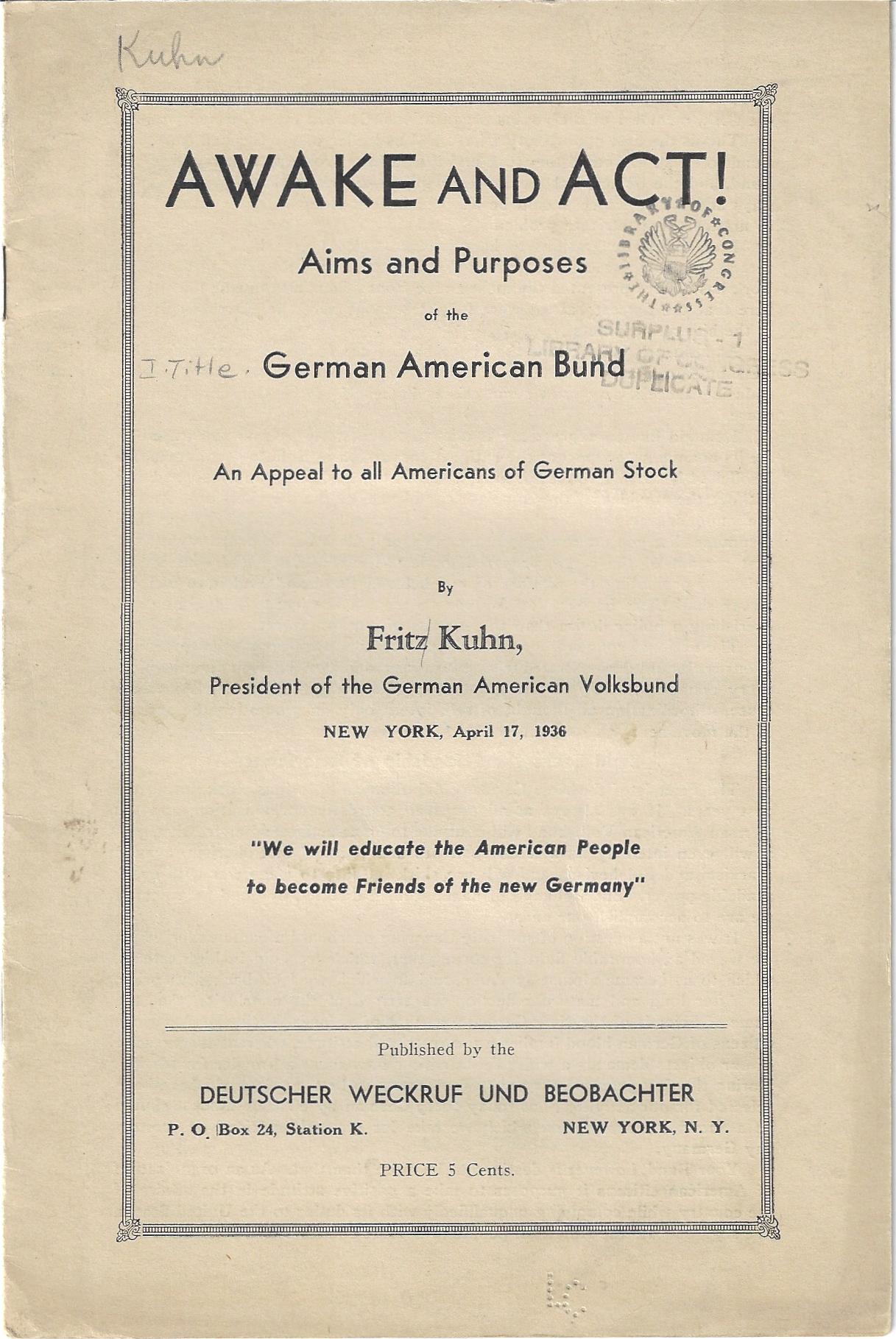
    Books covers awakw and actIn other news, there’s this pamphlet from 1936, a miserable message from a miserable man, telling the U,S, to wake up…and become National Socialists. 

    Fritz Julius Kuhn was president of the German American Volksbund and a nasty, hateful character who worked in service of National Socialism in the United States. He wound up in trouble and in jail for mishandling funds, and once the U.S. got into the war, he found himself arrested as an enemy alien and sent to spend time in the interment camp on Ellis Island. He was kicked out of the country, and then arrested again by U.S. Occupation Forces and sent to Dachau in 1947 as part of the Denazification effort of Gen. Lucius D. Clay. Of course Dachau wasn’t the Dachau of Kuhn’s idol, so he unfortunately did not experience the camp of his intentions. He died in 1951, and that was that. Provenance: the Library of Congress, the pamphlet being a gift from the Bund.

    In 1936 Kuhn wasn’t yet interested in taming the U.S. for the Nazis, though he was interested in protecting it from the greatest evil of mankind–Communism.. Actually, it turns out to be Bolshevism, but the controlling power to this is”the war battalions of the Jewish capitalists of the stock exchange” which was “the international (J)ewish attack of world Marxism”, which he said is what was attacking Germany, presently. There’s a lot more of this rhetoric in the pamphlet…actually, that is all there is in it, this sort of language, written by a non-native speaking chemist walking in Hitlerian glory and not all that smart. He was smart enough though in his rants, and tirades, and his anger was such that he was able to get 20,000 people to attend a rally at Madison Square Garden in 1939 where amidst his adjectival malignancies he ranted against “Franklin Delano Rosenfeld” and his “Jew Deal”, much like the language used in someone else’s beloved Ezra Pound’s traitorous broadcasts from Italy during the war. This was the straw that broke the stinking fascist’s back, though, terminally pissing off Mayor Laguardia who went after Kuhn’s taxes and found fraud and embezzlement. And so off he went.  But not before ruining the memories of those people who witnessed their friends become engorged by his wrath and hatred, a ruined man with ruinous ideas who ruined people. 

    Notes:

    1. “The National Security League (NSL) was an American patriotic, nationalistic, nonprofit, nonpartisan organization that supported a greatly-expanded military based upon universal service, the naturalization and Americanization of immigrants, Americanism, meritocracy, and government regulation of the economy to enhance national preparedness. Many of the programs advocated by the NSL, such as a unified national defense agency, an interstate highway system, universal conscription, English as the official language, and a unified national budget, were highly influential. Although the organization had declined before it finally folded in 1942, many of its ideas would become national policy in the United States.”–Wikipedia


  • A Beautiful Apocalypse (1508)

    JF Ptak Science Books  Quick Post

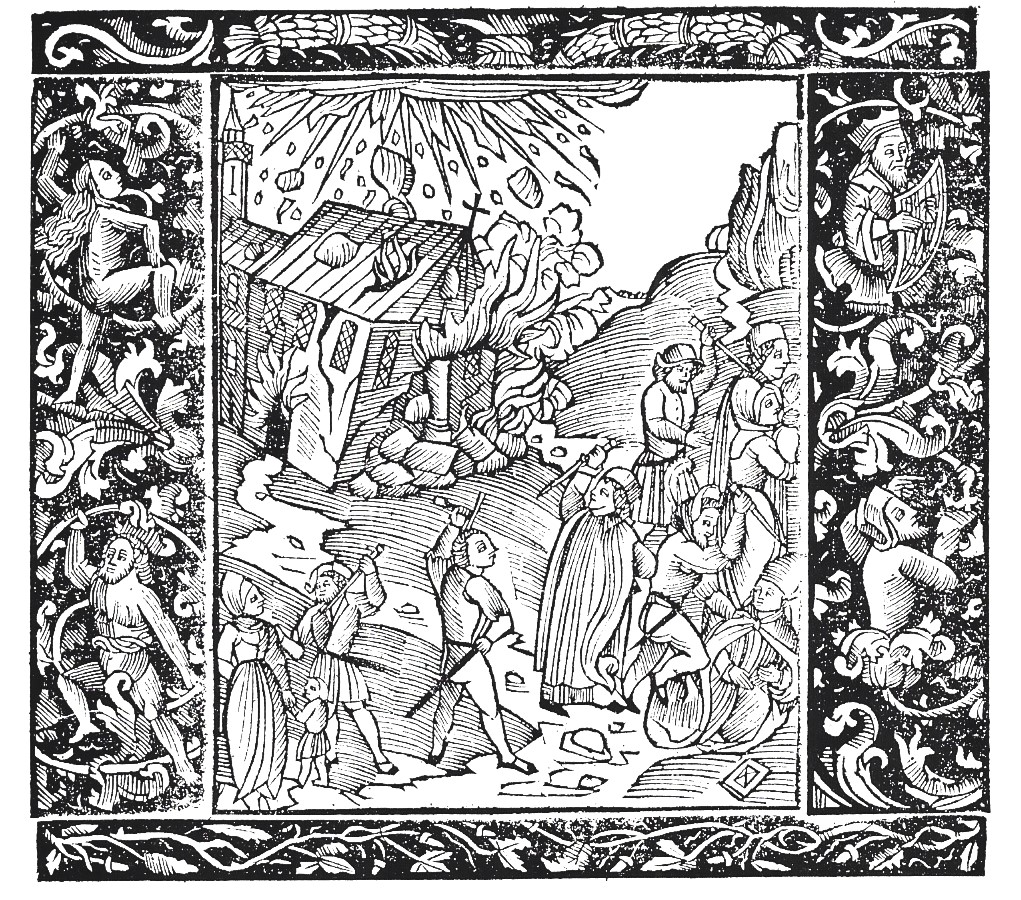
    This vision of The Apocalypse doesn’t look overwhelmingly apocalpse-y, to me, but the message was put across to the viewer that something bad was happening, what with the hail and brimstone and lightning and fire being visited upon the dissolving church in the background and the murdered clergy in the foreground. The woodcut appeared in Joseph Gruenbeck’s Speculum naturalis coelestis & propheticae visionis, printed in Nuremberg in October 1508, being a short (18 leaves) prognostication on the fate of humankind and its wicked ways. It is a very orderly fall from grace, but a fall nevertheless, and the reader no doubt was reminded of the waiting ring of fire. 

    Apocalypse beautiful


  • The Beauty of the Nuts-and-Bolts of Bolts and Nuts (1864)

    JF Ptak Science Books  Quick Post 

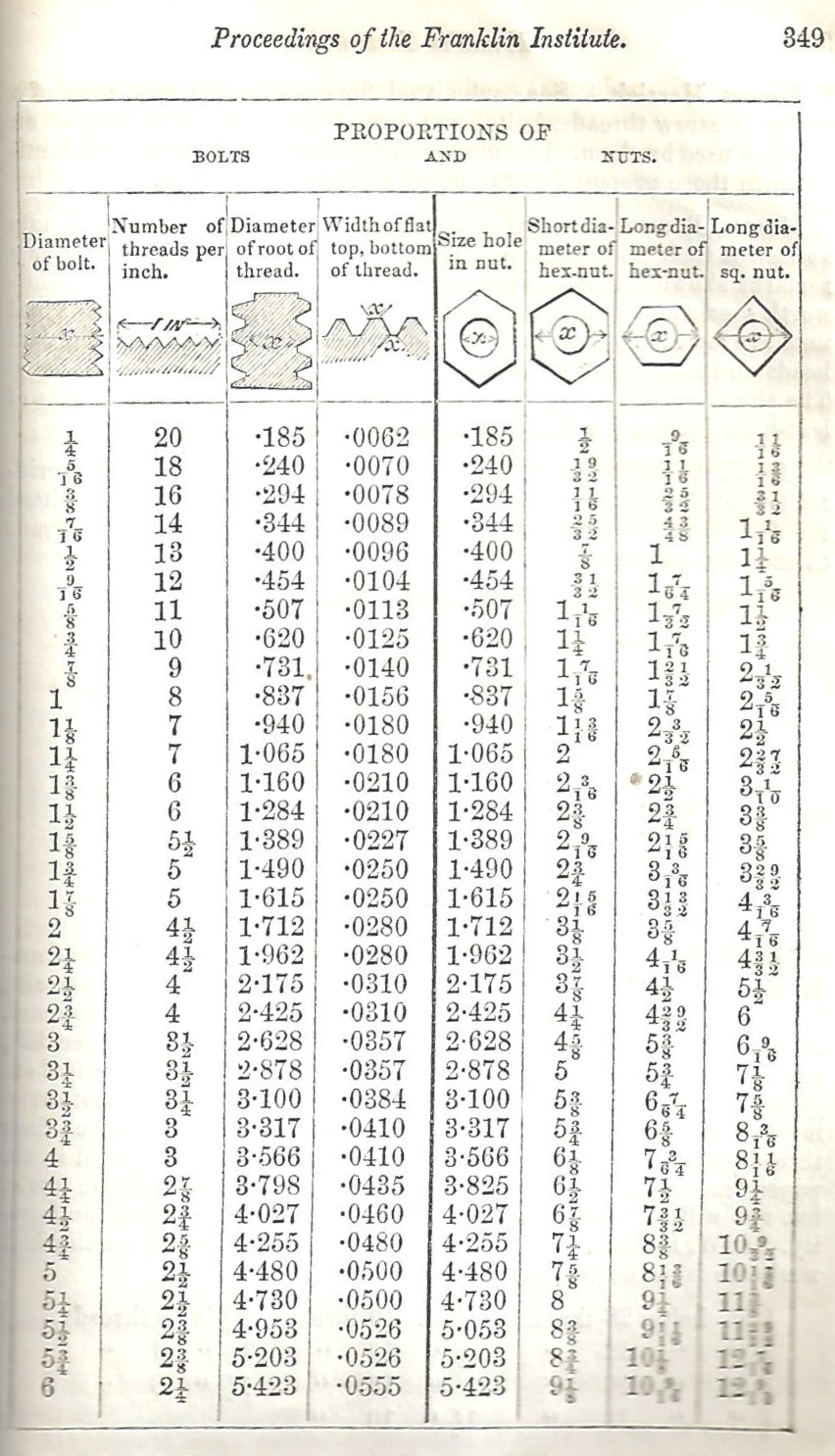
    JFI 1864 bolts (1)So, at first glance, this chart may look like a simple statement of nut and bolts specs. The importance of this chart is its commonplace appearance, and the overt statements about what all of these size and parameters should be, establishing a common denominator, a standard. Even though nuts and bolts had been around for at least 400 years when this chart appeared in the Journal of the Franklin Institute in 1864 (and threaded bolts and screws long before that), the idea of standardization of this hardware really hadn’t taken place until Joseph Whitworth gave the idea life in 1841. The nut and bolt industry was well underway, except that for X manufacturers there could be X-number of varieties of nut and bolt sizes from one location to another (near or far), which made things difficult for the end-user, as they could basically be using a proprietary design with their hardware. Standardization made it possible to buy a certain size nut in one country and mate it with the necessary bolt from another country (etc.) with the capacity of knowing that one will fit the other, which is a big deal. In any event, here’s a table of a U.S. attempt to codify those dimensions. 

            [See: W.R. Wilson,  The History of the Nut and Bolt Industry in America, 1905.]


  • Finger Prints by Wire (1921)

    JF Ptak Science Books  Quick Post

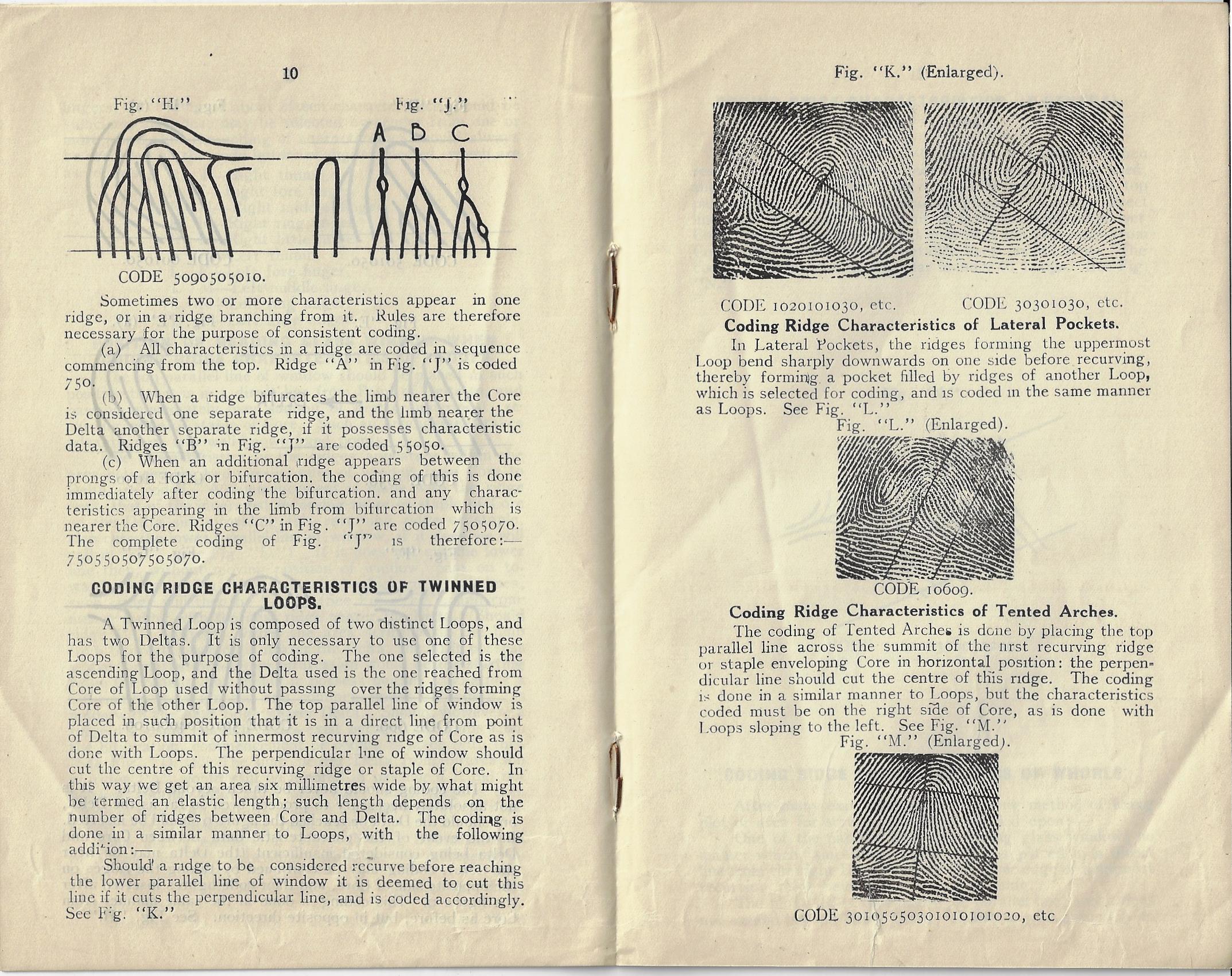
    The use of finger prints in identification is fairly old, used in Asia and India long before it became a popular practice in the West.  Also it seems that finger prints as forensic instruments occurs in literature before it occurred in actual police work. Mark Twain uses finger prints as essential legal elements (as well as comic relief) in his novels Life on the Mississippi (1893) and Puddn’head Wilson (1894), no doubt inspired by Francis Galton’s pioneering work on the subject (Finger Prints, published in 1892). Conan Doyle takes things a step further and describes the forging of finger prints, which I think was a brilliant idea.  All of this takes place before finger prints were more or less firmly established as an identifying tool, as the first conviction based on finger print evidence did not occur (in Great Britain) until 1902, while its weight in the conviction of murderers wasn’t felt until a first conviction was made using them in 1905 (and then 1910 in the U.S.). 

    Finger prints _1_

    Which brings us to these fascinating images of finger prints and their enumeration and transmission by wire,  which was the brainchild of the foremost finger print expert in the U.K., Detective Chief Inspector Charles Stockley Collins1 (M.B.E.), chief of the Finger Print Bureau at the New Scotland Yard.  I cannot determine how long in advance of this publication that he employed the idea of transmitting finger print data by telegraph, but it seems to be an excellent idea, sending important information relatively instantly over distances to help in conducting criminal investigation. It may be that this idea–far in advance of modern transmission practices, even though Arthur Korn’s first “facsimile” images were made as early as 1902–was seen at the time as both fantastic and obvious, the second impression coming almost immediately on the heals of the first, like one of those terrific ideas that seemed “obvious” once it was first stated.

    Notes:

    1. Charles Stockley Collins. A Telegraphic Code for Finger-Print Formulae and a System for Sub-Classification of Single Digit Impressions. Published at the Office of the Police Chronicle, London, (1921).  9×6″, 17pp, with two plates and 15 illustrations/drawings in text. Provenance: Library of Congress, with their rubber stamp surplus/duplicate on the front cover. There are only two copies of this work located in WorldCat/OCLC (Cornell and the British Museum); for all of what Mr. Collins accomplished, this seems to be his only publication outside of journals. 


  • The First Imagery of Einstein with “E=mc^2” Appears in…a Comic Book?

    JF Ptak Science Books  Post 2782
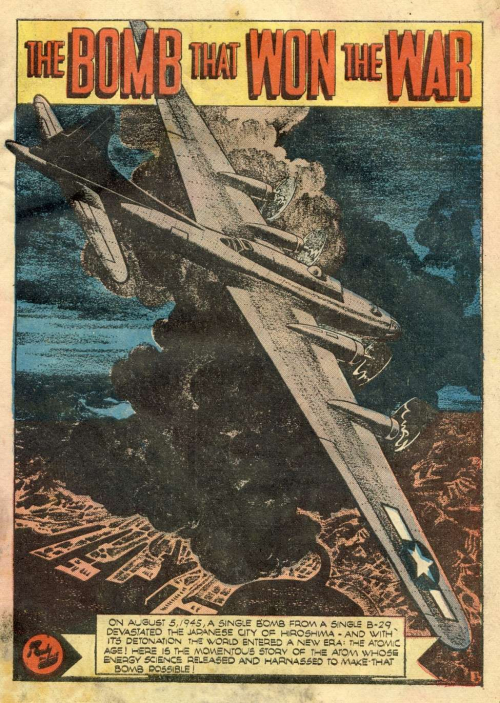
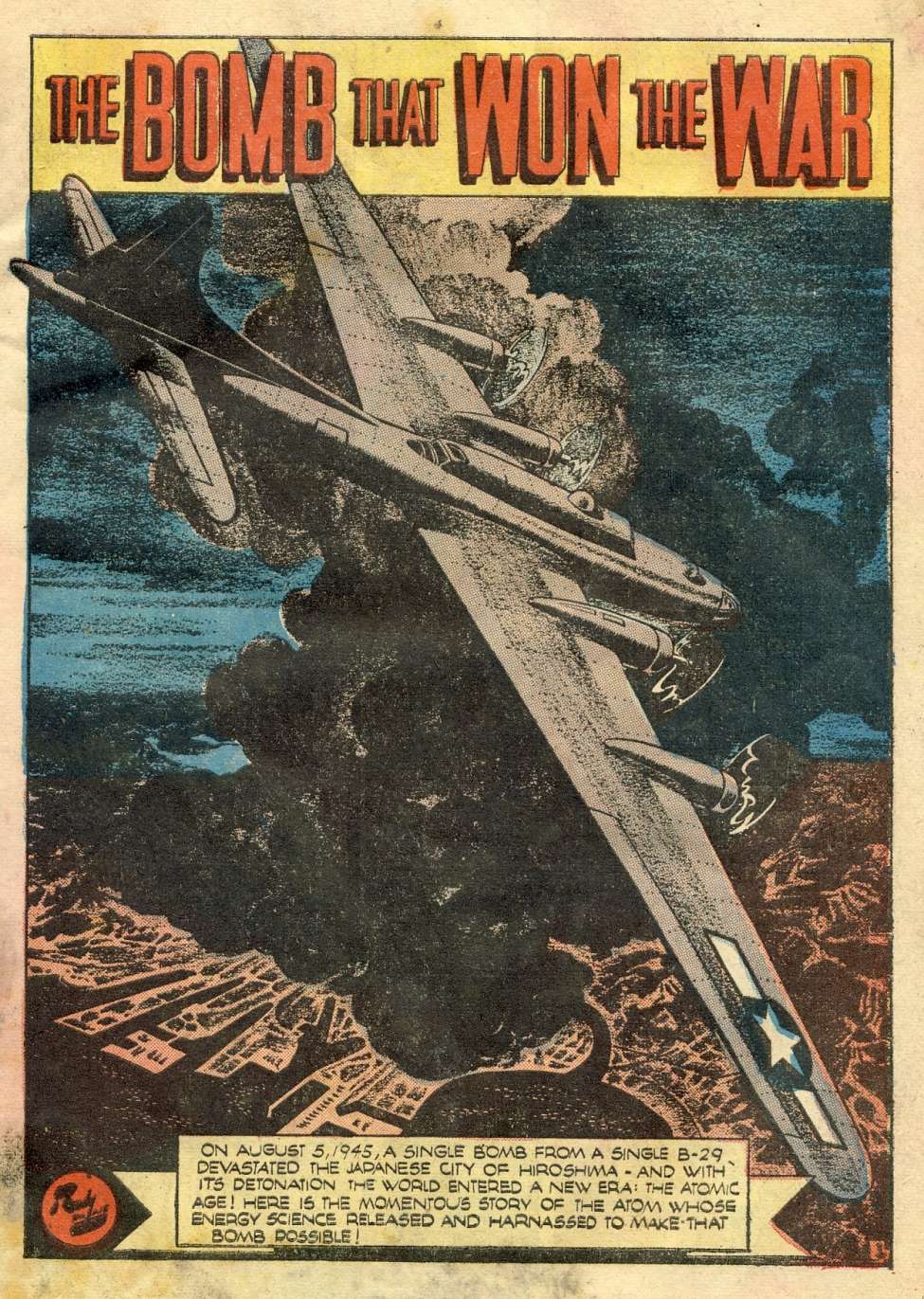
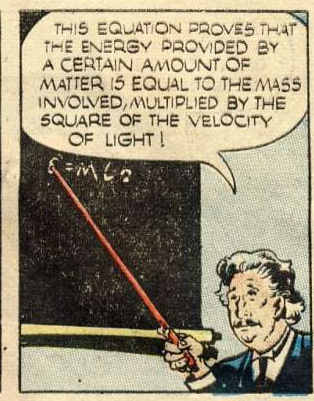
    Comic book hiroshima 1946After years of interest in the development of the atomic bomb and the half+-century of physics and chemistry that went into it, the question was put to me as to when the bomb’s use at Hiroshima and Nagasaki first appeared in a comic book. (It was potentially interesting to see how long it took  to see the effects of the bomb depicted to the very popular youth culture.) That led to an unexpectedly long and not very satisfying search for what turned out to be not a trivial answer. I’m not telling that story here now because the middle parts of the search are still a little unsorted–there was however another curious and provoking bit that popped up in the latest installment of the question,  found in what I think is the issue of this “first” comic book appearance of the use of the atomic bomb.

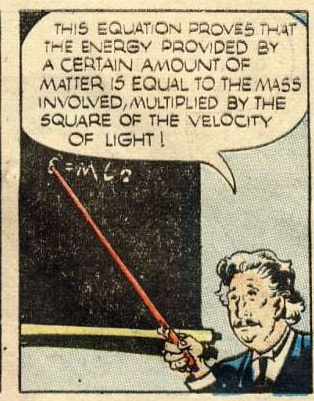
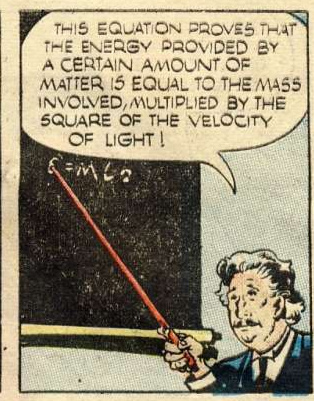
    Tucked inside this comic was an odd though not terribly wrong description of some of the background physics to the bomb. Amidst some fawning (?) and for no obvious reason highly caricatured images of physicists there appeared a crudely-rendered Einstein, and in his second panel, with his second blackboard, we see the The Equation, or almost so, appearing perhaps as   “E=mc2” or “E=mc2” [sic]. What seems to me to be the fact of the matter is that the equation that every schoolchild knows was not a very famous face to the great idea for nearly half a century, and nearly 25 years after Einstein received his Nobel (though that was not for relativity), because it just doesn’t show up. Long story short with a new subset, it seems to me that the very first time that Einstein publishes using this equation is not until the first issue of Science Illustrated,  in his article “E=mc2 the Most Urgent Problem of Our Time”, in April 1946.

    [Image sources above and below: Science Comics, vol 1/1, January 1946, from the wonderful website Comic Books Plus http://comicbookplus.com/?dlid=15937.  Also it is worth noting that the Enola Gay isn’t drawn very well, with extraneous stuff on the fuselage, and is also flying the wrong direction over Hiroshima and is too low…that’s all done for the sake of art, but, still, it ain’t right.]
    E=MC2 comic book 1946

    It didn’t seem possible that it took so long for the equation to be published under Einstein’s name, but it appears that this is the case. The theory appears with much else in Einstein’s miracle year of 1905 (where it was written as a sentence and not as a formula), and there are numerous other representation of the idea of mass-energy equivalence, but so far as Einstein writing it in its most recognizable notation, publishing it under his name, it looks like the first appearance comes years later.

    The equation seems not quite right here in the comic book, and of course it is a comic book characterization of Einstein who is writing it and not Einstein himself, so it seems that this is a curiosity and little else…except when you wonder where the comic book writer/inkman/artist was exposed to the equation so that he might include it in the story?  This must be a shadow of something else, obviously, though not a shadow thrown directly by Einstein. (Another twist came in July 1946 when Time magazine used an image of Einstein and a mushroom cloud on their cover, with E=mc2 written onto the mushrooming cloud. This is “close” but then again, not really–also it appears after the publication of our comic book and Science Illustrated.)

    Just a year earlier there was an appearance of “E=mc2 in Henry DeWolf Smyth’s Atomic Energy for Military Purposes: The Official Report on the Development of the Atomic Bomb Under the Auspices of the United States Government, 1940-1945, right there on page 2, in the introduction. (It was published months earlier in several formats by the U.S. government, though the Princeton 1945 edition reached more readers.)

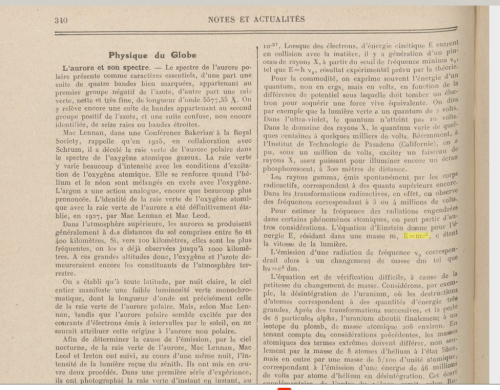
    This part of the story also has to wait to be told because I haven’t quite got the timeline down for the E=mc2 equation exactly as it appears and not written/published by Einstein, the earliest example that I have found thus far is 1929 (below). Today’s entry on this matter is more thinking-out-loud than anything else. 

    I guess the bigger question is: does it matter that E=mc2 doesn’t appear until much later, or that Einstein didn’t use it much?  Probably not. Other equations–like m=E/c2 and E0=m–were used in lecture and in other papers. It is simply curious to me why the equation has such a misty history given its supra-iconic status. 

    • I’m a little hesitant about posting this on the equation because it seems that the answer is obvious, which makes my question seem a little kooky–so far though the answer seems not trivial. 

    Notes:

    The first appearance in print in general of the equation is a much knottier question, with the “usual suspects” of possibilities exhausted without a satisfactory answer.  I must commend Eric Sacharow (an independent scholar in Milford, Connecticut) for instantaneously suggesting several possibilities during a phone call, all of which were very good and very close to the mark, but not quite there–thus far the best of the possibilities offered.

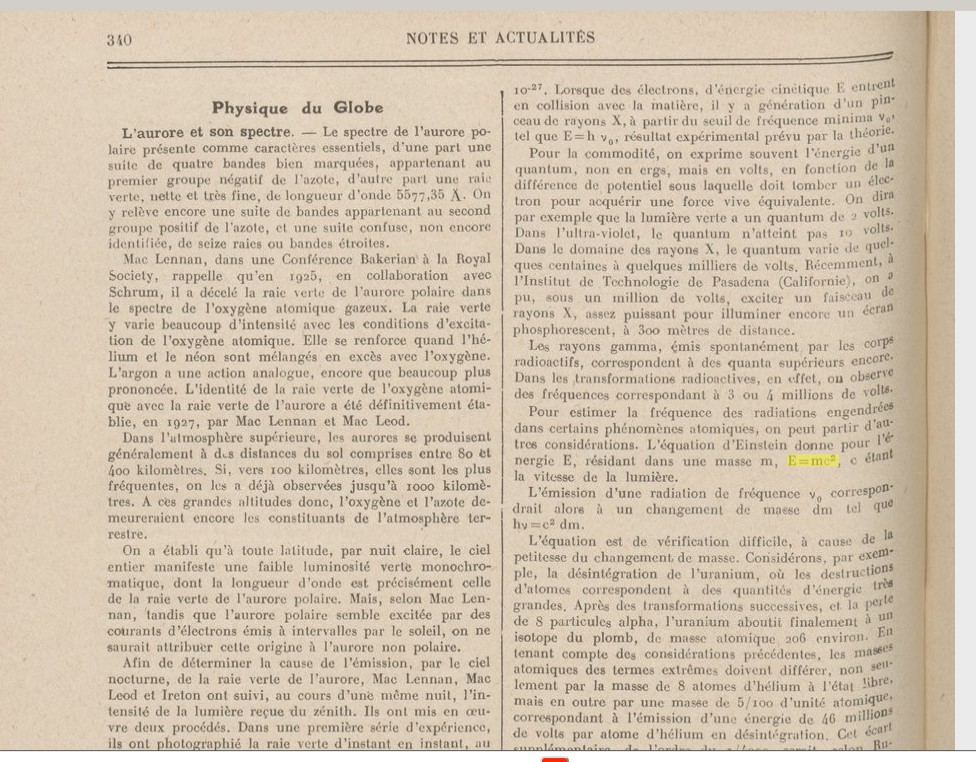
    Here’s an early appearance of E=mc2, in Revue Scientifique (Rose), 1929, in a review of physics for the previous weeks, a condensed review, signed only “S.V.”:
    E=mc2 1929 Revue

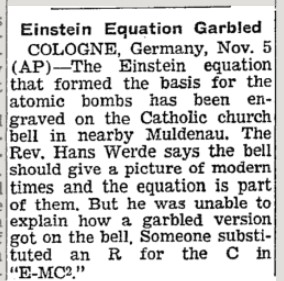
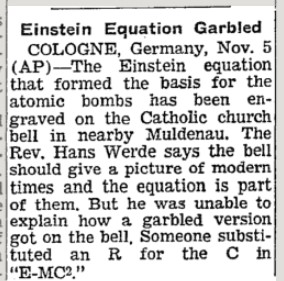
    And in this note from the New York Times (1950, sorry no further data yet) reporting on a “garbled” notation of E=mc2 that sounds as though it was engraved on a church bell as E=mr2 itself garbles the equation as “E-mc2“:
                                     E=MC 1950 NYT

    ·Posted by :

    ·in:

    —