A Daily History of Holes, Dots, Lines, Science, History, Math, Physics, Art, the Unintentional Absurd, Architecture, Maps, Data Visualization, Blank and Missing Things, and so on. |1.6 million words, 7500 images, 4.9 million hits| Press & appearances in The Times, Le Figaro, Mensa, The Economist, The Guardian, Discovery News, Slate, Le Monde, Sci American Blogs, Le Pont, and many other places… 5000+ total posts since 2008.

Category: Anticipation, History of

  • The First Microscopical Images of Captured-and-Reproducible Sound? (1878)

    JF Ptak Science Books   Quick Post

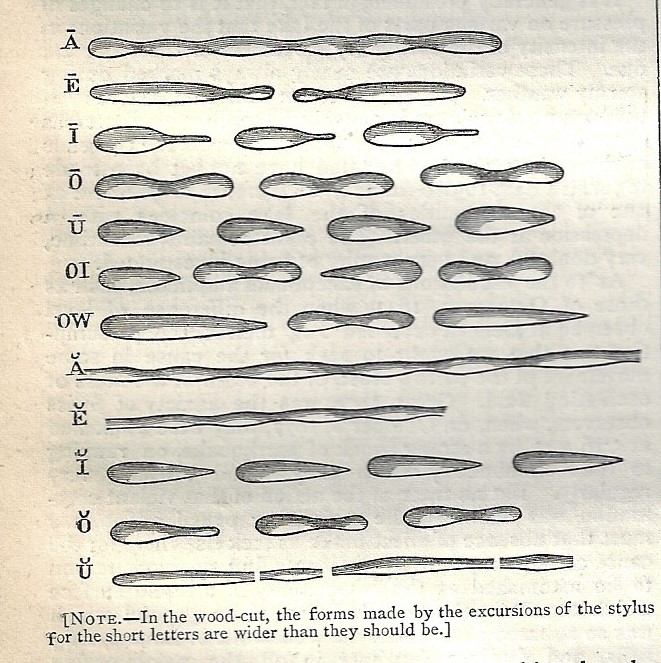
    Only months into the invention of the phonograph by Thomas Edison (at Menlo Park in December of 1877 and patented in January 1878) Alexander J. Ellis reviewed a version of it constructed in London by Mr. Stroh, and found it, well, wanting.  Ellis (1814-1890) was a product of Eton, Cambridge, Trinity, and was a gifted mathematician, philologist, and a groundbreaking ethnomusicologist, and did see some limited utility of the machine to restricted areas of his research. In the short note he wrote for Nature in their April 18, 1878 issue1, he mostly found that the phonograph was generally flawed in its reproductive capacity, and did not venture far from this interpretation so far as the possible applications of the machine was concerned, which seems iconically short-sighted from my perch here in the future. Even though Ellis recognized that “the effects produced are sometimes startling (as in cries, coughs, laughter, music), the philosophy of the process (making a permanent impression of a very complex compound vibration, and using it as a mould to reproduce that vibration is exceedingly attractive, but at present the instrument–at least the one that I saw…” he concludes that the status of the invention “…has not risen beyond a lecture illustration or a philosophical toy”.  

    Nature 1878 Perifser Frazer

    Five weeks after this article and about four months following the patenting a visually-arresting article appeared in Nature which contains what I am assuming to be the first microscopic images of recorded and reproducible sound. I know that is a pretty deep qualification, but I think that’s its accurate. The article appeared as “Examination of the Phonograph Record under the Microscope” by Persifor Frazer2, who investigated what the impression of the stylus looked like as known sounds are recorded on tin foil. And so this remarkable image, showing what vowel and some dipthongs “look like”.  

    Notes:

    1. Persifer Frazer,   “Examination of the Phonograph record under the Microscope”,  an abstract of a paper presented at the Franklin Institute April 17, 1878, by Persifor Frazer, Nature, May 23, 1878, p. 102, in the weekly issue. 
    2. Persifor Frazer was of the Philadelphia Frazers, of long and interesting lineage. A Gettysburg vet, he was in professional life mainly a geologist; he did become expert in handwriting and the detection of forgeries using photographic means.  

  • An Improbable Advertisement in “Astrophysical Journal”, 1903.

    JF Ptak Science Books   Quick Post

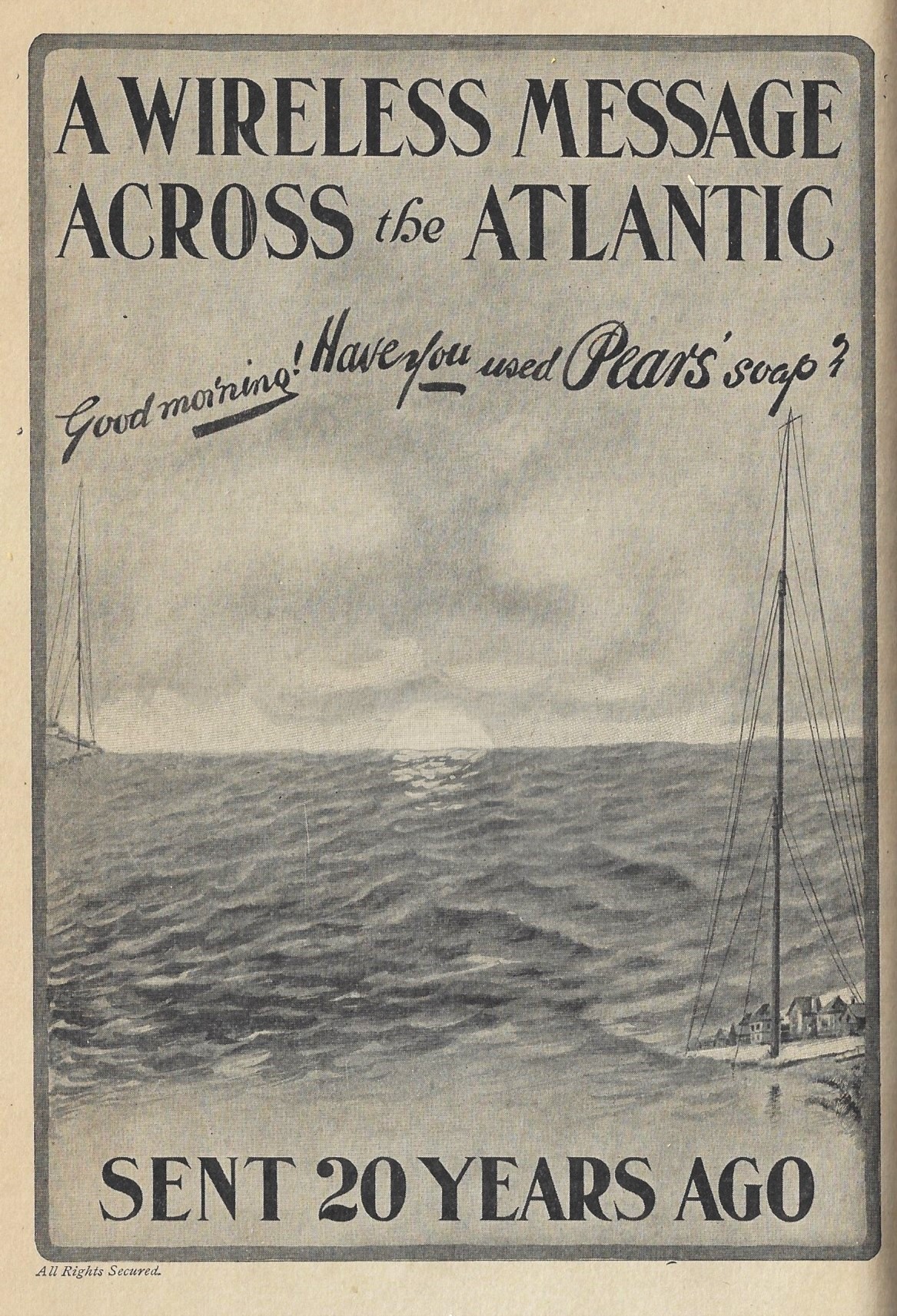
    Pears soapHere’s a scamperingly light post: an ad for Pears’ soap making a very curious and probably intentional incorrect claim. Of course it is just an ad, and it is just soap, but it is displayed proudly full-page on the inside cover of the prestigious Astrophysical Journal for 19031, and it seems to make an odd statement about transoceanic radio communication, inferring that a message was sent across the Atlantic via wireless “20 years ago”.

    Here’s the deal: I don’t understand why this ad is so purposefully wrong. The first message sent across the Atlantic didn’t occur “20 years ago” or 1883 as is coddled in the ad–that honor belongs to Marconi (1874-1934) who expanded on his first experiments in 1894 to send and receive radio signals across the Atlantic on 12 December 1903. (The signals originated in Poldhu, Cornwall, England, and was received at Signal Hill, St. Johns, Newfoundland—the message was a simple Morse code for the letter “s”.) Those twenty years notwithstanding, Marconi and Ferdinand Braun shared the Nobel in 1909 for their work in radio.

    Now, the ad says “sent 20 years ago” and not sent and received, or received at all for that matter. I know the “twenty years” doesn’t correspond to when Pears began operation, because that occurred in 1807. So I’m not sure what it is that they’re talking about here, though it is a pretty ad. If anyone has the answer to this little issue, I’d like to hear about it.

    (The antennas depicted here are very unlike the ones that Marconi constructed for his famous feat: “The spark-gap transmitter fed a mammoth antenna array — four hundred wires suspended from 20 masts, each 200 feet tall, placed in a circle. A similar station was set up on the American side of the Atlantic at South Wellfleet, Cape Cod.”–IEEE Milestones, “Milestones:Reception of Transatlantic Radio Signals, 1901.”)

    Notes:

    1. Oddly enough, Pears’ was about the only advertiser in the 1903 volume of the journal. I don’t know what the attraction was between soap and astronomy, though perhaps the elite at Pears’ just wanted to sponsor the relatively new journal.  


  • Edgar Allan Poe and Science: on the Infinite and Being It *and* the Big Bang Found in “Eureka”?

    JF Ptak Science Books    Post 2803

    I heard about Edgar Allan Poe’s “prose poem”,  Eureka, an Essay on the Material and Spiritual Universe (1848) , and its mystical relationships to scientific bits and bobs, but not much more than that. Looking at it it must’ve looked high-inspired Outsidery back in the day, the language and created references being somewhat impenetrable, and sometimes insufferable, except that it is was a piece of highly creative writing. The book was not well-received at all when published–the public reception was terrible, and it must’ve been a blow to Poe as hr thought that this was the best work he had ever done, and ever could do.  The pity is that he would be dead at age 40 only months later. The book is terrifically mysterious and probing, theologico-sci-fi-osohpy enthrallingly not-science science, and almost the entire audience he wrote for mostly hadn’t yet been born.

    • Link to the text of Eureka: http://www.gutenberg.org/files/32037/32037-h/32037-h.htm

    There’s an endless amount here that is interesting, if not obscure and obscured—much of what I find interesting is also heavily endowed with double-inscrutable jargon, though I think I can make out the meaning but for the words. [Caveat: that said, I’m no Poe guy whatsoever, though I do like his work, particularly the “Marginalia” series–which puts me in mind of Walter Benjamin’s The Arcade Project–but in general I’m just a general reader of the man with no expertise whatsoever.]

    To start this walkaround in the science in Poe I did a very simple word search: I looked for “Newton” (25 hits), followed by“Newtonian” (19 hits). Then came “God” (42), “particle” (23), “word” (71), “gravity (35), “love” (3), “mass” (38 ), and “soul” (20), and some others, none giving me the skeleton key I was looking for. (I haven’t read the whole book and didn’t have the time for it given that I only spend about an hour on each one of these blog posts.) I found my prize with “atom” (147 hits!) and read the appropriate sections, and that got me to where I wanted to go, or at least close to it.

    It begins with a rough entry:

    • “What I wish to impress upon the reader is the certainty of there arising, at once, (on withdrawal of the diffusive force, or Divine Volition,) out of the condition of the atoms as described, at innumerable points throughout the Universal sphere, innumerable agglomerations, characterized by innumerable specific differences of form, size, essential nature, and distance each from each. The development of Repulsion (Electricity) must have commenced, of course, with the very earliest particular efforts at Unity, and must have proceeded constantly in the ratio of Coalescence—that is to say, in that of Condensation, or, again, of Heterogeneity”
    • “Thus the two Principles Proper, Attraction and Repulsion—the Material and the Spiritual—accompany each other, in the strictest fellowship, forever. Thus The Body and The Soul walk hand in hand.”–pg 80

    Poe then goes on to describe the formation of the Solar System (which he estimates to the limits of the revolutions of newly-discovered Neptune to be “6 thousand million miles” which is very close to being correct) as the result of the meeting of two not-diametrically-opposed atoms, which nearly join together, and start spinning around each other, joined by other atoms, and so on, until an enormous uncohesive mass is form after which a collapsing takes place to form the planets as we know them. 

    •  “For ages, this mass of matter has been undergoing condensation, until at length it has become reduced into the bulk we imagine; having proceeded gradually, of course, from its atomic and imperceptible state, into what we understand of visible, palpable, or otherwise appreciable nebulosity….”–pg 85

    This is all some pretty interesting thinking for a man with no science background, sitting in a room.

    We did get to “Ultimately individual consciousnesses will collapse back into a similar single mass, a “final ingathering” where the “myriads of individual Intelligences become blended”, (pg 132) which does have a sort of Black Hole appeal to it.

    And then backtracking a bit I came upon this, 

    • “Let us now endeavor to conceive what Matter must be, when, or if, in its absolute extreme of Simplicity. Here the Reason flies at once to Imparticularity—to a particle—to one particle—a particle of one kind—of one character—of one nature—of one size—of one form—a particle, therefore, “without form and void”—a particle positively a particle at all points—a particle absolutely unique, individual, undivided, and not indivisible only because He who created it, by dint of his Will, can by an infinitely less energetic exercise of the same Will, as a matter of course, divide it. “–page 30

    I then came to what I think I was looking for, to a sort of Big Bang, or a cosmology that at least entertains some Big Bang bits:

    • “The assumption of absolute Unity in the primordial Particle includes that of infinite divisibility. Let us conceive the Particle, then, to be only not totally exhausted by diffusion into Space. From the one Particle, as a centre, let us suppose to be irradiated spherically—in all directions—to immeasurable but still to definite distances in the previously vacant space—a certain inexpressibly great yet limited number of unimaginably yet not infinitely minute atoms.”(pg 31)

    Lemaitre is still far off in the distance at this point, as are Gamow/Alpher/Herman–none would be born for another 50-60 years or so. But here we have some very probing thinking in an area that has something to it,  that can call on the prequel to the Big Bang, all rolled up in an enormous cosmotheology by a poet/writer/editor back in the year of revolutions, 1848.

    Poe knows that he is way out on a limb here, I imagine, and perhaps he was even being heretical: “I design to speak of the Physical, Metaphysical and Mathematical—of the Material and Spiritual Universe:—of its Essence, its Origin, its Creation, its Present Condition and its Destiny. I shall be so rash, moreover, as to challenge the conclusions, and thus, in effect, to question the sagacity, of many of the greatest and most justly reverenced of men.”

    Here’s where the “heresy” part might come into play, with endless god-beings in infinite space, even before existence existed

    • “…a still-existent Being existed—one of an absolutely infinite number of similar Beings that people the absolutely infinite domains of the absolutely infinite space”) who wades through eternity absolutely compacted and expanded, I guess ( “…a Divine Being, who thus passes his Eternity in perpetual variation of Concentrated Self and almost Infinite Self-Diffusion” ). And it is in that compacted part that all beings are created in their consciousnesses, and that eventually all of that will be molded into one big ball of being (“Think that the sense of individual identity will be gradually merged in the general consciousness—that Man, for example, ceasing imperceptibly to feel himself Man, will at length attain that awfully triumphant epoch when he shall recognize his existence as that of Jehovah.”)

    And now off to the finishing bits, the closing paragraphs on p 143:

    • “for pleasure and for pain:—but the general sum of the sensations is precisely that amount of Happiness which appertains by right to the Divine Being when concentrated within Himself. These creatures are all, too, more or less conscious Intelligences; conscious, first, of a proper identity; conscious, secondly and by faint indeterminate glimpses, of an identity with the Divine Being of whom we speak—of an identity with God. Of the two classes of consciousness, fancy that the former will grow weaker, the latter stronger, during the long succession of ages which must elapse before these myriads of individual Intelligences become blended—when the bright stars become blended—into One. Think that the sense of individual identity will be gradually merged in the general consciousness—that Man, for example, ceasing imperceptibly to feel himself Man, will at length attain that awfully triumphant epoch when he shall recognize his existence as that of Jehovah. In the meantime bear in mind that all is Life—Life—Life within Life—the less within the greater, and all within the Spirit Divine.”

    I hope I haven’t done a disservice here to Mr. Poe, or that I’ve gotten things terribly wrong–this is how it reads to me. Poe’s writing is dense and light at the same time, even transcendental–and so to try and nail a piece of writing like this to the floor it hovers above may be the entirely wrong thing to do.


  • A Vision of the Future: 1911 Takes a Look at 1950.

    JF Ptak Science Books  Post 2802

    While pacing through a volume of Technical World for December 1911 I found an interesting paper on what the world of the future–in 1950–held for the average person in 1911.  

    Introduction

    “Wait! Every ten years in America sees a revolution. Industrial phases assume new proportions, commerce enlarges its borders to rush over strange seas, politics become a tangled web during its evolutionary processes, economic problems broaden their scope. Were the possibilities of the great labor divisions of the world gauged by the strides made during the last fifty years, one would stand in wholesome awe of the vision. The last word in the reconstruction of America is far from being said, though tireless workers of science are constantly forming the new America out of natural forces already largely under their control.”

    Air travel and airplanes

    –“Charles K. Hamilton recently stated that the form of aeroplane now in use can be indefinitely increased in size, and that the speed and carrying power can be proportionately augmented. He believes the limited size of aeroplanes, thus far, to be merely a question of cost,…This will come today or tomorrow, and after that will come the Mauretanias of the air. In 1950 we may have air-ships a thousand feet long, flying at a rate of speed so high as to bring New York and London as near together as New York and Chicago now are.

    –Thomas Edison: “…the most serious difficulty to be overcome in aerial navigation—the difficulty of carrying fuel. “I do not know how to do it,” says the inventor of the phonograph, “but a method will be discovered of wirelessly transmitting electrical energy from the earth to the motor of a machine in mid air. There is no reason to believe it cannot be done.”


  • The Skinniest Early Description in the USA of the Invention of Photography (1839)?

    JF Ptak Science Books   Post 2801

    Among the earliest and lengthiest mentions of the newly-announced Daguerre invention of photography in the U.S. was “Pencil of Nature—A New Discovery”  that appeared 13 April 1839 in the Corsair: A Gazette of Literature, Art, Dramatic Criticism, Fashion and Novelty. There’s a lot in there on the effects of what the new process might be more so than any real description of what the magical new process was. It would take several months for that to appear, and one of the first to do so, to provide some real detail on what was still a rather mysterious event and process, appeared in the National Intelligencer on 25 September 1839 (which was based on the 23 August 1839 London Globe account).

    The Corsair article starts out bemoaning “progress”, in a way, setting the reader up for the next step of the democratization of art, which would meanwhile send the world of engraving (and engravers), lithography, sketchers, painters, and so on, who would all be replaced by the new invention of Daguerre.

    • “We know not how it is, but just as we are going to have something good in this world, up starts a mischief to mar it or to vilify it. There is not a real panacea, but has its rival. Engraving, set upon a firm basis, one would have thought might have been supreme. No such a thing—her illegitimate sister, Lithography, sets up her claim, and by means of cheap publications, calls in the masses, who naturally prefer the inferior article; and here commences the democracy of art.”

    And just like any advancement in anything—from water delivery systems in towns and cities that would replace the water-fetcher to the lineman working on some U.S.-built car being replaced by robotics, and etc.–the author sees the fate of the artisan in light of photography:

    • “Here is a revolution in art; and, that we may not be behindhand in revolutions, for which we have so imitative a taste, no sooner does one start up in Paris, but we must have one in London too. And so Mr. Daguerre’s invention is instantly rivalled by Mr. Fox Talbot’s. The Dagueroscope and the Photogenic revolutions are to keep you all down, ye painters, engravers, and, alas! the harmless race, the sketchers.” –Source: Gary Ewer, http://www.daguerreotypearchive.org/texts/P8390015_PENCIL_CORSAIR_1839-04-13.pdf

    It is interesting to see the variety of titles given to the earliest articles and notices of Daguerre from January through August 1839—granted for most of that time there were very few details of the process until late summer 1839 at which time the article titles became more directed and less fanciful. The following is a selection of the articles that appeared at this early stage—all of the work putting together the remarkable list of linked publications that these titles are taken from is that of Gary Ewer at the Daguerreotype Archive, here: http://www.daguerreotypearchive.org/1839.php

    • “The Daguerotype” [sic]
    • “Fixation of Images”
    •  “Chemical and Optical Discovery”
    •  “The New Art
    • “Clericus”
    • “Remarkable Invention”
    • “Extraordinary Chemical and Optical Discovery”
    • “New Discovery—Engraving, and Burnett’s Cartoons.”
    • “Self-Operating Processes of Fine Art”
    •  “Sun-Painting”
    • “The Daguerrotype” [sic]
    •  “Photogenic Drawings”
    • “Daguerre’s Photogenic Paper, and Fixation of Images”
    • “Pencil of Nature—A New Discovery”
    •  “New Discovery in the Fine Arts—The Daguerroscope” [sic]
    • “The Daguerrotype, or Solar Engraving”
    •  “The Daguerre Secret”
    • “The Pencil of Nature”

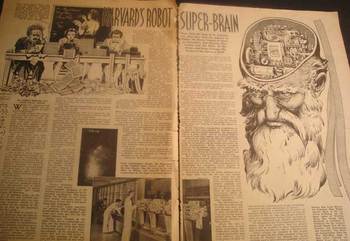
  • Leonardoesque Robot Brains, the Harvard Mark I, and a Peek into the Future of Computing (1944)

    JF Ptak Science Books   (Expanding an earlier post from 2008)

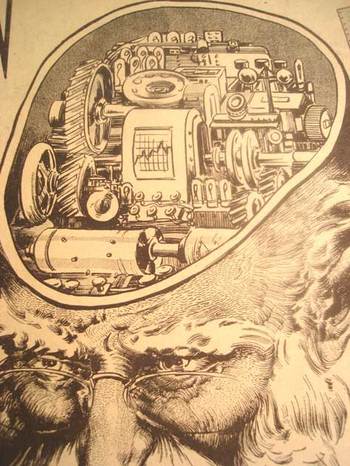
    Blogharvardbrain This may well be the first popularly-written and popularly-published report on the Harvard Automatic Sequence Controlled Calculator (ASCC) (appearing in the American Weekly, 15 October 1944), which was the first automatic, general-purpose, digital calculator.  Known as the MARK I, it was the brainchild of Howard Aiken (1900-1973), a graduate student at Harvard, who started it all in 1937 by proposing a series of coordinated Monroe calculators to function as a unified whole  that would cross the threshold of the physically-impossible calculation (though theoretically possible) to the eminently doable.  The project was immeasurably aided by the input of Harvard astronomer Harlow Shapley (who had earlier dealt with the enormously problematic aspects of the scale of the universe) who put Aiken in the hands of IBM at Endicott (NY).  From there the building of the computer came under the supervision of Clair D. Lake, with the engineering and theoretical team of Francis Hamilton, Ben Durfee and Howard Aiken. 
    Blogharvardbraindetail
    The machine was basically completed in 1943 and tested in Endicott for the better part of the year before it was shipped of to Harvard in February 1944, where it was put almost instantly to work on ballistic calculations (like its cousin ENIAC at the Moore School at U Penn), as well as naval engineering and design issues. 

    The author of this article, Gordind Bhari Lal (“noted science analyst”), actually does a pretty decent job describing the machine and its (1940’s) possibilities, noting at the end that “it may even unleash for Man’s Use the long-dreamed-of energy of the atom”.  This part did come true, especially post-war, when the machine was put to fair use by the US Atomic Energy Commission. 

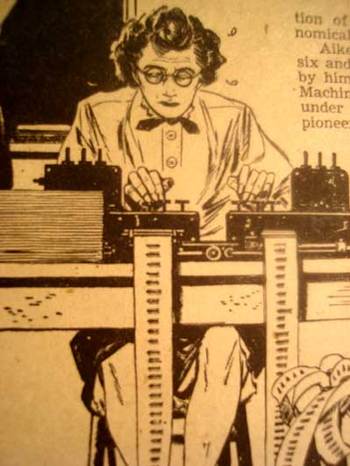
    The part I really don’t understand in this article is comparing the speed and function of the ASCC to two women working on calculators and Albert Einstein, working with a pencil, paper and pipe, none of whom look comfortable or happy.   Lal does make a decent comparative point (of uncertain veracity) about four generations of humans (the three above-mentioned calculators?) doing calculations that the ASCC could do in seconds.  Right or wrong, it gave the crowds in 1944 a real something to think about.
    Blogharvardbraingirl


  • On the Annihilation of the Mind (1877)

    JF Ptak Science Books   Quick Post

    I found an article with a captivating title and didn’t know where it would take me, except that at the end we got to the point of life-and-death being somewhat in league with the conservation of energy. Anyway, the title is as you see it in the title of this quick post, “On the Annihilation of the Mind”, written by the considerable John Trowbridge, who was a professor of physics at Harvard, an E&M guy, and the major force in establishing the Jefferson Lab at Harvard. I recall that he was very prolific in addition to his teaching duties, and right about this time published several articles on the Bell telephone, which made it first appearances less than a year before this article, which published in the Popular Science Monthly in April 1877.

    The last three sentence sum the article up, though I’m not exactly sure of how the author arrived at his conclusions—it bears repeating in spite of the result, if for no other reason than to share the pretty remarkable structure of the close of the article.

    And so:

    “The doctrine of the existence of the spirit after physical death seems to me not to be foreign to the scientific ideas of the conservation of force, which have now obtained such complete supremacy in the science of physics; or to the doctrines of Darwin, which are accepted by so large a body of eminent naturalists. Without the sun there would be an annihilation of force. When energy is dissipated, we find the sun exalting it again by processes which we cannot completely follow. The idea of a great source of life and mind, the prototype of our physical sun, which sets in motion a vast scheme for the survival of the fittest, and the exaltation of energy in vast cycles, is not inconsistent with the doctrine of the New Testament, and seems to be required in a philosophical theory which shall endeavor to account for the differences in that great spiritual world which are continually suggested to the human mind by the various types of mental growth.”

    ·Posted by :

    ·in:


  • A 19th-Century 3-D Printer (1864)

    JF Ptak Science Books  Post 2799

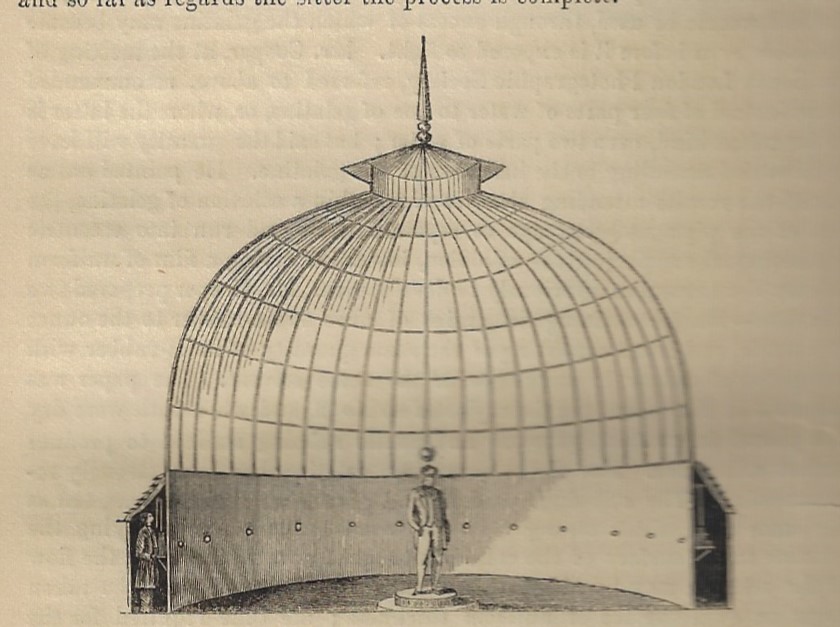
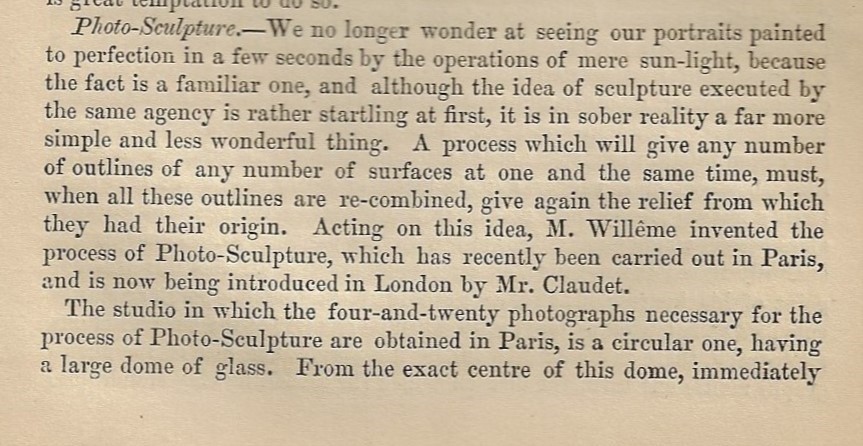
    Well, the title to this post is not quite right as we would think of it in modern terms: this one is a human-based photo-aided clay fabricator of 2-D images into 3-D, which is something. What we have here is a dedicated apparatus for making a continuous photographic 360-degree view of a subject, set in order on a revolving disc on a magic lantern and projected onto a screen with a sculptor viewing the progression and making cuts and changes to his lump of clay in response to the change of perspective. The photographs of the subject were made in a circular hall, the walls of which hosted 24 regularly-spaced cameras working in unison to make a complete photographic record of the subject. The images were then taken and arranged in order on a large disc and portrayed slowly on a screen behind which the sculptor worked his magic.

    Pop Sci Rev 1864 Photo sculpt _3_

    The author tells us the process came from Paris via Francois Willeme (1830-1905), who seems to have created the process in 1859 and patented it in 1860 (1864 in the U.S.), and who started a veritable “craze” for the process.

    The article I’m referencing and reproducing here is from the Popular Science Review of 1864, though an earlier paper was published on the process in the Journal of the Franklin Institute in 1861. Offhandedly I’ve spotted several articles in the Scientific American in 1867 (including a piece of micro-photo-sculpture), plus many other papers published before 1880, so the processes wasn’t obscure by any means.

    In any event I found this interesting—having never seen this application before—and thought to pass it along. Plus the woodcut of the imaging room (or 3-D “scanner”) is very appealing in itself.

    Pop Sci Rev 1864 Photo sculpt _3_

    ·Posted by :

    ·in:


  • From the Department of Hopes and Dreams: the Red Cross, St. John, and POWs (WWII)

    JF Ptak Science Books   Post 2798

    I assembled a little collection of WWII Red Cross and St. John charity pamphlets–what they all share is a sense unity, duty, perseverance, and hope. They are all published between 1942 and 1944, the majority coming in the summer of 1943–a wicked bad time for the Allies, perhaps the worst time since the Nazi onslaught of Europe. Five of these pamphlets directly addressed trying to help the prisoners of war held by Nazi Germany, and portrayed some healthy and sustaining images of the possibilities of POW life, as well as what would seem to be a high chance of delivery all manner of goods to the prisoners to make their time behind barbed wire somewhat more bearable. (Several of these short pamphlets are reproduced below, while the covers of four of them follow):

    Red Cross POW _1_ (1)


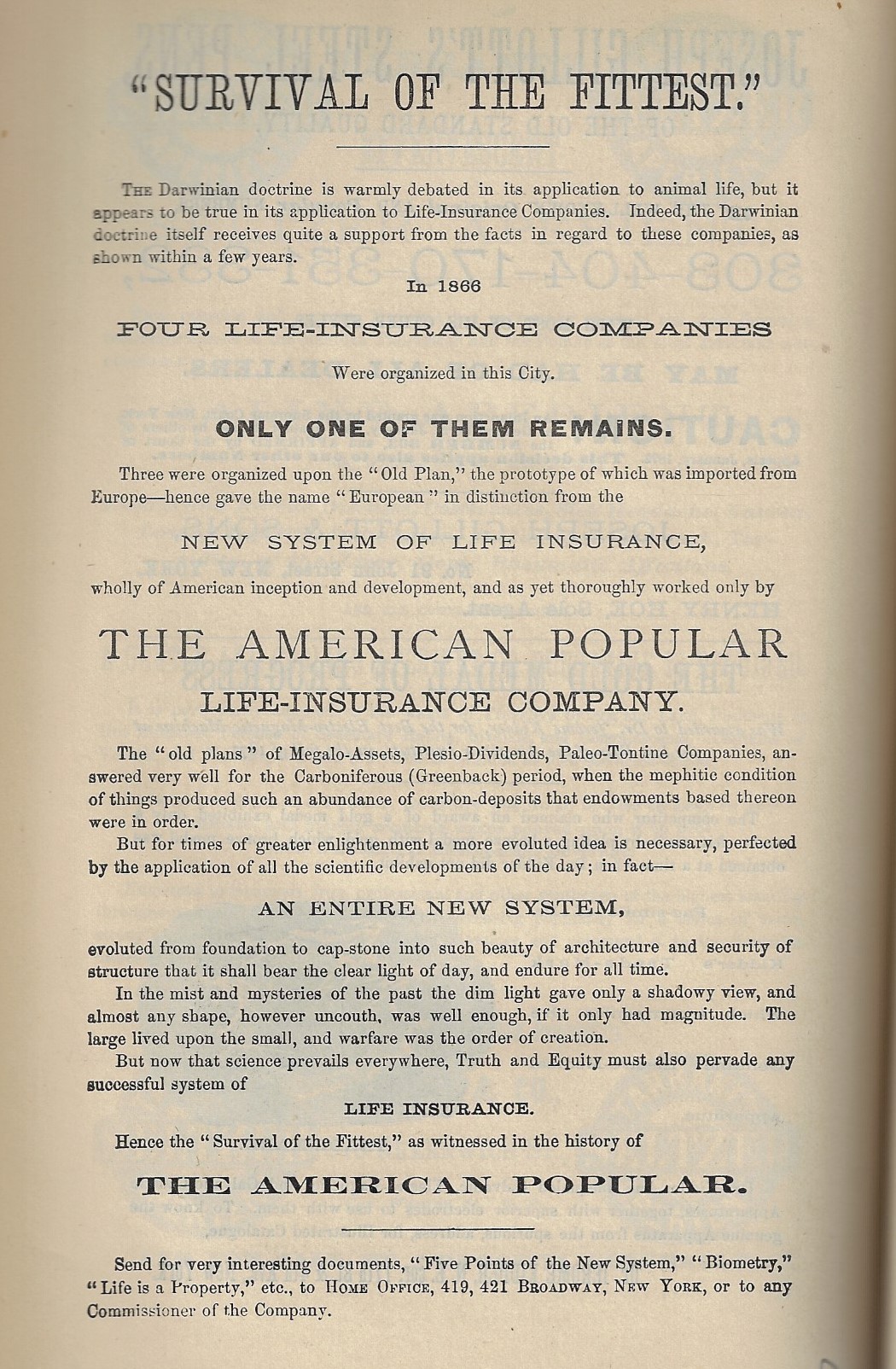
  • Using Darwin to Sell Stuff–an Early Appearance of Marketing Darwin (1877)

    JF Ptak Science Books  Quick Post

    I can’t be sure of where this stands overall, but it certainly seemed to my reading over the last x-yearsx that using a quote or idea from our Mr. Darwin to sell something in the first decade or two after the publication of On the Origin of Species…. is a rare thing. So seeing this ad in the back of the volume of Popular Science Monthly (1877) was really surprising, as it was taking the phrase we find in Darwin to sell the long-lasting qualities of a life insurance firm.  (Well, the phrase actually starts out with Herbert Spencer as he was influence by OTOOS, writing it to express an idea in economics in his Principles of Biology in 1864; Darwin himself adopts it in Variations of Animals and Plants under Domestication in 1868 and then in the fifth edition of OTOOS in 1869. I’ve included a lengthy quote from the Spencer, where the phrase turns out on page 444.)  I do have a recollection of a drawing in Punch of a crying Mr. Darwin in a quarter illustration promoting kindness to animals or some such…but offhand there’s no memory of using the man/ideas as a sales vehicle before this. Again, that’s not my field so I may be missing a lot–if you know of other ads like this please let me know.  

    Pop Sci Mo 1877 survival fittest full