A Daily History of Holes, Dots, Lines, Science, History, Math, Physics, Art, the Unintentional Absurd, Architecture, Maps, Data Visualization, Blank and Missing Things, and so on. |1.6 million words, 7500 images, 4.9 million hits| Press & appearances in The Times, Le Figaro, Mensa, The Economist, The Guardian, Discovery News, Slate, Le Monde, Sci American Blogs, Le Pont, and many other places… 5000+ total posts since 2008.

Category: Anticipation, History of

  • On Flying Machines–Scientific American, 1848

    JF Ptak Science Books  Quick Post   Overall Post 5120

    I found a short article on human flight (“Flying Machines”) in the fourth volume of Scientific American (1848).  It is an interesting and occasionally predictive piece that saw a bit into the future, well past the contemporaneous failures and iron-punk possibilities of sky machines, into a place of “mathematical certainty.  The writer saw the possibility of heavier-than-air flight, only just not in 1848 (or any time soon). “The air furnishes a vast fund of power for the use of mankind, although as yet they have only used it to propel ships and wind-mills. We live in an age of great discoveries and improvements, and among these will certainly be ranked the navigation of the air.” 

    And so some snippets from the article: 

    “Flying Machines and Perpetual Motions are very old and unfortunate acquaintances. No people have invented so many as the Germans, and many a poor fellow has lost his life by his fool hardy confidence in some machines he had invented to ride upon the winds, yet for all the accidents that have taken place to high flyers, from the Dutch Doctor at Ratisbone in 1692 to the unfortunate Englishman who perished a few years ago in London when descending by a parachute, there are still to be found new flying machines coming out every few months. An Austrian made quite a fine display in Cremone Gardens, London last winter, by taking several long jumps with a steam flyer. Since that we have heard no more about it, and presume it has met the fate of its illustrious predecessors…

    IMG_3864 (1)

    “But the end of flying machines is not yet, and here we insert the description of a new and an original one certainly, taken from the Jacksonian published at Pontiac, Michigan… After describing how wings had been tried to beat the lark and eagle, he says:—“As wings then, have failed, and balloons been attended with no better success, men have begun to think that the end is unattainable, and that flying is a victory which man can never achieve.”


  • The Not-Unbearable Extra-sub-Heaviness of Light (1876)

    JF Ptak Science Books  Quick Post (Overall post 5119)

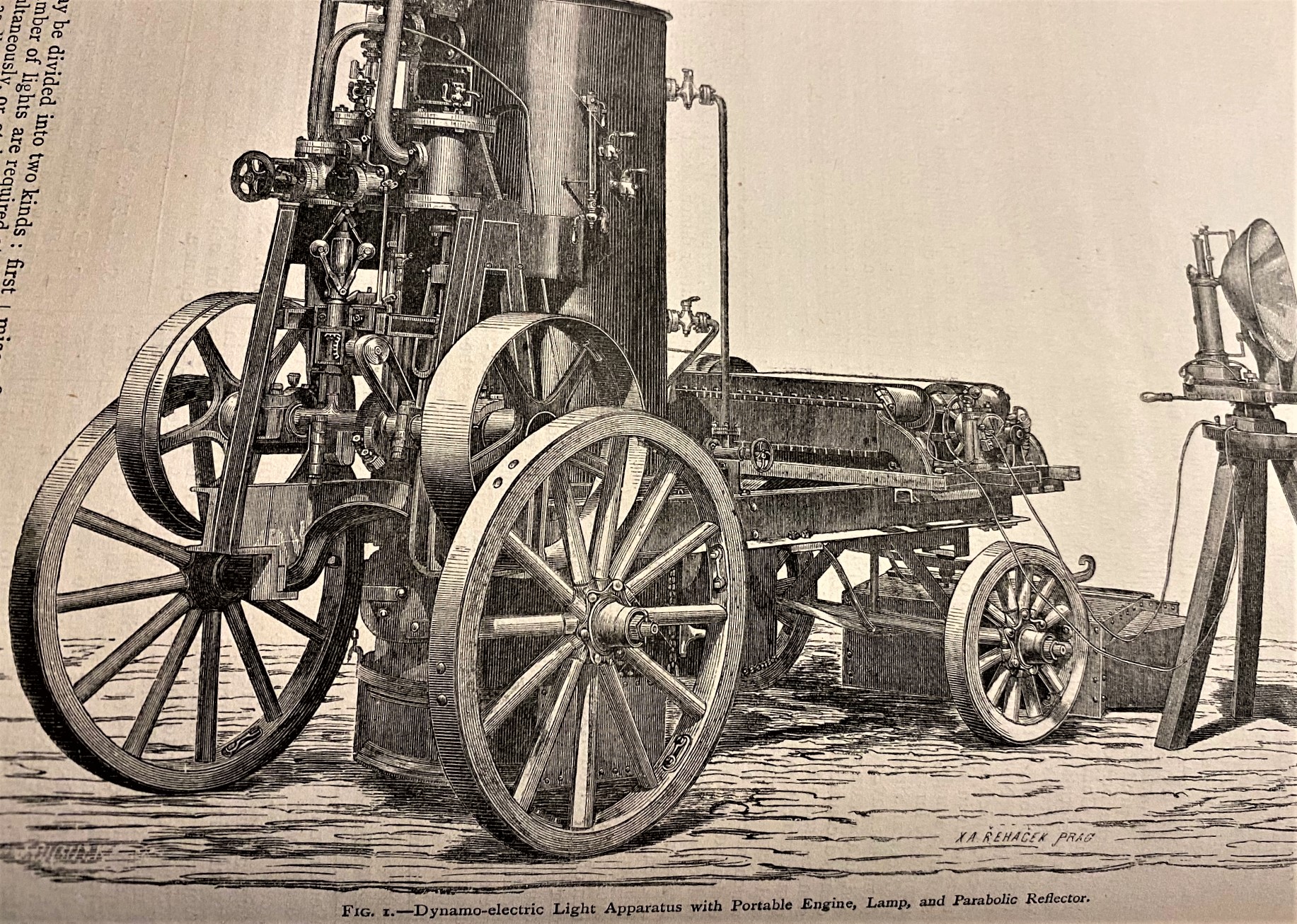
    I thought it would be interesting to share this engraving of a portable electric light apparatus. This does come very early in the modern (post 1850) sense of “electric light”, but, still, even knowing of how early this is in this fiel dit is still a little shocking to see the weight of the engineering and ingenuity in providing mobile electric light.  

    • “THE comparatively infrequent employment of electric light, considering the great success achieved in its production, would at first sight appear to be due to something in the application of the electricity itself. It has been repeatedly and satisfactorily proved that a continuous and powerful light can be produced by electricity, and the question naturally arises, Why is it not more frequently employed for practical purposes?”
    • “For transportation of the Dynamo-electric Light Apparatus is mounted on a wagon, with steam engine, the whole weighing 4,960 lbs. The combination has proved very serviceable on account of its lightness and compactness.”– Siemens’ Electric Light Apparatus. Nature 14, 133–136 (1876).

    IMG_3381


  • “The Fine Sport” of Flying, 1893.

    JF Ptak Science Books    Quick Post (Overall Post 5117) 

    Lillienthal

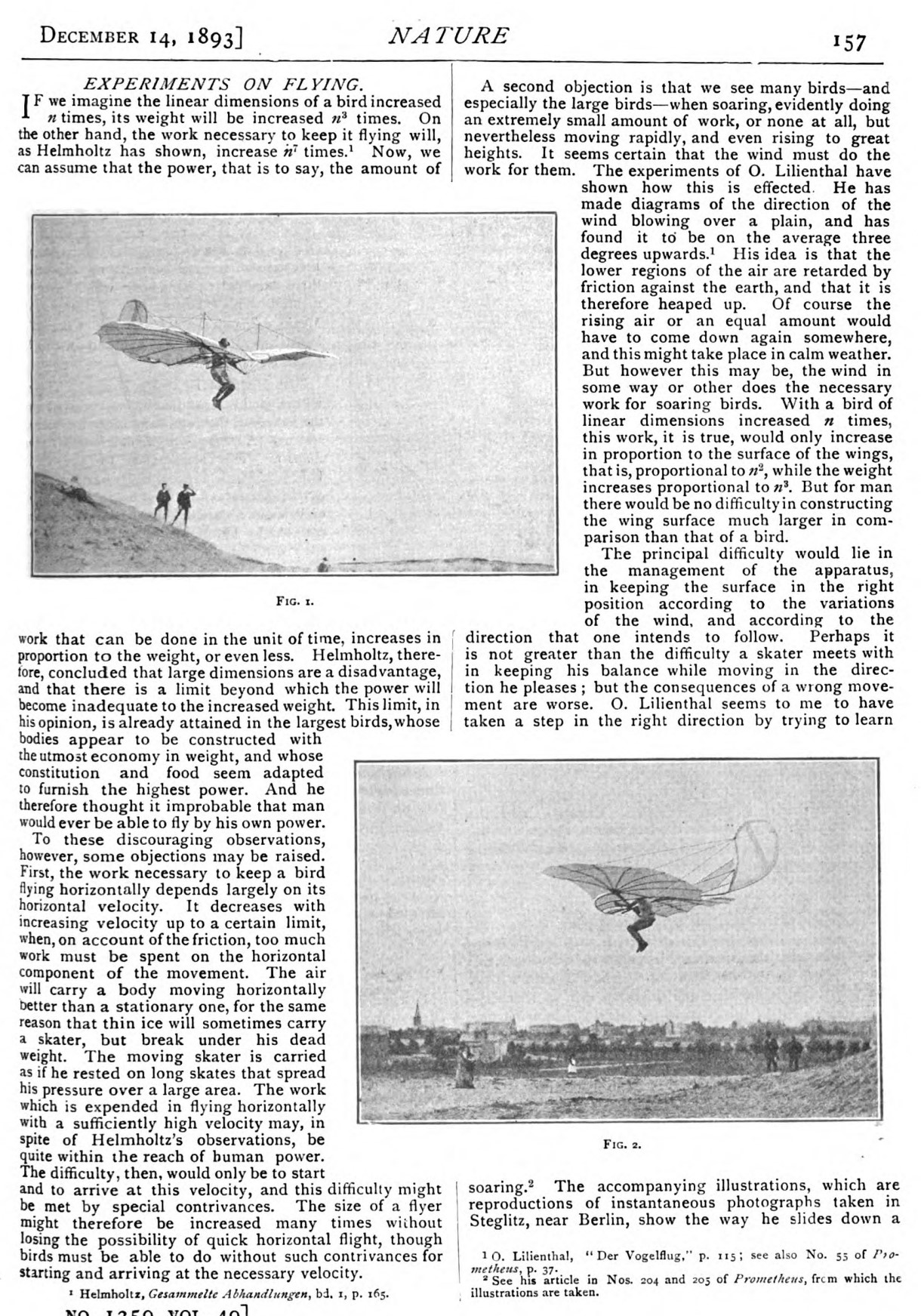
    I found an interesting article in Nature1 just now,  a piece by Carl Runge on 19th century heavier-than-air human flight by the remarkable Otto Lilienthal. 

    Lilienthal was an international authority on human flight, and was known to many as The Flying Man, and The Father of Flight, because, well, he flew. And he flew more often and with more recorded/documented successes in his non-powered flying machines than any other aviation pioneer of the time. In fact, he had a major influence on the Wright brothers (though not necessarily for his experimental data, which they abandoned after a while to create their own in their wind tunnel), with Wilbur Wright saying: “Of all the men who attacked the flying problem in the 19th century, Otto Lilienthal was easily the most important. … It is true that attempts at gliding had been made hundreds of years before him, and that in the nineteenth century, Cayley, Spencer, Wenham, Mouillard, and many others were reported to have made feeble attempts to glide, but their failures were so complete that nothing of value resulted.” (From the Wikipedia article on Lilienthal.)

    Lilienthal was well into making  successful jumps/flights by this time, but would suffer his fatal fall in about two more years, dying August 10, 1896, after a series of 850′ flights. (I’m offering a later paper on Lilienthal, also available on ABE, from Nature for 12 December 1894.)

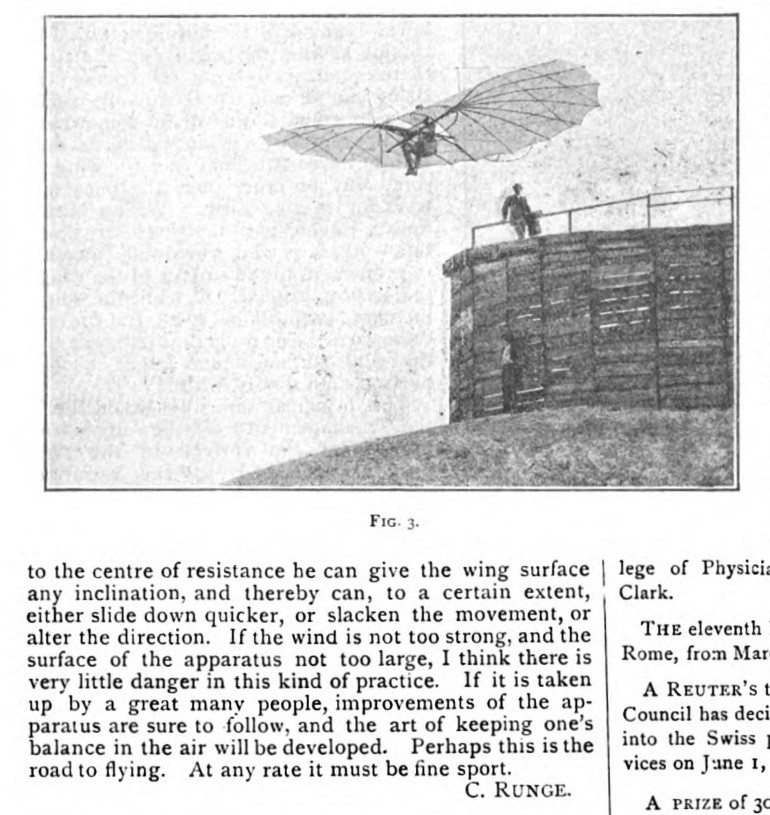
    The last three sentences by Runge are remarkable:

    “If it [flying or attempting to do so]  is taken up by a great many people, improvements of the apparatus are sure to follow, and the art of keeping one’s balance in the air will be developed. Perhaps this is the road to flying. At any rate it must be fine sport.”

    Notes:

    1. (LILIENTHAL, Otto). Runge, C. “Experiments on Flying”, in Nature, a Weekly Illustrated Journal of Science, 14 December 1893, volume 49 no. 1259, pp 145-168, with the Runge article on pp 157-8, with three photo illustrations of Lilienthal in flight.

    Lillienthal _2_


  • A Note on Explaining Impressionism as a Result of Astigmatism (1872)

    JF Ptak Science Books  Post 2907  (Overall Post 5116)

    Years ago I wrote short post here on the influence of eyesight and modern art, something along the lines of Impressionism owing itself to artists with poor/uncorrected vision. It was along the lines of alien outer space space aliens determining that for the USA the most revered object in society was what we called “automobiles”–we feed them, wash them, take them out for exercise, work long hours to afford them, get them regular checkups plus occasional doctor visits, etc.–and so in this light Impressionism is born of astigmatism by an artist who thought that their color symphony was what everyone was seeing, and not just a product of their poor eyesight, and lo! a revolution in imagination is created.

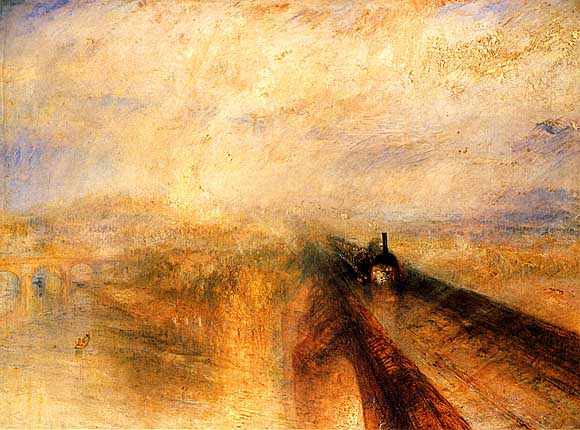
    After this bit the subject really never came up…until last night, when I happened on a story by Richard Liebreich in several 18721 articles in the early years of publication of the great science journal, Nature. Between an article on the new Yellowstone Park and another on adaptive coloration of mollusks is “Leibreich on Turner and Mulready”, and on the face of it there’s not much in the title to excite an interest, unless you knew that the first name was that of a celebrated ophthalmology person, suggesting something-or-other in the science/art realm. This appearance is a report on Liebreich’s lecture to the Royal Institution on 8 March 1872 “On the effects of certain faults of vision on painting, with special reference to Turner and Mulready”, the title here getting straightaway to the point, which was basically explaining the creation of Impressionism due to abnormalities in artistic vision.

    Liebreich (1830-1917) was a fine anatomist, an artist and sculptor, an assistant to one of the 19th century’s greatest minds in von Helmholtz, creator of his own ophthalmoscope, and creator of the first atlas of ophthalmology, and so had the chops to look deeply into the possible physiological aspects of vision. He applied this talen to the pre-Impressionist JMW Turner, and evidently found that was people find to be genius in Turner was to Liebreich the possible result of astigmatism. He writes:

    • “It was particularly important to ascertain if the anomaly of the whole picture could be deduced from a regularly recurring fault in its details. This fault is a vertical streakiness, which is caused by every illuminated point having been changed into a vertical line. The elongation is, generally speaking, in exact proportion to the bright- ness of the light; that is to say, the more intense the light which diffuses itself from the illuminated point in nature, the longer becomes the line which represents it on the picture.”

    Giving Liebreich the benefit of the doubt here, it should be noted that when he was working this out in 1871/2 Impressionism was still a very young idea, and Turner (1775-1851) was already dead for 21 years. His access to other examples of Impressionist works was no doubt extremely limited, as the first exhibition of Impressionist painters was still two years away in 1874. (This show displayed works by Degas, Monet, Pissarro, Renoir, Cezanne, Sisley, Morisot and others, and resulted in sales of only 1000 francs for Monet, 200 francs for Renoir and Cezanne, 130 francs for Pissarro, with Degas and Morisot selling nothing. The second exhibition—two years later in 1874—would do a little better.) Anyway my guess is that there wasn’t much for Liebreich to compare Turner to, and so relied on his interpretation of physiological evidence to explain Turner’s revolutionary depiction of light and form. I’ve wondered what people tried to make of Turner in the 1830s—now I know a little of that story, from a little later on. Liebreich writes:

    • “Everything that is abnormal in the shape of objects, in the drawing, and even in the colouring of the pictures of this period, can be explained by this vertical diffusion of light. Till the year 1830 all is normal [re Turner]. In I831 a change in the colouring becomes for the first time perceptible, which gives to the works of Turner a peculiar character not found in any other master. During the last years of Turner’s life this peculiarity became so extreme that his pictures can hardly be understood at all.”

    He does defend Turner from folks who simply see his work as “deranged”–it isn’t, as the “derangement” is just the result of the artist rendering exactly what it was he saw, which was a twisted version of what everyone else was viewing, though it was beyond his control.

    " It is a generally received opinion that Turner adopted
    a peculiar manner, that he exaggerated it more and more,
    and that his last works are the result of a deranged intel-
    lect. I am convinced of the incorrectness, I might almost
    say of the injustice, of this opinion. According to my
    idea, Turner's manner is exclusively the result of a change
    in his eyes, which developed itself during the last twenty
    years of his life. In consequence of it the aspect of nature
    gradually changed for him, while he continued in an un-
    conscious, I might almost say in a naive manner, to re-
    produce what he saw. And he reproduced it so faithfully
    and accurately, that he enables us distinctly to recognise
    the nature of the disease of his eyes, to follow its develop-
    ment step by step, and to prove by an optical contrivance
    the correctness of our diagnosis."

    Liebreich ends another version (appearing in the first volume of Popular Science Monthly, NYC) two months later in June 1872:

    • “It would be more important to correct the abnormal vision of the artist, than to make a normal eye see as the artist saw when his sight had suffered. This, unfortunately, can only be done to a certain extent.”

    This is a complicated story and I’m just making a note of it here. Liebreich overall—I think—makes a defense for understanding and even defending Turner as a fine artist who does not have control over his painting field because of a visual impairment, rather than a revolutionary artist introducing a new way of representing the world.

    A few weeks later a response by W. Mattieu Williams2 appears in Nature in which he conducts some of his own experiments, and finds that some of the Turner imagery were results of deformation in the crystalline lens and of prolonged exposure to the Sun and viewing a scene through excessive tears.

    • “The other phenomena represented by Turner are, I think, simply a faithful copying of the effects of glare and suffusion produced by painful sun-gazing and the looking at a landscape where the shadows are, so to speak, nowhere, or all behind one’s-back.”

    Liebreich lived to 1917, which means that he was able to see the full development of Impressionism and then of non-Representational painting. I wonder how his opinions changed when when seeing Braque and Kandinsky and all he rest…

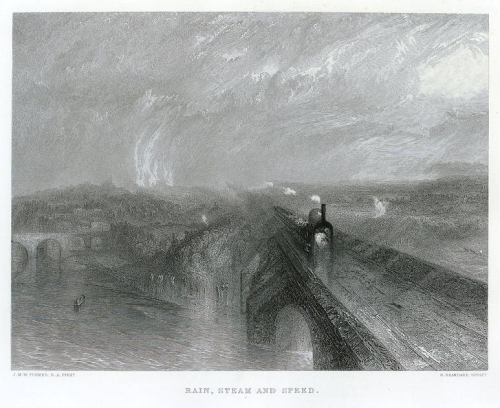
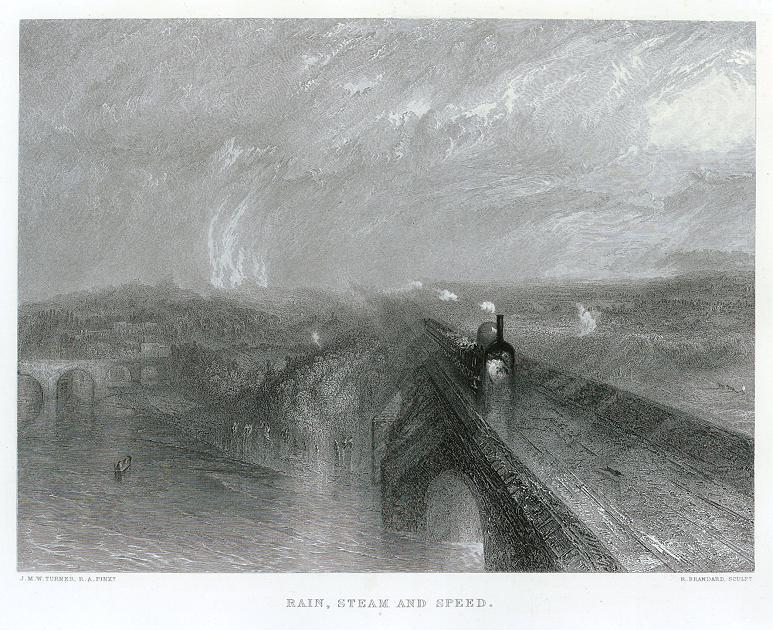
    And as an aside, Turner does get “cleaned up” in a way, when his artwork appears as engravings. There is of course much more definition given the scene as the engraver puts in hard lines on the soft non-edges of the original. For example, here we have “Rain, Steam, and Speed”:

    Before:
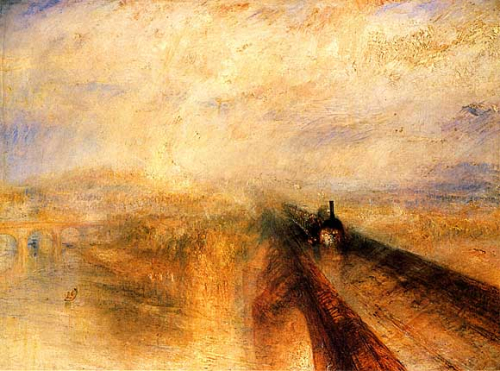
    Rain_Steam_and_Speed_The_Great_Western_Railway_1844

    After:

    Rain_Steam_and_Speed_The_Great_Western_Railway_1844

    The “after” version here is actually much more representative of the original than generally found in Turner engravings. 

    Anyway there’s nothing that quite takes the “impression” out of “Impressionism” than cutting a hard line of it in a steel plate.  

    (Again, this is just some outside thinking on the topic, limited to about the timeline of three cups of coffee.  Maybe four.)

    Notes:

    1. “Dr. Liebreich on Turner and Mulready”, Nature, March 21, 1872

    2. Williams, W. Mattieu. “Turner’s Vision”, Nature, 25 April 1872, p 500.

  • Thought Machines and the Revenge of the Atoms

    JF Ptak Science Books   Post 2906 (Overall post 5110)

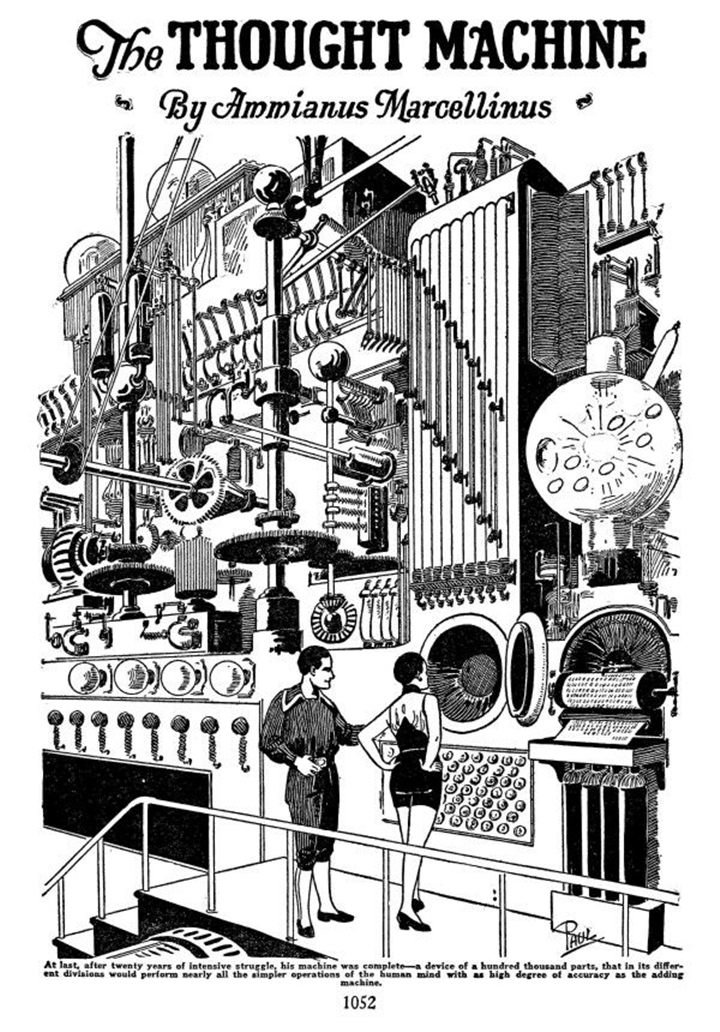
    THought machineIn the past of the past of the Thinking Machine, back when Alan Turing was only 15, the prodigious and fabulous Frank R. Paul was creating this image (left) of such a machine for an almost-adventurous story by “Ammianus Marcellinus” called “The Thought Machine”. The story appeared in Amazing Stories in February 1927, and for me Ammianus (the name of an historian who live in the 4th century CE and who wrote on the later Roman Empire) just did not have the power of persuasion for his tale–perhaps a lot like his 1600-year-old original, who Gibbon found to be boring and tedious). But the legendary work of Mr. Paul was enough for me, and so I’ve reprinted his artwork, which in itself is expansive and techo-lyrical in its many ways. In this one, I was intrigued by some of the thought machine’s components–the most obvious bit being what very much looks like a “Millionaire” calculating machine at bottom right. That, and the Napier’s-Bones-type thing about the bouncing brain of the machine–and then there numerous gears and worms…and what also seems to be like the hints of the power for the whole thing, which are the several belts leading up and away to a larger power conveyer off-picture, which for all I know may have been steam.  

    Atom revolt  of theI looked around in the pulp/sci fi references I have for some other images of “thought machines” from this early <1930 period and came away with very little, though I did find something hopeful called “The Thought Materializer” which was also supposed to be illustrated by Mr. Paul. The story appeared in Science Wonder Quarterly and was published in the spring of 1930–unfortunately the illustration was just a simple and disappointing portrait of the author.  The story was even more disappointing, and the writing was Boy-Wonder-robbed-as-he-knealt-to-pray-about-lonesome-love bad–for example, there is this unpolishable pearl: “Imaginatively, Proctor stepped from the bath”. Ouch.

    That said, looking for that “missing” Paul illustration let me bump into another interesting bit with a title begging question: “The Revolt of the Atoms”.  

    This brings to mind the possibility of “The Revolt of the Adams”, where 17th c Bishop Burnett postulated infinite planets and infinite worlds with infinite people populated by infinite Adams and Eves because as god is perfect each world would be completed with its own A&E.  

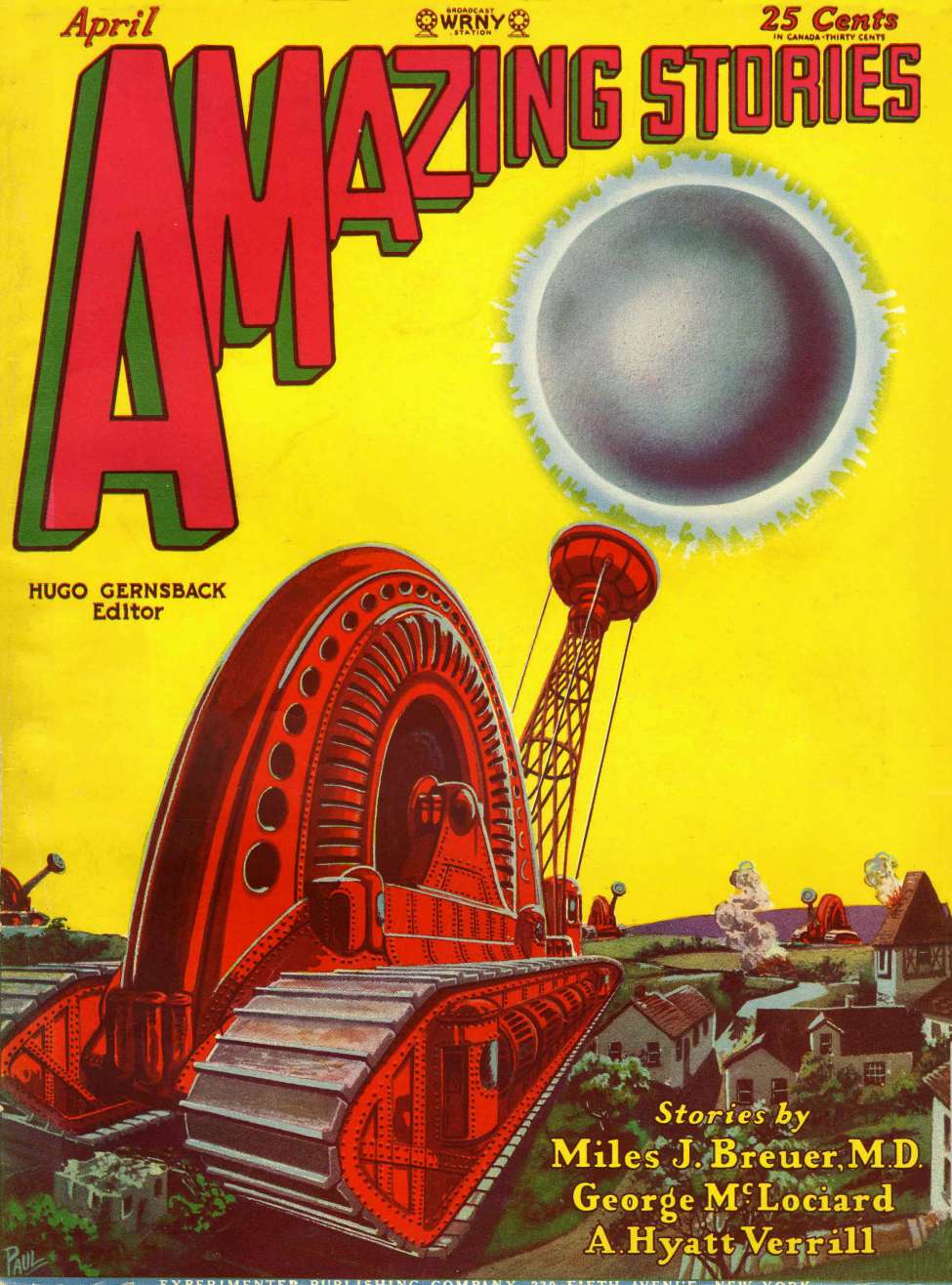
    Getting back to atoms–this story was published in Amazing Stories in their April 1929 issue and was one of the not-many early sci fi bits working around the idea of harnessing the energy of atom. Unlike many, the author, V. Orlovsky, had a go at the dangers of the atoms “rising to power”, the new-found energy becoming an agent in the possible demise of the Earth.  In any event, Something Happens in the story and the atoms run wild, forming a gigantic firey nucleus of a floating monster atom which “swept away everything that was alive”. The giant atom moved across Russia and into Italy, then on to France, destroying everything, threatening the Earth itself with utter destruction. I did not read the whole story, but it does seem as though an eruption of Vesuvius directly beneath the atom and ejected it on an “etherwave” into the Earth’s atmosphere, where it spun itself away and harmlessly so, becoming a small satellite. As I said, it is a disappointing story, though the cover art–again by Frank Paul–saves the day with its drawing of the giant atom being approached by enormous electromagnets to try and do such-and thus to it.  Frankly, I just liked the idea of the killer atom.  


  • “Telephone” Calls from Tomorrowland–or, Weighing Antique Surprise

    JF Ptak Science Books    (An episode in the series on the History of Anticipation.)

    TelephoneThis ad appeared only 66 years ago in 1954–that’s four generations in dog years, two human generations (or one for the more later-in-life crew, which is appealing as I knew a man whose grandfather was born in the 18th century), and 15 generations in managing data and communications. Perhaps more.  It is difficult to imagine the intense surprise that attended this ad showing a practical and popular adaptation of a communications breakthrough. 

    The electromagnetic telegraph, which is arguably the first electrically-powered iteration of the internet, was in the works from the 1820’s until it was nailed by Samuel Morse in 1837.  It was 40 years to the development of the Bell telephone (another dramatic example of an invention/technological idea/breakthrough that was “in the wind”, a popular undiagnosed monumental meme, some decades in the making in the hands of Bell and Reiss and Meucci and Gray and even Edison). Two more decades (just past the turn of the century) until more-widespread wireless telegraphy, another two decades after that (1920’s) for popular radio, and another two decades after that (post WWII/1950’s) for popular television broadcasting. 120 years between the patented invention of the Morse telegraph to 50 million Americans with televisions in 1955. 

    The “telephone” of 2020 is as removed as the telephone of 1954 as the telephone of 1954 was removed from the electromagnetic telegraph–we’re not meeting half-way in the meeting of improbable impossible worlds, of worlds of the future unimagined in the past.  That is what comes to mind when I see this add for the speaking telephone in 1954–the astounding, astonishing, speaking telephone, the phone that allowed you to not have the receiver to the ear, that allowed you to do free-hand work and communicate at the same time.  It was an ambitious improvement, and as soon as the phone appeared, it became a standard of necessity if that necessity was within budget. 

    It is the weight of surprise that is so abundant looking at pictures like this, giving us the opportunity to imagine the surprise elements of another time. It may well be that the new 1954 user of the speakerphone would have looked at the first telephone systems of 1894 as we look on that 1954 telephone today.  Probably not so, though, probably it was much more imaginable to have foreseen the 1954 possibilities in 1894 than for 1954 to have seen in the same amount of time to 2013:  the technological pieces necessary for part of that imagination had not yet been invented, the science ahead of the sci fi.

    The other part of this surprise element is that 1954 is well within living memory, and that this combination of technology and physics and mathematics has grown so incredibly from the speakerphone to the massive changes in 2013–it is as surprising to imagine this as to imagine the same scenario for what happened a year before in biology:  it is difficult to grasp the  sweeping changes in that field from the identification of DNA in 1953  and how far those fields have come since. 

    I think that if one could quantify this sort of “surprise” that the greatest amount of “Surprise Integers” (or whatever) ever recorded would have taken place within these past 50 or 60 years. Which makes me wonder–will people 66 years hence see the pictures of our fabulous accomplishments in 2020 as quaint reminders of how much things changed between 2020 and 2086?  Will those “Surprise Integers” be as great for that period of time as the (“our”) preceding period with concomitant revolutions in thought?  My guess is “yes”–it’s just hard to imagine. 

    ·Posted by :

    ·in:


  • A Note on Reverseness–Time

    JF Ptak Science Books  Quick Post

    I was working on a paper by H.C.Corben on time dilation (“Time Dilation Effects in Space Travel” 1959) and the clock paradox and thought about just time moving backwards, in whole or in part, and went poking around the edges of things a little bit to see a few examples in the arts.  

    One story–or a piece of one story–is  in Vonnegut’s Slaughterhouse Five (1969), where we are introduced to backwards WWII narratives of B-17’s getting bullets sucked out of them by Germans while going in to retrieve their bombs to return to base. Martin Amis’ Time’s Arrow (1991) is another good one, though the end result was very troubling, where a doctor brings people back to life through his life though we are disgusted to see how much life he “gives back” as a medical doctor at Auschwitz. There’s Philip K. Dick , Counter-Clock World (1967) , with the charming idea of “old-birthing” in the grave and emerging from wood and dirt (don’t know about cremation); Fitzgerald’s Benjamin Button (1922) in which only one character lives in a reverse chronology; WR Burnett’s Goodbye to the Past (1934), which is a standard story except that it moves continually from 1929 to 1873; and Iain Banks’ Use of Weapons (1991) which tells one story going forwards and the other backwards, together. Remember, this is just a little taste of the literature, a ramble. 

    A few examples from the stage: George S. Kaufman and Moss Hart’s play, Merrily We Roll Along ( 1934 ), which is a narrative told in reverse order. Here’s an interesting theatre example: Harold Pinter’s Betrayal and Seinfeld’s “The Betrayal” episode, in which the later pays homage to the former, maybe, going so far as to name a principal character in the story “Pinter”–no doubt this is toxic to post-structuralists. 

    In cinema, Jean Epstein ‘s The Three Sided Mirror (1927) features a sequence where the events happen in reverse, while more modern examples include Atom Egoyan (The Sweet Hereafter, 1997), Christopher Nolan (Memento, 2000),  Jean-Luc Godard’s short (From the Origin of the 21st Century for Me, 2000), and many others.

    Then there’s the not-quite reverse storytelling line of the nonlinear story, which can go back and forth, or partially this or that, in movies like Citizen Kane (1941), Once Upon a Time in the West (1984), and Gance’s Napolean (1927); and in books like Ulysses (1922), Finnegan’s Wake (1939), and Flann O’Brien At Swim Two Birds, and many many others. It seems this category (and anachronism and parachronism) are much larger than the reverse time story, and seems to be initiated a little earlier as well.

    I’m not going anywhere with this one, just making notes…

    ·Posted by :

    ·in:


  • The Normandie That Failed (1942)

    JF Ptak Science Books  Post 2905

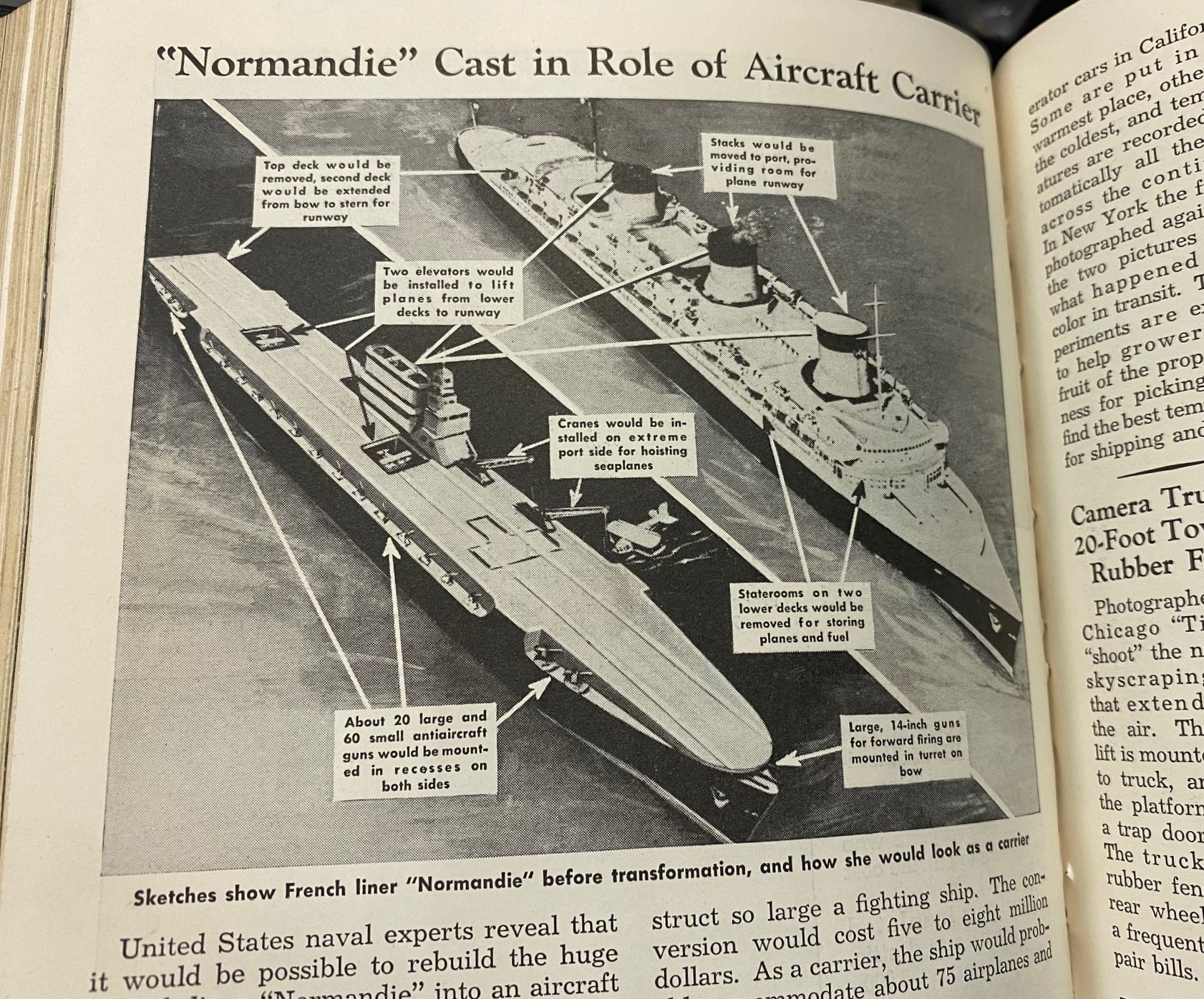
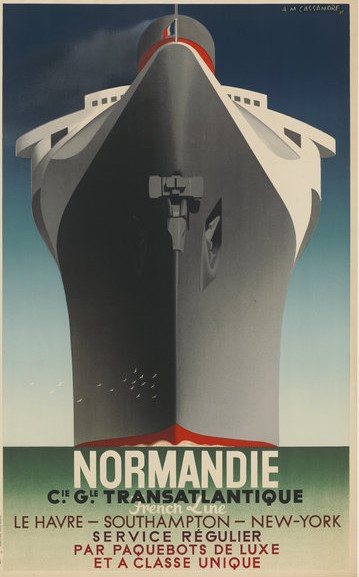
    Breezing through a volume of Popular Mechanic for 1942 I came across an article on refitting the French ocean liner, the Normandie.  The only thing I knew about her was that the ship was the subject of one of the all-time great travel posters (pictured below). The imagery for February 1942 was vastly different. It turns out that when the general war began in Europe the Normandie was in NYC harbor where it was more or less immediately interned. As a matter of fact after just a short while this great ship was tied up next to the RMS Queen Elizabeth and the Queen Mary, which meant the world’s three largest ocean liners were cheek and jowl to one another in NYC.  After Pearl Harbor the ship was put under the command of the U.S. Coast Guard, and after a very brief period the command was transferred to the USN. That’s where these plans come in, to re-purpose the ship into an aircraft carrier:

    IMG_2477

    But that was not to be and construction plans were made to transform the ship into a troop transport

    2017KC2259_jpg_lThen came the Great Misfortune.  In February 1942–the month that this Popular Mechanics was issued–the Normandie (renamed the USS Lafayette) caught fire, flamed out, capsized, and died. There was some amount of rumor and innuendo that the ship was sunk as a result of foreign intrigue, but a board of inquiry found otherwise.1 It seems that in the course of refitting that a blow ironically and tragically set on fire a pile of life preservers that were made of very buoyant by highly flammable fibre from the great kapok tree. The very effective fire suppressor was disengaged after the French sailors were led off, and, well, seemingly a lot of other unfortunate things played into one another to the critical result. It was a fatal fire for the ship. I recall seeing very unsettling pictures of the Normandie in LIFE magazine, capsized in shallow water and winter ice mud.

     There were efforts to revive her, retrieve her, bring the great ship back to life in one way or another, but all attempts failed, and the Normandie was sold for scrap in 1946 and was completely gone by 1948.

    Notes.

    1. “The investigation found evidence of carelessness, rule violations, lack of coordination between the various parties on board, lack of clear command structure during the fire, and a hasty, poorly-planned conversion effort.”–Wikipedia


  • Zed + Zero Zeppelins = No Zeppelins at All (1913).

    JF Ptak Science Books  Quick Post

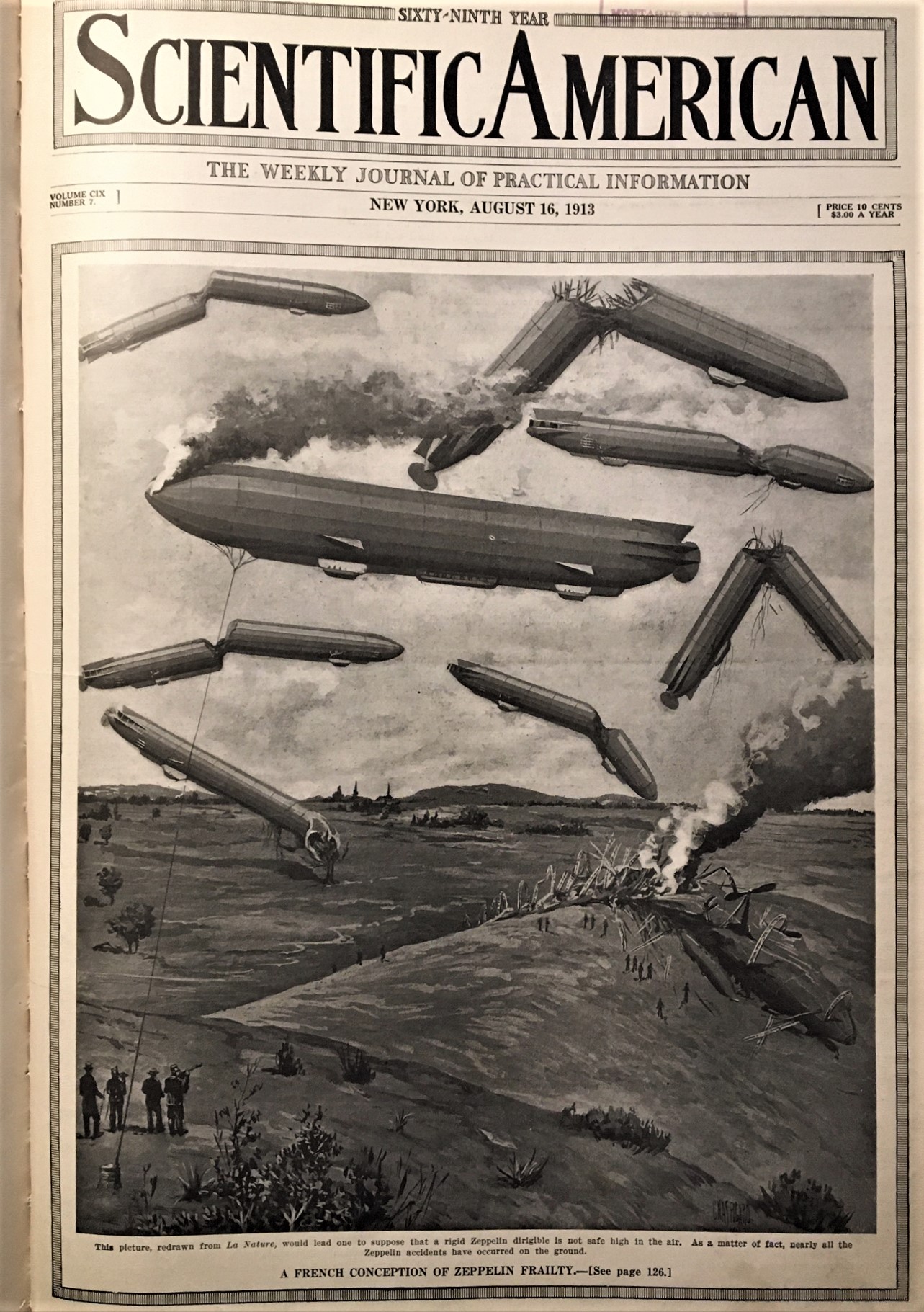
    I knew I needed to do something with this tremendous image (found as you can see in Scientific American for 16 August 1913) and thought it might be nice to make something of it rhyming “zeppelin” all the way through…but there aren’t very many single words that do that, though if you cheat a little you can have a lot of two-word constructions with the second word being “in” that would close the gap. Anyway, that’s not all that fruitful or interesting, so I’m just going to note that this composite image depicts Zepps on their way to be zero and zed following their zigs and zags through the sky. It is an attempt–I think–to show that in spite of their tremendous size and threatening nature, the Zeppelins could break just like everything else.  

    IMG_2293


  • An Educated Fly–Scientific American, 1898

    JF Ptak Science Books  Quick Post

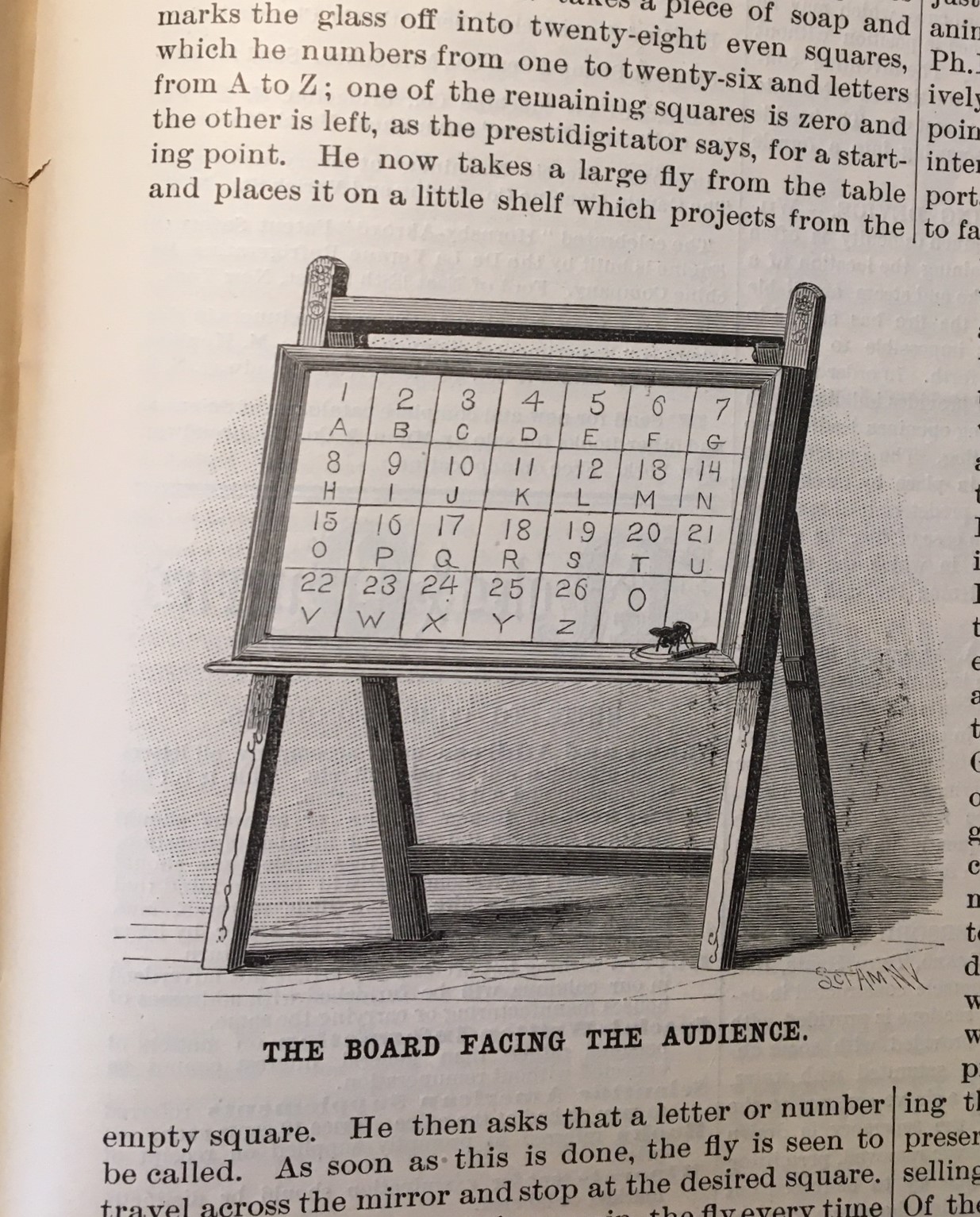
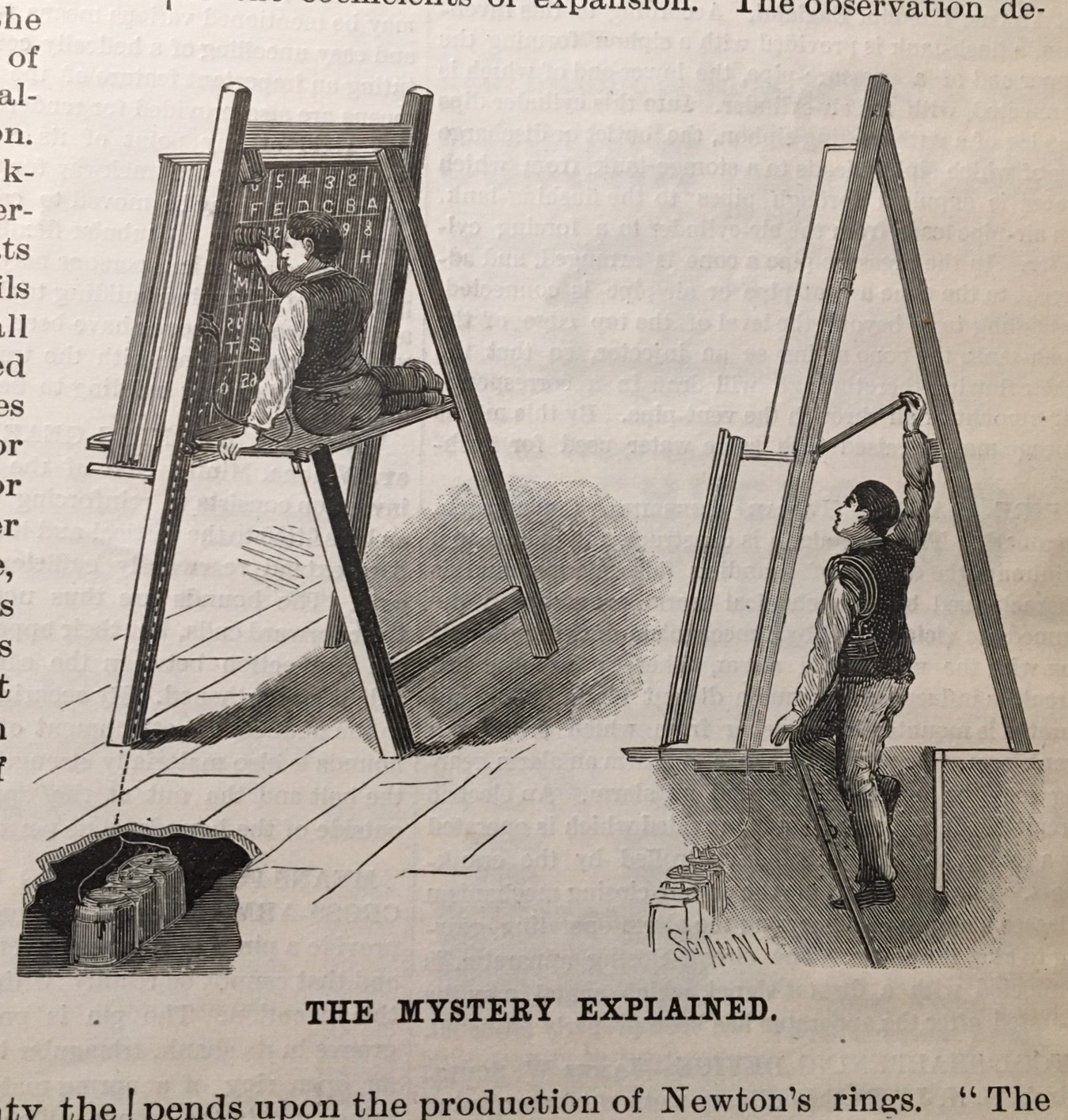
    Sci Am 1898 fly _2_How could you see an article heading of “An Educated Fly” and not share the secret?  I don’t know, and so I am performing a bit of due diligence, sharing the story from Scientific American from 3 September 1898. There really isn’t that much to tell, and the title is probably better than the story: the large tablet is placed on a stage in front of an audience, with a pitchman telling some sort of warm-up story to create interest among the crowd; a fly of some sort (whether a model or a real fly pinned or tied to something, I don’t know) and placed on a little shelf beneath the board. The ringmaster would ask a question, and the fly move around and alight or somehow make it known as to its selection of the numbers/letters on the grid. The trick is revealed in the image below–after the blackboard on its pedestal is shown to the audience front-and-back, it is positioned over a trap door on the stage, where a confederate would rise up and position themselves inside the pedestal and operate the device holding the live/inanimate fly. That’s it. After the tricks were performed, the inside man would escape through the trap door, the pedestal would be wheeled out to display that it was empty, and that was that. Old trick, new fly. 

    Sci Am 1898 fly _1_