A Daily History of Holes, Dots, Lines, Science, History, Math, Physics, Art, the Unintentional Absurd, Architecture, Maps, Data Visualization, Blank and Missing Things, and so on. |1.6 million words, 7500 images, 4.9 million hits| Press & appearances in The Times, Le Figaro, Mensa, The Economist, The Guardian, Discovery News, Slate, Le Monde, Sci American Blogs, Le Pont, and many other places… 5000+ total posts since 2008.

Category: Anticipation, History of

  • A Photograph of the Food Consumed “by the Inebriate in Captivity”

    JF Ptak Science Books   Post 1272

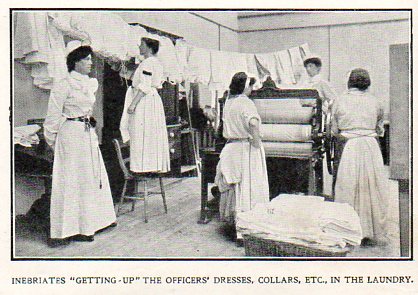
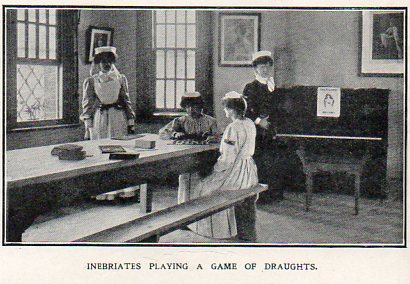
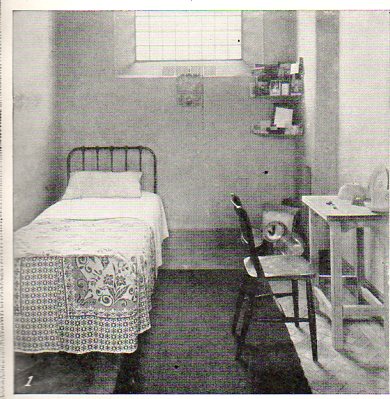
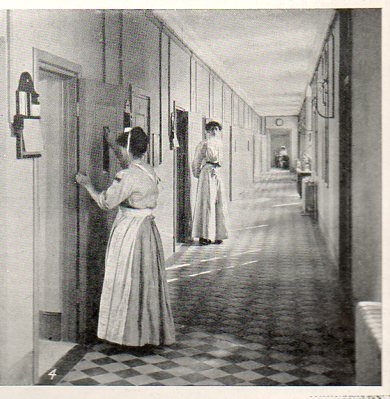
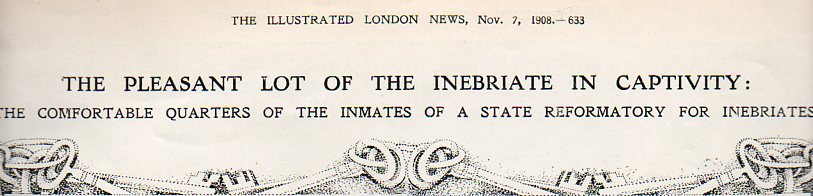
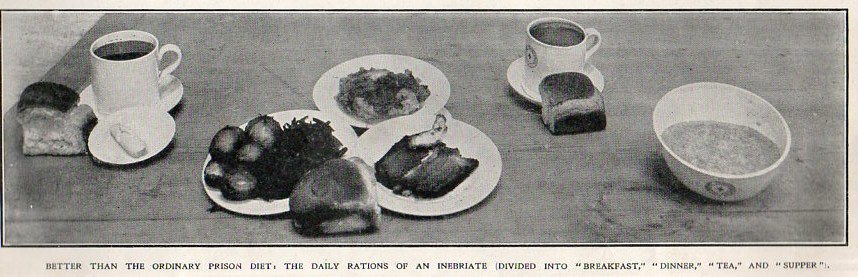
    I stumbled upon this while looking for an article on the Wright Brothers in The Illustrated London News.  I figure that this may be the first opportunity in recent decades that a photograph of the dinner table of  incarcerated British drunkards would be published–and some opportunities need to be serviced.  No doubt that this was an ideal table setting and selection of food because, well, that’s what people do– they normally don’t present an average-something for photographic display in national/international media.  Also the snapshot quality of the daily surroundings of the incarcerated was unusual, as was the Andrew Lang fairyland title to the two-page photo story. 

    Inebriate title115

    And the food:

    Inebriate food112

    A full day’s serving: breakfast included a six-ounce white loaf of bread, a pint of tea–and an ounce of butter on the last day of the term.  Dinner  included six-ounces of white bread, twelve ounces of potatoes, four ounces of French beans, four ounces of fresh meat, and eight ounces of fruit pudding. Supper  “was a pint of gruel”, pictured on right.

    Inebriate 2106

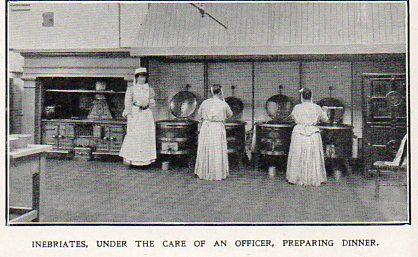
    The life in the state reformatory as an alcoholic British woman was hardly “pleasant” as the title states, though we don’t know what the author was comparing this to.  I suspect it was a general prison that was the benchmark for pleasantness, though perhaps it could have been an insane asylum , assuming of course that they didn’t seem nearly as pleasant as the “pleasant” scenes in these pictures.  The reformatory for alcoholics in Great Britain was established more along the lines of an almshouse or mental institution and seemed not terribly coercive–though given the border decorations for the photos on these pages–keys–there is no doubt that these people were incarcerated “for their own and the community’s good.”. Inebriate 4107

    Inebriate 6111

    Inebriate bed113


    Inebriate hall114


  • Steampunk Anatomy–Cancer Holes, Nut and Bolts, Oil, Outer Space Belly Shirts and Heavy Things of the Future

    JF Ptak Science Books  Post 1269

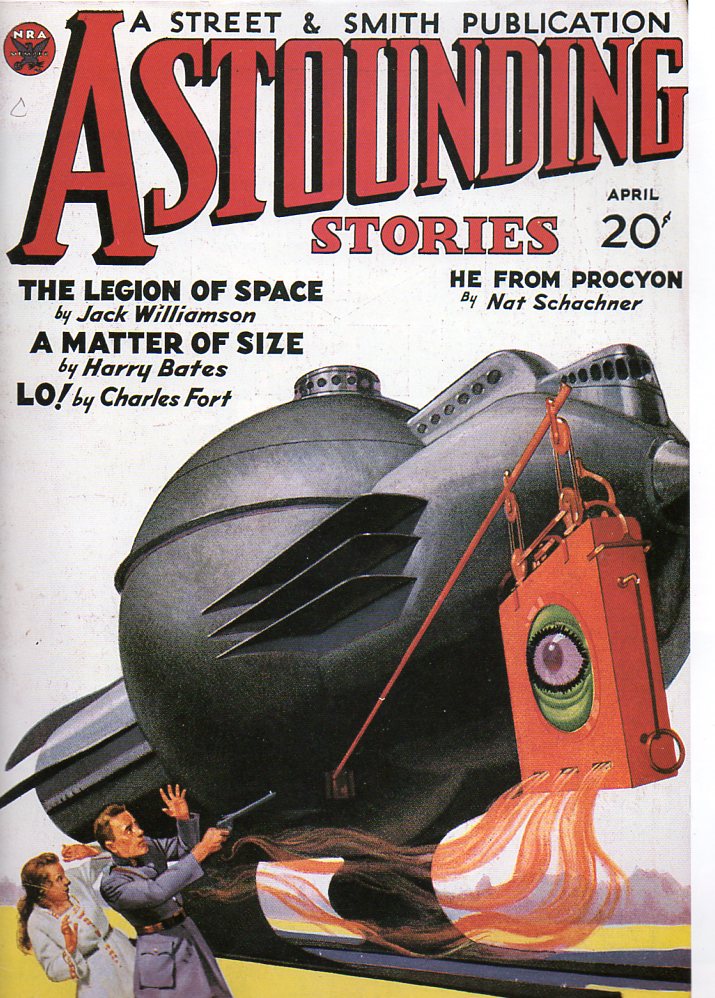
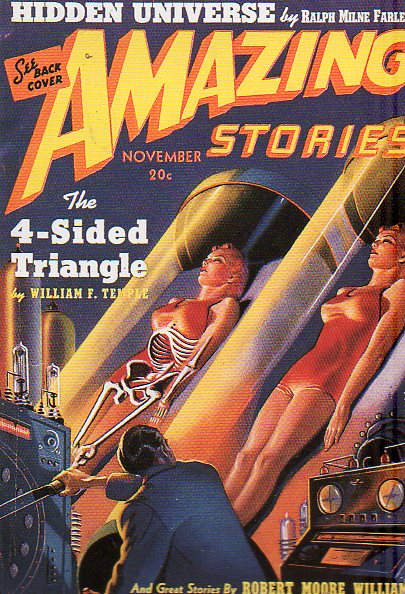
    What is it about science and the future and how the scifiction of the past (pre-1950’s) almost never could encapsulate the superior scientific innovation and discovery of its near future?  It is marvelous and wickedly magnificent to look at some cover art and illustration for the pulp and not-so-pulpy science ficton, images that not only have a certain look and feel, but also a smell, a particular bookstore/basement pulp-paper-not-exposed-in-forty-years smell.

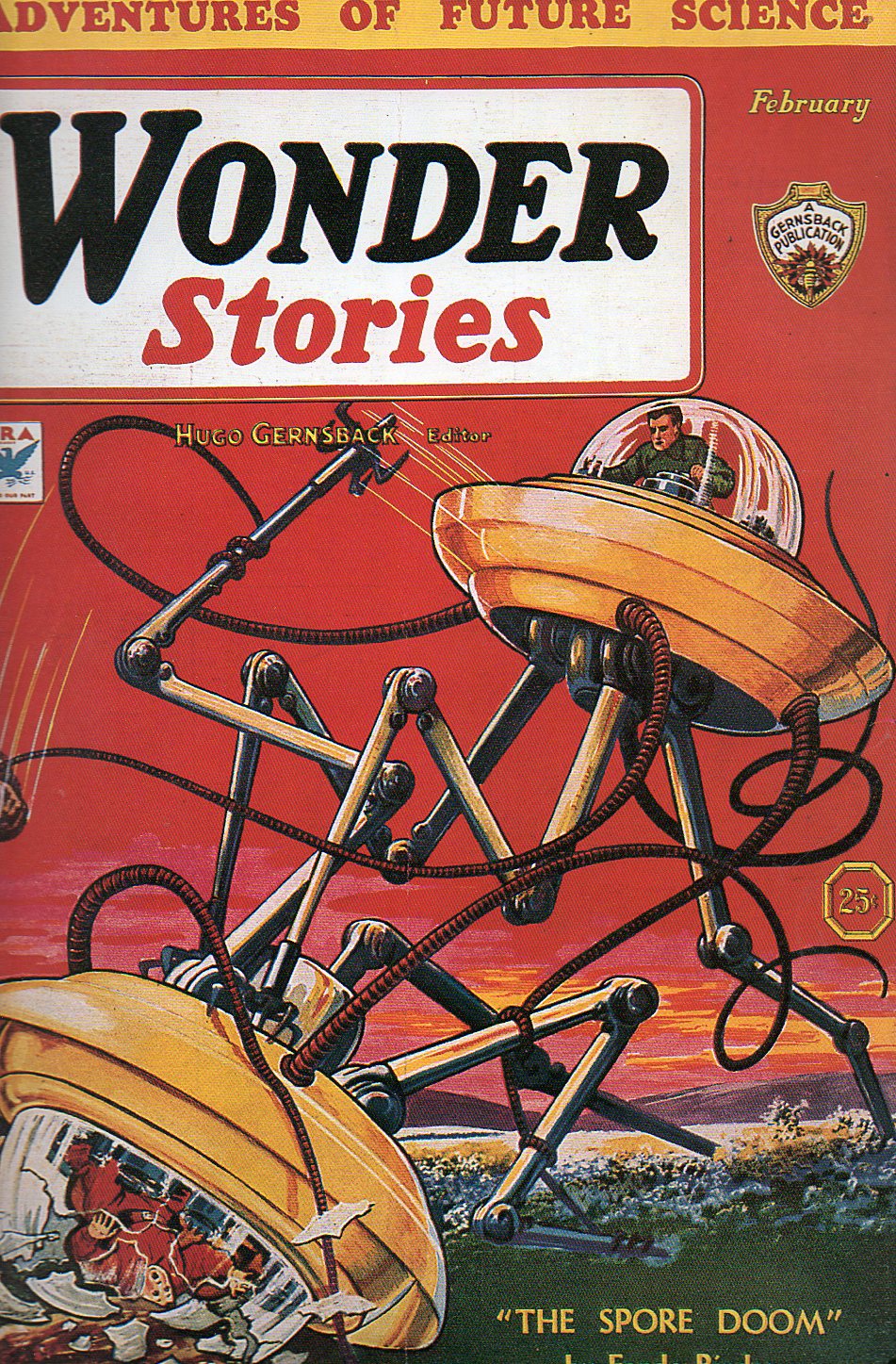
    Steampunk Eye–that enormous ship, governed by a long, long pole with a small box witn an eye in it, being raised and lowered on pulleys:

    Steampunk a077

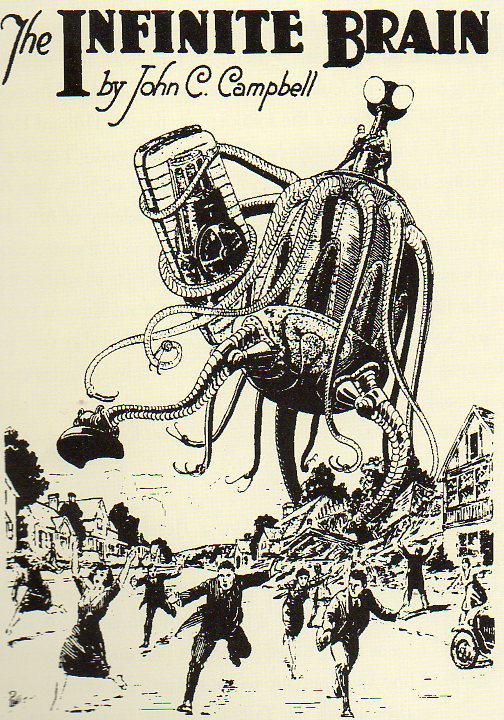
    The Steampunk Gigantic Enormous Stupendous Infinite Brain (also notice that folks are fleeing, running for their lives, witt heir arms thrown high into the air, running like SpongeBob SquarePants–its hard to run like that):

    Steampunk brain084

    Steampunk Lust:

    Steampunk lust085

    Steampunk Addiction & Cancer Hole:

    Steampunk cancer hole088

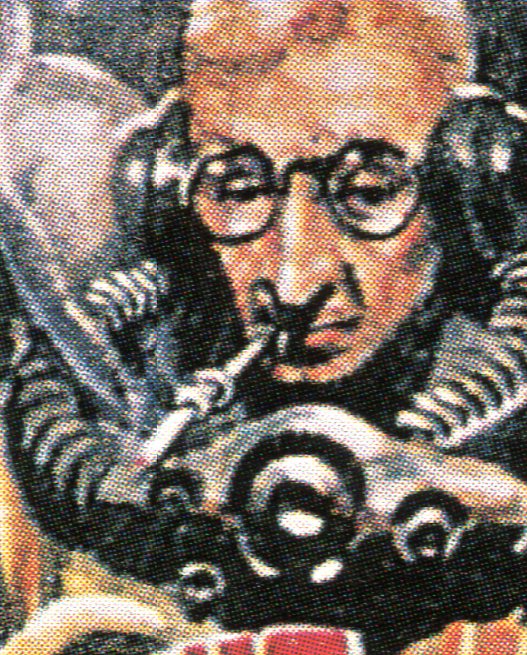
    And the Philip -Morris contribution for smoking in alien space:

    Steampunk cancer hole089
    Steampunk Humano-Robot Replicant:

    Steampunk human robot081

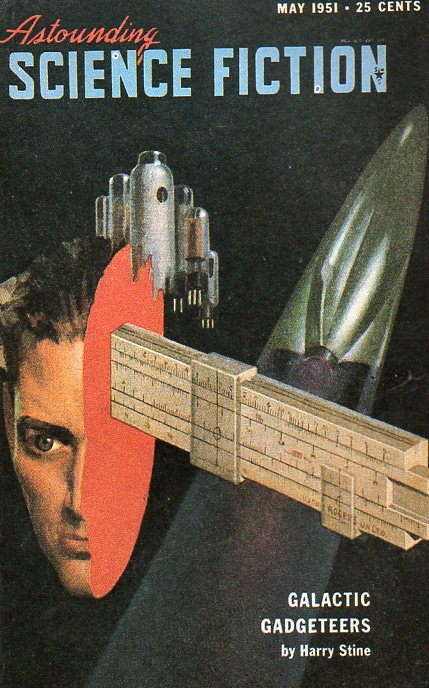
    Steampunk Thinking (the slide rule really didn’t give out until around 1970):

    Steampunk calculating086 Steampunk Legs:

    Steampunk legs083

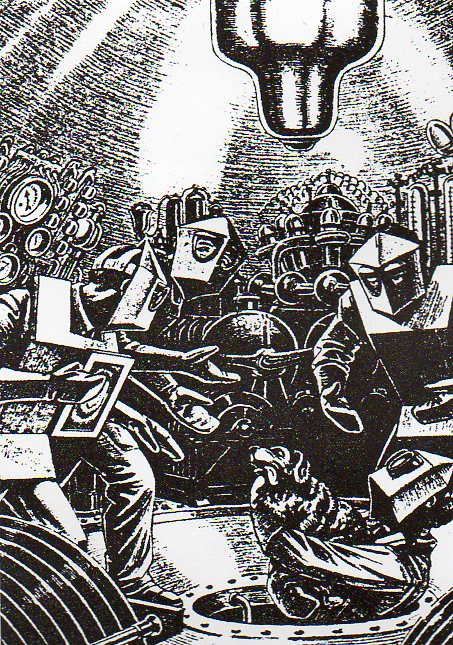
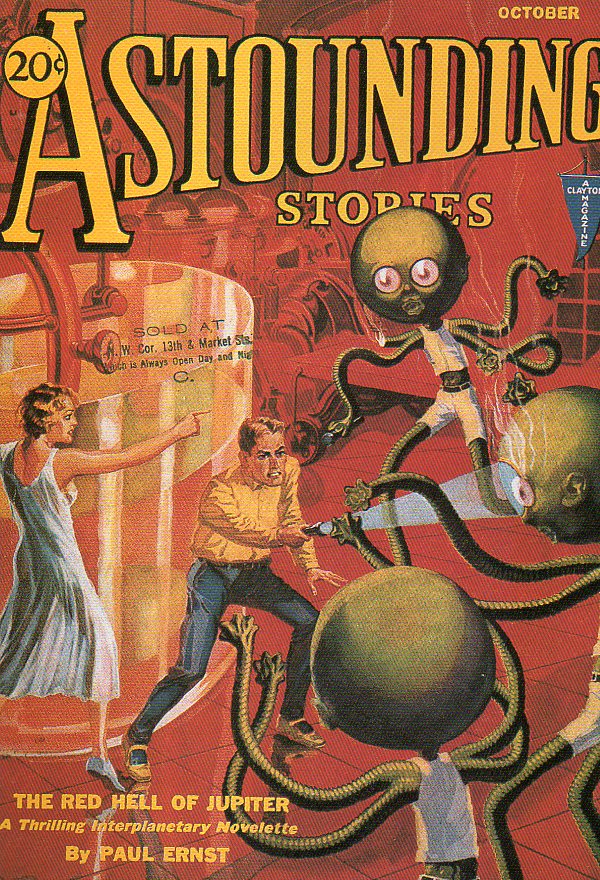
    Steampunk Abs:  humans are surrounded by arm-waving large-headed belly-shirted aliens, the man using a flashlight for defense )burning the alien eye even though they’re all in bright light) while the woman points really hard:

    Steampunk abs090
    Steampunk Hair–and with all of that vast technology and futurismo, there are still unruly locks here and their:

    Steampunk hair082
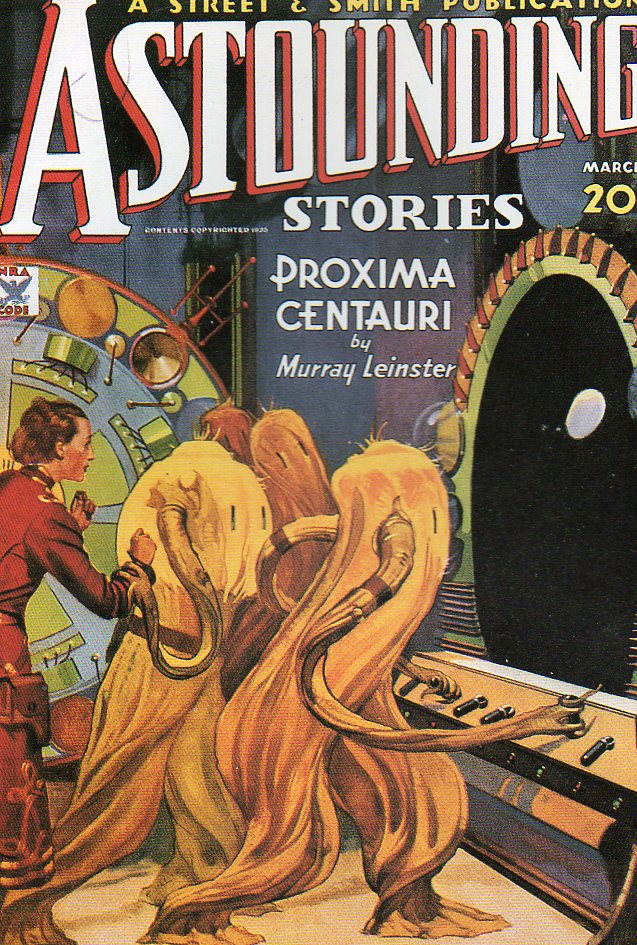
    Electro/Steampunk Body Replicator

    Steampunk body replicator087


  • Verticals and Lead-Spewing Gargoyles: Spires, Rifles, Bayonettes. Reims, November 27, 1918.

    JF Ptak Science Books  Post 1267

    Verticals and Anticipation after Four Grueling Years

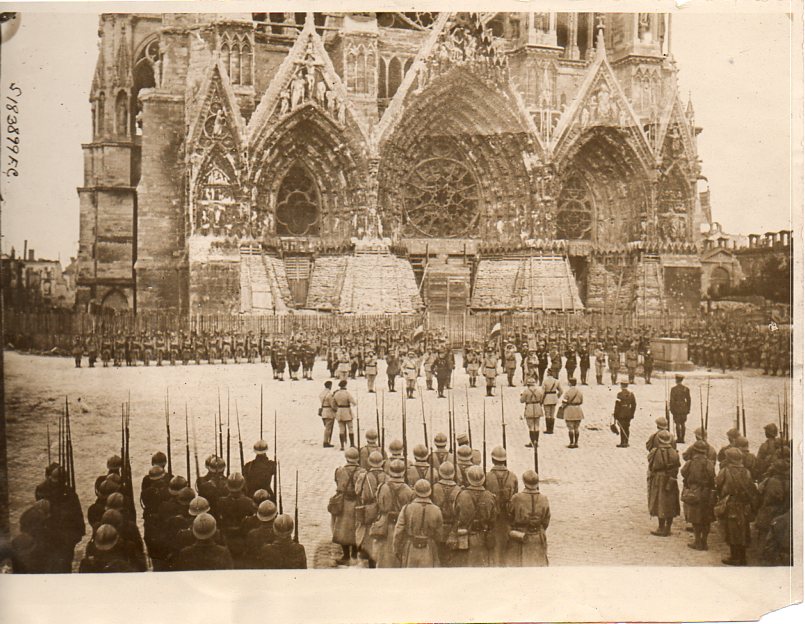
    In developing a history of vertical lines I thought that I would look at single vertical lines, but having just stumbled across this in our WWI News Photo Service archive, I just could not resist.  There is of course plenty of vertical arrangement here–just orders of magnitude more than what I was setting out to find.  So it goes.

    WWI photograph--spires071

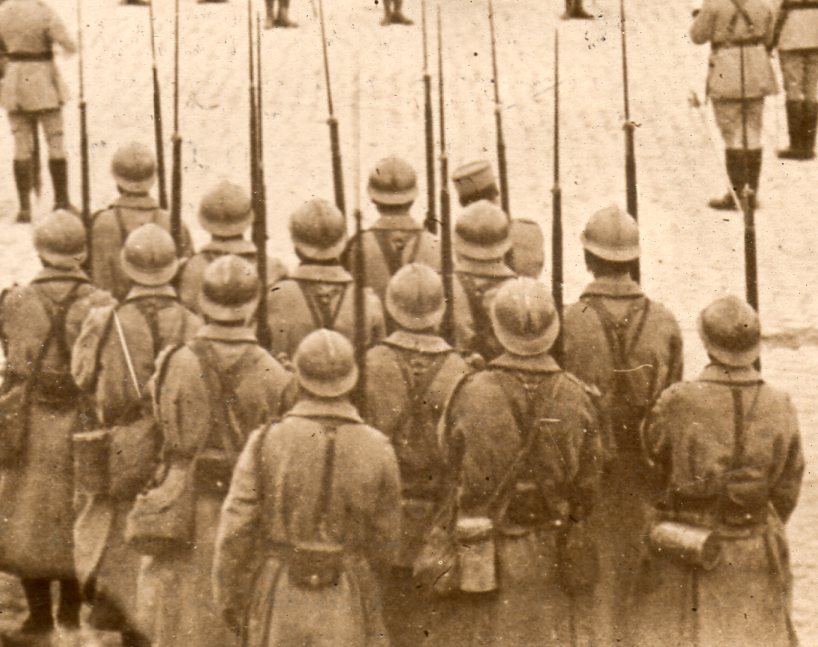
    (The image is available from our blog bookstore, here.) And the detail:

    WWI photograph--spires det072
     And another:

    WWI photograph--spires det073

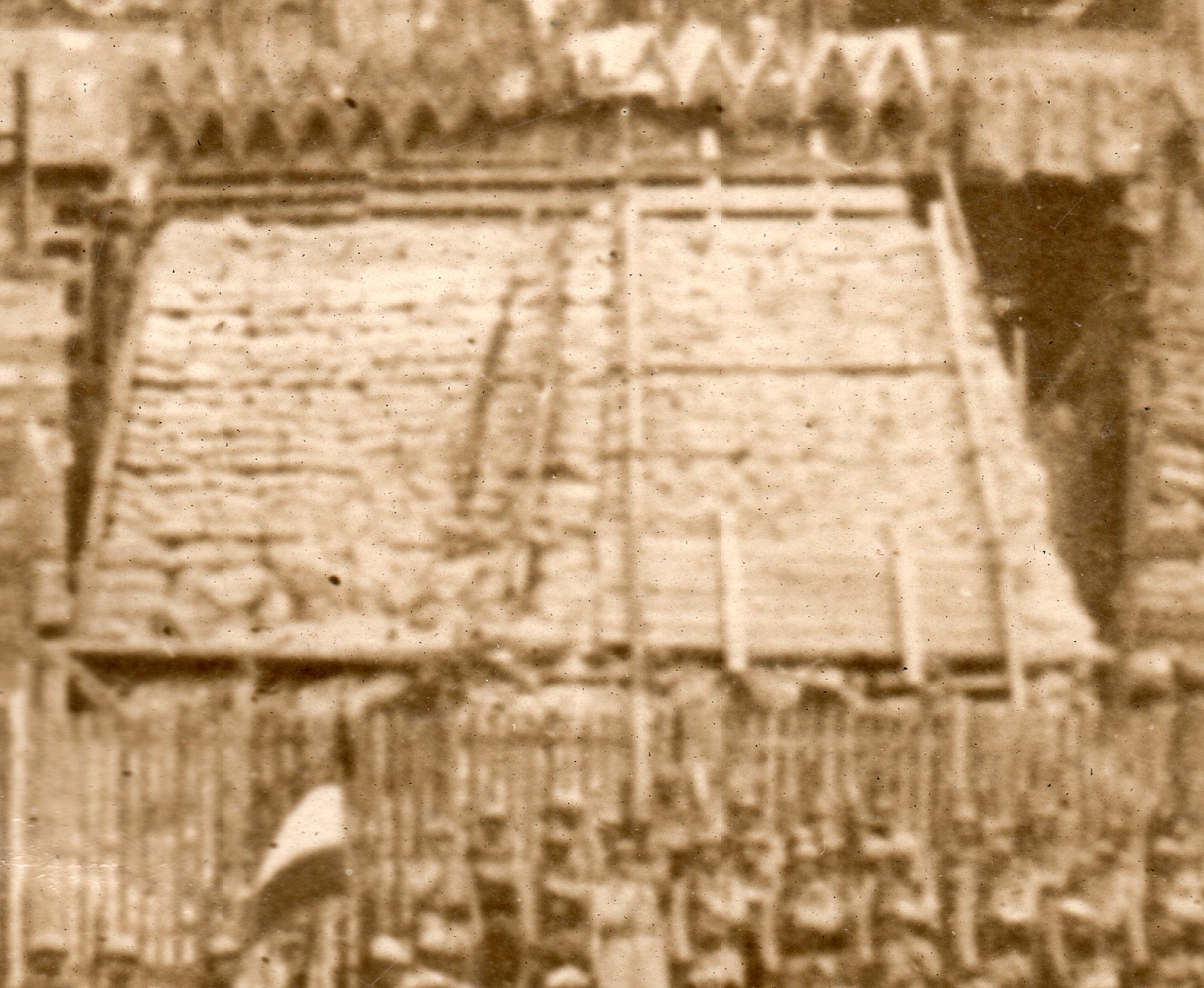
    I find this a soaring image, in its own odd way–this is a celebration scene, after,all, a decoration exercise, a military display of French forces that liberated the town of Reims, all taking place in front of the battered cathedral. Notre-Dame de Reims was the place of the coronation of French kings, and was a spectacular 13th century structure built on top of other buildings stretching back the site’s inhabitation to at least the 5th century.  

    But German artillery shelling caught the cathedral right at the beginning of the war and very nearly wrecked it.  The building was badly damaged by fire, a fire caused by the Germans, which spread along the scaffolding on the building which fed the wooden supports and superstructures, the flames finding its way throughout the building.  The fire was hot enough to melt the lead in the roof, which poured down as molten rain and out of the mouth-spouts of the building’s gargoyles. 

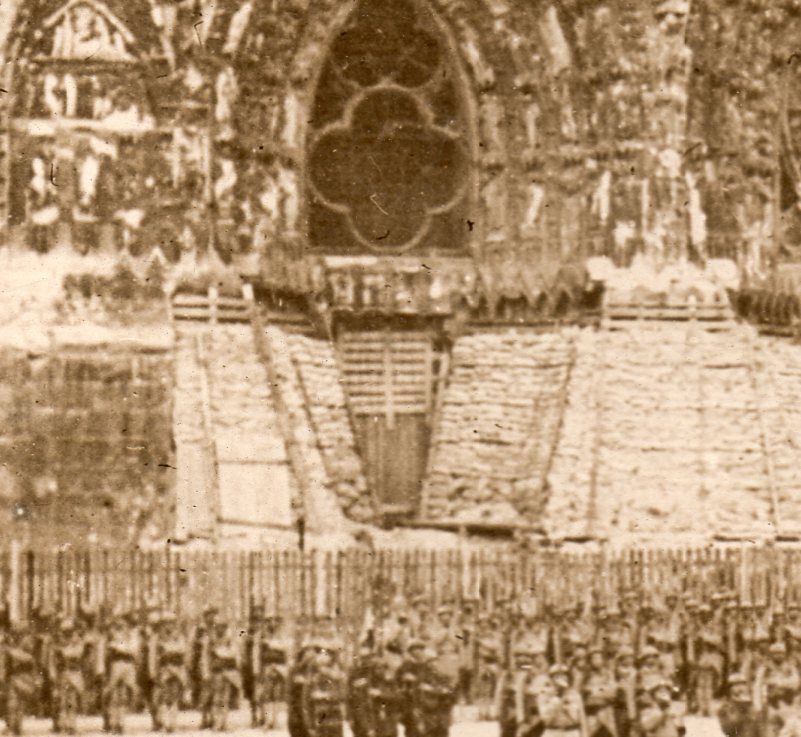
    As I brought out the further figures against the base of the cathedral one can clearly see the enormous stands of sandbags, the piles stacked up twenty feet or so behind the makeshift wooden fence.  IT was some sort of protection for the building, but not muc. 

    WWI photograph--spires det074

    This was yet another battle for the city, this one taking place 1550 years or so after the first, the Alemanni defending against the Romans; and then 104 years after the next major encounter, this between Napoleon and a Russian/Prussian force.  The liberating battle (the Battle of Reims, or the Second Battle of the Marne) took place 15 July 1918 to 6 August 1918, and it was a major failure for the German army, and spelled the collapse of the Spring Offensive, opening the door to the end of the war.  There were more than 135,000 Allies killed or wounded in this campaign (including 95,000 french troops), plus another 130,000 German troops.

    The process of victory in front of the wounded church seems exhausting and exhilarating, bu tnot without a good sense of anticipation.


  • The Discovery of America(ns), 1933: a Vast Understatement of the Condition of Native Americans.

    JF Ptak Science Books  Post 1256

    Nothing makes “discovery” itself than re-discovery, with the important element being “forgetting”.  Some important thnigs in the history of science have been “forgotten”, or not remembered, actually, little reported–like Mendel’s work on genetics and the re-discovery of penicillin.  And the flying shuttle.  And so on.

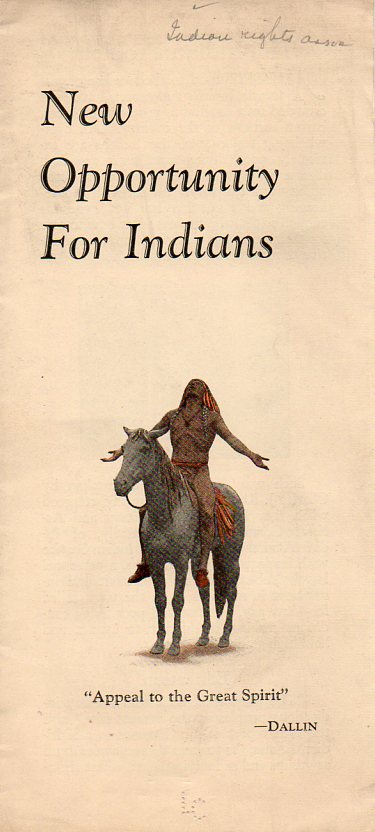
    Indian oppty011 This small pamphlet, New Opportunity for Indians (1933), may look like a solidified reverse misprint: “opportunity” rather than its plural, and singular “Indians” for its plural, and identifies what may be one of the most forgotten things in American history.  (The pamphlet is available at our blog bookstore.)

    The fact of the matter is that Native Americans had been basically forgotten during the last forty years or so, squandered away onto removed reservations with little support or money or time or effort. 

    In 1926 the Bookings Institution authorized a study of the condition of American Indians, with Lewis Meriam and his team responding with their report The Problem of Indian Administration in 1928.  It was the first statistical and analytical survey of its kind in eighty years (though the special volume of the 1890 census Indians Taxed and Indians Not Taxed comes close, though without a particular analytical thread) and was a general indictment of the government’s treatment of the Indian.

    We find most of the following in just the first dozen pages or so:
     –“the health of the Indians compared with that of the general population is bad.”(page 3) and that tuberculosis and trachoma were widespread, and infant mortality high.A major contribution was poor health facilities and the lack of Indian language understanding by the health care providers.
    –“The hospitals, sanatoria, and sanatorium schools maintained by the Service, despite a few exceptions, must generally be characterized as lacking in personnel, equipment, management, and design.”(page 9) And that “the government, through numerous on- and off-reservation health –“the most important single item affecting health is probably the food supply.”
    –“The income of the typical Indian family is low and the earned income extremely low.” (Page  4.)
    –“In justice to the Indians it should be said that many of them are living on lands from which a trained and experienced white man could scarcely wrest a reasonable living.” (Page 5. )
    –“The economic basis of the primitive culture of the Indians has been largely destroyed by the encroachment of white civilization.” (Page 6.)
    –Little attempt has been made to formulate a broad constructive program for the service as a whole, extending over a long term of years, and having for its goal the general improvement of economic conditions.” (Page 5)
    –“The survey staff finds itself obligated to say frankly and unequivocally that the provisions for the care of the Indian children in boarding schools are grossly inadequate.”(Page 11)

    And on and on.
           
    Perhaps the most important outcome of the Meriam report was the abandonment of the Dawes Act of 1887, which basically broke up tribal connections and lands, segregating individual families ad incorporating them as yet another American farming family.  Franklin Roosevelt’s Indian reorganization Act (1934) ended this practice and allowed for the organization of tribal government and incoporation of land trusts.

    But the fact that the Indians had been discovered, and discovered to have been rendered into such poor conditions, and that there was a general consensus to alleviate those conditions and provide better and more uniform health care and food (especially food) and education and tribal independence, it did not mean that getting the money for doing such things would be accomplished.

    In this slim pamphlet the outlines for helping Indians are described and failures acknowledged, though generally the planning was scant and rudimentary.  The pamphlet did identify “the first essentials tr a satisfactory home life are adequate food supply, proper clothing, and a comfortable shelter”. I think stopping at the “food supply” part would’ve been enough. 

    There was certainly an increase in money spent on health care, but the increase wasn’t much to speak of, not really.  The pamphlet states that “Indian Health Appropriations” topped out in 1911 at $40,000–or about $6/person/year.  The 1933 total was $3.2 million, but that still doesn’t spread out very thickly over 295,000 people. 

    In any event the pamphlet was not without hope, but that hope seemed to be all it had so far as implementing its new ideas for improvements and services.  In a small slug of a mention, “Crippled Services” it is noted that appropriations for the new years would be down $4 million dollars.  Unfortunately there is no figure of overall appropriations, so the figure doesn’t mean that much.  It did mean though to the author(s) of this pamphlet that even if there was no money there was hope.  Unfortunately “hope” doesn’t buy food.

    This pamphlet ends with a severe understatement: “the Indian problem is by no means solved either in education, health, making a living or providing a good home, much remains to be worked out”.  Indeed. 
                               
    The full Meriam report can be found here.


  • Looking Inside Out–Ernst Mach’s pre-Escher Image

    JF Ptak Science Books   Post 1243

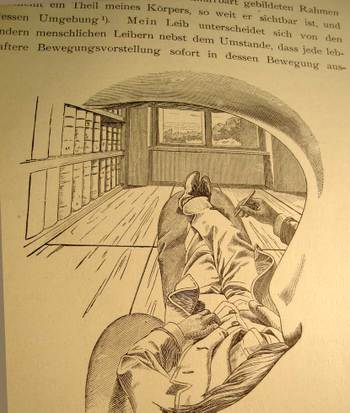
    MachbookI cannot think of another illustration by a scientist or philosopher who attempts to explain their own–literal, interior,physical–view of the world and then offer what this looks like to the reader from inside his own head, looking out through his own eye.  That’s exactly what Ernst Mach is doing right here on page 15 of his influential book Die Analyse der Empfindungen, the fourth German edition (“The Analysis of Sensations and the Relation of the Physical to the Psychical”)  (Jena, 1903)

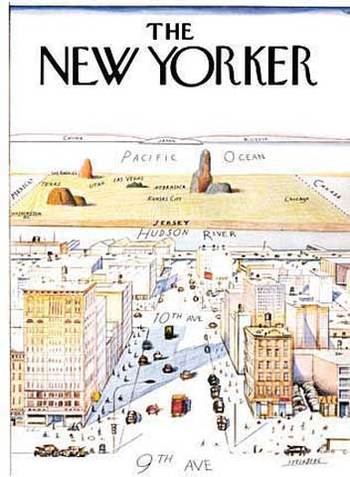
    There is nothing in this world for Mach that is not admissible to the human brain that is not empirically verifiable–that is, the world is nothing but awash in sensation and that sensation itself forms part of the experience of, well, experience. I’ve actually never been interested in the philosophy of science, and this is one of the reasons why.  Nevertheless I boldly break through my own prejudices to enjoy this phenomenally original image, drawn from the inside of Mach’s working mind, looking out through his eye socket, over his mustache, under his eyebrow, around his nose, out across his body and then leaping into the rest of the world.  I think he does make his point about the essentialSteinberg_352 nature of the observer. And much like the classic Steinberg New Yorker cartoon of the world view of the New Yorker (of course this includes only Manhattan), I know some number of people who have transposed their bodies much like Herr Mach into the Steinberg map–except that their worldview ends basically at the Hudson River (Mach’s feet) with the rest of the world being the sliver out there beyond the river (Mach’s window) until you go 359 degrees around the world to get back to the East River (and back inside Mach’s noggin).  It is an unusual world view to have, but someone has to have it so that we can at least identify it so. 

    I just like the picture.   


  • A New Class of Scientific Image? Francis Galton and Synesthesia, Revisited

    JF Ptak Science Books  

    A Quick Note on an Interesting Image: is this the First Published Illustration of the Mental Imaging of an Active Thought?

    Prestogalton_vis_closeup

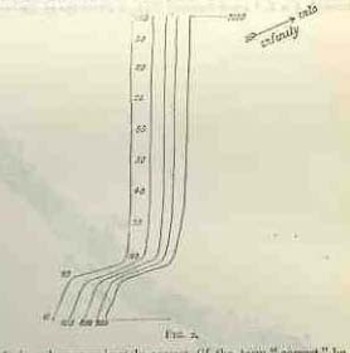
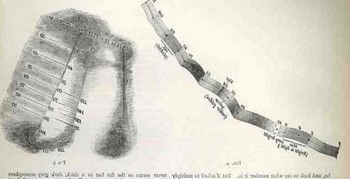
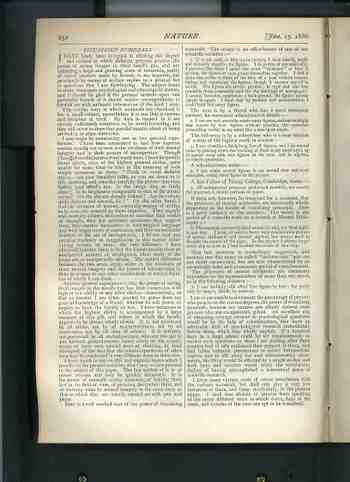
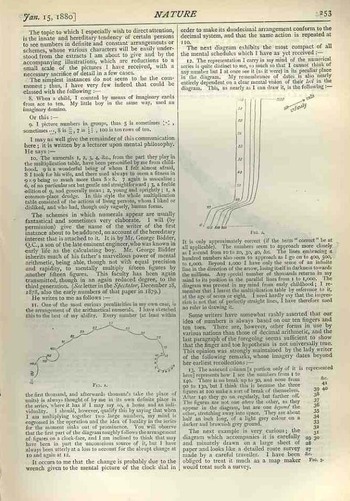
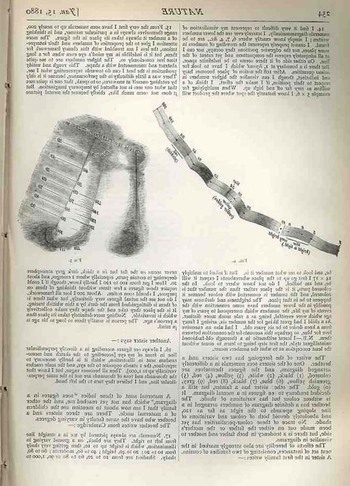
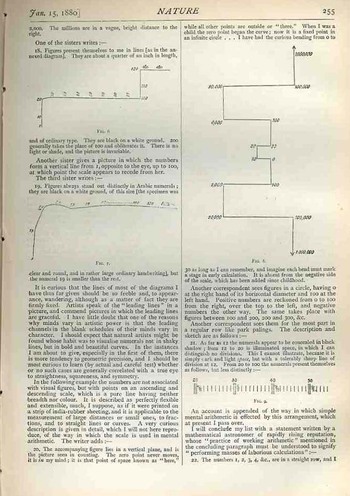
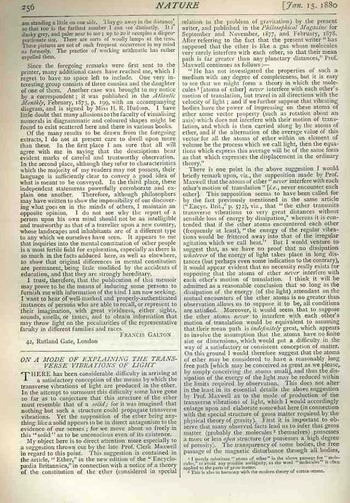
    I asked this question in the eigth post on this blog, back in February 2008, almost a million words ago,  and it seems to me that the answer to this is “yes”.1  Now that I’ve done a bit of reading here and there, this illustration may well be among the first that tries to describe how a thought “looks” in the head of  a person doing arithmetical calculation. That is to say, of how the thought-image of this process “looks” to people.  “Special” people, according to Galton, who was actually writing what was also probably sciences first paper on synesthesia. I’m returning to this post now because I’m offering the original of this paper for sale., here. Enjoy.

    I was stumbling through my collection of Nature (A Weekly Illustrated Journal of Science, London) magazine when I found a fantastic article by Francis Galton  (“Visualized Numerals”, Thursday, January 15, 1880) concerning (in one aspect)  the mental visualization of the act of doing mathematics. That is to say, what images people formed in their brains as they performed mathematical functions–this was even illustrated (!)

    Fascinating!  Scholars have pointed to this article as perhaps the earliest scientific effort on synesthesia , but what strikes me is how he tried to describe the intimate or logical function with the visualization of the act….I think that is what makes this effort so spectacular.

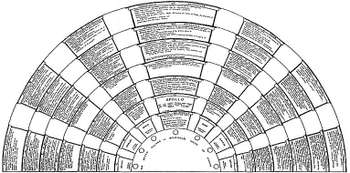
    I’m not associating memory devices (like the memory palaces of Matteo Ricci or Robert Fludd’s spectacular creations from his Ars Memoriae, or the beautiful schematic of Civlio Camillo’s memory theater,  for example which are more (basely speaking)
    visual aids for restructuring already-completed thought patterns) with this question; l I’m not so sure that it applies. These are more issues of phylogenic memory, and concerned with memetics and semitoics rather than the actual formation of an idea.

    Prestogalton_closeup_2

    People have certainly written on images in the mind before Galton–the question is if anyone has illustrated what they think this process looks like? I’m also not so sure if this directly relates to Aristotle’s elements/colors affirmation or Pythagoras’s numerals and colors or Scriabins music and color associations, or Cardano and his color/flavor and the planets associations….

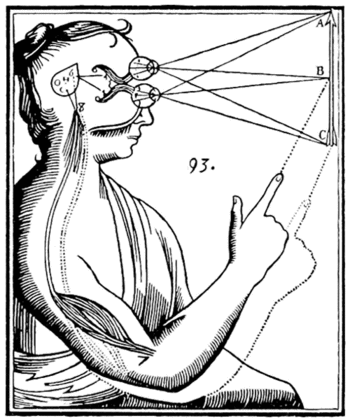
    I guess the question is—where does this image fall in the history of the illustration of abstract thought?  I’m not including famous examples of the physical aspects of sight as with Descartes etc; just the image of what people see in their heads as they are formulating thoughts and ideas.

    Galtoncamillo

    We’ll have more later.  I just wanted to put something up here as people have wanted to see the Galton article and Nature (1880) is not a terribly common thing to find. 
    Galtondescartes

    It would also be just plain wrong not to mention two things at this point—the works of Frances Yates , which is a gorgeous and insightful work on memory.  And secondly, I need to acknowledge the work of Barbara Stafford (University of Chicago) who for decades has produced the most beautiful and the most interesting works on what scientific images *are*. 

    Notes:

    1. See Scientific American, May 2003, page 53, which cites the Galton Nature paper as the first of its kind. Also see Scheuren, Fritz (08/01/2003). “History corner”. The American statistician (0003-1305), 57 (3), p. 189, which cites the SciAm article citing this.  Also Ramachandran, Vilayanur S (01/01/2006). “Hearing Colors, Tasting Shapes”. Scientific American (0036-8733), 16 (3), p. 76. And also Sacks, Oliver, (07/28/2003). “THE MIND’S EYE A NEUROLOGIST’S NOTEBOOK”. The New Yorker , 79 (20), p. 048. And lastly, Pinel, Philippe (06/01/2005). “Interactions between number and space in parietal cortex”. Nature reviews. Neuroscience (1471-003X), 6 (6), p. 435.There are many others who classify the Galton paper as the “first” in its field.

    For a good read in general on the basic papers in the history of synesthesia, see: Synaesthesia : classic and contemporary readings edited by Simon Baron-Cohen and John E. Harrison. Oxford, Blackwell: 1997, which includes the ground-breaking Galton paper.

    Here’s the entire article by Galton


    Presto018_4


    Presto019_2

    Presto020

    Presto021

    Presto022


  • Trying Hard Not to See the Jews: American Immigration Practices, WWII

    JF Ptak Science Books LLC  Post 1237

     This pamphlet holds an insight into a period, and also to one of he greatest stains of American foreign policy/humanitarianism of the last seventy years. And somehow this prolonged act is still a semi-secret, still I think not very widely known or acknowledged.
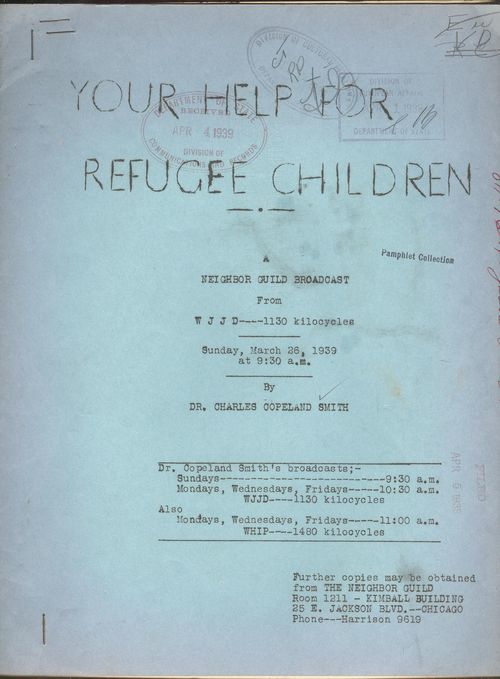
    April 17 jewishYour Help for Refugee Children (March 1939)  is the text for a radio broadcast by Chicago-based Dr. Charles Copeland Smith for his “The Neighborhood Guild” series.  (The document is also available from our blog bookstore.) Actually, Smith gave the broadcast over to his wife (for some reason) to make this appeal– I guess because the subject was children, and that it would best be made by a woman.  Mrs. Smith made the case for the relaxation or extension of American immigration policy to accommodate the newly-minted refugees of Hitler’s Nazi Germany. 

    The European war was just about started by the point–Czechoslovakia and Austria were already done, and Poland and the rest of the beginning of the war was just six months away.  By this point, however, the war was considered a foregone conclusion by most thinking people.  

    I have to give credit to the Smiths, as they did recognize the coming threat of Nazism, and did make the appeal for a more expansive inclusive of the relatively stingy American immigration policy.  They figured that the children of refugees would be their main concern, and that accommodation should be made to accept 10,000 of them per year.  

    That would be 10,000 “extra” children, I’m assuming, since the Smiths make the case that the current levels for allowable immigration was an at “inadequate” 27,000 per year.  In 1938 there were more than 300,000 applications for U.S. visa from German Jews alone, about 20,000 of which were accepted.  In 1939, a smaller number of Jews would find themselves allowed into the United States. From 1933 onwards, the case can be clearly made for the State Department, Congress and the Executive branch actively engaged in restricting immigration to the U.S. by many hundreds of thousands of European Jews.  Even after it became apparent that not only were Jews being sent to concentration camps by the millions, but they were also being exterminated , that the U.S. policy for acceptance of Jewish refugees barely changed.

    It is at the Jewish question that the Smiths got things wrong in their broadcast.  Mrs. Smith made “another attempt” to make the case for the refugee issue was not “predominately a Jewish problem”, the argument being that there were so many more Catholics than Jews in places like Czechoslovakia and Austria.  She went on: “I believe that Nazism is determined to stamp out liberalism.  The movement is political, not racial, not religious.”

    The undercurrent of their argument for saving (“not just”) Jewish children was based on a very selective use of out-of-context statistics, concentrating on numbers of refugees coming out of Austria and Czechoslovakia, and not, somehow, out of Germany.  I’m not sure how they could have gotten to their argument on refugee status for Europeans while ignoring the six years worth of anti-Jewish legal abominations perpetuated upon the German Jewish population.  

    The “Law for the Restoration of the Professional Civil Service” was passed in April 1933 (the first official banishment of the Jewish people as menials, second-class citizens,  banning them Jews from government jobs). The Jews had already been established by the Nazis as being the cause for the loss of WWI, the debacle at Versailles, the ruination of German culture and mortal enemy of the Aryan German. Many hundreds of laws like this would be instituted over the coming few years, establishing the legality of the supposed inferior nature of the Jewish people.  (Also in July 1933 came the underpinning legislation of some future nasty thinking, Ernst Rudin’s “Law for the Prevention of Hereditarily Diseased Offspring”, which established health courts and compulsory abortion and sterilization for a variety of physical and hereditary traits found to be unacceptable for the promulgation of a superior German race.) And this is all before the Nuremberg Laws of 1935/1936, (specifically the “Reich Citizenship Law” 1936)  which basically established the fate of the Jews, removing their citizenship and making them “subjects of the state”.Do I really need reiterate the case for the Nazi subjugation of the Jews, and their making the social and legal basis for the coming extermination policies which were codified at Wansee in 1942?  I think not–though it seems to me that for whatever reason the Smiths decided to not utilize this already well established (even by 1939) information.I think that at the very least they did not want to know.
                                        
    I’d like to focus on this self-deception, the welcoming of not knowing something, of not wanting to know, of stopping: of doing nothing in the face of something needing to be done.

    The destruction of the Jewish people during World War II is a history with many bearings, a complex of actions that seem to have been both elusively unstoppable and eminently addressable.  The psychology of why this occurred is forensically comprehensible; the ultimate question, after everything is said and done, is why the extermination was allowed to continue for years on end. There is a considerable catalog of demons of non-actions and deceits that I just can’t address now in a short post like this. Though I would like to know why was it so difficult/impossible for the British government (and in particular, Anthony Eden) to allow Palestine as a safe haven for desperate Jews, engaging in torturously long non-decisions and bureaucratic inscrutability to emergency situations?  Why did Franklin Roosevelt take so long to come acknowledge the documentation of the Holocaust and then cause almost nothing to be done about it?  Why did Sumner Welles act decidedly against any real action in presenting the full case of the Holocaust to American leaders?  Why would the War Department (represented by Assistant Secretary McCloy) respond in 1944 that  Auschwitz was both beyond the reach of tactical bombers and not be of sufficient military interest to divert Air Force resources away from other areas of interest?  The knowledge of vast extermination of Jews in Europe was known by early 1943, and yet, there was little action taken to do anything to stop it.  Not only that, the issue of emigration for Jews to the United States or any other country that would have them was caustic and slow; it was in short a history of the use of the word “no”.

    Henry Morgenthau (1891-1967), an old-line politician, was Secretary of the Treasury under Roosevelt and was also the only Jew in the cabinet.  It was he who in 1944 produced one of the most compelling, and damaging, documents questioning the American government’s culpability in doing nothing concerning the Holocaust, when “officials dodged their grim responsibility, procrastinated when concrete rescue schemes were placed before them, and even suppressed information about atrocities.”

    Its title left nothing to question:

    Report to the Secretary on the Acquiescence of this Government in the Murder of the Jews (1944).

     It starts so:

    “One of the greatest crimes in history, the slaughter of the Jewish people in Europe, is continuing unabated.

    “This Government has for a long time maintained that its policy is to work out programs to serve those Jews of Europe who could be saved.
  • A Note on American Two-Way Border Wars

    JF Ptak Science Books  Post 1171

    Porosity  is a measure of spaces-in-between, voids in a material’s total volume.  Some things certainly have visible porous elements, like a cotton shirt or netting, and others–like rocks and soil–don’t.  Other elements are measurable but less visible and experimental than fluid flow though still experiential,  like truth and falsity, or the concepts of good and evil, good taste and bad, love, generosity, felicity.  Ideas like “god” are very porous, as are the prospects of salvation and redemption, and (getting into) heaven and hell. 
                               
    Skin is also porous because it is composed of, well, pores. We don’t think of things like skin being permeable, as it holds in the vast amounts of liquids that make up the majority of the human body (for example).  Football has porous defenses, a necessary design to the process of the game, because years of 0-0 games just won’t work so well as paid entertainment.  Poromechanics in real and abstract bits is all a matter of degree.  And direction.         
    http://blog.selfportrait.net/blog/wp-content/uploads/2010/07/frances-flora-palmer-for-currier-and-ives-across-the-continent-westward-the-course-of-empire-makes-its-way-1868.jpg
    The American border is fairly well porous–much less now than it used to be of course.  There’s 3,987 miles of border (excluding Alaska) with Canada, and another 1969 miles between the U.S. and Mexico (1241 of those shared with Texas), so there’s a lot of room for room–for people trying to get into the country.  The flow of people through/over the borders weren’t always gong one-way–the expansion of the country is a history of the mythic pioneer/settler moving into space contiguous  to property that was owned by the U.S.  (Actually, it wasn’t all contiguous, adventurers and “explorers and entrepreneurs and filibusterers reaching far and wide.)  It would be interesting to know how many miles of variable borders within the U.S. we have slipped through over the last few centuries–my offhand guess is that it is an order of magnitude greater than what we have right now.

    Before we constructed massive walls and armed our borders, before we started to erase the incised sentiments on the base of the Statue of Liberty, the border wars of the United States were being fought going the other way ‘round.  The borders of the country were extended in many different ways, not the least of which were what we would call “pioneers”–plus of course politicians and the military, all deeply at work in establishiung the sactions of expansion.

    For example, in the 1800-1850 period, there were 21 major attempts to access foreign properties to become part of the United States.  Ten of these were attempts made to purchase the land outright–only Louisiana (and that is a gigantic “only” was wholly successful, with Sonoma being half-successful.  Five of  the other cases– East Florida, West Florida, Texas, New Mexico  and Alta California–came to us via wartime acquisition.  Attempts to buy and bully Mexico for Baja didn’t work; Yucatan and Cuba escape our proposals for annexation and purchase as well, while Chihuahua resisted purchase, invasion and annexation. 

    All of this excludes Indian lands, of course, a list of the tribes involved in the 709 seizures1 can be found in the continued reading section, below.  (That’s the number of “transactions” for the 110 year history between 1784 and 1894, which extends beyond the 1800-1850 slice of our expansionist pie; there were still a hundred or so motions against the Indians during this time, not to mention the dreadful Southern Removals of the Five Civilized Tribes as well as the disastrous removals in Indiana.)

    Conquest and purchase has been the name of the game in moving the Americans through our borders, an exercise of great regularity and incredibly high return.  Again putting aside the Indian question, had we not pushed up against the owners of these lands in the first place and absorbed them in the second, instead of having California, Utah and Texas we may well have had the Republics of California and Texas and the entity of Dereret, not to mention a wide swath of the southwest (including New Mexico, Nevada and part of Colorado) reaching up nearly to SLC that still belong to Mexico.

    And what it all boils down to after the borders have been passed through and moved forward, again, are the people that wind up staying–pioneers, farmers. The log cabin came to symbolize this spirit in the 19th century, a picture of progressive civilization and stability, of spirit, of achieving Manifest Destiny.  In my own collection of images of log cabins (prior to the Civil War), there are very few of these structures that show people in or near them.  More often than not, the pictures are silent; every now and then, there is a woman in the doorway or inside looking through a window–a symbol of innocense and felicity. There are images with the log cabin in the background, the foreground filled with pulled stumps and men plowing the fields (with and without horses) I don’t own a single image that shows a man with a gun.  (I’ve not done a survey on this issue, but that’s my overall impression over the years.) A subtle message I think was definitely being sent.
     
    Even the name “America” proved to be exceptionally porous.  At one point it stood to include North and South America, and then  it changed to exclude South and Central, and then Canada, and then Mexico–it really only related to the United States during the period of greatest nation building.

    This is just an interesting thing to think about now when we discuss closing our borders–those lines had to get to those positions somehow over the last 500-odd years.

    Notes:

    1. Indian Land Cessions in the United States,1784-1894, United States Serial Set, Number 4015; this is the  second part of the two-part Eighteenth Annual Report of the Bureau of American Ethnology to the Secretary of the Smithsonian Institution, 1896-1897.  “The Schedule of Indian Land Cessions subtitle notes that it indicates the number and location of each cession by or reservation for the Indian tribes from the organization of the Federal Government to and including 1894, together with descriptions of the tracts so ceded or reserved, the date of the treaty, law or executive order governing the same, the name of the tribe or tribes affected thereby, and historical data and references bearing thereon.”

    Sometimes just seeing hte extent of a list of names gives you a much greater appreciation for the numbers involvewd than the sheer number itself:
    Acoma Pueblo
    Alabama
    Alsea et al
    Apache
    Apache (Eastern bands)
    Apache (Jicarilla bands).
    Apache (southern).
    Apache (Southern).
    Apache (Western bands)


  • A Shadow for a Mask–the Pivot Person in the Execuiton of the Lincoln Conspirators

    JF Ptak Science Books   Post 1166

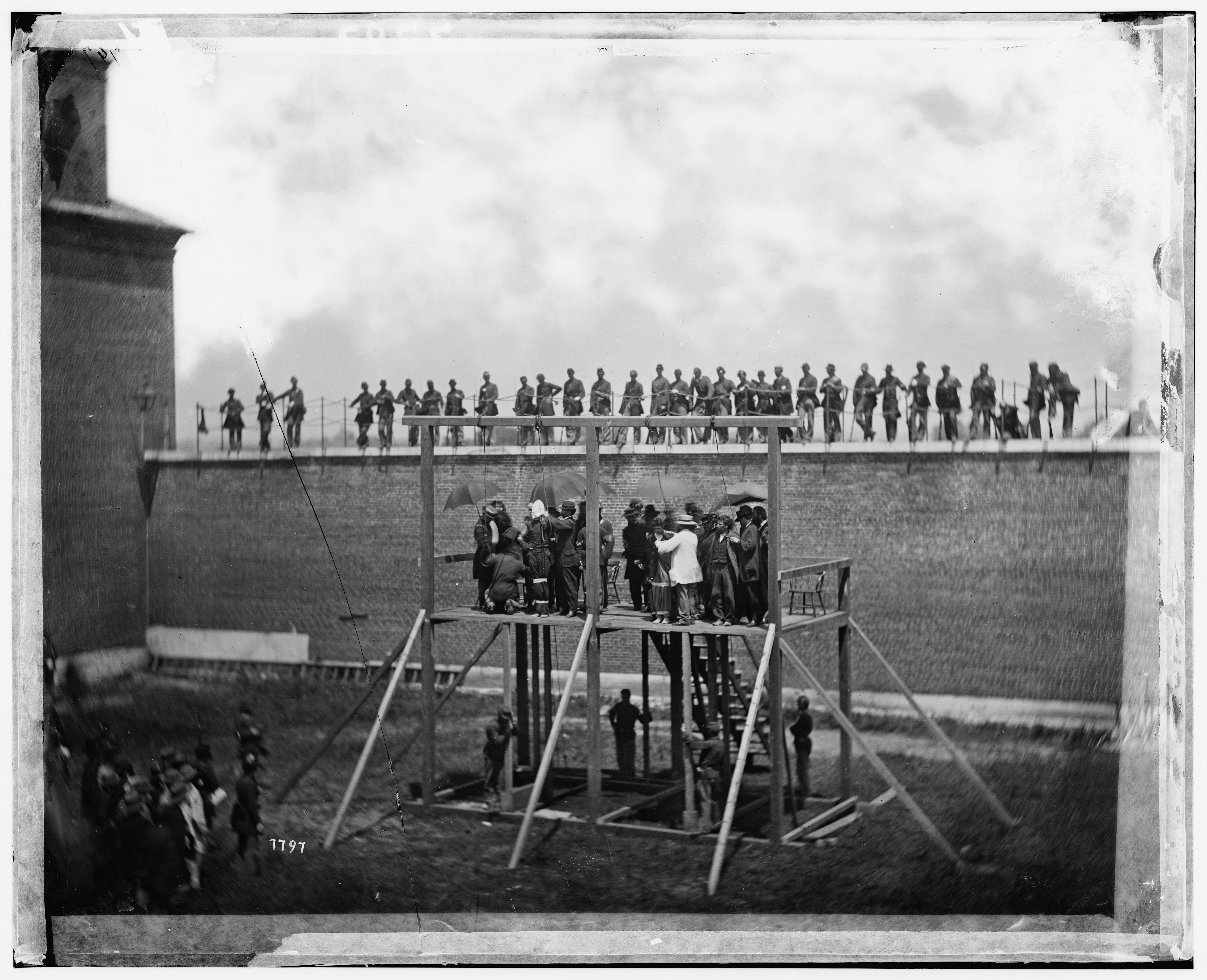
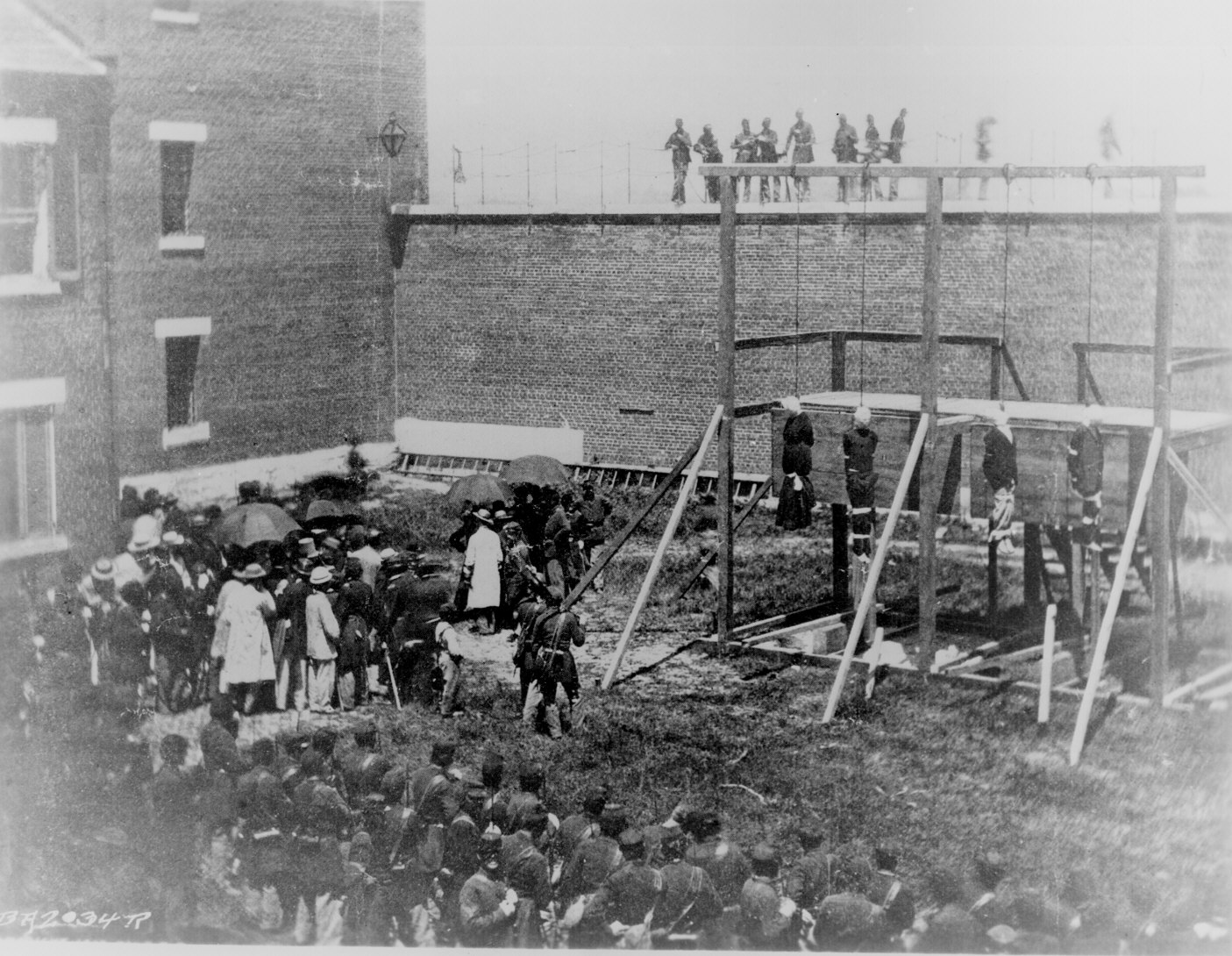
    On a hot 7 July, 1865, photographer Matthew Brady was the only photographer present at the old Washington Penitentiary to make images of the execution of the Lincoln assassination conspirators  Mary Surratt, Lewis Powell, George Atzerodt and  David Herold.  All of these stories of the assassination are best told elsewhere–in many other elsewheres, a story that is legion–but I can’t seem to find anything about one special, particular  person captured in two of the series of these photos.

    Lincoln conspirators

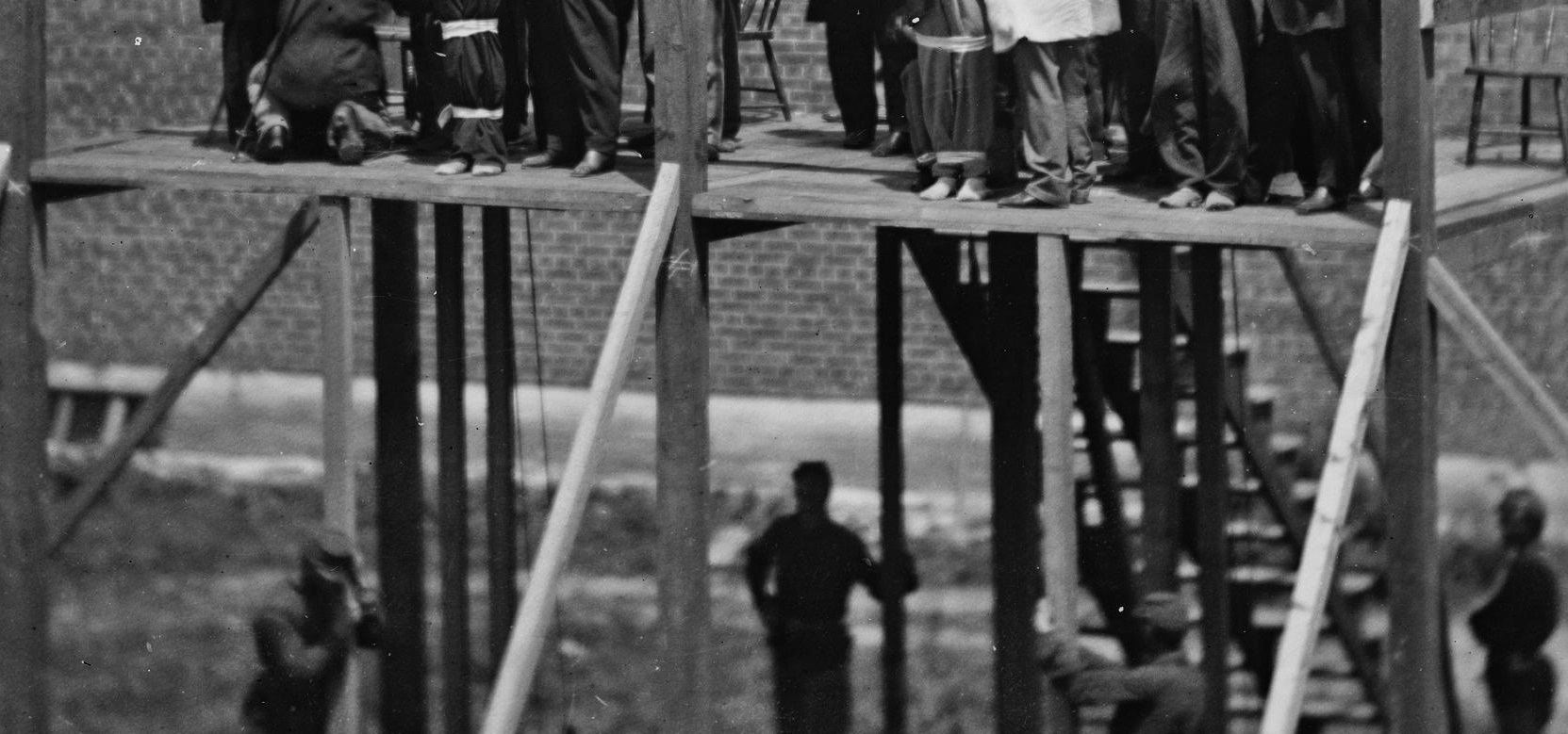
    If you look closely at the first photograph, there is a man leaning against a pole that is directly under the first condemned conspirator, Mary Surratt.  That pole, a substantial 6x6x10′ or something like that, is the only thing that is holding the trapdoor closed on which Surratt stands.  Actually, I think that two conspirators occupy one trapdoor–there is a second pole just to the right, another man standing nearby.

    Lincoln conspirators detail

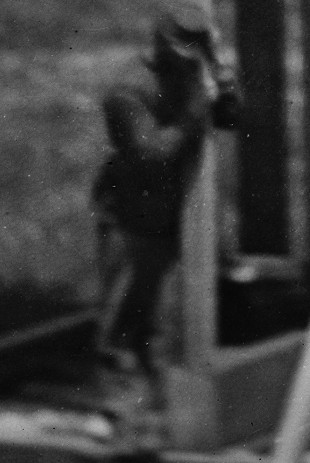
    I guess the execution was at high noon.  The shadows seem to be falling straight down, our man–standing just out of the reach of the shadow of the gallows–has his face obscured by the shadow of the brim of his cap. Like a mask.

    Gardner execution detail man pole jpg 

    What was that first man doing, exactly?  He seems to be in a  nonchalant attitude, given his position and circumstance, as well as the crowds and significance of the event. Why was he leaning on the pole?  Was this just the last part of a long morning?  Was the pole not terribly secure? Was he bored?  Was he overcome?

     He was surrounded on all sides, and he was hearing the boots-on-wood above him, the conversations in the preparations of the nooses, the shuffling of the shackled feet of the condemned, and perhaps the last words of the people waiting now for the last noose to be fitted over the last man.  At that point, an order would be given, and our man–who was now positioned behind the gibbet–would simply push another long pole against the bottom of the supporting pole, dislodging it, and allowing the trapdoor to open, the conspirators dropping to their deaths with broken necks. Or I hope for their sake that their necks were broken–by the looks of the position of one of the nooses, its in a bad spot so far as assuring a quick death is concerned.  Maybe the noose’s position was changed after this picture was made  Maybe not.  What did our man do after pushing the beam out of position?  He would’ve been very close to the action, within a few feet.

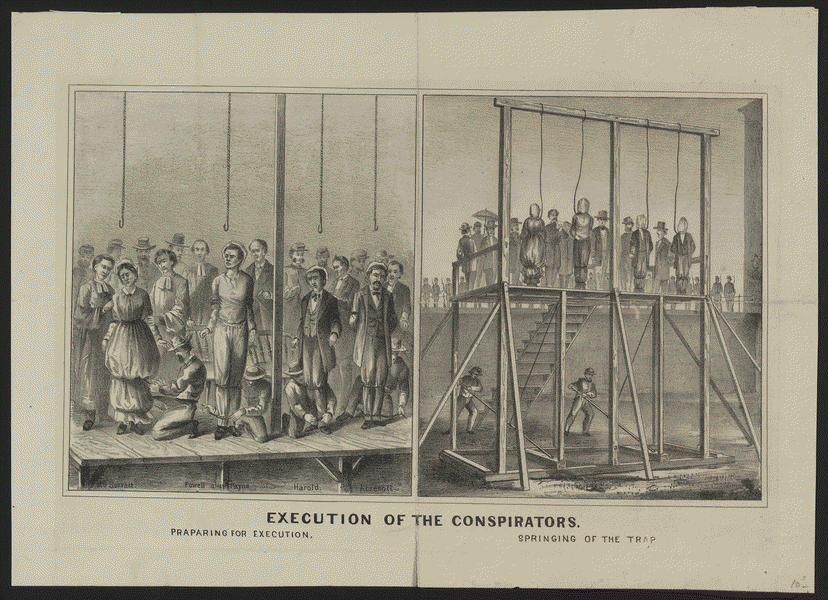
    I wonder what the trapdoor pole pushers do afterwards?  What were their jobs?  From the looks of the last picture, someone put the beams in order, placing them alongside the execution structured, tidied up. 

    Where did the man go?  Since they were the few folks right at the base of the scaffold, right there where the mandrake were supposed to grow, did these men wind up with th job of cutting the bodies free from their ropes and burying them?  Someone did it. I wonder what that someone thought as they returned home, or to the barracks, and st down to dinner.  What did they see in their dinner plate?

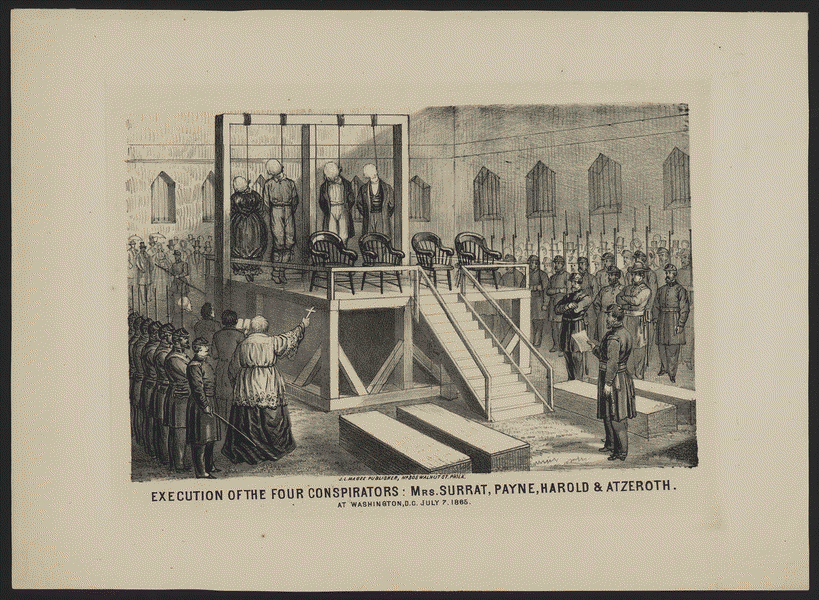
    Civil-war-201

     This contemporary print of the scene gets little correct, though the chairs for the conspirators are about right.  The scaffolding is much nicer than in the original, and the place looks certainly far less austere than the penitentiary. The awful thing here is the actual, physical manner of the hanging–the attitudes depicted here  would have been even more bestial,  the lack of a trapdoor suggesting that the were all dropped or raised a few inches and basically strangled to death.  Also in the real scene of the execution there were four coffins for the condemned nearby–except that three of them were piled one on top of the other.  I’m not sure why they were stacked. It seems to me that they were within the visual range of the conspirators.

    Lincoln conspirators

    The next contemporary print gets a little more of the reality of the scene correct, both mechanically and emotionally, and shows how our own character of interest did his job. The actual hanging part–the ropes and the nooses–is again wrong, suggesting strangling more than hanging.

    Lincoln execution 2

    The pictures raise far more questions to me than anything else, as witnessed by my personal record use of the question mark in this post. . 

    [Sources: photographs courtesy of the U.S. National Archives; prints, courtesy of the Stern Collection, U.S. Library of Congress.]


    ·Posted by :

    ·in:

    —

  • Tremendous Change in 10-Year Increments: 1935-1945

    JF Ptak Science Books Post 1091

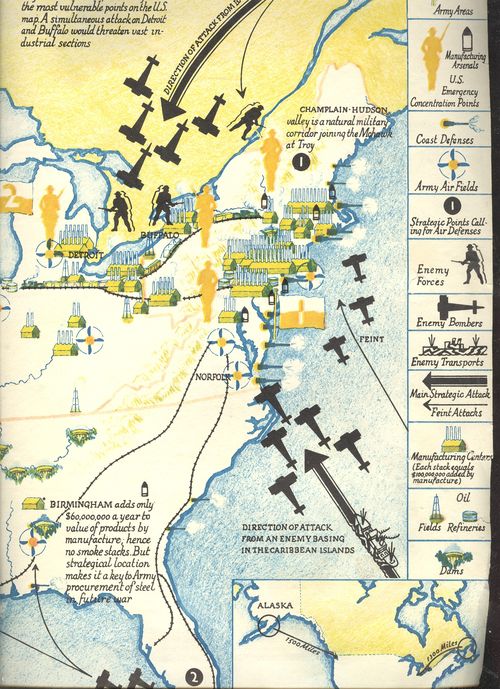
    I was reading an early post that I made here (“The Invasion of America, 19??–1935–Scenario for Invasions via Canada, Mexico and the Caribbean”), mainly concerned with the fantastic, propagandistic map that accompanied the original 1935 Fortune magazine article.  This time I took away something entirely different. 
    Invasion america fortune
    The article, “Why an Army?”, asked the interesting and surprising question of whether the United States actually needed a standing army.  The army was supposed to be for defense, and the author adroitly points out that the U.S. had never fought a defensive war–except, of course, if you redefined certain ideas and terms that could somehow explain the wars for Manifest Destiny (the Mexican-American war of 1846) or the Spanish-American war (1898) and so on as “defensive” in their provocatively offensive manner as a reverse defense procedure.   But more on that in a bit.

    What really surprised me was the appearance of the phrase “…the effect of an expansion of this nuclear force…”   It simply referred to the standing army size of 165,000 troops there in 1935, but ten years later it would mean something entirely different.

    This is when I was thinking of the enormous changes that took place in the ten-year period of 1935-1945. And then of different ten-year periods–but first to WWII. 

    In 1935 the “nuclear” that was being referred to was the crux of the American fighting force, which was a standing army of about 165,000 men and 1,509 airplanes (“of all types”). At this point the U.S. Army was poorly outfitted, costing a total of 1 million dollars a day for upkeep and maintenance.  The technical, ordnance aspects of the army’s mainstays were unimpressive.  The great standard cannon was the 75, an 1898 French-created thing capable of a 6-degree traverse and which needed a massive pit for its recoil.  WWI tanks were still a common sight, being replaced by the T1 “combat car”, a relatively-lightly armored fighting vehicle that was slow and underpowered.  The T1 was just at this time being replaced by “the holiest of holies”, the T2, a much faster, somewhat better-armored and more heavily gunned (having two 30 calibers and 1 50 caliber) version of its earlier incarnation.  It could travel 50 mph with its tracks on (unlike the T1, which, when it needed to move with some speed, needed to remove its tracks and replace them with wheels, and then vice versa once they got to the combat area).  The T2 could run circles around the T1, and double (or triple) that around the 1000 or so WWI 6 mph leftovers.  The problem was, though, that in 1935 there were only 19 of the T2’s around–their $26,000 price tag was a bit much. 

    The discussion of increasing the “nuclear” force was to increase the standing size of the army– ten years later the term could be used to describe an increase in the development of the first generation nuclear weapons, these following an absolutely phenomenal ramp-up for development and production of all manner of weapons during America’s involvement in WWII. It was an overall astonishing achievement that was capable of no other country on earth, given the vast resources and workforce in the U.S.  This production was simply impossible for any other country to even approximate, especially when you consider the vast calls on energy that the production of the atomic bomb called for–and of course considering that America was a fortress, basically impregnable from any outside force.

    Which gets us back to the Fortune article.  The author references a Lloyds of London report that there were 500-to-1 odds that anyone would attack the U.S. in 1935 or in the near future.  There really wasn’t anyone around with the power or wherewithal to do so, except for Great Britain, which of course would have no interest in doing such a thing.  (Especially when you consider that the great natural resource wealth of GB was in the empire, and it was in the policing and protecting of the empire that required the attention of the Royal Navy and Army.  Be that as it may, Britain was no going to attack America.)

    The author of “Why an Army” makes the point that if the U.S. has an army it is for defensive purposes; on the other hand the U.S. has never really fought a defensive war.  The idea of “defense” though needed to be expanded to include attacking other countries whose actions threatened our way of life.  And so,  “If the citizen thinks that he is ever going to need an army for meddling, then he needs one now”, given the poor state of American defense.   “We cannot abolish the army if we think illogically that we will never be in a war”, the article claims, and “a war in any quarter of the world may affect our industrial mechanism…”

    “We are no longer isolated and we have never been really holy…” Fortune concludes, and that the bottom line was that we needed a real standing army–not the make-believe sort that existed in 1935–if we were going to protect ourselves against invasion by attacking people who threatened our existence. [It is curious to note that there is no mention of Nazi Germany whatsoever in the course of this long feature article.]

    And this winds up back to the history of ten-year periods of enormous change.  I can think of some obvious examples:

    1905-1915 for physics,  1911-1921 for the arts, 1945-1955 (for entering into the Cold War, MAD and the Korean War, not to mention the advent of computers and DNA and all the rest), 1859-1869 for Darwin, and spectroscopy and the maths, 1953-1963 for the enormous changes in the biological sciences, 1939-1949 for physics (again, this time running from the nuclear fission to QED). There are others, of course, and there will be faults with these dates, perhaps–I think that they’re pretty good for a start..

    I suppose that you could make the case that beginning in 1895 or so that you could say that these great periods of enormous change could begin at the beginning of nearly any year, though I do feel that there are many periods that begin at recognizable dates   I think that the existence of these 10-year periods become less abundant as you move to the years before one of the earliest great 10-year periods (1859) simply because it took so long for an idea to go ‘viral”.  Certainly there would be fewer people working in any given field, and communicating even great ideas would’ve taken far longer in  pre-telegraph days.  (An interesting question could be how long it took for an idea or thought to be spread thoroughly through a community/nation/world?)  There are exceptions of course:  the reaction to the invention of the telescope and Galileo”s use of that instrument, and also for the use of the microscope and the work of Robert Hooke being perhaps the most prominent examples.

    I like the idea of looking at the unfolding of  revolutionary events in 10-year increments.  And for the 20th century there would be a solid need to be a geologist of the history of ideas to see how many different levels of change were going on for each revolutionary period.

    ·Posted by :

    ·in: