A Daily History of Holes, Dots, Lines, Science, History, Math, Physics, Art, the Unintentional Absurd, Architecture, Maps, Data Visualization, Blank and Missing Things, and so on. |1.6 million words, 7500 images, 4.9 million hits| Press & appearances in The Times, Le Figaro, Mensa, The Economist, The Guardian, Discovery News, Slate, Le Monde, Sci American Blogs, Le Pont, and many other places… 5000+ total posts since 2008.

Category: Absurdist, Unintentional

  • The Exploding Dots of Falling Dominoes: Vietnam, 1954

    JF Ptak Science Books LLC  Post 996

    This story is more about Ho Chi Minh’s capture of French silk than about anything else–it is a peep into the future following the end of the French endgame in Vietnam, which came abruptly with their defeat at the Battle of Dien Bien Phu in 1954.
    Blog--april 1 detail

    [Detail/larger image below.]

    The siege there started on the 13th of March, and lasted 57
    days, until May 7th, 1954. The
    commanding general of the Viet Minh forces, Vo Nguy Giap, achieved an enormous
    victory over the French—the first time a guerrilla force readjusted itself into
    a conventional force to defeat a Western army. It was the end of the line for the French military involvement there and it just so happened to be
    the beginning of Vietnam as an object on the American foreign policy event horizon.

     Just a week after this notice appeared, Dwight Eisenhower made his domino
    speech:

    “Finally, you have broader considerations that might follow what you would
    call the “falling domino” principle. You have a row of dominoes set
    up, you knock over the first one, and what will happen to the last one is the
    certainty that it will go over very quickly. So you could have a beginning of a
    disintegration that would have the most profound influences.conference…”

    Vietnam was supposed to be one of those dominoes.  Evidently all of the dominoes were the same size regardless of the size or international presence of the country.  It was also the same sort of domino even if had appealed for American recognition of its democracy-laced post-WWII government. And it was a domino still even if the United States had helped fashion the events that necessitated the movement of that country toward domino-hood.  No matter.  The U.S. decided to back the French in reclaiming their war-lost possession, in spite of the fact that the French were still doing business during the war with the Japanese occupying force in Vietnam, and in spite of the fact that the French re-armed Japanese troops to help fight against the “insurgent” forces of Ho Chi Minh.  It was an ugly decision, and I suspect FDR was just too sick to deal with it properly. 

    Nine years later, the French had finally been soundly defeated and Vietnam thought that it had finally gained independence.  Not so. 

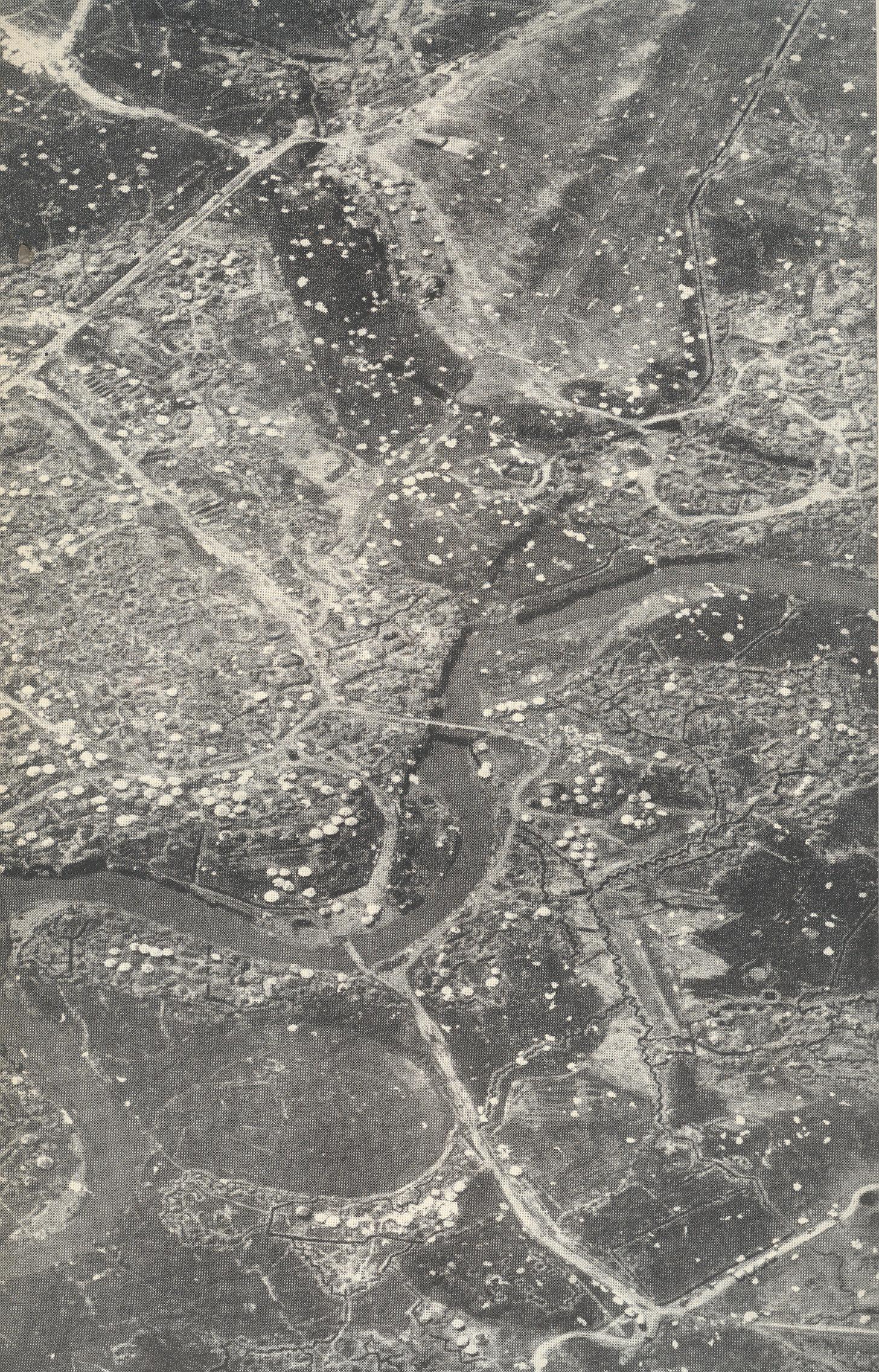
    The picture here is of dots–the field of battle at Dien Bien Phu, littered with silk parachutes–cargo dropped by the French air force to the defenders of the garrison….most of which, evidently, fell well outside the French-controlled perimeter and into the hands of the attacking Vietnamese army.  These were the exploding dots of the falling domino.
    Blog--april 1 

    If these dots stood for something, they could stand for the coming wave of death and misery, a graphical representation of what was to come over the next 25 or so years.

    I reckon there to be about 500 parachutes/dots in this picture.
    Each of these dots could be assigned a number, each representing a gross statistic for the war, from  1950 to 1975:

    U.S. forces killed in action:  100/dot (58,000 killed)

    U.S. forces wounded in action: 300/dot  (313,000)

    Army of the Republic of Vietnam, killed in action:  500/dot (263,000)

    Army of North Vietnam, killed in action:  2,000/dot (1.1 million killed)

    Civilian deaths, North & South Vietnam: 4000/dot (2 million killed)

    Civilian deaths caused by North Vietnam during the war: 300/dot

    Civilian deaths caused by “North” Vietnam, postwar consolidation and reeducation: 1,000/dot

    Civilian deaths caused by the U.S.: 175/dot

    All deaths for the war, 1950-1975: 8,000/dot (using a figure of 4 million).

  • 1947 Atomic-Powered Farm Industry and the 1945 Internet–Interesting Future Visions Fueled by Booze

    JF Ptak Science Books LLC  Post 1017

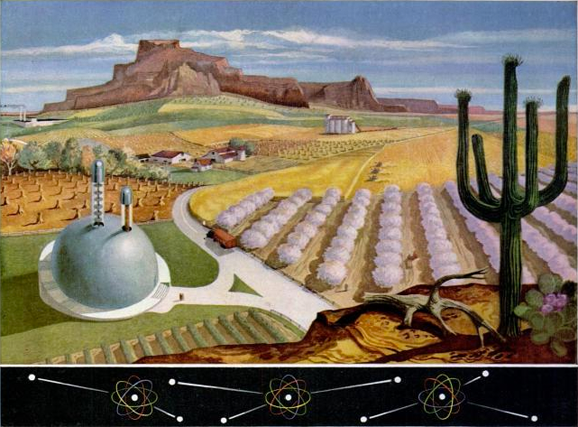
    Seagrams V.O. Canadian Whiskey powered the future through a series of a dozen or so ads for itself in the 1945-1947 period, taking a usually-strangled though occasionally interesting peep into what the future might bring.  (And of course the future is brought by men who drink Seagrams.)  In this ad, appearing in the 12 May 1947 issue of LIFE Magazine, we are told “deserts will bloom through atomic power”–how this might happen is left to the imagination. Also left to fantasy is what exactly is being farmed there in front of the incongruous “atomic energy plant”. Plastic smoke?  Taking a fractured approach to the possibilities one might say that atomic bomb mushroom clouds are being grown from seedlings here from the ground up, nurtured until the day they too will be as big as the blasts of August 1945.

    Atomic garden

    Oddly enough, the illustrator–who after all was just trying to sell alcohol–came pretty close to the truth, except that they got the power source wrong.  Rather than nuclear energy, it would be petrochemical industries that would lie there at the heart of America’s farm production (via seeds and fertilizers and so on)–I’m sure that it would’ve made more sense in a weak way back there in 1947 to believe the atomic story rather than thepossibility that it would be petroleum that would drive the entire production of food forward.  

    In another weirdly prescient image–“weird” anyway for a quick effort made by an artist trying to sell drunk juice–is this proto-internet office view, made in May 1945. There’s lots of passive solar going on here(though not really very effective when you consider the other ways of directing and filtering exterior light inside) in the office of tomorrow, but more important is the desk and the file cabinets.  The seated man is talking to someone across the country  via phone/wireless, with data en masse at his fingertips, a “computer” (in the old sense of the word, that being a person–and usually a women–given the charge of adding long columns of number or whatever and then doing the arithmetic, like a comptometer) working some sort of calculating interest on the largish calculating instrument. In general we see a decision-maker awash in responsibility connecting all of the parts of his world: a primitive, secular, analog internet.  And this too just at about the same time that Vannevar Bush introduced his own vision of the informational future with his superb Memex (which I wrote about earlier on this blog here.)

    Internet 1945


  • Picture Dictionary of Extinct Semi-Luxuries, Part 1

    JF Ptak Science Books LLC  Post 1016       

    Luxury for the not-wealthy, the luxuries of the working classes, is a relatively new invention in the West.  Virtually unmolested except by the aristocracy, “luxury” was a thing defined to exclude nearly everyone in Europe, the United Kingdom, America and virtually any other place.  Not until the second Industrial Revolution did capital become more “absorbent” to those working for it, with the working classes allowed to be paid more and keep more of it–money in the hands of the mass of society became expendable on the stuff of life that wasn’t necessarily “necessary”.   This picture dictionary–collected but not assembled by the social muse and graphical strategist Malcom Mumbry (of Landrum, South Carolina, working-class neighbors to the wealthy in the horse country of northern South Carolina)–displays some of the many new luxuries of the 1880-1920’s period, most of which have now been lost to the dust and short memory.

    The images are beautiful and unusual–their content may be even more so, and generally unexpected and–occasionally-unimagined. We’ll be making posts to this site until we can construct a few representative alphabets of lost luxuries–their initial presentation will  not be made alphabetically.

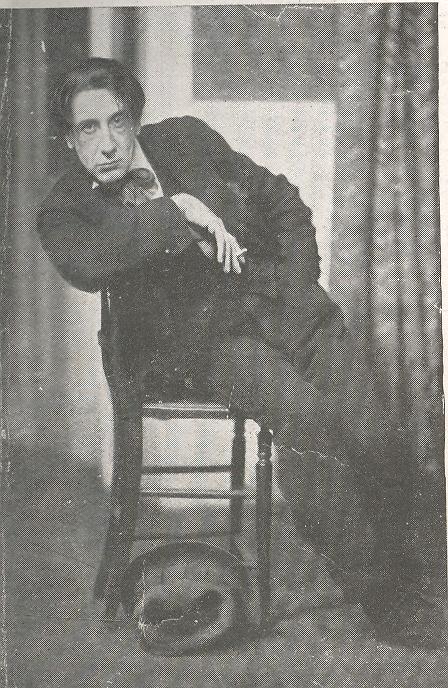
    H     Hat Ennui.  


    1-apr 29--luxury--hat ennui

    By the time this photo was made in 1920 hat-need had surpassed itself to the point where only ennui could quench the continuing hat-thirst.  So much so as a matter of fact that Giles Rope, a French playwright, wrote and co-produced  (along with Guy la Flembeur) “Ennui Chappeu”, an absurdist work on the developing hat anti-lust.  Intended as a silent/violent statement against hat ennui, it became a pro-ennui sensation–not only did men want hat ennui, they evidently wanted to watch other men with hat ennui, as well. The play ran 85 weeks in Paris, 50 in London and 102 in New York, closing in 1926.

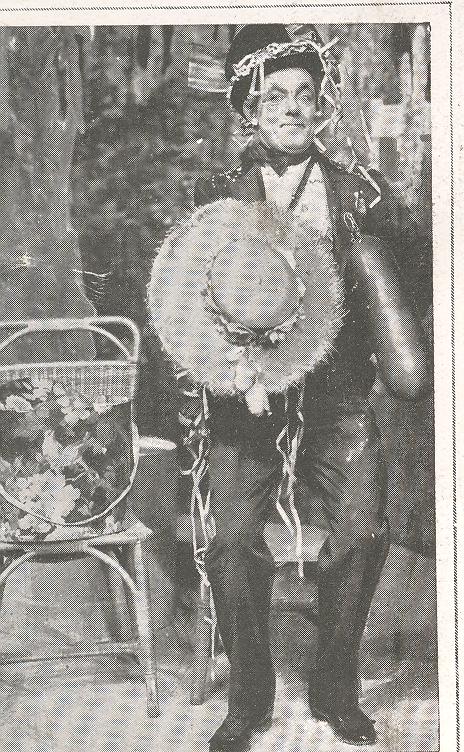
    H  Hats, Bologna

    1-apr 29--luxury--bologna hats 

    Perhaps a more unusual hat story in 1921 was the appearance of party hats for over-sized bologna.  The delicatessen standard was new in 1921, and in order to make it more somehow appealing to customers the bologna were dressed in large, flat-brimmed party/sun hats.  By 1922, bologna hat racks began to appear in some eateries; by 1923, the hat craze was over, and bologna had shrunk. 

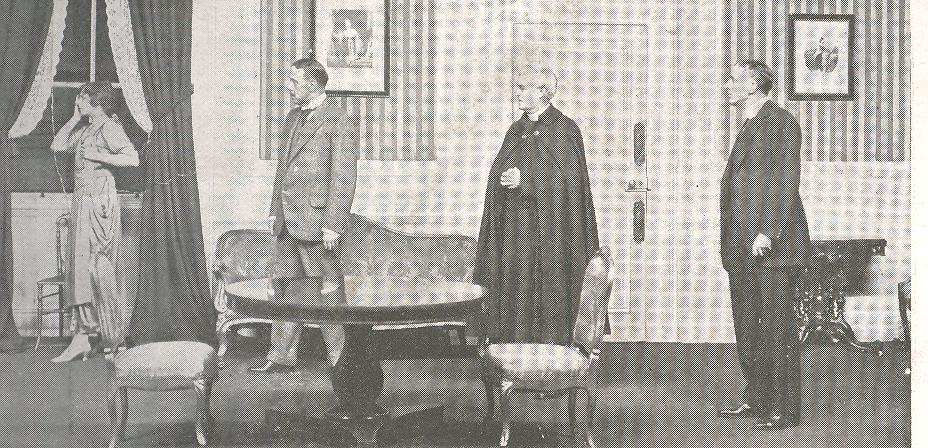
    S  Sob-watching/sob-watchers

    1-apr 29--luxury--sobwatch
    The somewhat wealthier classes were offered a short “Exclusive Hirelings” pamphlet by Bent Gruel Company (of Chicago),  where well-dressed “Attendants” could be hired to “engage at a distance”. This amounted to polite watching–interested parties could now hire one (or more) of Gruel’s sophisticated cadre to “attend to the visual needs deserted” of people in joy or crisis so that whatever it was being experienced was now not necessarily experienced alone. (In the above scene a client has hired three men to equidistantly observe her weeping by a painted window.)

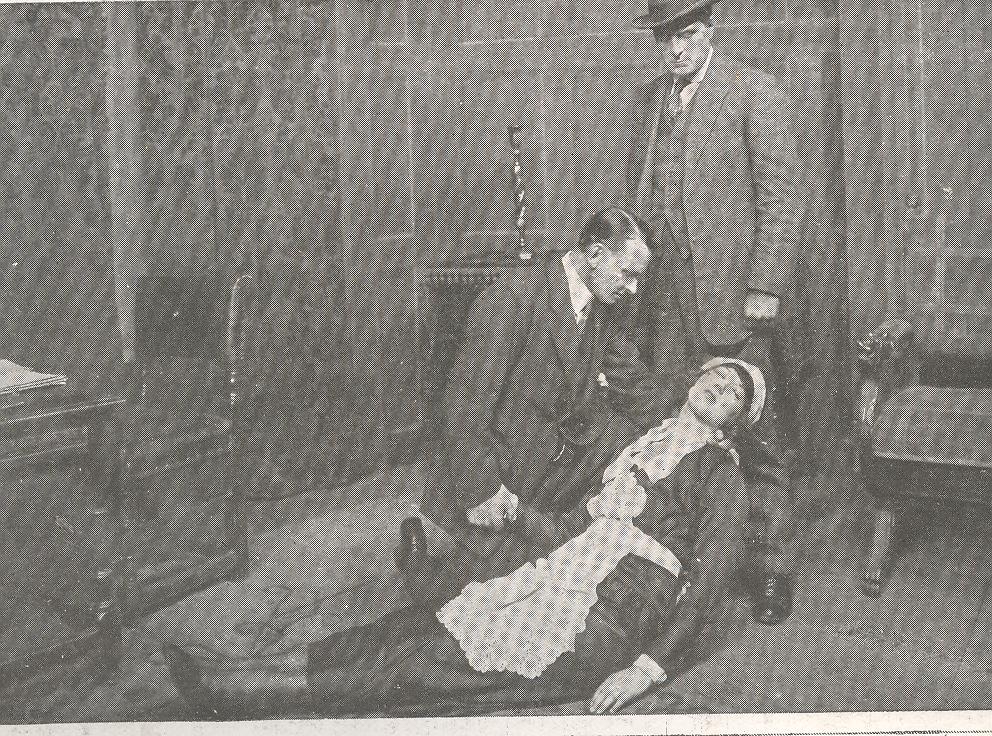
    M   Maid Fainting

    1-apr 29--luxury--maid fainting

    For the millions of Americans who were newly affluent in 1925 but not affluent enough to afford a fainting maid that they could attend to came the Maid Fainting Society Inc of America.  Bonded in 15 states, MFSA sponsored overseas maids to faint in good American homes.  They were hired out at $4/hour (a handsome hourly sum in 1925), the fainting maids being allowed to keep half.  In 1926 a sub-cult of Extra-Tall Fainting Maids was born (an example of which is picture above), and provided an income to thousands for several years.  (One of the last silent films ever made, Fainting Maid Maiden, with Clara Bow, 1944, used this phenomenon as a basis for its story; by that time however the craze had passed, the war was on, and no one cared anymore for silent films about fainting maids.)

    C   Cigar Cane Rentals

    1-apr 29--luxury--cane
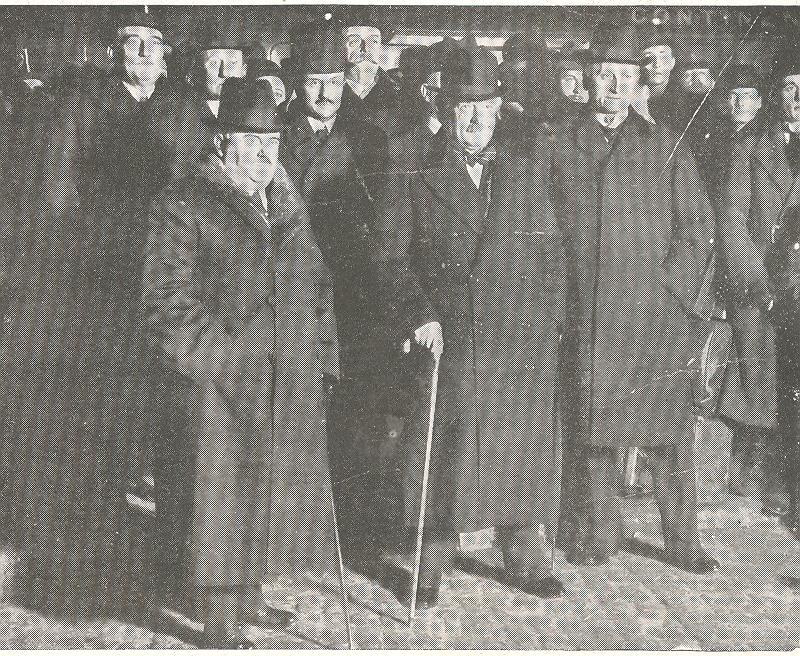
    An excellent example of an extinct semi-luxury that was almost entirely based in England and which never caught on anywhere else in the world was cigar cane rentals.  As seen in this photo (made in London in 1922), well-intentioned better-clothed country pensioners were brought into the city and made to pose with their renter canes.  Wooden canes evidently deprived Londoners of a “cigar aromaticity” need that was fulfilled with these canes made of cigars.  The short craze lasted for about 15 months, during which time better than 500 cane renter holders were stationed around London at walking parks on any given evening.  It was an essential part of care rental to do so on brick, as the cigar cane tip made a distinctive sound  (a harley-like individuality if you may), which was enjoyed by the renter and the non-renter alike.  AS we can see in the photo above, nearly all of the cane renter men have already rented their canes, pushing the last two men with canes to the front for greater visibility.  

    –end, Part I


  • A History of Blank & Empty Things #70: Thought and Fox-Tossing

    JF Ptak Science Books LLC  Post 1015

    1 april 27 fox tossing

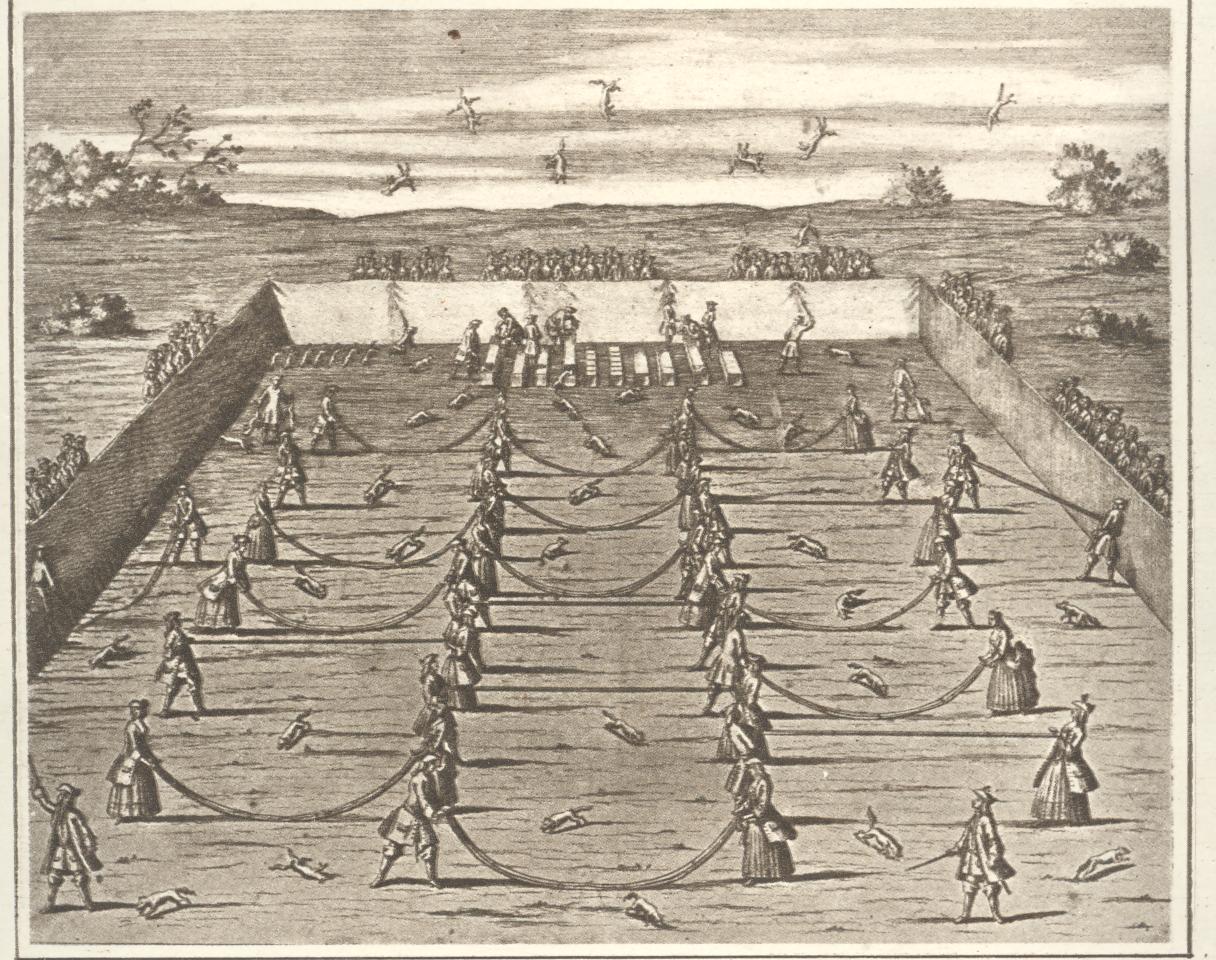
    In the ten-level history of blank thought none are more cardinally ninth-level than the abuse of animals–except of course the abuse of animals for sport. (As unspeakable as this is there is always another level of the truly unspeakable.)  In the early 17th century, at about the same time that the two Electors of Saxony were legendarily and grossly dispatching animals of all shapes and sizes (including 110,530 deer, 54,200 wild boar, 6,607 wolves, 477 bears and all manner of small “prey”) there existed a German Court sport of fox-tossing.

    What would happen is this: a coral would be made of cloth screens; court favorites would entire the enclosures with ropes while disabled foxes were also introduced; the people would pair up with a long rope between them, held slack t the ground; the animals would run in an enforced terror around and through the pairs and over the slack ropes; when the fox tried to run over the rope, the pair would yank the rope taught, launching the fox into the air.  And so on until everything was up in the air or dead.  And that’s it. 

    Fleming’s  Deutsche Jaeger  (published in 1719) produced this (above) image, and commented on it: “Skilled male tossers could toss a fox 24 ft. high…At a famous fox-tossing in Dresden there were tossed some 687 foxes, 533 hares, 34 badgers, 21 wild cats, and at the end 34 young wild boar and 3 wolves….”

    Oscar Wilde famously skewered fox hunting, which pales in comparison to this thing; I find it difficult to imagine what he might have said about fox tossing. 


  • Giant Airship as a Floating Tuberculosis Hospital, 1930

    JF Ptak Science Books LLC  Post 1010

    Tuberculosis has been killing people in its nasty, eat-you-alive-from-within way, for thousands of years.  TB (for tubercles bacillus), also known as consumption (for just those properties mentioned), phthsis and scrofula, was the cause for every fourth death in early industrial age England (1815), and tended to nest among the urban poor.  It really wasn’t well understood until the 19th century. when it was first actually named as a disease (by J.L. Schoenbein, 1839), and it wasn’t identified as contagious for another 42 years or so.  The bacillus causing

    April 21 dirigible
    tuberculosis wasn’t identified until 1882 (by Robert Koch, who wound up
    getting the Nobel Prize in Physiology or Medicine for his work in 1905),
    and although some early forms of immunization began as early as the
    first decade of the 20th century, it really wasn’t until just after
    WWII that immunization and antibiotic treatment bean in earnest.

    There have been many ways of dealing with the disease in the history of man and mythology, but prior to the late 1940’s the mainstay of effective treatment for TB was isolation (or collection of affected in “clean air” sanitoria) or penumothorax–there wasn’t much that could be done with this mass murderer. 

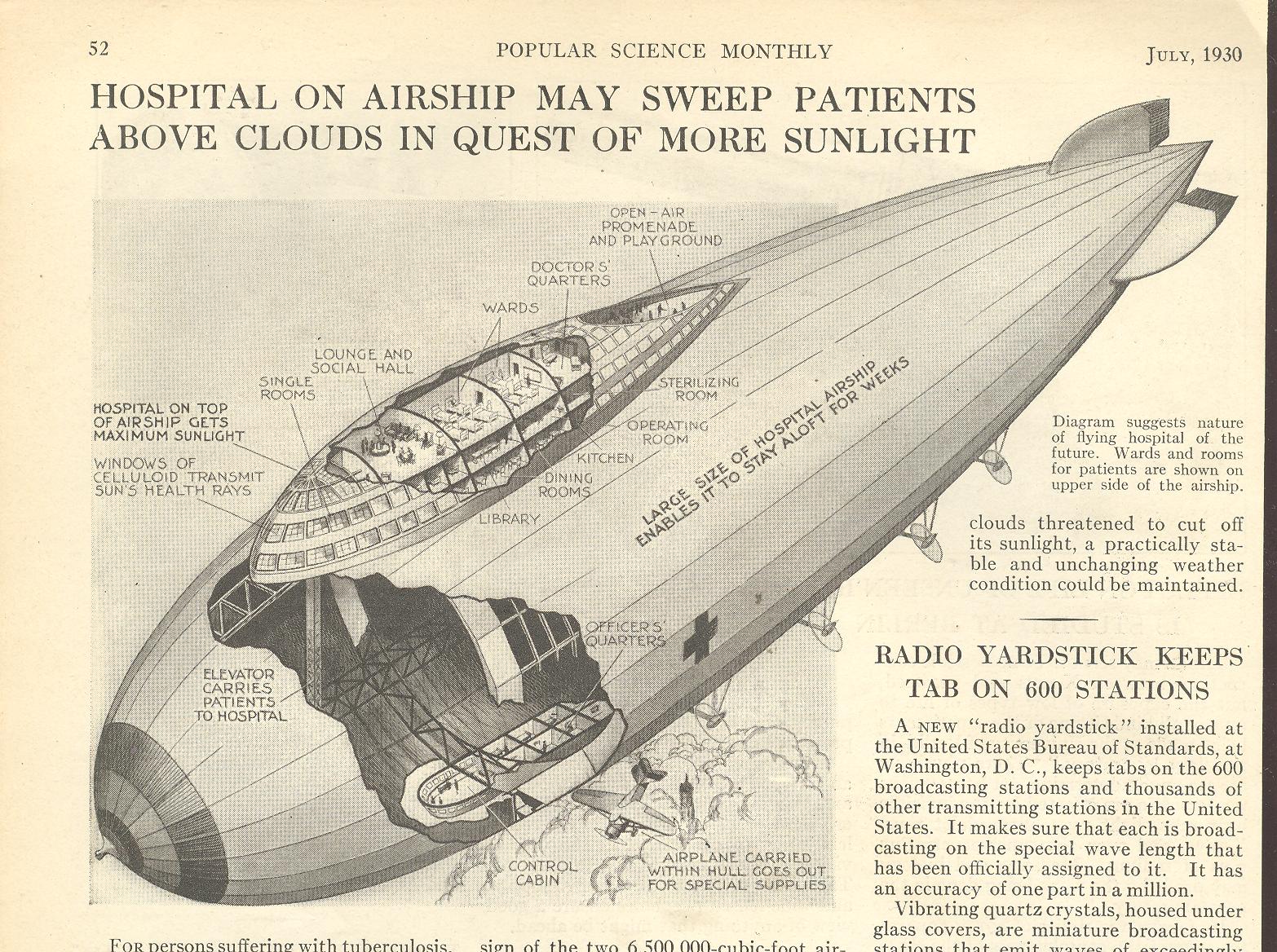
    And so it came to be that  Dr. Karl Arnstein (a significant engineer and  the chief designer of the U.S. Navy airships USS Akron and USS Macon) proposed this flying hospital ship—a 6.5 million cubic foot airship, actually. The hospital was “a blister on the skin” of the airship, occupying very little of the entire surface area, looking as though it might be able to accommodate 75 or so patients, staying aloft for weeks at a time–there would even be an aircraft in the belly of the beast that could be released to fetch supplies from time to time (though I don’t kow how  the whole return trip would work).  The airship was intended to follow the sun, skirting clouds and bad weather, keeping the TB patients “in the health rays of the sun” to help cure them of their disease.  It was an odd and desperate idea, which seems on one level to be a good effort, the best that could be done with the data available. 


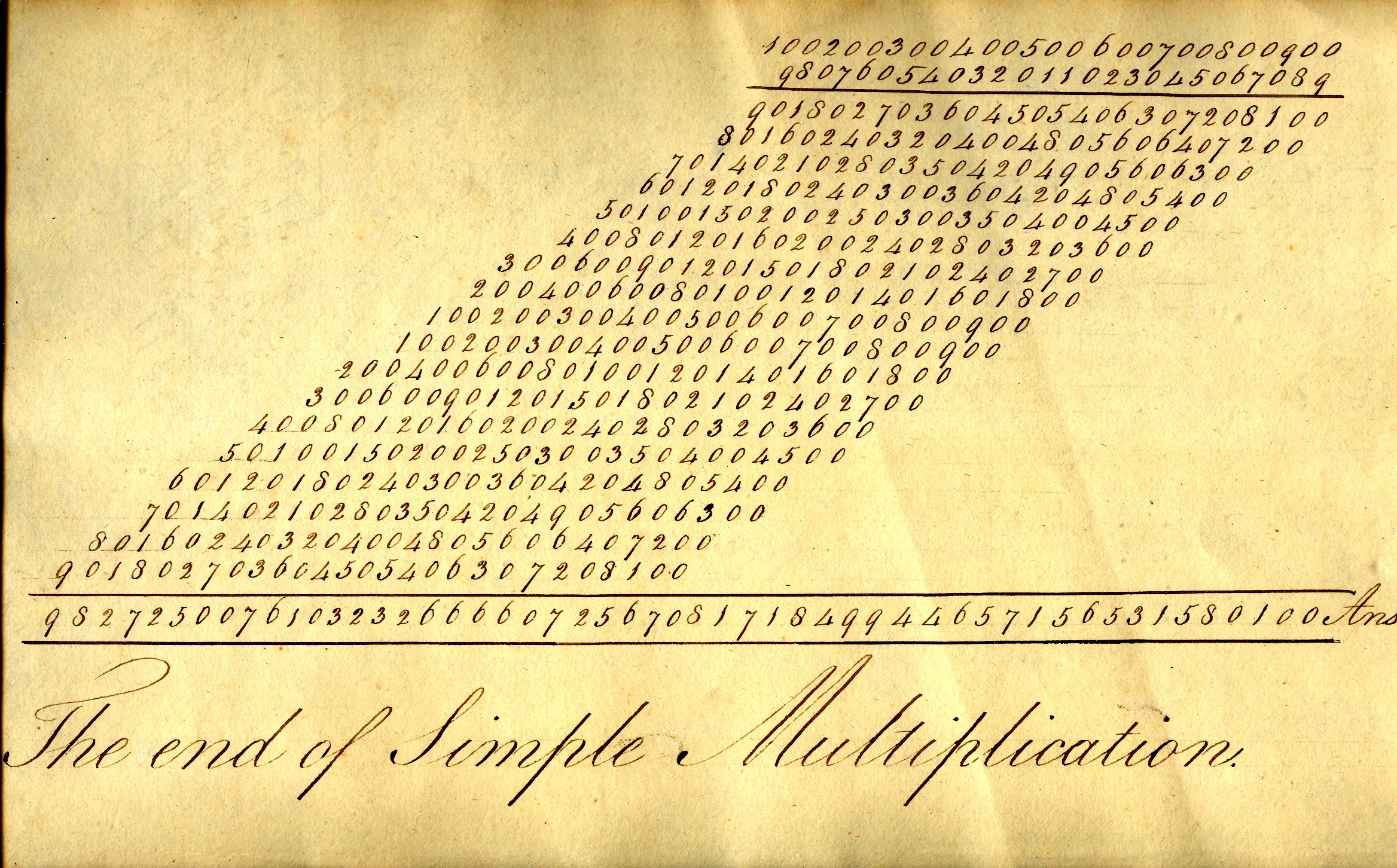
  • Mathematical Art: “The End of Simple Multiplication”, 1814

    JF Ptak Science Books  Post 982

    Mar 22 end of multipiplication det

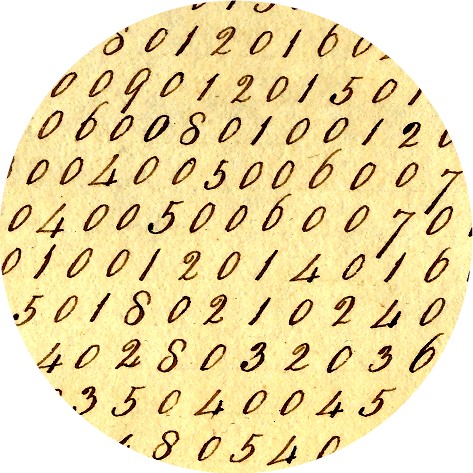
    I found this fabulous example of multiplication in a student’s workbook, written out in 1814.  Undoubtedly the sub-title, “the end of Simple Multiplication” was not intended to imply the literal end of multiplication (though the thought does invoke some interesting bits of fiction), just the result. It is simply a gorgeous object.

    Mar 22 end of multipiplication


  • Alpha and Omega Department, #3

    JF Ptak Science Books LLC

    Sometimes the beginnings and ends of things show up in unexpected places.  Penzias and Wilson at Bell Labs in Holmdel, New Jersey, discovered that the reason for the “interference” readings  that they were receiving in their instrument was not due to pigeon poop, but was actually the remnant radiation of the Big Bang.  And it didn’t look like much, but the stuff that caused the end of the great American Western frontier was found in simple lines:  ribbons of steel for the railroads, on the one hand; and twisted bits of sharp metal wrapped around wire, the barbed wire fence ultimately and very cheaply closing off the vast land into manageable parcels, on the other. Stories like these are legion.

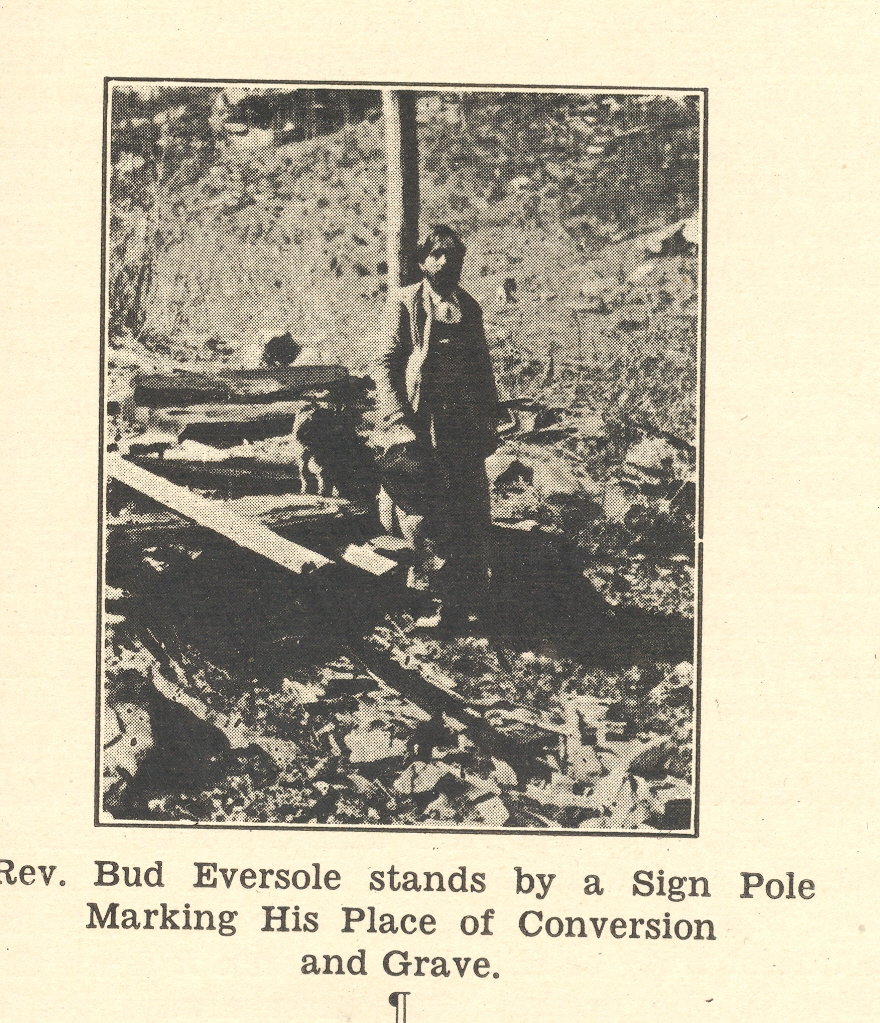
    It is infrequent to find the two combined though in a simple, single photograph.  This is the case, for me, in this small (1-inch tall) image found in an obscure publication called The Kentucky Mountain Echo, a True story of the Mountains, published in 1929.  The small, delicate pamphlet seemed the physical opposite of the stories that it told, rocky and rough bits of life from the Kentucky mountains, hardscrabble farms, luscious woods and company coal mining towns.  

    The Rev. Bud Eversole is pictured here–along with his dog–at the spot in his farm in which he was taken by the guiding light, the holy spirit; an invincible vision took hold of him and never let go.   Rev. Eversole continued to work his farm and taught the scriptures for free for many years afterwords as a roving minister.   He marked the spot of his conversion with a pole; he also determined that the pole would mark his grave, the ultimate place of rest for him at the very spot where he was “born”. 

    For all that it symbolizes, the image looks pervasively  unsettled to me–Rev. Eversole (I have no idea if that was his real name or if it was a post-conversion creation) looks like he is waiting for something, anything, even for the late afternoon sun to just hurry up and warm his back.  This area of his farm just looks a mess, not like a small farm kept between and along rolling hills (no treat, that). The Rev. doesn’t tell me much, except that he was obliged to allow his dog in the photo, and took off his broad-brimmed hat to have his picture made.  Perhaps that is all that he wanted to say.

    Ebay mar 18 grave 

    Ebay mar 18 grave2


  • War of Nicknames: 19th Century Criminals vs. Modern Mobsters vs. mid-Century Baseball vs. Mathematicians & Physicists

    JF Ptak Science Books LLC  Post 979

    [See my earlier post on the change in 19th century Western literary figure nicknames]

    Inspector
    Thomas Byrnes published a remarkable mug book and history of criminality in his
    1886 Professional Criminals of America.  It is remarkable how often the hundreds of
    people detailed in this book went on to long, vast, storied and a well-traveled
    careers, stopping here and there for a few years in Sing Sing or Dannemora,
    before moving on to riper pickings in other cities.  But what I’ve focused on in this book,
    unfortunately or not, are the categories of crimes and the nicknames of the
    criminals, many of which strike me as prosaic.

    [The interesting image below shows the only criminal in their sick/death bed,a accompanied by two rather ordinary guys who–uncommonly–are not looking down.]

    The nicknames include such lovelies as Big Rice, Mollie Matches, Doctor Dick, Hoggie, Fairy, Blink, Nibbs, Funeral, Deafy, Milkman, Poodle, Daigo, Shang, Bugs, Shone, Bad Boy and Tit.  The women ha dfar fewer nicknames, the three of the best of that limited selection being Mother Hubbard, Black Lena, Big Bertha and Kid Glove Rosey.

    Their classifications of crime included boarding house thief, swindler, pennyweight, confidential operator, bogus custom house collector, sawdust gamer, scarper, river thief, tip lifter, window smash, skingamer, and butcher cart thief. (At some point I’ll need to write a little something about the originator of the “Butcher Cart Thief”, Big Frank McCoy.  Big Frank didn’t steal butcher carts–he would make his daring escape after robbing bank in a passing butcher cart.  He’d rob the bank and spring onto the back of a cart to make his getaway.  I think that this tells us that in NYC, for example, in 1882, there were so many of these carts in the streets that a person could actually get lost in a sea of the things…perhaps like hiding in a cab nowadays. Quite a little peep into a time long passed.)

    But
    in the annals of nicknames these are not my choices for the most colorful, or
    descriptive.  Leaving out all other categories
    (political, religious, musical, military will just have to wait for a more
    rainy day) of nicknames except for mobsters (as in “The Mob”), professional
    American baseball and physicist/mathematicians

    [And from the female end of the book:]

    Baseball
    has provided ceaseless though a little limited entertainment, tending sometimes
    toward the poetic overstatement (the Chairman of the Board, The Mighty Slider,
    The Great Significance) though it does get down to business in the ‘40’s and
    ‘50’s (the golden age of BB nicknames). 
    Here are a few examples, minus the racist stuff:  Pork Chop, Tater, Gummy, Whale, Pickles,
    Rawmeat, Spud, Bunny, Beast, Kitten, Possum, Slug, The Rat, Pudge, Tomato Face,
    Buttercup. (The most effective nicknames could’ve been made by combining two of the single names:  “Spud Rawmeat”, “Pudge Slug” or “Gummy Buttercup”, for example.)  There’s an awful lot of them
    dealing with food, and a whole heck of  a
    lot dealing with facial features; they all seem to outweigh ball playing
    ability, by far.

    So
    far as I can tell there are no good nicknames for physicists and
    mathematicians, except for the ones that I’ll make up right now.  Richard (“You Talkin’ to ME?) Feynman, Albert
    (“Lady Boy” and “Big Soft”) Einstein, Paul (“Deep Face”) Dirac, Enrst (“’Stache Boy”) Mach, John
    (“The Big Finger”) Nash,  Ernest  (“The Bone”) Rutherford, Erwin (“Slitty” or
    “Tabs”) Schroedinger,  Isaac (“Sparkles”)
    Newton, Kurt (“Bad Water”) Goedel, Norbert (“Double Fisty”) Wiener,  John (“Johnny the Push” or “Other God” or
    “Sweet Suits”) von Neumann are all possibly pretty if not irreverent.  They also don’t come close to the overall
    winners in this restricted category of nickname appreciation, modern mobsters.

    No
    one, I think quite comes to grip with nicknames as does The Mob; there’s a
    certain joie de morte there that escapes other groups, possibly because of its
    terminating, enforcing qualities and expectations. 

    Pete the Killer, Frankie Shots, Jimmy the Monk, Louie
    Two Gun, Tommy Scar, Louie Ha Ha, Joey the Animal, Teets, Richie the Boot, Joey
    the Push, Nags, Fifi, Joe Bananas, Baldy Dom, Frankie the Bug, Big Nose Sam,
    Butterass, Chicken Sticks, No Nose, Louie the Mooch, Joey Spoons, One-Ear
    Frankie, Punchy, Richie Phone, Beany the Squint, the Blind Pig, Joey Beans, and
    of course Jimmy the Sniff.  And a host of
    Big ____, Little_____, Crazy _____, Fat ______ whatever. 

    I think that The Mob takes this contest, fair and square.

    (For the record, the entire text by Byrnes is located here; also, I have the original 1886 edition and a 1969 reprint available for purchase should the spirit move anybody.)


  • Image Archaeology–Images within Images Department, 1934

    JF Ptak Science Books LLC  Post 978


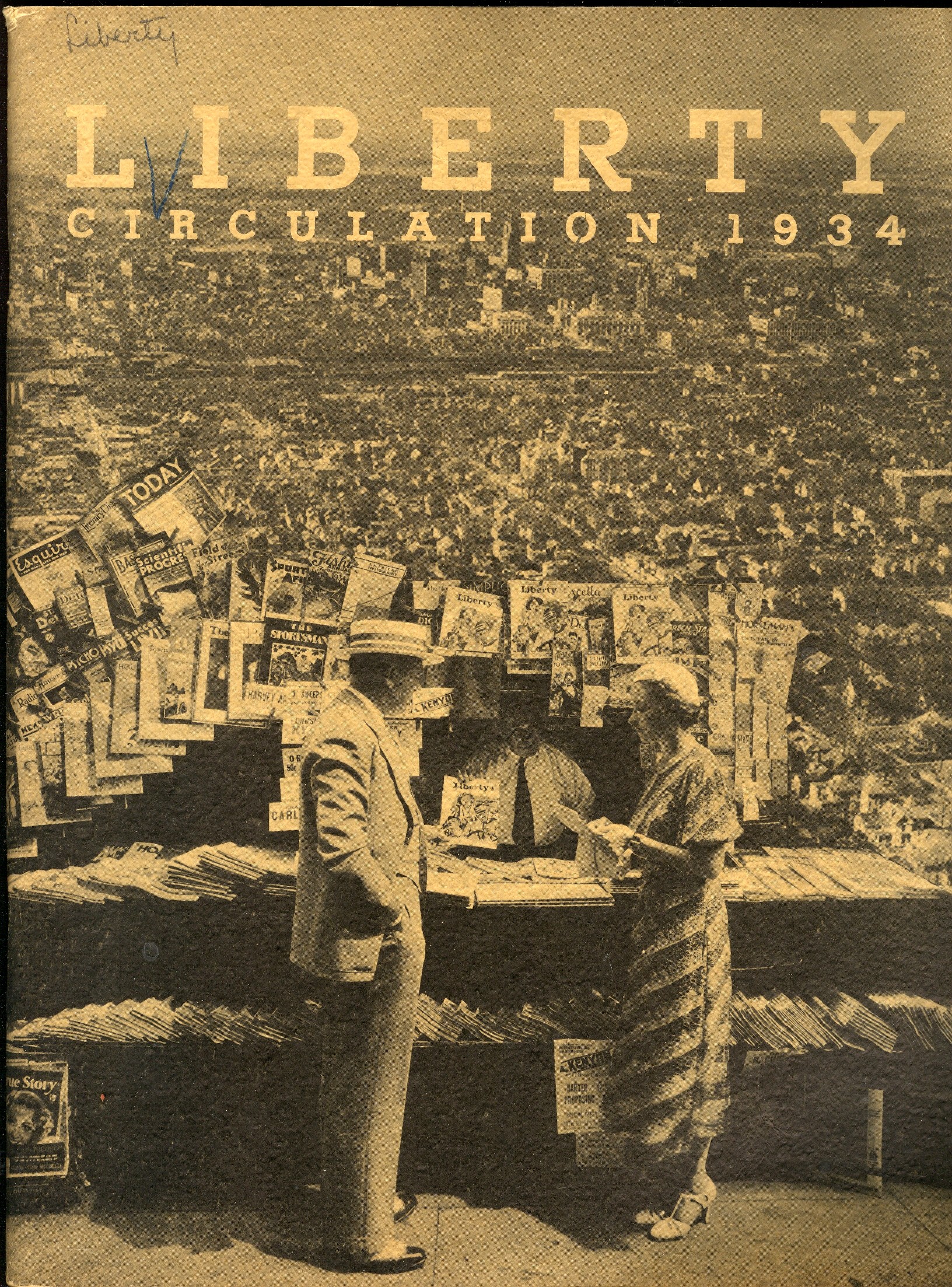
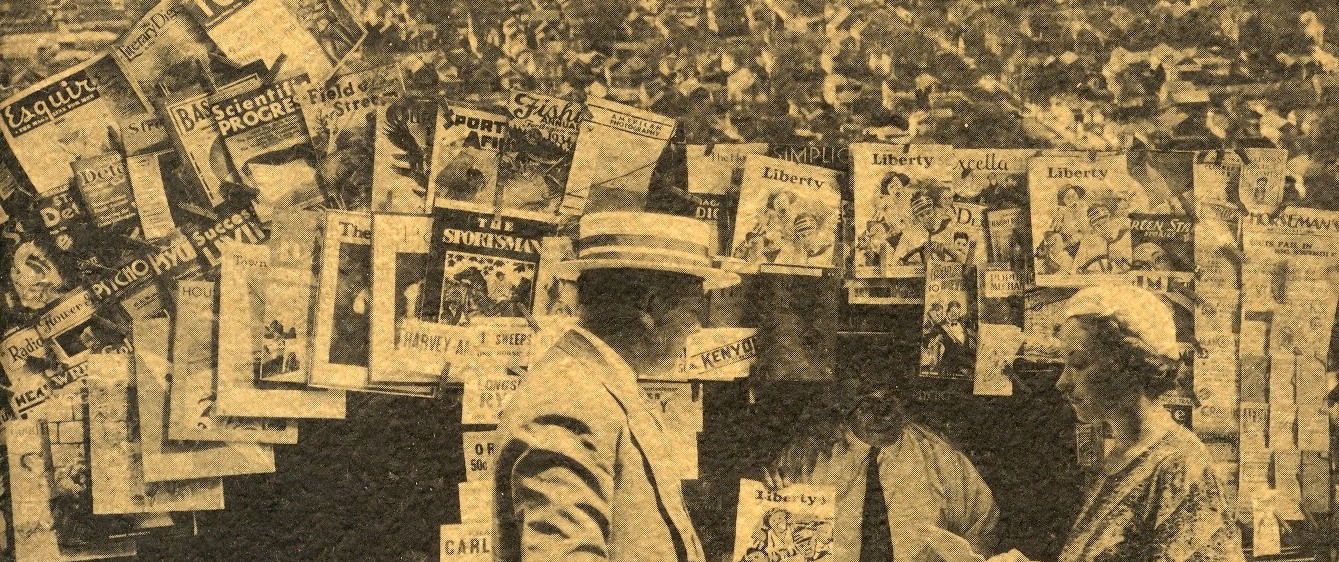
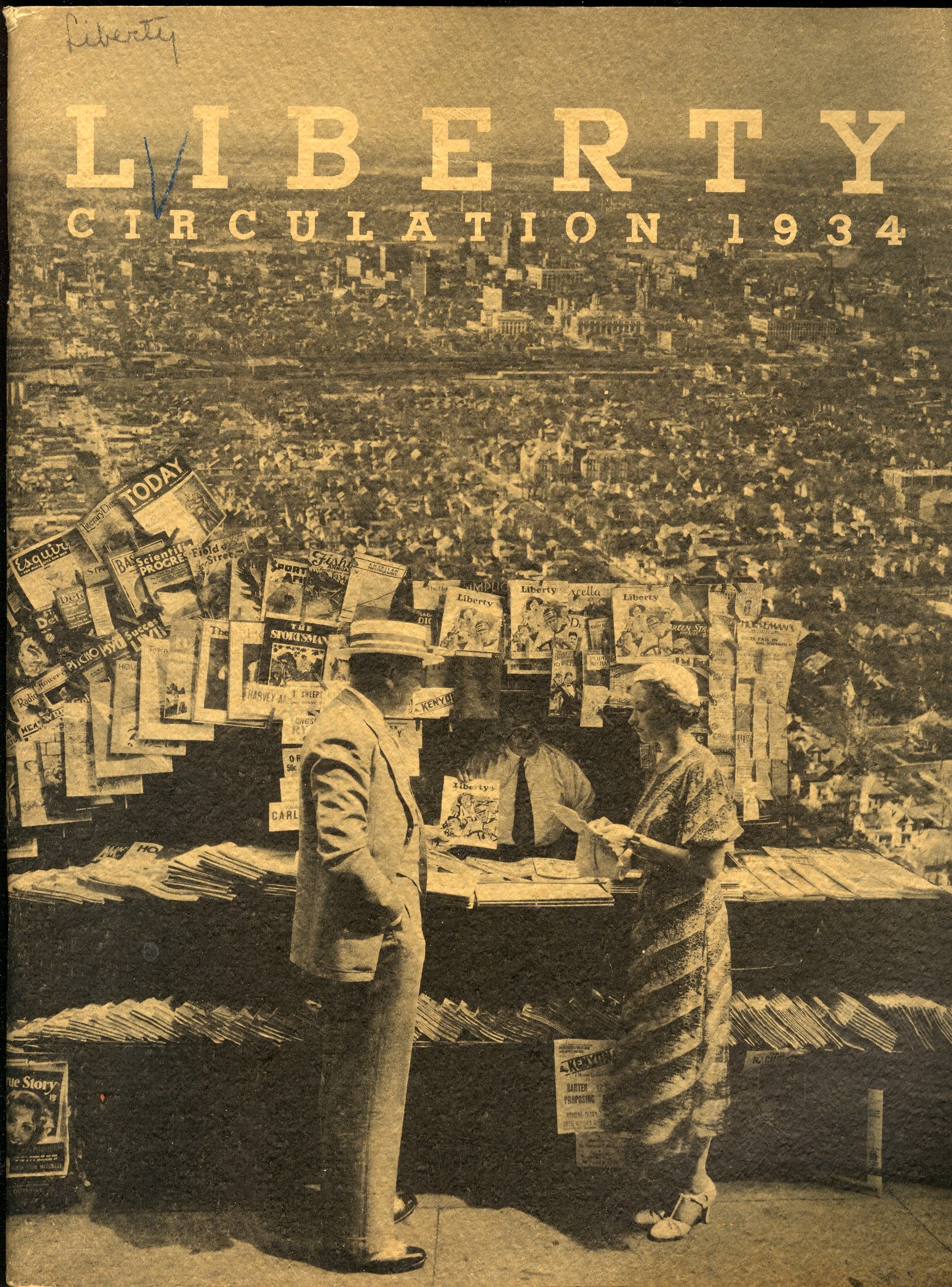
    Ebay mar 15 LIBERYbig eye

    This
    short post comes in the can’t-judge-a-book-by-its-cover category, as the cover
    is absolutely the  most interesting component of this publication.  Unless of course you’re interested in knowing
    how many paid subscribers Liberty had in Asheville, North
    Carolina
    in 1934. 
    Or Salida, Colorado.

    Ebay mar 15 LIBERY

    Ebay mar 15 LIBERYman2

    That’s all there is to the innards of this pamphlet: circulation numbers
    for a prancing, popular magazine.  This
    would’ve been of great concern to the folks trying to sell and distribute Liberty, showing
    potential customers how far and wide the magazine was read. (And evidently it
    was very popular:  with a circulation per
    issue of about 2.2 million, it was the sixth most popularly-read magazine in
    the country, following Collier’s, McCall’s,
    Ladies Home Journal
    and The Saturday
    Evening Post
    , all of which had circulations between 2.3 and 2.9 million, so
    Liberty was not far off from being
    one of the most widely-circulated magazines in the country. It actually rose to
    the number two spot for a little while during the war.) 

    Ebay mar 15 LIBERYman
     
    This
    is not to say that the magazine itself was a bore, what with writers like P. G.
    Wodehouse,  Robert Benchley,  Edgar Rice Burroughs, Robert W. Chambers, F.
    Scott Fitzgerald, Murray Leinster,  Sax
    Rohmer and others making contributions here and there. 

    An
    odd bit about Liberty—they “timed” their articles.  The reader was told about how long, on average,
    it would take to read each piece, taking about three hours to read the entire
    issue.  That’s something I’ve never seen
    before. 

    So
    the contents turned out to be a bit of a bore—the cover, on the other hand, is just
    lovely, a beautiful and seamless piece of photo montage with some interesting
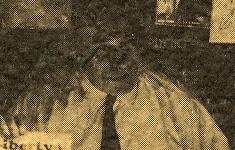
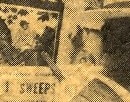
    semi-hidden images. I quite like the image of the white-shirt-tie magazine stand purveyor that emerges from the shadows (above). And also the face that emerges from underneath the rear brim of the boater on the fellow standing in front of the stand.

    Ebay mar 15 LIBERYface hat 

    This is just a lovely example of what ephemeral play one can draw from an unexpected source.

    Ebay mar 15 LIBERYbig eye


  • Popular Culture Imagery–16th Century Street People (Fools, Musicians and Pregnant Women and more)

    JF Ptak Science Books LLC Post 970

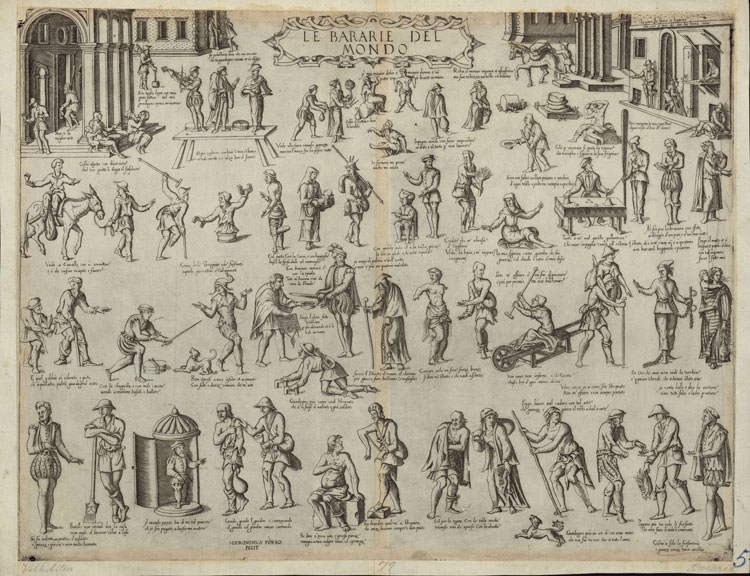
    Le
    barbarie del
    mondo,
    by Hieronymous Porro (fl
    1574-1604), depicts Italian street
    people collected under the unkind general heading of  “barbarism of the world”. I misread the description of the actions of the people in the print
    (found at the University
    of Texas
    website below) as “Making
    a living doing unnecessary tasks of nothing”—a harsh appraisal of the efforts
    of people who have nothing trying to make a little bit of change for bread, though it does describe the general sentiment of the print, wrong or not. Though the
    written descriptions are slightly kinder than this, the depictions of the social
    unfortunates was certainly not. 

    Mar 10 porro

    The people described in this image–the collection of unfortunates,a veritable museum of social “outcasts”–include fools, street laborers, merchants, the disabled, prostitutes, destitute women (with children), musicians, street performers, flagellants, religious zealots, and general beggars, not to mention what must’ve been alley dwellers, street-sleepers and the homeless.

    Not too much different from today. What makes this image remarkable to me is that it makes these generally invisible people visible, gathered together in one image.  Generally these people would be used occasionally as found objects, tertiary depictions in larger, grander artworks showing grand structures or town views, the people used to show scale, and the artist taking some small liberty by employing street people as the scale units rather than landed strollers. (See here for an example.) Holbein, de Hooghe, Bruegel–masters of the large gathering and crowds, did not attempt a solitary image to the underclasses’ underclass.

    [Source:  Harry Ransom Humanities Research Center, University of Texas, Austin.]